VI. LIFE ON THE PRESS. 1866-1869.
Reading edition
I become managing editor of John W. Forney’s Press—Warwick the King-maker—The dead duck—A trip to Kansas in the old buffalo days—Miss Susan Blow, of St. Louis—The Iron Mountain of Missouri—A strange dream—Rattlesnakes—Kaw Indians—I am adopted into the tribe—Grand war-dance and ceremonies—Open-air lodgings—Prairie fires—In a dangerous country—Indian victims—H. M. Stanley—Lieutenant Hesselberger—I shoot a buffalo—Wild riding—In a herd—Indian white men—Ringing for the carriage with a rifle—Brigham the driver—General and Mrs. Custer—Three thousand miles in a railway car—How “Hans Breitmann’s” ballads came to be published—The publisher thinks that he cannot sell more than a thousand of the book—I establish a weekly newspaper—Great success—Election rioting—Oratory and revolvers—How the meek and lowly Republicans revolvered the Democrats—The dead duck and what befell him who bore it—I make two thousand German votes by giving Forney a lesson in their language—Freiheit und Gleichheit—The Winnebago Indian chief—Horace Greeley—Maretzek the Bohemian—Fanny Janauschek and the Czech language—A narrow escape from death on the Switchback—Death of my father—Another Western railway excursion—A quaint old darkey—Chicago—I threaten to raise the rent—General influence of Chicago—St. Paul, Minnesota—A seven days’ journey through the wilderness—The Canadian—Smudges—Indians—A foot journey through the woods—Indian pack-bearers—Mayor Stewart—I rifle a grave of silver ornaments—Isle Royale—My brother, Henry Perry Leland—The press—John Forney carries Grant’s election, and declares that I really did the work—The weekly press and George Francis Train—Grant’s appointments—My sixth introduction to the General—Garibaldi’s dagger.
We had not lived at Mrs. Sandgren’s more than a week when George Boker, knowing my need, spoke to Colonel John Forney, who was at that time not only Secretary of the Senate of the United States, but the proprietor of the Chronicle newspaper in Washington, of the Press in Philadelphia, “both daily,” as the Colonel once said, which very simple and commonplace expression became a popular by-word. Colonel Forney wanted a managing editor for the Press, and, as I found in due time, not so much a man of enterprise and a leader—that he supplied—nor yet one to practically run the journal—that his son John, a young man of eighteen, supplied—so much as a steady, trustworthy, honest pivot on which the compass could turn during his absences—and that I supplied. I must, to explain the situation, add gently that John, who could not help it considering his experiences, was, to put it mildly, a little irregular, rendering a steady manager absolutely necessary. It was a great pity, for John the junior was extremely clever as a practical managing editor, remembering everything, and knowing—what I never did or could—all the little tricks, games, and wiles of all the reporters and others employed.
Colonel Forney was such a remarkable character, and had such a great influence for many years in American politics, that as I had a great deal to do with him—very much more than was generally known—at a time when he struck his greatest political coup, in which, as he said, I greatly aided him, I will here dwell on him a space. Before I knew him I called him Warwick the King-maker, for it was generally admitted that it was to his intense hatred of Buchanan, added to his speech-making, editing, and tremendously vigorous and not always over-scrupulous intriguing, that “Ten-cent Jimmy” owed his defeat. At this time, in all presidential elections, Pennsylvania turned the scale, and John Forney could and did turn Pennsylvania like a Titan; and he frankly admitted that he owed the success of his last turn to me, as I shall in time relate.
Forney’s antipathies were always remarkably well placed. He hated Buchanan; also, for certain personal reasons, he hated Simon Cameron; and finally it came to pass that he hated Andrew Johnson with a hatred of twenty-four carats—an aquafortis detestation—and for a most singular cause.
One night when this “President by the pistol, and smallest potato in the American garden of liberty,” was making one of his ribald speeches, after having laid out Horace Greeley, some one in the crowd cried—
“Now give us John Forney!”
With an air of infinite contempt the President exclaimed—
“I don’t waste my powder on dead ducks.”
He had better have left that word unsaid, for it ruined him. It woke Colonel John Forney up to the very highest pitch of his fighting “Injun,” or, as they say in Pennsylvania, his “Dutch.” He had always been to that hour a genial man, like most politicians, a little too much given to the social glass. But from that date of the dead duck he became “total abstinence,” and concentrated all his faculties and found all his excitement in vengeance hot and strong, without a grain of sugar. In which I gladly sympathised and aided, for I detested Johnson as a renegade Copperhead, or rather venomous toad to the South, who wished with all his soul to undo Lincoln’s work and bring in the Confederacy. And I believe, on my life and soul, that if John Forney had not defeated him, we should have had such disasters as are now inconceivable, the least of them being a renewal of the war. Johnson had renegaded from the Confederacy because, being only a tailor, he had ranked as a “low white,” or something despised even by “quality” negroes. The Southern aristocracy humbugged him by promising that if he would betray the Union he should be regarded as one of themselves, by which very shallow cheat he was—as a snob would be—easily caught, and in due time cast off.
I had been but a few weeks on the Press, and all was going on well, when one morning the Colonel abruptly asked me if I could start in the morning for Fort Riley, of which all I knew was that it constituted an extreme frontier station in Kansas. There was to be a Kansas Pacific railway laid out, and a large party of railroad men intended to go as far as the last surveyor’s camp. Of course, a few editors had been invited to write up the road, and these in turn sent some one in their place. I knew at once that I should have something like the last year’s wild life over again, and I was delighted. I borrowed John Forney’s revolver, provided an agate-point and “manifold paper” for duplicate letters to our “two papers, both daily,” and at the appointed hour was at the railway station. There had been provided for us the director’s car, a very large and extremely comfortable vehicle, with abundance of velvet “settees” or divan sofas, with an immense stock of lobster-salad, cold croquettes, game, with “wines of every fineness,” and excellent waiters. The excursion, indeed, cost £1,000; but it was made to pay, and that to great profit.
We were all a very genial, congenial party of easy-going geniuses. There was Hassard, the “day editor” of the New York Tribune, who had been with me on the Cyclopædia, and to whom I was much attached, for he was a gentlemanly scholar, and withal had seen enough of life on the Tribune to hold his own with any man; and Captain William Colton, who had been with me in Tennessee; Robert Lamborn, who had studied science in Germany, and was now a railroad man, and many more who are recorded in my pamphlet, “Three Thousand Miles in a Railway Car,” and my old associate, Caspar Souder, of the Bulletin. This excursion was destined, in connection with this pamphlet, to have a marvellous effect on my future life.
In every town where we paused—and our pauses were frequent, as we travelled very much on the “go-as-you-please” plan—we were received by the authorities with honour and speeches and invited to dinners or drinks. Our conductors were courtesy itself. One afternoon one of them on a rough bit of road said, “Gentlemen, whenever you wish to open a bottle of champagne, please to pull the cord and stop the train. You can then drink without spilling your wine.”
So we went to Chicago and St. Louis, where we were entertained by Mr. Blow, and where I became acquainted with his daughter Susan. She was then a beautiful blonde, and, as I soon found, very intelligent and cultured. She was long years afterwards busy in founding philanthropic schools in St. Petersburg, Russia, when I was there—a singularly noble woman. However, at this time neither of us dreamed of the school-keeping which we were to experience in later years. At this soirée, and indeed for the excursion the next day, we had as a guest Mr. Walter, of the London Times.
The next day we had a special train and an excursion of ladies and gentlemen to visit the marvellous Knob or Iron Mountain. This is an immense conical hill with a deep surrounding dale, beyond which rise other hills all of nearly solid iron. Returning that evening in the train, a very strange event took place. There was with us a genial, pleasant, larky young fellow, one of the famous family of the MacCooks. When the war came on he was at college—went into the army, fought hard—rose to be captain, and then after the peace went back to the college and finished his studies. This was the “event.” We were telling stories of dreams; when it came to my turn I said:—
“In 1860 I had never been in Ohio, nor did I know anything about it. One night—it was at Reading, Pennsylvania—I fell asleep, I dreamed that I woke up, rose from the bed, went to the match-box, struck a light, and while it burned observed the room, which was just the same as when I had retired. The match went out. I lit another, when what was my amazement to observe that everything in the room had changed its colour to a rich brown! Looking about me, I saw on a kind of étagère scores of half-burned candles in candlesticks, as if there had been a ball. I lighted nearly all of them. Hearing a sound as of sweeping and the knocking of a broom-handle without, I went into the next room, which was the hall where the dance had been held. A very stupid fellow was sweeping it out. I asked him where I was. He could not reply intelligently. There came into the hall a bustling, pleasant woman, rather small, who I saw at a glance was the housekeeper. She said something to the man as to the room’s being dark. I remarked that there was light enough in my room, for I had lit all the candles. She cried, laughing, ‘What extravagance!’ I answered, ‘My dear little woman, what does a candle or two signify to you? Now please tell me where I am. Last night I went to sleep in Reading, Pennsylvania. Where am I now?’ She replied (and of this word I was not sure), ‘In Columbus, Ohio.’ I asked if there was any prominent man in the place who was acquainted with Philadelphia, and who might aid me to return. She reflected, and said that Judge Duer and his two daughters (of whom I had never heard) had just returned from the East.”
Here MacCook interrupted me eagerly: “You were not in Columbus, but in Dayton, Ohio. And it was not Judge Duer, but Judge Duey, with his two daughters, who was that summer in the East.” I went on:—
“I left the room and went into the hall. I came to the front door. Far down below me I saw a winding river and a steamboat.”
Here MacCook spoke again: “That was surely Dayton. I know the house and the view. But it could not have been Columbus.” I went on:—
“I went downstairs too far by mistake into the cellar. There I found a man sawing wood. I went up again. [Pray observe that a year after, when I went West, this very incident occurred one morning in Cincinnati, Ohio.] I found in the bar-room three respectable-looking men. I told them my story. One said to the others, ‘He is always the same old fellow!’ I stared at him in amazement. He held out one hand and moved the other as if fiddling. Monotonous creaking sounds followed, and I gradually awoke. The same sounds continued, but they were caused by the grasshoppers and tree-toads, who pipe monotonously all night long in America.”
Nothing ever came of the dream, but it all occurred exactly as I describe it. I have had several quite as strange. Immediately after I had finished my narration, some one, alluding to our party, asked if there was any one present who could sing “Hans Breitmann’s Barty,” and I astonished them not a little by proclaiming that I was the author, and by singing it.
We went on to Leavenworth, where we had a dinner at the hotel which was worthy of Paris. We had, for example, prairie pullets or half-grown grouse, wild turkeys and tender venison. Thence to Fort Riley, and so on in waggons to the last surveyor’s camp. I forget where it was on the route that we stopped over-night at a fort, where I found some old friends and made new ones. A young officer—Lieutenant Brown, I think—gave me a bed in his cabin. His ceiling was made of canvas. For weeks he had heard a great rattlesnake moving about on it. One day he had made a hole in the ceiling and put into it a great fierce tom-cat. The cat “went for” the snake and there was an awful row. After a time the cat came out looking like a devil with every hair on end, made straight for the prairie, and was never heard of again. Neither was the snake. They had finished one another. On another occasion, when sitting in a similar cabin, my gentle hostess, an officer’s wife, whom I had known a few years before as a beauty in society, remarked that she had two large rattlesnakes in her ceiling, and that if we would be silent we might hear them crawling about. They could not be taken out without rebuilding the roof.
Captain Colton had just recovered from a very bad attack of fever and ague, and, being young, had the enormous appetite which follows weeks of quinine. I saw him this day eat a full meal of beefsteaks, and then immediately after devour another, at Brown’s, of buffalo-meat. The air of the Plains causes incredible hunger. We all played a good knife and fork.
About twilight-tide there came in a very gentlemanly Catholic priest. I was told that he was a roving missionary. He led a charmed life, for he went to visit the wildest tribes, and was everywhere respected. I conversed with him in French. After a while he spread his blanket, lay down on the floor and slept till morning, when he read his prayers and departed.
The next day the fort square was full of Kaw Indians, all in savage array, about to depart for their autumnal buffalo-hunt. I met one venerable heathen with his wife and babe, with whom I made genial acquaintance. I asked the wife the name for a whip; she replied B’meergashee; a pony was shoonga, the nose hin, and a woman shimmy-shindy! I bought his whip for a dollar. The squaw generously offered to throw in the baby, which I declined, and we all laughed and parted.
I went to the camp, and there the whole party, seeing my curious whip, went at the Kaws to buy theirs. Bank-bills were our only currency then, and the Indians knew there were such things as counterfeits. They consulted together, eyed us carefully, and then every man as he received his dollar brought it to me for approval. By chance I knew the Pawnee word for “good” (Washitaw), and they also knew it. Then came a strange wild scene. I spoke to the chief, and pointing to my whip said, “B’meergashee” and indicating a woman and a pony, repeated, “Shimmy-shindy, shoonga-hin,” intimating that its use was to chastise women and ponies by hitting them on the nose. Great was the amazement and delight of the Kaws, who roared with laughter, and their chief curiously inquired, “You Kaw?” To which I replied, “O, nitchee, me Kaw, washitá good Injun me.” He at once embraced me with frantic joy, as did the others, to the great amazement of my friends. A wild circular dance was at once improvised to celebrate my reception into the tribe; at which our driver Brigham dryly remarked that he didn’t wonder they were glad to get me, for I was the first Injun ever seen in that tribe with a whole shirt on him. This was the order of proceedings:—I stood in the centre and sang wildly the following song, which was a great favourite with our party, and all joining in the chorus:—
I slew the chief of the Muscolgee; I burnt his squaw at the blasted tree! By the hind-legs I tied up the cur, He had no time to fondle on her.
Chorus.
Hoo! hoo! hoo! the Muscolgee! Wah, wah, wah! the blasted tree!
A faggot from the blasted tree Fired the lodge of the Muscolgee; His sinews served to string my bow When bent to lay his brethren low.
Chorus.
Hoo! hoo! hoo! the Muscolgee! Wah, wah, wah! the blasted tree!
I stripped his skull all naked and bare, And here’s his skull with a tuft of hair! His heart is in the eagle’s maw, His bloody bones the wolf doth gnaw.
Chorus.
Hoo! hoo! hoo! the Muscolgee! Wah, wah, wah! the blasted tree!
The Indians yelled and drummed at the Reception Dance. “Now you good Kaw—Good Injun you be—all same me,” said the chief. Hassard and Lamborn cracked time with their whips, and, in short, we made a grand circular row; truly it was a wondrous striking scene! From that day I was called the Kaw chief, even by Hassard in his letters to the Tribune, in which he mentioned that in scenes of excitement I rode and whooped like a savage. It may be so—I never noticed it; perhaps he exaggerated, but I must admit that I do like Indians, and they like me. We took ambulances or strong covered army-waggons and pushed on. We were now well out on the plains. All day long we passed prairie-dog villages and saw antelopes bounding afar. At night we stopped at the hotel Alla Fresca, or slept in the open air. It was perfectly delightful, though in November. Far in the distance many prairie fires stretched like miles of blazing serpents over the distance. I thought of the innumerable camp-fires before the battle of Gettysburg, and determined that the two were among the most wonderful sights of my life. We rose very early in the morning, by grey light, and after a drink of whisky pushed on. I may here mention that from 1863 for six years I very rarely indeed tasted any intoxicant.
So we went on till we reached the last surveyor’s camp. We had not been there half an hour before a man came in declaring that he had just saved his scalp, having seen a party of Apaches in their war-paint, but luckily hid himself before they discovered him. It was evident that we had now got beyond civilisation. Already, on the way, we had seen ranches which had been recently burned by the Indians, who had killed their inmates. One man, observing my Kaw whip, casually remarked that as I was fond of curiosities he was sorry that he had not kept six arrows which he had lately pulled out of a man whom he had found lying dead in the road, and who had just been shot by the Indians.
Within this same hour after our arrival there came in a Lieutenant Hesselberger, bringing with him a Mrs. Box and her two daughters, one about sixteen and the other twelve. The Indians had on the Texas frontier murdered and scalped her husband before her eyes, burned their home, and carried the three into captivity, where for six months they were daily subjected to such incredible outrages and cruelty that it was simply a miracle that they survived. As it was, they looked exactly like corpses. Lieutenant Hesselberger, with bravery beyond belief, having heard of these captives, went alone to the Indians to ransom them. Firstly, they fired guns unexpectedly close to his head, and finding that he did not start, brought out the captives and subjected them to the extremes of gross abuse before his eyes, and repeatedly knocked them down with clubs, all of which he affected to disregard. At last the price was agreed on and he took them away.
In after years, when I described all this in London to Stanley, the African explorer, he said, “Strange! I, too, was there that very day, and saw those women, and wrote an account of it to the New York Herald.” I daresay that I met and talked to him at the time among those whom we saw.
Not far from our camp there was a large and well-populated beaver-dam, which I studied with great interest. It was more like a well regulated town than is many a western mining village. I do not wonder that Indians regard Quahbeet, the beaver, as a human being in disguise. N.B.—The beaver always, when he cuts a stick, sharpens it like a lead-pencil—which indicates an artistic nature.
It was now resolved that a number of our party should go into the Smoky Hill country to attend a very great Indian council, while the rest returned home. So I joined the adventurers. The meeting was not held, for I believe the Indians went to war. But we rode on. One morning I saw afar a few black specks, and thought they were cattle. And so they were, but the free cattle of the plains, or buffaloes. That evening, as we were out of meat, Colton and others went out to hunt them, and had a fine chase, but got nothing.
The next morning Colton kindly gave me his chance—that is, he resigned to me a splendid black horse used to the business—and most of us went to the field. After a while, or a four miles’ run, we came up with a number. There was a fine cow singled out and shot at, and I succeeded in putting a ball in just behind the shoulder. Among us all she became beef, and an expert hunter with us, whose business it was to supply the camp with meat, skinned and butchered her and cooked a meal for us on the spot. The beef was deliciously tender and well flavoured.
Now, before this cooking, in the excitement of the chase, I had ridden on like an Indian, as Hassard said in his letter, whooping like one all alone after the buffalo, and in my joy forgot to shake the spent cartridge out of my Spenser seven-shooter carbine. All at once I found myself right in the herd, close by a monstrous bull, whose height at the instant when he turned on me to gore me seemed to be about a hundred and fifty feet. But my horse was used to this, and swerved with incredible tact and swiftness, while I held on. I then had a perfectly close shot, not six feet off, under the shoulder, and I raised the carbine and pulled trigger, when it—ticked! I had forgotten the dead cartridge, and was not used to the arm which I carried. I think that I swore, and if I did not I am sorry for it. Before I could arrange my charge the buffaloes were far away.
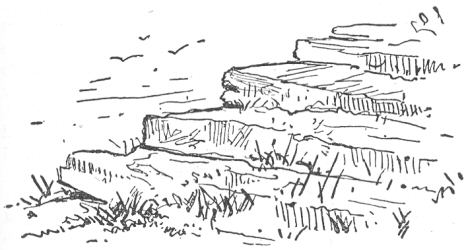
However, we had got our cow, and that was more than we really needed. At any rate, I had shot a buffalo and had a stupendous run. And here I must mention that while racing and whooping, I executed the most insanely foolish thing I ever did in all my life, which astonished the hunter and all present to the utmost. I was at the top of a declivity from which there descended a flight of natural stairs of rock, but every one very broad, like the above sketch.
And being inspired by the devil, and my horse not objecting at all, I clattered down over it at full speed à la Putnam. I have heard that Indians do this very boldly, declaring that it is perfectly safe if the rider is not afraid, and I am quite sure that mine must have been an Indian horse. I hope that no one will think that I have put forward or made too much of these trifling boyish tricks of recklessness. They are of daily occurrence in the Wild West among men who like excitement, and had Robert Hunt been among us there would have been fun indeed.
So we turned homewards, for the Indian Conference had proved a failure. We had for our driver a man named Brigham, to whom I had taken a great liking. He had lived as a trader among the wildest Indians, spoke Spanish fluently, and knew the whole Western frontier like his pocket. The day after we had seen Mrs. Box come in, I was praising the braveness of Lieutenant Hesselberger in venturing to rescue her.
“It isn’t all bravery at all,” said Brigham. “He’s brave as a panther, but there’s more in it than that. There is about one man in a hundred, and not more, who can go among the most God-forsaken devils of Injuns and never get hurt. The Injuns take to them at a glance and love ’em. I’m such a man, and I’ve proved it often enough, God knows! Lieutenant Hesselberger is one, and,” he added abruptly, “Mr. Leland, you’re another.”
“What makes you think so?” I said, greatly surprised.
“’Cause I’ve watched you. You’ve got Injun ways that you don’t know of. Didn’t I notice the other day, when the gentlemen were buying the whips from the Kaws, that every Injun took a squint, and then came straight to you? Why didn’t they go to one of the other gentlemen? Because they’ve got an instinct like a dog for their friends, and for such as we.”
We were coming to Fort Harker. I forget how it all came about, but we found ourselves afoot, with a mile or two to walk, carrying our guns, carpet-bags, and petites bagages, while about fifty yards ahead or more there was Brigham driving on merrily to the fort, under the impression that we had secured other conveyance.
Captain Colton fired his carbine. It made about as much noise as a percussion-cap, and the wind was from Brigham toward us. Carried away by an impulse, I caught Colonel Lamborn’s light rifle out of his hand.
“Great God!” he cried, “you don’t mean to shoot at him?”
“If you’ll insure the mules,” I said, “I will the driver.” My calculation was to send a bullet so near to Brigham that he could hear it whizz, but not to touch him. It was not so dangerous as the shot I had fired over Sam Fox, and the “spirit” was on me!
But I did not know that in the covered waggon sat Hassard talking with Brigham, their faces being, as Hassard declared, just about six inches apart. I fired, and the bullet passed just between their noses!
Hassard heard the whizz, and cried, “What’s that?”
“Injuns, by God!” roared Brigham, forgetting that we had left the Indian country two days behind us. “Lie down in the waggon while I drive.” And drive he did, till out of gunshot, and then putting his face out, turned around, and gave in full desperate cry the taunting war-whoop of the Cheyennes. It was a beautiful sight that of Brigham’s broad red face wild with rage—and his great gold earrings and Mexican sombrero—turning round the waggon at us in defiance like Marmion!
But when he realised that we had fired at him, just as a pack of d---d Apaches might have done, for fun, to stop the waggon, his expression became one of utter bewilderment. As I came up I thought there might be a shindy.
“Brigham,” I said in Spanish, “es la mano o el navajo?” [Is it to be hand, or knife?]
Brigham was proud of his Spanish; it was his elegant accomplishment, and this was a good scene. Grasping my hand cordially, he said, “La mano.” Like a true frontiersman, he felt in a minute the grandeur of the joke. There was, if I may so vulgarly express myself, an Indian-uity in it which appealed to his deepest feelings. There was a silence for several minutes, which he broke by exclaiming—
“I’ve driven waggons now this twelve years on the frontier, but I never heard before of tryin’ to stop the waggon by shootin’ at the driver.”
There was another long silent pause, when he resumed—
“I wish to God there was a gulch (ravine) between here and the fort! I’d upset this crowd into it d---d quick!”
That evening I took leave of Brigham. I drank healths with him in whisky, and shook hands, and said—
“I did a very foolish and reckless thing to-day, Brigham, when I shot at you, and I am sorry for it, and I beg your pardon. Here is a dagger which I have had for twenty-five years. I carried it all over Europe. I have nothing better to give you; please take it. And when you stick a Greaser (Mexican) with it, as I expect you will do some day, then think of me.”
The tears rose to his eyes, and he departed. I never met him again, but “well I wot” he ever had kindly remembrance of me. We were to be guests of General Custer at the fort, and I was rather shy of meeting the castellan after firing at his driver! But he greeted me with a hearty burst of laughter, and said—
“Mr. Leland, you have the most original way of ringing a bell when you want to call a carriage that I ever heard of.”
As for Hassard, when he witnessed my parting with Brigham, he said—
“This is all mighty fine! daggers and whisky, and all kinds of beautiful things flying around for Brigham, but what am I to have?”
“And what dost thou expect, son Hassard?” I replied.
Holding out both his hands, he replied—
“Much tobacco! much tobacco!”
This was in allusion to a story told us by Lieutenant Brown. Not long before, the Lieutenant, seeing, as he thought, a buffalo, had fired at it. But the buffalo turned out to be an Indian on a pony; and the Indian riding fiercely at the Lieutenant, cried aloud for indemnity or the “blood-fine” in the words, “Much tobacco!” And so I stood cigars.
Life is worth living for—or it would be—if it abounded more in such types as Mrs. General Custer and her husband. There was a bright and joyous chivalry in that man, and a noble refinement mingled with constant gaiety in the wife, such as I fear is passing from the earth. Her books have shown that she was a woman of true culture, and that she came by it easily, as he did, and that out of a little they could make more than most do from a life of mere study. I fear that there will come a time when such books as hers will be the only evidences that there were ever such people—so fearless, so familiar with every form of danger, privation, and trial, and yet joyous and even reckless of it all. Good Southern blood and Western experiences had made them free of petty troubles. The Indians got his scalp at last, and with him went one of the noblest men whom America ever brought forth. [333]
That evening they sent for a Bavarian-Tyroler soldier, who played beautifully on the cithern. As I listened to the Jodel-lieder airs I seemed to be again in his native land. It was a pleasure to me to hear from him the familiar dialect.
At St. Louis we were very kindly entertained in several distinguished houses. At one they gave us some excellent Rhine wine.
“What do you think of this?” said Hassard, who was a good Latinist.
I replied, “Vinum Rhenense decus et gloria mense.”
In the next we had Moselle wine. “And what of this?”
I answered, “Vinuin Moslanum fuit omne tempore sanum.”
And here I would say that every memory which I have of Missouri (and there are more by far than this book indicates), as of Missourians, is extremely pleasant. The State is very beautiful, and I have found among my friends there born such culture and kindness and genial hospitality as I have never seen surpassed. To the names of Mary A. Owen, [334] Blow, Mark Twain, and the Choteaus I could add many more.
So we jogged on homeward. I resumed my work. I had written out all the details of our trip in letters to the Press. They had excited attention. The Pennsylvania Railroad Company suggested that they should be published in a pamphlet. I did so, and called it “Three Thousand Miles in a Railroad Car.” They offered to pay me a very good sum for my trouble in so doing. I declined it, because I felt that I had been amply paid by the pleasure which I had derived from the journey. But I received grateful recognition subsequently in another form. The pamphlet was most singular of its kind. It was a full report of all the statistics and vast advantages of the Kansas Pacific Road. It contained very valuable facts and figures; and it was all served up with jokes, songs, buffalo-hunting, Indians, and Brigham. It was a marvellous farrago, and it “took.” It was sent to every member of Congress and “every other man.”
Before it appeared, a friend of mine named Ringwalt, who was both a literary man and owner of a printing-office, offered me $200 if I would secure him the printing of it. I said that I would not take the money, but that I would get him the printing, which I easily did; but being a very honourable man, he was led to discharge the obligation. One day he said to me, “Why don’t you publish your ‘Breitmann Ballads?’ Everybody is quoting them now.” I replied, “There is not a publisher in America who would accept them.” And I was quite right, for there was not. He answered, “I will print them for you.” I accepted the offer, but when they were set up an idea occurred to me by which I could save my friend his expenses. I went to a publisher named T. B. Peterson, who said effectively this—“The book will not sell more than a thousand copies. There will be about a thousand people who will buy it, even for fifty cents, so I shall charge that, though it would be, as books go, only as a twenty-five cent work.” He took it and paid my friend for the composition. I was not to receive any money or share in the profits till all the expenses had been paid.
Mr. Peterson immediately sold 2,000—4,000—I know not how many thousands—at fifty cents a copy. It was republished in Canada and Australia, to my loss. An American publisher who owned a magazine asked me, through his editor, to write for it a long Breitmann poem. I did so, making, however, an explicit verbal arrangement that it should not be republished as a book. It was, however, immediately republished as such, with a title to the effect that it was the “Breitmann Ballads.” I appealed to the editor, and it was withdrawn, but I know not how many were issued, to my loss.
I had transferred the whole right of publication in England to my friend Nicolas Trübner, whom I had met when he had visited America, and I wrote specially for his edition certain poems. John “Camden” Hotten wrote to me modestly asking me to give him the sole right to republish the work. He said, “I hardly know what to say about the price. Suppose we say ten pounds!” I replied, “Sir, I have given the whole right of publication to Mr. Trübner, and I would not take it from him for ten thousand pounds.” Hotten at once published an edition which was a curiosity of ignorance and folly. There was a blunder on an average to every page. He had annotated it! He explained that Knasterbart meant “a nasty fellow,” and that the French garce was gare, “a railway station!” Trübner had sold 5,000 copies before this precious affair appeared. After Hotten’s death the British public were informed in an obituary that he had “first introduced me” to their knowledge!
Hans Breitmann became a type. I never heard of but one German who ever reviled the book, and that was a Democratic editor in Philadelphia. But the Germans themselves recognised that the pen which poked fun at them was no poisoned stiletto. Whenever there was a grand German procession, Hans was in it—the indomitable old Degen hung with loot—and he appeared in every fancy ball. Nor were the Confederates offended. One of the most genial, searching, and erudite reviews of the work, which appeared in a Southern magazine (De Bow’s), declared that I had truly written the Hudibras of the Civil War. What struck this writer most was the fact that I had opened a new field of humour. And here he was quite right. With the exception of Dan Rice’s circus song of “Der goot oldt Sherman shentleman,” and a rather flat parody of “Jessie, the Flower of Dumblane,” I had never seen or heard of any specimen of Anglo-German poetry. To be merely original in language is not to excel in everything—a fact very generally ignored—else my Pidgin-English ballads would take precedence of Tennyson’s poems! On the other hand, very great poets have often not made a new form. The Yankee type, both as regards spirit and language, had become completely common and familiar in prose and poetry, before Lowell revived it in the clever Biglow Papers. Bret Harte’s “Heathen Chinee,” and several other poems, are, however, both original and admirable. Whatever the merits or demerits of mine were—and it was years ere I ever gave them a thought—the public, which is always eager for something new, took to them at once.
I say that for years I never gave them a thought. All of the principal poems except the “Barty” and “Breitmann as a Politician,” were merely written to fill up letters to C. A. Bristed, of New York, and I kept no copies of them—in fact, utterly forgot them. Weingeist was first written in a letter to a sister of Captain Colton, with the remark that it was easier to write such a ballad than any prose. But Bristed published them à mon insu in a sporting paper. Years after I learned that I published one called “Breitmann’s Sermon” in Leslie’s Magazine. This I have never recovered. If I write so much about these poems now, I certainly was not vain of them when written. The public found them out long before I did, and it is not very often that it gets ahead of a poet in appreciating his own works.
However, I was “awful busy” in those days. I had hardly begun on the Press ere I found that it had a weekly paper, made up from the daily type transferred, which only just paid its expenses. Secondly, I discovered that there was not a soul on the staff except myself who had had any experience of weekly full editing. I at once made out a schedule, showing that by collecting and grouping agricultural and industrial items, putting in two or three columns of original matter, and bringing in a story to go through the daily first, the weekly could be vastly improved at very little expense.
Colonel Forney admired the scheme, but asked “who was to carry it out.” I replied that I would. He remonstrated, very kindly, urging that I had all I could do as it was. I answered, “Colonel Forney, this is not a matter of time, but method. There is always time for the man who knows how to lay it out.” So I got up a very nice paper. But for a very long time I could not get an agent to solicit advertisements who knew the business. The weekly paid its expenses and nothing more. But one day there came to me a young man named M. T. Wolf. He was of Pennsylvania German stock. He had lost a small fortune in the patent medicine business and wanted employment badly. I suggested that, until something else could be found, he should try his hand at collecting “advers.”
Now, be it observed, as Mozart was born to music, and some men have a powerful instinct to study medicine, and others are so unnatural as to take to mathematics, Wolf had a grand undeveloped genius beyond all belief for collecting advertisements. He had tried many pursuits and failed, but the first week he went into this business he brought in $200 (£40), which gave him forty dollars, and he never afterwards fell below it, but often rose above. “Advers.” for him meant not adversity. It was very characteristic of Colonel Forney, who was too much absorbed in politics to attend much to business, that long after the Weekly Press was yielding him $10,000 a year clear profit, he said to me one day, “Mr. Leland, you must not be discouraged as to the weekly; the clerks tell me in the office that it meets its expenses!”
There was abundance of life and incident on the newspaper in those days, especially during election times in the autumn. I have known fights, night after night, to be going on in the street below, at the corner of Seventh and Chestnut, between Republicans and Democrats, with revolver shots and flashes at the rate of fifty to a second, when I was literally so occupied with pressing telegrams that I could not look out to see the fun. One night, however, when there were death-shots falling thick and fast, I saw a young man make a most incredible leap. He had received a bullet under the shoulder, and when a man or a deer is hit there he always leaps. I heard afterwards that he recovered, though this is a vital place.
It happened once that for a week the Republicans were kept from resisting or retaliating by their leaders, until the Democrats began to disgrace themselves by excesses. Then all at once the Republicans boiled over, thrashed their foes, and attacking the Copperhead clubs, threw their furniture out of the window, and—inadvertently perhaps—also a few Copperheads. Just before they let their angry passions rise in this fashion there came one night a delegation to serenade Colonel Forney at the office. The Colonel was grand on such occasions. He was a fine, tall, portly man, with a lion-like mien and a powerful voice. He began—
“My friends, fellow-citizens and Republicans, you have this week acted nobly.”
Cries from the crowd, “We hev! we hev!”
“You, when smitten on the right cheek, turned unto the oppressor the left.”
“We did! we did!”
“You are beyond all question models—I may say with truth, paragons of patience, long-suffering, and humility. You are—Christian gentlemen!” “We air! we air!”
While this was passing, a great gloomy thundercloud of the Democratic enemy gathered on the opposite sidewalk, and as the Colonel lifted his voice again, there came a cry—
“Shut up, you d---d old Republican dead-duck!”
That word was a spell to raise the devil withal. Bang! bang! bang! went the revolvers of the Union men in a volley, and the Democrats fled for their lives down Seventh Street, pursued by the meek, lowly, and long-suffering Christians—like rabbits before wolves.
The enemy at last resolved to attack the Press and burn the building. Then we had one hundred and fifty policemen sent to garrison and guard. There was a surging, howling mob outside, and much guerilla-shooting, but all I can remember is my vexation at having so much to disturb me in making up the paper.
I never went armed in my life when I could help it, for I hate impedimenta in my pockets. All of us in the office hung up our coats in a dark place outside. Whenever I sent an assistant to get some papers from mine, he said that he always knew my coat because there was no pistol in it.
Scenes such as these, and quite as amusing, were of constant occurrence in those days in Philadelphia. “All night long in that sweet little village was heard the soft note of the pistol and the dying scream of the victim.” Now, be it noted, that a stuffed dead duck had become the gonfalon or banner of the Republicans, and where it swung there the battle was fiercest. There was a young fellow from South Carolina, who had become a zealous Union man, and who made up for a sinful lack of sense by a stupendous stock of courage. One morning there came into the office an object—and such an object! His face was all swathed and hidden in bloody bandages; he was tattered, and limped, and had his arm in a sling.
“In the name of Heaven, who and what are you?” I exclaimed. “And who has been passing you through a bark-mill that you look so ground-up?”
In a sepulchral voice he replied, “I’m ---, and last night I carried the dead duck!”
Till I came on the Press there was, it may be said, almost no community between the Germans of North Philadelphia and the Americans in our line. But I had become intimate with Von Tronk, a Hanoverian of good family, a lawyer, and editor, I believe, of the Freie Presse. I even went once or twice to speak at German meetings. In fact, I was getting to be considered “almost as all de same so goot ash Deutsch,” and very “bopular.” One day Von Tronk came with a request. There was to be an immense German Republican Massenversammlung or mass-meeting in a great beer-garden. “If Colonel Forney could only be induced to address them!” I undertook to do it. It was an entirely new field to him, but one wondrous rich in votes. Now Colonel Forney, though from Lancaster County and of German-Swiss extraction, knew not a word of the language, and I undertook to coach him.
“You will only need one phrase of three words,” I said, “to pull you through; but you must pronounce them perfectly and easily. They are Freiheit und Gleichheit, ‘freedom and equality.’ Now, if you please, fry-height.”
The Colonel went at his lesson, and being naturally clever, with a fine, deep voice, in a quarter of an hour could roar out Freiheit und Gleichheit with an intonation which would have raised a revolution in Berlin. We came to the garden, and there was an immense sensation. The Colonel had winning manners, with a manly mien, and he was duly introduced. When he rose to speak there was dead silence. He began—
“Friends and German Fellow-citizens:—Yet why should I distinguish the words, since to me every German is a friend. I am myself, as you all know, of unmingled German extraction, and I am very, very proud of it. But there is one German sentiment which from a child has been ever in my heart, and from infancy ever on my lips, and that sentiment, my friends, is Freiheit und Gleichheit!”
If ever audience was astonished in this world it was that of the Massenversammlung when this burst on their ears. They hurrahed and roared and banged the tables in such a mad storm of delight as even Colonel Forney had never seen surpassed. Rising to the occasion, he thundered on, and as he reached the end of every sentence he repeated, with great skill and aptness, Freiheit und Gleichheit.
“You have made two thousand votes by that speech, Colonel,” I said, as we returned. “Von Tronk will manage it at this crisis.” After that, when the Colonel jested, he would called me “the Dutch vote-maker.” This was during the Grant campaign.
Droll incidents were of constant occurrence in this life. Out of a myriad I will note a few. One day there came into our office an Indian agent from the West, who had brought with him a Winnebago who claimed to be the rightful chief of his tribe. They were going to Washington to enforce the claim. While the agent conversed with some one the Indian was turned over to me. He was a magnificent specimen, six feet high, clad in a long trailing scarlet blanket, with a scarlet straight feather in his hair which continued him up ad infinitum, and he was straight as a lightning rod. He was handsome, and very dignified and grave; but I understood that. I can come it indifferent well myself when I am “out of my plate,” as the French, say, in strange society. He spoke no English, but, as the agent said, knew six Indian languages. He was evidently a chief by blood, “all the way down to his moccasins.”
What with a few words of Kaw (I had learned about a hundred words of it with great labour) and a few other phrases of other tongues, I succeeded in interesting him. But I could not make him smile, and I swore unto myself that I would.
Being thirsty, the Indian, seeing a cooler of ice-water, with the daring peculiar to a great brave, went and took a glass and turned on the spicket. He filled his glass—it was brim-full—but he did not know how to turn it off. Then I had him. As it ran over he turned to me an appealing helpless glance. I said “Neosho.” This in Pottawattamie means an inundation or overflowing of the banks, and is generally applied to the inundation of the Mississippi. There is a town on the latter so called. This was too much for the Indian, and he laughed aloud.
“Great God! what have you been saying to that Indian?” cried the agent, amazed. “It is the first time he has laughed since he left home.”
“Only a little pun in Pottawattamie. But I really know very little of the language.”
“I have no knowledge of the Indian languages,” remarked our city editor, MacGinnis, a genial young Irishman, “least of all, thank God! of Pottawattamie. But I have always understood that when a man gets so far in a tongue as to make puns in it, it is time for him to stop.”
Years after this I was one evening in London at an opening of an exhibition of pictures. There were present Indian Hindoo princes in gorgeous array, English nobility, literary men, and fine ladies. Among them was an unmistakable Chippeway in a white Canadian blanket-coat, every inch an Indian. I began with the usual greeting, “Ho nitchi!” (Ho, brother!), to which he gravely replied. I tried two or three phrases on him with the same effect. Then I played a sure card. Sinking my voice with an inviting wink, I uttered “Shingawauba,” or whisky. “Dot fetched him.” He too laughed. Gleich mit gleich, gesellt sich gern.
While living in New York, and during my connection with the Press, I often met and sometimes conversed with Horace Greeley. Once I went with him from Philadelphia to New York, and he was in the car the observed of all observers to an extraordinary degree. He sat down, took out an immense roll of proof, and said, “Lead pencil!” One was immediately handed to him by some stranger, who was by that one act ennobled, or, what amounts to the same thing in America, grotesquely charactered for life. He was the man who gave Horace Greeley a lead pencil! I, as his companion, was also regarded as above ordinary humanity. When the proof was finished “Horace” said to me—
“How is John Forney getting on?”
“Like Satan, walking to and fro upon the face of the earth, going from the Chronicle in Washington one day to the Press in Philadelphia on the next, and filling them both cram full of leaders and letters.”
“Two papers, both daily! I tell Forney that I find it is all I can do to attend to one. Tell him not to get too rich—bad for the constitution and worse for the country. Any man who has more than a million is a public nuisance.”
Finally, we walked together from the ferry to the corner of Park Place and Broadway, and the philosopher, after minutely explaining to me which omnibus I was to take, bade me adieu. I do not think we ever met again.
In the summer Colonel Forney went to Europe with John the junior. When he left he said, “I do not expect you to raise the circulation of the Press, but I hope that you will be able to keep it from falling in the dead season.” I went to work, and what with enlarging the telegraphic news, and correspondence, and full reports of conventions, I materially increased the sale. It cost a great deal of money, to be sure, but the Colonel did not mind that. At this time there came into our office as associate with me Captain W. W. Nevin. He had been all through the war. I took a great liking to him, and we always remained intimate friends. All in our office except myself were from Lancaster County, the birthplace, I believe, of Fitch and Fulton. It is a Pennsylvania German county, and as I notoriously spoke German openly without shame ours was called a Dutch office. Once when Colonel Forney wrote a letter from Holland describing the windmills, the Sunday Transcript unkindly remarked that “he had better come home and look after his own Dutch windmill at the corner of Seventh and Chestnut Streets.”
I had at this time a great deal to do with the operas and theatres, and often wrote the reviews. After a while, as Captain Nevin relieved me of a great deal of work, and I had an able assistant named Norcross, I devoted myself chiefly to dramatic criticism and the weekly, and such work as suited me best. As for the dignity of managership, Captain Nevin and I tossed it from one to the other like a hot potato in jest, but between us we ran the paper very well. There was an opera impresario named Maurice Strakosch, of whom I had heard that he was hard to deal with and irritable. I forget now who the prima donna in his charge was, but there had appeared in our paper a criticism which might be interpreted in some detail unfavourably by a captious critic. One afternoon there came into the office, where I was alone, a gentlemanly-seeming man, who began to manifest anger in regard to the criticism in question. I replied, “I do not know, sir, what your position in the opera troupe may be, but if it be anything which requires a knowledge of English, I am afraid that you are misplaced. There was no intention to offend in the remarks, and so far as the lady is concerned I shall only be too glad to say the very best I can of her. Comprenez, monsieur, c’est une bagatelle.” He laughed, and we spoke French, then Italian, then German, and of Patti and Sontag and Lind. Then I asked him what he really was, and he replied, “I do not believe that you even know the name of my native tongue. It is Czech.” I stared at him amazed, and said—
“Veliky Bog! Rozprava pochesky? Nekrasneya rejece est.”
The Bohemian gentleman drew a handsomely bound book from his pocket. “Sir,” he said, “this is my album. It is full of signatures of great artists, even of kings and queens and poets. There is not a name in it which is not that of a distinguished person, and I do not know what your name is, but I beg that you will write it in my book.”
Nearly the same scene was repeated soon after, with the same words, when the great actress Fanny Janauschek came to Philadelphia. At that time she played only in German. Her manager, Grau, introduced me to her, and she complimented me on my German, and praised the language as the finest in the world.
“Yes,” I replied, “it is certainly very fine. But I know a finer, which goes more nearly to the heart, and with which I can move you more deeply.”
“And what is that?” cried the great artist astonished.
“It is,” I replied, in her native tongue, “Bohemian. That is the language for me.”
Madame Janauschek was so affected that she burst out crying, though she was a woman of tremendous nerve. We became great friends, and often met again in after years in England.
I have seen Ristori play for thirty nights in succession, [346] and Rachel and Sarah Bernhardt; but as regards true genius, Janauschek in her earlier days was incomparably their superior; for these all played from nerves and instinct, but Janauschek from her brain and intellect. I often wondered that she did not write plays. It is said of Rachel that there was once a five-act play in which she died at the end of the fourth act. After it had had a long run she casually asked some one how it ended. She had never read the fifth act. Such a story could never have been told of Janauschek.
In the summer there were one or two railroad excursions to visit new branch roads in Pennsylvania. While on one of these I visited the celebrated Mauch Chunk coal mines, and rode on the switchback railway, where I had a fearfully narrow escape from death. This switchback is a montagne Russe coming up and down a hill, and six miles in length. Yet, though the rate of speed is appalling, the engineer can stop the car in a few seconds’ time with the powerful brake. We were going down headlong, when all at once a cow stepped out of the bushes on the road before us, and if we had struck her we must have gone headlong over the cliff and been killed. But by a miracle the engineer stopped the car just as we got to the cow. We were saved by a second. Something very like it had occurred to my wife and to me in 1859. We were going to Reading by rail, when the train ran off the track and went straight for an embankment where there was a fall of 150 feet. It was stopped just as the locomotive protruded or looked over the precipice. Had there been the least trifle more of steam on at that instant we must all have perished.
In November of this my second year on the Press my father died. One thing occurred on this sad bereavement which alleviated it a little. I had always felt all my life that he had never been satisfied with my want of a fixed career or position. He did not, I think, very much like John Forney, the audacious, reckless politician, but he still respected his power and success, and it astonished him a little, and many others quite as much, to find that I was in many respects Forney’s right-hand man, and manager of a bold political paper which had a great influence. A day or two before he died my father expressed himself kindly to the effect that I had at last done well, and that he was satisfied with me. At last, after so many years, he felt that I had état—a calling, a definite position. In fact, in those days it was often said that Forney could make himself President, as he indeed might have done but for certain errors, no greater than have been committed by more successful men, and a stroke of ill-luck such as few can resist.
The winter passed quietly. I was extremely fond of my life and work. Summer came, and with it a great desire for a change and wild life and the West, for I had worked very hard. A very great railway excursion, which was destined to have a great effect, was being organised, and both my wife and I were invited to join it. Mr. John Edgar Thompson, the president of the Pennsylvania Railroad, Mr. Hinckley, of the Baltimore road, President Felton, Professor Leidy, Robert Lamborn, and a number of other notables, were to go to Duluth, on Lake Superior, and decide on the terminus of the railroad as a site for a city. Mrs. John E. Thompson had her own private car, which was seventy feet in length, and fitted up with every convenience and luxury. To this was added the same directors’ car in which I had travelled to Minnesota. There were to be in all ten or twelve gentlemen and ten ladies. There was such efficient service that one young man, a clerk, was detailed especially to look after our luggage. As we stopped every night at some hotel, he would inquire what we required to be taken to our rooms, and saw that it was brought back in the morning. I went off in such a hurry that I forgot my Indian blanket, nor had I any revolver or gun, all of which, especially the blanket, I sadly missed ere I returned. I got, before I left, a full white flannel or fine white cloth suit, which was then a startling novelty, and wore it to the Falls of the Mississippi. Little did I foresee that ere it gave out I should also have it on at the Cataracts of the Nile!
So we started and after a few hours’ travel, stopped at Altona. There I was very much amused by an old darkey at the railway-station hotel, who had, as he declared, “specially the kyar of de ladies an’ quality.” He had been a slave till the war broke out, and had been wondrously favoured by visions and revelations which guided him to freedom. “De Lawd he ’pear to me in a dream, an’ I hyar a vi’ce which cry, ‘Simon, arise an’ git out of dis, an’ put fo’ de Norf as fass as you kin travel, fo’ de day of de ’pressor is at an end, an’ you is to be free.’ So I rosed an’ fled, hardly a-waitin’ to stuff my bag wid some corn-dodgers an’ bacon, an’ foller de Norf Star till I git confused an’ went to sleep agin, wen, lo, an angel expostulated hisself befo’ my eyes in a wision, an’ say, ‘Simon, beholdes’ dou dat paff by de riber? Dat’s de one fo’ you to foller, ole son!’ So I follers it till I git on de right trail. Den I met anoder nigger a-’scapin’ from the bon’s of captivity, an’ carryin’ a cold ham, an’ I jined in wid him—you bet—an’ so we come to de Lawd’s country.”
And so gaily on to Chicago. We went directly to the first hotel, and as soon as I had toiletted and gone below, I saw on the opposite building a sign with the words Chicago Tribune. This was an exchange of ours, so I crossed over, and meeting the editor by chance in the doorway, was welcomed and introduced to Governor Desbrosses, who stood by. Then I went to a telegraph office and sent a despatch to the Press. The man wanted me to pay. I told him to C. O. D., “collect on delivery.” He declined. I said, “Your principal office is in Philadelphia, is it not?—Third and Chestnut Streets. Just send a telegram and ask the name of your landlord. It’s Leland, and I’m the man. If you make me pay, I’ll raise your rent.” He laughed heartily and let me off, but not without a parting shot: “You see, Mr. Leland, there are so many scallawags [349] from the East come here, that we are obliged to be a little particular.”
I returned to the hotel, and was immediately introduced to some one having authority. I narrated my late experience. He looked at me and said, “How long have you been in Chicago?” I replied, “About thirty minutes.” He answered gravely, “I think you’d better stay here. You’ll suit the place.” I was beginning to feel the moral influence of the genial air of the West. Chicago is emphatically what is termed “a place,” and a certain amount of calm confidence in one’s self is not in that city to any one’s discredit. Once there was an old lady of a “hard” type in the witness-box in an American city. She glared round at the judge, the jury, and the spectators, and then burst out with, “You needn’t all be staring at me in that way. I don’t keer a --- for you all. I’ve lived eleven years in Chicago, and ain’t affeard of the devil.” Chicago is said in Indian to mean the place of skunks, but calling a rose a skunk-cabbage don’t make it one.
Walking on the edge of the lake near the city, the waters cast up a good-sized living specimen of that extraordinary fish-lizard, the great menobranchus, popularly known as the hell-bender from its extreme ugliness. Owing to the immense size of its spermatozoa, it has rendered great aid to embryology, a science which, when understood au fond, will bring about great changes in the human race. We were taken out in a steamboat to the end of the great aqueduct, which was, when built, pronounced, I think by the London Times, to be the greatest engineering work of modern times.
In due time we came to St. Paul, Minnesota. We went to a very fair hotel and had a very good dinner. In the West it is very common among the commonalty to drink coffee and milk through dinner, and indeed with all meals, instead of wine or ale, but the custom is considered as vulgar by swells. Having finished dessert, I asked the Irish waiter to bring me a small cup of black coffee and brandy. Drawing himself up stiffly, Pat replied, “We don’t serve caafy at dinner in this hotel.” There was a grand roar of laughter which the waiter evidently thought was at my expense, as he retreated smiling.
We were kindly received in St. Paul by everybody. There is this immense advantage of English or American hospitality over that of all other countries, that it introduces us to the home, and makes us forget that we are strangers. When we were at the end of the fearfully wearisome great moral circus known as the Oriental Congress, held all over Scandinavia in 1890, there came to me one evening in the station a great Norseman with his friends. With much would-be, ox-like dignity he began, “You ha-ave now experienced de glorious haspitality off our country. You will go oom and say—”
“Stop a minute there!” I exclaimed, for I was bored to death with a show which had been engineered to tatters, and to half defeating all the work of the Congress, in order to glorify the King and Count Landberg. “I have been here in your country six weeks, and I had letters of introduction, and have made no end of acquaintances. I have been shown thousands of fireworks, which blind me, and offered dozens of champagne, which I never touch, and public dinners, which I did not attend. But during the whole time I have never once seen the inside of a Swedish or Norwegian house.” Which was perfectly true, nor have I ever seen one to this day. There is a kind of “hospitality” which consists of giving yourself a grand treat at a tavern or café, and inviting your strangers to it to help you to be glorified. But to very domestic people and utter Philistines, domestic life lacks the charm of a brass band, and the mirrors and gilding of a restaurant or hotel; therefore, what they themselves enjoy most, they, with best intent, but most unwisely, inflict on more civilised folk. But in America and England, where home-life is worth living and abounding in every attraction, and public saloons are at a discount, the case is reversed. And in these Western towns, of which many were, so to speak, almost within hearing of the whoop of the savage or the howl of the wolf (as Leavenworth really was), we experienced a refinement of true hospitality in homes—kindness and tact such as I have never known to be equalled save in Great Britain. One evening I was at a house in St. Paul, where I was struck by the beauty, refined manners, and agreeableness of our hostess, who was a real Chippeway or Sioux Indian, and wife of a retired Indian trader. She had been well educated at a Canadian French seminary.
We were taken over to see the rival city of Minneapolis, of which word my brother Henry said it was a vile grinding up together of Greek and Indian. Minne means water; Minne-sota, turbid water, and Minne-haha does not signify “laughing,” but falling water. This we also visited, and I found it so charming, that I was delighted to think that for once an Indian name had been kept, and that the young ladies of the boarding-schools of St. Paul or Minneapolis had not christened or devilled it “Diana’s Bath.”
We were received kindly by the Council of the city of Minneapolis. Half of them had come from the East afflicted with consumption, and all had recovered. But it is necessary to remain there to live. My wife’s cousin, Mr. Richard Price, who then owned the great saw-mill next the Fall of St. Anthony, came with this affliction from Philadelphia, and got over it. After six years’ absence he returned to Philadelphia, and died in six weeks of consumption. Strangely enough, consumption is the chief cause of death among the Indians, but this is due to their careless habits, wearing wet moccasins and the like.
Now a great question arose. It was necessary for the magnates of our party to go to Duluth, and to do this they must make a seven days’ journey through the wilderness, either on a very rough military road cut through the woods during the war, or sometimes on no road at all. Houses or post-stations, often of only one or two rooms, were sometimes a day’s journey apart. The question was whether delicate ladies, utterly unaccustomed to anything like hard travel could take this trip, during which they must endure clouds of mosquitos, put up with camp-cooking, or often none, and otherwise go through privations such as only an Indian or a frontiersman would care to experience? The entire town of St. Paul, and all the men of our party, vigorously opposed taking the ladies, while I, joining the latter, insisted on it that they could go; for, as I said to all assembled, where the devil is afraid to go he sends a woman; and I had always observed that in travelling, long after men are tired out women are generally all right. They are never more played out than they want to be.
“Femme plaint, femme deult, Femme est malade quand elle veult, Et par Sainte Marie! Quand elle veult elle est guerye.”
And of course we carried the day. Twelve men, even though backed up by a city council, have no chance against any ten women. To be sure women, like all other savages, require a male leader—I mean to say, just as Goorkha troops, though brave as lions, must have an English captain—so they conquered under my guidance!
Having had experience in fitting out for the wilderness, I was requested to see to the stores—so many hams to so many people for so many days, so much coffee, and so forth. I astonished all by insisting that there should be one tin cup to every traveller. “Every glass you have will soon be broken,” I said. And so it was, sooner than I expected. As tin cups could not be found in St. Paul, we bought three or four dozen small tin basins of about six inches diameter at the rim, and when champagne was served out it was, faute de mieux, drunk from these eccentric goblets.
In the first waggon were Mr. and Mrs. Thompson and Mrs. Leland. Their driver was a very eccentric Canadian Frenchman named Louis. He was to the last degree polite to the ladies, but subject to attacks of Indian rage at mere trifles, when he would go aside, swear, and destroy something like a lunatic in a fury, and then return quite happy and serene. I was in the second waggon with three ladies, a man being wanted in every vehicle. Our driver was named George, and he was altogether like Brigham, minus the Mexican-Spanish element. George had, however, also lived a great deal among Indians, and been at the great battle of the Chippeways and Sioux, and was full of interesting and naïve discourse.
Of course, we of the two leading waggons all talked to Louis in French, who gave himself great airs on it. One morning George asked me in confidence, “Mr. Leland, you’re not all French, are you?” “Certainly not,” I replied; “we’re from Philadelphia.” “Well,” replied George, “so I told Louis, but he says you are French, like him, and shut me up by askin’ me if I hadn’t heard you talkin’ it. Now what I want to know is, if you’re not French, how came the whole of you to know it?” I explained to George, to his astonishment, that in the East it was usual for all well-educated persons, especially ladies, to learn it. I soon became as intimate with George as I had been with Brigham, and began to learn Chippeway of him, and greet the Indians whom we met. One day George said—
“Of course you have no Indian blood in you, Mr. Leland; but weren’t you a great deal among ’em when you were young?”
“Why?”
“Because you’ve got queer little old Injun ways. Whenever you stop by the roadside to talk to anybody and sit down, you always rake the small bits of wood together and pull out a match and make a smudge” (a very smoky fire made by casting dust on it), “just like an Indian in an Injun kind of way.” (In after years I found this same habit of making fires of small bits of wood peculiar to old English gypsies.)
The smudge is the great summer institution of Minnesota. It is the safeguard against mosquitos. They are all over the State in such numbers that they constitute a plague. We all wore all the time over our faces and necks a kind of guard or veil, shaped exactly like an Egyptian fanous or folding lantern. It is cylindrical, made of tulle or coarse lace, with rings. At every house people sat in the porticos over a tin bucket, in which there was a smudge—that is to say, in smoke. In the evening some one goes with a tin or iron pail containing a smudge, and fills the bedrooms with dense smoke. One evening Mr. Hinckley and another of our party went fishing without veils. They returned with their necks behind swollen up as if with goitres or Kröpfe. I knew a young Englishman who with friends, somewhere beyond Manitoba, encountered such a storm of mosquitos that their oxen were killed, and the party saved themselves by riding away on horseback. So he told me.
At the stations—all log-houses—the ladies collected pillows and buffalo blankets, and, making a great bed, all slept in one room. We men slept in waggons or under a tent, which was not quite large enough for all. The Indian women cut spruce twigs and laid them over-lapping on the ground for our bed. By preference I took the outside, al fresco. One night we stayed at a house which had an upper and a lower storey. The ladies camped upstairs. In the morning, when we men below awoke, all took a drink of whisky. There entered a very tall Indian, clad in a long black blanket, who looked on very approvingly at the drinking. I called to my wife above to hand me down my whisky flask. “There is a big Indian here who wants a drink,” I remarked. “I think I know,” she replied, “who that big Indian is,” but handed down the flask. “Don’t waste whisky on an Indian” said one of my companions. But I filled the cup with a tremendous slug, and handed it to the Objibway. He took it down like milk, and never a word spoke he, but when it was swallowed he looked at me and winked. Such a wink as that was! I think I see it now—so inspired with gratitude and humour as to render all words needless. He had a rare sense of tact and gratitude. Soon after I was sitting out of doors among a few ladies, when the Indian, who had divined that I was short of Chippeway and wished to learn, stalked up, and pointing to our beauty, said gravely, squoah—i.e., woman. Then he indicated several other articles, told me the Indian name for each and walked away. It was all he could do. The ladies, who could not imagine why this voluntary lesson was given to me, were much amused at it. But I understood it; he had seen the Injun in me at a glance, and knew what I wanted most!
One night we stopped at a place called Kettle River. It was very picturesque. Over the rushing stream the high rocky banks actually overhung the water. I got into a birch canoe with my wife, and two Indian boys paddled us, while others made a great fire on the cliff above, which illuminated the scene. Other Indian youths jumped into the water and swam about and skylarked, whooping wildly. It reminded me strangely of the Blue Grotto of Capri, where our boatmen jumped in and swam in a sulphur-azure glow, only that this was red in the firelight.
Our whisky ran short—it always does on all such excursions—and our drivers in consequence became very “short” also, or rather unruly. But bon chemin, mal chemin, we went on, and the ladies, as I had predicted, pulled through merrily.
One day, at a halt, I found, with the ladies, in the woods by a stream, a pretty sight. It was a wigwam, which was very open, and which had been made to look like a bower with green boughs. When I was in the artillery I was the only person who ever thus adorned our tent in Indian style. It is very pleasant on a warm day, and looks artistic. In the wigwam sat a pretty Indian woman with a babe. The ladies were, of course, at once deeply interested, but the Indian could not speak English. One of the ladies had a common Japanese fan, with the picture of a grotesque god, and I at once saw my way to interest our hostess.
I once read in the journal of a missionary’s wife in Canada that she had a curious Malay or Cingalese dagger, with a curved blade and wooden sheath, while on the handle was the figure of an idol. One day she showed this to an Indian, and the next day he came with five more, and these again with fifteen, till it seemed as if the whole country had gone wild over it. Very much alarmed at such heathenism, the lady locked it up and would show it no more. Ere she did so, she asked an old Indian how it was possible to make a scabbard of one piece of wood, with a hole in it to fit the blade. This man, who had been one of the most devoted admirers of the deity on the handle, saw no puzzle in this. He explained that the hole was burned in by heating the blade.
I showed the god on the fan to the Indian woman, and said, “Manitū—ktchee manitū” (“a god—a great god”). She saw at once that it was heathen, and her heart went out unto it with great delight. With a very few Chippeway words and many signs I explained to her that forty days’ journey from us was the sea, and forty days beyond another country where the people had this manitou. I believe that the lady gave her the fan, and it may be that she worships it to this day. How absurd it is to try to force on such people Catholic or Protestant forms, which they do not understand and never will, while their souls take in with joy the poly-pantheistic developments of supernaturalism, and that which suits their lives. Like the little boy who thought he would like to have a Testament, but knew he wanted a squirt, the Indian, unable to rise to the grandeur of monotheistic trinitarianism, is delighted with goblins, elves, and sorcery. He can manage the squirt.
At Fond-du-Lac I became acquainted with a Mr. Duffy, a very genial and clever man, a son of a former governor of Rhode Island. He had an Indian wife and family, and was looked up to by the Indians as Kitchimōkomon, “the white man.” That he was a gentleman will appear from the following incident. There was one of our party who, to put it mildly, was not remarkable for refinement. A trader at Fond-du-Lac had a very remarkable carved Indian pipe, for which he asked me fifteen dollars. It certainly was rather a high price, so I offered ten. Immediately the man of whom I spoke laid down fifteen dollars and took the pipe. He was dans son droit, but the action was churlish. It seemed so to Duffy, who was standing by. After I had returned to Philadelphia, Mr. Duffy sent me a very handsome pipe for a present, which he assured me had been smoked at two grand councils. He was indeed a “white man.”
There was an old Indian here whose name in Indian meant “He who changes his position while sitting,” but white people called him Martin “for short.” He was wont to smoke a very handsome pipe. One day, seeing him smoking a wretched affair rudely hewn, I asked him if he had not a better. He replied, “I had, but I sold it to the kcheemo-komon iqueh”—the long-knife woman (i.e., to a white lady). Inquiry proved that the “long-knife woman” was Miss Lottie Foster, a very beautiful and delicate young lady from Philadelphia, to whom such a barbaric term seemed strangely applied. As for me, because I always bought every stone pipe which I could get, the Indians called me Poaugun or Pipe. Among the Algonkin of the East in after-days I had a name which means he who seeks hidden things (i.e., mysteries).
We came to Duluth. There were in those days exactly six houses and twenty-six Indian wigwams. However, we were all accommodated somehow. Here there were grand conferences of the railroad kings with the authorities of Duluth and Superior City, which was a few miles distant, and as the Dulutherans outbid the Father Superiors, the terminus of the road was fixed at Duluth.
It was arranged that the ladies should remain at Duluth while we, the men, were to go through the woods to examine a situation a day’s march distant. We had Indians to carry our luggage. Every man took a blanket and a cord, put his load into it, turned the ends over the cord, and then drew it up like a bag. They carried very easily from 150 to 250 lbs. weight for thirty miles a day over stock and stone, up and down steep banks or amid rotten crumbling trees and moss. Though a good walker, I could not keep up with them.
I had with me a very genial and agreeable man as walking companion. His name was Stewart, and he was mayor, chief physician, and filled half-a-dozen other leading capacities in St. Paul. Our fellow-travellers vanished in the forest. Mayor Stewart and I with one Indian carrier found ourselves at two o’clock very thirsty indeed. The view was beautiful enough. A hundred yards below us by the steep precipice rushed the St. Lawrence, but we could not get at it to drink.
Stewart threw himself on the grass in despair. “Yes,” he cried, “we’re lost in the wilderness, and I’m going to die of thirst. Remember me to my family.” “I say,” he suddenly cried, “ask that Injun the name of that river.”
I asked of the Indian, “Wa go nin-iu?” (“How do you call that?”) Thinking I wanted to know the name for a stream, he replied, “Sebe.” This is the same as sipi in Missis-sippi.
“I knew it,” groaned Stewart. “There is no such river as the Sebe laid down on the map. We’re lost in an unknown region.”
“It occurs to me,” I said, “that this is a judgment on me. When I think of the number of times in my life when I have walked past bar-rooms and neglected to go in and take a drink, I must think that it is a retribution.”
“And I say,” replied Stewart, “that if you ever do get back to civilisation, you’ll be the old --- toper that ever was.”
When we came to the camp we found there by mere chance a large party of surveyors. As there were thirty or forty of us, it was resolved, as so many white men had never before been in that region, to constitute a township and elect a member to the Legislature, or Congress, or something—I forget what; but it appeared that it was legal, and it was actually done—I voting with the rest as a settler. I, too, am a Minnesot.
We railroad people formed one party and sat at our evening meal by ourselves, the surveyors made another, and the Indians a third table-d’hôte. An open tin of oysters was before us, and somebody said they were not good. One only needs say so to ruin the character of an oyster—and too often of “a human bivalve,” as the Indiana orator said. We were about to pitch it away, when I asked the attendant to give it to the Indians. It was gravely passed by them from man to man till it came to the last, who lifted it to his mouth and drank off the entire quart, oysters and all, as if it had been so much cider. Amazed at this, I asked what it meant, but the only explanation I could get was, “He like um oyster.”
This was a charming excursion, all through the grene wode wilde, and I enjoyed it. I had Indian society, and learned Indian talk, and bathed in charming rushing waters, and saw enormous pine trees 300 feet high, and slept al fresco, and ate ad libitum. To this day its remembrance inspires in me a feeling of deep, true poetry.
I think it was at Duluth that one morning there was brought in an old silver cross which had just been found in an Indian grave on the margin of the lake, not very far away. I went there with some others. It was evidently the grave of some distinguished man who had been buried about a hundred years ago. There were the decayed remains of an old-fashioned gun, and thousands of small beads adhering, still in pattern, to the tibiæ. I dug up myself—in fact they almost lay on the surface, the sand being blown away—several silver bangles, which at first looked exactly like birch-bark peelings, and, what I very much prized, two or three stone cylinders or tubes, about half an inch in diameter, with a hole through them. Antiquaries have been much puzzled over these, some thinking that they were musical instruments, others implements for gambling. My own theory always was that they were used for smoking tobacco, and as those which I found were actually stuffed full of dried semi-decayed “fine cut,” I still hold to it. I also purchased from a boy a red stone pipe-head, which was found in the same grave. I should here say that the pipe which had been bought away from me by the man above mentioned had on it the carving of a reindeer, which rendered it to me alone of living men peculiarly valuable, since I have laboured hard, and subsequently set forth in my “Algonkin Legends” the theory that the Algonkin Indians went far to the North and there mingled with the Norsemen of Greenland and Labrador. The man who got the pipe promised to leave it to me when he died, but he departed from life and never kept his word. A frequent source of grief to me has been to see objects of great value, illustrating some point in archæology, seized as “curiosities” by ignorant wealthy folk. The most detestable form of this folly is the buying of incunabula, first editions or uncut copies, and keeping them from publication or reading, and, in short, of worshipping anything, be it a book or a coin, merely because it is rare. Men never expatiate on rariora in literature or in china, or talk cookery and wines over-much, without showing themselves prigs. It is not any beauty in the thing, but the delightful sense of their own culture or wealth which they cultivate. When there is nothing in a thing but mere rarity and cost to commend it, it is absolutely worthless, as is the learning and connoisseurship thereupon dependent.
Business concluded, we took a steamboat, and were very sea-sick on Lake Superior for twenty-four hours. Then we went to the Isle Royale, and saw the mines, which had been worked even by the ancient Mexicans; also an immense mass of amethysts. The country here abounds in agates. At Marquette there was brought on board a single piece of pure virgin copper from the mine which weighed more than 4,000 pounds. There it was, I think, that we found our cars waiting, and returned in them to Philadelphia.
It was at this time that my brother Henry died, and his loss inflicted on me a terrible mental blow, which went far, subsequently, to bring about a great crisis in my health. My dear brother was the most remarkable illustration of the fact that there are men who, by no fault of their own, and who, despite the utmost honour or integrity, deep intelligence, good education, and varied talents, are overshadowed all their lives by sorrow, and meet ill-luck at every turn. He went at sixteen as employé into a Cuban importing house, where he learned Spanish. His principal failed, and thence he passed to a store in New York, where he worked far too hard for $600 a year. His successor, who did much less, was immediately paid $2,500 per annum. Finding that his employer was being secretly ruined by his partner, he warned the former, but only with the result of being severely reprimanded by the merchant and my father as a mischief-maker. After a while this merchant was absolutely ruined and bankrupted by his partner, as he himself declared to me, but, like many men, still kept his rancune against my poor brother. By this time the eyesight and health of Henry quite gave out for some time. Every effort which he made, whether to get employment, to become artist or writer, failed. He published two volumes of tales, sporting sketches, &c., with Lippincott, in Philadelphia, which are remarkable for originality. One of them was subsequently written out by another distinguished author in another form. I do not say it was after my brother’s, for I have known another case in which two men, having heard a story from Barnum, both published it, ignorant that the other had done so. But I would declare, in justice to my brother, that he told this story, which I am sure the reader knows, quite as well as did the other.
He travelled a great deal, was eighteen months in Rome and its vicinity, visited Algeria, Egypt, and Cuba and the West, always spending so little money that my father expressed his amazement at it. I regret to say that in my youth I never astonished him in this way. But this morbid conscientiousness or delicacy as to being dependent did him no good, for he might just as well have been thoroughly comfortable, and my father would never have missed it. The feeling that he could get no foothold in life, which had long troubled me, became a haunting spectre which followed him to the grave. His work “Americans in Rome” is one of the cleverest, most sparkling, and brilliant works of humour, without a trace of vulgarity, ever written in America. It had originally some such title as “Studios and Mountains,” but the publisher, thinking that the miserable clap-trap title of “Americans in Rome” would create an impression that there was “gossip,” and possibly scandal, in it, insisted on that. It was published in the weary panic of 1862 in the war, and fell dead from the press. Though he never really laughed, and was generally absolutely grave, my brother had an incredibly keen sense of fun, and in conversation could far outmaster or “walk over the head” of any humorist whom I ever met. He was very far, however, from showing off or being a professional wit. He was very fond, when talking with men who considered themselves clever, of making jests or puns in such a manner and in such an unaffected ordinary tone of voice that they took no note of the quodlibets. He enjoyed this much more than causing a laugh or being complimented. But taking his life through, he was simply unfortunate in everything, and his worst failures were when he made wisely directed energetic efforts to benefit himself or others. He rarely complained or grieved, having in him a deep fond of what I, for want of a better term, call Indian nature, or stoicism, which is common in Americans, and utterly incomprehensible to, or rarely found in, a European.
The death of my father left me a fifth of his property, which was afterwards somewhat augmented by a fourth share of my poor brother’s portion. For one year I drew no money from the inheritance, but went on living as before on my earnings, so that my wife remarked it really took me a year to realise that I had any money. After some months I bought a house in Locust Street, just opposite to where my father had lived, and in this house I remained six months previously to going to Europe in 1869. We had coloured servants, and I never in all my life, before or since, lived so well as during this time. The house was well furnished; there was even the great luxury of no piano, which is a great condition of happiness.
This year I was fearfully busy. As I had taken the dramatic criticism in hand, for which alone we had always employed a man, I went during twelve months 140 times to the opera, and every evening to several theatres, et cetera. Once I was caught beautifully. There had been an opera bouffe, the “Grande Duchesse” or something, running for two or three weeks, and I had written a criticism on it. This was laid over by “press of matter,” but as the same play was announced for the next night with the same performers, we published the critique. But it so chanced that the opera by some accident was not played! The Evening Bulletin, my old paper, rallied me keenly on this blunder, and I felt badly. John Forney, jun., however, said it was mere rubbish of no consequence. He was such an arrant Bohemian and hardened son of the press, that he regarded it rather as a joke and a feather in our caps, indicating that we were a bounding lot, and not tied down to close observances. Truly this is a very fine spirit of freedom, but it may be carried too far, as I think it was by a friend of mine, who had but one principle in life, and that was never to write his newspaper correspondence in the place from which it was dated. It came to pass that about three weeks after this retribution overtook the Bulletin, for it also published a review of an opera which was not sung, but I meanly passed the occurrence by without comment. When a man hits you, it is far more generous, manly, and fraternal to hit him back a good blow than to degrade him by silent contempt.