MEMOIRS OF THE LIFE, EXILE, AND CONVERSATIONS, OF THE EMPEROR NAPOLEON. (continued 4)
Reading edition
Alluding to Cæsar, the Emperor remarked that he, the reverse of Alexander, had commenced his career at an advanced period of life; that his youth had been passed in indolence and vice; but that he had ultimately evinced the most active and elevated mind. He thought him one of the most amiable characters in history. “Cæsar,” observed he, “overcame the Gauls, and the laws of his country. But his great warlike achievements must not be attributed merely to chance and fortune.” Here he analyzed the victories of Cæsar, as he had done those of Alexander.
“Hannibal,” continued the Emperor, “is perhaps the most surprisingsurprising character of any, from the intrepidity, confidence, and grandeur, evinced in all his enterprises. At the age of twenty-six, he conceived what is scarcely conceivable, and executed what must have been looked upon as impossible. Renouncing all communication with his country, he marched through hostile or unknown nations, which he was obliged to attack and subdue. He crossed the Pyrenees and the Alps, which were presumed to be impassable, and descended upon Italy, sacrificing the half of his army for the mere acquisition of his field of battle, the mere right of fighting. He occupied and governed Italy for the space of sixteen years, being several times within a hair’s breadth of possessing himself of Rome, and only relinquished his prey when his enemies, profiting by the lesson he had set them, went to attack the Carthaginian territory. Can it be supposed that Hannibal’s glorious career and achievements were the mere result of chance, and fortune’s favours? Certainly, Hannibal must have been endowed with great vigour of mind, and he must also have possessed a vast consciousness of his own skill in the art of war, when, being interrogated by his youthful conqueror, he hesitated not to place himself, though subdued, next in rank to Alexander and Pyrrhus, whom he esteemed as the first of warriors.
“All the great Captains of antiquity,” continued Napoleon, “and those who in modern times have successfully 142trodden in their steps, performed vast achievements, only by conforming with the rules and principles of the art; that is to say, by correct combinations, and by justly comparing the relation between means and consequences, efforts and obstacles. They succeeded only by the strict observance of these rules, whatever may have been the boldness of their enterprises, or the extent of the advantages gained. They invariably practised war as a science. Thus they have become our great models, and it is only by closely imitating them that we can hope to approach them.
“My greatest successes have been ascribed merely to good fortune; and my reverses will no doubt be imputed to my faults. But if I should write an account of my campaigns, it will be seen that, in both cases, my reason and faculties were exercised in conformity with principles.”
It is to be hoped that the Emperor will execute the idea of writing his campaigns. How invaluable would be Napoleon’s Commentaries!
The Emperor analyzed the characters of Gustavus-Adolphus and Condé: with the latter, he said, science seemed to be instinctive, nature having created him with maturity of intellect. Turenne, on the contrary, had perfected his talent by dint of pains and study. I remarked that Turenne had formed no pupils, while Condé had left many distinguished ones behind him. “That was the mere caprice of chance,” replied the Emperor; “the contrary ought to have happened. But it is not always in the master’s power to form good pupils; nature must lend her aid: the seed must be sown in a fertile soil.” He made many remarks on Eugène, Marlborough, Vendome, &c. Frederick the Great, he said, was in all respects a super-excellent tactician, and possessed the art of rendering his troops absolute machines. “How often,” said he, “men’s characters prove to be totally different from what their early actions indicate! Do they themselves know what they really are? Frederick,” continued he, “at the commencement of his career, fled from his own victory; 143and, certainly the whole of his subsequent history proves him to have been the most intrepid, most tenacious, and coolest of men.”
After dinner, the Emperor, who was pleased with the subject of the dictations and conversation in which he had been engaged during the morning, discoursed on the same topics for nearly an hour; discussing in the most masterly and ingenious way a variety of points connected with the art of war.
Alluding to the great difference between ancient and modern warfare, he observed: “The invention of fire-arms has wrought a total change. This great discovery operates entirely to the advantage of assailants, though many moderns have maintained the contrary opinion. The corporeal strength of the ancients,” added he, “was in harmony with their offensive and defensive weapons; ours, on the other hand, are entirely beyond our sphere.”
Should the Emperor leave behind him his thoughts on these points, they will be truly invaluable. In course of the evening, he pronounced his opinion on several military subjects; sometimes embracing the highest questions, and sometimes descending into the minutest details.
He remarked that war frequently depended on accident, and that, though a commander ought to be guided by general principles, yet he should never lose sight of any thing that may enable him to profit by accidental circumstances. The vulgar call good-fortune that which, on the contrary, is produced by the calculations of genius.
In the present mode of military operations, he thought it advisable that greater consistency should be given to the third rank of infantry, or, that it should be suppressedsuppressed; and he explained his reasons for this.
He was of opinion that infantry charged by cavalry should fire from a distance, instead of firing closely, according to the present practice. He proved the advantage of this method.
He observed that infantry and cavalry left to themselves, 144without artillery, could procure no decisive result; but that, with the aid of artillery, all things else being equal, cavalry might destroy infantry. He clearly explained these facts, and many others besides.
He added that artillery really decided the fate of armies and nations; that men now fought with blows of cannon balls, as they fought with blows of fists; for in battle, as in a siege, the art consisted in making numerous discharges converge on one and the same point; that, amidst the conflict, he who had sufficient address to direct a mass of artillery suddenly and unexpectedly on any particular point of the enemy’s force was sure of the victory. This, he said, had been his grand secret and his grand plan of tactics.
The Emperor conceived that it would be impossible to form a perfect army, without a revolution in the manners and education of the soldier, and perhaps even the officer. This could not be accomplished with our ovens, magazines, commissaries, and carriages. There could be no perfect army, until, in imitation of the Romans, the soldier should receive his supply of corn, grind it in his hand-mill, and bake his bread himself. We could not hope to possess an army, until we should abolish all our monstrous train of civil attendants.
“I contemplated all these changes,” said he, “but they never could have been put in practice, except during profound peace. An army in a state of war would infallibly have rebelled against such innovations.”
I will here insert some notes which I have collected at various times, relative to the new plans projected by the Emperor, not only in the army, but on many other points essential to social organization.
The Emperor often observed that he intended, on the establishment of peace, to induce the Powers of Europe to make an immense reduction in their standing armies. He wished that each sovereign should limit himself to his guard, as the skeleton of the army, to be raised in case of necessity. He intended, should he have found himself compelled to keep up a numerous army in time of peace, to employ the troops in public works, and to have disciplined and provisioned them on a peculiar plan.
145He said he had found that, in his plans of campaigns and expeditions, the greatest difficulty arose from the modern method of provisioning troops; by which it was necessary first to find corn, then to get it ground, and next to have the flour made into bread. The Roman custom, which he highly approved, and which he had intended to introduce wholly or in part, would have obviated all these inconveniences. “By the adoption of the ancient plan,” said he, “an army might have marched to the end of the world. But, it would require time to bring about such a transition. It could not have been accomplished by a mere order of the day. I had long entertained the idea of such a change; but however great might have been my power, I should never have attempted to introduce it by force. There is no subordination with empty stomachs. Such an object could only have been effected in time of peace, and by insensible degrees: I should have accomplished it by creating new military manners.”
The Emperor constantly insisted on subjecting the whole nation to the laws of the conscription. “I am inexorable on the subject of exemption,” said he, one day in the Council of State;—“it would be criminal. How could I reconcile it to my conscience to expose the life of one man for the advantage of another? I do not even think I would exempt my own son.” On another occasion, he said, “The conscription is the everlasting root of a nation, its moral purification, the real foundation of its habits. By means of the conscription,” he added, “the nation was classed according to its real interests for defence abroad, and tranquillity at home. Organized, built up in this way, the French people might have defied the world, and might with justice have renewed the saying of the proud Gauls:—If the sky should fall, we will prop it up with our lances.”
According to Napoleon’s plans, the conscription, so far from impeding education, would have been the means of promoting it. He intended to have established, in each regiment, a school for the commencement or continuation of instruction of every kind, either in science, the liberal arts, or mere mechanics. “And 146nothing would have been so easy,” he remarked. “The principle once adopted, we should have seen each regiment supplied with all that was necessary, out of its own ranks. And what advantages would have accrued to the mass of society by the dispersion of these young men, with their acquired knowledge, even had it been merely elementary, and the habits necessarily produced by it!”
The Emperor one day, in the course of conversation, observed that, if he had had leisure there were few institutions in which he would not have made improvements. He dwelt on the evils arising from lawsuits, which, he said, were an absolute leprosy, a social cancer. “My code,” said he, “had singularly diminished lawsuits, by placing numerous causes within the comprehension of every individual. But there still remained much for the legislator to accomplish. Not that he could hope to prevent men from quarrelling: this they have done in all ages; but he might have prevented a third party in society from living upon the quarrels of the other two and even stirring up disputes to promote their own interest. It was, therefore, my intention to establish the rule that lawyers should never receive fees except when they gained causes. Thus, what litigations would have been prevented! On the first examination of a cause, a lawyer would have rejected it, had it been at all doubtful. There would have been no fear that a man, living by his labour, would have undertaken to conduct a lawsuit, from mere motives of vanity; and if he had, he would himself have been the only sufferer in case of failure. But my idea was opposed by a multitude of objections, and as I had no time to lose, I postponed the further consideration of the subject. Yet I am still convinced,” added he, “that the scheme might, with certain modifications, have been turned to the best account.”
When speaking of the clergy, the Emperor remarked that he intended to have rendered curates a very important and useful class of men. “The more enlightened they are,” said he, “the less will they be inclined to abuse their ministry.” Therefore, in addition to their 147theological studies, he wished them to acquire a knowledge of agriculture and the elements of medicine and law. “Thus,” said he, “dogmatism and controversy, the battle-horse and the arms of fools and fanatics, would gradually have become more and more rare in the pulpit, whence would have been promulgated the doctrines of pure morality, always pleasing, eloquent, and persuasive. As men usually love to discourse on what they know, the clergy would have instructed the peasantry in their agricultural labours, counselled them against chicanery, and given advice to the sick. Such pastors would have been real blessings to their flocks; and, as they would have been allowed a liberal stipend, they would have enjoyed high consideration: they would have respected themselves, and would have been respected by all. They would have possessed the power of feudal lords, and they might, without danger, have exercised all their influence. A curate would have been a natural justice of peace, a true moral chief, to whom the direction of the population might have been safely intrusted, because he would himself have been dependent on the Government for his appointment and salary. If to all this be added the study and privation necessary for the calling, and supposing the individuals to be possessed of good qualities of heart and mind, it must be confessed that pastors, thus constituted, would have produced a revolution in society highly advantageous to the cause of morality.”
I recollect having heard the Emperor, in the Council of State, declaim against the perquisites of ministers of the Gospel, and point out the indecorum of their trafficking, as he said, with sacred, and yet indispensable, objects. He therefore proposed putting an end to this practice. “By rendering the acts of religion gratuitous,” he observed, “we shall make their dignity, beneficence, and charity more conspicuous; and confer a great benefit on the poor. Nothing would be easier than to substitute legal imposts for these perquisites. Every one is born, many marry, and all die; and yet births, marriages, and deaths, are three great subjects of religious jobbing, which, in my opinion, are particularly objectionable, 148and which I would wish to abolish. Since these are matters which concern all equally, why not place them under a special impost, or include them among the subjects of general taxation?” This proposal had no result.
I also recollect having heard the Emperor suggest that all public functionaries, and men employed under Government, even officers in the army, should themselves form a fund for their future pensions, by a slight deduction from their annual salaries. “Thus,” said he, “the future support of these individuals would no longer be an object of solicitation or a favour; it would be a right. The deductions made from their salaries would be thrown into a sinking fund, liable to this application. It would be a certain property, which they might regard as their own, and upon which they might draw, without opposition, on retiring from the public service.” It was urged, in objection, that there were incomes, those of military officers in particular, that would not admit of deduction.—“Well,” replied the Emperor, “I will make up the deficiency, I will add whatever is necessary for the deduction.”—“But,”“But,” it was asked, “what end will that answer? If we have to pay the same amount, where will be the economy? where will be the advantage?”—“The advantage,” replied the Emperor, “will be in the difference between certainty and uncertainty; between the settled course of the treasury, which would no longer have occasion to concern itself about these accidents, and the tranquillity of citizens, who would thus possess their guarantee.”
The Emperor warmly defended this idea, and adverted to it oftener than once; it however produced no result. I have already remarked that I have often known him to enter upon extempore discussions in this way, and even to comment on others after they were printed.
The following brief quotation will afford an idea of the labours and activity of the Emperor’s reign:—“It has been calculated that Napoleon’s Government, in the space of fourteen years and five months, presents, 61,139 deliberations of the Council of State, on different subjects!”[14]
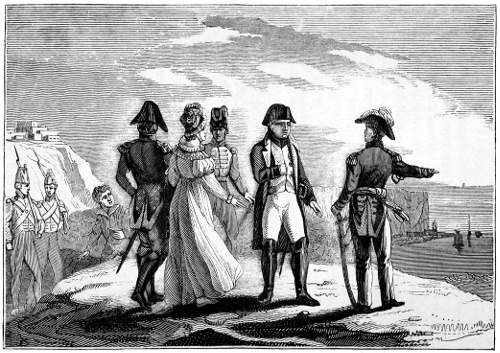
NAPOLEON AT ST. HELENA. London: Published for Henry Colburn, April, 1836.
149I have often heard Napoleon repeat that he wished for the establishment of an European Institute and European prizes, to superintend and stimulate the learned societies of every country.
He would have wished to fix throughout Europe, uniformity of coins, weights, and measures, and also uniformity of legislation. “Why,” said he, “might not my Code Napoleon have served as the groundwork for a European Code, and my Imperial University have been the basis of a European University? Thus the whole population of Europe would have become one and the same family; and every man, while he travelled abroad, would still have found himself at home.”
Various other subjects, of the above nature, were canvassed at different times; but I refrain from noticing them, as my memory does not enable me to enter into details.
ALARMING CHANGE IN THE EMPEROR.—THE GOVERNOR SURROUNDS US WITH FORTIFICATIONS.—PANIC TERRORS OF SIR HUDSON LOWE.—GENERAL LAMARQUE.—MADAME RECAMIER AND A PRUSSIAN PRINCE.
15th.—About three o’clock, the Emperor, with whom I breakfasted this morning, sent for me. He wished to take the air, and he endeavoured to walk as far as the wood; but the air was too keen for him. He then called at the Grand Marshal’s, and he sat for a considerable time in an arm-chair, apparently quite exhausted. We remarked the colour of his countenance, how much he had fallen away, and his evident debility; and we were much distressed at the change observable in him.
As we passed through the wood, the Emperor cast his eyes on the fortifications which were surrounding us; and he could not forbear smiling at these useless and absurd works. He remarked that the ground in our neighbourhood had been entirely disfigured by the removal of the kind of turf with which it was covered, and which had been carried away for the purpose of raising banks. In fact, for the last two months, the Governor has been incessantly digging ditches, constructing parapets, erecting palisades, &c. He has quite blockaded us 150in Longwood, and the stable at this moment presents every appearance of a redoubt. We are at a loss to guess where will be the advantage equivalent to the expense and labour bestowed on these works, which by turns excite the ill-humour and ridicule of the soldiers and Chinese, who are employed upon them, and who now call Longwood and its stable, by the names of Fort Hudson and Fort Lowe. We are assured that Sir Hudson Lowe often starts from his sleep to devise new measures of security. “Surely,” said the Emperor, “this seems something like madness. Why cannot the man sleep quietly, and let us alone? Has he not sense enough to perceive that the security of our local situation here is sufficient to remove all his panic terrors?”—“Sire,” said an individual present, “he cannot forget Capri, which, with 2000 men, thirty pieces of cannon, and perched among the clouds, was taken by 1200 Frenchmen, commanded by the brave Lamarque, who could only reach Sir Hudson Lowe by the help of a triple escalade.”—“Well,” said the Emperor, “this only proves that our Governor is a better jailor than general.”
For some time past, I have felt seriously alarmed respecting the health of my son. The pains of which he formerly complained have been succeeded by violent palpitations, attended by fainting fits; and he is frequently obliged to rise during the night, to relieve himself by walking about, or assuming some particular position. Dr. O’Meara thought he perceived symptoms of aneurism, and considered him to be in a dangerous state. I requested the chief medical officer. Dr. Baxter, to hold a consultation with Dr. O’Meara. The result greatly relieved my anxiety; for his state was declared to have nothing in it very alarming.
During the conversations of the day, the Emperor alluded to Madame de Staël, of whom, however, he said nothing new, except mentioning some letters which had been examined by the police, and which related to Madame Recamier and a Prussian Prince.
“This correspondence,” said the Emperor, “presented unequivocal proofs of the influence of Madame Recamier’s 151charms, and the high regard which the Prince entertained for her. The letters contained nothing less than offers or promises of marriage on his part.”
The following is an explanation of this affair. The beautiful Madame Recamier, whose pure reputation stood unassailed during those stormy times in which few escaped censure, was residing with Madame de Staël, to whom she had heroically devoted herself, when one of the Prussian Princes, who had been made prisoner at Eylau, and who was proceeding to Italy by Napoleon’s permission, alighted at the castle of Coppet, with the intention of resting only for a few hours. Here, however, he was detained during the whole of the summer by the charms of Madame Recamier, who was voluntarily sharing the exile of her friend. This lady, and the young Prince, both considered themselves as the victims of Napoleon, and their common hatred of him, whom they looked upon as their oppressor, probably engendered the interest which they mutually conceived for each other. Inspired with an ardent passion, the Prince, in spite of the difficulties which his exalted rank naturally suggested, conceived the idea of marrying Madame Recamier. He communicated his design to Madame de Staël, whose poetic imagination prompted her to favour a scheme that was calculated to diffuse a sort of romantic interest over Coppet. The Prince was recalled to Berlin, but absence produced no change in his sentiments. He still ardently prosecuted his suit; but Madame Recamier constantly declined this unexpected elevation, either from natural generosity of feeling, or from her Catholic prejudice against divorce.
To this circumstance we are indebted for the picture of Corinne, which is accounted one of the most original creations of Gerard’s pencil. The Prince ordered the picture as a compliment to Madame Recamier.
Having reverted to Madame de Staël, I will take this opportunity of observing that since the publication of the preceding parts of my Journal, I have been visited by some of the most intimate friends of that celebrated woman. These individuals have assured me that Madame de Staël has been often represented to have employed expressions in reference to Napoleon, of which she was 152wholly incapable,—for example, the phrase Robespierre on horseback, which they said they could take upon themselves conscientiously to disavow. I have moreover been informed that Madame de Staël was often more favourable to Napoleon in her private conversation than in her writings, which, it must be confessed, are, in all that relates to the Emperor, embittered by a spirit of malignity and resentment. One of her friends assured me that he had been very much gratified on finding it mentioned in my Journal that Napoleon at St. Helena had compared Madame de Staël at once to Armida and Clorinda I was informed that Madame de Staël, on her part, at the time of her enthusiasm for the young General of the army of Italy, had compared him at once to Scipio and Tancred; because, as she said, he combined the simple virtues of the one with the brilliant achievements of the other.
After dinner, the Emperor ordered his favourite Racine to be brought out, and he read to us some of the finest passages in Iphigenia, Mithridates, and Bajazet. “Though Racine has produced master-pieces in themselves,” said he, “yet he has diffused over them a perpetual air of insipidity. Love is eternally introduced, with its tone of languor and its tiresome accompaniments. But these faults must not be attributed entirely to Racine, but to the manners of the age in which he wrote. Love was then, and at even a later period, the whole business of life with every one. This is always the case when society is in a state of idleness. As for us,” said he, “our thoughts have been cruelly turned to other subjects, by the great events of the revolution.”
The Emperor likewise condemned, by the way, the whole of the celebrated plan of campaign of Mithridates. He remarked that it might be fine as a narrative; but that it was absurd as a conception.
PORTRAITS OF THE PRESENT ENGLISH MINISTERS.—THE EMPEROR CONDEMNS ALL MINISTRIES.—HONOURABLE EXCEPTIONS.—NAPOLEON’S SENTIMENTS FOR THE INDIVIDUALS WHO SERVED HIM.
16th.—I found the Emperor amusing himself by looking over an English publication, a kind of political almanack. 153Alluding to the members of the English Ministry who were mentioned in the work, he said to me: “Do you know any of them? What was the general opinion of them, when you were in England?”—“Sire,” I replied, “it is so long since I left England that nearly all who are now distinguished in the ministry were then only commencing their career. At that time none of them had come forward on the scene.”
The Emperor, having mentioned Lord Liverpool, said: “He appears to me to be the most worthy man among them. I have heard a great deal of good of him. He seems to have some feeling of propriety and decorum. I have no objection to a man being my enemy: every one has his own business and his own duties to perform; but I have certainly a right to be indignant at unworthy conduct and measures.” I mentioned to the Emperor that, when I was in England, Lord Liverpool’s father, Mr. Jenkinson, who successively became Lord Hawkesbury, and Lord Liverpool, had made his political fortune. He was said to have been a very good kind of man, and a private friend of George III.; he was distinguished for assiduity, and particularly directed his attention to diplomatic documents.
The Emperor next mentioned Lord Sidmouth. “I am told,” said he, “that he too is a worthy man enough: but he possesses no great share of understanding. He is one of those honest blockheads who, with the utmost sincerity, concur in all sorts of mischief.”
“Sire,” said I, “in my time, Lord Sidmouth, under the name of Mr. Addington, was a member of the House of Commons, and was a man generally esteemed. He was said to be the creature of Mr. Pitt, who was understood to have appointed Addington as his successor, in order to ensure to himself the means of returning to the ministry whenever he should think fit. The public were certainly greatly astonished to see Pitt succeeded by Mr. Addington; as the post was considered to be very far beyond his talents. One of the English opposition papers, alluding to Mr. Addington, quoted the remark made by a philosopher (Locke, I believe), who says that the mind of a child is a blank sheet of paper, on which 154nature has yet written nothing: and the Journal in question humorously observed that when nature wrote upon the blank sheet of the Doctor (the nickname then given to Mr. Addington), it must needs be confessed, she left plenty of margin.”
“Well,” resumed the Emperor, “what do you know of that sad fellow, into whose keeping we have been delivered up—that Lord Bathurst?” “Absolutely nothing, Sire,” I replied, “either of his origin, his person, or his character.”—“For my part,” said he, with some degree of warmth, “I have no opportunity of knowing him, except by his conduct towards me; and in judging from that, I hold him to be the vilest the basest the most cowardly of men. The brutality of his orders, the coarseness of his language, the choice of his agent, all authorize me to make this declaration. An executioner, such as he has sent hither, is not easily found. Such a selection could not be made at random. He must have been sought for, tried, judged, and instructed. Certainly, this, in my opinion, is sufficient to justify the moral condemnation of the man who could stoop to so base a course. By the arm which he moves it is easy to guess what must be his heart!”
I must confess that, yielding to feelings of delicacy, I had at first almost prevailed on myself to suppress or to soften down the expressions above quoted: but on the other hand, certain scruples deterred me from doing so. The shade of him who was so deeply injured is, thought I, at this moment hovering above me, and seems to say:—“Since you make me speak, at least preserve my words.” Justice asserts her rights. Men, in the enjoyment of honours and powers must feel it incumbent on them to answer charges that are brought against them. Let the accused justify himself:—if he can, so much the better.
Speaking of Lord Castlereagh, the Emperor said:—“This man governs all the rest, and rules even the Prince himself, by dint of impudence and intrigue. Supported by a majority of his own creating, he is always ready to contend, with the utmost effrontery, against reason, law, justice, and truth. No falsehood 155staggers him: he stops at nothing, well knowing that he can always command votes to applaud and legalize whatever he does. He has completely sacrificed his country, and is daily degrading her by acting in opposition to her policy, doctrines, and interests: in short, he has entirely delivered her up to the Continent. The situation of England is becoming worse and worse. Heaven knows how she will extricate herself!”
“Lord Castlereagh,” continued he, “is, I am informed, looked upon, even in England, as a man politically immoral. He commenced his career by an act of political apostacy, which, though common enough in his country, nevertheless, always leaves an indelible stain. He entered upon public life as an advocate of the people, and he has finally become the engine of power and despotism. If all that is said of him be correct, he must be execrated by his countrymen, the Irish, whom he has betrayed, and by the English, who may justly regard him as the destroyer of their domestic liberties, and foreign interests.
“He has had the impudence to bring forward in parliament, as authentic facts, statements which he knew to be false, and which probably he himself fabricated: and yet, on the authority of these documents, Murat’s dethronement was decided. Lord Castlereagh makes it his business to belie himself daily in parliament and in public meetings, by putting into my mouth language calculated to prejudice me in the eyes of the English, though he is well aware that he is making false assertions. This conduct is the more base; since he himself withholds from me the power of refuting him.
“Lord Castlereagh is the disciple of Pitt, of whom he probably thinks himself the equal, though he is merely the ape of that distinguished statesmen. He has incessantly pursued the plans and plots of his master against France; but even here pertinacity and obstinacy were perhaps his only good qualities. But Pitt had grand views: with him his country’s interest took place of every consideration. He possessed talent and ingenuity; and from England, he moved the lever by which he ruled and influenced the continental sovereigns at will. Castlereagh, 156on the contrary, substituting intrigue for ingenuity, and subsidies for genius, is regardless of his country’s interest, and has incessantly employed the credit and influence of the continental sovereigns merely to confirm and perpetuate his own power at home. However, such is the course of things in this world, that Pitt with all his talent, constantly failed, while the incapable Castlereagh has been completely successful. Oh, blindness of fortune!
“Castlereagh has proved himself entirely the man of the continent. When master of Europe, he satisfied all the monarchs of the continent, and only forgot his own country. His conduct has been so prejudicial to the national interests, so incompatible with the doctrines of his country, and altogether presents so much the appearance of inconsistency, that it is difficult to conceive how so wise a people as the English can allow themselves to be governed by such a fool!
“He adopts legitimacy as the basis of his creed, and wishes to establish it as a political dogma, while that principle would sap the very foundation of the throne of his own sovereign. Besides, he acknowledges Bernadotte in opposition to the legitimate Gustavus IV., who sacrificed himself for England; and he acknowledges the usurper Ferdinand VII., to the detriment of his venerable father, Charles IV.
“He and the Allies establish, as another fundamental basis, the restoration of the old order of things, the redress of what they term past injuries, injustice, and depredation; finally, the return of political morality. Yet Castlereagh scrupled not to sacrifice the republic of Venice and Genoa, by abandoning the former to Austria, and annexing the latter to Piedmont. He enriched Russia by the possession of Poland. He robbed the King of Saxony, for the advantage of Prussia, who can no longer afford any aid to England. He separated Norway from Denmark, while, had the latter power been left more independent of Russia, she might have surrendered to England the key of the Baltic; and Norway was transferred to Sweden, which, by the loss of Finland and the Islands of the Baltic, has fallen entirely under the subjection of Russia. Finally, by a violation of the first principles of general policy, he neglected, in his all-powerful 157situation, to restore the independence of Poland, thereby exposing Constantinople, endangering the whole of Europe, and preparing a thousand troubles in Germany.
“I need say nothing of the monstrous inconsistencyinconsistency of a Minister, the representative of a nation pre-eminently free, restoring Italy to the yoke of slavery, keeping Spain in a state of bondage, and exerting every effort to forge fetters for the whole continent. Does he think that liberty is only proper for the English, and that the rest of Europe is not fit to enjoy it?[15] But even supposing him to entertain this opinion, how does he explain his conduct with regard to his own countrymen, whom he is daily depriving of some of their rights? For example: the suspension of the Habeas Corpus Act, right or wrong; the enforcement of the Alien Bill, by which (will it be credited?) the wife of an Englishman, should she happen to be a foreigner, may be driven from England, at the will and pleasure of the Minister; the endless dispersion of spies and informers, those exciting agents and infernal instigators, by whose aid criminals may always be created, and victims multiplied. In short, Castlereagh has established at home the system of cold violence, the iron yoke, which he exercises over foreign dependencies.[16] No; Lord Castlereagh is not calculated to be the Minister of a free people, or to command the respect of foreign nations. He is the vizier of the continental Sovereigns, at their instigation training his countrymen to slavery: he is the connecting link, the conductor, by which English 158gold is dispersed over the continent, and the despotic doctrines of other countries imported into England.
“He proves himself to be the partisan, the obsequious associate of the Holy Alliance,—that mysterious alliance, of which I cannot guess either the meaning or the object, which can afford neither utility nor advantage. Can it be directed against the Turks? It would then be for the English to oppose it. Can it really have for its object the maintenance of a general peace? That is a chimera, by which it is impossible diplomatic cabinets can be duped. With them, alliances can only be formed for the purpose of opposition or counterpoise. They cannot all be allied together. I cannot therefore comprehend this Holy Alliance, except by regarding it as a league of sovereigns against subjects; but, in that case, what has Castlereagh to do with it? If it be so, will he not, ought he not, one day, to pay dearly for his conduct?
“I once had Lord Castlereagh in my power,” said the Emperor. “He was intriguing at Chatillon, when, during one of our momentary successes, my troops passed beyond the seat of Congress, which was, by this means, surrounded. The Prime Minister of England maintained no public character, and was without the law of nations.
“He was aware of his embarrassing situation, and manifested the utmost uneasiness at thus finding himself in my power. I intimated to him that he might set his mind at rest, as he was at perfect liberty. I did this on my own account, and not on his, for certainly I had no reason to expect any good from him. However, some time afterwards, he evinced his gratitude in a very peculiar way. When he saw me make choice of the Isle of Elba, he caused England to be proposed as my asylum, and employed all his eloquence and subtlety to induce me to make choice of that country as my place of residence. Now, however, I may justly entertain suspicion of the offers of Castlereagh, and doubtless, he already meditated the horrible treatment which he is at this moment exercising towards me!
“It was a misfortune for England that her Prime Minister treated personally with the continental Sovereigns: it was a violation of the spirit of the British 159constitution. The English at first felt their pride flattered, at seeing their representative dictate laws to Europe; but they have now abundant cause to repent, since the result has proved that, on the contrary, he only stipulated for embarrassment, degradation and loss.
“It is an undoubted fact, that Castlereagh might have obtained all; while, on the contrary, from blindness, incapacity, or perfidy, he sacrificed every thing. When seated at the banquet of Monarchs, he blushed to dictate peace like a merchant, and determined to treat liberally like a lord. Thus he gained something in point of vanity; and, it may be presumed, he lost nothing in point of interest: his country alone suffered, and will long continue to suffer.
“And the continental Sovereigns are also likely to repent of having permitted their Prime Ministers to come into personal contact with each other. The result seems to have been that these Premiers have created among themselves a sort of secondary sovereignty, which they mutually guarantee to each other; and, there is good reason to suppose that it is accompanied by subsidies furnished with the knowledge of their respective Sovereigns. This business may be very easily managed; nothing can be more simple, and, at the same time, more ingenious. In fixing the secret service money, it is very easy to mention that such a one on the continent has been very useful, that he may still continue to be so, and, therefore, that it is proper to make an acknowledgment for his services. This individual, in his turn, may represent to his Government that some man or other abroad has rendered important services and even compromised his own interests, and that consequently he should not be forgotten. It was probably some such arrangements as these that occasioned an illustrious personage at Vienna to exclaim, in a moment of vexation, Such a one costs me the eyes in my head! Doubtless, these disgraceful schemes and transactions will one day come to light. We shall then see what enormous fortunes have thus been squandered and swallowed up. They will perhaps hereafter be recorded in new letters of Barillon; but nothing will be unfolded, no characters 160will be disgraced, because contemporaries will have anticipated all.”
After this long and energetic sally, in which, I may say, I for the first time heard Napoleon express himself privately, with such warmth and bitterness against these individuals of whom he had personally cause to complain he was silent for a few moments. Then resuming, he said, “And Lord Castlereagh is artful enough to support himself entirely on Lord Wellington (whose name the Emperor, at the moment, found among the members of the English Ministry). Wellington has become his creature! Can it be possible that the modern Marlborough has joined the train of a Castlereagh, and yoked his victories to the turpitude of a political mountebank? It is inconceivable! Can Wellington endure such a thought? Has not his mind risen to a level with his success?...”
I had remarked that, in general, the Emperor disliked to speak of Lord Wellington. He seemed carefully to avoid pronouncing his opinion on him; feeling, no doubt, the impropriety of publicly depreciating the General who had triumphed over him. On the present occasion, however, he yielded, without reserve, to the full expression of his feelings. The consciousness of the indignities that are heaped upon him seemed, at this moment, to rise forcibly in his mind. Though usually so calm and unresenting towards those who had done him the greatest injuries, he now evinced a degree of warmth which I had never before witnessed in him. His gestures, his features, his tone of voice, were all expressive of the utmost indignation. I listened to him with astonishment.
“I have been told,” said he, “that it is through Wellington that I am here; and I believe it.[17] It is conduct well worthy of him, who, in defiance of a solemn capitulation, suffered Ney to perish;—Ney, with whom he had so often been engaged on the field of battle! 161For my own part, it is very certain that I gave him a terrible quarter of an hour. This usually constitutes a claim on noble minds; his was incapable of feeling it. My fall, and the lot that might have been reserved for me, afforded him the opportunity of reaping higher glory than he has gained by all his victories. But he did not understand this. Well, at any rate, he ought to be heartily grateful to old Blucher: had it not been for him, I know not where his Grace might have been to-day; but I know that I, at least, should not have been at St. Helena. Wellington’s troops were admirable, but his plans were despicable; or, I should rather say, that he formed none at all. He had placed himself in a situation in which it was impossible he could form any; and, by a curious chance, this very circumstance saved him. If he could have commenced a retreat, he must infallibly have been lost. He certainly remained master of the field of battle; but was his success the result of his skill? He has reaped the fruit of a brilliant victory; but did his genius prepare it for him? His glory is wholly negative. His faults were enormous. He, the European Generalissimo, to whose hands so many interests were intrusted, and having before him an enemy so prompt and daring as myself, left his forces dispersed, and slumbered in a capital until he was surprised. And yet such is the power of fatality! In the course of three days, I three times saw the destiny of France and of Europe escape my grasp.
“In the first place, but for the treason of a General, who deserted from our ranks, and betrayed my designs, I should have dispersed and destroyed all the enemy’s detached parties before they could have combined themselves into corps.
“Next, had it not been for the unusual hesitations of Ney at Quatre-Bras, I should have annihilated the whole English army.
“Finally, on my right, the extraordinary manœuvres of Grouchy, instead of securing victory, completed my ruin, and hurled France into the abyss.
“No,” continued he, “Wellington possesses only a special kind of talent: Berthier also had his! In this 162he perhaps excels. But he has no ingenuity; fortune has done more for him than he has done for her. How different from Marlborough, of whom he seems to consider himself as the rival and equal. Marlborough, gained battles, ruled cabinets and guided statesmen; as for Wellington, he has only shewn himself capable of following the views and plans of Castlereagh. Madame de Staël said of him that, when out of the field of battle, he had not two ideas. The saloons of Paris, so distinguished for delicacy and correctness of taste, at once decided that Madame de Staël was in the right: and the French Plenipotentiary at Vienna confirmed that opinion. His victories, their result, and their influence, will rise in history; but his name will fall, even during his lifetime.”
Alluding to ministries in general, but particularly to collective ministries, the intrigues, the great and petty passions that agitate the men who compose them, the Emperor said, “After all, they are only so many plagues. No one escapes the contagion. A man may be honest when he enters a ministry; but it seldom happens that he retires from one without having forfeited his purity of character. I may perhaps except only two: mine, and that of the United States—mine, because my Ministers were merely my men of business, and I alone stood responsible; and that of the United States, because there Ministers are men of public credit, always upright, always vigilant, and always rigid.” He concluded with the following remarkable words:—
“I believe that no Sovereign was ever surrounded by more faithful servants than I was towards the close of my reign. And if I did not obtain due credit for the selection I had made, it was because the French are too apt to murmur incessantly.” He then took a review of his principal Ministers, counting them on his fingers.
“My two great dignitaries,” said he, “Cambacérès and Lebrun, were distinguished men, and perfectly well disposed. Bassano and Caulaincourt, two men remarkable for sincerity and rectitude. Molé, whose name reflects honour on the French Magistracy, is probably destined to act a part in future ministries. Montalivet 163was an honest man; the ministry of Decrès was pure and rigorous; Gaudin was distinguished for steady and well directed labour; Mollien possessed vast perspicuity and promptitude; and all my Councillors of State were prudent and assiduous! All these names will remain inseparably connected with mine. What country, what age, ever presented a better composed, or more moral Ministry? Happy the nation that possesses such instruments, and knows how to turn them to good account!... Though I was not given to praise, and though my approbation was in general purely negative, yet I fully appreciated the value of those who served me, and who have everlasting claims on my gratitude. Their number is immense, and the most modest are not the least meritorious. I shall not attempt to name them, because many would have to complain of having been omitted, and such omission might appear like ingratitude on my part!”
THE GENERALS OF THE ARMY OF ITALY.—NAPOLEON THE ADOPTED FATHER OF ONE OF HIS AIDES-DE-CAMP.—SCANDALOUS NOVEL.—NAPOLEON’S DISLIKE OF GAMING.—THE LA ROCHEFOUCAULT FAMILY, &c.
17th.—The Emperor was unwell, and saw nobody during the whole of the day. In the evening he sent for me. I expressed myself very much concerned for the state of his health; but he assured me that he was more indisposed in mind than in body. He began to converse on a variety of subjects, and this seemed to rouse his spirits.
He once more took a review of the Generals of the army of Italy, describing their characters, and quoting many anecdotes respecting them. He spoke of the selfishness of one, of the false pretensions of another, the folly of a third; the depredations committed by some, the good qualities of others, and the important services rendered by all. He dwelt particularly on one, to whom he had been much attached, and whose defection, he said, had proved a severe wound to his heart. The Emperor remarked that, from what he knew of that individual, he was sure he must occasionally suffer deeply 164from remorse. “Never,” observed he, “was defection more fatal, or more decidedly avowed. It was recorded in the Moniteur, and by his own hand. It was the immediate cause of our disasters, the grave of our power, the cloud of our glory. And yet,” added he, in a tone of affection, “I am convinced that his sentiments are better than his reputation; his heart is superior to his conduct. Of this, he himself appears to be conscious. The newspapers inform us that when, soliciting in vain for the pardon of Lavalette, he exclaimed, with warmth, in reply to the obstacles urged by the Monarch, Sire, have I not given you more than life? We were, it is true,” said the Emperor, “betrayed by others, and in a manner still more vile; but no other act of apostacy was so solemnly recorded by official documents.”
The Emperor then observed that, at an early period of life, he had acted the part of a father to the General above alluded to, who could not enter the royal corps of artillery, and had been obliged to join a provincial regiment. “He was,” said the Emperor, “the nephew of one of my comrades at the school of Brienne, and in the regiment of La Fère, who, when he emigrated from France, recommended his young relation to my care. This circumstance imposed upon me the obligation of acting the part of his uncle and his father, which I literally did. I took a real interest in his welfare, and felt a pleasure in advancing his fortune. His father was a knight of St. Louis, the proprietor of some iron-works in Burgundy, and a man of considerable fortune.”fortune.”
Napoleon mentioned that, in 1794, as he was returning from the army of Nice to Paris, he visited the father’s chateau, where he was magnificently treated, as he was already beginning to enjoy a certain degree of reputation. The father, according to the son’s account, was an absolute miser. However, he determined to give a handsome reception to the guest who had been so kind to his son. His entertainment was distinguished by all the ostentation which misers are fond of displaying. He exhibited complete prodigality. It was in July or August, and he ordered immense fires to be kindled in all the apartments. “This,” said the Emperor, “would have been an incident for Moliere.”
165Speaking of the manners of Paris, and its immense population, the Emperor adverted to the many evils which he said must inevitably exist in all great capitals, where depravity of every kind is continually stimulated by want, passion, wit, and the facilities afforded by bustle and confusion. He often repeated, that all capitals were so many Babylons. He adduced several proofs of odious libertinism with respect to Paris; and he mentioned that, after he became Emperor, he had perused the most scandalous book that was ever conceived by the most depraved imagination. It was a novel, which, even in the time of the Convention, had proved so offensive to public morals as to occasion the imprisonment of its author, who had continued in confinement ever since, and whom the Emperor believed to be still living. I have forgotten the name of the writer, and it was the first time I had ever heard the production mentioned.
The Emperor said that he had endeavoured, as far as circumstances permitted, to suppress many sources of immorality; but in some instances, he had not had courage to descend into details. For example, he prohibited masked gaming, and even had it in view to prohibit all gaming houses; but when I wished to have the subject thoroughly discussed in my presence, it proved to be a very difficult question. I mentioned that the police had even prohibited us from playing privately in one of the principal houses of the Faubourg St. Germain. The Emperor observed that he had had no idea of this act of tyranny; and yet, as I assured him, it was exercised by Fouché in his name. “That may be,” said he, “but I knew nothing of it; and so it was with all the details of the police, high, middling, and low.”
He then questioned me respecting the kind of gaming to which I had just alluded; and observing that, in my replies, I always used the plural we, he interrupted me, saying,—“Were you yourself one of the party? Were you a gamester?”—“Alas! Sire, I unfortunately was. Only at long intervals, it is true. But st¡ll, when the fit seized me, it urged me to excess.”—“I am very glad I knew nothing of it at the time,“ said the Emperor, “otherwise you would have been ruined in my esteem. 166This circumstance shews how little we knew of each other, and it also proves that you could not have made yourself many enemies; for there were charitable souls about me who would have taken care to inform me of your failing. My prejudice against gaming was well known. A gamester was sure to forfeit my confidence. I had not leisure to enquire whether I was right or wrong; but, whenever I heard that a man was addicted to gaming, I placed no more reliance on him.”
This allusion to the Faubourg St. Germain led us to mention many of the principal names in the capital. The Emperor made some remarks on the different members of the family of La Rochefoucault. He mentioned the lady of honour to the Empress Josephine; her husband, who was ambassador to Vienna and Holland; her brother, the member of the Legislative Body; their father, M. de Liancourt, whom he highly respected; and finally, the daughter whom he had given in marriage to Prince Aldobrandini, brother to Prince Borghese. He repeated that he had once entertained the idea of making her the wife of Ferdinand VII. He also mentioned another, M. de la Rochefoucault, who died in prison at the commencement of his reign, and he asked me what relation he was to the others. I could not inform him. I knew nothing either of the person or the circumstance mentioned by the Emperor.
“He was,” said Napoleon, “the author of a conspiracy against my person, which I never mentioned to you: it just now occurs to my recollection.
“This M. de la Rochefoucault formed in Paris, in behalf of the King, who was then at Mittau, a conspiracy, the first stroke of which was to be the death of the head of the Government. M. de la Rochefoucault ended his days in prison, after a long confinement. Some one having procured a knowledge of this affair, a confidential agent of the police pretended to enter into the conspiracy, and to become one of its most active members. He received his credentials at a chateau in Lorraine, from an old gentleman, who had held a distinguished rank in the army of Condé, and who had been enabled to return to France by the amnesty of the First 167Consul. This gentleman, who, to do him justice, was a very worthy man, was appointed to accredit the members of the conspiracy, and to afford them the necessary facilities for gaining access to Louis XVIII. at Mittau. He had evinced great repugnance on entering into the conspiracy. He said it was now too late to think of such enterprises, as France was beginning to enjoy repose. He solemnly declared his disapproval of any violence being offered to the First Consul, whom he now looked upon as something sacred. After having several interviews with Louis XVIII. at Mittau, the police agent returned with a knowledge of the whole affair. M. de la Rochefoucault and his party were arrested. If they had but known who disclosed their plot!”
PONIATOWSKI THE REAL KING OF POLAND.—CHARACTERISTIC ANECDOTES OF NAPOLEON.
18th,—19th.—The conversation turned on Poland, roused as she had been at the voice of Napoleon. We spoke of the individuals who seemed to have been destined to ascend the throne of that country: each made his own conjectures on this subject. The Emperor remained silent for some time, and at length interrupted us, saying: “Poniatowski was the real King of Poland. He possessed every quality requisite for that high station.” He said no more.
At another moment, the Emperor smiled at the pains that had been taken to obliterate his emblems and devices on the public monuments which he had erected, “They may,” said he, “be withdrawn from the public eye; but they cannot be erased from the page of history, or from the recollection of connoisseurs and artists. I acted differently,” added he; “I respected all the vestiges of royalty that existed when I came into power. I even restored the fleurs-de-lis, and other royal emblems, when chronological correctness required it.”
An individual present remarked that Prince Lucien had manifested precisely the same sentiments. The Palais Royal was assigned as his place of residence on the Emperor’s return in 1815, and, observing, as he ascended the staircase, the groupes of fleurs-de-lis on the tapestry 168that overhung the walls, he said to the officer who attended him: “This will all be taken down, I presume?”—“Why, Monseigneur?” “Because these are the devices of the enemy.” “Well! Monseigneur, why should they not remain as our trophies?”—“You are right,” replied the Prince, “this is exactly my way of viewing the matter.”
To-day, I have been able to collect but little from the Emperor’s conversation.... I shall, therefore, fill up this void, and that of the succeeding day, by inserting some anecdotes which I find in scattered memoranda on the cover of my ordinary Journal: for here I noted down such particulars as I found I had forgotten to insert in their proper place, together with any old reminiscences that happened to occur to me, or delicate points which, in our state of captivity, required to be treated with prudence and circumspection. These notes also contain many facts, which have been subsequently collected from unquestionable sources.
Many of these articles have no relation to each other; but, they are all connected with the object of the present work, whether they serve to prove the false colours in which Napoleon has been painted, or whether, on the contrary, they develop the real traits of his character. May the perusal of this Journal induce those who have been about the Emperor to record on their parts all they know, or have heard respecting him!
Formerly, a great deal was said about the excessive severity and violence exercised by the Emperor towards the individuals about his person. Now, however, it is acknowledged that every one who served him adored him, precisely for his kindness of heart and manners. Since my return to Europe, a gentleman of high rank, whose name alone would be sufficient to command credit, and whose high functions kept him constantly about the person of the Emperor, in foreign expeditions as well as in the interior of the palace, has assured me that he never in his life knew Napoleon to strike a servant, except on one occasion. This was when one of his grooms, at the retreat of Saint Jean d’Acre, refused to give up his horse for the transport of the invalids, while 169he, the General-in-Chief, had surrendered his, and had obliged all his staff to do so likewise. But, after all, added my informant, it was easy to perceive that this act was prompted by policy rather than by natural severity of temper: the scene took place in the presence of dispirited troops, to whom it was necessary to give proofs of the lively interest that was felt for them.
It used to be a common remark that Napoleon was not less morose to the individuals of his Court than to those in his service; and that he never had any thing complimentary or agreeable to say to any one. Among the multitude of facts that might be adduced in contradiction to this assertion, I will mention the following, to which I was myself a witness. On his return from the disastrous campaign of Leipsic, the Emperor received the officers of his household at an unusual hour. He presented himself to us with an air of melancholy. Stepping up to the individual who was next me (M. de Beauveau, I think,) whose son, yet a youth, had served in the campaign, in the guard of honour, or some other corps. Napoleon said to him: “Your son’s conduct has been admirable. He has conferred honour on his name. He has been wounded; but what of that? He may proudly boast of having thus early shed his blood for his country.”
AtAt the same period, at one of his levees, after giving some orders to General Gerard, whose reputation was then beginning to attract attention, the Emperor concluded with some words evidently kindly meant, though somewhat obscure. After advancing a few paces to continue his circuit, he turned back to General Gerard, apparently having read in his countenance that he had not precisely understood him, and he said very distinctly: “I observed that, if I had many men like you, I should consider all my losses repaired, and should think myself master of my fortune.”
About the same period, I had an opportunity of witnessing a proof of the ascendency which the Emperor could exercise over the human mind, and the sort of veneration with which he was regarded. A General, whose name I do not know, and who had been severely 170wounded in the leg, attended the Emperor’s levee. Napoleon had been informed that amputation was pronounced to be absolutely indispensable, but that the unfortunate officer obstinately refused to submit to it. “Why do you object to an operation that will preserve your life?” said Napoleon: “It cannot be want of courage, since you have so often braved danger on the field of battle! Is it contempt of life? But does not your heart tell you that, even with the remaining limb, you may be useful to your country, and render her signal services?” The officer was silent; the expression of his countenance was calm and placid, but still negative. The Emperor seemed sorry for him, and passed on to speak to some other persons, when the officer, who had apparently formed a sudden resolution, turned to the Emperor, saying, “Sire, if your Majesty orders me to submit to the operation, I will immediately do so,”—“My dear Sir,” replied the Emperor, “I have no power to do that. I wished to move you by persuasion; but Heaven forbid that I should command you!” I think I have heard it said that, on leaving the palace, the wounded officer submitted to the operation.
The Emperor, on his return from the Isle of Elba, arrived at the Tuileries very late in the evening. His levee, on the following day, was, as may be supposed, exceedingly numerous. When the door was thrown open, and he presented himself before us, it would be difficult for me to explain what were my ideas and sensations. The Emperor appeared the same as usual; just as though he had never left the palace, and had held a levee but yesterday; his countenance, attitude, dress, manners, all were unaltered. I was powerfully affected, and I believe my sensations were shared by all present. The force of sentiment prevailed over respect; and all rushed forward to meet him. The Emperor himself was visibly moved; and he embraced several of the most distinguished persons. He then commenced his circuit as usual. His voice was mild, his countenance placid, and his manner affable: he spoke with kindness to every one. “How!” said he, addressing a certain individual, “What! the 171Major-General of the white army two paces from me!” Several of those present seemed to be labouring under a little embarrassment, owing to the extraordinary events that had just taken place; as for Napoleon, he appeared as though nothing had happened. He did not forget that he had released them all from their allegiance at Fontainebleau.
The following anecdotes prove his correctness of judgment and coolness of temper. They also shew that, when at the summit of his power, his moderation and equity were never shaken, even in matters most directly personal, and on subjects on which he might have been presumed to be most delicate and susceptible.
When Moreau was arrested, on the charge of being concerned in the affair of Georges and Pichegru, one of the First Consul’s Aides-de-camp, who was, perhaps, also the Aide-de-camp of Moreau, or had served under his command, visited him in prison, and evinced great interest for him. “This is all very natural,” said Napoleon, on being informed of the circumstance, “I certainly cannot blame such conduct; but I must appoint another Aide-de-camp. The post is one perfectly confidential: there can be no division in an affair so personal as this.” Napoleon gave the command of a regiment to this Aide-de-camp (Col. Laucée), who, some time afterwards, perished at the head of it, in one of the actions which preceded the capitulation of Ulm.
About the same period, the Prefect of Liege, equally remarkable for his administrative talents and excellent character, was suddenly summoned to Paris; and he hastened thither, pleased with the anticipation of the proofs of satisfaction which he trusted he should receive, because he deserved them. He was, however, invited by the Grand Judge to visit him before he should present himself to the First Consul; and he found himself unexpectedly interrogated, ex officio, on the subject of a letter that was presented to him. At first he could not deny the signature, so accurately had his own been imitated; but he positively disavowed the sentiments it contained. It consisted of a justification of Moreau, and was filled 172with imprecations against the Consul. The whole was an infamous plot, contrived by a high public functionary, an enemy of the Prefect’s, for the purpose of ruining him. The Prefect, having proved that he knew nothing of the letter attributed to him, appeared at the First Consul’s grand audience. Napoleon treated him with particular attention, and when he took his leave, he said to him, “Return and resume your functions, which you know so well how to fulfil. You carry with you my utmost esteem. Let this public testimony of your good conduct console you for the painful feelings that calumny and falsehood may have occasioned you.”
The following will shew that Napoleon was not inclined hastily to condemn a certain degree of independence, even though it might be somewhat unreasonable:—
M. de Montalivet, who was Minister of the Interior during the Empire, has informed me that, being one day left alone with the Emperor, after a Council of Ministers, he thus addressed him:—“Sire, it is not without considerable embarrassment that I presume to mention to your Majesty a circumstance which is certainly extremely ridiculous; but a Prefect, a young Auditor, obstinately persists in withholding from me the title which custom has assigned to all your Ministers. Some persons, holding inferior situations in my department, observing that he never used the customary title of Monseigneur in speaking of me, and thinking it an instance of affectation, very absurdly required him, in my name, to observe the formality; and he peremptorily refused. I am quite ashamed that this affair should have arisen; but as it is, the thing has been carried to such a point that I cannot give it up.” At first, the Emperor could scarcely credit such obstinacy and folly on the part of the Prefect. After a short pause, he said to M. de Montalivet, smiling, “But, after all, there is no such obligation specified in the Code. The young man is perhaps good fruit, though not yet ripe. However, this refractory conduct must be checked. Desire his father to come to me; surely the young man will not disobey his orders.” What a delicate, moral sentiment was thus conveyed!
On the evening of the 20th of March, the Emperor 173had no sooner entered his apartments in the Tuileries, than the Captain of Dragoons, G. D—-- appeared before him. He was the bearer of the capitulation of Vincennes, which had just been obtained by dint of extraordinary courage and address. Napoleon at first smiled at the details that were communicated to him; but, being struck with the vehement manner and language of the narrator, and suddenly calling to mind the fate of Governor Puyvert at Vincennes, he hastily exclaimed, “But, Sir, you say nothing of the Governor; what has become of him?”—“Sire,” resumed the officer, in a calmer tone, “he has been furnished with a passport, and has been escorted out of Paris.” Napoleon then advanced, and seizing the officer’s hand, with an expression that sufficiently betrayed the anxiety with which he had just been agitated, “I am satisfied,” said he; “you have done well, very well!”
I find, in one of my notes, that the Emperor once remarked that the finest military letter he had ever read was one written during the consulate, by a soldier of the south, named Leon. From this high praise, it must of course be presumed that the letter was a very extraordinary one. I myself know nothing of it; but I merely mention the circumstance, in the hope that some one may be induced to lay the document before the public, in case it should not be already upon record.
Napoleon, during his military career, fought sixty battles; Cæsar fought but fifty.
It was asked one day, in Napoleon’s presence, how it happens that misfortunes, which are yet uncertain, often distress us more than afflictions which we are already suffering. “Because,” observed the Emperor, “in the imagination, as in calculation, the power of what is unknown is immeasurable.”
After having given any one an important mission, or traced out the plan of any great enterprise, the Emperor used frequently to say, “Come, Sir, be speedy: use despatch; and do not forget that the world was created in six days.”
On an occasion of this kind, he concluded by observing to the individual whom he was addressing, “Ask me 174for whatever you please, except time: that’s the only thing that is beyond my power.”
On another occasion, Napoleon commissioned a person to execute some important business, which he expected would be finished in the course of the same day. It was not, however, completed until late on the following day. At this, the Emperor manifested some degree of dissatisfaction; and the person, to excuse himself, said that he had worked all day. “But had you not all night too?” replied Napoleon.
The Emperor directed particular attention to the improvement and embellishment of the markets of the capital. He used to say, “The market-place is the Louvre of the common people.”
Equality of rights, that is to say, the power of aspiring and obtaining, enjoyed by all individuals, was one of the points to which Napoleon attached particular importance. This regard for equality was one of his peculiar traits, and seemed to belong innately to his character. “I have not reigned all my life,” he would say: “before I became a Sovereign, I recollect having been a subject; and I can never forget how powerfully the sentiment of equality influences the mind and animates the heart.”
When he was once giving a project to be drawn up by one of his Councillors of State, he said, “Let me charge you to respect liberty; and above all, equality. With regard to liberty, it might be possible to restrain it, in a case of extremity; circumstances might demand and justify such a step: but Heaven forbid that we should ever infringe upon equality! It is the passion of the age; and I wish to continue to be the man of the age!”
In Napoleon’s eyes, merit was single, by itself, and he recompensed it uniformly. Thus the same titles, and the same decorations, were awarded equally to the ecclesiastic, the soldier, the artist, the philosopher, and the man of letters. It may truly be said that in no other country or period was merit more highly honoured, or talent more magnificently rewarded. On these points, the Emperor’s views were unlimited. I have already mentioned that he one day said, “If Corneille had lived in my time, I would have made him a prince.”
175The Emperor said one day at St. Helena, “Nature seems to have made me for great reverses; they have found me with a mind of marble. The thunderbolt cannot make an impression upon, but merely glides over, it.”
At another time, when some vexation arose at St. Helena, one of those about Napoleon exclaimed, “Ah, Sire, this must indeed increase your hatred of the English.” Upon which the Emperor, shrugging up his shoulders, said, in a mingled tone of pleasantry and contempt, “Prejudiced man! Say rather that at most it may increase my hatred of this or that particular Englishman.... But, since we are on this subject, let me tell you that a man, he who has the true feelings of a man, never cherishes hatred. His anger or ill-humour never goes beyond the irritation of the moment,—the electric shock. He who is formed to discharge high duties, and to exercise authority, never considers persons; his views are directed to things, their weight, and consequence.”
On a certain occasion, he remarked that he doubted not but his character would gain in proportion as it descended to posterity; and that future historians would conceive themselves bound to avenge the injustice of contemporaries. Excess is always succeeded by reaction. Besides, he was of opinion that, when viewed from a distance, his character would appear in a more favourable light, by being relieved from many useless encumbrances. He would hereafter be judged by general views, and not by petty details. Every thing would be in harmony, and all local irregularities would disappear. Above all, he would not be compared with himself; but with what might exist at a future period. He added that now, as hereafter, he could proudly submit every act of his private life to the most rigid scrutiny, confident that the severest judges would pronounce him to be free from crime.
The Emperor one day told me that he had conceived the idea of composing his Diplomatic History, or a complete account of his negotiations, from Campo Formio to his abdication. If he should have fulfilled his design, what an historical treasure will thus be presented to the world!
176Speaking of military eloquence, the Emperor said, “When, in the heat of the battle, passing along the line, I used to exclaim, ‘Soldiers, unfurl your banners, the moment is come,’ our Frenchmen absolutely leapt for joy. I saw them multiply a hundred-fold. I then thought nothing impossible.”
Many of Napoleon’s military harangues are well known. The following has been communicated to me by one who heard it on the spot. When reviewing the 2d regiment of horse chasseurs at Lobenstein, two days before the battle of Jena, Napoleon, addressing the Colonel, said: “How many men are there here?”—“Five hundred,” replied the Colonel; “but there are many raw troops among them.”—“What signifies that,” said the Emperor, in a tone which denoted surprise at the observation, “are they not all Frenchmen?”—Then, turning to the regiment, “My lads,” said he, “you must not fear death. When soldiers defy death, they drive him into the enemy’s ranks.” He here made a motion with his arm expressive of the action to which he alluded. At these words a sudden movement among the troops, accompanied by a murmur of enthusiasm, seemed the precursor of the memorable victory which forty-eight hours afterwards overthrew the column of Rosbach.
At the battle of Lützen, the army was chiefly composed of conscripts, who had never been in any engagement. It is said that, in the heat of the action, Napoleon rode along the rear of the 3d rank of infantry, supporting and encouraging the young troops. “This is nothing, my lads,” said he, “stand firm. France has her eye on you. Show that you can die for your country.”
Napoleon entertained a high regard for the Germans. “I levied many millions of imposts on them, it is true,” said he, “that was necessary; but I should never have insulted them or treated them with contempt. I esteemed the Germans. They may hate me; that is natural enough. I was forced for ten years to fight upon the dead bodies of their countrymen. They could not know my real designs or give me credit for my ultimate intentions, which were calculated to render Germany a great nation.”
177The Emperor, alluding to one of his decisions, remarked:—“I could do nothing in that case, I suffered myself to be moved, and I yielded. There I was wrong: a statesman’s heart should be in his head.”
Napoleon observed that the physical faculties of men were strengthened by their dangers or their wants: “Thus,” said he, “the Bedouin of the desert has the piercing sight of the lynx; and the savage of the forest has the keen scent of beasts of prey.”
One day mention was made of a person who, though distinguished for his ideas and his acts, nevertheless betrayed gross faults in his manners and mode of expressing himself. The Emperor explained this discordance by saying: “You see the fault is in his first education; his swaddling clothes were neither fine nor clean.”
When speaking of the danger which he had incurred among the Five Hundred, on the 18th Brumaire, he attributed it militarily to local circumstances. He had been obliged to enter the Orangery at one of the extremities, and to pass along the whole length of it. “The misfortune was,” said he, “that, instead of facing my opponents, I was compelled to present my flank to them.”
When we were alluding to an individual who seemed to think that he could overawe us by speaking almost in a tone and language of menace, the Emperor said: “This is a very absurd idea. Nobody is afraid now. A child would not be afraid. Even little Emmanuel (pointing to my son) would exchange pistol shots with any one who might require him to do so.” These words of the Emperor’s will probably influence my son throughout the rest of his life.
Napoleon, on his return from the Russian campaign, was so struck by the courage and strength of mind displayed by Ney that he created him Prince of the Moskowa, and he was often heard to say: “I have two hundred millions in my coffers, and I would give them all for Ney.”
Remarking on the certainty of the ultimate triumph of modern principles, the Emperor said: “They cannot but 178triumph. Mark the train of events: even oppression now-a-days turns to the disadvantage of the oppressor.”
On a certain occasion, it was observed to the Emperor that he was not fond of putting forward his own merits; “That is,” replied he, “because with me morality and generosity are not in my mouth, but in my nerves. My iron hand was not at the extremity of my arm, it was immediately connected with my head. I did not receive it from nature; calculation alone has enabled me to employ it.”
Speaking of the ill humour and discontent frequently evinced by the inhabitants of Paris, the Emperor asked what he was expected to do after all he had accomplished. “Sire,” said some one present, “it was wished that your Majesty should stop your horse.” “Stop my horse!” resumed Napoleon, “that was easily said. My arm was strong enough, it is true, to stop, with a single check, all the horses of the continent. But I could not bridle the English fleets: and there lay all the mischief. Had not the people sense enough to see this?”
One day, when the Emperor was reproaching a person for not correcting the vices which he knew he possessed, “Sir,” said he, “when a man knows his moral infirmity, he may cure his mind, just as he would cure his arm or his leg.”
The Emperor, speaking of the nobility which he had created, regretted that he had been so ill understood. It was, he said, one of his grandest and happiest ideas. He had in view three objects of the highest importance, and all three would have been accomplished: 1st, to reconcile France with Europe, and to restore harmony, by seeming to adopt European customs: 2nd, by the same means to bring about a complete reconciliation and union between old and new France; and 3d, to banish feudal nobility, the only kind that is offensive, oppressive, and unnatural. “By my plan,” said the Emperor, “I should soon have succeeded in substituting positive and meritorious qualities for antiquated and odious prejudices. My national titles would have exactly restored that equality which feudal nobility proscribed. They 179were conferred as the reward of merit of every kind. For genealogical parchments I substituted noble actions, and for private interests, the interests of the country. Family pride would no longer have been founded on obscure and imaginary circumstances, but would have rested on the noblest pages of our history. Finally, I would have banished the odious pretension of blood; an absurd idea, a theory that has no real existence; for we all know very well that there is but one race of men, and that one is not born with boots on his legs, and another with a packsaddle on his back.
“All the nobility in Europe, those who really govern it, were pleased with my plan. They unanimously applauded an institution the novelty of which enhanced its pre-eminence; and yet this very novelty would have sapped its foundation and infallibly destroyed it. Why did that opinion, to which I had secured a triumph, precisely serve the purpose of its enemies? But I have suffered this misfortune oftener than once.”
ON THE DIFFICULTIES WHICH HISTORY PRESENTS.—GEORGES, PICHEGRU, MOREAU, THE DUKE D’ENGHIEN.
20th.—“It must be admitted, my dear Las Cases,” said the Emperor to me to-day, “that it is most difficult to obtain absolute certainties for the purposes of history. Fortunately it is, in general, more a matter of mere curiosity than of real importance. There are so many kinds of truths! The truth which Fouché, or other intriguers of his stamp will tell, for instance; even that which many very honest people may tell, will, in some cases, differ essentially from the truth which I may relate. The historic truth, so much in request, to which every body eagerly appeals, is too often but a term. At the time of the events, during the heat of conflicting passions, it cannot exist; and if, at a later period, all parties are agreed respecting it, it is because those persons who were interested in the events, those who might be able to contradict what is asserted, are no more. What then is, generally speaking, the truth of history? A concerted fable, as it has been very ingeniously remarked. 180There are, in these matters, two essential points, very distinct from each other: the positive facts, and the moral intentions. With respect to the positive facts, it would seem that they ought to be incontrovertible; yet you will not find two accounts agreeing together in relating the same fact: some have remained contested points to this day, and will ever remain so. With regard to moral intentions, how shall we judge of them, even admitting the candour of those who relate events? And what will be the case if the narrators are not sincere, or if they should be actuated by interest or passion? I have given an order, but who was able to read my thoughts, my real intentions? Yet every one will take up that order, and measure it according to his own scale, or adapt it to his own plans or system. See the different colourings that will be given to it by the intriguer, whose plans it disturbs or favours: see how he will distort it. The man who assumes importance, to whom the ministers or the sovereign may have hinted something in confidence on the subject, will do the same thing; as will the numerous idlers of the palace, who, having nothing better to do than to listen at doors, and invent when they can not hear. And each person will be so certain of what he tells! and the inferior classes of people, who have received their information from these privileged mouths, will be so certain, in their turn, of its correctness! and then memoirs are digested, memorandums are written, witticisms and anecdotes are circulated; and of such materials is history composed!
“I“I have seen the plan of my own battle, the intention of my own orders, disputed with me, and opinion decide against me! Is not that the creature giving the lie to its creator? Nevertheless, my opponent, who contradicts me, will have his adherents. This it is which has prevented me from writing my own private memoirs, from disclosing my individual feelings, which would, naturally, have exhibited the shades of my private character. I could not condescend to write confessions, after the manner of Jean Jaques Rousseau, which every body might have attacked; and, therefore, I have thought 181proper to confine the subjects of my dictations here to public acts. I am aware that even these relations may be contested: for where is the man in this world, whatever be his right, and the strength and power of that right, who may not be attacked and contradicted by an adverse party? But, in the opinion of those men who are wise and impartial, of those who reflect and are reasonable, my voice, after all, will be as good as another’s; and I have little fear for the final decision. So much light has been diffused in our days that I rely upon the splendour which will remain after passions shall have subsided and clouds passed away. But, in the mean time, how many errors will arise! People will often give me credit for a great deal of depth and sagacity on occasions which were, perhaps, most simple in themselves; I shall be suspected of plans which I never formed.[18] It will be inquired whether I did or did not aspire, in reality, to universal dominion. The question will be argued, at length, whether my absolute sway and my arbitrary acts were the result of my character or of my calculations; whether they were determined by my own inclination or by the influence of circumstances; whether I was led into the wars in which I was constantly engaged, by my own inclination, or against my will; whether my insatiable ambition, which has been so much deprecated, was kindled by the thirst for dominion and glory, or by my love of order and my concern for the general welfare; for that ambition will deserve to be considered under all those different aspects. People will canvass the motives which guided me in the catastrophe of the Duke d’Enghien,[19] and so on with respect to many 182other events. Sometimes they will distort what was perfectly straight, and refine upon what was quite natural. It was not for me to treat of all those subjects here: it would have appeared as if I were pleading my cause—and that I disdain to do. If the rectitude and the sagacity of historians can enable them to form, from what I have dictated on general matters, a correct opinion and just notions respecting those things which I have not mentioned, so much the better. But, along with the faint ray thus afforded, how many false lights will appear to them—from the fables and falsehoods of the great intriguers (who all had their views, their plots, their private negotiations, which, being mixed up with the main objects, tend to render the whole an inextricable chaos), to the disclosures, the portfolios, and even the assertions of my ministers, who, with the best intentions, will have to state not so much what really existed as what they believe to have existed; for which of them ever possessed the entire general conception of my mind? Their share of it was, most frequently, one of the elements of a great whole, which they did not know. They will, therefore, only have seen that side of the prism which concerned them; and, even then, how will they have seen it? Did it reach them entire? Was it not already broken? And yet probably every one of them, judging from what he has seen, will give the fantastical result of his own combinations as my true system; and here again we have the admitted fable, which will be called history. Nor can it be otherwise. It is true that, as there are many, they will be far from agreeing together. However, in their positive assertions they would have the advantage over me: for I should very frequently have found it most difficult to affirm confidently what had been my whole and entire thoughts on any given subject. It is well known that I did not strive to subject circumstances to my ideas; but that I in general suffered myself on the contrary to be led by them; and who can calculate beforehand the chances of accidental circumstances or unexpected events? I have, therefore, often found it necessary to alter essentially my plan of proceeding, and have acted through 183life upon general principles, rather than according to fixed plans. The mass of the general interests of mankind, what I considered to be the advantage of the greater number, such were the anchors on which I relied, but around which I most frequently floated at the caprice of chance,” &c.
After these memorable expressions, the present is the best opportunity of returning to an historical point which in an early part of this work I promised to treat of, and which ought to have found a place long before this; I allude to the conspiracy of Georges and Pichegru, and the trial of the Duke d’Enghien. I shall presently state the true reasons of this transposition, and of the long delay that has occurred.
“War,” said the Emperor, “had some time since re-commenced with England, when suddenly our coasts, our high roads, and the capital, were inundated with agents from the Bourbons. A great number of them were arrested; but their plans could not yet be discovered. They were of all ranks and descriptions. All the passions were roused, the agitation of the public became extreme; a storm was gathering; the crisis assumed the most alarming aspect; the agents of the police had exhausted all their means, without being able to obtain any information. My own sagacity saved me,” observed Napoleon. “Having risen on one occasion in the night, to work, as I used frequently to do, chance, which governs the world, directed my eyes to one of the last reports of the police, containing the names of those persons who had already been arrested in consequence of this affair, to which no clue had yet been obtained. Amongst those names I observed that of a surgeon in the army; I immediately concluded that such a man must be an intriguer rather than a devoted fanatic, and I ordered every measure likely to extort a prompt confession to be instantly resorted to against him. The affair was immediately placed in the hands of a military commission; in the morning he was sentenced, and threatened with immediate execution if he did not speak. Half an hour afterwards he had disclosed every thing, even to the most minute details. The nature and the extent of the plot, 184which had been got up in London, was then known, and the intrigues of Moreau, and the presence of Pichegru in Paris, &c. were discovered soon after.”
I omit all the details of that affair; they may be seen in the Letters written from the Cape in refutation of those of Dr. Warden, and in the work of Mr. O’Meara. The particulars which I should relate would be precisely the same as those contained in the work last mentioned; they are derived from the same source. With respect to the accusation relative to the death of Pichegru, who was said to have been strangled by order of the First Consul, Napoleon said that it was too absurd, and that it would be degrading to attempt to repel it:—“What advantage,” he observed, “could accrue to me from his death? A man of my stamp does not act without some powerful motive. Have I ever been known to shed blood through caprice? Notwithstanding all the efforts that have been made to blacken my reputation and misrepresent my character, those who know me know that crime is foreign to my nature. There is not a private act that has occurred during the whole course of my administration, of which I might not speak openly before a tribunal, not only without any disadvantage, but even with some credit to myself. The fact is that Pichegru found himself placed in a hopeless situation; his high mind could not bear to contemplate the infamy of a public execution; he despaired of my clemency, or disdained to appeal to it, and put an end to his existence.
“Had I been disposed to crime,” continued the Emperor, “it is not against Pichegru, who could do no harm, that I should have levelled the blow, but at Moreau, who had at that moment placed me in a most perilous situation. If the latter had unfortunately also killed himself while in prison, my justification would have been rendered much more difficult, on account of the great advantage it would have been to me to get rid of him. You gentlemen who were abroad, and the ultra-royalists who were in France, have never known the true state of public opinion in France. Pichegru, having been once unmasked, and exposed as a traitor to the nation, no longer excited sympathy in any breast; and this feeling 185went so far that the circumstance of his being connected with Moreau was sufficient to effect the ruin of the latter, who saw himself abandoned by many of his adherents; for, in the struggle of parties, the majority of the people cared more about the commonwealth than about individuals. I judged so correctly in this business that, when Real came to propose to me to arrest Moreau, I rejected the proposal without hesitation. Moreau is a man of too much importance, said I to him; he is too directly opposed to me, I have too great an interest in getting rid of him, to expose myself thus to the conjectures of public opinion. But, replied Real, if Moreau conspires with Pichegru?—The case is then different; prove that to me, shew me that Pichegru is in Paris, and I will instantly sign the order for the apprehension of Moreau. Real had received indirect information of Pichegru’s arrival; but had not yet been able to trace his steps. Run to his brother’s, said I; if he has left his residence, it will be a strong indication that Pichegru is in Paris; if he is still in his lodgings, arrest him: his surprise will soon inform you of the truth. This brother had been a monk, and lived in a fourth floor in Paris. As soon as he found himself arrested, he asked, before any question was put to him, what fault he had committed, and whether it was imputed to him as a crime that he had received, against his will, a visit from his brother. He had been the first, he said, to represent to him the peril of his situation, and to advise him to go away again. This was quite enough. Moreau’s arrest was ordered and carried into effect. Moreau appeared at first to be under no apprehension; but, when he found, after he had been conducted to prison, that he was arrested for having conspired with Pichegru and Georges against the state, he was quite disconcerted and extremely agitated. As for the greater number of those who composed that party,” added Napoleon, “the name of Pichegru seemed to them a triumph; they exclaimed on all sides that Pichegru was in London, and that in a few days this would be proved; for they either did not know that he was in Paris, or believed that it would be easy for him to escape thence.”