MEMOIRS OF THE LIFE, EXILE, AND CONVERSATIONS, OF THE EMPEROR NAPOLEON. (continued 2)
Reading edition
The Emperor does not leave his chamber until he is completely dressed. He wears shoes in the morning, and does not put on his boots until he rides out on horseback. When he first came to Longwood, he laid aside his green uniform of the Guard, and wore a hunting coat the lace of which had been taken off. This coat soon 48began to look shabby, and his attendants were at a loss what to substitute for it. This, however, was not the only inconvenience of the kind to which he was exposed. For instance, we were much distressed to see him reduced to the necessity of wearing one pair of silk stockings for several days in succession; but he laughed whenever we expressed our regret on this subject, or remarked that it was easy to count the number of days the stockings had been worn, by the marks which the shoes had left on them. In other respects he retained his usual dress; namely, waistcoat and small clothes of white kerseymere, and a black cravat. When he was going out, any one of the gentlemen who happened to be in the room handed to him his hat; that little hat which has in some measure become identified with his person. Several of the Emperor’s hats have been carried off since we have been on the island; for every individual who approaches him is anxious to obtain some token of remembrance of him. How often have we been tormented even by persons of distinguished rank, to procure for them even a button of his coat or any other trifle belonging to him.
I was almost always present at the Emperor’s toilet: sometimes I remained after having finished my writing, and sometimes the Emperor desired me to come and chat with him. One day I was looking steadfastly at him as he put on his flannel waistcoat. My countenance I suppose expressed something particular, for he said in his good humoured way of addressing me: “Well, what does your Excellency smile at? What are you thinking of at this moment.”—"Sire, in a pamphlet which I lately read, I found it stated that your Majesty was shielded by a coat of mail for the security of your person. A report of the same kind was circulated among certain classes in Paris; and in support of the assertion, allusion was made to your Majesty’s sudden embonpoint, which was said to be quite unnatural. I was just now thinking that I could bear positive evidence to the contrary, and that at St. Helena, at least, all precautions for personal safety have been laid aside."—"This is one of the thousand absurdities that have been published respecting me," said he. "But the story you have just mentioned 49is the more ridiculous, since every person about me well knows how careless I am in regard to self-preservation. Accustomed from the age of eighteen to be exposed to cannon-balls, and knowing the inutility of precautions, I abandoned myself to my fate. When I came to the head of affairs, I might still have fancied myself surrounded by the danger of the field of battle: and I might have regarded the conspiracies that were formed against me as so many bomb-shells. But I followed my old course; I trusted to my lucky star; and left all precautions to the police. I was perhaps the only sovereign in Europe who dispensed with a body guard. Every one could freely approach me without having, as it were, to pass through military barracks; the sentinels at the outer gates being passed, all had free access to every part of my palace. Maria Louisa was much astonished to see me so poorly guarded; and she often remarked that her father was surrounded by bayonets. For my part, I had no better defence at the Tuileries than I have here: I don’t even know where to find my sword; do you see it?" said he, looking about for it.... “I have, to be sure,” he continued, "incurred great dangers. Upwards of thirty plots were formed against me: these have been proved by authentic testimony, without mentioning many that never came to light. Some sovereigns invent conspiracies against themselves; for my part, I made it a rule carefully to conceal them whenever I could. The crisis most serious to me was during the interval between the battle of Marengo and the attempt of Georges, and the affair of the Duke d’Enghien."
Napoleon related that about a week before the arrest of Georges, a petition had been delivered into his own hands, on the parade, by one of the most determined of the conspirators. Others insinuated themselves among the household at St. Cloud or Malmaison; finally Georges himself seems to have been so near his person as to have been in the same apartment with him.
Independently of good luck, the Emperor attributes his safety, in a great measure, to certain circumstances which were peculiar to himself. That which had doubtless, 50he said, contributed to preserve him was his having lived after his own fancy; without any regular habits or fixed plan. His close occupations kept him much at home, and almost constantly confined him to his closet. He never dined abroad, seldom visited the theatres, and never appeared but at those times and places at which he was not expected.
As we were descending to the garden after the Emperor had finished dressing, he observed to me that the two designs on his life which had placed him in the most imminent danger were those of Cerachi the sculptor, and the fanatic of Schönbrunn. Cerachi, and some other desperate wretches, had laid a plan for assassinating the First Consul. They agreed to carry their design into execution at the moment of his withdrawing from his box at the theatre. Napoleon, who received intimation of the plot nevertheless proceeded to the theatre, and fearlessly passed by the conspirators, who had shown themselves most eager to occupy their respective stations. They were not arrested until about the middle or near the close of the performance.
Cerachi, said the Emperor, had formerly adored the First Consul; but he vowed to sacrifice him, when, as he pretended, he proved himself a tyrant. This artist had been loaded with favours by General Bonaparte, whose bust he had executed; and, when he entered into the plot against his benefactor, he endeavoured by every possible means to procure another sitting, under pretence of making an essential improvement on the bust. Fortunately, at that time, the Consul had not a single moment’s leisure, and, thinking that want was the real cause of the urgent solicitations of the sculptor, he sent him six thousand francs. But how was he mistaken! Cerachi’s real motive was to stab him during the sitting.
The conspiracy was disclosed by a captain of the line, who was himself an accomplice. “This,” said Napoleon, “was a proof of the strange modifications of which the human mind is susceptible, and shows to what lengths the combinations of folly and stupidity may be carried! This officer regarded me with horror as First Consul, 51though he had adored me as a General. He wished to see me driven from my post, but he rejected the idea of any attempt upon my life. He wished that I should be secured, but would not have me injured in any way; and he proposed that I should be sent back to the army to face the enemy and defend the glory of France. The rest of the conspirators laughed at these notions; but, when he found that they were distributing poniards and going far beyond his intentions, he then came and disclosed the whole to the Consul.”
As we were discoursing on this subject, some one present mentioned having witnessed at the Theatre Feydeau, a circumstance which threw a part of the audience into the greatest consternation. The Emperor entered the Empress Josephine’s box, and had scarcely taken his seat, when a young man hastily jumped upon the bench immediately below the Box, and placed his hand on the Emperor’s breast. The spectators on the opposite side were filled with alarm. Fortunately, however, the young man was merely presenting a petition, which the Emperor received and read with the utmost coolness.
The Emperor described the Fanatic of Schönbrunn, as the son of a protestant minister of Erfurt, who, about the time of the battle of Wagram, had laid a plan for the assassination of Napoleon, with all due parade. He had passed the sentinels at some distance from the Emperor, and had twice or thrice been driven back, when General Rapp, in the act of pushing him aside with his hand, felt something concealed under his coat. This proved to be a knife about a foot and a half long, pointed, and sharp at both edges. “I shuddered to look at it,” said the Emperor; “it was merely rolled up in a piece of newspaper.”
Napoleon ordered the assassin to be brought into his closet. He called Corvisart, and directed him to feel the criminal’s pulse while he spoke to him. The assassin stood unmoved, confessing his intended crime, and frequently making quotations from the Bible. “What was your purpose here?” enquired the Emperor. “To kill you.” “What have I done to offend you? By whose 52authority do you constitute yourself my Judge?”—"I wish to put an end to the war." “And why not address yourself to the Emperor Francis?” “To him!” said the assassin, “and wherefore? he is a mere cipher. And besides, if he were dead, another would succeed him; but, when you are gone, the French will immediately retire from Germany.” The Emperor vainly endeavoured to move him. “Do you repent?” said he. “No.” “Would you again attempt the perpetration of your intended crime?” “Yes.” “What, if I were to pardon you?” Here, said the Emperor, nature for an instant resumed her sway; the man’s countenance and voice underwent a momentary change. “Even though you do,” said he, “God will not forgive me.” But he immediately resumed his ferocious expression. He was kept in solitary confinement and without food for four-and-twenty hours. The Doctor examined him once more. He was again questioned, but all was unavailing; he still remained the same man, or, to speak more properly, the same ferocious brute. He was at length abandoned to his fate.
MEASURES THAT MIGHT HAVE BEEN ADOPTED AFTER THE BATTLE OF WATERLOO.
3rd.—In the morning the Emperor dictated in the shady part of the garden. The day was delightfully clear and serene. He had been reading the account of Alexander’s expedition in Rollin’s History; and had several maps spread out before him. He complained that the narrative was destitute of taste, and without any proper plan. He observed that it afforded no just idea of the grand views of Alexander; and he expressed a wish himself to write an account of the expedition.
About five o’clock, I joined him in the garden, where he was walking, attended by all the gentlemen. As soon as he perceived me, he said: “Come, we must have your opinion on a point which we have been discussing for the last hour. On my return from Waterloo, do you think I could have dismissed the Legislative Body, and have saved France without it?”—"No," I replied, “it 53would not have been dissolved voluntarily. You would have found it necessary to employ force; which would have excited protestations, and would have been regarded as scandalous. The dissatisfaction excited in the Legislative Body would have spread through the whole nation. Meanwhile the enemy would have arrived; and your Majesty must have succumbed, accused by all Europe, accused by foreigners, and even by Frenchmen; perhaps loaded with universal maledictions, regarded merely as an adventurer carrying every thing by violence. But as it was, your Majesty issued pure and unsullied from the conflict, and your memory will be everlastingly cherished in the hearts of those who respect the cause of the people. Your Majesty has, by your moderation, ensured to yourself the brightest character in history, while, by a different line of conduct, you might have incurred the risk of reprobation. You have lost your power, it is true; but you have attained the summit of your glory.”
“Well, this is partly my own opinion,” said the Emperor. "But after all, am I certain that the French people will do me justice? Will they not accuse me of having abandoned them? History will decide! Instead of dreading, I invoke, its decree!—I have often asked myself whether I have done for the French people all that they could expect of me; for that people did much for me. Will they ever know all that I suffered during the night that preceded my final decision?
"In that night of anguish and uncertainty, I had to choose between two great courses: the one was to endeavour to save France by violence; and the other was to yield to the general impulse. The measure which I pursued was, I think, most advisable. Friends and enemies, the good and the evil disposed, all were against me, and I stood alone. I could not but yield, and my decision being once adopted, could not be revoked. I am not one who takes half measures; and, besides, sovereignty is not to be thrown off and on like one’s cloak. The other course demanded extraordinary severity. It would have been necessary to arraign great criminals and to decree great punishments. Blood must have been 54shed; and then who can tell where we should have stopped! What scenes of horror might not have been renewed! By pursuing this line of conduct, should I not have drowned my memory in the deluge of blood, crimes, and abominations of every kind, with which libellers have already overwhelmed me? Should I not thereby have seemed to justify all that they have been pleased to invent? Posterity and History would have viewed me as a second Nero or Tiberius. If, after all, I could have saved France at such a price!... I had energy sufficient to carry me through every difficulty!... But, is it certain that I should have succeeded? All our dangers did not come from without; the worst existed in our internal discord. Did not a party of mad fools dispute about shades, before they had ensured the triumph of the colour? How would it have been possible to persuade them that I was not labouring for myself alone, for my own personal advantage? How could I convince them of my disinterestedness, or prove that all my efforts were directed to save the country? To whom could I point out the dangers and miseries from which I sought to rescue the French people? They were evident to me, but the vulgar mass will ever remain in ignorance of them until they are crushed beneath their weight.
“What answer could be given to those who exclaimed: Behold the despot, the tyrant! again violating the oaths which he took but yesterday! and who knows whether amidst this tumult, this inextricable complication of difficulties, I might not have perished by the hand of a Frenchman, in the civil conflict! Then how would France have appeared in the eyes of the universe, in the estimation of future generations? The glory of France is to identify herself with me. I could not have achieved so many great deeds for her honour and glory without the nation, and in spite of the nation. France was inclined to elevate me to too high a point!... As I said before, History will decide!...”
He then adverted to the plan and details of the Campaign, dwelling with pleasure on its glorious commencement, and with regret on the terrible disaster that marked its close.
55“Still,” continued he, "I should have considered the state of affairs as by no means desperate, had I obtained the aid I expected. All our resources rested in the Chambers. I hastened to convince them of this; but they immediately rose against me, under pretence that I was come to dissolve them. What an absurdity! From that moment all was lost.[8]
“It would perhaps be unjust,” added the Emperor, "to accuse the majority of the Members of the Chambers; but such is the nature of all numerous bodies that they must perish, if disunited. Like armies, they must have leaders. The chiefs of armies are appointed; but, in constituted bodies, men of eminent talent and genius rise up and rule them. We wanted all this, and, thereforetherefore, in spite of the good spirit which might have animated the majority, all were, in an instant, plunged into confusion and tumulttumult. The Legislative Body had perfidy and corruption stationed at its doors, while incapacity, disorder, and perversity prevailed 56in its bosom; and thus France became the prey of foreigners.
"For a moment, I entertained the idea of resistance. I was on the point of declaring myself permanently at the Tuileries, along with my Ministers and Councillors of State. I had thoughts of rallying round me the six thousand guards who were in Paris, augmenting them with the best disposed portion of the National Guard, who were very numerous, and the federate troops of the Faubourgs; of adjourning the Legislative Body to Tours or Blois; re-organizing before the walls of Paris, the wrecks of the army, and thus exerting my efforts singly, as a Dictator, for the welfare of the country. But would the Legislative Body have obeyed? I might have enforced obedience, it is true; but this would have been a new cause of scandal, and a fresh source of difficulties. Would the people have made common cause with me? Would even the army have continued constantly faithful to me? In the succession of events, might not both the people and the army have been separated from me? Might not plans have been arranged to my prejudice? The idea that so many dangers were caused by me alone might have served as a plausible pretext, and the facilities which every one had experienced during the preceding year in gaining favour with the Bourbons, might to many have become decisive inducements.
“Yes,” continued the Emperor, "I hesitated long, I weighed every argument on both sides; and I at length concluded that I could not make head against the coalition without and the royalists within: that I should be unable to oppose the numerous sects which would have been created by the violence committed on the Legislative Body, to control that portion of the multitude which must be driven by force, or to resist that moral condemnation which imputes to him who is unfortunate every evil that ensues. Abdication was therefore absolutely the only step I could adopt. All was lost in spite of me. I foresaw and foretold this: but still I had no other alternative.
“The Allies always pursued the same system against me. They began it at Prague, continued it at Frankfort, 57at Chatillon, at Paris, and at Fontainbleau. Their conduct displayed considerable judgment. The French might have been duped in 1814; but it is difficult to conceive how they could have been deceived in 1815. History will for ever tarnish the memory of those who suffered themselves to be misled. I foretold their fate when I was departing to join the army: Let us not resemble, I said, the Greeks of the Lower Empire, who amused themselves in debating while the battering-ram was levelling the walls of their city. And, when forced to abdicate, I said, Our enemies wish to separate me from the army; when they shall have succeeded, they will separate the army from you. You will then be merely a wretched flock, the prey of wild beasts.”
We asked the Emperor whether he thought that, with the concurrence of the Legislative Body, he could have saved France? He replied, without hesitation, that he would confidently have undertaken to do so, and that he would have answered for his success.
“In less than a fortnight,” continued he, "that is to say, before any considerable mass of the allied force could have assembled before Paris, I should have completed my fortifications, and have collected before the walls of the city, and out of the wrecks of the army, upwards of eighty thousand good troops, and three hundred pieces of horse artillery. After a few days’ firing, the national guard, the federal troops, and the inhabitants of Paris, would have sufficed to defend the entrenchments. I should have had eighty thousand disposable troops at my command. It is well known how advantageously I was capable of employing this force.—The achievements of 1814 were still fresh in remembrance. Champaubert, Montmirail, Craon, Montereau, were still present in the imagination of our enemies; the same scenes would have revived the recollection of the prodigies of the preceding year. I was then surnamed the hundred thousand men.
"The rapidity and decision of our successes gave rise to this name. The conduct of the French troops was most admirable. Never did a handful of brave men accomplish so many miracles. If their high achievements have never been publicly known, owing to the 58circumstances which attended our disasters, they have at least been duly appreciated by our enemies, who counted the number of our attacks by our victories. We were truly the heroes of fable!
“Paris,” said he, "would in a few days have become impregnable. The appeal to the nation, the magnitude of the danger, the excitement of the public mind, the grandeur of the spectacle, would have drawn multitudes to the capital. I could undoubtedly have assembled upwards of four hundred thousand men, and I imagine the allied force did not exceed five hundred thousand. Thus the affair would have been brought to a single combat, in which the enemy would have had as much to fear as ourselves. He would have hesitated, and thus I should have regained the confidence of the majority.
“Meanwhile I should have surrounded myself with a national senate or junta selected from among the members of the Legislative Body—men distinguished by national names, and worthy of general confidence. I should have fortified my military Dictatorship with all the strength of civil opinion. I should have had my tribune, which would have promulgated the talisman of my principles through Europe. The Sovereigns would have trembled to behold the contagion spread among their subjects. They must have treated with me, or have surrendered....”
“But, Sire,” we exclaimed, “why did you not attempt what would infallibly have succeeded?—Why are we here?”
“Now,” resumed the Emperor, “you are blaming and condemning me! But, if you were to take a view of the contrary chances, you would change your tone. Besides, you forget that we reasoned on the hypothesis that the Legislative Body would have joined me; but you know what line of conduct it pursued. I might have dissolved it, to be sure. France and Europe perhaps blame me, and posterity will doubtless censure my weakness, in not breaking up the Legislative Body after its insurrection. It will be said, that I ought not to have separated myself from the destinies of a people who had done all for me. But by dissolving the Assembly, 59I could at most have obtained only a capitulation from the enemy. In that case, I again repeat, blood must have been shed, and I must have proved myself a tyrant. I had however arranged a plan on the night of the 20th, and on the 21st measures of the most rigid severity were to have been adopted; but before the return of day, the dictates of humanity and prudence warned me that such a course was not to be thought of, that I should miss my aim, and that every one was merely seeking blindly to accommodate himself to circumstances. But I must not begin again. I have already said too much on a subject which always revives painful recollections. I repeat once more that History will decide.”—The Emperor returned to his chamber desiring me to follow him. . . . . . . . . . . . . . . . . . . . . . . . . .
4th. At 5 o’clock I went to meet the Emperor in the garden. He had taken too warm a bath, and in consequence found himself ill. We rode out in the calash, the weather was delightful: for several days it had been very warm and dry. Before dinner the Emperor dictated to the Grand Marshal. Madame Bertrand dined at the Admiral’s. The Emperor withdrew to his chamber immediately after dinner.
CHARACTERISTIC TRAITS.
5th—8th. During these four days, the Emperor invariably rode out on horseback about six or seven in the morning, accompanied only by me and my son.
I am enabled to affirm that I never saw Napoleon swayed either by passion or prejudice, that is to say, I never knew him to pronounce a judgment on men and things that was not dictated by reason. Even when he displays what perhaps may be called anger, it is merely the effect of transitory feeling, and never influences his actions; but I can truly say that, during the eighteen years in which I have had the opportunity of observing his character, I never knew him to act in contradiction to reason.
Another fact which has come to my knowledge, and which I note down here because it recurs to my memory at this moment, is that, either from nature, calculation, 60or the habit of preserving dignity, he for the most part represses and conceals the painful sensations which he experiences, and still more, perhaps, the kind emotions of his heart. I have frequently observed him repressing feelings of sensibility, as if he thought that they compromised his character. Of this I shall hereafter adduce proofs. Meanwhile, the following characteristic trait so perfectly corresponds with the object of this journal, namely, that of showing the man as he really is, and seizing nature in the fact, that I cannot refrain from mentioning it.
For some days past, Napoleon seemed to have something deeply at heart. A domestic circumstance which had occurred vexed and ruffled him exceedingly. During the last three days, in our rides about the park, he several times alluded to this circumstance with considerable warmth, desiring me to keep close by his side, and ordering my son to ride on before. On one of these occasions the following observation escaped him:—"I know I am fallen. But to feel this among you!"... These words, the gesture, the tone that accompanied them, pierced my very heart. I was ready to throw myself at his feet, and embrace his knees. “I know,” continued he, “that man is frequently unreasonable and susceptible. Thus, when I am mistrustful of myself, I asked, should I have been treated so at the Tuileries? This is my sure test.”
He then spoke of himself, of us, of our reciprocal relations, of our situation in the island, and the influence which our individual circumstances might enable us to exercise. His reflections on these subjects were numerous, powerful, and just. In the emotion with which this conversation inspired me, I exclaimed: “Sire, permit me to take this affair upon myself. It certainly never could have been viewed in this light. If the matter were explained, I am sure it would excite deep sorrow and repentance! I only ask permission to say a single word.” The Emperor replied with dignity:—"No, sir; I forbid it. I have opened my heart to you. Nature has had her course. I shall forget it; and you must seem never to have known it."
61On our return, we breakfasted all together in the garden, and the Emperor was more than usually cheerful. In the evening he dined in his own apartment.
POLITICS.—THE STATE OF EUROPE.—IRRESISTIBLE ASCENDANCY OF LIBERAL OPINIONS.
9th-10th. On the 9th a ship arrived from England, bringing papers to the 21st of January. The Emperor continued his morning rides on horseback, and passed the rest of the day in examining the newspapers in his own chamber. The contents of these late papers were not less interesting than those which we had already examined. The agitation in France continued to increase; the King of Prussia had issued proclamations respecting secret societies; a misunderstanding had arisen between Austria and Bavaria; in England the persecution of the French Protestants, and the violence of the party which was gaining the ascendancy, agitated the public mind, and gave arms to the Opposition. Europe never presented a more violent fermentation.
On perusing the account of the deluge of evils and sanguinary events which overwhelmed all the French departments, the Emperor rose from his couch, and, stamping his foot violently on the ground, he exclaimed! “How unfortunate was I in not proceeding to America! From the other hemisphere I might have protected France against re-action! The dread of my re-appearance would have been a check on their violence and folly. My name would have sufficed to bridle their excesses, and to fill them with terror.”
Then, continuing the same subject, he said with a degree of warmth, bordering on inspiration, "the counter-revolution, even had it been suffered to proceed, must inevitably have been lost in the grand revolution. The atmosphere of modern ideas is sufficient to stifle the old feudalists; for henceforth nothing can destroy or efface the grand principles of our revolution. Those great and excellent truths can never cease to exist, so completely are they blended with our fame, our monuments, and our prodigies. We have washed away their first stains in the flood of glory, and they will henceforth be immortal. 62Created in the French tribune, cemented with the blood of battles, adorned with the laurels of victory, saluted with the acclamations of the people, sanctioned by the treaties and alliances of Sovereigns, and having become familiar to the ears as well as in the mouths of Kings, these principles can never again retrograde!
“Liberal ideas flourish in Great Britain, they enlighten America, and they are nationalized in France; and this may be called the tripod whence issues the light of the world! Liberal opinions will rule the universe. They will become the faith, the religion, the morality of all nations; and, in spite of all that may be advanced to the contrary, this memorable era will be inseparably connected with my name; for, after all, it cannot be denied that I kindled the torch and consecrated the principles; and now persecution renders me quite their Messiah. Friends and foes, all must acknowledge me to be their first soldier, their grand representative. Thus even when I shall be no more, I shall still continue to be the leading star of the nations....”nations....”
THE EMPEROR’S OPINION OF SEVERAL CELEBRATED MEN.—POZZO DI BORGO—METTERNICH—BASSANO—CLARKE—CAMBACÉRÈS—LEBRUN—FOUCHÉ, &C.
11th—12th. The Emperor took advantage of every fine morning to ride on horseback. He breakfasted in the garden; and the conversation was afterwards maintained with great freedom and interest on the events of his own private life, on public affairs, on the individuals who surrounded his person, and those who have played a conspicuous part in the other Courts of Europe.
The English lessons were no longer thought of; they were continued only in our rides or walks during the day time. What the Emperor thus lost in grammatical accuracy he gained in facility of expression.
About five o’clock on the 11th, we took our usual airing in the calash. In the evening we resumed our ministerial anecdotes and conversations on celebrated persons. Napoleon gave us the history of M. Pozzo di Borgo, his countryman, who had been a Member of the 63Legislative Body. It was he, it is said, who advised the Emperor Alexander to march upon Paris, even though Napoleon should have attacked his rear. “And thus,” said the Emperor, “he“he decided the fate of France, of European civilization, and the destinies of the whole world. He had acquired great influence in the Russian Cabinet."
He also gave us the history of M. Capo d’Istria. He then spoke of M. de Metternich.
The Emperor next spoke of his own Ministers; of Bassano, whom he believed to have been sincerely attached to him; Clarke, to whose character Time, he said, would do ample justice; C.... whom late events had shewn to have been worth but little. The Emperor had successively appointed him Ambassador to Vienna, Minister of the interior, and Minister for foreign affairs. Talleyrand, observed the Emperor, described his character in a word, when he said of him, with his usual point and ill-natured spirit, that he was a man who could make himself fit for any place on the day before his appointment to it.
The conversation next turned on M. Cambacérès, whom Napoleon called the man of abuses; observing that he had a decided inclination for the old regime. Lebrun, on the contrary, had a predilection to the opposite extreme. He, said the Emperor, was the man of idealisms. These two men, he observed, were the counterpoises between which the First Consul had placed himself, and he in his turn was humourously called the consolidated third.
Messrs. de T.... and Fouché were next spoken of. After saying a great deal respecting both, the Emperor proceeded to make some energetic remarks on the morality of individuals connected with the ministry in France, and generally of all functionaries or men in office; on their want of political faith, or national feeling, which led them to serve indifferently one person to-day, and another to-morrow. “This levity, this inconsistency,” said he, “has descended to us from antiquity. We still remain Gauls, and our character will never be complete, until we learn to substitute principles 64for turbulence, pride for vanity, and, above all, the love of institutions for the love of place.”
The Emperor concluded that, at the close of our late events, the Monarchs of Europe must necessarily have retained a retrospective feeling of scorn and contempt for the great people who had thus sported with Sovereignty. “But,” said he, “the excuse may perhaps be found in the nature of things, and in the power of circumstances. Democracy raises up Sovereignty, aristocracy preserves it. Mine had neither taken a root deep enough, nor acquired sufficient spirit. At the moment of the crisis it was still connected with democracy; and it mingled with the multitude instead of becoming the sheet-anchor to secure the people from the fury of the tempest, and to guide them in their blindness.”
The following are some fresh particulars respecting M. de T—— and M. Fouché, whose names have so frequently been mentioned. I endeavour as much as possible to avoid repetitions.
“M. de T——” said the Emperor, “waited two days and nights at Vienna for full powers to treat for peace in my name; but I should have been ashamed to have thus prostituted my policy; and yet, perhaps, my conduct in this instance has purchased my exile to St. Helena; for I cannot but allow that T—— is a man of singular talent, and capable at all times of throwing great weight into the scale.
“T——” continued he, “was always in a state treason; but it was in partnership with fortune. His circumspection was extreme; he treated his friends as if they might in future become his enemies; and he behaved to his enemies as if they might some time or other become his friends. M. de T—— had always been, in my opinion, hostile to the Faubourg St. Germain. In the affair of the divorce, he was for the Empress Josephine. It was he who urged the war with Spain, though in public he had the art to appear averse to it.” Thus it was from a kind of spite that Napoleon made choice of Valencey as the residence of Ferdinand. “In short,” said the Emperor, “T—— 65was the principal instrument and the active cause of the death of the Duke d’Enghien.”
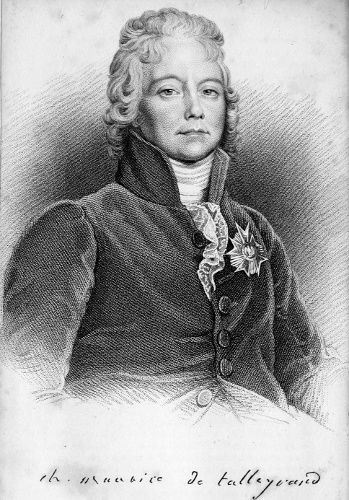
Ch. Maurice de Talleyrand Engraved by Thomson, from the Original Painting by F. Gérard
Napoleon observed that a celebrated actress (Mademoiselle Raucourt) had described him with great truth. “If you ask him a question,” said she, “he is an iron chest, whence you cannot extract a syllable; but if you ask him nothing, you will soon be unable to stop his mouth—he will become a regular gossip.”
This was a foible which, at the outset, destroyed the confidence of the Emperor, and made him waver in his opinion of T——. “I had entrusted him,” said Napoleon, "with a very important affair, and, a few hours afterwards, Josephine related it to me word for word. I instantly sent for the Minister, to inform him that I had just learned from the Empress a circumstance which I had told in confidence to himself alone. The story had already passed through four or five intermediate channels.
"T——’s countenance," added the Emperor, “is so immoveable that nothing can ever be read in it. Lannes and Murat used jokingly to say of him that if, while he was speaking to you, some one should come behind him and give him a kick, his countenance would betray no indication of the affront.”
M. de T—— is mild and even endearing in his domestic habits. His servants, and the persons in his employment, are attached and devoted to him. Among his intimate friends he willingly and good-humouredly speaks of his ecclesiastical profession. He one day expressed his dislike of a tune which was hummed in his hearing. He said he had a great horror of it; it reminded him of the time when he was obliged to practise church-music, and to sing at the desk. On another occasion, one of his intimate friends was telling a story during supper, while M. de T—— was engaged in thought, and seemed inattentive to the conversation. In the course of the story, the speaker happened to say in a lively manner of some one whom he had named, “That fellow is a comical rogue; he is a married priest.” T——, roused by these words, seized a spoon, plunged it hastily into the dish before him, and with a 66threatening aspect called out to him, “Mr. Such-a-one, will you have some spinach?” The person who was telling the story was confounded, and all the party burst into a fit of laughter, M. de T—— as well as the rest.
The Emperor, at the time of the Concordat, wished to have made M. de T.... a Cardinal, and to have placed him at the head of ecclesiastical affairs. He told him that his proper destiny was to return to the bosom of the Church, to refresh his memory, and to stop the mouths of the declaimers. T——, however, would never agree to this; his aversion to the ecclesiastical profession was insurmountable.
Napoleon was very near appointing him Ambassador to Warsaw, a dignity which he subsequently conferred on the Abbé de Pradt; but his dirty stock-jobbing tricks, as the Emperor called them, occasioned this intention to be abandoned. The Emperor was induced by the same reasons, and at the instance of several sovereigns of Germany, to deprive him of the portfolio of Foreign Affairs.
The Emperor remarked that Fouché was the T—— of the clubs, and that T—— was the Fouché of the drawing-rooms. “Intrigue,” he said, "was to Fouché a necessary of life. He intrigued at all times, in all places, in all ways, and with all persons. Nothing ever came to light but he was found to have had a hand in it. He made it his sole business to look out for something that he might be meddling with. His mania was to wish to be concerned in every thing...! Always in every body’s shoes." This the Emperor would often repeat.
At the time of the conspiracy of Georges, when Moreau was arrested, Fouché was no longer at the head of the Police, and he endeavoured to make himself very much regretted. “What stupidity!” said he, “they have arrested Moreau when he was returning to Paris from his country residence, a circumstance which at least appeared like the confidence of innocence. On the contrary, he should have been seized when he went to Gros-Bois, for then he was evidently running away.”
67The remark which he made, or which is attributed to him on the affair of the Duke d’Enghien, is well known; “It is more than a crime, it is a fault,” said he. Such traits as these paint the character of a man better than whole volumes.
The Emperor knew Fouché well, and never became his dupe. He has been much blamed for having employed him in 1815, when indeed Fouché basely betrayed him. Napoleon was not ignorant of his disposition; but he also knew that the danger depended more on the circumstances than on the individual. “If I had been victorious,” said he, “Fouché would have been faithful. He took great care, it is true, to hold himself in readiness for whatever might happen. I ought to have conquered!”
The Emperor, however, was acquainted with his underhand dealings, and he did not spare him.him. After Napoleon’s return in 1815, one of the first bankers of Paris presented himself at the Elysée, to inform him that, a few days previously, a person just arrived from Vienna had waited upon him with letters of credit, and had made enquiries respecting the means by which he could meet with Fouché. Whether from reflection or presentiment, the banker conceived some doubts respecting this individual, and accordingly came to communicate them in person to the Emperor, who was astonished that Fouché had concealed the matter from his knowledge. In the course of a few hours Réal found the person in question, and immediately brought him to the Elysée, where he was shut up in a small room by himself. The Emperor ordered him to be brought into the garden. “Do you know me?” said he to the man. This commencement, and the feelings which the Emperor’s presence inspired, greatly startled the stranger. “I am acquainted with all your proceedings,” continued Napoleon, in a tone of severity: “if you this moment confess all you know, I may pardon you; if not, you will be taken from this garden to be shot.”—"I will tell all," said the man. “I am sent hither by M. de Metternich to the Duke of Otranto, to propose that he will despatch a messenger to Bâle, who will there meet the messenger sent by M. de 68Metternich from Vienna. These,” continued he, delivering some papers, “are the marks of recognition which they are to possess.”—"Have you executed your mission to Fouché?" enquired the Emperor.—"Yes."—"Has he despatched his messenger?"—"I do not know." The man was put under confinement, and within an hour a confidential person (M. F——) was on the road to Bâle. He introduced himself to the Austrian messenger, and even held four conferences with him.
Meanwhile Fouché, who was uneasy at the non-appearance of his Vienna messenger, one day waited on the Emperor, and attempted with an air of gaiety and cheerfulness to conceal his extreme embarrassment. “There were several looking-glasses,” said the Emperor, “in the apartment, and I was much amused in studying him by stealth; the expression of his countenance was hideous; he did not know how to enter upon the subject which interested him so deeply.”—"Sire," said he at length, "a circumstance"a circumstance occurred to me four or five days ago, which I fear I was wrong in not communicating to your Majesty.... But I have so much business on my hands——I am surrounded with so many reports, so many intrigues——. A man came to me from Vienna with most ridiculous propositions,——and he is now no where to be found!"—"M. Fouché," said the Emperor, “you may injure yourself, if you take me for a fool. I have secured the man you speak of, and I have known the whole intrigue for several days. Have you sent to Bâle?”—"No, Sire."—"That is fortunate for you. If it be otherwise, and I obtain proofs of it, it may cost you your life."
Subsequent events have proved that this would have been but justice. It appears, however, that Fouché had not sent, and here the business ended.
PAPERS FROM EUROPE.—POLITICAL REFLECTIONS.
13th.—The Emperor breakfasted in the garden, and sent for us all to attend him. He resumed the reading of the papers which we had glanced at in the morning, and then proceeded to expatiate on political affairs. The 69following observations are those which most forcibly struck me.
“On the 13th Vendemiaire, the inhabitants of Paris were completely disgusted with the Government,” said the Emperor; "but the whole of the army, the great majority of the population of the departments, the lower class of citizens, and the peasantry, remained attached to it. Thus the Revolution triumphed over this grand attack of the counter-revolution, though it was only four or five years since the new principles had been promulgated. The most frightful and calamitous scenes had been witnessed; and a happier future was anticipated.
"But now how altered is the case!... If the soldier in his barracks seeks to while away the tedious hours in talking of battles, he cannot speak of Fontenoy or Prague, which he did not witness; he must speak of the victories of Marengo, Austerlitz, and Jena; of him who gained them; in short, of me, whose fame fills every mouth, and lives in every heart.
"Such a situation is unexampled in history. On whichever side it is viewed, nothing but misfortunes present themselves. What will be the result of this?... Two classes of people, inhabitants of the same soil, will become mortal, irreconcileable enemies, will be incessantly quarrelling, and will, perhaps, finally exterminate each other.
“The same fury will soon spread through Europe. The whole Continent will be composed of two hostile parties; it will be no longer divided by nations and territories, but by party-colours and opinions. Who can foresee the crisis, the duration, the details of so many troubles! The event cannot be doubtful. The present enlightened age will not retrograde in knowledge!... How unfortunate was my fall!... I had imprisoned the winds; but bayonets have released them. I could have proceeded tranquilly in the universal regeneration, which can henceforth be effected only amidst storms! My object was to amalgamate; others, perhaps, will extirpate!”
70
THE GOVERNOR’S ARRIVAL.
14th.—The rainy weather had returned; for two days it had been miserably wet. Some vessels appeared in sight; and we learnt by signals that they brought the new Governor, Sir Hudson Lowe.
The Emperor was silent and melancholy during dinner. He was not well, and he retired very early.
THE EMPEROR’S PROGRESS IN LEARNING ENGLISH.
15th.—About 12 o’clock this morning I received four letters from Europe, which rendered me as happy as I could possibly be in this place.
I saw the Emperor at five o’clock in the garden. He had taken advantage of an interval of fine weather; the rain had been pouring the whole day. I communicated to him the contents of my letters. All our party had received communications from Europe. They were delivered to us open, and they contained no news; but they proved that our friends still remembered us, and in our situation such an assurance was peculiarly gratifying.
During dinner, the Emperor described to us the contents of some French papers which he had by him, and which, he said, gave an account of the shipwreck of La Perouse, his different adventures; his death, and his journal. The narrative consisted of the most curious, striking, and romantic details, and interested us exceedingly. The Emperor observed how highly our curiosity was excited, and then burst into a fit of laughter. This story was nothing but an impromptu of his own, which he said he had invented merely to show us the progress he had made in English.
THE GOVERNOR’S FIRST VISIT.—DECLARATION REQUIRED FROM US.
16th.—The new Governor arrived at Longwood about ten o’clock, notwithstanding the rain which still continued. He was accompanied by the Admiral, who was to introduce him, and who had, no doubt, told him that this was the most suitable hour for his visit. The Emperor did not receive him; he was indisposed, and even 71had he been well, he would not have seen him. The Governor, in this abrupt visit, neglected the usual forms of decorum. It was easy to perceive that this was a trick of the Admiral’s. The Governor, who probably had no intention to render himself at all disagreeable, appeared very much disconcerted. We laughed in our sleeves. As for the Admiral, he was quite triumphant.
The Governor, after long hesitation and very evident marks of ill-humour, took his leave rather abruptly. We doubted not that this visit had been planned by the Admiral, with the view of prepossessing us against each other at the very outset. But whether the Governor himself had any concern in it, or entertained any suspicion of its design, is a question which time will decide.
About half-past five, the Emperor sent for me to attend him in the garden. He was alone. He told me that a circumstance had arisen which regarded us all individually. It had been determined to require a declaration from each of us, stating whether we chose rather to unite our fate with that of the Emperor, or to be removed from St. Helena and set at liberty.
We could not guess the motive of this determination. Was it adopted by the English Ministry for the sake of procuring regular documents? But at the time of our departure from Plymouth, this preliminary condition was perfectly understood. Was it hoped by this means to separate the Emperor more completely from the world? But could it ever be supposed that we would forsake him?
He asked what would be my determination on this point. I replied that it could not be for a moment doubtful; that if I ever felt a pang, it must have been at the moment of my first determination; that from that instant my fate had been irrevocably fixed. I had at first obeyed only the dictates of glory and honour; but in every succeeding day I had indulged my natural affection and feelings. The Emperor’s voice assumed a milder tone; and this was the mode in which he expressed his thanks. I knew his heart, and the full extent of his gratitude.
72I added that there was but little merit in my resolution. No change could take place in our situations. The day after having signed the document, we should be the same as we had been the day before. Our fate depended not on human combinations, but on the course of events. It would be very unwise to add to our troubles by calculations beyond the reach of human foresight. It is our duty calmly to resign ourselves to the mysterious decrees of Fate; and, in the depth of our misfortune, to comfort ourselves with the reflection that our minds are free from self-reproach. This is a consolation which it is beyond the power of man to enfeeble or to destroy.
CHARACTERISTIC CONVERSATION.—THE EMPEROR’S RETURN FROM ELBA FORESEEN AT THE TIME OF HIS DEPARTURE FROM FONTAINEBLEAU.—THE GOVERNOR’S INTRODUCTION.—MORTIFICATION EXPERIENCED BY THE ADMIRAL.—OUR CAUSES OF COMPLAINT AGAINST HIM.—DESCRIPTION OF SIR HUDSON LOWE.
17th.—The Emperor sent for me at nine o’clock. He read to me an article in the Portsmouth Courier, which gave a very long and faithful description of his residence at Briars.
He sent for me again in the middle of the day to converse with him. One part of the conversation affords so valuable a development of Napoleon’s character that I cannot refrain from noting down some passages of it.
There occasionally arose among us transient misunderstandings and disputes, which vexed and annoyed the Emperor. He adverted to this topic. He analysed our situation with his usual train of reasoning. He calculated the miseries and horrors of our exile, and pointed out the best mode of alleviating them. He said that we ought to make mutual sacrifices, and overlook many grievances; that man can only enjoy life by controlling the character given to him by nature, or by creating to himself a new one by education, and learning to modify it according to the obstacles which he may encounter.
73“You should endeavour to form but one family,” said he. “You have followed me only with the view of assuaging my sorrow. Ought not this feeling to subdue every other consideration? If sympathy alone is not sufficiently powerful, let reason be your guide. You should learn to calculate your sorrows, your sacrifices, and your enjoyments, in order to arrive at a result, just as we make additions or subtractions in every kind of calculation. All the circumstances of our lives should be submitted to this rule.... We must learn to conquer ill temper. It is natural enough that little misunderstandings should arise among you; but they should be followed by explanation, and not succeeded by ill-humour; the former will produce a result, the latter will only render the affair more complicated. Reason and logical inference should, in this world, be our constant guides.” He then proceeded to show how he had sometimes acted up to these principles, and sometimes departed from them. He added that we ought to learn to forgive, and to avoid that hostility and acrimony which must be offensive to our neighbours and prejudicial to our own happiness; that we ought to make allowance for human frailties, and humour, rather than oppose, them.
“What would have become of me,” said he, "had I not followed these maxims? It has often been said that I have been too good-natured, and not sufficiently cautious; but it would have been much worse for me had my disposition been the reverse of what it is. I have been twice betrayed, it is true; and I may be betrayed a third time. But it was my knowledge of human character, and the spirit of reasonable indulgence which I had adopted, that enabled me to govern France; and which still perhaps render me the fittest person to rule that nation, under existing circumstances. On my departure from Fontainebleau, did I not say to all who requested me to point out the line of conduct they should pursue, ‘Go, and serve the King!’ I wished to grant them lawful authority for doing what many would not have hesitated to do of their own accord. I would not allow the fidelity of some to be the cause of their ruin; 74and finally, above all, I did not wish to have any one to censure on my return."
I here ventured, contrary to my constant custom, to call the Emperor, in some measure, to account. “How, Sire,” I exclaimed, “had your Majesty any idea of returning when you left Fontainbleau?”—"Yes, certainly, and by the simplest reasoning. If the Bourbons, said I, intend to commence a fifth dynasty, I have nothing more to do here; I have acted my part. But, if they should obstinately attempt to re-continue the third, I shall soon appear again. It may be said that the Bourbons then had my fame and conduct at their own disposal. It was in their power still to represent me in the eyes of the common mass of mankind as an upstart, a tyrant, a fire-brand, and a scourge. How much good sense and calm reflection would have been necessary to appreciate my real character, and render me justice!... But the men by whom the Bourbons were surrounded, and the erroneous line of conduct they pursued, rendered my presence desirable; they restored my popularity and decreed my return. I should otherwise have ended my days on the Island of Elba, and this would doubtless have proved most to the interest of all parties. I returned to discharge a great debt, and not for the sake of resuming possession of a throne. Perhaps few will comprehend the motive by which I was actuated; no matter. I took upon myself a heavy charge, but it was a duty I owed to the French people. Their complaints reached me; and how could I turn a deaf ear to them?
"Upon the whole, my situation in the Island of Elba was sufficiently enviable and agreeable. I should soon have created to myself a new kind of sovereignty. All that was most distinguished in Europe began to pass in review before me. I should have presented a spectacle unknown in history: that of a monarch who had descended from his throne, beholding the civilized world thronging to file off before him.
“It may indeed be objected that the Allies would have removed me from my Island; and I admit that this circumstance hastened my return. But had France been wisely governed, had the French people been content 75my influence would have ended; I should henceforth have belonged only to history, and the cabinet of Vienna would have entertained no idea of deposing me. It was the agitation created and maintained in France that first gave rise to the thought of my removal.”
Here the Grand Marshal entered the Emperor’s apartment. He came to announce the arrival of the Governor, who was escorted by the Admiral, and followed by the whole of his staff.
After some further conversation, Bertrand was left alone with the Emperor, and I proceeded to the antechamber; here all the suite was assembled. We endeavoured to exchange a few words with each other; but we were rather bent on observing than conversing.
In about half an hour, the Emperor entered the drawing-room. The valet-de-chambre on duty, who was stationed at the door within the apartment, then summoned the Governor, and he was introduced. The Admiral was following close behind him. The valet who had heard only the Governor’s name mentioned, suddenly closed the door without admitting the Admiral, who was shut out in spite of his remonstrance; and he withdrew quite disconcerted into the recess of one of the windows. The valet de chambre who was the cause of this affront, was Noverraz, a Swiss, a good and faithful servant, of whom the Emperor frequently said that his whole understanding was absorbed in his attachment to his master.
We were astonished at this unexpected occurrence; and we at first concluded that Noverraz had acted in obedience to the Emperor’s wishes. Though we had ample reason to complain of the Admiral, yet we did all in our power to relieve him from his embarrassment; his awkward situation distressed us. Meanwhile the Governor’s staff was summoned and introduced; and this circumstance served only to increase the Admiral’s confusion. In about a quarter of an hour the Emperor took leave of his visitors. The Governor came out of the drawing-room, and the Admiral eagerly advanced to meet him. They said a few words to each other with some degree of warmth, then took leave of us and departed.
76We joined the Emperor in the garden, and our conversation turned on the Admiral’s discomfiture. The Emperor knew nothing of the matter. The whole circumstance was solely the effect of chance. The Emperor declared himself delighted with the joke. He burst into a fit of laughter, rubbed his hands, and exhibited the joy of a child, of a school-boy, who had successfully played off a trick on his master. “Ah! my good Noverraz,” said he, “you have done a clever thing for once in your life. He had heard me say that I would not see the Admiral again, and he thought he was bound to shut the door in his face. But this honest Swiss may perhaps carry the joke too far; if I were unfortunately to say we must get rid of the Governor, he would be for assassinating him before my eyes. After all,” said the Emperor, assuming a more serious tone, "it was entirely the Governor’s fault. He should have requested that the Admiral might be admitted, particularly as he had informed me that he could be presented only by him. Why, again, did he not request the Admiral’s admission when he presented his officers to me? He is solely to blame. But," continued he, “the Admiral has lost nothing by the mistake. I should without hesitation have apostrophized him in the presence of his countrymen. I should have told him that by the sentiment attached to the honourable uniform which we had both worn for forty years, I accused him of having, in the eyes of the world, degraded his nation and his Sovereign by wantonly and stupidly failing in respect to one of the oldest soldiers in Europe. I should have reproached him with landing me at St. Helena just as he would have landed a convict at Botany-Bay. I should have assured him that a man of true honour would shew me more respect on my rock than if I were still on my throne and surrounded by my armies.” The force and spirit of these remarks put a period to our gaiety, and closed the conversation.
As I have thus alluded to the Admiral, and as he is now about to quit us, I will once for all sum up the insults with which we have to reproach him, with as much impartiality as our situation and the state of our feelings will admit of.
77We cannot pardon the affected familiarity with which he treated us, though our conduct afforded but little encouragement to it. Still less can we forgive him for having endeavoured to extend this familiarity to the Emperor. We can never forget the haughty and self-complacent air with which he addressed Napoleon by the title of General. The Emperor, it is true, has immortalized that title; but the tone and the intention with which it was applied were sufficiently insulting.
On our arrival at St. Helena, he lodged the Emperor in a little room, a few feet square, where he kept him for two months, though other residences could have been procured, and there was one which the Admiral had himself fixed upon. He indirectly prohibited the Emperor from riding on horseback, even in the grounds surrounding the Briars; and the individuals of the Emperor’s suite were loaded with embarrassments and humiliations, when they came to pay their daily visits to him in his little cell.
On our removal to Longwood, he stationed sentinels under the very windows of the Emperor; and then, by an evasion, which savoured of the bitterest irony, he alleged that this step had been taken only with a view to the General’s own advantage and protection. He suffered no one to come near us without a note from him, and, having thus placed us in close confinement, he declared that these arrangements had been made solely to secure the Emperor against importunity, and that he (the Admiral) was merely acting the part of Grand Marshal. He gave a ball, and sent a written invitation to General Buonaparte, in the same manner as he did to every individual in the suite. He replied with the most unbecoming jeers to the notes of the Grand Marshal, who used the title of Emperor, saying that he knew no Emperor at the Island of St. Helena, nor any such Sovereign in Europe, or elsewhere, who was not in his own dominions. He refused to forward a letter from the Emperor to the Prince Regent, unless it were delivered to him open, or he were permitted to read it. He even stifled the sentiments and expressions of respect which other individuals manifested for Napoleon. We were 78assured that he had put persons in inferior situations under arrest, merely for having used the title of Emperor or other similar expressions; which, however, were frequently employed in the 53rd regiment, doubtless, as the Emperor observed, through an irresistible sentiment with which these brave men were inspired.
The Admiral, from his own personal caprice, had limited the extent of our rides and walks. On this subject he had even broken his word to the Emperor. At a moment when he appeared somewhat inclined to make concessions, he had assured Napoleon that he was free to ride in all parts of the Island, without being annoyed even by the sight of the English officer appointed to guard him. But a few days after this, just as Napoleon was on the point of mounting his horse to ride out to breakfast in a shady spot at some distance from our residence, he found himself under the necessity of renouncing this little enjoyment. The officer declared that he must henceforth form one of the party and ride close to him. From that moment the Emperor refused to see the Admiral. The latter had moreover neglected the most ordinary forms of decorum, always fixing upon unsuitable hours for his own visits, and directing strangers who arrived at the Island to select the same unseasonable periods for visiting the Emperor. This was no doubt done with a view of preventing people from gaining access to Napoleon, who constantly refused to be seen on these occasions. It has already been stated that the Admiral acted thus when the Governor paid his first visit to Longwood; and the satisfaction he evinced at the Governor’s ill reception but too plainly betrayed his design.
However, if we were required to pronounce an impartial opinion on him, making allowance for the irritability of our own feelings and the delicacy of his situation, we should not hesitate to declare that our grievances rested in forms rather than facts. We should say, with the Emperor, who had after all a natural predilection for him, that Admiral Cockburn is far from being an ill-disposed man, that he is even susceptible of generous and delicate sentiment; but that he is capricious, irascible, 79vain, and overbearing: that he is a man who is accustomed to authority, and who exercises it ungraciously; frequently substituting energy for dignity. To express in a few words the nature of our relations with respect to him, we should say, that, as a jailor, he was mild, humane, and generous, and that we have reason to be grateful to him; but that, as a host, he was generally unpolite, often something worse, and that in this character we have cause to be displeased with him.
About two or three o’clock, the Emperor took his usual airing. During our walk in the garden and our ride in the calash, he said a good deal about the events of the morning; and the conversation on this subject was resumed after dinner. Some one jokingly observed that the two first days of the Governor’s arrival had been like days of battle, and were calculated to make us appear very untractable, though we were naturally most patient and accommodating. At these last words, the Emperor smiled and pinched the ear of the individual who made the remark.
The conversation then turned on Sir Hudson Lowe. He was described as being a man about forty-five years of age; of the ordinary height, and of slender make, with red hair, a ruddy complexion, and freckled. His eyes were said to have an oblique kind of expression; glancing askance, seldom fixed full in a person’s face; surmounted by fair, bushy, and very prominent eyebrows. “He is hideous,” said the Emperor, "he has a most villainous countenance. But we must not decide too hastily; the man’s disposition may perhaps make amends for the unfavorable impression which his face produces; this is not impossible."
CONVENTION OF THE SOVEREIGNS RESPECTING NAPOLEON.—REMARKABLE OBSERVATIONS.
18th. The weather had been horrible for some days past, but it cleared up a little to-day. The Emperor went out early to take his walk in the garden; about 4 o’clock he got into the calash and took rather a longer airing than usual. Before dinner the Emperor desired me to translate to him the Convention of the 80Allied Sovereigns relative to his captivity. It was as follows:—
CONVENTION BETWEEN GREAT BRITAIN, AUSTRIA, PRUSSIA, AND RUSSIA.—Signed at Paris, August 20th, 1815.
"Napoleon Bonaparte being in the power of the Allied Sovereigns, their Majesties the King of the United Kingdom of Great Britain and Ireland, the Emperor of Austria, the Emperor of Russia, and the King of Prussia, have agreed, by virtue of the stipulations of the treaty of the 25th of March, 1815, on the measures best calculated to preclude the possibility of his making any attempt to disturb the peace of Europe.
"Art. I.—Napoleon Bonaparte is considered by the Powers who signed the treaty of the 20th of March last, as their prisoner.
"Art. II.—His safeguard is specially intrusted to the British Government.
"The choice of the place and the measures which may best ensure the object of the present stipulation, are reserved to his Britannic Majesty.
"Art. III.—The imperial courts of Austria and Russia and the Royal court of Prussia shall appoint Commissioners to reside in the place which his Britannic Majesty’s Government shall assign as the residence of Napoleon Bonaparte, and who, without being responsible for his security, shall assure themselves of his presence.
"Art. IV.—His most Christian Majesty is invited in the name of the four Courts above mentioned, also to send a French commissioner to the place of Napoleon Bonaparte’s detention.
"Art. V. —His—His Majesty the King of the United Kingdom of Great Britain and Ireland pledges himself to fulfil the engagements assigned to him by the present convention.
"Art. VI.—The present convention shall be ratified, and the ratification shall be exchanged in the space of a fortnight, or sooner if possible.
"In virtue of which the respective Plenipotentiaries 81have signed the present convention, and have affixed their seals thereto.
“Given at Paris on the 20th of August, in the year of our Lord 1815.”
When I had finished translating this document, the Emperor asked me what I thought of it.
“Sire,” I replied, "in the situation in which we are placed, I would rather depend on the interests of a single one, than on the complicated decision of four. England has evidently dictated this treaty. You see how carefully she stipulates that she alone shall answer for and dispose of the prisoner. She has been labouring to provide herself with the lever of Archimedes, and therefore it is not probable that she w¡ll entertain any idea of breaking it."
The Emperor, without explaining his ideas on this subject, adverted to the different chances which might bring about his liberation from St. Helena, and he made the following remarkable observations: “If the Sovereigns of Europe act wisely, and should succeed in completely restoring order, we shall not be worth the money and the trouble which it must cost to keep us here, and they will get rid of us. But our captivity may still be prolonged for some years, perhaps three, four, or five. Otherwise, setting aside the fortuitous events which are beyond the reach of human foresight, I calculate only on two uncertain chances of our liberation: first, that the Sovereigns may stand in need of me to assist in putting down rebellion among their subjects; and secondly, the people of Europe may require my aid in the contest that may arise between them and their monarchs. I am the natural arbiter and mediator in the immense conflict between the present and the past. I have always aspired to be the supreme judge in this cause. My administration at home and my diplomacy abroad all tended to this great end. The issue might have been brought about more easily and promptly; but fate ordained otherwise. Finally, there is a last chance, which perhaps is the most probable of all; I may be wanted to check the power of the Russians; for, in less than ten years, all Europe may 82perhaps be overrun with Cossacks, or subject to republican government. Such however are the statesmen who brought about my overthrow.” Then, reverting to the decision of the Sovereigns respecting him, he observed that it was difficult to account for the style of the document, and the malignant spirit which pervaded it.
“The Emperor Francis,” said he, “is a pious sovereign, and I am his son-in-law.—As for Alexander, we once loved each other. With regard to the King of Prussia, I doubtless did him much harm, but I might have done him much more; and after all, might he not have found real glory and self-satisfaction in distinguishing himself by generosity? As to England, it is to the animosity of her Ministers that I am indebted for all. But it remained for the Prince Regent to observe and interfere, or to be branded as a fool, and a protector of vulgar malignity.—One thing however is certain, namely: that the Allied Sovereigns have compromised, degraded, and lost themselves, by their treatment of me.”
THE DECLARATION REQUIRED FROM US BY THE GOVERNOR.
19th.—This morning the Grand Marshal and Madame Bertrand came into the garden, in consequence of the Emperor having expressed an intention of breakfasting there; but as he had passed a very restless night, and had had no sleep, he breakfasted in his chamber.
The Governor gave us official notice that we must each send him a declaration, expressing our voluntary determination to remain at Longwood, and to submit to all the restrictions which Napoleon’s captivity might require. Mine was as follows:—
Declaration.—"I, the undersigned, repeat the declaration which I made when in Plymouth-roads; namely, that I wish to devote myself to the fate of the Emperor Napoleon, to accompany him, to follow him, and to alleviate, as far as lies in my power, the unjust treatment he experiences, through the most unheard-of violation of the law of nations, of which I am the more particularly sensible as it was I who conveyed to him the offer and assurance of Captain Maitland of the Bellerophon, purporting 83that he had orders to receive the Emperor and his suite under the protection of the British flag, if agreeable to him, and to convey him to England.
"The Emperor Napoleon’s letter to the Prince Regent, which is known to all England, and which I had previously communicated to Captain Maitland, without his having made the slightest observation on it, explains to the world much better than any thing I can say how frankly the Emperor met this offer of hospitality, and, consequently, how much he has been the dupe of his sincerity and confidence.
"Notwithstanding the experience I have had of the horrors of a residence on the Island of St. Helena, which is so prejudicial to the Emperor’s health, and to that of every European, and though, during the six months which we have passed on the island, I have been subjected to every species of privation, which I myself daily multiply, in order to avoid, as much as possible, the violation of that respect which my rank and habits demand, yet, constant to my first sentiments, and resolved that for the future no fear of misfortune, or hope of advantage, shall separate me from the Emperor Napoleon, I repeat my desire to remain with him, and to submit to whatever restrictions may be arbitrarily imposed on him."
FAREWELL VISIT OF THE LATE GOVERNOR.—INTERESTING CONVERSATION.—REMARK OF AN OLD ENGLISH SOLDIER.
20th.—Colonel Wilks, being on the eve of his departure for Europe, called with his daughter to take leave of the Emperor. The young lady was presented by Madame Bertrand. I have already mentioned that Colonel Wilks had formerly been Governor of the Colony, for the East India Company; he was succeeded by the Admiral, in the King’s name, when, in consequence of our removal to St. Helena, the island was transferred from the possession of the Company to that of the Government.
The Emperor was in a remarkably cheerful humour. He conversed for some time with the ladies, and then took Colonel Wilks aside to the recess of one 84of the windows, whither I followed to serve as interpreter.
Col. Wilks, as I have probably mentioned before, was for a long time the diplomatic agent of the Company in the Indian Peninsula; he has written a history of that country. He is a man of extensive information, and possesses great knowledge of chemistry. Thus he was at once a soldier, an author, a diplomatist, and a chemist. The Emperor put questions to him relative to all these subjects, and treated them himself with great fluency and spirit. The conversation was lively and varied; and it was maintained for upwards of two hours. The following are the principal particulars which I noted down. I shall probably in some measure repeat what I have said before, for the Emperor and Colonel Wilks had, some months ago, a long conversation on precisely the same topics; but that is of no importance; these subjects are so interesting that I would rather incur the risk of repeating than of losing any thing connected with them.
The Emperor began by speaking of the English army, its organization, and particularly its system of promotion. He compared it with the French army, and repeated what I have formerly stated with regard to the excellent composition of our military force, the advantage of the Conscription, and the bravery of our troops. Then, turning to the subject of politics, he said, “You lost America by liberation: you will lose India by invasion. The first loss was perfectly natural; as children advance in years, they break the parental bonds. But, for the Hindoos, they are not advancing at all. They still remain children. The catastrophe, therefore, can only proceed from without. You are not aware of all the dangers with which you were threatened by my arms or my negotiations. As for my Continental system, you perhaps laughed at it?” “Sire,” replied the Colonel, “we affected to do so, but all men of judgment felt the full force of it.”—"Well," continued the Emperor, "I stood alone in my opinion on the Continent; and I was forced for the moment to employ violence every where. At length my plan began to be understood. The 85tree already bears its fruit. I made the beginning; time will do the rest.... Had I maintained my power, I would have changed the course of trade, and the direction of industry. I had naturalized sugar and indigo in France, and I should have naturalized cotton, and many other articles of foreign produce. I should have knocked up the Colonies, if we had continued to be denied a share of them.
“With us the impulse was most powerful. National prosperity and science advanced beyond measure. Yet your Ministers proclaimed through all Europe that the French were overwhelmed with misery, and were retrograding to a state of barbarism. Thus the view of our internal prosperity strangely surprised the vulgar mass, and even disconcerted the more thinking portion of the European public. The strides of knowledge in France were gigantic. The ideas of the French people were every where properly directed and extended. We took pains to render science popular. I was informed that your countrymen were distinguished for their knowledge of chemistry; and yet I will not decide on which side of the water the most able chemist will be found.”—"In France," said the Colonel immediately.
“It is of little importance,” continued the Emperor; “but I maintain that in the mass of the French people there is ten, and perhaps a hundred, times more chemical knowledge than in England; because the manufacturing classes now employ that science in their daily labour. This was one of the characteristics of my school. Had I been allowed sufficient time, there would soon have been no such thing as trades in France; they would all have been converted into arts.”
The Emperor concluded with these remarkable observations: "England and France held in their hands the fate of the world; and particularly that of European civilization. What injury have we not done to each other!——What good might we not have done! Under Pitt’s system, we desolated the world; and what has been the result? You imposed on France a tax of fifteen hundred millions of francs, and raised it by means of Cossacks. I laid a tax of seven thousand millions on 86you, and made you raise it with your own hands, by your Parliament. Even now, after the victory you have obtained, who can tell whether you may not sooner or later sink under the weight of such a burden?——With Fox’s system, we should have understood each other; we should have accomplished and preserved the emancipation of nations, the dominion of principles. Europe would have presented but a single fleet and a single army. We might have ruled the world. We might every where have established peace and prosperity, either by dint of force or persuasion. Yes, I repeat it, what mischief have we not done! What good might we not have effected!"
Never was Napoleon in a more talkative humour. He laughed more than once at the endeavours I made to keep up with the volubility with which he uttered his observations. As for the Colonel, he took his leave, amazed and confounded by what he had heard.
When he was gone, the Emperor continued to converse for a long time in the drawing-room. He afterwards went into the garden, in spite of the bad weather, and sent for us all to join him. He was desirous of reading the declarations which we had made; they became the subject of conversation.
Four ships arrived here to-day from Europe. They had on board the 66th regiment, and had left England before the Phaëton, which brought the new Governor, Sir Hudson Lowe.
After dinner, the Emperor good-humouredly related the remark made by an old soldier of the 53rd, who, having seen him yesterday for the first time, went back to his comrades and said,—"What lies they told me about Napoleon’s age; he is not old at all; the fellow is still young enough for at least sixty campaigns." We thought this expression savoured very much of the Frenchman, and we laid claim to it as having proceeded from one of our grenadiers. We then related to him a number of bons-mots made by our soldiers during his absence and on his return, with which he was much entertained. But what particularly excited his risibility was the answer made by a grenadier at Lyons. A grand 87review was held there, just after the Emperor had landed on his return from Elba. The Commanding Officer remarked to his soldiers that they were well clothed and well fed, that their pay might be seen upon their persons:—"Yes, certainly," replied the grenadier to whom he addressed himself.—"Well!" continued the officer, with a confident air, “it was not so under Bonaparte. Your pay was in arrear, he was in your debt?”—"And what did that signify," said the grenadier smartly, “if we chose to give him credit?”
THE EMPEROR’S MESSAGE TO THE PRINCE REGENT.—CHARACTERISTIC REMARKS.—PORTFOLIO LOST AT WATERLOO.—ON AMBASSADORS.—M. DE NARBONNE.—NAPOLEON ON THE POINT OF BEING TAKEN PRISONER IN GERMANY AFTER THE BATTLE OF MOSCOW.—COST OF THE EMPEROR’S TOILET.—EXPENSE OF A FAMILY ESTABLISHMENT IN THE DIFFERENT CAPITALS OF EUROPE.—THE FURNISHING OF NAPOLEON’S HOUSE IN THE RUE DE LA VICTOIRE.—THE FITTING UP OF THE IMPERIAL PALACES.—THE EMPEROR’S METHOD OF EXAMINING HIS ACCOUNTS.
21st.—The Emperor sent for me to attend him in the garden, about four o’clock, to act as interpreter. Captain Hamilton, the Commander of the Havannah frigate, was to sail next day for Europe, and, with his officers, had come to take leave of the Emperor. Captain Hamilton spoke French. When I joined the party in the garden, the Emperor was expressing himself with warmth.
“They wish to know what I desire?” said he; “I demand my liberty or death. Report these words to your Prince Regent. I no longer ask to hear from my son, since they have had the barbarity to leave my first request unanswered.... I was not your prisoner. Savages would have had more respect for my situation. Your Ministers have basely violated in my person the sacred rights of hospitality; they have for ever dishonoured England!”
Captain Hamilton having ventured to observe that Napoleon was not the prisoner of England alone, but of all the Allied Powers, the Emperor warmly resumed; 88“I did not deliver myself up to Russia, there I should doubtless have been well received; I did not surrender myself to Austria, there I should have been equally well treated; but I delivered myself up, of my own free will and choice, to England, because I had confidence in her laws and her public morals. I have been cruelly deceived! But Heaven will avenge my wrongs; and, sooner or later you will meet the punishment of a deed for which mankind already reproaches you!——Repeat all this to the Prince Regent, sir.” He accompanied these last words with a motion of his hand, and dismissed the Captain.
We walked about for a few minutes, and on the return of the Grand Marshal, who had accompanied Captain Hamilton a short distance, we thought that it would be proper to leave him alone with the Emperor; but I had scarcely entered my room when he sent for me. He was alone, in his own apartment; he asked me whether I had not had enough of retirement during the day. I told him that a feeling of respect and discretion had alone induced me to leave him. To this he answered that there was no occasion for it, as nothing had passed that he wished to make a secret of. “Besides,” added he, “a certain degree of freedom and ease is not without its charm.” These words, which fell carelessly from Napoleon’s lips, may better serve to show his character than hundreds of pages.
We then perused an English publication, containing the official documents found in his portfolio, which was taken at Waterloo. The Emperor was astonished himself at the number of orders which he had issued almost at the same moment, and the countless details which he had directed in every quarter of the empire. “This publication,” said he, “can do me no harm, after all. It will at least satisfy every one that its contents are not the production of a sluggard. They will compare me with the legitimate Sovereigns, and I shall not suffer by the comparison.”
After dinner, the Emperor conversed on several unconnected subjects. In speaking of his Ambassadors, he said that he considered M. de Narbonne as the only one 89who had fully deserved that title, and had really fulfilled the duties of his office. “And that,” said he, “by the peculiar advantages, not only of his talents, but of his old-fashioned morals, his manners, and his name. When an Ambassador has merely to prescribe, any one may fill the post; one person is just as good as another; perhaps an aide-de-camp is the best man that can be chosen.chosen. But when it is necessary to negotiate, the affair is widely different. In that case it is indispensable to present to the old aristocracy of the Courts of Europe, only the elements of that aristocracy, which, in fact, constitutes a sort of free-masonry. If an Otto or an Andreossi were to enter the saloons of Vienna, there would be a stop to the interchange of opinion; habitual manners would cease. They would be regarded as intruders and profaners, and the mysteries of diplomacy would be suspended. But how different would it be with a Narbonne, possessing the advantages of affinity, sympathy, and identity! A lady of the old nobility would perhaps resign her person to a plebeian, though she would not discover to him the secrets of the aristocracy.”
The Emperor was much attached to M. de Narbonne, and regretted him deeply. He had made him his aide-de-camp, he observed, only because Maria Louisa, through the intrigues of the persons composing her suite, had refused to let him be appointed her gentleman of honour; a post for which he was perfectly adapted. “Until the period of his embassy,” continued the Emperor, “we had been duped by Austria. In less than a fortnight, M. de Narbonne penetrated all the secrets of the cabinet of Vienna, and M. de Metternich was deeply mortified at the appointment. However, by a singular fatality, perhaps, even the success of M. de Narbonne thwarted my views. I found that his talent was no less fatal than useful. Austria, supposing that her designs were guessed, threw aside the mask, and took precipitate steps. Had less penetration been shewn on our part, she would have acted with greater reserve and deliberation. She would have prolonged her natural indecision, and in the interim other chances might have risen up.”
90Some one present having alluded to the embassies of Dresden and Berlin, and being apparently inclined to attach blame to our diplomatic agents in those courts, at the period of the return from Moscow, the Emperor replied that, at that period, the fault was not to be attributed to persons, but to things; that with a single glance any one might have foreseen what would happen; and that, for his part, he had not been deceived for a moment. He added that if he had not in person conducted the army back to Wilna, and into Germany, it was through the fear of not being able himself to reach France. He wished, he said, to obviate this imminent danger by the boldness of his movements in crossing Germany rapidly and alone. He was, however, on the point of being taken in Silesia: “but luckily,” said he, "the Prussians were deliberating at the moment when they ought to have been acting. Their conduct in this respect was like that which the Saxons observed towards Charles XII., who said, when he quitted Dresden on a similar occasion;—‘You‘You will see that they will hold a consultation to-morrow upon the expediency of having detained me to-day.’”to-day.’”
Before dinner the Emperor called me into his closet to go over some English exercises with him. He told me that he had just been calculating the expenses of his toilet, and that it cost him about four napoleons per month. We laughed at the immensity of the budget. He talked of ordering some clothes, shoes, boots, &c. from the tradesmen in Europe who had his measures. I thought that this would be attended with serious inconvenience, and, after some consideration, we were convinced that it would never be permitted.
“It is, however,” observed the Emperor, “extremely vexatious to be thus deprived of money; and I wish to come to some settlement on this point. As soon as the bill, which is to determine our situation here, shall be notified to me, I intend to make arrangements for receiving an annual loan of seven or eight millions of napoleons from Eugene. He cannot refuse me. He has received from me perhaps upwards of forty-millions; and it would be an insult to his sentiments to doubt his 91readiness to serve me. Besides, we have long accounts to settle together. I am sure, if I had appointed a committee of my Councillors of State to draw up a report on this subject, they would have presented me with a balance of at least ten or twelve millions against Eugene.”
At dinner the Emperor asked us some questions respecting the sum necessary to enable a bachelor to live in a European capital, or for the support of a plain family establishment, or the maintenance of a family in a style of elegance. He is fond of these questions and calculations; he treats them with great shrewdness, and enters into the most curious details.
We each presented our budgets, and agreed that a residence in Paris would cost 15,000, 40,000, and 100,000 francs. The Emperor dwelt much on the prices of various articles, and even on the prices of the same articles, as they are charged to different persons, and under different circumstances.
“When I was about to leave the army of Italy,” said he, “to return to Paris, Madame Bonaparte wrote to inform me that she had furnished, in the best possible style, a small house that we had in the Rue de la Victoire. The house was not worth more than 40,000 francs. What was my surprise and vexation to find that the drawing-room furniture, which, after all, appeared to me nothing out of the way, was charged at the enormous rate of between 120 and 130,000 francs. In vain did I remonstrate; I was obliged to pay the amount. The upholsterer showed me the directions he had received, and which required that every article should be the very best in its kind. Every thing had been made after new designs, and the designs themselves had been invented expressly for the fitting up of my house. Any judge of the case must have condemned me.”
The Emperor then adverted to the extravagant charges made for furnishing the imperial Palaces, and the vast saving which he had made on this point. He told us the price of the throne, the imperial ornaments, &c. Nothing could be more curious than to hear him detail these charges, together with his own plans of economy. How much I regret not having noted them down at the 92time! The following particulars will serve to show some of the methods which he adopted for ascertaining the correctness of the accounts that were presented to him:—
On one occasion, when he returned to the Tuileries, which had been magnificently fitted up during his absence, those about him were anxious to direct his attention to all the new furniture and decorations. After expressing his satisfaction at every thing he saw, he walked up to a window overhung with a rich curtain, and, asking for a pair of scissars, cut off a superb gold acorn which was suspended from the drapery, and coolly putting it into his pocket, he continued his inspection to the great astonishment of all present, who were unable to guess his motive. Some days afterwards, at his levee, he drew the acorn from his pocket and gave it to the person who superintended the furnishing of the palace. “Here,” said he, “Heaven forbid that I should think you rob me; but some one has doubtless robbed you. You have paid for this at the rate of one-third above its value. They have dealt with you as though you had been the steward of a great nobleman. You would have made a better bargain if you had not been known.” The fact was that Napoleon, having walked out one morning in disguise (as he was often in the habit of doing), called at some of the shops in the Rue Saint Denis, where he enquired the price of ornaments similar to that which he had cut from the curtain, and enquired the value of various articles of furniture like those provided for the palace, and thus, as he said, he arrived at the result in its simplest form. Every one knew his habits in this respect. These, he said, were his grand plans for ensuring domestic economy, which, notwithstanding his extreme magnificence, was carried to the utmost degree of precision and regularity.
In spite of his numerous occupations he himself revised all his accounts; but he had his own method of doing this, and they were always presented to him in their details. He would cast his eye on the first article, sugar for example, and, finding some thousands of pounds set down, he would take a pen, and say to the person who 93drew up the accounts: “How many persons are there in my household?”—"Sire, so many:" (and it was necessary to give the answer immediately.)—"And how many pounds of sugar do you suppose they consume per day on an average?"—"Sire, so many."—He immediately made his calculation, and, having satisfied himself, he would give back the paper, saying, “Sir, I have doubled your estimate of the daily consumption, and yet you are enormously beyond the mark. Your account is erroneous. Make it out again, and let me have greater correctness.” This reproof would be sufficient to establish the strictest regularity. Thus he sometimes said of his private, as of his public, administration, “I have introduced such order, and employed so many checks, that I cannot be much imposed on. If I am wronged at all, I leave the guilty person to settle the matter with his own conscience. He will not sink under the weight of his crime, for it cannot be very heavy.”