Volume 2 — SIMON FRASER, LORD LOVAT.
Reading edition
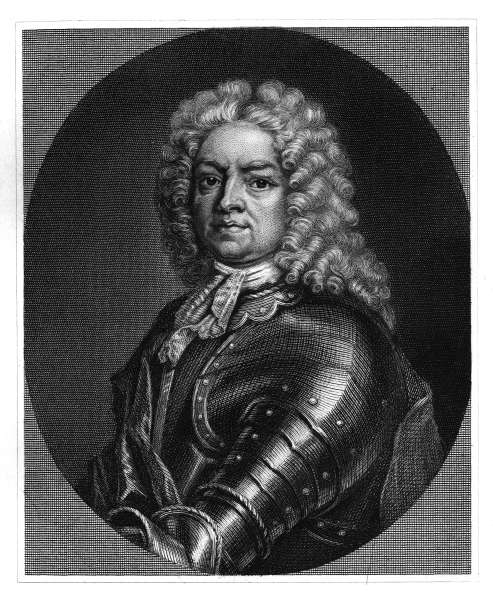
Le Clare, pinxt.Cook, sculpt.
SIMON FRASER,
LORD LOVAT, CHIEF OF THE CLAN FRASER.
The memoirs of Simon Fraser, Lord Lovat, have been written in various forms, and with a great diversity of opinions. Some have composed accounts of this singular, depraved, and unfortunate man, with the evident determination to give to every action the darkest possible tinge; others have waived all discussion on his demerits by insisting largely upon the fame and antiquity of his family. He has himself bequeathed to posterity an apology for his life, and from his word we are bound to take so much, but only so much, as may accord with the statements of others in mitigation of the heinous facts which blast his memory with eternal opprobrium.
As far as the researches into the remote antiquity of Scotland may be relied upon, it appears that the name of Fraser was amongst the first of those which Scotland derived from Normandy, and the origin of this name has been referred to the remote age of Charles the Simple. A nobleman of Bourbon—such is the fable,—presented that monarch with a dish of strawberries. The loyal subject, who bore the name of Julius De Berry, was knighted on the spot, and the sirname of Fraize was given him in lieu of that which he had borne. Hence the ancient armorial bearing of the Frasers, a field azure, semé with strawberries: and hence the widely-spreading connection of the Frasers with the noble family of Frezeau, or Frezel, in France, a race connected with many of the royal families in Europe. For a considerable period after the elevation of Julius de Berry, the name was written Frezeau, or Frisil.
The period at which the Frasers left Normandy for Scotland has been assigned to the days of Malcolm Canmore, where John, the eldest of three brothers of the house, founded the fortunes of the Frasers of Oliver Castle in Tweedale, by marrying Eupheme Sloan, heiress of Tweedale: whilst another brother settled beyond the Forth, and became possessed of the lands of Inverkeithing. Eventually those members of this Norman race who had at first settled in Tweedale, branched off to Aberdeenshire, and to Inverness-shire;[118] and it was in this latter county, at Beaufort, a property which had been long held by his family, that the famous Lord Lovat was born.
Such is the account generally received. According to others, the family of Fraser is of Scandinavian origin. When the Scandinavians invaded the eastern coast of Britain, and the northern coast of France, one branch of the family of Frizell, or Fryzell, settled in Scotland; another in Normandy, where the name has retained its original pronunciation.[119]
The castle of Beaufort, anciently a royal fortress, had been bestowed upon the Frasers, in the year 1367. It is situated in the beautiful neighbourhood of Inverness, in the district of the Aird; it was besieged by the army of Edward the First during the invasion of Scotland by the usual method of throwing stones from catapultæ, at a distance of seven hundred yards. A subsidiary fortress, Lovat, heretofore inhabited by one of the constables of the Crown, whom the lawlessness of the wild inhabitants and the turbulence of their chieftains had rendered it necessary to establish in the west of Scotland, also fell into the possession of the Frasers.
The present seat of the family of Lovat, still called Beaufort, is built on a part of the ground originally occupied by a fortress. It lies on a beautiful eminence near the Beauly, and is surrounded by extensive plantations.
The race, thus engrafted upon a Scottish stock, continued to acquire from time to time fresh honours. It was distinguished by bravery and fidelity. When Edward the First determined to subdue Scotland, he found three Powers refuse to acknowledge his pretensions. These were, Sir William Wallace, Sir Simon Fraser, commonly called the Patriot, and the garrison of Stirling. When Bruce, with an inconsiderable force fought the English army at Methven, near Perth, and was thrice dismounted, Sir Simon Fraser thrice replaced him on his saddle; he was himself taken prisoner and ordered to be executed. And then might be witnessed one of those romantic instances of Highland devotion, which appear almost incredible to the calmer notions of a modern era. A rumour went abroad that the stay of the country, the gallant Fraser, was to suffer for his fidelity to his country's interests. Herbert de Norham, one of his followers, and Thomas de Boys, his armour-bearer, swore, that if the report were true, they would not survive their master. They died voluntarily on the day of his execution.
In 1431, the Frasers were ennobled; the head of the house was created a Lord of Parliament by James the First, and the title was preserved in regular succession, until, by the death of Hugh, the eleventh Lord Lovat, it reverted, together with all the family estates, now of considerable value and extent, to Thomas Fraser, of Beaufort, great uncle of the last nobleman. This destination of the property and honours was settled by a deed, executed by Hugh, Lord Lovat, in order to preserve the male succession in the family. It was the cause of endless heart-burnings and feuds. Hugh had married the Lady Emelia Murray, daughter of John, Marquis of Athole, and had daughters by that marriage. He had, in the first instance, settled upon the eldest of them the succession, on condition of her marrying a gentleman of the name of Fraser. But this arrangement agreed ill with the Highland pride; and upon a plea of his having been prevailed on to give this bond, contrary to the old rights and investments of the family, he being of an easy temper, having been imposed on to grant this bond, he set it aside by a subsequent will in favour of his great uncle, dated March 26th, 1696.[120]
The families of Murray and Fraser were, at the time that the title of Lovat descended upon Thomas Fraser, united in what outwardly appeared to be an alliance of friendship. Their politics, indeed, at times differed. The late Lord Lovat had persisted in his adherence to James the Second of England after his abdication, and had marshalled his own troops under the banners of the brave Dundee. The Marquis of Athole, then Lord Tullibardine, on the other hand, had adopted the principles of the Revolution, and had received a commission of Colonel from William the Third, to raise a regiment of infantry for the reigning monarch.[121] Thus were the seeds of estrangement between these families, so nearly united in blood, sown; and they were aggravated by private and jarring interests, and by manœuvres and intrigues, of which Lord Lovat, who has left a recital of them, was, from his own innate taste for cabals, and aptitude to dissimulation, calculated to be an incomparable judge.
Of the character of Thomas of Beaufort, the father of Simon, little idea can be formed, except that he seems to have been chiefly guided by the subtle spirit of his son Simon. The loss of an elder son, Alexander, after whose death Simon was considered as the acknowledged heir of the Frasers, may have increased the influence which a young, ardent temper naturally exercises over a parent advanced in years. Of his father, Simon, in his various memoirs and letters, always speaks with respect; and he refers with pride and pleasure to his mother's lineage.
"His mother," he remarks, writing in the third person, "was Dame Sybilla Macleod, daughter of the chief of the clan of the Macleods, so famous for its inviolable loyalty to its princes."[122]
During his life-time his great nephew, Thomas Fraser of Beaufort, had borne the title of Laird of Beaufort. "He now took possession," says his biographer, "without opposition, of the honours and titles which had descended to him, and enjoyed them until his death." According to other authorities, however, Thomas Fraser never assumed the rank of a nobleman, but retired to the Isle of Sky, where he died in 1699, three years after his accession to the disputed honours and estates.
The family of Thomas of Beaufort was numerous. Of fourteen children, six died in infancy; of the eight who survived, Simon Fraser only mentions two,—his elder brother, Alexander, and his younger, John. Alexander, who died in 1692, was of a violent and daring temper. A determined adherent of James the Second, he joined Viscount Dundee in 1689, when the standard was raised in favour of the abdicated monarch. During a funeral which had assembled at Beauly, near Inverness, Alexander received some affront, which, in a fit of passion, he avenged. He killed his antagonist, and instantly fled to Wales, in order to escape the effects of his crime. He died in Wales, without issue. John became a brigadier in the Dutch service, and was known by the name of Le Chevalier Fraser. He died in 1716, "when," says his brother, Lord Lovat, in his Memoirs, "I lost my only brother, a fine young fellow."[123]
Simon Fraser, afterwards Lord Lovat, was born at Inverness,—according to some accounts in 1668, to others in 1670: he fixes the date himself at 1676. He was educated at the University of Aberdeen, where he distinguished himself, and took the degree of Master of Arts. During his boyhood he shewed his hereditary affection to the Stuarts,—an affection which was probably sincere at that early age: and he was even imprisoned for his open avowal of that cause, at the time when his elder brother repaired to the standard of Dundee. Deserting the study of the civil law, to which he had been originally destined, Simon Fraser entered a company in the regiment of Lord Tullibardine, his relation; nevertheless, he twice attempted to benefit the Jacobite cause,—once, by joining the insurrection promoted by General Buchan, and a second time by forming a plan, which was rendered abortive by the famous victory at La Hogue, for surprising the Castle of Edinburgh, and proclaiming King James in that capital.
This plot escaped detection; and the young soldier pursued his military duties, until the death of Hugh Lord Lovat drew him from the routine of his daily life into intrigues which better suited his restless and dauntless character.
Although his father, it is clearly understood, never bore the title of Lord Lovat, Simon, immediately upon the death of Lord Hugh, took upon himself the dignity and the offices of Master of Lovat. He seems, indeed, to have assumed all the importance, and to have exercised all the authority, which properly belonged to Lord Lovat. He was at this time nearly thirty years of age, and he had passed his life, not in mere amusement, but in acquiring a knowledge of the world in prosecuting his own interests. It is true, his leisure hours might have been more innocently bestowed even in the most desultory pursuits, than in the debasing schemes and scandalous society in which his existence was passed: it is true, that in studying his own interests, he forgot his true interest, and failed lamentably; still, he had not been idle in his vocation.
He is said, on tradition, to have been one of the most frightful men ever seen; and the portrait which Hogarth took of him, corroborates that report. He inherited the courage natural to his family, and his character, in that single respect, shone out at the last with a radiancy that one almost regrets, since it seemed so inconsistent that a career of the blackest vice and perfidy should close with something little less than dignity of virtue. He seems to have been endowed with a capacity worthy of a better employment than waiting upon a noble and wealthy relative, or inflaming discords between Highland clans. If we may adduce the Latin quotations which Lovat parades in his Memoirs, and which he uttered during his last hours, we must allow him to have cultivated the classics. His letters are skilful, even masterly, cajoling, yet characteristic. It is affirmed that in spite of a physiognomy vulgar in feature, and coarse and malignant in expression, he could, like Richard of Gloucester, obliterate the impression produced by his countenance, and charm those whom it was his interest to please. His effrontery was unconquerable: whilst conscious of the most venal motives, and even after he had displayed to the world a shameless tergiversation, he had the assurance always to claim for himself the merit of patriotism. "For my part," he said on one occasion, in conversation with his friends, "I die a martyr to my country."[124]
In after life, Lovat is described by a contemporary writer, "to have had a fine comely head to grace Temple Bar." He was a man of lofty stature, and large proportion; and in the later portion of his life, he grew so corpulent, that "I imagined," says the same writer, "the doors of the Tower must be altered to get him in."[125]
"Lord Lovat," says another writer, "makes an odd figure, being generally more loaded with clothes than a Dutchman: he is tall, walks very upright, considering his great age, and is tolerably well shaped; he has a large mouth and short nose, with eyes very much contracted and down-looking; a very small forehead, covered with a large periwig,—this gives him a grim aspect, but on addressing any one, he puts on a smiling countenance: he is near-sighted, and affects to be much more so than he really is."
"His natural abilities," remarks the editor of the Culloden Papers, "were excellent, and his address, accomplishments, and learning far above the usual lot of his countrymen, even of equal rank. With the civilized, he was the modern perfect fine gentleman; and in the North, among his people, the feudal baron of the tenth century."[126]
It seems absurd to talk of the religious principles of a man who violated every principle which religion inculcates; yet the mind is naturally curious to know whether any bonds of faith, or suggestion of conscience ever checked, even for an instant, the career of this base, unprincipled man. After much deception, much shuffling, and perhaps much self-delusion, Lord Lovat was, by his own declaration, a Roman Catholic: his sincerity, even in this avowal, has been questioned. In politics, he was in heart (if he had a heart) a Jacobite; and yet, on his trial, he insisted strongly upon his affection for the reigning family.
Such were the characteristics of Simon Fraser, when, by the death of Hugh Lord Lovat, his father and himself were raised from the subservience of clansmen to the dignity of chieftains. To these traits may be added a virtue rare in those days, and, until a long time afterwards, rare in Highland districts;—he was temperate: when others lost themselves by excesses, he preserved the superiority of sobriety; and perhaps his crafty character, his never-ending designs, his remorseless selfishness, were rendered more fatal and potent by this singular feature in his deportment. There was another circumstance, less rare in his country, the advantage of an admirable constitution. It was this, coupled with his original want of feeling, which sustained him in the imprisonment in the Tower, and enabled him to display, at eighty, the elasticity of youth. Lord Lovat was never known to have had the headache, and to the hour of his death he read without spectacles. A very short time after the death of Hugh Lord Lovat elapsed, before those relatives to whom he had bequeathed his estates were involved in the deadliest quarrel with the family of Lord Tullibardine.
The family of Lord Tullibardine, at that time called Lord Murray, furnish one of those numerous instances which occur in the reign of William the Third, of an open avowal of Whig principles, joined to a secret inclination to favour the Jacobite party. The Marquis of Athole, the father of Lord Tullibardine, had been a powerful Royalist in the time of Charles the First; but had, nevertheless, promoted the Revolution, and had hastened, in 1689, to court the favour of the Prince of Orange, with whom his lady claimed kindred.
Disappointed in his hopes of distinction, the Marquis returned to his former views upon the subject of legitimacy; and finally retired into private life, leaving the pursuit of fortune to his son, Lord John, afterwards Earl Tullibardine, and Marquis of Athole. The disgust of the old Marquis towards the government of William the Third, and the evident determination which his son soon manifested to ingratiate himself with that monarch, had, at the time when the death of Hugh Lord Lovat took place, completely alienated the Marquis from his son, and produced an entire separation of their interests.[127]
In his zeal for the King's service, Lord Tullibardine had endeavoured to raise a regiment of infantry; and it happened, that at this time Simon Fraser, as he expresses it, "by a most extraordinary stroke of Providence, held a commission in that regiment." This commission had been procured for him by his cousin, Lord Lovat, who looked upon it as the best means of "bringing him out in the world," as he expressed himself. The mode in which Simon was induced by Lord Murray to accept of this commission, and the manner in which he was, according to his own statement, induced to support a scheme which was adverse to the interests of King James, is narrated in his own Memoirs. If we may believe his account, he opposed the formation of this regiment by every exertion in his power: he aided the Stewarts and Robinsons of Athole, devoted Jacobites, and determined opposers of Lord Murray, whose claims on them as their chieftain they refused to admit; and when Lord Murray, on being appointed one of the Secretaries of State, resolved to give up the colonelcy of the troop, he tried every means in his power to dissuade his cousin, Hugh Lord Lovat, to whom it was offered, from accepting the honour which it was inconsistent with his principles to bear. This conduct, according to the hero of the tale, was highly applauded by the old Marquis of Athole, who even engaged his young relative, Simon, to pass the winter in the city of Perth with the younger son of the Marquis, Lord Mungo Murray, in order that they might there prosecute together the study of mathematics.
Simon accepted the invitation; and whilst he was at Perth, he was, according to his own statement, cajoled by Lord Murray into accepting the commission, which "he held by a stroke of Providence;" and which was represented by Lord Murray, as Simon affirms, to be actually a regiment intended for the service of King James, who, it was expected, would make a descent into Scotland in the following summer. And it was observed that since the Laird of Beaufort was so zealous in his service, he could not do his Majesty a greater benefit than in accepting this commission.
Influenced by these declarations, Simon had not only accepted the commission, but had used his influence to make up a complete company from his own clan: nevertheless, the command of the company was long delayed. His pride as a Highlander and a soldier was aggrieved by being obliged to sit down content, for some time, as a lieutenant of grenadiers; and, at last, the company was only given upon the payment of a sum of money to the captain, who made room for the Laird of Beaufort. Nor was this all; for upon the Lord Murray being made one of the Secretaries of State, he insisted upon the regiment taking oath of abjuration, which had never before been tendered to the Scottish army.[128]
Such had been the state of affairs when Hugh Lord Lovat was taken ill, and died at Perth. The manner in which Simon Fraser represents this event, is far more characteristic of his own malignant temper, than derogating to the family upon whom he wreaks all the luxury of vengeance that words could give. Simon, it appears, had persuaded Lord Lovat to go to Dunkeld, to meet his wife, the daughter of the Marquis of Athole, in order to conduct her to Lovat. Lord Lovat, disgusted by the treachery of the Earl of Tullibardine in respect to the regiment, had refused to have anything more to do with "this savage family of Athole," as he called them, "who would certainly kill him."[129] According to an account more to be relied on than that of the scheming and perfidious Simon, the aversion which Lord Lovat imbibed during his latter days to his wife's kindred, was implanted in his mind by Simon Fraser, in order to gain his weak-minded relative over to that plot which he had formed in order to secure the estates of Lovat to his own branch of the house.[130] This, however, is the account given by Fraser of his kinsman's last illness:—
"In reality he had been only two days at Dunkeld, when he fell sick, and the Atholes, not willing to be troubled with the care of an invalid, or for some other reasons, sent him to an inn in the city of Perth, hard by the house of Dr. James Murray, a physician, the relation or creature of the Marquis of Athole, upon whom the care of Lord Lovat's person was devolved.
"The moment the Laird of Beaufort heard the news that Lord Lovat had been conducted, very ill, to the town of Perth, he set out to his assistance. But before his arrival, in consequence of the violent remedies that had been administered to him, he lost the use of his reason, and lay in his bed in a manner incapable of motion,—abandoned by his wife and the whole family of Athole, who waited for his dissolution in great tranquillity, at the house of Dr. Murray, their relation."
Lord Lovat, however, recollected his cousin, and embracing him said, "Did not I tell you, my dear Simon, that these devils would certainly kill me? See in what a condition I am!" Simon could not refrain from tears at this melancholy spectacle. He threw himself on the bed beside Lord Lovat, and did not quit him till he died the next morning in his arms. Meanwhile, not an individual of the Athole family entered his apartment after having once seen him in the desperate condition in which he had been found by the Laird of Beaufort.
Such was the state of family discord when Lord Lovat died; and it was discovered, to the consternation of the Marquis of Athole and his sons, that he had made a will in favour of his relation Thomas of Beaufort, and to the exclusion of his own daughter.
The right of Thomas of Beaufort was deemed incontestable; and not a man, it was presumed, dreamed of disputing it. Yet it was soon obvious that the Earl of Tullibardine, who had now acquired the title of Viceroy of Scotland, was determined to support a claim in behalf of the daughter of Lord Lovat, and to have her declared heiress to her father. This scheme was coupled with a design of marrying the young lady also to one of Lord Tullibardine's own sons,[131] of whom he had five, and, according to Simon Fraser, without fortune to bestow on any of his children.
The Master of Lovat, Simon Fraser, as he rightfully was now, communicated this scheme to his father, and entreated him to resist this claim. Recourse was had to several of the most able lawyers of the kingdom, and their opinion unanimously was, that Lord Tullibardine had no more right to make his "niece heiress of Lovat than to put her in possession of the throne of Scotland: that the right of Thomas of Beaufort to those honours and estates was incontrovertible, and that the King himself would not deprive him of them, except for high treason." It appears that Lord Tullibardine was satisfied of the justice of the opinion as far as the title was concerned, but he still considered that the property of the last Lord Lovat ought to descend to his daughter and heiress. The point was warmly viewed between the Earl and the Master of Lovat; but the conference ended with no farther satisfaction to either of the gentlemen than that of having each a full opportunity of reviling the other: such, at least, is the account given by one of the parties; no reasonable person will venture wholly to vouch for its accuracy, yet the dialogue does not appear improbable. This firmness and spirit threw the Lord Commissioner into a violent passion; he exclaimed in a furious tone, "I have always known you for an obstinate, insolent rascal; I don't know what should hinder me from cutting off your ears, or from throwing you into a dungeon, and bringing you to the gallows, as your treasons against the Government so richly deserve." Simon, having never before been accustomed to such language, immediately stuck his hat on his head, and laying his hand upon the hilt of his sword, was upon the point of drawing it, when he observed that Lord Tullibardine had no sword: upon this he addressed him in the following manner.
"I do not know what hinders me, knave and coward as you are, from running my sword through your body. You are well known for a poltroon, and if you had one grain of courage, you would never have chosen your ground in the midst of your guards, to insult a gentleman of a better house, and of a more honourable birth than your own; but I shall one day have my revenge. As for the paltry company that I hold in your regiment, and which I have bought dearer than ever any company was bought before,—it is the greatest disgrace to which I was ever subject, to be a moment under your command; and now, if you please, you may give it to your footman."[132]
Such was the beginning of a long course of hostilities which were thenceforth carried on between the Murrays and the clan of Fraser, and which was productive of the deepest crimes on the part of the Master of Lovat. That he was fully prepared to enter into any schemes, however desperate, to ensure the succession of the estates of Lovat, cannot be doubted. He prosecuted his designs without remorse or shame. The matter of surprise must be, that he found partisans and followers willing to aid him in crime, and that he possessed an influence over his followers little short, on their part, of infatuation.
The first suggestion that occurred to the mind of this bold and reckless man was, perhaps, a natural and certainly an innocent method of securing tranquillity to the enjoyment of his inheritance. He resolved to engage the affections of the young daughter of the late Lord Lovat, and, by an union with that lady, to satisfy himself that no doubt could arise as to his title to the estates, nor with regard to any children whom he might have in that marriage; nor was the hand of the Master of Lovat, if we put aside the important point of character, a proffer to be despised. The estate of Beaufort had long been in the possession of his father, as an appanage of a younger son; and had only been lent as a residence to Hugh Lord Lovat, on account of the ruinous state of the castle of Lovat. Downie Castle, another important fortress, also accrued to the father of Simon Lovat; and the estate of Lovat itself was one of the finest and best situated in Scotland.[133] In addition to these, the family owned the large domain of Sthratheric, which stretches along the western banks of the Ness, and comprises almost the whole circumference of that extensive and beautiful lake. The pretensions of the Master were, therefore, by no means contemptible; and as he was young, although, according to dates, ten years older than he states himself to be, in his Memoir of his life, he had every reason to augur success.
For a time, this scheme seemed to prosper. The young lady, Amelia Fraser, was not averse to receive the Master of Lovat as her suitor; and the intermediate party, Fraser, of Tenechiel, who acted as interpreter to the wishes of the Master, actually succeeded in persuading the young creature to elope with him, and to fix the very day of her marriage with the Master, to whom Fraser promised to conduct her. But either she repented of this clandestine step, or Fraser of Tenechiel, dreading the power of the Athole family, drew back; for he reconducted her back to her mother at Castle Downie, even after her assurance had been given that she would marry her cousin.[134]
The circumstances of this elopement are obscurely stated by Lord Lovat in his account of the affair; and he does not refer to the treachery or remorse of his emissary Fraser of Tenechiel, nor does he dwell upon a disappointment which must have gratified his mortal enemies of the house of Athole. Yet it appears, from the long and early intimacy to which he alludes as having subsisted between himself and the Dowager Lady Lovat, that he may have had many opportunities of gaining the regard of the young daughter of that lady,—an idea which accounts, in some measure, for her readiness to engage in the scheme of the elopement. At all events, he expresses his rage and contempt, and makes no secret of his determined revenge on those who had, as he conceived, frustrated his project.
The young lady was at first placed under the protection of her mother at Castle Downie, the chief residence of the clan Fraser; but there it was not thought prudent to allow her to abide, and she was therefore carried, under an escort, to Dunkeld, the house of her uncle, the Marquis of Athole. And here another match was very soon provided for her, and again her consent was gained, and again the preliminaries of marriage were arranged for this passive individual. The nobleman whom her relations now proposed to her was William, afterwards eleventh Lord Salton, also a Fraser, whose father was a man of great wealth and influence, although referred to by the Master of Lovat as the "representative of an unconsiderable branch of the Frasers who had settled in the lowlands of the county of Aberdeen."[135] This match was suggested to the Athole family by one Robert Fraser "an apostate wretch," as the Master of Lovat calls him, a kinsman, and an advocate; and he advised the Marquis of Athole, not only to marry the young lady to the heir of Lord Salton, but also, by various schemes and manœuvres, to get Lord Salton declared head of the clan of Frasers. This plot was soon divulged; disappointment, rage, revenge were raised to the height in the breast of the Master of Lovat. His pride was as prominent a feature in this bold and vindictive man, as his duplicity. Throughout life, he could, it is true, bend for a purpose, as low as his designs required him to bend; but the fierce exclusiveness of a Highland chieftain never died away, but rankled in his heart to the last.
It must be admitted that he had just cause of irritation against the Murrays, first for disputing the claim of his father to the Lovat title and estates, a claim indisputably just; nor was their project for constituting Lord Salton the head of the clan Fraser, either a wise or an equitable scheme. It was heard with loud indignation in that part of the country where the original stock of this time-honoured race were, until their name was stained by the crimes of Simon Fraser, held in love and reverence. It was heard by the Master of Lovat perhaps with less expression of his feelings than by his followers; but the meditated affront was avenged, and avenged by a scheme which none but a demon could have devised. It was avenged; but it brought ruin on the head of the avenger.
Perhaps in no other country, at the same period, could the wrongs of an individual have been visited upon an aggressor with the same dispatch and ruthless determination as in the Highlands. Until the year 1748, when the spirit of clanship was broken, never to be restored, those "hereditary monarchies founded on custom, and allowed by general consent rather than established by laws,"[136] existed in their full vigour. The military ranks of the clans was fixed and continual during the rare intervals of local quiet, and every head of a family was captain of his own tribe.[137] The spirit of rivalry between the clans kept up a taste for hostility, and converted rapine into a service of honour. Revenge was considered as a duty, and superstition aided the dictates of a fiery and impetuous spirit. A people naturally humane, naturally forbearing, had thus, by the habits of ages immemorial, become remorseless plunderers and resolute avengers. When any affront was offered to a chieftain, the clan was instantly summoned. They came from their straths and their secluded valleys, wherein there was little intercourse with society in general to tame their native pride, or to weaken the predominant emotion of their hearts,—their pride in their chieftain. They came fearlessly, trusting, not only in the barriers which Nature had given them in their rocks and fastnesses, but in the unanimity of their purpose. Each clan had its stated place of meeting, and when it was summoned upon any emergency, the fiery cross, one end burning, the other wrapt in a piece of linen stained with blood, was sent among the aroused clansmen, traversing those wild moors, and penetrating into the secluded glens of those sublime regions. It was sent, by two messengers, throughout the country, and passed from hand to hand, these messengers shouting, as they went, the war-cry of the clan, which was echoed from rock to rock. And then arose the cry of the coronach, that wail, appropriate to the dead, but uttered also by women, as the fiery cross roused them from their peaceful occupations, and hurried from them their sons and their husbands.
Never was the fiery cross borne throughout the beautiful country of Invernessshire, never was the wail of the coronach heard on a more ignoble occasion, than on the summons of the Master of Lovat, in the September of the year 1698. After some fruitless negotiation, it is true, with Lord Salton, and after availing himself of the power of his father, as chieftain, to imprison Robert Fraser, and several other disaffected clansmen whom that person had seduced from their allegiance, the Master of Lovat prepared for action. The traitors to his cause had escaped death by flight, but the clan were otherwise perfectly faithful to their chieftain. Fear, as well as love, had a part in their allegiance; yet it has been conjectured that the hereditary devotion of the Highlanders must, originally, have had its origin in gratitude for services and for bounty, which it was the interest of every chieftain to bestow.
The Master of Lovat, or, as he was called by his people, the chieftain, first assembled his people at their accustomed place, to the number of sixty and seventy, and bade them be in readiness when called upon. He thanked them for their prompt attendance, and then dismissed them. During the next month, however, he was met, coming from Inverness, by Lord Salton and Lord Mungo Murray, who were returning from Castle Downie. Such was the preparation for the disgraceful scenes which quickly followed. As soon as the Master of Lovat and his father were informed of the flight of their treacherous clansmen, they wrote a letter to Lord Salton, and conjured him, in the name of the clan, to remain at home, and not to disturb their repose nor to interfere with the interests of their chief; and they assured him, that though a Fraser, he should, if he entered their country, pay for that act of audacity by his head. Such is Lord Lovat's account: it is not borne out by the statements of others; yet since the affair must have been generally discussed among the clan, it is probable, that he would not have given this version of it without foundation. Lord Salton, according to the same statement, at first received this letter in good part; and wrote to Lord Lovat and to the Master, giving his word that he would only interfere to make peace; and that, for this reason, he would proceed to the seat of the Dowager Lady Lovat, at Beaufort.[138] Upon afterwards discovering that this courtesy was a mere feint, and that this new claimant to the honours of chief was in close correspondence with the Murrays, who were with him and the Dowager at Beaufort, the Master of Lovat wrote to his father, who was at Sthratheric, to meet him at Lovat, which was only three miles' distance from Beaufort, whilst he should himself proceed to the same place by way of Inverness, where he trusted that Lord Salton would grant him an interview for the purpose of explaining their mutual differences.[139]
No sooner had the Master arrived at Inverness, than he found, as he declares, so much reason to distrust the assurances of Lord Salton, that he wrote him a letter, sent, as he says, "with all diligence by a gentleman of his train, to adhere to his word passed to his father and himself, and to meet him the next day at two in the afternoon, three miles from Beaufort, either like a friend, or with sword and pistol, as he pleased."[140]
Such is the account transmitted by Lord Lovat, and intended to give the air of an "affair of honour" to a desperate and lawless attack upon Fraser of Salton, and on those friends who supported his pretensions to the hand of the heiress of Lovat.
The real facts of the case were, that Fraser of Salton was to pass through Inverness on his way to Dunkeld, where the espousals between him and the heiress of Lovat were to be celebrated. Whether Simon Fraser purposed merely to prevent the accomplishment of this marriage, or whether he had fully matured another scheme:—whether he was incited by disappointment to rush into unpremeditated deeds of violence, or whether his design had been fostered in the recesses of his own dark mind, cannot be fully ascertained. In some measure his revenge was gratified. He was enabled, by the events which followed, to delay the marriage of Fraser of Salton, and to retard the nuptials,—which, indeed, never took place. "This wild enterprise," observes Arnot, in his Collection of Criminal Trials in Scotland, "was to be accomplished by such deeds, that the stern contriver of the principal action is less shocking than the abject submission of his accomplices."[141]
Lord Salton dispatched an answer, saying, that he would meet the Master of Lovat at the appointed time, as his "good friend and servant." But the bearer of that message distrusted the reply, and informed the Master that he believed it was Fraser of Salton's intention to set out and to pass through Inverness early in the morning, in order to escape the interview. Measures were taken accordingly, by the Master of Lovat. At a very early hour he was seen passing over the bridge of Inverness, attended by six gentlemen, as he himself relates, and two servants, completely armed. This is the Master's statement; but on his subsequent trial, it appeared that the fiery cross and the coronach had been sent throughout all the country; that a body of four or five hundred men in arms were in attendance, and that they had met in the house of one of the clansmen, Fraser of Strichen, where the Master took their oaths of fidelity, and where they swore on their dirks to be faithful to him in his enterprise.[142] "The inhabitants of Inverness," says Lord Lovat, "observing their alert and spirited appearance, lifted up their hands to heaven, and prayed God to prosper their enterprise." These simple and deluded people, doubtless, but partially understood the nature of that undertaking which they thus called on Heaven to bless.
The Master of Lovat and his party had not proceeded more than four or five miles from Inverness, than they observed a large party of "runners issuing out of the wood of Bonshrive, which is crossed by the high road." "It is a custom," adds Lord Lovat, "in the north of Scotland, for almost every gentleman to have a servant in livery, who runs before his horse, and who is always at his stirrup when he wishes to mount or to alight; and however swift any horse may be, a good runner is always able to match him."
The gentlemen who attended the Master of Lovat, were soon able to perceive that Lord Salton was one of the leaders of the party who was quitting the Wood of Bonshrive, and emerging into the high road; and that his Lordship was accompanied by Lord Mungo Murray, a younger son of the Marquis of Athole, and, as the Master of Lovat intimates, an early friend of his own. The account which Lord Lovat's narrative henceforth presents, of that which ensued, is so totally at variance with the evidence on his trial, that it must be disregarded and rejected as unworthy of credit, as well as the boast with which he concludes it, of having generously saved the lives of Lord Salton, and of his own kinsman, Lord Mungo. It appeared afterwards, that his followers had orders to seize them, dead or alive.
These two young noblemen were, it seems, almost instantly overpowered by numbers, notwithstanding the attendance of the "runners," on whom Lord Lovat so much insists. Lord Mungo was taken prisoner by the Master himself. They were then deprived of their horses, and being mounted on poneys, were conducted to Fanellan, guards surrounding them, with their muskets loaded, and dirks drawn, to a house belonging to Lord Lovat, where they were kept in close confinement, guarded by a hundred clansmen. Gibbets were erected under the windows of the house, to intimidate the prisoners; and at the end of a week they were marched off to Castle Downie,—the Master of Lovat going there in warlike array, with a pair of colours and a body of five hundred men. From Castle Downie, Lord Salton and Lord Mungo were led away into the islands and mountains, and were treated with great indignity.
These adversaries being thus disposed of, the Master of Lovat invested the castle of Downie with an armed force, and soon took possession of a fortress, tenanted only by a defenceless woman, the Dowager Lady Lovat. But that lady was a Murray; one of a resolute family, and descended on her mother's side from a Stanley. She was the grand-daughter of Charlotte de la Tremouille, who defended Latham House against the Parliamentary forces in 1644. Notwithstanding that armed men were placed in the different apartments of the castle, she was undaunted. Attempts were made by the Master of Lovat to compel her to sign certain deeds, securing to him that certainty of the right to the estates, for which he was ready to plunge in the deepest of crimes. She was firm—she refused to subscribe her name. Her refusal was the signal, or the incentive, for the completion of another plot, of a last resource,—a compulsory marriage between the Master of Lovat and herself.
The awful and almost incredible details of that last act of infuriated villany, prove Lady Lovat to have been a woman of strong resolution, and of a deep sensibility. The ceremony of marriage was pronounced by Robert Monro, Minister of Abertaaffe. The unhappy Lady Lovat's resistance and prayers were heard in the very court-yard below, although the sound of bagpipes were intended to drown her screams. Morning found the poor wretched being, to make use of one of the expressions used by an eye-witness, "out of her judgment; she spoke none, but gave the deponent a broad stare." For several days reason was not restored to her, until, greeted by one of her friends with the epithet "Madam," she answered, "Call me not Madam, but the most miserable wretch alive." The scene of this act of diabolical wickedness[143] is razed to the ground: Castle Downie was burned by the royal troops, in the presence of him who had committed such crimes within its walls, and of three hundred of his clansmen, shortly after the battle of Culloden.
It appears from a letter written by Thomas Lovat, the father of the Master, to the Duke of Argyle, that he and his son were shortly "impeached for a convocation," and for making prisoners of Lord Salton and Lord Mungo Murray, for which they were charged before him, were fined, discharged their fines, and "gave security to keep the peace."[144] So lightly was that gross invasion of the liberty that threatened the lives of others at first treated! "We have many advertisements," adds Thomas Lovat, "that Athole is coming here in person, with all the armed men he is able to make, to compel us to duty, and that without delay. If he come, so we are resolved to defend ourselves; the laws of God, of nature, and the laws of all nations, not only allowing, but obliging all men, vim vi repellere. And I should wish from my heart, if it were consistent with divine and human laws, that the estates of Athole and Lovat were laid as a prize, depending on the result of a fair day betwixt him and me."[145] It was, perhaps, an endeavour to avert the impending ruin and devastation that followed, that the Master of Lovat gave their liberty to Lord Saltoun and Lord Mungo Murray, although not until he had threatened them both with hanging for interfering with his inheritance, and compelling Lord Saltoun to promise that he would, on arriving at Inverness, send a formal obligation for eight thousand pounds, never more to concern himself with the affairs of the Lovat estate, and that neither he nor the Marquis of Athole would ever prosecute either Lord Lovat or his son, or their clan in general, for the disgrace they had received in having been made prisoners, for any of the transactions of this affair.[146]
But it was evident that, in spite of this concession, the vengeance of the Marquis of Athole never slept; and that he was resolved to wreak it upon the head of the wretch who had for ever blasted the happiness of his sister.
The Master of Lovat was shortly aware that it would no longer be prudent to remain with his victim in the castle of Downie. His wife, as it was then his pleasure to call her, remained in a condition of the deepest despair. She would neither eat nor drink whilst she was in his power; and her health appears to have suffered greatly from distress and fear. In the dead of night she was summoned to leave Castle Downie, to be removed to a more remote and a wilder region, where the unhappy creature might naturally expect, from the desperate character of her pretended husband, no mitigation of her sorrows. Since rumours were daily increasing of the approach of Lord Athole's troops, the clan of Fraser was again, when Lady Lovat was conveyed from the scene of her anguish, called forth to assist their leader, and the wail of the coronach was again heard in that dismal and portentous night: for portentous it was. This crime, the first signal offence of Simon Fraser, stamped his destiny. Its effects followed him through life: it entailed others: it was the commencement of a catalogue of iniquities almost unprecedented in the career of one man's existence.
Crushed, broken-spirited, afraid of returning to her kindred, whose high fame she seems to have thought would be sullied by her misfortunes, Lady Lovat was conducted by Fraser to the Island of Aigas. They stole thither on horseback, attended by a single servant, and arriving at the sea-shore, they there took a boat, and were carried to the obscure island which Fraser had chosen for his retreat. Thomas Fraser of Beaufort, the father of Simon, thus writes to the Duke of Argyle respecting this singular and revolting union.
"We have gained a considerable advantage by my eldest son's being married to the Dowager of Lovat; and if it please God they live together some years, our circumstances will be very good. Our enemies are so galled at it, that there is nothing malice or cruelty can invent but they design and practice against us; so that we are forced to take to the hills, and keep spies at all parts; by which, among many other difficulties, the greatest is this,—that my daughter-in-law, being a tender creature, fatigue and fear of bloodshed may put an end to her, which would make our condition worse than ever."[147]
And now there took place, in the mind of Lady Lovat, one of those singular revulsions which experience teaches us to explain rather than induces us to believe as neither impossible nor uncommon. Lady Lovat, it is said upon the grave authority of a reverend biographer, became attached to the bonds which held her. "Here," says Mr. Arbuthnot, in his Life of Lord Lovat,[148] "he continued a month or six weeks, and by this time the captain had found means to work himself so effectually into the good graces of the lady, that, as he reported, 'she doated on him, and was always unhappy at his absence.'" However true or however false this representation may be, the marriage service was again, as it was said, solemnized, at the suggestion of the Master of Lovat, and with the free consent of Lady Lovat.[149] On the twenty-sixth of October, 1697, we find Simon Fraser writing in the following terms to the Laird of Culloden. The answer is not given in the Culloden Papers, but it not improbably contained a recommendation to repeat the marriage ceremonials:—
"Beaufort, the 26th of Oct., 1797.
"Dear Sir,
"Thir Lords att Inverness, with the rest of my implacable enemies, does so confound my wife, that she is uneasy till she see them. I am afraid that they are so madd with this disapointment, that they will propose something to her that is dangerous, her brother having such power with her; so that really, till things be perfectly accommodatt, I do nott desire they should see her, and I know not how to manage her. So I hope you will send all the advice you can to your oblidged humble servant,
Sim. Fraser."
"I hope you will excuse me for not going your lenth, since I have such a hard task at home."
FROM SIMON FRASER TO THE LAIRD OF CULLODEN.
"Nov. 23rd, 1697.
"Sir,
"I pray you receive the inclosed acompt of my business, and see if your own conscience, in sight of God, doth not convince you that it is literally true. I hade sent it to you upon Saturday last, but you were not at home; however, I sent it that day to the Laird of Calder, who, I hope, will not sitt down on me, but transmitt it to my best friends; and I beseech you, Sir, for God's sak, that you do the like. I know the Chancellour is a just man, notwithstanding his friendship to my Lord Tilliberdine. I forgive you for betraying of me; but neither you, nor I, nor I hope God himself, will forgive him that deceived you, and caused you to do it. I am very hopeful in my dear wife's constancey, if they do not put her to death. Now I ad no more, but leaves myself to your discretion; and reste, Sir, your faithful friend and servant,
Sim. Fraser."
Lady Lovat lived to hear her husband deny that he had ever sought her in marriage, and to see him married to two different wives; and he scrupled not to represent the unfortunate Lady Lovat as the last possible object of his regard—as a "widow, old enough to be his mother, dwarfish in her person, and deformed in her shape."[150] This, as far as related to disparity of years, was untrue; the Dowager was only four years older than the Master of Lovat.
Meantime justice had not slumbered; and one morning, a charge "against Captain Simon Fraser, of Beaufort, and many others, persons mostly of the clan Fraser, for high treason, in forming unlawful associations, collecting an armed force, occupying and fortifying houses and garrisons, &c.," was left by the herald, pursuant to an old Scottish custom, in a cloven stick which was deposited at the river side, opposite to the Isle of Aigas.[151] Of this no notice was taken by Simon, except to renew his addresses to his clan, and to hasten, as far as he could from his secluded retreat, a systematic resistance to the Marquis of Athole, and even to the royal troops, whose approach was expected. But his fears were aroused. Again he sought to avert the coming danger by concession; and he determined, in the first instance, on restoring Lady Lovat to her friends.
It is stated by Mr. Arbuthnot, but still on the authority of the Master of Lovat, that Lady Lovat had now become reluctant to return to her relations. Nor is it improbable that this statement is true, without referring that reluctance to any affection for the wretch with whom her fate was linked. She complied, nevertheless, with the proposal of the Master; and leaving the Island of Aigas, she proceeded first to Castle Downie, and afterwards to Dunkeld, where, according to Arbuthnot, she was obliged by her brother, the Marquis, to join in a prosecution against her husband, for a crime which she had forgiven. According to a letter from the Duke of Argyle, addressed to the Rev. Mr. Carstares, chaplain to King William, she fully exculpated the Master from the charges made against him on her account.[152] This exculpation was doubtless given when the unhappy woman was under the influence of that subtle and powerful mind, which lent its aid to its guilty schemes. Simon Fraser himself, as we have seen, in writing to Duncan Forbes, declared—"I am very hopeful in my dear wife's constancy, if they do not put her to death." This might be only a part of his usual acting,—a trait of that dissimulation which was the moral taint of his character; or it may have been true that the humiliated being whom he called his wife had really learned to cherish one who seemed born to be distrusted, hated, and shunned.
The return of Lady Lovat to her family was of no avail in mitigating the indignation of the Marquis of Athole. By his influence with the Privy Council, who were, it is said, completely under his control, he procured an order from King William for the march of troops against the clan of Fraser, with instructions, according to Simon Fraser, to overrun the country, to burn, kill, and to destroy the whole clan, without exception; and, without issuing a citation to Thomas Fraser of Beaufort, or to his son, to appear—without examining a single witness—a printed sentence was published against all the Frasers, men and women and children, and their adherents. Even the sanctuary of churches was not to be respected: "in a word," says Lord Lovat's Manifesto, "history, sacred or profane, cannot produce an order so pregnant with such unexampled cruelty as this sentence, which is carefully preserved in the house of Lovat, to the eternal confusion and infamy of those who signed it."[153] The Government which sanctioned the massacre of Glencoe was perfectly capable of issuing a proclamation which confounded the innocent with the guilty, and punished before trial.
The Master of Lovat assembled his clan. That simple and faithful people, trusting in the worth and honour of their leader, swore that they would never desert him, that they would leave their wives, their children, and all that they most valued, to live and die with him. An organized resistance was planned; and the Master of Lovat intreated his father, as he himself expressed it, with tears, "to retire into the country of his kinsmen, the Macleods of Rye." The proposal was accepted, and Thomas of Beaufort, for he never assumed the disputed title of Lord Lovat, took refuge among that powerful and friendly clan.
The prosecution against the Master of Lovat was, in the mean time, commenced in the Court of Justiciary; "the only case," so it has been called, "since the Revolution, in which a person was tried in absence, before the Court of Justiciary, a proof led, a jury inclosed, a verdict returned, and sentence pronounced; forfeiting life, estate, honours, fame, and posterity."[154] None of the parties who were summoned, appeared. The jury returned a verdict finding the indictment proved, and the Court adjudged Captain Fraser and the other persons accused, to be executed as traitors; "their name, fame, memory, and honours, to be extinct, and their arms to be riven forth and deleted out of the books of arms; so that their posterity may never have place, nor be able hereafter to bruite or enjoy any honours, offices, titles, or dignities; and to have forfeited all their lands, heritages, and possessions whatsoever."[155]
After this sentence, a severer one than that usually passed in such cases, the Master of Lovat, for the period of four years, led a life of skirmishes, escapes, and hardships of every description. He retired into the remote Highlands, then almost impenetrable; and, followed by a small band of his clansmen, he wandered from mountain to mountain, resolved never to submit, nor yield himself up to justice. Since his father's estates were forfeited, and he could draw no means of subsistence from them, he was often obliged to the charity of the hospitable Highlanders for some of their coarse fare; and when that resource failed, or when he had lived too long on the bounty of a neighbourhood, he and his companions made nightly incursions into the Lowlands, and, carrying off cattle and provisions, retreated again to their caverns, there to satisfy hunger with the fruits of their incursions.[156]
During the four years of misery and peril in which the Master of Lovat continued to evade justice, his father died, among his relations in the island of Skye. His decease was caused, according to the representation of his son, by a hasty march made to escape the King's troops, who, he heard, were coming to the islands to pursue him. Among the few humane traits in the character of Simon Fraser, the habitual respect and affection borne by the Highlanders to parents appears to have been perceptible. He speaks of Thomas of Beaufort in his Life with regret and regard; but seals those expressions of tenderness with an oath that he "would revenge himself on his own and his father's enemies with their blood, or perish in the attempt." Such were his notions of filial piety.
The Master of Lovat had now attained the rank for which he had made such sacrifices of safety and of fame; and had the hollow satisfaction of a disputed title, with an attainted estate, and a life over which the sword of destiny was suspended.
A sentence of outlawry followed that of condemnation, and letters of fire and sword were issued against him. He was forbidden all correspondence or intercourse with his fellow subjects: he was cast off and rejected by his friends, and in constant danger either of being captured by the officers of justice, or assassinated by his enemies. The commission for destroying the clan of Fraser was not, indeed, put into execution; but that wild and beautiful district which owned him for its lord, was ravaged by the King's troops stationed at Inverness, or intimidated by the Highland army, commanded by Lord Lovat's early companions, but now deadly foes,—Lord James and Lord Mungo Murray. At length, after gaining a complete victory, according to his own account, at Stratheric, over the tributaries of Lord Athole, and extracting from the prisoners an oath by which they "renounced the claims on our Saviour and their hopes in Heaven if ever they returned to the territories of his enemy, the guilty and unfortunate man grew weary of his life of wandering, penury, and disgrace."
He was always fertile in expedients, and audacious in proffering his petitions for mercy. During his father's life, a petition in the form of a letter, written by Thomas of Beaufort, and signed by seven Frasers, had been addressed to the Duke of Argyle, appealing to his aid at Court, upon the plea of that "entire friendship which the family of Lovat had with, and dependence upon, that of Argyle, grounded upon an ancient propinquity of blood, and zealously maintained by both through a tract and series of many ages."[157] The Duke of Argyle had, it was well understood, made some applications on behalf of the Frasers; and Lord Lovat now resolved to push his interest in the same friendly quarter, and to endeavour to obtain a remission of the sentence out against his head.
His efforts were the more successful, because King William had by this time begun to suspect the fidelity of Lord Tullibardine, and to place a strong reliance upon the integrity and abilities of the Duke of Argyle. The Duke represented to his Majesty not only the ancient friendship subsisting between the house of Campbell and that of Fraser, but also that the King might spend "a hundred times the value of the Fraser estate before he could reduce it, on account of its inaccessible situation and its connection with the neighbouring clans."[158] The Duke's account of his success is given with characteristic good sense in the following letter:—
THE EARL OF ARGYLE TO THE LAIRD OF CULLODEN.
"Edinburgh, Sept. 5, 1700.
"Sir,
"In complyance with your desyre and a great many other gentlemen, with my own inclination to endeavour a piece of justice, I have made it my chief concern to obtain Beaufort's (now I think I may say Lord Lovatt's) pardon, and the other gentlemen concerned with him in the convocation and seizing of prisoners, which are crymes more immediately against his Majesty, which I have at last obtained and have it in my custody. I designe to-morrow for Argyllshire; and, there not being a quorum of Exchequer in town, am oblidged to delay passing the remission till next moneth. We have all had lyes enuf of his Majestie before: his goodness in this will, I hope, return my friend Culloden to his old consistency, and make E. Argyll appear to him as good a Presbiterian and a weel wisher to his country in no lesse a degree then Tullibardine, who plundered my land some tyme agoe, and Culloden's lately. Pray recover the same spiritt you had at the Revolution; let us lay assyde all resentments ill founded, all projects which may shake our foundation; let us follow no more phantasms (I may say rather divells), who, with a specious pretext leading us into the dark, may drownd us. I fynd some honest men's eyes are opened, and I shall be sorie if Culloden's continue dimm. You have been led by Jacobitt generales to fight for Presbiterie and the liberty of the country. Is that consistent? If not speedily remedied, remember I tell you the posteritie of such will curse them. Let me have a plain satisfactorie answer from you, that I may be in perfect charitie with Culloden. Adieu."
Accordingly, the Duke having obtained his pardon, Lord Lovat was enjoined to lay down his arms, and to go privately to London. That sentence, which had followed the prosecution on the part of Lady Lovat, was not, at that time, remitted, for fear of disobliging the Athole family. Upon arriving in London, Lord Lovat found that Lord Seafield, the colleague of the Earl of Tullibardine, was disinclined to risk incurring the displeasure of the Athole family. He put off the signing of the pardon from time to time. He was even so much in awe of the Earl of Tullibardine, that he endeavoured to get the King to sign the pardon when he was at Loo; that Mr. Pringle, the other Secretary of State, might bear the odium of presenting it for signature. During this delay, Lord Lovat, not being able with safety to return to Scotland, resolved to occupy the interval of suspense by a journey into France.
Whilst Lord Lovat's affairs were in this condition, the Marquis of Athole, resolved for ever to put it out of Lord Lovat's power to gain any ascendancy over the young heiress of Lovat, Amelia Fraser, was employed in arranging a marriage for that lady to the son of Alexander Mackenzie, Lord Prestonhall. It was agreed, by a marriage settlement, that Mr. Mackenzie should take the name and title of Fraserdale, and that the children of that marriage should bear the name of Fraser. The estate of Lovat was settled upon Fraserdale in his life, with remainder to his children by his wife.[159] It indeed appears, that the estate of Lovat was never surrendered to Lord Lovat; that he bore in Scotland, according to some statements, no higher title than that of Lord of Beaufort; and that a regular receiver of the rents was appointed by the guardians of Amelia Fraser:[160] so completely were the dark designs of Simon Fraser defeated in their object! He was, however, graciously received at St. Germains, whither he went whilst yet, James the Second, in all the glory of a sanctified superstition, lived with his Queen, the faithful partner of his misfortunes. Lord Lovat ascribes this visit to St. Germains to his intention of dissipating the calumnious stories circulated against him by the Marquis of Athole. The flourishing statement which he gives in his memoirs of King James's reception, may, however, be treated as wholly apocryphal. James the Second, with all his errors, was too shrewd a man, too practised in kingcraft, to speak of the "perfidious family of Athole," or to mention the head of that noble house by the title of that "old traitor." Lord Lovat's incapacity to write the truth, and his perpetual endeavour to magnify himself in his narrative, cause us equally to distrust the existence of that document, with the royal seal affixed to it, which he says the King signed with his own hand, declaring that he would protect Lord Lovat from "the perfidious and faithless family of Athole."[161]
The fact is, and it redounds to the credit of James the Second, that monarch, eager as he ever remained to attach partisans to his interests, never received Lord Lovat into his presence.[162] The infamy of the exploits of the former Master of Lovat had preceded his visit to France: the whole account of his own reception at St. Germains, written with astonishing audacity, and most circumstantially worded, was a fabrication.
Lord Lovat's usual readiness in difficulties did not fail him; he was a ruined man, and it was puerile to shrink from expedients. He applied to the Pope's nuncio, and expressed his readiness to become a Roman Catholic. The suit was, of course, encouraged, and the arch hypocrite, making a recantation of all his former errors, professed himself a member of the holy Catholic Church, and acknowledged the Pope as its head. This avowal cost him little, for he was by no means prejudiced in favour of any specific faith; and it gained him for the time, some little popularity in the gay metropolis in which he had taken refuge.
King James, indeed, to his honour, was still resolute in declining his personal homage; but Louis the Fourteenth was less scrupulous, and the Marquis de Torcy, the favourite and Minister of the French King, presented the abjured of England and Scotland at the Palais of Versailles. It is difficult to picture to oneself the savage and merciless Fraser, the pillager, the destroyer, the outlaw, conversing, as he is said to have done, with the saintly and sagacious Madame Maintenon. It is scarcely possible to conceive elegant and refined women of any nation receiving this depraved, impenitent man, with the rumour of his recent crimes still fresh in their memory, into their polished circles. Yet they made no scruple in that dissolute city, to associate with the abandoned wretch who dared not return to Scotland, and who only looked for a pardon for his crimes through the potent workings of a faction.
Lord Lovat well knew the value of female influence. He dressed in the height of fashion—he adapted his language and sentiments to the tone of those around the Court. He was a man of considerable conversational talents; "his deportment," says his biographer, "was graceful and manly." When he was first presented to Louis the Fourteenth, who was desirous of asking some questions concerning the invasion of Scotland, he is said to have prepared an elaborate address, which he forgot in the confusion produced by the splendour around him, but to have delivered an able extempore speech, with infinite ease and good taste, upon the spur of the moment, to the great amusement of Louis, who learned from De Torcy the circumstance.[163]
His advancement at the Court of Versailles was interrupted by the necessity of his return to England, in order to obtain at last a final pardon from the King for his offences. It is singular that the instrument by whom he sought to procure this remission was William Carstairs, that extraordinary man, who had suffered in the reign of James the Second the thumb-screw, and had been threatened with the iron boot, for refusing to disclose the correspondence between the friends of the Revolution. Mr. Carstairs was now secretary to King William, and he little knew, when he counselled that monarch to pardon Lovat, what a partisan of the Jacobite cause he was thus restoring to society.
His mediation was effectual, perhaps owing to a dislike which had arisen in the mind of William against the Athole family; and a pardon was procured for Lord Lovat. The affair was concluded at Loo, whither Lovat followed the King from England. "He is a bold man," the Monarch is said to have observed to Carstairs, "to come so far under sentence of death." The pardon was unlimited, and that it might comprise the offence against Lady Athole, it was now "a complete and ample pardon for every imaginable crime." The royal seal was appended to it, and there remained only to get that of Scotland also affixed.
Lovat entrusted the management of that delicate and difficult matter to a cousin, a Simon Fraser also, by whose treachery it was suppressed; and Lord Seafield caused another pardon to pass the great seal, in which the treason against King William was alone specified; and other offences were left unpardoned. Upon this, Lord Lovat cited the Marquis of Athole before the Lords Justiciary in Edinburgh to answer before them for a false accusation: but on the very day of supporting his charge, as the biographer of his family relates, his patron the Duke of Argyle was informed that the judges had been corrupted, and that "certain death would be the result if he appeared."[164] This statement is taken from Lord Lovat's own complication of falsehoods, his incomparably audacious "Manifesto." Notwithstanding that Lovat had appeared with a retinue of a hundred armed gentlemen, "as honorable as himself," with the intention of intimidating the judges;—in spite of the Duke of Argyle's powerful influence, the friends of the outlawed nobleman counselled him again to retreat to England, and to suffer judgment to go by default. The Duke of Argyle, he says, would not lose sight of him till he had seen him on horseback, and had ordered his own best horse to be brought round to the door. There was no remedy for what was called by Lord Lovat's friends, the "rascality" of the judges:—and again this unworthy Highlander was driven from his own country to seek safety in the land wherein his offences had received their pardon. The inflexibility of the justiciary lords, or their known integrity, form a fine incident in history; for the Scottish nation was at this period, ridden by Court faction, and broken down by recent oppression and massacre.
Lord Lovat, meeting the Duke of Argyle on the frontiers, accompanied his Grace to London; and here, notwithstanding his boast, "that after his arrival in London he was at the Duke's house every day," he appears, about this time, to have been reduced to a state of miserable poverty, and merited desertion.
In the following letter to Mr. Carstairs, he complains that nothing is done for him—he applies to Mr. Carstairs for a little money to carry him home, "having no other door open."
LORD LOVAT TO MR. CARSTAIRS,
"London, June 20th, 1701.
"Dear Sir,
"I reckon myself very unhappy that my friends here do so much neglect me; and I believe my last journey to England has done me a vast prejudice; for if I had been at home, I would have got something done in my Lord Evelin's business, and would have got money before now, that might serve me to go a volunteer with the King, or maintain me anywhere; but my friend at home must have worse thoughts now of my affairs than ever, having staid so long here, and got nothing done. However, I now resolve to go to Scotland, not being able to subsist longer here. I have sent the inclosed note, that, according to your kind promise, I may have the little money which will carry me home, and it shall be precisely paid before two months; and I must say, it is one of the greatest favours ever was done me, not having any other door open, if you were not so generous as to assist me, which I shall alwise gratefully remember, and continue with all sincerity, Dear Sir, Your faithful and obliged servant,
Lovat."
The death of William the Third revived the hopes of the Jacobite party; and to that centre of attraction the ruined and the restless, the aspiring and the profligate, alike turned their regards. Never was so great a variety of character, and so great a diversity of motives displayed in any cause, as in the various attempts which were made to secure the restoration of the Stuarts. On some natures those opinions, those schemes, which were generally known under the name of Jacobitism, acted as an incentive to self-sacrifice—and to a constancy worthy of better fortune. In other minds the poison of faction worked irremediable mischief: many who began with great and generous resolves, sank into intrigue, and ended in infidelity to the cause which that had espoused. But Lord Lovat came under neither of these classes; he knew not the existence of a generous emotion; he was consistent in the undeviating selfishness and baseness of his career.
If he had a sincere predilection, he was disposed to the interest of King James. Hereditary tendencies scarcely ever lose their hold upon the mind entirely: notions on politics are formed at a much earlier age than is generally supposed. The family of Fraser had been, as we have seen, from ages immemorial employed in defence of the Stuart Kings; and early prepossessions were imbibed by the unworthy descendant of a brave race, before his passions had interfered to warp the generous sentiment of loyalty. As he grew up, Lord Lovat learned to accommodate himself to any party; and it was justly observed by Lord Middleton, one of the favourite courtiers at St. Germains, that though he boasted so much of his adherence to his Sovereign, he had never served any sovereign but King William, in whose army he had commanded a regiment.[165]
The period was now, however, approaching, when he whose moral atmosphere was, like his native climate, the tempest and the whirlwind, might hope to glean some benefit from the impending storm which threatened the peace of the British empire.
On the sixth of September, 1701, James the Second of England expired at St. Germains. This event was favourable to those of the Jacobite party who wished to bring forward the interests of the young Prince of Wales. James had long been infirm, and had laid aside all schemes of worldly elevation. He had passed his time between the diversion of hunting and the duties of religion. His widowed Queen retained, on the contrary, an ardent desire to see her son restored to the throne of England. She implanted that wish in his own breast; she nourished it by the society of those whom she placed around him; and she passed her time in constantly forming new schemes for the promotion of that restoration to which her sanguine anticipations were continually directed.
The death of James was succeeded by two events: one, the avowed determination of Louis the Fourteenth to take the exiled family of Stuart under his protection, and the consequent proclamation of the young Prince of Wales as King of England; the other, the bill for the attainder of the pretended Prince of Wales, in the English Parliament, with an additional clause of attainder against the Queen, Mary of Modena, together with an oath of abjuration of the "Pretender." The debates which impeded the progress of this measure, plainly prove how deeply engrafted in the hearts of many of the higher classes were those rights which they were thus enforced to abjure.[166]
This was one of the last acts of William. His death, in 1702, revived the spirits of the Jacobites, for the partiality of Anne to her brother, the young Prince, was generally understood; and it appears, from the letters which have been published in later days to have been of a far more real and sisterly character than has generally been supposed. The death of the young Duke of Gloucester appeared, naturally, to make way for the restoration of the Stuart family; and there is no doubt but that Anne earnestly desired it; and that on one occasion, when her brother's life was in danger from illness, her anxiety was considerable on his account.
It is, therefore, no matter of reproach to the Jacobites, as an infatuation, although it has frequently been so represented, that they cherished those schemes which were ultimately so unfortunate, but which, had it not been that "popery appeared more dreadful in England than even the prospect of slavery and temporal oppression," would doubtless have been successful without the disastrous scenes which marked the struggle to bring them to bear.
Lord Lovat was at this time no insignificant instrument in the hands of the Jacobite party. When he found that the sentence of outlawry was not reversed; when he perceived that he must no longer hope for the peaceable enjoyment of the Lovat inheritance, his whole soul turned to the restoration of King James; and, after his death, to that of the young Prince of Wales. Yet he seems, in the course of the extraordinary affairs in which the Queen, Mary of Modena, was rash enough to employ him, to have one eye fixed upon St. James's, another upon St. Germains, and to have been perfectly uncertain as to which power he should eventually dedicate his boasted influence and talents.
Lord Lovat may be regarded as the first promoter of the Insurrection of 1715 in Scotland. Whether his exertions proceeded from a real endeavour to promote the cause of the Jacobites, or whether they were, as it has been supposed, the result of a political scheme of the Duke of Queensbury's, it is difficult to determine, and immaterial to decide; because his perfidy in disclosing the whole to that nobleman has been clearly discovered. It seems, however, more than probable, that he could not go on in the straightforward path; and that he was in the employ of the Duke of Queensbury from the first, has been confidently stated.[167]
Early in 1702, Lord Lovat went to France, and pretending to have authority from some of the Highland clans and Scottish nobility, offered the services of his countrymen to the Court of St. Germains. This offer was made shortly before the death of James the Second, and a proposal was made in the name of the Scottish Jacobites to raise an army of twelve thousand men, if the King of France would consent to land five thousand men at Dundee, and five hundred at Fort William. His proposals were listened to, but his integrity was suspected.[168]
According to his own account, Lord Lovat, being in full possession of his family honours, upon the death of King William, immediately proclaimed the Prince of Wales in his own province, and acting, as he declares, in accordance with the advice of his friend, the Duke of Argyle, repaired to France, "in order to do the best that he could in that country."[169]
He immediately, to pursue his own statement, engaged the Earl Lord Marischal, the Earl of Errol, Lord Constable of Scotland, in the cause; and then, passing through England and Holland, in order to go to France through Flanders, he arrived in Paris with this commission about the month of September.
Sir John Maclean, cousin-german of Lord Lovat, had resided ten years at the Court of St. Germains, and to his guidance Lovat confided himself. By Maclean, Lovat was introduced to the Duke of Perth, as he was called, who had been Chancellor of Scotland when James the Second abdicated, and whose influence was now divided at the Court of St. Germains, by the Earl of Middleton. For never was faction more virulent than in the Court of the exiled Monarch, and during the minority of his son. The Duke of Perth represented Lord Middleton as a "faithless traitor, a pensionary of the English Parliament, to give intelligence of all that passes at the Court of St. Germains." It was therefore agreed that this scheme of the invasion should be carried on unknown to that nobleman, and to this secrecy the Queen, it is said, gave her consent. She hailed the prospect of an insurrection in Scotland with joy, and declared twenty times to Lord Lovat that she had sent her jewels to Paris to be sold, in order to send the twenty thousand crowns,[170] which Lord Lovat represented would be necessary to equip the Highland forces. Hitherto the Court of St. Germains had been contented merely to keep up a correspondence with their friends, retaining them in their principles, though without any expectation of immediate assistance. The offer of Lord Lovat was the first step towards more active exertions in the cause of the Stuarts. It is in this sense that he may almost be considered as the father of the Rebellion of 1715. He first excited those ardent spirits to unanimity and to action; and the project of restoration, which only languished whilst Anne lived, was never afterwards abandoned until after the year 1746.
Either through the indiscretion of Queen Mary of Modena, or through some other channel, the plot of the invasion became known to Lord Middleton. Jealous of the family of Perth, his avowed enemies, Lord Middleton, according to Lord Lovat, was enraged at the project, and determined to ruin the projectors. It is very true that the antipathies between the prevailing factions may have excited Lord Middleton's anger; but it is evident, from his lordship's letters and memoranda, that his dislike had a far deeper source—the profligacy of the agent Lovat; a profligacy which had deterred, as it was afterwards found, many of the Highland chiefs from lending their aid to the cause. Party fury, however, ran high, and before the affair of the insurrection could be settled, Lord Middleton, declaring that the last words of King James had made a powerful impression on his mind, retired into the convent of Benedictines at Paris, to be satisfied of some doubts, and to be instructed in the doctrines of the Roman Catholic Church. But this temporary retirement rather revived than decreased the favour of the Queen towards him. She trusted to his advice; and, as the statement which Lord Lovat gave of the affairs of Scotland appeared too favourable to the excluded family to be believed, Louis the Fourteenth counselled the Court of St. Germains to send with Lord Lovat, or, as he is invariably called in all contemporary documents, Simon Fraser, a person who could be trusted to bring back a genuine account. Accordingly, James Murray of Stanhope, the brother of Sir David Murray, was employed to this effect. "He was," says Lord Lovat, "a spy of Lord Middleton's, his sworn creature, and a man who had no other means of subsistence."[171] From other accounts, however, Mr. Murray is shown to have been a man of probity, although in great pecuniary difficulties, as many of the younger members of old families were at that time.[172] Mr. James Murray was sent forward into Scotland six weeks before Lord Lovat set out from France; and the Court had the wisdom to send with the latter another emissary in the person of Mr. John Murray, of Abercairney.
After these arrangements were completed, Lord Lovat received his commission. He set out upon his expedition by way of Brussels, to Calais. Not being furnished with passports, and having no other pass than the orders of the Marquis De Torcy to the commandants of the different forts upon the coast, he was obliged also, to wait for an entire month, the arrival of an English packet for the exchange of prisoners,—the captain of the vessel having been bribed to take him and his companions on board as English prisoners of war, and to put them on shore during the night, in his boat, near Dover.
Through the interest of Louis the Fourteenth, Lovat had received the commission from King James of major-general, with power to raise and command forces in his behalf:[173] and thus provided, he proceeded to Scotland, where he was met by the Duke of Argyle, his friend, and conducted by that nobleman to Edinburgh. Such was the simple statement of Lovat's first steps on this occasion. According to his memorial, which he afterwards presented to Queen Mary, he received assurances of support from the Catholic gentry of Durham, who, "when he showed them the King's picture, fell down on their knees and kissed it."[174] This flattering statement appeared, however, to resemble the rest of the memorial of his proceedings, and met with little or no credence even in the quarter where it was most likely to be well received.
From the Duke of Queensbury, Lord Lovat received a pass to go into the Highlands, which was procured under feigned names, both for him and his two companions, from Lord Nottingham, then Secretary of State. After this necessary preliminary, Lord Lovat made a tour among some of the principal nobility in the Lowlands. He found them, even according to his own statement, averse to take up arms without an express commission from the King. But he remarks, writing always as he does in the third person, "My Lord Lovat pursued his journey to the Highlands, where they were overjoyed to see him, because they believed him dead, having been fourteen months in France, without writing any word to his country. They came from all quarters to see him. He showed them the King's instructions, and the King of France's great promises. They were ravished to see them, and prayed to God to have their King there, and they should soon put him on the throne. My Lord Lovat told them that they must first fight for him, and beat his enemies in the kingdom. They answered him, that, if they got the assistance he promised them, they would march in three days' advertisement, and beat all the King's enemies in the kingdom."[175] This statement, though possibly not wholly untrue, must be taken with more than the usual degree of allowance for the exaggeration of a partisan. Many of the Highland noblemen and chieftains were, indeed, well disposed to the cause of which Lord Lovat was the unfortunate and unworthy representative; but all regretted that their young King, as they styled him, should repose trust in so bad a character, and in many instances refused to treat with Lovat. And, indeed, the partial success which he attained might be ascribed to the credit of his companion Captain John Murray, a gentleman of good family, whose brother, Murray of Abercairney, was greatly respected in his county.
The embryo of the two Rebellions may be distinctly traced in the plain and modest memorial which Captain Murray also presented, on his return from Scotland, at the Court of St. Germains. "The Earl and Countess of Errol," he relates, "with their son Lord Hay, were the first to whom I spoke of the affairs of the King of England." "Speaking at Edinburgh with the King's friends, about his Majesty's affairs, in a more serious way than I had done before, I found that these affairs had not been mentioned among them a long time before, and that it was to them an agreeable surprise to see some hopes that they were to be revived by my negotiation."
The greatest families in Scotland were, indeed,[176] ready to come forward upon condition of a certain assistance from France; and a scheme seems even to have been suggested for the invasion of England, and to have formed the main feature in one of those various plots which were as often concerted, and as often defeated, in favour of the excluded family.[177]
In France, these continual schemes, and the various changes in the English Government, were regarded with the utmost contempt. "The people," writes the Duke of Perth, Chancellor of Scotland, "are kept from amusement, frameing conceits of government and religion, such as our giddy people frame to themselves, and make themselves the scorn and reproach of mankind, for all are now foes under the name of English, and we are said to be so changeable and foolish, that nothing from our parts seems strange. Beheading, dethroning, and banishing of kings, being but children's play with us."[178]
But all the promise of this plan was defeated, as it is generally and confidently asserted, by the character of Lord Lovat. A general distrust prevailed, of his motives and of his authority, even in that very country where he had once led on his clansmen to crimes for which they had paid dearly in the humiliation and devastation of their clan. He was indeed, prevented from lingering near the home of his youth, from the decrees which had been issued against him, and the risk of discovery. Disappointed in his efforts, unable to raise even fifty men of his own clan, and resolved upon gaining influence and favour in some quarter or another, he determined upon betraying the whole scheme, which has since obtained in history the name of the Scottish Plot, to the Duke of Queensbury.
It was on pretext of obtaining a passport for France, that Lord Lovat now sought an interview with the Duke in London. He there discovered to that able and influential minister, then Secretary of State for Scotland, the entire details of the meditated insurrection, together with the names of the principal Scottish nobility concerned in the conspiracy. The Duke, it appears, perfectly appreciated the character of his informant. He seems to have reflected, that from such materials as those which composed the desperate and hardened character of Lovat, the best instruments of party may be selected. He consented, it is generally believed,—although historians differ greatly according to their particular bias, as to the fact,—to furnish Lovat with a passport, and to employ him as a spy in the French Court, in order to prosecute his discoveries still farther.
When Lovat was afterwards charged with this act of treachery, he declared, that he had told the Duke of Queensbury little more than what had escaped through the folly or malice of the Jacobites; but acknowledged that a mutual compact had passed between him and the Duke of Queensbury.[179]
Somerville, in his history of the reign of Queen Anne, remarks, that it is doubtful whether Fraser of Lovat had ever any intention of performing effectual service to the Chevalier. "No sooner had he set foot in England," adds the same historian, "than he formed the nefarious project of counter-plotting his associate, and betraying the trust which he had procured through the facility and precipitate confidence of the Queen."[180]
The Duke of Queensbury immediately communicated the plot, disclosed by Lovat, to Queen Anne. In the main points the conduct of that able and influential Minister appears to have been tolerably free from blame during the inquiry into the Scottish plot which was afterwards instituted; but it is a proof of the horror and suspicion in which Lord Lovat was held, that the Duke of Queensbury's negotiations with so abandoned a tool for some time diminished the political sway which he had heretofore possessed in Scotland.[181]
Lord Lovat returned to Paris, where he had the effrontery to hand in a boasting memorial of his services, written with that particularity which gives an air of extreme accuracy to any statement. In this art he was generally accomplished, yet he seems on this occasion to have failed. For some time he flourished; alternately, one day at Versailles—one day at St. Germains; and, whilst an under-current of dislike and suspicion marked his course, all, apparently, went on successfully with this great dissembler. The Earl of Middleton, indeed, was undeceived.
"I doubt not," he writes to the Marquis De Torcy, "you will be as much surprised at Lord Lovat's memorial as we have been; for although I never had a good opinion of him, yet, I did not believe him fool enough to accuse himself. He has not, in some places, been as careful as authors of romance to preserve probability."
"If the King thinks proper to apprehend him," concludes Lord Middleton, "it should be done without noise. His name should not be mentioned any more, and at the same time his papers should be seized."[182] Such were the preparations for the secret incarceration which it was then the practice of the French Court to sanction.
Lord Lovat was not long in ignorance of the intrigues, as he calls them, which were carried on to blast his reputation at the Court of St. Germains. In other words, he perceived that the double game which he had been playing was discovered, and discovered in time to prevent any new or important trust being committed to his command. He fell ill, or perhaps feigned illness, probably in order to account for his absence from Court; and, although backed by the influence of the Earl of Melfort, brother of the Duke of Perth, and by the Marquis De Torcy, he found that he could never recover the confidence of the Queen Mother.
He took the usual plan adopted by servants who perceive that they are on the eve of being discarded—he announced his determination to retire. "My Lord," he wrote to Lord Middleton, "I am daily informed, that the Queen has but a scurvy opinion of me, and that I did her Majesty bad rather than good service by my journey. My Lord, I find that my enemies have greater power with the Queen than I can have; and to please them, and ease her Majesty, I am resolved to meddle no more with any affairs till the King is of age."[183]