MAJOR HENRY LEE.
Reading edition
Henry Lee, the subject of the following sketch, was born in Virginia on the 29th of January, 1756. His family was one of the most respectable among the first settlers of that state. His father was for many years a member of the provincial assembly of Virginia. Henry Lee was prepared for college by a private tutor at his father’s residence, and afterwards graduated at Princeton College, New Jersey, under the superintendence of Dr. Witherspoon, then President.
Two years after his graduation, and in the twentieth of his age, he was appointed to the command, as captain, of one of the six companies of cavalry, raised by his native state; the whole under the command of Colonel Theodoric Bland.
During the campaigns of 1775 and 1776, there was not a single troop of horse attached to the continental army. General Washington, seeing the danger arising from this, was urgent in his applications to Congress, and consequently the Virginia regiment was received into the service of the United States.
Here, under the immediate eye of the commander-in-chief, his skill in discipline and gallant bearing rapidly acquired confidence. He was promoted to the rank of Major, with the command of a separate corps of cavalry. From his able and rigorous attention to his horses and men, he was enabled at all times to act with promptness and efficiency. Not only in attacking light parties of the enemy, but in foraging and obtaining information, he rendered most essential service to the American army.
As it was the province of Lee to lay near the British lines to discover their movements, an attempt was made to cut off both him and his troops. A body of British cavalry, amounting to about two hundred men, made a circuitous route, seizing four of his patrols, and came unexpectedly upon him in his stone house used as quarters. He had with him at the time but ten men; the majority were dispersed in search of forage.
With this small but gallant band, he made such a resolute and determined defence, that the enemy hastily retreated, after having four men and several horses killed, with one officer and three men wounded. This gallant and almost miraculous affair called forth from his commander-in-chief marks of his warmest approbation. Congress also voted him their thanks and congratulations upon his fortunate escape. In the year 1779, Lee again called forth the approbation of his country, by the successful execution of a plan for the capture of the British garrison, stationed at Paulus Hook, near New York.
At the head of about three hundred men, he completely surprised the garrison, and after taking one hundred and sixty prisoners, retreated with the loss of but two men killed and three wounded.
As a reward for the “prudence, skill and bravery” shown by Major Lee in the affair of Paulus Hook, Congress ordered a gold medal to be struck, under the direction of the board of treasury, and presented to him; a description of which will be given at the end of this memoir.
Early in 1780, he returned with his legion to the south, having been previously promoted to the rank of lieutenant-colonel, to join General Greene, who was then watching the movements of Cornwallis.
At the celebrated retreat of Greene, before Cornwallis, the legion of Major Lee formed the rear-guard of the American army; and so hasty was the pursuit, that Lee, coming in contact with the dragoons of Tarleton, in a successful charge, killed eighteen, and made a captain and fifteen privates prisoners. When the safety of General Greene’s retreat was certain, Lee, with Colonel Pickins, was detached to intercept and watch the movements of Lord Cornwallis. Lee now formed a plan to surprise Tarleton, and on their way to execute the plan, they fell in with some messengers, dispatched by some loyalists to Tarleton, to apprise him of his situation. These messengers, mistaking the legion of Lee for the British, freely communicated the object of their errand, which enabled Lee to act accordingly.
He particularly distinguished himself in the battle of Guildford. Afterwards he succeeded in capturing Fort Cornwallis, and other forts.
In the battle of Eutaw Springs, which soon followed, his military talents were again exerted, and again contributed in no small degree to the successful issue of the day. Our hero was next dispatched by General Greene to lay before his commander-in-chief the exigencies of the troops under his command. Washington was then engaged in the siege of Yorktown, and Lee arrived a few days only before its surrender. He was present at that imposing and eventful ceremony, and, after having executed his commission, returned again to the south. The health of Colonel Lee had been much impaired by the fatigues and hardships he had undergone; besides, he fancied himself neglected, and his services underrated. Under the influence of these feelings, he sought and obtained permission to retire from the army. Soon after his return to Virginia, he married Matilda, the daughter of Philip Ludwell Lee, and settled at Stratford, in Westmoreland county.
In 1786, he was appointed a delegate in Congress from Virginia, in which body he remained till the constitution was adopted. In 1791, he was chosen governor of Virginia, and retained the office three years. He was a member of Congress at the death of General Washington, and was appointed by Congress to deliver an eulogy on the occasion. He retained his seat in Congress until the election of Jefferson to the chief magistracy, when he retired into private life. The last years of this gallant officer were clouded by pecuniary embarrassments. The profuse and extravagant mode of living in Virginia ruined his estate, and obliged him for some time to submit to the incarceration of a prison.
During his confinement he composed his memoirs of the southern campaign, in which he had been one of the principal actors; the events of which he had so good an opportunity of knowing. In hopes of restoring his broken health, Colonel Lee repaired to the West Indies, in order to try a warmer and more equable climate; but his hopes proved futile, and in 1818, on his return to the United States, he died on the 25th of March, at the house of Mrs. Shaw, on Cumberland Island, near St. Mary’s, Georgia, the daughter of his old friend and companion in arms, General Greene.
DESCRIPTION OF THE MEDAL.
Occasion.—Attack on Paulus Hook.
Device.—Bust of Colonel Lee.
Legend.—Henrico Lee, equit præfecto.
Exergue.—Comitia Americana.
Reverse.—Non obstantib fluminibus, vallis astutia et virtute bellica, parva manu hostes vicit victosq. Armis humanitate devinxit. In men. pugn. ad Paulus Hook, 19th August, 1779. (See Plate IV.)
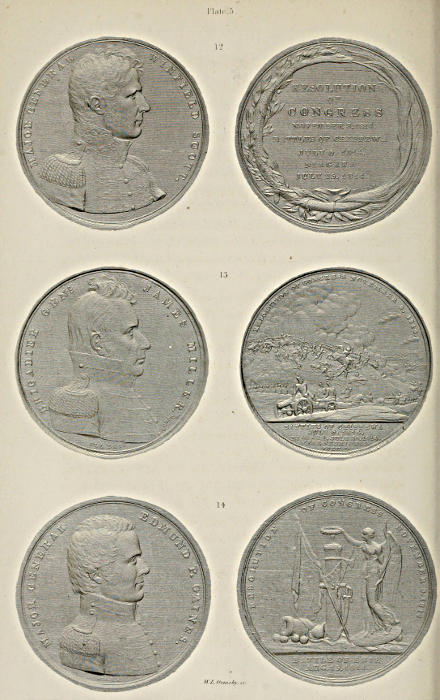
Plate 5.
12
13
14
W. L. Ormsby, sc.