Volume 2 — THE WITCH MANIA. (continued 2)
Reading edition
It is time, however, to return to James VI., who is fairly entitled to share with Pope Innocent, Sprenger, Bodinus, and Matthew Hopkins the glory or the odium of being at the same time a chief enemy and chief encourager of witchcraft. Towards the close of the sixteenth century, many learned men, both on the continent and in the isles of Britain, had endeavoured to disabuse the public mind on this subject. The most celebrated were Wierus, in Germany; Pietro d’Apone, in Italy; and Reginald Scot, in England. Their works excited the attention of the zealous James, who, mindful of the involuntary compliment which his merits had extorted from the devil, was ambitious to deserve it by still continuing “his greatest enemie.” In the year 1597, he published in Edinburgh his famous treatise on Demonology. Its design may be gathered from the following passage in the introduction: “The fearful abounding,” says the king, “at this time and in this country of these detestable slaves of the devil, the witches or enchanters, hath moved me, beloved reader, to despatch in post this following treatise of mine, not in any wise, as I protest, to serve for a show of mine own learning and ingene [ingenuity], but only (moved of conscience) to press thereby, so far as I can, to resolve the doubting hearts of many, both that such assaults of Satan are most certainly practised, and that the instrument thereof merits most severely to be punished, against the damnable opinions of two, principally in our age; whereof the one called Scot, an Englishman, is not ashamed in public print to deny that there can be such thing as witchcraft, and so maintains the old error of the Sadducees in denying of spirits. The other, called Wierus, a German physician, sets out a public apology for all these crafts-folks, whereby procuring for them impunity, he plainly betrays himself to have been one of that profession.” In other parts of this treatise, which the author had put into the form of a dialogue, to “make it more pleasant and facile,” he says: “Witches ought to be put to death, according to the law of God, the civil and imperial law, and the municipal law of all Christian nations: yea, to spare the life, and not strike whom God bids strike and so severely punish in so odious a treason against God, is not only unlawful, but doubtless as great a sin in the magistrate as was Saul’s sparing Agag.” He says also that the crime is so abominable, that it may be proved by evidence which would not be received against any other offenders,—young children, who knew not the nature of an oath, and persons of an infamous character, being sufficient witnesses against them; but lest the innocent should be accused of a crime so difficult to be acquitted of, he recommends that in all cases the ordeal should be resorted to. He says, “Two good helps may be used: the one is the finding of their mark, and the trying the insensibleness thereof; the other is their floating on the water,—for, as in a secret murther, if the dead carcass be at any time thereafter handled by the murtherer, it will gush out of blood, as if the blood were crying to Heaven for revenge of the murtherer (God having appointed that secret supernatural sign for trial of that secret unnatural crime), so that it appears that God hath appointed (for a supernatural sign of the monstrous impiety of witches) that the water shall refuse to receive them in her bosom that have shaken off them the sacred water of baptism, and wilfully refused the benefit thereof;—no, not so much as their eyes are able to shed tears (threaten and torture them as you please), while first they repent (God not permitting them to dissemble their obstinacy in so horrible a crime); albeit, the womenkind especially, be able otherwise to shed tears at every light occasion when they will, yea, although it were dissembling like the crocodiles.”
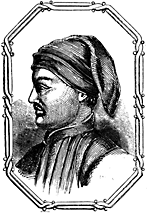
PIETRO D’APONE.
When such doctrines as these were openly promulgated by the highest authority in the realm, and who, in promulgating them, flattered, but did not force the public opinion, it is not surprising that the sad delusion should have increased and multiplied until the race of wizards and witches replenished the earth. The reputation which he lost by being afraid of a naked sword, he more than regained by his courage in combating the devil. The Kirk shewed itself a most zealous coadjutor, especially during those halcyon days when it was not at issue with the king upon other matters of doctrine and prerogative.
On his accession to the throne of England in 1603, James came amongst a people who had heard with admiration of his glorious deeds against the witches. He himself left no part of his ancient prejudices behind him; and his advent was the signal for the persecution to burst forth in England with a fury equal to that in Scotland. It had languished a little during the latter years of the reign of Elizabeth; but the very first parliament of King James brought forward the subject. James was flattered by their promptitude, and the act passed in 1604. On the second reading in the House of Lords, the bill passed into a committee, in which were twelve bishops. By it was enacted, “That if any person shall use, practise, or exercise any conjuration of any wicked or evil spirit, or shall consult, covenant with, or feed any such spirit, the first offence to be imprisonment for a year, and standing in the pillory once a quarter; the second offence to be death.”
The minor punishment seems but rarely to have been inflicted. Every record that has been preserved mentions that the witches were hanged and burned, or burned, without the previous strangling, “alive and quick.” During the whole of James’s reign, amid the civil wars of his successor, the sway of the Long Parliament, the usurpation of Cromwell, and the reign of Charles II., there was no abatement of the persecution. If at any time it raged with less virulence, it was when Cromwell and the Independents were masters. Dr. Zachary Grey, the editor of an edition of “Hudibras,” informs us, in a note to that work, that he himself perused a list of three thousand witches who were executed in the time of the Long Parliament alone. During the first eighty years of the seventeenth century, the number executed has been estimated at five hundred annually, making the frightful total of forty thousand. Some of these cases deserve to be cited. The great majority resemble closely those already mentioned; but two or three of them let in a new light upon the popular superstition.
Every one has heard of the “Lancashire witches,” a phrase now used to compliment the ladies of that county for their bewitching beauty; but it is not every one who has heard the story in which it originated. A villanous boy, named Robinson, was the chief actor in the tragedy. He confessed many years afterwards that he had been suborned by his father and other persons to give false evidence against the unhappy witches whom he brought to the stake. The time of this famous trial was about the year 1634. This boy Robinson, whose father was a wood-cutter, residing on the borders of Pendle Forest, in Lancashire, spread abroad many rumours against one Mother Dickenson, whom he accused of being a witch. These rumours coming to the ears of the local magistracy, the boy was sent for and strictly examined. He told the following extraordinary story without hesitation or prevarication, and apparently in so open and honest a manner, that no one who heard him doubted the truth of it. He said, that as he was roaming about in one of the glades of the forest, amusing himself by gathering blackberries, he saw two greyhounds before him, which he thought at the time belonged to some gentleman of the neighbourhood. Being fond of sport, he proposed to have a course; and a hare being started, he incited the hounds to run. Neither of them would stir. Angry at the beasts, he seized hold of a switch, with which he was about to punish them, when one of them suddenly started up in the form of a woman, and the other of a little boy. He at once recognised the woman to be the witch Mother Dickenson. She offered him some money to induce him to sell his soul to the devil; but he refused. Upon this she took a bridle out of her pocket, and shaking it over the head of the other little boy, he was instantly turned into a horse. Mother Dickenson then seized him in her arms, sprang upon the horse, and placing him before her, rode with the swiftness of the wind over forests, fields, bogs, and rivers, until they came to a large barn. The witch alighted at the door, and, taking him by the hand, led him inside. There he saw seven old women pulling at seven halters which hung from the roof. As they pulled, large pieces of meat, lumps of butter, loaves of bread, basins of milk, hot puddings, black puddings, and other rural dainties, fell from the halters on to the floor. While engaged in this charm, they made such ugly faces, and looked so fiendish, that he was quite frightened. After they had pulled in this manner enough for an ample feast, they set-to, and shewed, whatever might be said of the way in which their supper was procured, that their epicurism was a little more refined than that of the Scottish witches, who, according to Gellie Duncan’s confession, feasted upon dead men’s flesh in the old kirk of Berwick. The boy added, that as soon as supper was ready, many other witches came to partake of it, several of whom he named.
In consequence of this story, many persons were arrested, and the boy Robinson was led about from church to church, in order that he might point out to the officers by whom he was accompanied the hags he had seen in the barn. Altogether, about twenty persons were thrown into prison; eight of them were condemned to die, including Mother Dickenson, upon this evidence alone, and executed accordingly. Among the wretches who concocted this notable story, not one was ever brought to justice for his perjury; and Robinson, the father, gained considerable sums by threatening persons who were rich enough to buy off exposure.
Among the ill-weeds which flourished amid the long dissensions of the civil war, Matthew Hopkins, the witch-finder, stands eminent in his sphere. This vulgar fellow resided, in the year 1644, at the town of Manningtree, in Essex, and made himself very conspicuous in discovering the devil’s marks upon several unhappy witches. The credit he gained by his skill in this instance seems to have inspired him to renewed exertions. In the course of a very short time, whenever a witch was spoken of in Essex, Matthew Hopkins was sure to be present, aiding the judges with his knowledge of “such cattle,” as he called them. As his reputation increased, he assumed the title of “Witch-finder General,” and travelled through the counties of Norfolk, Essex, Huntingdon, and Sussex, for the sole purpose of finding out witches. In one year he brought sixty poor creatures to the stake. The test he commonly adopted was that of swimming, so highly recommended by King James in his Demonologie. The hands and feet of the suspected persons were tied together crosswise, the thumb of the right hand to the toe of the left foot, and vice versa. They were then wrapped up in a large sheet or blanket, and laid upon their backs in a pond or river. If they sank, their friends and relatives had the poor consolation of knowing they were innocent; but there was an end of them: if they floated, which, when laid carefully on the water, was generally the case, there was also an end of them; for they were deemed guilty of witchcraft, and burned accordingly.
Another test was to make them repeat the Lord’s prayer and creed. It was affirmed that no witch could do so correctly. If she missed a word, or even pronounced one incoherently, which in her trepidation it was most probable she would, she was accounted guilty. It was thought that witches could not weep more than three tears, and those only from the left eye. Thus the conscious innocence of many persons, which gave them fortitude to bear unmerited torture without flinching, was construed by their unmerciful tormentors into proofs of guilt. In some districts the test resorted to was to weigh the culprit against the church Bible. If the suspected witch proved heavier than the Bible, she was set at liberty. This mode was far too humane for the witch-finders by profession. Hopkins always maintained that the most legitimate modes were pricking and swimming.
Hopkins used to travel through his counties like a man of consideration, attended by his two assistants, always putting up at the chief inn of the place, and always at the cost of the authorities. His charges were twenty shillings a town, his expenses of living while there, and his carriage thither and back. This he claimed whether he found witches or not. If he found any, he claimed twenty shillings a head in addition when they were brought to execution. For about three years he carried on this infamous trade, success making him so insolent and rapacious that high and low became his enemies. The Rev. Mr. Gaul, a clergyman of Houghton, in Huntingdonshire, wrote a pamphlet impugning his pretensions, and accusing him of being a common nuisance. Hopkins replied in an angry letter to the functionaries of Houghton, stating his intention to visit their town; but desiring to know whether it afforded many such sticklers for witchcraft as Mr. Gaul, and whether they were willing to receive and entertain him with the customary hospitality, if he so far honoured them. He added, by way of threat, that in case he did not receive a satisfactory reply, “he would waive their shire altogether, and betake himself to such places where he might do and punish, not only without control, but with thanks and recompense.” The authorities of Houghton were not much alarmed at this awful threat of letting them alone. They very wisely took no notice either of him or his letter.
Mr. Gaul describes in his pamphlet one of the modes employed by Hopkins, which was sure to swell his revenues very considerably. It was a proof even more atrocious than the swimming. He says, that the “Witch-finder General” used to take the suspected witch and place her in the middle of a room, upon a stool or table, cross-legged, or in some other uneasy posture. If she refused to sit in this manner, she was bound with strong cords. Hopkins then placed persons to watch her for four-and-twenty hours, during which time she was to be kept without meat or drink. It was supposed that one of her imps would come during that interval and suck her blood. As the imp might come in the shape of a wasp, a moth, a fly, or other insect, a hole was made in the door or window to let it enter. The watchers were ordered to keep a sharp look out, and endeavour to kill any insect that appeared in the room. If any fly escaped, and they could not kill it, the woman was guilty; the fly was her imp, and she was sentenced to be burned, and twenty shillings went into the pockets of Master Hopkins. In this manner he made one old woman confess, because four flies had appeared in the room, that she was attended by four imps, named “Ilemazar,” “Pye-wackett,” “Peck-in-the-crown,” and “Grizel-Greedigut.”
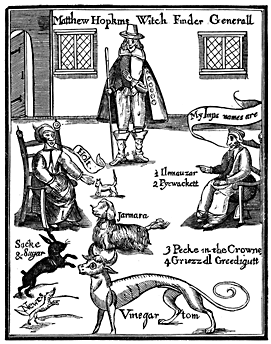
MATTHEW HOPKINS.32
It is consoling to think that this impostor perished in his own snare. Mr. Gaul’s exposure and his own rapacity weakened his influence among the magistrates; and the populace, who began to find that not even the most virtuous and innocent were secure from his persecution, looked upon him with undisguised aversion. He was beset by a mob at a village in Suffolk, and accused of being himself a wizard. An old reproach was brought against him, that he had, by means of sorcery, cheated the devil out of a certain memorandum-book, in which he, Satan, had entered the names of all the witches in England. “Thus,” said the populace, “you find out witches, not by God’s aid, but by the devil’s.” In vain he denied his guilt. The populace longed to put him to his own test. He was speedily stripped, and his thumbs and toes tied together. He was then placed in a blanket, and cast into a pond. Some say that he floated, and that he was taken out, tried, and executed upon no other proof of his guilt. Others assert that he was drowned. This much is positive, that there was an end of him. As no judicial entry of his trial and execution is to be found in any register, it appears most probable that he expired by the hands of the mob. Butler has immortalised this scamp in the following lines of his Hudibras:
“Hath not this present Parliament A lieger to the devil sent, Fully empower’d to treat about Finding revolted witches out? And has he not within a year Hang’d threescore of them in one shire? Some only for not being drown’d, And some for sitting above ground Whole days and nights upon their breeches, And feeling pain, were hang’d for witches; And some for putting knavish tricks Upon green geese or turkey chicks; Or pigs that suddenly deceased Of griefs unnatural, as he guessed; Who proved himself at length a witch, And made a rod for his own breech.”
In Scotland also witch-finding became a trade. They were known under the designation of “common prickers,” and, like Hopkins, received a fee for each witch they discovered. At the trial of Janet Peaston, in 1646, the magistrates of Dalkeith “caused John Kincaid of Tranent, the common pricker, to exercise his craft upon her. He found two marks of the devil’s making; for she could not feel the pin when it was put into either of the said marks, nor did the marks bleed when the pin was taken out again. When she was asked where she thought the pins were put in her, she pointed to a part of her body distant from the real place. They were pins of three inches in length.”33
These common prickers became at last so numerous that they were considered nuisances. The judges refused to take their evidence; and in 1678 the privy council of Scotland condescended to hear the complaint of an honest woman who had been indecently exposed by one of them, and expressed their opinion that common prickers were common cheats.
But such an opinion was not formed in high places before hundreds of innocent persons had fallen victims. The parliaments had encouraged the delusion both in England and Scotland; and by arming these fellows with a sort of authority, had in a manner forced the magistrates and ministers to receive their evidence. The fate of one poor old gentleman, who fell a victim to the arts of Hopkins in 1646, deserves to be recorded. Mr. Louis, a venerable clergyman, upwards of seventy years of age, and who had been rector of Framlingham, in Suffolk, for fifty years, excited suspicion that he was a wizard. Being a violent royalist, he was likely to meet with no sympathy at that time; and even his own parishioners, whom he had served so long and so faithfully, turned their backs upon him as soon as he was accused. Placed under the hands of Hopkins, who knew so well how to bring the refractory to confession, the old man, the light of whose intellect had become somewhat dimmed from age, confessed that he was a wizard. He said he had two imps that continually excited him to do evil; and that one day, when he was walking on the sea-coast, one of them prompted him to express a wish that a ship, whose sails were just visible in the distance, might sink. He consented, and saw the vessel sink before his eyes. He was, upon this confession, tried and condemned. On his trial, the flame of reason burned up as brightly as ever. He denied all that had been alleged against him, and cross-examined Hopkins with great tact and severity. After his condemnation, he begged that the funeral service of the Church might be read for him. The request was refused, and he repeated it for himself from memory as he was led to the scaffold.
A poor woman in Scotland was executed upon evidence even less strong than this. John Bain, a common pricker, swore that, as he passed her door, he heard her talking to the devil. She said, in defence, that it was a foolish practice she had of talking to herself, and several of her neighbours corroborated her statement; but the evidence of the pricker was received. He swore that none ever talked to themselves who were not witches. The devil’s mark being found upon her, the additional testimony of her guilt was deemed conclusive, and she was “convict and brynt.”
From the year 1652 to 1682, these trials diminished annually in number, and acquittals were by no means so rare as they had been. To doubt in witchcraft was no longer dangerous. Before country justices, condemnations on the most absurd evidence still continued; but when the judges of the land had to charge the jury, they took a more humane and philosophical view. By degrees, the educated classes (comprised in those days within very narrow limits) openly expressed their unbelief of modern witchcraft, although they were not bold enough to deny its existence altogether. Between them and the believers in the old doctrine fierce arguments ensued, and the sceptics were designated Sadducees. To convince them, the learned and Reverend Joseph Glanvil wrote his well-known work, Sadducismus Triumphatus, and The Collection of Relations; the first part intended as a philosophical inquiry into witchcraft, and the power of the devil “to assume a mortal shape:” the latter containing what he considered a multitude of well-authenticated modern instances.
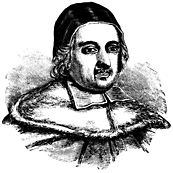
SIR MATTHEW HALE.
But though progress was made, it was slow. In 1664, the venerable Sir Matthew Hale condemned two women, named Amy Duny and Rose Cullender, to the stake at St. Edmondsbury, upon evidence the most ridiculous. These two old women, whose ugliness gave their neighbours the first idea that they were witches, went to a shop to purchase herrings, and were refused. Indignant at the prejudice against them, they were not sparing of their abuse. Shortly afterward, the daughter of the herring-dealer fell sick, and a cry was raised that she was bewitched by the old women who had been refused the herrings. This girl was subject to epileptic fits. To discover the guilt of Amy Duny and Rose Cullender, the girl’s eyes were blinded closely with a shawl, and the witches were commanded to touch her. They did so, and she was immediately seized with a fit. Upon this evidence they were sent to prison. The girl was afterwards touched by an indifferent person, and the force of her imagination was so great, that, thinking it was again the witches, she fell down in a violent fit as before. This, however, was not received in favour of the accused.
The following extract, from the published reports of the trial, will shew the sort of evidence which was received:
“Samuel Pacey, of Leystoff (a good, sober man), being sworn, said that, on Thursday the 10th of October last, his younger daughter, Deborah, about nine years old, was suddenly taken so lame that she could not stand on her legs, and so continued till the 17th of the same month, when the child desired to be carried to a bank on the east side of the house, looking towards the sea; and, while she was sitting there, Amy Duny came to this examinant’s house to buy some herrings, but was denied. Then she came twice more, but, being as often denied, she went away discontented and grumbling. At this instant of time, the child was taken with terrible fits, complaining of a pain in her stomach, as if she was pricked with pins, shrieking out with a voice like a whelp, and thus continued till the 30th of the same month. This examinant further saith, that Amy Duny, having long had the reputation of a witch, and his child having, in the intervals of her fits, constantly cried out on her as the cause of her disorder, saying, that the said Amy did appear to her and fright her; he himself did suspect the said Amy to be a witch, and charged her with being the cause of his child’s illness, and set her in the stocks. Two days after, his daughter Elizabeth was taken with such strange fits, that they could not force open her mouth without a tap; and the younger child being in the same condition, they used to her the same remedy. Both children grievously complained that Amy Duny and another woman, whose habit and looks they described, did appear to them and torment them, and would cry out, ‘There stands Amy Duny! There stands Rose Cullender!’ the other person who afflicted them. Their fits were not alike. Sometimes they were lame on the right side; sometimes on the left; and sometimes so sore, that they could not bear to be touched. Sometimes they were perfectly well in other respects, but they could not hear; at other times they could not see. Sometimes they lost their speech for one, two, and once for eight days together. At times they had swooning fits, and, when they could speak, were taken with a fit of coughing, and vomited phlegm and crooked pins; and once a great twopenny nail, with above forty pins; which nail he, the examinant, saw vomited up, with many of the pins. The nail and pins were produced in the court. Thus the children continued for two months, during which time the examinant often made them read in the New Testament, and observed, when they came to the words Lord Jesus, or Christ, they could not pronounce them, but fell into a fit. When they came to the word Satan, or devil, they would point, and say, ‘This bites, but makes me speak right well.’ Finding his children thus tormented without hopes of recovery, he sent them to his sister, Margaret Arnold, at Yarmouth, being willing to try whether change of air would help them.
“Margaret Arnold was the next witness. Being sworn, she said, that about the 30th of November, Elizabeth and Deborah Pacey came to her house, with her brother, who told her what had happened, and that he thought his children bewitched. She, this examinant, did not much regard it, supposing the children had played tricks, and put the pins into their mouths themselves. She therefore took all the pins from their clothes, sewing them with thread instead of pinning them. But, notwithstanding, they raised, at times, at least thirty pins in her presence, and had terrible fits; in which fits they would cry out upon Amy Duny and Rose Cullender, saying, that they saw them and heard them threatening, as before; that they saw things like mice running about the house; and one of them catched one, and threw it into the fire, which made a noise like a rat. Another time the younger child, being out of doors, a thing like a bee would have forced itself into her mouth, at which the child ran screaming into the house, and before this examinant could come at her, fell into a fit, and vomited a twopenny nail, with a broad head. After that, this examinant asked the child how she came by this nail, when she answered, ‘The bee brought the nail, and forced it into my mouth.’ At other times, the eldest child told this examinant that she saw flies bring her crooked pins. She would then fall into a fit, and vomit such pins. One time the said child said she saw a mouse, and crept under the table to look for it; and afterwards, the child seemed to put something into her apron, saying, ‘She had caught it.’ She then ran to the fire, and threw it in, on which there did appear to this examinant something like a flash of gunpowder, although she does own she saw nothing in the child’s hand. Once the child, being speechless, but otherwise very sensible, ran up and down the house, crying, ‘Hush! hush!’ as if she had seen poultry; but this examinant saw nothing. At last the child catched at something, and threw it into the fire. Afterwards, when the child could speak, this examinant asked her what she saw at the time? She answered that she saw a duck. Another time the youngest child said, after a fit, that Amy Duny had been with her, and tempted her to drown herself, or cut her throat, or otherwise destroy herself. Another time they both cried out upon Amy Duny and Rose Cullender, saying, ‘Why don’t you come yourselves? Why do you send your imps to torment us?’”
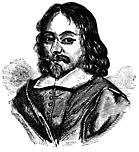
SIR THOMAS BROWN.
The celebrated Sir Thomas Brown, the author of Vulgar Errors, was also examined as a witness upon the trial. Being desired to give his opinion of the three persons in court, he said he was clearly of opinion that they were bewitched. He said there had lately been a discovery of witches in Denmark, who used the same way of tormenting persons, by conveying crooked pins, needles, and nails into their bodies. That he thought, in such cases, the devil acted upon human bodies by natural means, namely, by exciting and stirring up the superabundant humours; he did afflict them in a more surprising manner by the same diseases their bodies were usually subject to; that these fits might be natural, only raised to a great degree by the subtlety of the devil, co-operating with the malice of these witches.
The evidence being concluded, Sir Matthew Hale addressed the jury. He said, he would waive repeating the evidence, to prevent any mistake, and told the jury there were two things they had to inquire into. First, Whether or not these children were bewitched; secondly, Whether these women did bewitch them. He said, he did not in the least doubt there were witches; first, Because the Scriptures affirmed it; secondly, Because the wisdom of all nations, particularly our own, had provided laws against witchcraft, which implied their belief of such a crime. He desired them strictly to observe the evidence, and begged of God to direct their hearts in the weighty concern they had in hand, since, to condemn the innocent and let the guilty go free are both an abomination to the Lord.
The jury then retired, and in about half an hour returned a verdict of guilty upon all the indictments, being thirteen in number. The next morning the children came with their father to the lodgings of Sir Matthew Hale, very well, and quite restored to their usual health. Mr. Pacey, being asked at what time their health began to improve, replied, that they were quite well in half an hour after the conviction of the prisoners.
Many attempts were made to induce the unfortunate women to confess their guilt; but in vain, and they were both hanged.
Eleven trials were instituted before Chief Justice Holt for witchcraft, between the years 1694 and 1701. The evidence was of the usual character; but Holt appealed so successfully in each case to the common sense of the jury, that they were every one acquitted. A general feeling seemed to pervade the country that blood enough had been shed upon these absurd charges. Now and then, the flame of persecution burnt up in a remote district; but these instances were no longer looked upon as mere matters of course. They appear, on the contrary, to have excited much attention; a sure proof, if no other were to be obtained, that they were becoming unfrequent.
A case of witchcraft was tried in 1711, before Lord Chief Justice Powell; in which, however, the jury persisted in a verdict of guilty, though the evidence was of the usual absurd and contradictory character, and the enlightened judge did all in his power to bring them to a right conclusion. The accused person was one Jane Wenham, better known as the Witch of Walkerne; and the persons who were alleged to have suffered from her witchcraft were two young women, named Thorne and Street. A witness, named Mr. Arthur Chauncy, deposed, that he had seen Ann Thorne in several of her fits, and that she always recovered upon prayers being said, or if Jane Wenham came to her. He related, that he had pricked the prisoner several times in the arms, but could never fetch any blood from her; that he had seen her vomit pins, when there were none in her clothes or within her reach; and that he had preserved several of them, which he was ready to produce. The judge, however, told him that was needless, as he supposed they were crooked pins.
Mr. Francis Bragge, another witness, deposed, that strange “cakes” of bewitched feathers having been taken from Ann Thorne’s pillow, he was anxious to see them. He went into a room where some of these feathers were, and took two of the cakes, and compared them together. They were both of a circular figure, something larger than a crown piece; and he observed that the small feathers were placed in a nice and curious order, at equal distances from each other, making so many radii of the circle, in the centre of which the quill-ends of the feathers met. He counted the number of these feathers, and found them to be exactly thirty-two in each cake. He afterwards endeavoured to pull off two or three of them, and observed that they were all fastened together by a sort of viscous matter, which would stretch seven or eight times in a thread before it broke. Having taken off several of these feathers, he removed the viscous matter with his fingers, and found under it, in the centre, some short hairs, black and grey, matted together, which he verily believed to be cat’s hair. He also said, that Jane Wenham confessed to him that she had bewitched the pillow, and had practised witchcraft for sixteen years.
The judge interrupted the witness at this stage, and said, he should very much like to see an enchanted feather, and seemed to wonder when he was told that none of these strange cakes had been preserved. His lordship asked the witness why he did not keep one or two of them, and was informed that they had all been burnt, in order to relieve the bewitched person of the pains she suffered, which could not be so well effected by any other means.
A man, named Thomas Ireland, deposed, that hearing several times a great noise of cats crying and screaming about his house, he went out and frightened them away, and they all ran towards the cottage of Jane Wenham. One of them he swore positively had a face very like Jane Wenham’s. Another man, named Burville, gave similar evidence, and swore that he had often seen a cat with Jane Wenham’s face. Upon one occasion he was in Ann Thorne’s chamber, when several cats came in, and among them the cat above stated. This witness would have favoured the court with a much longer statement, but was stopped by the judge, who said he had heard quite enough.
The prisoner, in her defence, said nothing, but that “she was a clear woman.” The learned judge then summed up, leaving it to the jury to determine whether such evidence as they had heard was sufficient to take away the prisoner’s life upon the indictment. After a long deliberation they brought in their verdict, that she was guilty upon the evidence. The judge then asked them whether they found her guilty upon the indictment of conversing with the devil in the shape of a cat? The sapient foreman very gravely answered, “We find her guilty of that.” The learned judge then very reluctantly proceeded to pass sentence of death; but, by his persevering exertions, a pardon was at last obtained, and the wretched old woman was set at liberty.
In the year 1716, a woman and her daughter—the latter only nine years of age—were hanged at Huntingdon for selling their souls to the devil, and raising a storm by pulling off their stockings and making a lather of soap. This appears to have been the last judicial execution in England. From that time to the year 1736, the populace raised at intervals the old cry, and more than once endangered the lives of poor women by dragging them through ponds on suspicion; but the philosophy of those who, from their position, sooner or later give the tone to the opinions and morals of the poor, was silently working a cure for the evil. The fear of witches ceased to be epidemic, and became individual, lingering only in minds fettered by inveterate prejudice or brutalising superstition. In the year 1736, the penal statute of James I. was finally blotted from the statute-book, and suffered no longer to disgrace the advancing intelligence of the country. Pretenders to witchcraft, fortune-tellers, conjurors, and all their train, were liable only to the common punishment of rogues and impostors—imprisonment and the pillory.
In Scotland, the delusion also assumed the same phases, and was gradually extinguished in the light of civilisation. As in England, the progress of improvement was slow. Up to the year 1665, little or no diminution of the mania was perceptible. In 1643, the General Assembly recommended that the privy council should institute a standing commission, composed of any “understanding gentlemen or magistrates,” to try the witches, who were stated to have increased enormously of late years. In 1649, an act was passed, confirmatory of the original statute of Queen Mary, explaining some points of the latter which were doubtful, and enacting severe penalties, not only against witches themselves, but against all who covenanted with them, or sought by their means to pry into the secrets of futurity, or cause any evil to the life, lands, or limbs of their neighbours. For the next ten years, the popular madness upon this subject was perhaps more furious than ever; upwards of four thousand persons suffered for the crime during that interval. This was the consequence of the act of parliament and the unparalleled severity of the magistrates; the latter frequently complained that for two witches they burned one day, there were ten to burn the next: they never thought that they themselves were the cause of the increase. In a single circuit, held at Glasgow, Ayr, and Stirling, in 1659, seventeen unhappy creatures were burned by judicial sentence for trafficking with Satan. In one day (November 7, 1661), the privy council issued no less than fourteen commissions for trials in the provinces. Next year, the violence of the persecution seems to have abated. From 1662 to 1668, although “the understanding gentlemen and magistrates” already mentioned, continued to try and condemn, the High Court of Justiciary had but one offender of this class to deal with, and she was acquitted. James Welsh, a common pricker, was ordered to be publicly whipped through the streets of Edinburgh for falsely accusing a woman of witchcraft; a fact which alone proves that the superior court sifted the evidence in these cases with much more care and severity than it had done a few years previously. The enlightened Sir George Mackenzie, styled by Dryden “the noble wit of Scotland,” laboured hard to introduce this rule into court, that the confessions of the witches should be held of little worth, and that the evidence of the prickers and other interested persons should be received with distrust and jealousy. This was reversing the old practice, and saved many innocent lives. Though a firm believer both in ancient and modern witchcraft, he could not shut his eyes to the atrocities daily committed under the name of justice. In his work on the Criminal Law of Scotland, published in 1678, he says, “From the horridness of this crime, I do conclude that, of all others, it requires the clearest relevancy and most convincing probature; and I condemn, next to the witches themselves, those cruel and too forward judges who burn persons by thousands as guilty of this crime.” In the same year, Sir John Clerk plumply refused to serve as a commissioner on trials for witchcraft, alleging, by way of excuse, “that he was not himself good conjuror enough to be duly qualified.” The views entertained by Sir George Mackenzie were so favourably received by the Lords of Session, that he was deputed, in 1680, to report to them on the cases of a number of poor women who were then in prison awaiting their trial. Sir George stated that there was no evidence against them whatever but their own confessions, which were absurd and contradictory, and drawn from them by severe torture. They were immediately discharged.
For the next sixteen years the Lords of Session were unoccupied with trials for witchcraft. Not one is entered upon the record. But in 1697 a case occurred which equalled in absurdity any of those that signalised the dark reign of King James. A girl named Christiana Shaw, eleven years of age, the daughter of John Shaw of Bargarran, was subject to fits; and being of a spiteful temper, she accused her maid-servant, with whom she had frequent quarrels, of bewitching her. Her story unfortunately was believed. Encouraged to tell all the persecutions of the devil which the maid had sent to torment her, she in the end concocted a romance that involved twenty-one persons. There was no other evidence against them but the fancies of this lying child, and the confessions which pain had extorted from them; but upon this no less than five women were condemned before Lord Blantyre and the rest of the commissioners, appointed specially by the privy council to try this case. They were burned on the Green at Paisley. The warlock of the party, one John Reed, who was also condemned, hanged himself in prison. It was the general belief in Paisley that the devil had strangled him lest he should have revealed in his last moments too many of the unholy secrets of witchcraft. This trial excited considerable disgust in Scotland. The Rev. Mr. Bell, a contemporary writer, observed that, in this business, “persons of more goodness and esteem than most of their calumniators were defamed for witches.” He adds, that the persons chiefly to blame were “certain ministers of too much forwardness and absurd credulity, and some topping professors in and about Glasgow.”34
After this trial, there again occurs a lapse of seven years, when the subject was painfully forced upon public attention by the brutal cruelty of the mob at Pittenween. Two women were accused of having bewitched a strolling beggar who was subject to fits, or who pretended to be so, for the purpose of exciting commiseration. They were cast into prison, and tortured until they confessed. One of them, named Janet Cornfoot, contrived to escape, but was brought back to Pittenween next day by a party of soldiers. On her approach to the town she was unfortunately met by a furious mob, composed principally of fishermen and their wives, who seized upon her with the intention of swimming her. They forced her away to the sea-shore, and tying a rope around her body, secured the end of it to the mast of a fishing-boat lying alongside. In this manner they ducked her several times. When she was half dead, a sailor in the boat cut away the rope, and the mob dragged her through the sea to the beach. Here, as she lay quite insensible, a brawny ruffian took down the door of his hut, close by, and placed it on her back. The mob gathered large stones from the beach and piled them upon her till the wretched woman was pressed to death. No magistrate made the slightest attempt to interfere; and the soldiers looked on, delighted spectators. A great outcry was raised against this culpable remissness, but no judicial inquiry was set on foot. This happened in 1704.
The next case we hear of is that of Elspeth Rule, found guilty of witchcraft before Lord Anstruther, at the Dumfries circuit, in 1708. She was sentenced to be marked in the cheek with a red-hot iron, and banished the realm of Scotland for life.
Again there is a long interval. In 1718, the remote county of Caithness, where the delusion remained in all its pristine vigour for years after it had ceased elsewhere, was startled from its propriety by the cry of witchcraft. A silly fellow, named William Montgomery, a carpenter, had a mortal antipathy to cats; and somehow or other these animals generally chose his back-yard as the scene of their catterwaulings. He puzzled his brains for a long time to know why he, above all his neighbours, should be so pestered. At last he came to the sage conclusion that his tormentors were no cats, but witches. In this opinion he was supported by his maid-servant, who swore a round oath that she had often heard the aforesaid cats talking together in human voices. The next time the unlucky tabbies assembled in his back-yard, the valiant carpenter was on the alert. Arming himself with an axe, a dirk, and a broadsword, he rushed out among them. One of them he wounded in the back, a second in the hip, and the leg of a third he maimed with his axe; but he could not capture any of them. A few days afterwards, two old women of the parish died; and it was said, that when their bodies were laid out, there appeared upon the back of one the mark as of a recent wound, and a similar scar upon the hip of the other. The carpenter and his maid were convinced that they were the very cats, and the whole county repeated the same story. Every one was upon the look-out for proofs corroborative; a very remarkable one was soon discovered. Nanny Gilbert, a wretched old creature of upwards of seventy years of age, was found in bed with her leg broken. As she was ugly enough for a witch, it was asserted that she also was one of the cats that had fared so ill at the hands of the carpenter. The latter, when informed of the popular suspicion, asserted that he distinctly remembered to have struck one of the cats a blow with the back of his broadsword, which ought to have broken her leg. Nanny was immediately dragged from her bed and thrown into prison. Before she was put to the torture, she explained in a very natural and intelligible manner how she had broken her limb; but this account did not give satisfaction. The professional persuasions of the torturer made her tell a different tale, and she confessed that she was indeed a witch, and had been wounded by Montgomery on the night stated; that the two old women recently deceased were witches also, besides about a score of others whom she named. The poor creature suffered so much by the removal from her own home, and the tortures inflicted upon her, that she died the next day in prison. Happily for the persons she had named in her confession, Dundas of Arniston, at that time the king’s advocate-general, wrote to the sheriff-depute, one Captain Ross of Littledean, cautioning him not to proceed to trial, the “thing being of too great difficulty, and beyond the jurisdiction of an inferior court.” Dundas himself examined the precognition with great care, and was so convinced of the utter folly of the whole case, that he quashed all further proceedings.
We find this same sheriff-depute of Caithness very active four years afterwards in another trial for witchcraft. In spite of the warning he had received that all such cases were to be tried in future by the superior courts, he condemned to death an old woman at Dornoch, upon the charge of bewitching the cows and pigs of her neighbours. This poor creature was insane, and actually laughed and clapped her hands at sight of “the bonnie fire” that was to consume her. She had a daughter who was lame both of her hands and feet, and one of the charges brought against her was, that she had used this daughter as a pony in her excursions to join the devil’s sabbath, and that the devil himself had shod her, and produced lameness.
This was the last execution that took place in Scotland for witchcraft. The penal statutes were repealed in 1736; and, as in England, whipping, the pillory, or imprisonment, were declared the future punishments of all pretenders to magic or witchcraft.
Still for many years after this the superstition lingered both in England and Scotland, and in some districts is far from being extinct even at this day. But before we proceed to trace it any further than to its legal extinction, we have yet to see the frightful havoc it made in continental Europe from the commencement of the seventeenth to the middle of the eighteenth century. France, Germany, and Switzerland were the countries which suffered most from the epidemic. The number of victims in these countries during the sixteenth century has already been mentioned; but at the early part of the seventeenth, the numbers are so great, especially in Germany, that were they not to be found in the official records of the tribunals, it would be almost impossible to believe that mankind could ever have been so maddened and deluded. To use the words of the learned and indefatigable Horst,35 “the world seemed to be like a large madhouse for witches and devils to play their antics in.” Satan was believed to be at every body’s call to raise the whirlwind, draw down the lightning, blight the productions of the earth, or destroy the health and paralyse the limbs of man. This belief, so insulting to the majesty and beneficence of the Creator, was shared by the most pious ministers of religion. Those who in their morning and evening prayers acknowledged the one true God, and praised him for the blessings of the seed-time and the harvest, were convinced that frail humanity could enter into a compact with the spirits of hell to subvert his laws and thwart all his merciful intentions. Successive popes, from Innocent VIII. downwards, promulgated this degrading doctrine, which spread so rapidly, that society seemed to be divided into two great factions, the bewitching and the bewitched.
The commissioners named by Innocent VIII. to prosecute the witch-trials in Germany were, Jacob Sprenger, so notorious for his work on demonology, entitled the Malleus Maleficarum, or Hammer to knock down Witches; Henry Institor, a learned jurisconsult; and the Bishop of Strasburgh. Bamberg, Trèves, Cologne, Paderborn, and Würzburg, were the chief seats of the commissioners, who, during their lives alone, condemned to the stake, on a very moderate calculation, upwards of three thousand victims. The number of witches so increased, that new commissioners were continually appointed in Germany, France, and Switzerland. In Spain and Portugal the Inquisition alone took cognisance of the crime. It is impossible to search the records of those dark, but now happily non-existing tribunals; but the mind recoils with affright even to form a guess of the multitudes who perished.
The mode of trial in the other countries is more easily ascertained. Sprenger in Germany, and Bodinus and Delrio in France, have left but too ample a record of the atrocities committed in the much-abused names of justice and religion. Bodinus, of great repute and authority in the seventeenth century, says, “The trial of this offence must not be conducted like other crimes. Whoever adheres to the ordinary course of justice perverts the spirit of the law, both divine and human. He who is accused of sorcery should never be acquitted, unless the malice of the prosecutor be clearer than the sun; for it is so difficult to bring full proof of this secret crime, that out of a million of witches not one would be convicted if the usual course were followed!” Henri Boguet, a witch-finder, who styled himself “The Grand Judge of Witches for the Territory of St. Claude,” drew up a code for the guidance of all persons engaged in the witch-trials, consisting of seventy articles, quite as cruel as the code of Bodinus. In this document he affirms, that a mere suspicion of witchcraft justifies the immediate arrest and torture of the suspected person. If the prisoner muttered, looked on the ground, and did not shed any tears, all these were proofs positive of guilt! In all cases of witchcraft, the evidence of the child ought to be taken against its parent; and persons of notoriously bad character, although not to be believed upon their oaths on the ordinary occasions of dispute that might arise between man and man, were to be believed, if they swore that any person had bewitched them! Who, when he hears that this diabolical doctrine was the universally received opinion of the ecclesiastical and civil authorities, can wonder that thousands upon thousands of unhappy persons should be brought to the stake? that Cologne should for many years burn its three hundred witches annually? the district of Bamberg its four hundred? Nuremberg, Geneva, Paris, Toulouse, Lyons, and other cities, their two hundred?
A few of these trials may be cited, taking them in the order of priority, as they occurred in different parts of the Continent. In 1595, an old woman residing in a village near Constance, angry at not being invited to share the sports of the country people on a day of public rejoicing, was heard to mutter something to herself, and was afterwards seen to proceed through the fields towards a hill, where she was lost sight of. A violent thunder-storm arose about two hours afterwards, which wet the dancers to the skin, and did considerable damage to the plantations. This woman, suspected before of witchcraft, was seized and imprisoned, and accused of having raised the storm, by filling a hole with wine, and stirring it about with a stick. She was tortured till she confessed, and was burned alive the next evening.
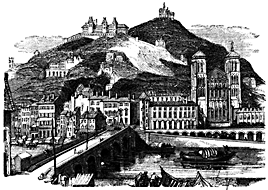
CITY OF LYONS.
About the same time two sorcerers in Toulouse were accused of having dragged a crucifix about the streets at midnight, stopping at times to spit upon and kick it, and uttering at intervals an exorcism to raise the devil. The next day a hail-storm did considerable damage to the crops; and a girl, the daughter of a shoemaker in the town, remembered to have heard in the night the execrations of the wizards. Her story led to their arrest. The usual means to produce confession were resorted to. The wizards owned that they could raise tempests whenever they pleased, and named several persons who possessed similar powers. They were hanged, and then burned in the market-place, and seven of the persons they had mentioned shared the same fate.
Hoppo and Stadlin, two noted wizards of Germany, were executed in 1599. They implicated twenty or thirty witches, who went about causing women to miscarry, bringing down the lightning of heaven, and making maidens bring forth toads. To this latter fact several girls were found to swear most positively! Stadlin confessed that he had killed seven infants in the womb of one woman.
Bodinus highly praises the exertions of a witch-finder named Nider, in France, who prosecuted so many that he could not calculate them. Some of these witches could, by a single word, cause people to fall down dead; others made women go with child three years instead of nine months; while others, by certain invocations and ceremonies, could turn the faces of their enemies upside down, or twist them round to their backs. Although no witness was ever procured who saw persons in this horrible state, the witches confessed that they had the power and exercised it. Nothing more was wanting to ensure the stake.
At Amsterdam a crazy girl confessed that she could cause sterility in cattle, and bewitch pigs and poultry by merely repeating the magic words Turius und Shurius Inturius! She was hanged and burned. Another woman in the same city, named Kornelis van Purmerund, was arrested in consequence of some disclosures the former had made. A witness came forward and swore that she one day looked through the window of her hut, and saw Kornelis sitting before a fire muttering something to the devil. She was sure it was to the devil, because she heard him answer her. Shortly afterwards twelve black cats ascended out of the floor, and danced on their hind legs around the witch for the space of about half an hour. They then vanished with a horrid noise, and leaving a disagreeable smell behind them. She also was hanged and burned.
At Bamberg, in Bavaria, the executions from the year 1610 to 1640 were at the rate of about a hundred annually. One woman, suspected of witchcraft, was seized because, having immoderately praised the beauty of a child, it had shortly afterwards fallen ill and died. She confessed upon the rack that the devil had given her the power to work evil upon those she hated, by speaking words in their praise. If she said with unwonted fervour, “What a strong man!” “What a lovely woman!” “What a sweet child!” the devil understood her, and afflicted them with diseases immediately. It is quite unnecessary to state the end of this poor creature. Many women were executed for causing strange substances to lodge in the bodies of those who offended them. Bits of wood, nails, hair, egg-shells, bits of glass, shreds of linen and woollen cloth, pebbles, and even hot cinders and knives, were the articles generally chosen. These were believed to remain in the body till the witches confessed or were executed, when they were voided from the bowels, or by the mouth, nostrils, or ears. Modern physicians have often had cases of a similar description under their care, where girls have swallowed needles, which have been voided on the arms, legs, and other parts of the body. But the science of that day could not account for these phenomena otherwise than by the power of the devil; and every needle swallowed by a servant-maid cost an old woman her life. Nay, if no more than one suffered in consequence, the district might think itself fortunate. The commissioners seldom stopped short at one victim. The revelations of the rack in most cases implicated half a score.
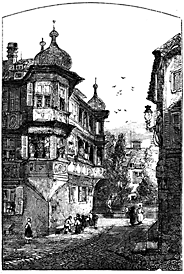
BAMBERG.
Of all the records of the witch-trials preserved for the wonder of succeeding ages, that of Würzburg, from 1627 to 1629, is the most frightful. Hauber, who has preserved this list in his Acta et Scripta Magica, says, in a note at the end, that it is far from complete, and that there were a great many other burnings too numerous to specify. This record, which relates to the city only, and not to the province of Würzburg, contains the names of one hundred and fifty-seven persons who were burned in two years in twenty-nine burnings, averaging from five to six at a time. The list comprises three play-actors, four innkeepers, three common councilmen of Würzburg, fourteen vicars of the cathedral, the burgomaster’s lady, an apothecary’s wife and daughter, two choristers of the cathedral, Göbel Babelin, the prettiest girl in the town, and the wife, the two little sons and the daughter of the councillor Stolzenberg. Rich and poor, young and old, suffered alike. At the seventh of these recorded burnings, the victims are described as a wandering boy, twelve years of age, and four strange men and women found sleeping in the market-place. Thirty-two of the whole number appear to have been vagrants, of both sexes, who, failing to give a satisfactory account of themselves, were accused and found guilty of witchcraft. The number of children on the list is horrible to think upon. The thirteenth and fourteenth burnings comprised four persons, who are stated to have been a little maiden nine years of age, a maiden still less, her sister, their mother, and their aunt, a pretty young woman of twenty-four. At the eighteenth burning the victims were two boys of twelve, and a girl of fifteen; at the nineteenth, the young heir of the noble house of Rotenhahn, aged nine, and two other boys, one aged ten, and the other twelve. Among other entries appear the names of Baunach, the fattest, and Steinacher, the richest burgher in Würzburg. What tended to keep up the delusion in this unhappy city, and, indeed, all over Europe, was the number of hypochondriac and diseased persons who came voluntarily forward and made confession of witchcraft. Several of the victims in the foregoing list had only themselves to blame for their fate. Many again, including the apothecary’s wife and daughter already mentioned, pretended to sorcery, and sold poisons, or attempted by means of charms and incantations to raise the devil. But throughout all this fearful period the delusion of the criminals was as great as that of the judges. Depraved persons who in ordinary times would have been thieves or murderers, added the desire of sorcery to their depravity, sometimes with the hope of acquiring power over their fellows, and sometimes with the hope of securing impunity in this world by the protection of Satan. One of the persons executed at the first burning, a prostitute, was heard repeating the exorcism which was supposed to have the power of raising the arch enemy in the form of a goat. This precious specimen of human folly has been preserved by Horst in his Zauberbibliothek. It ran as follows, and was to be repeated slowly, with many ceremonies and wavings of the hand:
“Lalle, Bachera, Magotte, Baphia, Dajam, Vagoth Heneche Ammi Nagaz, Adomator Raphael Immanuel Christus, Tetragrammaton Agra Jod Loi. König! König!”
The two last words were uttered quickly, and with a sort of scream, and were supposed to be highly agreeable to Satan, who loved to be called a king. If he did not appear immediately, it was necessary to repeat a further exorcism. The one in greatest repute was as follows, and was to be read backwards, with the exception of the last two words:
“Anion, Lalle, Sabolos, Sado, Pater, Aziel Adonai Sado Vagoth Agra, Jod, Baphra! Komm! Komm!”
When the witch wanted to get rid of the devil, who was sometimes in the habit of prolonging his visits to an unconscionable length, she had only to repeat the following, also backwards, when he generally disappeared, leaving behind him a suffocating smell:
“Zellianelle Heotti Bonus Vagotha Plisos sother osech unicus Beelzebub Dax! Komm! Komm!”
This nonsensical jargon soon became known to all the idle and foolish boys of Germany. Many an unhappy urchin, who in a youthful frolic had repeated it, paid for his folly the penalty of his life. Three, whose ages varied from ten to fifteen, were burned alive at Würzburg for no other offence. Of course every other boy in the city became still more convinced of the power of the charm. One boy confessed that he would willingly have sold himself to the devil, if he could have raised him, for a good dinner and cakes every day of his life, and a pony to ride upon. This luxurious youngster, instead of being horsewhipped for his folly, was hanged and burned.
The small district of Lindheim was, if possible, even more notorious than Würzburg for the number of its witch-burnings. In the year 1633 a famous witch, named Pomp Anna, who could cause her foes to fall sick by merely looking at them, was discovered and burned, along with three of her companions. Every year in this parish, consisting at most of a thousand persons, the average number of executions was five. Between the years 1660 and 1664, the number consumed was thirty. If the executions all over Germany had been in this frightful proportion, hardly a family could have escaped losing one of its members.
In 1627, a ballad entitled the Druten Zeitung, or the Witches’ Gazette, was very popular in Germany. It detailed, according to the title-page of a copy printed at Smalcald in 1627, “An account of the remarkable events which took place in Franconia, Bamberg, and Würzburg, with those wretches who from avarice or ambition have sold themselves to the devil, and how they had their reward at last: set to music, and to be sung to the tune of Dorothea.” The sufferings of the witches at the stake are explained in it with great minuteness, the poet waxing extremely witty when he describes the horrible contortions of pain upon their countenances, and the shrieks that rent the air when any one of more than common guilt was burned alive. A trick resorted to in order to force one witch to confess, is told in this doggrel as an excellent joke. As she obstinately refused to own that she was in league with the powers of evil, the commissioners suggested that the hangman should dress himself in a bear’s skin, with the horns, tail, and all the et-ceteras, and in this form penetrate into her dungeon. The woman, in the darkness of her cell, could not detect the imposture, aided as it was by her own superstitious fears. She thought she was actually in the presence of the prince of hell; and when she was told to keep up her courage, and that she should be relieved from the power of her enemies, she fell on her knees before the supposed devil, and swore to dedicate herself hereafter, body and soul, to his service. Germany is, perhaps, the only country in Europe where the delusion was so great as to have made such detestable verses as these the favourites of the people:
“Man shickt ein Henkersknecht Zu ihr in Gefängniss n’unter, Den man hat kleidet recht, Mit einer Bärnhaute, Als wenns der Teufel wär; Als ihm die Drut anschaute Meints ihr Buhl kam daher. Sie sprach zu ihm behende, Wie lässt du mich so lang In der Obrigkeit Hände? Hilf mir aus ihren Zwang, Wie du mir hast verheissen, Ich bin ja eben dein, Thu mich aus der Angst entreissen O liebster Buhle mein!”36
This rare poet adds, that in making such an appeal to the hangman, the witch never imagined the roast that was to be made of her, and puts in, by way of parenthesis, “was not that fine fun!—was das war für ein Spiel!” As feathers thrown into the air shew how the wind blows, so this trumpery ballad serves to shew the current of popular feeling at the time of its composition.
All readers of history are familiar with the celebrated trial of the Maréchale d’Ancre, who was executed in Paris in the year 1617. Although witchcraft was one of the accusations brought against her, the real crime for which she suffered was her ascendency over the mind of Mary of Medicis, and the consequent influence she exercised indirectly over the unworthy king, Louis XIII. Her coachman gave evidence that she had sacrificed a cock at midnight in one of the churches, and others swore they had seen her go secretly into the house of a noted witch named Isabella. When asked by what means she had acquired so extraordinary an influence over the mind of the Queen Mother, she replied boldly that she exercised no other power over her than that which a strong mind can always exercise over the weak. She died with great firmness.
In two years afterwards, scenes far more horrible than any that had yet taken place in France were enacted at Labourt, at the foot of the Pyrenees. The parliament of Bourdeaux, scandalised at the number of witches who were said to infest Labourt and its neighbourhood, deputed one of its own members, the noted Pierre de l’Ancre, and its president, Espaignel, to inquire into the matter, with full powers to punish the offenders. They arrived at Labourt in May, 1619. De l’Ancre wrote a book setting forth all his great deeds in this battle against the powers of evil. It is full of obscenity and absurdity, but the facts may be relied on as far as they relate to the number of trials and executions, and the strange confessions which torture forced from the unhappy criminals.
De l’Ancre states as a reason why so many witches were to be found at Labourt, that the country was mountainous and sterile! He discovered many of them from their partiality to smoking tobacco. It may be inferred from this that he was of the opinion of King James, that tobacco was the “devil’s weed.” When the commission first sat, the number of persons brought to trial was about forty a day. The acquittals did not average so many as five per cent. All the witches confessed that they had been present at the great Domdaniel, or Sabbath. At these saturnalia the devil sat upon a large gilded throne, sometimes in the form of a goat; sometimes as a gentleman, dressed all in black, with boots, spurs, and sword; and very often as a shapeless mass, resembling the trunk of a blasted tree, seen indistinctly amid the darkness. They generally proceeded to the Domdaniel, riding on spits, pitchforks, or broomsticks, and on their arrival indulged with the fiends in every species of debauchery. Upon one occasion they had had the audacity to celebrate this festival in the very heart of the city of Bourdeaux. The throne of the arch fiend was placed in the middle of the Place de Gallienne, and the whole space was covered with the multitude of witches and wizards who flocked to it from far and near, some arriving even from distant Scotland.
After two hundred poor wretches had been hanged and burned, there seemed no diminution in the number of criminals to be tried. Many of the latter were asked upon the rack what Satan had said when he found that the commissioners were proceeding with such severity? The general reply was, that he did not seem to care much about it. Some of them asserted that they had boldly reproached him for suffering the execution of their friends, saying, “Out upon thee, false fiend! thy promise was that they should not die! Look, how thou hast kept thy word! They have been burned, and are a heap of ashes!” Upon these occasions he was never offended: he would give orders that the sports of the Domdaniel should cease, and producing illusory fires that did not burn, he encouraged them to walk through, assuring them that the fires lighted by the executioner gave no more pain than those. They would then ask him, where their friends were, since they had not suffered; to which the “Father of Lies” invariably replied, that they were happy in a far country, and could see and hear all that was then passing; and that, if they called by name those they wished to converse with, they might hear their voices in reply. Satan then imitated the voices of the defunct witches so successfully that they were all deceived. Having answered all objections, the orgies recommenced and lasted till the cock crew.
De l’Ancre was also very zealous in the trial of unhappy monomaniacs for the crime of lycanthropy. Several who were arrested confessed, without being tortured, that they were weir-wolves, and that at night they rushed out among the flocks and herds killing and devouring. One young man at Besançon, with the full consciousness of the awful fate that awaited him, voluntarily gave himself up to the commissioner Espaignel, and confessed that he was the servant of a strong fiend, who was known by the name of “Lord of the Forests:” by his power he was transformed into the likeness of a wolf. The “Lord of the Forests” assumed the same shape; but was much larger, fiercer, and stronger. They prowled about the pastures together at midnight, strangling the watch-dogs that defended the folds, and killing more sheep than they could devour. He felt, he said, a fierce pleasure in these excursions, and howled in excess of joy as he tore with his fangs the warm flesh of the sheep asunder. This youth was not alone in this horrid confession; many others voluntarily owned that they were weir-wolves, and many more were forced by torture to make the same avowal. Such criminals were thought to be too atrocious to be hanged first and then burned: they were generally sentenced to be burned alive, and their ashes to be scattered to the winds. Grave and learned doctors of divinity openly sustained the possibility of these transformations, relying mainly upon the history of Nebuchadnezzar. They could not imagine why, if he had been an ox, modern men could not become wolves by Divine permission and the power of the devil. They also contended that, if men should confess, it was evidence enough, if there had been no other. Delrio mentions that one gentleman accused of lycanthropy was put to the torture no less than twenty times; but still he would not confess. An intoxicating draught was then given him, and under its influence he confessed that he was a weir-wolf. Delrio cites this to shew the extreme equity of the commissioners. They never burned any body till he confessed; and if one course of torture would not suffice, their patience was not exhausted, and they tried him again and again, even to the twentieth time! Well may we exclaim, when such atrocities have been committed in the name of religion,
“Quel lion, quel tigre égale en cruauté, Une injuste fureur qu’arme la piété?”
The trial of the unhappy Urbain Grandier, the curate of Loudun, for bewitching a number of girls in the convent of the Ursulines in that town, was, like that of the Maréchale d’Ancre, an accusation resorted to by his enemies to ruin one against whom no other charge could be brought so readily. This noted affair, which kept France in commotion for months, and the true character of which was known even at that time, merits no more than a passing notice in this place. It did not spring from the epidemic dread of sorcery then so prevalent, but was carried on by wretched intriguers, who had sworn to have the life of their foe. Such a charge could not be refuted in 1634: the accused could not, as Bodinus expresses it, “make the malice of the prosecutors more clear than the sun;” and his own denial, however intelligible, honest, and straightforward, was held as nothing in refutation of the testimony of the crazy women who imagined themselves bewitched. The more absurd and contradictory their assertions, the stronger the argument employed by his enemies that the devil was in them. He was burned alive, under circumstances of great cruelty.37
A singular instance of the epidemic fear of witchcraft occurred at Lille, in 1639. A pious but not very sane lady, named Antoinette Bourignon, founded a school, or hospice, in that city. One day, on entering the schoolroom, she imagined that she saw a great number of little black angels flying about the heads of the children. In great alarm she told her pupils of what she had seen, warning them to beware of the devil whose imps were hovering about them. The foolish woman continued daily to repeat the same story, and Satan and his power became the only subject of conversation, not only between the girls themselves, but between them and their instructors. One of them at this time ran away from the school. On being brought back and interrogated, she said she had not run away, but had been carried away by the devil; she was a witch, and had been one since the age of seven. Some other little girls in the school went into fits at this announcement, and, on their recovery, confessed that they also were witches. At last the whole of them, to the number of fifty, worked upon each other’s imaginations to such a degree that they also confessed that they were witches—that they attended the Domdaniel, or meeting of the fiends—that they could ride through the air on broom-sticks, feast on infants’ flesh, or creep through a key-hole.
The citizens of Lille were astounded at these disclosures. The clergy hastened to investigate the matter; many of them, to their credit, openly expressed their opinion that the whole affair was an imposture—not so the majority; they strenuously insisted that the confessions of the children were valid, and that it was necessary to make an example by burning them all for witches. The poor parents, alarmed for their offspring, implored the examining Capuchins with tears in their eyes to save their young lives, insisting that they were bewitched, and not bewitching. This opinion also gained ground in the town. Antoinette Bourignon, who had put these absurd notions into the heads of the children, was accused of witchcraft, and examined before the council. The circumstances of the case seemed so unfavourable towards her that she would not stay for a second examination. Disguising herself as she best could, she hastened out of Lille and escaped pursuit. If she had remained four hours longer, she would have been burned by judicial sentence as a witch and a heretic. It is to be hoped that, wherever she went, she learned the danger of tampering with youthful minds, and was never again entrusted with the management of children.
The Duke of Brunswick and the Elector of Menz were struck with the great cruelty exercised in the torture of suspected persons, and convinced, at the same time, that no righteous judge would consider a confession extorted by pain, and contradictory in itself, as sufficient evidence to justify the execution of any accused person. It is related of the Duke of Brunswick that he invited two learned Jesuits to his house, who were known to entertain strong opinions upon the subject of witchcraft, with a view of shewing them the cruelty and absurdity of such practices. A woman lay in the dungeon of the city accused of witchcraft, and the duke, having given previous instructions to the officiating torturers, went with the two Jesuits to hear her confession. By a series of artful leading questions the poor creature, in the extremity of her anguish, was induced to confess that she had often attended the sabbath of the fiends upon the Brocken; that she had seen two Jesuits there, who had made themselves notorious, even among witches, for their abominations; that she had seen them assume the form of goats, wolves, and other animals; and that many noted witches had borne them five, six, and seven children at a birth, who had heads like toads, and legs like spiders. Being asked if the Jesuits were far from her, she replied that they were in the room beside her. The Duke of Brunswick led his astounded friends away, and explained the stratagem. This was convincing proof to both of them that thousands of persons had suffered unjustly; they knew their own innocence, and shuddered to think what their fate might have been if an enemy instead of a friend had put such a confession into the mouth of a criminal. One of these Jesuits was Frederick Spee, the author of the Cautio Criminalis, published in 1631. This work, exposing the horrors of the witch-trials, had a most salutary effect in Germany: Schonbrunn, Archbishop and Elector of Menz, abolished the torture entirely within his dominions, and his example was imitated by the Duke of Brunswick and other potentates. The number of supposed witches immediately diminished, and the violence of the mania began to subside. The Elector of Brandenburg issued a rescript, in 1654, with respect to the case of Anna of Ellerbrock, a supposed witch, forbidding the use of torture, and stigmatising the swimming of witches as an unjust, cruel, and deceitful test.
This was the beginning of the dawn after the long-protracted darkness. The tribunals no longer condemned witches to execution by hundreds in a year. Würzburg, the grand theatre of the burnings, burned but one where, forty years previously, it had burned three score. From 1660 to 1670 the electoral chambers, in all parts of Germany, constantly commuted the sentence of death passed by the provincial tribunals into imprisonment for life, or burning on the cheek.
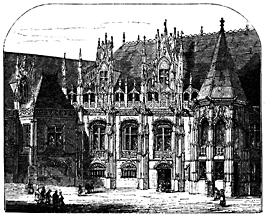
ROUEN.
A truer philosophy had gradually disabused the public mind. Learned men freed themselves from the trammels of a debasing superstition, and governments, both civil and ecclesiastical, repressed the popular delusion they had so long encouraged. The parliament of Normandy condemned a number of women to death, in the year 1670, on the old charge of riding on broomsticks to the Domdaniel; but Louis XIV. commuted the sentence into banishment for life. The parliament remonstrated, and sent the king the following remarkable request. The reader will perhaps be glad to see this document at length. It is of importance, as the last effort of a legislative assembly to uphold this great error; and the arguments they used and the instances they quoted are in the highest degree curious. It reflects honour upon the memory of Louis XIV. that he was not swayed by it.
“REQUEST OF THE PARLIAMENT OF ROUEN TO THE KING, IN 1670.
“Sire,—Emboldened by the authority which your majesty has committed into our hands in the province of Normandy, to try and punish offences, and more particularly those offences of the nature of witchcraft, which tend to the destruction of religion and the ruin of nations, we, your parliament, remonstrate humbly with your majesty upon certain cases of this kind which have been lately brought before us. We cannot permit the letter addressed by your majesty’s command to the attorney-general of this district, for the reprieve of certain persons condemned to death for witchcraft, and for the staying of proceedings in several other cases, to remain unnoticed, and without remarking upon the consequences which may ensue. There is also a letter from your secretary of state, declaring your majesty’s intention to commute the punishment of these criminals into one of perpetual banishment, and to submit to the opinion of the procureur-general, and of the most learned members of the parliament of Paris, whether, in the matter of witchcraft, the jurisprudence of the parliament of Rouen is to be followed in preference to that of the parliament of Paris, and of the other parliaments of the kingdom which judge differently.
“Although by the ordinances of the kings your predecessors, parliaments have been forbidden to pay any attention to lettres de cachet; we, nevertheless, from the knowledge which we have, in common with the whole kingdom, of the care bestowed by your majesty for the good of your subjects, and from the submission and obedience to your commandments which we have always manifested, have stayed all proceedings, in conformity to your orders; hoping that your majesty, considering the importance of the crime of witchcraft, and the consequences likely to ensue from its impunity, will be graciously pleased to grant us once more your permission to continue the trials, and execute judgment upon those found guilty. And as, since we received the letter of your secretary of state, we have also been made acquainted with the determination of your majesty, not only to commute the sentence of death passed upon these witches into one of perpetual banishment from the province, but to re-establish them in the possession of their goods and chattels, and of their good fame and character, your parliament have thought it their duty, on occasion of these crimes, the greatest which men can commit, to make you acquainted with the general and uniform feelings of the people of this province with regard to them; it being, moreover, a question in which are concerned the glory of God and the relief of your suffering subjects, who groan under their fears from the threats and menaces of this sort of persons, and who feel the effects of them every day in the mortal and extraordinary maladies which attack them, and the surprising damage and loss of their possessions.
“Your majesty knows well that there is no crime so opposed to the commands of God as witchcraft, which destroys the very foundation of religion, and draws strange abominations after it. It is for this reason, sire, that the Scriptures pronounce the punishment of death against offenders, and that the Church and the holy fathers have fulminated their anathemas, and that canonical decisions have one and all decreed the most severe punishments, to deter from this crime; and that the Church of France, animated by the piety of the kings your predecessors, has expressed so great a horror at it, that, not judging the punishment of perpetual imprisonment, the highest it has the power to inflict, sufficiently severe, it has left such criminals to be dealt with by the secular power.
“It has been the general feeling of all nations that such criminals ought to be condemned to death, and all the ancients were of the same opinion. The law of the ‘Twelve Tables,’ which was the principal of the Roman laws, ordains the same punishment. All juris-consults agreed in it, as well as the constitutions of the emperors, and more especially those of Constantine and Theodosius, who, enlightened by the Gospel, not only renewed the same punishment, but also deprived, expressly, all persons found guilty of witchcraft of the right of appeal, and declared them to be unworthy of a prince’s mercy. And Charles VIII., sire, inspired by the same sentiments, passed that beautiful and severe ordinance (cette belle et sévère ordonnance), which enjoined the judges to punish witches according to the exigencies of the case, under a penalty of being themselves fined or imprisoned, or dismissed from their office; and decreed, at the same time, that all persons who refused to denounce a witch, should be punished as accomplices; and that all, on the contrary, who gave evidence against one should be rewarded.
“From these considerations, sire, and in the execution of so holy an ordinance, your parliaments, by their decrees, proportion their punishments to the guilt of the offenders; and your parliament of Normandy has never, until the present time, found that its practice was different from that of other courts; for all the books which treat upon this matter cite an infinite number of decrees condemning witches to be burnt, or broken on the wheel, or to other punishments. The following are examples:—In the time of Chilperic, as may be seen in Gregory of Tours, b. vi. c. 35 of his History of France; all the decrees of the parliament of Paris passed according to, and in conformity with, this ancient jurisprudence of the kingdom, cited by Imbert, in his Judicial Practice; all those cited by Monstrelet, in 1459, against the witches of Artois; the decrees of the same parliament, of the 13th of October 1573, against Mary Le Fief, native of Saumur; of the 21st of October 1596, against the Sieur de Beaumont, who pleaded, in his defence, that he had only sought the aid of the devil for the purpose of unbewitching the afflicted and of curing diseases; of the 4th of July 1606, against Francis du Bose; of the 20th of July 1582, against Abel de la Rue, native of Coulommiers; of the 2d of October 1593, against Rousseau and his daughter; of 1608, against another Rousseau and one Peley, for witchcraft and adoration of the devil at the Sabbath, under the figure of a he-goat, as confessed by them; the decree of 4th of February 1615, against Leclerc, who appealed from the sentence of the parliament of Orleans, and who was condemned for having attended the Sabbath, and confessed, as well as two of his accomplices, who died in prison, that he had adored the devil, renounced his baptism and his faith in God, danced the witches’ dance, and offered up unholy sacrifices; the decrees of the 6th of May 1616, against a man named Leger, on a similar accusation; the pardon granted by Charles IX. to Trois Echelles, upon condition of revealing his accomplices, but afterwards revoked for renewed sorcery on his part; the decree of the parliament of Paris, cited by Mornac in 1595; the judgments passed in consequence of the commission given by Henry IV. to the Sieur de l’Ancre, councillor of the parliament of Bourdeaux; of the 20th of March 1619, against Etienne Audibert; those passed by the chamber of Nerac, on the 26th of June 1620, against several witches; those passed by the parliament of Toulouse in 1577, as cited by Gregory Tolosanus, against four hundred persons accused of this crime, and who were all marked with the sign of the devil. Besides all these, we might recal to your majesty’s recollection the various decrees of the parliament of Provence, especially in the case of Gaufrédy in 1611; the decrees of the parliament of Dijon, and those of the parliament of Rennes, following the example of the condemnation of the Marshal de Rays, who was burned in 1441, for the crime of witchcraft, in presence of the Duke of Brittany;—all these examples, sire, prove that the accusation of witchcraft has always been punished with death by the parliaments of your kingdom, and justify the uniformity of their practice.
“These, sire, are the motives upon which your parliament of Normandy has acted in decreeing the punishment of death against the persons lately brought before it for this crime. If it has happened that, on any occasion, these parliaments, and the parliament of Normandy among the rest, have condemned the guilty to a less punishment than that of death, it was for the reason that their guilt was not of the deepest dye; your majesty, and the kings your predecessors, having left full liberty to the various tribunals to whom they delegated the administration of justice, to decree such punishment as was warranted by the evidence brought before them.
“After so many authorities, and punishments ordained by human and divine laws, we humbly supplicate your majesty to reflect once more upon the extraordinary results which proceed from the malevolence of this sort of people; on the deaths from unknown diseases, which are often the consequences of their menaces, on the loss of the goods and chattels of your subjects, on the proofs of guilt continually afforded by the insensibility of the marks upon the accused, on the sudden transportation of bodies from one place to another, on the sacrifices and nocturnal assemblies, and other facts, corroborated by the testimony of ancient and modern authors, and verified by so many eye-witnesses, composed partly of accomplices, and partly of people who had no interest in the trials beyond the love of truth, and confirmed, moreover, by the confessions of the accused parties themselves; and that, sire, with so much agreement and conformity between the different cases, that the most ignorant persons convicted of this crime have spoken to the same circumstances, and in nearly the same words, as the most celebrated authors who have written about it, all of which may be easily proved to your majesty’s satisfaction by the records of various trials before your parliaments.
“These, sire, are truths so intimately bound up with the principles of our religion, that, extraordinary although they be, no person has been able to this time to call them in question. If some have cited, in opposition to these truths, the pretended canon of the Council of Ancyre, and a passage from St. Augustin, in a treatise upon the Spirit and the Soul, it has been without foundation; and it would be easy to convince your majesty that neither the one nor the other ought to be accounted of any authority; and, besides that, the canon, in this sense, would be contrary to the opinion of all succeeding councils of the Church, Cardinal Baronius, and all learned commentators agree that it is not to be found in any old edition. In effect, in those editions wherein it is found, it is in another language, and is in direct contradiction to the twenty-third canon of the same council, which condemns sorcery, according to all preceding constitutions. Even supposing that this canon was really promulgated by the Council of Ancyre, we must observe that it was issued in the second century, when the principal attention of the Church was directed to the destruction of paganism. For this reason, it condemns that class of women who said they could pass through the air, and over immense regions, with Diana and Herodias, and enjoins all preachers to teach the falsehood of such an opinion, in order to deter people from the worship of these false divinities; but it does not question the power of the devil over the human body, which is, in fact, proved by the holy Gospel of Jesus Christ himself. And with regard, sire, to the pretended passage of St. Augustin, everybody knows that it was not written by him, because the writer, whoever he was, cites Bœtius, who died more than eighty years after the time of St. Augustin. Besides, there is still more convincing proof in the fact, that the same father establishes the truth of witchcraft in all his writings, and more particularly in his City of God; and in his first volume, question the 25th, wherein he states that sorcery is a communion between man and the devil, which all good Christians ought to look upon with horror.
“Taking all these things into consideration, sire, the officers of your parliament hope, from the justice of your majesty, that you will be graciously pleased to receive the humble remonstrances they have taken the liberty to make. They are compelled, for the acquittal of their own consciences and in discharge of their duty, to make known to your majesty, that the decrees they passed against the sorcerers and witches brought before them, were passed after a mature deliberation on the part of all the judges present, and that nothing has been done therein which is not conformable to the universal jurisprudence of the kingdom, and for the general welfare of your majesty’s subjects, of whom there is not one who can say that he is secure from the malevolence of such criminals. We therefore supplicate your majesty to suffer us to carry into effect the sentences we passed, and to proceed with the trial of the other persons accused of the same crime; and that the piety of your majesty will not suffer to be introduced during your reign an opinion contrary to the principles of that holy religion for which you have always employed so gloriously both your cares and your arms.”