PHILOSOPHICAL SUBJECTS.
Reading edition
To the Abbé Soulavie.[35]
Theory of the Earth.—Read in the American Philosophical Society, November 22, 1782.
Passy, September 22, 1782.
I return the papers with some corrections. I did not find coal mines under the calcareous rocks in Derbyshire. I only remarked, that at the lowest part of that rocky mountain which was in sight, there were oyster shells mixed in the stone; and part of the high county of Derby being probably as much above the level of the sea as the coal mines of Whitehaven were below it, seemed a proof that there had been a great boulversement in the surface of that island, some part of it having been depressed under the sea, and other parts, which had been under it, being raised above it. Such changes in the superficial parts of the globe seemed to me unlikely to happen if the earth were solid to the centre. I therefore imagined that the internal parts might be a fluid more dense, and of greater specific gravity than any of the solids we are acquainted with, which therefore might swim in or upon that fluid. Thus the surface of the globe would be a shell, capable of being broken or disordered by the violent movements of the fluid on which it rested. And as air has been compressed by art so as to be twice as dense as water, in which case, if such air and water could be contained in a strong glass vessel, the air would be seen to take the lowest place, and the water to float above and upon it; and as we know not yet the degree of density to which air may be compressed, and M. Amontons calculated that its density increasing as it approached the centre in the same proportion as above the surface, it would, at the depth of—— leagues, be heavier than gold; possibly the dense fluid occupying the internal parts of the globe might be air compressed. And as the force of expansion in dense air, when heated, is in proportion to its density, this central air might afford another agent to move the surface, as well as be of use in keeping alive the subterraneous fires; though, as you observe, the sudden rarefaction of water coming into contact without those fires, may also be an agent sufficiently strong for that purpose, when acting between the incumbent earth and the fluid on which it rests.
If one might indulge imagination in supposing how such a globe was formed, I should conceive, that all the elements in separate particles being originally mixed in confusion, and occupying a great space, they would (as soon as the almighty fiat ordained gravity, or the mutual attraction of certain parts and the mutual repulsion of others, to exist) all move to their common centre: that the air, being a fluid whose parts repel each other, though drawn to the common centre by their gravity, would be densest towards the centre, and rarer as more remote; consequently, all matters lighter than the central parts of that air and immersed in it, would recede from the centre, and rise till they arrived at that region of the air which was of the same specific gravity with themselves, where they would rest; while other matter, mixed with the lighter air, would descend, and the two, meeting, would form the shell of the first earth, leaving the upper atmosphere nearly clear. The original movement of the parts towards their common centre would naturally form a whirl there, which would continue upon the turning of the new-formed globe upon its axis, and the greatest diameter of the shell would be in its equator. If by any accident afterward the axis should be changed, the dense internal fluid, by altering its form, must burst the shell and throw all its substance into the confusion in which we find it. I will not trouble you at present with my fancies concerning the manner of forming the rest of our system. Superior beings smile at our theories, and at our presumption in making them. I will just mention, that your observations on the ferruginous nature of the lava which is thrown out from the depths of our volcanoes, gave me great pleasure. It has long been a supposition of mine, that the iron contained in the surface of the globe has made it capable of becoming, as it is, a great magnet; that the fluid of magnetism perhaps exists in all space; so that there is a magnetical north and south of the universe, as well as of this globe, and that, if it were possible for a man to fly from star to star, he might govern his course by the compass; that it was by the power of this general magnetism this globe became a particular magnet. In soft or hot iron the fluid of magnetism is naturally diffused equally; when within the influence of the magnet it is drawn to one end of the iron, made denser there and rarer at the other. While the iron continues soft and hot, it is only a temporary magnet; if it cools or grows hard in that situation, it becomes a permanent one, the magnetic fluid not easily resuming its equilibrium. Perhaps it may be owing to the permanent magnetism of this globe, which it had not at first, that its axis is at present kept parallel to itself, and not liable to the changes it formerly suffered, which occasioned the rupture of its shell, the submersions and emersions of its lands, and the confusion of its seasons. The present polar and equatorial diameters differing from each other near ten leagues, it is easy to conceive, in case some power should shift the axis gradually, and place it in the present equator, and make the new equator pass through the present poles, what a sinking of the waters would happen in the equatorial regions, and what a rising in the present polar regions; so that vast tracts would be discovered that now are under water, and others covered that are now dry, the water rising and sinking in the different extremes near five leagues. Such an operation as this possibly occasioned much of Europe, and, among the rest, this mountain of Passy on which I live, and which is composed of limestone, rock, and seashells, to be abandoned by the sea, and to change its ancient climate, which seems to have been a hot one. The globe being now become a perfect magnet, we are, perhaps, safe from any change of its axis. But we are still subject to the accidents on the surface, which are occasioned by a wave in the internal ponderous fluid; and such a wave is producible by the sudden violent explosion you mention, happening from the junction of water and fire under the earth, which not only lifts the incumbent earth that is over the explosion, but, impressing with the same force the fluid under it, creates a wave that may run a thousand leagues, lifting, and thereby shaking, successively, all the countries under which it passes. I know not whether I have expressed myself so clearly as not to get out of your sight in these reveries. If they occasion any new inquiries, and produce a better hypothesis, they will not be quite useless. You see I have given a loose to imagination; but I approve much more your method of philosophizing, which proceeds upon actual observation, makes a collection of facts, and concludes no farther than those facts will warrant. In my present circumstances, that mode of studying the nature of the globe is out of my power, and therefore I have permitted myself to wander a little in the wilds of fancy. With great esteem,
B. Franklin.
P.S.—I have heard that chymists can by their art decompose stone and wood, extracting a considerable quantity of water from the one and air from the other. It seems natural to conclude from this, that water and air were ingredients in their original composition; for men cannot make new matter of any kind. In the same manner, may we not suppose, that when we consume combustibles of all kinds, and produce heat or light, we do not create that heat or light, but decompose a substance which received it originally as a part of its composition? Heat may be thus considered as originally in a fluid state; but, attracted by organized bodies in their growth, becomes a part of the solid. Besides this, I can conceive, that in the first assemblage of the particles of which the earth is composed, each brought its portion of loose heat that had been connected with it, and the whole, when pressed together, produced the internal fire that still subsists.
To Dr. John Pringle.
ON THE DIFFERENT STRATA OF THE EARTH.
Craven-street, Jan. 6, 1758.
I return you Mr. Mitchell's paper on the strata of the earth[36] with thanks. The reading of it, and the perusal of the draught that accompanies it, have reconciled me to those convulsions which all naturalists agree this globe has suffered. Had the different strata of clay, gravel, marble, coals, limestone, sand, minerals, &c., continued to lie level, one under the other, as they may be supposed to have done before those convulsions, we should have had the use only of a few of the uppermost of the strata, the others lying too deep and too difficult to be come at; but the shell of the earth being broke, and the fragments thrown into this oblique position, the disjointed ends of a great number of strata of different kinds are brought up to day, and a great variety of useful materials put into our power, which would otherwise have remained eternally concealed from us. So that what has been usually looked upon as a ruin suffered by this part of the universe, was, in reality, only a preparation, or means of rendering the earth more fit for use, more capable of being to mankind a convenient and comfortable habitation.
B. Franklin.
To Mr. Bowdoin.
Queries and Conjectures relating to Magnetism and the Theory of the Earth.—Read in the American Philosophical Society January 15, 1790.
I received your favours by Messrs. Gore, Hilliard, and Lee, with whose conversation I was much pleased, and wished for more of it; but their stay with us was too short. Whenever you recommend any of your friends to me, you oblige me.
I want to know whether your Philosophical Society received the second volume of our Transactions. I sent it, but never heard of its arriving. If it miscarried, I will send another. Has your Society among its books the French work Sur les Arts et les Metiers? It is voluminous, well executed, and may be useful in our country. I have bequeathed it them in my will; but if they have it already, I will substitute something else.
Our ancient correspondence used to have something philosophical in it. As you are now free from public cares, and I expect to be so in a few months, why may we not resume that kind of correspondence? Our much regretted friend Winthrop once made me the compliment, that I was good at starting game for philosophers, let me try if I can start a little for you.
Has the question, how came the earth by its magnetism, ever been considered?
Is it likely that iron ore immediately existed when this globe was at first formed; or may it not rather be supposed a gradual production of time?
If the earth is at present magnetical, in virtue of the masses of iron ore contained in it, might not some ages pass before it had magnetic polarity?
Since iron ore may exist without that polarity, and, by being placed in certain circumstances, may obtain it from an external cause, is it not possible that the earth received its magnetism from some such cause?
In short, may not a magnetic power exist throughout our system, perhaps through all systems, so that if men could make a voyage in the starry regions, a compass might be of use? And may not such universal magnetism, with its uniform direction, be serviceable in keeping the diurnal revolution of a planet more steady to the same axis?
Lastly, as the poles of magnets may be changed by the presence of stronger magnets, might not, in ancient times, the near passing of some large comet, of greater magnetic power than this globe of ours, have been a means of changing its poles, and thereby wrecking and deranging its surface, placing in different regions the effect of centrifugal force, so as to raise the waters of the sea in some, while they were depressed in others?
Let me add another question or two, not relating indeed to magnetism, but, however, to the theory of the earth.
Is not the finding of great quantities of shells and bones of animals (natural to hot climates) in the cold ones of our present world, some proof that its poles have been changed? Is not the supposition that the poles have been changed, the easiest way of accounting for the deluge, by getting rid of the old difficulty how to dispose of its waters after it was over! Since, if the poles were again to be changed, and placed in the present equator, the sea would fall there about fifteen miles in height, and rise as much in the present polar regions; and the effect would be proportionable if the new poles were placed anywhere between the present and the equator.
Does not the apparent wreck of the surface of this globe, thrown up into long ridges of mountains, with strata in various positions, make it probable that its internal mass is a fluid, but a fluid so dense as to float the heaviest of our substances? Do we know the limit of condensation air is capable of? Supposing it to grow denser within the surface in the same proportion nearly as it does without, at what depth may it be equal in density with gold?
Can we easily conceive how the strata of the earth could have been so deranged, if it had not been a mere shell supported by a heavier fluid? Would not such a supposed internal fluid globe be immediately sensible of a change in the situation of the earth's axis, alter its form, and thereby burst the shell and throw up parts of it above the rest? As if we would alter the position of the fluid contained in the shell of an egg, and place its longest diameter where the shortest now is, the shell must break; but would be much harder to break if the whole internal substance were as solid and as hard as the shell.
Might not a wave, by any means raised in this supposed internal ocean of extremely dense fluid, raise, in some degree as it passes, the present shell of incumbent earth, and break it in some places, as in earthquakes. And may not the progress of such wave, and the disorders it occasions among the solids of the shell, account for the rumbling sound being first heard at a distance, augmenting as it approaches, and gradually dying away as it proceeds? A circumstance observed by the inhabitants of South America, in their last great earthquake, that noise coming from a place some degrees north of Lima, and being traced by inquiry quite down to Buenos Ayres, proceeded regularly from north to south at the rate of ____ leagues per minute, as I was informed by a very ingenious Peruvian whom I met with at Paris.
B. Franklin.
To M. Dubourg.
ON THE NATURE OF SEACOAL.
I am persuaded, as well as you, that the seacoal has a vegetable origin, and that it has been formed near the surface of the earth; but, as preceding convulsions of nature had served to bring it very deep in many places, and covered it with many different strata, we are indebted to subsequent convulsions for having brought within our view the extremities of its veins, so as to lead us to penetrate the earth in search of it. I visited last summer a large coalmine at Whitehaven, in Cumberland; and in following the vein, and descending by degrees towards the sea, I penetrated below the ocean where the level of its surface was more than eight hundred fathoms above my head, and the miners assured me that their works extended some miles beyond the place where I then was, continually and gradually descending under the sea. The slate, which forms the roof of this coalmine, is impressed in many places with the figures of leaves and branches of fern, which undoubtedly grew at the surface when the slate was in the state of sand on the banks of the sea. Thus it appears that this vein of coal has suffered a prodigious settlement.
B. Franklin.
CAUSES OF EARTHQUAKES.
The late earthquake felt here, and probably in all the neighbouring provinces, having made many people desirous to know what may be the natural cause of such violent concussions, we shall endeavour to gratify their curiosity by giving them the various opinions of the learned on that head.
Here naturalists are divided. Some ascribe them to water, others to fire, and others to air, and all of them with some appearance of reason. To conceive which, it is to be observed that the earth everywhere abounds in huge subterraneous caverns, veins, and canals, particularly about the roots of mountains; that of these cavities, veins, &c., some are full of water, whence are composed gulfs, abysses, springs, rivulets; and others full of exhalations; and that some parts of the earth are replete with nitre, sulphur, bitumen, vitriol, &c. This premised,
1. The earth itself may sometimes be the cause of its own shaking; when the roots or basis of some large mass being dissolved, or worn away by a fluid underneath, it sinks into the same, and, with its weight, occasions a tremour of the adjacent parts, produces a noise, and frequently an inundation of water.
2. The subterraneous waters may occasion earthquakes by their overflowing, cutting out new courses, &c. Add that the water, being heated and rarefied by the subterraneous fires, may emit fumes, blasts, &c., which, by their action either on the water or immediately on the earth itself, may occasion great succussions.
3. The air may be the cause of earthquakes; for the air being a collection of fumes and vapours raised from the earth and water, if it be pent up in too narrow viscera of the earth, the subterraneous or its own native heat rarefying and expanding it, the force wherewith it endeavours to escape may shake the earth; hence there arises divers species of earthquakes, according to the different position, quantity, &c., of the imprisoned aura.
Lastly, fire is a principal cause of earthquakes; both as it produces the aforesaid subterraneous aura or vapours, and as this aura or spirit, from the different matter and composition whereof arise sulphur, bitumen, and other inflammable matters, takes fire, either from other fire it meets withal, or from its collision against hard bodies, or its intermixture with other fluids; by which means, bursting out into a greater compass, the place becomes too narrow for it, so that, pressing against it on all sides, the adjoining parts are shaken, till, having made itself a passage, it spends itself in a volcano or burning mountain.
But to come nearer to the point. Dr. Lister is of opinion that the material cause of thunder, lightning, and earthquakes, is one and the same, viz., the inflammable breath of the pyrites, which is a substantial sulphur, and takes fire of itself.
The difference between these three terrible phenomena he takes only to consist in this: that the sulphur in the former is fired in the air, and in the latter under ground. Which is a notion Pliny had long before him: "Quid enim," says he, "aliud est in terrâ tremor, quam in nube tonitru?" For wherein does the trembling of the earth differ from that occasioned by thunder in the clouds?
This he thinks abundantly indicated by the same sulphurous smell being found in anything burned with lightning, and in the waters, &c., cast up in earthquakes, and even in the air before and after them.
Add that they agree in the manner of the noise which is carried on, as in a train fired; the one, rolling and rattling through the air, takes fire as the vapours chance to drive; as the other, fired under ground in like manner, moves with a desultory noise.
Thunder, which is the effect of the trembling of the air, caused by the same vapours dispersed through it, has force enough to shake our houses; and why there may not be thunder and lightning under ground, in some vast repositories there, I see no reason; especially if we reflect that the matter which composes the noisy vapour above us is in much larger quantities under ground.
That the earth abounds in cavities everybody allows; and that these subterraneous cavities are, at certain times and in certain seasons, full of inflammable vapours, the damps in mines sufficiently witness, which, fired, do everything as in an earthquake, save in a lesser degree.
Add that the pyrites alone, of all the known minerals, yields this inflammable vapour, is highly probable; for that no mineral or ore whatsoever is sulphurous, but as it is wholly or in part a pyrites, and that there is but one species of brimstone which the pyrites naturally and only yields. The sulphur vive, or natural brimstone, which is found in and about the burning mountains, is certainly the effects of sublimation, and those great quantities of it said to be found about the skirts of volcanoes is only an argument of the long duration and vehemence of those fires. Possibly the pyrites of the volcanoes, or burning mountains, may be more sulphurous than ours; and, indeed, it is plain that some of ours in England are very lean, and hold but little sulphur; others again very much, which may be some reason why England is so little troubled with earthquakes, and Italy, and almost all round the Mediterranean Sea, so much; though another reason is, the paucity of pyrites in England.
Comparing our earthquakes, thunder, and lightning, with theirs, it is observed that there it lightens almost daily, especially in summer-time, here seldom; there thunder and lightning is of long duration, here it is soon over; there the earthquakes are frequent, long, and terrible, with many paroxysms in a day, and that for many days; here very short, a few minutes, and scarce perceptible. To this purpose the subterraneous caverns in England are small and few compared to the vast vaults in those parts of the world; which is evident from the sudden disappearance of whole mountains and islands.
Dr. Woodward gives us another theory of earthquakes. He endeavours to show that the subterraneous heat or fire (which is continually elevating water out of the abyss, to furnish the earth with rain, dew, springs, and rivers), being stopped in any part of the earth, and so diverted from its ordinary course by some accidental glut or obstruction in the pores or passages through which it used to ascend to the surface, becomes, by such means, preternaturally assembled in a greater quantity than usual into one place, and therefore causeth a great rarefaction and intumescence of the water of the abyss, putting it into great commotions and disorders, and at the same time making the like effort on the earth, which, being expanded upon the face of the abyss, occasions that agitation and concussion we call an earthquake.
This effort in some earthquakes, he observes, is so vehement, that it splits and tears the earth, making cracks and chasms in it some miles in length, which open at the instant of the shock, and close again in the intervals between them; nay, it is sometimes so violent that it forces the superincumbent strata, breaks them all throughout, and thereby perfectly undermines and ruins the foundation of them; so that, these failing, the whole tract, as soon as the shock is over, sinks down into the abyss, and is swallowed up by it, the water thereof immediately rising up and forming a lake in the place where the said tract before was. That this effort being made in all directions indifferently, the fire, dilating and expanding on all hands, and endeavouring to get room and make its way through all obstacles, falls as foul on the waters of the abyss beneath as on the earth above, forcing it forth, which way soever it can find vent or passage, as well through its ordinary exits, wells, springs, and the outlets of rivers, as through the chasms then newly opened, through the camini or spiracles of Ætna, or other neighbouring volcanoes, and those hiatuses at the bottom of the sea whereby the abyss below opens into it and communicates with it. That as the water resident in the abyss is, in all parts of it, stored with a considerable quantity of heat, and more especially in those where those extraordinary aggregations of this fire happen, so likewise is the water which is thus forced out of it, insomuch that, when thrown forth and mixed with the waters of wells, or springs of rivers and the sea, it renders them very sensibly hot.
He adds, that though the abyss be liable to those commotions in all parts, yet the effects are nowhere very remarkable except in those countries which are mountainous, and, consequently, stony or cavernous underneath; and especially where the disposition of the strata is such that those caverns open the abyss, and so freely admit and entertain the fire which, assembling therein, is the cause of the shock; it naturally steering its course that way where it finds the readiest reception, which is towards those caverns. Besides, that those parts of the earth which abound with strata of stone or marble, making the strongest opposition to this effort, are the most furiously shattered, and suffer much more by it than those which consist of gravel, sand, and the like laxer matter, which more easily give way, and make not so great resistance. But, above all, those countries which yield great store of sulphur and nitre are by far the most injured by earthquakes; those minerals constituting in the earth a kind of natural gunpowder, which, taking fire upon this assemblage and approach of it, occasions that murmuring noise, that subterraneous thunder, which is heard rumbling in the bowels of the earth during earthquakes, and by the assistance of its explosive power renders the shock much greater, so as sometimes to make miserable havoc and destruction.
And it is for this reason that Italy, Sicily, Anatolia, and some parts of Greece, have been so long and often alarmed and harassed by earthquakes; these countries being all mountainous and cavernous, abounding with stone and marble, and affording sulphur and nitre in great plenty.
Farther, that Ætna, Vesuvius, Hecla, and the other volcanoes, are only so many spiracles, serving for the discharge of this subterraneous fire, when it is thus preternaturally assembled. That where there happens to be such a structure and conformation of the interior part of the earth, as that the fire may pass freely, and without impediment, from the caverns wherein it assembles unto those spiracles, it then readily gets out, from time to time, without shaking or disturbing the earth; but where such communication is wanting, or passage not sufficiently large and open, so that it cannot come at the spiracles, it heaves up and shocks the earth with greater or lesser impetuosity, according to the quantity of fire thus assembled, till it has made its way to the mouth of the volcano. That, therefore, there are scarce any countries much annoyed by earthquakes but have one of these fiery vents, which are constantly in flames when any earthquake happens, as disgorging that fire which, while underneath, was the cause of the disaster. Lastly, that were it not for these diverticula, it would rage in the bowels of the earth much more furiously, and make greater havoc than it doth.
We have seen what fire and water may do, and that either of them are sufficient for all the phenomena of earthquakes; if they should both fail, we have a third agent scarce inferior to either of them; the reader must not be surprised when we tell him it is air.
Monsieur Amontons, in his Mémoires de l'Académie des Sciences, An. 1703, has an express discourse to prove, that on the foot of the new experiments of the weight and spring of the air, a moderate degree of heat may bring the air into a condition capable of causing earthquakes. It is shown that at the depth of 43,528 fathoms below the surface of the earth, air is only one fourth less heavy than mercury. Now this depth of 43,528 fathoms is only a seventy-fourth part of the semi-diameter of the earth. And the vast sphere beyond this depth, in diameter 6,451,538 fathoms, may probably be only filled with air, which will be here greatly condensed, and much heavier than the heaviest bodies we know in nature. But it is found by experiment that, the more air is compressed, the more does the same degree of heat increase its spring, and the more capable does it render it of a violent effect; and that, for instance, the degree of heat of boiling water increases the spring of the air above what it has in its natural state, in our climate, by a quantity equal to a third of the weight wherewith it is pressed. Whence we may conclude that a degree of heat, which on the surface of the earth will only have a moderate effect, may be capable of a very violent one below. And as we are assured that there are in nature degrees of heat much more considerable than boiling water, it is very possible there may be some whose violence, farther assisted by the exceeding weight of the air, may be more than sufficient to break and overturn this solid orb of 43,528 fathoms, whose weight, compared to that of the included air, would be but a trifle.
Chymistry furnishes us a method of making artificial earthquakes which shall have all the great effects of natural ones; which, as it may illustrate the process of nature in the production of these terrible phenomena under ground, we shall here add.
To twenty pounds of iron filings add as many of sulphur; mix, work, and temper the whole together with a little water, so as to form a mass half wet and half dry. This being buried three or four feet under ground, in six or seven hours time will have a prodigious effect; the earth will begin to tremble, crack, and smoke, and fire and flame burst through.
Such is the effect even of the two cold bodies in cold ground; there only wants a sufficient quantity of this mixture to produce a true Ætna. If it were supposed to burst out under the sea, it would produce a spout; and if it were in the clouds, the effect would be thunder and lightning.
An earthquake is defined to be a vehement shake or agitation of some considerable place, or part of the earth, from natural causes, attended with a huge noise like thunder, and frequently with an eruption of water, or fire, or smoke, or winds, &c.
They are the greatest and most formidable phenomena of nature. Aristotle and Pliny distinguish two kinds, with respect to the manner of the shake, viz., a tremour and a pulsation; the first being horizontal, in alternate vibrations, compared to the shaking of a person in an ague; the second perpendicular, up and down, their motion resembling that of boiling.
Agricola increases the number, and makes four kinds, which Albertus Magnus again reduces to three, viz., inclination, when the earth vibrates alternately from right to left, by which mountains have been sometimes brought to meet and clash against each other; pulsation, when it beats up and down, like an artery; and trembling, when it shakes and totters every way, like a flame.
The Philosophical Transactions furnish us with abundance of histories of earthquakes, particularly one at Oxford in 1665, by Dr. Wallis and Mr. Boyle. Another at the same place in 1683, by Mr. Pigot. Another in Sicily, in 1692-3, by Mr. Hartop, Father Alessandro Burgos, and Vin. Bonajutus, which last is one of the most terrible ones in all history.
It shook the whole island; and not only that, but Naples and Malta shared in the shock. It was of the second kind mentioned by Aristotle and Pliny, viz., a perpendicular pulsation or succussion. It was impossible, says the noble Bonajutus, for anybody in this country to keep on their legs on the dancing earth; nay, those that lay on the ground were tossed from side to side as on a rolling billow; high walls leaped from their foundations several paces.
The mischief it did is amazing; almost all the buildings in the countries were thrown down. Fifty-four cities and towns, besides an incredible number of villages, were either destroyed or greatly damaged. We shall only instance the fate of Catania, one of the most famous, ancient, and flourishing cities in the kingdom, the residence of several monarchs, and a university. "This once famous, now unhappy Catania," to use words of Father Burgos, "had the greatest share in the tragedy. Father Antonio Serovita, being on his way thither, and at the distance of a few miles, observed a black cloud, like night, hovering over the city, and there arose from the mouth of Mongibello great spires of flame, which spread all around. The sea, all of a sudden, began to roar and rise in billows, and there was a blow, as if all the artillery in the world had been at once discharged. The birds flew about astonished, the cattle in the fields ran crying, &c. His and his companion's horse stopped short, trembling; so that they were forced to alight. They were no sooner off but they were lifted from the ground above two palms. When, casting his eyes towards Catania, he with amazement saw nothing but a thick cloud of dust in the air. This was the scene of their calamity; for of the magnificent Catania there is not the least footstep to be seen." Bonajutus assures us, that of 18,914 inhabitants, 18,000 perished therein. The same author, from a computation of the inhabitants before and after the earthquake, in the several cities and towns, finds that near 60,000 perished out of 254,900.
Jamaica is remarkable for earthquakes. The inhabitants, Dr. Sloane informs us, expect one every year. The author gives the history of one in 1687; another horrible one, in 1692, is described by several anonymous authors. In two minutes' time it shook down and drowned nine tenths of the town of Port Royal. The houses sunk outright, thirty or forty fathoms deep. The earth, opening, swallowed up people, and they rose in other streets; some in the middle of the harbour, and yet were saved; though there were two thousand people lost, and one thousand acres of land sunk. All the houses were thrown down throughout the island. One Hopkins had his plantation removed half a mile from its place. Of all wells, from one fathom to six or seven, the water flew out at the top with a vehement motion. While the houses on the one side of the street were swallowed up, on the other they were thrown in heaps; and the sand in the street rose like waves in the sea, lifting up everybody that stood on it, and immediately dropping down into pits; and at the same instant, a flood of waters breaking in, rolled them over and over; some catching hold of beams and rafters, &c. Ships and sloops in the harbour were overset and lost; the Swan frigate particularly, by the motion of the sea and sinking of the wharf, was driven over the tops of many houses.
It was attended with a hollow rumbling noise like that of thunder. In less than a minute three quarters of the houses, and the ground they stood on, with the inhabitants, were all sunk quite under water, and the little part left behind was no better than a heap of rubbish. The shake was so violent that it threw people down on their knees or their faces, as they were running about for shelter. The ground heaved and swelled like a rolling sea, and several houses, still standing, were shuffled and moved some yards out of their places. A whole street is said to be twice as broad now as before; and in many places the earth would crack, and open, and shut, quick and fast, of which openings two or three hundred might be seen at a time; in some whereof the people were swallowed up, others the closing earth caught by the middle and pressed to death, in others the heads only appeared. The larger openings swallowed up houses; and out of some would issue whole rivers of waters, spouted up a great height into the air, and threatening a deluge to that part the earthquake spared. The whole was attended with stenches and offensive smells, the noise of falling mountains at a distance, &c., and the sky in a minute's time was turned dull and reddish, like a glowing oven. Yet, as great a sufferer as Port Royal was, more houses were left standing therein than on the whole island besides. Scarce a planting-house or sugar-work was left standing in all Jamaica. A great part of them were swallowed up, houses, people, trees, and all at one gape; in lieu of which afterward appeared great pools of water, which, when dried up, left nothing but sand, without any mark that ever tree or plant had been thereon.
Above twelve miles from the sea the earth gaped and spouted out, with a prodigious force, vast quantities of water into the air, yet the greatest violences were among the mountains and rocks; and it is a general opinion, that the nearer the mountains, the greater the shake, and that the cause thereof lay there. Most of the rivers were stopped up for twenty-four hours by the falling of the mountains, till, swelling up, they found themselves new tracts and channels, tearing up in their passage trees, &c. After the great shake, those people who escaped got on board ships in the harbour, where many continued above two months; the shakes all that time being so violent, and coming so thick, sometimes two or three in an hour, accompanied with frightful noises, like a ruffling wind, or a hollow, rumbling thunder, with brimstone blasts, that they durst not come ashore. The consequence of the earthquake was a general sickness, from the noisome vapours belched forth, which swept away above three thousand persons.
After the detail of these horrible convulsions, the reader will have but little curiosity left for the less considerable phenomena of the earthquake at Lima in 1687, described by Father Alvarez de Toledo, wherein above five thousand persons were destroyed; this being of the vibratory kind, so that the bells in the church rung of themselves; or that at Batavia in 1699, by Witsen; that in the north of England in 1703, by Mr. Thoresby; or, lastly, those in New-England in 1663 and 1670, by Dr. Mather.
To David Rittenhouse.
New and curious Theory of Light and Heat.—Read in the American Philosophical Society, November 20, 1788.
Universal space, as far as we know of it, seems to be filled with a subtile fluid, whose motion or vibration is called light.
This fluid may possibly be the same with that which, being attracted by, and entering into other more solid matter, dilutes the substance by separating the constituent particles, and so rendering some solids fluid, and maintaining the fluidity of others; of which fluid, when our bodies are totally deprived, they are said to be frozen; when they have a proper quantity, they are in health, and fit to perform all their functions; it is then called natural heat; when too much, it is called fever; and when forced into the body in too great a quantity from without, it gives pain, by separating and destroying the flesh, and is then called burning, and the fluid so entering and acting is called fire.
While organized bodies, animal or vegetable, are augmenting in growth, or are supplying their continual waste, is not this done by attracting and consolidating this fluid called fire, so as to form of it a part of their substance? And is it not a separation of the parts of such substance, which, dissolving its solid state, sets that subtile fluid at liberty, when it again makes its appearance as fire?
For the power of man relative to matter seems limited to the separating or mixing the various kinds of it, or changing its form and appearance by different compositions of it; but does not extend to the making or creating new matter, or annihilating the old. Thus, if fire be an original element or kind of matter, its quantity is fixed and permanent in the universe. We cannot destroy any part of it, or make addition to it; we can only separate it from that which confines it, and so set it at liberty; as when we put wood in a situation to be burned, or transfer it from one solid to another, as when we make lime by burning stone, a part of the fire dislodged in the fuel being left in the stone. May not this fluid, when at liberty, be capable of penetrating and entering into all bodies, organized or not, quitting easily in totality those not organized, and quitting easily in part those which are; the part assumed and fixed remaining till the body is dissolved?
Is it not this fluid which keeps asunder the particles of air, permitting them to approach, or separating them more in proportion as its quantity is diminished or augmented?
Is it not the greater gravity of the particles of air which forces the particles of this fluid to mount with the matters to which it is attached, as smoke or vapour?
Does it not seem to have a greater affinity with water, since it will quit a solid to unite with that fluid, and go off with it in vapour, leaving the solid cold to the touch, and the degree measurable by the thermometer?
The vapour rises attached to this fluid, but at a certain height they separate, and the vapour descends in rain, retaining but little of it, in snow or hail less. What becomes of that fluid? Does it rise above our atmosphere, and mix with the universal mass of the same kind?
Or does a spherical stratum of it, denser, as less mixed with air, attracted by this globe, and repelled or pushed up only to a certain height from its surface by the greater weight of air, remain there surrounding the globe, and proceeding with it round the sun?
In such case, as there may be a continuity of communication of this fluid through the air quite down to the earth, is it not by the vibrations given to it by the sun that light appears to us? And may it not be that every one of the infinitely small vibrations, striking common matter with a certain force, enters its substance, is held there by attraction, and augmented by succeeding vibrations till the matter has received as much as their force can drive into it?
Is it not thus that the surface of this globe is continually heated by such repeated vibrations in the day, and cooled by the escape of the heat when those vibrations are discontinued in the night, or intercepted and reflected by clouds?
Is it not thus that fire is amassed, and makes the greatest part of the substance of combustible bodies?
Perhaps, when this globe was first formed, and its original particles took their place at certain distances from the centre, in proportion to their greater or less gravity, the fluid fire, attracted towards that centre, might in great part be obliged, as lightest, to take place above the rest, and thus form the sphere of fire above supposed, which would afterward be continually diminishing by the substance it afforded to organized bodies, and the quantity restored to it again by the burning or other separating of the parts of those bodies?
Is not the natural heat of animals thus produced, by separating in digestion the parts of food, and setting their fire at liberty?
Is it not this sphere of fire which kindles the wandering globes that sometimes pass through it in our course round the sun, have their surface kindled by it, and burst when their included air is greatly rarefied by the heat on their burning surfaces?
May it not have been from such considerations that the ancient philosophers supposed a sphere of fire to exist above the air of our atmosphere?
B. Franklin.
Of Lightning; and the Methods now used in America for the securing Buildings and Persons from its mischievous Effects.
Experiments made in electricity first gave philosophers a suspicion that the matter of lightning was the same with the electric matter. Experiments afterward made on lightning obtained from the clouds by pointed rods, received into bottles, and subjected to every trial, have since proved this suspicion to be perfectly well founded; and that, whatever properties we find in electricity, are also the properties of lightning.
This matter of lightning or of electricity is an extreme subtile fluid, penetrating other bodies, and subsisting in them, equally diffused.
When, by any operation of art or nature, there happens to be a greater proportion of this fluid in one body than in another, the body which has most will communicate to that which has least, till the proportion becomes equal; provided the distance between them be not too great; or, if it is too great, till there be proper conductors to convey it from one to the other.
If the communication be through the air without any conductor, a bright light is seen between the bodies, and a sound is heard. In our small experiments we call this light and sound the electric spark and snap; but in the great operations of nature the light is what we call lightning, and the sound (produced at the same time, though generally arriving later at our ears than the light does to our eyes) is, with its echoes, called thunder.
If the communication of this fluid is by a conductor, it may be without either light or sound, the subtile fluid passing in the substance of the conductor.
If the conductor be good and of sufficient bigness, the fluid passes through it without hurting it. If otherwise, it is damaged or destroyed.
All metals and water are good conductors. Other bodies may become conductors by having some quantity of water in them, as wood and other materials used in building; but, not having much water in them, they are not good conductors, and, therefore, are often damaged in the operation.
Glass, wax, silk, wool, hair, feathers, and even wood, perfectly dry, are non-conductors: that is, they resist instead of facilitating the passage of this subtile fluid.
When this fluid has an opportunity of passing through two conductors, one good and sufficient, as of metal, the other not so good, it passes in the best, and will follow it in any direction.
The distance at which a body charged with this fluid will discharge itself suddenly, striking through the air into another body that is not charged or not so highly charged, is different according to the quantity of the fluid, the dimensions and form of the bodies themselves, and the state of the air between them. This distance, whatever it happens to be, between any two bodies, is called the striking distance, as, till they come within that distance of each other, no stroke will be made.
The clouds have often more of this fluid, in proportion, than the earth; in which case, as soon as they come near enough (that is, within the striking distance) or meet with a conductor, the fluid quits them and strikes into the earth. A cloud fully charged with this fluid, if so high as to be beyond the striking distance from the earth, passes quietly without making noise or giving light, unless it meets with other clouds that have less.
Tall trees and lofty buildings, as the towers and spires of churches, become sometimes conductors between the clouds and the earth; but, not being good ones, that is, not conveying the fluid freely, they are often damaged.
Buildings that have their roofs covered with lead or other metal, the spouts of metal continued from the roof into the ground to carry off the water, are never hurt by lightning as, whenever it falls on such a building, it passes in the metals and not in the walls.
When other buildings happen to be within the striking distance from such clouds, the fluid passes in the walls, whether of wood, brick, or stone, quitting the walls only when it can find better conductors near them, as metal rods, bolts, and hinges of windows or doors, gilding on wainscot or frames of pictures, the silvering on the backs of looking-glasses, the wires for bells, and the bodies of animals, as containing watery fluids. And, in passing through the house, it follows the direction of these conductors, taking as many in its way as can assist it in its passage, whether in a straight or crooked line, leaping from one to the other, if not far distant from each other, only rending the wall in the spaces where these partial good conductors are too distant from each other.
An iron rod being placed on the outside of a building, from the highest part continued down into the moist earth in any direction, straight or crooked, following the form of the roof or parts of the building, will receive the lightning at the upper end, attracting it so as to prevent its striking any other part, and affording it a good conveyance into the earth, will prevent its damaging any part of the building.
A small quantity of metal is found able to conduct a great quantity of this fluid. A wire no bigger than a goosequill has been known to conduct (with safety to the building as far as the wire was continued) a quantity of lightning that did prodigious damage both above and below it; and probably larger rods are not necessary, though it is common in America to make them of half an inch, some of three quarters or an inch diameter.
The rod may be fastened to the wall, chimney &c., with staples of iron. The lightning will not leave the rod (a good conductor) through those staples. It would rather, if any were in the walls, pass out of it into the rod, to get more readily by that conductor into the earth.
If the building be very large and extensive, two or more rods may be placed at different parts, for greater security.
Small ragged parts of clouds, suspended in the air between the great body of clouds and the earth (like leaf gold in electrical experiments) often serve as partial conductors for the lightning, which proceeds from one of them to another, and by their help comes within the striking distance to the earth or a building. It therefore strikes through those conductors a building that would otherwise be out of the striking distance.
Long sharp points communicating with the earth, and presented to such parts of clouds, drawing silently from them the fluid they are charged with, they are then attracted to the cloud, and may leave the distance so great as to be beyond the reach of striking.
It is therefore that we elevate the upper end of the rod six or eight feet above the highest part of the building, tapering it gradually to a fine sharp point, which is gilt to prevent its rusting.
Thus the pointed rod either prevents the stroke from the cloud, or, if a stroke is made, conducts it to the earth with safety to the building.
The lower end of the rod should enter the earth so deep as to come at the moist part, perhaps two or three feet; and if bent when under the surface so as to go in a horizontal line six or eight feet from the wall, and then bent again downward three or four feet, it will prevent damage to any of the stones of the foundation.
A person apprehensive of danger from lightning, happening during the time of thunder to be in a house not so secured, will do well to avoid sitting near the chimney, near a looking-glass, or any gilt pictures or wainscot; the safest place is the middle of the room (so it be not under a metal lustre suspended by a chain), sitting on one chair and laying the feet up in another. It is still safer to bring two or three mattresses or beds into the middle of the room, and, folding them up double, place the chair upon them; for they not being so good conductors as the walls, the lightning will not choose an interrupted course through the air of the room and the bedding, when it can go through a continued better conductor, the wall. But where it can be had, a hammock or swinging bed, suspended by silk cords equally distant from the walls on every side, and from the ceiling and floor above and below, affords the safest situation a person can have in any room whatever; and what, indeed, may be deemed quite free from danger of any stroke by lightning.
B. Franklin.
Paris, September, 1767.
To Peter Collinson, London.
ELECTRICAL KITE.
Philadelphia, October 16, 1752.
As frequent mention is made in public papers from Europe of the success of the Philadelphia experiment for drawing the electric fire from clouds by means of pointed rods of iron erected on high buildings, &c., it may be agreeable to the curious to be informed that the same experiment has succeeded in Philadelphia, though made in a different and more easy manner, which is as follows:
Make a small cross of two light strips of cedar, the arms so long as to reach to the four corners of a large thin silk handkerchief when extended; tie the corners of the handkerchief to the extremities of the cross, so you have the body of a kite, which, being properly accommodated with a tail, loop, and string, will rise in the air like those made of paper; but this, being of silk, is fitter to bear the wet and wind of a thunder-gust without tearing. To the top of the upright stick of the cross is to be fixed a very sharp-pointed wire, rising a foot or more above the wood. To the end of the twine next the hand is to be tied a silk riband, and where the silk and twine join, a key may be fastened. This kite is to be raised when a thunder-gust appears to be coming on, and the person who holds the string must stand within a door or window, or under some cover, so that the silk riband may not be wet; and care must be taken that the twine does not touch the frame of the door or window. As soon as any of the thunder-clouds come over the kite, the pointed wire will draw the electric fire from them, and the kite, with all the twine, will be electrified, and the loose filaments of the twine will stand out every way, and be attracted by an approaching finger. And when the rain has wetted the kite and twine, so that it can conduct the electric fire freely, you will find it stream out plentifully from the key on the approach of your knuckle. At this key the vial may be charged; and from electric fire thus obtained, spirits may be kindled, and all the other electric experiments be performed, which are usually done by the help of a rubbed glass globe or tube, and thereby the sameness of the electric matter with that of lightning completely demonstrated.
B. Franklin.
Physical and Meteorological Observations, Conjectures, and Suppositions.—Read at the Royal Society, June 3, 1756.
The particles of air are kept at a distance from each other by their mutual repulsion * * *
Whatever particles of other matter (not endued with that repellancy) are supported in air, must adhere to the particles of air, and be supported by them; for in the vacancies there is nothing they can rest on.
Air and water mutually attract each other. Hence water will dissolve in air, as salt in water.
The specific gravity of matter is not altered by dividing the matter, though the superfices be increased. Sixteen leaden bullets, of an ounce each, weigh as much in water as one of a pound, whose superfices is less.
Therefore the supporting of salt in water is not owing to its superfices being increased.
A lump of salt, though laid at rest at the bottom of a vessel of water, will dissolve therein, and its parts move every way, till equally diffused in the water; therefore there is a mutual attraction between water and salt. Every particle of water assumes as many of salt as can adhere to it; when more is added, it precipitates, and will not remain suspended.
Water, in the same manner, will dissolve in air, every particle of air assuming one or more particles of water. When too much is added, it precipitates in rain.
But there not being the same contiguity between the particles of air as of water, the solution of water in air is not carried on without a motion of the air so as to cause a fresh accession of dry particles.
Part of a fluid, having more of what it dissolves, will communicate to other parts that have less. Thus very salt water, coming in contact with fresh, communicates its saltness till all is equal, and the sooner if there is a little motion of the water. * * *
Air, suffering continual changes in the degrees of its heat, from various causes and circumstances, and, consequently, changes in its specific gravity, must therefore be in continual motion.
A small quantity of fire mixed with water (or degree of heat therein) so weakens the cohesion of its particles, that those on the surface easily quit it and adhere to the particles of air.
Air moderately heated will support a greater quantity of water invisibly than cold air; for its particles being by heat repelled to a greater distance from each other, thereby more easily keep the particles of water that are annexed to them from running into cohesions that would obstruct, refract, or reflect the light.
Hence, when we breathe in warm air, though the same quantity of moisture may be taken up from the lungs as when we breathe in cold air, yet that moisture is not so visible.
Water being extremely heated, i. e., to the degree of boiling, its particles, in quitting it, so repel each other as to take up vastly more space than before and by that repellancy support themselves, expelling the air from the space they occupy. That degree of heat being lessened, they again mutually attract, and having no air particles mixed to adhere to, by which they might be supported and kept at a distance, they instantly fall, coalesce, and become water again.
The water commonly diffused in our atmosphere never receives such a degree of heat from the sun or other cause as water has when boiling; it is not, therefore, supported by such heat, but by adhering to air. * * *
A particle of air loaded with adhering water or any other matter, is heavier than before, and would descend.
The atmosphere supposed at rest, a loaded descending particle must act with a force on the particles it passes between or meets with sufficient to overcome, in some degree, their mutual repellancy, and push them nearer to each other. * * *
Every particle of air, therefore, will bear any load inferior to the force of these repulsions.
Hence the support of fogs, mists, clouds.
Very warm air, clear, though supporting a very great quantity of moisture, will grow turbid and cloudy on the mixture of colder air, as foggy, turbid air will grow clear by warming.
Thus the sun, shining on a morning fog, dissipates it; clouds are seen to waste in a sunshiny day.
But cold condenses and renders visible the vapour: a tankard or decanter filled with cold water will condense the moisture of warm, clear air on its outside, where it becomes visible as dew, coalesces into drops, descends in little streams.
The sun heats the air of our atmosphere most near the surface of the earth; for there, besides the direct rays, there are many reflections. Moreover, the earth itself, being heated, communicates of its heat to the neighbouring air.
The higher regions, having only the direct rays of the sun passing through them, are comparatively very cold. Hence the cold air on the tops of mountains, and snow on some of them all the year, even in the torrid zone. Hence hail in summer.
If the atmosphere were, all of it (both above and below), always of the same temper as to cold or heat, then the upper air would always be rarer than the lower, because the pressure on it is less; consequently lighter, and, therefore, would keep its place.
But the upper air may be more condensed by cold than the lower air by pressure; the lower more expanded by heat than the upper for want of pressure. In such case the upper air will become the heavier, the lower the lighter.
The lower region of air being heated and expanded, heaves up and supports for some time the colder, heavier air above, and will continue to support it while the equilibrium is kept. Thus water is supported in an inverted open glass, while the equilibrium is maintained by the equal pressure upward of the air below; but the equilibrium by any means breaking, the water descends on the heavier side, and the air rises into its place.
The lifted heavy cold air over a heated country becoming by any means unequally supported or unequal in its weight, the heaviest part descends first, and the rest follows impetuously. Hence gusts after heats, and hurricanes in hot climates. Hence the air of gusts and hurricanes is cold, though in hot climates and seasons; it coming from above.
The cold air descending from above, as it penetrates our warm region full of watery particles, condenses them, renders them visible, forms a cloud thick and dark, overcasting sometimes, at once, large and extensive; sometimes, when seen at a distance, small at first, gradually increasing; the cold edge or surface of the cloud condensing the vapours next it, which form smaller clouds that join it, increase its bulk, it descends with the wind and its acquired weight, draws nearer the earth, grows denser with continual additions of water, and discharges heavy showers.
Small black clouds thus appearing in a clear sky, in hot climates portend storms, and warn seamen to hand their sails.
The earth turning on its axis in about twenty-four hours, the equatorial parts must move about fifteen miles in each minute; in northern and southern latitudes this motion is gradually less to the poles, and there nothing.
If there was a general calm over the face of the globe, it must be by the air's moving in every part as fast as the earth or sea it covers. * * *
The air under the equator and between the tropics being constantly heated and rarefied by the sun, rises. Its place is supplied by air from northern and southern latitudes, which, coming from parts wherein the earth and air had less motion, and not suddenly acquiring the quicker motion of the equatorial earth, appears an east wind blowing westward; the earth moving from west to east, and slipping under the air.[37]
Thus, when we ride in a calm, it seems a wind against us: if we ride with the wind, and faster, even that will seem a small wind against us.
The air rarefied between the tropics, and rising, must flow in the higher region north and south. Before it rose it had acquired the greatest motion the earth's rotation could give it. It retains some degree of this motion, and descending in higher latitudes, where the earth's motion is less, will appear a westerly wind, yet tending towards the equatorial parts, to supply the vacancy occasioned by the air of the lower regions flowing thitherward.
Hence our general cold winds are about northwest, our summer cold gusts the same.
The air in sultry weather, though not cloudy, has a kind of haziness in it, which makes objects at a distance appear dull and indistinct. This haziness is occasioned by the great quantity of moisture equally diffused in that air. When, by the cold wind blowing down among it, it is condensed into clouds, and falls in rain, the air becomes purer and clearer. Hence, after gusts, distant objects appear distinct, their figures sharply terminated.
Extreme cold winds congeal the surface of the earth by carrying off its fire. Warm winds afterward blowing over that frozen surface will be chilled by it. Could that frozen surface be turned under, and warmer turned up from beneath it, those warm winds would not be chilled so much.
The surface of the earth is also sometimes much heated by the sun: and such heated surface, not being changed, heats the air that moves over it.
Seas, lakes, and great bodies of water, agitated by the winds, continually change surfaces; the cold surface in winter is turned under by the rolling of the waves, and a warmer turned up; in summer the warm is turned under, and colder turned up. Hence the more equal temper of seawater, and the air over it. Hence, in winter, winds from the sea seem warm, winds from the land cold. In summer the contrary.
Therefore the lakes northwest of us,[38] as they are not so much frozen, nor so apt to freeze as the earth, rather moderate than increase the coldness of our winter winds.
The air over the sea being warmer, and, therefore, lighter in winter than the air over the frozen land, may be another cause of our general northwest winds, which blow off to sea at right angles from our North American coast. The warm, light sea-air rising, the heavy, cold land-air pressing into its place.
Heavy fluids, descending, frequently form eddies or whirlpools, as is seen in a funnel, where the water acquires a circular motion, receding every way from a centre, and leaving a vacancy in the middle, greatest above, and lessening downward, like a speaking-trumpet, its big end upward.
Air, descending or ascending, may form the same kind of eddies or whirlings, the parts of air acquiring a circular motion, and receding from the middle of the circle by a centrifugal force, and leaving there a vacancy; if descending, greatest above and lessening downward; if ascending, greatest below and lessening upward; like a speaking-trumpet standing its big end on the ground.
When the air descends with a violence in some places, it may rise with equal violence in others, and form both kinds of whirlwinds.
The air, in its whirling motion, receding every way from the centre or axis of the trumpet, leaves there a vacuum, which cannot be filled through the sides, the whirling air, as an arch, preventing; it must then press in at the open ends.
The greatest pressure inward must be at the lower end, the greatest weight of the surrounding atmosphere being there. The air, entering, rises within, and carries up dust, leaves, and even heavier bodies that happen in its way, as the eddy or whirl passes over land.
If it passes over water, the weight of the surrounding atmosphere forces up the water into the vacuity, part of which, by degrees, joins with the whirling air, and, adding weight and receiving accelerated motion, recedes farther from the centre or axis of the trump as the pressure lessens; and at last, as the trump widens, is broken into small particles, and so united with air as to be supported by it, and become black clouds at the top of the trump.
Thus these eddies may be whirlwinds at land, water-spouts at sea. A body of water so raised may be suddenly let fall, when the motion, &c., has not strength to support it, or the whirling arch is broken so as to admit the air: falling in the sea, it is harmless unless ships happen under it; and if in the progressive motion of the whirl it has moved from the sea over the land, and then breaks, sudden, violent, and mischievous torrents are the consequences.
To Dr. Perkins.
Water-spouts and Whirlwinds compared.—Read at the Royal Society, June 24, 1753.
Philadelphia, Feb. 4, 1753.
I ought to have written to you long since, in answer to yours of October 16, concerning the water-spout; but business partly, and partly a desire of procuring farther information by inquiry among my seafaring acquaintance, induced me to postpone writing, from time to time, till I am almost ashamed to resume the subject, not knowing but you may have forgot what has been said upon it.
Nothing certainly can be more improving to a searcher into nature than objections judiciously made to his opinion, taken up, perhaps, too hastily: for such objections oblige him to restudy the point, consider every circumstance carefully, compare facts, make experiments, weigh arguments, and be slow in drawing conclusions. And hence a sure advantage results; for he either confirms a truth before too slightly supported, or discovers an error, and receives instruction from the objector.
In this view I consider the objections and remarks you sent me, and thank you for them sincerely; but, how much soever my inclinations lead me to philosophical inquiries, I am so engaged in business, public and private, that those more pleasing pursuits are frequently interrupted, and the chain of thought necessary to be closely continued in such disquisitions is so broken and disjointed, that it is with difficulty I satisfy myself in any of them; and I am now not much nearer a conclusion in this matter of the spout than when I first read your letter.
Yet, hoping we may, in time, sift out the truth between us, I will send you my present thoughts, with some observations on your reasons on the accounts in the Transactions, and on other relations I have met with. Perhaps, while I am writing, some new light may strike me, for I shall now be obliged to consider the subject with a little more attention.
I agree with you, that, by means of a vacuum in a whirlwind, water cannot be supposed to rise in large masses to the region of the clouds; for the pressure of the surrounding atmosphere could not force it up in a continued body or column to a much greater height than thirty feet. But if there really is a vacuum in the centre, or near the axis of whirlwinds, then, I think, water may rise in such vacuum to that height, or to a less height, as the vacuum may be less perfect.
I had not read Stuart's account, in the Transactions, for many years before the receipt of your letter, and had quite forgot it; but now, on viewing his draughts and considering his descriptions, I think they seem to favour my hypothesis; for he describes and draws columns of water of various heights, terminating abruptly at the top, exactly as water would do when forced up by the pressure of the atmosphere into an exhausted tube.
I must, however, no longer call it my hypothesis, since I find Stuart had the same thought, though somewhat obscurely expressed, where he says "he imagines this phenomenon may be solved by suction (improperly so called) or rather pulsion, as in the application of a cupping-glass to the flesh, the air being first voided by the kindled flax."
In my paper, I supposed a whirlwind and a spout to be the same thing, and to proceed from the same cause; the only difference between them being that the one passes over the land, the other over water. I find also in the Transactions, that M. de la Pryme was of the same opinion; for he there describes two spouts, as he calls them, which were seen at different times, at Hatfield, in Yorkshire, whose appearances in the air were the same with those of the spouts at sea, and effects the same with those of real whirlwinds.
Whirlwinds have generally a progressive as well as a circular motion; so had what is called the spout at Topsham, as described in the Philosophical Transactions, which also appears, by its effects described, to have been a real whirlwind. Water-spouts have, also, a progressive motion; this is sometimes greater and sometimes less; in some violent, in others barely perceivable. The whirlwind at Warrington continued long in Acrement Close.
Whirlwinds generally arise after calms and great heats: the same is observed of water-spouts, which are, therefore, most frequent in the warm latitudes. The spout that happened in cold weather, in the Downs, described by Mr. Gordon in the Transactions, was, for that reason, thought extraordinary; but he remarks withal, that the weather, though cold when the spout appeared, was soon after much colder: as we find it commonly less warm after a whirlwind.
You agree that the wind blows every way towards a whirlwind from a large space round. An intelligent whaleman of Nantucket informed me that three of their vessels, which were out in search of whales, happening to be becalmed, lay in sight of each other, at about a league distance, if I remember right, nearly forming a triangle: after some time, a water-spout appeared near the middle of the triangle, when a brisk breeze of wind sprung up, and every vessel made sail; and then it appeared to them all, by the setting of the sails and the course each vessel stood, that the spout was to the leeward of every one of them; and they all declared it to have been so when they happened afterward in company, and came to confer about it. So that in this particular, likewise, whirlwinds and water-spouts agree.
But if that which appears a water-spout at sea does sometimes, in its progressive motion, meet with and pass over land, and there produce all the phenomena and effects of a whirlwind, it should thence seem still more evident that a whirlwind and a spout are the same. I send you, herewith, a letter from an ingenious physician of my acquaintance, which gives one instance of this, that fell within his observation.
A fluid, moving from all points horizontally towards a centre, must, at that centre, either ascend or descend. Water being in a tub, if a hole be opened in the middle of the bottom, will flow from all sides to the centre, and there descend in a whirl. But air flowing on and near the surface of land or water, from all sides towards a centre, must at that centre ascend, the land or water hindering its descent.
If these concentring currents of air be in the upper region, they may, indeed, descend in the spout or whirlwind; but then, when the united current reached the earth or water, it would spread, and, probably, blow every way from the centre. There may be whirlwinds of both kinds, but from the commonly observed effects I suspect the rising one to be the most common: when the upper air descends, it is, perhaps, in a greater body, extending wider, as in our thunder-gusts, and without much whirling; and, when air descends in a spout or whirlwind, I should rather expect it would press the roof of a house inward, or force in the tiles, shingles, or thatch, force a boat down into the water, or a piece of timber into the earth, than that it would lift them up and carry them away.
It has so happened that I have not met with any accounts of spouts that certainly descended; I suspect they are not frequent. Please to communicate those you mention. The apparent dropping of a pipe from the clouds towards the earth or sea, I will endeavour to explain hereafter.
The augmentation of the cloud, which, as I am informed, is generally, if not always the case, during a spout, seems to show an ascent rather than a descent of the matter of which such cloud is composed; for a descending spout, one would expect, should diminish a cloud. I own, however, that cold air, descending, may, by condensing the vapours in a lower region, form and increase clouds; which, I think, is generally the case in our common thunder-gusts, and, therefore, do not lay great stress on this argument.
Whirlwinds and spouts are not always, though most commonly, in the daytime. The terrible whirlwind which damaged a great part of Rome, June 11, 1749, happened in the night of that day. The same was supposed to have been first a spout, for it is said to be beyond doubt that it gathered in the neighbouring sea, as it could be tracked from Ostia to Rome. I find this in Père Boschovich's account of it, as abridged in the Monthly Review for December, 1750.
In that account, the whirlwind is said to have appeared as a very black, long, and lofty cloud, discoverable, notwithstanding the darkness of the night, by its continually lightning or emitting flashes on all sides, pushing along with a surprising swiftness, and within three or four feet of the ground. Its general effects on houses were stripping off the roofs, blowing away chimneys, breaking doors and windows, forcing up the floors, and unpaving the rooms (some of these effects seem to agree well with a supposed vacuum in the centre of the whirlwind), and the very rafters of the houses were broken and dispersed, and even hurled against houses at a considerable distance, &c.
It seems, by an expression of Père Boschovich's, as if the wind blew from all sides towards the whirlwind; for, having carefully observed its effects, he concludes of all whirlwinds, "that their motion is circular, and their action attractive."
He observes on a number of histories of whirlwinds, &c., "that a common effect of them is to carry up into the air tiles, stones, and animals themselves, which happen to be in their course, and all kinds of bodies unexceptionably, throwing them to a considerable distance with great impetuosity."
Such effects seem to show a rising current of air.
I will endeavour to explain my conceptions of this matter by figures, representing a plan and an elevation of a spout or whirlwind.
I would only first beg to be allowed two or three positions mentioned in my former paper.
1. That the lower region of air is often more heated, and so more rarefied, than the upper; consequently, specifically lighter. The coldness of the upper region is manifested by the hail which sometimes falls from it in a hot day.
2. That heated air may be very moist, and yet the moisture so equally diffused and rarefied as not to be visible till colder air mixes with it, when it condenses and becomes visible. Thus our breath, invisible in summer, becomes visible in winter.
Now let us suppose a tract of land or sea, of perhaps sixty miles square, unscreened by clouds and unfanned by winds during great part of a summer's day, or, it may be, for several days successively, till it is violently heated, together with the lower region of air in contact with it, so that the said lower air becomes specifically lighter than the superincumbent higher region of the atmosphere in which the clouds commonly float: let us suppose, also, that the air surrounding this tract has not been so much heated during those days, and, therefore, remains heavier. The consequence of this should be, as I conceive, that the heated lighter air, being pressed on all sides, must ascend, and the heavier descend; and as this rising cannot be in all parts, or the whole area of the tract at once, for that would leave too extensive a vacuum, the rising will begin precisely in that column that happens to be the lightest or most rarefied; and the warm air will flow horizontally from all points to this column, where the several currents meeting, and joining to rise, a whirl is naturally formed, in the same manner as a whirl is formed in the tub of water, by the descending fluid flowing from all sides of the tub to the hole in the centre.
And as the several currents arrive at this central rising column with a considerable degree of horizontal motion, they cannot suddenly change it to a vertical motion; therefore, as they gradually, in approaching the whirl, decline from right curved or circular lines, so, having joined the whirl, they ascend by a spiral motion, in the same manner as the water descends spirally through the hole in the tub before mentioned.
Lastly, as the lower air, and nearest the surface, is most rarefied by the heat of the sun, that air is most acted on by the pressure of the surrounding cold and heavy air, which is to take its place; consequently, its motion towards the whirl is swiftest, and so the force of the lower part of the whirl or trump strongest, and the centrifugal force of its particles greatest; and hence the vacuum round the axis of the whirl should be greatest near the earth or sea, and be gradually diminished as it approaches the region of the clouds, till it ends in a point, as at P, Fig. 2. in the plate, forming a long and sharp cone.
In figure 1, which is a plan or groundplat of a whirlwind, the circle V represents the central vacuum.
Between a a a a and b b b b I suppose a body of air, condensed strongly by the pressure of the currents moving towards it from all sides without, and by its centrifugal force from within, moving round with prodigious swiftness (having, as it were, the entire momenta of all the currents → → united in itself), and with a power equal to its swiftness and density.
It is this whirling body of air between a a a a and b b b b that rises spirally; by its force it tears buildings to pieces, twists up great trees by the roots, &c., and, by its spiral motion, raises the fragments so high, till the pressure of the surrounding and approaching currents diminishing, can no longer confine them to the circle, or their own centrifugal force increasing, grows too strong for such pressure, when they fly off in tangent lines, as stones out of a sling, and fall on all sides and at great distances.
If it happens at sea, the water under and between a a a a and b b b b will be violently agitated and driven about, and parts of it raised with the spiral current, and thrown about so as to form a bushlike appearance.
This circle is of various diameters, sometimes very large. If the vacuum passes over water, the water may rise in it in a body or column to near the height of thirty-two feet. If it passes over houses, it may burst their windows or walls outward, pluck off the roofs, and pluck up the floors, by the sudden rarefaction of the air contained within such buildings; the outward pressure of the atmosphere being suddenly taken off; so the stopped bottle of air bursts under the exhausted receiver of the airpump.
Fig. 2 is to represent the elevation of a water-spout, wherein I suppose P P P to be the cone, at first a vacuum, till W W, the rising column of water, has filled so much of it. S S S S, the spiral whirl of air, surrounding the vacuum, and continued higher in a close column after the vacuum ends in the point P, till it reaches the cool region of the air. B B, the bush described by Stuart, surrounding the foot of the column of water.
Now I suppose this whirl of air will at first be as invisible as the air itself, though reaching, in reality, from the water to the region of cool air, in which our low summer thunder-clouds commonly float: but presently it will become visible at its extremities. At its lower end, by the agitation of the water under the whirling part of the circle, between P and S, forming Stuart's bush, and by the swelling and rising of the water in the beginning vacuum, which is at first a small, low, broad cone, whose top gradually rises and sharpens, as the force of the whirl increases. At its upper end it becomes visible by the warm air brought up to the cooler region, where its moisture begins to be condensed into thick vapour by the cold, and is seen first at A, the highest part, which, being now cooled, condenses what rises next at B, which condenses that at C, and that condenses what is rising at D, the cold operating by the contact of the vapours faster in a right line downward than the vapours can climb in a spiral line upward; they climb, however, and as by continual addition they grow denser, and, consequently, their centrifugal force greater, and being risen above the concentrating currents that compose the whirl, fly off, spread, and form a cloud.
It seems easy to conceive how, by this successive condensation from above, the spout appears to drop or descend from the cloud, though the materials of which it is composed are all the while ascending.
The condensation of the moisture contained in so great a quantity of warm air as may be supposed to rise in a short time in this prodigiously rapid whirl, is perhaps sufficient to form a great extent of cloud, though the spout should be over land, as those at Hatfield; and if the land happens not to be very dusty, perhaps the lower part of the spout will scarce become visible at all; though the upper, or what is commonly called the descending part, be very distinctly seen.
The same may happen at sea, in case the whirl is not violent enough to make a high vacuum, and raise the column, &c. In such case, the upper part A B C D only will be visible, and the bush, perhaps, below.
But if the whirl be strong, and there be much dust on the land, and the column W W be raised from the water, then the lower part becomes visible and sometimes even united to the upper part. For the dust may be carried up in the spiral whirl till it reach the region where the vapour is condensed, and rise with that even to the clouds: and the friction of the whirling air on the sides of the column W W, may detach great quantities of its water, break it into drops, and carry them up in the spiral whirl, mixed with the air; the heavier drops may indeed fly off, and fall in a shower round the spout; but much of it will be broken into vapour, yet visible; and thus, in both cases, by dust at land and by water at sea, the whole tube may be darkened and rendered visible.
As the whirl weakens, the tube may (in appearance) separate in the middle; the column of water subsiding, and the superior condensed part drawing up to the cloud. Yet still the tube or whirl of air may remain entire, the middle only becoming invisible, as not containing visible matter.
Dr. Stuart says, "It was observable of all the spouts he saw, but more perceptible of the great one, that, towards the end, it began to appear like a hollow canal, only black in the borders, but white in the middle; and though at first it was altogether black and opaque, yet now one could very distinctly perceive the seawater to fly up along the middle of this canal, as smoke up a chimney."
And Dr. Mather, describing a whirlwind, says, "A thick dark, small cloud arose, with a pillar of light in it, of about eight or ten feet diameter, and passed along the ground in a tract not wider than a street, horribly tearing up trees by the roots, blowing them up in the air life feathers, and throwing up stones of great weight to a considerable height in the air," &c.
These accounts, the one of water-spouts, the other of a whirlwind, seem in this particular to agree; what one gentleman describes as a tube, black in the borders and white in the middle, the other calls a black cloud, with a pillar of light in it; the latter expression has only a little more of the marvellous, but the thing is the same; and it seems not very difficult to understand. When Dr. Stuart's spouts were full charged, that is, when the whirling pipe of air was filled between a a a a and b b b b, fig. 1, with quantities of drops, and vapour torn off from the column W W, fig. 2, the whole was rendered so dark as that it could not be seen through, nor the spiral ascending motion discovered; but when the quantity ascending lessened, the pipe became more transparent, and the ascending motion visible. For, by inspection of the figure given in the opposite page, respecting a section of our spout, with the vacuum in the middle, it is plain that if we look at such a hollow pipe in the direction of the arrows, and suppose opaque particles to be equally mixed in the space between the two circular lines, both the part between the arrows a and b, and that between the arrows c and d, will appear much darker than that between b and c, as there must be many more of those opaque particles in the line of vision across the sides than across the middle. It is thus that a hair in a microscope evidently appears to be a pipe, the sides showing darker than the middle. Dr. Mather's whirl was probably filled with dust, the sides were very dark, but the vacuum within rendering the middle more transparent, he calls it a pillar of light.
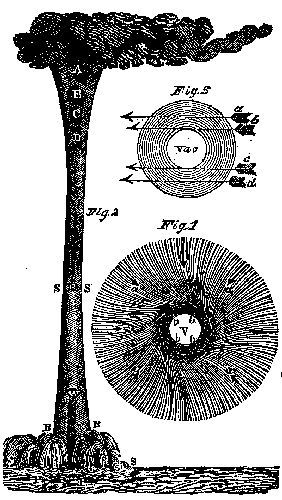
Enlarge
It was in this more transparent part, between b and c, that Stuart could see the spiral motion of the vapours, whose lines on the nearest and farthest side of the transparent part crossing each other, represented smoke ascending in a chimney; for the quantity being still too great in the line of sight through the sides of the tube, the motion could not be discovered there, and so they represented the solid sides of the chimney.
When the vapours reach in the pipe from the clouds near to the earth, it is no wonder now to those who understand electricity, that flashes of lightning should descend by the spout, as in that of Rome.
But you object, if water may be thus carried into the clouds, why have we not salt rains? The objection is strong and reasonable, and I know not whether I can answer it to your satisfaction. I never heard but of one salt rain, and that was where a spout passed pretty near a ship; so I suppose it to be only the drops thrown off from the spout by the centrifugal force (as the birds were at Hatfield), when they had been carried so high as to be above, or to be too strongly centrifugal for the pressure of the concurring winds surrounding it: and, indeed, I believe there can be no other kind of salt rain; for it has pleased the goodness of God so to order it, that the particles of air will not attract the particles of salt, though they strongly attract water.
Hence, though all metals, even gold, may be united with air and rendered volatile, salt remains fixed in the fire, and no heat can force it up to any considerable height, or oblige the air to hold it. Hence, when salt rises, as it will a little way, into air with water, there is instantly a separation made; the particles of water adhere to the air, and the particles of salt fall down again, as if repelled and forced off from the water by some power in the air; or, as some metals, dissolved in a proper menstruum, will quit the solvent when other matter approaches, and adhere to that, so the water quits the salt and embraces the air; but air will not embrace the salt and quit the water, otherwise our rains would indeed be salt, and every tree and plant on the face of the earth be destroyed, with all the animals that depend on them for subsistence. He who hath proportioned and given proper quantities to all things, was not unmindful of this. Let us adore Him with praise and thanksgiving.
By some accounts of seamen, it seems the column of water W W sometimes falls suddenly; and if it be, as some say, fifteen or twenty yards diameter, it must fall with great force, and they may well fear for their ships. By one account, in the Transactions, of a spout that fell at Colne, in Lancashire, one would think the column is sometimes lifted off from the water and carried over land, and there let fall in a body; but this, I suppose, happens rarely.
Stuart describes his spouts as appearing no bigger than a mast, and sometimes less; but they were seen at a league and a half distance.
I think I formerly read in Dampier, or some other voyager, that a spout, in its progressive motion, went over a ship becalmed on the coast of Guinea, and first threw her down on one side, carrying away her foremast, then suddenly whipped her up, and threw her down on the other side, carrying away her mizen-mast, and the whole was over in an instant. I suppose the first mischief was done by the foreside of the whirl, the latter by the hinderside, their motion being contrary.
I suppose a whirlwind or spout may be stationary when the concurring winds are equal; but if unequal, the whirl acquires a progressive motion in the direction of the strongest pressure.