Chapter VII · SIR JOHN HERSCHEL AT THE CAPE.
Reading edition
Cape Town, Jan. 21, 1834.
My dear Aunt,—
Here we are safely landed and comfortably housed at the far end of Africa, and having secured the landing and final stowage of all the telescopes and other matters, as far as I can see, without the slightest injury, I lose no time in reporting to you our good success so far. M. and the children are, thank God, quite well; though, for fear you should think her too good a sailor, I ought to add that she continued sea-sick, at intervals, during the whole passage. We were nine weeks and two days at sea, during which period we experienced only one day of contrary wind. We had a brisk breeze “right aft” all the way from the Bay of Biscay (which we never entered) to the “calm latitudes,” that is to say, to the space about five or six degrees broad near the equator, where the trade winds cease, and where it is no unusual thing for a ship to lie becalmed for a month or six weeks, frying under a vertical sun. Such, however, was not our fate. We were detained only three or four days by the calms usual in that zone, but never quite still, or driven out of our course, and immediately on crossing “the line,” got a good breeze (the south-east trade wind), which carried us round Trinidad, then exchanged it for a north-west wind, which, with the exception of one day’s squall from the south-east, carried us straight into Table Bay. On the night of the 14th we were told to prepare to see the Table Mountain. Next morning (N.B., we had not seen 263land before since leaving England), at dawn the welcome word “land” was heard, and there stood this magnificent hill, with all its attendant mountain range down to the farthest point of South Africa, full in view, with a clear blue ghost-like outline, and that night we cast anchor within the Bay. Next morning early we landed under escort of Dr. Stewart, M.’s brother, and you may imagine the meeting. We took up our quarters at a most comfortable lodging-house (Miss Rabe’s), and I proceeded, without loss of time, to unship the instruments. This was no trifling operation, as they filled (with the rest of our luggage) fifteen large boats; and, owing to the difficulty of getting them up from the “hold” of the ship, required several days to complete the landing. During the whole time (and indeed up to this moment) not a single south-east gale, the summer torment of this harbour, has occurred. This is a thing almost unheard of here, and has indeed been most fortunate, since otherwise it is not at all unlikely that some of the boats, laden as they were to the water’s edge, might have been lost, and the whole business crippled.
1834. Sir John Herschel at the Cape.
For the last two or three days we have been looking at houses, and have all but agreed for one, a most beautiful place within four or five miles out of town, called “The Grove.” In point of situation, it is a perfect paradise, in rich and magnificent mountain scenery, and sheltered from all winds, even the fierce south-easter, by thick surrounding woods. I must reserve for my next all description of the gorgeous display of flowers which adorns this splendid country, as well as of the astonishing brilliancy of the constellations, which the calm, clear nights show off to great advantage; and wishing we had you here to see them, must conclude with best loves from M. and the children.
Your affectionate nephew,
J. F. W. Herschel.
264MISS HERSCHEL TO SIR J. F. W. HERSCHEL.
Braunschweiger Strasse, No. 376, May 1, 1834.
My dear Nephew,—
Your precious letter relieved me on the 14th from a whole twelvemonth’s anxiety, for it was in April last year when, by your few brief lines on business, I saw that you were seriously preparing for leaving Europe, and from that time I became in idea a vagrant accompanying you through all the fatigues of preparing for such a momentous undertaking. And if it had not been for the consoling letter of your brother [in law] James, and one from Miss B. giving me an account of the carefully arranged accommodation with which they saw you depart, I should not have known how to support myself till I saw your dear letter, which brought me even more comfort than I could hope you would have found time to think of....
Both yourself and my dear niece urged me to write often, and to write always twice; but alas! I could not overcome the reluctance I felt of telling you that it is over with me, for getting up at eight or nine o’clock, dressing myself, eating my dinner alone without an appetite, falling asleep over a novel (I am obliged to lay down to recover the fatigue of the morning’s exertions) awaking with nothing but the prospect of the trouble of getting to bed, where very seldom I get above two hours’ sleep. It is enough to make a parson swear! To this I must add I found full employment for the few moments, when I could rouse myself from a melancholy lethargy, to spend in looking over my store of astronomical and other memorandums of upwards of fifty years collecting, and destroying all what might produce nonsense when coming through the hands of a Block-kopff in the Zeitungen.
1834. Arrival at the Cape.
My dear friends, Mrs. and Miss Beckedorff, are assisting 265me in my final preparations for going to that bourn from whence none ever returned, but let me hope that you, my dear nephew, with my dear niece and the whole of your young family, will return to your dear relatives and friends after having seen all your wishes and expectations crowned with success. Though, if I may not be among those who will greet your return, I can assure you their number will be great, judging from the sensation the account of your safe arrival at the Cape has caused among all our friends; and (as Dr. M—— will have it) “the whole intelligent and scientific world in general are participating in our feeling.” Poor Mrs. Beckedorff, to whom I read your letter, sat trembling and crying for joy; for I now find that my friends had not been without fear for your safety on account of the storms (and their sad consequences) which prevailed for a long time immediately after your departure, and the same evening a note was despatched to her Royal Highness the Landgräfin to communicate the news; for from the Duke’s and her Royal Highness’s constant inquiries when I expected to hear from you, I knew the account of your safe arrival would give pleasure.
* * * * *
The feelings of joy I experienced the first few days after the arrival of your letter are nearly evaporated, and I begin to feel already that the essential information required for making me reconciled to the immense space which divides me from you is still wanting; which is, that I cannot now, as formerly, receive so frequent accounts concerning the health of my dear niece and the children, not even from Miss B., who used to describe their little ways so prettily, for she, too, cannot now observe them. I look with impatience for the next account ... of the health of my dear niece, yours, and the dear little beings. Caroline and Isabella and I are old friends, but is William Herschel the 266second likely to live (if not beyond) at least to the age of his grandfather?
Perhaps you will receive the “Göttingsche Gelehrte Anzeigen” of 16th and 19th December, 1833, containing what is said of your book on Natural Philosophy (by Gauss they say).
God bless you all, and believe, my dear nephew,
Ever your most affectionate aunt,
Car. Herschel.
FROM J. F. W. HERSCHEL TO MISS HERSCHEL.
Feldhausen, June 6, 1834.
My dear Aunt,—
The twenty-foot has been in activity ever since the end of February, and, as I have now got the polishing apparatus erected and three mirrors (one of which I mean to keep constantly polishing) the sweeping gets on rapidly. I had hardly begun regular sweeping, when I discovered two beautiful planetary nebulæ, exactly like planets, and one of a fine blue colour. I have not been unmindful of your hint about Scorpio, I am now rummaging the recesses of that constellation and find it full of beautiful globular clusters. A few evenings ago I lighted on a strange nebula, of which here is a figure! and since I am about it I shall add a figure of one of the resolvable nebulæ in the greater magellanic cloud. The equatorial is at last erected, and the revolving roof (upon a plan of my own) works perfectly well, but I am sorry to say that the nights in which it can be used to advantage are rare, even rarer than in England, as, in spite of the clearness of the sky, the stars are ill-defined and excessively tremulous. But a truce to astronomical details! though from time to time I shall continue to plague you 267with them.... Farewell; M. desires to add her kindest regards to those of
Your affectionate nephew,
J. F. W. Herschel.
1834. The Landgravine of Hesse.
The following letters from the Princesses of Hesse and Dessau afford a pleasing memorial of the kind and affectionate interest which they lost no opportunity of expressing in Miss Herschel and her family.
Hanover, June 10, 1834.
I yesterday received the enclosed note from my niece, the Dowager Duchess of Anhalt Dessau, but felt too unwell to send it as I could not write, which I wished to do, to thank you also for your great kindness about the book. My niece writes in extasies with your good nature. I am glad to learn from our dear Sophy Beckedorff that you are pretty well. I trust to be well enough soon to see you, but I am still weak and unlike myself. It gave me very great pleasure to learn that you have had fresh accounts of your nephew, who, I pray God, may be prosperous in all his very interesting and valuable undertakings.
I am happy of having this opportunity of assuring you of the sincerity of my regard.
Elise,
The Dowager Landgravine of Hesse,
born Princess of England.
To Miss Caroline Herschel.
[Enclosure.]
Dessau, June 6, 1834.
Miss Caroline Herschel finds here the expressions of my utmost gratitude for the great kindness to give me 268the so very interesting work of her nephew, the worthy follower of a celebrated father.
The gentleman here, a Mr. Schwabe, to whom it was destined, looks with eager curiosity on the discoveries Mr. Herschel will make in the new regions of heaven he is now examining, and if she would be inclined, after receiving any interesting news, to make communication of it, it would always be accepted with the best thanks of
Fredrica,
Duchess of Anhalt Dessau.
Miss Caroline Herschel.
MISS HERSCHEL TO SIR J. F. W. HERSCHEL.
Sept. 11, 1834.
My dearest Nephew,—
Your welcome letter of June 6 I received on the 19th August ... and I know not how to thank you sufficiently for the cheering account you give of the climate agreeing so well with you and all who are so dear to me, and that you find all about you so agreeable and comfortable, ... so that I have nothing left to wish for but a continuation of the same, and that I may only live to see the handwriting of your dear Caroline, though I have my doubts about lasting till then, for the thermometer standing 80° and 90° for upwards of two months, day and night, in my rooms (to which I am mostly confined) has made great havoc in my brittle constitution. I beg you will look to it that she learns to make her figures as you will find them in your father’s MSS., such as he taught me to make. The daughter of a mathematician must write plain figures.
My little grand-nephew making alliance with your workmen shews that he is taking after his papa. I see you now in idea (memory?) running about in petticoats among your father’s carpenters, working with little tools of your own, and John Wiltshire (one of Pitt’s men, whom you may 269perhaps remember), crying out, “Dang the boy, if he can’t drive in a nail as well as I can!” but pray take care that he does not come to harm, and in your next tell me something of our little Isabella, too.
1834. A Hole in the Sky.
I thank you for the astronomical portion of your letter, and for your promise of future accounts of uncommon objects. It is not clusters of stars I want you to discover in the body of the Scorpion (or thereabout), for that does not answer my expectation, remembering having once heard your father, after a long awful silence, exclaim, “Hier ist wahrhaftig ein Loch im Himmel!”[47] and, as I said before, stopping afterwards at the same spot, but leaving it unsatisfied, &c....
About two months ago I was, for the last time, unfortunately, at the theatre, when Professor Schumacher and the Chevalier Kessel, of Danneburg, called on me. As soon as I came home I sent a note of invitation for the next evening, but had one returned informing me of their leaving Hanover next morning, and a promise of coming perhaps next summer. But I hear Struve is coming, and I hope I shall get a sight of him. The Emperor of Russia and the King of Denmark are cramming their observatories with astronomical instruments, &c., of all descriptions, made, I believe, some of them by Hohenbaum....
* * * * *
To my dear niece I beg you to give my best love and thanks for the kind arrangement to indemnify me for the loss of her dear letters, by charging her brothers to inform me of all they know, &c., which, thank God, is hitherto of the most comforting nature.
With the most heartfelt wishes for the continuance of the health of you all,
I remain, &c., &c.,
C. Herschel.
1835. Sir John Herschel at the Cape.
270FROM J. F. W. HERSCHEL TO MISS HERSCHEL.
Feldhausen, C. G. H., Feb. 22, 1835.
* * * * *
For my own part I never enjoyed such good health in England as I have done since I came here. The first coming on of the hot season affected me a little (odd enough with colds and rheumatisms), but it soon went off.
The stars continue to be propitious, and the nights which follow a shower, or a “black south-easter,” are the most observing nights it is possible to imagine. I have swept well over Scorpio, and have many entries in my sweeping books of the kind you describe, viz., blank space in the heavens without the smallest star. For example:—
R.A. 16h 15m—N.P.D. 113° 56ʹ—a field without the smallest star.
R.A. 16 19 N.P.D. 116 3—Antares (α Scorpii.)
R.A. 16 23 N.P.D. 114 25 to 214° 5ʹ—fields entirely void of stars.
R.A. 16 26 N.P.D. 114 14 not a star 16m—Nothing!
R.A. 16 27 N.P.D. 114 0 not a star as far as 114° 10ʹ.
and so on. Then come on the globular clusters, then more blank fields, then suddenly the Milky Way comes on as here described (from my sweep 474, July 29, 1834):—
“17h 28m, 114° 27ʹ.—The Milky Way comes on in large milky nebulous irregular patches and banks, with few stars of visible magnitude, after a succession of black fields and extremely rare stars above 18th magnitude. I do not remember ever to have seen the Milky Way so decidedly nebulous, or, indeed, at all so, before.”
Altogether the constitution of the Milky Way in its whole extent, from Scorpio to Argo Navis, is extremely curious and interesting. I have already collected a pretty large catalogue of southern nebulæ, for the most part hitherto unobserved, but my most remarkable object is a fine planetary nebula of a beautiful greenish-blue colour, a full and intense 271tint (not as when one says Lyra is a bluish star, &c.), but a positive and evident blue, between indigo-blue and verditer green. It is about 12ʺ in diameter, exactly round, or a very little elliptic, and quite as sharply defined as a planet. Its place is 11h 42m R.A., and 146° 14ʹ N.P.D. My review for double stars goes on in moonlight nights, and among them I may mention γ Lupi and ε Chameleontis as among the closest and most interesting.
I have been hunting for Halley’s comet by Rümker’s Ephemeris in Taurus, but without success, though in the finest sky, quite dark, and with a newly-polished mirror. (By the way, I should mention that I have not had the least difficulty in my polishing work, and my mirrors are now more perfect than at any former time since I have used them.) My last comet hunt was Feb. 18. I shall, however, continue to look out for it. Pray mention this to Schumacher, who is Rümker’s next-door neighbour.
MISS HERSCHEL TO A. DE MORGAN, ESQ., SECRETARY OF
ROYAL ASTRONOMICAL SOCIETY.
March 9, 1835.
Sir,—
I return you many thanks for your communication of being chosen an Honorary Member of the Royal Astronomical Society, and beg you will do me the favour to convey my most heartfelt thanks to the honourable gentlemen of the Council for conferring so great an honour on me; and only regret that at the feeble age of 85 I have no hope of making myself deserving of the great honour of seeing my name joined with that of the much distinguished Mrs. Somerville.
I beg you will believe me to remain, with great regard,
Sir, your most respectful and
obliged humble servant,
Caroline Herschel.
1835. Catalogues of Stars.
272MISS HERSCHEL TO F. BAILY, ESQ.
Hanover, April 2, 1835.
Dear Sir,—
I feel very great gratification at recollecting that some twenty years ago I had the pleasure of being present when you were conversing at Slough with my dear brother, for it encourages me to address you now as an old friend, and I might almost say my only one, for death has not spared me one of those valuable men of the last century in whose society I had an opportunity of spending many happy hours, when they came to pass an astronomical night at Bath, Datchet, Clay Hall, and Slough. And I should now in the absence of my nephew (who would in my name have properly answered your kind letter for me) been much at a loss how to reply to yours of March 17. But I hope, dear Sir, you will have the goodness to return my sincere thanks to the Council of the Society for voting me a complete copy of their Memoirs. But, considering my advanced age and declining health, I think it best not to have them sent over to me, for it would cause me much uneasiness to leave them in the hands of those who could neither read nor understand them.
I suppose my nephew must have himself a complete copy of the Memoirs; but, if not, I beg you will give them to him, along with my love, as a keepsake from his affectionate and grateful aunt, the first opportunity you have to see him on his return.
Your kind information of the work with which you are at present engaged, touches a string which it has caused me no small trouble to silence; for whenever my thoughts return to those two or three years of which every moment that could be spared from other immediate astronomical business was, by my brother’s desire, allotted for comparing 273each star of the British Catalogue with their observations in that incorrect edition of 1725, I feel always sorry that want of time, and, perhaps, want of ability too, must have been the cause of leaving many incorrections unnoticed. The work, however, was solely intended for the use of my brother, who valued Flamsteed as an observer too much to have made use of any other but the British Catalogue for determining the places of his newly-discovered objects. N.B. We ought to remember that till the year 1790 and 1800, when Wollaston’s and Bode’s Catalogues appeared, we had no other to go by, for those of Piazzi and several other excellent observers were then not generally known.
But, dear Sir, I ought to take leave of this to me interesting subject; for finding, about eight years since, that, on account of the failure of my eyes and wretched health in general, I should be unable to make further use of Flamsteed’s works, I gave the three volumes, along with the Atlas, Catalogue of Omitted Stars, &c., to the Observatory of Göttingen, all marked throughout with what corrections I knew of at that time; thinking they might be of use to the observer there, and relieve me besides from the fear of leaving them where they could not be appreciated, or an attempt be made to comment on them, and perhaps have made bad worse.
I wish (but almost fear life will not be spared me so long) to see your new edition of the British Catalogue, therefore beg you will favour me with a copy as early as possible. I never knew that there was a Biography of Flamsteed’s existing, and trust you will favour me with the same as soon as you can.
Any small parcels of astronomical papers will come to me by favour of Herr Schumacher in Altona, who is so kind as to send me his Astronom. Nachrichten regularly for 274my amusement. And if you could send me the names of the President and of the gentlemen of the present Council, it would greatly oblige me.
I hope you will pardon my having intruded so long on your time, but it has ever been my fault to be tedious in expressing my thoughts on paper; but will now only add that, with great esteem and regard,
I remain, my dear Sir,
Your humble servant,
Caroline Herschel.
1835. Letters.
FROM MRS. SOMERVILLE TO MISS HERSCHEL.
Royal Hospital, Chelsea,
April 16, 1835.
Dear Madam,—
I have sincere pleasure in availing myself of the opportunity of writing to you which the Astronomical Society of London has afforded me, by placing my name in the number of Honorary Members, and greatly adding to the value of that distinction by associating my name with yours, to which I have looked up with so much admiration.
My object in writing is to request that you will accept of a copy of my book on the Connexion of the Physical Sciences, which is offered with great deference, having been written for a very different class of readers.
I am proud of the friendship of your nephew, the worthy son of such a father, who is succeeding so well in his glorious undertaking at the Cape. I have seen a letter of the 27th January, when they were all well and prospering.
I remain, dear Madam,
With sincere esteem,
Very truly yours,
Mary Somerville.
275MISS HERSCHEL TO LADY HERSCHEL.
April 23, 1835.
My dearest Niece,—
* * * * *
Your own dear letter arrived containing such a volume of joyful news, conveyed in the most kindest expressions, as if chosen for the purpose to cheer the heart of feeble age.
I was then not able (nor am I so now) to thank you as I could wish for your sparing so much of your valuable time and strength for the purpose of making me a partaker of your domestic happiness.
* * * * *
I have now received in all five letters, two by your own hands, and three by my nephew. Each time after having read them over again they are put by, under thanksgiving to the Almighty, with a prayer for future protection.
... Writing to my absent friends is one of the most laborious employments I could fly to when under bodily and, of course, mental sickness, for it is not impossible I might, instead of making inquiry about my little precious grand-nephew and the young ladies who play, sing, and sew so prettily, write, “O! my back. O! I have the cramp here, there, &c.”
I had intended to keep a day-book to note down how and where I spent my time, and what was passing about me, which was to have served for yours and my nephew’s amusement some day or other. But this I have given up long since, for seeing nothing but lapses of weeks and months where I could have given no better account of myself than that, after the fatigue of getting up and dressing, I fell asleep on the sofa, with a newspaper or other uninteresting subject in my hands, this would only have put me in mind of the useless life I am leading now.
276But within the last two months I have been obliged to exert myself once more to answer two letters, one to Mr. De Morgan, the Secretary of the Royal Astronomical Society, the other to Mr. Baily (who I suppose is President), for they have been pleased to choose me, along with Mrs. Somerville, to be a member (God knows what for) of their Society. This, and receiving visits of congratulation (for congratulate they must about all they find—what they call promotion—in the Zeitungen) has really somewhat disturbed me, though Captain Müller and Mr. Hausmann I am always glad to see; with them I can talk about my nephew, for they know him personally, and admire him. The winter else has passed away rather heavily, because the Landgräfin not being here, I had no other opportunity for seeing anything to put me in mind of England, but going to eight or ten concerts, and those, ill or well, I never missed, for there I was always sure to be noticed by the Duke of Cambridge as his countrywoman (and that is what I want, I will be no Hanoverian!), and then inquiries are made about my nephew and his family; even the little princess, twelve years old, who sometimes when there, comes to give me her hand, asking if I have had any letters from the Cape; but now I have seen the last of them, for the family go to England, and will be absent for many months, and where may I be when they return? But Sunday night I sat a full hour on the sofa with the Duke at Mrs. Beckedorff’s, where I go Sundays from seven to nine, where there is nobody but the female part of Mrs. B.’s family, and another old lady, who was absent on account of being not well. Of this our meeting the good Duke knew all along, and good-naturedly came to join our gossip.
1835. Newton and Flamsteed.
Here I have filled my paper with talking of nothing but myself, because I know that my nephew corresponds with all scientific men in Europe, for I hear frequently of extracts having 277appeared in the papers (of his communications) by Struve, Littrow, &c., and should suppose he will also know what is done at our Society, of which I now am a fellow! and is of course acquainted with what Mr. Baily mentioned in his letter to me, that at the public expense a new edition of Flamsteed’s work is now in print, and that papers have been found at the Royal Society containing a biography by Flamsteed’s own hands, which—but here I transcribe what Mr. B. writes:—“I lament very much, in common with every friend of science, that Newton’s name is mixed up with transactions that show him in a different light from that in which we have generally received his character. But justice to Flamsteed’s memory would not allow me to suppress any portion of his autobiography.”
Now we talk of biographies, I have no less than nine of my poor brother, and heard of two more, one by Zach, which I shall try to get sight of. There is but one or two which are bordering on truth, the rest being stuff, not worth while to fret about. The best is accompanied with a miniature of Reberg’s bad copy; but I have ordered a lithograph copy to be taken from the portrait by Artaud; if it turns out correct I will send two copies as soon as they come out.
God bless you both, and the dear children, my best niece.
Ever your most affectionate aunt,
Car. Herschel.
MISS HERSCHEL TO P. STEWART, ESQ.[48]
May 25, 1835.
* * * * *
Let the time come whenever it may please God, I leave 278cash enough behind to clear me from all and any obligations to all who here do know me. Even the expenses of a respectable funeral lie ready to enable my friend Mrs. Beckedorff, and one of my nieces (the widow of Amptmann Knipping,[49] who lately came to settle at Hanover) to fulfil my directions.
I hope you will pardon my troubling you with such doleful subjects, but I wish to show you that my income is by one third more than I have the power to spend, for by a twelve years’ trial I find that I cannot get rid of more than 600 thl. = £100 per year, without making myself ridiculous.
MISS HERSCHEL TO LADY HERSCHEL.
Hanover, August 6, 1835.
My dearest Niece,—
I dare not wait any longer for a return of better spirits, such as in which I should like to reply to my nephew’s dated February 22nd, and yours of May 19th, for I fear if I do not at least acknowledge the receipt of them, I shall not be gladdened again by such delightful descriptions of your health and healthful situation, and my nephew’s contentment with the successful progress he is making in his intended observations.
At first, on reading them, I could turn wild, but this is only a flash, for soon I fall in a reverie of what my dear nephew’s father would have felt if such letters could have been directed to him, and cannot suppress my wish that his life instead of mine had been spared until this present moment; for what immense and wonderful discoveries have 279not been made within these thirteen years, chiefly by his own son, or son’s suggestion!
1835. Present of Constantia.
But I must stop here and turn to more earthly and indifferent subjects (though they ought not to be called indifferent neither), for in the first place I have to return my thanks for no less than three dozen of Constantia wine, but this I shall do but with a very bad grace, for ever since the 11th of May, when I received my nephew’s letter, I have been in the fidgets about the trouble he and his friends must have had before such a thing could reach me.... I feel more reconciled after unburdening myself of some of this weighty concern by making presents to all who love and esteem you so truly, and after setting apart a portion, according to Captain Müller’s advice, with which you may be treated when at your return you may perhaps visit Hanover again, there remains more than ever I can get through with, for I am very desirous to spin out the thread of my life till you return home. And I know it is a mistaken notion that old folks want more of what they call comfort than young ones. It is not very easy to find out what will convey comfort in general.... I, for instance, know of no other comforts like those I derive from yours and my dear niece’s letters. Her last leaves me nothing to wish for....
* * * * *
You compliment me on having a steady hand, but if you were to see the blotting I make before I can make it hang together (when I am composing, as it were, a letter) you would not say so, and, after all, it will cause you some trouble to understand me, for the letter begins to my dear niece, and soon after I find myself talking to you....
280SIR J. F. W. HERSCHEL TO MISS HERSCHEL.
Fellhausen, Oct. 24, 1835.
Dear Aunt,—
The last accounts we have of you are that you are elected a member of the Astronomical Society, and that to keep you in countenance, and prevent your being the only lady among so many gentlemen, you have for a colleague and sister member, Mrs. Somerville. Now this is well imagined, and we were not a little pleased to hear it. May you long enjoy your well-earned laurels!
As I presume our news will interest you more than comments upon what goes on in Europe, in the first place be it known to you, that we are all well and, thank Heaven, happy. The children, one and all, thrive uncommonly.... The stars go on very well, though for the last two months the weather has been chiefly cloudy, which has hitherto prevented me seeing Halley’s comet. Encke’s (yours) escaped me, owing to trees and the Table Mountain, though I cut away a good gap in our principal oak avenue to get at it. However, Maclear, at the Observatory, succeeded in getting three views of it with the fourteen-foot Newtonian of my father’s (the Glasgow telescope) on the 14th, 19th, and (?) 24th of September. If you have an opportunity of letting this become known to Encke, pray do so—(I shall write to him shortly myself). It was in or near the calculated place, but no measures could be got.
I have now very nearly gone over the whole southern heavens, and over much of it often. So that after another season of reviewing, verifying, and making up accounts (reducing and bringing in order the observations) we shall be looking homewards. In short, I have, to use a homely phrase, broken the neck of the work, and my main object now is to secure and perfect what is done, and get all ready 281to begin printing the moment we arrive in England; or, if that is not possible, at least to have no more calculation to do....
1835. Duke of Cambridge.
FROM H.R.H. THE DUKE OF CAMBRIDGE.
Hanover, Nov. 19, 1835.
The Duke of Cambridge hastens to acknowledge the receipt of Miss Herschel’s very obliging note, and to return his many thanks for her attention in sending him some of the Constantia she has lately received from her nephew. He seizes this opportunity of assuring her of the satisfaction he felt at hearing that Mr. Herschel and his family were in good health, and he sincerely hopes that the climate of the Cape will agree with them.
FRANCIS BAILY TO MISS HERSCHEL.
37, Tavistock Place, London,
Jan. 29, 1836.
My dear Madam,—
I forwarded some time since, to Professor Schumacher, a copy of my “Account of Flamsteed,” to be sent to you; and which he says was duly transmitted. I am anxious to know whether it has arrived safe, for, as only a limited number of copies were printed (which are all distributed) it cannot be purchased.
I have been the more desirous that you should have a copy, because there is no one that has taken so much pains to elucidate and explain the works of Flamsteed as yourself, and therefore I am bound in gratitude to see that you are put in possession of a copy of the work.
I shall take this opportunity of stating that I hear occasionally from your nephew at the Cape of Good Hope, and that the last accounts confirmed his continuance in good 282health, and his enjoyment of the pleasures of the fine climate in which he is placed.
I remain, my dear madam, with the assurance of my best respects, and my best wishes for your health and happiness,
Your very obedient servant,
Francis Baily.
MISS HERSCHEL TO F. BAILY, ESQ.
Hanover, Feb. 15, 1836.
Dear Sir,—
I am quite at a loss for terms in which to apologize for having neglected to acknowledge the receiving of your valuable Catalogue and biography of our dear ill-used Flamsteed, which was forwarded to me by the usual kindness and punctuality of Prof. Schumacher on the 9th October last. The same packet also contained Mrs. Somerville’s second edition “On the Connexion,” &c., accompanied by a kind note, dated as far back as April 16th, which, to my sorrow, is also still left unanswered on account of illness, and in the hope that when the days are somewhat longer (my eyes fail me), and that with the return of spring I might perhaps regain some small portion of strength—but I doubt.
The parcel also contained duplicates of my nephew’s second series, and on the satellites of Uranus, and I must trust that on his return he will convey my grateful thanks to you, sir, and the gentlemen, for all the kind attention conferred on me during his absence. My last letter from the Cape is dated October 24th, and I am much gratified by your kindness in having informed my nephew of the wish I have that the volumes of the Royal Astronomical Society’s publications voted to me might be kept for him, and he seems much pleased with the arrangement. I therefore would recommend them to your obliging care till his return. 283The volume of your “Account of Flamsteed” must be my companion to the last, but I will take care it shall be safely delivered to my nephew.
If I will not lose another post I must conclude with the assurance of ever remaining with great regard,
My dear Sir,
Your much obliged and humble servant,
C. Herschel.
1836. Southern Stars.
SIR JOHN HERSCHEL TO MISS HERSCHEL.
March 8, 1836.
Dear Aunt,—
Maggie desires me to finish this for her, but she has not left me room to write at length. So I will only devote this space to one point in your last letter which requires reply. I have not got Gauss’s apparatus, and I am not sufficiently acquainted with his method of observing to construct one for myself. Besides which it is quite out of my power to undertake any extensive series of observations, being anxious to get home, and having still so much to do, both in observation and reduction, that I really shall hardly be able to accomplish all I have already in hand. This comet [Halley’s] has been a great interruption to my sweeps, and I hope and fear it may yet be visible another month. Unluckily when I sailed from England I left all my volumes of Poggendorff and the Nachrichten behind me, and none of the former and very few of the latter have reached me here. I fear it is now too late to send home for anything, and I have two series of observations, viz., of the comparative brightness of the southern stars, and of the photometric estimation of their magnitudes—the former just commencing, the latter not yet begun, which I must do. Pray explain this to Gauss.... Astronomical news I have little, but one 284thing very remarkable I must tell you, γ Virginis is now a single star in both the twenty-foot and the seven-foot equatorial!!!
Your affectionate nephew,
J. F. W. Herschel.
MISS HERSCHEL TO SIR J. F. W. HERSCHEL.
Hanover, June 29, 1836.
My dearest Nephew,—
I do not know where to begin, for I see it is nearly a twelvemonth since I gave some account of myself, and in all that time never returned my thanks for the three letters I received.... I have a great deal to say, and will begin with accounting for my long silence, by confessing that I have throughout the whole winter been too ill to do anything besides nursing myself, and putting myself in a condition to appear before strangers, which I am not able to do till after twelve or one at noon, and the time which I wanted to rest after my exertion and getting my breakfast was generally taken up by pacifying the gulls about the foolish paragraphs they had been reading the night before in the Clubs. I never read, or would read, any of them, but when I heard of anything appearing rational concerning you, I copied or procured the paper for myself, and then I found among the rest a letter of yours to Professor Plana, in Turin, dated December 28th, 1834. And not being able to do anything of use to you myself, I begged Capt. Müller to cause those observations of June 21st, &c., to be made by somebody here in Hanover, and the enclosed letter will, I hope, meet with a gracious reception.... I believe Dr. Heere will not fail the next equinox to be at his post, and you may hear more of him.
1836. Her Brother’s Portrait.
Capt. Müller is at present with Gauss, and will deliver all your messages personally, for you must know I beware 285of corresponding with all those known ones if I can possibly help it, and have through his hands sent copies of your father’s likeness to Struve, Schumacher, Gauss, Bessel, Encke, Olbers, &c. Gauss sent me word it was hung up in his library. Encke sent me a very pretty letter of thanks.
... That sending is an ugly thing. Mrs. Somerville sent me her book with a letter dated April 16th, which I received October 9th, coming along with Mr. Baily’s publication, presented by the Lords Commissioners of the Admiralty to Miss Herschel. You cannot think how agitated I feel on such occasions, coming to me with such things!—an old poor sick creature in her dotage.... I was going to say something yet of Mr. Baily’s labours, but the paper is at an end; but I hope you will now soon read in your own library at Slough what the “Quarterly Review,” No. CIX., says, and what your Cambridge friend Whewell and others have said—in short, Newton remains Newton! God bless my dear nephew and niece!... My heart is too full—I can say no more than that
I am your affectionate aunt,
Car. Herschel.
MISS HERSCHEL TO LADY HERSCHEL.
Hanover, October 20, 1836.
My dearest Niece,—
From June 14 to October the 1st, and not any the least account, was rather too much for me to bear, especially during the months when those few friends who sometimes cheer me by a friendly call had all left the town to make summer excursions....
I have a few memorandums for my nephew, and will for the present take leave of my dear niece with my most heartfelt wishes that every future account with which I may yet be blessed from her dear hand may be like the last.
286* * * * *
... I have four complete years of the Astronom. Nachrichten ready bound for you.... I wished to give you the number of the paper (but cannot find it again) where Bessel speaks of Saturn’s satellites, but my eyes are so dim, and I am too unwell for doing anything. I will therefore only say he has seen the 6th but not the 7th, the ring being in the way. In No. 293, two of Bessel’s assistants, Beer and Mädler, say a great deal about the observations of your father, but that goes all for nothing. I will only say in general that he did in one season more than any one else could have done, and would have resumed the hunt the next fifteen years if nothing had interfered. And the Georgium Sidus was followed as long as anything could be obtained from that planet, and it will yet be some twenty years before he will be in that favourable situation in the ecliptic where he was at the time when the satellites were discovered.
I have seen Struve’s Catalogue of Double Stars, wherein I find he agrees with your and your father’s observations.... Do not think, my dear nephew, that I would expose myself so as to say a word about these things to anybody else, but to you I cannot help letting it out when I am nettled.
I must leave off gossiping, else I shall not get this letter away, in which you will find Dr. H.’s barometrical observations, which I received a few days ago....
1836-1837. Spots in the Sun.
SIR J. F. W. HERSCHEL TO MISS HERSCHEL.
Cape of Good Hope, Jan. 10, 1837.
My dear Aunt,—
* * * * *
I am now at work on the spots in the sun, and the general subject of solar radiation, which you know occupied 287a large portion of my father’s attention. The present is an admirable opportunity for studying these things, as the sun is infested now with spots to a greater degree than ever I knew it, and they are arranged over its surface in a manner singularly interesting and instructive. The sky here is so pure and clear in our summer that it would be a shame to neglect such an opportunity of making experiments on heat, and accordingly I have been occupied in the December solstice in determining the constant of solar radiation, that is to say, the absolute quantity of heat sent down to the earth’s surface from the sun at noon, or at a vertical incidence.
I do not think I have ever mentioned to you a remarkable and splendid instance of liberality on the part of His Grace of Northumberland, who has taken upon himself to defray the expenses of publishing my observations at the Cape, and that in a manner the most delicate and considerate imaginable. In consequence “my book” will appear, when it does appear, under his auspices, and I hope it will not do discredit to his munificence. This is not the only, nor the most remarkable, instance however, of his attachment to the cause of science, and his disposition to promote and support it.
MISS HERSCHEL TO SIR J. F. W. HERSCHEL.
March 30, 1837.
* * * * *
... I have for the last five months been in continued fear of losing Mrs. Beckedorff (to whom I could confide all my grievances). She is worn out with a cough and breaking up of constitution, and we but seldom can come together, which is when I am able to cross the street to go to her.... I experience a daily increase of pain and feebleness, so that I am (at least during this severe 288weather) totally confined to my solitary home; and what is worse, my eyes will not serve me to amuse myself with reading. But what business had I to live so very long?
1837. Saturn.
FROM SIR J. F. W. HERSCHEL TO MISS HERSCHEL.
Feldhausen, May 7, 1837.
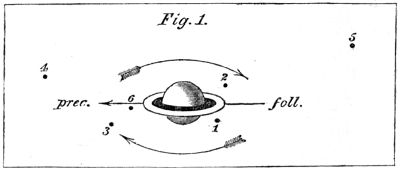
Fig. 1.
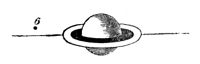
... I will try to entertain you with some celestial affairs in which it is delightful to find you still taking so much interest. As you allude to Saturn’s satellites in your letter of October 20, I must tell you that I have at last got decisive observations of the sixth satellite (the farthest of my father’s new ones). I had all but given the search up in despair, when no longer ago than last Thursday (May 4th inst.), being occupied in taking measures of the angles of position of the five old satellites with the twenty-foot and a polished new mirror, behold, there stood Mr. Sixth! a little short of its preceding elongation. I have kept it well in sight from 14h 26m Sid. T. till 16h 35m, in which time it had advanced visibly in its orbit from below the line of the ansæ (as in figure) to above. In this interval the planet had moved over fully one diameter of the body towards the preceding side, and, therefore, had 289it been a star, must have passed over it, whereas it preserved the same apparent distance all the while from the edge of the ring. (N.B. Saturn not very far from the zenith on merid.)
Next night, Friday, May 5, Saturn most gloriously seen: quite as sharp as any copper-plate engraving, with power 240 and full aperture. All the five old satellites seen and measured, being now on the opposite side. Now considerably short of its greatest following elongation; distance just as before; and, as on Thursday, it was kept in view long enough for Saturn to have left it behind by its own motion had it been a star. The change of situation agrees perfectly with the period 1d 9h, which is also the reason why it was not seen May 5th, being on that night near its inferior conjunction. So this is at last a thing made out. As for No. Seven I have no hope of ever seeing it.
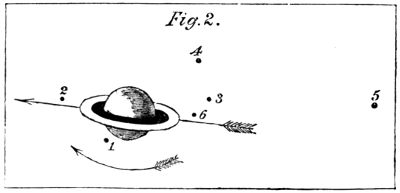
Fig. 2.
If your eyesight will not suffer from it, do write to Bessel. I am sure he will be interested by this observation, as he is the only astronomer who troubles himself about the system of Saturn. I shall myself write to him shortly about it, but should like to have a few more observations.
So now farewell once more, and, with many kind remembrances to all Hanoverian friends,
Believe me, your affectionate nephew,
J. Herschel.
290MISS HERSCHEL TO SIR JOHN HERSCHEL.
Hanover, June 11, 1837.
* * * * *
... From Mr. Schumacher I receive each paper as it comes from the press, but always with a feeling of uneasiness, because I am not one of those who can contribute anything to their valuable communications, nor even understand all which my defective eyes allow me to read. But they interest me exceedingly when I think what you will say. For instance, to a paper of twenty-two quarto pages, by Bessel, “Über den Einfluss der Unregelmässigkeiten der Erde, auf geodetische Arbeiten und ihre Vergleichung mit den astronomischen Bestimmungen.”[50] Perhaps you may have received these papers before this reaches you, but if any are lost by the way, I collect them for you; but I fear I shall not see the day of all the wonders coming to light when you return with your budget....
... I must conclude, for writing at any time makes me sad; and since I began this letter the notice of the death of our King has arrived, and the Duke of Cumberland has been this day proclaimed King of Hanover. It makes me feel as if I was doubly separated from England, for your King is now no longer my King. And we lose the Duke of Cambridge, who was ever so kind to me wherever he saw me. Last winter he introduced me to his brother, then Duke of Cumberland, who was here on a visit, at the concert, who spoke to me of you first as my son, but recollected himself that I was only aunt....
* * * * *
I had illuminated my front rooms with twenty candles (snuffed them all myself, for Betty was out to see the show) on the evening of the King’s arrival, and so I shall again 291next Saturday or Sunday, when the Queen is expected. More I cannot do!...
... My head becomes crowded with melancholy forebodings of my not lasting so long as to hear of your safe return to your home and the friends which I think are only to be found in happy England; so, instead of tracing my gloomy imaginations on paper, I go to sleep till Betty rouses me with a cup of coffee.... But all I hear of you is told in a tone of admiration, &c., &c., and it is felt by me like a drop of oil supplying my expiring lamp.
1837. Sir John Herschel’s Return.
J. F. W. HERSCHEL TO MISS HERSCHEL.
Cape of Good Hope,
Sept. 7, 1837.
My dear Aunt,—
* * * * *
I need hardly say how much we are rejoiced to see your handwriting once more, though that joy is damped by your complaints of winter indisposition. And such a winter! by all accounts. May this prove a better! and may we hope to find you in no worse health and spirits when we come to see you next summer in Hanover. For so, if it please God to lead us safe home, according to our present altered plans, we most assuredly propose to do.
I say our altered plans, for you know our intention was to have embarked next March for Rio Janeiro, and there to have spent two or three months, after which to have taken passage in the Brazilian packet for England, which would have probably detained us till October, and have rendered a visit to Hanover that season impracticable. But by striking off this Brazilian trip, and taking our course directly homewards, so much time will be saved, and all the rest of our domestic arrangements become so much simplified that it seems like finding a treasure, as a fund of time will thereby be placed at our disposal, the first fruits of which, as in 292all love and duty bound, we have determined to devote to you; or rather, I should say, that, when in talking over with Margaret all the pro’s and con’s of the question, whether to return home direct, or viâ Brazil?—this consideration at once decided it in favour of the direct course, her desire to see you outweighing every consideration of amusement or temporary gratification which a visit to Rio could offer. So now be sure, dear aunty, and keep yourself well, and let us find you in your best looks and spirits; and, although what you say respecting our good Mrs. Beckedorff’s health is somewhat deplorable, yet I will indulge the hope that she too will perform a part in the dramatis personæ of that happy meeting. Meanwhile, as the time of our departure hence approaches, we shall take care and apprise you of all our movements, respecting which it is impossible at present to speak more precisely.
FROM H.R.H. THE DUKE OF CAMBRIDGE.
Cambridge House, May 18, 1838.
My dear Madam,—
Having just been informed by the newspapers that your nephew is safely landed in this country, I hasten to write you a few lines by this night’s mail to congratulate you most sincerely on this event, which I know will give you pleasure.
I am unable to send you any further details about him or his family, as I am not aware if he is arrived as yet in town, and should this not be the case, my letter will perhaps be the first to give you this welcome news, which I shall certainly be delighted at.
I trust you continue enjoying your health; and with best wishes, &c., &c.,
Yours most sincerely,
Adolphus.
1838. Return of Sir John Herschel.
293SIR JOHN HERSCHEL TO MISS HERSCHEL.
London, May 20, 1838.
Here we are, my dear aunt, at last, safely landed and housed, all in good health and, as you may suppose, in good spirits at our return. We ourselves and our six little ones were very comfortable during our nine weeks’ voyage in the good ship Windsor, which is lying snug and sound in the river at Blackwall, with all our things on board, telescopes and all (as well as the astronomical results of our expedition). We left our ship, however, at the entrance of the Channel, and got to London in a steamer under the flag of King Leopold, of Belgium, which, having been to Glasgow to take in her machinery, was returning without passengers, not yet being fitted up for their reception. This was a most opportune and unexpected piece of good fortune, as I assure you we found most sensibly, by the non-arrival of the ship till this morning, having been four days longer at sea, beating about against contrary winds. I have more particulars to tell than would fill this paper, which I must reserve till our meeting, which will not now be longer delayed than is indispensable for getting our baggage on shore, and passing it through the Custom House, and transporting it by a barge to Windsor, and so to Slough. I hope and trust to find you as well in health as your two letters to John Stewart and Mary Baldwin allow us to suppose....
The visit promised in the foregoing letter was paid in July, when Sir John Herschel, accompanied by his little son, spent a few days with his aunt, whose intense anxiety as to the proper treatment of her little grand-nephew—his sleep, his food, his playthings—kept her in a constant state of alarm on 294his account. “I,” she writes, “rather suffered him to hunger than would let him eat anything hurtful; indeed, I would not let him eat anything at all without his papa was present.” Great as was the joy of the dear venerable lady to rest her aged eyes once more on almost the only living being upon whom she poured some of that wealth of affection with which her heart never ceased to overflow, it is on the disappointments and shortcomings of those few precious days that she dwells; and, if she could have felt resentment towards her nephew, it would have been roused by the abrupt termination of his visit. Her lamentations are piteous. Solely with the intention of sparing her feelings, her nephew went away without letting her know the exact time beforehand of his departure, and made no formal leave-taking, when he bade her good-night to return to his inn. To her infinite dismay and distress, she found that he and his son had quitted Hanover at four o’clock on the following morning. It was kindly intended, but it was a mistake that gave intense pain. Her introduction to her little grand-nephew is described as follows by his father:—
1838. Visit from her Grand-nephew.
... “Now let me tell you how things fell out. Dr. Groskopff took Willie with him to aunty, but without saying who he was. Says she, ‘What little boy is that?’ Says he, ‘The son of a friend of mine. Ask him his name.’ However, Willie would not tell his name. ‘Where do you come from, little fellow?’ ‘From the Cape of Good Hope,’ 295says Willie. ‘What is that he says?’ ‘He says he comes from the Cape of Good Hope.’ ‘Ay? and who is he? What is his name?’ ‘His name is Herschel.’ ‘Yes,’ says Willie, ‘William James Herschel.’ ‘Ach, mein Gott! das ist nicht möglich; ist dieser meines Neffen’s Sohn?’ And so it all came out, and when I came to her all was understood, and we sat down and talked as quietly as if we had parted but yesterday....
“Groskopff, by the way, was recounting a strange feat which, to give you some notion of the sort of person (par rapport au physique), she performed, not longer than half a year ago. Remember it is a person of eighty-eight or eighty-nine of whom we are speaking. Well! what do you say of such a person being able to put her foot behind her back and scratch her ear, in imitation of a dog, with it, in one of her merry moods?”
The “Day-Book,” as already stated, had been recommenced in the year 1833. The first volume of the new Day-Book concludes in May, 1837, with comments on Baily’s account of Flamsteed, and recollections of days spent at Greenwich in 1799, when she had seen and wondered at the piles of manuscripts accumulated there. “Dr. Maskelyne was not indifferent to the stores of observations of his predecessor, for he even attempted to make me undertake the examination of some of Halley’s scribblings on fragments of waste paper [to see if they] might not belong to some star or other. But such things cannot be done in a moment, and the parcel was restored to its dusty shelf. Poor Dr. Maskelyne had but one assistant, 296with a salary of £70 a-year, whom I once heard lament that all the planets happened to pass the meridian in the night-time!”
The entries are chiefly of the numerous visitors she received, but there are frequent intervals of several months when illness or disinclination to write prevented her continuing her Journal regularly. The English Quarterly and Monthly Reviews and newspapers, and James’s novels, supplied her with constant reading, and every allusion to her brother’s or her nephew’s labours is carefully noted. It is evident that she still was in the habit of taking ample notes of any book that interested her, in spite of complaints of the growing failure of sight, and that, when tolerably well, no day was considered altogether satisfactory which was passed in solitude. It was in May, 1833, that she moved to No. 376, Braunschweiger Strasse, and here she continued to dwell for the remainder of her days.
MISS HERSCHEL TO LADY HERSCHEL.
Hanover, July 30, 1838.
My dearest Niece,—
I hope that when you receive this my dear nephew, with his precious charge (little William), will be safely restored to your longing arms, and that he may have found you, with all the little family, in perfect health. I wish to be assured by a few lines from your dear hands as soon as possible, for I cannot divest myself of a fear that the botheration and intrusion of some of the stupid Hanoverians must have 297been very inconvenient to him. To which may be added the change of weather from excessive heat to very cold and wet, to which at this present moment (as far as I know) they are still exposed, for I think they must be now in Hamburg....
1838. Sir J. Herschel at Home again.
SIR J. F. W. HERSCHEL TO MISS HERSCHEL.
London, Aug. 6, 1838.
My dear Aunt,—
Willie and I arrived in London safe and hearty on Friday night about eight o’clock, and I am happy to say we found all here quite well—both mamma and all the little folks, who, as you may easily imagine, were in great joy, and full of enquiries about you and about all our adventures in foreign parts. Grandmamma Stewart, and all her circle also, with exception of poor James S. (who is, however, much better, and we hope permanently), are well, and join us in kind enquiries after you. I found here my cousin, Thomas Baldwin, and his excellent and most amiable wife. Cousin Mary had left us, and was returned to Anstey.
I found Dr. Olbers well, and have to thank you, in his name, for the Cape wine, a bottle of which was produced at dinner the day I dined there. I assure you it was drank in good company, being associated (not mixed) with Hock of 240 years of age!! Dr. O. is weak and corpulent, but is otherwise in the full enjoyment of his mental faculties, and in good spirits.
I could not persuade myself to encounter a regular parting with you, and, in fact, I found the distance to Bremen so much greater, on enquiry, than I had fancied it, that it was necessary to leave Hanover at four a.m., which, of course, prevented all further meeting. We shall be most anxious to hear from you. M. will write in a day or two (and so will the children) to thank you for all your kind remembrances 298of them, and for the many pretty and valuable things you have sent; and till then, believe me,
My dear aunt,
Ever your affectionate nephew,
J. F. W. Herschel.
MISS HERSCHEL TO SIR J. F. W. HERSCHEL.
Hanover, Aug. 21, 1838.
My dearest Nephew,—
By the arrival of your letter of the 6th I was relieved from my fears for the safety of you and your dear little fellow-traveller, almost a week sooner than I had reason to hope.
* * * * *
... I had so longed for a few hours of confidential conversation with you which would have spared me the unpleasant task of writing about earthly matters.... My good neighbours came to wish me joy, and congratulate me on having seen my glorious nephew and his son (who has left no few admirers behind, I can tell you).
Dr. Mühry has lost a sister, a solitary old maid, like myself, whom they could not leave till she was buried. But she was in some respects better off than I, for I found it necessary to order all these matters myself. Miss Beckedorff and Mde. Knipping will at my death have to deliver a sealed packet to Dr. Groskopff, my executor, in which, on his opening in their presence, he will find the means requisite for discharging all the items specified in an enclosed memorandum of directions. Such matters I had wished to talk over with you, thinking it not unnecessary you should know a little about the way in which I have always managed my affairs. As soon as I was left to myself, in the year 1788, I kept a book strictly accounting for my expenses, which was to serve as a voucher of the orderly life I led. 299But being frequently under the necessity of assisting one or other of my, as I thought, poor (but say extravagant) relations, I began to keep a spare box, by way of showing to what extent I have thus robbed myself.... I am sorry to trouble you with such details, but I find myself so unwell at present that I cannot rest till I have cautioned you not to ask any question about me of any one, for nobody knows anything about me—my confidence in Mrs. Beckedorff, even, can only be partial, as we can only see each other so seldom.
* * * * *
1838. Letter to Lady Herschel.
MISS HERSCHEL TO LADY HERSCHEL.
Hanover, Sept. 24, 1838.
* * * * *
I see by the postscripts you directed my nephew to add to your letter that you know exactly what will make his poor old aunt happy; and I must beg you to make my peace with my dear little William, for I fear the angry looks I gave him when seeing him climbing too high on an open window two stories above the pavement, can have left no favourable impression on his recollection. Unfortunately we could not converse together: he talked too soft and quick for me (I do not hear so well as formerly), and my mixture of German and English was not intelligible to him.... Had the knitting with beads been known forty years sooner, it would have been one of the accomplishments with which I came, at the age of twenty-two, into England in 1772, for there was no kind of ornamental needlework, knotting, plaiting hair, stringing beads and bugles, &c., of which I did not make samples by way of mastering the art. But as it was my lot to be the Cinderella of the family (being the only girl) I could never find time for improving myself in many 300things I knew, and which, after all, proved of no use to me afterwards, except what little I knew of music, being just able to play the second violin of an overture or easy quartette, which my father took a pleasure in teaching me. N.B. When my mother was not at home. Amen. I must think no more of those times, only just say I came to Bath with a mind eager to learn and to work, and never changed my mind till I came here again, but now I can no more.... One thing I must tell my nephew, which is, that I hope I have found a deserving protector of my sweeper in Director Hausmann, and I hope either himself or his son will find us a few comets with it yet. He is a constant visitor of mine.
SIR J. F. W. HERSCHEL TO MISS HERSCHEL.
Slough, Nov. 26, 1838.
My dear Aunt,—
I have received a letter from Sir Wm. Hamilton, Astronomer Royal, Dublin, informing me that the Royal Irish Academy have elected you an honorary member of that body. The diploma is by this time on its way to my care, and I will, so soon as I receive it, take the very first secure opportunity of transmitting it to you.
Yesterday I received your most welcome letter and Mr. Boguslawski’s in one. I wrote to him some time ago relative to Halley’s comet. He seems a very diligent observer, and I am glad you have seen him.
Your letter of September 24th, with its numerous dates, was like a little diary, and almost made us fancy ourselves with you in Hanover....
I am sorry to see, on looking at my banker’s account, that you have not (as you promised to do) drawn on Cohen for the £50 of this half year. Pray do, and that soon, or I shall be sadly disappointed.
301We have got a most excellent president for the Royal Society in the Marquis of Northampton. He presided at the anniversary dinner on the 30th, and did the honours with great credit.
A Copley Medal was awarded to Gauss for his researches, theoretical and practical, on the subject of terrestrial magnetism.
1838. Elected Hon. Member of the R. A. I. S.
MISS HERSCHEL TO SIR J. F. W. HERSCHEL.
Hanover, Dec. 17, 1838.
My dear Nephew,—
First and foremost let me dispatch what may be called business. In the first place, I thank you for your kind letter and communication of having so great an honour conferred on me as to be admitted an honorary member of the Royal Irish Academy. I cannot help crying out aloud to myself, every now and then, What is THAT for? Next I must beg you to return my thanks in what words you think proper I should express them, and if you will only send me a copy of the diploma, and keep the original along with my other trophies, allowing them perhaps a corner in some such box as that your dear mother had for suchlike things, for I have no other desire but to be remembered by you and Lady H., and your children, for yet awhile....
... It is a long while since you asked me if I wanted any of my Indexes to Flamsteed’s Catalogue of omitted stars. If there should yet be any left, I could wish to have one or two; for you hinted to me I might leave Baily’s work to the “Archives” here, which I intend to do, and then I should like to give an Index along with it.
* * * * *
302MISS HERSCHEL TO SIR JOHN HERSCHEL.
Hanover, Jan. 7, 1839.
I see, to my sorrow, that my letter was not come to hand at the time when you directed the parcel with the diploma, which was sent me on the 2nd of January, accompanied by a note from the President, which I beg you will answer for me, and for that purpose transcribe here the same:—
Observatory, Dublin,
Dec. 4, 1838.
“Madam,—
“In transmitting to you the accompanying Diploma from the Royal Irish Academy, I wish to be allowed to add, as I thus do, the expression of my own high sense of your services to Astronomy, and of the eminent degree in which you have deserved the present testimonial.
“I have the honour to be, Madam, &c., &c.,
“William Rowan Hamilton,
“P.R.I.A.”
1839. Life in Hanover.
MISS HERSCHEL TO SIR JOHN HERSCHEL.
Hanover, Dec. 1, 1839.
Dear Nephew,—
Do not you think I have been very good to let the most dismal month in the year pass without troubling you for accounts of the progress my dear niece is making in her recovery?
My dear niece said once, I should write often, and in few lines inform her how I go on, so I must say—I get up as usual every day, change my clothing, eat, drink, and go to sleep again on the sofa, except I am roused by visitors; then I talk till I can no more—nineteen to the dozen! N.B. I don’t tell fibs, though they may not always like what I say.
I have been twice at the concert, and each time been 303honoured with a wie gehts?[51] by His Majesty, and the notice of many acquaintances whom I have no opportunity of seeing elsewhere, the public concerts being the only place where I can go with the least trouble to myself or others. You say when I talk of the Gelehrten then all goes well, but I know nothing about them....
But one piece of news I must tell you, which is, that a fortnight after Dr. Mädler had been the conductor of Mde. Witte (the Moon) and her daughter to the meeting at Pyrmont, I received two cards, the one, “Professor Dr. Mädler,” under it, “Minna Witte-Verlobt.[52]” The reason Madame Witte gives for this hasty courtship is, that it is Dr. M.’s first love, and that he would not wait, so the lady said yes! As you have seen this lady, I would give you this piece of news.
* * * * *
I beg you will give a true account of my dear niece’s and the children’s health, not forgetting the babe and how she will be named, that I may enter the same in my biographical account.
I remain, my dear nephew,
Your most affectionate aunt,
Car. Herschel.
The second Day-Book concludes in July, 1839, and is in all respects like the preceding one, but contains here and there touches and sentiments of which her own words can only do justice.
Aug. 3rd.—I went to buy some clothing for wearing at home, and went to my mantua-maker to give directions. I had to climb up to the third story, and I was of course quite knocked up when I came home, but it is my intention 304to continue to take some exercise as long as the weather and the length of the afternoon will permit.
1839-1840. Her Day-Book.
Aug. 26th.—My niece Knipping came in the afternoon to assist me in some needlework—we did not do much!
Sept. 25th.—To-day I was made happy by a visit of Alexander Humboldt; which, though it was extended to the utmost limit of the time which this interesting man could spare me, was too short for all I wished to hear and had to say, which, as the theme of our conversation was my nephew, may be easily imagined.
Oct. 5th & 6th.—Mr. Hohenbaum and the carpenter were with me to pack up the seven-foot telescope. I assisted as well as I could, being very ill all the while.
Oct. 7th.—Dr. G. called for a moment, but nobody else!
Dec. 10th.—I went in the evening to the concert, where I exposed myself most sadly by falling a-crying when the King most kindly came to me to inquire after my health. I do not think I shall have the courage to show myself there again in a hurry.
Jan. 27th.—This is the first day since the 30th December that the ice is detached from my sitting-room window.
Jan. 31st.—Mr. Hausmann brought me some Journals, and talked for an hour of old times with me, as he ever does, good man!
Feb. 7th.—A letter from my niece came this morning by the Hamburger post, which will make me happy for some time, and make me bear my painful solitude more patiently.
March 17th.—Thank God the 7th and 16th March are got over, and I begin to recollect that I have much else to do than bewail myself at being obliged to spend such days severed from all that are, or were, so dear!... I found my poor friend [Mrs. Beckedorff] very much altered, but before I left her I thought she looked a twelvemonth younger for our two hours’ chat. But we both were obliged 305to part, for we could no more. Yesterday she sent me some fine flowers, as usual on my birthday. Dr. Mühry left a card; two of my nieces called, and Hofräthin Ubelode brought me some flowers. They left me fatigued to death, to spend the long evening in solitude.
June 18th.—Yesterday Mr. Hausmann came to see me, and brought the Philosophical Magazine for June, in which I had the pleasure to see that Dr. Lamont has observed three of the Georgium Sidus satellites.
July 3rd.—Dr. G. brought me an extract from The Sun that my nephew has been created a baronet on the occasion of the coronation.
July 9th.—My nephew arrived in Hanover in the evening.
July 10th.—In the afternoon I saw him and my little grand-nephew for a few hours.
July 25th.—My nephew and his son took tea with me, and we soon parted, without taking leave, and next morning I am told they left Hanover at four in the morning. More I cannot say!
Oct. 24th.—Mr. Hausmann came in the forenoon and took the box with the mirror of my sweeper with him, and in the evening he came to receive the stand. I am glad my poor sweeper is now in good hands!
Oct. 29th.—Mrs. Knipping spent an hour with me in the dusk of the evening, and read an act of a play.
Dec. 30th.—In the afternoon Fraulein S. came to see me, but she is deaf. I talked with her for a couple of hours without either of us being the wiser.
Jan. 5th.—Went in the evening to the concert; had some talk with the Levies, who delighted the company with their performance, especially the youngest son, eight years of age, who gave several pieces on the French horn. Conversed with several persons besides the Prince Solms.
Jan. 20th.—I have been to the concert last night to hear 306the wonderful violinist, Ole Bull. It was very crowded for the confined room, though the largest in Hanover next the play-house. By the help of Miss B. and the M.’s I got safely through the crowd to my chair. But I was somewhat disappointed, for, by the report of those who had heard Ole Bull before, I expected to hear a virtuoso on the violin who would have given us an idea of the manner of performance of a Jordine, Kramer, Jacob Herschel, and Dietrich too; but it is more like conjuration than playing on a violin.
Feb. 12th.—Dr. Lissing paid me a visit. He wished me to subscribe to a work on Magnetism, but I think it would look only like affectation to let my name appear among the learned subscribers on a subject of which I know so little.
March 16th.—Mrs. Beckedorff sent me two beautiful flowers, accompanied by her good wishes, which she never forgets to do on my birthday. Mde. Knipping, and others, came to wish me to live many more years,—but what can I say?
March 23rd.—I was at the last subscription concert. His Majesty was there, and asked me how I did? I said, tolerably! This was all our conversation.
July 16th.—The whole of yesterday I had no other prospect but that it would have been the last of the days of sorrow, trouble, and disappointment I have spent from the moment I had any recollection of my existence, which is from between my third and fourth year.... In the night I fell out of one fainting fit into another, and when I came to my recollection, between six and seven in the morning, I found Dr. G. sitting before me talking loud in his usual nonsensical way. Him had Betty called in her fright, for his wife (who is of use to nobody) is gone to spend the summer months in the country. Mde. Knipping also is away.
1839. End of Day-Book.
307July 25th.—Mr. Hausmann, junior, and Mr. Hohenbaum called to look at the photographical drawing. I am told it is the only specimen of the kind in Hanover.
This Day-book, No. 2, is now full, and I shall not be easy till it is deposited in a portfolio, in which will also be found the Mem.-book 9.... It often enables me to contradict erroneous impertinent notions concerning my brother William’s disinterested character.
I am now not able even to look over, much less to correct, what I have scribbled, but it must go as it is. Perhaps my dear niece may look into them at some leisure moment, and she will see what a solitary and useless life I have led these seventeen years, all owing to not finding Hanover, nor anyone in it, like what I left, when the best of brothers took me with him to England in August, 1772!
SIR J. F. W. HERSCHEL TO MISS HERSCHEL.
Slough, Oct. 23, 1839.
Dear Aunt,—
... Now let me reply to your two letters of August 26 and October 10, the last of which, being so entirety in your old style, made us very happy. I now go so little to London, and then only on the business of the Royal Society respecting this magnetic expedition, that it has not yet been practicable for me to call on Dr. Küper, whom I well remember, however, at Cumberland Lodge, and since.
As to sending either of our boys to Germany, it is time enough, as W. is yet only six years old, and I assure you he is now learning German very fast.
M. desires me to tell you, in answer to your question whether she preserves your letters, that she does so, most carefully. She is sorry she omitted saying so in her last 308in which she replied to everything else. So do I, you may be sure.
The Fables arrived safe, and W. must thank you for them himself, as well as for your care of him in Hanover.
I had the honour to meet at dinner, at Sir Gore Ouseley’s, the other day, H.R.H. the Duke of Cambridge. He was very particular in his enquiries after you. He is quite well, and his affable and agreeable manners make him generally beloved.
Your letter of October 10th relieved us of much uneasiness, after the alarming account with which the former one was filled. When you once more begin to write about die Gelehrten, &c., I know all is well. So God bless you, and believe me,
Dear Aunt, your affectionate nephew,
J. F. W. Herschel.
1840. Anecdote of the Old Telescope.
MISS HERSCHEL TO LADY HERSCHEL.
Jan. 10, 1840.
My dearest Niece,—
* * * * *
Perhaps you may have heard that in the early part of its [the forty-foot telescope’s] existence, “God save the King” was sung in it by the whole company, who got up from dinner and went into the tube, among the rest two Misses Stows, the one a famous pianoforte player, some of the Griesbachs, who accompanied on the oboe, or any instrument they could get hold of, and I, you will easily imagine, was one of the nimblest and foremost to get in and out of the tube. But now!—lack-a-day!—I can hardly cross the room without help. But what of that? Dorcas, in the Beggar’s Opera, says, “One cannot eat one’s cake and have it too!”... 309I will only thank you once more for your charming letter, and beg to be kindly remembered to all who are dear to you, and to give an embrace extraordinary to the dear little ones around you, and not forgetting to include my dear nephew in the general hug! and believe me,
My dearest niece,
Yours and his most affectionate aunt,
Car. Herschel.
P.S.—One anecdote of the old tube (if you have not heard it) I must give you. Before the optical parts were finished, many visitors had the curiosity to walk through it, among the rest King George III., and the Archbishop of Canterbury, following the King, and finding it difficult to proceed, the King turned to give him the hand, saying, “Come, my Lord Bishop, I will show you the way to Heaven!”
This was in the year 1787, August 17th, when the King and Queen, the Duke of York and some of the Princesses were of the company.
I hope the book where the visitors were noted, has been preserved? Some time after it was kept by other hands; but before I parted with it, I copied some pages which put me sometimes in mind of persons who were interesting to me.
These scribblings will come to you among the rest of my scraps. Good-bye!
MISS HERSCHEL TO LADY HERSCHEL.
Hanover, Jan. 10, 1840.
My dearest Niece,—
* * * * *
... For the last month past I have been so much disturbed and fatigued by visitors who came to wish me a happy New-year, &c., for I have of late gained the 310acquaintance of half a dozen ladies, added to two who were in the habit of visiting me between the hours of twelve at noon and six or seven in the evening; (for the first two or three hours, after having passed a sleepless night, I am obliged to spend in the manner as perhaps you may have seen Lord Ogleby did in The Clandestine Marriage).
But now, from seven to eight till between eleven and twelve, I am left to amuse myself as well as I may, but it is no easy task to turn books into companions by one who has no eyes left; but there is no help for it. There is neither man, woman, nor child in Hanover to be found but they must spend the evening at balls, plays, routs, clubs, &c., and not a month goes over one’s head without a jubilee being celebrated at enormous expense to someone who has fifty years enjoyed title and salaries for doing his duty (anyhow, perhaps).
But what a contrast between a jubilee auf der Börse[53] at Hanover and the one at Slough,[54] described in your letter with which I was made happy January 4th. The company so select—for I figure to myself none but angels from above were listening to, and joining their kindred in the chorus below!... Before I take leave of this jubilee I must beg the excellent poet of the song to accept my hearty thanks for remembering me so kindly in verse 4, and for not letting the poor forty-foot telescope[55] depart in silence.
1840. Misfortunes of Friends.
311MISS HERSCHEL TO LADY HERSCHEL.
April 5, 1840.
My dearest Niece!—
Your delightful letter of March 8th, which I received about a week after that of my dear nephew, could never have come at a more needful time for chasing away the melancholy impressions my friends’ losses and misfortunes have had on my spirits. On the 7th of March Dr. Mühry came to wish me joy on my nephew’s birthday. Nine days after, when they all used to come and bring me flowers, &c., the whole family were thrown into despair by the death of Dr. C. M., who died by his own hands (thirty-four years old). About a week before I had spent an evening with him at his grandmother’s, when he begged me to thank my nephew once more for giving him a letter of introduction to Dr. ——, at Oxford. This poor man was spoiled by being made too much of from his infancy. As a boy of seven or eight, he was brought to England to visit his grandmother and aunt, and was loaded with costly presents by the Princesses, and fed with nothing but dainties, till, when grown up, nothing but what was most extravagant would satisfy him. The 30th of March our friend P—— was buried, eighty-three years old. On my birthday a circular letter came by post, announcing Dr. Olbers’s death. So, I must say once more, my nephew’s and your dear letter came very seasonably to turn my thoughts to something more cheering....
Now I am in two minds whether I shall turn to my dear niece or have done with you first. But out with it! I would, if you have no objection, draw on Mr. Drummond for £52,
312* * * * *
and if I should (as it seems) live to the age of Methuselah, come again for the same sum after the 10th of October next. For this is quite enough for me to live with credit, and more would only be a trouble to me.
I am tired, and can write no more just now, but for our amusement I will, some time or other, give you the history of the few days you were in Hanover, in July, 1838. For all that past was like Sheridan’s Chapter of Accidents. If I could only have had a few hours of private conversation with you then, much trouble would since have been spared me.
I hope to have soon some account of how your new situation agrees both with papa, mamma, and the little bodies. How many English miles is it from London?
... My sweeper, which I should have been so happy to put in the hands of my little grand-nephew, and teach him to catch comets till he could do something better (O! why did I leave England!) is now in the hands of the good, honest creature, Director Hausmann, and the seven-foot telescope is also saved from being sold for an old song....
MISS HERSCHEL TO SIR J. F. W. HERSCHEL, BART.
July 6, 1840.
* * * * *
But at another time, when perhaps I may find myself a little better, I will amuse my dear niece with introducing some of my acquaintances to her notice. Some of the family of General Halkett,[56] at least, she will not be displeased at knowing personally. Last night the sister of the general, Mrs. W. Clarke,[57] a widow, sat an hour with 313me, and said she would next summer visit her late husband’s relations in England, and then she would not fail of seeing you. You must love her for my sake, for she really takes some pains to give me pleasure, bringing me flowers, taking me an airing in her fine English equipage, &c. I must not forget the general’s lady, a second wife, of course a stepmother of my young friend. She is Scotch (a Graham), and brought me little Christmas pies in her reticule on New-year’s Day, of the young lady’s making—the only good kind I have tasted in Hanover, and they were as good as my nephew’s mamma ever made.
1840. Her Seven-foot Telescope.
MISS HERSCHEL TO LADY HERSCHEL.
August 3, 1840.
My dearest Niece,—
... But first and foremost, I must beg you will give my best thanks to my dear niece Caroline for her very sensible and very clever letter, and I only wish I may be often favoured by her fair hands with such favourable accounts of all your health and contentment with your new situation.
I am not able to write long letters, and must content myself with saying, in as few words as possible, that if my nephew thought the seven-foot telescope worth the acceptance of the Royal Astronomical Society, it is well!... (Mem.—Its only being painted deal was, because it should look like the one with which the Georgium Sidus was discovered.)
I have also the Proceedings of the Royal Irish Academy to thank you for, twenty pages. I suppose I have nothing to do but to accept them. But I think almost it is mocking me to look upon me as a Member of an Academy; I that have lived these eighteen years (against my will and intention) without finding as much as a single comet. But no more of these terrible eighteen years just now....
314My dear nephew, if I did not feel myself seriously declining very fast, I would not incommode you at present (when your time must be so precious) with such letters as my two or three last have been.
But going many nights to bed without the hope of seeing another day, I think it my duty to guard you against putting any trust or confidence in ——. He and the whole family have never been of the least use to me; and for all the good I have lavished on them, they never came to look after me, but when they had some design upon me.
In short, I find that all along I have been taken for an idiot, or that at least I am now reckoned to be in my dotage, and therefore ought not to be mistress of my own actions. But, thank God, I have yet sense enough left to caution you against being imposed upon by a stupid being who would make you believe I died under obligations to any of the family. I know he has already, without asking my leave, passed himself off for my guardian, and is vexed at my being able to do without him. But I could not live without that little business of keeping my accounts; and by my last book of expenses and receipts may be seen, that I owe nothing to anybody, but to my dear nephew many many thanks for fulfilling his father’s wishes, by paying for so many years the ample annuity he left me.
SIR J. F. W. HERSCHEL TO MISS HERSCHEL.
August 10, 1840.
... The telescopes are now, I trust, properly disposed of. Mr. Hausmann (who will value it) has the sweeper. The five-foot Newtonian reflector is in the hands of the Royal Astronomical Society, and will be preserved by it as the little telescope of Newton is by the Royal Society, long after I and all the little ones are dead and gone.
315SIR J. F. W. HERSCHEL TO MISS HERSCHEL.
August 10, 1840.
... Did I ever tell you that I had lately brought together the observations of four or five years, proving beyond all doubt α Orionis to be both a variable and a periodical star, and one of the most remarkable among them? Its period is about a year, and it changes in that time from a lustre superior on some occasions even to Rigel, to a degree of brightness nearly on a par with Aldebaran.
MISS HERSCHEL TO SIR JOHN HERSCHEL.
Sept. 1, 1840.
... I owe you many thanks for relieving me two whole days sooner from the anxiety of having been misunderstood by you, and now I am happy, and all is well! But there are times when I should like to have some talk with you or my dear niece, to put you in mind of many past events, but if you will excuse the style and the spelling, &c., &c., on account of my eyesight being so uncertain, I will at times try to amuse you with what passed in old times, for my memory is as good as ever [this is in her ninety-first year]. (N.B.—Year of the past.) Writing this, puts me in mind that I never could remember the multiplication table, but was obliged to carry always a copy of it about me.
1840. Christmas in Hanover.
MISS HERSCHEL TO LADY HERSCHEL.
Dec. 27, 1840.
... There is another circumstance on which account I feel not very easy, which is that by leaving Slough you are separated from all your usual friends, &c., doctors and all; but pray keep up your spirits, for the days are already a cock’s stride longer, and my windows have now 316been covered with ice for the last three weeks, which is long enough in conscience; therefore I hope to see a change every morning when I can get my eyes open, which is never the case till near eleven o’clock.