PART ONE (continued 2)
Reading edition
Leaving the temple gates we soon crossed a bridge spanning a rushing river whose precipitous banks were thickly clothed with rich vegetation of palm ferns, poinsettias and other tropical plants. Pursuing our course we turned sharply to the right, whereupon I almost immediately found myself in the streets of the capital with the prospect of descending a very narrow steep paved roadway that led eventually to the beach below. The streets themselves being too narrow to permit of the presence of spectators, every window and flat house-roof, and indeed every possible coign of vantage, was occupied by the citizens of Tamarida, who all evinced the liveliest enthusiasm in thus beholding their new sovereign in his progress. Much to my relief my horse contrived to pick his way without mishap down that fearful lane, which now and again broke into actual steps, like the dingy mediæval streets of old Naples. Every second I was dreading a stumble on the part of my queer-coloured steed, and a consequent loss of majesty to myself; each moment I feared for the fate of my weighty diadem. Mechanically I continued to smile and to scatter benisons upon the vociferous crowds of loyal subjects, the while I trusted to my own good luck as well as to Hiridia's careful guidance; and it was with a sense of unspeakable gratitude that eventually I reached the water-side that was lined with shipping of which every yard-arm was positively bristling with eager brown humanity. For some little distance we now pursued the curved line of the shore, and then crossing another archway entered a gate opening into the lower portion of the palace gardens. Here a large number of servants, gardeners and labourers, with their families, was drawn up to cheer and to prostrate themselves before me, and I concluded my ride had drawn to an end. But it was not so, for I had to cross the gardens and by means of another bridge or viaduct to enter the southern quarter of the city and to repeat my previous experience, with the important difference that this time I had to ascend instead of descend the long narrow winding streets. This at any rate was an improvement on my former trial, and I carried it through with apparent unconcern, although it seemed an interminable time before I was finally quit of the crowds and the streets and was once more on my feet and in the purlieus of the palace. Thus did I accomplish successfully the not inconsiderable task allotted me on my second day in Meleager, and albeit hot and exhausted by my exertions, I flattered myself internally that I had borne the long ordeal of my coronation ceremonies with distinction.
It was almost dark when I dismounted from my peculiar but trustworthy palfrey, to seek the peace and privacy of my bed-chamber, where I was assisted to unrobe. A warm bath and a cool plunge soon refreshed me, so that I felt capable of facing any further demands on my bodily or mental strength that might be required of me that night. There was a grand banquet with music and some display of dancing and conjuring, but nothing more occurred of special interest, though I was glad to observe and feel that I had won the warm approval of the nobles of the Court, who sat feasting round me. Thus ended my coronation day, and right glad I was to retire to my bed and to sleep off the fatigue and excitement of its many strange incidents.
I trust I have not wearied or disgusted the reader with my lengthy account of all these events that took place during the first two days of my reign in Meleager. Portions of what I have thus described will, I fear, seem somewhat disjointed and obscure, but in excuse I can plead that so did they also seem disjointed and obscure to myself at the time, for at this early stage I had naturally learned next to nothing of the peculiar conditions prevailing in my new kingdom. These I intend to treat of in my subsequent chapters, whereby I hope to throw some light on my own anomalous position as a semi-divine monarch, on the composition and aims of the hierarchy, on the social status of the various classes composing the realm, and on the daily life of myself and of my people.
V
At this very early stage I had naturally not acquired the native language of Meleager, and my sole communication was carried on with the Arch-priest in a classical tongue. Besides this, apart from the restricted nature of our intercourse, it was tolerably clear to me that the members of the hierarchy as a whole showed themselves anxious to suppress rather than to explain to me their guiding principles of polity. With this impression firmly fixed in my mind, I became more than ever eager and determined to learn the native language with all speed, so that for the next few weeks I abandoned myself with the greatest diligence to this object. What with my sharpened wits and with my close application I made unexpectedly rapid progress; nor should I omit to pay my tribute of gratitude to Hiridia's pains and patience in this matter. For many hours daily we engaged in our task, and, with the exception of taking the exercise necessary for health, practically all my working time was occupied in linguistic efforts. My toil was well rewarded, for after no very great length of time I had the satisfaction of perceiving that daily I grew more and more proficient in my subject, so that I was able to converse with Hiridia with some degree of fluency and mutual understanding.
This interval of vigorous study must have lasted about three months in all, and in spite of many hints from the Arch-priest I firmly refused to leave the precincts of the palace until I had gained the mastery of the native tongue. As to whether this attitude of close seclusion caused disappointment in the capital or annoyance among the members of the council I paid no heed, but only showed my inflexible resolution on this head. Having once succeeded completely in my design, I made every effort to draw from Hiridia all conceivable information about the land and people I had been called upon to rule, my questions ranging over the whole field of possible inquiry. I certainly did in this way contrive to amass a certain amount of valuable knowledge, although I was by no means satisfied with all the answers and explanations I received. For, if it was plain that the Arch-priest and his colleagues were averse to supplying the required details, it was equally plain that poor Hiridia with all the good intentions possible was excessively ignorant of his own surroundings; for instance, he could tell me next to nothing of the mode of life, the general conditions and the interior affairs of any class of the realm save that of the nobility to which he himself belonged. As to the hierarchy, on which subject I plied him with the greatest tact, I had to conclude that, whilst regarding the ruling caste with unmeasured awe and respect, he was at the same time in nowise intimate with any of that elusive body, though its members were drawn solely from his own class and were in some cases his own relations. Thus was I compelled to build my edifice of knowledge and discovery of bricks without straw, so that often I was fain to lose my temper in my fruitless endeavours to attain the truth; happily, however, my patience and perseverance triumphed over my natural exasperation. Daily I made careful notes in English on my parchment, altering or adding to these notes from time to time, as further inquiry or observation served to throw more light on the main subject of my study. And it always amused me to observe the look of profound admiration, even of alarm, wherewith Hiridia used to regard the cabalistic scrolls I daily annotated on my table, which stood in the long gallery facing the sea. At the same time I grew to learn that my tutor's reverence was mingled with an intense feeling of loyalty and devotion to myself, so that I instinctively knew that his life would be willingly risked in my service, should any evil chance arise. Thus my reputation of semi-divinity in this instance certainly carried some advantages with it! As to the Arch-priest, who always insisted on speaking in Latin to me, I did not indeed look for the same unwavering fidelity as I found in Hiridia, yet with that curious extra sixth sense of mine, that is never at fault, I knew he was pleased with my painstaking efforts, and that he was for the present at least very much my sincere friend and champion.
I think I had better at this point in my narrative offer a brief description of the average day that I spend, so as to afford the reader some notion of my duties, my pleasures and my occupations—that is, of course, after I had succeeded in mastering the language of my kingdom. The course of time being reckoned in Meleager after the old Italian mode of counting the twenty-four hours from the uprising of the sun, at the first streak of dawn watchers in the temple proclaim the new-born day, by firing a piece of ordnance. This is succeeded by loud trumpet calls in the barracks of the soldiery, and the whole city awakens. Every one leaps from bed, and kneeling repeats the following short prayer to the Sun:
"O Sun, mighty King, Father of Lights, I bless thee and thank thee for another day! It is Thou alone that canst gladden our hearts, warm our homes, nourish our crops, sweeten our grass, ripen our fruits. By Thy Light alone Thy servants can live and adore Thee. Blessed be Thy Face once more appearing!"
This simple formula is the universal morning prayer on Meleager, whose inhabitants are true sun-worshippers, in the sense that they attribute all good and all gifts to the sun's visible power and majesty that are daily revealed to them. As for myself, however, being deemed the Child of the Sun, I do not consider it incumbent on me to indulge in this matutinal act of worship, though each dawn I wake to see my servant lying prostrate on the floor with face turned reverently towards the east. The act of prayer performed, he approaches my couch with a goblet filled with some sort of mineral water of a slightly bitter flavour, that is invariably swallowed before arising. I then have a rather perfunctory bath in an adjoining room, submitting myself to a rapid ablution with water slightly perfumed with verbena, a scent that is reserved exclusively for the royal use. I dress in the manner previously described, and am then ready for my breakfast, which is usually set out in the open gallery that is already flooded by the warm early sunlight. My repast consists of coffee (which is extensively cultivated here), together with thick cream, a manchet of fine white bread, and a platter heaped with superb fruit. I leisurely enjoy these dainties and then (what on my first acquaintance afforded me equal pleasure and surprise) I proceed to smoke a cigar, or large cigarette, consisting of coarse granular tobacco rolled in maize leaf, like the type of cigarette affected by the natives of Brazil. For tobacco is largely grown here, and its leaves are put to many uses, including this last-mentioned agreeable purpose.
Whilst I am enjoying my fragrant cigarette, Hiridia invariably appears, bringing me the news of the day, and thus conversing we soon stroll into the gardens that are still fresh and gleaming with the dew. As I stand about six feet three inches, and perhaps a trifle more, and my tutor is of the average Meleagrian height of five foot five inches, I used at first to find our walks on the terrace rendered unsatisfactory by reason of our disparity in stature. To remedy this, I have caused a low platform of stone to be constructed the whole of its length some ten inches above the ground, and along this erection Hiridia now walks beside me so that we can chat at a convenient level. I thought the Arch-priest rather inclined to boggle at this suggestion, but I contrived to carry my point all the same.
At the third hour of the day begins my work. First of all I hold an audience, which is attended by the Arch-priest and some other members of the hierarchy, whereat various matters of state concerning the needs of the community, or the colonies, or the troops are broached and discussed. An hour or more is generally exhausted in this business, and by the fourth hour or a little later I issue from the palace with a military escort and shadowed by the umbrella of state to the judgment hall of the people, which is situated in the city itself. (Or rather, to be quite explicit, I visit thus the two courts of the northern and southern quarters of Tamarida on alternate mornings.) Here I take my seat on a dais, and dispense justice and advice to all and sundry in a fashion that constantly reminds me of the multitudinous duties of a London stipendiary magistrate, though the conditions of the two cases are happily very diverse. My suppliants are drawn almost wholly from the lowest estate of the realm, and sometimes the points submitted to my judgment are of the most trivial character. But I sit and listen with all the patience I can command, and then announce my verdict with all the care and circumspection whereof I am capable. It is pathetic to observe the intense faith my people have in my decisions; a suitor who has lost his plea may perhaps feel disappointment, but he is obviously fully resigned to my judgment, and accepts my award as absolutely just and final. In short, the popular confidence in my wisdom and sense of equity is unbounded, as the large and ever-increasing roll of my daily petitioners can testify.
At noon a discharge of cannon, such as one still hears in the large Italian cities at midday, resounds through the air, and the business of the court is hurried to a conclusion. Everyone now retires to dine and sleep, for at least two hours' space of rest is allotted to the whole community. I return to the palace with my escort, quite ready for my midday meal, which usually consists of eggs, fish, bread and fruit, with plenty of the rough red or white Meleagrian wine, that is both palatable and wholesome. To this repast I am in the habit of inviting various members of the nobility, and I always find these small informal parties far preferable to the rather dreary public supper of the Court, which takes place each evening soon after sundown. After eating, I sometimes play at chess (which is a very popular game here) with one of my invited friends, whilst my other guests amuse themselves as best they may; or at other times I listen to tales or poems recited by such as aspire to become distinguished in this department of Meleagrian social life. About the ninth or tenth hour I walk in the gardens, and after that I change my clothes so as to enjoy a vigorous game of hand-ball, which usually lasts till dusk. After my exercise follows the bath, a lengthy but delightful daily experience, for after the usual sweating and course of rubbing in the heated chambers, one can plunge into a deep basin of cool water. This pool also contains a cascade of artificial construction that one shoots, in the manner employed by some of the islanders of the South Seas, the bather being hurled over the falling volume of water into another deep pool below. By swimming rapidly for a few strokes beneath the surface one emerges farther on in the calm clear water of a large natural basin that is fringed with ferns and verdure. A rapid stream flowing down from the mountain-tops above through a precipitous channel has at some time or other been cleverly utilised in the construction of this cataract and lower pool, which have been incorporated in these bathing arrangements for the palace. Afterwards, I rest a while before dressing, when I proceed at my own convenience to the large banqueting hall, though not before a salvo of trumpets has given the signal that the workaday phase of Meleagrian daily life is ended. All toil save that of domestic service now ceases, and the whole city of Tamarida willingly resigns itself to rest and recreation until the morrow's dawn. At the evening meal eaten in public I remain but a short time, and then retire to my own apartments, whither I summon, if so disposed, such persons as I feel inclined to honour with an interview. Often however I sit or pace alone for hours in the darkened or moonlit solitude of my loggia, meditating on my strange fate and concocting plans for my future course of conduct.
Such is the outline of my average day, but this programme is often varied. In the first place, every seventh day being a public day of thanks-giving and rest from labour, I have to attend the necessary ceremonies in the temple instead of holding my informal court in the city. On these days, too, I usually ride afield with some of my courtiers, generally to go hunting into the wild mountainous region behind the temple, where the keen air and the wide views over sea and land seem to freshen my body and my spirits. Occasionally I pay a visit on horseback to the seat of some hospitable nobleman, whence we return late at night. At other times I honour some country village with my presence, much to the delight and surprise of its inhabitants. There are no books, as I have already explained, so that in reality my life is necessarily compounded of action and meditation, which on the whole has not hitherto caused me weariness or disgust. Whether or no I shall always rest thus contented with this monotonous routine of splendour and duty is a disagreeable and anxious question that I try, with only moderate success, to thrust into the background of my thoughts.
VI
Not a day passes here but that I lament my crass ignorance of even the elementary principles of astronomy. In my school-days I was never taught the use of the celestial globe, though my young brains were burdened with the problems and theorems of Euclid, with Greek enclitics and other scholastic lumber, dear to the dry-as-dust soul of the English pedagogue. Such books dealing with the heavens as I chanced to read in later life failed to leave an abiding impression on my adult mind, with the result that now I can only bewail uselessly the gaps in my early education. I mention this defect for a special reason—namely, to crave allowance for the tentative character and amateurish account of the features of my planet, which I want to present to the reader.
From such calculations as I have made for myself and by myself I believe the planet of Meleager to be insignificant in comparison with the Earth. Possibly I may be mistaken in stating that its whole surface is barely equal to the area of Australia, yet that is my opinion. Its climate is subtropical in the central zone, gradually tapering to temperate and cold towards its poles. Roughly speaking, the "Regio Solis," the spreading peninsula that forms the main portion of the kingdom of the Child of the Sun, possesses the climate of Egypt or Mexico. Its summers are long and warm, though never disagreeably torrid; its winter is of brief duration and normally wet rather than cold, snow rarely falling near the coast. The changes of spring and autumn are little marked, so that the whole course of the year seems to consist of an extended warm season followed by a spell of wet and cold. Southward of the Region of the Sun there extends an apparently trackless ocean, on whose waters, I am told, there is no land visible save a few barren islets and rocky reefs. But then exploration for exploration's sake is wholly alien to the Meleagrian outlook, and I much doubt whether the light sailing vessels of the fishermen (who alone tempt these southern seas) have penetrated very far in this direction, especially in face of the storms that are apt to arise without warning in this quarter and are consequently much dreaded by mariners. The ensuing little sketch map according to Mercator's projection, though very rough and imperfect, may perhaps afford the reader some idea of the lands and seas of Meleager, as I conceive them to exist.
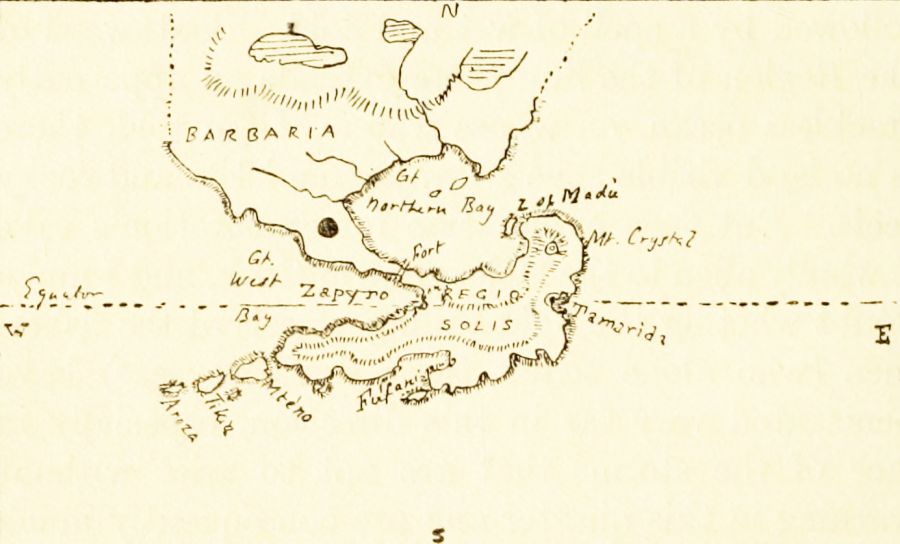
It will be observed that the capital lies, presumably of intention, exactly on the line of the Equator and that it faces due east; whilst Zapyro, the second city of the realm, is also situated in the same latitude but looking towards the west. The whole coast-line of the Regio Solis is much indented, and it forms a pendent peninsula to the large partially unexplored region to the north, which I always speak of as Barbaria, though it is commonly known merely as the North Land. Of the size of the main kingdom I am uncertain; at times I conceive it to be as large as Great Britain, at other times I think it can be hardly more extensive than Ireland. The centre of the kingdom is largely covered by mountain ranges and elevated plateaux. None of these mountains however are of any great height, with the sole exception of a tall isolated rocky peak in the promontory north of Tamarida, from which it is clearly visible. This conspicuous cloven peak I have named Mount Crystal on account of its shining crags, but it is known to the Meleagrians as the Altar of the Sun, and it is obviously invested in popular belief with many mystical attributes. Below the summit, which at a mere guess I should say was about seven thousand of our feet above sea-level, I can clearly distinguish a group of buildings on a narrow ledge to eastward; and Hiridia has told me that these belong to a temple of peculiar sanctity which none save the priests and their trusted servants are ever permitted to enter, or even to approach. Naturally I often speculate as to the uses of this lofty and jealously guarded shrine, and I have come to the conclusion that here are preserved the paraphernalia necessary to the due working of the details of The Secret. Be that as it may, the solitary mountain and its mysterious temple form a prominent feature in all the eastern portion of the kingdom.
All round the coast the soil is intensely fertile, and produces food in abundance for the whole population, which is nowhere very dense save in the two large cities. These two are in fact the only towns of any size in the whole peninsula, with the exception of Fúfani, situated at the head of a broad inlet of the southern coast. These southern shores are mostly rocky with huge beetling cliffs that recall the iron-bound shores of Capri and Cornwall. Against this natural barrier the raging billows in vain hurl themselves, and as I have stood watching the storm-vexed waters from these heights, I have often been reminded of the sounding seas and foam-flecked waves I once delighted to gaze upon from the heads of Sydney harbour that oppose the whole fury of the Pacific. The northern coasts of the Region of the Sun are less romantic, and in many places the coastal zone is marked by long stretches of sand with marshes behind them. Everywhere the vegetation both of cultivated and of wild growth exhibits a close resemblance to and an evident affinity with the flora of the Earth. In fact, there appear such endless points of similarity between the natural features of Meleager and of the Earth that I have often found it difficult to realise I was not living in some hitherto undiscovered corner of my native sphere. Appreciating the vast depths of my own ignorance in all matters scientific, I declare with trepidation yet with a firm sense of conviction that the geological history and development of the two planets must have been practically identical.
Not far from Zapyro begins the long isthmus that connects the warm subtropical Region of the Sun with the great half-explored territory of the north, or Barbaria. This large tract of land is said to widen out to northward, but very little is known of its interior, which at no great distance from the coast-line is blocked by a long chain of tall mountains, many of whose rugged peaks are covered with eternal snow. Large lakes and swamps are commonly reported to lie beyond these ranges, but in reality next to nothing is known of the country sheltered behind this great natural barrier. As I have already stated, the average Meleagrian has no taste for pioneering enterprise, so he remains quite satisfied with the tales of more intrepid hunters who have penetrated thus far and speak vaguely of a barren soil, of dismal morasses and of uncouth aborigines whose manners are fully as repellent as is the aspect of the lands they inhabit. Equally the coasts of Barbaria have been little examined, except those of the Great Northern Bay and the stretch of shore running north-west of Zapyro. All this coast-line is however sprinkled with stray colonies of South Meleagrians, some of these settlements being of a permanent character, whilst others are merely occupied as temporary bases for fishing or hunting. There are also a few colonies inland to the south of the mountains, but though the whole of this district is inhabited, no systematic occupation of this warmer portion of Barbaria has ever been attempted. The colonists for the most part consist of emigrants belonging to the people, but not a few of the nobles own estates whereon they breed cattle and sheep, or utilise for growing large timber. Some marble and stone quarries are likewise worked, but all these mercantile projects are evidently carried on in a distinctly haphazard style. All the permanent inhabitants of this region are subjects of my kingdom, yet they are not all of pure blood, but must in the remote past have intermingled with the original stock of this territory, who may perhaps have belonged to the same race as the yellow-skinned prognathous tribesmen who still dwell in the unexplored and unannexed portions of Barbaria beyond the mountains. In any case, these natives of South Barbaria are fine, strong-featured people, though easily distinguishable from those of the Region of the Sun. Many men of this district travel southward to enlist as soldiers, for which their more hardy physique admirably suits them, or else to offer themselves as indentured labourers and servants for a term of years. Two members of the hierarchy are charged specially with the interests of this class of temporary immigrant, and, so far as I could ascertain, they are always treated with fairness and consideration, though they are somewhat despised by the ruling populace of the south.
I have been informed that in times past these South Barbarians have actually attempted to invade the Region of the Sun, and in proof of this tradition I noted that the isthmus near Zapyro is fortified by a military wall running across its whole breadth from sea to sea. These old fortifications are solidly built, and are still kept in admirable repair, whilst one of the regiments is always quartered here in permanent barracks. There seems however, at the present time, to be little fear or probability of a repetition of any such incursion in spite of the constant guard maintained on the isthmus.
Of the capital I have already spoken, and of its picturesque situation on the hillsides sloping to the waters of the broad deep harbour whose circular form hints at a remote volcanic origin. Owing to the absence of towers and lofty buildings the whole town wears an Oriental aspect, for the Meleagrian style of architecture strongly inclines to colonnades, low domes and flat roofs. The streets are dark and narrow, a perfect labyrinth of paved lanes, but they are kept scrupulously clean by means of an excellent system of scavenging, whilst the copious use of disinfectant liquids renders them wholesome, so that Tamarida is remarkably free from disease in all forms. The houses own little external ornament, and being all white-washed recall the Arab quarters of Algiers and Tunis. This similarity is increased by the nature of their internal arrangements, which contain courtyards, or patios, open to the sky, these spaces in the case of the richer citizens being embellished with fountains and flower-beds. A happy combination of the dwellings of the classical world as still visible at Rome or Pompeii and the architecture of Islam may best describe the type of home prevailing in Tamarida and elsewhere throughout the kingdom. The houses of the poor are smaller and less elegant, but are of the same character as those of their wealthier neighbours. There is an abundant public supply of water for each house, with fountains in every garden and open space. The instinct of family life in the two upper classes is very strong, so that it is not easy for strangers to penetrate into these compact, secluded homes, where usually only near relatives are admitted except on the occasion of a wedding or a feast. Indeed, the family itself in upper-class life offers a tiny imperium in imperio throughout the country, and this attitude of aloofness is encouraged by the hierarchy, who prefer to see all domestic suits and quarrels settled within the walls of the family mansion rather than in the court held daily in public.
Zapyro, which traditionally claims to be considered the ancient metropolis of the realm, is only about half the size of Tamarida. Its streets, though equally clean and well tended, are less animated; its market is smaller; its houses and gardens are all on a less ambitious scale; and this remark especially applies to the Temple of the Setting Sun which crowns a large rock behind the town. This sacred building, whose former ruinous condition I have lately sought to improve and have thereby acquired considerable merit in the eyes of the Zapyriotes, cannot compare in size and splendour with the magnificent fane at Tamarida. Only four members of the hierarchy reside here, and though the services connected with the hour of sunset are impressive, they are not comparable with those held in the great Temple of Tamarida. My own residence here consists of a block of buildings of moderate size, but then I only spend one month in Zapyro itself, my arrival being greeted with most flattering rejoicing on the part of the Zapyriotes, who also exhibit much despondency at the time of my departure. One peculiarity of this city is worth recording; and that is the circumstance that, unlike Tamarida, it possesses a civil governor who may not belong to the priestly caste: a fiercely cherished honour that is believed to derive from very remote ages, when royalty resided here permanently. A leading member of the nobility is always chosen from his peers for this much-coveted distinction, which also includes the right to inhabit a portion of the rather exiguous palace at Zapyro, and the duty of holding the daily court of judgment in the absence of the King. The hierarchy is said to view these privileges with disfavour, but has hitherto hesitated to abolish the office in face of the pride and jealousy the Zapyriotes display in their retention of what is after all only a slight infringement of their universal powers of rule.
With regard to the third town, Fúfani, I gather it to be a place of recent growth. It is a large rambling unattractive seaport built on the marshy flats at the head of the Gulf of Fúfani. Its population consists entirely of families of the mercantile class and the populace who are engaged in the maritime trade of the southern ocean. The growth of Fúfani was, I understand, very rapid, so that the sudden realisation of this unauthorised collection of large numbers of citizens caused much misgiving amongst the senators at Tamarida, who took measures to scatter the community thus formed against their wishes. In this aim however the hierarchy was unsuccessful, largely, it is rumoured, owing to the sympathy of the reigning king, who found in the question of Fúfani a convenient occasion for pitting his authority against that of the priesthood. Failing to induce the inhabitants of this new-sprung town to disperse themselves throughout the neighbouring districts, the priests now came to consider it the lesser of two evils to recognise Fúfani as a city, and accordingly erected a Temple of the Sun at this spot and nominated three priests to reside there. This measure has brought the people of Fúfani, who must evidently have shown some fierce spirit of opposition, if not of flat rebellion against the government, directly under the arm of the hierarchy, whose rule here is strengthened by a garrison of soldiers. I cannot help thinking it must have been my predecessor who thus encouraged the spirit of revolt, not wholly without success, at Fúfani, with the ultimate result that he "ceased to reign," as his fate is euphemistically described to me. I have so often longed to discover what is the end of undesirable or obnoxious monarchs; are they secretly murdered, I wonder, or are they confined in that sinister temple on Mount Crystal or some other retreat? Or are they merely deprived of the benefits of the Fountain of Rejuvenation, and so allowed to fall to decrepitude and old age, and finally death? What would I not give for some true guiding details of these concealed tragedies, of these unequal struggles between palace and temple! On the only occasion I have visited Fúfani I could not detect any overt sign of disaffection among the populace, though I did not fail to note the sour looks of the priests accompanying me, as we rode through the rather squalid streets of the straggling featureless town, so different in its natural setting from Tamarida or Zapyro. There is no royal residence in Fúfani, and my visit hither was undertaken from the country seat of a neighbouring nobleman, who spoke of the town and its people with contemptuous dislike.
Before bringing this meagre and feeble sketch of Meleager to a close, and before proceeding to enlarge on the more interesting subject of the Meleagrians themselves, one final point of some importance occurs to my mind. This is the matter of their coinage, or rather medium of exchange. Although barter on an extensive scale and in a very sensible manner is largely utilised amongst merchants, and wages are frequently paid in kind, a system of coinage is in general use, the currency being limited to three coins. These are the golden "bezant," rather larger than our own half-sovereign; the silver "platera," about the size of a two-franc piece; and the bronze "denar," a little bigger than a penny. Each coin bears on its face the device of the sun, and on its reverse a raised lozenge in the case of the bezant, a square of the platera, and a circle of the denar, which marks can be distinguished in the dark. As the golden bezant is worth ten silver plateras, and each silver platera again is worth ten bronze denars, a simple system of decimal coinage may be said to prevail.
VII
Having described some of the natural features of Meleager, I now propose very shortly to speak of the various functionaries and classes of the realm. These may be divided into (1) the King; (2) the Hierarchy; (3) the Nobility; (4) the Mercantile class; (5) the Populace; and (6) Indentured servants or slaves.
As the King is the first official in the state, as well as its resident incarnated deity, I shall begin by speaking of my own powers and their many limitations. I have already explained the extraordinary genesis of the King of Meleager, how he is a native of the Earth, and is consequently on his arrival here utterly ignorant of the laws, traditions, polity and ideals of his new kingdom. At the end of five years I may add it is astonishing to reflect how terribly ignorant of all these matters I still remain, not through any fault of mine, but owing to the fixed intention of my practical masters, the hierarchy, to keep me in the dark concerning many affairs of importance in the realm for which they have themselves deliberately chosen me as monarch. The Arch-priest, whom I infinitely prefer to any of his colleagues, can be a perfect Sphinx of the most provoking silence at times, although, to do him justice, he does occasionally impart information, which is invariably accurate and useful for my real guidance, whereas I cannot trust any statements made me by other members of the college. What I glean from Hiridia is of some general service certainly, but from the political standpoint it is valueless. This is not surprising, seeing that education, in the restricted meaning of that term, is practically confined to the members of the hierarchy; still, from the social side Hiridia has proved of great assistance to me in my relations with the nobles and other estates of the realm.
The King here, even making full allowance for the peculiar bonds wherein he is tied and bound to the hierarchy, wields considerable powers. He is, as I have already shown, the judge of the people in their courts, and to them his decisions are final and undisputed. The belief and devotion of the populace are therefore wholly concentrated in their resident King, who appears to them—and who can marvel at it?—as the authentic Child of the Sun, whose father they daily worship and praise for the light whereby they live, for the food they eat, and for the warmth they enjoy. I can easily understand the strong temptation that has driven one, and probably more, of my predecessors to utilise the undoubted credulity and loyalty of the populace in a struggle against the repressive influence of the ruling caste, and I can also, for I am fair-minded, perceive the reasonableness of the continual panic that animates the hierarchy with regard to the relations existing between an alleged semi-divine monarch and a blindly adoring multitude. Any prospective understanding or union between these two forces of King and people is a constant source of jealousy and alarm to the priesthood, who are ever on the watch to prevent and stifle such intrigue should it arise. Yet, on the other hand, if once the King were goaded by indiscreet espionage or by harsh interference into revolt against official tutelage, then a personal appeal by the outraged Child of the Sun to his faithful people might very possibly result in the overthrow within a few hours of the whole fabric of government that it has taken so many centuries to rear. The open policy of the senators therefore must not tend to thwart or irritate the King; it must merely keep the sharpest outlook without awakening his suspicions; yet it must always be ready to guard against any sudden plot or combination between an ambitious King and a subservient populace. On the contrary, there must exist a mutual but unspoken compact between the monarch and the priesthood, in which the former should clearly and willingly realise his complete dependence on the latter, and submit in all things with a good grace. He is to be particeps fraudis, a sharer in the Great Imposture with its contrivers, and if he is content to play this rôle, well and good; but if he elects to kick against this tacit arrangement, the situation thus created must prove equally dangerous both to King and hierarchy, and in such a crisis the priesthood never mean the King to triumph, no matter what measures they may be reduced to take in order to preserve their ascendency. For my own part I have done my utmost to make the priesthood realise that I comprehend and agree in and respect this silent bargain. Some of the councillors are however too suspicious and nervous by nature to appraise my attitude at its true value; and though I am on fairly friendly terms with the majority of my masters, there are certain members of the council whose evident hostility I can never hope to disarm.
From the deliberations in the council chamber in the Temple of the Sun I am invariably excluded, yet no measure within the realm is essayed without my knowledge, the Arch-priest acting as intermediary in all such cases. I am always permitted, and even encouraged, to work with the hierarchy, but I could never work against them, even if I would. The peculiar relations between our two sets of authority must necessarily always be most precarious and delicate, and call for the utmost exercise of patience, restraint and self-effacement on my part. Fortunately, so long as it is realised on both sides that our mutual powers are intermingled and interdependent, there is little fear of a collision such as either party would naturally seek to avoid in its own interests.
Except for the short ceremony observed on the morning of each weekly feast-day, the King rarely visits the temple. Twice a year however, at the seasons of mid-summer and mid-winter, prior to the great public acts of worship before the crystal altar, I am subjected to a lengthy course of manipulation, followed by a dipping in the Fountain of Rejuvenation. In spite of the invigorating after-effects of this treatment, I confess I detest these two occasions most cordially, and their approach always fills my heart with intense bitterness at the thought of the humiliation that awaits me; nor can I shake off my feeling of chagrin for many days afterwards. Yet never a hint is uttered in my presence as to my dependence on the will of the hierarchy, nor has the Arch-priest ever alluded even in our most confidential talks to the intricacies of our unique relationship. To bear and forbear has therefore been the guiding note of my reign so far, and I earnestly hope that by following a similar course of conduct in the future I may contrive to continue thus on the throne of Meleager, for despite its many limitations and objections I am tolerably happy in my present situation. I have frankly accepted my anomalous position from the first, and as time progresses I find my perilous curiosity to peer behind the veil of The Secret grow less persistent and irksome.
I hope I have now explained with some degree of clarity the exact nature of the tie binding myself to the College of Seventy. The worst feature of my own position—and perhaps the worst also from the point of view of the hierarchy—is the haunting sense of uncertainty, or rather the knowledge that I myself, my aims, my motives and my deeds are continually under discussion by this mysterious band of priestly potentates, with whom I am really unable to get into touch and to whom I cannot explain satisfactorily any matters that may arouse their distrust or suspicion. I often wish the members, at least of the outer circle, of the council would decide to take me into their complete confidence, so that we could all open our hearts freely to one another. I feel sure in such an event all cause of misunderstanding on their part would be speedily removed, whilst a greater feeling of security would result to themselves from this open alliance. But I know only too well that at present any such arrangement is utterly impossible, so I have to abide in the same uncomfortable and strained position which has already, I have every reason to believe, proved too onerous and exasperating for more than one of my fore-runners on the throne of Meleager.
With the nobility my part is naturally a far less difficult one to play. In the eyes of my courtiers, and of the many leading nobles who have access to my personal society, I am regarded not merely in theory but in very deed as a semi-divine creature, and am treated with the requisite degree of honour. But so natural and well bred are the manners of the Meleagrian aristocracy that this intense deference never sinks to fawning, nor becomes personally inconvenient, so that I can associate on terms of easy familiarity with many of them. With their private affairs I have no great concern, seeing how strong is the patriarchal rule in each family; but sometimes as a last resort my opinion is invited, especially by the younger nobles, and such advice as I deign to supply is invariably regarded as the acme of wisdom and is promptly acted on.
With the commercial class I am brought much less into contact, so that I have smaller opportunity of observing its members. From time to time, however, I take pleasure in receiving accounts of travel by land and sea from some of the more intrepid merchant adventurers who sail the southern ocean, or penetrate the bleak hinterland of Barbaria. I have also acquired some merit in their eyes by making an expedition to the Barbarian coast, and visiting some of the settlements whence timber, furs and fish are exported to the south. The Arch-priest has never expressed any opposition to this display of interest on my part, and he certainly encouraged my voyage to Barbaria; but I know well some members of the College of Seventy at the time objected to my proposed tour of inspection of the northern colonies. Their arguments, no doubt voiced in the council chamber, must however have been over-ruled, for my expedition was permitted.
By the third estate, as also by the large mass of indentured slaves or servants, I am of course adored, worshipped and regarded as a Divine Incarnation. My appearance in the judgment hall calls forth diurnal blessings on my head, and persons of this class seek to kiss the hem of my robe in passing, or even manœuvre so that my shadow may fall upon them, much as the sick and decrepit of antique Asia Minor sought a blessing in the shadows of the early Apostles. I need not pursue this matter, for I have already made clear elsewhere the whole-hearted loyalty of the populace towards their King.
Apart from this deep attachment to my person of the commonalty of the kingdom, I possess too a certain amount of real power in the household of the palace and in the regiments of horse and foot that form my personal guards. All these wear my royal colour of blue in their livery or uniform, together with my badge of the sun in splendour. I can therefore well imagine the consequent jealousy and alarm of some members of the hierarchy being aroused by such an exhibition of potential strength, and I feel pretty sure of the presence of a number of spies both among my domestics and in the ranks of the military, who are constantly on the watch lest I should show any sign of pushing my advantage by these means. As such never has been, is not and never will be my intention, these official eavesdroppers can have nothing but what is reassuring to report to their employers. Nevertheless, the thought of this particular form of distrust is not pleasant, and it looms large among the various trials and disadvantages I have to endure in my exalted office.
VIII
Undoubtedly the most important feature in the whole body politic of Meleager is the ruling caste of the priests. I have at different times described these personages as a hierarchy of priests, as a college of senators, as a Council of Seventy, as a committee of councillors; but in reality none of these titles exactly expresses the nature or powers of this small executive clique selected from the nobility. The form, moreover, under which they are universally saluted or addressed in Meleager is simply "Arxattra," which signifies "Master." I had therefore better open with an account of the choice and composition of this body, whose sole check consists in the King whom they themselves call into being and can presumably dispose of in certain events. The priesthood (to use a convenient though inexact term) consists of never more than seventy-seven members nor less than seventy, and these are recruited solely from the aristocracy. The admission to this body is by election of the whole, and the candidates for this honour are confined to a number of probationers of the seminary that is situated within the precincts of the Temple of the Sun. These probationers are jealously excluded from all outside social intercourse, and are carefully educated for at least five years with the object in view by members of the council itself. No one under the age of thirty-five may be admitted for election, and it is usual, though not essential, for the candidate to be a bachelor or a widower. On his election, the successful candidate quits his college and retires to the Temple of the Sun, where apartments exist for every member of the council. This severe regulation as to age and family ties is obviously intended to preserve the conservative traditions of the hierarchy, for the human mind naturally is inclined to hark back affectionately to the conditions prevailing in youth and to prefer such to any later standard of morals and administration. At the same time the many services and duties to be performed by the junior councillors require the election of active and able-bodied members, for though the Temple of the Sun is the headquarters and official home of these councillors, yet many of them are in constant peregrination throughout the kingdom. Four priests reside at Zapyro; three at Fúfani; two are said to be in residence within the forbidden temple on Mount Crystal. All have their proper spheres of work assigned to them, and membership of this all-powerful council, far from being the sinecure I once conceived it, entails an immense amount of exertion, both mental and physical.
From the moment of his election there is an amplitude of employment for the new-comer. Thus of the junior councillors four hold the onerous posts of registrars of all births and deaths throughout the realm, their business in this capacity taking them far afield, for the whole system of Meleagrian registration is closely bound up with its public policy and edicts. Two more are concerned with the shipping and fishing industries; two with the control and inspection of the colonies in Barbaria; two are entrusted with the interests of the many indentured labourers; two or more act as commissioners of forest lands; at least four are charged with the important and troublesome duties as regards public sanitation and hygiene; and so on till every public department falls under the direct supervision of the nominees of this Council of Seventy and more. Such a shuffling and allocation of public offices may seem arbitrary and detestable to the windy demagogues of our twentieth-century civilisation; but I can assure my readers, as the result of my most careful and unbiased observation, the practical effect on the well-being of the community at large far exceeds any vaunted results that ever I saw or heard of in any democratic community on Earth. Nor do I marvel; for jobbery, sentimentalism, waste, financial dabbling, denominational intrigue, family influence are all necessarily absent from the workings of a council that is composed only of highly trained persons of gentle birth who, having resigned all the domestic and material interests of life, have no private or monetary ends to consider, but act solely for the benefit of the state, which they have chosen voluntarily to serve after a long preliminary course of special education.
Whenever a member of the council dies, or through failure of health is placed on an honorary footing, the vacant place is quickly filled. The last elected member of the hierarchy summons the chosen probationer and leads him to the council chamber where his brother members are assembled. Here he kneels, whilst a homily on the nature of the high honour conferred on him and the vast sum of confidence reposed in him, is read aloud by the Arch-priest, who acts as president. Impressive rites follow, for nothing is omitted to prove to the new member the terrible fate that awaits any councillor who may be found guilty of any disloyalty, or of even breathing a hint of The Secret, which he is now empowered to learn. What is the fate reserved for any indiscreet or treacherous councillor I cannot say; but I fancy breaches of confidence in the council itself must have been as rare in the past annals of Meleager as was the crime of Marino Faliero in those of the old Venetian republic, whose constitution, by the way, has evidently been carefully digested by the hierarchy. The oath of implicit obedience and of absolute silence having been administered, the new member is then led forward to have his crimson cloak and tunic removed and replaced by the voluminous white robes of his new order. He next receives the formal congratulations of all his colleagues, and is then made fully acquainted with the nature of The Secret, though I myself have a pretty shrewd notion his mind has already been cautiously prepared beforehand for its reception, so that he in fact possesses something more than a mere inkling of the impending revelation, which is announced with due solemnity. Here however the new member's information ceases, so that he possesses exactly the same limited amount of knowledge of The Secret as do I myself. Whether the new councillor will eventually arrive at a position of such trust and reputation as to be invited to enter the interior ring of the council, time alone can show. And it is of this paramount inner force within the council that I now wish to speak.
Of this small secret council within a larger secret council I can only state with certainty that its numbers vary from fourteen (the minimum) to twenty, which latter figure is never exceeded. The members of this inner clique are elected from the other members of the council, but on what principles I cannot say. The great difference between the larger and the smaller sets within the council is this: the latter not only know The Secret, but they are the individuals who carry out its details and work its machinery for the purposes I have already explained. With one exception every member of this interior circle has some time or another performed the voyage between the Earth and Meleager; and how strangely does it strike me in my utter solitude to reflect that here in Meleager are nearly a score of persons whose acquaintance with the planet of my birth is in some ways more extensive than my own! The sole exception is the Arch-priest, who may not be transported to Earth, because he is the one person who is in constant and close touch with the King. The limitation is subtle, but it is sound; for I can imagine some fine possibilities of intrigue between the King and the Arch-priest, if the latter had not only visited the Earth but was also familiar with the extraordinary methods whereby that end was attained. (I need hardly add that no senator of the inner ring is ever allowed to address or visit the King except in the presence of two other councillors.) This picked handful of the council chooses the Arch-priest from the general body, so that this functionary stands in an intermediate position of knowledge concerning the working of The Secret, for he thus knows more than the ordinary member of the council and less than his brethren of the inner ring. He is chiefly charged with the control of the services and staff of the temple, and he has also to superintend the establishment on Mount Crystal, where (so I strongly suspect) are kept in honourable confinement those aged members of the council who have grown infirm or garrulous under stress of years. What exact share these persons of the inner ring partake in the working of The Secret I naturally cannot tell; and I often speculate as to whether they themselves are mechanicians possessing a skill far beyond that achieved by any of our engineers on Earth, or whether they merely control certain servants who own the necessary technical knowledge to carry out the intricacies of the aerial machinery under their instruction. In other words, are these score of elderly men their own mechanics, or are they only overseers of others? For there are certainly large numbers of assistants attached to the service of the council, and a certain proportion of these menials I know to be deaf and dumb, the result, it is whispered, of a certain cruel operation which is inflicted sometimes with the consent of the patient, and sometimes (so I gather) by force following on brutal seizure. Is it that the priests are ever on the look-out for capable young mechanics to train for this purpose, and are such promising youths liable to disappear? On the other hand, many of these deaf and dumb servants of the temple have families, and apart from their unknown duties seem free to come and go; being dumb, they cannot chatter, and being deaf they cannot listen; and since the native language is purely phonetic and not literary, people so afflicted cannot converse with their fingers, as is the case with our deaf-mutes on Earth. My own theory is that these persons, having a natural taste in things scientific, are first carefully trained so as to acquire all the technical skill necessary for the accomplishment of the details of The Secret, and are then to their surprise suddenly given the option of being rendered deaf and dumb to be thus retained in the service of the council, or of being instantly and privately executed, for the hierarchy would have no scruples in so acting if by their refusal to submit The Secret were in any way endangered. All this reasoning however on my part is, I admit, founded on pure supposition. For aught I can adduce to the contrary, the journey to and from the Earth may be accomplished by means of some unknown power of levitation, such as is only claimed on Earth by the mahatmas and skooshoks of Tibet, whose wild theories are laughed to scorn by all enlightened Europeans and Americans. There are, I know, vast vaults beneath the Temple of the Sun, and perhaps these may shelter aeroplanes and cars of a type and capacity undreamed of on Earth; on the other hand, these capacious cellars may merely contain treasure and archives, or indeed nothing at all. Possibly there may be elaborate machines concealed in the temple on Mount Crystal, for I am convinced that it is on this conspicuous mountain that the returning Meleagrian envoys from the Earth alight. But I frankly confess I am completely at a loss to explain the system of communication with the Earth; it is a fascinating subject for speculation, but I am also fully cognizant of its perils to any would-be investigator.
Although there can be comparatively little fear of intrigue arising between the King and the councillors of the second grade, yet there exists no real friendliness or confidence between us. They treat me outwardly with marked deference, whilst I in my turn always show myself cordial and polite, but I have no personal friend in the whole body except the Arch-priest, for whom I have conceived a genuine liking and respect. My intimate companions are practically confined to the nobility, and though they are ignorant and illiterate, yet I prefer their honest prattle to any cautious discussion or interchange of lofty ideas with the highly educated priesthood. Nevertheless, I cannot refrain from eulogising the unselfish devotion of these persons to their tasks of administration, which is shown equally by every member. The clique of the interior circle do not of course participate in the actual business of government, for they are presumed to have reached a higher plane of usefulness to the state, but the junior councillors pursue their avocations with unflagging zeal. The tedious work of registration, which entails constant vigilance and many journeys to remote places; the settlement of trade questions; the management of the twin departments of medicine and sanitation; the marshalling of taxation; the control of the army;—all these and many other duties occupy the whole existence of the councillors who know no rest or respite from their allotted tasks.
Take the instance of hygiene alone. The accumulated wisdom of some two thousand years of the Earth's progress in the science of healing lies all at the disposal of the executive hierarchy of Meleager. And I feel compelled to pay a sincere tribute to the intelligent industry of the councillors in their untiring efforts to produce everywhere a "corpus sanum in civitate sanâ." The abundant water-supplies of the cities; the meticulous care wherewith every source of contamination is traced; the constant experiments that are made daily in the hospitals (less elaborately equipped than our own, but fully as clean and serviceable); the thoughtful measures to preserve existing health and to improve the physical condition of the mass of the citizens;—all testify to the common-sense and thoroughness of the means adopted by the ministers of public hygiene and eugenics. Thanks to their wise measures pure water, pure air, wholesome food, the prompt eradication of all epidemics, and the segregation of the physically or morally unsound are gradually producing a race that for health and happiness has no parallel on our progressive democratic Earth, where the boasted advance of European civilisation only conveys in its train to healthy but nominally uncivilised tribes and nations every species of moral, physical and æsthetic evil that did not exist under the old conditions of isolation and ignorance.
Although belonging to the aristocratic caste, yet these servants of the state wield their power with magnificent impartiality, weeding out the weaklings alike in the families of noble, merchant or plebeian. Adult degenerates are always removed to the island of Madù off the northern coast. Here the sexes are kept apart, but the poor creatures are permitted to live in tolerable comfort and to receive visits from their relatives, who however (it must be confessed) usually display no very marked anxiety to avail themselves of this privilege. For as time advances, it is commonly coming to be regarded as a social offence to harbour in one's household any idiotic or misshapen being. Thus almost all Meleagrians now heartily concur in the state regulations whereby all infants with obvious mental or bodily defects are at once strangled by the officials who attend in the train of the visiting councillors, and they also make little or no objection to the deporting of grown criminals to Madù.
This public acquiescence in a measure destined solely for the improvement of the race as a whole is, I believe, of comparatively recent date. For a long time the removal of malformed and idiotic infants, as well as the enforced deportation of lunatics or seriously diseased persons, was strongly resented by their families; but firm persistence on the part of the hierarchy and a gradual spread of reasonableness among the whole community have slowly gained the public approval for severe regulations that were at first as novel as they were distasteful. I particularly mention this case, as it tends to show that though conciliation of the populace must always form one of the leading tenets of the council's policy, yet it can on occasion enforce an unpopular edict throughout the nation in its own interest, despite the indignant protests of all classes. I have been told that the then reigning King, a most enlightened Switzer, did splendid service for the council by personally in his capacity of Child of the Sun, ordering his father's own people to obey the new regulations. How long ago this struggle arose I have no notion; and oh, how often have I yearned to learn more concerning that predecessor of mine whose memory is still gratefully held by the hierarchy to-day! How and under what circumstances did he finally "cease to reign"? Did he later on attempt to oppose the ruling body, after having saved it from possible collapse? But no questions of mine, however artfully or artlessly addressed, could ever secure me any but evasive answers.
I can never fix in my inconstant mind my exact feeling towards these "potent, grave and reverend signiors" of the council, these impassive and industrious priests (who are in reality not priests at all, for their task is almost purely a secular one, the priestly office being practically merged in that of the statesman). And in the performance of these duties they are as unselfish as they are indefatigable; nor is there any apparent taint of personal jealousy or internal intrigue amongst the hierarchy. When during my rides abroad for pleasure or for hunting I see a pair of these white-robed councillors, equally servants and rulers of the state, visit some remote hamlet and observe the scrupulous care and the genuine interest wherewith they inquire into and carry out every necessary arrangement for the public weal; and when I consider the implicit faith placed by the country folk in their rulers, I am somehow reminded of the mission of the Apostles of old as they wandered through the towns and villages of the Roman world healing and assisting helpless humanity. At other times, however, I am inclined to regard them with a mixture of hatred and contempt, whenever I reflect on the unprecedented system of conscious fraud whereon all their beneficent action rests. How strange, for example, must it seem for a newly elected candidate to learn for the first time that the religious teaching he has imbibed from infancy is a deliberate fabrication, which he himself is now called on to champion and perpetuate; that the divinity of the Sun is a hollow myth; that his Child is a mortal from another planet; that the world of Meleager, far from being the special creation and care of the Sun-god, is in reality a mere speck in a vast solar system, such as has been propounded by our own astronomers Copernicus and Galileo. What a terrible moment it must prove for a sensitive soul, implected with the beautiful mythology of a lifetime, when in a trice the whole of his religious environment is stripped rudely from him like a garment! I often meditate on the unique moral dilemma that must face every new councillor. How fearful an awakening! How difficult for a conscientious nobleman to combine the two phases of a public benefactor and of a promulgator of an elaborate lie! Has any Meleagrian noble of high integrity I wonder ever had the courage or conscience, at the supreme moment, to protest, even at the risk of death? But I presume the preliminary training and preparation bestowed on all probationers are carefully contrived to soften so great a shock, and to lead the postulant gently towards the amazing revelations made at the time of his reception into the council.
The dress of the hierarchy is simple, consisting outwardly of a white woollen toga-like garment that is free from all ornament. I suspect the adoption of this style of dress is borrowed from that of classical Rome, whose laws and customs evidently form the basis of the Meleagrian constitution. A white wand is carried in the hand, and a white fillet is bound round the temples; only on the two great half-yearly festivals are the ornate gold-fringed garments worn in public. The robes of the Arch-priest are likewise of a white woollen material, which in his case are relieved by a bordure of gold brocade, whilst the wand and fillet are also of gold; but on state occasions he dons magnificent vestments of cloth of gold and wears a golden mitre on his head. The Arch-priest's office is naturally more sacerdotal in its nature than that of his comrades, for it is he who is entrusted with the due performance of all the services of the temple, and he too assists at the solemn ceremony of censing the crystal altar of the Sun, as I have already shown. He is also the custodian of the awful Fountain of Rejuvenation, though his guardianship is shared by other members of the inner ring. One day, finding the venerable head of the council in an unusually expansive mood, I ventured to question him openly upon the properties of this sacred well, this Zem-Zem of Meleagrian un-faith. He replied that its medicated waters, though highly beneficial to a mortal born of the Earth, would prove fatal to any Meleagrian rash enough to attempt their use. Moreover, he added that should anyone plunge alone and unattended into this well, the terrific suction of the current beneath would infallibly drag the body under, never to reappear. I then questioned him if many such accidents had ever occurred, whereupon he answered dryly that none had happened in his own experience; which equivocal reply I interpreted as admitting that fatal incidents in the past were by no means unknown. I then twitted him jokingly for not renewing his own youth, of course with all proper precautions, in the fountain of his charge, to which he replied with considerable asperity and horror, using the most solemn Meleagrian form of denial: "May the God perish first and the Sun be darkened!" After this vigorous negation he took his departure with some abruptness, nor could I ever entice him to speak again of the fountain.
I fully realise that my account of the hierarchy or governing class of Meleager is both incomplete and unsatisfactory, but I must plead again the many difficulties of obtaining information which I have already mentioned. In fact, it is from two sources only that I can derive any details whatever, these being my own limited opportunities of observation and discovery and the rare statements that the Arch-priest lets fall from time to time, for I am not on confidential terms with any other member of the council. From Hiridia and my friends of the nobility I can gather absolutely nothing, for the simple reason that their own ignorance of the private affairs of their ruling caste is even greater than mine. Indeed, the marvel is that I have been able to compile even the small amount I have inscribed here, considering the obstacles in my way of acquiring knowledge. I must sum up therefore by stating that I have very little communication with that body of councillors with whom my own position and prerogative are so closely interwoven, this state of affairs being due wholly to the persistent refusal of the latter to take me into their confidence.
IX
Of the nobility I can speak with more confidence, for with many of them I am on terms of intimacy and friendship. The well-bred gentleman is not confined in our own world to any special climate or nation, for he is to be found equally under a white, a yellow, a brown and even a black skin; and the gentle type is also indigenous on the planet of Meleager.
The aristocracy of Meleager is closely connected with the land, and it is to some extent strongly impregnated with feudal principles. Every noble is either the owner of an estate, be it large, moderate or small, or else is connected by family ties with the actual landowner. Each house forms a distinctive gens in itself, and all its male members are entitled to bear a badge, which is its peculiar mark. These badges at first suggested to my mind a relic of totem-kin, but I soon changed my opinion on this point, and now hold the family badge to be heraldic in its aim and use. I gather that the adoption of a conspicuous badge or emblem for each family is of considerable antiquity, and perhaps derives from reports made by the Meleagrian envoys on Earth at the period of the Crusades, when coat-armour came into fashion among the chivalry of Western Christendom.
The mass of the nobles exhibits various degrees of wealth and influence, and I have noted the existence of some ill-feeling between the leading magnates and the smaller landowners. The social cleavage between the two sets is however imperceptible, and the constant intermarriage between the families of what I may call the major and the minor barons tends to eradicate many cases of jealousy. This landed aristocracy has, of course, its chief residence in the country districts, though the wealthier families possess houses in the cities in addition. The country house of Meleager is usually of moderate size, and consists of a low square white-washed mansion enclosing a courtyard. The native love of colonnades is prominently exhibited in these houses, which are frequently surrounded on all sides by loggias that can be utilised according to the varying conditions of weather. The arrangements within are somewhat primitive according to our own luxurious standards of the twentieth century, but they are not without a sufficiency of comfort. The floors are generally tiled; there are no rugs or carpets, save some skins of beasts; the furniture, though often elaborately carved, is not plentiful. There are no family portraits, for the art of painting pictures is unknown, but in compensation for this defect there is always the curious family chapel or mausoleum. This has usually a low domed roof pierced by windows of coloured glass that admit only a dim light within the chamber which seems very similar to the columbaria of the Romans, from whom I conclude this idea has been borrowed by their unknown admirers. Rows of small semicircular apertures line the walls, many of these standing empty, whilst not a few are occupied by busts of deceased members of the family. Beneath these effigies are placed small urns of metal or marble which contain the ashes, for cremation has for sanitary reasons been made compulsory in Meleager for many centuries past. Some of these busts are of no small artistic merit, and evidently well portray the features of the noble ancestors; others again are of inferior workmanship; whilst some are obviously merely conventional in their treatment. Such a collection certainly forms rather a gruesome substitute for a family portrait gallery, but its atmosphere does not seem to depress the spirits of the present generation, for I am always cheerfully invited to enter and inspect these queer oratories. The surrounding gardens are often beautiful, but are far less artificial than our own. One broad long flagged terrace usually suffices for the family to stroll; otherwise the paths and lawns are unkempt and neglected. These pleasances are however full of a luxuriant growth of wild or half-wild flowers, so that I found myself often being reminded of the exuberant gardens of old-world Italian villas in past days, before the late irruption of wealthy cosmopolitan tourists had succeeded in thoroughly vulgarising Italy and modernising all its old peaceful haunts.
Country life as pursued in Meleager varies little in its essence from that of our Earth, mutatis mutandis, for time is pretty evenly divided between the attractions of sport and the claims of estate management and domestic concerns. Everything is, of course, conducted in a manner that would appear as primitive to our pampered sportsmen as it would seem suggestive to the antiquary, for both field sports and agriculture have remained here in the mediæval, or even sometimes in the archaic, stage of development. Firearms, though not unknown, are at least never employed, so that in hunting the spear, the net, the trap and even the bow still constitute the chief weapons of the chase. All ploughing is performed by oxen with wooden implements, and the thorough cultivation of the crops is on a tiny scale. Again and again have the conditions of Meleagrian rural life recalled to me the old-world bucolic practices of Tuscany and Castile, that even down to the close of the nineteenth century retained so many picturesque features of remote classical times. The tenor of existence in the country is quiet enough, and would prove unspeakably dull and irksome to the majority of our modern squires; but it must be remembered that the Meleagrian landowners have no newspapers, no novels, no Stock Exchange, no party politics to sweeten and distract their daily round, so that they are perfectly content to follow in the secure footsteps of their forefathers. Should the younger men find the calm routine of country life wearisome, there are other avenues of occupation open to such restless souls. In the first place there is the army, which is officered solely by members of the aristocracy, some of whom make a permanent profession of their military duties and attain in due course to the higher commands therein. The usual plan is, however, for the younger sons of the noble houses to spend some three or four years in the army, after which they marry and come to settle in homes of their own, where they busy themselves for the rest of their lives with a medley of sport, agriculture and domestic economy. Again, the life at Court is open to a certain number of those who care neither for a career in the army nor for the monotony of the countryside. Here they participate in the constant variety of the palace, and hope to win honorary appointments in the royal household. A few, more adventurous still than their fellows, proceed to Barbaria either for the purpose of better hunting, or for the sake of the harder and more exciting life in a new sphere of energy. Some proportion of these latter obtain grants of land in this less than half-occupied territory, where they found new estates modelled on the old lines, much as the younger scions of our gentle English houses emigrated and settled in Virginia. Such experiments moreover are strongly commended and encouraged by the special councillors who are charged with the conduct of colonial affairs.
Yet another and a far more important means of escape from the alleged tedium of family or rustic routine is the career of the probationer, who aspires eventually to be elected a member of the hierarchy. This ambition cannot, however, be gratified before the age of thirty, when the intending candidate is admitted to the school of the neophytes. Here for a year he receives a course of lectures on Meleagrian history and is taught the rudiments of Latin grammar, but no instruction in reading or writing is yet afforded him. At the end of a twelvemonth of such preliminary training, the neophyte is either rejected as unfit or unsuitable, or else he is admitted a probationer of the seminary attached to the Temple of the Sun. In that case he receives a five years' course of far more advanced tuition; he is taught to read, write and speak the Latin language; and presumably he is also instructed in astronomy, politics, theology and other subjects concerning which his existing notions must be strangely vague or wholly erroneous. This long period of instruction entails a severe strain on the pupil, who is henceforth cut off from all private and external ties and interests, for he is never allowed to quit the precincts of his seminary. Of his final election and reception into the council of the hierarchy I have spoken elsewhere. Whether or no any candidate has ever failed to obtain his election and has been consequently compelled to remain in the institution for years, perhaps for the term of his lifetime, I cannot say; yet I do know for a fact that for its inmates there is but one door leading out of the seminary of probationers and that is the door which admits to the council chamber.
I always enjoy my occasional visits to the country seats of the nobility, where the calm useful healthy life affords an agreeable change to me from the atmosphere of the palace, which seems always charged with mystery and intrigue. The genuine greeting of my host and the members of his family, the delightful blend of divine honours and of frank hospitality wherewith I am everywhere received, the pride shown in their farms and agricultural schemes, the general air of repose and safety, all tend to soothe a mind that has grown perplexed and wearied with the endless cares of an exalted but anomalous office. The conversation of these uneducated but well-bred persons is certainly not exciting, and might fairly be described as trivial, but really I do not think, from past experience, that it is more trifling or banal than the average talk of the British aristocracy which of recent years has elevated sport and money-making to be the prevalent topics of society (using that term in its narrow technical application). And though all these excellent folk in Meleager are of necessity quite illiterate in the sense that they cannot read and write, their memory is marvellous, so that often after the evening meal the different members of the household recite whole poems in the Meleagrian language, or else tell stories that are by no means devoid of wit and imagination. Often too there is singing to the native lute of sweet melodious songs, which are well rendered by the fresh voices of the young performers.
The land tenure of Meleager may perhaps be best described as a modified form of primogeniture. The family estate, whether large or small, descends in tail male, and only in the failure of masculine issue in the whole family to the female heirs of the last possessor. This strict entail is, however, subject to certain limitations, which tend to allow provision for the widow and daughters of the landowner. Moreover, all members of the family have a species of life interest in the estate, so long as they continue unmarried. Thus on the death of a father, the eldest-born will inherit, but the new owner's younger brothers (and also his unmarried uncles), if still residing under the family roof, own the right to remain in their old home. Patriarchal life in this manner becomes highly developed, and the family council consisting of all its male and all its unmarried female members can exercise considerable power over all private affairs within the scope of the family circle. Thus the expulsion of an unworthy relative can be arranged, and this inherent family rule is admitted and upheld by the hierarchy. A noble thus expelled forfeits his right to bear the family badge, and also has to relinquish the crimson cloak and tunic of his order. A member so degraded sinks automatically into the ranks of the plebeian or third estate, and is generally lost sight of. Such incidents are rare, but they do occur occasionally, and this private form of prerogative to drive into social exile is undisputed.
Although a very distinct line is drawn between the Reds and the Greens, between the noble and the mercantile classes, there seems no contempt or envy of class on either side. Such jealousy as exists is rather noticeable within the ranks of the aristocracy itself, wherein, though nominally all are of equal rank, some are rich and some poor, some influential and some of little account. And the same remark holds good of the conditions prevailing in the mercantile class. Taxation of the landed interest is raised in two ways: first by a direct tax on land itself, which is apportioned at certain intervals; and second, by a poll-tax on every noble. Occasionally a landed estate left without any male heirs is sold for the benefit of the female inheritors; but it is clear that in the vast majority of cases the present estates in Meleager have descended in unbroken succession and unreduced in area for many generations.
As to the characteristics of the Meleagrian nobles, doubtless they have their failings, but these in my estimation are fully redeemed by their many good qualities. There is apparent some display of haughtiness in the higher nobility towards other less wealthy members of their own caste, but their attitude and bearing towards their many dependents and also towards the general populace would be worthy of imitation even in our so-called democratic world. Of course such intimacy as I can attain with them is necessarily limited, when one considers my own range of knowledge and their utter inability to grasp the meaning of any one of the many serious questions that perpetually vex my mind. I sometimes have the sensation of living in a world of shadows, with which I sport and even converse, for the mental gulf fixed between me and them is fathomless and unbridgeable. Even my Hiridia, faithful friend and delightful companion though he be, seems often a plaything rather than a co-equal being of the same flesh and blood as myself. I can study all these people and analyse with ease their simple empty minds; I can sympathise with their artless pleasures and pastimes; I can play and sing and hunt and bathe and feast with them;—but I cannot talk with them seriously any more than can a septuagenarian professor carry on a rational conversation with a child. Yet all the same they are charming grown-up children; and was it not the Divine Master of our world who more than once insisted that to share His promised kingdom all His grown-up hearers must become as little children? Nevertheless, despite such consoling thoughts, the fact remains that I am always lonely.
Of the mercantile class I intend to say very little. So much that I have just written applies with equal force to the Greens, or second estate of the realm. I am often entertained by the leading merchants of Tamarida and Zapyro, but these occasions really produce little more than the exchange of polite formalities, and I know far less of these persons than I do of the nobility. A portion of this class is connected with the land in the form of yeomen, or small freeholders, whose properties are however confined to Barbaria or to the poorer districts of the Regio Solis. In their case the law of primogeniture is enforced more strictly than amongst the landed aristocracy, for as the yeoman's estate is reckoned insufficient to provide for all the males of the family, only the eldest son enjoys the paternal acres. The younger sons are accordingly dispatched to make their living or fortune in some trade, and it is usually the stalwart young men of this small landed stock who supply the greater part of the petty officers in the army. The great majority of the Greens, as they are commonly termed, are traders either on a large or a small scale, though a certain number fill some of the lesser official posts of stewards and assistants in connection with the work of the hierarchy. In the case of members of this order who have amassed considerable wealth and are desirous of entering the class of the nobles, application is made to the council, and such appeals are either granted or refused after a full hearing of the circumstances. The royal consent is likewise necessary for the bestowal of this coveted privilege; and I may add that such applications constitute the sole exception to the general rule, that the nobles are never given to intrigue with myself. Naturally they are jealous concerning the prerogative of their order, and some at least are certain to resent fiercely any such attempts of outsiders to be admitted to their ranks. A good many of such appeals are rejected, but in the event of a successful application a large contribution has to be paid to the coffers of the temple and the palace; a landed estate has somehow to be purchased, usually in Barbaria, and then the fortunate postulant doffs the green robes and dons the red, which he is now permitted to wear, and also assumes the use of a badge granted him by the King, who selects the emblem he deems most suitable. The position of the new-comers for a considerable time, perhaps for a couple of generations, is not an enviable one, for they are treated coldly and looked at askance by the majority of their fellow-nobles. But as the older folk pass away, and memories grow shorter, the new lord, or rather his progeny, becomes gradually absorbed by matrimonial connection into the mass of the nobility, and intermingles with the rest. Still, the stigma of having risen from the Greens clings, I fancy, to this type of pseudo-aristocratic house for a long time. On the other hand, marriage with a junior member of the nobility at once confers the husband's rank on a bride of the second estate, who henceforth ceases to hold open intercourse with her own family. Contrariwise, ladies of the nobility who ally themselves with merchants or yeomen sink to the level of their husbands' station.
With the populace again I have more intimacy and sympathy than with the Greens, and through my attendants and bodyguard at the palace I am brought more closely into touch with the people at large. This third estate of the realm consists of all the manual labourers, the artisans, the fisher-folk, and in short all such persons as live by receiving wages, whether in money or kind. I have already hinted that their condition and well-being form the constant care of the councillors, who see that their homes are sanitary, well built and generally adequate, whilst the wages paid must be deemed sufficient to support the individual or his family in decency and comfort. In fact, the supervision of this, the largest and economically the most important section of the community, constitutes the first care of the hierarchy. The people seem hale and happy, nor do they exhibit any envy of the better-fed and better-clad Greens, nor yet of the majestic and privileged Reds. The rules of family life prevail less strongly here owing to the wider dispersal of its members, but they are nominally identical with those in the classes above. There are no law courts in Meleager, and usually disputes and difficulties in this class are settled, as I have already shown, in the judgment hall of the capital, where I sit on most days. The women-folk of the third estate live in less seclusion than do those of the nobility and merchants, a result that is due (as in our Mohammedan countries) to the necessity of the poor having to perform their marketing and daily business in public. This same class also may be said to include the numerous tribe of indentured labourers, mostly from Barbaria, whose status somewhat resembles that of the Roman slaves under the Empire. Vice and drunkenness, though by no means unfrequent, are not conspicuous in this class; whilst the police patrols keep a pretty sharp eye on the landlords of the lower sort of wine-shop and brothel. These resorts of the more dissipated of the people are also visited at times by the councillors charged with their management and reputation, so that the streets of Tamarida at night would compare favourably with those of most European cities, and such debauchery as does exist is assuredly kept well concealed behind doors and is not allowed to offend the eyes or the ears of the passer-by in the streets, which, though dark and narrow, can be safely traversed by all after nightfall. A few cases of quarrelling and use of the knife occur and are severely punished by the lash whenever the culprits are brought to book; deliberate murder is very rare; theft is not frequent; assaults on women and children are practically unknown. So far as my observations tend, I can sum up without hesitation by saying that the proletariat of Meleager is a remarkably happy, healthy, well-behaved, industrious and sober body under what I may call the benign despotism of councillors who have not only been educated to command by years of special training, but also possess a natural gift for such functions.
X
I should not like the reader from anything I have written hitherto to carry away the impression that, because I am myself debarred from their society, the women of Meleager own a status at all similar to that prevailing in Mohammedan countries. On the contrary, setting aside the exceptional case of their semi-divine monarch, the sex has little to lament on the score of inferior or unfair treatment. The Council of Seventy, it is true, contains no female element, but to balance this, the college of the priestesses of the Sun, which I shall describe presently, wields considerable powers in the government of the state. Moreover, the severe restrictions concerning their relations with the King rest, at least nominally, on religious grounds and would therefore naturally be less likely to cause resentment. I think therefore I had better first discuss the existing attitude of my female subjects towards myself, for on this point I can at least offer some correct and detailed information, both from personal knowledge and as the result of inquiries I have from time to time cautiously ventured to make of the older women, with whom alone I am permitted to hold social intercourse.
No unimportant part of the religious training which every girl receives at her mother's knee in Meleager is the Sun Myth, with its picturesque fables of the Sun-god and his incarnated Child. The divine nature and mission of the latter are always dwelt on by the teacher with particular insistence and with due solemnity; and his sanctity is described as placing him outside the pale of ordinary men with ordinary passions. And not only this. Should the Child of the Sun forget the sacred character of his entrusted mission to his father's people and flout his father's precepts so far as to stoop to philander with any maiden of his kingdom, not only will the disobedient monarch incur his divine parent's grave displeasure, but also a most terrible fate awaits the unhappy object of his attentions. From this last portion of the advice instilled into the growing female mind, I conclude that alarming scandals have actually occurred in the past; and who can marvel at it? But how recent or remote are these love intrigues in date; and how or where or when they were detected and punished I am quite ignorant, nor am I ever likely to receive enlightenment thereon. But it is also in harmony with my theory of past troubles of this nature that a salutary story (which is by no means regarded here as a legend) has long been in circulation. The tale itself is strongly reminiscent of the old Greek myth of Zeus and Semele, and in Meleager it takes the shape of an intrigue between a foolish maiden of the people, Anata by name, and the then reigning Child of the Sun, who fell a victim to her charms or her advances. For it is gravely related that Anata actually made her way to the private apartments of the King by stealth. Whether or no she obtained any satisfaction from her forbidden interview will never be known, but it is certain her body was found next morning in the royal bed-chamber charred and almost unrecognisable as the dire result of her clandestine embraces in the arms of the son of the God of Fire. To become the mistress therefore of the Sun-child, should the monarch descend so low as to forget his divine calling, is but the certain prelude to an ignominious and horrible death; and such a belief is firmly held by all women dwelling on Meleager. It is also pronounced dangerous (as it is voted most decidedly immodest) for any young woman, whether maiden or married, to allow even the casual glance of the Sun-child to fall full on her face; so that it is usual for all girls to fling the light veil, or mantilla, which every Meleagrian woman wears, over her features in the event of her encountering accidentally the person of the King. This custom, however, is not an actual regulation, and I have often noticed girls, especially those of the populace, indulge in a good solid stare as I have come riding or walking down the streets of the capital, though sooner or later some pretence of covering the eyes with the veil was carried out. Amongst the nobility this formal hiding of the face is more strictly insisted on, if only as a detail of good breeding. From what I have seen, the young women of Meleager are short, dark and comely, with fine brown merry eyes, small features, and dark hair. In extreme youth they are often remarkably pretty and attractive, but after child-birth they are very liable to lose their elegant symmetry, and to find what was an agreeable plumpness exchanged for a rather prominent bulkiness of figure.