Volume 2 / Part 3 — CHAPTER XXIX HOSPITALS
Reading edition
Stow provides a list of Hospitals in the City and suburbs “that have been of old time and now presently (1598) are.”
“Hospital of St. Mary, in the parish of Barking church, that was provided for poor priests and others, men and women in the City of London, that were fallen into frenzy or loss of their memory, until such time as they should recover, was since suppressed and given to the hospital of St. Katherine by the Tower.
St. Anthony’s.
St. Bartlemew, in Smithfield.
St. Giles in the Fields, a hospital for leprous people.
St. John of Jerusalem, by West Smithfield, a hospital of the Knights of the Rhodes.
St. James in the Field, a hospital for leprous virgins of the City of London.
St. John at Savoy, a hospital for relief of one hundred poor people, founded by Henry VII., suppressed by Edward VI.: again new founded, and endowed, by Queen Mary.
St. Katherine, by the Tower of London.
St. Mary Within Cripplegate, a Hospital founded by William Elsing.
St. Mary Bethlehem, without Bishopsgate, was an hospital, founded by Simon Fitzmary.
St. Mary without Bishopsgate, a hospital and priory called St. Mary Spital.
St. Mary Rouncevall, by Charing Cross.
St. Thomas of Acon, in Cheap.
St. Thomas in Southwark.
A hospital there was without Aldersgate, a cell to the house of Cluny, of the French order, suppressed by King Henry V.
A hospital without Cripplegate, also a like cell to the said house of Cluny, suppressed by King Henry V.
A third hospital in Oldborne, being also a cell to the said house of Cluny, suppressed by King Henry V.
The hospital or almshouse called God’s House, for thirteen poor men, with a college, called Whittington College, founded by Richard Whittington.
Christ’s Hospital, in Newgate Market.
Bridewell, now an hospital, or house of correction, founded by King Edward VI., to be a workhouse for the poor and idle persons of the city, wherein a great number of vagrant persons be now set a-work, and relieved at the charges of the citizens. Of all these hospitals, being twenty in number, you may read before in their several places, as also of good and charitable provisions made for the poor by sundry well-disposed citizens.”
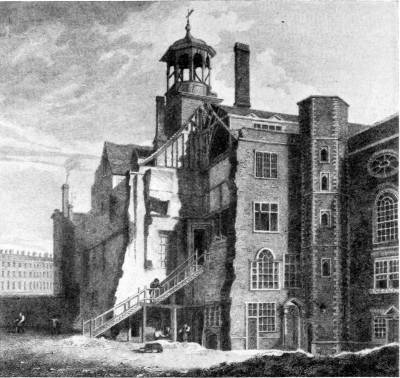
NORTH-WEST VIEW OF THE CHAPEL AND PART OF THE GREAT STAIRCASE LEADING TO THE HALL OF BRIDEWELL HOSPITAL, LONDON Londina Illustrata, published 1813 by Robert Wilkinson, No. 58 Cornhill.
The care of the sick, and especially of the helpless and incurable, is one of the first duties recognised by men when they begin to associate. Stow says that the hospital for leprous women at St. James’s existed from time immemorial. Leprosy is the most incurable of all diseases; it devours body and mind; it renders the unhappy victim helpless. The Lazar House, therefore, was very naturally founded before any other hospital. Those of London already mentioned were St. James’s on the site of the present Palace; and St. Giles’s, Holborn, founded by Matilda, Queen to Henry the First. To these were afterwards added, in the 20th year of Edward the Third, four Locks for lepers—viz. one in the Old Kent Road, one in the Mile End Road, one at Kingsland, and one at Knightsbridge; all, it will be observed, at a convenient distance from the city walls. In the reign of Edward the Fourth one William Pole, yeoman of the Crown, being afflicted with leprosy, founded a Hospital for lepers at Highgate. Three hundred years before this, King Stephen founded a Lazar House at Great Ilford in Essex, which still exists as an Almshouse.
APPENDICES
APPENDIX I LIST OF WARDS OF LONDON
3 Edward I
Nomina Wardarum, 1274Mod. Eng., 1897
Adrian, Joh’, Ward (see Walbrook)
Alv’nia, Anketili le Mercir de, Warda Farringdon Within and Without
Aunger’, Petr’, Warda Broad Street
Blakethorn’, Joh’is de Warda Aldersgate
Basing’, Thom’ de, Warda Candlewick
Bassieshagh, Warda de }
} Bassishaw
Blond, Rad’ le’ Ward }
Colemannestate, Warda de (see Meldeburn’)
Coventrie, Henr’ de, Warda Vintry
Douegate, Warda de Dowgate
Durham, Will’i de, Warda, alias Dinoll, Will’ de, Ward Bread Street
Edelmeton, Petri de, Warda Castle Baynard
Essexe, Wolmer’ de, Warda Billingsgate
Fabri, Rad’i, de Cornhill, Warda Lime Street
Fori, Warda Cheap
Frowyk’, Henr’ de, Warda Cripplegate, Within and Without
Hadestok, Symonis de, Warda Queenhithe
Hadestok, Will’i de, Warda Tower
Horn, Johannis, Warda Bridge Within
Langeburne, Warda de }
} Langbourn
Winton, Nich’ de, Ward }
Meldeburn’, Robert’ de, de Colemannestate, Warda }
} Coleman Street
Colemannestate, Warda de }
Norhampton, Joh’is de, Warda Aldgate
Portsok’ prioris de Cristesch’che extra Alegate Portsoken
Poter, Walter’ le, Warda Cornhill
Taillur, Ph’i le, Warda Bishopsgate
Walebrok’, Warda de }
} Walbrook
Adrian, Joh’, Ward }
Waleys, Henr’ le, Ward Cordwainer
Winton, Nich’ de, Ward (see Langbourn)
ROT. HUNDRED’, 3 ED. I Order of Wards
Warda Petr’ de Edelm’ton.
Ward Fory.
Warda Joh’ de Blacthorn.
Ward Rad’ Fabr’.
Ward Joh’ de North.
Ward Joh’ Horn.
Ward Will’ de Hadestok.
Ward Joh’ Adrian [also called Warda de Walebrok’].
Portsokne.
Ward Thom’ de Basing’.
Ward de Douegate.
Ward Wolmar’ de Essex’.
Ward Henr’ de Covent’e.
Ward Anketini.
Ward Peti Aug’.
Ward Rad’ le Blond [also called Warda de Bassieshagh].
Ward Nich’ de Winton [also called Warda de Langeburne].
Ward Henr’ de Frowik.
Ward Walt’ le Pater.
Ward Will’ de Dinoll [also called Warda Will’i de Durham].
Ward Ph’ le Taylur.
Ward Rob’ de Maldeburn’.
Ward Simon de Hadestok.
Ward Henr’ le Waleys.
Warda Petr’ Aunger’.
Portshokne Prior’ de Cristcherich’ Exa Alegate.
Warda Joh’is de Norhampton Lond’.
Warda Robert’ de Meldeburn’ de Colemannestate.
Warda Walter’ le Pater Lond’.
Warda Simon’ de Hadestok’ de Civitate Lond’.
Warda Will’i de Durham Lond’ [also called Ward Will’ de Dinoll].
Warda Wolmer’ de Essexe Lond’.
Warda Joh’is de Blakethorn’ Lond’.
Warda de Walebrok’ Lond’ [called also Ward Joh’ Adrian].
Warda de Langeburn’ Lond’ [called also Ward Nich’ de Winton].
Warda Anqetili le Mercir de Alv’nia Lond’.
Warda Thom’ de Basing’ Lond’.
Warda Fori.
Warda Henr’ de Covintroe Lond’.
Warda Ph’i le Taillur Lond’.
Warda de Bassieshagh [also called Ward Rad’ le Blond].
Warda Rad’i Fabri de Cornhull Lond’.
Warda de Dunegate Lond’.
Warda Henr’ le Walais Lond’.
Warda Henr’ de Frowyk’ Lond’.
Warda Will’i de Hadestok’.
Warda Joh’is Horn Lond’.
Warda Petri de Edelmeton Lond’.
APPENDIX II LIST OF ALDERMEN
(Supposed to be dated c. 1285-1286; from Calendar of Wills, Pt. i. p. 702)
The following is a copy of the earliest list of Aldermen of the City of London preserved among the records of the Corporation (Letter-Book A, fol. 116), together with the names of the wards they respectively represented. It is not dated, but there is good reason for conjecturing it to have been written circa 14 Edward the First [A.D. 1285-1286].
Nomina propria Wardarum Civitatis Londoniarum et nomina Aldermannorum
Warda Fori Stephanus Aswy
Warda de Lodgate et Neugate Willelmus de Farndon
Warda Castri Beynard Ricardus Aswy
Warda de Aldreidesgate Willelmus le Mazener
Warda de Bredstrate Anketinus de Betevile
Warda de Ripa regine Simon de Hadestok
Warda Vinetrie Johannes de Gisors
Warda de Douegate Gregorius de Rokesle
Warda de Walebrock Thomas Box
Warda de Colemanestrate Johannes filius Petri
Warda de Bassieshawe Radulphus le Blound
Warda de Crepelgate Henricus de Frowick
Warda de Candlewystrate Robertus de Basinge
Warda de Langeford Nicholaus de Wintonia
Warda de Cordewanerstrate Henricus le Waleys
Warda de Cornhull Martinus Box
Warda de Limstrate Robertus de Rokesle
Warda de Bissopesgate Philippus le Taylur
Warda de Alegate Johannes de Norhampton
Warda de Turri Willelmus de Hadestok
Warda de Billingesgate Wolmarus de Essex
Warda pontis Joceus le Achatur
Warda de Lodingeberi Robertus de Arras
Porsokne Prior Sancte Trinitatis de Alegate
On Tuesday next before the Feast of St. Botolph [17 June], anno 21 Edward I. [A.D. 1293], the chief men of every ward, in the presence of Sir John le Bretun, Warden of London, elected for themselves an Alderman, whom they presented to the said Warden, saying that whatsoever the Alderman so elected should, in conjunction with the Warden, determine upon for the government of the City and the keeping of the King’s peace, they would ratify and accept without challenge.
The following are the names of the Aldermen presented to the Warden by each ward on that occasion, being the next earliest list to the foregoing preserved among the Corporation Records (Letter-Book C, fol. vi.):—
Warda Fori []
Warda Ludgate et Neugate presentat Nicholaum de Farndon
Warda de Aldridesgate presentat Willelmum le Mazeliner
Warda de Crepelgate presentat Walterum de Finchingfed
Warda Castri presentat Ricardum Aswy
Warda Ripe Regine presentat Willelmum de Bettoyne
Warda de Bredstrate presentat Johannem le Blound
Warda de Cordewanerstrate presentat Henricum le Galeys
Warda de Douuegate presentat Johannem de Banquell
Warda de Walebrock presentat Johannem de Dunstaple
Warda de Candlewystrate presentat Robertum de Basinge
Warda de Langeburn presentat Adam de Rokesle
Warda de Bassieshawe presentat Radulphum le Blound
Warda de Cornhulle }
modo vocatur Bradestrate } presentat Martinum Box
Warda de Lotheberi presentat Thomam de Stanes
Warda de Bissoppesgate presentat Henricum le Bole
Warda Turris presentat Johannem de Cantuaria
Warda de Limstrate presentat Robertum de Rokele
Warda de Alegate presentat Willelmum de Hereford
Warda Porsokne presentat Priorem Sancte Trinitatis ☩ (sic)
Warda Vinetrie presentat Johannem de Gisors
Warda de Billingesgate presentat []
Warda Pontis London’ presentat Adam de Foleham
Warda de Colemannestrate presentat Eliam Russel.
APPENDIX III ALPHABETICAL LIST OF ALDERMEN WHOSE NAMES ARE AFFIXED TO DEEDS IN THE THIRTEENTH CENTURY
(From the Liber Trinitatis)
NAME.PARISH.DATE.
A Adrian All Saints’, Barking 1253
Richard Aswy St. Benet West 1290
Peter Armiger St. Matthew Outwych 1262
Peter Anger All Hallows, London Wall 1264
Rob. de Arraz St. Barth. the Less 1286
B Gervase Barne or Barum St. Mich. Aldgate 1223 or 1314
Adam Basing St. Pancras, Soper Lane 1257
Peter Blundus St. Olave by the Tower 1221-1248
Matthew Bukerel St. Edmund, Lombard Street 1270
Robert Blundus St. Clement, Candlewick 1221-1248
James Blunt St. Benet Fink 1221-1248
Stephen Bukerel St. Alban, Wood St. 1250
Andrew Bukerel St. Mary Aldermanbury (? 13th cent.)
C Gervase Cordewan, Cordwainer Holy Trinity 1237
Thos. Cros St. Andrew Hubbard 1293
Barth. de Capell St. Giles, Cripplegate 1270
Hugh Cabur St. Michael Bassishaw 1221
D Thos. de Durham All Saints’, Fenchurch (? 13th cent.)
Thomas de Dunton St. Clement, Candlewick St. 1221
E Edmund St. Andrew Undershaft 1147-1167
F Nicolas de Farndon St. Matthew, Friday St. 1302-1303
Alex. Ferrun St. Mary Woolchurch 1253-1255
Alex. le Fern St. John, Walbrook 1248-1291
Gilbert Fulk }
Fitz Fulk } St. Kath. Aldgate 1221-1248
Will. Fitz Bene’t St. Benet Sherehog 1221-1248
Thos. Fitz Thomas St. Mary Colech. 1220-1221
Josh. Fitz Peter St. Sepulchre 1221
Rich. Fitz Roger St. Bene’t Gracechurch 1221
Rich. Fitz Walter All Saints’, Coleman St. 1221-1248
(?) Gilbert Fitz Fiske All Saints’, Coleman St. 1221-1248
Martin Fitz Alice St. Mich., Paternoster 1218, 1219
Simon Fitz Mary St. John, Walbrook 1248
G Anketen de Gisors St. Kath., Aldgate 1313-1314
Geoffrey St. Michael, Cornhill 1170-1189
John De Gisors St. Michael, Paternoster 1266-1268
Stephen le Gras St. Bot., Aldgate 1221-1248
H Rob. Hardel St. Benet Fink 1251
John Hanin (sub Alderman) ... 1230
Will de Hadstock All Hall. Staining 1277-1278
Henry de St. Helen St. Botolph, Bishopsgate 1187-1221
Will. de Hereford St. Olave by the Tower 1285
Herbert St. Olave by the Tower 1221-1248
Will. de Haverhill St. Alban, Wood St. 1203
J Jermes St. Martin Orgar 1182-1221
Joce Junier St. Mary Abchurch 1221-1248
L Lumigus All Saints’, Barking 1189-1221
Walter de Lisle St. Martin, Outwich ? Henry III
M Mathew St. Dunstan’s East 1182-1221
N John de Northampton St. Mary Axe 1260-1264
P Walter Poter St. Michael, Cornhill 1271-1272
R Rich. Renger St. Margaret Brides 1223-1226
Gregory de Rokesley St. Michael, Paternoster 1275
S John Sperling St. Leonard, Eastcheap 1221-1248
Ralph Sperling St. Leonard, Eastcheap 1243
T Michael Tovy St. Benet Fink 1251-1252
Thomas Tidmar St. Mary, Abchurch 1269
Arnold Tidmar St. Edmund, Gracech. St. 1269
V John Vyel St. Nicholas, Cole Abbey 1221-1248
Sir John Vital St. Nicholas, Cole Abbey 1221-1248
W Nicholas de Wynton St. Edmund, Lombard St. 1225
Geoffrey de Wynton St. Martin, Orgar 1258
Thomas de Wimburne St. Botolph, Aldgate 1256-1257
Rich. de Walbroke St. Michael, Bassishaw 1262-1263
APPENDIX IV LIST OF PARISHES
Allhallows Barking, Great Tower Street.
All Hallows, Bread Street (no church), united with St. Mary-le-Bow.
Allhallows, Great and Less, Upper Thames Street.
All Hallows, Honey Lane (no church), united with St. Mary-le-Bow.
Allhallows, Lombard Street.
Allhallows, London Wall.
Allhallows Staining (no church), united with St. Olave, Hart Street.
Christ Church, Newgate Street, with St. Leonard, Foster Lane.
Holy Trinity the Less, united with St. James, Garlickhithe.
St. Alban, Wood Street, with St. Olave, Silver Street.
St. Alphage, London Wall.
St. Andrew Hubbard (no church), united with St. Mary-at-Hill.
St. Andrew Undershaft, St. Mary Axe.
St. Andrew by the Wardrobe, St. Andrew’s Hill, Queen Victoria Street, with St. Anne, Blackfriars.
St. Anne, Blackfriars, united with St. Andrew by the Wardrobe.
St. Anne and St. Agnes, Gresham Street, with St. John Zachary.
St. Antholin, united with St. Mary Aldermary.
St. Augustine, otherwise Austin, Old Change, with St. Faith-under-St.-Paul’s.
St. Bartholomew, Exchange, united with St. Margaret, Lothbury.
St. Bartholomew the Great, West Smithfield.
St. Bartholomew-the-Less, St. Bartholomew’s Hospital.
St. Bartholomew, Moor Lane.
St. Benet Fink, united with St. Peter-le-Poor, Old Broad Street.
St. Benet, Gracechurch Street (no church), united with Allhallows, Lombard Street.
St. Benet, Paul’s Wharf, Upper Thames Street, with St. Peter, Paul’s Wharf, united with St. Nicholas Cole Abbey.
St. Benet Sherehog, united with St. Stephen, Walbrook.
St. Botolph, Aldgate.
St. Botolph, Billingsgate, united with St. George, Botolph Lane.
St. Botolph without, Aldersgate Street.
St. Botolph without, Bishopsgate, Bishopsgate Street without.
St. Bridget, otherwise St. Bride, Fleet Street.
St. Christopher-le-Stock, united with St. Margaret, Lothbury.
St. Clement, Eastcheap, with St. Martin Orgar.
St. Dionis Backchurch, Fenchurch Street, united with Allhallows, Lombard Street, St. Benet, Gracechurch Street, and St. Leonard, Eastcheap.
St. Dunstan in the East, St. Dunstan’s Hill, Gt. Tower Street.
St. Dunstan in the West, Fleet Street.
St. Edmund the King and Martyr with St. Nicholas Acon, Lombard Street.
St. Ethelburga, Bishopsgate Street within.
St. Faith-under-St. Paul’s, united with St. Augustine, Old Change.
St. Gabriel, Fenchurch, united with St. Margaret Pattens.
St. George, Botolph Lane, with St. Botolph, Billingsgate.
St. Giles without, Cripplegate, Fore Street.
St. Gregory by St. Paul, united with St. Mary Magdalen, Old Fish Street, and St. Martin, Ludgate.
St. Helen, Great St. Helens, with St. Martin Outwich.
St. James, Aldgate, united with St. Katherine Cree, Leadenhall Street.
St. James, Garlickhithe, with St. Michael, Queenhithe, and Holy Trinity the Less.
St. John the Baptist, upon Walbrook, united with St. Mary, Aldermary.
St. John the Evangelist (no church), united with St. Mary-le-Bow, Cheapside.
St. John Zachary, united with St. Anne and St. Agnes.
St. Katherine Coleman, Fenchurch Street.
St. Katherine Cree, Leadenhall Street, with St. James, Aldgate.
St. Laurence Pountney, united with St. Mary, Abchurch.
St. Lawrence Jewry, Gresham Street, with St. Mary Magdalen, Milk Street.
St. Leonard, Eastcheap, united with Allhallows, Lombard Street.
St. Leonard, Foster Lane (no church), united with Christ Church, Newgate Street. St. Magnus the Martyr, Lower Thames Street, with
St. Margaret, New Fish Street, and St. Michael, Crooked Lane.
St. Margaret, Lothbury, with St. Christopher-le-Stock; St. Bartholomew by Exchange; St. Olave, Old Jewry; St. Martin, Pomeroy; St. Mildred the Virgin, Poultry, and St. Mary Colechurch.
St. Margaret Moses, united with St. Mildred, Bread Street.
St. Margaret, New Fish Street, united with St. Magnus the Martyr, Lower Thames Street.
St. Margaret Pattens, Rood Lane, with St. Gabriel, Fenchurch.
St. Martin, Ludgate, united with St. Mary Magdalen, Old Fish Street, and St. Gregory by St. Paul.
St. Martin Orgar, united with St. Clement, Eastcheap.
St. Martin Outwich, united with St. Helen, Great St. Helen’s.
St. Martin Pomeroy, united with St. Margaret, Lothbury.
St. Martin Vintry, united with St. Michael, Paternoster Royal.
St. Mary Abchurch, Abchurch Lane, with St. Laurence Pountney.
St. Mary Aldermary, Bow Lane, with St. Antholin, St. John the Baptist, and St. Thomas Apostle.
St. Mary-at-Hill, Eastcheap, with St. Andrew Hubbard.
St. Mary Bothaw, united with St. Swithin, London Stone, Cannon Street.
St. Mary Colechurch, united with St. Margaret Lothbury.
St. Mary-le-Bow, Cheapside, with St. Pancras, Soper Lane, All Hallows, Honey Lane, All Hallows, Bread Street, and St. John the Evangelist.
St. Mary Magdalen with St. Gregory by St. Paul and St. Martin, Ludgate.
St. Mary Magdalen, Milk Street, united with St. Laurence Jewry.
St. Mary Mounthaw and St. Mary Somerset, united with St. Nicholas Cole Abbey.
St. Mary Staining, united with St Michael, Wood Street.
St. Mary the Virgin, Aldermanbury.
St. Mary Woolnoth and St. Mary Woolchurch Haw united, Lombard Street.
St. Matthew, Friday Street, with St. Peter, Westcheap, united with St. Vedast, Foster Lane.
St. Michael Bassishaw, Basinghall Street.
St. Michael, Cornhill.
St. Michael, Crooked Lane, united with St. Magnus the Martyr, London Bridge.
St. Michael, Paternoster Royal, and St. Martin Vintry, College Hill, with Allhallows, Great and Less.
St. Michael, Queenhithe, Upper Thames Street, united with St. James, Garlickhithe.
St. Michael le Querne, united with St. Vedast, Foster Lane.
St. Mildred, Bread Street, with St. Margaret Moses.
St. Mildred the Virgin, Poultry, united with St. Margaret, Lothbury.
St. Nicholas Acon, united with St. Edmund the King and Martyr.
St. Nicholas Cole Abbey and St. Nicholas Olave (united), Queen Victoria Street, with St. Mary Somerset; St. Mary Mounthaw; St. Benet, Paul’s Wharf, and St. Peter, Paul’s Wharf.
St. Olave, Hart Street, with All Hallows Staining.
St. Olave, Old Jewry, united with St. Margaret, Lothbury.
St. Olave, Silver Street, united with St. Alban, Wood Street.
St. Pancras, Soper Lane (no church), united with St. Mary-le-Bow.
St. Peter, Cornhill.
St. Peter, Paul’s Wharf, with St. Benet, Paul’s Wharf, united with St. Nicholas Cole Abbey, etc.
St. Peter-le-Poor, Old Broad Street, with St. Benet Fink.
St. Peter ad Vincula.
St. Peter, Westcheap, united with St. Vedast, Foster Lane.
St. Sepulchre, Holborn Viaduct.
St. Stephen, Coleman Street.
St. Stephen, Walbrook, with St. Benet Sherehog.
St. Swithin, London Stone, Cannon Street, with St. Mary Bothaw.
St. Thomas Apostle (no church), united with St. Mary Aldermary.
St. Vedast, alias Foster, Foster Lane, with St. Michael le Querne, St. Matthew, Friday Street, and St. Peter, Westcheap.
Whitefriars (Precinct of), united with Holy Trinity, Great New Street.
The following names of city benefices are taken from the Liber Custumarum, pp. 228-230 (Riley, 1859):—
[Nomina Beneficiorum Londoniarum]
Sancti Andreae super Cornhulle—Sancti Andreae de Holebourne—Sancti Andreae de Castro Baynardi—Sancti Andreae Hubert—Sancti Antonii—Sancti Augustini ad Portam—Sancti Augustini Papay—Sancti Alphegi—Sancti Audoeni—Sancti Albani—Sancti Athelburgae—Sanctae Agnetis—Sancti Botulphi extra Bisschopesgate—Sancti Botulphi apud Billinggesgate—Sancti Botulphi de Alegate—Sancti Botulphi de Aldresgate—Sancti Benedicti ad Ripam Sancti Pauli—Sancti Benedicti de Garschirche—Sancti Benedicti Finke—Sancti Benedicti Schorhogge—Sancti Bartholomaei Parvi—Sanctae Brigidae—Sanctus Bartholomaeus Magnus de Smethefelde—Capella Beati Thomae Martyris super Pontem—Sancti Clementis de Estchepe—Capella Episcopi juxta Sanctum Paulum—Capellanus Domini Archidiaconi—Sancti Dunstani de Weste—Sancti Dunstani apud Turrim—Sancti Dionysii—Duo Capellani in Ecclesia Sancti Pauli—Sancti Egidii extra Crepelgate—Sancti Edmundi de Graschirche—Sanctae Fidis in Cryptis Sancti Pauli—Sancti Gregorii juxta Sanctum Paulum—Sancti Georgii de Estchepe—Sanctae Helenae—Hospitalis Beatae Mariae extra Bisschopesgate—Sancti Johannis Zakariae—Sancti Jacobi de Garlechethe—Sancti Johannis de Walebroke—Sanctae Katerinae Trinitatis—Sancti Laurentii in Candelwikstrete—Sancti Leonardi in Venella Sancti Vedasti—Sancti Laurentii in Judaismo—Sancti Leonardi de Estchepe—Sancti Leonardi de Schordiche—Sancti Michaelis in Foro ad Bladum—Sancti Michaelis ad Ripam Reginae—Sancti Michaelis de Woudestrete—Sancti Michaelis de Bassieshawe—Sancti Michaelis de Cornhulle—Sancti Michaelis de Crokedelane—Sancti Michaelis de Paternosterchirche—Sancti Mariae de Aldermannebiri—Sanctae Mariae Wolnothe—Sanctae Mariae de Ax—Sanctae Mariae de Abbechirche—Sanctae Mariae de Wolchirchawe—Sanctae Mariae de Somersete—Sanctae Mariae de Montenhaut—Sanctae Mariae de Stanninglane—Sanctae Mariae de Colchirche.—Sanctae Mariae atte Hille—Sanctae Mariae de Arcubus—Sanctae Mariae de Eldemariechirche—Sanctae Mariae de Bothawe—Sanctae Mariae de Iseldone—Sanctae Mariae Magdalenae de Veteri Piscaria—Sanctae Margaretae ad Pontem—Sanctae Margaretae de Lodebiri—Sanctae Margaretae Patines—Sanctae Margaretae Moysy de Fridaystrete—Sancta Mildreda in Poletria, cum Capella de Conehop—Sancta Mildreda in Bredstrate—Sancti Martini Orgar in Candelwikstrete—Sancti Martini de Ludgate—Sancti Martini in Vinetria—Sancti Martini de Pomerio—Sancti Martini Otheswike—Sancti Matthaei in Fridaystrete—Sancti Magni ad Pontem—Sancti Michaelis extra Sanctae Trinitatis—Sancti Nicholai Aldrethegate ad Macellas—Sancti Nicholai Coldabbey—Sancti Nicholai Hacoun—Sancti Nicholai Olof—Novum Templum—Ecclesia Omnium Sanctorum de Fenchirche—Omnium Sanctorum de Colmannechirche—Omnium Sanctorum de Berkyngchirche—Omnium Sanctorum de Honylane—Omnium Sanctorum ad Fenum—Omnium Sanctorum super Cellarium—Omnium Sanctorum de Bredstrete—Omnium Sanctorum de Garschirche—Omnium Sanctorum de Staningchirche—Sancti Olavi in Judaeismo—Sancti Olavi juxta Turrim—Sancti Olavi de Mocwelle—Omnium Sanctorum ad Murum—Sancti Petri de Bredstrete—Sancti Petri supra Tamisiam—Sancti Petri de Cornhulle—Sancti Petri in Foro de Westchep de Wodestrete—Sancti Pancratii—Sancti Stephani de Colemannestrete—Sancti Swithini—Sancti Sepulchri—Sacrista Sancti Pauli—Servientes Capituli—Sancti Thomae Apostoli—Sanctae Trinitatis Parvae—Sancti Vedasti—Sanctae Wereburgae—Sancti Christophori.
APPENDIX V PATRONAGE OF CITY CHURCHES
The patronage of the London Churches in the thirteenth and fourteenth centuries is given by the Chronicler called Arnold.
The Dean and Chapter of St. Paul’s had nineteen London benefices in their gift. The Archbishop of Canterbury had seven.
The Prior of Holy Trinity, six.
The Dean of St. Martin’s-le-Grand }
The Bishop of London }
The Prior of St. Mary Overy } five each.
The Abbot of Westminster }
The Prioress of St. Helen’s }
The King }
The Abbot of Bermondsey } four.
The Prior of Christ Church, Canterbury }
The Master of Lawrence Pountney }
The Abbot of Barking } two.
The Abbot of Tower Hill }
The Prior of St. Bartholomew’s }
The Mayor and Aldermen } two.
The Prior of Botley, Suffolk }
The Bishop of Exeter, one.
The Bishop of Hereford, one.
The Bishop of Worcester, one.
The Abbot of Alnwick, one.
The Abbot of Evesham, one.
The Abbot of Gloucester, one.
The Abbot of Colchester, one.
The Abbot of Malmesbury, one.
The Abbot of Winchester, one.
The Abbot of White Monks, one.
The Prior of the Augustine Friars, one.
The Prioress of Clerkenwell, one.
The Prior of Elsyng Spital, one.
The Master of St. Anthony, one.
The Provost of Eton, one.
The Master of St. Thomas Acon, one.
The Master of Balliol College, Oxford, one.
The Archdeacon of London, one.
The Duke of Suffolk, one.
The Earl of Shrewsbury, one.
Gwins’ Company, one.
Mercers’ Company, one.
Merchant Taylors’ Company, one.
Mr. Page of Dartford, one.
APPENDIX VI
The “Glossarial Index of Festivals,” published in the Liber Custumarum, will throw light upon the religious life of London. The alphabetical table is followed by a yearly table for convenience.
Adventus Domini. The Advent of Our Lord; the four weeks preceding Christmas, devoted by the Church to preparation for the Advent of Christ.
Almes. The Feast of All Souls, 2nd November.
Andreae Apostoli, Festum Sancti. The Feast of Saint Andrew, the Apostle, 30th November.
Ascensio Domini. The Ascension of Our Lord. A movable Festival held on Thursday in Rogation Week, the week next but one before Pentecost, or Whitsun, Week.
Barnabae Apostoli, Festum Sancti. The Feast of Saint Barnabas, the Apostle, 11th June.
Bartholomaei Apostoli, Festum Sancti. The Feast of Saint Bartholomew, the Apostle, 24th August.
Benedicti, Translatio Sancti. The Translation of Saint Benedict, 11th July.
Carnilevaria. The last day of the Carnival, or season preceding Lent. Shrove Tuesday.
Carniprivium. The beginning of Lent.
Chaundelour, Chaundeloure, Chaundelure. Candlemas; the Purification of the Virgin Mary, 2nd February. See Mariae, Purificatio Sanctae.
Circumcisionis Domini Festum. The Feast of the Circumcision of Our Lord, 1st January.
Clausum Paschae. The Close of Easter, or Sunday after Easter.
Clementis, Festum Sancti. The Feast of Saint Clement, 23rd November.
Crucis Sanctae Exaltatio. The Exaltation of the Holy Cross, 14th September. This Feast commemorated the raising of the Cross on which Our Saviour suffered, after its Invention, or Discovery, by Saint Helena, A.D. 307 or 325.
Dies Sabbati. The Sabbath day, Saturday.
Dunstani, Festum Sancti. The Feast of Saint Dunstan, 19th May.
Edmond, le jour Seint; Edmundi Regis, Festum Sancti. The Feast of Saint Edmund, the King, 20th November.
Edwardi Regis et Confessoris, Translatio Sancti. The Translation of Saint Edward, King and Confessor, 13th October.
Epiphania Domini. The Epiphany, or Manifestation, of Our Lord, 6th January. See Tiphayne.
Gregorii Papae, Festum (Dies) Sancti. The Feast of Saint Gregory, the Pope, 12th March.
Hillarie, la Sent; Hillere, la Seint; Hillarii, Festum Sancti. The Feast of Saint Hillary, 13th January.
Hippolyti Martyris, Natale Sancti. The Nativity of Saint Hippolytus, the Martyr, 13th and 22nd August; there having been two Martyrs of this name.
Indictio. A given year of the Indiction; so called from the Edicts of the Roman Emperors; for as one such Edict was supposed to appear every fifteen years, the years were reckoned by their distance from the last Indiction. This mode of reckoning was employed, at Rome more particularly, from the time of the Nicene Council (A.D. 325), but was introduced into England so early as the time of King Edgar.
Innocentium Dies (Festum) Sanctorum. The Feast of the Holy Innocents, Childermas Day, 28th December.
Jacobi Apostoli, Festum Sancti. The Feast of Saint James, the Apostle, 25th July.
Johan, la Feste Seint: Johannis Baptistae Nativitas. The Nativity of Saint John the Baptist, Saint John’s day, 24th June.
Johannis Baptistae, Decollatio Sancti. The Decollation of Saint John, the Baptist, 29th August.
Kalendarum Maii Caput. The beginning (or 18th) of the Calends of May, 14th April.
Lucae Evangelistae Festum; Lucie, la Feste Seinte. The Feast of Saint Luke, the Evangelist; 18th October according to the Romish Calendar, 13th October according to that of Carthage.
Marci Evangelistae, Festum Sancti. The Feast of Saint Mark, the Evangelist, 25th April.
Margaretae, Festum Sanctae. The Feast of Saint Margaret, 20th July.
Mariae, Festum Sanctae. The Feast (of the Nativity) of Saint Mary, 8th September.
Mariae, Festum Annuntiationis Beatae. The Feast of the Annunciation of the Blessed Mary, Lady Day, 25th March. See Nostre Dame.
Mariae, Purificatio Sanctae (or Beatae). The Purification of Saint Mary, or Candlemas, 2nd February. See Chaundelour.
Mariae Virginis, Festum Assumptionis Beatae. The Feast of the Assumption, or ascent into heaven, of the Blessed Virgin Mary, 15th August.
Mariae Magdalene, Festum Sanctae (or Beatae). The Feast of Saint Mary Magdalene, 22nd July.
Martin, la Feste Seint; Martini, Festum Sancti. The Feast of Saint Martin, or Martinmas, 11th November.
Matthiae Apostoli, Festum Sancti. The Feast of Saint Matthias, the Apostle, 24th February.
Michaelis, Festum Sancti. The Feast of Saint Michael, or Michaelmas, 29th September (passim).
Michel, les Utaves de Seint. The Octaves of Saint Michael; one week after Michaelmas. See Octabae.
Natale Domini. The Nativity of Our Lord, Christmas Day, 25th December.
Nostre Dame (Daume) en Quarenne. (The Feast of) Our Lady in Lent; Lady Day, or the Feast of the Annunciation. See Mariae, Festum Annuntiationis.
Nowel. Christmas.
Octabae. The Octave, or Octaves. The eighth day after a festival inclusively, in other words, that day week. The celebration of the Octave is said to have arisen in the fact that the early Christians celebrated their festivals for eight days, but made the last of those days the one of greatest solemnity, on the authority of Leviticus, xxiii. 36. Octabas was the A.S. name for the Octave.
Omnium Sanctorum Festum. The Feast of All Saints, or All-Hallows, 1st November.
Pasche; Pasqe. Easter.
Passionis Festum. The Feast of the Passion. The period between the fifth Sunday in Lent and Easter Sunday. Since the Reformation, the term “Passion Week” has been applied solely to the last week in Lent.
Pauli, Conversio Sancti. The Conversion of Saint Paul, 25th January.
Pentecoste; Pentecouste. Pentecost, or Whitsuntide.
Perpetuae et Felicitatis, Festum Sanctarum. The Feast of Saints Perpetua and Felicitas, 7th March. These Saints are said to have suffered martyrdom in the reign of the Emperor Valerian.
Petri ad Vincula, Festum Sancti. The Feast of Saint Peter’s Chains, or Saint Peter in Prison, 1st August.
Petri in Cathedra, Festum Sancti. The Feast of Saint Peter’s Chair; in commemoration of his founding the Cathedra, or Church, of Antioch, 22nd February.
Petri et Pauli, Festum Apostolorum. The Feast of the Apostles Peter and Paul, 29th June.
Philippi et Jacobi, Festum Apostolorum. The Feast of the Apostles Philip and James, 1st May.
Quadragesima; Quareme. Quadragesima, or Lent, the Fast of forty days before Easter.
Ramis Palmarum, Dominica in. Palm Sunday, the First Sunday before Easter.
Simonis et Judae, Festum Apostolorum. The Feast of the Apostles Simon and Jude, 28th October.
Swithini, Dies Sancti. The day (of the Deposition) of Saint Swithun, or Swithin, 2nd July.
Swithini, Translatio Beati; Swythan, la Feste Seint. The Feast of the Translation of Saint Swithin, 15th July.
Symonis et Judae, Festum Apostolorum. See Simonis et Judae, Festum.
Thomae Apostoli, Festum Sancti. The Feast of Saint Thomas, the Apostle, 21st December.
Thomae Martyris, Festum Beati; Thomae Martyris, Translatio Sancti. The Translation of Saint Thomas, the Martyr, 7th July. The Passion of Saint Thomas of Canterbury was 29th December; it is not clear whether, in the first instance, that or his Translation is meant.
Tiphayne. The Epiphany, 16th January; a corruption of Theophania, the Manifestation of God. But in the Greek Church the words θεοφάνεια and ἐπιφάνεια were used as synonymous expressions for the day of Our Saviour’s Nativity. See Suicer’s Thesaurus, i. p. 1200, and Hampson’s Med. Ævi Kalendar ii. s.vv. Epiphania and Theophania.
Trinitatis, Festum Sanctae; Trinite, Feste de la; Jour de la. The Feast of the Trinity, the Sunday after Pentecost, or Whitsuntide.
Trinitatis Sanctae Octabae. The Octave of the Holy Trinity; the Sunday after Trinity Sunday.
Valentini, Festum Sancti. The Feast of Saint Valentine. Probably that celebrated on the 14th February; but there were other festivals in honour of persons of this name, 16th April, 16th July, 13th November, and 9th and 16th December.
Vincentii Martyris, Festum Sancti. The Feast of Saint Vincent, the Martyr, 22nd January.
(Liber Custumarum, Riley, vol. ii. pt. ii. pp. 841-844.)
Jan. 1. Circumcision.
„ 13. St. Hilary.
„ 16. Epiphany.
„ 22. St. Vincent.
„ 25. Conversion of St. Paul.
Feb. 2. Candlemas. Purification of the B. V. M.
„ 14. St. Valentine.
„ 22. Petri in Cathedra Festum.
„ 24. St. Matthias.
Feb. or Mar. Shrove Tuesday and Carniprivium.
Mar. 7. St. Perpetua and Felicitas.
„ 12. St. Gregory.
„ 25. Annunciation.
„ 25. Annunciation.
Mar. or April. Easter. Sunday after Easter (Clausum Paschae).
Apr. 25. St. Mark.
May 1. St. Philip and James.
„ 19. St. Dunstan.
„ 19. St. Dunstan.
May or June. Ascension Day. Whitsun Week. Trinity Sunday.
June 11. St. Barnabas.
„ 24. St. John Baptist.
„ 29. SS. Peter and Paul.
July 2. St. Swithin.
„ 7. St. Thomas Martyr.
„ 11. St. Benedict.
„ 15. Translation of St. Swithin.
„ 22. St. Mary Magdalene.
„ 22. St. Margaret.
„ 25. St. James the Apostle.
Aug. 1. St. Peter at Vincula.
„ 13, 22. St. Hippolyte.
„ 15. Assumption of B. V. M.
„ 24. St. Bartholomew.
„ 29. Beheading of St. John Baptist.
Sept. 8. Nativity of B. V. M.
„ 14. Exaltation of the Cross.
„ 29. St. Michael.
Oct. 13. Translation of Edward the Confessor.
„ 18. St. Luke.
„ 28. SS. Simon and Jude.
Nov. 1. Allhallows.
„ 11. St. Martin.
„ 20. St. Edmund.
„ 23. St. Clement.
Dec. 21. St. Thomas.
„ 25. Christmas Day.
„ 28. Childermas.
APPENDIX VII AN ANCHORITE’S CELL22
“Soon after the present work was begun a strange hole was discovered in the chancel wall, just at the turn of the apse on the north side. It is about 4 feet high and 20 inches wide. There is no stonework. A roughly rectangular hole has been broken through the flint wall, and the sides of it plastered to something like a smooth face. There is no provision for or mark of a door. And it was difficult to assign any reason for the making of the hole. Yet it was certain that some reason for it had been. Rough as it is, there is enough care bestowed on its making to show that it was not one of the openings sometimes left in the walls of buildings for the convenience of bringing things in during their construction, and blocked up when done with. Besides, it is too small for such a use. It was suggested that it may have been made to bring in a coffin at some funeral. But it is too small for that also: and it needs to be shown why men should have broken through the wall to bring in a coffin when it was much easier to bring it in by a door. Then it was guessed that it might belong to some extinct stove for warming the church; but neither the position nor anything in the form of the hole seemed likely for that use. It is too small to have been the entrance to a vestry, though the position is a proper one; and certainly there must have been a door had that been its purpose. Yet if the hole had ever more than a temporary use, it must have led to some chamber outside, for the church could not have been used if it were open to the weather.
Some further light was thrown on the place a few months ago when a coating of modern cement was stripped off the outside of the wall. Then was found a second hole about the same size as the first, but cut only part way through the wall. It is plastered inside with clay, and was filled up with flints and clay. Rather above these holes, and east and west of them respectively, are two smaller ones, such as may have received the ends of timbers. These also were found stopped with clay. The annexed illustration explains the work better than any description.
It seems that a little wooden hut has been built at some time against the wall of the church. The smaller holes give its length from east to west—about eight feet inside—and perhaps also its greatest height, about six feet. But this last and the width from north to south are uncertain, for there is nothing to show what was the shape of the roof, and if there were ever any foundations they are not to be found now. The walls were probably of stud and clay daubing, and the roof thatch.
The place can hardly have been other than an anker’s den. And it must surely have been one of the least commodious. It is remarkable that so few such have been identified, for the numbers of ankers in England must at one time have been considerable. There is a good deal about them in the second volume of the new edition of Mr. Bloxam’s Gothic Architecture, and Mr. Bloxam would assign to ankers most of the habitable chambers attached to churches, over vestries and porches and elsewhere. Very likely some such were used by ankers of the easier sort: but I think more were occupied by secular clerks and chaplains, and the anker’s place was a hut built outside against the wall, under the eaves of the church, as is said in the thirteenth-century Ancren Riwle, which tells us more about ankers than any other book I know of.
A cell was so placed that the anker need not leave it, either for worship or for any other reason. There was a window opening through which he might join in the worship at the altar, and at times receive the sacrament. And there was another window or hatch to the outside through which necessaries might be received and conversation held with visitors or servants. A window or squint is often found from a chamber over a vestry towards the high altar, and there is sometimes one from a porch chamber: but being on upper floors they could not well have the other window, so I take most of them not to have been ankerholds. Though as the degree of strictness varied much and seems for the most part to have been fixed only by the anker himself, it is possible that some may have been so used. The anker of the strictest sort was inclusus—permanently shut up in his cell which he entered with the license and blessing of the bishop. Such an one could scarcely have inhabited an upper chamber. Whether our Bengeo Anker was inclusus or not is uncertain. The entrance to his cell had no door, but it may have been blocked, and a squint or loop towards the altar formed the blocking. If it were open a curtain must have been hung across it, perhaps a black cloth with a white cross like that ordered in the Riwle to be put to the ‘parlour’ window.
The recess in the church wall west of the doorway is the anker’s seat and perhaps his sleeping place. And his bones may lie below: for it seems to have been a custom for ankers to prepare their own graves within their cells.”
APPENDIX VIII THE MONASTIC HOUSES
List of Religious Houses and Parish Churches
The religious Houses and Churches of the City and its suburbs which existed in the fifteenth century are enumerated in Arnold’s Chronicle. Arnold, who lived and wrote towards the end of the fifteenth century, belongs to Mediæval London, which Stow, of a hundred years later, certainly did not. We shall adopt, therefore, from Arnold’s list, as a guide to this survey of Mediæval London, the Churches and ecclesiastical foundations which he considers as especially belonging to London. His own spelling is followed here.
Seint Martin’s Graunte
Cryst Chirche
The Chartur hous
Elsyngspitel
Seynt Barthū Priory
Seynt Barthū Spitel
Seynt Thom̄s of Acres
Seint Antonis
Seynt Johēs in Smythfeld
Clerkenwell Nonry
Halywelle Nonry
Barmondsay Abbey
Seint Mary Ouery Priory
Seint Thom̄s Spitel
Saint Giles in the Felde
Seynt Helen’s Nonry
Seynt Mary Spitel
Seynt Mary at Beethelem
The Menures Nonry
Seynt Anne at the Tourhil
Seynt Katerins
The Crouched Fryers
The Friers Augustines
The Fryours Mynors
The Fryours P’chars
Seynt James in the Wall
The Whit Fryers
Seint Peter at Westm̄ Abbey
Seynt James in the Temple
Seynt Stephenys at Westminster
Seint Thom̄s Chapel of the Bridge
Seynt James in the Fields
Seynte Mary Magdalene Yeldhall
Seynt Mary Rouncyuale
Seynt Ursula chapel in the Poultry
APPENDIX IX A DOMINICAN HOUSE
The following Notes are from the Archæolog. Journal:—
“The traditions of the Dominican order required that the buildings should be arranged quadrilaterally, enclosing a plot of ground which formed the cloistral cemetery for the deceased of the community, one side being occupied by the church; but no fixed rule was adopted for the distribution of the offices. This is apparent from the plans of several of the English priories founded within the same period of twenty years. At Gloucester, Bristol, and Stamford, the church formed the north side of the quadrangle, whilst at Norwich and Canterbury it was on the south, and at Newcastle-on-Tyne it was on the east, being probably regulated by the conveniences of the localities; and even orientation was not uniformly preserved. The culinary offices at Gloucester were evidently on the south, whilst at Canterbury they stood on the west.
The early Dominican churches were exceeding simple in arrangement and severe in details. A good example of them existed at Canterbury where the choir, nave, and two aisles were all included under one long unbroken roof, and a porch at the west end afforded entrance to the congregation. The church at Gloucester, consisting of choir, nave, north chapel or transept, and north aisle, being rebuilt about the beginning of the sixteenth century, departed somewhat from this plan, inasmuch as the chapel was covered with a distinct transverse roof. It occupied only about three-fourths of the side of the quadrangle, the rest being completed by monastic buildings. In the church were three altars; the steeple with two bells and the aisle have disappeared.
The rest of the buildings which complete the quadrangle, about 73 feet square, are doubtless the original structures of the thirteenth century. The dormitory forming the second storey of the south side, with its exterior stairs, is still perfect, even to the stone partitions of the separate cells. On the ground floor was probably the refectory. The triplet window in the south gable of the west building is deserving of notice. But the interiors of all these buildings have been so much changed and adapted for modern requirements, that it is difficult to ascertain their monastic destinations. The cellaring is extensive, but presents little worthy of remark.”
BLACKFRIARS PRIORY
(Survey made ante 1552)
[A Document of the Loseley MSS. at Loseley Hall, Guildford]
Blakfryer Survey.23
Sm̃⁓xlvi li vjs viijd vlt̃ . xiij li vjs. xiijd. de redditibz woodman & vlt̃ xx li de redd Saunders in toto⁓lxxix li. xiijs. iiijd.
Itm A gallery oũ24 the water cominge owt of the townedyche at Holborne runynge into the temys abuttynge vpon the highe waye leadinge from brydwell to the watersyd on the west syd and vpon the tenemente of James la forheye on the est syd conteyninge that waye in lengethe xlij fote and abuttinge vpon A payre of stayers and waye leadinge from the blackfryers to bryd well oư25 the seid diche on the northe syde and vpon the seide dyche runynge in to the temys on ye sothe syde conteyninge in breddethe that wage xiiij fote.
Itm James la fforher broderer holdeth one tenemente abutinge vpon the seid highe waye on the northe parte & vpon A garden therto adioyninge vpon the sothe syde conteyninge in bredethe that waye xiiij fote and abutt vpon the aforseide gallery on the weste syd and vpon the tenemente of John Taylor on the est syd conteynynge in length that waye xxxj fote wt A garden adioyninge to the same tenemente on the northe syd and upon A garden And howse of ... 26 More or Creswell on the sothe syd conteynunge that waye at the west end abuttinge vpon the seide dyche xxiiij fote and at the est end abuttinge vpon the garden of the seide tenement of John Taylor xxxj foote and in lenge from the east ende to the weste end on the sowthe syde xxix ffoote and on the northe syd xxxj ffoote payinge therefore by year ... lxvjs. viijd.
John Taylor Carpenter holdeth a tenemente Abuttinge vpon the tenemente of James la fforheys on the weste syde and vpon the tenemente of Robt Damanye on the easte syde conteyninge that waye in lengthe xxx ffote and upon A garden thereto belonginge on the sowthe syde and vpon the seid highewaye on the northe syd conteyninge in breddethe that waye xiiij foote wt A garden to the seid tenemente adioyninge on the northe syd and upon A garden of ... Mr. Creswells on the sowthe syd conteyninge in breddethe that waye att the weste ende xxxj fote and at the eeste ende xlv ffoote & abuttinge v[p]on the garden of the tenemente of James la fforhaye on the west syde & vpon the garden of the tenement of Robt Damany on the este syd cont̃ in breddethe yt waye at the northe end xxx ffoot and at the sowthe ende xxx ffoote payinge ... lxvjs. xiijd.
Robt Damany bokebynder holdethe A tenemente abutt on the seid highwaye on the northe syde Conteynynge in lengethe xxiiij foote and vpon A garden to the same belonginge on the sothe syde Conteyninge in lengethe xvij ffote and on the weste syd vpon the seide highe waye vidz27 from the highwaye to the tenement28 of John Tayler x foote and upon the seide tenemente of John tayler xiiij ffoo beinge in the hole breddethe at that the weste ende xxiiij foote and abuttynge on the este syde vpon A tenemente in the tenure of Maryan Turner in breddethe xiiij ffoote and vpon the garden of the tenement of the seide Maryan in breddethe x foote beinge in the hole breddethe at yl easte ende xxiiij ffoote w29 A garden therto adioyninge on the northe syde conteyne in lengethe xvij fote and on the sowthe syde vpon A garden f30 Mr. Creswel xvij ffoote &c. on the weste syde vpon J. Taylers garden coñ xlv ffoote and on the easte syde vpon the gardens of the tenementes of Thomas Gemyny and ... coñ lte31 ffoote payinge therefore ... lxvjs. viijd.
Maryan Turner ffounder holdethe A Tenemente abuttinge vpon the seid highewaye on the Northe syde and coñ in lengethe that waye xl foote and on the sowthe syd vpon a garden plott to the same tenement belonginge & coñ xix foote and vpon A garden of the tenemente of Nicholas ...32 sadler cont xiiij fote and vpon the tenement of Robt Damanye vij ffoote in the hole on that syde xlte ffoote abutinge on the weste syde vpon the tenement of Robt Damanye & coñ xiiij ffote and on the easte syd vpon the garden of the tenement of Nicholas ... sadler iij foote and vpon the tenemente of John de Horse hatmaker xj foote in the hole at that ende xiiij foote. / wt A garden therto adioynynge on the northe syde & coñ xix ffoote and abuttinge vpon the garden of the tenement of ... Taylor on the sowthe syde & coñ xix foote and vpon the tenem̃ of Robt Damany on the weste syde coñ x ffoote and vpon the garden of the tenement of Nicholas ... the sadler on the easte syde coñ ix ffoote. / payinge therefore ad ijos Ai Diuios33—— lxvjs. viijd. John de Horse hattmaker holdethe A tenement abuttinge on the northe syde vpon the seide highewaye cont xxxj ffoote &c. / on the sowthe syd vpon A tenement of Nicholas ... sadler coñ xviij ffoote and vpon the garden of the tenement of the seide Nicholas xiiij f. in the hole on that syde xxxij ffoote. / abuttd on the weste vpon the tenement of Maryan turner coñ xi ffoote & vpon an highewaye leadynge from Ludgate to the bridge of the blacke ffryers on the easte syde coñ xj ffoote payinge therefore by yeare ad ijos Ai diuinos ... lxs.
N̶i̶c̶h̶o̶l̶a̶s̶ ̶ ̶S̶a̶d̶l̶e̶r̶ [erased thus in the MS.].
A bridge and Stayers on the towne diche comynge ffrom Holborne bride34 and forby Brydewell into the temys abuttyng weste vpon the highewaye leadinge forby brydewell to the temys coñ x fote brode abuttinge sothe and northe vpon the seid diche coñ on eache syde xxxix ffote. / wt A lane leadinge ffrom the seide bridge to the highwaye leadinge from ludgate to the black ffryers bridge and abutt ˜ easte upon yt highewaye coñ ... ffoote and abutt weste vpon the seide bridge of bridewell coñ xij ffoote abutt sothe vpon all the seide tenemente of James la fforhaye John Tayler Robt Damany, Maryan Turner and John de horse. / and abutt northe vpon ... coñ in lengethe from the easte to the weste Clii foote pased in lv pace. /
Itm the same lane is betwene brydewell bridge and the tenement of J Damany xix foote brode and lij ffoote longe and betwene yt tenement and the highe waye leading to the blackfryers bridg x ffoote brode and Ci35 ffoote longe.
Nicholas ... Sadler holdethe A tenemente abuttinge easte vpon an highe waye leadinge from Ludgate to the bridge of the blacke fryers coñ xv ffoote / abuttinge weste vpon A garden belongynge to the same tenemente coñ xiij foote / abuttinge northe vpon the tenemente of John de horse coñ xviij foote and sothe vpon the tenent of Edward Charratt Tayler coñ xxviij ffoote wt A garden therto belongynge abutt̃ easte vpon thys seid tenemente coñ xiij foote / weste vpon the garden of the tenement of Maryan turner coñ x ffoote sowthe vpon the garden of the tenemt of Edwrd Charrat tayler coñ xij ffoote / and northe vpon the tenement of Maryan turner coñ xij foote ... lxvj s. viij d.
Edward Sharratt Tayler holdeth A tenement abuttynge easte upon the high waye leadinge from ludgate to bridge of ye blackffryers coñ xxx ffoote / weste upon A garden belonginge to the same tenemente coñ xxx ffoote Sowthe vpon the tenement Thomas Gemeny coñ xxxv ffoote and northe vpon the tenement of Nicholas ... con xxviij ffoote wt A garden th to adjoininge & abuttinge easte coñ xxxt ffoote. / weste vpon the garden of the tenement of Robt Damany coñ xxv fote / Northe vpon the gardens of the tenemente of Maryan turner xviij ffoote and Nicholas his garden xiij fote in the hole on that syd xxxj fote and Sowthe vpon the garden of the tenement of Thomas gemeny coñ xxiiij ffoot‘ payinge vjli xiijs. iiijd.
Thomas Gemeny printer holdethe A tenemente Abuttinge easte vpon the seid highewaye to the blackefryers bridge & coñ xxxiii ffoote and weste vpon A garden to the same belongynge con xxx ffoote / Northe vpon the tenemente of Edward Sharrat tayler coñ xxxvts foote / and Sowthe vpon A garden of Mr. More or Mr. Cresswell coñ xxviij ffoote. / wt A garden thereto adioyninge and abutt easte coñ xxx ffoote weste vpon ye garden of ye tenement of Rbt Damany coñ xxviij ffoote. / Northe vpon the garden of the tenemente of Edward Charrat tayler coñ xxiiij ffoote and sothe vpon A garden of one Mr. More or Mr. Cresswell coñ xxviij ffoote payinge vjli xiijs. iiijd.
John Potter broderer holdethe A tenemente36 abuttynge weste vpon the seid high waye to the blackffryers bridge & coñ xxvijt ffoote. / Easte vpon A garden of Mr. Gernyngegams in the tenure of one Thomas Nasshe Capper coñ xxvij ffoote Sowthe vpon A stable of the same Mr. Gernynghm̃ in the tenure of Sr Thomas Saunders knighte coñ xviij ffoote and Northe vpon a tenemente of the seide Mr. gernynghm̃ in the tenure of the seide T. Nasshe coñ xviij ffoote payinge ad ijos Ai Diuios eqa lz [ad duos Anni divisiones equales] liijs. iiijd.
... Scryven gent holdeth A tenemente abutt northe vpon the seid highe waye to the blacke fryers bridge coñ xxxts[37] foote and weste vpon the same highe waye coñ lts37 ffoote. / Sowthe vpon the tenemente of Jame ffremounte widowe coñ xxiiij ffoote. / and Easte vpon A vacante place wch was the bodie of the Churche coñ lxijts ffote and vpon the yarde of A howse in ye tenure of T. ffillyppes xv ffoote in the hole on that syde lxxvij ffoote wt a lofte saylinge38 oư the entry of the tenemente of the seide Jame ffremounte widowe. / being in lengethe xxviij ffoote and in breddethe xij ffoote. / ... viij li.
Jame ffremounte wydowe holdethe A tenemente whereof the entrye is under the seid tenemente of J (?) ... Scryven and thother39 ioines [joines] under the lodginge of the lord Cobam the hole abuttinge easte vpon the late body of the churche of the blacke ffryers xxviij ffoote by est? [estimation] and vpon the late Cloyster of the same churche xxj ffoote in the hole on that syde xlix ffoote by estimacion. / weste vpon certen howses one in the tenure of Mr. Harper coñ xlix foote & vpon ye seid high waye iiij ffoote beinge the rome of her dore in the hole liij ffoote. Northe vpon the seid tenement of ... Scryven xxiiij foote vpon the wall of the seide late bodie of the churche towarde theste40 syde xx ffoote & upon the seid howses in the tenure of Mr. harper towards the weste syde xv ffoote in ye hole on that syde deductynge seven ffoote of the butt ageanst Mr. harpers howses wch is also A pcell of the xxiiij foote abutted ageanst ... Scryvens tenemente lij ffoote. and on the Sowthe side abutting vpon certen howses in the tenure of the lorde Cobhm̃ coñ lii ffoote. / payinge by yeare liijs. iiijd.
BLACKFRIARS SURVEY
[A document at Loseley Hall, near Guildhall, relating to the Blackfriars, 2 Ed. VI.]
[Howesses At the blacke ffryars in London.41
A Survey42 of certen Edifices bildinge and vo[yde] grounde ... [a word illegible? “&c.”] taken the ... [blank in MS.] of Marche in the ij yere of the rayne of Kinge Edward the vjth by ... [blank in MS.].
FFIRSTE A voyde grounde wth A decayed Galerye theryn and voyde romes therunder wheryn owlde tymber and carte wheles doe lye cont in lengeth iiij ∕ xx x viij [i.e. 98] foote abuttinge ageanste bridewell diche on the weste ende beinge there in breddethe at that ende lxxiiij foote abuttinge on the este ende to the comune highe waye and lane that goethe to the comune stayre at the temmes side ⁁ beinge in breddethe at that ende iiij ∕ xx x iiij (94) foote And abuttinge on the Northe side to the ladie or Mrs. Harpars garden and to one ffraunsis garden And on the Sowthe syde to Sꝰ [Sir] Xpoffer Mores garden wch galery runnethe alonge by the northe side of the seide voyde grounde from the est ende te the weste ende as it is above bounded. /
Itm Cutchyn yarde an owlde cutchyn an entree or passage Joyninge to the same cont in lengethe xx/iiij iiij (84) foote, abuttinge on the weste syde to the lane aforseide and beinge in breddethe at that ende lxviij foote / and abuttinge ageanste the owlde buttrye on the este side beinge there in breddethe at that ende lxxiiij foote Abuttinge on the sowthe syde to Mr. Portmarys parler nexte the lane And to my lorde Cobhm̃s brack wall and garden on the Northe syde. /
Itm an owlde buttery and enterye or passage wth a greate Stayre therin wth Sellers therunder wth a halle place at the upper ende of the Stayre and an entree there to the frater over the same butterye all wch conteyne in lengethe xxxvts ffoote / and in breddethe iiij ∕ xx x v (95) fooet abuttinge to the cloyster on the Easte ende and the Cutchin aforseide at the weste ende and on the Northe syde to the lorde Cobhm̃s howse and on the Sowthe syde to A blynde pler that my lorde43 Warden did claim.
Itm A howse44 called the upper frater [?] in lengethe Cvij foote and in breddethe lij foote /
Itm vnder the same A hall A pler A lytle Chaumber A litle Cutchen therunder wth iiijor small sellers and darke holes therunder of the same lengethe and breddethe aforeseide /
Itm A voyde rome cont in lengethe xxxt foote and in breddethe xvij foote //
Itm a Chaumber called the Duchie Chaumber wth a darke loginge therunder cont in lengethe l45 foote and in breddethe xvj foote.
APPENDIX X THE PAPEY
“The Hospital of Le Papey was founded in the year 1442, by Thomas Symminesson, William Cleve, William Barnaby, and John Stafford, priests in the diocese of London. Symminesson, otherwise written Symmesson, and Symson, was Rector of All Saints, or All Hallows, on the Wall; Cleve was priest of the charity of St. John Baptist in the church of St. Mary Aldermary; Barnaby was a chantry priest in the Cathedral Church of St. Paul; and of Stafford I know no more than that he was a priest in the city of London. The Hospital was founded for those of their own Order whom age or sickness disabled from the active performance of the duties of their function.” (Late Rev. Thomas Hugo in London and Midd. Archæological Soc., vol. v.)
“The name of the Hospital was derived from that of the church which, as we shall see, was appropriated to it, ordinarily known as St. Augustine’s de Papey.” (Ibid. 187.)
“The charter of foundation is as follows. It will supply various particulars of interest which I have hitherto omitted for the sake of brevity.
To all the sons of our Holy Mother the Church to whom and to whose knowledge these letters or the contents of them shall come, and those whom the writing underneath do touch or shall hereafter touch, Thomas Symminesson, Parson [vicar or curate, note in margin] of the Parish Church of All Saints at the Wall of the City of London, together with the Church of St. Augustine Pappey, of the same city, by ordinary authority, and for true, lawful, and honest causes, joined, annexed, and incorporated to the same Church of All Saints; and William Cleve, chaplain of the Chantry founded at the altar of St. John Baptist in the Church of the Blessed Mary of Aldermary Church of London; and William Barnaby, one of the chaplains of the Chantry in the Cathedral Church of S. Paul in London; and John Stafford, chaplain of the City of London, send greeting in our Lord everlasting.
Know you all by these presents that the most excellent prince in Christ, and our Lord and Master, the famous Henry the Sixth, King of England and France, and Lord of Ireland, of his special grace, sure knowledge, and mere motion, by advice and assent of this great council, by his letters patents, the tenor of which is underwritten, to us and to others hath graciously granted and given license for him and his heirs, as much as in him is, that we three, or any two of us, may begin, make, found, ordain, unite and establish, in the honour of St. Charity and S. John Evangelist, a certain perpetual Fraternity of Brotherhood, as well of ourselves and other Chaplains of Chantries and hirelings [conducts, note in margin] as of other honest men whatsoever, in some place convenient and honest of the said City which we shall provide for that purpose, for the relief and sustaining of poor priests destroyed [decayed, in margin] through poverty and detained by diseases, having nothing to live on, but, as well to the great displeasure of God as the reproach to the Clergy and shame to Holy Church, do miserably beg, to pray devoutly as well for the healthy state and happy prosperity of our said lord the king and kingdom of England, and of the nobility and peers, of the Brethren also and Sisters of the Fraternity aforesaid and also for the souls of all the Faithful Departed, as in the aforesaid royal letters patent, to which and the contents of the same we refer you, and which in the same here inserted is more fully contained.
Wherefore we, William Cleve, William Barnaby, and John Stafford, the Chaplains aforesaid,—considering that the premises are good, godly, and meritorious, and firmly minding effectually to perform and surely to fulfil them, and to found such aforesaid perpetual Fraternity, in the Name of the Holy and Undivided Trinity, the Father, the Son, and the Holy Ghost, the Glorious Virgin Mary, St. Charity, and St. John Evangelist, in whose honour the aforesaid Fraternity by the King’s license given and granted, as is said, is founded and ordained [the rights of all and singular persons interested ... in this part given and conceded], begin and proceed after this order.” (Ibid.)
“As so little is known of this ancient church and parish of St. Augustine, I may perhaps be doing some of my readers a service, by giving them here all the information which is believed to be extant, in addition to that already included in the present memoir. Stow says that an Earl of Oxford had his inn within its boundaries, and that the last will of Agnes, Lady Bardolph, anno 1403, was dated from thence in these words: ‘Hospitio, &c., from the Inn of the Habitation of the Earl of Oxford, in the parish of St. Augustine’s de Papey, London.’ When or by whom the church was founded I know not. But the names of the rectors, so far as they are preserved in the episcopal registers, are as follows:
Stephen de Benytone, clerk, presented by the prior and convent of Holy Trinity, Aldgate, xiij Kal. April (20 March), 1321-2.
Roger Oxecumb, ————?
Adam Long, priest, by the death of R. O., presented by the same, 21 October, 1372.
Adam Nunne, chaplain, by the death of A. L., presented by the same, 19 January, 1395-6.
I presume that he was the last rector. When he died, or otherwise vacated his benefice, I have no means of determining. But, on his avoidance, the church seems, as already mentioned, to have been too poor to be worth accepting, and was incorporated accordingly in the manner described. May I suggest, though with considerable hesitation, that the little graveyard still noticeable in Camomile Street, and once used as a place of sepulture by the neighbouring but not adjoining parish of St. Martin Outwich, still marks the site of this ancient church?” (Ibid.)
“The brethren of the hospital were selected for their age and infirmities. Poor they necessarily were on admission, and the slender revenues of the house were barely sufficient to supply the common needs of human existence. With the exception of their home and the benefactions previously recorded, I know not of any property belonging to them, save the following:—First, a tenement at Baynard’s Castle, which is incidentally mentioned in a memorandum in the Cottonian MS., of which a literal copy here follows:—
Of the vaute in our ten’t at Baynd castell—
Be it Remembryd that in or howse at Baynd Castell ys a drawght of the which the entry into the vaute. ys. vj. fote fro the Reredoce of the Chy’ney beneth in the Kechyn and ij. fote & di’ fro the wall-plate or ground sell of the est syde of the sayd Kechyn.
Then there were six cottages or chambers in Panyer Alley, in the parish of St. Michael-le-Querne, belonging to them; and two messuages in the same alley, some particulars of which I have found in the Patent Roll of the 17th of Elizabeth.” (Ibid.)
“The church was pulled down, and on its site ‘one Grey, an apothecary, built a stall and a hayloft.’ At the time that Stow wrote his ‘survey,’ in or about the year 1598, a dwelling-house occupied the site of the church, and the churchyard was turned into a garden plot. The priests’ house would appear to have been kept standing, and the names of Mr. Morris, of Essex, Sir Francis Walsingham, and Mr. Barrett, also of Essex, are mentioned as those of its tenants.
The last record that I can supply of the outraged and pillaged brethren, thus banished from their ancient home, is that contained in the pension book of Cardinal Pole, where four of them are enumerated as then, 1556, living and receiving pensions:—Robert Ffoxe, who, it will be remembered, had been the last master, receiving a yearly pension of lxvj s. viij d.; Richard Bee and George Stroger, the last wardens, each with a pension of liij s. iiij d.; and John Mardocke, with one of xl s. Two of the six who witnessed the suppression of their house, Richard Birchall and John Barrett, had, it would appear, died during the interval.” (Ibid.)
APPENDIX XI CHARITABLE ENDOWMENT
I. Almshouses (From Stow)
The following is a list of charitable endowments:—
Those of Sir John Milborne’s, draper, Mayor in 1531, founded in Woodroffe Lane for 13 poor men and their wives.
Those at Bishopsgate for the Parish Clerks, all that remained of a suppressed Brotherhood.
Those at Little St. Helen’s for 7 poor persons belonging to the Leathersellers.
Those in Gresham Street founded by Sir Thomas Gresham, for 8 poor persons.
St. Anthony’s Hospital. A School and Almshouses.
In Spittle Lane or Stodil Lane, the Vintners’ Almshouses for 13 poor people.
In Monkeswell St. those founded by Sir Ambrose Nicholas, Mayor 1575, for 12 poor people.
In White Cross Street the houses a brotherhood used as an almshouse and suppressed.
In Beech Lane the Drapers’ Company founded almshouses for 8 poor people.
In Golding Lane Richard Gallard’s for 13 poor people.
In Stayning Lane the Haberdashers’ Almshouses for 10 poor people.
In Bread Street Salters’ Almshouses for 8 poor people.
In Trinity Lane Ironmongers’ Houses for 8 poor people.
In Peter’s Hill David Smith’s for 6 poor widows.
On College Hill Whittington’s College and almshouses for 13 poor men.
II. Charitable Endowment Generally
As for charities and charitable endowments generally, one cannot do better than quote Stow himself:—
“I myself, in that declining time of charity, have oft seen at the Lord Cromwell’s gate in London more than two hundred persons served twice every day with bread, meat, and drink sufficient; for he observed that ancient and charitable custom, as all prelates, noblemen, or men of honour and worship, his predecessors, had done before him; whereof somewhat to note for example, Venerable Bede writeth, that prelates of his time having peradventure but wooden churches, had notwithstanding on their board at their meals one alms dish, into the which was carved some good portion of meat out of every other dish brought to their table; all which was given to the poor, besides the fragments left, in so much as in a hard time, a poor prelate wanting victuals, hath caused his alms dish, being silver, to be divided among the poor, therewith to shift as they could, till God should send them better store.
Such a prelate was Ethelwald, Bishop of Winchester, in the reign of King Edgar, about the year of Christ 963: he in a great famine sold away all the sacred vessels of his church for to relieve the almost starved people, saying that there was no reason that the senseless temples of God should abound in riches, and lively temples of the Holy Ghost to lack it.
Walter de Suffilde, Bishop of Norwich, was of the like mind; about the year 1245, in a time of great dearth, he sold all his plate, and distributed it to the poor every pennyworth.
Robert Winchelsey, Archbishop of Canterbury, about the year 1093, besides the daily fragments of his house, gave every Friday and Sunday, unto every beggar that came to his gate, a loaf of bread sufficient for that day, and there were usually, every such alms day, in time of dearth, to the number of five thousand, and otherwise four thousand, at the least; more, he used every great festival day to give one hundred and fifty pence to so many poor people, to send daily meat, bread and drink, to such as by age or sickness were not able to fetch his alms, and to send meat, money, and apparel to such as he thought needed it.
I read, in 1171, that Henry II., after his return into England, did penance for the slaughter of Thomas Becket, of whom (a sore dearth increasing) ten thousand persons, from the first of April, till new corn was inned, were daily fed and sustained.
More, I find recorded, that in the year 1256, the 20th of Henry III., William de Haverhall, the King’s treasurer, was commanded, that upon the day of the Circumcision of our Lord, six thousand poor people should be fed at Westminster, for the state of the king, queen, and their children. The like commandment the said King Henry gave to Hugh Gifford and William Browne, that upon Friday next after the Epiphany, they should cause to be fed in the great hall at Windsore, at a good fire, all the poor and needy children that could be found, and the king’s children being weighed and measured, their weight and measure to be distributed for their good estates. These few examples for charity of kings may suffice.
I read, in the reign of Edward III., that Richard de Berie, Bishop of Durham, did weekly bestow for the relief of the poor eight quarters of wheat made into bread, besides his alms dish, fragments of his house, and great sums of money given to the poor when he journeyed. And that these alms dishes were as well used at the tables of noblemen as of the prelates, one note may suffice in this place.
I read, in the year 1452, that Richard, Duke of York, then claiming the crown, the Lord Rivers should have passed the sea about the King’s business, but staying at Plimmoth till his money was spent, and then sending for more, the Duke of Sommerset sent him the image of St. George in silver and gold, to be sold, with the alms dish of the Duke of Glocester, which was also of great price, for coin had they none.
To end of orders and customs in this city, also of great families kept by honourable persons thither repairing, and of charitable alms of old times given, I say, for conclusion, that all noble persons, and other of honour and worship, in former times lodging in this city, or liberties thereof, did without grudging bear their parts in charges with the citizens, according to their estimated estates, as I have before said, and could prove by examples; but let men call to mind Sir Thomas Cromwell, then Lord Privy seal, and vicar-general, lying in the city of London; he bare his charges to the great muster there in A.D. 1539; he sent his men in great number to the miles end, and after them their armour in cars, with their coats of white cloth, the arms of this city; to wit, a red cross, and a sword, on the breast and back; which armour and coats they wear amongst the citizens, without any difference, and marched through the city to Westminster.”
The following additions are from the list compiled by Stow; a few of the foundations have been already considered in the chapters of the Religious Houses:—
It will be observed that these endowments number eleven founded during the fourteenth century, twenty-three founded during the fifteenth, and thirty-two founded in the sixteenth century. Attention has already been called to the decay of bequests for charities and masses for the soul, ‘mind-days,’ and gifts to friars and religious persons during the fifteenth century; it is interesting to note how, while the old fashion of bequest is decaying, the new fashion is advancing.
“The citizens of London, time out of mind, founded an hospital of St. James in the fields for leprous women of their city.
In the year 1197, Walter Brune, a citizen of London, and Rosia, his wife, founded the hospital of Our Lady, called Domus Dei, or St. Marie Spittle.
In the year 1247, Simon Fitzmary, one of the sheriffs of London, founded the hospital of St. Mary called Bethlem, also without Bishopsgate.
In the year 1283, Henry Wallis, then mayor, built the Tun upon Cornhill, to be a prison for nightwalkers, and a market-house called the Stocks, both for fish and flesh, standing in the midst of the city. He also built divers houses on the west and north side of Paule’s churchyard; the profits of all which buildings are to the maintenance of London Bridge.
In the year 1332, William Elsing, mercer of London, founded Elsing Spittle within Cripplegate for an hundred poor blind men.
Sir John Poultney, draper, four times mayor, in 1337 built a fair chapel in Paule’s church, wherein he was buried. He founded a college in the parish church of St. Laurence, called Poultney: he built the parish church called Little Allhallowes, in Thames Street; the Carmelite friars church in Coventry: he gave relief to prisoners in Newgate and in the Fleet, and ten shillings a year to St. Giles’ Hospital by Oldborne for ever, and other legacies long to rehearse.
John Stodie, vintner, mayor 1358, gave to the vintners all the quadrant wherein the Vintners’ hall now standeth, with all the tenements round about, from Stodies Lane, wherein is founded thirteen alms houses for so many poor people, &c.
John Lofken, fishmonger, four times mayor, 1367, built an hospital called Magdalen’s, in Kingston upon Thames; gave thereunto nine tenements, ten shops, one mill, one hundred and twenty-five acres of land, ten acres of meadow, one hundred and twenty acres of pasture; more, in London, he built the fair parish church of St. Michael in Crooked Lane, and was there buried.
John Barnes, mayor 1371, gave a chest with three locks, and one thousand marks therein, to be lent to young men upon sufficient pawn, and for the use thereof, to say de profundis, or Pater noster, and no more: he also was a great builder of St. Thomas Apostle’s parish church, as appeareth by his arms there, both in stone and glass.
This Sir Robert Knoles, thus worthily infranchised a citizen, founded a college with an hospital at Pontefract: he also built the great stone bridge at Rochester, over the river of Medway, &c.
John Churchman, grocer, one of the sheriffs, 1386, for the quiet of merchants, built a certain house upon Wool Wharf, in Tower ward, to serve for tronage or weighing of wools, and for the customer, comptroller, clerks, and other officers to sit, &c.
Adam Bamme, goldsmith, mayor 1391, in a great dearth, procured corn from parts beyond the seas, to be brought hither in such abundance as sufficed to serve the city, and the countries near adjoining; to the furtherance of which good work he took out of the orphans’ chest in the Guildhall two thousand marks to buy the said corn, and each alderman laid out twenty pounds to the like purpose.
Thomas Knoles, grocer, mayor 1400, with his brethren the aldermen, began to new build the Guildhall in London, and instead of an old little cottage in Aldermanberie Street, made a fair and goodly house, more near unto St. Laurence Church in the Jurie: he re-edified St. Anthony’s church, and gave to the grocers his house near unto the same, for relief of the poor for ever. More, he caused sweet water to be conveyed to the gates of Newgate and Ludgate for relief of the prisoners there.
John Hinde, draper, mayor 1405, newly built his parish church of St. Swithen by London Stone.
Thomas Falconer, mercer, mayor 1414, made the postern called Mooregate, caused the ditches of the city to be cleansed, and did many other things for good of the same city.
William Sevenoke, grocer, mayor 1419, founded in the town of Sevenoke, in Kent, a free school for poor men’s children, and thirteen alms houses: his testament saith, for twenty poor men and women.
Richard Whittington, mercer, three times mayor, in the year 1421 began the library of the Grey Friars in London, to the charge of four hundred pounds: his executors with his goods founded and built Whittington college, with alms houses for thirteen poor men, and divinity lectures to be read there for ever. They repaired St. Bartholomew’s Hospital in Smithfield; they bare some charges to the glazing and paving of the Guildhall; they bare half the charges of building the library there, and they built the west gate of London, of old time called Newgate, &c.
John Carpenter, town-clerk of London, in the reign of Henry V., caused with great expense to be curiously painted upon board, about the north cloister of Paule’s, a monument of Death leading all estates, with the speeches of Death, and answer of every state. This cloister was pulled down 1549. He also gave tenements to the City, for the finding and bringing up of four poor men’s children with meat, drink, apparel, learning at the schools in the universities, &c., until they be preferred, and then other in their places for ever.
Robert Chichley, grocer, mayor 1422, appointed by his testament, that on his minde day, a competent dinner should be ordained for two thousand four hundred poor men, householders of this city, and every man to have two pence in money. More, he gave one large plot of ground, thereupon to build the new parish church of St. Stephen, near unto Walbrooke.
John Rainwell, fishmonger, mayor 1427, gave tenements to discharge certain wards of London of fifteenths and other payments.
John Wells, grocer, mayor, 1433, was a great builder of the chapel or college of the Guildhall, and was there buried. He caused fresh water to be conveyed from Tyborne to the standard in West Cheape for service of the City.
William Eastfield, mercer, 1438, appointed his executors of his goods to convey sweet water from Tyborne, and to build a fair conduit by Aldermanberie church, which they performed, as also made a standard in Fleet Street by Show Lane end; they also conveyed water to Cripplegate, &c.
Stephen Browne, grocer, mayor 1439, sent into Prussia, causing corn to be brought from thence; whereby he brought down the price of wheat from three shillings the bushel to less than half that money.
Philip Malpas, one of the sheriffs 1440, gave by his testament one hundred and twenty-five pounds, to relieve poor prisoners, and every year for five years, four hundred shirts and smocks, forty pairs of sheets, and one hundred and fifty gowns of frieze, to the poor; to five hundred poor people in London six shillings and eight pence; to poor maids’ marriages one hundred marks; to highways one hundred marks; twenty marks the year to a graduate to preach; twenty pounds to preachers at the Spittle the three Easter holidays, &c.
Robert Large, mercer, mayor 1440, gave to his parish-church of St. Olave in Surrey two hundred pounds; to St. Margaret’s in Lothberie twenty-five pounds; to the poor twenty pounds; to London bridge one hundred marks; towards the vaulting over the water-course of Walbrooke two hundred marks; to poor maids’ marriages one hundred marks; to poor householders one hundred pounds, &c.
Richard Rich, mercer, one of the sheriffs, 1442, founded alms houses at Hodsdon in Hertfordshire.
Simon Eyre, draper, mayor 1346, built the Leaden hall for a common garner of corn for the use of this city, and left five thousand marks to charitable uses.
Godfrey Bollein, mayor of London, 1458, by his testament, gave liberally to the prisons, hospitals, and lazar houses, besides a thousand pounds to poor householders in London, and two hundred pounds to poor householders in Norfolke.
Richard Rawson, one of the sheriffs, 1477, gave by testament large legacies to the prisoners, hospitals, lazar houses, to other poor, to highways, to the water-conduits, besides to poor maids’ marriages three hundred and forty pounds, and his executors to build a large house in the churchyard of St. Marie Spittle, wherein the mayor and his brethren do use to sit and hear the sermons in the Easter Holidays.
Thomas Ilam, one of the sheriffs, 1480, newly built the great conduit in Cheape, of his own charges.
Edward Shaw, goldsmith, mayor 1483, caused the Cripplegate of London to be newly built of his goods, &c.
Thomas Hill, grocer, mayor 1485, caused of his goods the conduit of Grasse Street to be built.
Hugh Clopton, mercer, during his life a bachelor, mayor 1492, built the great stone-arched bridge at Stratford-upon-Avon in Warwickshire, and did many other things of great charity, as in my Summary.
Robert Fabian, alderman, and one of the sheriffs, 1494, gathered out of divers good authors, as well Latin as French, a large Chronicle of England and of France, which he published in English, to his great charges, for the honour of this city, and common utility of the whole realm.
Sir John Percivall, merchant-taylor, mayor 1498, founded a grammar-school at Macklefield in Cheshire, where he was born; he endowed the same school with sufficient lands for the finding of a priest master there, to teach freely all children thither sent, without exception.
The Lady Thomasine his wife founded the like free school, together with fair lodgings for the schoolmasters, scholars, and other, and added twenty pounds of yearly revenue for supporting the charges, at St. Mary Wike in Devonshire, where she was born.
Stephen Gennings, merchant-taylor, mayor 1509, founded a fair grammar-school at Ulfrimhampton in Staffordshire, left good lands, and also built a great part of his parish church, called St. Andrew’s Undershaft, in London.
Henry Keble, grocer, mayor 1511, in his life a great benefactor to the new building of Old Mary church, and by his testament gave a thousand pounds towards the finishing thereof; he gave to highways two hundred pounds; to poor maids’ marriages one hundred marks; to poor husbandmen in Oxford and Warwick shires one hundred and forty ploughshares, and one hundred and forty coulters of iron; and in London, to seven almsmen sixpence the week for ever.
John Collet, a citizen of London by birth and dignity, dean of Paule’s, doctor of divinity, erected and built one free school in Paule’s churchyard, 1512, for three hundred and fifty-three poor men’s children to be taught free in the same school, appointing a master, a surmaster, and a chaplain, with sufficient stipends to endure for ever, and committed the oversight thereof to the mercers in London, because himself was son to Henry Collet, mercer, mayor of London, and endowed the mercers with lands to the yearly value of one hundred and twenty pounds or better.
John Tate, brewer, then a mercer, mayor 1514, caused his brewhouse, called the Swan, near adjoining to the hospital of St. Anthonie in London, to be taken down for the enlarging of the said church, then newly built, a great part of his charge. This was a goodly foundation, with alms houses, free school, &c.
George Monox, draper, mayor 1515, re-edified the decayed parish church of Waltonstow, or Walthamstow, in Essex; he founded there a free school, and alms houses for thirteen alms people, made a causeway of timber over the marshes from Walthamstow to Lock Bridge, &c.
Sir John Milborne, draper, mayor 1522, built alms houses, fourteen in number, by the Crossed Friers church in London, there to be placed fourteen poor people; and left to the Drapers certain messuages, tenements, and garden plots, in the parish of St. Olave in Hart Street, for the performance of stipends to the said alms people, and other uses.
Robert Thorne, merchant-taylor, deceased a bachelor in the year 1532, gave by his testament to charitable actions more than four thousand four hundred and forty pounds, and legacies to his poor kindred more than five thousand one hundred and forty-two pounds, besides his debts forgiven, &c.
Sir John Allen, mercer, mayor of London, and of council to King Henry VIII., deceased 1544, buried in St. Thomas of Acres in a fair chapel by him built. He gave to the city of London a rich collar of gold to be worn by the mayor, which was first worn by Sir W. Laxton. He gave five hundred marks to be a stock for sea-coal; his lands purchased of the king, the rent thereof to be distributed to the poor in the wards of London for ever. He gave besides to the prisons, hospitals, lazarhouses, and all other poor in the city, or two miles without, very liberally, and long to be recited.
Sir William Laxton, grocer, mayor 1545, founded a fair free school at Owndale in Northamptonshire, with six alms houses for the poor.
Sir John Gresham, mercer, mayor 1548, founded a free school at Holt, a market-town in Norfolk.
Sir Rowland Hill, mercer, mayor 1550, caused to be made divers causeways both for horse and man; he made four bridges, two of stone, containing eighteen arches in them both; he built one notable free school at Drayton in Shropshire; he gave to Christ’s Hospital in London five hundred pounds, &c.
Sir Andrew Jud, skinner, mayor 1551, erected one notable free school at Tunbridge in Kent, and alms houses nigh St. Helen’s Church in London, and left to the Skinners lands to the value of sixty pounds three shillings and eight pence the year; for the which they be bound to pay twenty pounds to the schoolmaster, eight pounds to the usher, yearly, for ever, and four shillings the week to the six alms people, and twenty-five shillings and fourpence the year in coals for ever.
Sir Thomas White, merchant-taylor, mayor 1554, founded St. John’s college, Oxford, and gave great sums of money to divers towns in England for relief of the poor, as in my Summary.
Edward Hall, gentleman, of Gray’s Inn, a citizen by birth and office, as common serjeant of London, and one of the judges in the Sheriffs’ court; he wrote and published a famous and eloquent chronicle entitled, The Uniting of the Two Noble Families, Lancaster and Yorke.
Richard Hills, merchant-taylor, 1560, gave five hundred pounds towards the purchase of a house called the manor of the Rose, wherein the merchant-taylors founded their free school in London; he also gave to the said merchant-taylors one plot of ground, with certain small cottages on the Tower hill, where he built fair alms houses for fourteen sole women.
About the same time William Lambert, Esq., born in London, a justice of the peace in Kent, founded a college for the poor, which he named of Queen Elizabeth, in East Greenwich.
William Harper, merchant-taylor, mayor 1562, founded a free school in the town of Bedford, where he was born, and also buried.
Sir Thomas Gresham, mercer, 1566, built the Royal Exchange in London, and by his testament left his dwelling house in Bishopsgate Street to be a place for readings, allowing large stipends to the readers, and certain alms houses for the poor.
William Patten, gentleman, a citizen by birth, a customer of London outward, justice of peace in Middlesex, the parish church of Stokenewenton being ruinous, he repaired, or rather new built.
Sir Thomas Row, merchant-taylor, mayor 1568, gave to the merchant-taylors lands or tenements, out of them to be given to ten poor men, clothworkers, carpenters, tilers, plasterers, and armourers, forty pounds yearly, namely, four pounds to each; also one hundred pounds to be lent to eight poor men; besides he enclosed with a wall of brick nigh one acre of ground, pertaining to the hospital of Bethlem, to be a burial for the dead.
Ambrose Nicholas, salter, mayor 1576, founded twelve alms houses in Monke’s well Street, near unto Creple’s gate, wherein he placed twelve poor people, having each of them sevenpence the week, and once every year five sacks of coals, and one quarter of a hundred faggots, all of his gift for ever.
William Lambe, gentleman and cloth worker, in the year 1577, built a water-conduit at Oldborne cross to his charges of fifteen hundred pounds, and did many other charitable acts, as in my Summary.
Sir T. Offley, merchant-taylor, mayor, deceased 1580, appointed by his testament the one half of all his goods, and two hundred pounds deducted out of the other half given to his son Henry, to be given and bestowed in deeds of charity by his executors, according to his confidence and trust in them.
John Haydon, sheriff 1583, gave large legacies, more than three thousand pounds, for the relief of the poor, as in my Summary.
Barnard Randolph, common serjeant of London 1583, gave and delivered with his own hand, nine hundred pounds towards the building of water-conduits, which was performed. More, by testament he gave one thousand pounds to be employed in charitable actions; but that money being in hold fast hands, I have not heard how it was bestowed, more than of other good men’s testaments—to be performed.
Sir Wolston Dixie, skinner, mayor 1586, founded a free school at Bosworth, and endowed it with twenty pounds land by year.
Richard May, merchant-taylor, gave three hundred pounds toward the new building of Blackwell hall in London, a market place for woollen cloths.
John Fuller, Esq., one of the judges in the sheriffs’ court of London, by his testament, dated 1592, appointed his wife, her heirs and assigns after his decease, to erect one alms house in the parish of Stikoneth,46 for twelve poor single men, aged fifty years or upwards, and one other alms house in Shoreditch, for twelve poor aged widow women of like age, she to endow them with one hundred pounds the year, to wit, fifty pounds to each for ever, out of his lands in Lincolne shire, assured ever unto certain fiefs in trust, by a deed of feoffment. Item: more, he gave his messuages, lands, and tenements, lying in the parishes of St. Benet and St. Peter, by Powle’s wharf in London, to feoffees in trust, yearly for ever, to disburse all the issues and profits of the said lands and tenements, to the relieving and discharge of poor prisoners in the Hole, or two penny wards in the two compters in London, in equal portions to each compter, so that the prisoners exceed not the sum of twenty-six shillings and eight pence for every one prisoner at any one time.
Thus much for famous citizens have I noted their charitable actions, for the most part done by them in their lifetime. The residue left in trust to their executors, I have known some of them hardly (or never) performed; wherefore I wish men to make their own hands their executors, and their eyes their overseers, not forgetting the old proverb:—
Women be forgetfull, children be unkind, Executors be covetous, and take what they find. If any body aske where the dead’s goods became, They answere, So God me help, and holy dame, he died a poore man.
One worthy citizen merchant-taylor, having many years considered this proverb foregoing, hath therefore established to twelve poor aged men, merchant-taylors, six pounds two shillings to each yearly for ever. He hath also given them gowns of good broad cloth, lined thoroughly with bays, and are to receive every three years’ end the like new gowns for ever.
And now of some women, citizens’ wives, deserving memory, for example to posterity shall be noted.
Dame Agnes Foster, widow, sometime wife to Stephen Foster, fishmonger, mayor 1455, having enlarged the prison of Ludgate in 1463, procured in a common council of this city, certain articles to be established for the ease, comfort, and relief of poor prisoners there, as in the chapter of gates I have set down.
Avice Gibson, wife unto Nicholas Gibson, grocer, one of the sheriffs 1539, by license of her husband, founded a free school at Radclyffe, near unto London, appointing to the same, for the instruction of sixty poor men’s children, a schoolmaster and usher with fifty pounds; she also built alms houses for fourteen poor aged persons, each of them to receive quarterly six shillings and eight pence the piece for ever; the government of which free school and alms houses she left in confidence to the Coopers in London.
Margaret Danne, widow to William Danne, ironmonger, one of the sheriffs of London, gave by her testament to the ironmongers, two thousand pounds, to be lent to young men of that company, paying after the rate of five pounds in the year for every hundred; which one hundred pounds so rising yearly to be employed on charitable actions as she then appointed, but not performed in more than thirty, years after.
Dame Mary Ramsey, wife to Sir Thomas Ramsey, mayor about the year 1577, being seised of lands in fee simple of her inheritance to the yearly value of two hundred and forty-three pounds, by his consent gave the same to Christ’s Hospital in London towards the relief of poor Children there.”
APPENDIX XII
The following is a list, by no means complete, of the fraternities of London:—
Fraternity of S. Albone, in church of S. Albone.
„„ Allhallows, London Wall.
„„ All Hallows de Bredstret.
„„ All Saints, in church of Stanyng.
„„ S. Anne, in church of S. Audeon within Neugate.
„„ S. Anne, in church of S. Michael, Cornhull.
„„ the Assumption, in church of S. Botolph, Billingsgate.
„„ the B.V. Mary in Abchurch.
„„ the B.V. Mary in church of S. Matthew, Friday Street.
„„ S. Brigid, in Fletestrete.
„„ Candelwikstrete.
„„ “Charnell” in S. Paul’s Churchyard.
„„ S. Christopher, in church of S. Christopher.
„„ S. Christopher and S. George.
„„ the Church of S. Margaret de Berking.
„„ Corpus Christi in church of All Hallows de Bredstrete.
„„ Corpus Christi in church of S. Mildred Poultry.
„„ Corpus Christi in church of S. John Walbrook.
„„ Corpus Christi in chapel of S. Mary Conyhope Lane.
„„ S. Eligius (S. Eloy) in church of S. Giles, Cripplegate.
„„ S. Eligius in Church of S. Thomas, Apostle.
„„ S. Erkenwald.
„„ SS. Fabian and Sebastian in church of S. Botolph without Aldrychegate.
„„ S. George, in church of S. Giles without Cripulgate.
„„ S. Giles in church of S. Giles without Crepulgate.
„„ H. Cross in church of S. Vedast.
„„ Light of H. Cross in church of S. Laurence in the Jewry.
„„ H. Ghost.
„„ H. Trinity in church of S. Botolph without Aldrichesgate.
„„ H. Trinity in church of S. Mary de Abbecherche.
„„ H. Trinity near the Tower.
„„ H. Trinity and S. Mary in parish church of S. Augustine at Hakeney.
„„ H. Trinity, S. Mary and S. John the Baptist.
„„ S. James, Garlekhithe.
„„ Jesus, in the crypt of S. Paul’s Cathedral.
„„ S. John, founded in church of S. Andrew, de Holbourne.
„„ S. John the Baptist of Tailors of London.
„„ S. John the Evangelist in church of S. John, Watlyngstrete.
„„ Kalendars, at Exeter.
„„ Kalendars, at Winchester.
„„ S. Katherine, in church of All Hallows at the Hay.
„„ S. Katherine, in church of S. Andrew Huberd, near Estchepe.
„„ S. Katherine, in church of S. Botolph without Aldrichesgate,
„„ S. Katherine, in church of S. Botolph near Billingsgate.
„„ S. Katherine, in church of H. Trinity.
„„ S. Katherine, formerly in church of S. Katherine de Colman, but afterwards in the monastery of Newchirchhaw (or New Abbey).
„„ S. Katherine, in church of S. Martin Pomer in Ismongerelane.
„„ S. Katherine, in church of S. Mary de Colchirche.
„„ S. Katherine, in church of S. Matthew in Friday-strete.
„„ S. Katherine, in S. Paul’s Church.
„„ S. Katherine, in church of S. Sepulchre without Newgate.
„„ S. Katherine, near the Tower.
„„ the Light of the B.V. Mary, in church of S. Sepulchre.
„„ the Lights of S. Katherine and S. Anne, in church of S. Laurence Jewry.
„ for Maintenance of Salve Regina in church of S. Magnus.
„ of S. Mary, in church of Allhallows under the Wall, near Bisschoppesgate.
„„ S. Mary, in church of S. Benedict de Grescherch.
„„ S. Mary, in church of S. Botolph, Billyngesgate.
„„ S. Mary, in church of S. Brigid in Fletestrete.
„„ S. Mary, in church of S. Dunstan East.
„„ S. Mary, in church of S. Giles without Crepulgate.
„„ S. Mary, in church of H. Trinity within Algate.
„„ S. Mary, in church of S. Leonard de Eastcheap.
„„ S. Mary, in church of S. Martin within Ludgate.
„„ S. Mary, in church of S. Mary le Bow.
„„ S. Mary, in church of S. Mary Magdalen, near the old Fish Market.
„„ S. Mary, in church of S. Mary Wolnoth.
„„ Assumption of S. Mary.
„„ the Light of S. Mary, in church of S. Michael Bassynghawe.
„„ S. Mary and All Saints.
„„ S. Mary of Bedleham.
„„ S. Mary’s Chapel, in church of S. Mary de Wolchurchawe.
„„ S. Mary de Crichirche.
„„ S. Mary and of S. Dunstan in Fleet Street.
„ or Guild of S. Mary and S. Giles in church of S. Giles without Crepulgate.
„ of S. Mary and S. John Baptist, in church of S. Botolph, Bisshopsgate.
„„ S. Mary atte Nax.
„ or Guild of S. Mary and S. Stephen in church of S. Sepulchre.
„ of S. Mary, S. Stephen, and S. Gabriel, in church of S. Sepulchre.
„„ S. Mary atte Stronde.
„„ S. Michael in church of S. Michael, Cornhull.
Fraternities of S. Michael and Our Blessed Lady, and S. Anne and S. George, in church of S. Michael, Cornhull.
Fraternity of S. Nicholas.
„„ the Chapel of S. Nicholas de Berkyngchirche, near the Tower.
„„ S. Osithe, in church of S. Andrew in Holborn.
„„ the Pappey.
„„ Parish Clerks.
„„ S. Peter, in church of S. Peter, Cornhill.
„„ Priests.
„„ the Resurrection of Christ, in S. Paul’s Church.
„„ the Resurrection of S. Paul.
„„ Salve, in church of S. Magnus the Martyr in Briggestret.
„„ S. Sebastian in church of S. Botolph without Aldrichesgate.