Chapter V
Reading edition
FINANCIAL DIFFICULTIES
Annual income twenty pounds, annual expenditure nineteen, nineteen, six; result, happiness. Annual income twenty pounds, annual expenditure twenty pounds, ought and six; result, misery.
Mr Micawber.
In the history of the medieval nunneries of England there is nothing more striking than the constant financial straits to which they were reduced. Professor Savine’s analysis of the Valor Ecclesiasticus has shown that in 1535 the nunneries were on an average only half as rich as the men’s houses, while the average number of religious persons in them was larger[442]; and yet it is clear from the evidence of visitation documents that even the men’s houses were continually in debt. It is therefore not to be wondered at that there was hardly a nunnery in England, which did not at one time or another complain of poverty. These financial difficulties had already begun before the end of the thirteenth century and they grew steadily worse until the moment of the Dissolution. The worst sufferers of all were the nunneries of Yorkshire and the North, a prey to the inroads of the Scots, who time after time pillaged their lands and sometimes dispersed their inmates; Yorkshire was full of nunneries and almost all of them were miserably poor. But in other parts of the country, without any such special cause, the position was little better. When Bishop Alnwick visited the diocese of Lincoln in the first half of the fifteenth century, fourteen out of the twenty-five houses which he examined were in financial difficulties. Moreover not only is this true of small houses, inadequately endowed from their foundation and less likely to weather bad times, but the largest and richest houses frequently complained of insufficient means. It is easy to understand the distress of the poor nuns of Rothwell; their founder Richard, Earl of Gloucester, had died before properly endowing the house, and the prioress and convent could expend for their food and clothing only four marks and the produce of four fields of land, in one of which the house was situated[443]. But it is less easy to account for the constant straits of the great Abbey of Shaftesbury, which had such vast endowments that a popular saying had arisen: “If the Abbot of Glastonbury could marry the Abbess of Shaftesbury, their heir would hold more land than the King of England”[444]. It is comprehensible that the small houses of Lincolnshire and the dangerously situated houses of Yorkshire should be in difficulties; but their complaints are not more piteous than those of Romsey, Godstow and Barking, richly endowed nunneries, to which the greatest ladies of the land did not disdain to retire.
The poverty of the nunneries was manifested in many ways. One of these was the extreme prevalence of debt. On the occasion of Bishop Alnwick’s visitations, to which reference has been made above, no less than eleven houses were found to be in debt[445]. At Ankerwyke the debts amounted to £40, at Langley to £50, at Stixwould to 80 marks, at Harrold to 20 marks, at Rothwell to 6 marks. Markyate was “indebted to divers creditors for a great sum.” Heynings was in debt owing to costly repairs and to several bad harvests, and about the same time a petition from the nuns stated that they had “mortgaged for no short time their possessions and rents and thus remain irrecoverably pledged, have incurred various very heavy debts and are much depressed and brought to great and manifest poverty”[446]. In some cases the prioresses claimed to have reduced an initial debt; the Prioress of St Michael’s, Stamford, said that on her installation twelve years previously the debts stood at £20 and that they were now only 20 marks; the Prioress of Gracedieu said that she had reduced debts from £48 to £38; the Prioress of Legbourne said that the debts were now only £14 instead of £63[447]. But from the miserable poverty of some of these houses (for instance Gokewell, where the income in rents was said to be £10 yearly and Langley, where it was £20, less than half the amount of the debts) it may be inferred that the struggle to repay creditors out of an already insufficient income was a hopeless one; and the effort to do so out of capital was often more disastrous still. Nothing is more striking than the lists of debts which figure in the account rolls of medieval nunneries. In thirteen out of seventeen account rolls belonging to St Michael’s Stamford[448] and ranging between 1304 and 1410, the nuns end the year with a deficit; and in fourteen cases there is a schedule of debts added to the account. Sometimes the amount owed is small, but occasionally it is very large. In the first roll which has survived (1304-5) the deficit on the account is some £5 odd; the debts are entered as £23. 1s. 11d. on the present year (which were apparently afterwards paid, because the items were marked “vacat pour ceo ke le deners sount paye”) and fifteen items amounting to £52. 3s. 8d. and described as “nos auncienes dettes estre cest aan”; in fact the debts amount to considerably more than the income entered in the roll[449]. Similarly in 1346-47 the debts amount to £51 odd and in 1376-77 to £53 odd, and in other years to smaller sums. In some cases a list of debts due to the convent is also entered in the account, but in only four of these does the money owed to the house exceed the amount owing by it; and “argent aprompté” or “money borrowed” is a regular item in the credit account. Similarly the treasuresses’ accounts of Gracedieu end with long schedules of debts due by the house[450]. Nor was it only the small houses which got into debt. Tarrant Keynes was quite well off, but as early as 1292 the nuns asked the royal leave to sell forty oaks to pay their debts[451]. Godstow was rich, but in 1316 the King had to take it under his protection and appoint keepers to discharge its debts, “on account of its poverty and miserable state,” and in 1335 the profits during vacancy were remitted to the convent by the King “because of its poverty and misfortunes”[452]. St Mary’s, Winchester, was a famous house, but it also was in debt early in the fourteenth century[453]. It should be noticed that the last cases (and that of St Michael’s Stamford, 1304-5) are anterior to the Black Death, to whose account it has been customary to lay all the financial misfortunes of the religious houses. It is undeniable that the Black Death completed the ruin of many of the smaller houses, and that matters grew steadily worse during the last half of the fourteenth and throughout the fifteenth century; but there is ample evidence that the finances of many religious houses, both of men and of women, had been in an unsatisfactory condition at an earlier date; and even the golden thirteenth century can show cases of heavy debt[454].
In the smaller houses the constant struggle with poverty must have entailed no little degree of discomfort and discouragement. Sometimes the nuns seem actually to have lacked food and clothes, and it seems clear that in many cases the revenues of these convents were insufficient for their support and that they were dependent upon the charity of friends. A typical case is that of Legbourne, where one of the nuns informed Bishop Alnwick (1440) that since the revenues of the house did not exceed £40 and since there were thirteen nuns and one novice, it was impossible for so many of them to have sufficient food and clothing from such inadequate rents, unless they received assistance from secular friends[455]. Fosse in 1341 was said to be so slenderly endowed that the nuns had not enough to live on without external aid[456]; and in 1440 Alnwick noted “all the nuns complain ever of the poverty of the house and they receive nothing from it save only food and drink”[457]. Of Buckland it was stated that “its possessions cannot suffice for the sustenance of the said sisters with their household, for the emendation of their building, for their clothes and for their other necessities without the help of friends and the offering of alms”[458]. Cokehill in 1336 was excused a tax because it was so inadequately endowed that the nuns had not enough to live upon without outside aid[459]. Davington in 1344 was in the same position; although the nuns were reduced to half their former number, they could not live upon their revenues without the charity of friends[460]. Alnwick’s visitations, indeed, show quite clearly that in poor houses the nuns were often expected to provide either clothes or (on certain days) food for themselves, out of the gift of their friends[461]. At Sinningthwaite, in the diocese of York, the position appears even more clearly; in 1319 it was declared that the nuns who had no elders, relatives or friends, lacked the necessary clothes and were therefore afflicted with cold, whereupon the Archbishop ordered them to have clothes provided out of the means of the house[462]. The clause of the Council of Oxford which permitted poor houses to receive a sum sufficient for the vesture of a new member was evidently stretched to include the perpetual provision of clothing by external friends, and this is sometimes indicated in the wording of legacies. Thus Roger de Noreton, citizen and mercer of York, left the following bequest in 1390:
I bequeath to Isabel, my daughter, a nun of St Clement’s, York, to buy her black flannels (pro flannelis suis nigris emendis), according to the arrangement of my wife Agnes and of my other executors, at fitting times, according to her needs, four marks of silver[463].
Sir Thomas Cumberworth, dying in 1451, specifically directed that “ye blak Curteyne of lawne be cut in vailes and gyfyn to pore nones”[464].
The nuns were not always able to obtain adequate help from external friends in the matter of food and clothes; and evidence given at episcopal visitations shows that they sometimes went cold and hungry. Complaints are common that the allowance paid to the nuns (in defiance of canon law) for the provision of food and of garments had been reduced or withdrawn; and so also are complaints that the quality of beer provided by the convent was poor, though here the propensity of all communities to grumble at their food has to be taken into account[465]. But more specific information is often given; and though it is clear that financial mismanagement was often as much to blame as poverty, the sufferings of the nuns were not for that reason any less real. The Yorkshire nunnery of Swine is a case in point. It was never rich, but at Archbishop Giffard’s visitation in 1268 the nuns complained that the maladministration of their fellow canons[466] had made their position intolerable. Although the means of the house, if discreetly managed, sufficed to maintain them, they nevertheless had nothing but bread and cheese and ale for meals and were even served with water instead of ale twice a week, while the canons and their friends were provided for “abundantly and sumptuously enough”; the nuns were moreover insufficiently provided with shoes and clothes; they had only one pair of shoes each year[467] and barely a tunic in every three and a cloak in every six years, unless they managed to beg more from relatives and secular friends[468]. Fifty years later there was still scarcity at Swine, for the Prioress was ordered to see that the house was reasonably served with bread, ale and other necessities[469]. At Ankerwyke (1441) the frivolous and incompetent Prioress, Clemence Medforde, reduced her nuns to similar discomfort. Margery Kirkby, whose tongue nothing could stop, announced that “she furnishes not nor for three years’ space has furnished fitting habits to the nuns, insomuch that the nuns go about in patched clothes. The threadbareness of the nuns” added the bishop’s clerk “was apparent to my lord. (Patebat domino nuditas monialium.)” Three of the younger nuns also made complaints; Thomasine Talbot had no bedclothes “insomuch that she lies in the straw,” Agnes Dychere “asks that sufficient provision be made to her in clothing for her bed and body, that she may be covered from the cold, and also in eatables, that she may have strength to undergo the burden of religious observance and divine service, for these hitherto had not been supplied to her”; and Margaret Smith also complained of insufficient bedclothes. Poor little sister Thomasine also remarked sadly that she had no kirtle provided for her use[470].
The history of Romsey shows that even the rich houses suffered from similar inconveniences. In 1284 Peckham speaks of a scarcity of food in the house and forbids the Abbess to fare sumptuously in her chamber, while the convent went short[471]; in 1311 it was ordered that the bread should be brought back to the weight, quantity and quality hitherto used[472]; and in 1387 William of Wykeham rather severely commanded the Abbess and officiaries to provide for the nuns bread, beer and other fit and proper victuals, according to ancient custom and to the means of the house[473]. Campsey was another flourishing house, but in 1532 a chorus of complaint greeted the ears of the visitor, and (as in so many cases) the ills were all put down to the mismanagement of the Prioress, Ela Buttry. She was not too luxurious, but too stingy; Katherine Symon said that noble guests, coming to the priory, complained of the very great parsimony of the Prioress; Margaret Harmer said that the sisters were sometimes served with very unwholesome food; Isabel Norwich said that the friends of the nuns, coming to the house, were not properly provided for; Margaret Bacton said that dinner was late through the fault of the cook and that the meat was burnt to a cinder; Katherine Grome said that the beef and mutton with which the nuns were served were sometimes bad and unwholesome and that within the past month a sick ox, which would otherwise have died, had been killed for food, and that the Prioress was very sparing both in her own meals and in those with which she provided the nuns; and four other sisters gave evidence to the same effect[474]. One has the impression that the nuns were elderly and fussy, but there was evidently a basis for their unanimous complaint, and it is easy to imagine that food may sometimes have been very bad in convents which (unlike Campsey) were burdened with real poverty[475].
Another sign of the financial distress of the nunneries was the ruinous condition of their buildings. The remark written by a shivering monk in a set of nonsense verses may well stand as the plaint of half the nunneries of England:
Haec abbathia ruit, hoc notum sit tibi, Christe, Intus et extra pluit, terribilis est locus iste.
(“This abbey falleth in ruins, Christ mark this well! It raineth within and without; how fearful is this place!”)[476]. Time after time visitations revealed houses badly in need of repair and roofs letting in rain or even tumbling about the ears of the nuns; time after time indulgences were granted to Christians who would help the poor nuns to rebuild church or frater or infirmary. The thatched roofs especially were continually needing repairs. It will be remembered how the Abbess Euphemia of Wherwell rebuilt the bell tower above the dorter,
which fell down through decay one night, about the hour of mattins, when by an obvious miracle from heaven, though the nuns were in the dorter, some in bed and some in prayer before their beds, all escaped not only death but any bodily injury[477].
PLATE IV
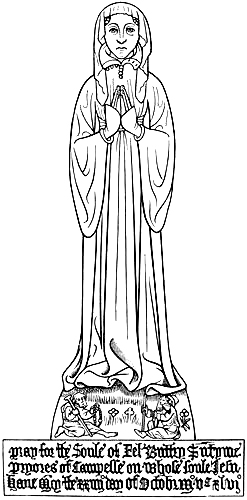
Brass of Ela Buttry, the stingy Prioress of Campsey († 1546), in St Stephen’s Church, Norwich. Stingy even in death, she has appropriated to her own use the brass of a 14th century laywoman.
At Crabhouse in the time of Joan Wiggenhall
the dortour that than was, as fer forthe as we knowe, the furste that was set up on the place, was at so grete mischeef and, at the gate-downe, the Prioresse dredyinge perisschyng of her sistres whiche lay thereinne took it doune for drede of more hermys,
and next year “sche began the grounde of the same dortoure that now stondith and wrought thereupon fulli vij yere betymes as God wolde sende hir good[478].” The Prioress of Swine was ordered in 1318 to have the dorter covered without delay, so that the nuns might quietly and in silence enter it, without annoyance from storms, and to have the roofs of the other buildings repaired as soon as might be[479]. At St Radegund’s Cambridge, in 1373, the Prioress was charged with suffering the frater to remain unroofed, so that in rainy weather the sisters were unable to take their meals there, to which she replied that the nunnery was so burdened with debts, subsidies and contributions, that she had so far been unable to carry out repairs, but would do so as quickly as possible[480]. At Littlemore in 1445 the nuns did not sleep in the dorter for fear it should fall[481]. At Romsey in 1502 the wicked Abbess Elizabeth Broke had allowed the roofs of the chancel and dorter to become defective, “so that if it happened to rain the nuns were unable to remain either in the quire in time of divine service or in their beds and the funds that the abbess ought to have expended on these matters were being squandered on Master Bryce”; the fabric of the monastery in stone walls was also going to decay through her neglect, and so were various tenements belonging to the house in the town of Romsey[482]. Over a hundred and twenty years before, William of Wykeham had found Romsey hardly less dilapidated, with its church, infirmary and nuns’ rooms “full of many enormous and notable defects,” and the buildings of the monastery itself and of its different manors in need of repair[483]. Of the unfortunate houses within the area of Scottish inroads, Arden, Thicket, Keldholme, Rosedale, Swine, Wykeham, Arthington and Moxby were all ruinous at the beginning of the fourteenth century; the monotonous list includes the church, frater and chapter house of Arden, the cloister of Rosedale, the bakehouse and brewhouse of Moxby, the dorter and frater of Arthington[484].
In the sixteenth century the distress was, as usual, at its worst. At the visitation of the Chichester diocese by Bishop Sherburn in 1521 the cloister of Easebourne needed roofing and Rusper was “in magno decasu”; six years later Rusper was still “aliqualiter ruinosa”[485]. At the Norwich visitations of Bishop Nykke the church of Blackborough was in ruins, and the roofs of cloister and frater at Flixton were defective; while at Crabhouse buildings were in need of repair and the roof of the Lady chapel was ruinous[486]; Joan Wiggenhall must have turned in her grave. Bishop Longland’s visitations of the diocese of Lincoln show a similar state of affairs. In 1531 he commanded the Abbess of Elstow “that suche reparacons as be necessarye in and upon the buildinges within the said monasterye, and other houses, tenements and fearmes thereto belonging, be suffycyently doon and made within the space of oon yere,” and the Prioress of Nuncoton, “that ye cause your firmary, your chirche and all other your houses that be in ruyne and dekaye within your monastery to be suffycyently repayred within this yere if itt possible may”; and reminded the nuns of Studley that they “muste bestowe lardge money upon suche reparacons as are to be doon upon your churche, quere, dortor and other places whiche ar in grete decaye”[487]. At Goring, also, the nuns all complained that the buildings were utterly out of repair, especially the choir, cloister and dorter[488].
The frequency of fires in the middle ages was probably often to blame for the ruin of buildings. There were then no contrivances for extinguishing flames, and the thatched and wooden houses must have burned like stubble. Thus it was that “thorow the negligens of woman[489] with fyre brent up a good malt-house with a soler and alle her malt there” at Crabhouse, and Joan Wiggenhall had to repair it at a cost of five pounds[490]. There is a piteous appeal to Edward I from the nuns of Cheshunt, who had been impoverished by a fire and sought “help from the King of his special grace and for God’s sake”; but “Nihil fiat hac vice,” replied red tape[491]; an undated petition in the Record Office says that the house, church and goods of the nuns had twice been burned and their charters destroyed[492]. In 1299 the Abbess of Wilton received permission to fell fifty oaks in the forest of Savernake “in order to rebuild therewith certain houses in the abbey lately burnt by mischance”[493]. At Wykeham, in Edward III’s reign, the priory church, cloisters and twenty-four other buildings were accidentally burned down and all the books, vestments and chalices of the nuns were destroyed[494]. Similarly the nuns of St Radegund’s, Cambridge, lost their house and all their substance by fire at the beginning of the fourteenth century, and in 1376 their buildings were again said to have been burned; either they had never recovered from their first disaster or a second fire had broken out[495]. The nuns of St Leonard’s, Grimsby, apparently lost their granaries in 1311, for they sought licence to beg on the ground that their houses and corn had been consumed by fire, and in 1459 they asked for a similar licence, because their buildings had been burnt, and their land inundated[496]. The convent of St Bartholomew’s, Newcastle, gave misfortune by fire as one reason for wishing to appropriate the hospital or chapel of St Edmund the King in Gateshead[497].
Sometimes poverty, misfortune and mismanagement reduced the nuns to begging alms. About 1253 the convent of St Mary of Chester wrote to Queen Eleanor, begging her to confirm the election of a prioress “to our miserable convent amidst its multiplied desolations; for so greatly are we reduced that we are compelled every day to beg abroad our food, slight as it is”[498]. Similarly the starving nuns of Whitehall, Ilchester, were reduced to “begging miserably,” after the régime of a wicked prioress at the beginning of the fourteenth century[499]. In 1308 the subprioress and convent of Whiston mentioned, in asking for permission to elect Alice de la Flagge, that the smallness of their possessions had compelled the nuns formerly to beg, “to the scandal of womanhood and the discredit of religion”[500]. In 1351 Bishop Edyndon of Winchester “counted it a merciful thing,” to come to the assistance of the great Abbeys of Romsey and St Mary’s Winchester, “when overwhelmed with poverty, and when in these days of increasing illdoing and social deterioration they were brought to the necessity of secret begging”[501]. At Cheshunt in 1367 the nuns declared that they often had to beg in the highways[502]. At Rothwell in 1392 the extreme poverty of the nuns compelled some of them “to incur the opprobrium of mendicity and beg alms after the fashion of the mendicant friars”[503]. In all these cases it is evident that objection was taken to personal begging by the nuns, and it is clear that such a practice, which took the nuns out into the streets and into private houses, was likely to be subversive of discipline. The custom of begging through a proctor was open to no such objection; and it was common for bishops to give to the poorer houses licences, allowing them to collect alms in this manner. Early in the fifteenth century the nuns of Rowney in Hertfordshire petitioned the Chancellor for letters patent for a proctor to go about the country and collect alms for them, and their request was granted[504]. Many such licences to beg occur in episcopal registers; Bishop Dalderby of Lincoln granted them to Little Marlow (1300 and 1311)[505], St Leonard’s Grimsby (1311)[506], and Rothwell (1318)[507]; and St Michael’s Stamford (1359) and Sewardsley (1366) received similar licences from his successors[508]. The distinction between begging by the nuns and begging by a proctor is clearly drawn in the licence granted by Bishop Dalderby to Rothwell. Addressing the clergy in the Archidiaconates of Northampton and Buckingham he writes:
Pitying, with paternal affection, the want of the poor nuns of Rothwell in our diocese, who are oppressed by such scarcity that they are obliged to beg the necessities of life, we command and straitly enjoin you, that when there shall come to you suitable and honest secular proctors or messengers of the same nuns (not the nuns themselves, that they may have no occasion for wandering thereby), to seek and receive the alms of the faithful for their necessities, ye shall receive them kindly and expound the cause of the said nuns to the people in your churches, on Sundays, and feast days during the solemnisation of mass, and promote the same by precept and by example once every year for the next three years, delivering the whole of whatever shall be collected to these proctors and messengers[509].
The Bishops sought to relieve necessitous convents by offering particular inducements to the faithful to give alms, when they were thus requested. Along with mending roads and bridges, ransoming captives, dowering poor maidens, building churches and endowing hospitals, the assistance of impecunious nunneries was generally recognised as a work of Christian charity, and indulgences were often offered to those who would aid a particular house[510]. The same Bishop Dalderby, for instance, granted indulgences for the assistance of Cheshunt, Flamstead[511], Sewardsley, Catesby, Delapré[512], Ivinghoe[513], Fosse[514], St James’ outside Huntingdon and St Radegund’s, Cambridge[515]. Archbishop Kemp of York granted an indulgence of a hundred days valid for two years to all who should assist towards the repair of Arden (1440) and of Esholt (1445), and Archbishop William Booth (1456) granted an indulgence of forty days to penitents contributing to the repair of Yedingham[516]; indeed it is probable that the money for the much needed work of roofing a building could be collected only by means of such special appeals. The Popes also sometimes granted indulgences; Boniface IX did so to penitents who on the feasts of dedication visited and gave alms towards the conservation of the churches and priories of Wilberfoss, St Clement’s, York, and Handale[517]. The history of St Radegund’s, Cambridge, will serve to illustrate the method by which the Church thus organised the work of poor-relief in the middle ages; and it will be noticed that this nunnery was an object of care to Bishops of other dioceses beside that of Ely[518]. In 1254 Walter de Suffield, Bishop of Norwich, granted a relaxation of penance for twenty-five days to persons contributing to the aid of the nuns; in 1268 Richard de Gravesend, Bishop of Lincoln, ordered collections to be made in the churches of the Archidiaconates of Northampton and Huntingdon on their behalf; in 1277 Roger de Skerning, Bishop of Norwich, ordered collections to be made in his diocese for the repair of the church; in 1313 the Official of the Archdeacon of Ely wrote to the parochial clergy of the diocese recommending the nuns to them as objects of charity, having lost their house and goods by fire, and in the same year Bishop Dalderby granted an indulgence on their behalf for this reason[519]; while in 1314 John de Ketene, Bishop of Ely, confirmed the grants of indulgence made by his brother bishops to persons contributing to their relief and to the rebuilding of the house. The next indulgence mentioned is one of forty days granted by Thomas Arundel, Bishop of Ely, in 1376, also on the occasion of a fire; in 1389 Bishop Fordham of Ely granted another forty days indulgence for the repair of the church and cloister and for the relief of the nuns[520], and in 1390 William Courtenay, Archbishop of Canterbury, made a similar grant, mentioning that the buildings had been ruined by violent storms; finally in 1457 Bishop Grey of Ely granted a forty days indulgence for the repair of the bell-tower and for the maintenance of books, vestments and other church ornaments[521]. There is no need to suppose that St Radegund’s was in any way a particularly favoured house; and such a list of grants shows that the Church fulfilled conscientiously the duty of organising poor-relief and that the objects for which indulgences were granted were not always as unworthy as has sometimes been supposed[522].
The financial straits to which the smaller convents were continually and the greater convents sometimes reduced grew out of a number of causes; and it is interesting to inquire what brought the nuns to debt or to begging and why they were so often in difficulties. A study of monastic documents makes it clear that a great deal of this poverty was in no sense the fault of the nuns. Apart from obvious cases of insufficient endowment, the medieval monasteries suffered from natural disasters, which were the lot of all men, and from certain exactions at the hands of men, which fell exclusively upon themselves. Of natural disasters the frequency of fires has already been mentioned. Another danger, from which houses situated in low lying land near a river or the sea were never free, was that of floods. The inundation of their lands was declared one of the reasons for appropriating the church of Bradford-on-Avon to Shaftesbury in 1343; and in 1380 the nuns were allowed to appropriate another church, in consideration of damage done to their lands by encroachments of the sea and losses of sheep and cattle[523]. In 1377 Barking suffered the devastation by flood of a large part of its possessions along the Thames and never recovered its former prosperity[524]; and in 1394 Bishop Fordham of Ely granted an indulgence for the nuns of Ankerwyke, whose goods had been destroyed by floods[525]. In the north the lands of St Leonard’s, Grimsby, were flooded in 1459[526]; in 1445 the nuns of Esholt suffered heavy losses from the flooding of their lands near the river Aire, which had been cultivated at great cost and from which they derived their maintenance[527]; and in 1434 Archbishop Rotherham appealed for help for the nuns of Thicket, whose fields and pasturages had been inundated and who had suffered much loss by the death of their cattle[528]. Heavy storms are mentioned as contributing to the distress of Shaftesbury in 1365[529] and of St Radegund’s, Cambridge, in 1390[530]. Moreover some houses suffered by their situation in barren and unproductive lands. Easebourne in 1411 complained of “the sterility of the lands, meadows and other property of the priory, which is situated in a solitary, waste and thorny place”[531]; Heynings put forward the same plea in 1401[532]; and Flamstead in 1380[533].
But far more terrible than fire and flood were those two other scourges, with which nature afflicted the men of the middle ages, famine and pestilence. The Black Death of 1348-9 was only one among the pestilences of the fourteenth century; it had the result of “domesticating the bubonic plague upon the soil of England”; for more than three centuries afterwards it continued to break out at short intervals, first in one part of the country and then in another[534]. The epidemics of the fourteenth century were so violent that in forty years the chroniclers count up five great plagues, beginning with the Black Death, and Langland, in a metaphor of terrible vividness, describes the pestilence as “the rain that raineth where we rest should.” The Black Death was preceded by a famine pestilence in 1317-8, when there was “a grievous mortalitie of people so that the sicke might vnneath burie the dead.” It was followed in 1361 by the Second Plague, which was especially fatal among the upper classes and among the young. The Third Plague in 1368-9 was probably primarily a famine sickness, mixed with plague. The Fourth plague broke out in 1375; and the Fifth, in 1390-1 was so prolonged and so severe as to be considered comparable with the Black Death itself. Moreover these are only the great landmarks, and scattered between them were smaller outbreaks of sickness, due to scarcity or to spoiled grain and fruit. The pestilences continued in the fifteenth century (more than twenty-one are recorded in the chronicles), but, except perhaps for the great plague of 1439, they were seldom universal and came by degrees to be confined to the towns, so that all who could used to flee to the country when the summer heat brought out the disease in crowded and insanitary streets. But if country convents escaped the worst disease, those situated in borough towns ran a heavy risk.
Often enough these plagues were preceded and accompanied by famines, sometimes local and sometimes general. The English famines had long been notorious and were enshrined in a popular proverb: “Tres plagae tribus regionibus appropriari solent, Anglorum fames, Gallorum ignis, Normannorum lepra”[535]. The three greatest outbreaks took place in 1194-6, in 1257-9 and in 1315-6 (before the plague of 1318-9). The dearth which culminated in the last of these famines had begun as early as 1289; and the misery in 1315 was acute:
“The beastes and cattell also,” says Stow, translating from Trokelowe, “by the corrupt grane whereof they fed, dyed, whereby it came to passe that the eating of flesh was suspected of all men, for flesh of beasts not corrupted was hard to finde. Horse-flesh was counted great delicates the poore stole fatte dogges to eate; some (as it was sayde) compelled through famine, in hidden places did eate the flesh of their owne children, and some stole others, which they devoured. Theeves that were in prisons did plucke in peeces those that were newly brought among them and greedily devoured them halfe alive.”
There was another severe famine in 1322, and in 1325 a great drought, so that the cattle died for lack of water. Famine accompanied the pestilences of 1361, 1369, 1391 and 1439; and these are only the more outstanding instances. Here again, however, the fourteenth century was on the whole worse off than the fifteenth; almost every year was a year of scarcity and the average price of wheat during the period 1261 to 1400 was nearly six shillings (i.e. nearly six pounds of modern money)[536]. Moreover the ravages of murrain among cattle and sheep were hardly intermittent from the end of the thirteenth to the middle of the fifteenth century[537]. The fatal years 1315-9 included not only a famine and a plague but also (1318-9) a murrain among the cattle, which was so bad that dogs and ravens, eating the dead bodies, were poisoned and died, and no man dared eat any beef. In the year of the Black Death also there was “a great plague of sheep in the realm, so that in one place there died in pasturage more than five thousand sheep and so rotted that neither beast nor bird would touch them”; and murrains accompanied the four other great plagues of the century. Indeed dearth, murrain and pestilence went hand in hand, in that unhappy time we call the “good old days.”
These natural disasters could not but have an adverse effect upon the fortunes of the monastic houses; and many charters and petitions contain clauses which specifically attribute the distress of this or that nunnery to one of the three causes described above. During the famine years of 1314-5 Walter Reynolds, Archbishop of Canterbury, wrote to the Bishop of Winchester, urging him to take some steps for the relief of the nuns of Wintney, who were dispersing themselves in the world, because no proper provision was made for their food[538], and about the same time the convent of Clerkenwell addressed a petition to Queen Isabel, stating that they were “moet enpouerees par les durs annez” and begging her to procure for them the King’s leave to accept certain lands and rents to the value of twenty pounds[539]. In 1326 (after the great drought) the nuns of King’s Mead, Derby, begged the King to take them under his special protection, granting the custody of the house to two custodes, on the ground that, owing to the badness of past years and the unusually heavy mortality among cattle their revenues were reduced and they were unable to meet the claims made by guests upon their hospitality[540]. The ravages of the Black Death were most severe of all and many houses never recovered from it[541]. In the diocese of Lincoln the nunnery of Wothorpe lost all its members save one, whom the Bishop made Prioress; and in 1354 it was annexed to St Michael’s Stamford[542]. Greenfield Priory, when he visited it in 1350, “per tres menses stetit et stat priorisse solacio destituta”[543]; and other houses in this large diocese which lost their heads were Fosse, Markyate, Hinchinbrooke, Gracedieu, Rothwell, Delapré, Catesby, Sewardsley, Littlemore and Godstow[544]. In the diocese of York the prioresses of Arthington, Kirklees, Wallingwells and St Stephen’s Foukeholm died; the latter house, like Wothorpe, failed to recover and is never heard of again[545]. Other parts of the country suffered in the same way. At Malling Abbey in Kent the Bishop made two abbesses in succession, but both died and only four professed nuns and four novices remained, to one of whom the Bishop committed the custody of the temporalities and to another that of the spiritualities, because there was no fit person to be made Abbess[546]. At Henwood, in August 1349, there was no Prioress, “and of the fifteen nuns who were lately there, three only remain”[547].
The death of the nuns themselves was, moreover, the least disastrous effect of the pestilence; it left a legacy of neglected lands, poverty and labour troubles which lasted for long after a new generation of sisters had forgotten the fate of their predecessors. The value of Flixton dwindled after the Black Death to half its former income, and the house was never prosperous again[548]. In 1351 the nuns of Romsey petitioned for leave to annex certain lands and advowsons and gave as one of the reasons for their impoverishment “the diminution or loss of due and appointed rents, because of the death of tenants, carried off by the unheard of and unwonted pestilence”[549], and in 1352 the house of St Mary’s Winchester made special mention, in petitioning for the appropriation of a church, of the reduction of its rents and of the cattle plague[550]. The other great plagues of the century aggravated the distress. St Mary’s Winchester and Shaftesbury mentioned the pestilence (of 1361) in petitions to the King three years later[551]. Four of the sixteen nuns of Carrow died in the year of the third pestilence (1369)[552], and in 1378, three years after the fourth pestilence, the licence allowing Sewardsley to appropriate the church of Easton Neston, recites that the value of its lands had been so diminished by the pestilence that they no longer sufficed to maintain the statutory numbers[553]. In 1381 (mentioned as a plague and famine year in some of the chronicles) a bull of Urban IV, appropriating a church to Flamstead, after recapitulating the slender endowments of the house, repeats the complaint that
the servants of the said priory are for the most part dead, and its houses and tenants and beasts are so destroyed that its lands and possessions remain as it were sterile, waste and uncultivated, wherefore, unless the said Prioress and Convent be by some remedy succoured, they will be obliged to beg for the necessities of life from door to door[554].
In 1395, four years after the “Fifth” pestilence and itself a year of bad plague and famine, the nuns of Legbourne complained that their lands and tenements were uncultivated, “on account of the dearth of cultivators and rarity of men, arising out of unwonted pestilences and epidemics”[555]. The outbreak of 1405-7 was followed by a petition from Easebourne for licence to appropriate two churches, on the ground of “epidemics, death of men and of servants,” and because
the lands and tenements of the Prioress and Convent notoriously suffer so great ruin that few tenants can be found willing to occupy the lands in these days, and the said lands, ever falling into a worse state, are so poor that they cannot supply the religious women with sufficient support for themselves or for the repair of their ruinous buildings.[556]
The worst of these natural disasters was not the actual damage done by each outbreak, but the fact that famine, murrain and pestilence followed upon pestilence, murrain and famine with such rapidity, that the poorer houses had no chance of recovery from the initial blow dealt them by the Black Death. The nuns of Thetford, for instance, were excused from the taxation of religious houses under Henry VI, on the ground that their revenues in Norfolk and in Suffolk were much decreased by the recent mortality and had so continued since 1349[557]. Even the well-endowed houses found recovery difficult, and the history of the great abbey of Shaftesbury illustrates the situation very clearly. In 1365, shortly after the pestis secunda, the nuns received a grant of the custody of their temporalities on the next voidance, and losses by pestilence were mentioned as one reason for the decline in their fortunes. In 1380 their lands were flooded and they suffered heavy losses in sheep and cattle. In 1382 (the year of the fifth plague) they were obliged to petition once again for help, representing that although their house was well-endowed,
toutes voies voz dites oratrices sont einsi arreriz a jour de huy, quoy par les pestilences en queles lours tenantz sont trez toutz a poy mortz, et par murryne de lour bestaille a grant nombre et value, nemye tant seulement a une place et a une foitz, einz a diverses foitz en toutes leurs places, quoy par autres grandes charges quelles lour convient a fine force de jour en autre porter et sustenir, q’eles ne purront, sinoun qe a moelt grant peine, sanz lour endangerer al diverses bones gentz lours Creditours, mesner l’an a bon fyn[558].
Again towards the middle of the fifteenth century Bishop Ayscough sanctioned the appropriation of a church to the abbey, which had pleaded its great impoverishment through pestilence, failure of crops, want of labourers, and through the excessive demands of such labourers as could be obtained[559]. If Shaftesbury found recovery so difficult, it may easily be imagined what was the effect of the natural disasters of the fourteenth century upon smaller and less wealthy houses.
The revenues of the nunneries, often scant to begin with and liable to constant diminution from the ravages of nature, were still more heavily burdened by a variety of exactions on the part of the authorities of Church and State. The procurations payable to the Bishop on his visitation fell heavily upon the smaller houses; hence such a notice as that which occurs in Bishop Nykke’s Register under the year 1520: “Item the reverend father with his colleagues came down to the house of nuns that afternoon, and having seen the priory he dissolved his visitation there, on account of the poverty of the house”[560]. St Mary Magdalen’s, Bristol, was on account of its poverty exempt from the payment of such procurations[561] and the Bishops doubtless often exercised their charity upon such occasions[562]. Papal exactions were even more oppressive; John of Pontoise, Bishop of Winchester, pleaded with the papal nuncio in 1285 that he would forbear to exact procurations from the poor nuns of Wintney, whom the Bishop himself excused from all charges in view of their deep poverty[563]; and in 1300 Bishop Swinfield of Hereford made a similar appeal to the commissary of the nuncio, and secured the remission of procurations due from the nuns of Lingbrook and the relaxation of the sentence of excommunication, which they had incurred through non-payment[564]. The obligation to pay tithes also fell heavily upon the poorer houses; it was for this reason that Archbishop John le Romeyn appealed to the Prior of Newburgh in 1286 not to exact tithes from the food of animals in Nether Sutton, belonging to the poor nuns of Arden[565]; and in 1301 the Prior of Worcester desired his commissary to spare the poverty of the nuns of Westwood and not to exact tithes or any other things due to him from them or from their churches[566]. Added to ecclesiastical exactions were the taxes due to the Crown. In 1344 the nuns of Davington addressed a petition to Edward III, representing that, owing to their great poverty, they were unable to satisfy the King’s public aids without depriving themselves of their necessary subsistence, a plea which was found to be true[567]. The frequency with which such petitions for exemption from the payment of taxes were made and granted, is in itself a proof that the burden of taxation was a real one, for the Crown would not have excused its dues, unless the need for such an act of charity had been great[568]; and it is obvious that the sheer impossibility of collecting the money from a poverty-stricken house must often have left little alternative. The houses that did contribute were not slow to complain. “The unwonted exactions and tallages with which their house and the whole of the English Church has been burdened” were pleaded by the nuns of Heynings as in part responsible for their poverty in 1401[569]; similarly “the necessary and very costly exactions of tenths and other taxes and unsupportable burdens” occurs in a complaint by Romsey in 1351; and the Abbess and Convent of St Mary’s, Winchester, stated in 1468, that they were so burdened with the repair of their buildings and with the payment of imposts, that they could not fulfil the obligations of their order as to hospitality[570].
Nor was taxation for public purposes the only demand made upon the religious houses. Abbeys holding of the King in chief had to perform many services appertaining to tenants in chief, which seem oddly incongruous in the case of nunneries. The Abbesses of Shaftesbury, St Mary’s Winchester, Wilton and Barking, were baronesses in their own right; the privilege of being summoned to parliament was omitted on account of their sex; but the duty of sending a quota of knights and soldiers to serve the King in his wars was regularly exacted[571]. In 1257 Agnes Ferrar, Abbess of Shaftesbury, was summoned to Chester to attend the expedition against Llewelyn ap Griffith, and her successor, Juliana Bauceyn, was also summoned in 1277 to attack that intrepid prince[572]. The Abbess of Romsey had to find a certain number of men-at-arms with their armour for the custody of the maritime land in the county of Southampton; she resisted when an attempt was made to exact an archer as well and successfully showed the King “that she has only two marks’ rent in Pudele Bardolveston in that county”[573]. Less lawful exactions were even more burdensome, and the nunneries suffered with the rest of the nation under the demand for loans and the burden of purveyance[574]. In December 1307 the Abbess of Barking, in common with the heads of ten other religious houses, was requested to lend the King
two carts and horses to be at Westminster early on the day of St Stephen to carry vessels and equipments of the King’s household to Dover, the King having sent a great part of his carts and sumpter horses to sea, so that he may find them ready when he arrives[575];
it is true that he engaged to pay out of his wardrobe the costs of the men leading the carts and of the horses going and returning, but meanwhile the Abbey lost their services, and carts and horses were very necessary on a manor; moreover it was common complaint that the tallies given by the King’s servants for what they took were sometimes of no more value than the wood whereof they were made:
I had catell, now have I none; They take my beasts and done them slon, And payen but a stick of tree.
Similarly in June 1310 the King sent out a number of letters to the heads of religious houses, requesting the “loan” of various amounts of victuals for his Scottish expedition, and among the houses upon whom this call was made were the nunneries of Catesby, Elstow, St Mary’s Winchester, Romsey, Wherwell, Barking, Nuneaton, Shaftesbury and Wilton[576].
The nunneries also suffered considerable pecuniary loss by the right possessed in certain cases by the patron of a house, to take the profits of its temporalities during voidance through the death or resignation of its superior, sometimes enjoying them himself and sometimes granting the custody of the house to someone else[577]. It is obvious that serious loss might be entailed upon the community, if the patron refrained for some time from granting his congé d’élire. It was for this reason that the Convent of Whiston wrote in 1308 to the Bishop-elect of Worcester, their patron, praying that “considering the smallness of the possessions of the nuns of Whiston, in his patronage, which compelled the nuns formerly to beg, and for the honour of religion and the frailness of the female sex” he would grant them licence to elect a new prioress and would confirm the same election; and the Prior of Worcester also addressed a letter to the commissary-general on their behalf[578]. The King exercised with great regularity his rights of patronage, and the direct pecuniary loss, sustained by a house in being deprived of the profits of its temporalities, seems to have been the least of the evils which resulted, if the state of affairs described in the petition addressed to the crown by the Abbess and Convent of Shaftesbury in 1382 was at all common. After a moving description of the straits to which they were reduced[579], they begged that the King would, on future occasions of voidance, allow the community to retain the administration of the Abbey and of its temporalities, rendering the value thereof to the King while the voidance lasted, so that no escheator, sheriff or other officer should have power to meddle with them:
understanding, most redoubtable lord, that by means of your grace in this matter great relief and amendment, please God, shall come to your same house, and no damage can ensue to you or to your heirs, nor to any other, save only to your officers, who in such times of voidance are wont to make great destructions and wastes and to take therefrom great and divers profits to their own use, whence nothing cometh to your use, as long as the said voidance endures, if only for a short time[580].
St Mary’s, Winchester, also pleaded the royal administration of its temporalities as one reason for its impoverishment, when petitioning the Pope for leave to appropriate the church of Froyle in 1343 and 1346[581].
Sometimes the abbeys found it cheaper to compound with the King for a certain sum of money and thus to purchase the right of administering their own temporalities, saving to the King, as a rule, knights’ fees, advowsons, escheats and sometimes wards and marriages. Romsey Abbey secured this privilege, after the escheator had already entered, in 1315, for a fine of forty marks; but in 1333, when there was another voidance, the convent had to agree to pay £40 for the first two months and pro rata for such time as the voidance continued, saving to the King knights’ fees, advowsons and escheats[582]. In 1340 the royal escheator was ordered to let the Prioress and Convent of Wherwell have the custody of their temporalities, in accordance with a grant made some years previously, by which the house was to render £230 for a year and pro rata[583]. In 1344 a similar order was made in the case of Wilton, whose late Abbess (prudent woman) had seized the opportunity to purchase the right for £60 from the King, when he lay at Orwell before crossing the sea[584]. Similarly, the next year, Shaftesbury received the custody of its temporalities in consideration of a fine of £100, made with the King by its Abbess, in the second year of his reign[585]. With four great abbeys falling vacant in little over ten years, the royal exchequer reaped a good harvest; and though the payment of a lump sum was better than falling into the hands of the escheator, and though the nuns would make haste to elect a new abbess as soon as possible, a voidance was always a costly matter.
But perhaps the most serious tax upon the resources of the nunneries was the right, possessed by some dignitaries (notably the King and the Bishop of the diocese), to nominate to houses in their patronage persons whom the nuns were obliged to receive as members of their community or to support as corrodians, pensioners or boarders. The right of nominating a nun might be exercised upon a variety of occasions. The Archbishop might do so to certain houses in his province on the occasion of his consecration, and this right was energetically enforced by Peckham, who nominated girls to Wherwell, Castle Hedingham, Burnham, Stratford, Easebourne and Catesby[586]. A Bishop possessed, in some cases, a similar right on the occasion of his consecration. Rigaud d’Assier, Bishop of Winchester, sent nuns to Romsey, St Mary’s Winchester and Wherwell[587]; Ralph of Shrewsbury, Bishop of Bath and Wells, nominated to Minchin Barrow and to Cannington[588]; Stephen Gravesend, Bishop of London, sent a girl to Barking[589]; and the successive bishops of Salisbury exercised the prerogative of placing an inmate in Shaftesbury Abbey and of appointing one of the nuns to act as her instructor[590]. The existence of this right seems to have varied with different dioceses and its exaction with different bishops, if it is possible to judge from the absence of commendatory letters in some registers and their presence in others. The Bishop of a diocese also sometimes had the right of presenting a nun to a house when a new superior was created there. This was the case at Romsey, where nuns were thus nominated in 1307, 1333 and 1397[591], and at Romsey also there occurs one instance (the only one of the kind which search has yet yielded) of the nomination of a nun by the bishop, because of “a profession of ladies of that house which he had lately made.” Bishop Stratford thus appointed Jonette de Stretford (perhaps a poor relative) “en regard de charite” in 1333, a month after having appointed Alice de Hampton by reason of the Abbess’ creation[592].
The King possessed in houses under his patronage rights of nomination corresponding to those of the Bishop. That of presenting a nun on the occasion of his coronation was frequently exercised. Edward II sent ladies to Barking, Wherwell and St Mary’s Winchester[593]; Barking received nuns from Richard II, Henry IV and Henry VI[594] and Shaftesbury from Richard II, Henry V and Henry VI[595]. He also possessed the right in certain abbeys of presenting a nun on the occasion of a voidance and there are many such letters of presentation enrolled upon the Close rolls; for instance Joan de la Roche was sent to Wilton in 1322[596], Katherine de Arderne to Romsey in 1333[597] and Agnes Turberville to Shaftesbury in 1345[598].
Sometimes similar rights to these were exercised by private persons, who held the patronage of a house or with whom it was connected by special ties; the family of le Rous of Imber, for example, had the right (resigned in 1313) of presenting two nuns, with a valet, to Romsey Abbey[599]. But the royal rights were always the most burdensome and, though such privileges as those described above, and the even more burdensome right to demand corrodies and pensions, normally affected only great abbeys such as Barking, Romsey, St Mary’s Winchester, and Shaftesbury, the smaller houses (not under royal patronage) were not always exempt from sudden demands—witness the case of Polsloe below—and a wide range of nunneries was affected by archiepiscopal and episcopal rights. Moreover even the great houses, in spite of their large endowments, were crippled by the system, as may be gathered from their constant complaints of poverty and of overcrowding. The obligation to receive fresh inmates by nomination was especially burdensome when it was incurred on more than one occasion by the same house and coincided with other exactions. The case of Shaftesbury is noticeable in this connection; the King claimed the right to administer its temporalities during voidance, to nominate a nun on his own coronation and on the election of an Abbess, to demand a pension for one of the royal clerks on the latter occasion, and to send boarders or corrodians for maintenance; and the Bishop of Salisbury could nominate a nun on his own promotion to the see and could demand a benefice for one of his clerks on the election of an Abbess. It is, of course, possible that all these prerogatives were not invariably exercised and that a new inmate was not sent to Shaftesbury every time a King was crowned, a Bishop consecrated or an Abbess elected; but it was exercised sufficiently often to be a strain upon the house.
Even when the right of nomination was confined to one occasion, it seems to have been generally resented and frequently resisted. The reason for resistance lay in the fact that the house was forced to support another inmate without the hope of receiving the donation of land or rents, which medieval fathers gave to the convents in which their daughters took the veil; and as the dowry system became more and more common, the hardship of having to receive a nun for nothing would soon appear intolerable. In some cases a sturdy resistance against this “dumping” of nuns finds an echo in the bishops’ Registers. Four houses out of the six to which Peckham nominated new inmates attempted a refusal, and the excuses which they offered are interesting. Two years after his consecration the nuns of Burnham were still refusing to receive his protégée, Matilda de Weston; they had begun by trying to question his right to nominate and he seems to have taken legal action against them, after which they pleaded poverty (resulting from an unsuccessful lawsuit) and also an obligation to receive no novice without the consent of Edmund Earl of Cornwall, son of their founder. The Archbishop directed a stern letter to them, rejecting both their excuses and announcing his intention of pursuing his right, but the end of the matter is not known[600]. An equally determined resistance was offered by the Prioress of Stratford, who had been ordered to receive Isabel Bret. In 1282 Peckham wrote to her for the third time, declaring that her excuses were frivolous; she had apparently objected that the girl was too young and that her house was too heavily burdened with nuns, lay sisters and debts for another inmate to be received, but the Archbishop declared the youth of the candidate to be rather a merit than a defect and pointed out that, so far from being a burden to their house, she would bring it honour, for by receiving her they would multiply distinguished friends and benefactors and would be able to rely on his own special protection in their affairs[601]. A further letter to the Bishop of London is interesting, because it mentions a third objection made by the recalcitrant nunnery.
“We have received your letter,” writes Peckham, “in favour of the Prioress and Convent of Stratford, urgently begging us to moderate our purpose concerning a certain burden which is alleged to be threatening them from us, on account of the insupportable weight and the poverty of the house and the deformity of the person, whom we have presented to them for admission. Concerning which we would have you know that already in the lifetime of your predecessor of good memory, we had ordered them to receive that same person and for two years we continued to believe that they would yield to our wishes in the matter, yet without burden to themselves, by the provision of the parents of the said little maid; especially seeing that never yet have we been burdensome to any monastery making a truthful plea of indigence. We believe that what they allege about deformity would be an argument in favour of our proposal; would that not only these women of Stratford, concerning whom so many scandals abound, but also all who so immodestly expose themselves to human conversation and company, were or at least appeared notable for such deformity that they should tempt no one to crime! We have moreover heard that the greater part of the convent would willingly consent to the reception of the girl, were they not hindered by the malice of the prioress; nevertheless, lest we should seem deaf to your entreaties, we suspend the whole business until we come to London, to ascertain how our purpose may be carried out without notable damage to them[602].”
The Archbishop had his way however; for eleven years later the will of Robert le Bret was enrolled in the Court of Husting and contained a legacy of rents on Cornhill “to Isabella his daughter, a nun of Stratford”[603]. Peckham also wrote in a tone of strained patience to the nuns of Castle Hedingham, who had refused to receive Agnes de Beauchamp, warning them that besides incurring severe punishment at his own hands, further obstinacy would offend the Queen of England, at whose instance he had undertaken the promotion of the said Agnes[604]. The Prioress of Catesby was equally troublesome and as late as 1284 the Archbishop wrote reprimanding her for her inconstancy and feigned excuses, because, after promising to receive the daughter of Sir Robert de Caynes and after repeated requests on his part that they should admit the girl, she and her nuns had written asking to be allowed to admit another person in her stead[605].
Real poverty often nerved the nuns to such bold resistance. In the Register of Bishop Grandisson of Exeter there is a letter from Polsloe Priory, written in 1329 and addressed to Queen Philippa, on the subject of a certain Johanete de Tourbevyle[606], whom she had requested the nuns to receive as a lay sister. Written in the French of their daily speech, with no attempt at formal phraseology, their naive plea still rings with the agitation of the “poor and humble maids,” torn between anxiety not to burden their impecunious house, and fear of offending the new-made Queen of England:
To their very honourable and very powerful and redoubtable lady, my lady Dame Philippa, by the grace of God queen of England, etc., her poor and humble maids, the nuns of Polsloe, in all that they may of reverence and honour; beseeching your sweet pity to have mercy on our great poverty. Our very noble dame, we have received your letters, by the which we understand that it is your will that we receive Johanete de Tourbevyle among us as sister of the house, to take the dress of a nun in secular habit. Concerning the which matter, most debonair lady, take pity upon us, if it please you, for the love of God and of His mother. For certainly never did any queen demand such a thing before from our little house; though mayhap they be accustomed to do so from other houses, founded by the kings and holding of them in chief; but this do not we, wherefore it falls heavily upon us. And if it please your debonair highness to know our simple estate, we are so poor (God knows it and all the country) that what we have suffices not to our small sustenance, who must by day and night do the service of God, were it not for the aid of friends; nor can we be charged with seculars without reducing the number of us religious women, to the diminution of God’s service and the perpetual prejudice of our poor house. And we have firm hope in God and in your great bounty that you will not take it ill that this thing be not done to the peril of our souls; for to entertain and to begin such a new charge in such a small place, a charge which would endure and would be demanded for ever afterwards, would be too great a danger to your soul, my Lady, in the sight of God, wherefrom God by His grace defend you! Our most blessed Lady, may God give you a long and happy life, to His pleasure and to the aid and solace of ourselves and of other poor servants of God on earth; and we should have great joy to do your behests, if God had given us the power[607].
The nuns evidently asked the support of the Bishop (which accounts for the presence of their letter in his Register) for about the same time Grandisson also wrote an informal letter in French to the King, begging him to give up his design to place his cousin Johanete de Tourbevyle at Polsloe, on the ground that the nuns held all that they possessed in frank almoign and were so poor that it would be unpardonable to entail upon them a charge, which would become a precedent for ever:
“Wherefore, dear Sire,” he continued, “If it please you, hold us excused of this thing and put this thought from you. And for love of you, to whom we are much beholden aforetime, and to show you that we make no feigned pretence, ordain, if it please you, elsewhere for her estate, and we will very willingly give somewhat reasonable out of our own goods towards it; for this we may safely do[608].”
It is not impossible that the disinclination of the nunneries to receive royal and episcopal nominees was in part due to dislike of taking an entirely unknown person into the close life of the community, in which so much depended upon the character and disposition of the individual. The right seems nearly always to have been exercised in favour of well-born girls, but though the bishops endeavoured to send only suitable novices, their knowledge of the character of their protégées would sometimes appear to have rested upon hearsay rather than upon personal acquaintance—“ut credimus,” “come nous sumez enformez.” On at least one occasion the nuns who resisted a bishop’s nominee were to our knowledge justified by later events. In 1329 Ralph of Shrewsbury, the new Bishop of Bath and Wells, wrote to the Prioress and Convent of Cannington, desiring them to receive Alice, daughter of John de Northlode, to whom he had granted the right, “par resoun de nostre premiere creacion,” on the request of Sir John Mautravers; four years later he was obliged to repeat the order, because the convent “had not yet been willing to receive the said Alice.” The end of the story is to be found in the visitation report of 1351[609]. It is impossible to say whether the convent corrupted Alice or Alice the convent; but it is unfortunate that the Bishop’s nominee should have been implicated.
The obligation to receive a nun on the nomination of the king or the bishop was not the only burden upon the finances of the nunneries. Abbeys in the patronage of the Crown were upon occasion obliged also to find maintenance for other persons, men as well as women, who never became members of their community. The right to demand a pension for one of the royal clerks was sometimes exercised on the occasion of a voidance, and the money had in most cases to be paid until such time as the young man was provided with a suitable benefice by the Abbey. The Abbess of Romsey was ordered to give a pension to William de Dereham in 1315 by reason of her new election[610]; John de St Paul was sent to the same house in 1333[611], William de Tydeswell in 1349[612]. The right is also found in exercise at Wherwell[613], St Mary’s, Winchester[614], Shaftesbury[615], Wilton[616], Delapré (Northampton)[617], Barking[618] and Elstow[619]. In certain cases the Bishop possessed a similar right on the occasion of his own consecration; for instance John of Pontoise, Bishop of Winchester, wrote to the Abbess of St Mary’s, Winchester, in 1283, complaining
that whereas his predecessors had by a laudable custom presented their own clerks to the first benefice in the patronage of a religious house vacant after their establishment in the bishopric, they (the nuns) had recently presented a nominee of their own to a benefice then vacant.
Two years later the Abbess and Convent of Wherwell wrote to him, voluntarily offering him the next vacant benefice in their patronage for one of his clerks; and in 1293 he reminded the nuns of Romsey that they were bound by agreement to do likewise[620]. Similarly Simon of Ghent, Bishop of Salisbury, directed the Abbess of Shaftesbury to provide for Humphrey Wace in 1297[621]. The demand to pension a clerk, like the demand to receive a nun, was sometimes resisted by the convents. In the early part of his reign Edward II ordered the Sheriff of Bedford
to distrain the Abbess of Elstow by all her lands and chattels in his bailiwick and to answer to the King for the issues and to have her body before the King at the octaves of Hilary next, to answer why, whereas she and her convent, by reason of the new creation of an Abbess, were bound to give a pension to a clerk, to be named by the King and he had transferred the option to his sister Elizabeth Countess of Hereford and had asked the Abbess to give it to her nominee they had neglected to do so[622].
The end of the story is contained in a petition printed in the Rolls of Parliament, wherein the Abbess and Convent of “Dunestowe” (Elstow) informed the King in 1320
que, come il les demaunde par son Brief devant Sire H. le Scrop et ses compaignons une enpensione pur un de ses clerks par reson de la novele Creacion la dite Abbesse et tiel enpensione unqs devant ces temps ne fust demaunde ne donee de la dite meson, fors tant soulement que la dereyn predecessere dona a la requeste nostre Seigneur le Roy a la Dameysele la Countesse de Hereford, un enpension de c s. Par qi eles prient que nostre Seigneur le Roy voet, si lui plest, comander de soursere de execucion faire de la dite demaunde, que la dite Abbay est foundee de Judit, jadis Countess de Huntingdon, et la dite enpension unques autrement done[623].
The reference to the Countess of Hereford’s “dameysele” shows that the pension was not invariably given to a clerk, and it appears that the King tried to substitute corrodies, pensions and reception as a nun for each other according to the exigencies of the moment. In 1318 he sent Simon de Tyrelton to the Abbess and Convent of Barking,
they being bound to grant a pension to one of the King’s clerks, by reason of the new creation of an abbess, and the King having requested them to grant in lieu of such pension the allowance of one of their nuns to Ellen, daughter of Alice de Leygrave, to be received by her for life, to which they replied that they could not do so, for certain reasons[624].
In 1313, in pursuance of his right to nominate a nun on the new creation of an abbess, he had sent Juliana de Leygrave “niece of the King’s foster-mother, who suckled him in his youth,” to St Mary’s, Winchester, in order that she might be given a nun’s corrody for life (the value of which was to be given her wherever she might be) and a suitable chamber within the nunnery for her residence, whenever she might wish to stay there[625].
The obligation to provide corrodies for royal nominees pressed more heavily than the duty of pensioning royal clerks. A corrody was originally a livery of food and drink given to monks and nuns, but the term was extended to denote a daily livery of food given to some person not of the community and frequently accompanied by suitable clothing and a room in which to live. Hence corrodians were often completely kept in board and lodging, having the right to everything that a nun of the house would have (a “nun’s corrody”) and sometimes allowed to keep a private servant, who had the right to the same provision as the regular domestics of the house (a “servant’s corrody”). The King, indeed, looked upon the monastic houses of his realm as a sort of vast Chelsea Hospital, in which his broken-down servants, yeomen and officials and men-at-arms, might end their days. Thus he obtained their grateful prayers without putting his hand into his purse. There must have been hundreds of such old pensioners scattered up and down the country, and judging from the number of cases in which one man is sent to receive the maintenance lately given to another, deceased, some houses had at least one of them permanently on the premises. Many a hoary veteran found his way into the quiet precincts of a nunnery:
His helmet now shall make a hive for bees; And, lovers’ sonnets turn’d to holy psalms, A man-at-arms must now serve on his knees, And feed on prayers, which are Age his alms.
In the intervals between feeding on prayers he must have been vastly disturbing and enthralling to the minds of round-eyed novices, with his tales of court and camp, of life in London town or long campaigns in France, or of how John Copeland had the King of Scots prisoner and what profit he got thereby.
In the last three months of 1316 Edward II sent seventeen old servants to various religious houses, and among them Henry de Oldyngton of the avenary was sent to Barking, to receive such maintenance as William de Chygwell, deceased, had in that house[626]. In 1328 Roger atte Bedde, the King’s yeoman, who served the King and his father, was sent to St Mary’s, Winchester, instead of James le Porter, deceased[627]; and in 1329 the Abbess and Convent of Shaftesbury were requested to admit to their house Richard Knight, spigurnel of the King’s chancery, who had long served the King and his father in that office, and to administer to him for his life such maintenance in all things as Robert le Poleter, deceased, had in their house[628]. The unlucky convent of Wilton apparently had to support two pensioners, for in 1328 Roger Liseway was sent there in place of Roger Danne and the next year John de Odiham, yeoman of the chamber of Queen Philippa, took the place of John de Asshe[629].
It was doubtless even more common for the widows of the King’s dependents to be sent to nunneries, and he must often have received such a petition as was addressed by Agnes de Vylers to Edward III:
A nostre Seigneur le Roi et a son Conseil, prie vostre poure veve Agneys, qi fut la femme Fraunceys de Vylers, jaditz Bachiler vostre piere, qe vous pleise de vostre grace avoir regard du graunt service qe le dit Fraunceys ad fait a vostre dit piere et ed vostre ayel, en la Terre Seinte, Gascoigne, Gales, Escoce, Flaundres et en Engleterre, et graunter au dit Agneys une garisoun en l’Abbeye de Berkyng, c’est assaver une mesoun & la droite de une Noneyme pour la sustinaunce de lui et de sa file a terme de lour vie, en allegaunce de l’alme vostre dit piere, qi promist al dit Fraunceys eide pour lui, sa femme et ses enfaunz.
“Il semble a conseil q’il est almoigne de lui mander ou aillours, s’il plest a Roi,” was the reply; so Agnes and her daughter might end their days in peace, and Barking be the poorer for their appetites[630]. At Barking the King had the right to claim a corrody at each new election of an abbess, as Agnes de Vylers doubtless knew; as early as 1253 its Abbess was exempted from being charged with conversi and others, because she had granted food and vesture for life to Philippa de Rading and her daughter[631]. Other nunneries in the royal patronage were under a similar obligation. In 1310 Juliana la Despenser was sent to Romsey, to be provided with fitting maintenance for herself and for her maid during her lifetime[632] and in 1319 Mary Ridel was sent to Stainfield to be maintained for life[633]. There were the usual attempts to escape from a costly and burdensome obligation; Romsey seems to have been successful in repelling Juliana la Despenser, for in the following month the King sent her to Shaftesbury, requesting the nuns to “find her for life the necessities of life according to the requirements of her estate, for herself and for the damsel serving her, and to assign her a chamber to dwell in, making letters patent of the grant”[634]. Stainfield was less successful in the matter of Mary Ridel; the usual plea of poverty was considered insufficient and the convent was ordered to receive her, to supply her with food, clothing and other necessities and to make letters patent, specifying what was due to her[635].
Certain convents were in addition handicapped by the obligation to make certain grants or liveries, in kind or in money, to other monastic houses. The nunneries of St Clement’s, York, and Moxby seem to have involved themselves—as a condition, perhaps, of some past benefaction—in a curious obligation to the friars of their districts. At a visitation of the former house in 1317, Archbishop Melton found that the Friars Minor of York, every alternate week of the year, and the Friars Preachers of York in the same manner, had for a long time been receiving fourteen conventual loaves; the nuns were ordered to show the friars the Archbishop’s order and to cease from supplying the loaves as long as their own house was burdened with debt; and in no case was the grant to be made without special leave from the Archbishop[636]. The next year, on visiting Moxby, Melton was obliged to make an injunction as to the bread and ale called “levedemete,” which the Friars Minor were accustomed to receive from the house; if it were owed to them it was to be given as due, if not it was not to be given without the will of the head[637]. At Alnwick’s first visitation in 1440 the Prioress of St Michael’s, Stamford, declared that the house was burdened with the payment of an annual pension of 60s. to the monastery of St Mary’s, York, “and that for tithes not worth more than forty pence annually; also it is in arrears for twenty years and more”[638]. The nuns also had to pay various small sums to Peterborough Abbey, by which they had been founded and to which they always remained subordinated[639].
The support of resident corrodians and the payment of pensions and liveries were, however, less onerous than the duty of providing hospitality for visitors, which the nunneries performed as one of their religious obligations. Date and Dabitur did not always accompany each other. The great folk who held the Pope’s indult to enter the houses of Minoresses were probably generous donors; but the unenclosed orders had to lodge and feed less wealthy guests and often enough they found the obligation a strain upon their finances. When the nuns of King’s Mead, Derby, in 1326, petitioned the King to take the house into his special protection, they explained that great numbers of people came there to be entertained, but that owing to the reduction in their revenue they were unable to exercise their wonted hospitality[640]; and the number of guests was mentioned by the nuns of Heynings in 1401 as one reason for their impoverishment[641]. At Nunappleton in 1315 the Archbishop of York had to forbid two sets of guests to be received at the same time, until the house should be relieved of debt; and at Moxby (which was also in debt) he ordained that relatives of the nuns were not to visit the house for a longer period than two days; Nunappleton was evidently a favourite resort, for in 1346 another archbishop speaks of guests flocking—hospites confluentes—to the priory and orders them to be admitted to a hostelry constructed for the purpose. At Marrick in 1252 it was ordered that guests were not to stay for more than one night, because the means of the house barely sufficed for the maintenance of the nuns, sisters and brethren[642].
Another charge which fell heavily upon the nunneries, sometimes not entirely by their own fault, was that of litigation. This was only an occasional expense, but when it occurred it was heavy, and a suit once begun might drag on for years. Moreover the incidental expenses in journeys and bribes, which all had to be paid out of the current income of a house already (perhaps) charged with the payment of tithes and taxes and badly in need of repair, were often almost as heavy as the costs of the litigation. For instance an account of Christian Bassett, Prioress of St Mary de Pré (near St Albans), contains the following list of expenses incurred by her in the prosecution of a law suit in 1487, during the rule of her predecessor Alice Wafer:
Item when I ryde to London for the suyt that was taken ayenst dame Alice Wafer in the commen place, for myself and my preest and a woman and ij men, their hyre and hors hyre and mete and drynke, in the terme of Ester ye secunde yere of the regne of kyng Henry the vijth xx. s. Item paid aboute the same suyt at Mydsomer tyme, for iiij men, a woman and iiij horses xvi s. Item paid for the costs of a man to London at Mighelmas terme to Master Lathell, to have knowledge whethir I shuld have nede to come to London or not xij d[643]. Item for the same suyt of Dame Alice Wafer for herself and a suster wt. her, ij men, ij horses, in costs at the same time xiiij s. Item for the same suyt when I cam from London to have councell of Master More and men of lawe for the same ple x s. Item whan I went to Master Fforster to the Welde to speke wt. him, to have councell for the wele of the place, for a kercher geven to hym, ij s. Item on other tyme for a couple of capons geven to Master Fforster ij s. Item for a man rydyng to London at Candilmas to speke wt. Master Lathell and Master More and for iiij hennys geven to them and for the costs of the same man and his hors iij s. iiij d. Item whan I went to London to speke wt. Master Lathell for to renewe our charter of the place and other maters of our place xj s. Item in expenses made upon Master Ffortescue atte dyvers tymes, whan I wente to hym to have his councell for the same suyt in the common place xiij s. iiij d. Item paid to a man to ryde to Hertford to speke wt. Norys, that he shuld speke to Master Ffortescue for the same ple viij d. Item in costs for a man to go to Barkhamsted to Thomas Cace viij d. Item whan I went to Master Ffortescue to his place, for mens hire and hors hire for the same mater ij s. Item whan I went to London at an other tyme for the same plee, for iiij men and iiij hors hire xvj s.[644]
After this one does not wonder that in 1517 the convent of Goring pleaded that owing to lawsuits it was too poor to repair its buildings[645].
The account rolls of the Priory of St Michael’s, Stamford, are full of references to expenses incurred in legal business. On one occasion the nuns bought a “bill” in the Marshalsea “to have a day of accord” and the roll for 1375-6 contains items such as,
Paid for a purse to the wife of the Seneschal of the Marshalsea xx d. Paid for beer bought for the Marshalsea by the Prioress ij s. ij d. Paid for capons and chickens for the seneschal of the Marshalsea xxiij d. ob.[646]
Poor Dames Margaret Redynges and Joan Ffychmere “del office del tresorie,” ending the year £16. 8s. 8½d. in debt, must often have sighed with Langland
Lawe is so lordeliche. and loth to make ende, Withoute presentz or pens. she pleseth wel fewe.
Nor was it only the expenses of great lawsuits which bore heavily upon the nunneries; a great deal of lesser legal business had to be transacted from year to year. The treasuresses’ accounts of St Michael’s, Stamford, contain many notices of such business; the expenses of Raulyn at the sessions, expenses of the clerks at the Bishop’s court or at the last session at Stamford, a suit against a neighbouring parson over tithes, four shillings to Henry Oundyl for suing out writs; and innumerable entries concerning the inevitable “presentz or pens,” a douceur to the Bishop’s clerk, a courtesy to the king’s escheator, a present to the clerks at the sessions, a gift “to divers men of law for their help on divers occasions.” All nunneries had constantly to meet such petty expenses as these; and if we add an occasional suit on a larger scale the total amount of money devoured by the Law is considerable.
So far mention has been made only of such reasons for their poverty as cannot be considered the fault of the nuns. The inclemency of nature, the rapacity of lay and ecclesiastical authorities and the law’s delays could not be escaped, however wisely a Prioress husbanded her resources. Nevertheless it cannot be doubted that the nuns themselves, by bad management, contributed largely to their own misfortunes. Bad administration, sometimes wilful, but far more often due to sheer incompetence, was constantly given as a reason for undue poverty. It was “negligence and bad administration” which nearly caused the dispersion of the nuns of Wintney during the famine year of 1316[647]; and those of Hampole in 1353[648]. At Davington in 1511 one of the nuns deposed that “the rents and revenues of the house decrease owing to the guilt of the officers”[649]. The fault was often with the head of the house, who loved to keep in her own hands the disposal of the convent’s income, omitted to consult the chapter in her negotiations, retained the common seal and did not render accounts. An illustration of the straits to which a house might be reduced by the bad management of its superior is provided by the history of Malling Abbey in the early part of the fourteenth century, as told by William de Dene in his Historia Roffensis. In 1321 an abbess had been deposed, ostensibly on the complaint of her nuns and because the place had been ruined by her; but too much importance must not be assigned to the charge, for she was a sister of Bartholomew de Badlesmere, at that time a leader of the baronial party against Edward II, and it was by the King’s command that Hamo of Hythe, Bishop of Rochester, visited Malling and deprived her[650]; her deposition was probably a political move. The same cannot however be said of Lora de Retlyng, who became abbess in 1324.
“The Bishop,” says William de Dene, “although unwilling, knowing her to be insufficient and ignorant, set Lora de Retlyng in command as abbess, a woman who lacked all the capacity and wisdom of a leader and ruler, the nuns enthusiastically applauding; and the next day he blessed her, which benediction was rather a malediction for the convent. Then the Bishop forbade the Abbess to give a corrody to her maid-servant, as it had been the ill custom to do, and he sequestrated the common seal, forbidding it to be used, save when his licence had been asked and obtained”[651].
Twenty-five years passed and in 1349 the chronicler writes:
The Bishop of Rochester visited the abbeys of Lesnes and Malling, and he found them so ruined by longstanding mismanagement, that it is thought they never can recover so long as this world lasts, even to the day of judgment[652].
Malling had suffered severely from the Black Death in the previous year, but our knowledge of the character of Lora de Retlyng and the plain statement of William de Dene (“destructa per malam diutinam custodiam”), make it clear that bad management and not the pestilence was to blame for its poverty[653].
Financial mismanagement was, indeed, the most frequent of all charges brought against superiors at the episcopal visitations. When Alnwick visited his diocese of Lincoln several cases of such incompetence came to light. At St Michael’s, Stamford (1440), it was found that the Prioress had never rendered an account during the whole of her term of office, and one of the nuns declared that she did not rule and supervise temporal affairs to the benefit of the house; two years later the Bishop visited the convent again and the Prioress herself pleaded bodily weakness, adding
that since she was impotent to rule the temporalities, nor had they any industrious man to supervise these and to raise and receive the produce of the house, and since the rents of the house remained unpaid in the hands of the tenants, she begged that two nuns might be deputed to rule the temporalities, and to be responsible for receipts and payments.
In 1445, however, one of the appointed treasuresses, Alice de Wyteryng, admitted that she neither wrote down nor accounted for anything concerning her administration, and another nun complained that, if Wyteryng were to die, it would be impossible for any of them to say in what state their finances stood[654]. At the poor and heavily indebted house of Legbourne (1440) the Prioress, unknown to the Bishop, but with the consent of the Convent, had sold a corrody to the bailiff of the house, Robert Warde, who was nevertheless not considered useful to the house in this post; the tenements and leasehold houses belonging to the house were ruinous and like to fall through the carelessness of the Prioress and bailiff, and one aggrieved nun stated that “the prioress is not circumspect in ruling the temporalities and cares not whether they prosper, but applies all the common goods of the house to her own uses, as though they were her own[655].” At Godstow also it was complained that the steward had an annual fee of ten marks from the house and was useless[656]. At Heynings (1440) the Prioress was charged with never rendering accounts and with cutting down timber unnecessarily, but she denied the last charge and said she had done so only for necessary reasons and with the express consent of the convent[657]. At Nuncoton corrodies had been sold and bondmen alienated without the knowledge of the nuns[658]. At Harrold it was found that no accounts were rendered, that a corrody had been sold for twenty marks, and that when the Prioress bought anything for the convent, no tallies or indentures were made between the contracting parties, so that after a time the sellers came and demanded double the price agreed upon; one nun also asked that the Bishop should prevent the selling or alienation of woods[659]. At Langley (which was miserably poor) there was a similar complaint of the sale of timber[660]. These are the less serious cases of financial mismanagement; the cases of Gracedieu, Ankerwyke and Catesby have already been considered. Sometimes the extravagance or incompetence of a Prioress became so notorious as to necessitate her suspension or removal; as at Basedale in 1307[661], Rosedale in 1310[662], Hampole in 1353[663], Easebourne in 1441[664] and St Mary de Pré at the end of the fifteenth century[665]. But more frequently the bishops endeavoured to hem in expenditure by elaborate safeguards, which will be described below.
Besides cases of incompetence and cases of misappropriation of revenues by an unscrupulous prioress, the mismanagement of the nuns may usually be traced to a desperate desire to obtain ready money. One means by which they sought to augment their income was by the sale of corrodies in return for a lump sum[666]. A man (or woman) would pay down a certain sum of money, and in return the convent would engage to keep him in board and lodging for the rest of his natural life; at Arden for instance, in 1524, Alice widow of William Berre paid twelve pounds and was granted “mett and drynke as their convent hath” at their common table, or when sick in her own room, and “on honest chamber with sufficient fyer att all tyme, with sufficient apperell as shalbe nedful”[667]. Obviously, however, such an arrangement could only be profitable to the nuns, if the grantee died before the original sum had been expended in boarding her. The convent, in fact, acted as a kind of insurance agency and the whole arrangement was simply a gamble in the life of the corrodian. The temptation to extricate themselves from present difficulties by means of such gambles, was one which the nuns could never resist. They would lightly make their grant of board and lodging for life and take the badly needed money; but it would be swallowed up only too soon by their creditors and often vanish like fairy gold in a year. Not so the corrodian. Long-lived as Methusaleh and lusty of appetite, she appeared year after year at their common table, year after year consumed their food, wore their apparel, warmed herself with their firewood. Alice Berre was still hale and hearty after twelve years, when the commissioners came to Arden and would doubtless have lasted for several more to come, if his Majesty’s quarrel with Rome had not swept her and her harassed hostesses alike out of their ancient home; but she must long before have eaten through her original twelve pounds[668]. There is an amusing complaint in the Register of Crabhouse; early in the fourteenth century Aleyn Brid and his wife persuaded the nuns to buy their lands for a sum down and a corrody for their joint and separate lands. But the lands turned out barren and the corrodians went on living and doubtless chuckling over their bargain, and “si cher terre de cy petit value unkes ne fut achate,” wrote the exasperated chronicler of the house[669]. Bishop Alnwick found two striking instances of a bad gamble during his visitations in 1440-1; at Langley the late Prioress had sold a corrody to a certain John Fraunceys and his wife for the paltry sum of twenty marks, and they had already held it for six years[670]; worse still, at Nuncoton there were two corrodians, each of whom had originally paid twenty marks, and they had been there for twelve and for twenty years respectively[671].
In the face of cases like these it is difficult not to suspect that unscrupulous persons took advantage of the temporary difficulties of the nuns and of their lack of business acumen. There is comedy, though not for the unhappy Convent, in the history of a corrody which, in 1526, was said to have been granted by Thetford to “a certain Foster.” Six years later there was a great to-do at the visitation. The nuns declared that John Bixley of Thetford, “bocher,” had sold his corrody in the house to Thomas Foster, gentleman, who was nourishing a large household on that pretext, to wit six persons, himself, his wife, three children and a maid; but Bixley said that he had never sold his corrody and there in public displayed his indenture. What happened we do not know; Thomas Foster, gentleman, must be the same man who had a corrody in 1526, and how John Bixley came into it is not clear. It looks as though the Convent (which was so poor that the Bishop had dissolved his visitation there some years previously) was trying by fair means or foul to get rid of Thomas Foster and his family; doubtless they had not bargained for a wife, three children and a maid when they rashly granted him one poor corrody[672]. It is easy to understand why medieval bishops, at nearly every visitation, forbade the granting of fees, corrodies or pensions for life or without episcopal consent; “forasmoche as the graunting of corrodyes and lyveryes hath bene chargious, bardynouse and greuouse unto your monastery” wrote Longland to Studley in 1531: