Volume 31 — THE BATTLE AGAINST THE SHERMAN LAW
Reading edition
HOW CAPITAL AND LABOR COMBINE TO SAFEGUARD THE TRUST AND LEGALIZE THE BOYCOTT
BY
BURTON J. HENDRICK
ILLUSTRATED WITH PHOTOGRAPHS
Under the existing laws of the United States, it is a crime to organize a combination of individuals or corporations into a business aggregation in restraint of trade. It is likewise a crime for labor men or labor unions in different States to combine for the prosecution of certain aggressive enterprises popularly described as boycotts. Any person convicted of engaging in either of these prohibited acts may be fined not more than $5,000 for each offense, or imprisoned for one year at hard labor, or both.
According to reliable estimates, there are in the neighborhood of five hundred large trusts or combinations that daily violate this law. There are many thousands of smaller corporations and business firms that indulge in secret practices for which their officers may at any time be lodged in jail. As for the national prohibition of boycotts, labor organizations openly exist for the express purpose of conducting them. The constitution of the most powerful labor organization in this country, the Federation of Labor, specifically provides for engaging in this form of industrial warfare.
The statute that outlaws these combinations of both capital and labor is the famous Sherman Anti-trust Law. It is one of the briefest, most pointed, and most comprehensive measures ever passed by Congress. It contains only about seven hundred words and would fill less than a page of this magazine. In its first three lines, without any modifications or circumlocutions, it declares illegal "every contract, combination in the form of trust or otherwise, or conspiracy, in restraint of trade or commerce among the several States or with foreign nations." The next few lines provide the punishment, cited above, for breaking the law. The Sherman Act does not say that "some combinations" are illegal and criminal, but that "every" one is. It does not provide that certain offenders may be punished, but that "every" one "shall be." It leaves absolutely no discretion to prosecuting officers or to the courts. Within its comprehensive folds are gathered, on the one hand, the most commanding captains of industry and the greatest railroad magnates; and, on the other, the most insignificant puddlers in their furnaces and stokers on their trains.
The Sherman Act has thus established a community of interest between labor and capital which has had important practical results. Both capital and labor are openly evading the law. Both have many times been haled into court, convicted of infringing this statute, and enjoined from continuing in their illegal combinations. Both consequently find it an irksome impediment to their present plans and ambitions. In their active opposition to the law the two previously warring elements now meet on common ground.
The platform of the Republican party calls for amendments which, to all practical purposes, will seriously weaken the law, so far as its application to corporate combinations is concerned. The Democratic platform demands such changes as will exempt labor unions from its operation,—which is virtually the same thing as demanding the legalization of the boycott. At the last session of Congress the spectacle was presented of important labor unions and great corporation lawyers working hand in hand to this common end. Though this agitation failed for the time being, it may safely be asserted that the repeal or modification of the Sherman Act will continue to be a fixed article of the policy both of large aggregations of wealth and of large aggregations of labor. This fact makes important a study of its history and of its practical effects upon corporate and labor organizations.
The Sherman Law Not Rushed Through Congress
Hardly any important legislation has been so imperfectly understood or more persistently misrepresented. Although the law was passed only eighteen years ago, a large number of legends have already grown up about it. According to popular belief, the Sherman Anti-trust Act is an imperfect piece of legislation; a measure which was drawn up hastily, without thorough study or knowledge of the economic and social problems which it was intended to solve. The corporations declare that it was never intended to meet industrial conditions as they exist now: labor leaders have repeatedly asserted that the framers of the measure never intended that it should affect organizations of labor.
A study of the congressional debates which preceded the passage of the Sherman Act dissipates these misconceptions. The law was not rushed through Congress. It was seriously proposed as a carefully thought-out attempt to check great and clearly comprehended evils. In essence those evils did not differ from the ones which confront the American people today. In 1890 the trust, or the industrial combination, had almost reached its present state of development. Large aggregations of capital had already secured a monopoly of many of the necessaries of life. The Standard Oil Trust was then, as it is now, the most conspicuous of these combinations, and had already attained an unpopularity almost as great as it enjoys today; the Sugar Trust controlled practically the whole output of refined sugar. The Steel Trust, it is true, did not exist; but many combinations in steel products had already been formed. Combinations on steel rails dictated prices; nails, barbed fence wire, copper, lead, nickel, zinc, cordage, cottonseed oil,—all these products had already been brought largely under trust control. The Salt Trust and the Whiskey Trust had been organized. Combinations of railroads, for the purpose of fixing charges for transportation, had existed for twenty-five years. In 1875 Commodore Vanderbilt called the first great meeting of railroad trunk lines at Saratoga; and this conference adopted a "pooling" arrangement. The accumulated railroad abuses of a generation, especially this practice of "pooling" earnings, had led to the passage of the Interstate Commerce Act in 1887—three years before the enactment of the Sherman Law.
Other combinations, which disdained the name of trusts, but which had already developed certain points in common with them, also flourished. The labor union, for example, was in full flower. The Knights of Labor, under Powderly, had passed through many triumphant years; the Federation of Labor was firmly entrenched, and Samuel Gompers was its President then as he is today. The unions existed then, as they do now, to secure higher wages and greater advantages of employment for their members; and one of their weapons then, as it is at present, was the boycott. Organizations of farmers, which existed for a similar purpose—the Farmers' Alliance, the National League—had also reached a high state of development.
Statesmen who Framed the Sherman Law
Nor were the framers of this law inexperienced legislators who hastily scrambled together a measure to meet certain political exigencies. The men chiefly responsible for the anti-trust law were John Sherman of Ohio, George F. Edmunds of Vermont, George F. Hoar of Massachusetts, George Gray of Delaware, and James Z. George of Mississippi. Senator Spooner recently declared that no greater body of lawyers ever sat in Congress; no one would venture to contend that there is any similar group of five men in Washington today. John Sherman had served almost continuously in Congress since 1854; he had represented Ohio in the Senate throughout the Civil War and the reconstruction period, displaying especial talent in dealing with questions of national finance; and, as Secretary of the Treasury in President Hayes' cabinet, had carried through with masterly success the resumption of specie payments. George F. Edmunds was generally regarded as the greatest lawyer then in the Senate. Starting his career in that body in 1866, when Congress had to handle the intricate constitutional problems involved in the readmission of the Southern States, he immediately became one of an influential group of which the other members were Sumner, Fessenden, Trumbull, and Wade, and took an important part in framing the legislation of the reconstruction period. George F. Hoar had, by 1890, represented Massachusetts in the Senate for thirteen years; his great learning, his comprehensive knowledge of public questions, his independence, his genuine devotion to the best public interests had made him one of the most commanding figures in that body. George Gray of Delaware, at present a judge of the United States Circuit Court, and for many years one of the most conservative forces in the Democratic party—the same George Gray upon whom many of Mr. Bryan's opponents hoped to unite a few months ago as the Democratic presidential nominee—was also recognized as one of the Senate's greatest authorities on the Constitution. Senator George had served for many years as chief justice of the Supreme Court of Mississippi, and was the author and compiler of many works on law which are still widely used.
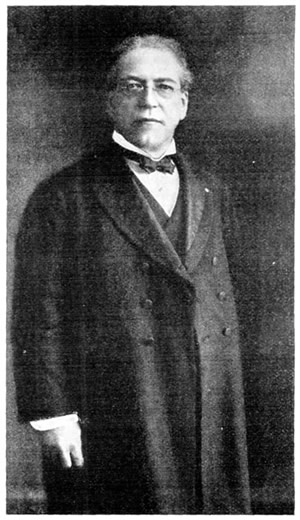
SAMUEL GOMPERS, FOR TWENTY-FIVE YEARS PRESIDENT OF THE FEDERATION OF LABOR. MR. GOMPERS DEMANDS AN AMENDMENT OF THE SHERMAN ANTI-TRUST ACT THAT WOULD MAKE LEGAL THE INTERSTATE BOYCOTT
Over the question of federal control of large combinations these five men and their colleagues debated for nearly two years. Senator Sherman introduced his first anti-trust act August 14, 1888; the present statute finally became a law on July 21, 1890. During this period six separate trust bills, all modifications of that originally introduced by Mr. Sherman, were laid before the Senate. They were considered by two committees—the Finance and the Judiciary—and debated at great length in the committee of the whole. The discussions occupy one hundred and fifty pages of the Congressional Record.
A striking illustration of the general ignorance of the circumstances under which the Sherman Act was passed is furnished by the present Republican platform. This declares that "the Republican party passed the Sherman Anti-Trust Act over Democratic opposition." The records of Congress, however, show no indications of any opposition at all, Democratic or other. Of the five men most conspicuous in framing the law, three were Republicans and two were Democrats. In the Senate only one senator voted against the passage; in the House two hundred and forty-two votes were cast in favor of the act, and not a single one was cast against it. The whole debate was notable for its seriousness and its dignity; one or two Democrats did suggest that a revision of the tariff might help to curb the trusts; but that was the only partisan note struck. Congress keenly appreciated the issues raised by the trust problem and the necessity of taking action that would be beneficial and permanent. Everybody realized, also, the inherent difficulties of the situation. The debates in the Senate on this issue, far from indicating a scrappy investigation, furnish material for a liberal education in the constitutional questions involved in dealing with monopolies. Senator Hoar, in preparation for the work, studied the history of legislation concerning monopolies from the time of Zeno. One of the sections in the bill—that providing that a successful litigant against a trust can recover three times the damages suffered from it—Mr. Hoar incorporated from a statute on monopolies passed in the reign of James I.