EDITORIAL ANNOUNCEMENT FIVE ARTICLES
Reading edition
A DISCLOSURE OF THE SECRET POLICIES OF RUSSIA
BY GENERAL KUROPATKIN
Once in a generation the intimate and vital secrets of a great nation may be made public through one of the little circle of men to whom they are entrusted; but rarely, if ever, till the men are dead, and the times are entirely changed. Beginning next month, McClure’s Magazine will present to the reading world a striking exception to this rule. It will print for the first time a frank and startling official revelation of the present political plans and purposes of Russia—the great nation whose guarded and secret movements have been the concern of modern European civilization for two centuries.
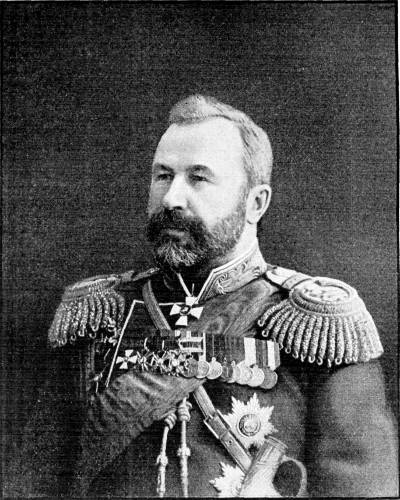
GENERAL ALEXEI NICHOLAEVITCH KUROPATKIN
General Kuropatkin—Minister of War and later Commander-in-Chief of the Russian forces in the great and disastrous Manchurian campaign—became a target for abuse at the close of the Russo-Japanese War. He returned to St. Petersburg and constructed, from the official material accessible to him, an elaborate history of the war, and a detailed statement of the condition, purposes, and development of the Russian Empire. Documents and dispatches endorsed “Strictly Confidential,” matters involving the highest officials, information obviously intended for no eyes but those of the innermost government circles, are laid forth with the utmost abandon in this work. No sooner had it been completed, than it was confiscated by the government. Its manuscript has never been allowed to pass out of the custody of the Czar’s closest advisers.
An authentic copy of this came into the hands of McClure’s Magazine this spring; it is not essential and obviously would not be wise to state just how. George Kennan, the well-known student of Russian affairs, now has it in his possession and is engaged in translating and arranging material taken from it for magazine publication. A series of five or six articles, constructed from Kuropatkin’s 600,000 words, will be issued in McClure’s, beginning next month. These will contain astonishing revelations concerning matters of great international importance, and accusations that are audacious to the point of recklessness.
LETTERS TO THE CZAR
Remarkable among these are the letters to the Czar. Kuropatkin’s correspondence with him is given in detail, documents which naturally would not appear within fifty or a hundred years from the time when they were written. And upon the letters and reports of the General appear the comments and marginal notes of the Emperor. The war was forced against the will of the sovereign and the advice of the War Department. It was ended, Kuropatkin shows, when Russia was just beginning to discipline and dispose her great forces, because of the lack of courage and firmness in the Czar.
Japan certainly would have been crushed, says Kuropatkin, if war had continued. At the time of the Treaty at Portsmouth, the military struggle, from Russia’s standpoint, had only begun. She was then receiving ammunition and supplies properly for the first time; her men were becoming disciplined soldiers; and the railroad, whose service had increased from three to fourteen military trains a day, had now, at last, brought the Russian forces into the distant field. For the first time, just when treaty negotiations were begun, Russia had more soldiers in her army than Japan. There were a million men, well equipped and abundantly supplied, under General Linevitch, who succeeded General Kuropatkin as Commander-in-Chief; and he was about to take the offensive when peace was declared.
Beyond the individual conflict General Kuropatkin shows the Russian nation, a huge, unformed giant, groping along its great borders in every direction to find the sea.
“Can an Empire,” he asks, “with such a tremendous population, be satisfied with its existing frontiers, cut off from free access to the sea on all sides?”
RUSSIA’S SECRET NATIONAL PROGRAM
There are in existence in the secret archives of the government, Kuropatkin’s work discloses, documents containing the definite program of Russia, fixed by headquarters years ago, for its future growth and aggrandizement. Results of campaigns and diplomacy are checked up according to this great program, and decade after decade Russia is working secretly and quietly to carry it out. The Japanese War constituted a great mistake in the development of this national plan.
During the twentieth century, says Kuropatkin, Russia will lose no fewer than two million men in war, and will place in the field not fewer than five million. No matter how peaceful and purely defensive her attitude may be, she will be forced into war along her endless borders by the conflict with other national interests and the age-long unsatisfied necessity of her population to reach the sea.
Russia will furnish in this century the advance guard of an inevitable conflict between the white and yellow races. For within a hundred years there must be a great struggle in Asia between the Christian and non-Christian nations. To prepare for this, an understanding between Russia and England is essential for humanity. Kuropatkin deals with this necessity at length; and the future relations of Russia with Japan and China are treated with an impressive grasp.
His exposition of the sensitive and dangerous situation on the Empire’s western border contains matters of consequence to the whole world. The relations he discloses, between Russia, on the one hand, and Austria and Germany on the other, are important in the extreme. Within a fortnight these two latter countries could throw two million men across the Russian frontier, and a war would result much more colossal than that just finished with Japan.
KUROPATKIN’S FORTY YEARS OF SERVICE
General Kuropatkin has had an education and a career which eminently qualify him as a judge and critic of the Russian nation. For forty years, as an active member of its military establishment, he has watched its development, from the viewpoint of important posts in St. Petersburg, Turkey, Central Asia, and the far East.
Kuropatkin was born in 1848 and was educated in the Palovski Military School and the Nikolaiefski Academy of the general staff in St. Petersburg. From there he went at once into the army, and, at the early age of twenty, took part in the march of the Russian expeditionary force to the central Asian city of Samarkand. He won distinction in the long and difficult march of General Skobeleff’s army to Khokand. In 1875 he acted as Russia’s diplomatic agent in Chitral, and a year or two later he headed an embassy to Kashgar and concluded a treaty with Yakub Bek.
When the Russo-Turkish War broke out in 1877, he became General Skobeleff’s chief of staff and took part in the battle of Loftcha and in many of the attacks on Plevna. While forcing the passage of the Balkans with Skobeleff’s army, on the 25th of December, 1877 (O.S.), he was so severely wounded that he had to leave the theater of war and return to St. Petersburg. There, as soon as he recovered, he was put in charge of the Asiatic Department of the Russian General Staff, and, at the same time, was made adjunct-professor of military statistics in the Nikolaiefski Military Academy. In 1879 the rank of General was conferred upon him and he was appointed to command the Turkestan rifle brigade in Central Asia. In 1880 he led a Russian expeditionary force to Kuldja, and when the trouble with the Chinese there had been adjusted, he was ordered to organize and equip a special force in the Amu Daria district and march to the assistance of General Skobeleff in the Akhal-Tekhinski oasis. After conducting this force across seven hundred versts of nearly waterless desert, he joined General Skobeleff in front of the Turkoman fortress of Geok Tepe, and in the assault upon that famous stronghold, a few weeks later, he led the principal storming column. After the Turkomen had been subdued, he returned to European Russia, and during the next eight years served on the General Staff in St. Petersburg, where he was entrusted with important strategic work. In 1890 he was made Lieutenant-General and was sent to govern the trans-Caspian region and to command the troops there stationed.
He occupied this position six or eight years, and then, shortly after his return to St. Petersburg, was appointed Minister of War. In 1902, while still holding the war portfolio, he was promoted to Adjutant-General; in 1903 he visited Japan and made the acquaintance of its political and military leaders; and in 1904, when hostilities began in the Far East, he took command of the Russian armies in Manchuria under the general direction of Viceroy Alexeieff. Besides, he has written and published three important books.
No man perhaps, is better equipped, by education and experience, to explain Russia’s plans and movements in Asia; to tell the true story of the Japanese war. And probably never, at least in this generation, has an international matter of this magnitude been treated with such frankness by a person so thoroughly and eminently qualified to discuss it.