Chapter XX · [COMPOSED BY STERN.]
Alphonse Nahuys translation
It was evening. Tine was reading in the inner gallery; and Havelaar was drawing an embroidery pattern; little Max was putting together a puzzle picture, and was getting angry because he could not find that red lady’s body.
“Will it be right so, Tine?” asked Havelaar. “See, I have made this palm a little larger … it is exactly Hogarth’s line of beauty.”
“Yes, Max! but these lace-holes are too near each other.”
“Are they? And the others?”
“Max! do let me see your trousers, … have you that stripe?”
“Ah! I remember where you embroidered that, Tine!”
“Not I—where then?”
“It was at the Hague, when Max was ill, and we were so frightened because the physician said that he had such an uncommonly shaped head, and that so much care was required to prevent congestion of the brain … then you were busy with that stripe.”
Tine went and kissed the little one.
“I have found her stomach, I have found her stomach!” cried the little boy gaily; and the red lady was complete.
“Whose bedtime is it?” asked the mother.
“Mine; but I have not yet supped,” said little Max.
“You shall have some supper first of course.”
And she rose up, and gave him his simple supper, which she seemed to have fetched out of a well-secured cupboard in her room; for the noise of many locks had been heard.
“What are you giving him?” asked Havelaar.
“Oh, don’t be uneasy! It is biscuit out of the tin box from Batavia, and the sugar too has been kept under lock and key.”
Havelaar’s thoughts turned again to the point where they had been interrupted.
“Do you know,” he continued, “that we have not yet paid that doctor’s bill?…”
“Oh! that is very hard!”
“Dear Max, we live so economically here, we shall soon be able to pay all; moreover, you will certainly soon be appointed Resident, and then all will be arranged in a little time.”
“That is exactly the thing that makes me sad,” said Havelaar. “I should be so unwilling to leave Lebak.… I will explain that to you. Don’t you believe that we loved our Max more after his illness? Now, it appears to me that I shall love poor Lebak still more, after it has recovered from the cancer from which it has suffered for so many years. The thought of promotion frightens me, and yet on the other side, when I think again that we have debts.…”
“All will be right, Max! even if you had to go from here, then you could help Lebak afterwards on being made Governor-General.”
Then came wild lines in Havelaar’s pattern——there was anger in those flowers, … those strips were sharp, angular, crossing each other.… Tine understood that she had said something wrong.
“Dear Max!” she began kindly.
“A curse on it!… Will you have them starve so long?… Can you live on sand?”
“Dear Max!…”
But he jumped up from his chair, and there was no more drawing that evening.
He went up and down in the inner gallery, and at last he spoke in a tone which would have sounded rough and hard to every stranger, but which was thought of quite differently by Tine.
“A curse on this indifference, this shameful indifference! Here I have waited a month for justice, and meanwhile the poor people are suffering terribly. The Regent seems to calculate upon nobody daring to take it up against him—look.…”
He went into his office, and came back with a letter in his hand—a letter which lies before me, reader!
“Look, in this letter, he dares to make me proposals about the kind of labour which he intends to have done by men whom he has summoned unlawfully … is not that shamelessness going too far? And do you know who these persons are? They are women with little children, with sucklings; women who are pregnant, who have been driven from Parang-Koodjang to the capital, to work for him——there are no more men! And they have nothing to eat, and they sleep on the road, and eat sand.… Can you eat sand? Must they eat sand till I am Governor-General?
“Curse it!…”
Tine knew very well with whom alone Max was angry, when he spoke thus to her whom he loved.
“And,” continued Havelaar, “that is all on my responsibility. If at this moment some of these poor creatures are wandering there outside, and seeing the light of our lamps, will say: ‘There lives the wretch who ought to protect us; there he sits quietly with wife and child, and draws embroidery patterns, while we lie here like dogs on the road, and starve with our children!’ Yes, I hear it, I hear it; that cry for vengeance upon my head! … here, Max, here!…”
And he kissed the child with a wildness which frightened it.
“My child, if they tell you that I am a wretch, who had no courage to do justice, that so many mothers have died by my fault; if they tell you that the neglect of your father stole away the bliss of your life … Max, bear witness how I suffered!”
And he burst into tears, which Tine kissed away. Then she put little Max to bed—a mat of straw—and when she returned found Havelaar in conversation with Verbrugge and Duclari, who had just come in. The conversation was about the expected decision of the Government.
“I understand very well that the Resident is in a difficult position,” said Duclari. “He cannot advise the Government to accept your proposals, for then too much would be brought to light. I have been long in Bantam, and know much about it,—more than you, Mr. Havelaar! I was here as sub-lieutenant, and in that position one hears things that the native does not dare to tell the functionaries. But if now, after an open investigation, all this comes to light, the Governor-General will summon the Resident to account for it, and ask him how it is that he has not discovered in two years what was obvious to you immediately? He must, therefore, prevent that investigation.
“I have considered that,” replied Havelaar, “and put on my guard by his endeavours to move the Regent to say something against me, which seems to show that he will try to remove the question, for instance, by accusing me of … I know not what; I have covered myself against that by sending copies of my letters direct to the Government. In one of these letters, I beg to be called to account, if perhaps it should be pretended that I had done something wrong. If, now, the Resident of Bantam attacks me, no decision can be made, according to justice, before I have been heard—that is allowed even to a criminal—and I have done nothing wrong.…”
“There is the post!” said Verbrugge.
Yes, it was the post!—the post that brought the following letter from the Governor-General of the Dutch Indies to Havelaar, late Assistant Resident of Lebak:—
“Official.—No. 54.
“Buitenzorg, 23d March 1856.
“The manner in which you have acted on the discovery or supposition of wrong-doing on the part of the chiefs in the district of Lebak, and your attitude towards your superior, the Resident of Bantam, have excited, in a high degree, my displeasure. In your acts there is not only a want of the deliberate judgment, caution, and prudence so indispensable to a functionary intrusted with power in the interior of Java (sic), but also notions of insubordination to your immediate superior. Only a few days after your appointment to your present office, you made the head of the native Government of Lebak the subject of irritating examinations, without first consulting (sic) the Resident. In these examinations you found cause, without substantiating your accusations against that chief by facts (sic), much less by proofs, to make proposals which tended to subject a native functionary of the rank of the Regent of Lebak (a man of sixty years, but still a zealous servant, related to neighbouring influential Regents, and of whom favourable testimony has always been given) to a morally quite annihilating treatment. Moreover, you have, when the Resident did not feel inclined to give his consent to your proposals, refused to satisfy the just desire of your superior, that you should say openly what you knew of the actions of the native Government of Lebak.
“Such conduct merits all disapprobation, and sanctions belief in your incapacity to bear office in the interior Government of Java. I am therefore obliged to dismiss you from your employment as Assistant Resident of Lebak.
“Yet, in consideration of the favourable reports received formerly of you, I have not found cause to deprive you of the prospect of again getting a situation in the Government of the interior. I have therefore given you the temporary appointment of Assistant Resident of Ngawie. On your behaviour in this office, it will entirely depend whether you remain a functionary in the service of the Government.”
And beneath that stood the name of the man on whose “zeal, capacity, and good faith,” the King said that he could rely, when he signed his appointment as Governor-General of the Dutch Indies.
“We go from here, dear Tine,” said Havelaar; and he gave the letter to Verbrugge, who read the document with Duclari.
Verbrugge had tears in his eyes, but did not speak. Duclari, a very polite and well-bred man, burst out with a wild curse.
“G——, I have seen rogues and thieves in the Government here, … they have gone from here with honours, and to you they write such a letter!”
“It is nothing,” said Havelaar; “the Governor-General is an honest man, … he must be deceived; though he could have guarded himself against that deceit, by first hearing me. But I will go to him, and show him how matters stand here … he will do justice, I am certain of it.”
“But if you go to Ngawie.…”
“I know this for certain. The Regent of Ngawie is related to the Regent of Bantam. I should have to do the same at Ngawie that I have done here: that would be a useless journey.
“Moreover, it was impossible for me to serve the trial as if I had behaved ill … and, finally, I see that to put an end to all this deceit, I can no longer be a functionary. As functionary, there are too many persons between me and the Government who have an interest in denying the misery of the population. There are other reasons that prevent me from going to Ngawie. There was no vacancy there; there has been one made for me——Look here!”
And he showed in the Javanese newspaper, which had come by the same post, that indeed, in the same decree of the Government whereby he was appointed Assistant Resident of Ngawie, the Assistant Resident of that place was appointed to another district where there was a vacancy.
“Do you know why I have to go to Ngawie, and not to the district where there was a vacancy?
“I will tell you——the Resident of Madioen, to which Ngawie belongs, is the brother-in-law of the late Resident of Bantam. I have said that such scandalous things went on here,——that the Regent had had such bad examples.…”
“Ah,” cried Verbrugge and Duclari at the same time. They understood why Havelaar was transferred to Ngawie in particular, to be tried if he would perhaps correct himself.
“Dear Max!”
“You have courage, have you not?”
“Max! you know I have courage when I am with you.”
“Good!”
He went and wrote the following, in his own opinion an example of eloquence:—
“Rankas-Betong, 29th March 1856.
“To the Governor-General of the Dutch Indies.
“I have had the honour to receive the official letter of your Excellency of the 23d inst., No. 54. In reply to that document, I feel constrained to beg your Excellency to grant me an honourable discharge from the service of the Government.
(Signed) “Max Havelaar.”
It needed not so long a time at Buitenzorg to grant the asked-for discharge, as was needed to decide how Havelaar’s accusation could be turned away. For the latter a month was required, and the news of the discharge arrived in a few days at Lebak.
“God be praised,” said Tine, “that you can be your own self at last.”
Havelaar received no instructions to surrender the Government to Verbrugge; he therefore awaited his successor. The latter was a long time in coming, because he had to travel from a remote corner of Java. After waiting three weeks, the ex-officio Assistant Resident of Lebak, who had, however, still acted as such, wrote the following letter to the Controller Verbrugge:—
“No. 153.
“Rankas-Betong, 15th April 1856.
“To the Controller of Lebak.
“You know that I have received at my own request an honourable discharge from the service of the Government by decree of 4th inst., No. 4. Perhaps I should have acted rightly, if, on the receipt of this decree, I had resigned my office of Assistant Resident immediately; as it seems to be an anomaly to fulfil a function without being a functionary.
“Yet I received no instructions to surrender my office, and partly from the idea of the obligation not to leave my post without being duly relieved, partly from causes of subordinate interest, I waited for the arrival of my successor, thinking that that functionary would arrive soon, at least this month.
“I had once promised to betray nobody to the rancour of his chiefs;—once I had, imprudently enough, given my word for the justice of the Government.
“The poor population could not know that this promise and this bail had been denied, and that I, poor and impotent, stood alone with my desire for justice and humanity.
“And people went on complaining. It was painful, after the receipt of the missive of 23d March, to sit there as a supposed refuge, as a powerless protector.
“It was heart-rending to hear the complaints of ill-treatment, extortion, poverty, hunger, whilst I myself had, with a wife and child, to meet hunger and poverty!
“Neither could I betray the Government. I might not say to these poor people: ‘Go and suffer, for it is the will of the Government that you should suffer extortion.’ I might not avow my impotence, one as it was with the shame and unconscionableness of the Governor-General’s counsellors.
“Here is what I replied:
“ ‘I cannot help you immediately, but I will go to Batavia; I will speak to the Governor about your misery. He is just, and he will assist you. Go now quietly to your home; do not oppose, do not remove—wait patiently: I think, … I hope that justice will be done!’
“So I thought, ashamed as I was of the violation of my promise of help, to bring my ideas in harmony with my duty to the Government, which pays me still this month, and I would have continued thus till the arrival of my successor, if a particular occurrence had not obliged me to-day to put an end to this equivocal position. Seven persons had complained. I gave them the above-mentioned reply. They returned to their homes. The district chief met them on the way. He must have forbidden them to leave their village again, and taken away (as I am told) their clothes, to oblige them to remain at home. One of them escaped, came to me again and declared ‘that he did not dare to return to his village.’
“What I ought to reply to this man, I did not know.
“I could not protect him;——I might not avow my impotence; I would not prosecute the accused chief, because this would have appeared as if the matter had been picked up by me, pour le besoin de ma cause I did not know what to do.…
“I charge you, until further instructions from the Resident of Bantam, with the Government of the district of Lebak, from to-morrow morning.—The Assistant Resident of Lebak,
(Signed) “Max Havelaar.”
Then Havelaar departed with wife and child from Rankas-Betong. He refused all escort. Duclari and Verbrugge were deeply touched at the leave-taking. Max was likewise moved; above all, when he found at the first stage a great number of persons who had gone secretly from Rankas-Betong to bid him a last farewell.
At Serang, the family was received into the house of Mr. Slymering, with the ordinary Indian hospitality.
In the evening many visitors came to the Resident. They said they had come to say farewell to Havelaar, and Havelaar received many an eloquent shake of the hand.…
But he had to go to Batavia to speak to the Governor-General.
When they arrived there, he sought for an audience. This was refused him, because his Excellency had a pain in his foot.
Havelaar waited till the foot was cured. Then he again sought an audience.
His Excellency “had so much to do that he had been obliged to refuse an audience even to the Director-General of Finance, and could not see Havelaar.”
Havelaar waited till his Excellency should have struggled through all this; meanwhile he felt something like jealousy for the persons who had to help his Excellency in his labour, for he liked to work quickly and hard, and generally so much business disappeared under his hand. This was, however, out of the question. Havelaar’s labour was heavier than labour.… He waited.
He waited. At last he again sought an audience. He received an answer that his Excellency could not see him, as he had too much to do, being on the point of departure.
Max sought the favour of his Excellency to be heard for half-an-hour as noon as there should be some space between two “businesses.”
At last he heard that his Excellency would depart the next day! That was a thunderbolt for him. Still he believed with spasmodic energy that the resigning Governor was an honest man, and had been deceived. A quarter of an hour would have sufficed to prove the justice of his cause, and it appeared that this quarter of an hour would not be granted him.
I find among Havelaar’s papers the copy of a letter which he seems to have written to the retiring Governor-General, on the last evening before his departure to the mother country. In the corner I find the words written in pencil “not exact,” which gives me to understand that some phrases were changed in copying. I make this observation in order that no doubt may arise regarding the authenticity of the other official documents which I have communicated, and which have all been signed by another hand for exact copy; I mention this, because of the want of literal conformity with this document. Perhaps he to whom this letter was addressed may feel inclined to make public the exact text; then one may see how far Havelaar deviated from this copy.
“Batavia, 23d May 1856.
“Your Excellency,—My official request, by missive of 28th February, to be heard on the affairs of Lebak, has remained unanswered.
“Neither has your Excellency thought fit to grant my repeated request for an audience.
“A functionary, who was ‘favourably known to the Government’ (I quote your Excellency’s own words),—one who has served his country in these regions for seventeen years,—one who not only never neglected his duty, but who conceived what was good with unexampled self-sacrifice, and who chose to sacrifice all for honour and duty,—such a one your Excellency has placed beneath the criminal, for the criminal is at least heard.
“That they have deceived your Excellency with regard to me, I understand,—but that your Excellency did not catch the opportunity to escape from this deceit, I do not understand. To-morrow your Excellency goes from here, and I may not let you depart without having said once more that I did my duty,—only my duty,—with judgment, with calmness, with humanity, with moderation, and with courage.
“The grounds on which is based the censure contained in your Excellency’s missive of 23d March are entirely invented and false. I can prove this, and it would have been proved already, if your Excellency had granted me half-an-hour’s interview, if your Excellency could have found half-an-hour to do justice.
“This you could not; and an honest family has been ruined.
“Yet I do not complain of this.
“But your Excellency has sanctified the system of abuse of power, of plunder and murder, by which the poor Javanese suffer, and I complain of that.
“That is what I complain of!
“Your Excellency, blood cleaves to the money saved out of the Indian salary thus earned! Once more I beg for a moment’s interview, be it this night, be it early to-morrow! And again I do not ask this for myself, but for the cause which I defend, the cause of justice and humanity, which is, at the same time, the cause of good policy.
“If your Excellency can reconcile it with your conscience, to depart from here without hearing me, mine will be quiet in the persuasion that I have endeavoured all that I could to prevent the sad bloody events, which will soon be the consequence of the self-willed ignorance in which the Government is left as regards the population.…
(Signed) “Max Havelaar.”
Havelaar waited that evening. He waited the whole night. He had hoped that perhaps anger at the tone of his letter would bring about what he had tried in vain to obtain by moderation and patience.
His hope was vain. The Governor-General departed without having heard Havelaar.…
Another Excellency had retired to the mother country to rest!
Havelaar wandered about poor and neglected. He sought * * * * * * *
Enough, my good Stern! I, Multatuli, take up the pen. You are not called upon to write Havelaar’s biography. I created you: I brought you over from Hamburg: I taught you good Dutch in a very short time: I made you kiss Louise Rosemeyer, of the Rosemeyers, who trade in sugar … it is enough,——Stern! you may go.
“This Shawlman and his wife.…”
Stop!! miserable spawn of dirty covetousness and blasphemous hypocrisy! I created you:——you have grown into a monster under my pen:——I am disgusted with my own creation … choke yourself with coffee and begone!
Yes, I, Multatuli, “who have suffered much,”——I take the pen. I do not make any excuses for the form of my book,——that form was thought proper to obtain my object. That object has a double end——
In the first place, I would bring forward something which may be preserved as a holy poosaka by “little Max” and his sister, when their parents have died of sheer want.——I would give to these children a testimonial from my own hand.
And in the second place, I will be read! Yes, I will be read! I will be read by statesmen, who are obliged to pay attention to the signs of the times; by men of letters, who must also peep into the book of which so many bad things are said; by merchants, who have an interest in the coffee-auctions; by lady’s-maids, who read me for a few farthings; by Governors-General in retirement; by Ministers who have something to do; by the lackeys of these Excellencies; by mutes, who, “more majorum,” will say that I attack God Almighty, where I attack only the god which they made according to their own image; by the members of the Representative Chambers, who must know what happens in the extensive possessions over the sea, which belong to Holland.…
Ay, I shall be read!
When I obtain this I shall be content. For I did not intend to write well.… I wished to write so as to be heard, and, as one who cries “Stop thief!” does not care about the style of his impromptu address to the public, I too am indifferent to criticism of the manner in which I cried my “Stop thief!”——
“The book is a medley; there is no order, nothing but a desire to make a sensation. The style is bad; the author is inexperienced; no talent, no method.”…
Good! good!… all very well!… but the Javanese are ill-treated!
For, the merit of my book is this:—that refutation of its main features is impossible. And the greater the disapprobation of my book, the better I shall be pleased, for the chance of being heard will be so much the greater;—and that is what I desire.
But you, whom I dare to interrupt in your business, or in your retirement, ye Ministers and Governors-General—do not calculate too much upon the inexperience of my pen. I could exercise it, and perhaps, by dint of some exertions, attain to that skill which would make the truth heard by the people. Then I should ask of that people a place in the Representative Chambers, were it only to protest against the certificates which are given vice versa by Indian functionaries.
To protest against the endless expeditions sent, and heroic deeds performed against poor, miserable creatures, whose ill-treatment has driven them to revolt.
To protest against the cowardice of general orders, that brand the honour of the nation, by invoking public charity on behalf of the victims of inveterate piracy.
It is true those rebels were reduced by starvation to skeletons, while those pirates could defend themselves.
And if that place were refused me, … if I were still disbelieved.…
Then I should translate my book into the few languages that I know, and the many that I yet can learn, to put that question to Europe, which I have in vain put to Holland.
And in every capital such a refrain as this would be heard: “There is a band of robbers between Germany and the Scheldt!”
And if this were of no avail?…
Then I should translate my book into Malay, Javanese, Soondanese, Alfoer, Boegi, and Battah.
And I should sharpen Klewangs, the scimitars and the sabres, by rousing with warlike songs the minds of those martyrs whom I have promised to help——I Multatuli would do this!
Yes! delivery and help, lawfully if possible;—lawfully with violence, if need be.
And that would be very pernicious to the coffee auctions of the Dutch Trading Company!
For I am no fly-rescuing poet, no soft dreamer, like the down-trodden Havelaar, who did his duty with the courage of a lion, and endured starvation with the patience of a marmot in winter.
This book is an introduction.…
I shall increase in strength and sharpness of weapons, according as it may be necessary.
Heaven grant that it may not be necessary!…
No, it will not be necessary! For it is to thee I dedicate my book: William the Third, King, Grand Duke, Prince, … more than Prince, Grand Duke and King, … Emperor of the magnificent empire of Insulind, which winds about the equator like a garland of emeralds!…
I ask Thee if it be thine Imperial will that the Havelaars should be bespattered with the mud of Slymerings and Drystubbles; and that thy more than thirty millions of Subjects far away should be ill-treated and should suffer extortion in THY name?
EDINBURGH: T. CONSTABLE, PRINTER TO THE QUEEN, AND TO THE UNIVERSITY.
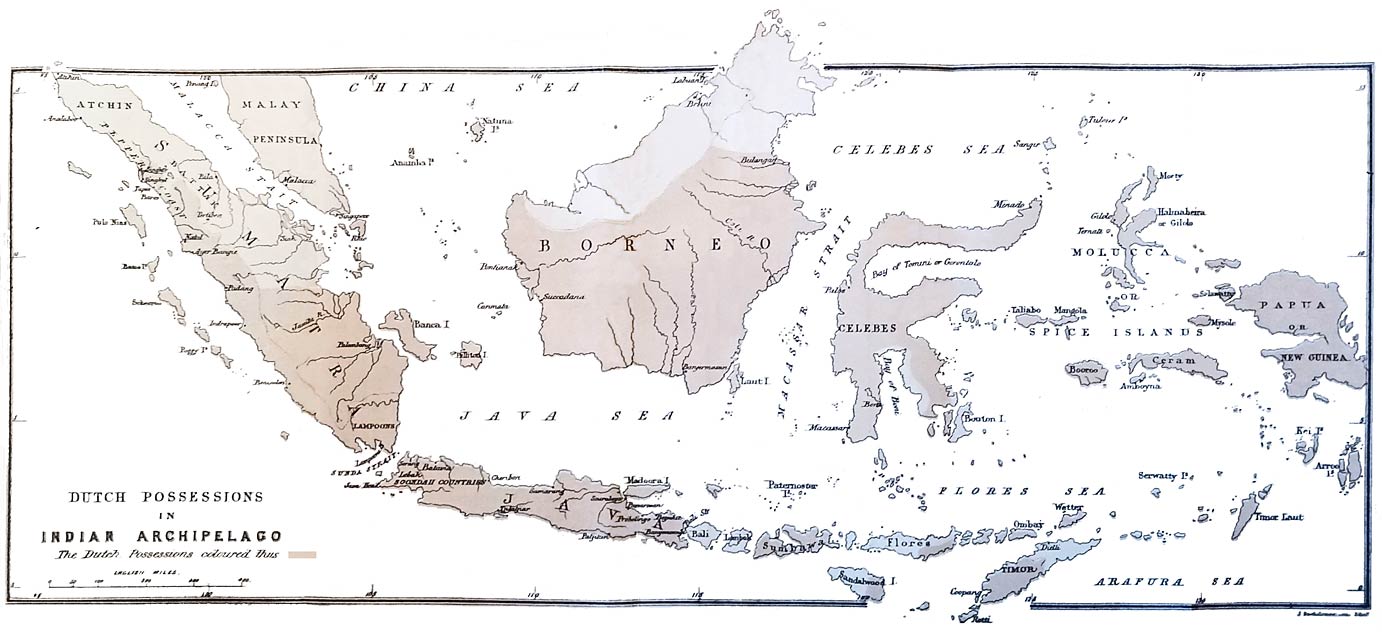
DUTCH POSSESSIONS IN INDIAN ARCHIPELAGO
The Dutch Possessions coloured thus
88 Princes Street, Edinburgh.
EDMONSTON & DOUGLAS’
LIST OF WORKS
————oOo————
Wanderings of a Naturalist in India,
The Western Himalayas, and Cashmere. By Dr. A. L. ADAMS, of the 22d Regiment. 1 vol. 8vo, with illustrations, price 10s. 6d.
A Short American Tramp in the fall of 1864.
By the Editor of ‘Life in Normandy.’ 8vo, price 12s.
Memoir of Lieutenant-General Sir Ralph Abercromby, K. B.,
1793–1801. By his Son JAMES LORD DUNFERMLINE. 8vo, price 10s. 6d.
Essays and Tracts:
The Culture and Discipline of the Mind, and other Essays. By JOHN ABERCROMBIE, M. D., Late First Physician to the Queen for Scotland. New Edition. Fcap. 8vo, cloth, 3s. 6d.
The Malformations, Diseases, and Injuries of the Fingers and Toes, and their Surgical Treatment.
By THOMAS ANNANDALE, F. R. C. S., Assistant Surgeon, Royal Infirmary, Edinburgh. The Jacksonian Prize for the Year 1864. 1 vol. 8vo, with Illustrations, price 10s. 6d.
Odal Rights and Feudal Wrongs.
A Memorial for Orkney. By DAVID BALFOUR of Balfour and Trenaby. 8vo, price 6s.
Basil St. John.
An Autumn Tale. 1 vol. 8vo, price 12s.
By the Loch and River Side.
Forty Graphic Illustrations by a New Hand. Oblong folio, handsomely bound, 21s.
Aunt Ailie.
Second Edition. By CATHARINE D. BELL, Author of ‘Cousin Kate’s Story,’ ‘Margaret Cecil,’ etc. Fcap. 8vo, cloth, 8s. 6d.
Charlie and Ernest; or, Play and Work.
A Story of Hazlehurst School, with Four Illustrations by J. D. By M. BETHAM EDWARDS. Royal 16mo, 8s. 6d.
Homer and the Iliad.
In three Parts. By JOHN STUART BLACKIE, Professor of Greek in the University of Edinburgh. In 4 vols. demy 8vo, price 42s.
Part I.— Homeric Dissertations.
II.— The Iliad in English Verse.
III.— Commentary, Philological and Archæological.
By the same Author.
On Democracy.
A Lecture delivered to the Working Men’s Institute, Edinburgh. Sixth Edition, price 1s.
On Beauty.
Crown 8vo, cloth, 8s. 6d.
Lyrical Poems.
Crown 8vo, cloth, 7s. 6d.
On Greek Pronunciation.
Demy 8vo, 3s. 6d.
Memoirs of the Life, Writings, and Discoveries of Sir Isaac Newton.
By Sir DAVID BREWSTER, K. H., A. M., LL. D., D. C. L., F. R. S., etc., etc. With Portraits. New and Cheaper Edition, 2 vols. fcap. 8vo, cloth, 12s.
Works by Margaret Maria Gordon (neè Brewster).
Lady Elinor Mordaunt; or, Sunbeams in the Castle. Crown 8vo, cloth, 9s.
Letters From Cannes and Nice. Illustrated by a Lady. 8vo, cloth, 12s.
Work; or, Plenty to do and How to do it. Thirty-fourth thousand. Fcap. 8vo, cloth, 2s. 6d.
Little Millie and her Four Places. Cheap Edition. Fiftieth thousand. Limp cloth, 1s.
Sunbeams in the Cottage; or, What Women may do. A narrative chiefly addressed to the Working Classes. Cheap Edition. Forty-first thousand. Limp cloth, 1s.
Prevention; or, An Appeal to Economy and Common-Sense. 8vo, 6d.
The Word and the World. Price 2d.
Leaves of Healing for the Sick and Sorrowful. Fcap. 4to, cloth, 3s. 6d. Cheap Edition, limp cloth, 2s.
The Motherless Boy; with an Illustration by J. Noel Paton, R. S. A. Cheap Edition, limp cloth, 1s.
France under Richelieu and Colbert.
By J. H. BRIDGES, M.B., late Fellow of Oriel College, Oxford. In 1 vol. small 8vo, price 8s. 6d.
Memoirs of John Brown, D.D.
By the Rev. J. CAIRNS, D.D., Berwick, with Supplementary Chapter by his Son, John Brown, M.D. Fcap. 8vo, cloth, 9s. 6d.
Works by John Brown, M.D., F.R.S.E.
Locke and Sydenham, with other Professional Papers. By JOHN BROWN, M.D. A New Edition in 1 vol. extra fcap. 8vo, price 7s. 6d.
Horæ Subsecivæ. Sixth Edition, in 1 vol. extra fcap. 8vo, price 7s. 6d.
Letter to the Rev. John Cairns, D.D. Second Edition, crown 8vo, sewed, 2s.
Arthur H. Hallam; Extracted from ‘Horæ Subsecivæ.’ Fcap. sewed, 2s.; cloth, 2s. 6d.
Rab and his Friends; Extracted from ‘Horæ Subsecivæ.’ Thirty-fifth thousand. Fcap. sewed, 6d.
Marjorie Fleming: A Sketch. Fifteenth thousand. Fcap. sewed, 6d.
Our Dogs; Extracted from ‘Horæ Subsecivæ.’ Nineteenth thousand. Fcap. sewed, 6d.
Rab and his Friends. With Illustrations by George Harvey, R.S.A., J. Noel Paton, R.S.A., and J. B. New Edition, small quarto, cloth, price 3s. 6d.
“With Brains, Sir;” Extracted from ‘Horæ Subsecivæ.’ Fcap. sewed, 6d.
Minchmoor. Fcap. sewed, 6d.
Jeems the Doorkeeper: A Lay Sermon. Price 6d.
The Enterkin. Price 6d.
Lectures on the Atomic Theory, and Essays, Scientific and Literary.
By SAMUEL BROWN. 2 vols., crown 8vo, cloth, 15s.
The Biography of Samson
Illustrated and Applied. By the Rev. JOHN BRUCE, D.D., Minister of Free St. Andrew’s Church, Edinburgh. Second Edition. 18mo, cloth, 2s.
My Indian Journal,
Containing descriptions of the principal Field Sports of India, with Notes on the Natural History and Habits of the Wild Animals of the Country—a visit to the Neilgherry Hills, and the Andaman and Nicobar Islands. By Colonel WALTER CAMPBELL, author of ‘The Old Forest Ranger.’ 8vo, with Illustrations, price 16s.
Popular Tales of the West Highlands,
Orally Collected, with a translation by J. F. CAMPBELL. 4 vols., extra fcap., cloth, 32s.
Inaugural Address at Edinburgh,
April 2, 1866, by THOMAS CARLYLE, on being Installed as Rector of the University there. Price 1s.
Book-keeping,
Adapted to Commercial and Judicial Accounting, giving Systems of Book-keeping for Lawyers, Factors and Curators, Wholesale and Retail Traders, Newspapers, Insurance Offices, and Private House-keeping, etc By F. H. CARTER, C.A. 8vo, cloth, price 10s.
Characteristics of Old Church Architecture, etc.,
In the Mainland and Western Islands of Scotland. 4to, with Illustrations, price 25s.
Ballads from Scottish History.
By NORVAL CLYNE. Fcap. 8vo, price 6s.
Life and Works of Rev. Thomas Chalmers, D.D., LL.D.
Memoirs of the Rev. Thomas Chalmers. By Rev. W. Hanna, D.D., LL.D. 4 vols., 8vo, cloth, £2: 2s.
—— Cheap Edition, 2 vols., crown 8vo, cloth, 12s.
Posthumous Works, 9 vols., 8vo—
Daily Scripture Readings, 3 vols., £1:11:6. Sabbath Scripture Readings, 2 vols., £1:1s Sermons, 1 vol, 10s. 6d. Institutes of Theology, 2 vols., £1:1s. Prelections on Butler’s Analogy, etc., 1 vol, 10s. 6d.
Sabbath Scripture Readings. Cheap Edition, 2 vols., crown 8vo, 10s.
Daily Scripture Readings. Cheap Edition, 2 vols., crown 8vo, 10s.
Astronomical Discourses, 1s. Commercial Discourses, 1s.
Select Works, in 12 vols., crown 8vo, cloth, per vol., 6s.
Lectures on the Romans, 2 vols. Sermons, 2 vols. Natural Theology, Lectures on Butler’s Analogy, etc., 1 vol. Christian Evidences, Lectures on Paley’s Evidences, etc., 1 vol. Institutes of Theology, 2 vols. Political Economy; with Cognate Essays, 1 vol. Polity of a Nation, 1 vol. Church and College Establishments, 1 vol. Moral Philosophy, Introductory Essays, Index, etc., 1 vol.
‘Christopher North;’
A Memoir of John Wilson, late Professor of Moral Philosophy in the University of Edinburgh. Compiled from Family Papers and other sources, by his daughter, Mrs. GORDON. Third Thousand. In 2 vols. crown 8vo, price 24s., with Portrait, and graphic Illustrations.
Chronicle of Gudrun;
A Story of the North Sea. From the mediæval German. By EMMA LETHERBROW. With frontispiece by J. Noel Paton, R.S.A. New Edition for Young People, price 5s.
Of the Light of Nature,
A Discourse by NATHANIEL CULVERWELL, M.A. Edited by John Brown, D.D., with a critical Essay on the Discourse by John Cairns, D.D. 8vo, cloth, 12s.
Dainty Dishes.
Receipts collected by Lady HARRIET ST. CLAIR. Sixth edition, with many new Receipts. 1 vol. crown 8vo. Price 7s. 6d.
“Well worth buying, especially by that class of persons who, though their incomes are small, enjoy out-of-the-way and recherché delicacies.”—Times.
The Annals of the University of Edinburgh.
By ANDREW DALZEL, formerly Professor of Greek in the University of Edinburgh; with a Memoir of the Compiler, and Portrait after Raeburn. In 2 vols. demy 8vo, price 21s.
Gisli the Outlaw.
From the Icelandic. By G. W. DASENT, D.C.L. 1 vol. small 4to, with Illustrations, price 7s. 6d.
The Story of Burnt Njal;
Or, Life in Iceland at the end of the Tenth Century. From the Icelandic of the Njals Saga. By GEORGE WEBBE DASENT, D.C.L. In 2 vols. 8vo, with Map and Plans, price 28s.
Popular Tales from the Norse,
With an Introductory Essay on the origin and diffusion of Popular Tales. Second Edition, enlarged. By GEORGE WEBBE DASENT, D.C.L. Crown 8vo, 10s. 6d.
Select Popular Tales from the Norse.
For the use of Young People. By G. W. DASENT, D.C.L. New Edition, with Illustrations. Crown 8vo, 6s.
On the Application of Sulphurous Acid Gas
to the Prevention, Limitation, and Cure of Contagious Diseases. By JAMES DEWAR. M.D. Eighth edition, price 1s.
The Fifty Years’ Struggle of the Scottish Covenanters,
1638–88. By JAMES DODDS. Third Edition, fcap., cloth, 6s.
The Last Years of Mary of Lorraine,
1557 to 1560. By JAMES DODDS, author of ‘The Fifty Years’ Struggle of the Scottish Covenanters.’
Memoir of Thomas Drummond, R.A., F.R.A.S.,
Under-Secretary to the Lord-Lieutenant of Ireland, 1835 to 1840. By JOHN F. M’LENNAN, M.A. 1 vol. demy 8vo, price 15s.
Studies in European Politics.
By M. E. GRANT DUFF, Member for the Elgin District of Burghs. 1 vol. 8vo. Price 10s. 6d.
“We have no hesitation in saying that there is no work in the English Language which has anything like the same value to persons who wish to understand the recent history and present position of the countries described.”—Saturday Review.
Inaugural Address
Delivered to the University of Aberdeen, on his Installation as Rector, March 22, 1867, by MOUNTSTUART E. GRANT DUFF, Member for the Elgin District of Burghs. Price 1s.
Notes on Scotch Bankruptcy Law and Practice.
By GEORGE AULDJO ESSON, Accountant in Bankruptcy in Scotland. Second edition, price 2s. 6d.
Karl’s Legacy.
By the Rev. J. W. EBSWORTH, 2 vols, ex. fcap. 8vo. Price 6s. 6d.
Social Life in Former Days;
Chiefly in the Province of Moray. Illustrated by letters and family papers. By E. DUNBAR DUNBAR, late Captain 21st Fusiliers. 2 vols, demy 8vo., price 10s. 6d.
Veterinary Medicines; their Actions and Uses.
By FINLAY DUN. Third Edition, revised and enlarged. 8vo, price 12s.
The Story of Waldemar Krone’s Youth.
A Novel. By H. F. EWALD. 2 vols. crown 8vo, price 16s.
The Secret of Happiness.
A Novel By ERNEST FEYDEAU. 2 vols. fcap. 8vo, price 7s.
Forest Sketches.
Deer-stalking and other Sports in the Highlands fifty years ago. 8vo, with Illustrations by Gourlay Steell, price 16s.
L’Histoire d’Angleterre. Par M. LAMÉ FLEURY. 18mo, cloth, 2s. 6d.
L’Histoire de France. Par M. LAMÉ FLEURY. 18mo, cloth, 2s. 6d.
Christianity viewed in some of its Leading Aspects.
By Rev. A. L. R. FOOTE, Author of ‘Incidents in the Life of our Saviour.’ Fcap., cloth, 3s.
Frost and Fire;
Natural Engines, Tool-Marks, and Chips, with Sketches drawn at Home and Abroad by a Traveller. Re-issue, containing an additional Chapter. In 2 vols. 8vo, with Maps and numerous Illustrations on Wood, price 21s.
“A very Turner among books, in the originality and delicious freshness of its style, and the truth and delicacy of the descriptive portions. For some four-and-twenty years he has traversed half our northern hemisphere by the least frequented paths; and everywhere, with artistic and philosophic eye, has found something to describe—here in tiny trout-stream or fleecy cloud, there in lava-flow or ocean current, or in the works of nature’s giant sculptor—ice.”—Reader.
Clinical Medicine.
Observations recorded at the Bedside, with Commentaries. By W. T. GAIRDNER, M.D., Professor of the Practice of Physic in the University of Glasgow. 8vo, 742 pp., with numerous Engravings on wood, 12s. 6d.
By the same Author.
Medicine and Medical Education. 12mo, cloth, price 2s. 6d.
Clinical and Pathological Notes on Pericarditis. 8vo, sewed, price 1s.
A Girl’s Romance.
1 vol. ex. fcap. cloth, price 6s.
Camille.
By MADAME DE GASPARIN, Author of ‘The Near and Heavenly Horizons.’ 1 vol. fcap. 8vo, price 3s. 6d.
By the Seaside.
By MADAME DE GASPARIN, Author of ‘The Near and Heavenly Horizons.’ 1 vol. fcap. 8vo, price 3s. 6d.
Great Harefield.
A new Novel by a new Writer. 1 vol. small 8vo, price 12s.
“A book with a great deal of cleverness in it. Nearly all the satirical touches—and they sparkle everywhere—are keen, truthful, and brilliant.”—Star.
An Ecclesiastical History of Scotland,
From the Introduction of Christianity to the Present Time. By GEORGE GRUB, A.M. In 4 vols. 8vo, 42s. Fine Paper Copies, 52s. 6d.
The Earlier Years of our Lord’s Life on Earth.
By the Rev. WILLIAM HANNA, D.D., LL.D. Extra fcap. 8vo, price 5s.
The Ministry in Galilee.
By the Rev. WILLIAM HANNA, D.D., LL.D. 1 vol. ex. fcap. 8vo.
The Last Day of our Lord’s Passion.
By the Rev. WILLIAM HANNA, D.D., LL.D. 46th thousand, extra fcap. 8vo, price 5s.
The Forty Days after our Lord’s Resurrection.
By the Rev. WILLIAM HANNA, D.D., LL.D. Extra fcap. 8vo, price 5s.
The Passion Week.
By the Rev. WILLIAM HANNA, D.D., LL.D. Extra fcap. 8vo, price 5s.
The Healing Art, the Right Hand of the Church;
Or, Practical Medicine an Essential Element in the Christian System. Crown 8vo cloth, price 5s.
Hidden Depths.
2 vols. crown 8vo, price 21s.
“This book is not a work of fiction, in the ordinary acceptation of the term: if it were, it would be worse than useless, for the hidden depths, of which it reveals a glimpse, are not fit subjects for a romance.”—Preface.
Notes of a Cruise of H.M.S. ‘Fawn’
In the Western Pacific in the year 1862. By T. H. HOOD. Demy 8vo, with numerous Illustrations from Photographs, price 15s.
Homely Hints from the Fireside.
By the author of ‘Little Things.’ Cheap Edition, limp cloth, 1s.
Herminius.
A Romance. By I. E. S. In 1 vol. fcap. 8vo, price 6s.
Sketches of Early Scotch History.
By COSMO INNES, F.S.A., Professor of History in the University of Edinburgh.
1. The Church; its Old Organisation, Parochial and Monastic 2. Universities. 3. Family History. 8vo, price 16s.
Concerning some Scotch Surnames.
By COSMO INNES, F.S.A., Professor of History in the University of Edinburgh. 1 vol. small 4to, cloth antique, 5s.
Death Scenes of Scottish Martyrs.
By HENRY INGLIS. Square 12mo, cloth, price 6s.
The New Picture Book.
Pictorial Lessons on Form, Comparison, and Number, for Children under Seven Years of Age. With Explanations by NICHOLAS BOHNY. 36 oblong folio coloured Illustrations. Price 7s. 6d.
Instructive Picture Books.
Folio, 7s. 6d. each.
“These Volumes are among the most instructive Picture-books we have seen, and we know of none better calculated to excite and gratify the appetite of the young for the knowledge of nature.”—Times.
I.
The Instructive Picture Book. A few Attractive Lessons from the Natural History of Animals. By ADAM WHITE, late Assistant, Zoological Department, British Museum. With 58 folio coloured Plates. Seventh Edition, containing many new Illustrations by Mrs. Blackburn, J. Stewart, Gourlay Steell, and others.
II.
The Instructive Picture Book. Lessons from the Vegetable World. By the Author of ‘The Heir of Redclyffe,’ ‘The Herb of the Field,’ etc. Arranged by Robert M. Stark, Edinburgh. New Edition, with many New Plates.
III.
Instructive Picture Book. The Geographical Distribution of Animals, in a Series of Pictures for the use of Schools and Families. By the late Dr. Greville. With descriptive letterpress by ADAM WHITE, late Assistant, Zoological Department, British Museum.
The History of Scottish Poetry,
From the Middle Ages to the Close of the Seventeenth Century. By the late DAVID IRVING, LL.D. Edited by John Aitken Carlyle, M.D. With a Memoir and Glossary. Demy 8vo, 16s.
The Circle of Christian Doctrine;
A Handbook of Faith, framed out of a Layman’s experience. By Lord KINLOCH, one of the Judges of the Supreme Court of Scotland. Third and Cheaper Edition. Fcap. 8vo, 2s. 6d.
Time’s Treasure;
Or, Devout Thoughts for every Day of the Year. Expressed in verse. By Lord KINLOCH. Third and Cheaper Edition. Fcap. 8vo, price 3s. 6d.
Devout Moments.
By Lord KINLOCH. Price 6d.
Studies for Sunday Evening.
By Lord KINLOCH. Second Edition. Fcap. 8vo, price 4s. 6d.
The Philosophy of Ethics:
An Analytical Essay. By SIMON S. LAURIE, A.M., Author of ‘The Fundamental Doctrine of Latin Syntax: being an Application of Psychology to Language.’ 1 vol. demy 8vo, price 6s.
Supplemental Descriptive Catalogue of Ancient Scottish Seals.
By HENRY LAING. 1 vol. 4to, profusely illustrated, price £3 : 3s.
Life of Father Lacordaire.
By DORA GREENWELL. 1 vol. fcap. 8vo. Price 6s.
A Memoir of Lady Anna Mackenzie,
Countess of Balcarres, and afterwards of Argyle, 1621–1706. By Lord ALEXANDER LINDSAY. Fcap. 8vo, price 3s. 6d.
The Reform of the Church of Scotland
In Worship, Government, and Doctrine. By ROBERT LEE, D.D., Professor of Biblical Criticism in the University of Edinburgh, and Minister of Greyfriars. Part I. Worship. Second Edition, fcap. 8vo, price 3s.
The Clerical Profession,
Some of its Difficulties and Hindrances. By ROBERT LEE, D.D. Price 6d.
The Early Races of Scotland and their Monuments.
By Lieut.-Col. FORBES LESLIE. 2 vols. demy 8vo, profusely Illustrated, price 32s.
“This learned and elaborate book presents the closest and most satisfactory investigation of the character of the primitive races who inhabited the British Islands yet given to the public. Whether the readers agree with Colonel Leslie or not, they must of necessity allow that he has produced the most complete book on this subject that has ever been published.”—Daily News.
Life in Normandy;
Sketches of French Fishing, Farming, Cooking, Natural History, and Politics, drawn from Nature. By an English Resident. Third Edition, 1 vol. crown 8vo, price 6s.
Specimens of Ancient Gaelic Poetry,
Collected between the years 1512 and 1529 by the Rev. JAMES M’GREGOR, Dean of Lismore—illustrative of the Language and Literature of the Scottish Highlands prior to the Sixteenth Century. Edited, with a Translation and Notes, by the Rev. Thomas Maclauchlan. The Introduction and additional Notes by William F. Skene. 8vo, price 12s.
The Development of Science among Nations.
By Baron JUSTUS LIEBIG, F.R.S., President of the Royal Academy of Science, Member of the French Institute, etc., etc. Price 1s.
Little Ella and the Fire-King,
And other Fairy Tales. By M. W., with Illustrations by Henry Warren. Second Edition. 16mo, cloth, 3s. 6d. Cloth extra, gilt edges, 4s.
Love and Duty.
A Novel. By the Author of ‘Basil St. John.’ 1 vol. crown 8vo, price 12s.
Macvicar’s (J. G., D.D.)
The Philosophy of the Beautiful; price 6s. 6d. First Lines of Science Simplified; price 5s. Inquiry into Human Nature; price 7s. 6d.
Heroes of Discovery.
By SAMUEL MOSSMAN, Author of ‘Our Australian Colonies,’ ‘China: its Inhabitants,’ etc. 1 vol. crown 8vo, price 5s.
Medical Officers of the Navy.
Everything about them. For the information of Medical Students, and of the Parents of Young Gentlemen intended for the Medical Profession. Price 1s.
The Correct Form of Shoes.
Why the Shoe Pinches. A contribution to Applied Anatomy. By HERMANN MEYER, M.D., Professor of Anatomy in the University of Zurich. Translated from the German by John Stirling Craig, L.R.C.P.E., L.R.C.S.E. Fcap., sewed, 6d.
The Herring:
Its Natural History and National Importance. By JOHN M. MITCHELL F.R.S.S.A., F.S.A.S., F.R.P.S., etc. Author of ‘The Natural History of the Herring, considered in Connection with its Visits to the Scottish Coasts,’ ‘British Commercial Legislation,’ ‘Modern Athens and the Piræus,’ etc. With Six Illustrations, 8vo, price 12s.
The Insane in Private Dwellings.
By ARTHUR MITCHELL, A.M, M.D., Deputy Commissioner in Lunacy for Scotland, etc. 8vo, price 4s. 6d.
Ancient Pillar-Stones of Scotland:
Their Significance and Bearing on Ethnology. By George Moore, M.D. 1 vol. 8vo, price 6s. 6d.
North British Review.
Published Quarterly. Price 6s.
Reflections on the Relation of Recent Scientific Inquiries to the Received Teaching of Scripture.
By JAMES MONCREIFF, Esq., M.P., LL.D., Dean of the Faculty of Advocates. Price 1s.
The Extension of the Suffrage.
By JAMES MONCREIFF, Esq., M.P., LL.D., Dean of the Faculty of Advocates. Price 1s.
Biographical Annals of the Parish of Colinton.
By THOMAS MURRAY, LL.D., Author of ‘The Literary History of Galloway’, etc., etc. Crown 8vo, price 3s. 6d.
A New-Year’s Gift to Children.
By the author of ‘John Halifax, Gentleman.’ With Illustrations, price 1s.
Man: Where, Whence, and Whither?
Being a glance at Man in his Natural-History Relations. By DAVID PAGE, LL.D. 1 vol. fcap. 8vo, price 3s. 6d.
‘At the Seaside.’
Nugæ Criticæ; Occasional Papers written at the Seaside. By SHIRLEY. Crown 8vo, price 9s.
The Bishop’s Walk and The Bishop’s Times.
By ORWELL. Fcap. 8vo, price 5s.
Popular Genealogists
Or, The Art of Pedigree-making. 1 vol. crown 8vo, price 4s.
Reminiscences of Scottish Life and Character.
By E. B. RAMSAY, M.A., LL.D., F.R.S.E., Dean of Edinburgh. Fifteenth Edition, price 1s. 6d.
“The Dean of Edinburgh has here produced a book for railway reading of the very first class. The persons (and they are many) who can only under such circumstances devote ten minutes of attention to any page, without the certainty of a dizzy or stupid headache, in every page of this volume will find some poignant anecdote or trait which will last them a good half-hour for after-laughter: one of the pleasantest of human sensations.”—Athenæum.
⁂ The original Edition in 2 vols. with Introductions, price 12s., and the Sixteenth Edition in 1 vol. cloth antique, price 5s., may be had.
Memoirs of Frederick Perthes;
Or, Literary, Religious, and Political Life in Germany from 1789 to 1843. By C. T. PERTHES, Professor of Law at Bonn. Crown 8vo, cloth, 6s.
Scotland under her Early Kings.
A History of the Kingdom to the close of the 13th century. By E. WILLIAM ROBERTSON, in 2 vols. 8vo, cloth, 36s.
Doctor Antonio
A Tale. By JOHN RUFFINI. Cheap Edition, crown 8vo, boards, 2s. 6d.
Lorenzo Benoni;
Or, Passages in the Life of an Italian. By JOHN RUFFINI. With Illustrations. Crown 8vo, cloth gilt, 5s. Cheap Edition, crown 8vo, boards, 2s. 6d.
A Quiet Nook in the Jura.
By JOHN RUFFINI, Author of ‘Doctor Antonio,’ etc. 1 vol. extra fcap. 8vo, price 7s. 6d.
The Salmon
Its History, Position, and Prospects. By ALEX. RUSSEL. 8vo, price 7s. 6d.
Horeb and Jerusalem.
By the Rev. GEORGE SANDIE. 8vo, with Illustrations, price 10s. 6d.
Our Summer in the Harz Forest.
By A SCOTCH FAMILY. 1 vol. fcap. 8vo, price 6s.
Twelve Years in China:
The People, the Rebels, and the Mandarins, by a British Resident. With coloured Illustrations. Second Edition. With an Appendix. Crown 8vo, cloth, price 10s. 6d.
A Handbook of the History of Philosophy.
By Dr. ALBERT SCHWEGLER. Translated and Annotated by J. Hutchison Stirling, LL.D., Author of the ‘Secret of Hegel.’ Crown 8vo, price 5s.
John Keble:
An Essay on the Author of the ‘Christian Year.’ By J. C. SHAIRP, Professor of Humanity, St. Andrews. 1 vol. fcap. 8vo, price 3s.
The Sermon on the Mount.
By the Rev. WALTER C. SMITH, Author of ‘The Bishop’s Walk, and other Poems, by Orwell,’ and ‘Hymns of Christ and Christian Life.’ 1 vol. crown 8vo, price 6s.
On Archaic Sculpturings of Cups and Circles upon Stones and Rocks in Scotland, England, etc.
By Sir J. Y. SIMPSON, Bart, M.D., D.C.L., Vice-President of the Society of Antiquaries of Scotland, etc., etc. 1 vol. small 4to, with Illustrations, price 21s.
The Law and Practice of Heraldry in Scotland.
By GEORGE SETON, Advocate, M.A., Oxon, F.S.A., Scot. 8vo, with numerous Illustrations, 25s.
⁂ A few copies on large paper, half-bound, 42s.
‘Cakes, Leeks, Puddings, and Potatoes.’
A Lecture on the Nationalities of the United Kingdom. By GEORGE SETON, Advocate, M.A., Oxon, etc. Second Edition. Fcap. 8vo, sewed, price 6d.
The Roman Poets of the Republic.
By W. Y. SELLAR, M.A., Professor of Humanity in the University of Edinburgh, and formerly Fellow of Oriel College, Oxford. 8vo, price 12s.
The Four Ancient Books of Wales,
Containing the Kymric Poems attributed to the Bards of the Sixth century. Edited, with an Introduction and Notes, by WILLIAM F. SKENE. 2 vols. 8vo, with Illustrations.
My Life and Times, 1741–1813.
Being the Autobiography of the Rev. THOS. SOMERVILLE, Minister of Jedburgh, and one of His Majesty’s Chaplains. Crown 8vo, price 9s.
Life and Work at the Great Pyramid
During the Months of January, February, March, and April A.D. 1865; with a Discussion of the Facts Ascertained (Illustrated with 30 Plates and several Woodcuts). By C. PIAZZI SMYTH, F.R.SS.L. and E., F.R.G.S., F.R.S.S.A., Hon. M.I.E. Scot., P.S. Ed., and R.A.A.S. Munich and Palermo, Professor of Practical Astronomy in the University of Edinburgh, and Astronomer-Royal for Scotland. 3 vols. demy 8vo, price 56s.
Dugald Stewart’s Collected Works.
Edited by Sir William Hamilton, Bart. Vols. I. to X. 8vo, cloth, each 12s.
Vol. I.—Dissertation. Vols. II. III. and IV.—Elements of the Philosophy of the Human Mind. Vol. V.—Philosophical Essays. Vols. VI. and VII.—Philosophy of the Active and Moral Powers of Man. Vols. VIII. and IX.—Lectures on Political Economy. Vol. X.—Biographical Memoirs of Adam Smith, LL.D., William Robertson, D.D., and Thomas Reid, D.D.; to which is prefixed a Memoir of Dugald Stewart, with Selections from his Correspondence, by John Veitch, M.A. Supplementary Vol.—Translations of the Passages in Foreign Languages contained in the Collected Works; with General Index.
History Vindicated in the Case of the Wigtown Martyrs.
By the Rev. ARCHIBALD STEWART. Price 1s.
Natural History and Sport in Moray.
Collected from the Journals and Letters of the late CHARLES St. JOHN, Author of ‘Wild Sports of the Highlands.’ With a short Memoir of the Author. Crown 8vo, price 8s. 6d.
Christ the Consoler:
Or Scriptures, Hymns, and Prayers for Times of Trouble and Sorrow. Selected and arranged by the Rev. Robert Herbert Story, Minister of Roseneath. 1 vol. fcap. 8vo, price 3s. 6d.
Shakespeare.
Some Notes on his Character and Writings. By a Student. 8vo, price 4s. 6d.
Works by Professor James Syme.
Observations in Clinical Surgery. Second Edition. 1 vol. 8vo, price 8s. 6d.
Stricture of the Urethra, and Fistula in Perineo. 8vo, 4s. 6d.
Treatise on the Excision of Diseased Joints. 8vo, 5s.
On Diseases of the Rectum. 8vo, 4s. 6d.
Excision of the Scapula. 8vo, price 2s. 6d.
Lessons for School Life;
Being Selections from Sermons preached in the Chapel of Rugby School during his Head Mastership. By The Right Reverend The Lord Bishop of London. Fcap., cloth, 5s.
What is Sabbath-Breaking?
8vo, price 2s.
The Dynamical Theory of Heat.
By P. G. TAIT, Professor of Natural Philosophy in the University of Edinburgh. 1 vol. fcap. 8vo.
Day-Dreams of a Schoolmaster.
By D’ARCY W. THOMPSON. Second Edition. Fcap. 8vo, price 5s.
Ancient Leaves;
Or Metrical Renderings of Poets, Greek and Roman. By D’ARCY W. THOMPSON. Fcap. 8vo, 6s.
Sales Attici:
Or Proverb Wisdom of the Athenian Drama. By D’ARCY WENTWORTH THOMPSON, Professor of Greek in Queen’s College, Galway. Fcap. 8vo, price 9s.
Antiquities of Cambodia.
By J. THOMSON, F.R.G.S., F.E.S.L. Sixteen Photographs, with Explanatory Text. Imperial 4to, handsomely bound, half-morocco. Price Four Guineas.
An Angler’s Rambles among the Rivers and Lochs of Scotland.
By Thomas Tod Stoddart, Author of “The Angler’s Companion.” 1 vol. crown 8vo, price 9s.
Travels by Umbra.
8vo., price 10s. 6d.
Hotch-Pot.
By UMBRA. An Old Dish with New Materials. Fcap 8vo, price 3s. 6d.
Life of Dr. John Reid,
Late Chandos Professor of Anatomy and Medicine in the University of St. Andrews. By the late GEORGE WILSON, M.D. Fcap. 8vo, cloth, price 3s.
Researches on Colour-Blindness.
With a Supplement on the danger attending the present system of Railway and Marine Coloured Signals. By the late GEORGE WILSON, M.D. 8vo, 5s.
Dante’s—The Inferno.
Translated line for line by W. P. Wilkie, Advocate. Fcap. 8vo, price 5s.
Westfield.
A View of Home Life during the American War. 1 vol. crown 8vo, price 8s. 6d.
ODDS AND ENDS—Priced 6d. Each.
Now Ready, Vol. I., in Cloth, price 4s. 6d., containing Nos. 1–10.
1. Sketches of Highland Character—
Sheep Farmers and Drovers.
2. Convicts.
By a Practical Hand.
3. Wayside Thoughts of an Asophophilosopher
By D’ARCY W. THOMPSON. No. 1. Rainy Weather; or, the Philosophy of Sorrow. Gooseskin; or, the Philosophy of Horror. Te Deum Laudamus or, the Philosophy of Joy.
4. The Enterkin.
By JOHN BROWN, M.D.
5. Wayside Thoughts of an Asophophilosopher.
By D’ARCY W. THOMPSON. No. 2. Asses—History—Plagues.
6. Penitentiaries and Reformatories.
7. Notes from Paris; or, Why are Frenchmen and Englishmen different?
8. Essays by an Old Man.
No. 1. In Memoriam—Vanitas Vanitatum—Friends.
9. Wayside Thoughts of an Asophophilosopher.
By D’ARCY W. THOMPSON. No. 3. Not Godless, but Godly; a Triangular Treatise on Education.
10. The Influence of the Reformation on the Scottish Character.
By J. A. FROUDE, Author of the ‘History of England.’
Now Ready, Vol. II., in Cloth, price 4s. 6d., containing Nos. 11–19.
11. The Cattle Plague.
By LYON PLAYFAIR, C.B., LL.D., F.R.S., etc.
12. Rough Nights’ Quarters.
By One of the People who have Roughed it.
13. Letters on the Education of Young Children.
By S. G. O.
14. The Stormontfield Piscicultural Experiments. 1853–1866.
By ROBERT BUIST.
15. A Tract for the Times.
16. Spain in 1866.
17. The Highland Shepherd.
By the Author of ‘The Two Queys.’
18. The Doctrine of the Correlation of Forces: its Development and Evidence.
By the Rev. JAMES CRANBROOK, Edinburgh.
19. ‘Bibliomania.’ ——
20. A Tract on Twigs, and on the best way to Bend them.