Chapter XVI · His Posthumous Reputation
Reading edition
Immediately after Maury’s death there was a veritable flood of eulogies of the character and services of the great scientist. They were by no means confined to the colleges, legislators, and newspapers of Virginia; but the scientific journals throughout the world made known in unmistakable terms the high estimation in which he was held. For example, the British journal Nature of March 20, 1873, declared that Maury was the first to show how meteorology could be raised to the dignity of a science, and that he was essentially a practical man in the highest sense of the term. “He will certainly”, it added, “and deservedly, occupy a niche in the temple of fame as a benefactor of humanity and a promoter of scientific knowledge, to which not many men ever attain”. It is difficult to resist the temptation to quote other extracts from the dozens of highly commendatory appraisals of Maury’s achievements and character, which appeared soon after his death. But such is unnecessary, if this biography has with a reasonable degree of success given an understandable account of his work and revealed through the assistance of his letters the sterling character of the man.
After this flood of eulogy had subsided, a period of some fifteen years followed during which Maury’s name was wrapped in comparative forgetfulness. Then, there appeared in 1888 the “Life of Maury” by his daughter Diana Fontaine Maury Corbin, and the reviews of that volume once again brought his name into the literary and scientific journals where the praises of former years were repeated. The Athenaeum of July 21, 1888, after pointing out how Maury’s meteorological work had come to be unduly depreciated, declared, “The work (Physical Geography of the Sea) remains one of undoubted genius—great if only for the impulse which it gave to the study of this particular branch of physical geography and for the enormous advance in the science of meteorology which we owe to it”. The Saturday Review of October 20, 1888 said that scientific navigation was almost non-existant before Maury’s work and that he had improved the course of every ship on the sea. It would be tedious to quote further from these reviews, and it will be sufficient to state that they were unanimous in their opinion that Maury deserved high rank among the great scientists of the world because of his pioneer work in the field of oceanography.
In this connection, there is a letter which, because of the fame of its author as well as the pertinence of its contents, is of peculiar interest. Thomas Nelson Page, the distinguished Virginia novelist, wrote to Mrs. Matthew Fontaine Maury,[28] on the receipt of a copy of Mrs. Corbin’s biography of her father, as follows: “Please accept my thanks for the biography of your distinguished husband which will be an addition to our library both on account of its literary merit and of the information it contains of one of our greatest men. I trust you may live to see the services he rendered mankind suitably commemorated by a monument worthy of him. But whether you do or not, the time will assuredly come when he will be recognized by our people as an honor to the race from which he sprang. I esteem it one of my privileges that in my youth I knew personally two such men as General Lee and your honored husband”.
For many years repeated attempts have been made to erect such an adequate monument to Maury as the one mentioned in Page’s letter. Immediately after Maury’s death, at the suggestion of Rear Admiral Marin H. Jansen of Holland, some steps were taken toward the building of a lighthouse on the Rocas Banks near the coast of Brazil, as a fitting memorial to the great oceanographer. But the plan did not succeed, as foreign geographic societies wished the movement to originate in America, and this country, when approached on the matter, was found unsympathetic toward the undertaking. The renewed interest in Maury which was caused by Mrs. Corbin’s biography led to an effort in 1890 to induce Congress to appropriate $20,000 to erect a monument to Maury in Washington; but this attempt was not successful. Then, the Daughters of the American Revolution began a movement, which lasted for about fifteen years, to interest the government in building an appropriate monument in the nature of a lighthouse upon the Rip-Raps in Hampton Roads, off Old Point Comfort, Virginia. A final effort was made to have the memorial built and to arrange for its unveiling during the Jamestown Exposition in 1907; but failure again met all endeavors.
In 1915 it was suggested by the Superintendent of the Naval Observatory that a memorial building in Maury’s honor to accommodate the Hydrographic Office and some of the Observatory activities be erected on the Naval Observatory grounds, but the suggestion brought no tangible results. On May 11 of that year, however, the Matthew Fontaine Maury Association[29] was organized in Richmond, with three specific objects in mind. The first was to have Maury’s name placed in the Hall of Fame of New York University. In this they have not as yet succeeded, but in the election of 1925 Maury’s name came sixth, with fifty-two out of the one hundred votes cast. The two successful candidates, John Paul Jones and Edwin Booth, received sixty-eight and eighty-five votes respectively; while the other three who were ahead of Maury were John Jay with fifty-nine votes, Samuel Adams with fifty-eight, and “Stonewall” Jackson with fifty-three. The second object of the Maury Association was to induce the State Board of Education of Virginia to appoint January 14th—Maury’s birthday—as Maury Day in the schools; this was done June 27, 1916. Their third and most ambitious undertaking was the erection of a bronze statue of Maury in Richmond. In this effort slow but steady progress was made. The Virginia legislature contributed $10,000, and after the close of the World War the United Daughters of the Confederacy gave their support to the raising of funds. The school children of Virginia gave $2000, and many others contributed generously. Accordingly, the sum of $60,000 has now been raised, and the monument will in the near future be put in place at the intersection of Belmont and Monument Avenues in Richmond, where the corner stone was laid with appropriate ceremonies on June 22, 1922. A tentative model of this monument has been made by the sculptor, Mr. F. William Sievers, and approved by the committee in charge of the memorial. For description of this monument please see footnote, end of chapter, page 251.
A long list of minor memorials to Maury have appeared from time to time. One of the oldest is his portrait in fresco on the ceiling of the Library of the State Capitol of Tennessee in Nashville, which was painted in 1857. His name, among six or seven others, adorns the exterior of the building of the Seaman’s Institute, overlooking the Elbe, in Hamburg, Germany; while the University of Virginia has his name inscribed on the frieze of its new Rotunda. There are a number of other memorials in Maury’s native state. In Lexington at the Virginia Military Institute there is a Maury-Brooke Hall in which the physical sciences are taught. In Richmond, the house in which he invented the electric mine has been marked, and in South Richmond a street, a cemetery, and an elementary school all bear his name. Norfolk has a Matthew Fontaine Maury High School; while Fredericksburg has its Maury Hotel, and has marked the house where he resided for several years. In Goshen Pass, a tablet in Maury’s honor was unveiled on June 9, 1923. The bronze tablet is attached to a granite shaft about eight feet tall, at the base of which is to be placed an anchor, weighing 1500 pounds, and 90 feet of chain, of a type used in Maury’s time and donated by the Virginia Pilot Association of Norfolk. This memorial, which was designed and constructed by the sculptor Guiseppe Moretti, was authorized by the Legislature of Virginia. In the state of his adoption, there is only one recent memorial, a tablet in his honor, placed on the walls of the Public School Building in Franklin, Tennessee, by the Old Glory Chapter of the Daughters of the American Revolution.
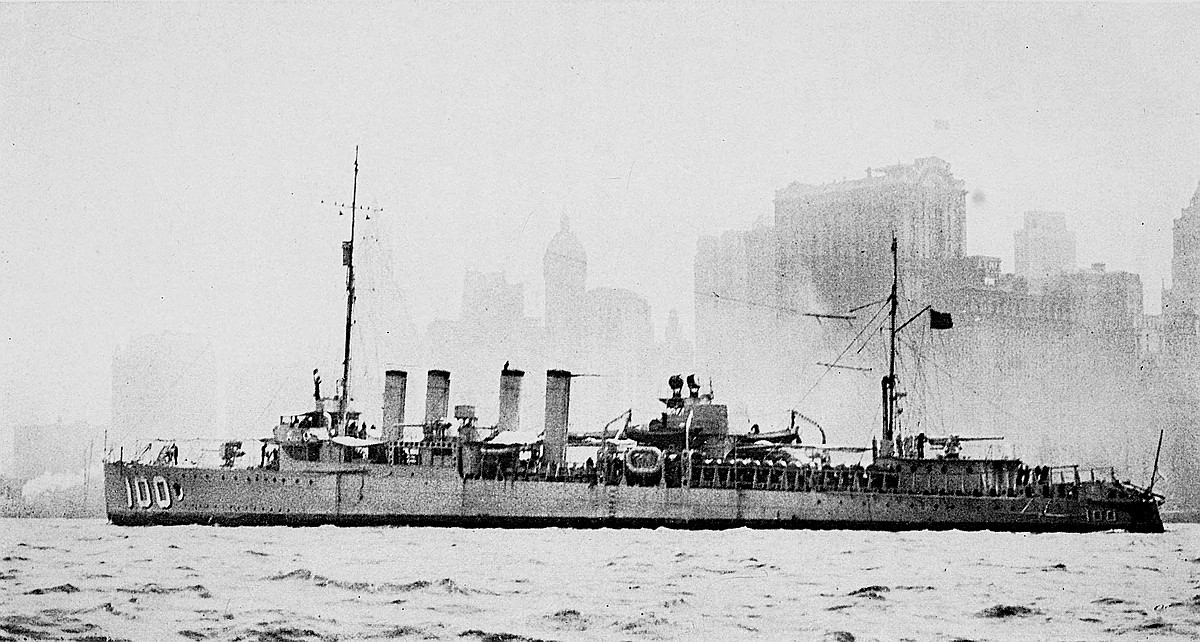
Courtesy of the Commanding Officer, Commander James B. Glennon, U. S. N.
Destroyer U. S. S. “Maury,” Named in Honor of Maury
In the United States Navy there has been considerable recognition of Maury since his death,—particularly in recent years. His name is placed at the top of all the charts issued by the Hydrographic Office, in the following phrase: “Founded upon the researches made and the data collected by Lieutenant M. F. Maury, U. S. Navy”. In 1918 a destroyer in the U. S. Navy was called the Maury, and recently the Secretary of the Navy has named the Naval Oceanographic Research in his honor. At the United States Naval Academy at Annapolis, the left wing of the Academic Building bears the name of Maury Hall. This was originally the navigation wing of the building, and, according to the Superintendent of the Academy (Captain W. F. Fullam, U. S. Navy, in 1915), it was named by his direction “Maury Hall” because of “Maury’s distinguished and world-wide reputation in connection with meteorology and the study of ocean currents, etc.” In 1919, the United Daughters of the Confederacy established a prize at the Naval Academy, consisting of a pair of marine binoculars, to be known as the “Maury Prize” and to be awarded annually to that midshipman of the First Class who has shown superior excellence in electrical engineering and physics. A portrait of Maury by E. Sophonisba Hergesheimer was presented to the Naval Academy by the Daughters of the Confederacy, Atlanta Chapter, Georgia Division, and unveiled on November 20, 1923.[30]
One of the most recent memorials to Maury is as interesting as it is appropriate. On December 22, 1925, the Martin Vas Isles (Ilhas da Martin Vas) were visited by the Schooner Blossom of the South Atlantic Expedition which was sent out by the Cleveland Museum of Natural History for the purpose of collecting specimens from the volcanic islands of the South Atlantic. These islands, individually unnamed and hitherto imperfectly charted, lie about eight hundred miles off the coast of Brazil in the direction of Africa (latitude 20° 31′ S., longitude 28° 51′ W.). Captain George Finlay Simmons of the Blossom and his associates, impressed with the importance of the work done by Maury, decided to give his name to one of the three islands of the group which rises from the ocean like an impressive monument.
All of these memorials, so varied in their nature and so widely distributed, would seem to indicate that Maury’s name is by no means likely to be forgotten. Still, his name and his achievements are not so generally known, even in the United States, as they deserve to be. “For myself”, wrote Julian Street[31] a few years ago, “I must confess that, until I visited Virginia, I was ignorant of the fact that such a person had existed; nor have Northern schoolboys, to whom I have spoken of Maury, so much as heard his name. Yet there is not one living in the United States or in any civilized country, whose daily life is not affected through the scientific researches and attainments of this man”. One is surprised, however, sometimes to find foreign authors more familiar with Maury’s name, and to meet with references to him where one might least expect any knowledge of his scientific work. For example, in Walter de la Mare’s “Memoirs of a Midget” (p. 226), the reader is unexpectedly confronted with this: “I searched Mrs. Bowater’s library for views of the sea, but without much reward. So I read over Mr. Bowater’s Captain Maury—on the winds and monsoons and tide-rips and hurricanes, freshened up my Robinson Crusoe, and dreamed of the Angels with the Vials”. Another example, almost equally unexpected is to be found in Vicente Blasco Ibanez’s “Mare Nostrum” (p. 65). “He (Ulysses) had learned English”, writes Ibanez, “the universal language of the blue dominions, and was refreshing himself with a study of Maury’s charts—the sailor’s Bible—the patient work of an obscure genius who first snatched from ocean and atmosphere the secret of their laws”.
In recent scientific works, however, such as “The Depths of the Sea” by Sir John Murray and Dr. Johan Hjort, “Science of the Sea” edited by G. Herbert Fowler, and “Founders of Oceanography” by Sir William A. Herdman one is not surprised to find full justification for referring to Maury as “The Pathfinder of the Seas”, for marine meteorology, they declare, may be said to date from his time. Not only is this title appropriate in that Maury laid out on his charts the best tracks for voyagers to follow on the Seven Seas, but it is also fitting in a figurative sense for he was indeed a pathfinder in the realm of a new science,—the physical geography of the sea. This phrase was, therefore, rightly chosen to be placed on the memorial tablet in Goshen Pass as well as on the one at Franklin, Tennessee, and it is to be prominently inscribed on the monument soon to be erected to him in Richmond. This beautifully poetic title, “The Pathfinder of the Seas”, will be his real monument against which the tooth of time will gnaw in vain, for it will rest solidly based upon his original contributions to the science of the world: “The Physical Geography of the Sea” and the “Wind and Current Charts” with their “Sailing Directions”.
It is not so easy, on the other hand, to describe in a phrase Maury’s personality. Some of those who knew him well thought his most characteristic trait was his modesty; others considered “masculine common sense”, which enabled him to see things in their true light and their real bearing, most fully characterized him; while still another declared that he belonged to that class of men who are sans peur et sans reproche. But his character had too many facets for such a simple characterization, and one is forced to turn to a more detailed summary. Perhaps, the most nearly satisfying one of this sort is that written by Francis H. Smith, formerly Professor of Physics at the University of Virginia and one who was well acquainted with Maury and his scientific work.
“Of Maury’s personality”, Professor Smith wrote, “it may be said that no one that had the privilege of meeting him ever forgot the event. He had the winning manner and kindly address which seemed to belong to the men of his race and section. No worthy young fellow ever felt ignored or oppressed in his presence. He wore his honors easily, but while he valued the public tributes he received, he was not fond of displaying the insignia which came with them. He would put on those jewels sometimes in the privacy of home to gratify his children. He loved the little ones, and if to be childlike is to be perfect he was charmingly complete. His conversation was interesting to the thoughtful in the richness of the lessons he drew from common things. He would couple facts, regarded by others as unconnected, and thereby disclose unsuspected relations. It takes genius to make the rejected refuse of one generation the valuable ore of a succeeding one. This detection of a hidden meaning in the simplest matters shows the inexhaustible nature of truth, and is the mark of a superior mind”.[32]
Publisher’s Note: Permission has been granted to print the following portion of Miss Virginia Lee Cox’s description of the Maury Monument soon to be erected in Richmond, Virginia:
“It is a marvelous conception of the man who was admired as the ‘Pathfinder of the Seas,’ and beloved for his humanity. Just how wonderful it is, is proved in the words of Commodore Maury’s own daughter, Mrs. James R. Werth, who, when she saw the finished figure of Mr. Sievers’ skill, said: ‘I feel as if I am sitting in the presence of my father in flesh, blood, and spirit; I feel as if I could put my arms around his neck as I did when I was a little girl.’
“The sculptor has portrayed Maury in a reminiscent attitude, listening to the voice of the storm. It has been said of him that the voice of the wind and waves was music to his ears and Mr. Sievers, with fine sympathy and originality, built on much study of the man, has succeeded in showing this.
“Above the figure of Maury, which is seated in a great chair, there is a group of figures which supports the globe. The figures represent a storm on land and sea. At one corner of the monument is an ox around which cluster the windswept figures of the farmer and his household, driven before the fury of the storm.
“At the other corner is an overturned boat and figures of women and sailors, drenched in the thundering waves of the sea. The group embraces a symbolization of the world and its natural elements. Through the allegorization three of Maury’s outstanding achievements are brought well to the foreground—meteorology, hydrography, and geography.
“The storm is a meteorological disturbance, and the capsized lifeboat with its occupants amid the rolling waves is symbolic of ocean meteorology, a branch of hydrography, symbolized also in the “paths of the sea” on the globe, that naturally represent geography.
“On the plinth of the monument in the flattest relief are figures of fish, representing Maury’s interest in the paths of the sea. The story goes that once when Maury was ill he had his son read the Bible to him each night. One night he read the eighth Psalm, and when he came to the passage—‘The fishes of the sea and whatsoever walketh through the paths of the sea’—Maury had him read it over several times. Finally he said, ‘If God says there are paths in the sea I am going to find them if I get out of this bed.’ Thus the Psalm was the direct inspiration for his discoveries.
“Mr. Sievers has shown Maury in a reminiscent mood, representing him at that period of his life when he had achieved his greatest discoveries. In his right hand are the pencil and the compass, and in his left hand a chart. Against his chair is the Bible, from which he drew inspiration for his explorations. The sculptor has caught amazingly the spirit of the man.”—From Richmond (Va.) Times.