Front matter
Reading edition
Note: Images of the original pages are available through Internet Archive. See https://archive.org/details/matthewcalbraith00grifrich
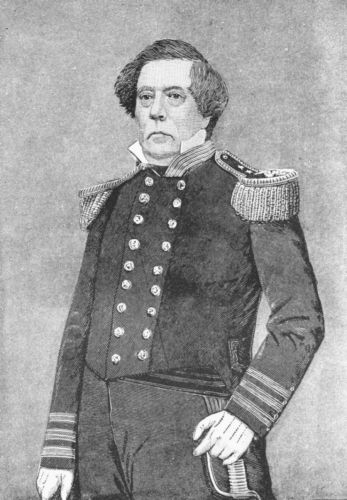
COMMODORE MATTHEW CALBRAITH PERRY.
MATTHEW CALBRAITH PERRY
A Typical
AMERICAN NAVAL OFFICER
BY
WILLIAM ELLIOT GRIFFIS
Author of “The Mikado’s Empire”, “Corea the Hermit Nation”
and “Japanese Fairy World”
BOSTON
CUPPLES AND HURD
94 Boylston Street
1887
Copyright, 1887,
By Cupples and Hurd.
All Rights Reserved
The Hyde Park Press.
IN REVERENT MEMORY
OF MY FATHER
JOHN L. GRIFFIS
AND OF MY GRANDFATHER
JOHN GRIFFIS
WHO AS
MERCHANT NAVIGATORS AND COMMANDERS OF SHIPS AND MEN
at the ends of the earth
CARRIED THE FLAG AND EXTENDED THE TRADE
OF THE YOUNG REPUBLIC
THIS BIOGRAPHY OF HER GREATEST SAILOR-DIPLOMATIST
IS INSCRIBED
BY THE AUTHOR
TABLE OF CONTENTS.
OUR EARLY NAVY.
ChapterPage
I.The Child Calbraith.—A Real Boy1
II.Boyhood’s Environment.—Under the Flag of Fifteen Stars10
III.A Midshipman’s Training Under Commodore Rodgers19
IV.Men, Ships, and Guns in 181228
V.Service in the War of 1812.—The Flag kept flying on all Seas38
AFRICA. SLAVERS AND PIRATES.
VI.First Voyage to the Dark Continent.—Lieutenant Perry goes to Guinea50
VII.Perry locates the Site of Monrovia.—The African Slave Trade58
VIII.Fighting Pirates in the Spanish Main65
EUROPE AND DIPLOMACY.
OUR FLAG IN THE MEDITERRANEAN.
IX.The American Line-of-Battle Ship.—Among Turks and Greeks72
X.The Concord in the Seas of Russia and Egypt.—Czar and Khedive81
XI.A Diplomatic Voyage in the Frigate Brandywine.—Andrew Jackson’s stalwart policy.—Perry rehearses for Japan.—Naples pays up91
SHORE DUTY. TEN YEARS OF SCIENCE AND PROGRESS.
XII.The Founder of the Brooklyn Naval Lyceum.—Master-Commandant Perry99
XIII.The Father of the American Steam Navy.—The Engineer’s status fixed.—The Line and the Staff110
XIV.Perry discovers the Ram.—The Trireme’s prow restored.—The “Line-of-Battle” changed to “Bows on”120
XV.Lighthouse Illumination.—Lenses or Reflectors?129
XVI.Revolutions in Naval Architecture.—The new middle term between Courage and Cannon.—Caloric138
XVII.The School of Gun Practice at Sandy Hook.—Bomb-guns and the coming Shells146
XVIII.The Twin Steamers Missouri and Mississippi.—Iron-clads and Armor156
COMMODORE OF A SQUADRON. AFRICAN WATERS.
EXTIRPATING “THE SUM OF ALL VILLIANIES.”
XIX.The Broad Pennant.—Our only Foreign Colony.—Powder and Ball at Berribee167
XX.Science and Religion.—A War of Ink Bottles.—Perry as a Missionary and Civilizer183
THE MEXICAN WAR.
XXI.The Mexican War197
XXII.Commodore Perry commands the Squadron216
XXIII.The Naval Battery breaches the walls of Vera Cruz226
XXIV.The Naval Brigade.—Capture of Tabasco241
XXV.Fighting the Yellow Fever.—Peace251
XXVI.Results of the War.—Gold and the Pacific Coast261
JAPAN.
XXVII.American attempts to open trade270
XXVIII.Origin of the American Expedition to Japan281
XXIX.Preparations for Japan.—An International Episode294
XXX.The Fire-Vessels of the Western Barbarians314
XXXI.Panic in Yedo.—Reception of the President’s Letter329
XXXII.Japanese preparations for Treaty-Making343
XXXIII.The Professor and the Sailor make a Treaty359
XXXIV.Last Labors375
THE MAN AND HIS WORK.
XXXV.Matthew Perry as a Man395
XXXVI.Works that follow409
========
APPENDICES.
ChapterPage
I.Authorities427
II.Origin of the Perry Name and Family429
III.The Name Calbraith430
IV.The Family of M. C. Perry431
V.Official Detail of M. C. Perry433
VI.The Naval Apprenticeship System435
VII.Duelling440
VIII.Memorials in Art of M. C. Perry443
========
INDEX447
LIST OF ILLUSTRATIONS.
Commodore Matthew Calbraith Perry
The United States Steam Frigate “Mississippi”
Perry at the age of fifty-four
Conveyance at Funchal
Commodore Perry entering the Treaty-House
Signatures and Pen-Seals of the Japanese Treaty Commissioners
Silver Salver in possession of Commodore Perry’s Daughter, Mrs. August Belmont
Medal Presented by the Merchants of Boston
Commodore Perry’s Autograph
PREFACE.
Among the earliest memories of a childhood spent near the now vanished Philadelphia Navy Yard, are the return home of the marines and sailors from the Mexican war, the launch of the noble steam frigate Susquehanna, the salutes from the storeship Princeton, and the exhibit of the art treasures brought home by the United States Expedition to Japan—all associated with the life of Commodore M. C. Perry. Years afterwards, on the shores of that bay made historic by his diplomacy, I heard the name of Perry spoken with reverence and enthusiasm. The younger men of Japan, with faces flushed with new ideas of the Meiji era, called him the moral liberator of their nation. Many and eager were the questions asked concerning his career, and especially his personal history.
Yet little could be told, for in American literature and popular imagination, the name of the hero of Lake Erie seemed to overshadow the fame of the younger, and, as I think, greater brother. The dramatic incidents of war impress the popular mind far more profoundly than do the victories of peace. Even American writers confound the two brothers, treating them as the same person, making one the son of the other, or otherwise doing fantastic violence to history. Numerous biographies have been written, and memorials in art, of marble, bronze and canvas, on coin and currency, of Oliver Hazard Perry, have been multiplied. No biography of Matthew Calbraith Perry has, until this writing, appeared. In Japan, popular curiosity fed itself on flamboyant broadside chromo-pictures, “blood-pit” novels, and travesties of history, in which Perry was represented either as a murderous swash-buckler or a consumptive-looking and over-decorated European general. It was to satisfy an earnest desire of the Japanese to know more of the man, who so profoundly influenced their national history, that this biography was at first undertaken.
I began the work by a study of the scenes of Perry’s triumphs in Japan, and of his early life in Rhode Island; by interviews in navy yard, hospital and receiving-ship, with the old sailors who had served under him in various crusades; by correspondence and conversation with his children, personal friends, fellow-officers, critics, enemies, and eye-witnesses of his labors and works. I followed up this out-door peripatetic study by long and patient research in the archives of the United States Navy Department in Washington, with collateral reading of American, European, Mexican and Japanese books, manuscripts and translations bearing on the subject; and, most valued of all, documents from the Mikado’s Department of State in Tōkiō.
As the career and character of my subject unfolded, I discovered that Matthew Perry was no creature of routine, but a typical American naval officer whose final triumph crowned a long and brilliant career. He had won success in Japanese waters not by a series of happy accidents, but because all his previous life had been a preparation to win it.
In this narrative, much condensed from the original draft, no attempt has been made to do either justice or injustice to Perry’s fellow-officers, or to write a history of his times, or of the United States Navy. Many worthy names have been necessarily omitted. For the important facts recorded, reliance has been placed on the written word of documentary evidence. Fortunately, Perry was a master of the pen and of his native language. As he wrote almost all of his own letters and official reports, his papers, both public and private, are not only voluminous and valuable but bear witness to his scrupulous regard for personal mastery of details, as well as for style and grammar, fact and truth.
Unable to thank all who have so kindly aided me, I must especially mention with gratitude the Hon. Wm. E. Chandler and W. C. Whitney, Secretaries of the United States Navy Department, Prof. J. R. Soley, chief clerk T. W. Hogg and clerk J. Cassin, for facilities in consulting the rich archives of the United States Navy; Admiral D. D. Porter and Rear-Admirals John Almy, D. Ammen, C. R. P. Rodgers, T. A. Jenkins, J. H. Upshur, and Captain Arthur Yates; the retired officers, pay director J. G. Harris, Lieut. T. S. Bassett and Lieut. Silas Bent formerly of the United States Navy, for light on many points and for reminiscences; Messrs. P. S. P. Conner, John H. Redfield, Joseph Jenks, R. B. Forbes, Chas. H. Haswell, Joshua Follansbee, and the Hon. John A. Bingham, for special information; the daughters of Captains H. C. Adams, and Franklin Buchanan, for the use of letters and for personalia; Rev. E. Warren Clark, Miss Orpah Rose, Miss E. B. Carpenter and others in Rhode Island, for anecdotes of Perry’s early life; the Hon. Gideon Nye of Canton; the Rev G. F. Verbeck of Tōkiō; many Japanese friends, especially Mr. Inazo Ota, for documents and notes; and last, but not least, the daughters of Commodore M. C. Perry, Mrs. August Belmont, Mrs. R. S. Rodgers, and especially Mrs. George Tiffany, who loaned letters and scrap-books, and, with Mrs. Elizabeth R. Smith of Hartford, furnished much important personal information. Among the vanished hands and the voices that are now still, that have aided me, are those of Rear-Admirals Joshua R. Sands, George H. Preble, and J. B. F. Sands, Dr. S. Wells Williams, Gen. Horace Capron, and others. A list of Japanese books consulted, and of Perry’s autograph writings and publications, will be found in the Appendix; references are in footnotes.
The work now committed to type was written at Schenectady, N. Y., in the interstices of duties imperative to a laborious profession; and with it are linked many pleasant memories of the kindly neighbors and fellow Christians there; as well as of hospitality in Washington. In its completion and publication in Boston, new friends have taken a gratifying interest, among whom I gratefully name Mr. S. T. Snow, and M. F. Dickinson, Esq.
In setting in the framework of true history this figure of a fellow-American great in war and in peace, the intention has been not to glorify the profession of arms, to commend war, to show any lack of respect to my English ancestors or their descendants, to criticise any sect or nation, to ventilate any private theories; but, to tell a true story that deserves the telling, to show the attractiveness of manly worth and noble traits wherever found, and to cement the ties of friendship between Japan and the United States. One may help to build up character by pointing to a good model. To the lads of my own country, but especially to Japanese young men, I commend the study of Matthew Perry’s career. The principles, in which he was trained at home by his mother and father, of the religion which anchored him by faith in the eternal realties, and of the Book which he believed and read constantly, lie at the root of what is best in the progress of a nation. No Japanese will make a mistake who follows Perry as he followed the guidance of these principles; while the United States will be Japan’s best exemplar and faithful friend only so far as she illustrates them in her national policy.
W. E. G.
Shawmut Church Parsonage,
Boston, July 1st, 1887.