LETTERS FROM WORKING-WOMEN.
Reading edition
1. Twenty Years of Child-Bearing.
I shall be very pleased if this letter will be any help to you. Personally I am quite in sympathy with the new Maternity Scheme. I do feel I cannot express my feelings enough by letter to say what a great help it would have been to me, for no one but a mother knows the struggle and hardships we working women have to go through. I do hope I shall never see the young women of to-day have to go through what I did. I am a mother of eleven children—six girls and five boys. I was only nineteen years old when my first baby was born. My husband was one of the best and a good father. His earnings was £1 a week; every penny was given to me, and after paying house rent, firing, and light, and clubs, that left me 11s. to keep the house going on; and as my little ones began to come, they wanted providing for and saving up to pay a nurse, and instead of getting nourishment for myself which we need at those times, I was obliged to go without. So I had no strength to stand against it, and instead of being able to rest in bed afterwards, I was glad to get up and get about again before I was able, because I could not afford to pay a woman to look after me. I kept on like that till the sixth little one was expected, and then I had all the other little ones to see after. The oldest one was only ten years old, so you see they all wanted a mother’s care. About two months before my confinement the two youngest fell ill with measles, so I was obliged to nurse them, and the strain on my nerves brought on brain-fever. All that the doctor could do for me was to place ice-bags on my head. Oh, the misery I endured! My poor old mother did what she could for me, and she was seventy years old, and I could not afford to pay a woman to see after my home and little ones; but the Lord spared me to get over my trouble, but I was ill for weeks and was obliged to work before I was able. Then in another eighteen months I was expecting another. After that confinement, being so weak, I took a chill, and was laid up for six months, and neighbours came in and done what they could for me. Then there was my home and little ones and husband to look after, as he was obliged to work. It was the worry that kept me from getting better; if I could have had someone to look after me I should not have been so ill. After this I had a miscarriage and another babe in one year and four months. I got on fairly well with the next one, and then the next one, which was the eighth, I had two down with measles, one two years old with his collar-bone out, and a little girl thirteen with her arm broke. That was at the same time as I was expecting my eighth little one, and my dear husband worried out of life, as you see with all this trouble I was only having the £1 a week and everything to get out of it. What a blessing it would have been if this Maternity Scheme was in go then! It would have saved me a lot of illness and worry, for my life was a complete misery. For twenty years I was nursing or expecting babies. No doubt there are others fixed the same way as I have been. This is only a short account of how I suffered; I could fill sheets of paper with what I have gone through at confinements and before, and there are others, no doubt, have felt the pinch as well as myself. If there is anything else you would like to know and I could tell you, I should be glad, for the benefit of my sisters.
Wages 17s. to 25s.; eleven children, two miscarriages.
2. “Out of Bed on the Third Day.”
I received your paper on Maternity Scheme, and I can assure you it brought back to me many painful hours of what I have passed through in twenty-one years of married life. For one thing, I have had a delicate husband for fifteen years, and I have had nine children, seven born in nine years. I have only one now; some of the others have died from weakness from birth. I only had a small wage, as my husband was then a railway porter. His earnings were 18s. one week and 16s. the next, and I can say truthfully my children have died from my worrying how to make two ends meet and also insufficient food. For many of my children I have not been able to pay a nurse to look after me, and I have got out of bed on the third day to make my own gruel and fainted away. My little girl which is just fourteen years old, from the first month of pregnancy until my nine months were up I attended the hospital and had a hospital nurse in to confine me.... A woman with little wage has to go without a great deal at those times, as we must give our husbands sufficient food or we should have them home and not able to work; therefore we have to go without to make ends meet. Before my confinements and after I have always suffered a great deal with bearing down, and doctors have told me it is weakness, not having enough good food to keep my health during such times. My little girl I have was under the doctor for seven months, being a weak child born, and I for one think that if I had a little help from someone I should have had my children by my side to-day. It has only been through weakness they have passed away. It is with great pleasure I write this letter to you. I could say a deal more on sufferings of women if I saw you.
Wages 16s. to 18s.; nine children, one still-birth, one miscarriage.
3. Hospitals—A Crying Need.
A neighbour of mine called in the doctor, who after examining her said she must be got into a Lying-In Hospital at once, as she was in such a critical condition. She needed to be under medical care all the time; the doctor expects when the birth takes place there will be twins. The woman was taken by cab several miles, and after being there two days was sent home, as the birth was not expected till March, and this was about the middle of February; but she was to be taken back by February 27, as she is in such a state that the children will have to be removed before they attain their full size. A few days after she was home, she was so ill that her doctor got a cab and sent her to another hospital, as he said if anything occurred when he was not able to get to her, her life would be lost. She must be where there were doctors in constant attendance.
After putting her through an examination and bullying her for going there, she was informed they had no maternity ward, and sent her home again, and all the time she was in the greatest of pain and vomiting blood; she is now at home, and will have to be taken to the first hospital at the end of the week, if nothing happens before.
Now for her circumstances. Her husband has worked for his present employer for thirteen years, and earns the magnificent sum of 23s. per week. The conveying of her to hospitals and back the two times has cost 25s., and the husband had to lose a day and a half. When the foreman asked the master to allow the man to have his pay for the lost time owing to the expense he had had, he replied: “He will get 30s. when the job comes off; let him pay it out of that.” This man is a Church warden and a prominent Church worker and Christian! The husband’s fellow-workers who earn no more than him, and some of them less, have had what they call a whip round, and have managed to raise 19s. for him.
Our District Nurse goes in each morning and does what she can for her, and one morning she asked how she had got ruptured; and she said she was not sure, but she thought it was when she was at the factory. And it transpired that her eldest boy is very bright, and he managed to win a scholarship, but his mother said she could not manage to get the clothes for him that he ought to have at such a school, and so she got work at the factory to try and clothe him better. She was only there two months when she was taken ill and had to leave. (What mothers put up with for their children!) She has been paying 3d. a week into a Sick Loan, and Dividing Society, in connection with a Church, but she can have no help from it, as her illness is through pregnancy.
4. “All Day Washing and Ironing.”
In answer to your letter, in my opinion the cause of women suffering from misplacements and various other inward complaints, is having to work during pregnancy, and I am the mother of three children. When the youngest was coming my husband was out of employment, so I had to go out to work myself, standing all day washing and ironing. This caused me much suffering from varicose veins, also caused the child to wedge in some way, which nearly cost both our lives. The doctor said it was the standing and the weight of the child. I have not been able to carry a child the full time since then, and my periods stopped altogether at thirty-four. Then I have a niece of twenty-five, who is at present in hospital undergoing a serious operation through getting up too soon after her confinement. Once we can make men and women understand that a woman requires rest when bearing children, we shall not have so many of our sisters suffering and dying through operations, or, on the other hand, dragging out a miserable existence.
My husband’s wages was 19s. 10d. He was compelled to lose time in wet or frosty weather, and I was very lucky to get my share, 18s., four weeks in succession.
Wages 19s. 10d.; three children, one miscarriage.
5. A Half-Starved Pregnancy.
My experience during and after my second pregnancy is only one example of what thousands of married working women have to endure. My husband has always been a very delicate man, and was ill most of the time I carried both my children. He had been out of employment eight months out of the nine I carried my first child.... As a last resource was glad to go to work on the railway for the magnificent wage of 17s. a week, and had to walk nearly six miles night and morning or pay 5d. a day for train fare. Our rent was 7s. 6d. a week and clubs to be paid. By the time my second child was born my husband’s wages had increased to £1 1s. a week for seventy-two hours. By that time hard work and worry and insufficient food had told on my once robust constitution, with the result that I nearly lost my life through want of nourishment, and did after nine months of suffering lose my child. No one but mothers who have gone through the ordeal of pregnancy half starved, to finally bring a child into the world to live a living death for nine months, can understand what it means.... It was the Women’s Co-operative Guild which saved me from despair.
The first confinement I managed to get through very well, having some money left from what I had saved before marriage. But how I managed to get through my second confinement I cannot tell anyone. I had to work at laundry work from morning to night, nurse a sick husband, and take care of my child three and a half years old. In addition I had to provide for my coming confinement, which meant that I had to do without common necessaries to provide doctor’s fees, which so undermined my health that when my baby was born I nearly lost my life, the doctor said through want of nourishment. I had suffered intensely with neuralgia, and when I inquired among my neighbours if there was anything I could take to relieve the pain, I was told that whatever I took would do no good; it was quite usual for people to suffer from neuralgia, and I should not get rid of it till my baby was born.
I had to depend on my neighbours for what help they could give during labour and the lying-in period. They did their best, but from the second day I had to have my other child with me, undress him and see to all his wants, and was often left six hours without a bite of food, the fire out and no light, the time January, and snow had lain on the ground two weeks.
When I got up after ten days my life was a perfect burden to me. I lost my milk and ultimately lost my baby. My interest in life seemed lost. I was nervous and hysterical; when I walked along the streets I felt that the houses were falling on me, so I took to staying at home, which of course added to the trouble.
Now, is it possible under such circumstances for women to take care of themselves, during pregnancy, confinement, and after? Can we any longer wonder why so many married working women are in the lunatic asylums to-day? Can we wonder that so many women take drugs, hoping to get rid of the expected child, when they know so little regarding their own bodies, and have to work so hard to keep or help to keep the children they have already got? If only the State would do something that would give all working mothers the assurance that during pregnancy, where needed, means would be provided whereby they could get an all-important rest before confinement, and that proper attention should be provided during and after so long as necessary. It would make all the difference between a safe and speedy confinement, a better offspring, therefore a better asset of the State, and a broken-down motherhood, and a race of future parents who start in life very often with a constitution enfeebled through the mother having to undergo privation, as well as the mental and physical strain that childbirth entails.
Wages 17s. to £1 1s.; two children.
6. Healthy and Strong.
During pregnancy I always looked to my diet, and as my husband never got more than 24s. 6d. per week, I had not much to throw away on luxuries. I had plain food, such as oatmeal and bacon, and meat, plenty of bread and good butter. I may say that during pregnancy and during suckling my appetite was always better, and I ate more and enjoyed my food better than at any other time. I always did my own housework and my own washing, and I never had a doctor all the time I was having children. I have had six, one dead.
During my labour I was never bad more than about three or four hours. I felt I could get out of bed the first day, and I never had the doctor, only an old midwife.
And though I say it myself, nobody had bonnier or healthier children than I had, with fair skins and red cheeks.
I must say that I am a staunch teetotaller, and have been all my life. I think that drink has a lot to do with some women’s sufferings.
I had one child born without a midwife at all, before we had time to fetch her, and I did as well as at any other time.
We lived under the colliery, and our rent was only 3s. 6d. a week. We got our coal at a lower price, about 1s. a week. During part of the time we had a lodger, who paid us 11s., which helped up a bit. But you must know we had to be very careful. But, taking all into consideration, we were very comfortably off. We had not many doctors’ bills, as our children were all very healthy, and I don’t think I have spent a pound on doctoring for myself since I was a baby, for which I am very thankful.
Wages 18s. to 24s. 6d.; six children.
7. “She is Real Ill.”
I have a sister-in-law who has five children, and from the first month of pregnancy she is real ill, the sickness (as she herself puts it) strains her all to pieces, after which she is in a state of collapse. It is painful to be with her, the faintness and sickness continue, right up till the eighth month. It is not safe for her to go any distance by herself, as it comes on at any time, and her legs are blue-black until after her baby is born. All her children are living; her confinements are normal. She is a very plucky woman. Of course, she has to do everything herself; she could not afford to have anyone in to help her, and in that state she has to do all her own washing, cleaning, etc. She has been to the doctor during these bad times, but he does not seem able to relieve her, only tells her to rest her legs all she can, which of course is one of the things with a family around you the mother cannot do. Her husband was only getting 15s. at the time she was having her first three children. Now he is getting £1 per week. He works for the Rural District Council.
Wages 15s.; five children.
8. Men Need Education.
My own experience in child-bearing was rather abnormal because I had them late in life. Consequently, I suffered more than usual because the bones were set and do not easily adapt themselves to changed conditions. Extreme sickness from first to last, and during last months much pain and much discomfort. My two first were lost from malnutrition because I could not retain my food. In loss of strength the miscarriage cost me most, and because of the falling of the womb—a trouble which was not cured till I had a living child. I was not ignorant, and took every care, so that I can conceive any mother’s life being a dreadful thing if she was neglected under such circumstances.
My husband’s wages was very unsettled, never exceeded 30s., and was often below the sum. I earned a little all the time by sewing. Did all housework, washing, baking, and made all our clothes. But no amount of State help can help the suffering of mothers until men are taught many things in regard to the right use of the organs of reproduction, and until he realises that the wife’s body belongs to herself, and until the marriage relations takes a higher sense of morality and bare justice. And what I imply not only exists in the lower strata of society, but is just as prevalent in the higher. So it’s men who need to be educated most. The sacred office of parenthood has not yet dawned on the majority. Very much injury and suffering comes to the mother and child through the father’s ignorance and interference. Pain of body and mind, which leaves its mark in many ways on the child. No animal will submit to this: why should the woman? Why, simply because of the Marriage Laws of the woman belonging to the man, to have and to own, etc.
Wages 30s.; three children, two miscarriages.
9. Bad Confinements.
I shall only be too glad to assist you in giving my experience. In the first place, I have had eight children; seven is now living. I was twenty-three when I was married. My first pregnancy I suffered with my leg swollen and veins ready to burst. At my confinement the baby was hung with navel cord twice round the neck and once round the shoulder, owing to lifting and reaching, which caused me hours of suffering, and it caused my womb to come down, and I have had to wear something to hold it up until these late years. I am now fifty-eight; my husband has been dead seven years. I was left to fight life’s battles alone. As my family increased I had to have my legs bandaged. I never felt a woman during pregnancy; as I got nearer I felt worse. At my confinements the greatest trouble was the flooding after the baby was born, and the afterbirth grown to my side. When that was taken away the body had to be syringed to stop mortification. I have had the doctor’s arm in my body, and felt his fingers tearing the afterbirth from my side. While I am writing, I almost fancy I am talking to you. I hope I have not tired you with my letter.
Wages £1 to £2; eight children, two miscarriages.
10. “I am a Ruined Woman.”
I have been a martyr to suffering through having children, owing to the fact that I could not retain my food. I was always sick, troubled with nausea and vomiting, which kept me very weak; my constitution was brought that low, that after having three children born living I was unable to go the full length of pregnancy. The last still-born child I had, during pregnancy I was dropsical all the time I was carrying, and I had to have two doctors to chloroform me before the child could be born. It had taken all the water from me; it was impossible for it to be born until they had lanced the child to let the water out of it. I had to be fed every hour day and night. Besides two still-born children, I have had two miscarriages. The last miscarriage I had I lost that much blood it completely drained me. I was three whole months and was unable to sleep; I could not even sleep one half-hour. I had lost my sleep completely; my hair come off and left bald patches about my head. The doctor told me if I had not had the presence of mind to lay me flat on my bed when the miscarriage took place I should have bled to death. Having all this to go through, it brought on falling of the womb, and now that I am able to do for my family and attend to my household duties, I have to wear a body-belt, a kind that is worn after appendicitis. I am a ruined woman through having children. All the times that I was pregnant I could not bear my husband to smoke one pipe of tobacco. I have sent you the main ailments I have had to endure, but there are a hundred and one little items that have crept in between through being brought so weak. I have been subject to other ailments besides, such as influenza, and rheumatic fever, and catarrh of the bowels.
When I was married, my husband was a weaver; at that time his highest wages were £1 per week. We paid 2s. 6d. rent, so that did not leave much for food, fire, and clothing. My first-born was one year all but two days when the second was born. When the last-named was three months old, my husband went on strike for more wages; he was out eleven weeks, and not a penny coming in. At the end of that period, there being both men and women at the same job, the masters were so obstinate they had to go in at the women’s price. After the strike there was a turn of bad trade, and he was on short time for seven years; his average wages during that period was 14s. per week. If I had not been a good needlewoman and a capable manager it would have been worse.
Wages £1 to 14s.; three children, two still-births, two miscarriages.
11. “I was Awfully Poor.”
My first girl was born before I attained my twentieth year, and I had a stepmother who had had no children of her own, so I was not able to get any knowledge from her; and even if she had known anything I don’t suppose she would have dreamt of telling me about these things which were supposed to exist, but must not be talked about. About a month before the baby was born I remember asking my aunt where the baby would come from. She was astounded, and did not make me much wiser. I don’t know whether my ignorance had anything to do with the struggle I had to bring the baby into the world, but the doctor said that my youth had, for I was not properly developed. Instruments had to be used, and I heard the doctor say he could not tell whether my life could be saved or not, for he said there is not room here for a bird to pass. All the time I thought that this was the way all babies were born.
At the commencement of all my pregnancies I suffered terribly from toothache, and for this reason I think all married child-bearing women should have their teeth attended to, for days and nights of suffering of this kind must have a bad effect on both the mother and child. I also at times suffered torments from cramp in the legs and vomiting, particularly during the first three months. I hardly think the cramp can be avoided, but if prospective mothers would consult their doctors about the inability to retain food, I fancy that might be remedied. At the commencement of my second pregnancy I was very ill indeed. I could retain no food, not even water, and I was constipated for thirteen days, and I suffered from jaundice. This had its effect on the baby, for he was quite yellow at birth, and the midwife having lodgers to attend to, left him unwashed for an hour after birth. She never troubled to get his lungs inflated, and he was two days without crying. I had no doctor. I was awfully poor, so that I had to wash the baby’s clothes in my bedroom at the fortnight’s end; but had I had any knowledge like I possess now, I should have insisted at the very least on the woman seeing my child’s lungs were properly filled. When we are poor, though, we cannot say what must be done; we have to suffer and keep quiet. The boy was always weakly, and could not walk when my third baby was born. He had fits from twelve to fourteen, but except for a rather “loose” frame, seems otherwise quite healthy now.
My third child, a girl, was born in a two-roomed “nearly underground” dwelling. We had two beds in the living-room, and the little scullery was very damp. Had it not been for my neighbours, I should have had no attendance after the confinement, and no fire often, for it was during one of the coal strikes. My fourth child, a boy, was born under better housing conditions, but not much better as regards money; and during the carrying of all my children, except the first, I have had insufficient food and too much work. This is just an outline. Did I give it all, it would fill a book, as the saying goes.
In spite of all, I don’t really believe that the children (with the exception of the oldest boy) have suffered much, only they might have been so much stronger, bigger, and better if I had been able to have better food and more rest.
Cleanliness has made rapid strides since my confinements; for never once can I remember having anything but face, neck, and hands washed until I could do things myself, and it was thought certain death to change the underclothes under a week.
For a whole week we were obliged to lie on clothes stiff and stained, and the stench under the clothes was abominable, and added to this we were commanded to keep the babies under the clothes.
I often wonder how the poor little mites managed to live, and perhaps they never would have done but for our adoration, because this constant admiration of our treasures did give them whiffs of fresh air very often.
My husband’s lowest wage was 10s., the highest about £1 only, which was reached by overtime. His mother and my own parents generally provided me with clothing, most of which was cast-offs.
Wages 10s. to £1; four children.
12. “I Dragged about in Misery.”
It is lack of knowledge that often brings unnecessary suffering. I know it from experience. In my early motherhood I took for granted that women had to suffer at these times, and it was best to be brave and not make a fuss. Once when things were not brisk in the labour world, I would do my house-cleaning all myself, for naturally at these times you like to feel everything is in order everywhere when the strange woman comes in to take charge. I was in a very weak state through worry and the difficulty of meeting the demands. I had not seen a doctor, for I was thinking of having a midwife I had heard of. I dragged about in misery and in great pain. A friend called in one morning after I had got the children off to school, and I suppose I looked very ill. She said: “Have you engaged a doctor?” I said: “No, there is plenty of time; I was only six months, and surely I shall have a change soon.” I could not lay, sit, or stand in ease, and my legs were so bad. However, she went away, saying nothing to me, and brought her doctor. He was amazed at my condition, ordered me to bed, said my confinement was near, and the child was in a critical condition. He sent for a midwife, and they were with me from eleven o’clock till three o’clock. He said the child was dead, and in such an awkward position that it nearly cost my life to bring it. I had a very long illness follow on (it would have been a lovely child full time). The child had been killed through shock, and already showed signs of mortification. I was in a poor state of health, and struggled against my strength, looking after the children’s welfare and neglecting myself. In trying to lift the washing-tub it slipped, and that was the shock; and instead of resting and having advice (which I felt I could not afford), I persevered, and that was the result. Now, if there had been such a thing as a Maternity Centre where I could have sent for someone, or could have attended without that feeling of expense, I could have been relieved of all that suffering.
Another experience I had some nine years after the previous. I was pregnant, work had been very scarce, and I was in a very weak state. My husband had been at work three weeks when he happened an accident. He had fallen from a high scaffold. The Clerk of the Works came to tell me they had taken him to the hospital, and I had better go at once and take someone with me. Of course, I thought the worst had happened. (He did not know my condition.) I was between three and four months, and this shock caused a miscarriage. I had a midwife, who, no doubt, was all right when things were straightforward. I got about again, but was very weak and ill. He was in hospital six weeks. I took in needlework. I got very weak yet very stout. I thought it was through sitting so much at the machine. I worked and starved myself to make sick pay, 12s. per week, go as far as possible. I got so weak, and fainted several times after heavy days at the machine. I was taken very ill one night, and my daughter went for the doctor. He said: “We must have her in bed,” and sent for a neighbour. It was a confinement of a seven-months babe. When he told me it was childbirth, I said it was impossible, for I had miscarried about four months previous. However, it was true. I had been carrying twins—a most peculiar case—during that four months. My system was being drained, and the worry and anxiety had effect on the child. It was weak and did not move much. I had a bad time, but the child lived for nine months, but a very delicate child. Now, if I had been able to have a qualified midwife when I had the miscarriage, we should have known there was another child, and if I could have been medically treated, all that suffering could have been prevented, and I might have had a strong child.
But apart from all that, I do not know which is the worst—child-bearing with anxiety and strain of mind and body to make ends meet, with the thought of another one to share the already small allowance, or getting through the confinement fairly well, and getting about household duties too soon, and bringing on other ailments which make life and everything a burden. I could forgive a woman in such a state giving herself and the children a drug which would end everything. I was an invalid for six years through getting about too soon and causing womb displacement.
Wages £2 2s.; eight children, one still-born, four miscarriages.
13. “Very Fortunate.”
I think I have been very fortunate. I have had two children, both girls; one will be sixteen in April, the other will be ten in August, so you see there is six years and four months (and not even a miscarriage) between them. I have always had the best of health, never had a doctor until my second baby was born.... When I was married I was three months short of twenty-one.... Trade was very bad at the time. I worked in the mill up to six weeks from the event; we had a home to make—that is why, as I thought every bit would help. Sometimes we did not make 10s. between us. I had a midwife, and I went on very well; in fact, I asked what I had to stay in bed for. The second day I got up, the fifth day I went out, the seventh baby got on all right, and I went back to work at eight weeks’ end. I gave her the breast till she was twelve months old. When weaning her, I put plasters on my breasts, which irritated the skin so much that they brought on inflammation. I suffered awful, as I did not like to tell anybody. It went almost round my body. Then I told mother. When she saw the state I was in she went nearly frantic; she made me go to the doctor, and one box of salve put me right. That is about the worst I suffered with her. I did not even have morning sickness, which I have often heard women speak about during pregnancy, with either of my children. When I was pregnant the second time, I heard that the midwife I had the first time had started drinking, so I was afraid to have her. I had a doctor, and it was well I had, as I did not go on as well as I did the first time. I was in bed a fortnight. I was well looked after, for I have one of the best of husbands and a good mother. I might say I have wanted for nothing. I have two fine girls.
Wages 7s. to 26s.; two children.
14. Inflammation.
When my boy was coming, for three months I could not dress myself properly; I could not get a pair of gloves or boots on, as I was so swollen—I suppose with water. I did not get any advice, as I thought I must just put up with it. After he was born, I could not pass my water for a week—it had to be taken from me. Then I had inflammation of the bladder, and finally inflammation of the kidneys, besides other complications. My doctor, who was an old man, had to leave me in charge of his son for a few days, and once, while talking about my illness, he said it was a blessing I had had the inflammation of the kidneys, as it had disclosed the fact that there was albumen in the water of some standing. I told him how I had been held during pregnancy, and he said I ought to have been to his father at that time, and he would have been able to do me some good, but, like the majority of women, I thought it was one of the ills I had to bear.
The next case is of a young married woman with her first baby. She took ill at the eight months, and had a very bad time, falling out of one fit into another, and at last, after her baby was born, she lay two days quite unconscious—in fact, they never expected she would recover. She had two doctors, and they gave her every attention, and then when she was getting better her own particular doctor told her that if she had only consulted him beforehand he could have saved her a lot of pain, which she had to put up with. He said it was some kidney trouble which had been the reason of all she had suffered. In both her case and mine we could have had advice, as far as the expense was concerned, but it was sheer ignorance, and the idea that we must put up with it till the nine months were over.
Wages £2; two children.
15. “Oh, the Horrors we Suffer!”
From the time I married till just previous to the birth of my third child, my husband earned 28s. per week; then followed two years’ shortness of work. When my fourth was born, we had no food or anything to eat, until my husband went to a storekeeper and told him how we were placed, and he trusted us, and said we ought to have asked him before. And we all had dinner off oatmeal gruel made with tinned milk. The past struggle left its mark on the physique of my children. One has since died of heart disease, aged ten years; another of phthisis, sixteen years; my youngest has swollen glands, and not at all robust, though not born in poverty, aged fifteen years....
I have not been the worst-placed woman by a long way, my husband generally having 30s. per week, but I could not afford help during pregnancy, and I suffer from valvular disease of the heart, which (doctors say) was caused of extreme attacks of hæmorrhage and shortness of breath, leaving me a complete wreck at those times. My home was very dirty, the children got ragged, meals worse than usual, and each doctor I consulted said I was not fit to do my work, and I had not to bother. I was told not to worry at all, or I should be worse than I was. No one who has not been placed in a similar position can realise how horrible it is to be so placed. I have resorted to drugs, trying to prevent or bring about a slip. I believe I and others have caused bad health to ourselves and our children. But what has one to do?
I hope this communication will not offend in any way. But after the birth of my first baby I suffered from falling womb, and the torture of that was especially cruel when at closet, in more than I can describe; and quite by accident I learnt that other mothers I met were not suffering the same. My baby was ten months old when I told the doctor, who said I ought to have told him before, and he soon put me right. But doctors who attended me never told me anything concerning my babies or myself. My husband was easeful about attention to himself, and always willing to help, even after working from 6 a.m. in the morning. I often pitied him; he was never impatient. I have seen women similarly placed, and their husbands throw their dinner in the fire. I have been told I ought to do as well as his mother, and I wish I could have done. Oh, the horrors we suffer when men and women are ignorant! Some have severe attacks of hæmorrhage caused by sexual intercourse soon after birth....
Wages 30s.; eight children, two still-born, three miscarriages.
16. “A Nightmare Yet.”
The first feeling of a young mother (to be) (unless she has been very intelligently trained or is very ignorant) is one of fear for herself when she finds out her condition. As time goes on she will probably lose this fear in the feeling she is to have something all her very own, but in some instances the dread grows, and in a sense fills her whole being. This must of necessity weaken her bodily and mentally, and, of course, makes her time of trial harder to bear.
I remember over my first baby, although I felt delighted to think I was to be a mother, I had a very nervous fear that my baby would prove weakly because I had suffered for so many years from chronic bronchitis. I believe this dread had a very bad effect on my nervous system, with the result that when I got within a fortnight of full term my baby was born very weakly, and I had a severe labour lasting two nights and two days. (This was twenty-three years ago.) No effort was made to obtain help for me, although my mother at that time was starting to practise as a midwife, and had all a mother’s fears for her daughter in her first labour. At that time it was much more usual to trust to Providence, and if a woman died it only proved her weakness and unfitness for motherhood. My baby only lived seven months. In spite of all this trouble, I was very glad when a year later I found I was to become a mother again. I was still weak, and this baby was born at eight months, very tiny but not weakly. I again had a slow time, lasting two days and one night, but not so severe as the first. I had what is known as “white-leg” during the lying-in period. This is usually due to a septic condition, and may be induced by uncleanliness or careless handling during the first stage of labour; again, a chill will produce this state, and this was the cause in my case, owing to getting out of bed on the second day rather than call mother upstairs when I needed her. My last baby was born at a time when we were really badly off. My husband was out of work during the greater part of the time, and I was not only obliged to work myself, but often went short of food and warm clothing when I was most in need of it. The effect on my health was, of course, bad, but the baby was a fine healthy boy weighing over 12 pounds. Bad as was the effect on my bodily health, the mental effect was worse. I nearly lost hope and faith in everyone. I felt that even the baby could not make up for the terrible strain I had undergone, and at that time I could fully enter into the feelings of those women who take drugs to prevent birth. I know I ought to have been more strong-minded, but anyway, I got through all right after all, and, strange to say, I got up feeling better and more hopeful than I had felt for years. During this pregnancy I never dared to allow myself to think of the time when the baby would be born; first, because I knew the pain would be so bad, and then because I realised that I would not be able to work when I got near the end and for some time afterwards. I left off a month before and did not start again for four months after the birth. I don’t know now how I got through, and it is a nightmare to me yet. (I may say here that although we were so poor we stuck to the Store all through, and this was a great help.) I believe if I had felt quite comfortable as to the position of my other children during the time when I would be laid up, my sufferings would not have been so great, or my dread of the labour.
Wages 25s.; three children.
17. Lack of Food and Bad Housing.
I think a great deal of suffering is caused to the mother and child during pregnancy by lack of nourishment and rest, combined with bad housing arrangements. The majority of working women before marriage have been used to standing a great deal at their work, bringing about much suffering which does not tell seriously until after marriage, particularly during pregnancy. A very common complaint is falling of the womb. If women could be taught to sit down more when they were doing little jobs, that they very often stand to do now, I believe it would be a great help to them physically. The majority of working women do not get sufficient nourishment during pregnancy. If there is other children the mother generally takes what is left. I believe this tells very greatly at the time of confinement. I well remember the prostrate condition I have been in on several occasions owing to lack of nourishment and attention at the time. I found I could not get anybody to come into my house and do the work unless I could pay them 10s. per week; in consequence I had to take pot-luck. My last confinement I was nearly twelve months before I was able to do my duties in the home, which meant a great deal of suffering to my children, as they were not kept clean. This caused me a great deal of trouble and anxiety. I believe all this tells on the mother’s health and also the baby’s which she is nursing. I have known women, who have had the opportunity and good sense, to get all the nourishment and rest during pregnancy, even at the expense of something going short in the home; at time of confinement they have got over it quite easily, and made very little difference to them a few hours afterwards.
I believe the bad housing arrangements have a very depressing effect on mothers during pregnancy. I know of streets of houses where there are large factories built, taking the whole of the daylight away from the kitchen, where the woman spends the best part of her life. On top of this you get the continual grinding of machinery all day. Knowing that it is mostly women and girls who are working in these factories gives you the feeling that their bodies are going round with the machinery. The mother wonders what she has to live for; if there is another baby coming she hopes it will be dead when it is born. The result is she begins to take drugs. I need hardly tell you the pain and suffering she goes through if the baby survives, or the shock it is to the mother when she is told there is something wrong with the baby. She feels she is to blame if she has done this without her husband knowing, and she is living in dread of him. All this tells on the woman physically and mentally; can you wonder at women turning to drink? If the child lives to grow up, you find it hysterical and with very irritable, nasty ways when in the company of other children. When you see all this it is like a sting at your heart when you know the cause of it all and no remedy.
Wages 28s.; six children.
18. Astonishing Health.
Although I have had eight children and one miscarriage, I am afraid my experiences would not help you in the least, as I am supposed to be one of those women who can stand anything. During my pregnancy I have always been able to do my own work.
With the boys labour has only lasted twenty minutes, girls a little longer. I have never needed a doctor’s help, and it has always been over before he came. I have never had an after-pain in my life, so the doctors don’t know what I am made of. I always had to get up and do my own work at three weeks’ end. I work all day long at housework until six or seven, and I then take up all voluntary work I can for the sake of the Labour Cause. I am sorry and yet glad that my lot has not been so bad as others. My idea is that everything depends on how a woman lives, and how healthy she was born. No corsets and plenty of fruit, also a boy’s healthy sports when she is young. I had the advantage of never having to work before I was married, and never have wanted for money, so when the struggle came I had a strong constitution to battle with it all.
Wages 30s. to 35s., and upwards; eight children, one miscarriage.
19. “Kept All to Myself.”
I was a very strong woman before my baby was born. I was a weaver. I worked up to five weeks before the baby was born. I had a good appetite all the nine months and did not ail anything. But when baby was born he was a miserable little thing. Now that I am older I can see things different, and I say that if I had not have worked so hard during the nine months, my baby would have been better. When a baby is born delicate they are a great care for a good many years.
I may say here that I did not want any more. I never knew what it was to ail anything all my life before, but I could not say that after. I lost 2 stone in weight in a very short time after. Of course, I can see now I was a good bit to blame, because I thought I was only like other women would be, and kept all to myself. I was so strong before he was born, that I was ashamed to own up to it that I felt so weak. It was more weakness than anything else that I suffered from. They used to tell me that I would perhaps be better if I had another, but I said I never would go through it again to feel as bad again. I may say in conclusion, if ever my son takes a wife, I will do all in my power to help her not to suffer as I did.
Wages 20s.; one child.
20. Stead’s Penny Poets.
I was married at twenty-eight in utter ignorance of the things that most vitally affect a wife and mother. My mother, a dear, pious soul, thought ignorance was innocence, and the only thing I remember her saying on the subject of childbirth was, “God never sends a babe without bread to feed it.” Dame Experience long ago knocked the bottom out of that argument for me. My husband was a man earning 32s. a week—a conscientious, good man, but utterly undomesticated. A year after our marriage the first baby was born, naturally and with little pain or trouble. I had every care, and motherhood stirred the depths of my nature. The rapture of a babe in arms drawing nourishment from me crowned me with glory and sanctity and honour. Alas! the doctor who attended me suffered from eczema of a very bad type in his hands. The disease attacked me, and in twenty-four hours I was covered from head to foot ... finally leaving me partially and sometimes totally crippled in my hands. Fifteen months later a second baby came—a dear little girl, and again I was in a fairly good condition physically and financially, but had incurred heavy doctor’s bills and attendance bills, due to my incapacity for work owing to eczema. Both the children were delicate, and dietary expenses ran high. Believing that true thrift is wise expenditure, we spent our all trying to build up for them sound, healthy bodies, and was ill-prepared financially and physically to meet the birth of a third baby sixteen months later. Motherhood ceased to be a crown of glory, and became a fearsome thing to be shunned and feared. The only way to meet our increased expenditure was by dropping an endowment policy, and losing all our little, hard-earned savings. I confess without shame that when well-meaning friends said: “You cannot afford another baby; take this drug,” I took their strong concoctions to purge me of the little life that might be mine. They failed, as such things generally do, and the third baby came. Many a time I have sat in daddy’s big chair, a baby two and a half years old at my back, one sixteen months and one one month on my knees, and cried for very weariness and hopelessness. I fed them all as long as I could, but I was too harassed, domestic duties too heavy, and the income too limited to furnish me with a rich nourishing milk.... Nine months later I was again pregnant, and the second child fell ill. “She cannot live,” the doctors said, but I loved.... She is still delicate, but bright and intelligent. I watched by her couch three weeks, snatching her sleeping moments to fulfil the household task. The strain was fearful, and one night I felt I must sleep or die—I didn’t much care which; and I lay down by her side, and slept, and slept, and slept, forgetful of temperatures, nourishment or anything else.... A miscarriage followed in consequence of the strain, and doctor’s bills grew like mushrooms. The physical pain from the eczema, and working with raw and bleeding hands, threatened me with madness. I dare not tell a soul. I dare not even face it for some time, and then I knew I must fight this battle or go under. Care and rest would have cured me, but I was too proud for charity, and no other help was available. You may say mine is an isolated case. It is not. The sympathy born of suffering brings many mothers to me, just that they may find a listening ear. I find this mental state is common, and the root cause is lack of rest and economic strain—economic strain being the greatest factor for ill of the two.
Working-class women have grown more refined; they desire better homes, better clothes for themselves and their children, and are far more self-respecting and less humble than their predecessors. But the strain to keep up to anything like a decent standard of housing, clothing, diet, and general appearance, is enough to upset the mental balance of a Chancellor of the Exchequer. How much more so a struggling pregnant mother! Preventives are largely used. Race suicide, if you will, is the policy of the mothers of the future. Who shall blame us?
Two years later a fourth baby came. Varicose veins developed. I thought they were a necessary complement to childbirth. He was a giant of a boy and heavy to carry, and I just dragged about the housework, washing and cleaning until the time of his birth; but I looked forward to that nine days in bed longingly; to be still and rest was a luxury of luxuries. Economics became a greater strain than ever now that I had four children to care for. Dimly conscious of the evils of sweating, instead of buying cheap ready-made clothes, I fashioned all their little garments and became a sweated worker myself. The utter monotony of life, the lack of tone and culture, the drudgery and gradual lowering of the standard of living consequent upon the rising cost of living, and increased responsibilities, was converting me into a soulless drudge and nagging scold. I felt the comradeship between myself and husband was breaking up. He could not enter into my domestic, I would not enter into his intellectual pursuits, and again I had to fight or go under. I could give no time to mental culture or reading and I bought Stead’s penny editions of literary masters, and used to put them on a shelf in front of me washing-day, fastened back their pages with a clothes-peg, and learned pages of Whittier, Lowell, and Longfellow, as I mechanically rubbed the dirty clothes, and thus wrought my education. This served a useful purpose; my children used to be sent off to sleep by reciting what I had learnt during the day. My mental outlook was widened, and once again I stood a comrade and helpmeet by my husband’s side, and my children all have a love for good literature.
Three years later a fifth baby came. I was ill and tired, but my husband fell ill a month prior to his birth, and I was up day and night. Our doctor was, and is, one of the kindest men I have ever met. I said: “Doctor, I cannot afford you for myself, but will you come if I need?” “I hope you won’t need me, but I’ll come.” I dare not let my husband in his precarious condition hear a cry of pain from me, and travail pain cannot always be stifled; and here again the doctor helped me by giving me a sleeping draught to administer him as soon as I felt the pangs of childbirth. Hence he slept in one room while I travailed in the other, and brought forth the loveliest boy that ever gladdened a mother’s heart. So here I am a woman of forty-one years, blessed with a lovely family of healthy children, faced with a big deficit, varicose veins, and an occasional loss of the use of my hands. I want nice things, but I must pay that debt I owe. I would like nice clothes (I’ve had three new dresses in fourteen years), but I must not have them yet. I’d like to develop mentally, but I must stifle that part of my nature until I have made good the ills of the past, and I am doing it slowly and surely, and my heart grows lighter, and will grow lighter still when I know that the burden is lifted from the mothers of our race.
Wages 32s. to 40s.; five children, one miscarriage.
21. How a Woman may Suffer.
I cannot tell you all my sufferings during the time of motherhood. I thought, like hundreds of women do to-day, that it was only natural, and you had to bear it. I was left an orphan, and having no mother to tell me anything, I was quite unprepared for marriage and what was expected of me.
My husband being some years my senior, I found he had not a bit of control over his passions, and expected me to do what he had been in the habit of paying women to do.
I had three children and one miscarriage within three years. This left me very weak and suffering from very bad legs. I had to work very hard all the time I was pregnant.
My next child only lived a few hours. After the confinement I was very ill, and under the care of a doctor for some time. I had inflammation in the varicose veins; the doctor told me I should always lay with my legs above my head. He told my husband I must not do any work for some time. I had either to wear a bandage or an elastic stocking to keep my legs so that I might get about at all. I am still suffering from the varicose veins now, although my youngest child is fourteen; at times I am obliged to keep my legs bandaged up. With each child I had they seemed to get worse, and me having them so quickly never allowed my legs to get into their normal condition before I was pregnant again. I do wish there could be some limit to the time when a woman is expected to have a child. I often think women are really worse off than beasts. During the time of pregnancy, the male beast keeps entirely from the female: not so with the woman; she is at the prey of a man just the same as though she was not pregnant. Practically within a few days of the birth, and as soon as the birth is over, she is tortured again. If the woman does not feel well she must not say so, as a man has such a lot of ways of punishing a woman if she does not give in to him....
Wages 30s. average; seven children, two miscarriages.
22. “Got on Splendidly.”
I have only had one child and one miscarriage, but I can assure you I had such good nursing that I got on splendidly. Of course, I was not allowed to get up before the tenth day, and I do not think that anyone ought to do so, even if they can. I think if everyone at those times had great care and good nursing for a month, there is no reason why they should not get on as well as I did.
One child, one miscarriage.
23. “One of the Fortunate.”
I must be one of the fortunate ones. I have always had fairly good health during pregnancy, and good times at confinements and getting up. I had never had anything to do with children before marriage, and I owe my good health to being well nourished and looked after by my mother when I was a growing girl. I think if the young girls of to-day are properly cared for, it will make all the difference to the mothers of the future, and save much suffering during pregnancy and after.
Wages 26s. to 30s.; three children, two miscarriages.
24. Utterly Overdone.
Sometimes we think that our own life does not seem to be of any importance, and our troubles are what should be, specially before the Maternity Benefit. When I was married, I had to leave my own town to go out into the world, as it were, and when I had to have my first baby, I knew absolutely nothing, not even how they were born. I had many a time thought how cruel (not wilfully, perhaps) my mother was not to tell me all about the subject when I left home. Although I was twenty-five years of age when married, I had never been where a baby was born. When my baby was born I had been in my labour for thirty-six hours, and did not know what was the matter with me, and when it was born it was as black as a coal and took the doctor a long while to get life into it. It was only a seven-months baby, and I feel quite sure if I had been told anything about pregnancy it would not have happened. I carried a heavy piece of oilcloth, which brought on my labour. Anyway, the boy lived, but it cannot be expected that he can be as robust as if he had been a nine months baby, but he is healthy, but not extra strong.
When he was six years old, I had my fifth baby, and had also a miscarriage, and then I went on strike. My life was not worth living at this rate, as my husband was only a working man, out of work when wet or bad weather, and also in times of depression. I had all my own household work to do, washing, mending, making clothes, baking, cooking, and everything else.
In those six years I never knew what it was to have a proper night’s sleep, for if I had not a baby on the breast I was pregnant, and how could you expect children to be healthy, as I always seemed to be tired. If I sat down, I very often fell asleep through the day.
I knew very little about feeding children; when they cried, I gave them the breast. If I had known then what I know now, perhaps my children would have been living. I was ignorant, and had to suffer severely for it, for it nearly cost me my life, and also those of my children. I very often ponder over this part of my life. I must not say anything about my mother now, because she is dead, but I cannot help thinking what might have been if she had told me.
Five children, one miscarriage.
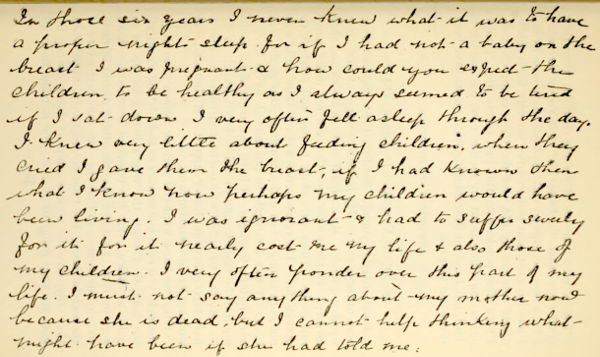
Facsimile of Extract from Letter 24.
25. Three Children in Three Years.
I was married young. My first three children were born in three years. My husband’s wages at that time was 27s. a week. My husband works in a boot and shoe factory. In the winter-time they did not make many full weeks. There were clubs to pay and holidays to provide for. The consequence was my third child was not born strong. She had a cough as soon as she was born. It was a struggle to put enough by to have a nurse in for a fortnight. I have had to get about to do my own housework long enough before I was fit to do it. My last two children have been stronger because I have been able to get better support. My husband was working for Co-operative firms.
When we know what the working women have to go through, you need not wonder at them trying to curtail the family. Though the wages have gone up, it is quite as difficult, for the prices of commodities have gone up too. I do feel that something should be done to help our women, so that they can take better care of themselves during the time of pregnancy. But when they only have the same amount of money coming in, how are they going to do it? For it takes them all their time to keep going on. A mother never thinks of herself. She is always trying to make her family comfortable. A good many of them get about too quick after confinement, and it is making invalids of a good many. I am very sorry I am not in active service for the Guild. I cannot tell you how much I love the work.
Wages 16s. to 27s.; six children, one miscarriage.
26. “Such is the Life of Poor Women.”
One of the difficulties I experienced during pregnancy was saving the doctor’s fee out of the small wage, which was only just enough each week for ordinary expenses. Thanks to the Maternity Benefit, a woman now knows she is provided for at the time.
I have had six children, all living, and what a terrible time it is, to be sure, especially during the last two months—only just enough to live on and another coming. The mental strain in addition to bodily labour must surely affect the child. I think a woman in that state should have all the rest that is possible. I did fairly well for a working man’s wife, but the recollection is anything but pleasant. Fancy bending over a washing-tub, doing the family washing perhaps an hour or two before baby is born. I think a woman in that condition should be considered unable to do heavy work for quite six weeks previous to the birth of her child.
Like other wage-paid workers, my husband’s wages fluctuated. The unsteadiness of the wages of a labourer is a matter of concern, and working a full week he would scarcely receive a real living wage. During the time of bringing my children up, the highest wage I received in any one week was 30s., and the lowest—well, I had so many that I really do not know how I got through. A week’s holiday[A] meant no wage at the week-end. And if the machinery broke down, or there were strikes or lock-outs, it stopped for six clear days, the sum of 10s., and 1s. for each child, would be paid. The same rate would be paid for out of work. My husband was seldom out of work, but, as I have stated, his wage was subject to fluctuation. I think the lowest (not to mention holidays of a week duration, when perhaps I had saved the Dividend to tide the week over) was 4s. 6d.
I shall have to tell you of a case near my home. The woman, I believe, is in her last month. I met her on her way home carrying a baby of two years (her second). She had been out to wash, as she said every copper helped (her husband is a labourer). She said: “I have to go out as long as I am able to help, to clean or wash; you see, they will not let me work in the factory.” When questioned about the baby she was carrying, her answer was that she took him with her, and he just sits on a chair until she has done. The child in question is rickety. He cannot stand yet. Such is the life of poor women. I have known many such.
27. Worked up to the Last.
I will just give you a little of my confinements. I had been married eighteen months when I had my first baby, when I had a trying time, being only an eight-months baby. My water broke five weeks before, and caused what the doctor calls “dry labour.” He only lived twelve hours. The second came three years and nine months afterwards. I had a straight labour, but I flooded afterwards, and if the doctor had not been there I should have lost my life; it caused me three months’ doctoring afterwards. The third one, which came two years and one month after, I had a fairly good labour. Over this one my sufferings were mostly before it came. I had varicose veins in the right leg right away in the abdomen, and the irritation was most distressing; I used to walk the bedroom most nights during the last month. The fourth came two years and three months after the third, and the doctor put me an elastic band on my leg, and of course I did not suffer so much over that one. I could have told at the meeting, where Mrs. D. was talking, about babies’ eyes, for this one’s eyes after a few days began as if they had got cold in them, and the doctor told me then many people took it for cold, but if neglected it was most serious. I am pleased to say I have had no trouble, for he is a fine young fellow now.
Between the fourth and fifth I was four years and eleven months, and then the sixth I went five years and eleven months, and was forty-two when I had him. Of course, I think I am suffering now for some of it, as I have always had to do my own work up to the last, and have had a lot of sickness with my husband and my second boy; till he was eleven years old I scarce ever had the doctor out of the house. I must say that I have had a good husband to help me through, but I do hope we get the £7 10s., and then there will be a many who will not suffer as many poor women have done in the past. At the time I had my children, and weighing all things together, I don’t think my husband’s wages averaged no more than 28s. a week, lowest 12s. and 15s. I should like to tell you, besides children we had my husband’s mother to keep, and allowed her 2s. 6d. a week besides keeping her. He has never been a strong man either, and many a time had him at home six or seven weeks at a time. I feel that when I go to conferences and meetings that I wish I had been a co-operator years ago, for since I have been a Guild worker I feel the years have been wasted, but I am trying to do my best now in my little way. Wishing you every success in the campaign we are fighting.
Wages average 28s.; six children, one miscarriage.
28. Heavy Expense of Childbirth.
My experiences as a young woman were very difficult, for I was the first child, and had never been brought up with young babies, or afterwards been where they were. My mother dying when I was three years old, I had no one to turn to for advice. I had spent all my youth in the country, and came as a stranger into a strange place, knowing no one but the man I married. My first child was a very delicate child, but I have often thought since that perhaps I had not done all things that were wise, but that would be for want of knowledge. I think a mother is a peculiarity during pregnancy, for I myself never seemed to want anything I had cooked myself, and if I went to any other house I could have eaten the poorest of foods. Then one must not go and buy what we may fancy, as that is an extra expense to the home; and knowing there is an additional expense coming, we have to be very careful. I have not had the Maternity Benefit yet, but that is only a trifle to the large expense that is incurred, when you have paid £1 1s. for your doctor, your nurse 10s. per week, a washerwoman 2s. per day (you cannot get a nurse here under, and if she does the washing she will charge 12s. per week). Then, you never find anyone that makes the money go as far as you do yourself, so that when you get up, instead of having the best of support, and very little to do, you have to begin to get pulled round again, and start and do the household work before you are strong enough, with an extra one added. Naturally the child either cannot be nursed by the mother at all, or only partly. The child suffers as well as the mother.
If it could be made possible, I really think mothers should have practically nothing to do with heavy work three months before childbirth and three months after—that is, if life is to be made worth living. But at present we have to clean down thoroughly ready for the event, till I have found myself wondering if death would not be a release. What with worry and feeling bad, I am never surprised at hearing of an expectant mother committing suicide. If she has two or three tiny children, she never has a minute’s rest, if she is an energetic housewife.
I think I won’t write any more, or you will be thinking I am rather a depressing character, but I shall be glad if anything I have said is any use to others as a benefit in future time.
Wages 20s. to 45s.; five children.
29. “I am Nearly Used Up.”
Through my married life I have had a good, kind partner, which means so much to the wife, and who always provided me with a doctor and a good nurse for my confinements, which goes without saying that the mother and child have a much better chance than other neglected ones. The first five were born with fifteen months between; then there was a wait of eight years for the sixth, and three years for the seventh. I have always worked hard both before and after childbirth. Give a woman a quiet home and an easy conscience and good plain food, and I see no reason why both mother and child should not do well. Personally, I don’t know what I should have done if it had not been for my good old nurse, my dear mother having passed away some years before; but by the grace of God and plenty of common sense, I have brought all my children through so far. I was married in 1884, and knew practically nothing about a child’s entry into the world. I do think there should be somewhere where intending brides could get information that would in some way prepare them for what may take place—those who have no mothers, I mean. But so much depends on the woman herself, whether she is going to make the best of things. Personally, I found it was no good worrying, although I found it much harder than most. I never knew what it was to have a day at the seaside for twenty years. I am not grumbling, only now I am nearly used up. If only the Maternity Benefit had been given when I and many others needed it, I cannot help thinking I could have done much better. My husband is a bricklayer, and you may guess it was a bit of a struggle with my little family.
Seven children.

ELEVEN CHILDREN BORN, ALL LIVING. FATHER A FISH-HAWKER.
This family is not connected with the Women’s Co-operative Guild.
(Reproduced by kind permission of the Medical Officer of Health for Liverpool.)
30. “Mother Last.”
When we were first married my husband’s wages was £1 a week. I have had seven children; one died at birth, one at one year old, and five are living. Each was about two years and three months old when the other was born. I had one miscarriage, which left me very ill for a long time. I found that the money was so little to do on that I must work as well to pay my way and clothe my children. My husband neither drank or smoked, but when rent, coals, gas, and food is taken out, what was left for other things? I had boarders, and was standing on my legs so much that after the birth of my last child a marble leg set in. I went under an operation, but my leg is still very bad. A mother wants good food before the birth as well as after, but how can it be done out of so little money? If father takes his food it must be as good as can be got; then the children come next and mother last.
Wages 20s.; seven children.
31. Little To Tell.
Why is it these things have never been thought of before? Is it ignorance, or is it that people are got used to the idea that we have to expect all sorts of illnesses when a woman gets pregnant, and we have just to put up with it and do the best we can? Personally, I have very little to tell of my own experiences, although I have four children—two boys and two girls, the eldest fifteen years and the youngest six years. Compared with some working mothers, I have gone through those trying periods fairly well. Also my confinements have on the whole been good. My husband’s occupation is a carpenter and joiner, and he gets the trade union rate of wages of the district.
Wages, trade union rate; four children.
32. Restriction Advocated.
I feel that I must write and explain why I advocate educating women to the idea that they should not bring children into the world without the means to provide for them. I know it is a most delicate subject, and very great care must be used in introducing it, but still, a word spoken sometimes does good. Someone has said that most of the trouble with delicate children were caused by women trying to destroy life in the early days of pregnancy. I do not, of course, recommend that sort of thing. It is absolutely wrong. But it is terrible to see how women suffer, even those that are in better conditions of life. I will quote one or two personal experiences. My grandmother had over twenty children; only eight lived to about fourteen years, only two to a good old age. A cousin (a beautiful girl) had seven children in about seven years; the first five died in birth, the sixth lived, and the seventh died and the mother also. What a wasted life! Another had seven children; dreadful confinements, two or three miscarriages, an operation for trouble in connection with same. Three children died and the mother also quite young. There are cases all round us much worse. You find in the majority of cases that in large families a certain number die and the others have less strength. Of course, there are exceptions. The trouble is that it takes so very long in England for things to be changed, and you are told to mind your own business and let people do as they like; but I am pleased to see that many men and women are getting wiser, to the benefit of the wives and families for whom the poor husband has to provide.
33. “Almost a Wreck.”
I was married at the age of twenty-two (barely twenty-two years), and by the time I had reached my thirty-second birthday was the mother of seven children, and I am sure you will pardon me if I take the credit for bringing up such a family without the loss of even one, seeing that it entailed such a great amount of suffering to myself on account of having to nurse them through all illness, and in addition (after sitting up many nights in succession) being compelled to do all household duties.
During pregnancy I suffered much. When at the end of ten years I was almost a mental and physical wreck, I determined that this state of things should not go on any longer, and if there was no natural means of prevention, then, of course, artificial means must be employed, which were successful, and am happy to say that from that time I have been able to take pretty good care of myself, but often shudder to think what might have been the result if things had been allowed to go on as they were. Two days after childbirth I invariably sat up in bed knitting stockings and doing general repairs for my family. My husband at that time was earning 30s. per week, and out of that amount claimed 6s. 6d. as pocket-money, and when I tell you that through all my difficulties there were no debts contracted on my part, you will be able to form some idea of what women are, in some cases, called upon to endure.
Wages 26s. to 30s.; seven children.
34. Delicate Children.
I had my three children in two years and five months, and all the time I carried I had violent sickness, night and day, under a doctor practically the whole time, who, of course, were unable to prevent my suffering. The result was my babies were delicate; the last one suffered with gastritis the whole of its short life—four years and ten months—which ended in peritonitis and abdominal tuberculosis. I have the eldest one still, but he is very delicate and unable to attend school.
Wages 21s. to 27s.; three children.
35. Continual Pregnancy for Fifteen Years.
I can speak from experience. For fifteen years I was in a very poor state of health owing to continual pregnancy. As soon as I was over one trouble, it was all started over again. In one instance, I was unable to go further than the top of the street the whole time owing to bladder trouble, constant flow of water. With one, my leg was so terribly bad I had constantly to sit down in the road when out, and stand with my leg on a chair to do my washing. I have had four children and ten miscarriages, three before the first child, each of them between three and four months. No cause but weakness, and, I’m afraid, ignorance and neglect. I was in a very critical state for years; my sufferings were very great from acute weakness. I now see a great deal of this agony ought never to have been, with proper attention. It is good to see some of our women waking up to this fact. It is help and attention during pregnancy that is wanted, and I hope my own dear daughter, if she ever marries, will be one to benefit with others, by our experience. I do hope this letter is something of what you are wishing for, hoping for good results of our Guild work in this matter.
Wages 25s.; four children, ten miscarriages.
36. Many Miscarriages.
My experience during wifehood has been that so long as husband and children could have necessities the mother could manage somehow.
It is my silver-wedding day to-morrow, and you will see something of what it has meant to me. I was married young; my husband is five years older. I had my first three children before I was twenty-four, nursing them all. Then I had three miscarriages in the next eight years. I had two more children later, in one and a half years. Since then, eleven years ago, I have had a misplaced womb, and have had two more miscarriages since, one being of twins five months, and one three months.
I believe it was having children too fast that weakened my inside and brought on miscarriages.
When I heard Mrs. H. say at our Conference she always had £5 provided for confinement, I felt that she had indeed been a lucky woman. I have never yet been in that position, and it is because a woman has not enough money to pay for things being done for her until she is strong enough to do them for herself, that causes so much suffering.
My husband’s wages was 30s. a week when he made a full week, but unfortunately his trade was very uncertain. In ten years we had moved four different times—twice to A, back again to B, and then to C which accounts a great deal for us being short, as we had to pay our own expenses each time, and of course you will understand what it means to a mother when she is left behind. The husband must be found his board-money and pocket-money, even if she goes short of necessaries.
Wages 30s.; five children, five miscarriages.
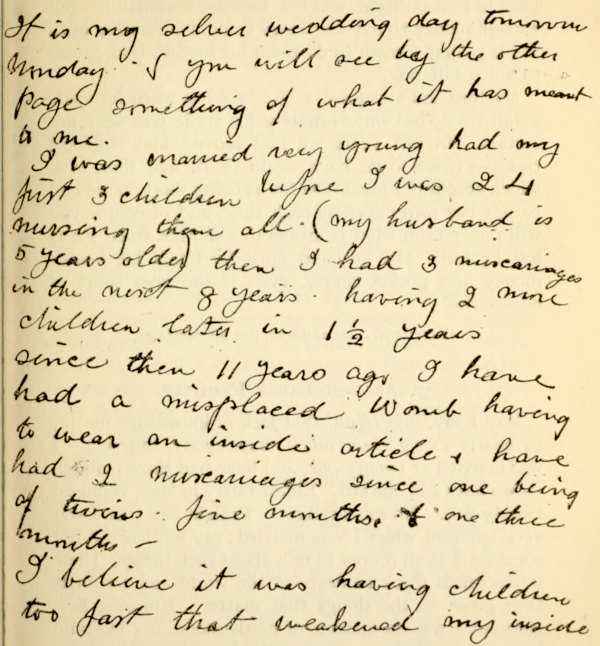
Facsimile of Extract from Letter 36.
37. Against Large Families.
May I say, first of all, that lack of knowledge means, in nearly every case, much unnecessary suffering. I was married at twenty-one, and have had three children—two boys and one girl. Eldest thirty in May, youngest twenty-five. No miscarriages. I might say that I was very ignorant when I was married; my mother did not consider it at all proper to talk about such things. There is too much mock modesty in the world and too little time given to the things that matter. Knowing how ignorant I was on matters of motherhood, my husband bought a book for me called “Advice to a Wife,” by Dr. Henry Pye Chavasse. It is a beautifully written book and would be a gift of untold value to any girl about to marry. There is also a sequel entitled “Advice to a Mother”—it has saved me pounds of expense—price 2s. 6d., by the same author. Yet, on the other hand, with all this knowledge, I had a very dreadful time with my first child—in fact, I nearly lost my life and reason too, and have never really enjoyed good health since. I was fully six months before I could look after my baby. This was one of my greatest disappointments. I was obliged to put my little one out to nurse, although I had an ample supply of milk. My second and third confinements were very bad, but I was able to get about at the end of the month. It is always a mystery how some poor mothers get about so soon, but of course some women are much stronger than others. Here let me add that through getting about too soon a great deal of suffering is stored up for later years. My old doctor once said to me that if women would only realise that a certain amount of rest was absolutely necessary after confinement, it would add several years to their life. I cannot speak too strongly about the evils of miscarriages. One miscarriage brought about unlawfully ruins a woman’s constitution more than half a dozen children. I have suffered from varicose veins since my first child was born, and during pregnancy.
My husband’s wages during child-bearing period have been never more than 24s.; being a piece-worker, has been as low as 9s. The wages I received when my last child was born (the same week, I mean) were 11s. I was glad to avail myself of a free doctor from the hospital. I may say I had a black doctor, and was never better attended in my life. I do not believe in large families. It does not give either the mother or the children a chance. Here again, I think, much education is needed. Fathers ought to control their bodies for the sake of the mother and child. I could quote several instances where a mother’s life has become intolerable through the husband’s lack of control. I do trust that the new Maternity Scheme will soon be a fact. I feel that, when put into working order, thousands of poor mothers will be saved unnecessary suffering.
Wages 9s. to 24s.; three children.
38. “Other Children with Measles.”
I think the earlier stages of pregnancy are the worst, but a woman needs most attention when she gets up. I have had to nurse my other children with measles when my baby was only four days old. I could never employ a proper nurse. I had six children when my husband was getting £1 a week. I am so glad to see the improvements in the lot of women to-day, but in some ways it is worse now to bring up a family. I am so glad to see anything being done to help the mother.
Wages £1 and upwards; eight children.
39. Benefit from Hearts of Oak.
I am afraid I have not much to tell from my experience. I have always been able to look after myself, with the help of a good husband. I have had nine children; eight are living.
When I tell you my husband is a member of the Hearts of Oak Benefit Society, you will know I have benefited by it.[B]
Nine children.
40. Neglect by Doctors.
I might say that I have had two children. The first one was still-born, but it was owing to the doctor not paying proper attention to me, as, when he came, he said he would not be needed until the morning after. However, I got to be worse, and he was fetched again, but refused to come, so we had to get a midwife, and she said if I had had proper attention the child would have been born then. Consequently, the child was suffocated in the birth. When all was over, my husband went to tell him, and he said he was very glad, as he wanted his rest. Then when I was going to have my second, I ordered another doctor, and when he was wanted, he was drinking, and sent another midwife; so you see I have not had it all straightforward. But when I was carrying them, I can say that I was very well during the time of pregnancy, only for sickness in the morning and after food, until about seven months gone, when I was all right.
Wages 21s. to 23s.; two children.
41. Over-Child-Bearing.
My feelings during pregnancy were just like those of Mary in Hall Caine (“The Woman Thou Gavest Me”). My mind was full of love and my time of preparation for the coming life within me. I worked very hard during the time of six children, knitting stockings and making clothes for those I already had, so my little one could be well nursed. Three are suffering from consumption, and one from curvature. When I had had six I never murmured, never once said I had enough, and did not want more, but after the birth of my last one I changed, because I could not nurse it and never carried it about. I do not blame my husband for this birth. He had waited patiently for ten months because I was ill, and thinking the time was safe, I submitted as a duty, knowing there is much unfaithfulness on the part of the husband where families are limited.
What is necessary for mothers is State aid for every child she gives birth to. If this is necessary for the aged, it is more so for the mother with the children.
It is quite time this question of maternity was taken up, and we must let the men know we are human beings with ideals, and aspire to something higher than to be mere objects on which they can satisfy themselves. Near my home are two sisters with ten months and eight days between their ages. Two doors from my own are four sisters, all living, and they all came in two years and fifteen days—the second born eleven months after the first, and thirteen months after twins came, and since then three more have been added to their number. None of them are old enough to work, and you will understand the position of the parents, who are good, deserving, well-meaning people, when the father, being out of work through the war (painter), has had to go labouring.
Wages 30s.; seven children, two miscarriages.
42. “Constant Care and Help.”
I take a strong personal interest in the matter, and will state a case that came under my notice, where a poor but respectable mother was practically ill the whole time of pregnancy, gave birth to a healthy baby, herself left very weak, and a month later taken to hospital, as a last resource, from no particular disease whatever. The doctors themselves could not give it a name. I myself should say that all her strength and vitality went to the nourishment of the baby, and she herself was left with scarce enough to live at all. I did all I could. She had another little one, one year and ten months old, at the time. I had him most of the time before her last illness, and entirely during the time she was in hospital (about three months, I think). This happened last year. The baby is now thirteen months old, and a fine, healthy child. The mother is still weak and ailing at times, certainly not fit to attend properly to her home duties and two small children. She had, previously to the two living, two other children, both still-born. In fact, I think both were dead some days previous to birth. This was before I knew her. I am confident, if more help had been forthcoming before and after confinement, she would and could have been saved much suffering.