Chapter VIII · HE SEES THE EQUATOR. (continued 2)
Reading edition
I said yes, by all means let us secure the boat. He exclaimed that for the present she would lie safely astern, and with that they took a turn with the line that held her and she rested quietly on the sea clear of the quarter.
Forthwith the three fellows began to explore the hull. The yellow man or boatswain, as I must henceforth call him, said no more to me than this as he pointed to the yawning hatches: “You are gen’elman,” with an ugly smile intended no doubt for a stroke of courtesy as he ran his eye over me: “ve are common sailor. Ve vill see to stop dem hole. More fresh vataire to drink ve need. Possib more bee-low. Also tobacco.” And thus saying he cried out to the others in their own dialect, and the three of them went to the main hatchway and disappeared down it.
I lifted the telescope and ran it over the sea, then sighed as with a breaking heart I laid the glass down again upon the deck. A strong sense of dismay filled me whilst I sat musing upon the men who were now coolly rummaging the vessel below. The rascality which lay in every line of the ugly yellow ruffian’s face, coupled with the stealthy, glittering glances, the greasy, snaky hair, the dark piratic countenances of the others might well have accounted for the apprehension, the actual consternation indeed which fell upon me whilst I thought of them. But that was not all. The recollection of the gold rushed upon me as a memory that had clean gone out of my mind, but that had suddenly flashed back upon me to communicate a sinister significance to the presence of the three Portuguese seamen. I can clearly understand now that my brain, as I had said, had been weakened by the honor of my situation, and by the long madness of expectation which had held it on fire whilst I searched the sea and waited for the Ruby to appear. So that, instead of accepting these three foreign sailors as a kind of godsend with whose assistance I might be enabled to doctor up the wreck so as to fit her to float until help came, not to speak of them as companions in misery, human creatures to talk to, beings whose society would extinguish out of this dreadful situation the intolerable element of solitude—I say instead of viewing these men thus, as might have happened, I believe, had I been my old self, a profound fear of and aversion from them seized me, and such was the state of my nerves at that time, I call to mind that I looked at the boat which hung astern with a sort of hurry in me to leap into her, cast her adrift, and sail away.
With an effort I mastered my agitation, constantly directing glances at the sea with a frequent prayer upon my lip that if not the Ruby, then at least some ship to rescue me would heave into view before sundown that night.
The men were a long while below. I stepped softly to the companion hatch, and bent my ear down it that I might know if they had made their way through the ’tween decks bulkhead into the cabin. The chink of money was very distinct, but that was all. Presently, however, I heard them talking in low voices, but their tongue was Hebrew to me, and I went back to my chair, looking yet again around the sea-line. I think they had been at least an hour below when they arrived on deck, emerging through the main hatch. They then walked forward without taking any notice of me, and disappeared through the fore-scuttle, whence, after a while, they arose bearing amongst them several tarpaulins which they had come across. I took it that there was a carpenter’s chest down there, for the yellow boatswain flourished a hammer in one hand, and a box of what proved to be round-headed nails in the other. They carefully secured the hatch with a couple of these tarpaulins, then came to the quarter-deck, and similarly roofed the skylight and the companion hatch, saving that they left free a corner flap to admit of our passage up and down.
“Dis is sailor vork,” said the boatswain, giving me a nod, whilst his face shone like a yellow sou’-wester in a squall of wet with the sweat that flooded his repulsive visage. “Dah vataire keep out now, sah.”
“It is well done,” said I, softening my voice to disguise the emotion of disgust and aversion which possessed me at sight of the ugly, treacherous, askant sort of stare he fastened upon me whilst he spoke. “Have you breakfasted?”
He came close to me before answering; the other two meanwhile remaining at the hatch and looking towards me.
“Ay,” he then said, “dere ish plenty biscuit, plenty vataire, plenty beef,” indicating with a grimy thumb a portion of the hold that lay under the cabin floor. “Dere ish plenty gold too,” he added in a hoarse, theatrical sort of whisper, with a sudden gleam of his little horrible eyes which to my fancy was as much like the blue flash off some keen and polished blade of poniard as anything I can figure to liken it to.
“Yes,” said I carelessly, “plenty I believe. But I must break my own fast now. We shall need fresh water before the day’s out, and, praised be the saints, there is plenty of it, you say.”
With that I went to the hatch, turned the flap of the tarpaulin and descended, eyed narrowly by the two fellows who stood beside it, and as I gained the interior I heard them say something to the boatswain, who responded with an off-hand sort of ya, ya! as though he would quiet a misgiving in them. I made a hurried meal of some wine, biscuit and cheese, and noticing as I passed on my way to the cabin again that the door of the berth in which the chest of gold stood was shut, I tried the handle and found it locked. The key was withdrawn. Smothering a curse upon the hour that had brought these creatures to the wreck, I lighted a cigar (of which I had a leather case half-full in my pocket), more for the easy look of it than for any need I felt for tobacco just then, and went in a lounge to the shelter of my umbrella. The boatswain was examining the telescope when I arrived. He instantly put it down on perceiving me and went forward to where his mates were. They peered first over one side, pointing and talking, and arguing with amazing volubility and with astonishing contortions; they then crossed to the other side, and looked over and fell into the same kind of hot, eager talk and gesticulations. It was easy to guess that they spoke about the spars which floated, held by their gear, against the wreck. After a bit they came to an agreement, disappeared in the forecastle and returned with tackles and coils of rope. One of them went over the side, and after a while there they were hauling upon purchases and slowly bringing the spar out of water, the boatswain talking and bawling with furious energy the whole while. I went forward to help them, and the yellow ruffian nodded when I seized hold of the rope they were pulling at, and cried with a hoarse roar of laughter, “Yash, yash. Ve make a mast, ve make a yart, and ve put up sail, and ve steer to our own countree and be reech men.”
Dagos as they were, they had some trick of seamanship amongst them. There was stump enough left of the foremast to secure the heel of a spar to, and by four o’clock that afternoon, with a break of but a single half-hour for a meal and a smoke (they had found plenty of pipes and tobacco in the seamen’s chests between decks), they had rigged up and stayed a jury-mast and crossed it with a yard manufactured from a boom of the wreckage to larboard; which, light as the breeze was, yet furnished them with spread of sail enough to give the sheer-hulk steerage way.
I had lent them a hand and done my landsman’s best, and had gone aft to rest myself and to sweep the sea with the telescope for the hundredth time that day. The three men were below getting some supper. The hull was stirring through the water at a snail’s pace to a weak, hot wind blowing right over her taffrail out of the south-east. The helm was amidships, and her short length of oil-smooth wake showed her going straight without steering. I could distinctly hear the men conversing in the cabin. I reckoned because they knew their lingo was unintelligible to me that they talked out. There was a fiery eagerness in the tones they sometimes delivered themselves in, but earnestly as I listened I could catch no meaning but that of their imprecations, which readily enough took my ear owing to a certain resemblance between them and Spanish and Italian oaths. A short interval of silence followed. All three then came on deck, one of them carrying a jar and another a canvas bag. I instantly observed that every man of them had girded a cutlass to his side. They seemed to avoid my gaze as they walked to the pin to which the line that connected the boat was belayed, and hauled her alongside. I threw away my cigar and stood up. The first idea that occurred to me was, they were going to victual the boat, sway the chest of gold into her and sail away from me; and I cannot express with what devotion I prayed to my Maker that this might prove so. I looked from one to the other of them. Once I caught a side-long glance from the boatswain; otherwise they went to this business as though I were not present, talking in rough, hurried whispers, with an occasional exclamation from the yellow ruffian, that was like saying, “Make haste!” When the boat was alongside one of them dropped into her, and received the jar and bag from the other. He then returned, and the moment he was inboards the boatswain, rounding upon me, drew his cutlass and pointed to the boat.
“Be pleashed to get in and go away!” he exclaimed.
“Go away!” I echoed, too much thunderstruck by the villain’s order to feel or witness the horror of the fate designed for me. “What have I done that you should——?”
He interrupted me with a roar. “Go quick!” he cried, lifting his weapon as though to strike, “or I kill you!”
The hands of the others groped at the hilts of their cutlasses; all three eyed me now, and there was murder in every man’s look. Without a word I stepped to the side, and sprang into the boat. One of them threw the line off the pin into the sea. “Hoise your sail and steer that way, or we shoot!” bellowed the yellow ruffian, waving his cutlass towards the sea astern. God knows there were small arms enough in the cabin to enable them to fulfil that threat. I grasped the halliards, mast-headed the little lug, and throwing an oar over the stern, sculled the boat’s head round, and in a minute was slipping away from the hull, at the stern of which the three men stood watching me, the blade in the boatswain’s hand shining to the sun like a wand of fire as he continued to point with it into the south-east.
Here now was I adrift in the mighty heart of the Indian Ocean in a small boat like a canoe, so shaped that she was little likely to lie close to the wind; hundreds of leagues from the nearest point of land, and in a part of the deep navigated in those days at long intervals only—I mean by the Dutch and English traders to the east; for the smaller vessels kept a much more westerly longitude than where I was, after rounding the Cape; often striking through the Mozambique or so climbing as to keep Mauritius aboard. Never was human being in a more wildly-desperate situation. I did not for an instant doubt that this was the beginning of the end, that if I was not capsized and drowned out of hand by some growing sea, I was to perish (unless I took my own life) of hunger and thirst. Yet the rage and terror which were upon me when I looked over my shoulder at the receding wreck passed away, with the help of God to be sure, ere the figures of the miscreants who had served me thus had been blended by distance out of their shapes into the body and hues of the hull. I thought to myself it is an escape, at all events. I may perish here; yet is there hope; but had I stayed yonder I was doomed: the sight of the gold had made them thirsty for my life. In my sleep, ay, or even waking, they would have hacked me to pieces and flung me overboard to the sharks here.
In this consideration, I say, I seemed to find a source of comfort. If I died as I now was, it would be God’s act, whereas had I remained in the wreck I must have been brutally butchered by the wretches whom the devil had despatched to me in the darkness of the morning that was gone. Nevertheless I was at a loss to comprehend their motive in thus using me. First of all by sending me away in their boat, they had robbed themselves of their only chance of escape should the wreck founder. Then again, I was a man, with a serviceable pair of hands belonging to me, and how necessary willing help was to persons circumstanced as they were, they could easily have gathered from the labours of the day. Besides, they would be able to judge of my condition by my attire, and how could they be sure that I should demand the treasure or put in my claim for a share of it? But I need not weary you with my speculations.
The sun sank when there was a space of about a league betwixt my boat and the wreck, and the darkness came in a stride out of the east. The wind was weak and hot, and there was a crackling noise of ripples round about the boat as she lay with scarce any way upon her, lightly but briskly bobbing upon the tropic ocean dimples. When the darkness came I let fall my sail, intending later on, when the wreck should have got well away towards the horizon, to head north; for methought the further I drew towards the equator out of these seas the better would be my chance of being rescued. The stars were very plentiful, rich, and brilliant that night. I gave God thanks for their company, and for the stillness and peace upon the ocean, and I prayed to Him to watch over and to succour me. When the moon rose I stood up and looked around, but saw nothing of the wreck; on which I hoisted my sail afresh and headed the boat north, as I conjectured by the position of the moon. There was a deal of fire in the sea, and I would again and again direct my eyes at the fitful flashing over the side with a dread in me of witnessing the outline of a shark.
The moon had risen about two hours, when I spied the gleam of water in the bottom of the boat. I was greatly startled, believing that she was leaking. Certainly there had been no water when I first entered her, nor down to this minute had I noticed the light or heard the noise of it in her. There was a little pewter mug in the stern sheets, a relic of the ship from which the Portuguese had come. I fell to bailing with it, and presently emptied the boat. No more water entered, for which at first I was deeply thankful; but after a little I got musing upon how it could have penetrated, seeing that no more came; and then a dreadful suspicion entering my mind, I looked for the jar which the Portuguese had handed into the boat, and saw it lying on its bilge in the bows. I picked it up and shook it; it was empty! It had been corked by a piece of canvas which still remained in the bung, but on the jar capsizing through the jerking of the boat, the water had easily drained out, and it was this precious fluid which I had been feverishly baling and casting overboard!
Maddened as I was by this discovery, I had yet sense enough remaining to sop my handkerchief in the little puddle that still damped the bottom of the boat, and to wring the moisture into the pewter measure. But at the outside half a pint was the utmost I recovered, which done I sat me down, my face buried in my hands, with my eyes scorched as though they were seared by the burning tears that rose to them from my full and breaking heart.
The night passed. Hour after hour I lay in a sort of stupefaction in the stern sheets, taking no notice of the weather, my eyes fixed upon the stars, a little space of which directly over my head I would crazily essay to number. Once I pressed the handkerchief to my parched lips, but found the damp of it brackish, and threw it from me. But I would not touch the precious drop of water I had preserved. Too bitterly well did I guess how the morrow’s sun would serve me, and the very soul within me seemed to recoil from the temptation to moisten my dry and burning tongue.
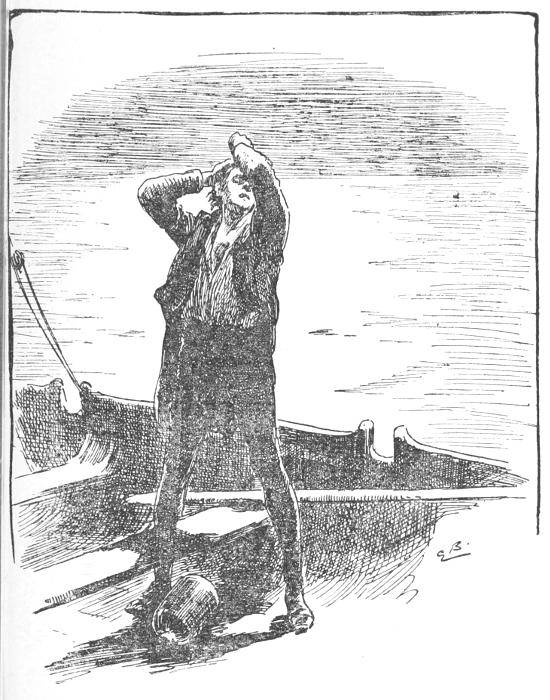
The memory of the early hours of that morning, of daybreak, of the time that followed, is but that of a delirium. I took no heed of my navigation. The sheet of the sail was fast, and the boat travelled softly before the gentle breeze that sat in little curls upon the water. I recollect thinking in a stupid, half-numbed way, that the boat was pursuing the path of the wreck whose one sail would suffer her to travel only straight before the wind. But the pain of thirst, the anguish of my situation, the maddening heat of the sun, the cruel, eternal barrenness of the ocean; these things combined lay like death upon me. I was sensible only that I lived and suffered. There was biscuit in the canvas bag which had been put in the boat. I thought by munching a fragment to ease the anguish in my throat, but found I could not swallow. Ah, heavenly God! the deliriousness of the gaze which I fastened upon the clear, cool, blue water over the side, the horrible temptation to drink of it, to plunge, and soak, and drown in it the torment of the seething and creaming noises of its ripples against the burning sides of the boat, which sickened the atmosphere with their poisonous smell of hot paint!
The night came—a second night. Some relief from the thirst which tortured me I had obtained by soaking my underclothes, and wearing the garments streaming. It was a night of wonderful oceanic beauty and tenderness: the moon, a glorious sphere of brilliancy, the wind sweet and cool with dew, and the sea sleeping to the quiet cradling of its swell. I had not closed my eyes for many a long weary hour, and nature could hold out no longer. It was a little before midnight I think that I fell asleep; the boat was then sailing quietly along, and steering herself, making a fair straight course of her progress—though to what quarter of the heavens she was carrying me I knew not, nor for a long while had thought of guessing. When I awoke the darkness was still upon the ocean, and the moon behind a body of high light cloud which she whitened and which concealed her, though her radiance yet lay in the atmosphere as a twilight. Right ahead of me, but at what distance I could not imagine, there floated a dark object upon the water. My glance had gone to her sleepily, but the instant it fell upon her I sprang to my feet, and bounded like a dart into the bow of the boat, and stood with my hands on the square of the canoe-shaped stem straining my sight into the gloom.
She was a ship—no doubt of that; yet she puzzled me greatly. The light was so thin and deceptive that I could distinguish little more than the block of blackness she made upon the dark sea. Apparently she was lying with all sails furled, or else hauled up close to the yards. One moment I would think that she was without masts; then I imagined I could perceive a visionary fabric of spar and rope. But she was a ship! Help she would yield me—the succour of her deck, and, oh my God! one drink, but one drink of water!
I flung the oars over, and weak as I was fell to rowing with might and main. The boat buzzed through the ripples to the impulse of my thirst-maddened arms. The shadow ahead slowly loomed larger and closer, till all in a breath I saw by a sudden gleam of moonlight which sparkled through a rent in the cloud, that she was La Mulette!
I dropped the oars, let fall the sail, and stood with my eyes fixed upon her, considering a little. Would the men murder me if I boarded her? Or would they not fill my empty jar for me on my beseeching them, on my pointing to my frothing lip as the yellow man had done, on my asking for water only, promising to depart at once? Why, it was better to be butchered by their cutlasses than to perish thus. I felt mad at the thought of a long sweet draught of wine and water out of a cold pannikin, and rendered utterly defiant, absolutely reckless by my sufferings, and by the dream and allurement of a drink of water, I fell to the oars again, and rowed the boat alongside the wreck.
I now noticed for the first time that the mast and sail which the fellows had erected were gone. Indeed the mast lay over the side, and the sail floated black under it in the water. I listened; all was hushed as death in the motionless hulk. I secured the painter of the boat to the chain plate, sprang on to the deck and stood looking a minute. Close to the wheel lay the figure of a man. He was sound asleep as I might suppose, his head pillowed on his arm, and the other arm over his face in a posture of sheltering it. He was the only one of the three visible. Wildly reckless always and goaded with the agony of thirst I went straight to the hatch and dropped into the cabin. The blackness was that of a coal-mine, but I knew the way, and after a little groping found the pantry door and entered. With an eager hand I sought for a candle, found one and lighted it, and in a few minutes my thirst was assuaged and I was standing with clasped uplifted hands thanking God for the exquisite comfort of the draught. Yet I drank cautiously. My need made me believe that I could have drained a cask to its dregs, but I forced my dreadful craving to be satisfied with scarce more than a quarter of a pint. The drink relaxed the muscles of my throat and I was able to eat. Afterwards I drank a little again, and then I felt a new man.
I stayed about twenty minutes in the pantry, in which time I heard no kind of noise saving a dim creak now and again from the hold of the wreck. Extinguishing the candle I entered the cabin and stood debating with myself on the course I should follow. Water I must have: should I fill a jar and carry it stealthily to the boat and be off and take my chance of managing the business unheard? Yes, I would do that, and if I aroused the sleepers, why, seeing that I was willing to go they might not refuse me a supply of drink....
I was musing thus when there was the sound of a yawn on deck. At that moment I remembered the array of cutlasses that embellished the cabin ceiling. It was the noise the fellow made, the perception that one of the three at all events was awake with his mates somewhere at hand to swiftly alarm, which put the thought of those cutlasses into my head, or it is fifty to one if in the blackness of that interior I should have recollected them. I sprang upon the table and in a moment was gripping a blade. The very feel of it, the mere sense of being armed sent the blood rushing through my veins as though to some tonic of miraculous potency. “Now,” thought I, setting my teeth, “let the ruffians fall upon me if they will. If my life is to be taken it shall not be for the want of an English arm to defend it.”
I jumped on to the deck, went stealthily to the foot of the steps and listened. The man yawned again, and I heard the tread of his foot as he moved, whence I suspected him to be the yellow boatswain, the others being unshod, though to be sure there were shoes enough in the ’tween decks for them had they a mind to help themselves. As I sent a look up through the lifted corner of tarpaulin over the hatch I spied the delicate, illusive grey of daybreak in the air, and so speedy was the coming of the dawn that it lay broad with the sun close under the rim of the horizon ere I could form a resolution whilst listening to make sure that he who was on deck continued alone. Then hearing him yawn again and no sound of the others reaching my ears, I mounted the steps and gained the deck.
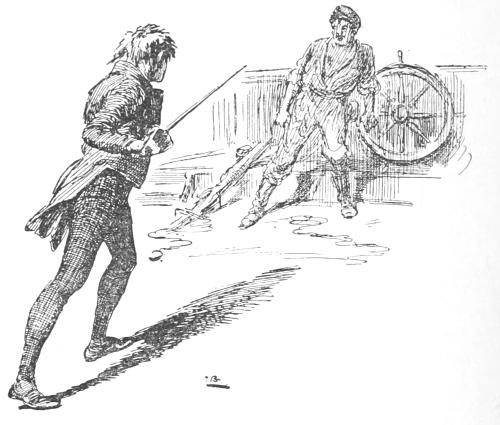
It was the Portuguese boatswain, as I had imagined. He was in the act of seating himself much in the same place where I had seen him sleeping when I boarded the vessel; but he instantly saw me as I arose, and remained motionless and rigid as though blasted by a flash of lightning. His jaw dropped, his hideous little eyes protruded bright with horror and fright from their sockets, and his yellow face changed into a sort of greenish tint like mottled soap or the countenance of a man in a fit. No doubt he supposed me a spectre, rising as I did in that way out of the cabin when the rogue would imagine me a hundred miles off, or floating a corpse in the water, and I dare say but for the paralysis of terror that had fixed his jaw some pious sentences would have dropped from him. For my part I hung in the wind undecided, at a loss to act. I sent a look over my shoulder to observe if the others were about, and the movement of my head seemed like the release of him from the constraint of my eye. He leapt into an erect posture and rushed to the side, saw the boat, uttered a cry for all the world resembling the rough, saw-like yell of the albatross stooping to some bait in the foaming eddies of a wake, in a bound came back to the binnacle, the body of which stood, though the compass, hood and glass were gone, and thrusting his hand into it pulled out a pistol which he levelled at me. The weapon flashed as I ran at him. Ere he had time to draw the cutlass which dangled at his hip, I had buried the blade, the large heavy hilt of which I grasped with both hands, deep in his neck, crushing clean through his right jaw; and even whilst he was in the act of falling I had lifted and brought the cutlass down upon him again, this time driving the edge of it so deep into his skull that the weight of him as he dropped dead dragged the weapon out of my hand, and it was a wrestle of some moments to free the blade.
I swept round fully prepared for the confrontment of the others, who, I took it, if they were sleeping below, would rush up on deck on hearing the report of the pistol. My head was full of blood; I felt on fire from my throat to my feet. God knows why or how it was, for I should have imagined of myself that the taking of a human life would palsy my muscles with the horror of the thing to the weakness of a woman’s arm; and yet in the instant of my rounding, prepared for, panting for a sight of the other two, I seemed conscious of the strength of a dozen men in me.
All was still. The sun had risen in splendour; the ocean was a running surface of glory under him, and the blue of the south had the dark tenderness of violet with the gushing into it of the hot and sparkling breeze which had sprung up in the north with the coming of the morn. Where were the others? My eyes reeled as they went from the corpse of the Portuguese to the pistol he had let drop. I picked it up; it was a rude weapon belonging to the armoury of La Mulette. I conjectured that the miscreant would not have thus armed himself without providing a stock of ammunition at hand, and on putting my arm into the binnacle stand I found, sure enough, a powder-horn and a parcel of pistol-bullets. I carefully loaded the weapon, narrowly seeing to the priming, all the while constantly glancing along the deck and listening. Then with the pistol in one hand and the cutlass in the other, I stepped below, furious and eager for a sight of the dead man’s mates.
The lifted tarpaulin let the morning sunshine fall fair into the cabin, and now I saw that which had before been invisible to me; I mean a great blood-stain upon the deck, with a spattering of blood-drops and spots of more hideous suggestion yet, round about. A thin trail of blood went from the large stain upon the floor along through the passage betwixt the berths, and so to the main hatch. Ha! thought I, this signifies murder! I found nothing in the cabins. The door of the berth in which the chest of gold stood, was locked, but on putting my whole weight against it with knee and shoulder it flew open. The contents of the place were as I had before taken notice of; and there were no signs here of either dead or living men. I regained the deck, and walking forward observed a thin line of blood going from the coamings of the main hatch to the side. It was the continuation and termination of the trail below, and most unmistakably denoted the passage of a bleeding body borne through the hatch and cast overboard. I walked further forward yet, and on the forecastle witnessed another wide stain of blood. It looked fresher than the other—nay, it was not yet dry, and the heat went out of my body, and ice cold shudders swept through my limbs as I turned my back upon it, sick, dizzy, and trembling.
Those horrible marks gave me the whole story as fully as though the dead brute aft had recited it to me at large ere I struck him down. He had murdered his mates one after the other to be alone with the gold. It had been murder cold and deliberate, I was sure. There were no signs of a struggle; there were no hints of any previous conflict in the person of the yellow Portuguese. It was as though he had crept behind the men one after another, and struck them down with a chopper. Indeed I was as sure of this as though I had witnessed the deed; and there was the chest of gold in the cabin to explain the reason of it. How he hoped to manage if he fell in with a ship (and I know not what other expectation of coming off with his life he could have formed) it is useless to conjecture. Some plausible tale no doubt he would have taken care to prepare, claiming the gold as his by law of treasure-trove.
I let fall the weapons, and lay over a little strip of bulwark, panting for breath. My eyes were upon the water over the side, but a minute after on directing them at the sea-line, I spied the sails of a ship, a square of pearl glimmering in the blue distance, and slightly leaning from the hot and brilliant breeze gushing fair down upon her starboard beam. Scarce had my mind time to recognize the object as a ship, when it vanished; a reddish gloom boiled up mistlike all about me; the ocean to a mile away from the side of the wreck turned of the deep crimson of blood, spinning round like a teetotum; then followed blackness, and I remember no more....
When consciousness returned I found myself lying in a bunk in a ship’s cabin. The place was familiar to me, and I recollect in a weak way trying to find out why it should be so. “Why, confound it all,” I muttered, “this is my cabin aboard the Ruby. God! what a dream it has been!”
“Very glad your senses have returned to you, Mr. Catesby. It’s been a doocid long faint, sir,” exclaimed a familiar voice, and no less a person than the second mate of the Ruby came to my bedside.
A moment after the door opened, and the doctor of the ship entered. I was about to speak; he peremptorily motioned silence, felt my pulse and brow, nodding approvingly; then addressing the mate, thanked him for keeping watch and told him he could go. As my dawning intellects brightened, my eagerness to make sure of the reality of the adventure I had come through grew into a little fever. When I looked round the cabin and saw my clothes hanging upon the bulkhead, my books, the twenty odds and ends of the homely furniture of my berth, I could not but believe that I had fallen ill, been seized perhaps with a fever, and that the incidents of the wreck, the open boat, the murderous Portuguese, were a mere vision of my distempered brain. But for some hours the doctor had his way, would not suffer me to talk, with his own hand brought me broth and wine, and now, finding me strong enough, as I supposed, to support a conversation, went out and in a few minutes returned with Captain Bow.
It was then my suspicion that all that had happened to me was most horribly and fearfully real was confirmed. The boat that had left me aboard the wreck had been sighted sweeping down in the mist; twenty ropes’ ends had been hove at her from the Ruby, and in a few minutes her people were safe on the Indiaman’s deck. Sail was shortened to close-reefed topsails, but a black blowing night drew around, as you know, and when the dawn broke the wreck was nowhere visible. Light, baffling weather followed. Meanwhile Bow swore that he would not quit these waters till he had exhausted the inside of a week in search for me. At sunrise that morning the wreck was signalled from the foretopgallant yard of the Ruby. The ship was immediately headed for it, and in a couple of hours the hulk was close aboard. The chief officer was sent in charge of a boat, and I was found lying, dead as they thought, a fathom’s distance from a large stain of blood, whilst aft was the body of a half-caste with his head cut open. They left him as he lay, but me they handed into the boat to carry on board, with the design of giving me a Christian burial, till the doctor, looking at me, asked if they wanted to add to the horrors of the wreck by drowning a living man, and ordered me to be conveyed at once to my bed.
This was the captain’s story, and I then related mine. Both he and the doctor exchanged looks as I talked. It was tolerably evident to my mind that they only believed in about a quarter of what I told them.
“But, Captain,” I cried, “on my solemn honour as a gentleman, as I am alive here to say it, there was gold to the value of many thousands of pounds in the chest.”
“Yes, yes,” he answered with a glance of compassion at me. “I don’t doubt it, Mr. Catesby. So much the better for the mermen when it goes down to them; it will render the mermaids more placable, I don’t doubt.”
“But, gracious mercy!” I cried, “it is only the sending of a boat, you know. Why, sir, there’s enough in that chest to yield a little fortune to every mother’s son of us aboard.”
“Yes, yes,” said Captain Bow, with a faint smile of concern at the doctor, who kept his eyes with a knowing look in them fastened upon the deck. “But we took you off the wreck, my dear sir, a little before nine o’clock, and it is now after four, and as our speed has been a comfortable eight knots ever since, you may reckon the hulk at sixty miles’ distance astern. No, Mr. Catesby, we’re bound to Bombay this time in earnest, sir. No more hunting after wrecks this voyage.”
But I got every man-jack of the passengers, with the whole ship’s company to boot, to credit my story up to the hilt before we had measured half the length of the Bay of Bengal, and such was the conviction I had inspired forwards at all events that the third mate one night told me it was reported that a number of the forecastle hands had made up their minds to charter, if possible, if not, then to run away with, a country wallah on the Ruby’s arrival at Bombay, and sail the Indian Ocean till they fell in with the wreck—if she was still afloat.
But now to resume the story of Master Rockafellar’s voyage: we caught the south-east trades much closer to the equator than they are used to blow, and bowled merrily down the South Atlantic, rounding the Cape of Good Hope at a distance of fifty leagues from it, and driving ahead, with a strong westerly gale over our stern, straight as an arrow for Cape Leeuwin. Though the Lady Violet showed like a frigate upon the water, with a beam that made her look somewhat tub-like, and a round massive bow that would crush a sea as the head of a whale might, she sailed nobly, easily reeling off a full twelve knots when there was wind enough to drive her, looking up when on a bowline with erect spars and a wake without an inch of lee-way in it; and I have known her, even in regions of calms and cats-paws and baffling airs, to travel in some mysterious manner a hundred miles in twenty-four hours.
She was a favourite ship among passengers, and almost as punctual in her dates as though she were a steamer; and this voyage, true to her old records, she sailed through the Sydney Heads one sparkling morning at about eight o’clock, making the time of her passage from the Thames exactly eighty-one days.
I will pass swiftly over our stay at Sydney. I should need a deal of room to describe the glories of this rich Australian scene, of islands and blue water and shores, with white houses peeping out from amidst the fringe of the bush. We hauled in alongside the Circular Quay, and then followed much grimy work in the shape of discharging cargo, furbishing up the ship, attending to the rigging, and the like. Then the vessel was conveyed to the other side of the harbour to receive her freight of wool. I was ashore a good many times, yet cannot say that I saw much of Sydney. Many a long hour would I spend in the beautiful Botanical Gardens, gazing at the astonishing vegetation, and watching with admiration the songless birds of superb plumage which throng those acres of grace, beauty, and colour. Mr. Cock took me to the theatre. I was out rowing and sailing too very often; but the captain would not let me have much liberty. He said I was too young to be cruising about ashore alone, and indeed my half-crown a week did not help me very largely to partake of the diversions of Sydney. My chief pleasure lay in sitting in the main-chains, when there was nothing to do, and fishing. Many fish, wonderful in colour, did I haul up, and some of them were a very delicate food.
The Lady Violet was pretty deep with wool when we were towed out to sea. The passengers we had brought out were replaced by a new set—all of them colonials, intending a visit to the old home for purposes of pleasure or business. Three of our sailors had run away, and new men were taken in their place; otherwise the ship’s company remained as it had been.
I remember going on the forecastle in the second dog-watch of the first day that we were out, and leaning over the head-rail and looking into the evening-shadowed distance, and saying to myself, “We are homeward bound!” Ah, the delight of those words to the sailor, be he old or young! It is the most inspiriting of all the sentiments in the songs Jack sings. It is a thought that seems to compensate for all past hardships, and to hearten a man to endure all that may be harsh and painful in the time that yet lies between him and his arrival home. My young heart beat high, I remember, and I found a wonderful delight, as I overlay the forecastle rail, in looking straight down under me, where the coppered fore-foot of the ship was sheering through the satin-like seas rolling to her bow, and in thinking that every fathom of white water, with its tinkling foam-bells and bubbles of yellow spume which ran past, shortened the distance between me and my dear old home by six feet!
We were in the South Pacific now, making for the terrible Cape Horn, about whose enormous icebergs and leviathan seas and black snow-storms there was a deal said in our midshipmen’s berth; but it was still delicious weather; the indescribable sweetness and softness of the Pacific was in the temperature; the sun-touched billows chased us in lines of dark blue and flaming gold; sea-birds with breasts of snow, poised on long tremulous wings of ermine, hovered in our wake; and the albicore and the bonito merrily kept us company, as the Lady Violet went ambling through the caressing waters.
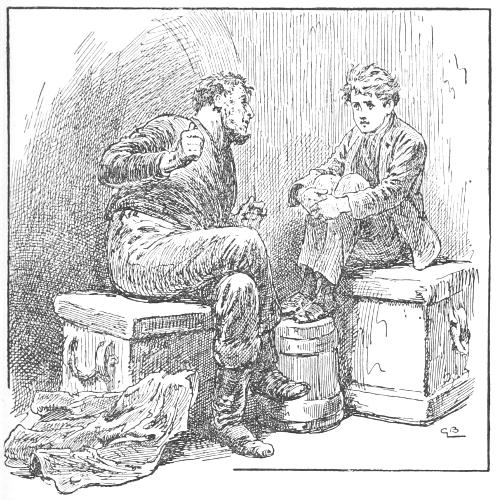
“LISTENING TO THE YARNS HE SPUN.”
This was the pleasantest part of the voyage, so far as I was concerned. I made friends with one of the boatswain’s mates, and was much in the forecastle with him during my watches below. I can see myself now, sitting on his sea-chest, listening to the yarns he spun me about the voyages he had made and the countries he had visited, or learning from him how to lay up sennit, to wield a marline-spike, to use the palm and needle, and so on. A lamp fed by slush spluttered under a blackened beam just over us; a number of hammocks hung from the ceiling or upper deck, with here and there a weather-darkened face, well whiskered, overlying the edge of the canvas with a pipe in its mouth. A double tier of bunks went curving into the eyes of the ship where the hawse-pipes were, and where the gloom lay heavy. In one of these beds a man would lie with a book in his hand, laboriously reading, his lips moving like a child’s as his eyes spelt down the page. Squatting on a chest would be a grim unshaven salt, sourly stitching at a pair of breeches. Elsewhere you would see a fellow greasing his sea-boots, another munching at a sea-biscuit with his eyes fixed like an owl’s, a third cutting up a pipeful of tobacco from a black flat cake that made me think of toffee. Yet, despite the life and movement within, the forecastle was always very quiet. My boatswain’s mate would talk to me in hoarse whispers, and the other sailors rarely conversed above their breath. Sleep is naturally prized at sea. The opportunities for taking it are short, and must be made the most of. Hence, seamen are very careful that their mates, when turned in, should repose undisturbed that when their own turn comes round for a nap they may sleep in quiet.
The dog-watches are the holiday hours at sea, and on a fine evening, whilst we were in the Pacific, I would repair to the forecastle and there sit, listening to and watching the men until the sun went down and the black shadow of night came along. They had a fiddle amongst them, and one of them played the concertina, and these instruments made music enough to set them a-dancing. I have laughed till the tears stood in my eyes to watch the brawny capering Jacks sliding about in a waltz, tenderly embracing one another as partners, capsizing over the flukes of the stowed anchors, and making a very pageant of the forecastle deck—with its rough details of capstan, catheads, scuttle and the like—by their swimming, floating, jovial figures, coloured of every hue with the clothes they wore. My friend the boatswain’s mate danced the hornpipe to perfection. He valued himself on this art, and was not always very forward in obliging us. When he suffered himself to be coaxed, the treat he gave us was a real one. He would dress himself so as to resemble a man-of-war’s man, and make his appearance with a straw hat on the back of his head-on “nine-hairs,” as sailors say—flowing trousers, pumps, an open shirt that disclosed his mossy breast, and take his stand on a part of the forecastle where the passengers aft could see him. The fiddler would then clamber on to the booms over the long-boat, and begin to saw away, and off would start the boatswain’s mate in a delightful shuffle—feet twinkling, legs vibrating, arms arched—a manly figure indeed! whilst the sailors noisily clapped their hands in huge relish of the show.
We were drawing into colder weather, though Cape Horn was still a long way off, when there happened two incidents in the same morning, one of which—as you will suppose when I have related it—made a very deep impression on me.
The ship was under all plain sail, by which is signified all the canvas a vessel carries saving her studding-sails. The breeze was moderate and off the bow, and there was very little sea; but through the bosom of the deep there ran, as regular as the beat of the pulse, a long swell, slipping its volumes into our quarter with weight enough in each broad-backed fold to keep the Lady Violet curtseying until the forecastle of her looked as flat as a spoon on the slope of water ahead. I was at work with Kennet in one of the quarter-boats, clearing her out. The boat hung from a pair of irons, termed “davits,” over the side, and was steadied by flat mat-like lashings, called “gripes.” From over the gunwale of the boat we could obtain a clear view of the sea ahead, whereas, from the poop the horizon over the bows was concealed by the foresail and mainsail.
Presently, pausing in my work to glance ahead, I caught sight of a body of foam about a couple of points on the bow, as we should say, though how far off it was I could not imagine. Figure the moon reflecting herself in water just as she shows in the heavens—that is to say, as a bright silver disk—and you will obtain a good idea of the appearance on which my eyes had fastened. It rose and fell upon the swell, by which one knew that it must be afloat, whatever it was.
“See that, Kennet?” said I.
He peered and cried, “Ha! doth it move?”
We stared at it.
“No,” said he, “it ith’nt moving. I thought it wath a whirlwind firtht. I thay tho’—what the doothe—tain’t a windmill, ith it?”
I now saw, as he had seen, what resembled the vanes of a windmill revolving in the foam—a wet black arm that rose and fell out of the white seething like to the blades of a propeller rotating under the counter of a tall light steamer, amidst the boiling of the water churned up by the machine.
“See that thrasher!” suddenly shouted the chief mate. “By George, gentlemen and ladies, a fight between a thrasher and a whale, as I live! A rare sight, truly!”
And all the passengers who were on deck came rushing with him over to the side to look. As we approached, the spectacle grew in magnitude, and proved one of the wildest—I may say one of the most terrific—pictures which the imagination could body forth, even of the sea—that arena of wonders and of terrors. There was so much fury of foaming water, that it was hard to distinguish the gigantic combatants. Yet now and again I would catch a sight of a large space of the gleaming dark body of a leviathan whale, upon which the great arms of the thrasher were beating in blows, the echoes of which had something of a metallic twang in them that made you think of a giant blacksmith striking upon an enormous anvil. The boiling commotion covered a large space of water, and might easily have passed for the first fierce foamings of a waterspout.
I watched, breathless with astonishment and awe, my eyes half out of my head. Here was something to talk about to my father and mother! But would they believe it? It was a sight I could scarcely credit, specially when Kennet told me that what I saw of the whale was only a little bit of him.
“Will the thrasher kill him?” said I.
“I expect tho,” he answered; “anyhow, of the two, I’d thooner not be the whale.”
When the monster duellists had settled down upon our quarter, the long black arms suddenly vanished. The seething turmoil expired into smooth water, and the swell rolled flawless as before.
“The whale’th killed,” said Kennet; “keep a bright look-out, Rockafellar, and you’ll thee his body rithe.”
But though I stared long and earnestly, it was to no purpose; the body did not rise: haply because the whale wasn’t dead.
“Oh, but,” said Kennet, “a big chap like that ithn’t going to rithe up with a pop ath though he wath a little fith. When a whale gothe to work, no matter what hith buthineth ith, he’th bound to take hith time. Did you ever thee a fat man hurry himthelf. Courth not. Tho ith it with whaleth.”
For a long time I continued to furtively glance at the sea, and then gave up looking, secretly pleasing myself with the idea that the whale was still alive, and not very much hurt; for it seemed to me very hard that any creature should meet with so dreadful an end as being flogged to death.