MASTER REYNARD
Reading edition
The earth where I was born was far down the face of a steep cliff and opened on a sloping shelf of turf, from the edge of which the undercliff fell sheer to the sea. The entrance we used most was slightly above the level of the springy sward and led by a small tunnel to a roomy chamber where daylight never penetrated.
There on the bare dry ground the vixen laid us—my two sisters and me. If I was like the baby cubs I have since seen, I was born blind, my muzzle was blunt and rounded, and my coat as black as a crow, the only white about me being a few hairs in the tag of my tiny brush. Even at the time when I first remember what I was like my fur was still a very dark color and bore no resemblance to the russet hue of a full-grown fox.
This was a few weeks after my eyes were opened, when, after awaking from our first sleep, we were in the habit of sunning ourselves just inside the mouth of the earth. It was there, with my muzzle resting on the vixen's flank, that I got my earliest glimpse of the world. The turf was then almost hidden by pink flowers, over the heads of which I could see, between two of the pinnacles that bordered the ledge, the sea breaking on a reef where the cormorants used to gather at low water and stand with folded or outstretched wings until the rising tide drove them to the big white rock beyond.
So few things moved within our field of vision that every creature we saw afforded us the keenest interest. Sometimes during days together nothing stirred but the stems of the thrift and the surf about the reef, for the sky was cloudless when the hot weather set in. Now and again a red-legged crow came and perched on one of the pinnacles, crying "Daw, daw!" until its mate joined it, and then, all too soon, they took wing and flew away; at times a hawk or a peregrine would glide by and break the monotony of our life.
Our narrow green was dotted by five boulders, and one of these we could see from the earth. On this our most frequent visitor alighted. It was an old raven, who presently dropped to the ground, walked up to the remains of any fowl or rabbit lying near the heap of sandy soil which my mother had scratched out when making the earth, and pecked, pecked, pecked, until only the bones were left. Then, uttering his curious "Cawpse, cawpse!" he would hop along the ground, flap his big black wings, and pass out of sight. I feel sure that he saw us watching him, for his eyes often turned our way.
One afternoon, to our astonishment, a half-grown rabbit came lopping along, and stopped to nibble the turf at a spot barely a good spring from the vixen. She, usually very drowsy, half opened her eyes and turned her face towards the intruder, but she did not rise to her feet. We youngsters were beside ourselves with excitement, but were not allowed to scramble over her side to drive away this audacious trespasser on our private domain. This, I think, was owing to my mother's great anxiety on our account.
I have never known a vixen so determined that her cubs should lie hidden by day; but then we were her first litter. She would constantly warn us against venturing out whilst the sun was up. So particular was she that we were not permitted to expose as much as our muzzles outside the earth, though birds and rabbits moved about there freely. We could not understand the restriction, and I fear that we thought it unkind of her to confine us to a cramped, stuffy hole the summer day through, when we longed to be gambolling about the sward or basking in those warm corners under the boulders which retained some of their heat even after the sun went down.
It is true that I tried hard to get my liberty. Time after time, when I thought she had dozed off, I endeavored to squeeze between her and the low roof. It was of no use, though I used the utmost stealth and trod as lightly as a feather. Never once did I catch her napping. On the few occasions when I was on the point of succeeding she seized me between her velvety lips and put me back in my place between my two little sisters.
Thus, by the kindest of mothers, I was disciplined in the ways of the wild creatures, learning, by constant correction and example, that the world outside the earth is denied to us by day, and is ours to move and play and seek our prey in only by night.
And how short those nights were! What a weary, weary time it was, awaiting their approach! How impatiently we watched their slow advent! how we tingled with delight in every limb on seeing the shadow of the high boulder creep and creep across the turf until it reached the pinnacle that had a patch of golden lichen on it! Then, as the sun sank behind the headland, the nearer sea became sombre, the bright expanse beyond darkened, and at last the stars would begin to show in the sky. By this my mother had shaken off her drowsiness, the glow had come back into her green eyes, and, rising to her feet, she would leave the earth. If she detected no danger, she would call us to her. What a moment that was! the pent-up energy of hours of restraint breaking out in such rompings and runnings after our own brushes as I have never seen in any other young creatures. Wearying at last of these antics and of jumping over the back of the vixen, who watched us with loving eyes, we settled down to the game of lurk and pounce amongst the boulders. To our great delight, the vixen often joined in this before setting out in search of food. Her nimbleness and skill in dodging filled us with amazement. Like a flash she was on us; there was no avoiding her rushes, though she always avoided ours, and her movements were as silent as the passing of a shadow when a swift cloud crosses the sun.
I shall never forget those frolics in which she shared; they not only were useful training for the life before us, as I afterwards realized, but also induced in us a fondness for her so great that we could not bear to have her out of our sight when she left us to seek the food we needed. We would watch her as she followed the narrow track that wound up the cliff, till from the rocks near the top she looked down to assure herself of our safety before going inland. And that was not the last we saw of her. Times and times I have caught sight of her bright eyes glittering like twin stars on the summit of the ivy-covered scarp where the magpies built.
A more affectionate mother cubs never had; but for the life of me I could not understand why she was so anxious about our safety: I had neither seen nor heard anything in our little world to alarm me. Whether she had or not I do not know, but she was haunted by the dread of something, as I could tell by the way she used to look about her and listen when watching our gambols, and by her starting at the slightest unusual sound. Her nervousness made me nervous, and, thus infected by my mother's fears, I got to be afraid without in the least knowing what there was to be afraid of.
These vague fears were on two occasions the cause of false alarms. Once, somewhere along the cliff a dry stick snapped. That was enough. My sisters and I fled in terror to our den, where we were joined a minute later by the anxious vixen who had just left us for a foraging expedition. There was no danger: it was merely a lumbering badger which crossed our playground later on; but I have learnt since that no wild thing can hear the snap of a twig without alarm. The badger was a strange-looking creature: his face was white, with black stripes from ear to muzzle; his gray hair all but swept the ground; and he walked not lightly on his toes as we do but heavily on the soles of his feet.
At another time the whistling of harvest curlews frightened us almost out of our lives. These were both needless terrors; but soon I was brought face to face with evidence of a real enemy, the one, no doubt, of whom my mother lived in such dread. It was not many days after the coming of the whimbrels—for the moon, a mere sickle then, had not waxed to half its full size—when two incidents occurred which proved to me, a raw, heedless cub, that there was serious ground for fear. Both happened in broad daylight, one close on the heels of the other.
One drowsy noon we were watching from our usual place the old raven pecking at the hind-quarters of a rabbit, when with an awful thud a big stone struck the turf close to him, bounded off, and rolled towards the corner of our playground. In a twinkling, before it had stopped rolling, we had retreated to the very end of the earth and there lay trembling, and wondering, even in our consternation, whether the mischievous magpies, who had set up a sudden clamor, were not the cause of our discomfiture. When we stole out in the quiet and dusk, my mother walked straight to the stone and smelt it, and I, being curious, must needs follow her example. What an awesome smell it had! The scent was unlike anything I had sniffed before, and surely not the scent of any beast of the field! The vixen, who stood there watching me, noted the cold shiver it sent through my young limbs and seemed by her expressive face to say: "The creature that tainted that stone is the cause of all my fears," and, further, if I read aright the sad look that rose to her eyes: "He will prove your scourge as he has proved mine." My story will tell whether it has been so.
In our games that night I avoided the corner where the stone lay, and so did my sisters. I noticed, too, that the vixen was away in quest of food a shorter time than usual, and did not go out a second time as she had generally done since our appetites had grown. We had, therefore, to satisfy our hunger on the gosling she had brought. This we broke up ourselves with our sharp milk teeth, chattering and quarrelling as was our wont whilst the meagre feast lasted. The vixen contented herself with a few old bones.
The other incident was graver, causing injury to my mother. It happened thus. She had gone out one night shortly after—for the moon was still not quite full—but, though absent till nearly dawn, she failed to procure any food. I remember our impatience at her long absence and our disappointment on seeing her issue from the furze without even a few mice in her mouth. However, there was no help for it. The sun was reddening the sky near the horizon, so, supperless and sullen, we curled ourselves up and fell asleep. On awakening, as we did before our usual time, we began to cry pitifully for food, and at length, driven to desperation by our complaints, the vixen stole out at noon, not under cover of mist or fog but with the sun shining in the bluest of skies. Ravenous with hunger, we crowded the mouth of the earth, listening for the sound of her returning steps. Long, long we harkened without catching any whisper of her approach. At last we heard a muffled, double report, and after an interval the faint patter of her pads. In my anxiety to see what she had brought I put my head out and kept my eyes fixed on the run in the yellow furze through which she always came. Never shall I forget my horror at what I saw. Instead of her russet face with its black and white marking, her mask below the eyes was all blood and dreadful to behold. I am ashamed to say it, but her appearance terrified me, though I loved her as I loved my life. She staggered into the earth, and took no more notice of us than, if we had been strange cubs, which alarmed me more than her dazed look. The reason of her plight was a puzzle to me, and though the stone, with its horrid association, forced itself upon my notice as a possible cause, I dismissed the idea that it could have done the injury, inasmuch as it was lying where it had rolled. No; in a vague way I attributed her state to the daylight, so great had my fear of it became. Ah me, how ignorant I was in those far-away days!
We were free now to go and come as we listed, but, famished though we were, not one of us attempted to leave the earth except to get a drink of water, and we lay huddled together, looking out of the corners of our eyes at our poor mother, as miserable and forlorn a litter of foxes as could anywhere be found. In the depth of the night, however, the pangs of hunger compelling us, we left the vixen, who seemed to be asleep, and crept out. Being bigger than my sisters, I felt called upon to take the lead, and neither of them showed any inclination to dispute it with me. But where to take them, or how to get a supper, I had not an idea.
I am not going to cast one word of blame on my mother for delaying to teach us to shift for ourselves. It was out of affection that she kept us so long to the nursery; and how could she possibly have foreseen the calamity that had so unexpectedly disabled her and thrown us on our own resources? And, lest a suspicion of neglect towards us should attach to her memory, I must here say what I have not yet mentioned—that by the death of the dog-fox, my father, the burden of our upbringing from the day of our birth fell wholly on my little mother. What labor and sacrifice this must have meant! After we were weaned, how often have I seen her go without her share of the prey that we greedy cubs might suffer no sint! When has cliff or moor witnessed greater devotion, greater unselfishness? And now she lay in the earth so sorely wounded as to be indifferent to our helpless plight. I will not dwell on my feelings, but they made it difficult to focus my thoughts on the undertaking before me.
For a minute or two I sat on my haunches near the big boulder, considering gravely where I should go, my sisters the while cruising restlessly up and down the turf with all the impatience of irresponsibility, awaiting development. This to-and-fro movement of theirs added to my bewilderment, and even the bats flitting about were a trifle disconcerting to a cub with three routes to choose from, each in its turn more inviting than the others.
There was the patch leading to the upper cliff; there was, I assumed, a way down the undercliff; and there was, I knew, a track between the two which the badger had worn. I have never been up the cliff, and after the vixen's recent experience dared not go, though it was night, and nothing stirred but the reeds about our drinking-place and the leaves of the gnarled tree where the magpies built.
In the end I decided, if I could find a way, to go down the cliff. There was a sandy cove below that I had often longed to reach in my mother's absence, but my strength was unequal to the descent. I determined to try to go there now. So, leading the others past the little basin where we quenched our thirst, I brought them along the cliff to a place where the sheer precipice changed into a succession of ledges, down which we leaped until brought to a standstill above a wall of nearly perpendicular rock. It was impossible to reach the flat shelf below by leaping: we should have broken our bones; and there we stood staring over the brink at the smooth rock beneath us, and wondering how we could pass it.
Again my sisters looked to me to take the lead, so, putting forth all the power of my untried claws, I began, brush first, to crawl down a fissure that lay aslant the precipitous face of the great slab. This I followed, partly by feeling with my hind claws where foothold permitted a firm grip, partly by turning my face and seeing where the easiest line of descent lay. At last I succeeded in reaching the bottom without mishap. My sisters imitated me, coming down more easily than I had done, probably on account of their greater skill and lesser weight.
A creek, too wide to jump, now separated us from the sand, but, taking to the water, we waded until we lost bottom, and then, for the first time in our lives, by swimming crossed deep water. More bedraggled creatures than we looked on landing it would be difficult to imagine; but we shook ourselves from muzzle to tag, making the spray fly from our wet coats, and set about searching for something to eat. Where the beach met the cliff was a cave that ran a long way in and had two lesser caves opening out of it. We explored these without finding in either of them anything except dry seaweed and pieces of cork, so we retraced our steps and made for the other side of the cove. There, just beyond the ribs of a wreck that projected from the sand, we came on a big jelly-fish. Though we should have turned up our noses at such food in ordinary times, it was a windfall in our famished condition, and we swallowed the quivering mass with gusto, sand and all. Good food or bad, it filled our stomachs and stopped the gnawing pangs of hunger.
We then clambered to the top of some rocks that stood out above the sand, and found there a small pool of water, temptingly clear. Being thirsty after our meal, we began to lap it. Ugh! it was nasty to the taste, but, what was worse, the mistake was a blow to my conceit, for I was humiliated by the reproachful glances my sisters shot at me. To avoid them I raised my eyes, and, as I did so, caught sight of the vixen on the cliff at the spot where we had taken to the ledges. Then it came home to me that I had done wrong to leave the earth without her, and, fearing she would be angry, I hid myself amongst the rocks, as did my sisters. The vixen, usually quick as lightning in her movements, came but very slowly down the cliff on the line we had taken, and as slowly crossed the sand to the cave. This she entered, and for a time was lost to view. My inclination nearly led me to quit my hiding-place and go after her; but again fear checked me, and I remained where I was. On leaving the cave, she with difficulty followed our trail to the spot where we had eaten the jelly-fish, and, not seeing us, seemed to lose heart, for she sank to the ground and called us with a most piteous cry, which at once drew us to her side. I can see even now the delight on her poor face as we bounded towards her across the sand that separated us. After licking us with her swollen tongue, she led us up the cliff by a much easier path than the one we had followed in descending, and we soon reached the level of our earth. We proceeded towards it in single file by the narrowest of paths, passing our usual drinking-place, where for a reason I am going to explain, the supply was so scanty that we found barely enough water to quench our thirst. The vixen was curled up at the mouth of the den when we reached it, and we had to climb over her back to get to our sleeping-places.
A short period free from troubles followed, during which my mother rapidly recovered. Nevertheless, the wounds on her face were barely healed when there befell one of the greatest calamities of my eventful life—a calamity that was near putting an end to us all.
Before attempting to describe it, I must mention the sufferings we endured in the days following our adventure down the cliff, through the gradual drying up of the water that supplied our drinking-place. Night after night, when we repaired to the basin that the falling water had hollowed in the rock, I had noticed that the stream, which came from some hidden source beneath a pile of boulders, got smaller and smaller, and, after the very hot weather set in, dwindled to a mere trickle. To such a thin thread did it shrink that from the mouth of the earth, which was not many yards away, we could no longer hear it splashing into the basin. Now and then, especially when some animal, generally the badger, had been there before us, we were driven to such an extremity as to be compelled to lick the dew off the turf to cool our tongues until the water had collected again.
It was a terrible time. To this day we speak of the year of my birth as the Dry Year, and indeed I, who was a May fox, was nearly three moons old before I saw rain, which fell on the afternoon of the day when the curlews' whistling scared us. I remember, though not as vividly as the rainbow seen that day, the embrowned turf of our playground being dotted with slugs which the downpour had enticed out of the sunless crevices of the rocks.
The rain had ceased before nightfall, and the following day the sky, which had been black and lowering, became as cloudless as before, whilst the heat, previously intense, became well-nigh unbearable. Hour after hour we lay in the deep shade of the bracken fronds at the entrance, panting for breath and longing for the water we were not allowed to get before dusk. At the first sign of twilight, and even whilst the after-glow suffused the sky, we rushed to the drinking-place, our three masks completely filling the basin, which we soon lapped dry. Almost as refreshing as the water we swallowed was the cool spray—despite the rain it was no more—that fell on our heads from the lip of the rock above.
For several days from dawn to dusk we thus endured the agony of parching thirst, till at last, when our tongues lolled out, and one of my sisters showed signs of utter exhaustion, the vixen so far yielded to our entreaties as to permit us to slink out, one by one, to drink.
Unfortunately we could not reach the reeds about the water without exposing ourselves to the eyes of the magpies overhead. On spying us they set up such a clamor that every bird and beast for a great distance along the cliffs must have known that a fox was moving, and rejoiced at our misfortune.
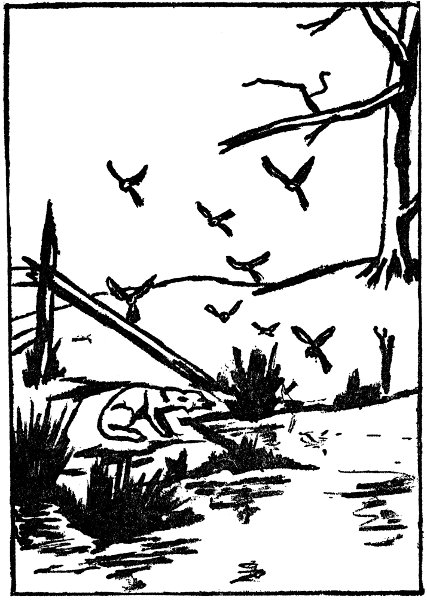
"THESE BLACK AND WHITE PESTS."
We have many enemies, but none whom we despise so much as magpies, crows, and jays. Their treatment of us is as unprovoked as it is insulting. We have never injured them, and yet, as I shall tell later, the pariahs of the wild, that gorge on our unburied kills, seek every opportunity of betraying us.
Those cliff magpies, at whose tongues we suffered such indignities, must have spent their days in watching our movements. After my sisters had had their drink, it took hours for the basin to refill, yet as soon as my muzzle projected beyond the bracken when I went to take my turn, the hateful wretches would cry out, "There he is!"
I never grew indifferent to this daily annoyance, and in a rage I used to lap up what water there was in choking haste, so as to escape the mobbing of these black and white pests who flew just beyond my reach, and at times even brushed with their wings the tops of the tall reeds about the basin.
We were not the only sufferers from the drought. Indeed everything suffered, and most of all perhaps the herbage. The thrift and white campion that covered the ledges, the ferns that found root-hold in the crannies and crevices of the rocks, and the stone-crop and lichens growing on the rocks themselves, drooped and withered; and at last the boggy ground above the drinking-place caked and dried, so that the reeds turned yellow, and rattled rather than swished when the night wind stirred them. Under the scorching sun the thread of water shrank and shrank until it dripped drop by drop, and finally dried up altogether. At my last visit to the drinking-place the smooth basin was hot with the fierce rays, and the moss about the edge of the rock above was nearly as moistureless as the crinkled lichen on the pinnacles.
In these conditions it was impossible to remain where we were, and that night my mother reluctantly decided to abandon our home and to lead us up the cliff. Would that she had taken us the moment the stars showed, instead of waiting until deep night; for the delay nearly proved fatal to us all. A fox's life is so short that he cannot forget even the groundless scares his fears make him the victim of, so it is not to be wondered at that the events of the night I am about to describe are almost as vivid to me still as at the time they happened.
My sisters had returned once more from the dried-up basin to which they had been some five or six times since sunset, and joined me where I lay near the mouth of the earth, waiting for the dew to fall and listening for the footsteps of the vixen who had gone to get ready the new lair. It was a beautiful night—the sea calm, and the surf about the reef alight with phosphorescence, whilst the furze-bushes and the clump of brambles near the reeds were dotted with glow-worms. There was even a solitary one on the drooping bracken above the entrance. A wind of summer strength stirred the withered herbage and murmured around the precipitous crags above our heads, but, save the boom from the great cave below when the tide rose, all was still. Suddenly, without warning of any kind, there came a flash of light from the cliffs above the sandy cove where we had eaten the jelly-fish. It died away and then returned, more brightly than before. It was not nearly so fierce as the lines of fire I had seen zigzagging the black sky on the afternoon of the heavy rain, nor was there any thunder with it as then, but there was a strange, crackling noise, as of animals crunching bones.
Immediately flames leapt in great tongues from the brambly thicket beyond the reeds. These drove us to the den; and there we crouched listening to the awful sound, which grew louder and louder. Soon a faint glare lit up a part of the earth as far in as the spot where two rocks narrowed the tunnel. Before this I was on the point of bolting; but now fear seized my limbs and I could not rise, could only crouch closer and closer to the earth like my sisters. Whilst we lay there huddled together and crying out for the vixen she returned, darkening the tunnel as she came towards us. Scarcely had she joined us when an evil-smelling fog rolled in, causing us to keep our muzzles close to the ground. Then the fire swept past the earth, lighting it up to the end where we lay. Panic-stricken though I was, I remember noticing how the smooth floor gleamed, and how curiously the light glowed on the vixen's fur. Suddenly the heat became less intense, and a current of fresh air entering the earth revived us as we lay panting at the point of suffocation.
The crackling and roar of the flames had long died away before we dared to quit our sanctuary, and when at last we ventured to the mouth of the earth, what a sight met our gaze! Our playground was charred, except for a narrow strip near its edge, and towards this a thin line of fire moved slowly, blotting out the criss-cross tracks we had worn between the boulders. A ring of sparks encircled the raven's perch, and crept higher and higher, consuming the lichen, and leaving bare rock in its train; where the brambles had stood was a heap of glowing ash; grasses and reeds had disappeared; in short, the place which had been our little world and of which we knew every blade and spray, was as nearly past recognition as a corn-field after harvest. Away towards the west great ruddy flames leapt from the furze brake and lit up sky and sea and headland with such a lurid light as I had never seen; whilst on the near slopes a hundred smaller fires flickered and died, to blaze again and re-illuminate the great piles of bared rock. Sparks falling from above showed that the ivy round the home of the magpies had not escaped; and as the birds had mobbed me most unmercifully that very day, I rejoiced in their misfortune.
The vixen, satisfied at last that she might venture forth, took up my puny sister, who was then unable to stand, and set out for the steep path by which she usually reached the top of the cliff. My other sister and I trod closely on her heels as she picked her way over the heated ground and skirted the glowing remains of the furze-bushes. In the ascent my pads were rather badly burnt and my fore-legs singed by a fire which suddenly broke out in some smouldering heather into which they sank. The glimpse I got of the face of the precipice showed that the ivy had lost all its leaves, the bared stems standing out plainly against the black fissures that seamed the great wall of rock besprinkled with sparks which in their fall resembled shooting stars.
When we reached the summit we could hear the magpies calling out, but, to do them justice, they were not mobbing us then. Once beyond the blackened ground we ranged up one on each side of the vixen, and after crossing fields of stubble and turnips and getting far beyond the reek of the burning, we caught the scene of the brook for which she was making. We struck it where it wound through marshy ground on the outskirts of a furze brake, and in a trice were up to our bellies in the delicious cool stream with our tongues hard at work. The water was cold and sweet; there was plenty of it, and we lapped and lapped as long as we could take in a drop. In all my life I never again enjoyed a drink like that, and the mud that stuck to my legs seemed to soothe the pain of the burns.
My little sister was able to follow us now without assistance, but the vixen, who was exhausted with carrying her so far, went at a walking pace between the stems of the furze and kept looking back to see that she was keeping up with us, though she took no notice whatever of my other sister who was going on three legs, or of myself whose poor feet were so tender that I hardly dared touch the ground.
Emerging from the furze we came upon a circle of turf, where we caught sight of at least a dozen rabbits scurrying to the holes that honey-combed the ground at the foot of a high cairn. One of these had been enlarged, as the heap of fresh earth showed, and into it the vixen led us to a dry and sweet-smelling den, where she left us, to procure food. In there it seemed as still as death to us who had had the roar of the sea in our ears all our lives, but the lair was very comfortable, and roomy enough for us to stand side by side whilst the vixen distributed the rabbit she presently brought us. We found, too, on curling ourselves up, that, big as we were, we could lie close together without trespassing on the tunnel as we had latterly done in the cliff earth. So, as we were thoroughly weary, we soon forgot the dangers we had passed and fell asleep, our mother lying between us and the opening, as was her invariable custom.
I was startled out of my sleep by a stamping overhead, caused by the rabbits in the heart of whose burrow we were lying. The noise, which broke out again and again just as I was on the point of dropping off, irritated me so much that at last I got on my hind-legs, thrust my muzzle into the hole in the roof, and breathed loudly through my nostrils. This snorting was not without result, for after the stampede that followed there was quiet for a long time. Nevertheless the tiresome creatures had spoilt my day's rest and, try as I might, I could not doze off again. My sisters slept through it all, and the vixen showed no sign of being disturbed, except that she half opened her eyes when the rabbits scampered over the spot where she lay. It was very early, as I could tell by the scent of the furze that stole along the tunnel and almost overpowered the flavor of rabbit, from which the den was never quite free. To pass the weary hours I licked the mud off my legs, which still smarted, and, whilst I did so, thought of our narrow escape, and wondered in a vague way whether fires were to be numbered amongst the regular troubles of a fox's life.
At length the vixen roused herself, and when the coolness and smell of the air warned her that the sun had set, she rose and led us forth, not for our usual gambols, but, as it proved, for our first lesson in hunting. I suspected something unusual was afoot the moment she ordered us to follow her across the stream, whither she had taken us to drink; and the further we got from the earth, the more excited I grew at the prospect of the adventures before us. It was most exhilarating to be wandering over the broad, high country, which, in comparison with our ledge at the foot of the precipice, seemed like the roof of the world. For nights and nights past I had yearned to accompany my mother on her rounds, and the unexpected gratification of my intense longing thrilled every fibre of my being. So great was my excitement that I quite forgot not only a loose milk tooth that had been worrying me, but even the tenderness of my poor pads, on which I had with difficulty limped to the drinking-place.
The vixen ran steadily some dozen paces in front, and side by side we cubs followed in her train, noiselessly as shadows. It fascinated me to watch her lissom movements as she stole along, and to note the ripples that ruffled her smooth coat when she crossed the broken ground. We had passed over one hill and were breasting the next beyond before I began to wonder what we were going to see and how soon, and then, without warning, she reared on her hind-legs, listened with ears erect, and pounced on something in a patch of rushes, in which she buried her long muzzle. The next instant she came trotting back to my little sister, and gave her the mouse she held between her lips. Her quick hearing had detected its movements in the undergrowth.
But mousing was apparently not the chief business of the night, for, without dwelling, she stepped across the dried-up runnel which the rushes fringed, and headed for the craggy ridge above. In her progress up the steep slope she kept scanning the ground to right and left of the trail as if she expected at any moment to see the prey she was in search of, and when near the crest, she crouched and crawled forward with the utmost caution. With breathless excitement we wormed our bodies along in her wake, as though we had been trained to it. But we had not; we were imitating her instinctively, and kept our distance as faithfully as the shadow of her brush that darkened the moonlit ground in front of us.
On reaching the ridge I could not help shifting my gaze to glance at the wide marshland below us, so strikingly unlike any scene my young eyes had looked on. Here and there on the level expanse sheets of water and a winding stream shone like silver, and from the great reed-beds about them came a soft voice like the murmur of waves on a distant beach. This was the expression of a stolen instant, and no sooner were my eyes back on the vixen than she sank to the ground as though she had suddenly lost the use of her legs. We did the same. This pleased her, as I could tell by the expression of satisfaction in the eager face which she turned slowly towards us and as slowly withdrew, brushing aside as she did so the dry bents that rose a good way up her long ears.
At first I wondered what she had found, as the only living things visible to me were some rabbits far below on the lip of a funnel-shaped warren. But presently over her head I saw the tips of the ears of a rabbit quite close to us, and my heart began to thump as it had perhaps never done before. The sight of the living prey had awoke in me the dormant spirit of the hunter that has hardly slumbered since; and not in me only—my sisters were evidently as excited as I was, for their brushes were lashing mine as wildly as mine did theirs.
The rabbit meanwhile winded danger and, as its nostrils showed, kept sniffing the air to try and locate it. When it succeeded, its eyes fell, not on a stealthy enemy thirsting for its blood but—so sudden was the vixen's change of attitude and demeanor—on a harmless, playful fox rolling on her back as I had seen her roll in utter guilelessness a hundred times. The rabbit started, as well it might, and I expected to see it dive into its hole; but, marvellous to relate, instead of seeking safety it regained its composure and resumed its nibbling on an almost bare patch, towards which the assumed frolics of the vixen and the slant of the ground were leading her. Then, with one of the lightning-like rushes which made her look a blurred mass even to our quick eyes, she was on it, and when she faced us the rabbit's head and hind-quarters hung limp as she held it across her mouth.
On witnessing the kill we cubs jumped to our feet, eager to partake of the first course of our supper. But when we attempted to take it from her mouth, to our amazement the vixen snarled at us as she had never done before. My little sister, to whom she had always been so tender, was the last to try, and, incredible as it may seem, the vixen turned on her like a fury.
Nothing but my desire to record faithfully the impressions of that time would make one own that I considered my mother unnatural and cruel in denying food to the weakling among her cubs. If the water which had cooled our parched throats the night before scalded us we should not have been so taken aback as by this sudden change of conduct on her part. It was simply incomprehensible. Had something outside our knowledge caused her to turn against us? If not, what did she mean by her harshness?
It did occur to me that this unaccountable behavior might be feigned, and that presently she would drop the rabbit at our feet and be again the affectionate mother she had always been. Indeed, I watched her out of the corners of my eyes from the spot to which I had retired, expecting to see her snarl relax into a grin. But in this I was disappointed, for, on reaching a ledge below, to which we followed her at a respectful distance, she devoured every bit of the luscious morsel before our eyes, though she knew well enough that we were ravenously hungry. The delicious smell of the hot entrails which the wind brought us put the keenest edge on my appetite—already sharp set by the previous night's shortness—and with the strong craving to satisfy it came the novel thought of satisfying it with a rabbit of my own catching. The bunnies were still playing about on the edge of the warren, and whilst the vixen kept shifting her gaze from them to me, licking her blood-stained lips, the lesson she wished to teach suddenly flashed upon me, and the explanation of her conduct was complete. She was saying as plainly as could be: "There is your prey. I have shown you how to catch it. Go and get your own supper." I required no further prompting. Then and there I began my first stalk under the eyes of all I loved in the world.
Summoning my untried powers, I wormed myself over the ground towards a single bush that screened me from the observation of most of the rabbits. Its shelter gained, I looked back and up to where three pairs of green eyes regarded my every movement, and then peeped with the utmost caution round the corner of the furze towards my prey. The bunnies were all there and thoroughly alert, and so disconcerting did I find their united gaze that I drew my head back to consider the situation. When I peeped again half their number showed their white scuts and went to ground, and the other half seemed prepared to follow their example.
Satisfied that direct approach was out of the question, I walked aslant the slope towards a piece of flat ground on a level with the warren, as though I were engaged on some engrossing pursuit in that direction. As I went I did not even squint at the rabbits, though it cost me an effort to look straight before my muzzle. My simulated detachment from my prey must, I felt sure, have excited the admiration of my dear mother, and so must the thoroughness with which I gave myself over to the antics that took me at first farther and farther away and then nearer and nearer to the few remaining rabbits, whose curiosity had got the better of their fears. The silly creatures were quite taken in by the capers I cut, and one at least realized his danger too late, for ere he could reach his hole I snapped him up and bore him up the hill towards the vixen.
Insignificant as the incident appears to me now, it was one of the greatest events of my life. Every fox is proud of his first skill, and I was no little elated by mine. Indeed, I felt I must make some sort of demonstration in honor of the occasion. Imagine me, then, a handsome young dog-fox, head erect, ears pricked, brush on end and well fluffed out, trotting along on the very tips of my toes with my first rabbit between my jaws, and you have a picture of me as I swaggered over the bare turf in the moonlight, before the eyes of my admiring mother and jealous sisters. I shall never forget the pride I felt nor the inner voice that kept whispering, "You are able to get your own living now, my boy, but don't be too highly elated!"
I got on rapidly after this my first experience. How could I do otherwise, with such a clever and painstaking little mother as I had to instruct me in the wiles and ways of our craft? In a short time I became expert not only in catching young rabbits, rats, moles, and mice, but in picking up the feathered prey that frequented fen and hillside.
Of course I met with many disappointments; pheasants, partridges and wild-duck often escaped my clutches when I already considered them mine. My failures were due chiefly to inexperience, but in a measure also to the intrusion of other foragers, who turned up at critical moments and ended for me the work of hours. On one occasion a hunted hare passed between me and a covey of partridges I was drawing up to; but the birds, who squatted in a circle with their heads outwards, as their custom is, did not rise until a pack of stoats came along on his line, and with their noisy yelpings broke the silence of the roosting-place. On another, the sudden appearance of a poaching cat defrauded me of a pheasant on the edge of the pine-wood; but that night I killed before the darkness faded, and had buried what I could not eat before the vixen raised the "dawn" cry.
After good hunting we used to romp home together over the furze-dotted land or across the fen, and from sheer high spirits vixen and cubs alike used to bound over the bushes or clumps of rushes and sags across our path. Week after week nothing happened to disturb our peace or excite our fears, but, for all our apparent security, we were never abroad at sunrise unless a thick fog lay over the land.
In those expeditions I used latterly to separate myself from the vixen on reaching the hunting-ground and seek my prey alone, rejoining her when she sounded the call to leave the trail or ambuscade. In this way I became more and more independent, and at times would turn a deaf ear to her summons. Twice I was so belated that the pools by the way reflected the rosy fore-glow of the dreaded sun as I scurried past them.
I may have spent a month in the vixen's company before I could make up my mind to shake off her authority and forage where I pleased. She was conscious that I chafed at the restraint which she considered necessary, and was no doubt prepared for the serious step I had resolved on. Nevertheless, when the night came, it was not without a sense of shame at breaking away from one who had been so tender and forbearing that I sidled past her where she sat outside the earth playing with my sisters. I had rather expected she would exercise her authority and call me back. Though she stopped her gambols and looked wistfully at me, she made no protest, and I passed on my way unchallenged; but I was glad when the bushes hid me from her sight and from the questioning eyes of my sisters, who seemed very much astounded at my going off alone.
Soon after crossing the stream I began to rehearse the plan I had surreptitiously formed in the earth. As it promised success, I decided to go through with it, though a darker night would have suited my purpose better. Clouds indeed there were, but white and fleecy, only slightly veiling the light of the full moon, which shone very brightly as it crossed the deep blue spaces between. The self-confidence I felt in the earth had been oozing out of me as I threaded my lonely way through brake and reed-bed, but it returned when, after trotting across the quaking bog that trembled under my light steps like a jelly-fish, I came at last in sight of the pool where I intended to lie in wait for wild-fowl.
Although I had taken a short cut over the treacherous morass to forestall the duck, I feared that they might have settled in the water before I reached my ambush, and it was with eager eyes that I scanned the surface from a clump of rushes on a finger of land that jutted a little way into the pool. All was well! Not a bird floated on the open water between the beds of lilies or in the lanes between the floating grasses. The only things that caught my eye were a moorhen and the trail of light she left behind her as she swam the gloomy water, which was shadowed by some alders.
Crossing the baked and cracked mud left exposed by the sunken pool, I entered the water, swam over to the islet, and secreted myself on the margin of a tiny creek just above a line of stranded feathers. There, screened from the keen eyes of flighting wild-fowl, I began my vigil with all the hope that waits on inexperience. Crouching beneath my ambush, I heard a few distant cries, which came, I should think, from birds feeding on the edge of the tide. So faint were they as to be audible only when the fitful breeze lulled and the tall, feathery reeds about the pool ceased rustling.
Presently, from the water between two lily-beds a silvery fish jumped thrice in quick succession, as if pursued by some invisible foe; of the latter I saw no sign, unless its presence was indicated by a swirl in the water near where the fish fell. The long silence which followed was broken at last by a swish of wings—an inspiriting sound after the tedious wait—and some wild-fowl wheeled in a wide circle above my head before settling on one of the many pools that glistened on the wide marshland below them. As I lost the sound, I feared that the birds had dropped in elsewhere, but round they came again, and, with a splash that made me tingle with excitement, a mallard and three ducks alighted on the water midway between the islet and the reeds. They were evidently ill at ease, though they seemed to me so secure that I could not imagine what they could be so suspicious of—certainly not of the peregrine that harassed them at sunrise; and at the time I knew nothing of the monster pike that tenanted the pool, and took toll of feather as well as of fin. Could it be that they had got some inkling of my presence? I crouched absolutely motionless whilst their restless eyes searched the tangle on the island, and when they stared at the patch where I was hiding I scarcely dared to breathe.
Before settling down to feed they cruised restlessly up and down, and even whilst they gobbled the green weed they kept looking so persistently my way that I began to think they could scent me, though they had only bills for noses. I had marked the mallard for my prey. He was a plump bird, and I had to keep my tongue from licking my lips at the prospect of the feast; for he was very tempting to an appetitie sated of rabbit, and by this time I knew every feather of the plumage that covered his juicy flesh. Just then it vexed me to hear the vixen's call, far off though it was, as I feared she might hit my trail, follow it, and spoil my hunting. Her yapping caused all four birds to raise their heads and listen, but they showed no further sign of alarm, as every creature of the wild knows that dead silence precedes the kill and that it need have no dread of a noisy fox.
The ducks were near enough now for me to see the least movement of the mallard's eyes, the white of which, even when his head was down, showed that he was in deadly fear of something. "Fool!" thought I, "eat your supper in peace; but when you land on the mud of the creek, where lie yesternight's imprints of your webbed feet, then look about you."
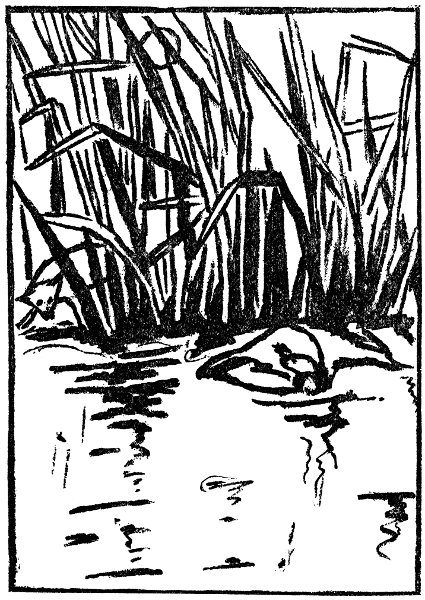
"HIS BEADY EYES GLEAMED."
And yet I was mistaken; at that instant an enemy was within a few yards of him. I had warning of its approach, for I saw the moonlight catch a heave of the water, just as from the cliff I had seen it catch the glassy surface of the curling wave; but in my inexperience I never dreamt that the glint could be caused by a rival for the bird. I was now to learn better, as with a great flapping of wings and a loud quack the mallard disappeared below the surface. I remember nothing about the three ducks for I nearly jumped out of my skin; and my stupefaction was complete when I saw a big animal appear at the surface and leave the water with the mallard in his mouth.
The sight of this brute with my bird enraged me so much that at first I was on the point of springing across the creek and taking it from him. I would have done so had he been only half his size, but I was afraid of the strong, queer-looking creature. His body was very long, his legs short but massive, and his tail, which tapered to a point, stretched across the mud and just touched the water. He had no ears—at least, nothing worth the name; his eyes were small, his whiskers very long and white, and his jaws so heavy that they frightened me. How he enjoyed the mallard, the rascal! How his beady eyes gleamed until he saw me back out of my ambush; and then what an evil look rose to them! That was enough to scare me without the frightful grimace and hissing that accompanied it.
I lost no time in getting out of sight of such a horror. I crossed the pool, dreading at every stroke that the fearsome beast would seize me from beneath, as he had seized the mallard, pull me under, and—disgusting thought!—perhaps eat me. I looked back on landing, and again when I reached the reeds; then, as I saw no trace of him and had dry land in front, I cursed him to my heart's content. I had been deprived of my supper in the last watch of the night, and it would take me all my time to reach the earth before dawn, even by way of the quaking bog. I gnashed my strong teeth as I hurried across the fen, swearing that I would be avenged on that thief if chance threw me in his way again; and though a fox may not be able to choose place and time, he generally gets his wrongs righted in the end. I own that for the moment the sight of the strong, fierce brute must have unnerved me; why else should the rustling of a vole on the bank of our own stream scare me so and cause me to run home in breathless haste?
When I reached the earth the vixen and my sisters were lying near the entrance, looking as happy and contented as mother and whelps can look. With misfortune written on my crestfallen face, I stood before them bedraggled and panting, as complete a picture of misery as can well be imagined. My mother looked me up and down with sympathetic eyes that told her thoughts, and though she never said a word I read in their varying expressions: "You are miserable and discomfited, my cub; you are evidently paying dear for your freedom. Nevertheless I admire your independence and, for all your wayward spirit, I am proud of you."
Crimson streaks marked the low sky to the east before I followed the others to the den for, rather than retire supperless, I stayed outside to crunch a few dry bones. It had been a most unsatisfactory night's hunting, and, though I tried hard to get the evil-looking brute with the webbed feet out of my mind, I seemed, even till I fell asleep, to be watching that rascally otter lying his full length and holding in his fore-paws the fattest mallard I had ever seen.
Despite my disappointment and fear, I resolved to visit the fen again a few nights later, and it vexed me greatly when the vixen objected and insisted that I should join her and my sisters in an expedition to the hill beyond it. I was sulky at the start, and lagged behind the others all the way across the marshland, but I closed up when we breasted the hill, and shook off the last traces of ill-temper on seeing the vixen steal towards an enclosed field some little distance down from the crest. I watched her closely whilst she reconnoitered at a gap in the rude stone wall, and, from the fixity of her gaze, felt almost sure that she espied game. All doubt was dispelled when, with the stealthiest of movements, she came back to me and, as if I was the most amiable cub in the world and worthy of the post of honor, led me round to the meuse through which the game had entered the field, and left me to watch it.
As I lay there, within a spring of the scent-tainted run that recalled a trail I had once followed on the fen, I became uncontrollably curious to see the animal that had but shortly before passed along it. I felt sure the creature was in the field, and no sooner had the vixen disappeared round the corner of the long wall than I left my hiding-place, crawled up the face of the enclosure as quietly as a fly, and peeped through a break in the top whence a stone had fallen. Ah! there he was, for all the world like an immense rabbit, nibbling the clover right out in the middle of the square field. Of course I ought to have returned to my ambush at once, but curiosity held me to the spot, and whilst I was taking a last look, I caught sight of the vixen stealing over the wall on the further side into the tangle that filled the corner and, in fact, grew all round the field at the foot of the wall. In this she was lost to view, till presently her mask appeared again between some seeding thistles about thirty yards from the unsuspicious hare.
Now began one of the most thrilling stalks I ever witnessed, though, owing to the astonishing way the vixen hid herself, I could see little of her but her ears. To have rendered herself so inconspicuous she must have grovelled along on her belly in some slight hollow of the ground not visible to me; for the clover was not more than an inch high and of itself afforded very little concealment. The nearer she got the more excited I became; and for the life of me I could not understand—even now I cannot understand—why the hare, of all animals the timidest and most watchful, neither saw, heard, nor scented her. Inch by inch the clever little stalker wound her way until nearer approach without discovery must have been impossible. I was wondering why she delayed making one of her lightning-like rushes, when, with a tremendous bound, the hare started off in a direction wide of my station. The vixen, who was in swift pursuit, made a desperate effort to turn him; but in this she would have failed, despite her wonderful fleetness, had not my little sister, whether by accident or design I do not know, suddenly showed herself at the gate for which the hare was heading. This had the effect of sending him towards the meuse I had been set to watch and of reminding me of my duty.
The hare was yet some thirty yards down the hill but coming like the wind, when I dropped quietly into my ambush and gathered my legs under me. What a row he made as he dashed through the brambles and came through the hole at the foot of the wall! Never shall I forget the excitement of the moment when, with his ears thrown back on his shoulders, he came in sight. I made my spring as he flashed by, and though I only knocked him over, I was on him and bore him down before he could recover himself. The vixen, who came up the next moment, was delighted to find me standing over my first hare; and when in response to her call my sisters joined us, she distributed the portions into which she had broken it up. There was much chattering over the feast—the contented chattering that attends good hunting.
Thus did our mother teach us to act in concert—the method sometimes employed by dog and vixen if hares are scarce and wild, but more commonly adopted when driving rabbits from a brake where there are no holes in which they can get to ground.
Our supper over, the vixen led us along the crest of the hill to a small clump of wind-clipt pines, which are still standing, whence can be obtained a view of the fen on the one side and of the sand-hills on the other. This was my first sight of the dunes and of the farm-buildings on the edge of them. Whilst we stood there a loud bark, thrice repeated, came from within the trees about the buildings.
"What is that?" I asked, somewhat alarmed.
"That is the voice of a dog—the voice of an enemy."
Then she warned us never under any circumstances to go near the place, "for," said she, "danger lurks there, and perhaps death."
Wise little mother, if I had only heeded thy warning, what anguish and degradation I might have been spared!
Day was already dawning, and I wondered that she so long delayed returning to the earth. To jog her memory I kept glancing first at her and at the eastern sky, but to my surprise she took no notice. Her face was very sad, and she seemed lost in thought. I believe she was thinking of the time, now close at hand, when we must separate from her and face the dangers of life alone.
But it was not her intention to go back to the cairn, for on reaching the foot of the hill she turned aside and brought us to another earth, before which lay an enormous heap of yellowish soil. This, as it proved, was to be our new home; and from the fresh trail that led to it, I judged that at least one animal would share it with us.
A little way inside the entrance, which was a large one, the tunnel divided; and when the vixen and my sisters disappeared in the branch leading to the left, I, curious to see our new neighbor, followed the trail along the other. On and on I stole through a low winding passage, which penetrated so far that I thought I should never reach the object of my search.
At last I came on his lair at a spot where the tunnel suddenly widened, and the sight of it made me stand agape. Instead of the bare ground, which is a fox's couch, and on which I expected to see the creature curled up, before me rose a great heap of dried grass that filled the chamber from side to side, and reached almost to the roof. So effectually did it conceal its occupant that not a hair of him could I see. The slight rustling of the bed would have told me he was there, even had my nostrils not given undeniable proof of his presence; and as my curiosity, now thoroughly aroused, would not let me retire before I had had at least a glimpse of the creature, I drew near with the utmost caution, craned my neck over the broad edge, and looked down on him.
My eye! he was a monster. It surprised me to see how big he was; but what really took me aback was his very pale color, which showed even in the darkness of the den. I had expected to see a gray creature, like the badger on the cliffs, and not a white one nearly twice his size. My first impulse was to retreat, but on regaining my composure, I resolved to stay and have a good look at him.
His broad side rose and fell with his slow, heavy breathing; his eye—I could see but one—was closed, and there was no sign of vigilance about the small limp ears. To all appearance he was in a deep sleep, which I believed, as well I might, that had done nothing to disturb. For if my approach had been as noiseless as the incoming of the fresh air that sweetens the close atmosphere of our dens, not less so was my examination of the formidable creature, though it was made with breathless wonderment.
Yet before I could bark in his ear and run away, as I was tempted to do, he sprang suddenly to his feet with a loud snarl, which nearly frightened me out of my skin. Fortunately, he did not snap at me as I drew back, or pursue me as I bolted at full speed along the tunnel; indeed, judging from his subsequent conduct, I should say that his venerable face was one grin from ear to ear when he discovered it was a chit of a fox cub that had scared him.
My mother, whom the loud snarl had brought in hot haste to my side, was very angry with me for trespassing on the badger's private quarters instead of following her into the part of the sett she had appropriated. No doubt it was a foolish thing to intrude on the privacy of so powerful an animal; but I had no occasion to regret my misconduct, for the badger, far from resenting it, became my best friend. Every morning after that I used to peep at him; but instead of creeping in stealthily, as I had done at first, I walked in as if I were going to my own den, and to apprise him of my approach gave a stifled bark on reaching the turn by the rock, beyond which a short length of straight tunnel led to his lair. Though I seldom neglected to warn him of my coming I believe it was unnecessary, as he got to know my light footstep so well that he did not take the trouble to raise his head on the rare occasions when I forgot to signal my approach. Sleepy though he always was after his night's round, he never failed to wink at me with the eye that was uppermost. Sometimes he would wink twice; but beyond that he never got.
He must have been a good fellow, this distinguished member of the oldest family amongst animals, to put up with these dawn visits of a fox who was still under the partial tutelage of his mother. I have often wondered why he did so, but never been quite sure. If I may give my reason—and be it understood that it involves no slur on the badger's fame—I should say it was because of his friendless state. I say, "friendless," inasmuch as he was never seen in company with the only other badger in the countryside, the one that dwelt on the cliffs; and he kept quite aloof from the other creatures of the wild.
I have always felt proud that he should have thought me worthy of the least consideration; but this did not make me blind to his faults. I don't refer to his living on beetles and wasp-grubs, nor do I mean the trick of sleeping with one paw in his mouth, or the queer way he had of running back-wards into the earth, at which little game I once surprised him; no, I am thinking of a bad habit from which we suffered much annoyance, and which I am very loth to mention, much less dwell on. But it must be stated, and at some length, on account of my story; it was this: he could not keep his claws from digging.
What made his offence ten times worse in our ears was that as far as our vulpine wits could enlighten us—and we discussed the matter again and again—there was no necessity for his self-imposed labor. Any reasonable creature would have thought the sett was more than complete, inasmuch as the part of the hill it tunnelled in all directions was like a vast honey-comb. It held quarters for a whole swarm of badgers; and yet the old fellow must needs keep burrowing farther and farther in, opening out more chambers and galleries, as if it were not commodious enough for his individual requirements. Of course he was free to add to the accommodation of the sett, whether he really did feel cramped for room or only imagined that he did; nevertheless we foxes accounted it a grievance to have to put up with the din he made in digging, which, as it reverberated along the hollow ways, resembled the rumbling of thunder more than any other sound, and prevented us from getting a wink of sleep in the long, dragging hours during which it lasted.
This was only the first stage of the annoyance. A more serious trouble was the way the great heap kept on increasing with the excavated soil that he fetched out by the barrow-load about once a week on the average, generally in the small hours of the morning when we were away foraging. The enormous mound made us hang our heads in shame every time we passed in and out. And as if this were not enough to betray us to our enemies, on our return home one morning we found his great bed lying atop of the pile, which now looked like a haycock in the midst of the brake. At the sight of this my mother lost her temper, and heaped such unrestrained abuse on the badger that I could not keep my jaws closed. It pains me to this day to remember that I dared reply to her; but how, when my old friend was attacked in such bitter terms, could I honorably keep silence? That day I had to be content with the draughty corner of the den, apart from my mother and sisters, who edged away from me as if I were mangy. I spent miserable hours lying there; but about noon the vixen walked over to me, licked my face with her hot tongue, and curled up by my side. These tender attentions soothed my injured feelings, and I soon fell into a peaceful sleep.
I do not reproach the badger for changing his bed, I cannot reproach him for his cleanliness, and I have no wish to disparage his great industry; my object is to set down the truth, and I think that this corpulent creature had to make work to keep his fat down and, even in times of famine, to dig willy-nilly to prevent his claws growing into his flesh.
Of course, had the matter of digging by day, in which lay the sting of the underground annoyance, been brought to an issue, we foxes had not a shadow of right on our side; because we knew that the earth belonged to the badger by right of excavation, and that we were there on sufferance only as long as he found us tolerant and agreeable. We did well to endure what we could not cure, for, had it come to a quarrel, to a conflict with tooth and claw, the badger could have made mincemeat of our whole party without sustaining a scratch. So we prudently refrained from making any comment in his hearing, and, as he could read nothing from my looks, he had not the faintest suspicion of the grumbling to which I had to listen, or of the difficult part I had to play to keep on good terms with my family.
So things went on until a common trouble befell both the badger and ourselves, and immediately following it, calamities so dire as almost to dwarf into nothingness the annoyances of which so much had been made.
We had frequented the sett for perhaps a month, when, on returning early one morning from hunting on the moors, we found, to our astonishment, the entrances to the earth blocked and the badger shut out. Thought I, "This misfortune to himself and to us is the result of his misdoings," and I fully expected to see the vixen pour out the vials of her wrath; but, to my surprise, all she did was to cruise up and down in a fever of anxiety, with a watchful eye on the desperate efforts the badger was making to remove the faggots jammed into the hole. Failing to remove them by tugging, he began to bite through the thick, tough stems as though they were reeds; and in my inexperience I thought he would soon succeed in chopping a way in. But whoever had placed the faggots there had done his work too well for the entry to be hurriedly effected, so that gray dawn found the badger but little advanced with his stubborn task and us cubs roaming restlessly about, eyeing him at his work.
The only time I got in his way he turned his nervous face and snarled at me as though I were a stranger. Seeing what deadly earnest he was in, I gave him a wide berth, and sat on the top of the heap with my brush to him, blinking at the sky that was now all read as if the cliffs were a-fire far, far away beyond the fen. Every now and again, when the vixen came my way, I caught her casting uneasy glances towards the east, and the instant the glaring rim of the sun showed, she stole away and we in her train, leaving my old friend biting and pounding in his apparently hopeless toil.
If his efforts looked hopeless, the journey before us was certainly disagreeable. I shall not soon forget that crossing of the fen, which, as bad luck would have it, was as free from mist as the gilded crests of the tor that seemed to stare at us belated creatures of the night, abroad at such an uncanny hour. The vixen took advantage of every bit of cover within easy reach of the bee-line to the cairn earth, for which she was making; but for all that, there were many exposed places that could not be avoided, and there the cruel sun had us at his mercy, and blinded us with his naked rays. Nor were we alone in our misfortune. Half-way over, at a spot where the glittering pools lay thickest, we met a vixen and four cubs heading straight for our sett. She, too, was all anxiety; and seeing this, I began to wonder why the stopping of an earth should occasion such widespread consternation.
My mother traversed the mossy spaces between the pools at the utmost speed of the weakly cub by her side, whilst my sister and I followed a little to one side, so as to avoid treading on the long, terrifying shadows they cast. On coming within sight of the earth she stopped suddenly in her stride, and as she did so my astonished eyes lighted on the object which had arrested her steps. It was the enemy—it was man. I recognized him at first sight, unlike though he was to the being I had vaguely imagined. There is no reason for surprise that I did. For what beast of the field or wild stands erect with such ease on his hind-feet, or has face, fore-paws and ears as bare of fur as is the skin of a mangy fox? Moreover, I caught his scent; and it was the same scent as had tainted the stone on the cliff, that tainted the faggots—evidence hardly less convincing than the steady gaze of his eyes and the shout he raised. At the awful sound we turned tail and melted into the brake.
Round and round the great furze cover we stole, until I thought that the vixen would never come to a standstill; but at last she chose for sanctuary a tangled corner near a runnel, and there, amidst the russet bracken, my weary sisters curled themselves up and fell asleep.
Whether the vixen slept at all I cannot say, but I do not think she did, for she was wide awake when I dropped off, and she was all eyes and ears when I was startled out of my sleep by three noisy wood-pigeons overhead. As we looked at one another across the tiny stream, a strange sound reached me from the direction of the wood below the tor, or, it might be, from the tor itself. It was a high-pitched note, very penetrating, and a little like a cock's crow, though differing from it even more than a curlew's whistle does from an otter's. The instant I heard it I knew that it came from no bird's throat, but whence it came I could not tell.
What a simpleton I was at that time! The toot of the horn is as familiar to me now as the clatter of shod horses. I know, too, now what it portends; but at that moment, though fear was mingled with my curiosity, I should not have been very uneasy, save for the obvious anxiety of my mother. Not that she fussed about as if flurried, but I could see her alarm in her unusual alertness. When a cock-pheasant flew past and skimmed the brake that mantled the steep slope below us, her eyes followed it with an eagerness that seemed to demand from it the secret of its startled flight.
Again the horn sounded, this time from the neighborhood of the withered oak between us and the tor. Then I heard a horse galloping and saw a flash of scarlet at the foot of the slope where the pheasant had dropped in. What did it all mean? Were we foxes in any way concerned in the unwonted proceedings that were disturbing the great silence that had till then brooded over the cover? The suspense, the uncertainty, which the vixen's evident distress intensified, the vague sense of danger, were painful; but all doubts were soon dispelled, "Eloo in! Hi, Forester! Eloo in!" The rasping yell with which this was uttered betokened some sinister happening, though we looked in vain to the vixen, round whom my sisters gathered, to enlighten us as to its nature.
At this point my recollection is blurred, save for two things, the crashing noise in the brake and the flight of the vixen and my sisters along the watercourse, with the pack in pursuit. I shall always hear the one and see the other. If ever I was terrified in my life it was then; and between the clamor of the hounds and the thundering tread of a hundred galloping horses I was so bewildered that I knew not where to turn. But as the noise died away my nerves steadied, and, rising from my crouching attitude, I peeped through the furze to try to discover what was happening. For a long time I could see nothing in the deserted valley below; but, continuing my watch, I perceived the vixen and my little sister coming along the open bank of the stream, with the leading hounds in close pursuit and apparently gaining at every stride.
I am too old now to feel strongly as I did then, but still I am affected at the recollection of the vixen striving to save my sister by devices such as a partridge will employ to divert an enemy from its young. How the chase ended I could not see; but the sudden ceasing of the clamor made me fear the worst.
In the silence that succeeded I made for the cairn earth, expecting to get in there; but that, too, was stopped. Whilst I was debating what to do, I heard the huntsman's voice, and had scarcely regained my old station by the watercourse when the hounds opened on my line. They were coming towards me at a great pace. Without an instant's delay I was off, and, stealing down the long slope, reached the edge of the cover, where I checked my steps to look out and see that the coast was clear. Except the blazing sunlight, there was nothing in the bottom or on the bare slope beyond to scare me, and as the hounds were half-way down the hill, I committed myself to the open.
I had not got far when there was a scream, a human scream, fit to wake the dead. It startled me horribly, but did not cause me to deviate a hair's-breadth from the direction in which I had set my head. Near the brow I stopped and looked back at the crowd of dogs and horsemen. It puzzled me then, it puzzles me yet, to know why they should wish to kill me, but I had not a doubt that was their object. The clamor did not greatly terrify me at that stage of the chase, as I felt sure I should be able to elude my pursuers in the fen for which I was making.
I held about the same lead across the next valley and up the hill beyond, but the heat of the sun was beginning to tell on me before I reached the wide belt of rushes near the mere. When I had crossed it the hounds had greatly reduced the distance between us; I was beginning to flag, and the sanctuary I sought was nearly two miles away. The going was heavy over the marshland, where never a breath stirred, but I struggled on as best I could towards the islet of my favorite pool, spreading terror amongst grebe and hern along the silent ways I threaded.
At length I gained the pool, and as I left the finger of land jutting towards the islet and took to the water, I felt I was near an asylum at last. Vain hope! When I was barely half-way across an accursed magpie espied me, and came and hovered just over my head, making a loud chattering noise that the hounds must have heard. I looked straight before my muzzle, pretending to take no notice of the plague, and as soon as I landed, lay down in my old ambush that half concealed me from the exasperating bird. "The pest will surely hold his tongue now that I am in lair," thought I. But no; he chattered louder than ever, as if it delighted him to betray me to the pack, whose whimpering I could now hear. In my exhausted condition I was very loth to move, but, seeing that to remain there was certain death, I left my hiding-place and plunged into the water on the further side of the islet. My tormentor came with me, and never shall I forget his harsh, jeering cries whilst I swam to the nearest alders, and even whilst I made my slow way through the sparse thorns that ran up to the furze about the earth. Under the close brake I was free from the traitor, and it cheered me to be so near the sett and a safe refuge. As I followed the beaten track leading to it I was indifferent to my pursuers, for I felt sure that the badger must long ere this have opened a way in.
Alas! it had proved beyond his powers. The ground about the faggots was littered with the bits he had chopped off, but he had failed to effect an entry. Realizing my desperate position, I almost gave myself up for lost. Fortunately, in my extremity—and a fox's brain is never clearer than then—I wondered where the badger had bestowed himself. Where he could get I could get, and if I could only trace him I might, despite the stiffness of my limbs and the nearness of the hounds, even yet escape with my life.
Picking up his trail, I followed it along the base of the hill to a thicket, dense and matted as bramble, blackthorn and furze could make it. Through this I passed until I reached a small cave at the foot of a sheer wall of rock. The trail led inwards, and at the very back I came on my friend. He looked most vicious at first; but when he recognized the bedraggled cub before him, the expression of his venerable face quickly changed to one of compassion, and then again to hate as he heard the hounds, now running mute, crash through the undergrowth. It was an awful moment. It behoved me to find, and that instantly, some secure position out of reach of the infuriated pack. The leading hounds were at the mouth of the cave when, by a last effort, I gained a scanty ledge, almost too narrow for foothold, a little way above the badger's head. I was never in a more desperate position, but fear glued me to the spot; and better vantage-ground for viewing the fight that followed could not have been. "Keep cool," I shouted to my old friend as well as I could for panting; and before I could repeat my warning, the hounds were on him.
There are things which seem incredible unless witnessed; and I would not now submit the evidence of my own eyes did I not feel it my bounden duty to record the facts which redound to the fame of the badger and to the glory of the wild. But how is it possible to describe what happened so the picture presented may approach in vividness the savage scene I looked upon? I have seen the waves dash and dash again into a cavern, only to be as often rolled back till the tide had spent its force and left the cave as silent as at first. The inrush of the pack was like the on-coming of an irresistible wave; but the badger, with his back to the low arch, was not to be overwhelmed whilst he could keep his feet and ply jaw and claw. Only three hounds could get at him at a time; and when it came to deadly fang work, what were these soft creatures of the kennel to the most formidable beast of the brake? As fast as the badger could deal with them, hound after hound withdrew howling, till there was scarcely one of the twenty couple composing the pack on whom his terrible jaws had not closed.
While the fray was at its height the badger was at times partly hidden under his assailants, and thus arose no small danger to myself. One big brute of a hound there was who espied me where I stood, still as if carved in stone, save for my heaving flank and lolling tongue. This must have caught his eye, and time after time he leapt at me from the backs of the writhing mass below; but for want of steady foothold, he failed as often to reach me. The last time he fell he slipped between two hounds, and the badger had him at his mercy. It did my ears good to hear him howl; and no sooner did the badger let him go than he retreated over the backs of the hounds behind with a celerity which did credit even to his long legs. Through the creeper that half curtained the mouth of the cave I saw him take up his station amongst the rearmost ranks of those hounds who were baying their loudest from the brambles.
Shortly after this, one of two mounted men, whose progress was arrested by the thicket, jumped from his horse and plunged into the tangle. Only his hot face and bald head showed above the brake as he came slowly along, cracking his whip as best he could for the briers that reached to his neck and clung to his red sleeve. Whilst he fought his way through, the other kept screaming at the top of his voice: "Whip 'em off! The brute'll murder my best hounds!" The huntsmen had no difficulty in whipping off the crew of howlers outside; but it was no easy task to call off the staunch hounds that, despite the terrible punishment they were receiving, would have carried on the fight until they dropped from exhaustion. At last he succeeded, remounted his horse, and rode away with the other.
In the silence that ensued my position appeared to me still most unenviable. Would the badger, on whom I had brought all this trouble, avenge himself on me for the wrong I had done him? I tried to read his intentions, but he gave no sign. Presently he looked up at me, and in fear and trembling I returned his gaze. A wild light blazed in his black eyes, but no trace of rage against myself. Then I took courage, though obliged to look away from his blood-stained face, so horrible was the sight it presented. His must have been a noble nature to bear such punishment without resentment, and I am glad he never guessed my fears.
How I wronged this chivalrous old aristocrat in thinking it possible he could use his giant strength to crush the life out of a helpless cub! The old fellow was as friendly as though nothing had happened when, at last, falling rather than leaping, I came down from my perch to try to find relief from the cramp that was knotting my muscles. His awful panting had by that time somewhat subsided; but I was truly sorry to see him in such a deplorable state, and I suppose I showed it in my face, for he said: "Do not grieve on my account, little brother. I shall soon recover from my scratches."
My legs were too stiff to let me lie down, so I stood by his side whilst he licked his wounds and smoothed his ruffled coat, and at nightfall, when he left, I staggered after him as best I could. After drinking at a spring on the way, we came to the earth, from the mouth of which, as I rejoiced to see, the faggots had been removed. There the badger left me and went up the hill toward the farm-land over which he wandered nearly every night in search of food. At what time he returned I do not know, as I did not awake till late the following afternoon, when I was aroused from my deep sleep by the noise he made on resuming his excavations.
There are some things which I would gladly be silent about, but which are necessary to the completeness of my story.
Chief of these are the grievous losses on that day's cub hunting. My little sister and—sadder still—my dear mother were killed by the hounds. It was best they should die together, for the cub was so dependent on the vixen, and the vixen so inseparable from the cub, that I am sure they could not have lived happily apart. Our common trouble drew my surviving sister and myself closer to each other, and for a few weeks we lived together in the earth, though we went our several ways at night, and very seldom hunted in concert.
The close of this period is marked by an event of great moment to myself, which, though it does not redound to my credit, must be told in some detail.
It is necessary first to state that for some reason the hounds gave up coming to our country, and that in their place a murderous gang of ruffians infested the district, and by traps, by poisoned carcasses, by terriers, by digging and by filling the earths with smoke, succeeded in destroying nearly every fox in the countryside. Fortunately our earth proved impregnable to the spade and proof against smoke; whilst the badger made such havoc with the dogs that were sent against us that, after two determined but futile assaults, we were left in peace. For a time we had to exercise the utmost caution in avoiding the numerous traps, which were artfully concealed in the runs leading from the earth; but afterwards these were removed, and we might roam without molestation over our desolate wilds.
Hares had been all but exterminated, and rabbits and wild-fowl so shot down and thinned that it was hard to get a living, and at last my necessities tempted me to that most perilous of undertakings, a raid on the poultry of the neighboring farm. Besides the everlasting crowing of the cocks, I had heard the noise made by the flocks of housed turkeys, geese, and ducks, as I returned at dawn from the empty warren on the dunes; and this had set me longing for them.
I did not enter lightly on this my first foray, which I knew to be fraught with danger. My plans were laid with the fullest deliberation, and in the deep silence of my den I carefully thought out every step in my expedition. One of the strong points of a fox is attention to details. We go over and over every turn, we weigh every chance, and try to foresee every contingency. Indecision and flurry are not in our nature; we know what we are going to do, and we go coolly through with it. Our best-laid schemes may and do miscarry at times; nevertheless, with the overconfidence of cubhood, I really thought that the precautions I meant to take excluded all risks to my skin. Why, I had mapped out in my brain every inch of the incursion; I had selected the best way of approach; I was prepared with the safest line of retreat; and, what is of no small moment, I had arranged for the disposal of the kill, which was likely to be a big one.
Eager as I was to realize my sanguine expectations, I twice postponed my visit, hoping for the cover of a storm that threatened; but on the third night, though the weather had cleared, I resolved to defer the raid no longer. The crescent moon was just above the hill when I stretched myself at the mouth of the earth and set out to put well-matured plans into execution. I walked up the rugged hillside with all the circumspection and gravity becoming a great undertaking, and stayed awhile on the crest to reconnoitre the scene of my operations. The farm-house, the outbuildings, the yards, were all silent. No foot stirred, no bark of dog broke the stillness which brooded over the rugged slope, the smooth fields, and the endless waste of sand beyond.