Chapter XXVI · PROTECTIONIST PARTY AT BURGHLEY[51].
Reading edition
CHAPTER XXVI PROTECTIONIST PARTY AT BURGHLEY[51].
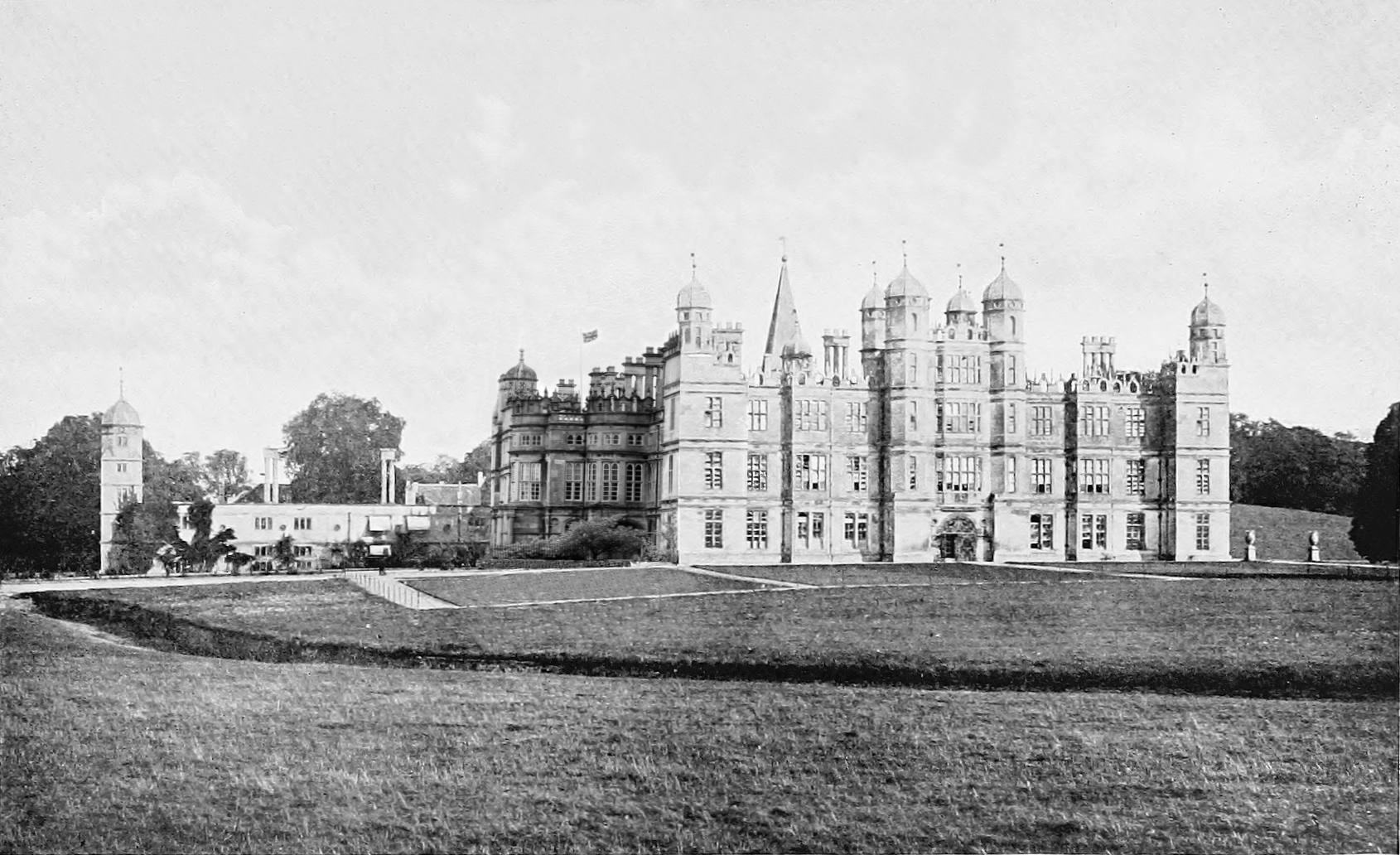
BURGHLEY.
ISABELLA, LADY EXETER
One of the most interesting places which I frequented after my return to England was “Burghley[52] house by 245Stamford town.” Here lived one of the best and kindest of women, the daughter of that beloved uncle, Mr Poyntz[53] to whom I have so often alluded. Lady Exeter had been before her marriage one of the most admired and courted of London beauties, and the suitors for her hand were as numerous as those usually attributed to a princess of fairyland. Indeed it was a family jest at the morning meal, when the letters were laid on the breakfast table, “Where is Isabella’s proposal?” Rather a laughable tribute was once paid her in later times by a retainer of Burghley, which was called forth by my mother’s remark to the bailiff: “How noble and good is Lady Exeter!” “Yes,” returned the man with enthusiasm, “I never look at her ladyship without saying to myself, ‘that is a fallen angel!’”
It was at Burghley that I first made acquaintance with Mr Stafford O’Brien, who afterwards became my colleague and fellow-actor in many a joyous revel and dramatic entertainment at Rockingham, Drayton and Farming Woods, names, each of which recall many a fond memory and tender regret. A housekeeper whom I knew at Burghley, and who was what is ambiguously termed a retired gentlewoman, and was constantly referring to better days, told me once, that she found a real consolation for all her troubles when gazing on that magnificent building “especially, Miss Boyle, the quadrangle by moonlight”; and certainly it was a “sight for sair e’en,” as it recurs 246most frequently to my mind one brilliant winter’s day, rising out of a plain of snow, with its golden gates resplendent in the sunshine.
I usually occupied the very small apartment called “Queen Elizabeth’s China Closet,” in which was a portrait by Domenichino far more lovely in my sight than that of the renowned Cenci, which in some measure it resembled. To my mother was allotted a room close at hand, and I used to laugh at her nightly search in manifold hidingplaces, behind the tapestry, in the turret, etc., lest some one should lie there concealed.
A picture by Sir Thomas Lawrence—one of his earliest, while still imbued with admiration for the works of Sir Joshua—represents the heroine of the Laureate’s beautiful ballad,[54] with her husband and “three fair children,”-“the village maiden” who, in her unexpected transition from obscurity to splendour—
“Shaped her heart with woman’s meekness
To all duties of her rank—”
was such—
“That she grew a noble lady
And the people loved her much.”
LORD DERBY—THE CORN LAWS
247Amongst my frequent visits to my cousins Lord and Lady Exeter, at this magnificent old dwelling, to which I have alluded in a former chapter, the one most worthy of being remembered was that paid in the year 1850, when the strife of parties respecting the Corn Laws was still raging. In fact it immediately preceded the short period of Lord Derby’s administration, and the house party included the greater part of those who were destined to become the principal members of his Government. It was in this manner that I became acquainted with that great Protectionist leader, and the man who eventually succeeded him as the head of the Conservative Party, Benjamin Disraeli. Lord Derby was then in the vigour of physical and intellectual strength, and in the mornings which he passed with his supporters and colleagues in private Cabinet councils, his whole time and thoughts were naturally absorbed in the great question of the day, and in the formation of a system of policy to be carried out, when, as appeared probable, he would become Prime Minister. From such important discussions the ladies of the house were excluded, as a matter of course; for the day had not arrived when women loudly clamoured for entrance into public life, neither had the gentler sex the ambition or the spirit of their sisters of the present day, who demand a right to sit at the official board with the lords of creation, and share their titles, after a somewhat Hibernian fashion, of “Alder-men and Council-men.”
How delightful, how captivating, was Lord Derby when work gave place to leisure, how enviable was the position of her who sat beside him at luncheon or dinner, how 248ringing his laugh, how brilliant his nonsense, how irresistible the good-humoured chaff in which he engaged with his worshipper, Mr Disraeli, who offered an ever-contented front to many a keen, though not envenomed dart; what a playfellow he was in conversation, full of mischief and sparkle! In my own mind I always considered him a perennial school-boy. It appeared to me that the wand of some enchanter had arrested the beats of his heart and the flow of his spirits at boyhood point. No wonder he died before old age crept on him; the very idea appeared incongruous in connection with him.
DISRAELI
One evening we had a large ball, to which the town of Stamford and the surrounding neighbourhood had been invited, and I was much amused by overhearing a conversation between two Stamfordians: “Do you know which is Dizzy?” “Well, naturally, because I see Punch every week.” For even at that remote period, the peculiar features and singular appearance of the future Lord Beaconsfield had already become familiar to the world through the cartoons of our London Figaro. There was scarcely ever a man who changed so little in aspect; his face grew thinner, his youthful locks became sparse and tinged with grey in later years, but he was the same man grown older, and a portrait of him between the ages of twenty and thirty might easily be recognised at fifty or sixty. He was, indeed, a godsend to the portrait-painter, or caricaturist, and I think it speaks much to his credit that he always gazed on his own effigy in Punch or elsewhere, however comic it might be, with intense and unalloyed amusement. In those days, and in the presence of 249his Chief, as we used to call Lord Derby, Dizzy did not take so prominent a part in social conversation as he naturally did in after years; but there was something which bespoke concentrated power and resolute ambition, at least to the readers of physiognomy. His demeanour towards his wife was through life a theme of commendation amongst those who knew him little or well. The delicate tact with which he warded off the occasional sallies that her eccentricities provoked, and the manner in which he, so to speak, shielded her from ridicule, were conspicuous by their affectionate diplomacy.
Mrs Disraeli, the farmer’s pretty daughter and the widow of a millionaire, was a hero-worshipper by profession, and laid herself and her dowry at the feet of the handsome and talented Benjamin. She was a happy woman, a happy wife, and a happy member of Society, which she enjoyed to the full. To few people could the epithet naïve be better applied. She rather lent herself to than resented the laugh which her unexpected observations would often raise. To me she was especially amiable, and I confess to having found untold amusement in her conversation.
At the time of which I am speaking, the interior of Burghley presented an appearance of more than usual brilliancy. The spacious rooms, whose walls were decorated by the paintings of old Italian masters, profusely lighted, the groups of gaily-dressed and richly-jewelled ladies, enlivened by a sprinkling of Knights of the Bath and Garter, and last, but not least, as far as the pageant went, the numbers of male attendants in the traditional garb of the retainers of the house of Cecil, in 250their sky-blue livery, resplendent with frogs and aiguillettes of silver. The whole scene was calculated to impress the spectator as one of no common splendour.
Mrs Disraeli had been describing to me the distinguished manner in which she and her husband had been received at the Court of Louis Philippe, and at that of the President, when she paused, and looking round complacently, exclaimed: “But I do assure you, dear Miss Boyle, I like this sort of thing a great deal better.” The speech reminded me in some measure of that of Caractacus of Rome, yet I could scarcely say that Burghley House reminded me of a humble cottage in Britain.
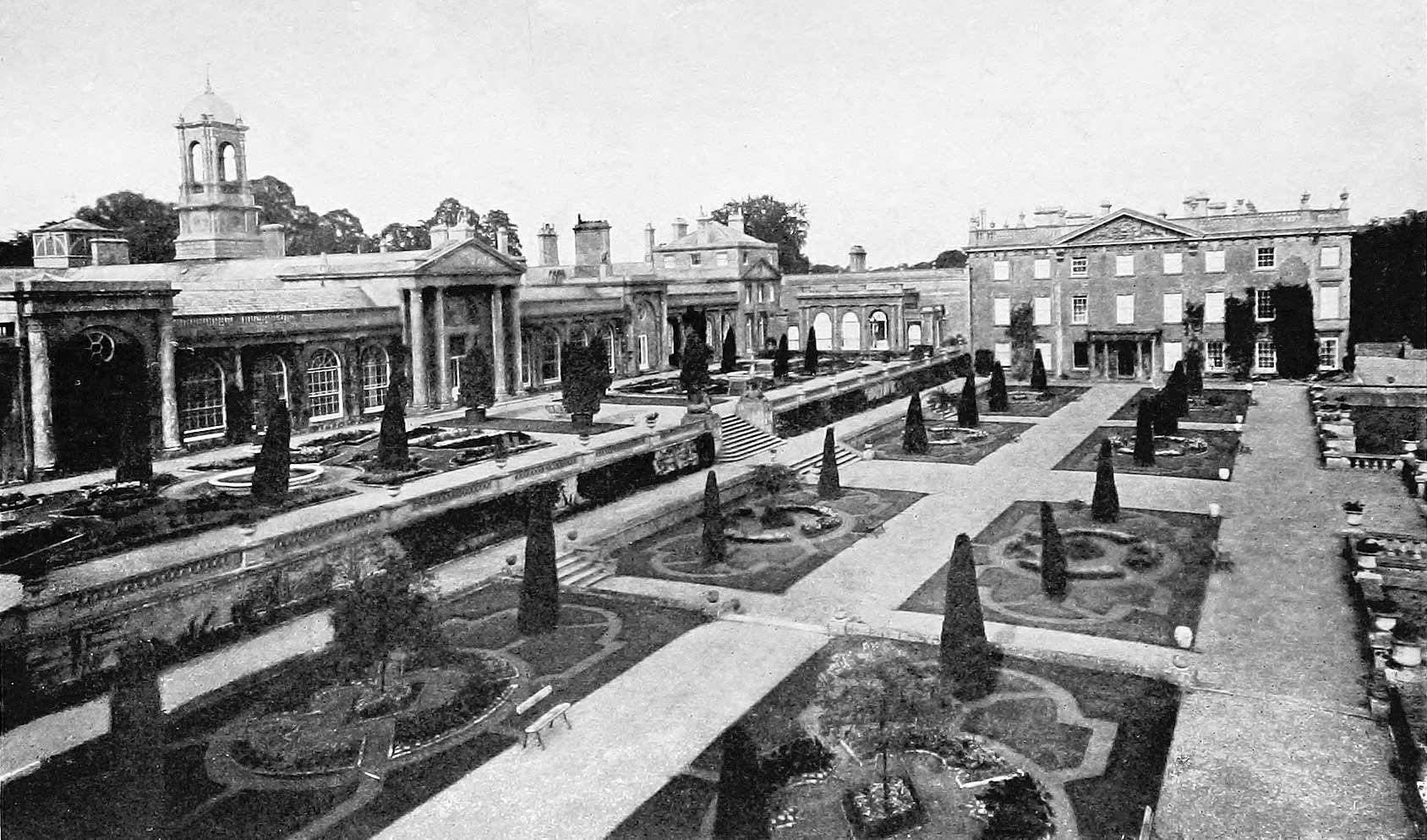
BOWOOD.
BOWOOD
Entirely unconnected with the preceding pages, either as to dates, locality, or personages, is the slight sketch, which I cannot refrain from subjoining, of the constant visits I paid to Bowood. My first acquaintance with Lord Lansdowne[55] was made while I was staying with Mrs Sartoris, of whom he was a warm and zealous admirer, and our friendship ripened so quickly, that I could scarcely imagine that I had not known that dear, kind old man all my life. He was a frequent visitor at my little house in London, and a frequent inviter when anything especially agreeable presented itself in the way of a party at Lansdowne House or Bowood. Agreeable indeed must the intercourse with those two houses have ever been to me, for his daughter-in-law who did the honours of both, rivalled my host in kindness, and I rejoice to think that we still meet to talk over those happy days of long ago. 251All that were remarkable in Politics, Art, and Literature, were constantly grouped round the hospitable board of the Master of Bowood, in that spacious dining-room, illuminated in every sense of the word by the shaded lights round the walls cast on the beautiful chef-d’œuvres of Clarkson Stanfield. It is the only instance I have ever seen of an apartment thus lighted, and the effect is as charming as it is singular. The house is full of Art treasures, of painting and sculpture, all collected by the Lord Lansdowne of whom I am writing,[56] who told me himself that when he first succeeded to the estate, and went to inspect the house at Bowood, the principal furniture consisted of two or three chairs and a looking-glass or so in the bedrooms. Now what luxury, what beauty at every step. As one descends the stairs from the drawing-room leading to the dining-room a magnificent caste of Michel Angelo’s Pensiero[57] arrests attention in a lofty niche, while priceless paintings of Murillo, Rembrandt, Salvator Rosa, etc., decorate the walls; and the lovely features of Mrs Sheridan, as Saint Cecilia, smile upon one from Sir Joshua’s canvas.
Our host was a great patron and connoisseur of the drama, and encouraged private theatricals; and I remember a successful evening in which Tom Taylor, and my friend Gowran Vernon[58] assisted me. Lord Shelburne[59] had lately brought with him from Paris a collection of those monster 252heads which are so often introduced into pantomimes, and we were bent on utilising these valuable properties.
It chanced that evening that among the guests, both gentlemen and ladies, there were three or four more than commonly tall, and we therefore imagined the representation of a scene in the land of Brobdingnag, each performer wearing one of the pantomime heads. To me the smallest was allotted, wearing as it did a simpering expression of innocence, bordering on imbecility, as in a juvenile costume I assumed the character of the youthful Glumdalclitch.
The eldest hope of the house, then a lovely little boy, dressed in a sailor’s suit, was supposed (by a stretch of imagination) to have been washed on shore, as the diminutive Gulliver. He was presented to me by my gigantic parent as a plaything. Does His Excellency, the Governor-General of India,[60] remember that evening when he cast upon me the most captivating glances of anger and indignation, while I knelt down to caress and admire my newly-acquired flotsam? His anger has long passed away, but not my admiration, for in the little Gulliver of those days I honour the independent Politician, and the high-minded statesman of these.
253