"Mary" (continued 2)
Reading edition
”‘But whatever you do, Charlie,’ he said, ‘don’t move from there till I come back for you!’”
Chapter Eight.
Papa’s Story Continued.
“For some time, a quarter of an hour or so, I dare say, I stood at the shop door very contentedly. It was very amusing, as my father had said, to watch the bustle in the street. I don’t think I looked much at the things in the shop window; I’d seen so many of the toys inside. But after awhile I began to wish that my father would be quick. He did seem to be a very long time. I peeped in through the glass door, but I couldn’t see him anywhere near. I even opened it a tiny bit to listen if I could hear his voice, but I couldn’t. People often passed me to go into the shop and to come out, but nobody specially noticed me; they were all too busy about their own affairs; besides, there’s nothing uncommon in a little boy standing at a toy-shop window.
“It seemed to grow colder too. I should have liked to run up and down on the pavement in front to warm myself a little; but I dared not move from where I was. At last some one belonging to the shop happened to come to the door to reach down some large toys hanging in the entrance, and this shopman noticed me. By this time, though I scarcely knew it, the tears were running down my face; I was growing so very tired with waiting. He said to me—
”‘Is there anything the matter? Have you hurt yourself?’
“I answered No, I was only waiting for my father who was in the shop. ‘But I don’t know why he’s such a long time,’ I said; ‘I am so tired of waiting,’ and somehow the saying it out made me begin to cry much more.
“The young man was very kind and seemed sorry for me. He wanted me to come inside where it would be warmer, while he went to look for my father; but I shook my head and told him that papa had said I must stay just there where I was. I wouldn’t even come the least bit inside the door. I remembered papa’s words so well—
”‘Whatever you do, Charlie, don’t move from there till I come back for you!’
“In a few minutes the shopman came back again. He was shaking his head now; there was no one in the shop with a little boy belonging to them. There were one or two ladies whom he had asked, which I thought very ridiculous, as if I could have mistaken papa for a lady, but there was no gentleman at all, and he tried again to persuade me to come inside. He said there must be some mistake; my father had most likely gone on somewhere else; perhaps he’d be back in a little while; he’d never want me to stay out there in the cold. But there was no getting me to move. I can remember, even now, the sort of fixed feeling in my mind that I wouldn’t do the least differently from what he had told me.
“Then the young man went off to fetch some one else—the owner of the shop most likely. I remember two or three people coming up and all talking to me and trying to get me to come inside. But I wouldn’t—even though by this time I couldn’t leave off crying—I just went on shaking my head and saying—
“He said I was to stay here.”
“I dare say they thought me a very tiresome little boy, but they were very kind. The young man, my first friend, brought me out a chair, and then I heard them talking about what was to be done. They had asked me my name, which I told them, but I couldn’t tell them the name of the hotel where we were staying, for I didn’t know it, and I wouldn’t tell them that it was in a street close by, because I was afraid they would carry me off there. I think I was getting rather confused by this time; I could only remember that I must stay where I was if ever I was to see papa again. I heard them saying that the gentleman had only given his country address, as the toys were to be sent straight home.
“After awhile, in spite of the cold and my unhappiness, I think I must have fallen asleep a little. I was almost too young to be anxious about my father and to fear that some accident must have happened to him, but yet I can quite remember that I had really very dreadful feelings. As the evening went on and the street grew darker and darker, and there began to be fewer passers-by, it seemed worse and worse. Once I remember bursting out into fresh crying at seeing, by the light of the gas-lamp, a little boy passing along chattering merrily to the gentleman whose hand he was holding. I felt like a poor shipwrecked mariner on a desert island—all the lonelier that I was in the middle of a great town.
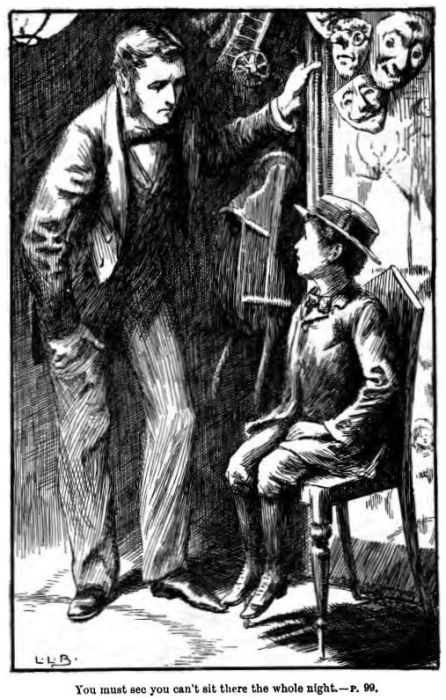
“No doubt the shop people must have been getting uncomfortable and wondering what was to come of it. It must have seemed very strange to them; and, at last, the head man came out again and spoke to me—this time rather sharply, perhaps he thought it the best thing to do—
”‘Young gentleman,’ he said, ‘this really can’t go on! You must see you can’t sit there the whole night. Try and think again of the name of the place you’re staying at.’
”‘I don’t know it,’ I said, and I dare say I seemed rather sulky, for he grew crosser.
”‘Well, if you can’t or won’t tell us, something’ll have to be done,’ he answered. ‘It’s the police’s business, not ours, to look after strayed children, or children that won’t say where they come from. Here, Smith,’ he called out to the young shopman, ‘just look up and down the street if there’s a policeman to be seen.’
“He didn’t really mean to do anything unkind, but he thought it the best way to frighten me into coming inside the shop, or into telling where I lived, for I don’t think they quite believed that I didn’t know. But the word ‘policeman’ terrified me out of my wits; I suppose I was already half-stupefied with tiredness and crying. If I had dared, I would have rushed out into the street and run off anywhere as fast as I could. But, through all, the feeling never left me that I must stay where I was, and I burst into loud screams.
”‘Oh, papa, papa!’ I cried, ‘why won’t you come back? The police are coming to take me; oh, papa, papa!’
“I was crying so that for a moment or two I didn’t hear a bustle at the other end of the shop. Then, all at once, I saw some one hurrying to me from the door leading into the other street, and as soon as I saw who it was, I rushed to meet him and threw myself into his arms, for of course it was my father. I don’t think, in all my life, I have ever felt greater happiness than I did then.
”‘Oh, Charlie,’ he said, ‘my poor little boy! Have you been waiting here all these hours—my good, obedient, little son?’
“Then he turned to the shopman who was now a little ashamed of himself—I dare say the poor man had been getting really afraid that I was to be left on his hands altogether—and explained the whole mistake. He had gone straight on to the city after finishing his orders in the other part of the shop, forgetting that the last thing he had said to me was to wait for him at the front door of the shop; for his thoughts were very much taken up that morning with some very serious business, and it was actually not till he got back to the hotel, late in the afternoon, and found I wasn’t there, that he remembered that the plan of my running back alone had been given up.
“Then he was terribly frightened and rushed off to the shop, hardly daring to hope he would find me still there. He kept saying he could scarcely forgive himself, and even years after, I often heard him say that he couldn’t understand what had come over his memory that day.
“When the shop people saw how troubled he was about it, they began telling him how they had tried to make me come inside, but that it had been no use, and all the way home papa kept saying to me—
”‘My faithful little Charlie’—which pleased me very much.
“He carried me to the hotel, and I felt so weak and tired that I didn’t mind, even though I was a big boy of six years old. And I remember, even now, how delightful it was to get well warmed at the fire, and what a nice tea papa ordered for me.
“And the next day I was none the worse; luckily I hadn’t caught cold, which papa was very glad of, as my mother came up to London that day to meet us, and we all three travelled home together.”
The children had been listening with all their ears to papa’s story. When he stopped Mary gave a deep sigh.
“That’s a bee-yu-tiful story, papa,” she said. “But it nearly made me cry for the poor little boy.”
“You shouldn’t say that, Mary,” said Leigh. “The poor little boy was papa himself! Don’t you understand?”
“Yes, in course I do,” said Mary. “But papa were a little boy then, so I might call him the poor little boy.”
“That’s right, Mary,” said her father. “Stick up for yourself when you know what you mean to say. Yes, indeed, I did feel a very poor little boy that day: the thought of it has always made me so sorry for children who are lost, or think they’re lost. It’s a dreadful feeling.”
“Papa,” said Mary—she was trotting beside her father, holding his hand very tight,—“I think, please, I don’t want never to go to London, for fear I should get losted; and, please, never take Leigh or Artie either—not to London—’cos, you see, it was when you was a little boy your papa nearly losted you, and Leigh and Artie are little boys.”
“Rubbish, Mary,” said Leigh. “I’m eight, and papa was only six, not much bigger than you are now. If I was with papa in London at a shop I could find my way home ever so far; there’s always people in the street you can ask. It’s not like getting lost when there’s nobody to tell you the way.”
“The worst kind of getting lost,” said Artie, “is in the snow. Up on those mountains, you know, where the snow comes down so thick that you can’t see, and then it gets so deep that you are buried in it.”
“Oh, how dedful!” said Mary; “you won’t ever take us to that place, will you, papa? I’d be more f’ightened than in London! Where is that country, papa?”
“I suppose Artie means Switzerland,” said their father.
“I mean the picture in my book,” said Artie; “where there’s dogs, you know, snuffing to find the poor people under the snow.”
“Oh, the great Saint Bernard mountain you mean!” said papa; “it’s sure to be that. You often see pictures of it in children’s books; there are such pretty stories about the good dogs and the kind monks who live there.”
“Can you teach any dogs to do things like that?” asked Leigh.
“No; they have to be a particular kind,” answered papa; “but a dog like your puppy can be taught to fetch anything out of the water, from a bit of stick to a baby. He’s what you call a retriever: that means fetching or finding something. You can teach a good retriever almost anything.”
“I thought so,” said Leigh, nodding his head wisely. “I’ll see what I can’t teach Fuzzy.”
They were back in the park by this time. It was a beautiful May day, almost as warm as summer. The children’s father stood still and looked round with pleasure.
“It is nice to have a holiday sometimes,” he said. “What a lovely colour the grass is in the sunshine!”
“And how happy the little lambs are; aren’t they, papa?” said Mary. “I wish I had one of my very own—like Mary and the lamb in my nursery book.”
“You couldn’t have a lamb and a dog,” said Artie. “Fuzzy would soon knock the lamb over.”
“I never thought of that,” said Mary. “Oh, papa dear,” she went on, “I do so want baby Dolly to get big quick! There’s such lotses of pretty things to show her in the world. The grass and the trees and the lambs”—and while she spoke her blue eyes wandered all round her,—“and the birds and the sky and—and—oh! the daisies, and”—as at that moment she caught sight of the old woman at the lodge crossing the drive with her red cloak on—“and old Mrs Crutch and her pussy-cat, and—”
“You’re getting to talk nonsense, Mary,” said Leigh. “Old Mrs Crutch isn’t a pretty thing!”
“Her cloak’s very pretty,” said Mary, “and she does make such nice ginger-b’ead cake.”
Chapter Nine.
Tears and Smiles.
The spring turned into summer, and with the longer days and warmer sunshine and gentle rain there grew up a great many more “pretty things” for Mary to show to her little sister Dolly; and Dolly herself grew like the flowers and the lambs. By the time she was three months old she could not only smile, she could even give little chuckling laughs when she was very pleased. Mary was quite sure that the baby understood all she said to her, and I do not think she would have been very surprised any day if Dolly had begun to talk.
“Why can’t she talk, mamma?” she asked her mother one morning.
“No little baby learns to do everything at once,” mamma answered. “She has to learn to walk and run and use her little hands the way you do. Just think what a lot of things babies have to learn; you must have patience.”
Mary tried to have patience; she did not so much mind baby’s not being able to stand or walk or things of that kind, for she could understand that her little legs needed to grow stronger and firmer, but for a long time she could not understand about the not talking, and it got to be quite a trouble to her.
“She can cry and she can laugh and she can coo, and she hears all the words we say to her,” said Mary, with a little sigh; “I can’t think why she won’t talk. Oh, baby dear! don’t you think you could if you tried? It’s kite easy.”
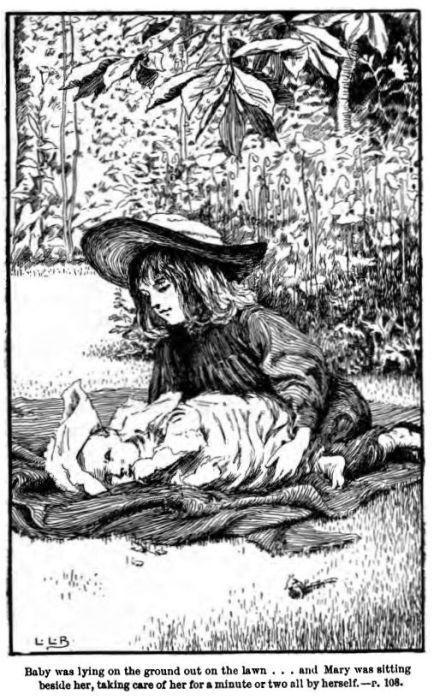
Baby was lying on the ground out on the lawn, where nurse had spread a nice thick shawl for her in case the grass might be damp, and Mary was sitting beside her, taking care of her for a minute or two all by herself. Nurse had gone in to fetch some more work. Mary was very proud of being trusted with baby. Leigh and Artie were at their lessons.
“Baby dear,” she said again, “don’t you think you could say just some little words if you tried? Nurse would be so pleased when she comes out if she could hear you saying, ‘Dear little sister Mary’ to me!”
She was leaning over baby, and gave her a little kiss. Baby looked up and opened her mouth very wide. Mary could see her little pink tongue, but that was all there was to be seen; and just at that moment there started into Mary’s head what must be the reason that baby could not speak.
“She hasn’t got no teeth!” cried Mary. “She’s opening her mouth wide to show me! Oh, poor little darling baby! Has they been forgotten? The baby at the Lavender Cottages has got teeth!”
Baby did not seem to mind; she lay there smiling quite happily, as if she was pleased that Mary understood her, but Mary felt very unhappy indeed. Something came back into her mind that she had heard about baby’s teeth, but it was a long time ago, and she could not remember it clearly. Was it something about them having been forgotten?
“I’m afraid there’s been a mistook,” said Mary to herself. “Oh, poor baby! A’posing she never can speak! Oh, nurse, nurse, do come; I want to tell you something about poor baby!”
But nurse was still in the house and could not hear Mary calling, and Mary dared not go to fetch her because baby must not be left alone. So she did what most little girls, and little boys too sometimes, do when they’re in trouble,—she began to cry.
“Oh, nurse, nurse!” she wailed through her tears, “do come—oh, do come?”
And though baby could not speak she certainly could hear. She half-rolled herself round at the sound of her sister’s sad sobs and cries, and for a moment or two her own little face puckered up as if she were going to cry too—it is wonderful how soon a tiny baby learns to know if the people about it are in trouble—but then she seemed to change her mind, for she was a very sensible baby. And instead of crying she gave a sort of little gurgling coo that was very sweet, for it said quite plainly that she knew Mary was grieving, and she wanted to be told what it was all about. At first Mary did not hear her, she was so taken up with her own crying. That is the worst of crying; it makes one quite unnoticing of everything else.
Then baby rolled herself still nearer; if only she had understood about catching hold of things, no doubt she would have given Mary a little tug. But she had not learnt that yet. So all she could do was to go on with her cooing till at last Mary heard it. Then the big sister turned round, her poor face all red and wet with her tears; and when she saw baby staring up at her with her sweet, big, baby eyes, and cooing away in her dear little voice, which sounded rather sad, she stooped down and gave her such a hug that, if Dolly had not been really very good-natured, I am afraid her cooing would have been changed into crying.
“Oh, baby, you sweet—you dear little innicent sweet!” said Mary; “you’re too little to understand what I’m crying for. I’m crying ’cos the angels or the fairies has forgotten about your teeth, and I’m afraid you’ll never be able to speak—not all your life, poor baby!”
But baby only cooed louder than before. And Mary, looking up, saw what baby saw too—that nurse was coming over the lawn; and baby’s face broke out into quite a wide smile; she was very fond of nurse.
Poor nurse did not smile when she got close to the two little girls, for she saw that Mary was crying, and she was afraid there was something the matter.
“Have you hurt yourself, Miss Mary?” she said. “Miss Baby’s all right, but what are you crying about?”
“Oh, nurse, I’ve been calling you so,” said Mary,—“calling and calling. I’m so unhappy about baby;” and then she told nurse the sad thought that had come into her mind, and how troubled she was about it.
Nurse listened very gravely, but—would you believe it?—when Mary had finished all her story, what do you think she did? She sat down on the grass and picked up baby in her arms and burst out laughing. I do not think she had laughed so much for a long time.
“Oh, Miss Mary, my dear,” she said, “you are a funny child!”
Mary looked up at her, her face still wet with tears and with a very solemn expression; she did not quite like nurse’s laughing at her when she had been so unhappy.
“I’m not funny,” she said. “It’s very sad for poor baby,” and new tears came into her eyes at the thought that even nurse did not care.
But nurse had left off laughing by this time. “Miss Mary, my dear,” she said, “don’t make a trouble about it. Miss Baby’s teeth will come all in good time. I shouldn’t wonder if she has several dear little pearls in her mouth to show you before Christmas. Don’t you remember that day when we were talking about her teeth, I told you how yours had come, one after the other, and that they used to hurt you sometimes.”
Mary’s face cleared at this.
“Oh, yes,” she said, “I ’amember. Does everybody’s teeth come like that? Doesn’t any babies have them all ready?”
“No,” said nurse; “why, even the Perrys’ baby that’s more than a year old hasn’t got all its teeth yet, and it can’t say many words. Don’t you trouble, Miss Mary, the teeth and the talking will come all right. There now,” as little Dolly looked up with a crow in nurse’s smiling face, “Miss Baby knows all about it, you see!”
Mary put her arms round baby and gave her another big hug.
“Oh, you dear little sweet!” she said. “Oh, nurse, I do think she’s got such lots of things to tell me if only she could speak!”
Baby gave a little chuckle as much as to say, “No fear, I’ll talk fast enough before long;” and Mary, who was rather like an April day, set off laughing so much that she did not hear steps coming along the terrace till a voice said, quite close to her—
“Well, Mary, darling, what are you and baby so merry about?”
It was mamma. Mary looked at her, and then mamma saw that her eyes were red.
“It’s all right now ma’am,” said nurse, for she knew that mamma was wondering what was the matter even though she had not asked; so mamma went on to tell them what she had come out about, for she knew that when Mary had had a fit of crying the tears were rather ready to come back again if anything more was said about her troubles.
“Nurse,” she said, “I want you to dress Miss Mary as quickly as possible after her dinner. I’m going to take her a drive with me—quite a long drive; I’m going to the town to choose a perambulator for baby.”
“Oh, mamma!” said Mary in great delight, “how lovely! And may I get into the p’ram-bilator to see if it’s comfor’ble for baby?”
“Yes,” said mamma, “though a tight fit for you will be all right for baby. And I’ve other things to buy as well! You’ve got a list ready for me, nurse, haven’t you? I’m quite sure the boys need new boots, and wasn’t there something about a sash for Mary?”
“She wouldn’t be the worse for another blue one, ma’am,” said nurse. “Her papa always likes her in blue.”
“Ah! well, I won’t forget about it. I like her in blue best too. And baby—doesn’t she want anything?” asked mamma.
Of course she did, ever so many things. I never knew a baby that did not want a lot of things—or a baby’s nurse perhaps we should say—when there was a chance. Ribbons to tie up its sleeves, and little shoes and tiny socks, and some very fine kind of soap that would not make its soft skin smart, and more things than I can remember. Babies have plenty of wants, though they are such small people. And mamma wrote them all down, saying each aloud as she did so, and Mary stood listening with a very grave face. For she thought to herself, “Just supposing mamma lost the paper or couldn’t read all the pencil words, or forgot to write down everything, it would be a very good thing for her to know them all and ’amind mamma.”
Soon it was time to go in to dinner, and Mary was so full of the thought of going to the town with mamma, that at first she sat with her spoon and fork in her hands, looking at her plate without eating at all.
“Why don’t you eat your dinner, Mary?” said Leigh.
“My nungryness has gone away with thinking of going out with mamma and buyin’ such lotses of things,” said Mary.
“How silly you are!” said Leigh. “Why, when I’ve something nice to think of, it makes me all the hungrier! If you don’t eat your dinner, I don’t believe mamma will take you.”
“Yes, Miss Mary, you must eat it,” said nurse. “You’ll be later than usual of getting your tea, too, so you should make an extra good dinner.”
Mary did not feel as if she could be hungry, but she did not want to be left behind, so she began to try to eat, and after one or two mouthfuls it got rather easier. Nurse went on talking, for she knew the less Mary thought about not being hungry the better it would be.
“Perhaps your mamma, will let you bring home a nice bagful of buns for tea,” she said. “That would be a treat for Master Leigh and Master Artie, to make up for their not going to the town too.”
“I don’t want to go,” said Leigh. “I hate shopping. It’s such rubbish—taking half an hour to choose things you could settle about in half a minute. Of course I suppose it’s different for women and girls.”
Nurse smiled a little.
“Have you nothing for Miss Mary to get for you?” she said.
“What shops are you going to?” asked Leigh.
“Are you going to the confectioner’s?” asked Artie.
Mary was not quite sure what the confectioner’s was. You see, she did not often see shops, as the children’s home was quite in the country. But she knew Leigh would laugh at her if she asked, so she just said—
“We’re going to all the shops there is, I think. We’re going to buy Baby Dolly’s p’ram-bilator.”
She got rather red as she spoke; but Leigh did not notice it, for he was very much interested by this news.
“To buy the p’rambulator,” he repeated. “Oh, I say—I wouldn’t mind going to choose that! But I couldn’t stand the rest of the shopping. Mary—” and he hesitated.
“What?” said Mary.
“There’s one thing I want, if you think you could choose it for me; it’s a pair of reins. I’ve got money to pay for them—plenty; so you can tell mamma if she’ll pay them in the shop, she can take the money out of my best purse that she keeps for me, when she comes home. They’ll cost about—” he stopped again, for he really did not know.
“Do you mean red braid ones, Leigh, like my old ones with the bells on?” asked Artie.
“No, of course not. I want regular good strong leather ones—proper ones, d’you hear, Mary?”
“Yes,” said Mary, “I’m listenin’.”
“Well, look here then; they must be of nice brown leather, and you must pull it well to be sure it’s strong. And they must have a kind of front-piece, stiff, you know, that they are fastened to, or perhaps they cross over it, I’m not sure. And they must be about as long as from me, where I’m sitting now, to where Artie is. And if you can’t get them nice in one shop, you must ask mamma to let you go to another, and you mustn’t be in a hurry to just take the first ones they show you. You must choose well, Mary, and—”
“Don’t take half an hour about it when half a minute would do,” said nurse, in rather an odd voice.
Leigh grew very red.
“Nurse,” he said, “reins are very pertickler things to get. Leather things have to be good, you know.”
“And so have silk things and cotton things and all the other things that ladies take so long to shop about,” said nurse. “But, I’m sure poor dear Miss Mary’s head will never hold all the explaining you’ve been giving her. If you take my advice, Master Leigh, you’ll run off to your mamma and tell her what you want and settle about the price and everything. She will be just finishing luncheon, I should think. It was to be early to-day.”
Leigh thought it a good idea, and did as nurse proposed. Mary was very glad not to have to remember all about the reins; her little head was full enough already. She was looking quite pale with excitement when nurse began to dress her in her best things to go out with her mamma. But it was very interesting to have all her Sunday things on on a week-day, and by the time she was ready—her best boots buttoned and her little white silk gloves drawn on, and her fair curls, nicely brushed, hanging down under her big straw hat, which had white bows and tufty feathers at one side—Mary’s face had grown rosier again.
Chapter Ten.
Shopping.
She felt quite happy when she found herself at last settled by mamma’s side in the victoria. She gave a deep sigh—it was a sigh of content—just because she was so happy.
But mamma turned round quickly.
“My darling,” she said, “is there anything the matter? Why are you sighing so?”
Mary cuddled a little bit nearer to mamma, and looked up in her face with a smile.
“I’m quite dreffully happy, mamma dear,” she said. “The breaving comes like that when I’m dreffully happy. But oh, mamma,” she went on, with an anxious look creeping over her face, “I hope we’ll ’amember all the lotses of things there is to buy!”
“I wrote them down, dear,” said mamma. “You saw me?”
“Yes, but doesn’t writing sometimes get rubbed out? I think I can ’amember neely all if you asked me. Did Leigh tell you all about his reins, mamma?”
“Yes, dear. He was very particular indeed. I can’t think what has put reins in his head again. He told me some time ago that he thought he was getting too big for playing at horses. Perhaps it’s to amuse Artie.”
“I wonder,” said Mary, “if p’raps it’s something to do with Fuzzy.”
But her mother did not hear, or at least did not notice what she said. She had taken the paper with the list of things she had to do, out of her bag and was looking it over.
It seemed a long way to the town to Mary. It was between five and six miles, and she had not often driven so far, for you know she was still a very little girl. Now and then her mamma looked at her to see if she was getting sleepy, but every time she seemed quite bright. Her little mind was so full of all the messages they had to do that I don’t think she could have grown sleepy.
And there were a great many pretty and strange and interesting things to notice as they went along. Mamma kept pointing them out to her and talking about them. There were the flowers in the hedges to begin with—some late ones were still in bloom—here and there stray sprays of honeysuckle even, and low down, nearer the ground, there came now and then little glimpses of pretty colours where smaller wild-flowers, such as “ragged robin,” “speedwell,” “crow’s-foot,” and a few others were still peeping out.
“If I were a tiny flower,” said mamma, “I think I would choose my home on the inside of the hedge—the field-side. It would be so hot and dusty near the road.”
But Mary thought it would be nice to see the carriages and carts passing, and that it would be rather dull to see nothing but the grass, and then she and mamma laughed at their funny fancies, as if flowers had eyes and ears like children.
Then they passed a very queer-looking waggon lumbering along. It seemed like a house built of baskets and straw chairs and brushes instead of brick or stone, and Mary’s mamma told her it was a travelling shop, and that the people lived inside and had a little kitchen and a little bedroom, and that sometimes they were quite clean and tidy and nice people. There was a tiny window with a red curtain at the side of the waggon they passed, and Mary saw a little girl, with a nice rosy face, peeping out at her. She nearly jumped when she saw the little girl, and she pulled mamma to make her look.
“See, see, mamma!” she cried. “They must be nice people that lives in that basket shop, mustn’t they, for that little girl’s got a clean face, and she’s smilin’ so sweetly?”
“Yes,” said mamma; “it looks as if she had a kind father and mother, and I hope she has. For many poor children have quite as kind fathers and mothers as rich children have, you know, Mary.”
“Like the Perrys—the Perrys at the Lavender Cottages,” said Mary.
And then she went on thinking to herself how nice it would be to live in a “going-about house,” as she called it. And she wished very much indeed she could have seen inside the waggon.
The next thing they passed after that, was a great high carriage with four horses; a man in a red coat was blowing a horn, and there were ever so many ladies and gentlemen sitting up on the top. It made such a dust! Mary began to think mamma was right about the field-side of the hedges, for even though she was a little girl in a carriage and not a flower, she felt quite choked for a minute. Mamma told her it was a stagecoach, and that long ago, before clever men had found out how to make railway trains go, drawn by steam-engines instead of horses, people were obliged to travel in these big coaches.
Mary was very much surprised. She thought there had always been railways, but mamma had not time to explain any more about them to her, for just then the carriage began to make a very rattling noise over the stones, so that they could scarcely hear each other speak. They were entering the town.
Mary looked about her with great interest. It was a long time since she had been there, and the last day she remembered being driven through the streets it had only been to go to the railway station. For the children and their mother were then on their way to visit their grandmamma. That was six months ago, half a year—before Mary’s birthday, which had brought her the wonderful present of Baby Dolly—a very long time ago.
But Mary remembered how she had wished that day to stop at the shops and look in at the windows. And now she was not only going to look in; she was going to go in to help mamma to choose all the things she had to buy.
It was very nice, but it seemed rather to take away her breath again to think of all they had to do. Mary gave a deep sigh, which made her mamma turn round.
“Mary, my dear, you are looking quite troubled,” she said; “what is it?”
“It’s on’y the lotses of things,” said Mary.
“But you mustn’t be like that, or I shall be afraid to bring you out shopping with me,” said mamma. “It will be all right, you’ll see. Here we are at the first shop—the draper’s. That’s right; give Thomas your hand and get out slowly.”
Thomas was quite ready to have lifted her out, but Mary did not like being lifted. It seemed as if she was a baby. Mamma knew this, and unless she was in a great hurry she let Mary manage for herself like a big girl.
Mary was not like some children, who do not care about any shops except a toy-shop and a confectioner’s; she was interested in all the things mamma had to buy, and she liked to watch the careful way mamma went about it. She had a list all ready, and she had put the same sorts of things together on it, so that she did not need to go backwards and forwards from one counter to another. It was a large shop, but there were not many people in it, so Mary climbed up on a chair and sat there comfortably watching, while mamma chose tape and buttons and reels of cotton and needles, and lots of what are called “small-wares.”
Mary enjoyed seeing them all brought out in their neat boxes and drawers; she thought to herself that she would like very much to have a shop and have all these interesting things to take care of. And then, when they moved a little farther down, to that part of the counter where pretty silks and ribbons were hanging up—silks and ribbons of all sorts of colours and shades—she was still more delighted.
“We are going to choose a sash for you now, Mary,” said mamma.
“And ribbins to tie up Baby Dolly’s sleeves. Weren’t you forgetting about the ribbins?” said Mary.
Mamma had not forgotten, but she did not say so, for she saw her little girl was proud of remembering; and she was pleased too to see that Mary thought of Dolly before herself.
“Yes; of course there are baby’s bows to get,” she said. “Thank you for reminding me. What colour shall they be? Would you like to choose?”
The shopman—I think it was the draper himself, who knew Mary’s mamma and was pleased to wait upon her—smiled as he brought out a large box full of ribbons of the right width for tying up babies’ sleeves. There were so many pretty colours that Mary felt as if she could not choose.
“I’d like some of all of them,” she said.
But mamma helped her by putting aside those that would not do. Yellow would not be pretty for baby, she said, nor green, nor bright red, nor deep blue or purple; and that left only the soft delicate colours—pale pink and pale blue and very pale lilac. There were pretty white ribbons too, with very fine little checks and spots over them, which she said would be very nice.
So then Mary found it easier, and she chose four sets—blue, with a little white line down the edge; and white, with a pink check over it; and another, with tiny blue spots, and one of the pale pinky lilac. It was like wild geranium colour, mamma said, and as Mary did not know what that flower was, mamma promised to look for one in the fields to show her.
Then there came the choosing of Mary’s sashes. Mamma got two, and Mary was quite pleased, for she saw that mamma was the best chooser after all. One was pale blue, very wide, and with a white line down the side. It was just “like the mamma of Dolly’s blue ribbon,” Mary said, and the other was all pink, very pretty pale pink. Mary did not like it quite so well, but still she felt sure it would look nice, or else mamma “wouldn’t have chosened it.”
It would take too long to tell you about all the things mamma bought. After she had finished at the draper’s she went to the shoemaker’s and got boots for the boys and slippers for Mary, and dear sweet little blue silk shoes for Dolly. They were to be her very best ones, to match her blue ribbons. Mary was so pleased that her mamma got them.
After that came the great thing of all—that was the perambulator. There was a man in that town who made pony-carriages, and he made perambulators too. Mamma took Mary into a large room which was all glass at the front, and was quite filled with pony-carriages. They did look so shiny and nice—some of them were wicker, and some were made of wood like big carriages. Mary would have liked to get into them all, one after the other, to see which was the most comfortable, and she could not help thinking how very nice it would be to be a pony-carriage man’s little girl. What lovely games she and Leigh and Artie could have in this big room! It would be even nicer than having a draper’s shop. She did not know that carriage-builders’ children and drapers’ children are not allowed to play with their fathers’ carriages and ribbons any more than she and her brothers would be allowed to pull about the books in the library, or to gather all the fruit and flowers in the garden.
They passed through the big room with the glass front to a smaller one behind, where there were a good many perambulators. The man who had shown them in explained to Mary’s mamma about the different kinds and told her the prices; and mamma chose three which she made the man draw out by themselves in front of all the others.
“It must be one of those,” she said; “I want a really good one, but still rather plain and strong, as it is for the country roads.”
Mary thought to herself what a good way of choosing mamma had; it makes choosing so much easier if you put away the things that won’t do. And while she was thinking this, mamma told her she wanted her to get into the perambulator standing next, and say if it was comfortable.
“I will lift her in,” she said to the man. “It’s quite strong enough, I suppose?”
“Oh, dear, yes, ma’am!” he answered. “It could bear a child twice this little lady’s weight. The springs are fust-rate.”
It was very comfortable, and when Mary jigged up and down a little gently, it felt quite “dancey,” she said.
“It’s the springs,” the man repeated; “they’re fust-rate.”
Mary wondered what “fust-rate” meant. She thought she would ask her mamma. Then she was lifted into the next perambulator—the man lifted her in. He meant to be quite kind, but Mary did not like it, and when at last she found herself on the floor again she stroked down her skirts and gave herself a little shake. Mamma saw that she did not like it, but afterwards she told Mary that sometimes it is best to hide that you do not like things, when they are done out of kindness.
“It didn’t matter to-day,” said mamma, “for the man was busy talking to me and he didn’t see you shaking yourself; but you must remember for another time.”
Mary felt very sorry. She did not forget what her mamma said. Even when she grew to be a big girl she remembered about the man meaning to be kind, and how glad she was he had not seen her shake herself.
The other perambulators were not quite as wide as the first one. Mary said they felt rather squeezy, so mamma fixed on the first one. But it could not be sent home at once because the lining had to be changed. It was brown, and the linings of mamma’s victoria and pony-carriage were dark red, and mamma liked Dolly’s carriage to match. So the man promised it should be ready in two or three days; but Mary looked at it a great deal, because she knew Leigh and Artie would want to know exactly what it was like.
After that they went to the grocer’s, but mamma did not stay long there, and then they went to the toy-shop to get a rattle for baby and reins for Leigh. But neither mamma nor Mary liked the reins much. There were some of red braid, but they were too common, and the leather ones did not seem strong, and they were not made of the right sort of leather; Mary was quite distressed.
“What shall we do?” she said. “Leigh will be so disappointed.” She said the word quite right, but it took her a good while.
Then mamma had a capital thought.
“I know,” she said. “We’ll go to the saddler’s. Even if he hasn’t got any toy-reins ready he can easily make them.”
And fancy—was not it lucky?—the saddler had a pair quite ready—beauties, just like what Leigh wanted. Mamma was so pleased, and so was Mary; though I do not think mamma would have been quite so pleased if she had known what Leigh had in his head about the reins. Then mamma went to the confectioner’s, where she bought some very nice little cakes for Mary to take home for the nursery tea, and, as she thought Mary looked a little tired and must be beginning to feel hungry, she asked for a glass of milk for her and a bun, and then she put Mary on a chair close up to the counter, where she could reach the milk. And then, just as she was going to pay for what she had bought, poor mamma started.
“Oh, dear!” she said, “where is my little bag with my purse in it? I must have left it somewhere; I was carrying so many parcels.”
“Mamma, dear,” said Mary, “you had it at the reins’ shop. I sawed it in your hand.”
“Oh, I’m so glad!” said mamma. “Then it’ll be all right. I’ll run back for it. You finish your milk and bun, dear, and I will come for you as quickly as I can.”
Mary did not quite like waiting alone, but she did not want to trouble her mother, so she said, “Very well, mamma dear.”
Her milk and bun did not take long to finish, but she sat on still on the high chair, partly because she thought her mamma would look for her there, partly because she could not get down alone, and she was too shy to ask to be lifted off. But mamma did not come as quickly as Mary hoped, though the time seemed longer to her than it really was.
In a few minutes she heard the door open, and she looked up gladly, thinking it was her mamma; but it was not. Instead of mamma in came a rather fat lady, with two boys and a girl. The lady had a red face, and they all talked very loudly.
“Now, what will you have, my loveys?” said the lady. “Puffs, cheesecakes, macaroons?”
The three children pushed up to the counter and began helping themselves. It was not a large shop, and they crushed against Mary, who was growing very uncomfortable.
“Dear, dear,” said the fat lady, “I am ’ot!” and she fanned herself with her handkerchief. “Haven’t you got a chair for me?”
The shop-woman looked at the girl who had seated herself on the only chair besides Mary’s one.
“I dare say Miss isn’t tired,” she said; “won’t you give the lady your chair?”
But the girl would not move.
“No,” she said; “that child isn’t eating anything. She can give her chair. Put her down, Fred.”
And the bigger of the boys lifted Mary roughly down from her perch before the shop-woman could interfere, and then they all burst out laughing, and Mary, whose face had been getting whiter and whiter, rushed to the open door and ran with all her might down the street.
Chapter Eleven.
Nursery Tea.
I dare say it was silly of Mary to be so frightened; but then, you know, she was only a very little girl, and she was not used to rude or rough ways.
“Mamma, mamma!” she cried as she ran along. And she did not even think or know which way she was going. But the town was not a big one, not like London, where her papa had been left alone in the toy-shop—and the street was quiet. Several people noticed the prettily-dressed little girl running so fast, the tears rolling down her face.
“She’s lost her way, poor dear,” said one woman, standing at the door of a greengrocer’s shop.
“She’s been bitten by a dog,” said another.
But nobody did anything till, luckily, Mary flew past the draper’s where she had been with her mamma; one of the young men in the shop was reaching something out of the window and saw her. He called to the draper—Mr Mitcham—and Mr Mitcham, who was a kind man and had little girls of his own, hurried after Mary and soon caught her up, for she was getting very tired now. Her legs were shaking sadly, and her breath seemed to choke her, and her heart,—oh, how her poor heart was thumping—it seemed to come right up into her ears.
“Are you looking for your mamma, my dear?” said Mr Mitcham. He was rather out of breath himself though he had only run a short way, for he was a fat little man, and he seldom took more exercise than walking about his shop.
“Zes, zes!” cried Mary, who went back to her baby talk when she was unhappy or frightened. “Her is goned away, and the naughty boy pulled me off my chair, and—oh, oh, where is my mamma goned?”
Mr Mitcham, could not make out what was the matter, but, luckily, just at that moment her mamma came round the corner of the street. She had found her bag at the saddler’s, but she had had to wait a few minutes for it, as he had locked it up in a drawer while he went to the inn, where the carriage was, to ask if Mrs Bertram was still in the town.
Mamma looked quite startled when she saw poor Mary all in tears, but Mary soon got happy again when she felt her own dear mamma’s hand clasping hers firmly. And then, when mamma had thanked the draper, she turned back to the confectioner’s again, to get the cakes to take home and to pay for them. Mary did not much want to go; she was afraid of seeing the rude boy and his mother again. But mamma told her she must try not to be so easily frightened.
“For, you see, dear, when you ran away in that wild way, I might not have been able to find you for some time, and think how unhappy it would have made me.”
Mary squeezed mamma’s hand very tight. She was beginning to see she had been rather silly.
“I won’t do like that again,” she said. “When I’m a big girl I won’t be frightened. But, please, mamma, let me always stay ’aside you when we go to shops.”
When they got to the confectioner’s, they found the young woman there very sorry about Mary having run away, as she felt she should have taken better care of her. The stout lady and her children were still there, and the lady was looking very ashamed, for the confectioner had been telling her that Mary was little Miss Bertram of the Priory—the Priory was the name of Mary’s home—and that Mrs Bertram would be very vexed. So the rude boy’s mother came up with a very red face, and told Mary’s mamma if they had only known who the young lady was, they would never have made so free as to disturb her. Mary’s mamma listened gravely, and then she said, “I think you should teach your son to be gentle and polite to everybody, especially little girls, whoever they are. Of course I know he did not mean to hurt her, but she is accustomed to her brothers behaving very nicely to her at home.”
Then she turned away rather coldly, and the children and their mother looked very red and ashamed, and just then the victoria came up to the door, with the two pretty bay horses, all so smart and nice. And mamma took Mary’s hand to lead her away. But Mary pulled it out of hers for a moment and ran back to the boy.
“Please, don’t be sorry any more,” she said. “I were a silly little girl, but I don’t mind now,” and she held out her hand. The boy took it and mumbled something about “beg your pardon.” And then Mary got up into the carriage beside mamma.
“I am glad you did that, Mary dear,” she said; “I hope it will make the boy remember.”
“And I were a silly little girl,” said Mary, as she nestled up to her mamma.
They did not talk very much going home. Mary was rather tired, and I think she must have had a little nap on the way; for she looked all right again, and her eyes were scarcely at all red when they drove up to the door of Mary’s own dear house. There were Leigh and Artie waiting for them; they had heard the carriage coming and they ran up to the door to be there to help their mamma and Mary out, and to tell them how glad they were to see them again.
“Tea’s all ready waiting,” said Leigh; “and, oh, mamma—we were wondering—nurse has put out a ’nextra cup just in case. Would you come up and have tea with us? Then we could hear all about all you’ve been buying and everything, for Mary mightn’t remember so well.”
“I don’t think I’d forget,” said Mary; “on’y we have had lotses of ’ventures. Doesn’t it seem a long, long time since we started off after dinner? I would like mamma to have tea with us!”
Mamma could not resist all these coaxings, and I think she was very pleased to accept the nursery invitation, for it seemed to her a long time since she had seen dear Baby Dolly. So she told Leigh to run up and tell nurse she was coming, and then, when all the parcels were brought into the hall, she chose out some which she sent upstairs; but the parcel of cakes for tea she gave to Artie to carry up.
That was a very happy tea-party. There was so much to tell, and so much to ask about. Mary chattered so fast that mamma had to remind her that her tea would be getting quite cold and everybody would have finished before her if she did not take care. But Mary said she was not very hungry because of the afternoon luncheon she had had at the confectioner’s; and that reminded her of what had happened there, and she told Leigh and Artie and nurse and Dolly—though I am not sure if Dolly quite understood—the story of the rude boy and how frightened she had been.
“Horrid cad,” said Leigh; “I’d like to knock him down.”
“He were much bigger than you, Leigh,” said Mary.
“What does that matter?” said Leigh. “I’d knock any fellow down who was rude to my sister.”
Mary thought it was very brave of Leigh to talk like that. She wondered if he would be vexed if he heard she had forgiven the boy afterwards.
“I think he was sorry,” said mamma. “He had no idea Mary would have minded so much, you see.”
“I cried,” said Mary,—she felt rather proud of herself now for having had such an adventure,—“I cried lotses.”
“I hope he didn’t see you crying,” said Leigh. “He would think you a baby and not a lady if he saw you crying.”
“I leaved off crying when mamma came,” said Mary; “but my eyes was reddy.”
“You shouldn’t have cried,” said Artie. “You should have looked at him grand—like this.”
And Artie reared up his head as high as he could get it out of his brown-holland blouse, and stared round at Dolly, who was cooing and laughing at him over nurse’s shoulder, with such a very severe face, that the poor baby, not knowing what she had done to vex him, drew down the corners of her mouth and opened her blue eyes very wide and then burst into a pitiful cry. Artie changed all at once.
“Darling baby, kiss Artie,” he said. “Sweet baby Artie wasn’t angry with you.”
But nurse told him he should not frighten Miss Baby. She was such a noticing little lady already.
“And I forgaved the boy,” said Mary. “I shaked hands with him.”
Nobody could quite see what this had to do with Artie and baby, but Mary seemed to know what she meant. Perhaps she thought that if she had “looked grand” at the boy, he would have set off crying like poor Dolly.
Then when tea was over and grace had been said—it was Artie’s turn to say grace, and he was always very slow at his tea, so they had some time to wait—mamma undid the parcels that she had sent up to the nursery. The children all came round to see the things, and Mary was very pleased to be able to explain about them.
“I helped mamma to choose, didn’t I, mamma dear?” she kept saying.
She was most proud of all, I think, about Baby Dolly’s ribbons. And nurse thought them very pretty indeed, and so I suppose did baby, for she caught hold of them when Mary held them out and tried to stuff them all into her mouth. That is a baby’s way of showing it thinks things are pretty; it fancies they must be good to eat.
“And my reins, mamma?” said Leigh at last; “when are you coming to my reins?”
He had been rather patient, considering he was a boy, for boys do not care about ribbons and sashes and those sorts of things, though he was very pleased with his own boots. So mamma looked out the parcel of his reins before she undid the tapes and cottons and buttons she had got for nurse.
“They are really very good reins,” she said. “I told you we got them at the saddler’s. They are much better and stronger than those you buy at a toy-shop.”
Leigh turned them over in his hands and pulled them and tugged them in a very knowing way.
“Yes,” he said, “they’re not bad—not bad at all. In fact they are beauties. And what did they cost?”
“They cost rather dear,” she said,—“dearer than you expected. But if you pay me two shillings, I will give you a present of the rest.”
“Whew!” said Leigh, “more than two shillings. But they are first-rate. Thank you very much indeed, mamma.”
“And you won’t over-drive your horses or your horse, will you?” said mamma. “I suppose Artie will be your regular one, or do you mean to have a pair—Mary too?”
Leigh did not answer at once.
“I shall drive Artie sometimes, and Mary sometimes, if she likes,” he said. “But I’ve, another horse too, better than them.”
Mamma did not pay much attention to what he said; she thought he meant one of the gardener’s boys or the page, with whom he was allowed to play sometimes, as they were good boys.
“And the p’ram-bilator?” Leigh asked. “When is it coming, mamma? and is it a very nice one? Does it go smoothly? and has it good springs?”
“I think it’s a very nice one,” mamma replied. She was pleased to see Leigh so interested about his little sister’s carriage. “But it won’t be here for some days—a week or so—as they have to change the linings.”
“Oh,” said Leigh to himself in a low voice, “all the better! I’ll have time to break him in a little.”
The next day, and every day after that for some time, Leigh was very busy indeed. He begged nurse to let him off going regular walks once or twice, because he had something he was making in the shed, where he and Artie were allowed to do their carpentering and all the rather messy work boys are so fond of, which it does not do to bring into the house. He was not “after any mischief” he told nurse, and she quite believed it, for he was a very truthful boy; but he said it was a secret he did not want to tell till he had got it all ready.
So nurse let him have his way, only she would not allow Artie to miss his walk too, for she did not think it safe to leave him alone with Leigh, with all his “hammering and nailing and pincering” going on. And I think nurse was right.
I wonder if you can guess what was Leigh’s “secret”—what it was he was so busy about? He did not tell either Artie or Mary; he wanted to “surprise” them.
The truth was, he was making harness for Fuzzy and trying to teach him to be driven. He had begun the teaching already by fastening the reins to an arrangement of strong cord round the dog’s body, and he was also making better harness with some old straps he had coaxed out of the coachman. He really managed it very cleverly.
It took him two or three days to get it finished, and in the meantime he “practised” with the cord. Poor Fuzzy! He was a big strong dog by this time, but still only a puppy. I am sure he must have wondered very much what all the tying up and pulling and tugging and “who-ho”-ing and “gee-up”-ing meant; but he was very good-tempered. I suppose he settled in his own mind that it was a new kind of play; and, on the whole—once he was allowed to start off running, with Leigh holding the reins behind him, trying to imagine he was driving Fuzzy, while it was really Fuzzy pulling him—he did not behave badly, though Leigh found “breaking him in” harder work than he had expected.
By the fourth day the “proper harness,” as Leigh called it, was ready. He had got the coachman’s wife, who was very fond of the children and very clever with her fingers, to stitch some of the straps which he could not manage to fasten neatly with boring holes and passing twine through, though that did for part. And as the coachman did not see that this new fancy could do any harm, he was rather interested in it too. So when it was all complete, and Fuzzy was fitted into his new attire, or it was fitted on to him, perhaps I should say, Mr and Mrs Mellor, and the grooms, and two or three of the under-gardeners all stood round admiring, while Leigh started off in grand style, driving his queer steed.
“If you had but a little cart now, Master Leigh,” said one of the boys; “it’d be quite a turn-out.”
“Yes,” said Leigh, with a smile; “I mean to get to something like that some day. But driving with reins this way is how they often begin with young horses, isn’t it, Mellor?”
“To be sure it is!” the coachman replied, as he went off, smiling to himself at the funny notions children take up. “The very idea of harnessing a puppy.” For Mellor had never been in Flanders, you see, nor in Lapland.
Chapter Twelve.
Leigh’s Plan.
Ever since the day the children had waited for their father outside the Lavender Cottages—the day when it was settled that they were to have Fuzzy—the idea of training the dog to be driven, and making him draw the perambulator as he had seen Ned drawing the Perrys’ old wicker carriage, had been in Leigh’s head. That was why he was so interested about the new carriage for his little sister.
He was sensible in some ways. He knew it would be no use harnessing the dog into a cart or anything till he had accustomed him a little to being driven. That was what had made him think of buying reins. He had waited a good while too, till the dog was nearly full-grown and had grown pretty obedient to his voice and call. But when he heard that the perambulator was really to be bought, he thought to himself that it was quite time Fuzzy’s “breaking-in” should begin.
For it was now late September. Baby Dolly was close upon her fifth “month-day,” as the children called it, and growing so big and lively that nurse could scarcely manage to carry her any distance without feeling rather tired, as Dolly was very fond of sitting straight up and looking about her and giving little jumps and springs when Mary or the boys ran up to her. And “Fuzz,” as Leigh generally called him—for he thought “Fuzzy” rather a girl’s name—was a very big puppy indeed—so big and playful that, when he came galloping over the lawn to the children, Mary used to run behind nurse, if she was there, for fear of being knocked over.
It was fun and affection, of course, and when he stood still Mary would pat him and call him “dear Fuzzy,” “poor old Fuzzy,” quite bravely, but at the bottom, of her heart she was a little afraid of him. And though she did not like to say so to the boys, she often wished that he had stayed a roly-poly, soft, tumbling-about creature, as he was when she had first seen him—only a few weeks old.
But Leigh would not have liked that at all, of course.
Well, the driving-lessons went on, and thanks to Leigh’s patience, of which he had a good deal when he chose, Fuzz became more manageable, as I said. After a while Leigh found an old remains of a little cart on wheels—it was really a sort of small dray which some of his young uncles had knocked together years ago for dragging wood on—which he managed to harness the dog to, to accustom him to feeling something behind him. Fuzz kicked and spluttered and ran away ever so many times; he did not like the rattling noise coming after him, but after a while he grew used to it and would scamper off quite merrily, and so fast that Leigh could scarcely keep up with him. That was the great difficulty—to make him go slowly.
But Leigh was not discouraged.
“It’ll be all right,” he thought, “when he feels he’s pulling something heavier.”
And still he kept it all a secret, except of course from Mellor and the outdoor servants, and they did not know anything about his plan for the perambulator.
It came, about ten days after it had been promised. Mary had been growing very impatient. She thought it was never coming, and even her mamma was on the point of writing to the place where she had ordered it, to ask why they were so long of sending it, when all of a sudden one afternoon it arrived.
Everybody admired it extremely. It was really a very pretty little carriage, and Baby Dolly liked it very much, to judge by the way she crowed and chattered in her own sweet baby language the first time she was tucked into it for a drive.
This was the very morning after it came. For it was luckily a fine, mild day, and the nursery dinner was made a little earlier than usual, so that Baby Dolly should have the best of the afternoon for the first trial of her perambulator; and Mary and the boys and the under-nurse and Fuzzy were all to go too.
Nurse had a holiday indeed! She began by pushing the new carriage herself, just to make sure that baby would not be frightened. But frightened—no, indeed; the little lady chuckled and crowed, and was as happy as could be. So then nurse let Leigh push it for a while, and then Artie, and then even Mary for a little bit, though not for very long, as, though it was beautifully light, it was tiring for her to stretch up her arms, and of course she was too small to see in front if the road was getting at all rough, or if there were stones or ruts to get out of the way of.
And then nurse told Emma, the under-nurse (I think I have forgotten to say that “Little Sarah” was not big enough to help with Dolly, so a new under-nurse had come), to push it for a while—not that Leigh and Artie were not most eager to do so, but nurse wanted to make sure that Emma pushed it carefully, for there are two ways of doing even such a simple thing as pushing a perambulator, though you might not think it. And Emma was rather a silly girl, though she was very good-natured.
“Now, we’se all pussed it except Fuzzy,” said Mary. She was dancing along holding nurse’s hand and feeling very happy and safe. For, to tell the truth, she was often a little frightened of the doggie knocking her over if she was walking along alone or with only Artie. “Poor Fuzzy!” Mary was always very affectionate to Fuzz when she felt herself well protected; “don’t you think, nursie, he’d like to puss it too? If Leigh made him walk like a bear,”—for walking like a bear was one of the tricks Leigh had taught Fuzz,—“on his two behind legs, and then put his two before legs on the pussing place; don’t you think he could do it a little, nursie dear? And then we’d all have took turns?”
Nursie laughed at Mary’s funny idea.
“I’m afraid Miss Dolly and the perambulator would soon all be in a heap on the road if Fuzzy was to have a try at pushing,” she said.
And Fuzz, who always seemed to know when they were talking of him, came close to nurse and looked up wistfully in her face with his bright sweet eyes as if he would say, “I’m rather afraid so too.”
Leigh gave him a pat.
“Pushing the p’rambulator,” he said. “No, indeed. You know something better than that; don’t you, Fuzz?”
And Fuzz wagged his tail as much as to say, “Yes, indeed; Leigh knows what I can do. But we’ll keep our secret.”
No one paid any attention to what Leigh said however; no one had any idea there was any secret to keep.
So the little party finished their walk very happily, and returned home greatly pleased with the new perambulator.
It was about a fortnight later that something happened which I must tell you about.
All this time Leigh kept on patiently with his training or “breaking-in” of Fuzz. Whenever he had a chance of getting off to the stables alone, for half an hour or so, he harnessed the dog to the remains of a cart that I told you of, and drove him up and down the paths. No one but the stablemen and the gardeners knew about it, and they only thought it was a fancy of the boy’s and never spoke about it.
And Leigh told nobody—not even Artie—of what he had got in his head.
He kept saying to himself he wanted to “surprise” them all, and that if he told Artie every one would be sure to hear of it.
“And I must manage to try it first without nurse fussing,” he thought. “She’d never believe it would do. She’s so stupid about some things.”
But at the bottom of his heart, I think he knew that what he was meaning to do was not a right thing for him to try without leave from the grown-up people, and that it was the fear of their stopping it much more than the wish to “surprise” everybody that made him keep his plan so secret.
So he said nothing, but waited for a chance to come.
And before long the chance did come. It does seem sometimes as if chances for wrong things or not-right things come more quickly and more surely than for good things, I am afraid. Or is it, perhaps, that we are more ready to catch at them?
Now I must tell you that Emma, the under-nurse, was not a very sensible girl. She was more taken up with herself and her dresses and chattering to whoever would listen to her than with her own work and duties; and she was very fond of calling nurse old-fashioned and fussy and too strict, which was not right. She spoke of her in that way to Leigh, and made him fancy he was too big a boy to be treated like a nursery child, which was very mischievous. But she was a good-natured girl, and she was what is called “civil-spoken” to nurse and to the other servants, so nurse hoped she would improve as she got older, though she found her lazy and careless very often.
Just about this time, unfortunately, poor nurse sprained her ankle. It did not make her ill, for it was not very bad and soon began to get better, but it stopped her going out walks for two or three days.
The first day this happened was one of the afternoons that Leigh had Latin lessons with a tutor, so only Artie and Mary went out a walk with Baby Dolly in the perambulator and Emma pushing it.
Nurse spoke a great deal to Emma about being very careful, and not going near the field where the bull was, and not crossing the little bridge which was soon going to be mended, and about several other “nots.” And Emma listened to what she said, and that day all went well. Artie and Mary trotted along very peacefully, and now and then, when the road was smooth, Emma let them push baby for a little bit, and baby cooed and crowed when they talked to her. They went near the Perrys’ cottage and they met all the children—Janie as usual carrying the baby, Comfort pushing the old wicker carriage with the two other babies, and staring away at the open book in her hand at the same time, so that Janie had to keep calling out every minute or two to warn her where she was going. Ned was not with them, that was the only difference. For Ned was beginning now to do a little work out of school hours.
The Perrys all came to a stop when they met the other party.
“How do you do?” said Mary and Artie politely. “How do you like our new p’ram-bilator?”
“It do be a beauty, Miss,” said Janie.
Poor Janie looked tired and hot, though it was not a warm day; the baby was growing heavy.
“Law,” said Emma, “I’d never carry that child if I was you. Why don’t you put it in the cart and make one of the others walk?”
“Law” is not a pretty word; but Emma was not very particular when she was alone with the children.
“Comfort’d never get her reading done if she had to look after Sammy walking,” said Janie. “And I’d have to push the carriage if the dear baby was in it.”
“Where’s Ned?” asked Artie. “And why doesn’t he pull the carriage?”
Emma stared.
“Law, Master Artie—” she was beginning, but Janie, who did not seem at all surprised at the question, for of course she had seen Ned’s attempts to make a horse of himself, answered quietly—
“It didn’t do—not so very well, sir, and it gave me a turn, it did, to see Sammy and Bertie a-tumblin’ about, and all but overturned. No, ’tweren’t no good; so Ned, he’s give it up.”
“What a pity!” said Artie and Mary together, “isn’t our p’ram-bilator nice, Janie?”
“’Tis indeed, the wheels is beautiful and the springs,” said Janie, as she stood watching, while Artie pushed it up and down, to let her see how it went; while even Comfort took her eyes off her book for a minute or two to join in, the admiration. “And Miss Baby do be getting on finely,” the little nurse-sister added.
“You’ve not come our way for a good bit, Miss,” said Comfort to Mary. “It’s a nice road past the cottages and on to the wood—so smooth, I can go on reading all the way. No need to look to one side nor the t’other.”
And then the Perrys moved on, with a curtsey from Janie, which she managed with some difficulty on account of the fat baby, and a kind of nod from Comfort, as she let her eyes drop on to her book again.
That evening at tea, Mary and Artie told Leigh and nurse about meeting the Lavender Cottages children, and how tired poor Janie looked.
“Isn’t it a pity Ned couldn’t dror the carriage?” said Artie.
“Draw, not dror,” said Leigh. “How vulgar you are, Artie. No, I don’t see that it could do much good to Janie, for somebody’d have to drive, and so she’d still have the baby to carry. The big sister should take turns with her.”
“Yes, indeed,” said nurse. “That’d be much better than nonsense about harnessing boys. It’s a wonder those children weren’t driven into bits, that day you told us of.”
“Oh, but Ned was so stupid,” said Leigh. “He hadn’t got proper reins, and he fastened the rope in a perfectly silly way. I could show him how to do it properly. In Lapland, you know, nurse, and in some other country, even dogs pull carts quite nicely.”
“They must be a different kind of dog from ours then,” said nurse. “I know dogs used to turn the spit with the meat to roast it before the fire, but they were a queer kind, and I suppose they were trained to it when they were little puppies.”
“Yes,” said Leigh, “that’s it. It’s all the training. It’s no good unless you begin to teach a dog while he’s a puppy.”
He did not say anything more just then; but that evening he said to Emma that he was going out a walk with the little ones the next day, as he would not have any lessons that afternoon.
“I suppose nurse won’t be able to go out to-morrow,” he added.
“No, not till the day after, if then,” said Emma. “But never mind, Master Leigh, I’ll go any way you like to name, and we’ll have a nice walk, if it’s a fine day.”
“I hope it will be a fine day,” said Leigh.
And the next morning, quite early, before his lessons, he took Fuzz a regular “exercising” up and down the long avenue leading to the stables at the back of the house—cart and all—the dog had really learnt to go pretty well. But then a rough little wooden sledge, on wheels, is a very different thing from a beautiful new perambulator with a sweet baby sister inside it.
Chapter Thirteen.
Brave Janie.
At dinner that day there was some talk of nurse going out to walk with the children.
“Oh do come, nursie dear,” said Mary. “It are so much nicer when you come too,” and baby cooed up in nurse’s face for all the world as if she were saying “do come,” too.
“I’d like to, dearly,” said nurse. “But I think I’d better rest my ankle one day more, and then I hope it will be quite well. I feel quite ashamed of having been so stupid about it.”
“It wasn’t your fault,” said Artie. “It was the carpet’s fault for being loose.”
“And mine for not seeing it and getting it fastened,” said nurse. Though really I think it was more Emma’s fault, for she had charge of the passage where nurse had tripped and fallen.
“I think you’d much better wait another day,” said Leigh gravely.
And nurse said to herself that Master Leigh was very thoughtful for his age.
But Leigh had a reason of his own for not wanting nurse to go out with them that day, and if he had let himself think about it honestly he would have seen that his dislike to nurse coming showed that he was not doing right. But all he would allow to himself was “Nurse is so fussy.”
“If we could put you in the p’ram-bilator, that would be nice,” said Mary. “But I’m afraid it wouldn’t be big enough.”
“Of course not, you silly girl,” said Leigh rather crossly. He did not want the perambulator spoken of, for fear nurse should say something about not playing any tricks with it. But Mary stared at him. She could not understand why he was so cross.
It was again a very fine day for October. And as soon as they could be got ready after dinner the children set off for their walk.
“I’ll follow you in a moment,” said Leigh, as they were waiting at the side door into the garden while Emma got out the perambulator.
“If you go slowly down the drive I’ll make up to you. I’m going to fetch Fuzzy.”
Mary’s face fell. She was frightened of the dog, you know, when nurse was not there for her to walk beside, for Emma only laughed at her. “I wiss poor Fuzzy wasn’t coming,” she said. “Rubbish,” said Leigh, and then he said more kindly, “You needn’t be frightened of him, Mary, you’ll see. He can’t knock you down to-day;” and then, as he ran off, he cried back to Emma, “If I don’t catch you up in the drive, turn to the right. We’re going round by the smithy and the Lavender Cottages—it’s the best road for the p’ram-bilator.”
No one paid much attention to what he said, or they might have wondered what he meant, for there were plenty of good roads for the perambulator. Mary kept as close as she could to Emma and baby, and every now and then she looked round over her shoulder for fear of Fuzz coming full bang upon her in his affection, and knocking her down. But till they had got some little way along the road there was no sign of him or of Leigh.
Suddenly there came a whoop and cry from behind them. Mary caught hold of Emma’s skirt, and in another moment Leigh rushed past them, “driving Fuzz,” he would have said, though it looked more like Fuzz dragging him. The dog had his harness on, and Leigh was holding the reins and shouting to him.
“I’m taking it out of him,” he called out, “just to quiet him down. Doesn’t he go well?”
It was certainly a comfort to Mary to see that Fuzz was not loose; and in a minute or two, when the pair came back again, running more slowly, she left off trembling and began to laugh a little.
“Doesn’t Fuzzy go just like a little pony?” she said. “Hasn’t Leigh taught him cleverly?”
Then Leigh showed off all he had trained the dog to do. He made him walk quite slowly, and then run, and then stop short when he called out “Woa-wo-a, now; gently, old man,” till they all admired it greatly.
“He’d soon learn to pull a cart,” said Emma.
“He can pull a cart, that’s what I’ve been teaching him for,” said Leigh. “He could draw the p’ram-bilator beautifully.”
“Law!” said Emma, “could he now, really?”
“Of course he could,” said Leigh, “as soon as we get into the lane I’ll let you see. The road’s nice and smooth there.”
Mary clapped her hands. She thought it would be lovely. But Emma did hesitate a little.
“Are you sure it’s quite safe, Master Leigh?” she said.
“Safe, of course it’s safe,” said Leigh. “But if you’re afraid you can hold on behind just like you’re doing now, and then you can stop us going faster than you like.”
The lane, when they got into it, ran almost straight to the cottages. Leigh meant to pass them and come home by the smithy, for he wanted Yakeman to admire him driving Fuzzy. There was a hill to go down, as you may remember, from the cottages to Yakeman’s, and I do not know how Leigh meant to manage there. But as things turned out he did not get so far as that.
The little party stopped when they had got some way down the lane, and Leigh began to fasten Fuzz to the perambulator. He had got everything ready—for he had secretly tried it before, and he had straps of the right length which he brought out of his pocket. Mary and Artie stood admiring his cleverness, but Baby Dolly was not pleased. She wanted to go on, and of course she did not understand what they were all stopping for. So she began to cry. Poor little girl, what else could she do?
“P’raps she’s cold,” said Mary. “It are raver cold standing still.”
“Cold, Miss Mary, oh dear no,” said Emma. “She’s that wrapped up she couldn’t be cold. But she’s very fractious to-day; she was crying and fretting all the time nurse was dressing her. Nurse spoils her—if she were my baby I’d be a bit sharper with her.”
“Poor Dolly—dear Dolly,” said Mary, going up to her little sister and trying to sooth her. “Don’t cry—Dolly’s going to have a beauty drive and go so fast.”
“Get out of the way, Mary,” shouted Leigh. “We’re just starting, don’t you see?”
He held the reins in his hand and ran back behind the perambulator. Then he made Emma take her place as usual, holding the bar—not that there was any need for her, he said, but just to make quite sure of Fuzz not running away—they were a funny-looking party, Emma between the reins and Fuzzy wagging his tail in his hurry to be off. Dolly left off crying and stared about her, wondering what it all meant.
“Gee-up, old fellow,” said Leigh, Emma giving a little starting push at the same time, and off they went, Mary and Artie at each side, breathless with excitement.
At first it seemed all right. They went slowly, and Fuzzy did nothing worse than stand still every minute or two, and look over his shoulder to see what was behind him. The first and second times he did this Leigh only called out, “All right, old fellow—gee-up then.” But when it got to the third and fourth time Leigh grew impatient.
“Get on with you, you stupid fellow,” he shouted, cracking the whip he held.
And poor Fuzzy, meaning no harm, not understanding what all the unusual noise and fuss were about, did the only thing he could—he did “get on.” He started off, running as fast as he could, and that was pretty fast, for the carriage was very light and Emma was pushing—she could not have helped pushing as she was holding the bar and running. And for a minute or two she laughed so that she could not speak. The silly girl thought it was such fun. And seeing her laughing, Leigh thought it was all right and laughed too. But—on went Fuzz, excited by the laughter, and thinking he was doing all right, till—at the corner where the lane they were in crossed another lane or road, wider but much rougher, and full of deep cart-ruts—instead of keeping straight on he turned sharply round, for some doggy reason or other, and rushed, still at the same speed, along this road to the right.
“Fuzz,” shouted Leigh, tugging at the left rein. “Fuzz, wo-a then, wo-a.”
“Stop, stop,” screamed Emma.
But it was no use; in another instant Emma, already panting with running and laughing, found herself flung off as it were, and Leigh, a moment after, lay sprawling at full length on the road, the reins torn out of his grasp, while Fuzzy in the greatest delight rushed on, on—the perambulator after him, swaying from side to side; and, oh dear, dear—sweet baby Dolly inside!
Mary and Artie were some little way behind, but when they came up, this was what they saw: Emma sitting on the road crying and rubbing her arm, Leigh tearing along as fast as he could go, and a small dark thing far in front of him, bumping up and down among the cart-ruts, and swinging from side to side, as if every moment it would tumble over, or else be broken to pieces.
Mary stood still and screamed. Artie ran on at once, shouting at the top of his voice, though I do not quite know what good he thought that would do. And then Mary ran after him and left off screaming, which was sensible. Indeed, I think both of them showed more sense than silly Emma, though she was grown up and they were little children. For what could be less use than to sit on the ground crying and rubbing her bruised arm?
But somebody else—somebody none of them was thinking of at all—showed the most sense of any one.
The Perry children were coming along a field-path at one side of the road—it was dry weather, and the path was pretty hard and smooth, so Comfort and the old wicker perambulator got on pretty well with Janie and the baby beside them of course—when the sound of Leigh’s shouts came across the hedge. Janie had quick ears and still quicker wits.
“Someat’s wrong,” she cried, and she plumped the baby into her sister’s arms. “Now hold he,” she added, and for once Comfort had to leave off reading—indeed the flop of the baby made her book drop to the ground—and get it into her head that the care of her three baby brothers was her business for the present, while Janie flew to the gate, which she scrambled over or crept under, I am not sure which, in less time than it takes to tell it, and found herself in the middle of the road.
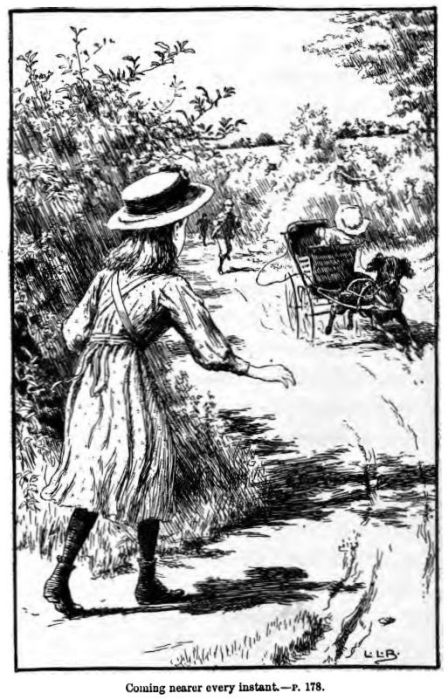
Leigh was some little way off still; but nearer than he, and coming nearer every instant, was something else which made even Janie’s stout little heart rise up to her mouth, as she afterwards said. It was the perambulator from the Hall, the beautiful new perambulator, banging and dashing along, dragged by something that looked just then very like a little wild beast instead of a well-disposed tame doggie. And yet it was only looks, for Fuzzy was in the best of spirits, quite pleased with himself, and thinking that Leigh’s shouts only meant he was to go faster and faster.
But Janie had not time to think anything. She only saw that the perambulator was not empty; she only took in that it must be stopped. She would not have been frightened, even if she had thought the dog was mad, for she was very brave. But she knew that her voice would have no power over him, and she made her plan in a moment. Just as the wildly excited dog came close to her—luckily just then he was going pretty evenly—she threw herself in his way, which made him slacken his pace, and then, somehow or other, she got hold of the edge of the carriage, holding on to it with all her strength, and she was very strong for her size. And then—what happened exactly she could not tell—I fancy Fuzzy must have given a bound forward to get rid of this troublesome interruption to his grand race—but before she knew where she was they were all in a jumbled-up heap on the ground, Janie, Baby Dolly, perambulator, and dog—Fuzzy barking loudly; baby, Janie was thankful to hear, crying and roaring, but, as far as the small sister-nurse could make out, unhurt.
She had got her safely in her motherly little arms by the time Leigh came up. The first thing he did was to seize hold of the reins which had been dragging behind, for after a glance had shown him that the baby was in good hands, Leigh’s next thought was for the new perambulator.
“She’s not hurt?” he exclaimed.
“No, no, sir. I think not,” said Janie. “She fell soft—right atop of me, Master Leigh. Hush, hush now, Miss Baby dear. Don’t ’ee cry. There’s Miss Mary a-coming along. Hush, hush, my dearie.”
And in surprise at the strange voice, and pleased by the sweet tones, Dolly actually did leave off crying. She opened her eyes wide, and by degrees a smile—a real smile—crept out of her mouth, and brightened up all the little face, still shining with tears. So that when poor wee Mary, all out of breath, and white with fear for her darling sister, came up to the little group, Janie was able to say, while Dolly stretched out her hands in welcome—
“She’s not hurt, Miss Mary, dear. She’s not hurt.”
Leigh by this time had unfastened Fuzz, and set the perambulator on its legs, or wheels, again. He was all trembling; and though it was not a hot day of course, the drops were standing out on his forehead. Wonderful to say, the perambulator was not broken or spoilt.
“Oh Mary,” said Leigh. He could scarcely speak. “Oh Janie, I don’t know how to thank you.”
Janie opened her eyes. It had never come into her head that she had done anything to be thanked for. But she was, as I said, very sensible.
“Master Leigh,” she replied, “I couldn’t a’ done less—that’s nothing. But I can’t think how Mrs Nurse could a’ let you do such a thing.”
“Nurse is ill; at least she’s hurt her leg,” said Leigh. “It’s Emma that’s with us.”
“Then she oughter be ashamed of herself,” exclaimed Janie, as if she was nineteen and Emma ten, instead of the other way about. “What’s the good of a big person to look after children if she’s as silly as them. I beg your parding, Master Leigh, but this ’ere precious baby’s had a narrer escape, and no mistake.”
Janie was hot with indignation and fright.
“But you tried yourselves, Janie,” said Leigh, feeling rather small. “Ned harnessed himself to—”
“That was quite different,” said Janie. “And I told you the other day as it hadn’t turned out a good plan at all. I’m sure if I’d had any notion you were thinking of such a thing, I’d have—” she stopped, then went on again, “But you’ll never try such tricks again, now, will you, Master Leigh? And you’ll go straight to your dear mamma as soon as you get in and tell her all about it.”
“No, I’ll never try it again, I promise you. And of course I’d rather tell about it myself, Janie. You won’t, will you? They’d be making such a song of it all through the village.”
“Very well then, I won’t say nothing,” agreed the little woman. “And I’ll tell Comfort—she’s in the field there behind the hedge with the babies. I’ll see to it that Comfort says nothing neither.”
Then Janie put Baby Dolly tenderly back into her nest again, charging the children to stay close round her till Emma came up, “for fear the sweet little lady should be frightened again.” There was a vision in the distance of Emma slowly making her way to them, and Janie did not want to see her.