Chapter III · Choosing Your Play
Reading edition
It may not always be easy to find just the play you wish for your marionettes. If you should go to your library and ask for a marionette play, it is possible that the librarian would have very little to offer you. But if you should go to her and ask for a good story that you could make into a marionette play, you would probably be surprised to see how many books she would place before you. You might even feel confused when you came to make your choice. Suppose that you wish to give a humorous play. Begin by making a list of the very best of the humorous books:
Alice in Wonderland—Carroll
Alice, Through the Looking Glass—Carroll
Gulliver’s Travels—Swift
Pinocchio, The Story of a Marionette—Lorenzini
Don Quixote—Cervantes
Midsummer Night’s Dream—Shakespeare
Peter and Wendy—Barrie
Rip Van Winkle—Irving
Just-So Stories—Kipling
Arabian Nights—Edited by Colum
Uncle Remus—Harris
34Rose and the Ring—Thackeray
Tom Sawyer—Clemens
Wind in the Willows—Grahame
Tales of Laughter—Wiggin and Smith
You will find that it is not at all difficult to turn the vivid and amusing characters of these books into marionettes. Neither is it difficult to turn these stories into marionette plays.
First: Make a list of the most important incidents in the story.
Second: Decide upon the number of scenes that you think necessary for your play.
Third: Decide upon the number of characters required for these scenes.
These three things you must do if your play is to be only the simplest kind of a Burattini play, if it is to be a shadow play, or a marionette play.
If you are not experienced in making marionette plays, you may think that you need a great many characters to act your story. But the more you learn about marionette plays, the more you will be surprised to find how few characters, and incidents, and scenes you will need. Choose only those which are most important. This means that you should know your story very well indeed before you begin to make your play. When you thoroughly know your story and all the characters in it, all that they say and do, you will enjoy your play-making quite as much as your play-giving.
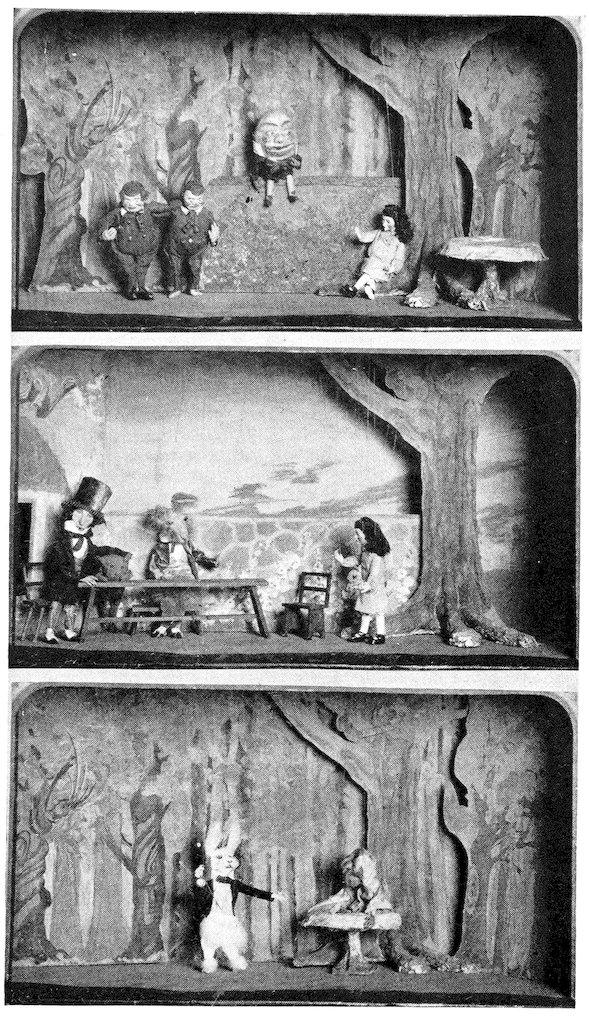
Scenes from the marionette play, "Adventures of Alice," given by ninth year pupils of Fairmount Junior High School at the Cleveland Museum of Art. Marionettes made by Tuesday Marionette Club.
35Let us choose one or two humorous books and see how we can turn them into a marionette play. We might choose Alice in Wonderland and Through the Looking Glass. You remember how the story of Alice in Wonderland begins? Alice falls asleep under the tree and the white rabbit passes by. So one might select:
Incident I.
Alice and the White Rabbit
Incident II.
Alice and the Caterpillar
Incident III.
Alice and Tweedle Dum and Tweedle Dee
Incident IV.
Alice and Humpty Dumpty
Incident V.
Alice and the Duchess, the Cheshire Cat, the Cook and the Pig Baby
Incident VI.
Alice and the Hatter, the March Hare and the Dormouse
Of course, a dozen plays could be made from these two books, but these six incidents will be quite enough for your purpose. A good play, as you know, must not be too long, it must begin in the right way, the story must hold together, and it must be very interesting all the time, and it must have the right ending. The above six incidents were selected with these requirements in mind.
Now, how many acts shall we have? Since this is a dream story, the play might begin by showing Alice falling asleep under the trees, and the White Rabbit running past, and then Alice jumping up and following him. This part of the play we might call a Prologue since it begins the story. Then follow with:
Act I.
Scene: In the woods
Act II.
Scene: In the Duchess’s kitchen
Act III.
Scene: The mad tea party
36To bring the play to an end, there might be a closing scene, or epilogue, showing Alice waking from her dream and becoming herself again.
We must now decide just how many characters are really necessary in these six incidents. Let us take a pencil and make the list as we find them in these three acts:
Prologue:
Alice and the White Rabbit.
Act I.
Alice, the Caterpillar, Tweedle Dee, Tweedle Dum, Humpty Dumpty
Act II.
Alice, the Duchess, the Pig Baby, the Cook, the Cheshire Cat
Act III.
Alice, the Hatter, the March Hare, the Dormouse
Epilogue.
Alice and the White Rabbit.
Here we have made from six important incidents, in the two stories about Alice, a marionette play of three acts, with a cast of thirteen characters. This play might be called The Adventures of Alice.
Possibly you and your friends are much interested in heroes and heroines and would prefer a hero play made from such stories as:
The Book of King Arthur and His Noble Knights—MacLeod
Sohrab and Rustum—Arnold
The Boys’ Iliad—Perry
The Boys’ Odyssey—Perry
Adventures of Ulysses—Lamb
Adventures of Odysseus and the Tale of Troy—Colum
Robin Hood—Pyle
The Tales of Troy and Greece—Lang
Stories of Charlemagne—Church
The Story of Roland—Baldwin
Seven Champions of Christendom—Johnson
37Beowulf—Cartwright
Sigurd, the Volsung—Morris
Joan of Arc—Boutet de Monvel
Ivanhoe—Scott
Daniel Boone—White
Norse Stories Retold—Mabie
The Cid—Wilson
Britain Long Ago—Wilmot-Buxton
Instead of hero plays you may be interested in plays of adventure. The list of excellent books of adventure is a long one, as you know. Here are just a few that are waiting to be turned into wonderful marionette plays:
Robinson Crusoe—Defoe
Boy’s Froissart—Lanier
The Wonder Book—Hawthorne
The Boys Percy—Lanier
Otto of the Silver Hand—Pyle
Black Arrow—Stevenson
Tales from the Alhambra—Irving
William Tell—Schiller
Treasure Island—Stevenson
Men of Iron—Pyle
The Story of the Canterbury Pilgrims—Darton
The Lance of Kanana—French
The Book of Bravery—Lanier
The Last of the Mohicans—Cooper
With Spurs of Gold—Greene
The Golden Perch—Hutchinson
Captains Courageous—Kipling
Let us take one of these, Howard Pyle’s Men of Iron, a story laid in England in the time of King Henry IV. The list of important incidents is a long one.
1.38
Myles parting from the old servant.
2.
Myles presenting his father’s letter to the Earl of Mackworth.
3.
Myles meeting with Gascoigne.
4.
Myles meeting with Sir James Lea.
5.
Myles at play with the boys.
6.
The ball flies over into the ladies’ garden.
7.
Myles and Lady Alice in the garden.
8.
Myles, discovered by the Earl of Mackworth, learns that the Earl is befriending him.
9.
Arrival of King Henry at Devlin Castle.
10.
The knighting of Myles.
11.
Myles’ challenge to the Earl of Alban, his father’s deadly enemy.
12.
The combat between the Earl of Alban and Myles.
13.
The triumph of Myles and his request for the hand of Lady Alice.
When you have studied the story of Men of Iron and made your list of important incidents, you will find that four acts are sufficient for your play:
Act I.
Courtyard of Devlin Castle
Act II.
The ladies’ garden
Act III.
The great hall in Devlin Castle
Act IV.
The tournament ground and the royal pavilions and gallery .
The list of characters is long but it gives an opportunity to many boys and girls in a class to make marionettes and to have a part in the play. Here is the list of characters:
1.
Myles as a boy in Acts I and II
2.
Myles as a man in Acts III and IV
3.
The old Servant
4.
The Armorer
5.
The Bear Trainer
6.
The Bear
7.
Gascoigne
8.
Walter Blunt
9.
The Squire 39
10.
Sir James Lea
11.
Earl of Mackworth
12.
The Pryor
13.
The Earl of Alban
14.
The Minstrel
15.
The Jester
16.
Lady Alice
17.
Lady Anne
18.
Black Horse
19.
Gray Horse
20.
The Pigeons
Marionette plays are exactly like all other plays. They need songs and dances, and many things that will be certain to interest the audience. Here is a list of the incidents that were added to this play when it was given by the boys and girls of Fairmount Junior High School in Cleveland, Ohio:
1.
An Italian bear trainer, who whistled a jolly tune while his bear danced and did his tricks.
2.
The song of the Armorer as he worked at his forge. (The forge was so made and wired that every stroke of the hammer on the anvil gave forth a shower of sparks.)
3.
A fight between Myles and the young squire, Walter Blunt.
4.
Practice at the pells to show the training of the squires of that day.
5.
Lady Alice’s little dance.
6.
Lady Anne’s song as she plays her lute.
7.
Alice’s tame pigeon that flew down to her shoulder.
8.
The wandering minstrel with his lute and his ballad of Chevy Chase.
9.
The antics, capers, and songs of the jester.
In order to prepare the audience for the play and to carry every person back in imagination to the time of this play, an announcer was chosen, who, in the costume of that day, came before the curtain and gave the introduction to the play. This announcer was chosen with great care because his part was so important. He was responsible for carrying his audience back into the days of chivalry, not only by his speech 40and costume, but by his tone of voice and his gestures. Here is the prologue that one of the children wrote:
Hark ye! Hark ye! Ye who came to see
Enacted here some scenes of chivalry.
The castle gate swings wide its door
Scenes long since gone return to us once more.
Into times dim and far we bid you gaze,
Down the long vista to the tournament days.
Towers and turrets and battlements old,
Squires and pages and bachelors bold.
Lords and ladies step out from past ages
While knights and earls throw down their iron gages.
Then men were bold and strongly said their say
And there were few who dared to say them “nay.”
The minstrel, too, did tune on lyre his hero’s deeds
And sang of love, of hope, and needs.
Bears oft came dancing in court and in hall,
Trained by their master to heed beck and call.
Fair maids in latticed bowers were seen dancing,
Fantastic and gay, a jester comes prancing.
Hark! a blare of trumpets sounds as in a dream
And lo! the king and train in mail and helmets gleam.
Mid fluttering scarfs, the Queen of Beauty sat
While in the lists brave knights did wage combat.
All these have you from history’s page
Now shall you see them pictured on our stage.
Grant us your patience, lend eyes and ears as well,
The truth our puppets now will strive to tell.
41There were many things in this play that every member of the class was uncertain about. No one knew about the kinds of costumes that were worn in England in the time of Henry IV. Neither did anyone know about houses, gardens, and furniture, nor about the armor and the musical instruments of that day until he had studied reference books. Here is a list of some of the books that were found helpful:
Heraldry—Complete Guide to Heraldry—Fox-Davies
Furniture—How to Know Period Styles in Furniture—Kimberly
Tapestry—Bayeux Tapestry—Belloc
Tapestry—Bayeux Tapestry—Bruce
Tapestry—The Practical Book of Tapestry—Hunter
Weapons—Armour and Weapons—Foulkes
Customs and Life of the Time—History of Everyday Things in England—Quennell
Songs and Ballads—Songs of England—Hatton
Costumes—The Heritage of Dress—Webb
Costumes—British Costumes During Nineteen Centuries—Ashdown
The Museum of Art and the Historical Museum can be visited for first-hand information. Librarians, history, art, and English teachers can be counted upon for help. The librarian will help you to find the kind of book you wish, and will be glad to help find reference books and pictures. The history teacher will help you in learning about the life and customs of the people who are of the time of your play. The English teacher can be of invaluable help to you in working out the development of your play. Last, but not least, you will have very great need of your art and manual training teachers. They will help you in 42learning how to make your marionettes, how to make your marionette stage, how to make your scenery and properties, how to light the stage, what colors to use in your costumes and in your scenery, and how to place both your scenery and your actors on the stage. They will also assist you in planning the stage pictures.
Moreover, you may be interested in other literary plays made from such stories as:
Birds’ Christmas Carol—Wiggin
Little Women—Alcott
Prince and the Pauper—Clemens
Oliver Twist—Dickens
Cricket on the Hearth—Dickens
The Tempest—Shakespeare
The Merchant of Venice—Shakespeare
Heidi—Spyri
Master Skylark—Bennett
Gabriel and the Hour Book—Stein
Rip Van Winkle—Irving
David Copperfield—Dickens
The Christmas Carol—Dickens
The King of the Golden River—Ruskin
Should you like the story of The Childhood of David Copperfield, some such interesting incidents as the following might be chosen:
1.
David and Pegotty.
2.
David meets Captain Pegotty, Emil, and Mrs. Grummage.
3.
David and Emily.
4.
David in the schoolroom.
5.
Betsy Trotwood and Master Dick.
6.
David and Betsy Trotwood.
43The characters in these incidents are:
1.
David
2.
Pegotty
3.
Captain Pegotty
4.
Mrs. Grummage
5.
Emily
6.
Sam
7.
Tommy Traddles
8.
Schoolboy
9.
Mr. Schoolmaster
10.
Mr. Schoolmaster’s assistant
11.
Betsy Trotwood
12.
Master Dick
13.
The mouse
Five acts would give the story:
Act I.
The Copperfield sitting room
Act II.
Inside the boathouse
Act III.
Along the seashore
Act IV.
In the schoolroom
Act V.
Betsy Trotwood’s garden
Since every act of a play should help in telling the story, in solving the principal problem, and in bringing about the proper ending, this arrangement might be made:
Act I.
David reads and talks to Pegotty about her brother’s boathouse. Pegotty invites David to spend a week there.
Act II.
In the boathouse. David meets Pegotty’s family.
Act III.
By the seashore. David plays with Emily, who sings a song, and David tells Emily how much he will miss her when he goes away to school.
Act IV.
In the schoolroom. The cruel schoolmaster and his assistant. David decides to run away.
Act V.
Betsy Trotwood’s garden. David finds a home with his good Aunt Betsy and gentle old Master Dick.
At the same time that Charles Dickens was writing David Copperfield and other stories about the people he knew, several clever artists were making drawings 44of the same people. You probably know many of the amusing pictures they drew, especially those of Cruikshank, Tenniel, and Du Maurier. If you wish to know how David and Pegotty and Betsy Trotwood and little Emily really looked, ask your librarian to show you some of the illustrations that these artists made. Because these pictures give the very best idea of how the people of Dickens’ time looked, you might copy them for your marionettes. Their faces have a great deal of character, their clothes are those of that time, and they are so quaint and characteristic that they will never be uninteresting.
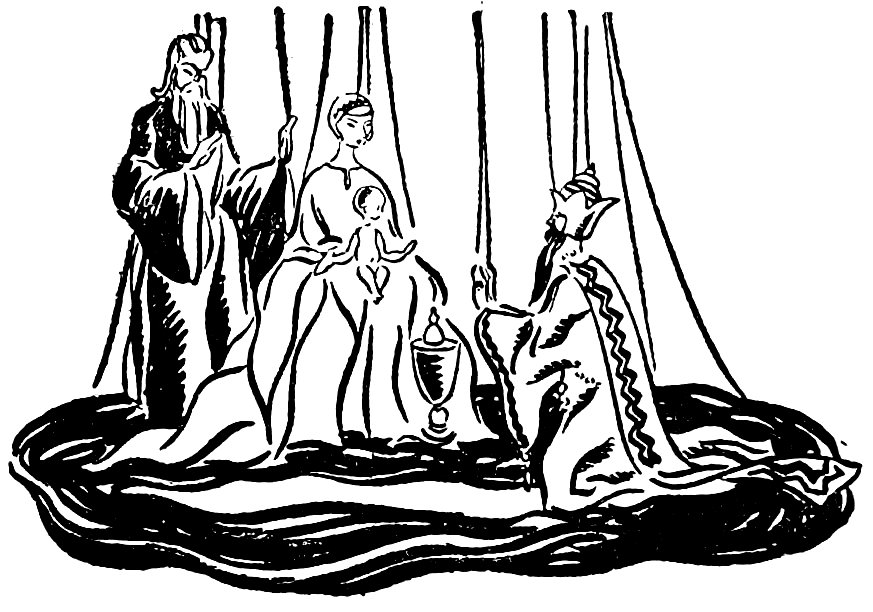
Probably the most beautiful marionette plays that one can imagine could be done from the great stories in the Bible. Just as in the early days of Christianity, when marionettes helped the people to see and feel the great scenes in their new religion, so, it would seem, that a time might come again when the little figures might return to their earliest uses. This could well be done in Christmas and Easter plays for the church and Sunday school. Imagine the story of Joseph and his brethren with scenes showing:
1.
The tent life of Israel.
2.
The kind old father.
3.
The cruel brothers.
4.
The selling into bondage.
5.
The court life in Egypt.
6.
Joseph among his new friends.
7.
The famine.
8.
The visit of the brothers.
9.
The remorse of the brothers.
10.
Joseph’s forgiveness in the last scene.
45Parables, such as that of the Good Samaritan, are full of dramatic possibilities.
How many beautiful plays appropriate for Christmas, Easter, and saints’ days could be made from the lives of the saints! If you are interested in a play for your Sunday school or your parochial school, read and make into a play the life of Saint Christopher, Saint George, Saint Patrick, Saint Francis of Assisi, Saint Agnes, Saint Genevieve, Saint Catherine of Sienna, or Saint Joan of Arc.
If you love fairy tales you will, no doubt, wish to make a fairy marionette play. You probably know many of the books listed here:
Mother Goose
Hans Christian Andersen’s Fairy Tales—Tr. Lucas
The Brothers Grimm Fairy Tales—Tr. Crane.
The Arabian Nights—Ed. Colum
Adventures of Nils—Lagerlöf
Gulliver’s Travels—Swift
The Blue Bird—Maeterlinck
Water Babies—Kingsley
The Little Lame Prince—Craik
Old Peter’s Russian Tales—Ransome
Æsop’s Fables—Ed. Jacobs
Undine—La Motte Fouqué
Story of the Rheingold—Chapin
Japanese Fairy Book—Ozaki
Wonder Tales of China Seas—Olcott
Tales of Wonder—Wiggin and Smith
Here are a few familiar poems that may be turned into marionette plays:
Hiawatha—Longfellow
Evangeline—Longfellow
46Story Telling Ballads—Olcott
Lady of the Lake—Scott
Lays of Ancient Rome—Macaulay
Many other stories will, no doubt, occur to you, and many ways of turning them to your needs.
47