THE DOWNFALL OF ROYALTY. (continued 2)
Elizabeth Gilbert Martin translation
Things did not go fast enough to suit Madame Roland's furious hatred. The popular gathering in the Champ-de-Mars, whose aim was to bring about the deposition of the King, was forcibly dispersed on July 17. With six exceptions, all the deputies who had belonged either to the Jacobin Club or that of the Cordeliers, left them on account of their demand that Louis XVI. should be brought to trial. The time for great measures, to use Madame Roland's expression, had not yet arrived. The ardent democrat laments it. "I cannot describe our situation to you," she writes at this moment of the revolutionary recoil; "I feel environed by a silent horror; my heart grows steadfast in a mournful and solemn silence, ready to sacrifice all rather than cease to defend principles, but not knowing the moment when they can triumph, and forming no resolution but that of giving a great example."
The mission which had kept Roland in Paris for seven months being ended, the discouraged pair returned to their province in September. After stopping a few days in Lyons, in order to found a popular society affiliated to the Jacobins of the capital, they went to spend the remainder of the autumn at their country place, the Close of Platière. But calm and silence no longer suited Madame Roland. Repose exasperated her. She missed the struggle and the emotions of revolutionary Paris, of which she had said: "One lives ten years here in twenty-four hours; events and affections blend with and succeed each other with singular rapidity; no such great events ever occupied minds."
The pleasure of seeing her daughter again was not enough to compensate her for the chagrin of having parted from Buzot. Just as she was despairing at the thought of sinking back into all the nullity of the province, as she expresses it, the news came that the inspectors of agriculture had been suppressed. Roland, no longer an official, deliberated with his wife as to their next step. His own inclination was to settle permanently in the country and devote himself to agricultural labors which would surely and safely augment his fortune. But his wife was by no means of the same mind. She must see her dear Buzot again at any cost. She flattered the self-love of her unsuspecting spouse, and persuaded him that Paris was the sole theatre worthy of the virtuous Roland. Roland allowed himself to be convinced. His wife, no longer mistress of herself, was drawn into the Parisian abyss as by an irresistible force. And yet was it not she who had proposed to herself this ideal, so easily to have been realized? "I have never imagined anything more desirable than a life divided between domestic cares and those of agriculture, spent on a healthy and fertile farm, with a little family where the example of its heads and common labor maintain attachment, peace, and freedom." Was it not she who had uttered this profoundly true thought: "I see neither pleasure nor happiness except in the reunion of that which charms the heart as well as the senses, and costs no regrets"? In the most beautiful days of her youth had she not written: "There was a time when I was never content except when I had a book or a pen in my hand; at present I am as well satisfied when I have made a shirt for my father or added up an account of expenses as if I had read something profound. I do not care at all to be learned; I want to be good and happy; that is my chief business. What is necessary but good, honest common sense?" Is it not she, too, who will write at the beginning of her Memoirs: "I have observed that in all classes, ambition is generally fatal; for the few happy ones whom it exalts, it makes a multitude of victims." Why did she not more frequently remind herself of the sentiment so just and well expressed in a letter dated in 1790: "Women are not made to share in all the occupations of men: they are altogether bound to domestic cares and virtues, and they cannot turn away from them without destroying their happiness." But, alas! passion does not reason. Farewell common sense, wisdom, and experience, when ambition and love have taken possession of a woman's heart. Returning to Paris, December 15, 1791, the Rolands established themselves in the rue de la Harpe, and plunged head-long into politics. The wife redoubled her activity, eloquence, and passion. The husband, instead of attending quietly to the management of his retiring pension, was named a member of the Jacobin corresponding committee at the beginning of 1792, a revolutionary centre of which Brissot was the leader. At this period, we are informed by Madame Roland, the intimidated court imagined that the nomination of a minister chosen from among the patriots of the Assembly would cause it to regain a little popularity. Brissot proposed Roland, who, on March 24, 1792, accepted the portfolio of the Interior.
Madame, behold yourself, then, the wife of a minister, and in fact more of a minister than your husband. Your ambitious projects, which have been treated as chimerical, are now realized. You have a cortège like Marie Antoinette. Men seek the favor of a smile, a word, from you. They court, they solicit, they fear you. The monarchy, which you detest, is at last obliged to reckon with you and your friends. Your beauty, your talent, and your eloquence are boasted of. Your name is in every mouth. You are powerful, you are celebrated. Well! you will find out for yourself what bitterness there is at the bottom of this cup of pride which has tempted your lips so long. You will learn at your own expense that renown does not produce happiness, and that, for a woman, twilight is better than the full glare of day. Yes, you will long for the obscurity which weighed upon you. You will long for the house of your father, the engraver, on the Quai des Orfèvres. You will dream of the sunsets which affected you, and of the monotonous but peaceful succession of your days. You, the deist, the female philosopher, will recall with regret the cloisters where in your adolescence you tasted the peace of the elect. In the time of your supreme trial Buzot's miniature will not console you; it is not his image you should cover with your kisses. No; that miniature is not the viaticum for eternity. What you will need is the crucifix, and you respect the crucifix no longer. And yet your imagination will evoke the mystic cloister, with its altars decked with flowers, its painted windows, its penetrating and ineffable poesy. And in thought, also, you will see the country once more, the harvest time, the month of the vintage, the poor who come to the door asking for bread and who go away with blessings on their lips and gratitude in their hearts. Why have you quitted these honest people? What have you come to do in the midst of these ferocious Jacobins, who flatter you to-day and will assassinate you to-morrow? Do you fancy that Marie Antoinette is the only woman who will be insulted, calumniated, and betrayed? Why do you seat at your hospitable table this livid-faced Robespierre, who to-day, perhaps, will address you a madrigal, and to-morrow send you to the scaffold? You will pay very dear for these false and artificial joys, these gusts of commonplace vanity, this pride of a parvenu, and the pleasure of presiding for a few evenings at the dinners given to the Minister of the Interior in Calonne's dining-room. The Legislative Assembly, the Jacobin Club, the journals and the ministry, the souvenirs of Plutarch and the parodies of Jean-Jacques, the noisy crowd of flatterers who are the courtiers of demagogues as they would have been the courtiers of kings, these adulators who are going to change into executioners,—all are vanity! Poor woman, whose power will be so ephemeral, why do you make yourself a persecutor? You will so soon be persecuted. Why labor so relentlessly to shake the foundations of a throne that will bury you beneath its ruins?
VII.
MARIE ANTOINETTE AND MADAME ROLAND.
Two women find themselves confronted across the chessboard and about to move the pieces in a terrible game in which each stakes her head, and each is foredoomed to lose. One is the woman who represents the old régime—the daughter of the German Cæsars, the Queen of France and Navarre; the other stands for the new régime, the Parisian middle classes—the daughter of the engraver of the Quai des Orfèvres. They are nearly the same age. Madame Roland was born March 18, 1754; and Marie Antoinette, November 2, 1755. Both are beautiful, and both are conscious of their charm. Each exercises a sort of domination over all who approach her.
In 1792, when Roland enters the ministry, Marie Antoinette is no longer thinking of coquetry, luxury, or dress. The heroine of the Gallery of the Mirrors, the crowned shepherdess of the Trianon, the queen of elegance, pleasure, and fashion is not recognizable in her. The time for splendors is over, like the time for pastorals. No more festivals, no more distractions, no more theatres. Incessant anxieties and unremitting labor; writing throughout the day and reading, meditating, and praying throughout the night, are now the unfortunate sovereign's whole existence. She hardly sleeps. Her eyes are reddened by tears. A single night, that of the arrest on the journey to Varennes, had sufficed to whiten her hair. She wears mourning for her brother, the Emperor Leopold, and for her ally, the King of Sweden, Gustavus III., and one might say that she is also wearing it for the French monarchy. All trace of frivolity has disappeared. The severe and majestic countenance of the woman who suffers so cruelly as queen, spouse, and mother, is sanctified by the double poetry of religion and sorrow.
Madame Roland, on the other hand, is more coquettish than she has ever been. The actress who has at last found her theatre and is very proud to play her part, wishes to allure, desires to reign. She delights in presiding at these political dinners where all the guests are men, and of which her grace and eloquence constitute the charm. She has just completed her thirty-eighth year. Her husband is nearly fifty-eight; Buzot is only thirty-two. Possibly she is still more preoccupied with love than with ambition. To use one of her own expressions, "her heart swells with the desire to please," to please Buzot above all; she takes pains to celebrate her own beauty, which, in spite of showing symptoms of decline, has the brilliance of sunset. In her Memoirs she describes her "large and superbly modelled bust, her light, quick step, her frank and open glance, at once keen and soft, which sometimes amazes, but which caresses still more, and always quickens." She writes: "My mouth is rather large; there are a thousand prettier, but none that has a softer and more seductive smile." In prison, when she is nearly forty, she states that if she has lost some of her attractions, yet she needs no help from art to make her look five or six years younger. "Even those who see me every day," she adds, "require to be told my age, in order to believe me more than thirty-two or thirty-three." Madame Roland had at first written thirty-three or thirty-four. But after reflection, finding herself too modest, she made an erasure and retrenched another year. She adds that she made very little use of her charms; avowing at the same time, and with the most absolute frankness, that if she could reconcile her duty with her inclination to utilize them more fully, she would not be sorry.
Both Marie Antoinette and Madame Roland were political women. But the one became so in her own despite, in the hope of saving the life of her husband and the heritage of her son; the other, through ambition and the desire to play a part for which her origin had not destined her. In the one, everything is at once noble and simple, natural and majestic; in the other there is always something affected and theatrical; one scents the parvenue who will never be a grande dame, even in the Ministry of the Interior or at the house of Calonne. All is unstudied in Marie Antoinette; Madame Roland, on the contrary, is an artist in coquetry.
Bizarre caprice of fate which makes political rivals and adversaries treating with each other on equal terms of these two women, of whom one was so much above the other by rank and birth. The Tuileries and the house of the Minister of the Interior are like two hostile citadels at a stone's throw from each other. On both sides there is watchfulness and fear. An impassable abyss, hollowed out by the vanity of the commoner still more than by the pride of the Queen, forever separates these two courageous women who, had they united instead of antagonizing each other, might have saved both their country and themselves.
It is necessary to go back a few years in order to comprehend the motive of Madame Roland's hatred for Marie Antoinette. It was inspired in the vain commoner by envy, the worst and vilest of all counsellors. Madame Roland's special characteristic was the passion for making an effect. Now the effect produced by Marie Antoinette under the old régime was immense; that produced by the future Egeria of the Girondin group was almost null. A simple mortal, regarding Olympus from below, she said to herself with vexation, that in spite of her talents and her charms there was no place for her among the gods and goddesses. Versailles was like a superior world from which it maddened her to be excluded. She was twenty years old when, in 1774, she visited it with her mother, her uncle, the Abbé Bimont, and an aged gentlewoman, Mademoiselle d'Hannaches. They all lodged at the palace. One of Marie Antoinette's women, who was acquainted with the Abbé, and who was not then on duty, lent them her apartment. The only object of the excursion was to give the young girl a near view of the court.
In recalling this souvenir in her Memoirs, Madame Roland displays her aversion for the old society. She is annoyed even with the companion of her visit, because she was, according to the expression then in use, a person of quality. "Mademoiselle d'Hannaches," she says, "went boldly wherever she chose, ready to fling her name in the face of any one who tried to stop her, thinking they ought to be able to read on her grotesque visage her six hundred years of established nobility. The fine figure of a pedantic little cleric like the Abbé Bimont, and the imbecile pride of the ugly d'Hannaches were not out of keeping in those scenes; but the unpainted face of my worthy mamma, and the modesty of my dress, announced that we were commoners; if my eyes or my youth provoked remark, it was almost patronizing, and caused me nearly as much displeasure as Madame de Boismorel's compliments." It was this Madame de Boismorel who, although she found the little Philipon very pleasing, had said to the grandmother of the future Madame Roland: "Take care that she does not become a learned woman; it would be a great pity."
The splendors of Versailles did not dazzle the daughter of the engraver of the Quai des Orfèvres. The apartment she occupied was at the top of the palace, in the same corridor as that of the Archbishop of Paris, and so near it that it was necessary for the prelate to take precautions lest she should overhear him talk. "Two poorly furnished rooms," she says, "in the upper end of one of which space had been contrived for a valet's bed, was the habitation which a duke and peer of France esteemed himself honored in possessing, in order to be closer at hand to cringe every morning at the levée of Their Majesties: and yet he was the rigorist Beaumont.... The ordinary and the ceremonial table-service of the entire family, eating separately or all together, the masses, the promenades, the gaming, the presentations, had us for spectators during a week." What impression was made on her by this excursion to the royal palace? She herself will tell us nineteen years later, in her prison. "I was not insensible," she says, "to the effect of so much pomp and ceremony, but I was indignant that its object should be to exalt certain individuals already too powerful and of very slight personal importance: I liked much better to look at the statues in the gardens than at the persons in the palace; and when my mother asked if I was satisfied with my visit, 'Yes,' I replied, 'provided it will soon be over; if I stay here many days longer, I shall detest the people so much that I shall be unable to hide my hatred.' 'What harm are they doing you, then?' 'Making me feel injustice, and constantly behold absurdity.'"
How this impression is emphasized in the really prophetic letter written by the future heroine of the Revolution to her friend, Mademoiselle Sophie Cannet, October 4, 1774: "To return to Versailles. I cannot tell you how greatly all I have examined has made me value my own situation, and thank Heaven that I was born in an obscure condition. You think, perhaps, that this sentiment is based on the slight esteem I attach to the worth of opinion, and my sense of the reality of the penalties attached to greatness. Not at all. It is based on the knowledge I have of my own character, which would be very detrimental both to me and to the State if I were placed at a little distance from the throne; because I would be keenly shocked by the extreme inequality which sets so many thousands of men below a single individual of the same species!" What a prediction! The most unforeseen events were one day to bring this young plebeian near that royalty formerly so far above her. The engraver's daughter will be the wife of a minister of State. And then what will happen? According to her own expression, her rôle will be very detrimental to herself and to the State.
In the same letter she had written: "A beneficent king seems to me an almost adorable being; but if, before coming into the world, the choice of a government had been given me, my character would have made me decide for a republic." She will end by hating the beneficent King, and probably no one will contribute more than she towards establishing the republican régime in France.
Supposing that, instead of being merely an insignificant commoner, Madame Roland had been born in the ranks of aristocracy, had enjoyed the right of sitting down in the presence of Their Majesties at Versailles, and had shone at the familiar entertainments of the Trianon, she would doubtless have shared the sentiments and ideas of the women of the old régime, and, like the Princess de Lamballe or the Duchess de Polignac, have shed tears of compassion over the Queen's misfortunes. Fate, in placing her in a subordinate position, made her an enemy and a rebel. She anathematized the society in which her rank bore no relation to her lofty intelligence and her need of domination. When, from the upper window of her father's house on the Quai des Orfèvres, beside the Pont-Neuf, she saw the brilliant retinue of Marie Antoinette pass by on their way to Notre Dame to return thanks to God for some happy event, she grew angry at all this pomp and glitter, so much in contrast with her own obscure condition. What crimes have been engendered by the sentiment of envy! The furies of the guillotine were above all things envious. They were delighted to see in the fatal cart the woman whom they had formerly beheld in gala carriages resplendent with gold. Madame Roland certainly ought not to have carried her hatred to such a pitch; but had she not demanded in 1789, when speaking of Louis XVI. and the Queen, that "two illustrious heads" should be brought to trial? Who knows? If, in 1784, she had obtained the patent of nobility for her husband which at that period she solicited so ardently, she might have become sincerely royalist! But having remained, despite herself, in the citizen class, she retained and personified, to her latest hour, its rancor, pettiness, and wrath. What figure could she have made at Versailles, or even at the Tuileries? In the midst of great lords and noble ladies the haughty commoner would have been out of place; she would have stifled. It was chiefly on that account that she attached herself to the new ideas. She told herself that so long as royalty lasted, she would always be of small importance; while, if the republic were established, she might aspire to anything. Though her husband was one of the King's ministers, she became daily more adverse to the monarchy, and Roland, following her counsels, was like a pilot whose whole intent is to make the vessel founder, even though he were to perish with its crew.
It is a sad thing to say, but even their community in suffering did not disarm Madame Roland's hate for Marie Antoinette. It was in prison, on the eve of ascending the scaffold herself, that she wrote concerning Louis XVI. and the Queen: "He was led away by a giddy creature who united the presumption of youth and grandeur to Austrian insolence, the intoxication of the senses, and the heedlessness of levity, and was herself seduced by all the vices of an Asiatic court, for which she had been too well prepared by the example of her mother." Ah! why were not these cruel lines effaced by the tears Madame Roland shed in floods over the pages she was writing, and of which the traces still remain on the manuscript of her Memoirs? Why did she not sympathize in the grief of Marie Antoinette, separated from her children, when in speaking of her daughter Eudora, she wrote: "Good God! I am a prisoner, and she is living far from me! I dare not even send for her to receive my embraces; hatred pursues even the children of those whom tyranny persecutes, and mine, with her eleven years, her virginal figure, and her beautiful fair hair, could hardly appear in the streets without creatures suborned or deluded by falsehood pointing her out as the offspring of a conspirator. Cruel wretches! how well they know how to tear a mother's heart!"
Why were these two women political adversaries? Both sensitive, both artistic, with inexhaustible sources of poetry and tenderness at heart, they were born for gentle emotions and not for horrible catastrophes. Who, at their dawning, could have predicted for them such an appalling night? Like Marie Antoinette, Madame Roland loved nature and the arts. She felt the profound and penetrating charm of the fields. She drew, she played on the harp, guitar, and violin, and she sang. "No one knows," she wrote a few moments before her death, "what an alleviation music is in solitude and anguish, nor from how many temptations it can save one in prosperity." She had sung the same romances as the Queen. The same poets had inspired and affected each.
Does not this most feminine passage in Madame Roland's Memoirs recall the character of the mistress of the Little Trianon? "I always remember the singular effect produced on me by a bunch of violets at Christmas; when I received them I was in that condition of soul often induced by a season favorable to serious thought. My imagination slumbered, I reflected coldly, and I hardly felt at all; suddenly the color of these violets and their delicate perfume struck my senses; it was an awakening to life.... A rosy tinge suffused the horizon of the day." Would not this cry of Madame Roland in her captivity suit Marie Antoinette as well? "Ah! when shall I breathe pure air and those soft exhalations so agreeable to my heart?" And might not the daughter of the great Maria Theresa have cried, like the daughter of Philipon the engraver? "Adieu! my child, my husband, my friends. Adieu! sun whose brilliant rays brought serenity to my soul, as if they were recalling it to the skies. Adieu! ye solitary fields which have so often moved me."
What must not these two keenly sensitive women have had to suffer at the epoch when France became a hell? They have each believed in the amelioration of the human species and the return of the golden age to earth, and what will their awakening be, after such alluring dreams? Men will be as unjust, as wicked, as cruel to the republican as to the queen. She, too, will be drenched with calumnies and outrages. They will insult her also in the most cowardly and ferocious manner. Under the very windows of her dungeon she will hear the hawkers crying: "Great visit of Père Duchesne to Citizeness Roland, in the Abbey prison, for the purpose of pumping her." The ignoble journalist will call her "old sack of the counter-revolution." He will say to her with his habitual oaths: "Weep for your crimes, old fright, before you expiate them on the scaffold!" The wife of Louis XVI. and the wife of Roland will die within twenty-three days of each other: one on October 16, the other on November 8, 1793. They will start from the same prison of the Conciergerie, to be led to the same Place Louis XV., to have their heads cut off by the blade of the same guillotine. The commoner who had been so jealous of the Queen, can no longer complain. If the lives of the two women have been different, they will at least have the same death; and the doer of the noble deeds of the régime of equality, the headsman, will make no distinction between the two victims, between the veritable sovereign, the Queen of France and Navarre, and the sovereign of a day, whom Père Duchesne, as insolent to one as to the other, will no longer speak of except under the sobriquet of Queen Coco.
VIII.
MADAME ROLAND AT THE MINISTRY OF THE INTERIOR.
Roland took the portfolio of the Interior, March 24, 1792, and installed himself and his wife in the ministerial residence, then occupying the site afterwards built on by the Théâtre Italien. This very beautiful and luxurious mansion had formerly been the controller's office, and both Calonne and Necker had lived in it. Madame Roland found no small pleasure in queening it under the gilded canopies of the old régime. It was not at all disagreeable to her to give dinners in the sumptuous banqueting hall erected by the elegant Calonne, nor did the austere admirer of the ancients set the black broth of Sparta before her guests.
Once arrived at power, was this great enemy of nobility and prescription simple, and easy of approach? Not in the least. There is often more arrogance displayed by parvenus of both sexes than by those who are aristocrats by birth. Madame Roland was extremely proud of her new dignity, and at once resolved, as she tells us in her Memoirs, neither to make nor receive visits. Her attitude and manners while at the ministry were those of an Asiatic sovereign. She secluded herself, permitting only a small number of privileged courtiers to enter her presence. Under the old régime, the wives of ministers and ambassadors, dukes and peers, had never felicitated themselves on "cultivating their private tastes" to the detriment of the proprieties and obligations of good breeding. But the Revolution had changed all that. French politeness was now mere old-fashioned rubbish. At the Ministry of the Interior, the etiquette whose "severity" is vaunted by Madame Roland was more rigorous than that of the court of Versailles, and it was easier to see the wife of the King than the wife of the minister. With what hauteur the latter expresses herself concerning "the self-seeking crowds who throng about those who hold great places"! Assuredly, the Queen had never spoken of her subjects in this tone of disdainful patronage.
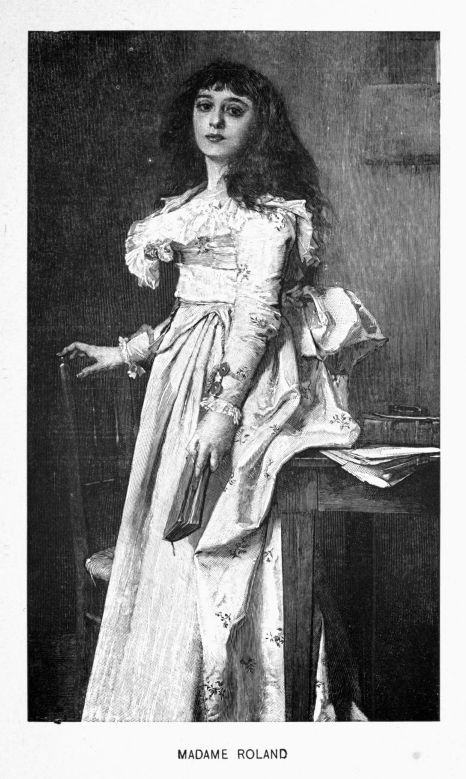
MADAME ROLAND
Madame Roland, who "was tired of fools," incommoded herself for nobody. The agreeable side of power was all she wanted. Suppressing the receptions which annoyed her, she gave none but men's dinners, where she perorated and paraded, and where, being the only woman present, she had no rivals to fear. Self-sufficiency and insufficiency are, for the most part, what fall to the share of parvenus. What would have been said in the old days of a noble dame who did the honors of a ministry so strangely, who never invited another woman to dinner, and admitted no one to her presence but a little clique of flatterers? Everybody would have accused such a lady as lacking in good breeding. But to Madame Roland all that she did was right in her own eyes. How could a woman so superior be expected to submit to the tyranny of polite usages? Was not the first of all despotisms the very one to be shaken off? and ought not a person so proud of the originality of her genius feel bound before all things, as she said herself, "to preserve her own mode of being"? Madame Roland did at the ministry just what she did from her cradle to her grave: she posed.
"To listen to Madame Roland," said Count Beugnot in his witty and curious Memoirs, "you would have thought she had imbibed the passion for liberty from reading the great writers of antiquity.... Cato the Elder was her hero, and it was probably out of respect for this hero that she showed a lack of courtesy towards her husband. She was unwilling to see that there was as much difference between Roland's wife and the Roman minister as there was between the Brutus of the Revolutionary Tribunal and him of the Capitol. Self-love was the means by which this woman had been elevated to the point where we have seen her; she was incessantly actuated by it, and does not dissimulate the fact." It was she, and not her husband, who was Minister of the Interior. If the aristocrats treated Roland as a minister sans-culottes, it might have been added that the breeches which he lacked were worn by his spouse. Out of all the rooms composing a vast apartment, she had chosen for her own daily use the smallest that could be converted into a study, and kept her books and writing-table in it. It was from this boudoir, half literary, half political, that she conducted the ministry according to her own whims. "It often happened," says she, "that friends or colleagues desiring to speak confidentially with the minister, instead of going to his own room, where he was surrounded by his clerks and the public, came to mine and begged me to have him called thither. Thus I found myself in the stream of affairs without either intrigue or idle curiosity. Roland took pleasure in talking these subjects over with me afterwards with that confidence which has always reigned between us, and which has brought our knowledge and our opinions into community."
On this head, M. Dauban makes the very just remark: "A community in which there is no equilibrium of forces, becomes a sort of omnipotence for the strongest." The omnipotence in this case was not on the side of the beard, but of Madame Roland. The wife wrote, thought, and acted for her husband. It was she who drew up his circulars and reports to the National Assembly. "My husband," she tells us, "had nothing to lose in passing through my hands. Roland, without me, would have been none the less a good administrator; with me, he has made more sensation, because I imparted to my writings that mixture of force and sweetness, that authority of reason and charm of sentiment, which perhaps belongs only to a sensitive woman, endowed with sound understanding." And the "virtuous" Roland took pride in the magnificent phrases which he naïvely believed to be the expression of his own genius, when his wife had saved him not merely the trouble of writing, but even of thinking. "He often ended," she says, "by persuading himself that he had really been in a good vein when he had written such or such a passage which proceeded from my pen."
Madame Roland had at her orders a man of letters, salaried by the Ministry of the Interior, who was the official defender of the minister and his policy. "It had been felt," she tells us, "that it was needful to counteract the influence of the court, the aristocracy, the civil list and their journals, by popular instructions to which great publicity should be given. A journal posted up in public places seemed to be the proper thing, and a wise and enlightened man had to be found for its editor." This wise and enlightened man was Louvet, the author of the Amours de Faublas. He was the writer whom Madame Roland esteemed most capable of instructing and of moralizing the masses. "Men of letters and persons of taste," she says, "know his charming romances, in which the graces of imagination are allied to lightness of style, a philosophical tone, and the salt of criticism. He has proved that his skilful hand could alternately shake the bells of folly, hold the burin of history, and launch the thunderbolts of eloquence. Courageous as a lion, simple as a child, a sensible man, a good citizen, a vigorous writer, he could make Catiline tremble from the tribune, dine with the Graces, and sup with Bachaumont."
Madame Roland admired the author of Faublas, now become the editor-in-chief of the Sentinelle; but among her intimates there was a man whom she admired much more. This was Buzot. With what complacency she draws in her Memoirs the portrait of this man "of an elevated character, a haughty spirit, and a vehement courage, sensitive, ardent, melancholy; an impassioned lover of nature, nourishing his imagination with all the charms she has to offer, and his soul with the principles of the most touching philosophy; he seems formed to enjoy and to procure domestic happiness; he could forget the universe in the sweetness of private virtues practised with a heart worthy of his own." Needless to say that in Madame Roland's thought, this heart worthy of the heart of Buzot was her own. "He is susceptible," says she, "of the tenderest affections" (always for Madame Roland), "capable of sublime flights and the most generous resolutions." Into what ecstasies she falls over the noble face and elegant figure of this handsome man, in whose costume "reigns that care, cleanliness, and decency which manifest the spirit of order, taste, the sentiment of decorum, and the respect of an honest man for the public and himself"! How she contrasts with men who think patriotism consists in "swearing, drinking, and dressing like porters, in order to fraternize with their equals," this attractive, this irresistible Buzot, who "professes the morality of Socrates and the politeness of Scipio"!
Clearly, the veritable idol of the Egeria of the Girondins is not the republic, but Buzot. He is so elegant, so distinguished! His mind and his person have so many charms! Poor Roland! You think that your better half is solely occupied with your ministry. Alas! this learned woman has other thoughts in her head. Your position as a minister has not augmented your prestige in the region of sentiment. Though you lord it in the Hotel Calonne, yet, in spite of the throng of petitioners and flatterers who surround you, you will never be a Lovelace, and your romantic spouse will not allow herself to be affected by your appearance, like that of a Quaker in Sunday clothes. You thought you were doing wonders in presenting yourself at the council of ministers with lanky, unpowdered locks, a round hat, and shoes minus buckles. This peasant costume, which so greatly scandalized the master of ceremonies, doubtless made the best impression at the Jacobin Club, but your wife prefers the careful dress of her too dear Buzot.
Madame Roland, who had just completed her thirty-eighth year, was still very charming. Lémontey thus paints her portrait as she appeared at this epoch: "Her eyes and hair were remarkably beautiful; her delicate complexion had a freshness and color which made her look singularly young. At the beginning of her husband's ministry she had lost nothing of her air of youth and simplicity; her husband resembled a Quaker whose daughter she might have been, and her child hovered round her with hair floating to her waist; one might have thought them natives of Pennsylvania transported to the drawing-room of M. de Calonne."
Count Beugnot, who was the companion of her captivity in the Conciergerie, is severe on the female politician, but he admires the pretty woman. "Her figure was graceful," he says, "and her hands perfectly modelled. Her glance was expressive, and even in repose her face had something noble and subtly attractive in it. One surmised her wit without needing to hear her speak, but no woman whom I have ever listened to, spoke with more purity and elegance. She must have owed her faculty of giving to French a rhythm and cadence veritably new, to her familiar knowledge of Italian. The harmony of her voice was still further heightened by graceful and appropriate gestures and the expression of her eyes, which grew animated in conversation. I daily experienced new charm in listening to her, less on account of what she said than because of the magic of her delivery."
If Madame Roland, a prisoner, crushed by misfortune, on the very threshold of the scaffold, after so many sleepless nights and so many tears, had preserved such attractions, what a charm must she not have exercised at the Ministry of the Interior, when hope and pride illumined her beautiful face, and when, after appearing to her electrified adorers as the Muse of the new régime, the magician, the Circe of the Revolution, she touched so profoundly their minds and hearts! She who knew so well how to love and how to hate, who felt so keenly, who had so much energy, so much vigor, what fascination must she not have exerted with her glance of fire, her long black tresses, her more than ornate eloquence, her inspired, lyric, enthusiastic bearing, and that consummate art which, according to the remark of Fontanes, made one believe that in her everything was the work of nature!
IX.
DUMOURIEZ, MINISTER OF FOREIGN AFFAIRS.
Madam Roland had wished to reign alone. She saw an influential rival in Dumouriez, and at once conceived for him an instinctive repugnance and suspicion. She met him first on March 23, 1792, at the time when, as Minister of Foreign Affairs, he came to salute Roland, just named Minister of the Interior, as his colleague. As soon as he departed: "There," said she to her husband, "is a man with a crafty mind and a false glance, against whom it is probably more necessary to be on one's guard than any other person; he expressed great satisfaction at the patriotic choice he was deputed to announce; but I should not be at all surprised if he were to have you dismissed some day." She thought she recognized in Dumouriez at first sight, "a witty roué, an insolent chevalier who makes sport of everything except his own interests and glory."
Later on she drew the following portrait of him: "Among all his colleagues, he had most of what is called wit, and less than any of morality. Diligent and brave, a good general, a skilful courtier, writing well and expressing himself with ease, capable of great enterprises, all he lacked was character enough to balance his mind, or a cooler brain to carry out the plans he had conceived. Agreeable to his friends, and ready to betray them, gallant to women, but not at all suited to succeed with those among them who are susceptible to affectionate relations, he was made for the ministerial intrigues of a corrupt court."
The nomination of Dumouriez as Minister of Foreign Affairs is one of the most curious and unforeseen events of this strange epoch. Few men have had a career so adventurous and agitated as his. A complex and mobile nature, where the intriguer and the great man were blended into one, he never commanded esteem, but at certain moments he secured admiration. Napoleon I. seems to have been too severe when he said of him that he was "only a miserable intriguer." The man who opened the series of great French victories, and who saved his country from invasion by his admirable defence of the defiles of Argonne, merited more than this disdainful mention. It is none the less certain, however, that one scents, as it were, an air of Beaumarchais in the Memoirs of Dumouriez, and that there is more than one link of character and existence between the author of the Mariage de Figaro and the victor of Jemmapes. Both were men without principles, but full of resource, wit, and fascination. Both were lovable in spite of their great defects, because of their humanity and kindness. Both belonged at the same time to the old régime and the Revolution. Before arriving at celebrity, each had a stormy youth, tormented by the love of pleasure, the need of money, and a sort of perpetual restlessness: they flattered every power of the time, sought fortune by the most circuitous ways, were diplomatic couriers, and secret agents; before coming out into open daylight, they made trial of their marvellous address in obscurity, and signalized themselves among those men of action and initiative whom governments, which make use of them in occult ways, first launch, then compromise, disavow, and sometimes imprison.
Born at Cambrai, January 25, 1739, Dumouriez belonged to a family of the upper middle class. Entering the army early, he distinguished himself by his high spirits and courage. As a cornet of the Penthièvre cavalry, he served in the German campaigns from 1758 to 1761, and was invalided in 1763. He spent twenty-four years at the wars and brought back nothing but twenty-two wounds, the rank of captain, a decoration, and some debts. Seeking then a new career, he entered, thanks to his connection with Favier, the secret diplomacy of Louis XV., and was sent to Corsica, Italy, and Portugal. He returned to the army in 1768, and made a brilliant record in the Corsican campaign, obtaining successively the grades of adjutant-major general, adjutant-quartermaster, and colonel of cavalry. It was he who seized the castle of Corte, Paoli's last asylum. In 1771, he again became a secret agent. Louis XV. wished to befriend Poland in its death-struggle, but without betraying his hand. Dumouriez was sent to the Polish confederates. He was reputed to be merely acting on his own impulses. He organized troops and fought successfully against Souvaroff, the future adversary of the French Republic, but could not save Poland—that Asiatic nation of Europe, as he called it. He came back to Paris in 1772, and the government, complying with the demands of Russia, shut him up for a year in the Bastille, where he had leisure to meditate on the ingratitude of courts. This captivity strengthened his taste for study, and, far from allaying his ambition, gave it renewed force.
Louis XVI. put him in command at Cherbourg, and it was he who conceived the plan of making that town a station for the French marine. He was fifty years old when the Revolution of 1789 broke out. At once he saw in it an opportunity for success and glory. Full of confidence in his own superiority, he merely awaited the hour when events should second his ambition. He said to himself that the emigration, by making a void in the upper ranks of the army, was going to leave him free scope, and that he would be commander-in-chief of the French troops under the new régime. To attain this end he decided to serve the King, the Assembly, and the factions; to assume all parts and all masks, and to be in turn, and simultaneously if need were, the courtier of Louis XVI. and the favorite of the Jacobins.
As has been very well said by M. Frédéric Masson in an excellent book, as novel as it is interesting, Le Département des affaires étrangères sous la Revolution, Dumouriez had been accustomed to make his way everywhere, to eat at all tables, and listen at all doors. One of the agents of Count d'Artois brought him into relations with Mirabeau. He was protected by the minister Montmorin. He drew up plans of campaign for Narbonne. He used the intimate "thou" to Laporte, the King's confidant and intendant of the civil list. He made use of women also. Separated from his lawful wife, he lived in marital relations with a sister of Rivarol, the Baroness de Beauvert, a charming person who had much intercourse with aristocratic society, who speculated in arms, and who was pensioned by the Duke of Orleans, as appears from a letter of Latouche de Tréville, the prince's chancellor, dated April 17, 1789. Dumouriez, who had expensive tastes, sought at the same time for gold and honors. Either by means of the court or the Revolution, he desired to gain a great fortune and much glory, to become a statesman, a minister, commander-in-chief, and realize his great military plan, the conquest of the natural frontiers of France. He said to himself: He who wills the end wills the means, and managed as adroitly with parties as with soldiers. At Niort, where he was in command at the beginning of the Revolution, he made himself remarkable by his enthusiasm for the new ideas, and became president of the club and honorary citizen of the town. He contracted an intimacy with Gensonné, whom the Assembly had sent into the departments of the west to observe their spirit. In January, 1792, the emigration of general officers had become so considerable that he rose by seniority to the rank of lieutenant-general. Thereafter, he believed his hour had come, and threw himself boldly into the political arena. The Gironde and the Jacobins were the two powers then in vogue; he flattered both the Jacobins and the Gironde. Brissot was the corypheus of the diplomatic committee and the chief of the war party. He became the familiar of Brissot. Already, in 1791, he had prepared a memoir on the subject of the Ministry of Foreign Affairs which he dedicated and read to the Jacobins. In it he announced (singular prediction for the future minister of a king!) that before fifty years had passed, Europe would be republican. He demanded an immediate and radical change in the diplomatic personnel. "It is of small importance," said he in the same memoir, "that our representatives would lack experience. In the first place, our interests are greatly simplified; moreover, our former representatives were young men belonging to the court who had had no political education. In a word, it is the majesty of the nation which gives our negotiations weight. The minister," he added, "should be a man of approved patriotism, above all suspicion, like the wife of Cæsar. Absolute integrity, great knowledge of men, great firmness, a broad and upright mind, should complete his character." Dumouriez perhaps imagined that all these qualities of an ideal minister were reunited in his person. However that may be, he accepted, without any mistrust of his own abilities, the portfolio of Foreign Affairs, confided to him March 15, 1792, on account of his relations with the Gironde and his popularity with the Jacobins. He had a high opinion of himself, and, even after his cruel disappointments, he was to write in his Memoirs, in 1794: "Dumouriez sometimes laughs sardonically in his retreat over the judgments passed upon him. When he arrived at the ministry, the courtiers said and published that he was only a soldier of fortune, incapable of conducting political affairs, in which he would make nothing but blunders. When he commanded an army, they told the Prussians and the German Emperor's troops that he was a mere writer, who had never made war and understood nothing about it. Since he retired with reputation from public employments, they have published that up to the date of the Revolution he had been an intriguing adventurer, a ministerial spy, an office-sweeper. Would to God, they had employed the adventures of their youth in similar espionages! They would not have begun the Revolution like factionists, they would have conducted it with wisdom, they would have preserved the esteem of the nation, they would not have been the prime authors of the King's death, either by betraying or abandoning him."
The new Minister of Foreign Affairs began to play his rôle of leader of French diplomacy in a singular fashion. Repairing to the Jacobin Club, he described himself as their liegeman, assumed the red bonnet in their presence, and, with it on his head, announced that as soon as war should be declared, he would throw away his pen in order to resume his sword. Let us add that he was simultaneously trying to conciliate the good graces of Louis XVI. and to persuade him that if he leaned upon the Jacobins, it was solely in the hope of serving the King and consolidating the throne. At the same time he appointed as director of foreign affairs that Bonne-Carrère whose portrait has been traced in this wise by Brissot: "Falling with all his vices and perverse habits into the midst of a revolution whereby the people had recovered sovereignty, he merely changed his idol without changing his idolatry. He caressed the people instead of caressing the great, made the hall of the Jacobins his OEil-de-Boeuf, played valet to the successful parties one after another, the Lameths and the Mirabeaus, and succeeded in raising himself from the secretaryship of the Jacobins to the embassy of Liège, by the aid of that very Montmorin who detested the Jacobins, and could but advance a man who betrayed them."
Dumouriez then, following the example of Mirabeau, was about to play a double game; to be revolutionary with the Revolution and a courtier with the court. As to Madame Roland, he never placed himself at her feet. The despotism of this female minister, the pretentious of this demagogic bluestocking, her affectation of puritan rigor, her mania for directing everything, shocked the good sense of a man who believed that woman is made to please, not to reign. It was repugnant to this soldier to take his orders from the Egeria of the Girondins. On the other hand, Dumouriez was displeasing to Madame Roland. She found him too dissolute and not sentimental enough. She could not pardon his having Madame de Beauvert for mistress and Bonne-Carrère for confidant. She admitted neither his free-and-easy tone, his Gallic humor, nor his natural gaiety, so unlike the declamatory tone and pretentious jargon of the disciples of Jean-Jacques Rousseau. Moreover, she found him too much of a royalist, too accustomed to the old régime. The ministry, apparently so homogeneous, was soon to be divided against itself.
X.
THE COUNCIL OF MINISTERS.
Louis XVI. had been persuaded that the only means of regaining public confidence would be to name a ministry chosen by the Gironde and accepted by the Jacobins. The six ministers—Dumouriez of Foreign Affairs, Roland of the Interior, De Grave of War, Claviére of Finances, Duranton of Justice, Lacoste of Marine—formed what was called the Girondin ministry; the reactionists named it the sans-culottes ministry. The revolutionists rejoiced in its advent, while the royalists sought to cover it with ridicule.
On the day when the Council met for the first time at the Tuileries (in the great royal cabinet on the first floor, afterwards called the Salon of Louis XIV.), Roland created a scandal by his plebeian dress. The simplicity of his costume, his round hat, his shoes fastened with ribbons instead of buckles, caused, as his wife disdainfully remarks, "astonishment to all the valets, those creatures who, existing only for the sake of etiquette, thought the safety of the empire depended on its preservation." The master of ceremonies, approaching Dumouriez with an uneasy frown, glanced at Roland, and said in an undertone, "Eh! sir, no buckles on his shoes!" "Ah! sir, all is lost!" replied Dumouriez so coolly that it raised a laugh.
Louis XVI., who wished, as one might say, to enlarge the borders of gentleness and resignation, displayed more than good-will towards the ministers; he showed them deference. This was the more meritorious because to him this ministry was like a reunion of the seditious, like the Revolution in arms against his crown; his pretended advisers seemed much more like enemies than auxiliaries. He tried, however, to attach them to him by kindness, and made a sincere trial of his rights and duties as a constitutional sovereign. Madame Roland herself, bitter and violent as she is, renders him a certain justice. "Louis XVI.," says she, "showed the greatest good nature towards his new ministers; this man was not precisely such as he has been painted by those who seek to degrade him." As to Dumouriez, he says in his Memoirs: "Dumouriez had been greatly deceived concerning the character of Louis XVI., who had been represented to him as a violent and wrathful man, who swore a great deal and maltreated his ministers. He must, on the contrary, do him the justice to say that during three' months when he observed him closely and in very delicate circumstances, he always found him polite, gentle, affable, and even very patient. This prince had a great timidity arising from his education and his distrust of himself, some difficulty in speaking, a just and dispassionate mind, upright sentiments, great knowledge of history, geography, and the arts, and an astonishing memory." Madame Roland also owns that he had an excellent memory and much activity; that he was never idle; that he read often, and had a distinct knowledge of all the different treaties concluded by France with neighboring powers; that he knew history well, and was the best geographer in the kingdom. "His knowledge of the names and faces of those belonging to his court," she adds, "and the anecdotes peculiar to each, extended to all persons who had come into prominence during the Revolution; no subject could be mentioned to him on which he had not some opinion founded on certain facts."
At first, the sessions of the ministry went off very tranquilly. The King, with an accent of candor, protested his attachment to the Constitution and his desire to see it solidly established. Often he left his ministers to chat among themselves without taking any part in their conversation. During such times he read his French and English journals, or wrote letters. If a decree was presented for his sanction, he deferred his decision until the next meeting, to which he came with a settled opinion, concealing it carefully, none the less, and appearing to decide only in accordance with the will of the majority. He frequently evaded irritating questions by turning the conversation to other subjects. If war were the topic, he spoke of travels; apropos of diplomacy, he described the manners of the country in question; to Roland he spoke of his works, to Dumouriez of his adventures. The Minister of Foreign Affairs, who was a first-class story-teller, and whose freedom of speech was welcomed by the King, to use Madame Roland's expression, amused both his colleagues and his sovereign by his jests and anecdotes.
But all this was far from agreeable to the spiteful companion of the Minister of the Interior. Indignant at the accord which seemed to exist between Louis XVI. and his counsellors, she dreamed of nothing but discussions and conflicts. All that wore the appearance of reconciliation was repugnant to her. She made her obedient spouse recount to her the smallest details of the sessions of the Council, meddling with and criticising all. During the first three weeks, Roland and Clavière, enchanted with the King's dispositions, flattered themselves that the Revolution was at an end. Madame Roland scoffed at their confidence. "Bon Dieu," she said to them, "every time I see you start for the Council with this charming confidence, it seems to me you are ready to commit some folly."—"I assure you," replied Clavière, "that the King is perfectly aware that his interests are bound up with the observance of the laws just established; he reasons too pertinently not to be convinced of this truth."—"Well," added Roland, "if he is not an honest man, he is the greatest rascal in the kingdom; nobody can dissimulate like that." Madame Roland rejoined that she could not believe in love for the Constitution on the part of a man nourished in the prejudices and accustomed to the use of despotic power. She, who doubtless thought herself the only person capable of presiding well at the council of ministers, treated it as a "café where they amused themselves with idle gossip." "There was no record of their deliberations," says she, "nor a secretary to take them down; after sitting three or four hours, they went away without having accomplished anything but a few signatures; it was like this three times a week."—"This is pitiable!" she would exclaim impatiently when, on his return, she asked her husband what had passed. "You are all in very good humor because there have been no disputes or vexations, and you have even been treated with civility; each of you seems to be doing pretty much as he pleases in his own department. I am afraid you are being made game of."—"Nevertheless, business is getting on."—"Yes, and time is wasted, for in the torrent that is carrying you away, I should be much better pleased to have you employ three hours in solid meditation on great combinations than to see you spend them in useless chatter."
It must needs be said that no person contributed more to the downfall of royalty than Madame Roland. At the moment when the good temper and gentleness of Louis XVI. began to gain upon his ministers, when Dumouriez was softened by the royal kindness, when minds experienced a relaxation, and honest people, worn out by so many political shocks, were sincerely desirous of repose, it was she who nourished discord, made the Gironde irreconcilable, inspired the subversive pamphlets of Louvet, embittered her husband's heart, and invented the provocations against which the conscience of the unfortunate monarch rebelled. This part, which would have been a sorry one for a man to play, seems still worse in a woman. Count Beugnot has said very justly: "I have seen that a woman can preserve only the faults of her sex in the midst of such a frightful catastrophe, not its virtues. The gentle, amiable, sensitive qualities grow and develop in the shelter of peaceful domestic joys; they are lost and obliterated in the heat of debates, the bitterness of parties, and the shock of passions. The soft and tender foot of woman cannot tread unharmed in paths bristling with steel and red with blood. To do so with safety she must become a man; but to me, a man-woman seems a monster. Ah! let them leave to us, whom nature has granted the pitiful advantage of strength, the field of contention and the fate of war; we are adequate to this cruel destiny; but let them keep to the easier and sweeter part of pouring balm into wounds and staunching tears."
Roland's character was tranquil; it was his wife who made him ambitious, haughty, and inflexible. She should have pacified her husband, but instead of that she excited him. Never was he malevolent and spiteful enough to suit her. She would not pardon him a single movement of compassion or respect towards the august unfortunates. Led by her, Roland no longer dared entertain a generous thought. He returned shamefaced to the Ministry of the Interior if he had felt a humane sentiment while at the Tuileries. It is sad to find tenderness and pity in the heart of a man, Dumouriez, and in the heart of a woman, Madame Roland, nothing but malevolence and hatred. Dumouriez wanted to put out the fire; Madame Roland, to stir it up. Dumouriez sincerely desired the King's safety; Madame Roland swore that he should perish. If a germ of pity woke to life in the hearts of the ministers, Madame Roland hastened to stifle it. Her hostility towards the royal family was more than deliberate; there was something like ferocity in it. Her Memoirs and those of Dumouriez display two very different minds. Sadness dominates in his; anger in hers. Even on the steps of the scaffold, Madame Roland will not feel her hatred lessen. Dumouriez, on the contrary, will cast a glance of melancholy respect upon the unfortunate sovereign whose sorrows and whose resignation, whose gentleness and uprightness, had touched him so profoundly.
XI.
THE FÊTE OF THE SWISS OF CHATEAUVIEUX.
Dumouriez, at the beginning of his ministry, was still the slave of the Jacobins, his allies and protectors. His elevation to the ministry was in great part due to them, and even while despising them, he felt unable to shake off their yoke. Little by little, they inspired him with horror, and before many weeks were over, his only idea was to free himself from their control. But at first he treated them like a power with which he was obliged to reckon. What proves this is his passive attitude at the time of the celebrated fête of the Swiss of Chateauvieux. The prologue of the bloody tragedies that were in course of preparation, this fête shows what headway the revolutionary ideas had made. The sinister days of the Convention were approaching, the Terror existed in germ, and already many representatives who, on a secret ballot, would have voted in accordance with right and honor, were cowardly enough to do so against their conscience when they had to answer to their names.
Things had travelled fast since the close of the Constituent Assembly. In 1790, that Assembly, as the faithful guardian of discipline, had congratulated the Marquis de Bouillé on the energy with which he repressed the military rebellion that broke out at Nancy, August 31. The soldiers garrisoned at this town were guilty of the greatest crimes. They pillaged the military chests, arrested the officers, and fired on the troops who remained faithful. M. Desilles, an officer of the King's regiment, conducted himself at the time in a heroic manner. When the insurgents were about to discharge the cannon opposite the Stainville gate, he sprang towards it, and covering it with his body, cried: "It is your friends, your brothers, who are coming! The National Assembly sends them. Do you mean to fire on them? Will you disgrace your flags?" It was useless to try to hold Desilles back. He broke away from his friends and threw himself again in front of the rebels, falling under four wounds at the moment when the fight began.
The Constituent Assembly passed a decree by which it thanked the Marquis de Bouillé and his troops "for having gloriously fulfilled their duty" in repressing the military insurrection of Nancy. Its president wrote an official letter to Desilles, soon to die in consequence of his wounds: "The National Assembly has learned with just admiration, mingled with profound sorrow, the danger to which your heroic devotion has exposed you; in trying to describe it, I should weaken the emotion by which the Assembly was penetrated. So sublime an example of courage and civic virtue is above all praise. It has secured you a sweeter recompense and one more worthy of you; you will find it in your own heart, and the eternal memory of the French people."
The Swiss regiment of Chateauvieux had taken part in the rebellion at Nancy. Switzerland had reserved, by treaty, its federal jurisdiction over such of its troops as had taken service under the King of France. By virtue of this special jurisdiction the soldiers of the regiment of Chateauvieux, taken arms in hand, were tried before a council of war composed of Swiss officers. Twenty-two were condemned to death and shot. Fifty were condemned to the galleys and sent to the convict prison at Brest. It was in vain that Louis XVI. attempted to negotiate their pardon with the Swiss Confederacy. It remained inflexible, and the guilty were still undergoing their penalty when the Jacobins resolved to release them from prison in defiance of the treaties uniting Switzerland and France. "To deliver these condemned prisoners," says Dumouriez in his Memoirs, "was to insult the Cantons, attack their treaty rights, and judge their criminals. We had enemies enough already without seeking new ones among an allied people who were behaving wisely towards us, especially a free and republican people." But revolutionary passions do not reason. Collot d'Herbois, a wretched actor who had passed from the theatrical stage to that of politics, and who, not content with having bored people, wished to terrorize them also, made himself the champion of the galley-slaves of the regiment of Chateauvieux. He was the principal impresario of the lugubrious fête which disgraced Paris on April 15, 1792.
The programme was not arranged without some opposition. Public opinion was not yet ripe for saturnalia. There were still a few honest and courageous publicists who, like André Chénier, boldly lifted their voices to stigmatize certain infamies. In the tribune of the Assembly some orators were to be found who expressed their minds freely and held their own against the tempests of demagogy. There were generals and soldiers in the army for whom discipline was not an idle word; and if the fête of the Swiss of Chateauvieux made the future Septembrists and furies of the guillotine utter shouts of joy, it drew from honest men a long cry of grief and indignation.
Intimidated by the menaces of the Jacobins, the Assembly voted the release of the Swiss incarcerated in the prison of Brest. But merely to deliver them was not enough: the Jacobins wanted to give them an ovation. Their march from Brest to Paris was a triumph, and Collot d'Herbois organized a gigantic fête in their honor.
André Chénier was at this time writing weekly letters for the Journal de Paris, in which he eloquently supported the principles of order and liberty. As M. de Lamartine has said, he was the Tyrtæus of good sense and moderation. He was indignant at the threatened scandal, and, in concert with his collaborator on the Journal de Paris, Roucher, the poet of Les Mois, he criticised in most energetic terms the revolutionary manifestation then organizing. At the Jacobin Club, on April 4, Collot d'Herbois freed his mind against him. "This is not Chénier-Gracchus," said the comedian; "it is another person, quite another." He spoke of André as a "sterile prose writer," and pointed him out to popular vengeance. The two brothers were in opposing camps. While André Chénier stigmatized the fête of anarchy, his brother Joseph was diligently manufacturing scraps of poetry, inscriptions, and devices which were to figure in the programme. "What!" cried André, "must we invent extravagances capable of destroying any form of government, recompense rebellion against the laws, and crown foreign satellites for having shot French citizens in a riot? People say that the statues will be veiled in every place through which this procession is to pass. Oh! if this odious orgy takes place, it will be well to veil the whole city; but it is not the images of despots that should be wrapt in funeral crape, but the faces of honest men. How is it that you do not blush when a turbulent handful, who seem numerous because they are united and make a noise, oblige you to do their will, telling you that it is your own, and amusing your childish curiosity meanwhile with unworthy spectacles? In a city which respected itself such a fête would meet nothing but solitude and silence." The controversy waxed furious. The walls were covered with posters for and against the fête. Roucher thus flagellated Collot d'Herbois: "This character out of a comic novel, who skipped from Polichinello's booth to the platform of the Jacobins, has sprung at me as if he were going to strike me with the oar the Swiss brought back from the galleys!"
Pétion, then mayor of Paris, far from opposing the fête, approved and encouraged it. "I think it my duty," he wrote, April 6, 1792, "to explain myself briefly concerning the fête which is being arranged to celebrate the arrival of the soldiers of Chateauvieux. Minds are heated, passions are in ferment, and citizens hold different opinions; everything seems to betoken disorder. It is sought to change a day of rejoicing into a day of mourning.... What is it all about? Some soldiers, leaders with the French guards, who have broken our chains and afterwards been overloaded with them, are about to enter within our walls; some citizens propose to meet and offer them a fraternal welcome; these citizens are obeying a natural impulse and using a right which belongs to all. The magistrates see nothing but what is simple and innocent in all this; they see certain citizens abandoning themselves to joy and mirth; every one is at liberty to participate or not to participate in the fête. Public spirit rises and assumes a new degree of energy amidst civic amusements." The municipality ordered this letter of Pétion's to be printed, posted on the walls, and sent to the forty-eight sectional committees and the sixty battalions of the National Guard.
Not all the members of the National Assembly shared the optimism of the mayor of Paris. The preparations for the fête, which was announced for April 15, occasioned, on the 9th, a session as affecting as it was stormy. The whole debate should be read in the Moniteur. The question was put whether the Swiss of Chateauvieux, then waiting outside the doors, should be introduced and admitted to the honors of the session. M. de Gouvion, who had been major-general of the National Guard under Lafayette, gravely ascended the tribune. "Gentlemen," said he, "I had a brother, a good patriot, who, through the favorable opinion of your fellow-citizens, had been successively a commander of the National Guard and a member from the Department. Always ready to sacrifice himself for the Revolution and the law, it was in the name of the Revolution and the law that he was required to march to Nancy with the brave National Guards. There he fell, pierced by fifty bayonets in the hands of those who.... I ask if I am condemned to look on tranquilly while the assassins of my brother enter here?" A voice rising from the midst of the Assembly cried: "Very well, sir, go out!" The galleries applauded. Gouvion attempted to continue. The murmurs redoubled. Several persons in the galleries cried: "Down! down!"
The Assembly, revolutionary though it was, felt indignant at the scandal, and called the galleries to order. The president reiterated the injunction to keep silence. Gouvion began anew: "I treat with all the contempt he merits, and with ... I would say the word if I did not respect the Assembly—the coward who has been base enough to outrage a brother's grief." The question was then put whether the Swiss of Chateauvieux should be admitted to the honors of the session. Out of 546 votes, 288 were in the affirmative, and 265 in the negative. Consequently, the president announced that the soldiers of Chateauvieux, who had asked to present themselves to the Assembly, should be admitted to the honors of the session. Gouvion went out by one door, indignant, and swearing that he would never re-enter an Assembly which received his brother's assassins as conquerors. By another door, Collot d'Herbois made his entry with his protêgês, the ex-galley slaves.
The party of the left and the spectators in the galleries burst into transports of joy, and gave three rounds of applause. The soldiers entered the hall to the beating of drums and cries of "Long live the nation!" They were followed by a large procession of men and women carrying pikes and banners. Collot d'Herbois, the showman of the Swiss, pronounced an emphatic address in praise of the pretended martyrs of liberty, which the Assembly ordered to be printed. One Goachon, speaking for the Faubourg Saint-Antoine, and holding a pike ornamented with a red liberty cap, exclaimed: "The citizens of the Faubourg Saint-Antoine, the victors of the Bastille, the men of July 14, have charged me to warn you that they are going to make ten thousand more pikes after the model which you see."
The fête took place on Sunday, April 15. It was the triumph of anarchy, the glorification of indiscipline and revolt. On that day the galley slaves were treated like heroes. The emblems adopted were a colossal galley, ornamented with flowers, and the convicts' head gear, that hideous red bonnet in which Dumouriez had already played the buffoon, and which was presently to be set on the august head of Louis XVI. The soldier galley slaves, whose chains were kissed with transports by a swarm of harlots, came forward wearing civic crowns. What a difference between the Constituent Assembly and the Legislative Assembly! Under the one, a grand expiatory ceremony on the Champ-de-Mars had honored the soldiers slain at Nancy, and the National Guards had worn mourning for these martyrs of duty. Under the other, it was not the victims who were lauded, but their assassins. A goddess of Liberty in a Phrygian cap was borne in a state chariot. The procession halted at the Bastille, the Hôtel de Ville, and the Champ-de-Mars. The mayor and municipality of Paris were present in their official capacity. The Ça ira was sung in a frenzy of enthusiasm. Soldiers and public women embraced each other. It was David who had designed the costumes, planned the chariot, and organized the whole performance,—David, the revolutionary artist who was destined by a change of fortune to paint the portrait of a Pope and the coronation of an Emperor.
In 1791, André Chénier and David, then friends, and saluting together the dawn of the Revolution, had celebrated with lyre and pencil the "Serment du Jeu de Paumé"[1] Consecrating an ode to the painter's magnificent tableau, the poet exclaimed:—
Resume thy golden robe, bind on thy chaplet rich, Divine and youthful Poesy! To David's lips, King of the skilful brush, Bear the ambrosial cup.
How he repented his enthusiasm now! What ill-will he bore the artist who placed his art, that sacred gift, at the service of anarchical passions! With what irony the same pen passed from dithyramb to satire!
Arts worthy of our eyes, pomp and magnificence Worthy of our liberty, Worthy of the vile tyrants who are devouring France, Worthy of the atrocious dementia Of that stupid David whom in other days I sang!
On the very day of the fête the young poet had the courage to publish in the Journal de Paris an avenging satire, which branded the shoulders of the ex-galley slaves as with a new hot iron. The sweet and pathetic elegiast, the Catullus, the Tibullus of France, added a bronze chord to his lyre:—
Hail, divine triumph! Enter within our walls! Bring us these warriors so famed For Desilles' blood, and for the obsequies Of many Frenchmen massacred... One day alone could win so much renown, And this fair day will shine upon us soon! When thou shalt lead Jourdan to our army, And Lafayette to the scaffold!
Jourdan was the slaughterer, the headsman, the torturer of the Glacier of Avignon, who, coming under the provisions of the amnesty, had arrived to take part in the triumph of the Swiss of Chateauvieux. The acclamations were lugubrious. The lanterns and torches shed a funereal glare. Nothing is more doleful than enthusiasm for ignominy. The applause accorded to disgrace and crime sounds like sinister derision. Outraged public conscience extinguishes the fires of apotheoses such as these. Madame Elisabeth, in a letter of April 18, speaks with a sort of pity of this odious but ridiculous fête: "The people have been to see Dame Liberty waggling about on her triumphal car, but they shrugged their shoulders. Three or four hundred sans-culottes followed, crying 'Long live the nation! Long live liberty! Long live the sans-culottes! to the devil with Lafayette!' All this was noisy but sad. The National Guards took no part in it; on the contrary, they were indignant, and Pétion, they say, is ashamed of his conduct. The next day a pike surmounted by a red bonnet was carried noiselessly through the garden, and did not remain there long." The Princess de Lamballe, who was living at the Tuileries in the Pavilion of Flora, could see the pike thus carried by a passer. It may, perhaps, have been that belonging to one of the Septembrists,—that on which her own head was to be placed.
The Moniteur, however, grew ecstatic over the fête. "There are plenty of others," it said, "who will describe the march of the triumphal cortège, the groups composing it, the car of Liberty, conducted by Fame, drawn by twenty superb horses, preceded by ravishing music which was sometimes listened to in religious silence and sometimes interrupted by wild, irregular dances whose very disorder was rendered more piquant by the fraternal union reigning in all hearts.... The people were there in all their might, and did not abuse it. There was not a weapon to repress excesses, and not an excess to be repressed." It concluded thus: "We say to the administration: Give such festivals as these often. Repeat this one every year on April 15; let the feast of Liberty be our spring festival; and let other civic solemnities signalize the return of the other seasons. In former days the people had none but those of their masters, and all that was accomplished by them was their depravity and abasement. Give them some that shall be their own, and that will elevate their souls, develop their sensibilities, and fortify their courage. They will create, or, better, they have already created, a new people. Popular festivals are the best education for the people."
Optimists, how will your illusions terminate? You who see nothing but an idyl in all this, can not you perceive that such ceremonies are the prelude to massacres, and that an odor of blood mingles with their perfumes? All who took part on either side of the heated controversy which preceded the ovation to the Swiss of Chateauvieux, will be pursued by fate. Gouvion, who had sworn never again to set foot within the precincts of the Assembly where the murderers of his brother triumphed, kept his word. On the very day of that shameful session he asked to be sent to the Army of the North, and three months later was to be carried off by a cannon-ball. Still more melancholy was to be the fate of Pétion, who showed such complaisance toward the Swiss on this occasion. He, once so popular that in 1791 he was asked to allow the ninth child, which a citizeness had just presented to her country, "to be baptized in his name, revered almost as much as that of the Divinity"; he of whom some one said at that time, "For the same reason which would have made Jesus a suitable mayor of Jerusalem, Pétion is a suitable mayor of Paris; there is too striking a resemblance between them to be overlooked," was sadly to exclaim some months later: "I am one of the most notable examples of popular inconsistency.... For a long time I have said to myself and to my friends: The people will hate me still more than they have loved me. I can no longer either enter or depart from the place where we hold our sessions without being exposed to the grossest insults and the most seditious threats. How often have I not heard them say as I was passing: 'Scoundrel! we will have your head!'"
Proscribed with the Girondins, May 31, 1793, he fled at first to Normandy, and afterwards into the Gironde, wandering from town to town, from field to field, and hiding for several months thirty feet under ground, in a sort of well; the poor people who showed him hospitality paid for it with their heads. Ah! how disenchanted he must have been with that revolutionary policy of which he had been the enthusiastic promoter! How sad was the farewell to life signed by him and Buzot: "Now that it has been demonstrated that liberty is hopelessly lost; that the principles of morality and justice are trodden under foot; that there is nothing to choose between two despotisms,—that of the brigands who are tearing the vitals of France and that of foreign powers; that the nation has lost all its energy; that it lies at the feet of the tyrants by whom it is oppressed; that we can render no further service to our country; that, far from being able to give happiness to the beings we hold most dear, we shall bring down hatred, vengeance, and misfortune upon them, so long as we live,—we have resolved to quit life and be no longer witnesses of the slavery which is about to desolate our unhappy country."
After ending with this cry of grief and indignation: "We devote the vile scoundrels who have destroyed liberty and plunged France into an abyss of evils to the scorn and indignation of all time," the two proscripts were found dead in a wheat-field about a league from Saint-Emilion. Their bodies were half devoured by wolves.
And how will André Chénier end? On the day of the Swiss fête, the city where such a scandal took place seemed to him insupportable. For several days he sought refuge in the country where he could breathe a purer air beneath the blossoming trees. But contemplation of nature did not soothe him. Running to meet danger, he returned and threw himself into the furnace, more ardent and indignant than before. With manly enthusiasm he exclaimed: "It is above all when the sacrifices which must be made to truth, liberty, and country are dangerous and difficult, that they are accompanied by inexpressible delights. It is in the midst of spying accusations, outrages, and proscriptions, it is in dungeons and on scaffolds, that virtue, probity, and constancy taste the pleasures of a proud and pure conscience." André had a presentiment of his fate.
He was to die on the same day and the same scaffold as his friend Roucher, a few hours earlier than the moment when Robespierre's condemnation would have saved them. It is thus that he was to pay with his life for his opposition to the fête of the Swiss of Chateauvieux, and Collot d'Herbois was avenged. But after the turn of the victims came that of the headsmen. The unlucky comedian who, pursuing even his comrades with his hatred, asked that "the head of the Comédie Française should be guillotined and the rest transported," the impresario of the fête of the Swiss galley slaves, the organizer of the Lyons massacres, Collot d'Herbois, cursed by friends and enemies, was transported to Guiana and died there in 1796, just as he had lived, in an access of burning fever.
XII.
THE DECLARATION OF WAR.
The wave of anarchy constantly rose higher, but the optimists, sheltering themselves, like Pétion, in a beatific calm, obstinately closed their eyes and would not see it. Abroad and at home there was such a series of shocks and agitations, of struggles and emotions, perils and troubles; things hurried on so fast, and the scenes of the drama were so varied and so violent, that what happened to-day was forgotten by the morrow. The noise of the fête of the Swiss of Chateauvieux had hardly ceased when the shouts of the multitude were heard saluting Louis XVI., who had just declared war on Austria.
In reality, the King did not desire war, but the bellicose current had become irresistible. The court of Vienna had shown itself intractable. It forbade the princes who owned possessions in Lorraine and Alsace to receive the indemnities offered by France in exchange for their feudal rights, and threatened to have the Diet of Ratisbonne annul any private treaties they might conclude concerning them. The electors of Trèves, Cologne, and Mayence undisguisedly favored the levying of troops by the emigrant princes, and even paid subsidies toward their support. They refused to recognize the official ambassadors of Louis XVI., while recognizing the plenipotentiaries of these princes. There was talk of holding a Congress at Aix-la-Chapelle for the purpose of intimidating the National Assembly. The successor of the Emperor Leopold, Francis II., who, before his election to the Empire, had assumed the title of King of Hungary and Bohemia, displayed extremely martial sentiments. Austria, which had sent forty thousand men to the Low Countries and twenty thousand to the Rhine, had just signed a treaty of alliance with Prussia, "to put an end to the troubles in France." Dumouriez urgently demanded the court of Vienna to explain itself. It finally sent the French Ambassador, Marquis de Noailles, a dry, curt, and formal note, naming the only conditions on which peace could be preserved. These were: the re-establishment of the French monarchy on the bases of the royal declaration of June 23, 1789, and, consequently, the restoration of the nobility and clergy as orders; the restitution of Church property; the return of Alsace to the German princes, with all their sovereign and feudal rights; and, finally, the surrender of Avignon and the county of Venaisson to the Holy See.
"In truth," says Dumouriez in his Memoirs, "if the Viennese minister had slept through the entire thirty-three months that had elapsed since the royal séance, and had dictated this note on awaking without knowledge of what had happened, he could not have proposed conditions more incongruous with the progress of the Revolution.... The new social compact was founded on the abolition of the orders and the equality of all citizens. The financial system, which alone could prevent bankruptcy, was founded on the creation of assignats. The assignats were hypothecated on the property of the clergy, now become the property of the nation, and the greater part of which had been already sold. The nation, therefore, could not accept these conditions except by violating its Constitution, destroying property, ruining its purchasers, annulling its assignats, and declaring bankruptcy. Could so humiliating an obedience be expected from a great nation, proud of having conquered its liberty? and that for the sake of placing itself once more under the yoke of nobles who, having abandoned their King himself, now threatened to re-enter their country with sword and flame and every scourge of vengeance?"
The entire National Assembly reasoned in the same way as Dumouriez. A cry for war arose on all sides. The Girondins saw in it the indispensable consecration of the Revolution. The Feuillants hoped that besides proving creditable to the government, it would accomplish the additional end of drawing away from Paris and other great cities a multitude of turbulent men who, for lack of anything else to do, were disturbing public order. Certain reactionists, stifling the sentiment of patriotism in their hearts, were equally anxious for war, in the secret hope that it would prove disastrous for the French army, and result in the re-establishment of the old régime. On the other hand, there were good citizens, inclined to optimism and judging others by themselves, who thought that when confronted with an enemy, all intestine dissensions would vanish as by enchantment, and that the new Constitution, hallowed by victory and glory, would ensure the country a most brilliant destiny. Ministers were unanimous, and enthusiasm universal. Even if he had so desired, Louis XVI. could no longer resist it. On April 20, 1792, he went to the Assembly. The hall was filled with a crowd which comprehended the importance and solemnity of the act about to be accomplished.
According to Dumouriez, the King was very majestic: "I come," he said, "in accordance with the terms of the Constitution, formally to propose war against the King of Hungary and Bohemia." He afterwards paid the greatest attention to the report of the Minister of Foreign Affairs, and seemed, by the motions of his head and hands, to approve it in every respect. He returned to the Tuileries amidst general acclamations. War was unanimously decided on, and Dumouriez went to the diplomatic committee in order to draw up the declaration. At ten in the evening the decree was brought in and carried to the King, who sanctioned it at once.
Thus commenced that gigantic war which France was to wage against all Europe, and which ended, twenty-three years later, in the disaster of Waterloo. How many battles, what suffering, and what a prodigious shedding of blood! And to attain what end? Simply the point of departure; that is to say, in the political order, to constitutional monarchy, and in territory, to the boundaries of 1792. What! to have filled Europe with noise and renown; to have carried the standards of France from east to west, from north to south; to have camped victoriously in Brussels, Milan, Venice, Rome, Naples, Cairo, Berlin, Madrid, Vienna, Moscow; to have enlarged the borders of valor, heroism, and self-sacrifice in order to arrive, after so many efforts, just at the spot where the strife began? Ah! how short-sighted is human wisdom, how deceitful the previsions of mortal man, how sterile the agitations of republics and monarchs! "Assuredly!" says Dumouriez, "if the Emperor and the King of Prussia could have foreseen that France was able to withstand all Europe, they would not have meddled with her domestic quarrels; they would have treated the émigrés not with confidence, but compassion; they would have responded frankly and without trickery to the minister's negotiation; the Revolution would have been accomplished without cruelties; Europe would have remained at peace, and France would be happy." What sadness underlies all history, and what disproportion there is between man's sacrifices and their results! The Revolution was achieved. All necessary liberties had been conquered. Privileges existed no longer. Animated by excellent intentions, Louis XVI. would have been the best of constitutional sovereigns, had his subjects possessed wisdom. Why this long misunderstanding between him and his people? Why, on one side, the insensate attitude of the émigrés, whose task seemed to be to justify the revolutionists; and why, on the other, those savage passions which seemed trying to justify the wrathful recriminations of Coblentz? Why that untimely intervention of Austria which irritated French national sentiment and gave a political pretext to inexcusable violence, cruelty, and crime? Inextricable confusion of false situations! Multitudes asked themselves in what direction right and duty lay. A large contingent of the French nobility heartily desired the success of foreign armies. At Coblentz a gathering of twenty-two thousand gentlemen hastened to the side of the seven Bourbon princes: the Comte de Provence, the Comte d'Artois, the Duc de Berry, the Duc d'Angoulême, the Prince de Conde, the Duc de Bourbon, and the Duc d'Enghien.
As M. de Lamartine has said: "Infidelity to the country called itself fidelity to the King. Desertion called itself honor. Fealty to the throne was the religion of the French nobility. To them the sovereignty of the people seemed an insolent dogma against which it was necessary to draw the sword under penalty of sharing the crime. There was real devotion in the act by which these men, young and old, abandoned their rank in the army, and the ties of country and family, and rushed into a foreign land to defend the white flag as common soldiers.... Their country symbolized duty for the patriots; to the émigrés, duty meant the throne. One of these parties deceived itself concerning its duty, but both of them believed they were performing it."
As to the unfortunate Louis XVI., he suffered cruelly. It was like death to him to declare war against his nephew, and at certain moments he felt that this Austrian army against which his troops contended might yet be his last resource. He could not even flatter himself that the sacrifice he had made of his sympathies and family feelings would be repaid by the love and confidence of his people.
"We have no difficulty nowadays in comprehending," says M. Geffroy very justly, "what pure patriotism there was in that young army of 1792, which represented new France. But this army, formed in independence of the old regiments, was none the less, in the eyes of the Queen, a veritable army of sedition. She thought of it as composed of the victors of the Bastille, those whom Mirabeau styled the greatest scoundrels of Paris; the very rabble who came to Versailles on the 6th of October. She believed they could be crushed by the first attack at the frontier, and that France and Paris would be rid of them." The following reflection by M. Geffroy is very judicious: "Marie Antoinette committed a double error, but honest men who had not the same overpowering motives as she, have committed it likewise. I do not allude merely to those Frenchmen who, after April 20, remained in the ranks of the Emigration, and who, apparently, did not suppose themselves to be betraying the true interests of their country. But look at M. de Bouillé. He even accepted a command in the foreign army under Gustavus III. And yet M. de Bouillé is an honest man who knows France and loves her ardently. Observe, in his Memoirs, his involuntary pride in our success, and how he shrugs his shoulders at the bluster of the Prussian officers."
It is not yet well understood what vigor, enthusiasm, and martial ardor animated that brave national army, which, according to the foreigners, was but a band of rioters, but which was suddenly to appear on the battle-field as a people of heroes. Honor took refuge in the camps. It was there that men whom the Jacobin Club enraged, and who had no consolation for their patriotic grief but the virile emotions of combat, went to fight and die. Why did not Louis XVI. call to mind that he was the commander-in-chief of the army? Ah! had he been a soldier, had he been accustomed to wear a uniform, to command, and, above all, to speak to his troops, how quickly he would have come to the end of his difficulties! Count de Vaublanc had good reason to say: "Anything can be done with Frenchmen if one knows how to animate and impress them with vehement ardor; otherwise, nothing need be expected.... Never did a prince merit better the eternal rewards promised by religion to the true Christian; and yet his example should forever teach kings that their conduct must be totally different from his. Lacking the courage which acts, the most virtuous king cannot achieve his own safety." Why did not Louis XVI. go amongst his soldiers? Victory would have given him a sceptre and a crown. While he still retained his sword, why did he leave it in the scabbard? Why did he not remember that it might launch thunderbolts?