MAMMOTH HOT SPRINGS AREA
Reading edition
YELLOWSTONE NATIONAL PARK
1
WELCOME to the Mammoth Hot Spring Terraces, one of Yellowstone’s fascinating natural features! There are several ways to enjoy the terraces—hike the boardwalks or drive the Upper Terrace Loop road, for example. You may wish to drive to the Upper Terrace Loop, drop off members of your party, let them hike down the boardwalk and pick them up at the lower parking area. The maps in this pamphlet will help you decide how you might best enjoy the terraces.
The Mammoth Terraces and Hot Springs were officially discovered by a U.S. Geological Survey party led by Dr. Ferdinand Hayden in 1871. However, some local knowledge of the Hot Spring Terraces and their activity had existed previous to that time.
The Mammoth Hot Springs have interested people since the establishment of Yellowstone National Park, not only for their striking beauty but also their changeability. These remarkable springs are noted for their rapid deposition, unpredictable shifts, and random rejuvenation. Here the active forces of geology often make measurable changes from one day to the next, and it is possible that significant changes have occurred since this booklet was printed.
INGREDIENTS FOR HOT SPRINGS ACTIVITY
Hot water is the life of the terraces. Without it terrace growth ceases; the formations weather gray and black, and begin to crumble. Typically the many hot springs gush forth at random, flow a short way, then disappear into a crack or fissure farther down slope.
In searching around the Mammoth area old dormant terrace mounds can be found in several places. Although a frequent shifting seems to take place, the records over the past several years indicate that the total flow of water has remained fairly constant at some 500 gallons per minute.
Ground water is the source of the outflow at Mammoth Hot Springs. It is mostly seepage fed by rain and snow falling high on the slopes of Terrace Mountain and areas as far south as Norris Geyser Basin. This cold ground water is heated before it emerges to the surface by rising heat from the magma chamber which once fueled the violent volcanos of Yellowstone’s past. See the diagram on the reverse of this leaflet. The water temperature in these springs reaches the vicinity of 170 F (73 C.)
2
Yet still another ingredient is needed for growth of the terraces—that is, a basic building material. The raw material here is calcium carbonate. It is abundant beneath Terrace Mountain as thick layers of sedimentary limestone. Related layers of limestone are visible as outcrops on the face of Mt. Everts across the narrow valley to the east.
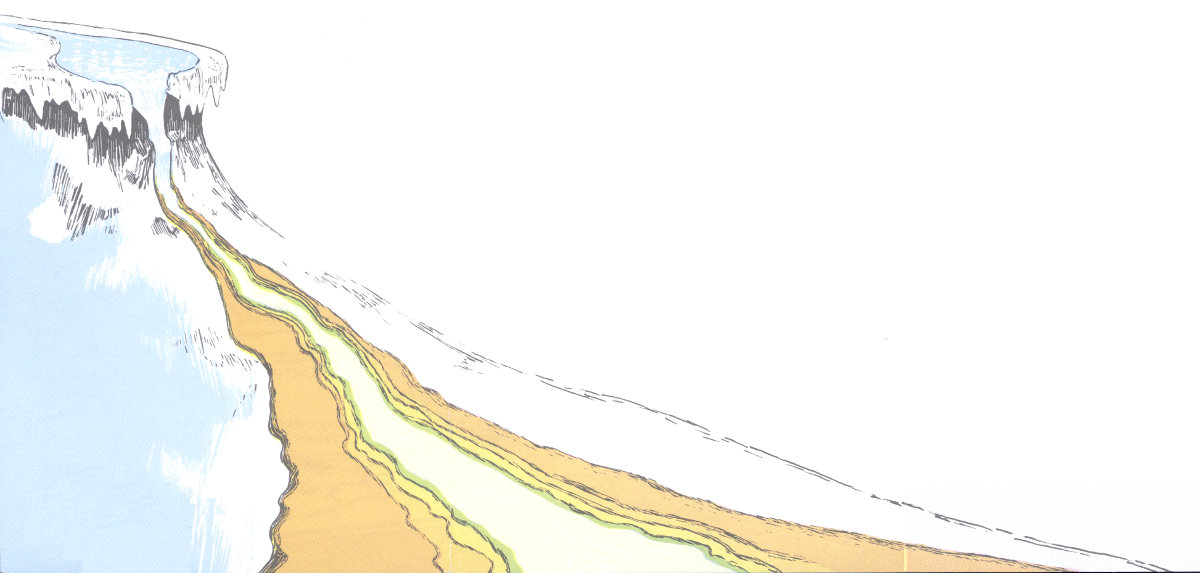
Different temperature zones in the water channels paint ribbons of algal color.
3
As the ground water seeps slowly downward into the limestone it comes in contact with hot gases rising from the magma chamber which are heavily charged with carbon dioxide. Some of the carbon dioxide is readily absorbed to form a carbonic acid solution. Ordinarily water can only slowly dissolve limestone, but the hot, acidic solution rapidly dissolves great quantities of it. Saturated with lime, the carbonated water continues to seep along the rock layers until it gushes forth as the Mammoth Hot Springs.
Once exposed to the open air some of the carbon dioxide escapes from the solution, thus reducing the acidic level. As this happens, the lime, no longer able to remain in solution, is deposited as travertine in the shape and form of a terrace.
Looking at the terraces you can visualize the amount of limestone excavated. Geologists estimate that the Mammoth Hot Springs water carries more than two tons of dissolved limestone to the ground surface each day.
CHANGE ON THE MAMMOTH TERRACE
The Mammoth Terraces are continuously changing. Had you visited the area in the 1930’s, you would have found Blue Spring, Cleopatra, and Angel Terraces to be the feature attractions. Today they stand as gray, lifeless ruins, and newly named springs have succeeded them. Throughout the 1970’s Jupiter and Minerva Springs and parts of Highland Terrace have flowed freely, building delicate and colorful terraces. These clear pools, rimmed by scallops of algae-tinted travertine, have created spectacles known around the world for their beauty. The tiered pools form as a result of the peculiar way in which the carbon dioxide escapes from the cooling water. In tranquil pools evaporation is slow. Where water is agitated the gas escapes quickly. At these points travertine is deposited rapidly. The rim of deposition grows upward to form a higher dam, which further accents the two zones. The travertine rim continues to grow until water pressure bursts the dam. Then the process begins again at a prominent riffle in the new channel.
4
COLOR IN THE HOT SPRINGS
Travertine is deposited as a white mineral, yet whenever hot water glistens on its surface the formation is brilliant with color. The oranges, yellows, greens and browns are from a great number of tiny living bacteria and algae. Approximately sixty-five species of thermal algae live in the waters of Mammoth Hot Springs and reflect varying conditions of such environmental factors as temperature, acidity, sunlight and carbon dioxide concentrations. White and bright yellow thermal bacteria predominate in the hottest section of the runoff channels near the springs. Farther along where the water has cooled a bit, the orange, brown and green algaes are most abundant. Different combinations of temperature and carbon dioxide paint mosaics of algal color across the terraces.
Most of the color comes from the group known as the blue-green algae, which display more colors than their name suggests. These thermal algae are extremely primitive and have probably changed little from those growing in hot springs at the very dawn of life on earth. Amid any Yellowstone thermal basin on a steamy day it is easy to imagine a volcanic region on a primitive earth where hot spring waters bubbled up through colored strands of these same types of algae and bacteria.
5