Biotic Provinces and Ecologic Associations
Reading edition
Because of the elevational extremes and attendant climatic contrasts in the San Gabriel Mountains, there is a rather wide range of environmental conditions. Four life-zones are represented: Lower Sonoran, Upper Sonoran, Transition, and Canadian. Within these zones certain ecologic communities can be recognized; these represent several biotic provinces. Table 1 shows the relationships between the environmental categories recognized by the writer in the San Gabriel Mountains. The biotic province and ecologic community system is that developed by Munz and Keck (1949), and the life-zone system is that of Merriam (1898).
Table 1.—Relations of the Major Environmental Categories of the San Gabriel Mountains.
Biotic province Plant community Life-zone Slope
Californian 1. Coastal sage scrub 2. Southern oak woodland 3. Chaparral Lower Sonoran Upper Sonoran Upper Sonoran Pacific Pacific Pacific
Sierran 4. Yellow pine forest and limited areas of boreal flora Transition Canadian Pacific and Desert
Nevadan 5. Sagebrush scrub Transition Upper Sonoran Desert
Southern Desert 6. Pinyon-juniper woodland 7. Joshua tree woodland Upper Sonoran Lower Sonoran Desert Desert
The Californian Biotic Province dominates the biotic aspect of the coastal slope of the range. Thirty-nine out of the seventy-two mammals recorded from the San Gabriels are typical of this Province. The coastal sage-flats at the Pacific base of the mountains and the vast tracts of chaparral of the coastal slope are included in this Province.
Forming a hiatus between the Pacific and the desert slope is the Sierran Biotic Province consisting of coniferous forests on the crest of the range. The chipmunk (Eutamias speciosus speciosus) and the introduced black bear (Ursus americanus californiensis) are the only two mammals which can be considered typical of this area. On the higher peaks of the range, such as Mount San Antonio and Mount Baden Powell, the Canadian Life-zone is represented by certain boreal plants.
At scattered points along the crest of the range and on the desert slope, the Nevadan Biotic Province is represented by the sagebrush scrub association. No mammals can be considered typical of this region.
The Southern Desert Biotic Province occurs below 6000 feet elevation on the interior slope of the range, and markedly influences the mammal fauna of this slope. Twenty-one species of mammals are typical of this Province.
Scientific and Common Names of Plants Mentioned in This Report
Pinus lambertiana Sugar Pine
P. monophylla One-leaf Pinyon
P. ponderosa Yellow Pine
P. contorta Lodge-pole Pine
Pseudotsuga macrocarpa Big-cone Spruce
Abies concolor White Fir
Libocedrus decurrens Incense-Cedar
Juniperus californica Juniper
Ephedra sp. Desert-Tea
Bromus sp. Brome Grass
Yucca Whipplei Spanish Bayonet
Y. brevifolia Joshua Tree
Salix sp. Willow
Alnus rhombifolia Alder
Castanopsis sempervirens Chinquapin
Quercus Kelloggii California Black Oak
Q. agrifolia California Live Oak
Q. dumosa Scrub Oak
Eriogonum fasciculatum California Buckwheat
Umbellularia californica Bay, California-laurel
Ribes nevadense Gooseberry
R. indecorum Currant
R. Roezlii Currant
Plantanus racemosa Sycamore
Rubus vitifolius Western Blackberry
Cercocarpus ledifolius Mountain Mahogany
C. betuloides Mountain Mahogany
Adenostoma fasciculatum Greasewood
Purshia glandulosa Antelope-brush
Prunus virginiana Choke Cherry
P. ilicifolia Holly-leaved Cherry
Larrea divaricata Creosote Bush
Rhus diversiloba Poisonoak
R. trilobata Squaw Bush
R. laurina Laurel Sumac
R. integrifolia Lemonadeberry
R. ovata Sugarbush
Rhamnus crocea Buckthorn
Ceanothus sp. Lilac
C. cordulatus Snow-brush
Fremontia californica California Slippery-elm
Opuntia occidentalis Prickly-pear
Arctostaphylos sp. Manzanita
Salvia mellifera Black Sage
S. apiana White Sage
Lycium Andersonii Box-thorn
Haplopappus squarosus
Chrysothamnus nauseosus Rabbitbrush
Baccharis sp. Mule Fat
Franseria dumosa Burroweed
Artemisia tridentata Basin Sagebrush
A. californica Coastal Sagebrush
Lepidospartum squamatum Scale-broom
L. latisquamatum Scale-broom
Tetradymia spinosa Cotton-thorn
Coastal Sage Scrub Association
Major Plants
Artemisia californica Salvia apiana Salvia mellifera Eriogonum fasciculatum Rhus integrifolia Opuntia occidentalis Haploppapus squarrosus
This association is restricted to the Pacific base of the range, is typical on the alluvium at the bases of the coastal foothills, and usually grades into the chaparral at about 1800 feet elevation. When seen from above, the rather level terrain of the association is broken sharply at the mouths of canyons by dry washes, and is limited below, to the south, by cultivated land. The coastal sagebrush is the most characteristic plant of this association, occurring in all undisturbed parts of the area.
There are several habitats within the coastal sage scrub association. These differ from one another chiefly on the basis of soil type. The soil of the rather level sageland in most places is rocky or gravelly, or, as adjacent to washes, it is finely sandy in texture, and supports the major plants of the association. Most of the eroded adobe banks at the bases of the foothills support these same plants, with white sage being the dominant species. Locally, as in damp hollows or cleared areas, there is grassland. Jumbles of boulders, sand, gravel, and steep cutbanks, are characteristic of the channels of dry washes, these areas supporting sparse vegetation. The fauna and flora of the washes are distinct from those of surrounding sage flats. Because they are included within the geographic limits of the coastal sage belt, however, the washes are discussed along with this association.
The abruptness with which one habitat gives way to another in this association causes sharp dividing lines between the local ranges of certain mammals. For example, in trap lines transecting dry washes and level sageland two assemblages of rodents were found. That part of the line amid the boulders and cutbanks of the wash took mostly Peromyscus eremicus fraterculus and Neotoma lepida intermedia, while Perognathus fallax fallax, Dipodomys agilis agilis, and Peromyscus maniculatus gambeli were taken in the adjacent sage flats. The steep adobe slopes of the foothills, which constitute the upper part of the coastal sage scrub association, are commonly inhabited by Peromyscus californicus insignis, which rarely occurs in the level tracts of sage a few yards away. Thus, this association is not homogeneous with regard to its rodent population; many of these species have local and discontinuous distributions.
The following list gives the results of about 500 trap nights (a trap night equals one trap set out for one night) in typical coastal sage-scrub association one-half mile southwest of the mouth of San Antonio Canyon, at 1700 feet elevation.
Table 2.—Yield of 500 Trap-nights in the Coastal Sage Scrub Association.
Number Per cent of total
Perognathus fallax fallax 31 30.7
Dipodomys agilis agilis 20 19.8
Reithrodontomys megalotis longicaudus 4 4.0
Peromyscus californicus insignis 4 4.0
P. eremicus fraterculus 7 6.9
P. maniculatus gambeli 20 19.8
Neotoma lepida intermedia 9 8.8
N. fuscipes macrotis 2 2.0
Microtus californicus sanctidiegi 4 4.0
The list below indicates the catch in 200 trap nights in San Antonio Wash, at 1700 feet elevation and within the realm of the coastal sage; all of the traps were set in rocky and sandy main channels of the wash.
Table 3.—Yield of 200 Trap-nights in San Antonio Wash.
Number Per cent of total
Perognathus fallax fallax 2 5.1
Peromyscus californicus insignis 2 5.1
P. eremicus fraterculus 26 66.7
Neotoma lepida intermedia 9 23.1
The prickly-pear cactus is of obvious importance to certain mammals of the coastal sage belt. This cactus is most common in disturbed areas such as sandy flats bordering washes, eroded adobe banks, and land once cleared by man. In these areas it is often the dominant plant with respect to area covered, usually growing in dense patches each covering approximately 150 square feet. It provides substitute nesting sites for Neotoma lepida in areas devoid of rock piles, and is probably the major factor governing the distribution of this wood rat in the sageland. Cottontails and brush rabbits use prickly-pear cactus extensively as refuge. Their forms and short burrows can be seen beneath many of the clumps of cactus.
This cactus serves as food for many mammals at least in the fruiting period in the fall. Usually only the fruit is eaten, but some pads are chewed by rabbits. The fruit or seeds of this plant are eaten by striped skunks, gray foxes, coyotes, pocket mice, kangaroo rats, wood rats, and probably white-footed mice.
The coyote is the dominant carnivore of the coastal sage flats. Many individuals spend the day in the adjacent chaparral-covered foothills and travel down into the flats at night to forage.
Southern Oak Woodland Association
Major Plants
Alnus rhombifolia Quercus agrifolia Ribes indecorum Rhus integrifolia Rhus ovata Rhus trilobata
This association is limited to the Pacific slope of the mountain range, occurs in the mouths of canyons and on the floors of canyons, and extends up the larger canyons to 4000 feet elevation or higher. In a few areas on the flats at the coastal base of the range the oaks replace the coastal sage.
The large oaks forming an overhead canopy and the lack of much undergrowth give the oak woodland a shaded parklike appearance. Few brushy or herbaceous plants grow in the mull-laden soil beneath the oaks. Some grasses, however, are present locally.
Two habitats are found in the oak woodland: the pure oak woodland and the riparian. Much of the oak woodland is in canyons and therefore near streams or seepages. The larger streams have bordering growths of alders, willows, and blackberries, inhabited by meadow mice and shrews that are normally absent from the adjacent oak woodland. Neotoma fuscipes macrotis and Peromyscus californicus insignis are commonly found in the riparian habitat, and Peromyscus boylii probably reaches peak abundance in the stream-side thickets and tangles of plant debris.
The rather open floor of the oak woodland is relatively devoid of mammal life. Peromyscus californicus and Peromyscus boylii, the only ground-dwelling rodents commonly found here, usually are taken near the limited areas of brushy growth, or the shelter afforded by logs and fallen branches. The paucity of shelter for small mammals seems to be an important factor limiting rodent populations in the oak woodland.
In the foothills of the San Gabriels the gray squirrel is restricted to the oak woodland, even though this association may be represented by only a narrow strip of canyon bottom oak trees. The presence or absence of "bridges" of oak woodland between mountains which are centers of gray squirrel populations and nearby ranges has probably been a major factor influencing the present geographic distribution of this animal.
The raccoon is the most abundant carnivore of the oak woodland, being especially common in the riparian habitat.
Chaparral Association
Major Plants
Adenostoma fasciculatum Rhamnus crocea Quercus dumosa Cercocarpus betuloides Yucca Whipplei Prunus ilicifolia Ceanothus sp. Arctostaphylos sp. Umbellularia californica
This association is characteristic of the Pacific slope of the San Gabriels and extends from roughly 2000 feet elevation to 5000 or 6000 feet elevation. The ecotone between the chaparral and yellow pine forest associations covers a broad elevational belt, with chaparral following dry slopes up into coniferous forests, and conifers extending down north slopes surrounded by chaparral.
The chaparral association is characterized by tracts of dense brushy plants. These plants are from three to ten feet tall, their interlacing branches often forming nearly impenetrable thickets. Typically little herbaceous growth is present beneath the chaparral, the ground being covered with varying amounts of mull.
The effects of fire, slope, exposure, and elevation, make the chaparral association extremely varied with regard to habitats or plant formations. There are nearly pure stands of greasewood on the lower arid slopes; scrub oak, sumac, and lilac clothe less dry exposures; scrub oak and bay trees occur commonly amid granite talus; and locally groves of bigcone-spruce are found. Because of the many habitats present, and the difficulty of collecting in the chaparral, less was learned of the ecology of the mammals in this association than of those occurring elsewhere. The distribution of several chaparral-inhabiting mammals seems to be influenced by the distribution of locally characteristic plants, for example oak and bay woodland, or greasewood chaparral.
Several habitats within the chaparral community support few species of mammals and few individuals. Possibly the compact, rocky nature of the soil limits burrowing rodents, and the lack of herbaceous growth limits the food supply. Steep rocky slopes in San Antonio Canyon grown to mountain-mahogany and scrub oak were sparsely populated by Peromyscus boylii rowleyi, Peromyscus californicus insignis, and Neotoma fuscipes macrotis. Fifty traps set on such a slope for one night caught only three Peromyscus. Traps set in tracts of greasewood brush on dry south slopes at the head of Cow Canyon produced only California mice, Peromyscus californicus insignis Rhoads.
Following is a list of the mammals taken in the course of approximately 600 trap nights in the lower parts of the chaparral belt. All of the traps were set on slopes in San Antonio Canyon below 4000 feet elevation. The list gives a general indication of the relative numbers of rodents inhabiting one chaparral habitat: the arid greasewood-covered south slopes of the lower chaparral belt.
Table 4.—Yield of 600 Trap-nights in Greasewood Chaparral.
Number Per cent of total
Perognathus californicus dispar 4 10.0
Dipodomys agilis agilis 4 10.0
Peromyscus californicus insignis 25 62.5
Neotoma fuscipes macrotis 7 17.5
Heteromyids are evidently absent from the upper parts of the chaparral association, but cricetid rodents are common there beneath heavy clumps of lilac and in the talus beneath oaks and bay trees. The following list gives the mammals taken in the course of about 200 trap nights in the granite talus one half mile northwest of the mouth of Icehouse Canyon, at 5200 feet elevation.
Table 5.—Yield of 200 Trap-nights in the Upper Part of the Chaparral Association.
Number Per cent of total
Eutamias merriami merriami 3 6.3
Peromyscus boylii rowleyi 38 79.2
Neotoma lepida intermedia 2 4.2
Neotoma fuscipes macrotis 5 10.4
The gray fox is the dominant carnivore of the chaparral association and forages widely in all habitats.
Yellow Pine Forest Association
Major Plants
Pinus ponderosa P. lambertiana Libocedrus decurrens Abies concolor Quercus Kelloggii Ribes nevadense Ribes Roezlii Arctostaphylos sp. Ceanothus cordulatus
The crest of the range, from the upper limit of the chaparral association at roughly 6000 feet to the limited areas of boreal flora above 8500 feet elevation, is covered by yellow pine forests. On the desert slope of the range the coniferous forests which extend down to about 6000 feet represent the best development of this association, while the coniferous forests on the coastal side of the drainage divide are often more or less diluted by chaparral elements. For example, yellow pines on the Pacific face of Blue Ridge at 7000 feet elevation often grow in association with scrub oak and mountain-mahogany.
Few mammals are resident in the typical yellow pine forest as characterized by dense coniferous timber and little herbaceous or brushy growth. Here most of the species recorded actually find optimal conditions in an adjacent habitat. The forest probably harbors surplus individuals from adjacent preferred habitats, or, as in the case of chipmunks and ground squirrels, the forest often serves as forage ground while nearby brushy areas are utilized for breeding and shelter. The abundance of birds in the timber contrasts strikingly with the paucity of mammals there. The lack of a seed-producing understory, and the open duff-covered stretches of ground on which rodents would be extremely vulnerable to predation, probably in part account for the scarcity of rodents.
Within the general area encompassed by the yellow pine forest there are two major habitats, namely coniferous forest and chaparral. The species of plants comprising the chaparral of the Transition Life-zone are different from those comprising the chaparral of the Upper Sonoran Life-zone on the Pacific slope. In the chaparral of the Transition Life-zone, basin sagebrush and snowbrush grow in extensive patches in clearings in the timber. Dense thickets of choke cherry cover many damp hollows, and these thickets harbor the houses of Neotoma fuscipes. The food and shelter afforded by these chaparral areas importantly influence the local distribution of rodents: for example, Dipodomys agilis and Perognathus californicus in the yellow pine area are found only in association with chaparral, being completely absent from wooded areas.
The severe winter weather in this association must force many of the mammals into periods of inactivity. Probably during the long periods in the winter when snow covers the ground the heteromyids and sciurids remain below ground.
Pinyon-Juniper Woodland Association
Major Plants
Pinus monophylla Juniperus californica Quercus dumosa var. turbinella Purshia glandulosa Fremontia californica Cercocarpus ledifolius Yucca Whipplei
In the San Gabriel Mountains this association is limited to the desert slope and reaches its lower limit at the bases of the foothills and extends up to the lower edge of the yellow pine forests. The altitudinal extent of the pinyon-juniper association is from roughly 4000 to 6000 feet elevation.
Several habitats are evident within the pinyon-juniper belt. On north slopes in the upper part of this association, scattered stands of pinyon pines are found with dense patches of scrub oak intervening, while on other such slopes a dense chaparral is present, consisting primarily of scrub oak, mountain-mahogany, and California slippery-elm. In this type of chaparral several hundred trap nights yielded only two rodent species: Neotoma fuscipes simplex and Peromyscus truei montipinoris. There are few pinyons on the south slopes, especially in the lower parts of the association; many of these slopes are clothed with an open growth of manzanita and yucca, while northern exposures there support mostly scrub oak. Many of the flats of the pinyon belt are grown to basin sagebrush.
Following is a list of the mammals taken in about 400 trap nights at one locality in the pinyon-juniper association. The area supported a mixed growth of pinyon, scrub oak, mountain-mahogany, and antelope-brush, together with smaller brushy plants, and was at the head of Grandview Canyon, at an altitude of roughly 5000 feet.
Table 6.—Yield of 400 Trap-nights in the Pinyon-juniper Association.
Number Per cent of total
Perognathus fallax pallidus 3 11.5
Dipodomys agilis fuscus 9 34.6
Peromyscus truei montipinoris 10 38.5
Neotoma fuscipes simplex 4 15.4
Although Munz and Keck (1949:101) considered the pinyon-juniper belt as one association, on the desert slope of the San Gabriels pinyons and junipers do not generally grow on common ground; but rather the juniper belt represents a well defined habitat occurring between the pinyon covered slopes and the flats that support Joshua trees. Because the mammalian populations of the pinyon belt and the juniper belt are somewhat different, the mammals of these areas are most conveniently taken up separately.
In the juniper belt the juniper tree is of marked ecologic significance; the distribution of Peromyscus truei and Neotoma fuscipes is determined here by the presence of junipers. At certain times of year the fruit of this plant is eaten by coyotes, kangaroo rats, and wood rats.
The list below indicates the results of approximately 500 trap nights in the juniper belt near Mescal Canyon, between 4000 and 5000 feet elevation.
Table 7.—Yield of 500 Trap-nights in the Juniper Belt.
Number Per cent of total
Perognathus fallax pallidus 16 16.7
Dipodomys merriami merriami 3 3.1
Dipodomys panamintinus mohavensis 36 37.5
Peromyscus truei montipinoris 22 22.9
Peromyscus maniculatus sonoriensis 12 12.5
Neotoma lepida lepida 2 2.1
Neotoma fuscipes simplex 2 2.1
Onychomys torridus pulcher 3 3.1
The biota of the washes that cut through the juniper belt in and below many of the larger canyons differs from that of the surrounding juniper-clad benches. Because the washes are in the same geographic area as the juniper belt they are discussed together. These washes on desert slopes are densely populated by rodents derived from adjacent areas, and support vegetation typical of higher floral belts in association with xerophytic, typically desert, species. In a sense, the washes serve to mix up the mammals of adjacent areas. For example, Onychomys torridus pulcher and Peromyscus eremicus eremicus, which are mammals typical of the desert, were found in Mescal Wash above their usual desert range; and Peromyscus californicus insignis and Peromyscus boylii rowleyi, which are chaparral inhabiting mammals, were found in the wash far removed from their chaparral environment. Washes are evidently effective agents in facilitating the dispersal of certain species of mammals. It is easy to envision a species crossing hostile habitats via dry washes to invade suitable niches in an area which is geographically and ecologically isolated from the original home of the species. Approximately 500 trap nights in Mescal Wash, at 4100 feet elevation, in the lower edge of the juniper belt, yielded the following mammals:
Table 8.—Yield of 500 Trap-nights in Mescal Wash (Desert Slope).
Number Per cent of total
Perognathus fallax pallidus 5 4.5
Dipodomys panamintinus mohavensis 43 38.7
Peromyscus californicus insignis 3 2.7
Peromyscus truei montipinoris 1 .9
Peromyscus boylii rowleyi 2 1.8
Peromyscus eremicus eremicus 28 25.0
Peromyscus maniculatus sonoriensis 23 20.5
Onychomys torridus pulcher 4 3.5
Neotoma lepida lepida 3 2.7
Dipodomys panamintinus mohavensis, Neotoma fuscipes simplex, and Peromyscus truei montipinoris are probably the most characteristic mammals of the pinyon-juniper association.
Sagebrush Scrub Association
Major Plants
Bromus sp. Artemisia tridentata Chrysothamnus nauseosus Purshia glandulosa
This association is found on only the crest and desert slope of the range between 5000 and 8000 feet elevation. There it characteristically occupies flats and clearings in the yellow pine forest and pinyon-juniper woodland. The dominant plant of the association is basin sagebrush, and in many places this plant forms mixed growths with snowbrush and Haplopappus. The low brush of this association is formed by closely spaced bushes with grasses growing between.
Because of its limited occurrence in the San Gabriel Mountains, this association there has relatively little effect on mammalian distribution. Locally, nevertheless, the presence of this association governs the distribution of certain mammals. For example, on Blue Ridge, islands of sagebrush amid the conifers provide suitable habitat for Dipodomys agilis perplexus and Perognathus californicus bernardinus; and in Swarthout Valley D. a. perplexus, Reithrodontomys megalotis longicaudus, and Lepus californicus deserticola are seemingly restricted to the sagebrush flats.
Joshua Tree Woodland Association
Major Plants
Yucca brevifolia Lycium Andersonii Eriogonum fasciculatum Tetradymia spinosa Ephedra sp. Larrea divaricata
This association is on the piedmont that dips toward the Mojave Desert from the interior base of the San Gabriels. The widely spaced Joshua trees with low bushes between, and the dry washes breaking the level terrain below the mouths of canyons are typical of this area. Field work was extended no farther down into the desert than about the 3500 foot level, where this association was still dominant.
Although the vegetation of this area is scattered and sparse, presenting a barren and sterile aspect, the area supports a rather high population of rodents. The soil at the bases of many large box-thorn- and creosote-bushes is perforated by burrow systems of Dipodomys panamintinus or Dipodomys merriami, and those burrows abandoned by kangaroo rats are used as retreats by Onychomys torridus and Peromyscus maniculatus. The mammals of this association are all characteristic of the fauna of the Mojave Desert, with the ranges of such species as the coyote and jack rabbit extending well up the desert slope of the mountains.
The mammals listed below were taken in 1948 in roughly 400 trap nights in the Joshua belt, at an elevation of 3500 feet, one mile below the mouth of Graham Canyon.
Table 9.—Yield of 400 Trap-nights in the Joshua Tree Belt.
Number Per cent of total
Dipodomys panamintinus mohavensis 36 59.0
Dipodomys merriami merriami 15 24.6
Onychomys torridus pulcher 4 6.6
Peromyscus maniculatus gambeli 6 9.8
Populations of Dipodomys merriami and D. panamintinus fluctuate widely, possibly in response to weather cycles. In November of 1948 trapping in the Joshua belt showed that panamintinus outnumbered merriami approximately three to one, whereas in December of 1951, after a succession of unusually dry years, merriami was the more numerous. Further, merriami occurred in the lower parts of the juniper belt in 1951 where in 1948 it seemed to be absent.
Dipodomys merriami merriami and Onychomys torridus pulcher are diagnostic of the Joshua tree woodland association in the San Gabriel Mountains area, since few individuals of either species occur outside of this association.
PLATE 1
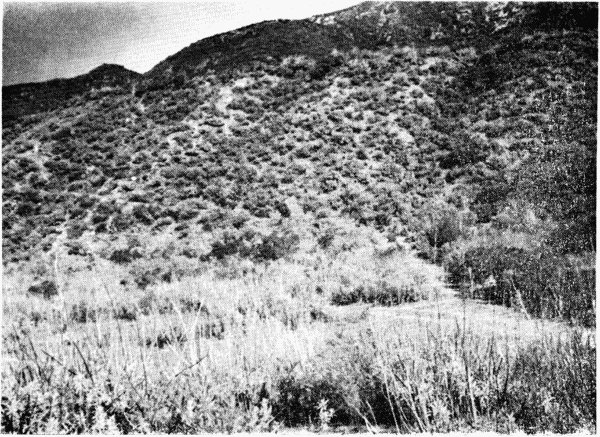
Fig. 1. View of typical coastal sage scrub association, showing in foreground white sage, and coastal sagebrush. The adobe banks beyond are grown mainly to white sage. Small mammals are abundant in this association, with Dipodomys agilis, Perognathus fallax, and Sylvilagus audubonii being characteristic of the area. Photo March 25, 1952, at mouth of San Antonio Canyon, 1800 feet elevation.
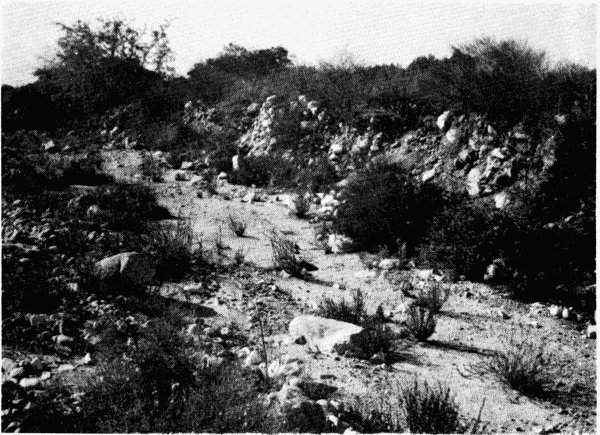
Fig. 2. View of a main channel in San Antonio Wash on Pacific slope. The wash is a distinct habitat in the coastal sage scrub association, and is the preferred habitat of Peromyscus eremicus fraterculus and Neotoma lepida intermedia. These rodents find shelter in the piles of boulders. Photo February 2, 1952, in San Antonio Wash, at 1700 feet elevation.
PLATE 2
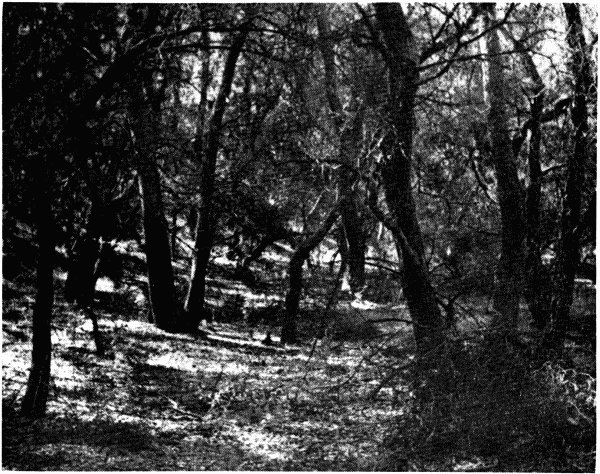
Fig. 1. Southern oak woodland association. The open leaf-strewn floor of the woodland lacks shelter for ground-dwelling rodents and the population of rodents is small. Peromyscus boylii rowleyi is the commonest rodent. Photo March 10, 1952, in Evey Canyon, 2700 feet elevation.
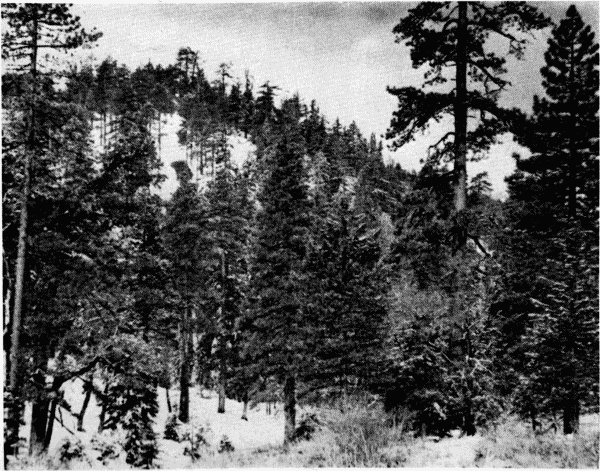
Fig. 2. Yellow pine forest association, composed largely of yellow pines, white fir, and black oak. Photo April 27, 1952, at Big Pines, 6800 ft. elevation.
PLATE 3
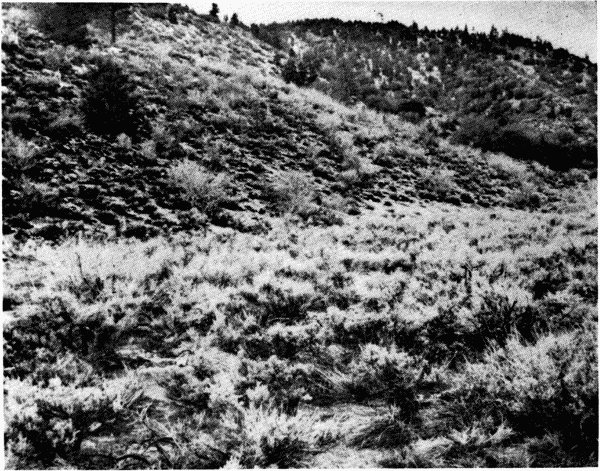
Fig. 1. View of the sagebrush scrub association showing a nearly pure stand of basin sagebrush. Dipodomys agilis perplexus and Reithrodontomys megalotis longicaudus occur in this association, and Peromyscus truei montipinoris is present where this association merges with the pinyon-juniper association. Photo April 27, 1952, in Swarthout Valley, 6200 feet elevation.
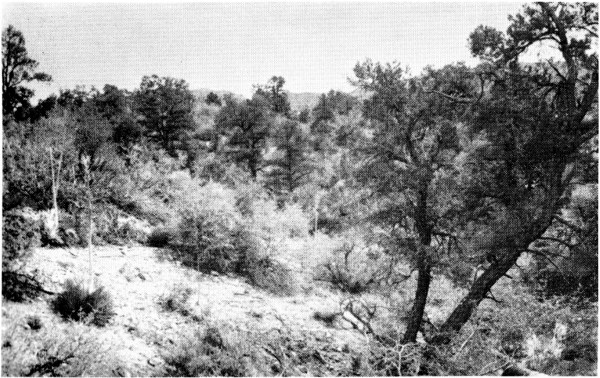
Fig. 2. View of a pinyon pine woodland. This habitat constitutes the upper part of the pinyon-juniper association, and is the habitat of Neotoma fuscipes simplex, Peromyscus truei montipinoris, and Eutamias merriami merriami. Photo April 27, 1952, in Sheep Creek Canyon, 5500 feet elevation.
PLATE 4
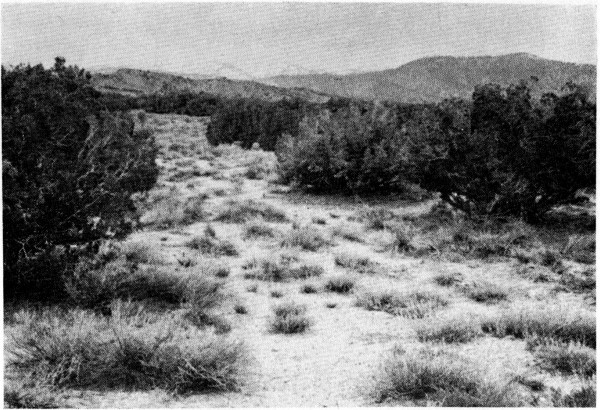
Fig. 1. View of the juniper belt. This habitat forms the lower part of the pinyon-juniper association. Perognathus fallax pallidus, Dipodomys panamintinus mohavensis, and Peromyscus truei montipinoris are typical of this area. Photo April 27, 1952, at Desert Springs, 4300 feet elevation.
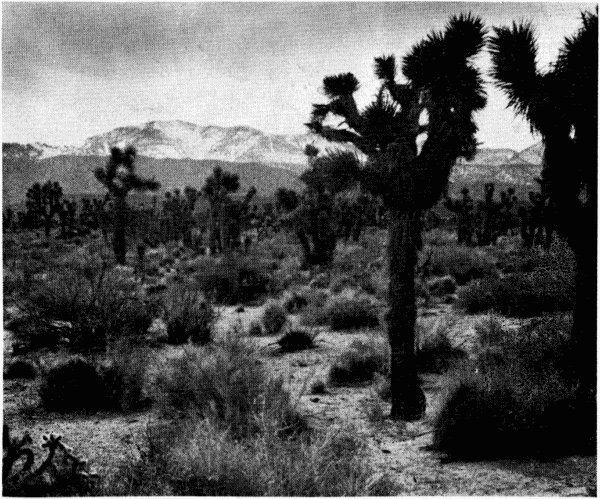
Fig. 2. Joshua tree woodland association. The characteristic mammals are Dipodomys panamintinus mohavensis, D. merriami merriami, and Onychomys torridus pulcher. Photo January 4, 1952, 6 miles east and 2 miles south Llano, 3600 feet elevation.