ORGANIZATION OF THE OHIO LAND COMPANY.
Reading edition
Far away upon the Atlantic sea board forces were at work a score of years anterior to 1788 which were not only to form the first settlement but to plant New England morals, law and institutions upon this vast inland domain of the nation. Ideas were in inception which, as the prime impetus in a long chain of causes and effects, were to swell the tremendous result and effect the destiny not alone of the west but of the Republic from sea to sea.
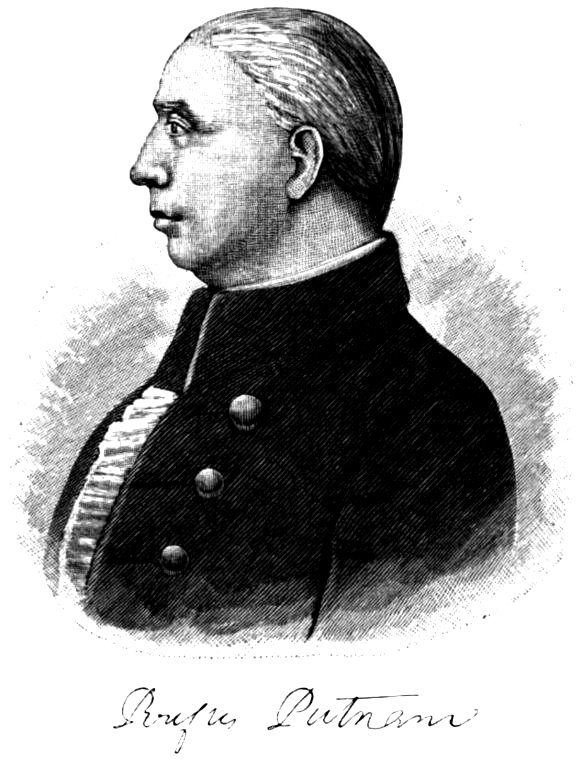
It is a pleasant thought that in the British war against the French, General Putnam (at the time of his enlistment in 1757, nineteen years of 33age) and many others assisted in wresting from the enemy and securing to their sovereign the very territory which was to become their home; and it is a disagreeable fact that they had finally so dearly to purchase a small portion of the domain which they had twice bought by bravery of arms. The men who fought to win for England the territory which the French disputed, in 1755–1760, were foremost to win it from her twenty years later, and thus twice exhibited the hardihood and heroism of their natures.
Something of the spirit of emigration manifested itself in New England after the conclusion of the French and Indian war, and in fact was an outgrowth of that struggle. An organization of ex-soldiers of the colonies was formed, called “The Military Company of Adventurers,” whose purpose it was to establish a colony in West Florida (now Mississippi). Although the project had been entered upon soon after the establishment of peace, it was not until the year 1772 that anything was accomplished. General Lyman, after several years’ endeavor, succeeded in procuring a tract of land. It was decided to explore the tract, and a company of surveyors, of which the celebrated Israel Putnam was the leader, went out in January, 1773, for that purpose. Rufus Putnam was a member of the party. The examination was satisfactory, and several hundred families embarked from Massachusetts and Connecticut to make a settlement. They found to their chagrin that the king’s grant had been revoked, and the settlement was therefore abandoned. Those who did not fall sick and die returned to their homes. Such was the disastrous end of this project of settlement, which, had it succeeded, might possibly have changed the whole political history of the United States. It seems at least to be within the realm of probability that had a settlement been planted in Mississippi, Massachusetts would not have made the initial settlement in the Ohio country and extended her influence over the territory from which five great States have been created. The enterprise of founding a colony in the far south, thwarted as it was, undoubtedly had its effect upon the New England mind, and was one of the elements which prepared the way for the inauguration of a new scheme of emigration in later years. The dream which had been fondly indulged in for a long term of years, was not to be forgotten even when the opportunity or its realization had passed away.
Soon, however, there arose a subject for thought which overshadowed all others. What men of shrewd foresight had long expected had come to pass. The colonies were arrayed against the mother country 34in a battle for independence. We shall not here attempt to follow Generals Putnam, Parsons, Varnum and Tupper, Major Winthrop Sargent, Colonel Ebenezer Sproat, and the many other brave soldiers who became Ohio Company emigrants through the perils of those seven dark years of the Revolution. But is it not natural to suppose that some of them who had been interested in the old colonization project talked of it around their camp fires? Is it not possible that the review of the past suggested the possibility of forming in the future another military colony, in which they should realize the bright hopes that had once been blasted? It seems natural that, in the long lulls between the periods of fierce activity, this topic should have come up frequently in conversation, or at least that it should have appeared as a vague but alluring element in many pictures of the future painted by hopeful imaginations. It is very likely that General Putnam had indulged the hope of emigration “to some remote land rich in possibilities” for many years before he led the little New England colony to the Muskingum. He had very likely cherished the hope unceasingly from the time when the military company of adventurers was organized, and doubtless the journey to that far away, strange and beautiful Mississippi had served as a stimulus to quicken his desire for the realization of a project which would employ so much of his energy and enterprise, and afford so fine an opportunity for the achievement of a life success. We know that Washington, during the darkest days of the Revolution, directed the attention of his companions at arms to the west, as a land in which they might take refuge should they be worsted in the struggle, but happily it was not to be that contingency which should cause the movement of emigration toward the Ohio. If, during the war, the western country was the subject of an occasional estray, light thought, the time was to come when it should be uppermost in the minds of many of the soldiers and practically considered, not as a land in which they must seek to take refuge from a victorious foe, but as one in which they might retrieve the losses they had sustained in repelling the enemy. It must be borne in mind that the independence of the American colonies was dearly bought, as indeed has been all the great good attained in the history of the world. The very men by whose long continued, self-sacrificing devotion and bravery the struggle against the tyrannical mother country had been won, found themselves, at the close of the war, reduced to the most straitened circumstances, and the young nation ushered into being by their heroism was unable to alleviate their condition. These 35were the times which tried men’s souls. Nowhere was the strain any more severe than in Massachusetts and Connecticut. The joy which peace brought after seven years of war was in most localities too deep to be voiced by noisy demonstration, and it was not unmingled with forebodings of the future. “The rejoicings,” says a local historian,[3] “were mostly expressed in religious solemnities.” There were still difficult problems to be solved—and there was the memory of husbands, fathers, sons, brothers, and lovers who would not return with the victorious patriots, and it may in many cases have been difficult “to discern the noise of the shout of joy from the noise of the weeping of the people.”
General Benjamin Tupper, in the early autumn of 1785, had gone to the Ohio country to engage in surveying under the ordinance passed by Congress May 20 of that year, but owing to the hostility of the Indians and consequent hazard of entering upon the work, he returned to New England. General Tupper was one of the men who had been most intently engaged in planning western settlements, and was undoubtedly a co-worker with his intimate old friend, General Putnam, advocating and agitating the scheme which had proved unsuccessful. He returned from the west filled with admiration of that portion of the country which he had seen, and made enthusiastic through the descriptions given by traders of the region farther down la belle riviere than he had journeyed. Doubtless he pondered upon the idea of removing to the west, during the whole time spent there, and was chiefly occupied with the subject while making the tedious return to his home. Early in January he visited, at his house in Rutland, Worcester County, Massachusetts, General Putnam, and there these two men, who may be properly called the founders of the Ohio Company, earnestly talked of their experiences and their hopes in front of the great fire, while the night hours fast passed away. In the language of one whom it is fair to suppose had preserved the truthful tradition of that meeting: “A night of friendly offices and conference between them gave, at the dawn, a development—how important in its results!—to the cherished hope and purpose of the visit of General Tupper.”[4] As the result of that long conversation by a New England fireside, appeared the first mention in the public prints of the Ohio Company. The two men had thought so deeply and carefully upon the absorbing theme of colonization, were so thoroughly impressed with the feasibility 36of their plans as they had unfolded them, so impatient to put them to that test, that they felt impelled to take an immediate and definite step. They could no longer rest inactive. They joined in a brief address, setting forth their views to ascertain the opinion of the people. It appeared in the newspapers on the twenty-fifth of January, and read as follows:
INFORMATION.
The subscribers take this method to inform all officers and soldiers who have served in the late war, and who are by a late ordinance of the honorable Congress to receive certain tracts of land in the Ohio country, and also all other good citizens who wish to become adventurers in that delightful region, that from personal inspection, together with other incontestible evidences, they are fully satisfied that the lands in that quarter are of a much better quality than any other known to the New England people; that the climate, seasons, products, etc., are in fact equal to the most flattering accounts that have ever been published of them; that being determined to become purchasers and to prosecute a settlement in that country, and desirous of forming a general association with those who entertain the same ideas, they beg leave to propose the following plan, viz.: That an association by the name of The Ohio Company be formed of all such as wish to become purchasers, etc., in that country, who reside in the commonwealth of Massachusetts only, or to extend to the inhabitants of other States as shall be agreed on.
That in order to bring such a company into existence the subscribers propose that all persons who wish to promote the scheme, should meet within their respective counties, (except in two instances hereinafter mentioned) at 10 o’clock A. M. on Wednesday, the fifteenth day of February next, and that each county or meeting there assembled choose a delegate or delegates to meet at the Bunch of Grapes Tavern in Boston, on Wednesday, the first day of March next, at 10 o’clock A. M., then and there to consider and determine upon a general plan of association for said company; which plan, covenant, or agreement, being published, any person (under condition therein to be provided) may, by subscribing his name, become a member of the company.
Then follow the places of meeting:
At Captain Webb’s, in Salem, Middlesex; at Bradish’s, in Cambridge, Hampshire; at Pomeroy’s, in North Hampton, Plymouth; at Bartlett’s, in Plymouth, Barnstable, Dukes and Nantucket Counties; at Howland’s, in Barnstable, Bristol; at Crocker’s, in Taunton, York; at Woodbridge’s, in York, Worcester; at Patch’s, in Worcester, Cumberland and Lincoln; at Shothick’s, in Falmouth, Berkshire; at Dibble’s, in Lenox.
Rufus Putnam,
Benjamin Tupper.
Rutland, January 10, 1786.
The plan suggested by Generals Putnam and Tupper was carried out, and upon the first day of March the delegates from the several counties assembled at the Bunch of Grapes Tavern, the designated place in Boston (which was then a considerably smaller city than is now the capital of Ohio), and there discussed, in conventional form, the proposed organization of the Ohio Company. The delegates present at that historical meeting were: Manasseh Cutler, of Essex; Winthrop Sargent and John Mills, of Suffolk; John Brooks and Thomas Cushing, of Middlesex; Benjamin Tupper, of Hampshire; Crocker Sampson, of Plymouth; Rufus Putnam, of Worcester; Jelaliel Woodbridge and John Patterson of Berkshire; Abraham Williams of Barnstable.
37General Putnam was made chairman of the convention, and Major Winthrop Sargent, secretary. Before adjournment a committee of five was appointed to draft a plan of an association, as “from the very pleasing description of the western country, given by Generals Putnam and Tupper and others, it appears expedient to form a settlement there.” That committee consisted of General Putnam, Dr. Manasseh Cutler, Colonel Brooks, Major Sargent, and Captain Cushing.
On Friday, March 3, the convention reassembled and the committee reported the following:
Articles of agreement entered into by the subscribers for constituting an association by the name of the Ohio Company.
PREAMBLE.
The design of this association is to raise a fund in Continental certificates, for the sole purpose and to be appropriated to the entire use of purchasing lands in the western territory belonging to the United States, for the benefit of the company, and to promote a settlement in that country.
Article 1st.—That the fund shall not exceed one million of dollars in Continental specie certificates, exclusive of one year’s interest due thereon (except as hereafter provided), and that each share or subscription shall consist of one thousand dollars, as aforesaid, and also ten dollars in gold or silver, to be paid into the hands of such agents as the subscribers may elect.
Article 2nd.—That the whole fund of certificates raised by this association, except one year’s interest due thereon, mentioned under the first article, shall be applied to the purchase of lands in some one of the proposed States northwesterly of the river Ohio, as soon as those lands are surveyed and exposed for sale by the Commissioners of Congress, according to the ordinance of that honorable body, passed the twentieth of May, 1785, or on any other plan that may be adopted by Congress, not less advantageous to the company. The one year’s interest shall be applied to the purpose of making a settlement in the country and assisting those who may be otherwise unable to remove themselves thither. The gold and silver is for defraying the expenses of those persons employed as agents in purchasing the lands and other contingent charges that may arise in the prosecution of the business. The surplus, if any, to be appropriated as one year’s interest on the certificates.
Article 3rd.—That there shall be five directors, a treasurer and secretary, appointed in manner and for the purposes hereafter provided.
Article 4th.—That the prosecution of the company’s designs may be the least expensive, and at the same time the subscribers and agents as secure as possible, the proprietors of twenty shares shall constitute one grand division of the company, appoint the agent, and in case of vacancy by death, resignation or otherwise, shall fill it up as immediately as can be.
Article 5th.—That the agent shall make himself accountable to each subscriber for certificates and invoices received, by duplicate receipts, one of which shall be lodged with the secretary; that the whole shall be appropriated according to articles of association, and that the subscriber shall receive his just dividend according to quality and quantity of lands purchased, as near as possibly may be, by lot drawn in person or through proxy, and that deeds of conveyance shall be executed to individual subscribers, by the agent, similar to those he shall receive from the directors.
Article 6th.—That no person shall be permitted to hold more than five shares in the company’s funds, and no subscription for less than a full share will be admitted; but this is not meant to prevent those who cannot or choose not to adventure a full share, from associating among themselves, and by one of their number subscribing the sum required.
Article 7th.—That the directors shall have the sole disposal of the company’s fund for the purposes before mentioned; that they shall by themselves, or such person or persons as they may think proper to entrust with the business, purchase lands for the benefit of the company, where and in such way, either 38at public or private sale, as they shall judge will be the most advantageous to the company. They shall also direct the application of the one year’s interest, and gold and silver, mentioned in the first article, to the purposes mentioned under the second article, in such way and manner as they shall think proper. For these purposes the directors shall draw on the treasurer from time to time, making themselves accountable for the application of the moneys agreeably to this association.
Article 8th.—That the agents, being accountable to the subscribers for their respective divisions, shall appoint the directors, treasurer and secretary, and fill up all the vacancies which may happen in these offices respectively.
Article 9th.—That the agents shall pay all the certificates and moneys received from subscribers into the hands of the treasurer, who shall give bonds to the agents, jointly and severally, for the faithful discharge of his trust; and also, on his receiving certificates or moneys from any particular agent, shal make himself accountable therefor, according to the condition of his bonds.
Article 10th.—That the directors shall give bonds, jointly and severally, to each of the agents, conditioned that the certificates and moneys they shall draw out of the treasury shall be applied to the purposes stipulated in these articles; and that the lands purchased by the company shall be divided among them within three months from the completion of the purchase, by lot, in such manner as the agents or a majority of them shall agree, and that on such division being made, the directors shall execute deeds to the agents, respectively, for the proportions which fall to their divisions, correspondent to those the directors may receive from the Commissioners of Congress.
Article 11th.—Provided, that whereas a sufficient number of subscribers may not appear to raise the fund to the sums proposed in the first article, and thereby the number of divisions may not be completed, it is therefore agreed that the agents of divisions of twenty shares each shall, after the seventeenth day of October next, proceed in the same manner as if the whole fund had been raised.
Article 12th.—Provided, also, that whereas it will be for the common interest of the company to obtain an ordinance of incorporation from the honorable Congress, or an act of incorporation from some one of the States in the Union (for which the directors shall make application), it is therefore agreed that in case such incorporation is obtained, the fund of the company (and consequently the shares and divisions thereof) may be extended to any sum, for which provision shall be made in said ordinance or act of incorporation, anything in this association to the contrary notwithstanding.
Article 13th.—That all notes under this association may be given in person or by proxy, and in numbers justly proportionate to the stockholder or interest represented.
These articles of agreement were unanimously adopted and subscription books were immediately opened. A committee was appointed, consisting of three members, to transact necessary business, and some other measures taken to advance the project of the association; but in spite of all the exertions made, there was but little progress in the affairs of the Ohio Company. When the next meeting was held—a little more than a year from the time of the first, that is, upon March 8, 1787—it was found that the total number of shares subscribed for was only two hundred and fifty. And yet, all untoward circumstances considered, that was probably a fair exhibit, and more than was expected. One active friend of the movement, General Tupper, was the greater part of the year in the west. The influence of the others was very largely counteracted by events of an alarming nature—the dissatisfaction which finally culminated in Shay’s rebellion. That civil commotion growing out of the imposition of heavy taxes upon the already impoverished people threatened for a time exceedingly 39dire results, but fortunately it was speedily quelled. It served as a startling illustration, however, of the great depression in New England, and of the desperation to which men can be driven by ill condition. Possibly the outbreak gave a slight impetus to the progress of the Ohio Company’s project, by way of increasing the disposition of some citizens to seek in the west a new home. General Tupper, whose immediate neighborhood was “deeply infected with the sedition,” returned from his second visit to the Ohio country in time to take a prominent part in subduing the revolt. The dawn of 1787 witnessed the pacification of the troubled country, but no marked increase in prosperity.
It was reported at the meeting held on the eighth of March at Brackett’s tavern in Boston, that “many in the commonwealth of Massachusetts, also in Connecticut, Rhode Island and New Hampshire, are inclined to become adventurers, who are restrained only by the uncertainty of obtaining a sufficient tract of country, collectively, for a good settlement.”
It was now decided to make direct and immediate application to Congress for the purchase of lands, and General Putnam, Dr. Manasseh Cutler and General Samuel H. Parsons were appointed directors and especially charged with this business. General Parsons had previously been employed to negotiate for a private purchase, had petitioned Congress, and a committee of that body had been appointed to confer with him. “To that committee,” says Dr. Cutler, “he proposed a purchase on the Scioto River,” but as the proprietors in Massachusetts “were generally dissatisfied with the situation and lands on the Scioto, and much preferred the Muskingum,” the negotiation was suspended. The directors now employed Dr. Cutler to make a purchase upon the Muskingum. It was considered desirable that the negotiations be commenced and the purchase consummated as soon as possible, as other companies were forming, the spirit of private speculation rapidly increasing, and there was a fear that the lands which the Ohio Company wished to possess would be bought by some other organization, or perhaps some part of them by individuals.
Just here the query arises: why were the New Englanders so anxious to purchase lands upon the Muskingum, rather than upon the Scioto, or elsewhere in the territory? To this question there are various answers. In the first place the greater part of the Federal territory was unfitted for settlement by the fact that it was occupied by the Indian tribes. None of these, however, had their residence in the lower Muskingum region, and it was only occasionally resorted to by them, when upon their hunting 40expeditions. Then, too, the people who proposed making a settlement beyond the Ohio were very naturally influenced by the proximity of well established stations upon the east and south of the river; they doubtless preferred the Virginians rather than the Kentuckians, as neighbors. The lower Scioto offered no more alluring an aspect than the lower Muskingum. The best bodies of lands on each river are fifty miles from their mouth. To penetrate so far into the interior, however, as the site of either Chillicothe or Zanesville would have been, at the time the Marietta settlement was made, was unsafe. The location of Fort Harmar, which we have seen was built in 1785–86, doubtless had its influence upon the Ohio Company. Thomas Hutchins, the United States geographer, who had formerly been geographer to the king of Great Britain, and had traveled extensively in the west, had said and written much in favor of the Muskingum country, and strongly advised Dr. Cutler to locate his purchase in this region. Other explorers and travelers had substantiated what Hutchins had said. General Butler and General Parsons, who had descended the Ohio to the Miamis, were deeply impressed with the desirableness of the tract of country now designated as southeastern Ohio, and the latter, writing on the twentieth of December, 1785, from Fort Finney (mouth of the Little Miami) to Captain Jonathan Hart, at Fort Harmar, said: “I have seen no place since I left you that pleases me so well for settlement as Muskingum.” General Benjamin Tupper doubtless added important testimony supporting that of Hutchins, Parsons, Butler and others. General Parsons, it has been asserted, became most strongly possessed of the belief that the Muskingum region was the best part of the territory, because one of the Zanes, who had been many years in the west, told him that the Scioto or Miami regions offered superior attractions, and he suspected that the old frontiersman artfully designed to divert attention from the Muskingum that he might have the first choice of purchase himself when the lands were put on sale. It is probable, too, that the prospect of establishing a system of communication and commerce between the Ohio and Lake Erie, by way of the Muskingum and Tuscarawas and Cuyahoga, and between the Ohio and the seaboard, by way of the Great Kanawha and the Potomac (a plan which Washington had thought feasible before the Revolutionary war), had its weight.
Alfred Mathews.
41