MAFEKING: A DIARY OF A SIEGE (continued 2)
Reading edition
The Protectorate Regiment, after a life of four months, and a strength of four hundred, has now suffered one hundred and ten casualties. It has accordingly had to be re-organized from four squadrons into three. On no occasion has it been engaged without distinguishing itself, and I think in its last action, though repulsed, it has, if possible, distinguished itself most.
What I have said about the contemplated surrender of the Boers has since been confirmed by what I heard on my journey south towards Vryburg. Keely, now Resident Magistrate in these parts, had been taken into camp about this time to swear neutrality; and the Boers made no secret of their intention to surrender the fort; but they were kept up to the mark by one determined man, who, lying behind an ammunition box, swore he would blow out the brains of the first man who offered to surrender. It was at this man that Paton was firing through a loophole with a pistol when he was shot. Nobody else on our side seems to have spotted the individual in question, hence the Boers, on our retiring, continued the fight.
27th, 28th, and 29th. Desultory shelling, sniping, and occasional wild firing from the enemy by night. We hear cheering native rumours from the south.
31st, Sunday. Sports, &c., driving competition, horse-show. I won hack competition.
January 1st, 1900, New Year's Day. We had anticipated a quiet day, as this is a Boer festival. I presume they thought we anticipated this, for they commenced early with a heavy bombardment and experimented with incendiary bombs, which however were of no success. A valuable member of the garrison, one of our few carpenters, Slater by name, was killed.
2nd. Our usual shelling, and a niece of a Baralong chief killed in the stadt, amongst others. In the evening Mr. Hamilton, Times correspondent, gave the staff and the other correspondents a most excellent dinner, which we all thoroughly appreciated, at Riesle's Hotel. How so good a dinner could be served after about four months' siege is indeed extraordinary.
3rd. The quick Q.-F. Krupp was moved to the north-west of the town, and fired on the western forts, amongst other places into the women's laager, killing two children, one Dutch, one English.
4th. Typhoid has broken out in the women's laager. I suppose we may consider ourselves lucky it is not more prevalent. The usual shelling goes on.
5th. Enemy quiet, with the usual shelling, which is terribly monotonous.
6th. Boers rather vicious to-day, and the usual Saturday's spar all round at sundown. Runners went north and south.
7th, Sunday. In the early morning heavy musketry fire from the Boers, quite contrary to their usual custom. Sports, Christie Minstrels, and a comical turn-out competition.
8th. Rained hard. Shelling went on as usual, and my usual sniping ground destroyed by four shells, and the occupant fatally injured, Shrapnell fired over the women's laager.
9th. From now onwards we may assume a very heavy shelling every day. Two whites and two natives injured while tampering with a hundred pound shell, one white since dead.
10th. Mrs. Poulton, born a Dutch woman, shot through the head and killed, also a few natives; this woman's sister at the commencement of the siege expressed the wish that the streets of Mafeking might run with English blood. This charming lady, named Hammond, created so much disturbance at the commencement of the siege that she was put under restraint; her daughter has since been severely wounded. Curses, like chickens, come home to roost.
11th. Usual day of shelling.
12th. A Boer attack on Fort Ayr. They galloped wildly fifty yards in advance of their trenches, about one thousand five hundred yards from Fort Ayr, and indulged in a fantasia, but never came any nearer. Their guns, however, five, twelve, and one hundred pounders, shot very straight and shelled for two hours. Our casualties, one man wounded, since dead.
13th. Big gun did not fire, enemy very quiet; expect they are running short of small arm ammunition.
14th, Sunday. Great excitement caused by disappearance of Creaky, many rumours. She was seen in at least six different places, but we all hoped she had taken a fond farewell.
15th. Creaky actually discovered about two miles down the Malmani Road. She had apparently been moved by our persistent persecutions, and we thought she had been moved into a worse position for her. We have materially changed our minds, at any rate, at the eastern end of the town, where she fires regularly at meal times, mostly hitting hotels. She commenced firing at 11 o'clock.
16th. Dislike the shelling more since I have fever; one shell struck auxiliary hospital.
17th. Enemy tried to foist Kaffirs into the town, to further diminish our food supply, under a flag of truce. Colonel Baden-Powell refused to receive them. They fired heavily and inexplicably on our white flag carried by Ronny Moncrieffe while retreating. Tremendous indignation in the town, though there is some rumour that one of our Kaffirs fired a shot somewhere (this was subsequently found to be untrue). Shell hit bomb proof occupied by Mr. Vere Stent, Reuter's representative, and myself. Large pieces ricocheted through Dixon's Hotel which was crowded; usual providential escapes.
18th. They shell the town as usual. Most unpleasant this end. They knocked off all corners of the square in two days; several casualties.
Our system of avoiding the gun is having look-out men in all parts, who ring so many strokes when the gun is loaded, so many when pointed, three strokes for the town, six when pointed off it. The enemy, however, have rather frustrated this, as they do not fire till uncertain intervals after the gun is pointed, ranging from an hour downwards. The lookout then rings another bell, but it gives a remarkably short time to take cover, and it is these odd shells and not a sustained shell fire which causes the loss of life; at any rate, there is no doubt that since the change of position of the gun a far greater proportion of damage has been done.
19th. There was an artillery duel between one of our seven-pounders--whose shells were made at our own factory here, and the fuses designed by Lieutenant Daniels, B.S.A.P., in which the shells and fuses proved a complete success--and the enemy's five-pounder which was almost immediately silenced. And now as regards the factory. The ammunition for the ship's gun, that weapon of our grandfathers, which was unearthed in the stadt, and which shoots with great violence, though doubtful precision, to enormous ranges, has been cast here. The seven-pounder's shells have been cast, studded, fused, and in every respect made perfect here. Some 2.5-pounder shells, left here by Dr. Jameson, have been fitted with two enlarged driving-bands and have been fired from our seven-pounders with complete success. Too much credit cannot be given to the ingenuity, ability, and energy with which Conolly and all his mates have worked at strengthening that portion of our defences.
20th. The two sides when at trench work happened on each other at night in the vicinity of Fort Ayr, and we drove them back. A very effective day's shelling.
21st, Sunday. Agricultural and produce show, including babies. The first prize for foals since the commencement of the siege to Mr. Minchin, Bechuanaland Rifles; for babies, to Sergeant Brady, B.S.A.P.; a great success, and really extraordinarily good show. My fever nearly gone.
22nd. Rather late shelling to-day, and rumoured attack on Kaffir stadt by Boer friendlies did not take place. A certain amount of firing from Fort Ayr. Rain begun again.
Colonel Baden-Powell protested the other day against the firing on our white flag, and General Snynian, who, as far as I could judge personally whilst in conversation with him after the action at Game Tree fort, is a crabbed old gentleman, somewhat naturally rabidly anti-British, and according to the Boer standard an extreme martinet, sent in an answer apologising for his burghers having fired on the white flag, and stating with regard to Colonel Baden-Powell's remonstrance to his arming and raising the natives, that he had merely armed a few as cattle guards. In that case the Boers must have many cattle in close proximity to our camp, unseen and unknown to us. He further stated that he had noticed us building fortifications on Sunday, to which Colonel Baden-Powell replied that we had merely taken out and relaid some mine lines, and that he had been vastly interested, while riding round the western outposts on Sunday, to see the assiduity with which the Boers had been working at their new fortifications in that part.
23rd. The usual sniping continues on the western front, but peace, punctuated occasionally by one-hundred pound shell, is more or less prevalent on the eastern. As regards our food supply, luxuries purchased at store are a thing of the past, as the authorities have taken charge of all tinned and other eatables in the place. We have now stood four months' siege, and it seems probable that this may be indefinitely prolonged, and it is mainly owing to the private enterprise of Mr. Benjamin Weil, the representative of Julius Weil & Co. here, that we are really ready to stand, as far as provisions and stores go, as long a time again. In addition to having supplied all the Government required, he laid in large stocks on his own account, and when the history of the siege of Mafeking comes to be written, he will be found to have played by no means the least important part. In addition to the white troops employed, and to the Baralongs, who defend their own stadt, we have four other black contingents: the Fingoes under Webster, the Cape Boys under Corporal Currie, C.P., a detachment of Baralongs under Sergeant Abrahams, and the "Black Watch" under Mackenzie, a mixed Zulu crowd. These gentry, to their huge delight, are continually engaged in endeavouring, with some success, to spend as much gunpowder and spill as much blood as in them lies. The Cape Boys, under Corporal Currie, who took charge of them after Captain Goodyear's wound, from which I am glad to say he is recovering, have done notably good service, their motto and apparently only principle being "Don't know retiring." In this there is a good deal of common sense; for the Boer, though not very dangerous when faced, becomes deadly and dangerous when he can shoot quietly at you as you retire. There is another portion of our defences--or perhaps that is a misnomer, I should rather say of our forces--to which I have hitherto not alluded, and that is the excellent transport service. All the mules were individually selected by Colonel Baden-Powell and Colonel Walford, assisted by Mr. Dunlop Smith, A.V.D., and Mr. Mackenzie, transport officer, and anybody who saw the beautiful spans of mules turned out for the driving competitions would have felt that in all cases their choice was well justified, and the condition of the mules reflected the greatest credit on the squadron leaders (for each squadron leader is responsible for his own transport), conductors and drivers, and to the care and supervision given by the two officers before mentioned. The driving was excellent, and the mules looked in the pink of condition. Rather heavy shelling, and more sniping than usual. There were several casualties, mostly natives, one shell exploding in a hut and killing and wounding most of its occupants. From this date the authorities have taken over all stores of food and drink, and nothing, even luxuries, can be obtained without an order from headquarters.
24th. Desultory shelling.
25th. There was a good deal of firing to-day round the western trenches. In the evening a native convicted as a spy was executed. He had been sent in to obtain full information as to the stores, forts, their garrisons, and the general disposition of the forces of the town. He quite acknowledged the justice of his sentence, but only seemed to think that it was hard lines that he should be executed before he had had time to procure any information at all. This is the third native spy executed, and the various native contingents are detailed in turn for the duty.
26th. Bradley's Hotel was partially wrecked by a shell. This is the most effective explosion we have so far had. A large piece from the shell went humming overhead beyond the B.S.A.P. fort, quite three-quarters of a mile from its bursting. There is generally time for a morning ride before the big gun commences shelling, but during the last three or four hundred yards into the town, if the bells have begun to ring, there is a certain amount of excitement in returning to the hotel, as it is to this portion of the town that the enemy generally confines his attentions about breakfast time. Later in the afternoon, Lady Sarah Wilson and Captain Wilson, who are both now convalescent, were seated with Major Goold Adams in a passage in the upper storey of the convent, when a shell burst about four feet over their heads, covering them with a pile of bricks and rubbish, but fortunately they escaped with a few bruises. There were rumours of a contemplated attack early next morning, and the northern and western fronts accordingly stood to arms. More significance was given to the rumours in that the Dutch women in the women's laager unanimously sought the shelter of the bomb proofs at an early hour. It was not till the next day that the reason was patent.
27th. During my return from my morning ride the big gun fired, and I saw the shell burst somewhat short of the women's laager. I naturally supposed this was an accident. It was not, however, the case. The big gun commenced a rapid fire in the same direction, and the effects of the shells as they fell were heliographed back from the western heights. The messages were intercepted by our signallers, under Sergeant Moffat. They placed eight large shells in and close round the laager, and we now understood the reason for the Dutch women taking the cover they did. It was a most deliberate piece of barbarism; mercifully, there were no casualties.
28th, Sunday. A quiet day. I rode round the western outposts in the morning and found them considerably augmented in strength. They are now a series of bomb-proof block-houses, a zig-zag approach runs from the refugee laager up to Fort Ayr. So approach is possible without danger (which was not so before). A thousand yards to the front of Fort Ayr the new Boer fort is plainly visible, and flies a flag we have not seen before, blue, white, and orange, with a vertical green stripe. It is possible that there may be some political significance attached to this, possibly that our friends, the Transvaalers, by uniting the two Republics, hope to get the Free State Boers to fight their battles further away from their own territory; but, after all, it is pure surmise, for we get but little news of any sort--and of political news none at all. Due south, and about eight hundred yards away from Fort Ayr, a new fort has been constructed, commanding the bed of the Molopo, and garrisoned by Cape Police. It is about on the position of the old look-out post. In the afternoon I rode round the eastern works. A trench now runs from Ellis's corner across the river, past the gun emplacement, past Webster's Kraal, up to and beyond the Nordenfelt position. It is hard to believe with the much stronger position we now have, and the reduced number of Boers, that they will attack again; but, on the other hand, it is harder to believe that they will leave Mafeking without a desperate effort to capture it. In any case, the garrison are confident. On the termination of evening service we sing the National Anthem. I have heard it sung in many places, the most impressive of all at St. Paul's on Jubilee day; certainly next to that occasion, I think the singing of it in Mafeking appealed to me most. For the men who were singing it on Sunday night would be fighting for it on Monday morning. And now, whilst on the subject, and having just read Mr. Kipling's poem, I hope the widows and children of the irregular troops serving out here will not be forgotten when it comes to "pay, pay, pay."
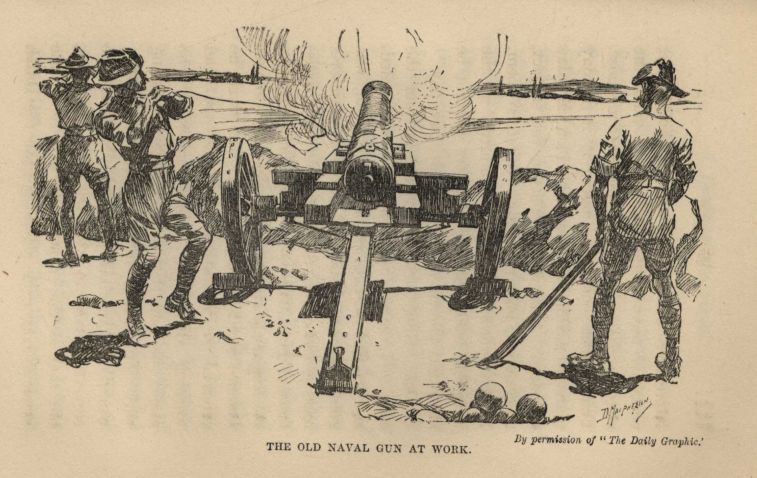
THE OLD NAVAL GUN AT WORK.
29th. Good news of victories from the south. It seems as if the tide had turned, and as if Old England, slow as usual, was going to forge ahead at last. Her Majesty's message was received with the deepest satisfaction here. It was a month late, but none the less acceptable for being delayed. Colonel Baden-Powell issued an order, in which he referred to the execution of the spy, and warning all persons, women included, who might be found treasonably corresponding with the enemy, that, on conviction, they would be inevitably shot; also that he regretted having to take such strong measures, but that as the enemy chose to fire on the women's laager, he should confine the Dutch prisoners in a gaol constructed in the laager, so that, if the enemy persisted in their brutality, they would kill their own friends. (It was a curious coincidence that on Sunday, after Saturday's performance, there was a feeling of insecurity in the town, and most people were of opinion that in all probability the Boers would violate the Sunday truce; but when the Dutch women were seen walking about, the feeling of confidence was quickly restored.) In the afternoon the gun bequeathed to us by Lord Nelson commenced firing on the Boer laager at Weasel's Springs, near the head of the waterworks--a range of something over three thousand yards. Her round shot bounded about the veldt through, over, short of, the laager, rapidly dispersing a mounted body of Boers in its proximity; for, unlike a shell, when she strikes, you have by no means done with her. The drill is somewhat complicated, but thanks to an edition of Captain Marryatt's works, we have succeeded in resuscitating this long extinct form of exercise.
30th. The results of our ancient piece's firing last night has been that the laager has shifted away, in the direction of Signal Hill, and that the Boers generally have been so busy that they have not yet found time (mid-day) to discharge their Creuzot gun. There was an alarm, last night, and the eastern front and reserve squadron were held in readiness all night. Yesterday the Boers re-established themselves on the nearest brick-kiln, and a sniping entertainment was organized for them by Corporal Currie, C.P., who has charge of the Cape Boy Post, within three hundred yards. One Boer, who for some extraordinary reason, wore a white shirt (which he will never do again) occasionally showed his back over the edge of a shelter he was constructing for himself, acting apparently on the principle of the ostrich, Trooper Piper of the Cape Police eventually got him, and at the same moment, his friend who was firing from a loop-hole, fired at Piper; fortunately Currie, who was covering the loop-hole, fired almost simultaneously and got him too, to the huge delight of the Cape Boys; stretchers came up under the Red Cross and removed the bodies, the second man was a bearded man and a well known sniper, he was an excellent shot, and the news of his demise was received with universal pleasure by the garrison, while for the rest of the day his friends made the post very warm for its occupants.
31st. There is one effect of this continual shell fire which is perhaps undesirable, and that is the remarkable degree of selfishness it engenders. There is really nothing to do and no excitement. News is rare, and not always of the best, and with lack of the proper amount of exercise and the frequent ringing of bells, which are almost as bad as the shells themselves, tempers get short, and the solicitude on "No. 1's" account increases. However, entertainments like the one organized this evening, go far to relieve our spleen and vary the interminable monotony of the siege. We were warned in the afternoon that our artillery was going to bombard the Boer lines, and from various points of vantage numerous spectators strolled out to look on. Personally, I made my way to the trench running from Ellis's corner to the river, and selected a spot where I was well away from other people, and which commanded a good view of the Boer trench, and, above all, of the big gun, which showed clearly against the white marquees in rear of it. At the time there was no firing going on, and cattle on both sides were being brought home. Absolute stillness reigned, only broken by the lowing of the beasts, the sounds of the poultry yards, and the barking of dogs. These, with the drowsy hum of the insects, made one feel extremely sleepy, and one might well have imagined oneself lolling between two peaceful villages at home. However, at 5.30 p.m. a change came very distinctly "o'er the spirit of the dream." Our guns commenced, three seven-pounders and the Nordenfeldt, and steadily shelled for about an hour, answered by the nine-pounder quick-firer, five-pounder Krupps, and old Creaky, who swung her nose backwards and forwards from one extremity of the eastern defences to the other, making, on the whole, moderate but extremely varied practice. As I had a pair of very strong glasses, a small cluster soon collected around me, thereby inviting the undesirable attentions of their riflemen, who, however, were pretty well engaged themselves, and consequently did not annoy us very much. It was about as safe a performance for the onlookers as could well be imagined. The guns drew most of the fire, and were scattered over a large extent of front. One could plainly see the big gun, and when she fired our way, had ample time to get into the trench. There were no casualties on our side, but after dark the Boers, who had been much upset by this disturbance of their reliefs and feeding arrangements, commenced to shell the town, killing one man outside the newspaper offices, and contriving, in some extraordinary manner, to drop a fragment of shell down the chimney of the headquarters' staff offices. This they continued till past nine, doing no further damage, except to houses. The Boers in the course of the day put a five-pounder shell through a portion of the hospital, and at night fired a volley into the operating room, where a patient was being examined. So we conclude that they must have lost some men during the day, which made them vicious. During the past fortnight they fired upon a flag of truce, deliberately shelled the women's laager, and fired on the hospital.
February 1st. To-day completes the sixteenth week of the siege, and we have had plenty of shell fire to celebrate it; one big shell, I regret to say, bursting on a splinter proof at Cannon Kopje, wrecking it, and killing one man and wounding two others. These splinter proofs were a line of trenches running down towards the town from the kopje, and it had seemed that by no chance could they possibly be struck direct by a shell. In the evening the Boer shell fire again continued till a late hour, and the last explosion that we heard puzzled us a good deal. It subsequently transpired that Major Panzera and Corporal Carrie, with three natives, had crept up to the nearest brick-kiln, from which the Boers were unfortunately absent, and had blown it up with fifty pounds of dynamite. This will probably keep the Boers away from that locality for a while, as they are not unnaturally very cautious of approaching any place where they suspect the presence of dynamite. A Kimberley native informed us that they stop the natives going home from the Kimberley mines and ask them if there is dynamite laid down round the town, to which the natives generally reply, "Plenty!" They seem to be having a much better time in Kimberley than we are here, as the natives say we live here like mere cats, whilst they have apparently no big gun to annoy them down there.
2nd. They began shelling later here to-day, so one's morning's ride was uninterrupted, but they are, however, now in full swing again. Sergeant Francis, B.S.A.P., died of wounds received at Cannon Kopje. Our usual shelling.
3rd. We sent off runners north and south. In the morning the enemy devoted his attention to the town. But in the afternoon our seven-pounder and Nordenfeldt, east of Cannon Kopje, commenced firing on the enemy, who were constructing a new trench, considerably in advance of the old position of the big gun on the S.E. heights. Consequently Creaky vigorously assailed them in turn, and the Krupp gun and the one-pound Maxim galloped from McMullen's farm to her assistance. The big gun made very good shooting, but fortunately only one man was hit, and he by a sand-bag hurled up by a shell aimed at the Nordenfeldt. The Nordenfeldt gun detachment consists of two men, Privates Lowe and Mulholland, both of the Railway Volunteers, and these two men have served this gun for months daily, often under a heavy fire directed entirely at them. At the same time our beloved relic of Lord Nelson was engaged on the western front in bombarding the new fort in front of Fort Ayr, being answered on that front and assisted by musketry and rifle fire. The week, as usual, culminated in the customary Saturday evening flare-up all round. The big gun was cleaned and oiled for Sunday, and we thought it was all over till Monday morning. This, however, was not the case. The Boers were unusually jumpy. They treated us to incendiary shells till late, and kept up a heavy musketry fire at fitful intervals during the night. They commenced constructing a new trench in the Brickfields, and can plainly be heard working at it.
4th, Sunday. The usual quiet day. At Fort Ayr, while cleaning the Maxim, it was accidentally discharged, and the Boers promptly answered, so Mr. Greenfield, in charge of the post, strolled out to explain matters, and was met half way by the Boer representatives, who talked to him for a bit, gave him the latest news (presumably untrue), exchanged little harmless chaff, and agreed to swap newspapers for whisky. The newspapers, needless to say, contained flaming accounts of universal Boer victories, which, here, one finds it somewhat hard to credit, and they agreed to furnish similar papers next Sunday. It is curious to see in the advertisement sheets advertisements from manufacturers, stating themselves to be manufacturers to Her Majesty the Queen, to read the London letter, and a column of society chit-chat in a paper published in the capital of our enemy. However, it is an odd world.
5th. Two lots of runners came in from the north this morning. Personally, I received my first communication from home since the siege began, only a wire though. Quite a number of letters came in, but were very unequally distributed. One receiving a dozen, the vast majority none, Hanbury Tracey was exceptionally fortunate, as he received a money-lender's circular and a bill, re-addressed in red ink, from his orderly room at home, and that was his sole communication. They shelled us as usual, and kept it up late. A wet night, but that did not seem to deter them. Their incendiary shells were, as usual, a failure.
6th. Shelling all day, and firing at night. Two natives were killed and Colonel Hore, commanding Protectorate Regiment, had a narrow escape whilst returning from the Court of Summary Jurisdiction.
7th. They commenced shelling early this morning, so far with little damage. There seem regular streaks of luck in this shell fire, and sometimes we strike a very bad one, but it is really marvellous how these huge shells have done comparatively little injury to life here. From what we can gather from other places, it will be about the worst knocked about town in South Africa. The remains of some buildings have been removed and the majority will require re-building. Yesterday, a shell went clean through the smoke box and boiler of a locomotive, and did not explode until striking the ground beyond. One also pitched on the top of an unfortunate native in an engine ash-pit and destroyed him. The price of food has naturally risen enormously and will probably rise more. The humble Kaffir, if he possesses a hen which lays regularly, can maintain himself and another. An egg fetches sixpence, and a Kaffir's ration of mealie meal only comes to threepence sterling, consequently the henless Kaffir sponges upon his more wealthy brother.
This afternoon I rode up to Cannon Kopje and arrived simultaneously with a ninety-four pound shell from the contrary direction. We did not, however, hurt each other, and I dismounted and tethered my horse under the best cover available, and to ground with me like a rabbit. They fired one or two more shells at the kopje, doing no harm, and we then strolled up to the look-out post to have a look at our persecutor. It was a lovely evening, and as she was then pointed on the town, one could view her proceedings with the utmost equanimity, speculating mildly as to whether she would pitch her shell on one's own bomb proof or not. The shell, however, burst prematurely, just clear of the muzzle of the gun, and we continued watching the town and the rest of the defences, all of which lie like a panorama from the Cannon Kopje look-out. Creaky was then re-loaded, and with her nose cocked high in the air, was apparently aimed in the direction of the planet Venus. As a matter of fact, however, she was aimed at Fort Ayr, and after the discharge one imagined one could trace the projectile in its flight by the hurtling sound it made; but when by sound it seemed as far as Fort Miller, one could see the strike close by Fort Ayr (which is about four miles from the gun), and yet the noise of the projectile through the air continued for some seconds longer, producing a very curious effect. She re-loaded and was again pointed on the town when slowly she swung her nose round and was pointed on us, a roar of look out from the man on duty, and the crowd of languid spectators was transformed into a body of active men, heading straight for their accustomed shelters, which having attained, they peered carefully at the gun, waiting for the smoke from the muzzle, which would be the signal for their final disappearance. We waited and waited, but she came not, so, deciding that it was the good-night gun, I walked back, accompanied by one of the garrison of the kopje, and ate my dinner at the hotel with the comforting assurance that I had last seen her directed a good mile from the dining-room.
This morning Corporal Currie and his men killed and wounded a few Boers, coming at dawn to their trenches. The Boers consequently gave us a quiet day, as their obsequies and attendant ceremonies seemed to fill in all their time; but at dark they commenced a heavy fire of small arms, shell, and vituperation, upon our advanced post, about two hundred and fifty yards from their main trench. They assure the garrison of this post that they intend to make it particularly warm for them, and it is about as warm a corner as one could well select. I rode out in the afternoon to Captain Marsh's post on the western edge of the stadt, we have there driven the Boers out of and occupied Fort Cronje, a mile from the western edge, and seven hundred yards from the nearest Boer fort. This Fort Cronje commands the whole of the valley on the other side of the ridge, under cover of which the Boers used to remove their reliefs and reinforcements to and from Cronje's laager and the western laager. Its capture has largely extended our field for grazing. We had proposed to walk out there, but on consultation we decided not to, as one is under a pretty heavy fire in the open the last part of the journey, and one would see it better and under more favourable circumstances on the Sunday, during the truce. Riding back, I tried a short cut, at a good pace; the Boers, however, were not quite asleep, and began sniping with marvellous ill-success, as I was about to get under cover again. To-day we were informed that we must be prepared to hold out for another four months, which we are quite ready to do. The garrison and inhabitants received the intelligence with the utmost equanimity felt no earthly doubt as to the result, merely expressing extreme boredom at the prospect of four months more of such monotonous existence.
9th. A runner from the south arrived, informing us of Buller's crossing the Tugela. Comparing this news with the Boer accounts of British defeats with heavy losses on the 24th, south of Tugela, one can only conclude that they must indeed be in a bad plight when they can invent such amazingly circumstantial and appalling lies. However, I hope we are nearing the end of the last act, and "God Save the Queen." They have been quiet to-day, and as far as we know, no funerals to occupy them so hope and trust that they are digesting some bad news; the Kaffir who brought the messages states that the Free Staters have had enough of it, but that Cronje will not allow them to surrender, as they had everything to lose and absolutely nothing to gain; we can well believe it. The Kimberley correspondence is of a chatty description, refers to the weather and papers (which have not arrived), but the gist of the whole is cheerful and consequently welcome, though we should prefer news. Their food supply seems good, which is consoling. But this much is certain, that if we have to hold out another four months, the means of our doing so, in the supply line, is due to the presence of Mr. B. Weil. I wonder whether it is appreciated, even yet at home, what a stupendous and monumental liar the Boer is. The Kaffir says what he thinks you will like. The Boer, however, says what he knows he likes himself. I hope some day to read a British account of the war. The Boer account would pain me if I believed it.
10th. The enemy remained quiet, at least as regards their big gun, yesterday evening, though the now nightly fusillade began about 8 o'clock. This morning they commenced shelling late, and apparently directed their projectiles at the Mill, which works every night, protected by a traverse, at the south-eastern corner of the town. They only fired two projectiles, one of which struck Mr. J. Dall, Town Councillor, and commander of one of the Town Guard posts, full, blowing him to pieces. His wife, poor woman, who was in the women's laager, where the intelligence was abruptly conveyed by a panic stricken Kaffir woman servant, came up semi-distracted, under the escort of the Rev. W. H. Weekes. It was, of course, impossible that she should see him, and the scene was a very painful one for her friends in their endeavours to be of some comfort to her. Musketry and the discharge of field pieces continued all the afternoon, during which we had an exceedingly heavy thunderstorm which flooded some of the uncompleted and advanced trenches, compelling the evacuation of the one within two hundred yards of the Boer main trench, during which operation one of our men was wounded. The others remained there, and sought the best cover from fire they could in its immediate propinquity. Firing continued all round the outposts, at intervals all night and well into the dawn on Sunday morning. Since we have been warned to be ready for four months more siege, the question of food supplies for natives has become very serious. Two of these unfortunate fugitives were shot last night in their endeavours to elude the vigilance of the cordon all round us. It is not the question of meat so much as the question of grain, which is our difficulty.
11th, Sunday. I was aroused about dawn by musketry fire, and as I heard no more, supposed I had been dreaming, but when starting for my early ride, was told there had been heavy firing to the east. I went to Fort Ayr, from whence the Boer fort seemed ridiculously close, and so on to the Cape Police fort, and from there the Boer sniping station looked within six hundred yards. I was, however, informed that it was a good sixteen hundred yards off. It was a perfectly lovely morning, and had one's horse only felt as fresh as the morning, the ride would have been indeed enjoyable, but the stress of the siege in the way of shortness of provisions has fallen far more severely on the horses than the human beings. From this fort I rode to the B. Squadron horse lines. The horses are not at present a pleasing spectacle, but, owing to our extended grazing ground, I dare say they could still do some work. Sundry of them are killed and turned into billtong for the Kaffirs. Thence along the picturesque bank of the Molopo, through the centre of the stadt to breakfast at Captain Marsh's. This officer, whose squadron has held the stadt since the commencement of the siege, has, from his West Coast experiences, a wonderful knack of dealing with natives, and in a great measure the absolute confidence of the Baralongs in the white garrison may be ascribed to him, they have accordingly constituted him a sort of universal referee in all their local troubles. After breakfast we walked out from the edge of the stadt to the two forts occupied by Sergeant Abrahams and his detachment of natives, within six hundred yards of which are situated the Boer forts, also garrisoned by natives. Between the opposing forts both sides rambled at their own sweet will. We then went on to Fort Cronje, originally in the occupation of the Boers, and having attained our utmost limits we sat and smoked and looked at the stadt (distant about a mile), and appreciated how Mafeking looked to the Boers from their western outposts. Personally, the northern end of the stadt reminds me of nothing so much as the Curragh Camp when viewed from the Newbridge Road, and, indeed, the veldt all round looked fresh, green, and undulating enough for the Curragh itself. Fort Cronje is enfiladed by the blockhouse north of the Molopo. Eastward from Sergeant Abrahams' fort, and in a circular direction across the railway line towards Cannon Kopje, extend forts occupied by McKenzie's contingent. We thus now have a large and secure grazing ground, the area of which I had not previously appreciated. We strolled back to the stadt and rode back to shop and church. During the morning and afternoon occurred some of those interchanges of courtesy between ourselves and our opponents, which generally do take place on Sunday. Corporal Currie, who during the week spends all his time in endeavouring to slay and not be slain by the Boers, was called over by them to translate a note they had received. They offered him tobacco and small civilities, and patted him on the back saying he was a "freundlish kerel." They also said they were sick of it, and what a waste of time it was not to be ploughing. A somewhat similar conversation was carried on by Mr. Greenfield on the other side. The Dutch, in addition, said they thought it would all be over in a month, that they hadn't got any papers, but would give them to us at the first opportunity, which we understood to mean, when their romancing journalists had sufficiently seasoned the dish of Dutch defeats for Mafeking consumption. The bicycle sports had to be postponed owing to the condition of the track, but there was a cricket match in the morning between Fitzclarence's squadron and the town of Mafeking, which the latter won by nineteen runs, and in the afternoon a concert, where our commanding officer, as usual, distinguished himself by his comic songs and humourous sketches. This talent is well known to his friends, but is certainly not so well known to the British public, who only have had the advantage of viewing him from a serious side; however, we appreciated him quite as much in his lighter capacity, and the concert was a great success. The Beleagured Batchelors' Ball, given by the batchelors of Mafeking, had in consequence of Mr. Call's death been postponed till to-night. It commenced merrily enough, and had been going on for about an hour when history and the Duchess of Richmond's ball repeated itself. The staff officer arrived warning all officers to fall in. Heavy firing commenced all round, and an attack was anticipated. The galloping Maxim raced across the veldt in the dark from the western outposts to the town, at no time a pleasant journey, and now with the innumerable pitfalls all round it, it was lucky to get there without a smash. The Bechuanaland Rifles and a squadron of the Protectorate Regiment were pushed forwards towards the brickfields, taking the place of the Cape Police who had reinforced the extreme eastern advanced posts. The Boers had put three hundred more men into their advance trench and kept up a heavy fire at intervals all night, as indeed they did at all points. Our men did not fire much.
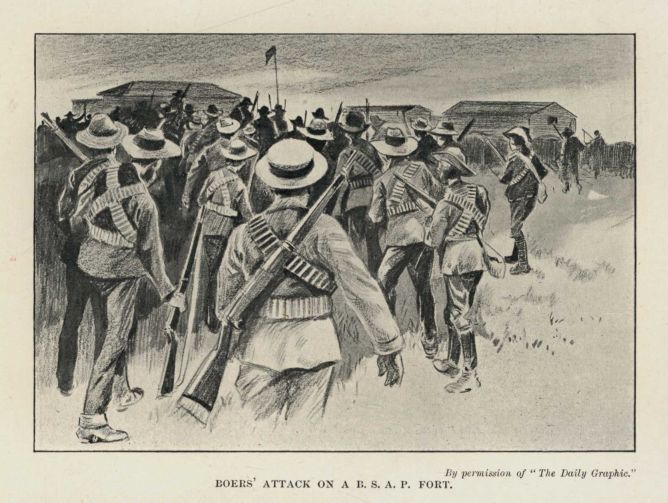
BOERS' ATTACK ON A R.S.A.P. FORT.
12th. At dawn this morning I went to Ellis's corner, as heavy firing was going on in that direction. The five-pounder was firing at Currie's post and the Cape Police, from the Boer main trench at under two hundred yards. Their quick firer and one-pound Maxim were also doing so. The big gun seemed anxious to participate, and was elevated several times, but owing to the Boer trench being immediately in the line of fire did not venture to. Things slackened somewhat at half-past six, and I went for a ride round the western side where a few odd shots were being fired, but nothing was going on. About half-past eight the big gun commenced firing at Cannon Kopje, and after half a dozen shots transferred her attentions to the town, mainly bursting in fairly close proximity to this dug-out, but so far no damage to my knowledge. This afternoon I take up my residence at Cannon Kopje for a bit.
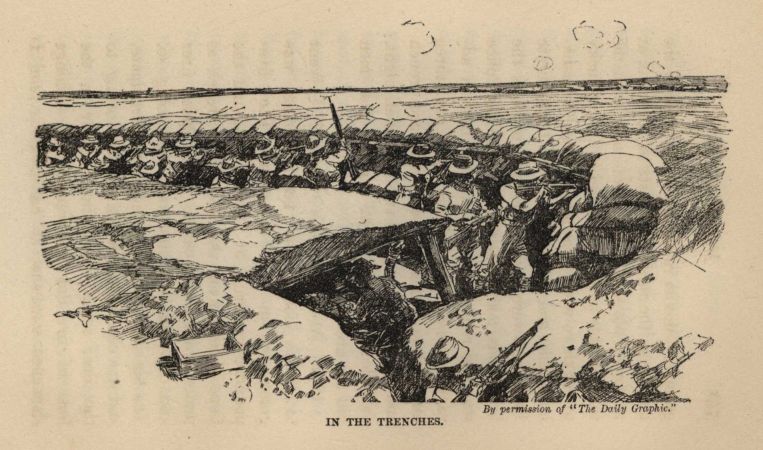
IN THE TRENCHES.
12th. When I had finished the last paragraph I left my dug-out and went to lunch, and as I walked to the hotel, heard a single shot, of which I naturally took no notice. An hour afterwards I heard that it had claimed its victim in Captain R. Girdwood, late 3rd Battalion Royal Irish Rifles, assistant commisariat officer here, who was mortally wounded. To the garrison and all who knew him the blow was severe. Throughout the whole siege he was always laughing and joking, and nothing ever subdued his never-failing cheerfulness: to meet him was a regular tonic if liver or temper were at fault. The duty he did in assisting Captain Ryan to regulate the supplies of food and stores was invaluable, and Colonel Baden-Powell in his general order literally expressed the great regret and sympathy felt for his wife. In the evening I went up to the kopje, and am for a time attached to the B.S.A.P. Prior to my departure they gave us a good doing in the town, both musketry and shell fire.
13th. To sleep in the open and live on the heights in fine weather is undoubtedly an improvement on the town, at any rate for a short time; though one is away from headquarters and the latest garrison gossip, one's view of proceedings is universal and uninterrupted, unless one happens to be the recipient of Boer favours. The bomb proof gives ample cover and a dining-room, for the rest one lives in the open which, in this perfect weather, unless the sun be unduly hot, is charming, and though washing arrangements be scanty, the air is better and the view far less circumscribed than in the town some two thousand yards away. Last night wild musketry fire went on all night, and incendiary Boer shells provided the kopje contingent with fireworks gratis, and only succeeded in setting one house on fire, which was quickly extinguished. Poor Girdwood died this afternoon and was buried this evening.
14th, Valentine's Day. I rode into the town and having transacted my business, and had a pleasant ride round the western outposts, returned just in time to elude their first shells. They are messing about their works as usual, but what they are doing we cannot quite make out. They have, however, withdrawn their marquees from their gun at McMullan's farm. The homely Dutch families generally play about the gun (the Asp on the Cocktrice's den--N.B. the Cocktrice's business end directed on us), and when family life is most in evidence in the gun's vicinity they generally fire on the town, as it does not amuse the dear things to fire at a small mark where they may possibly do no damage, whilst they think they cannot well miss everybody in the town. The fair ladies frequently fire the gun themselves and dandle their babies on high to look on at the prospective slaughter of English women and children. Charming race! I think even Sheridan could scarcely find a Dutch woman "an excuse for a glass," or, indeed, an excuse for anything else. However, if their menkind had as much pluck as they possess venom, Mafeking would not now be flying the Union Jack, but the Vierkleur of bilious hue. This is plentiful in the vicinity, but has not, and will not, desecrate the township, and I trust the new issue may serve as a model for the ribbon of our Transvaal medal. Sundown: Creaky dismantled. Are they sick of it at last?
15th. As dawn broke a crowd of us went up to the lookout post, to look for our dear departed, and when we failed to find her we accepted our loss with due philosophy. I rode over to Fort Ayr to see Mr. Greenfield, who is isolated for a month in this post. He must, when not engaged in rallies with the Boers, find it very dull, for he accepted with avidity the offer of my diary of the siege to read. He had, however, found Creaky in front of his position and about five miles due west of the town; what she proposes to do here time will show, but our end is pretty safe from her. Later I received a telephone message to say how pleased he was with the account of the fight of November 31st. This blunder, in my diary, is a legacy from my late typewriter. His last batch of copy (which was the last straw that gave the correspondent the "hump ") dated the 12th, though irritating, was rather amusing, I have now transferred my favours elsewhere. The gun has commenced bombarding the stadt and women's laager.
16th. I rode up to Major Godley's and had the "31st of November" cast in my teeth once more (since corrected). The big gun fired twenty-eight shots at the stadt and women's laager. From Cannon Kopje there is twenty-three-and-a-half seconds between the smoke from her muzzle and the report, which makes her a matter of nine thousand yards away, and about the same from the centre of the town which she cannot now properly reach, and to strike which at all, she is elevated apparently at right angles. She devoted several shells to McKenzie's western shelter trenches, doing no harm, however. Her change of position must have been another deliberate atrocity on the part of the Boers, for which I trust their Commander will be strictly called to account. There can be no immediate effect expected on the defences or ultimate resistance of Mafeking by the deliberate bombardment of women and children, black or white. And he who sows the storm may reap the whirlwind, for the blacks neither forget nor forgive, and this is one more, and by no means the least, tally in a long score. Now, as regards the position of the Baralongs and our other native residents.
At the outbreak of the war, the Boers flooded the town with all the refugee Kaffirs from Johannesburg and other parts of the Transvaal, who happened to be in our vicinity, hoping either on the capture of the town, which they confidently anticipated, to secure a good labour market, or, in the event of an unexpectedly protracted resistance, to exercise through these additional mouths, a severe pressure on our food supplies, and thus indirectly on our length of defence. They carefully, however, first robbed them of all their money. Now, picking a Kaffir's pocket, or wherever he may carry his money, ranks about as high in the code of honour, as stealing coppers from a blind man's plate. I am not sure whether it is a transgression of the Law of Nations, but as by the time this diary is read the Boer will not be, as he certainly never ought to have been, a nation, it is of small moment, but the act of robbery distinctly took place. The Baralongs were assured by both sides that the war was between two white races, and that they had no cause to interfere. We went even further, and refused to allow them to assist us. However, when the Baralong had seen his cattle raided, his kraals burnt, and himself bombarded, he, somewhat of a rhetorician, but lacking perhaps in the logical capacity for distinguishing between "a military operation" and "an act of war," decided that the Boers' application of the former to his property was good enough excuse for him to indulge in the latter to prevent a further application, he accordingly, in his childlike manner, invited the Boers to enter his stadt, and shot several of them when they tried to. Recently, too, the Boers made overtures to secure the Baralong assistance, and the Chief, Wessels, said he must think it over; after long deliberation he declined. It was probably in order to punish them for this lack of readiness to support them, that the Boers so slated the stadt. However this may be, the Baralongs and other natives have loyally and consistently supported us, and deserve ample compensation for the hardships, privations, and losses which they have sustained. All day the Boers have been making feeble attempts on McKenzie's outpost; and at night, seated at the kopje, one could see a circle of fire running all round the outposts. On the eastern side, our Maxim in the brickfields, our seven-pounder and their five-pounder and many rifles were flashing in the darkness; in the distance Fort Ayr was warmly engaged, while to support McKenzie in our immediate proximity, the armoured train was creaking and groaning up the grass-grown line. And nothing perhaps brings home our isolation so much, as to see the rails overgrown with grass, and reflect that this is a main line to England. Owing to the custom of the Boer of elevating the muzzle of his rifle over the parapet and firing in the air, bullets were whistling and falling all round us on the kopje all night, which, as we were a mile from, and two hundred feet higher than, the trench they were firing at, argued poor marksmanship on their part. However, we were all fairly safe, and the Boer presumably quite so, and as he made plenty of noise I suppose everybody was satisfied.
17th. Very little firing till the evening, and then usual performance.
18th, Sunday. Our usual quiet day. The bank now opens for business on Sundays. As the Kaffirs, in common with other natives, persist in burying their specie, it is very literally locked up, and to restore the circulation of silver we have a paper issue for small sums. Indeed, we are now a very self-contained community, we have our bank, our ordnance factory, our police, and flourish under a beneficent and remote autocracy. As regards the ordnance, the factory was started for the manufacture of shells for our seven-pounders, for shot, brass and iron, for our antique cannon, and for the adaptation of five-pounder shells (left here by Dr. Jameson) to our seven-pounders by the addition of enlarged driving bands; these have all proved a complete success, and too much praise cannot be given to Connely and Cloughlan of the Locomotive Department, who have organized and run the aforesaid factory. As great a triumph has been the manufacture of powder, and invention of fuses by Lieutenant Daniel, B.S.A.P., and Glamorgan Artillery Militia, and thus we are rendered secure against our ammunition running short; a gun is also being manufactured, and will shortly be used. This factory is of long standing, but prior to this the authorities have not allowed us to allude to its existence.
19th. Went out to try and shoot plover, which form an acceptable addition to our rations, as we have now come down to horse-flesh and six ounces of bread per day. Fairly quiet day. Strolling down to town in the evening, I assumed that their snipers were too much occupied with our people in the brickfields to bother about me. They were not, however, and were unpleasantly attentive.
20th. Re-transferred my residence to the town, the firing is heavier down here through the day, and also, indeed, the night, but here we are under cover.
21st. Gun did not fire more than two or three shots, but at night there was very heavy firing along the brickfield front, they shot some of the working party, and also headed some of the natives going towards Kanya. The Boers made a half-hearted sort of attempt to turn our men out of the advanced trench, but utterly failed. The question of feeding the natives has been solved by the establishment of a soup kitchen, the component parts of the stock may be varied, but the result is eminently nutritious.
Gun changed back near to old position east of town, they elevated and depressed her several times, but did not fire. As the bells rung, however, the moral effect was exactly the same, possibly also the physical. Sergeant-Major Looney, A.S.C., was reduced to the ranks and five years penal servitude awarded to him for selling Government stores. Private Miller, Protectorate Regiment, tampering with a loaded ninety-four-pound shell, was blown to pieces. This form of lunacy is apparently ineradicable. We anticipate an attack to-morrow, as it is the Orange Free State Independence Day. I wonder if the Free State still exists: the following letter apropos of this from the leader of the opposition in the Free State before the war is, I think, interesting:--
(Copy.)
BLOMFONTEIN, September 4th, 1899.
CHARLES METTAM, ESQ., Box 23. Krugersdorp.
DEAR MR. METTAM,
Your letter of the 30th inst. is to hand, and affords a by no means solitary instance of the one sided and high-handed treatment former Free State Burghers have to undergo at the hands of our so-called brethren in the South African Republic, yet in spite of all this the political union or alliance was put through our Raad, and should hostilities break out, we shall have to be belligerants and be involved in all the horrors of war and have to lose our independence, and for what? As a just reward for the folly of allowing a spurious sentiment to override common sense. So it is, however--and under the circumstances, as you have lost your Free State burgher rights you could not claim protection here. The only way I see for you--as you hold to your birthright staters--is to bring your position to the notice of the British resident, and ask him to advise you how you are to act. With kindest regards to Mrs. Mettam and yourself.
Yours faithfully, J. G. FRASER.
P.S.--I think a great many of our people are being educated by this crisis to the accuracy of the policy which I placed before them at the last election, and have since always advocated.
J.G.F.
HER MAJESTY'S AGENCY, PRETORIA, September 11th, 1899.
SIR,
I beg to acknowledge receipt of your letter and enclosure (herewith returned) of the 7th instant, and regret that it is not in my power to discuss the matter to which you refer by letter. I should, however, recommend you, if you should be in Johannesburg, to see the British Vice-Consul there, who will no doubt give you such advice as may be possible under the circumstances.
I am, Sir, Your obedient servant, CONYNGHAM GREENE.
MR. C. METTAM, P. O. Box 23, Krugersdorp.
Certified true copy. E. H. CECIL MAJ, C. S. O.
23rd. They commenced shelling cattle and northern end of the town. As the inhabitants have not been shelled severely for ten days, they seem more concerned in running to see where the shell pitches, than in taking cover as they have been strictly warned to do. Steady rain has commenced, depressing the big gun and the Boers.
24th. Rain continuing, gun and owners still depressed. No news received for ten days and great universal anxiety felt for anticipated decisive intelligence.
25th, Sunday. No heavy shelling yesterday, but firing all night and this morning. Cape Boys in advanced trenches, and Boers, engaged in an argument as to their respective mothers and other female relatives' merits and demerits. The arguments for and against having rapidly degenerated to assertions, shooting began, but as it was merely a personal quarrel no one else interfered, and, indeed, white flags from both sides met within a quarter of a mile of the firing, which continued all day. Our Sunday concert was a great success, and the day being fine was most enjoyable. It is curious what different people buy at the stores, the Europeans buying mainly the necessities of life, while the Kaffir, who has plenty of money, but is only allowed to purchase a limited amount of meal, browses off Pâte de Foie Gras, and other similar comestibles. In the afternoon I went to inspect our new gun. She reflects the greatest credit on her builders, the finish and turn-out being quite dandy. She's a smooth bore 5.5, and carries a round shell; we ought to have good fun from her.
26th. Runners in this morning, news very meagre. Her Majesty's telegram received, which gave intense satisfaction, but we have been anxiously anticipating decisive intelligence. The Kaffirs report that the Boers are few round here, but will not abandon the prosecution of the siege; on our side we cannot afford a serious sortie, as a reverse might mean the fall of Mafeking, which is not desirable or in the least probable. The Boers began shell-fire at dawn this morning, and continued it at intervals all day. This was the most rapid fire we have had, and the continuous clanging of bells might have induced a stranger to suppose that we were indulging in some popular celebration. They particularly favoured our end of the town. In the evening we tried our new gun on Game Tree fort at about 2300 yards, she was a great success, and her range was apparently only limited by eyesight.
27th. Being Majuba Day we expected an attack, so I went up to Cannon Kopje before dawn. What attacking there was was in the brickfields and was done by us, but after a fitful splutter of musketry for an hour things quieted down. I went up to Fort Ayr but nothing was doing, and with the exception of musketry fire and a few small shells, it was a quiet day. The Boers blew up the line about two miles north of the town.
28th. We have got our news at last, and though the shell fire is very much heavier than usual the population is wandering about with a bland smile on its face and a comfortable contempt for the Boer nation at large, only tempered by the fear that the military success over Boer armies in the field may be discounted greatly if the British people allow themselves to be hoodwinked by the most unscrupulous, self-interested politicians who ever led a country to its ruin, but who have unfortunately sown seeds which may sprout again and to which there is only one successful treatment, that of force majeure, followed by pax Brittanica, to be upheld again whenever necessary by the aforesaid force majeure, which is the only argument that South Africa, black or white, in its present condition can understand. Generosity would be wasted, kindness treated with ill-concealed contempt, and blood and treasure cast away, whilst race hatred would again be rampant, were the Dutch to be once more in a position to struggle for supreme control. It is a strong man armed who keeps South Africa, let that man be British.
The Boers are determined to keep us amused, and do not approve of the Free Press; they have just now blown the newspaper office, by our dug-out, to pieces, and are trying to silence our mild manifestations of joy by particularly heavy shell fire. This afternoon we tried our new gun again on the veldt, with bursting charges in the shells, and the results were eminently satisfactory; they afforded a certain amount of interest to the garrison of Game Tree fort, who, as the gun was pointed almost at right angles to them, bobbed somewhat unnecessarily to each discharge. The explosion of the shell might well have puzzled them for it was exactly like the discharge of another gun. It is a shame to be cooped up here in such weather, "where all around is beautiful and only Boers are vile," and if they had any sense of decency or humour they would give us one good fight to finish, as it is we hang on in trenches into which they cannot possibly come, they hang on in opposing trenches into which we cannot afford to go, exchanges of shots go on all day, varied by shell fire on their part, which is becoming monotonous, and the dullest, deadest level of warfare has been effectually attained. To-day we had our little joke; a dummy truck was placed on the line about two miles south of the town, some snipers fired a few shots from it and then abandoned it, they were, however, successful in drawing the fire from the quick-firer Krupp and one-pound Maxim at Jackal Tree with occasional shots from the big gun; they made execrable shooting, but killed some cattle and a horse or two in a remote portion of the veldt, and unfortunately killed the Sergeant-Major of the Black Watch, a fine Zulu over six feet four inches: a one-pound Maxim hit him clean in the head. Yesterday, too, Trooper Elkington, a particularly smart, good-looking fellow in the Cape Police, was struck in the face by a five-pound shell, and his nose and eyes destroyed; he still lives, poor fellow. Apropos of Zulus, there is a mad Zulu in the town who, when the frenzy seizes him, strips, and indulges in a war dance in front of the Boers; how many thousand rounds of ammunition they have fired at him it would be hard to say, but one day for certain they fired a five nine-pounder Krupp at him, the only result being that he assegaied the spot were each shell fell. My own personal experience of him was aggravating. One day having selected a secluded spot with good cover from which to snipe, and thinking myself exceedingly well concealed, I was much annoyed by the inordinate amount of bullets which came my way, and whilst waiting till they stopped a bit, happened to look round and discovered that my friend, stark naked, was dancing about a hundred yards in rear of me, when he had finished he put on his clothes and went home. He is still alive, and dancing when inclined. Mr. Whales, who has edited The Mafeking Mail and brought out daily editions throughout the siege, had an extraordinary escape yesterday. A 94 lb. shell came into his office and exploded whilst he was talking to two other men, wrecking the place, but providentially only slightly scratching one man. As he emerged from the debris much shaken, his first remark was, "That the slip would not be issued to-night." This is the second shell through the office, and though the setting up operations are carried on in a bomb proof, he has consistently carried on his editorial avocations regardless of the heaviest fire. This practice I am glad to say he proposes to discontinue in a measure, and work more or less underground, for, as he truly says, "The third shell may hit me." Really this does look as if it were the beginning of the end, and as if this somewhat isolated outpost of the Empire were going to get its communications with civilization restored. It has been an experience, and though certainly not a very pleasant one, I do not think the survivors can but have profited by it. I rather fancy, however, that it will take a singularly astute foeman ever to involve any of them in a siege again; it is, however, Colonel Vyvyan's second experience in South Africa, as he was once before shut up in Etchowe.
March 1st. Yesterday a large party of women and children, who do not belong to this district, were sent away; the Boers turned them back, and when they were retiring deliberately opened a heavy fire on them, killing and wounding many. This is not the first deliberate outrage on the native women and children, and in addition they have flogged and turned back women trying to escape. Colonel Baden-Powell has addressed several remonstrances to General Snyman on the subject, and pointed out that he cannot expect the native chiefs in the vicinity to restrain their tribesmen, if the Boers persist in murdering their friends and relations, and that he, Colonel Baden-Powell, cannot be answerable for any subsequent occurrences in the way of reprisals on the part of the natives, to which General Snyman has answered as a rule more or less civilly (generally less) that we and the natives may do our worst. To-day is the usual sort of day, heavy sniping at intervals and a fair amount of shelling. Certainly the amount of damage done to Mafeking in life and property has been wholly disproportionate to the amount of shell fire sustained, the reason of course being the soft mud bricks of which the houses are constructed; and to-day we had two very fine object lessons of the extensive damage these shells would have done among more solidly constructed edifices. Mr. Whitely, the mayor's, house, which is built of stronger materials than any other house in Mafeking, was struck by a shell, and the damage done was far greater than was usually the case. Round the house of Mr. Bell, the magistrate, there is a loose stone wall, the shell struck and exploded at the base of it, the fragments of shell did but little harm, but one boulder about twice the size of a man's body was hurled about twenty-five yards, and two rocks about twice the size of a man's head were projected through the house some twenty-five yards away, while stones of various sizes were hurled great distances and in every direction. So, though thanks to its flimsy construction, Mafeking has escaped better than many a more important town would, it does seem rather like breaking a butterfly to use modern siege guns against a place of this sort. However, it is still a fairly lively butterfly in spite of twelve thousand pounds of metal from one gun alone. We have developed a new trench N.E. of the town to enfilade the enemies' sniping trenches, which, though it does not silence them, seems to annoy them passably.
2nd. Shell fire. Our new gun was tried on the sniping trenches, more for ranging purposes and to learn her extent and powers than anything else. The Boer trenches showed great curiosity as to what she was and why she did it, for her shells burst with a most delightful report and seemed to spread very nicely. A new toy like this is a god-send to us in our present dull condition.
The Boers during the experiment, however, kept themselves and their curiosity underground. The Boer big gun was removed at sunset and the usual crop of surmises, bets as to destination, cause of removal, &c., sprang rapidly into existence, and at any rate gave us something to talk about; it takes very little to interest us here.
3rd. The Boers tried dynamiting our trenches last night, but failed, our advanced parties are within forty yards of each other. At dawn the big gun, which had shifted back to the south-east heights from where she flanks our brickfield advance, commenced heavy fire, sending thirty-six or thirty-eight shells before breakfast, and mortally wounding Sergeant-Major Taylor of the Cape Boys; we also had four or five others wounded more or less severely. They, however, stuck to their ground in shallow trenches which were hardly any protection, and that we suffered no greater loss is a matter of astonishment to everybody.
Our seven-pounders then commenced on their trenches, and the firing was heavy all round the whole morning. The Boers contemplated renewing their entertainment in the afternoon, but our snipers had crept up to within about eight hundred yards of the big gun and commenced picking off the gunners. Trooper Webb, C.P., fortunately shot their Artillery Officer whilst laying the gun, at a fairly early stage in the performance, and this seemed to damp their enthusiasm. They commenced running about like a lot of disturbed ants, messengers were dispatched to the laager, their doctor arrived on horseback, and they then proceeded to hoist three Red Cross flags on the work. They carried a stretcher under a guard towards the laager and met a carriage, but he was apparently too bad to be put in that, and the carriage returned to the laager, when some mounted men rode forth, and, meeting the stretcher, dismounted and followed behind. Altogether they seemed very depressed whilst we were correspondingly the reverse, and in the confusion the big gun forgot to go off, and was removed before dark. With the exception of musketry the rest of the day was quiet. Our saps have now crossed each other.
Sunday. This morning at daybreak the Boers were still working, so we gave them a volley at forty yards and are believed to have shot four. Sniping continued all day, and later on we killed another. From this quarter the Boers, who were evidently very cross, sniped viciously all day. I walked up with Captain Williams, whose turn it is now for duty in the brickfields, and personally I consider it a most undesirable place of residence. The big gun has disappeared. We are all glad to hear that our old friend Cronje is in a tight place; from all accounts he will trouble us no more.
5th. The big gun is back at the old place east of the town; her immediate entourage evidently prefer gun practice at a safe range, for we have shot a good many gunners. Their efforts to get the gun off under musketry fire always cause amusement. They rush to the gun, and then disappear, this goes on sometimes quite a long time before the gun gets fired. Sergeant Major Taylor died last night; he was a splendid fellow and a good representative of the Cape Boys, who are a most gallant race of men and good shots. In times of peace he was one of the leading members of the Church in the location. There is heavy firing in the direction of the brickfields, so I must see what is going on.
6th. Yesterday our seven-pounders made very good shooting on the Boer brickfield trenches, and after Mr. Feltham, Protectorate Regiment, had thrown dynamite at them for some time, the Cape Boys went to poke them out of their sap with the bayonet, but the wily Boer was gone; they had closed their sap. In this fight of "sit down" (as the Zulus say), I for one had worn out much patience and several pairs of trousers, and we seem to be borrowing more and more hints in the way of mortars, hand grenades, &c., from our forefathers. The Boers seemed much annoyed yesterday afternoon, and heavy firing went on last night and is going on this morning. The big gun did not fire yesterday though she was elevated and pointed several times, nor has she fired this morning. There are strong rumours that the Boers intend to trek, and are preparing for it; that the gun we see is a dummy; and that the real one has been withdrawn to defend a position on the frontier. We sincerely hope it is true.
6th. The gun proved herself to be the "old original" by letting us have two or three shots in the evening.
7th. Heavy firing all night in the brickfields; only two shells. The Boers have commenced to trek. Trooper McDonald, Cape Police, died. His was an adventurous career; he joined the Argyle and Sutherland Highlanders in '47, served in the Crimea (French and Sardinian Medal, two clasps), served in the Indian Mutiny, was kidnapped when embarking home by Americans, fought for the North against the South, deserted the North and fought for the South, afterwards went to Australia, thence to New Zealand, and served in the Maori War where he was taken prisoner. Later he came to South Africa, served in the Basuto War, Sir Charles Warren's expedition, Carrington's Horse, the B.B.P., and transferred to the Cape Police, in which corps he has died of hardships and old age, fighting the Boers. He is not the only Crimean veteran we have here, both the Navy and Army are represented. Mr. Ellis joined the Royal Navy in 1854, served in the Baltic and the Black Sea, came to Africa and served in the Galika War. Mr. Brasier served in the Crimea and Mutiny, and there are others of whose extent of service I am not so certain. The contrast between them and the Cadet Corps, who are utilised for orderly work, &c., is remarkable, and if the Boers have their greybeards and boys fighting, why so have we. It seems very curious at first, but one soon gets used to it, as indeed one does to the underground residences, all business, as far as possible, being carried on in dug-outs; dining-rooms, offices, stores, barracks, even the bank where Mr. Urry, who with Captain Greener runs our paper coinage, sits in charge of a vast amount of paper, but very little hard cash, for the Kaffirs have buried all specie obtainable, are below ground. In our dug-out we have some siege mice, born since its construction, of a friendly and confiding disposition, who come and feed on the table, and play about and have a good time generally; other animals are therefore not admitted.
8th. Good news arrived of Cronje's defeat and surrender, and the wiping out of Majuba Day. Soldiers were proud, the population at large delighted, but most of all the South African Englishman. For the last twenty years he has been taunted by the Dutch with Majuba; he can now hold up his head again, and nothing could conduce more to a permanent pacification of South Africa than the wiping out of the day. Henning Pretorius, one of the leading Transvaal burghers, when he heard of Majuba, said, "Now it is finished. They will never stop till they have wiped us out." This he maintained till his death, which occurred recently, and he always urged that the Boers should make friends with us and become one nation. Usual heavy firing at night, only one shell.
9th. Heavy firing all night, commencing early with heavy volleys on the north and north-west fronts. I rode round the western outposts; it is a very pleasant ride and the Boers were pretty quiet, at least as concerned me, for they took no notice at all.
10th. Heavy firing this morning in the brickfields, the gun is elevated and pointed on the town, in which position she has remained for the past two or three days with very occasional shells. The Boers are daily treking by degrees. I propose to go down to the brickfields this morning as that is about the liveliest spot in Mafeking, though I fancy very little of it will go a long way.
Trooper Webb of the Cape Police was shot through the head in the brickfield trenches last night; a fine specimen of a splendid corps. He was shot through the ankle in a sortie at the commencement of the siege, and when able to hobble he came out for duty as look-out man and orderly at headquarters; yesterday, as he was not so lame, at his earnest request he was allowed to go on duty in the advanced trenches, and during his first tour of sentry-go, was mortally wounded by a chance bullet in the dark. He is greatly regretted by the townspeople and all ranks, and Her Majesty loses a fine soldier, a first-class policeman, and a good all-round man.
I went down to the brickfields this morning and met Captain Fitzclarence and Captain Williams; things were pretty quiet down there in the morning, though they livened up again shortly afterwards. I went round the trenches with them. One's mode of progression is distinctly uncomfortable, bent double, with a certain amount of water in the trenches, which are shallow as yet between the various works, but being deepened daily. The various works and trenches all have their names, Regent's Circus, Oxford Street, &c., whilst our most advanced work is called the New Cut, and the Boers' trench forty yards away Houndsditch. The sound of the Mauser at this short range has a very different effect to its sound at the longer ranges, and the crack of the bullets when they strike is like the explosion of a young shell. The Boers at these ranges are very quick and good shots; they shoot at your hat if visible, or at the sound of your voice, and as the loopholes have to be kept closed, the only way of looking out is by means of a pair of Zeiss glasses which project over the edge of the parapet while one's head is in safety some inches below, even so they put a bullet through one of the lenses this morning (which, as they were mine, did not please me) and through the hat of the look-out man, but with them you can see right into the Boer loopholes with comparative safety, though bullets frequently, owing to the tremendous penetration of the Mauser, come clean through the upper part of the parapet, and the sand bags on the top are cut to ribbons. The advance post is occupied by the Cape Boys, who under Lieutenants Feltham and Currie (who has recently been promoted) take it day and day about; one was shot this morning. This post which we now occupy was sapped up to and occupied from the other side by the Boers, but was retaken by the Cape Boys under Currie, with Captain Fitzclarence and some of the white garrison; they had to emerge in single file from a narrow opening which was commanded by the Boer loop-holes, and run round the edge of the excavation of the brickfield up to the loop-holes occupied by the Boers, a distance of some twenty yards; the latter fled on their approach. We have now occupied it from our side and strengthened the work. The trenches approaching the advance works are exposed to fire from the front and right flanks, but are being strengthened daily. On our return from the advance work we made our way to the river bed where Currie's post is established, and it was there that poor Webb was killed. The garrison of the trenches are now fairly housed and comparatively safe, though, of course, casualties occur daily; still, if the Boers try a sortie they will meet a very warm reception.
Sunday. Last night heavy firing as usual, but to-day, contrary to our late custom, peace has reigned in the brickfields, and both sides sat on their parapets and asked after various friends on the other side. The Boers have lately, as the natives express it, become much more tame, and have allowed Kaffir women to gather wood, pumpkins, and Kaffir corn without molestation. Our Sunday was absolutely peaceful and quiet, and as we are not able now to indulge in mounted sports, &c., owing to the condition of the horses, we have fallen back on cricket as our Sunday relaxation.
12th. The natives went out last night, and McKenzie's boys got into Jackal Tree which they found empty. The Baralongs attacked Fort Snyman from the rear and had a lively engagement with the hundred odd Boers who garrisoned it, and after finishing their ammunition, withdrew with a loss of one killed and two wounded. We know of one Boer dead for certain, for Trooper Webb of the C.P. blew his head off at the entrance to the work, and we fancy that at the short range our volleys must have accounted for several more. General Snyman has returned and notified his arrival by an unusually heavy dose of shell fire. I rode round the western outposts this morning with Captain Wilson; the natives seemed quite pleased with themselves, more particularly as they had secured some thirty head of fat cattle in a raid two days ago. We then inspected the soup kitchens which he is managing, and which are a great improvement on those first started; the food provided is very popular with the natives, who come in their hundreds for it.
13th. Our runners brought us in good news of the relief of Ladysmith and the heavy Boer losses. Everybody is consequently jubilant, and our only regret is that we can't drive these Boers over the frontier and clear British territory; however, Colonel Plumer is at Lobatsi, and as there cannot be any considerable body of Boers between this and Kimberley, we ought soon to have the line open both ways. They began shelling early and kept on with their home-made shrapnel all day, killing two and wounding several. One shell burst in a pigeon-house and killed sixteen valuable carrier pigeons; the shot is somewhat large for pigeon shooting, but apparently effective. The base of another shell went through the head-quarter office, making a hideous mess, but hurting no one; in fact, they were shooting offices all round, and the ordinarily neatly-kept official papers were in two or three cases much upset and covered with the debris of their various abodes. This new shrapnel is essentially a man-killing shell, for which reason I suppose the Boers have paid particular attention to the earthworks, per contra if they want to snipe cattle or slay men they generally employ common shell. Last night a cattle raiding party came in with some horses, saddles, rifles and bandoliers belonging to some deceased Boers. The Boers had tracked this party of Baralongs, who, seeing them following on their spoor, had doubled back on their own trail and ambushed them at short range. They accounted for six or seven, and relieved their dead of their arms, &c., as far as they could, before the Boers recovered from their surprise, and drove them off with a loss to the raiders of one killed and two wounded, the latter of whom they brought in. This success has naturally much pleased the natives, and encouraged them greatly for future raids, which is most useful, as the results feed us and harass the Boers. The advanced trenches also got a couple by moonlight as they were creeping up to our trench.
14th. Shelling has begun again this morning, quite up to its best form. The Boers in Snyman's absence take things much more easily, and if we could only kill him here and Kruger in the south, as well as old Cronje, it would save a vast amount of trouble, for it takes these leaders all their time to keep their followers up to the scratch. They had a sort of "indaba" this morning. I only trust it was bad news for them, they get their news about a fortnight before we do.
15th. Fairly quiet day, pretty heavy shelling.
16th. Very little shelling. The Cape Boys in the advance trenches were playing a concertina, and so chaffed the Boers, saying they were dancing, and asking them to send some ladies, &c., that one of them, either attracted by the music or bursting with repartee, popped up his head, and was incontinently shot by a wily Cape Boy, to the intense delight of the others. They have a distinct sense of humour, though possibly a somewhat grim one. The advance trenches are now deepened and strengthened, and are as safe as it is possible for them to be to walk about in; from the advance trenches the Boers and ourselves throw bombs, and they are also using explosive bullets; their bombs are made like old hand-grenades, the bombs of both sides being charged with dynamite. They throw theirs by hand, but ours, though of a cruder form (being mainly jam tins) are propelled in a much more scientific manner. Sergeant Page, of the Protectorate Regiment, has rigged up a bamboo as a fishing-rod, and casts his bomb with great precision the short distance to the Boer trenches.
17th. Pretty quiet day. Last night McKenzie's boys raided Jackal Tree fort, killed one Boer and a Kaffir, and secured three horses and rifles. The dug-outs are all so close to various residences that it was amusing to see one card party, disturbed by the ringing of the bell, dive from the mess to the dug-out, and actually be back picking up their cards before the shell which had passed high in the air, had exploded. Vices in time of peace become virtues in war time; the most expert Baralong cattle thief, who under other circumstances would assuredly be in durance vile, is now indeed a persona grata and leader of men, and whilst enjoying himself at the top of his bent is making the most of his fleeting opportunity.
18th, Sunday. I went down to the brickfields to the advanced trenches; down there both parties had agreed not to shoot, and exchanged tobacco for peach brandy, &c., asking after their various friends and relations. I got three snap shots at the Boers in the advance trench, and we studied each other with great curiosity, our clean shirts, collars, and Sunday clothes apparently astonishing them as much as their remarkable grime surprised us. On the way back there is a pleasant meadow, in which we lay and smoked and tried to pretend it was England, though that was somewhat a failure. Whilst down there I met an old warrior who had drifted a long way from his last fight. A native of Bagdad, he was in Sarif (?) Pasha's command at Plevna, which he said was a very different siege to this; he says they fought only occasionally there, and then killed thousands of men, but rested in between, whilst here we were continually shooting. If we killed thousands here the siege would soon come to an end. The old man is very fit and seems to enjoy his fighting still. Runners came in from the south this morning who had seen the relief of Kimberley, which impressed them very much. They said that the man who wrote the Bible must have been referring to the English army, when he spoke of the Tribes of Israel and the thousands which composed them, and that the aforesaid army was big enough to eat up all the Kaffirs; they reported, also, that the searchlights of the force advancing up the line had been seen as far as Taungs, and that the Boers were concentrating, but are pretty thick between here and the advancing force. As regards this place the boot will soon be on the other leg, as the Boers are now afraid to move about except in large bodies, and we hope that our communication will soon be thoroughly restored. The runners from Setlagoli reported that the raiding party I spoke of on the 13th, had killed and wounded some twenty Boers, including the man who had shot one of our Baralongs in cold blood the day before. There was a smoking concert to-night to celebrate St. Patrick's Day, largely attended by Irishmen and others; the proceedings were harmonious throughout.
19th. A fair amount of shelling. A party of Boers and three guns have returned from the north, where native rumour says they have had a repulse, and in which direction musketry fire was faintly heard yesterday morning.
20th. We got runners in from the north; the Boers seem in a bad way all round.
21st. More runners in. To-day we were unlucky, and we had a few casualties.
22nd. More runners. Plumer's column twenty-four miles away.
23rd. We shelled the brickfield trench, but did not succeed in drawing fire from the big gun, which has been almost silent for the last few days. In the garrison there are soldiers from all parts of the world, one German veteran who served all through the Franco-German War in the 84th Regiment, Trooper Block by name, was through the Orleans campaign, and has since served in all the South African wars; there are men who served in the Chilian war, the Carlist, and in fact practically every known war for the last fifty years.
24th. Last night the Boers evacuated their brickfield trenches, which we occupied with much cheering; they left several cases of dynamite behind connected with a wire, with which they proposed to blow up our men; the wire was, however, promptly disconnected. In Dutch newspapers discovered in the trenches was found the account of the fall of Bloemfontein, which was confirmed by runners from Plumer this morning. The Boers have now withdrawn to a respectful distance all round the town, which is, however, still invested, but the big gun so far is quiet. This must be the beginning of the end, and we have nearly completed our six months' siege. I fully expect the big gun to be removed in a day or two; last night was the first time she has failed to reply to our artillery fire.
We have started a post-office here, with stamps, &c., and also a very tastefully designed £1 note. I must finish off my entries as a go of fever makes it difficult, almost impossible, to write at all.
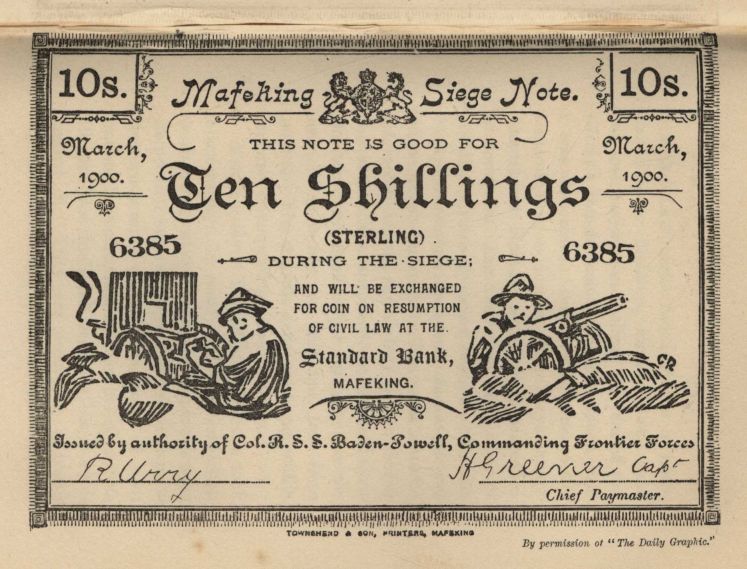
Mafeking Siege Note
24th. Last night Sub-Inspector Murray and Trooper Melahue, Cape Police, went out, and having reconnoitred the rear of the enemy's trench, came to the conclusion that it was unoccupied. Inspector Browne, of the Cape Police, and the Cape Boys under Lieutenants Feltham and Currie, proceeded to occupy it. The Boers had left a mine of 250 lbs. of nitro-glycerine behind. Sergeant Page, Protectorate Regiment, discovered and disconnected the wire. The men cheered themselves hoarse, and rightly too, for this is the most decisive success we have scored since the commencement of the campaign, as the town is now for the first time free from musketry fire, and our guns are again within striking distance of the Boer artillery.
25th, Sunday. The Siege Exhibition took place to-day. A most creditable exhibition from the ingenuity shown, and also considering its peculiar surroundings. We shall hope to forward some of our exhibits home. I went out and inspected the Boer trench. If it is "an ill bird that fouls its own nest," a Boer is indeed ill. They are occupying a trench about seven hundred yards away, from which they shoot with a certain amount of precision, but with no result, upon their late happy home. Personally, I particularly wished to inspect the brick kilns, at which I had discharged some hundred rounds of ammunition. It is very interesting, but still somewhat annoying to find that it is practically bullet proof; however, on the other hand, the particular place of resort from which I had fired the said ammunition was also fairly safe, so perhaps I had no reason to grumble, and at any rate I had frequently silenced them.
26th, Monday. Exceptionally quiet to-day. Late at night I was in Mr. Weil's dug-out when he received the news of the English troops' arrival at Vryburg. Mafeking accordingly jubilant.[#]
[#] This eventually turned out to be untrue.
27th, Tuesday. The Boers commenced early and continued a heavy shell fire all day, pouring more shells into the town than they had any two days of the siege. It was very curious, but the news received the night before caused the population to show more absolute disregard for the shell fire than they had done on many days when the bombardment was comparatively light. The Premier's message to the two Presidents was published this evening, and now even the most pessimistic admit it is possible that there may be a satisfactory solution of the war. We hope we may be able to slightly assist in a less passive manner than heretofore.
28th, Wednesday. After our treat of yesterday, absolute quiet reigns to-day. Really there is no understanding the Boers. Our locally manufactured field-piece burst last night, but the shell managed to reach the Boer laager. What they contemplate and what is their plan of campaign leaves everybody wondering. No ulterior object can be obtained by their desultory mode of conducting operations. Occasional casualties, which is apparently their only object, is the sole result arrived at, and these casualties are, we think, more heavy on their side than ours.
29th, Thursday. A quiet day. The Boers gradually evacuating their eastern trenches.
30th, Friday. The guns are fairly quiet. We are gradually occupying the evacuated trenches.
31st, Saturday. In the morning a quiet day. In the afternoon a body of four hundred or five hundred Boers and three guns hastily left their eastern laager in a northerly direction. I took up a position in the convent, and from there could see considerable confusion and excitement amongst the Boers galloping backwards and forwards in the direction of Signal Hill. The sound of guns too was distinctly audible to the north, some six or seven miles away. The garrison livened up. The guns under Major Panzera and Lieutenant Daniells commenced playing from every face. A mounted squadron under Major Grodley demonstrated towards Game Tree fort on the north. For an hour or so things were lively, but quieted down.