Chapter IX · MIDDLE AGES AND LATER (continued 2)
Reading edition
Margaret: There’s too much disparity
between his quality and mine, to hope it.
Overreach: I more than hope’t, and doubt not to effect it.
Be thou no enemy to thyself, my wealth
Shall weigh his titles down, and make you equals.
Now for the means to assure him thine, observe me:
Remember he’s a courtier and a soldier,
And not to be trifled with; and therefore, when
He comes to woo you, see you do not coy it:
299This mincing modesty has spoil’d many a match
By a first refusal, in vain after hop’d for.
Margaret: You’ll have me, sir, preserve the distance that
Confines a virgin?
Overreach: Virgin me no virgins!
I must have you lose that name, or you lose me.
I will have you private—start not—I say, private;
If thou art my true daughter, not a bastard,
Thou wilt venture alone with one man, though he came
Like Jupiter to Semele, and come off, too;
And therefore, when he kisses you, kiss close.
Margaret: I have heard this is the strumpet’s fashion, sir,
Which I must never learn.
Overreach: Learn any thing,
And from any creature that may make thee great;
From the devil himself.
Margaret (aside): This is but devilish doctrine!
Overreach: Or, if his blood grows hot, suppose he offer
Beyond this, do not you stay till it cool,
But meet his ardor; if a couch be near,
Sit down on’t, and invite him.
Margaret: In your house,
Your own house, sir! For Heaven’s sake, what are you then?
Or what shall I be, sir?
Overreach: Stand not on form;
Words are no substances.
Margaret: Though you could dispense
With your own honor, cast aside religion,
The hopes of Heaven, or fear of hell, excuse me,
In worldly policy this is not the way
To make me his wife; his whore, I grant it may do.
My maiden honor so soon yielded up,
Nay, prostituted, cannot but assure him
I, that am light to him, will not hold weight
Whene’er tempted by others; so, in judgment,
300When to his lust I have given up my honor,
He must and will forsake me.
Overreach: How! I forsake thee!
Do I wear a sword for fashion? or is this arm
Shrunk up or wither’d? Does there live a man
Of that large list I have encounter’d with
Can truly say I e’er gave inch of ground
Not purchas’d with his blood that did oppose me?
Forsake thee when the thing is done! He dares not.
Give me but proof he has enjoy’d thy person,
Though all his captains, echoes to his will,
Stood arm’d by his side to justify the wrong,
And he himself in the head of his bold troop,
Spite of his lordship, and his colonelship,
Or the judge’s favor, I will make him render
A bloody and a strict account, and force him,
By marrying thee, to cure thy wounded honor!
I have said it.
As late as the eighteenth century, in Italy, phallic amulets, in the form of the fascinum itself and the obscene digital gesture called in French la figue, were in common use. They were worn by children as protective periapts. Chapels too were decorated with wax images of phalli, dedicated by devout women worshippers.
An esoteric club existed in England in the eighteenth century that was associated with the British Navy. It was called The Very Ancient and Very Powerful Order of Beggars Benison and Merryland. On the seal of this Society, among other and naval designs, was a phallic symbol. The intent of the Society is still obscure, especially the relation between naval matters and the phallus.
Amulets in the form of the male mandrake came into vogue in the Middle Ages, especially in Central Europe, for 301apotropaic and amatory purposes. These charms were associated with incantations and magic formulas and recitatives.
The phallus or fascinum, too, especially in France, was used, as a meaningful protective agent, on buildings and even on churches.
Phallic and other genital forms were also used for cakes and breads: and are still so used, especially in Germany and France.
In the Middle Ages Priapus assumed Christian characteristics and in time was even endowed with sanctity, although he still retained his functional properties. In many cities of Southern France, for instance, Saint Foutin was virtually a transferred Priapus. He aided sterile women and renewed the amatory vigor of men. Images of genitalia were included among the sacrificial objects dedicated to this saint.
In medieval France a certain Saint Greluchon was a cryptic Priapus, venerated among the members of the saintly canon. When women made supplication to this saint, they scraped off minute particles from the stone genitalia and compounded these scrapings into an amatory potion, and also as an aid to counteract sterility.
Other saints to whom were attributed the virtues and functions of Priapus were: Saint Guignolet, Saint Regnaud, Saint Gilles.
In Belgium, Priapus became Ters, equally venerated by women. Ters, in Antwerp, was actually a synonym for fascinum.
Among the gods of Northern Europe was Frikko, who may be equated with Priapus, the phallic deity. The Saxons had a similar god, called Frisco, endowed with the same functions. An analogous deity was Frigga, goddess of voluptuousness. Before the worship of this symbolic or actual 302phallus was the worship of the sun, represented by the phallus as the creator of cosmic and human fecundity.
Clauder
A German medieval scholar presented for his doctoral thesis a brief monograph on Philtres, their essential characteristics, the dangers involved in their use, the contents, the purpose of their employment. The thesis, in Latin, is entitled De Philtris, and was published in Leipzig in 1661. The author is Johannes Clauder.
Although philtres were frequently used for erotic purposes, the author asserts, the result rarely corresponded to the intention. The reason for this was that the philtre was concocted under evil auspices, without appeal to divine aid and protection. Another reason for the inefficacy of the potions was improper and defective preparation. The result, he declares categorically, was very often madness for the victim, or even death itself.
Some philtres are associated with Satanic and magic practices, and are essentially poisons. Whores and panders resort to such philtres, although some use what might be termed natural remedies.
The best philtre, however, according to Clauder, is love itself. In this regard, he quotes confirmatory statements from the Romans. Seneca the philosopher, in one of his 124 Epistles, advises: I shall show you a love philtre, without medicaments, without herbs, without a witch’s incantations. It is this: If you want to be loved, love. Martial, the Roman epigrammatist, has something similar to say: Marcus, in order to be loved, love.
And Ovid had already advised: Banish every evil, be lovable, in order to be loved.
Paracelsus, the medieval scholar and alchemist, is quoted in relation to the philtre and its content. Or, as Clauder 303suggests, the amatory inducement may take the form of a magic inscription on a key, or a ring, or a necklace, or an armlet. As for herbs, the Romans preferred the laurel and the olive, in infusions. Vegetable and mineral and organic matter is also in use; perspiration, urine, spittle. But there is a sinister and hazardous element in such practices. Prostitutes in particular, Clauder threatens, use philtres that rob the victim of mind and soul and leave him a shallow husk. So corroborates Paracelsus. There is one potion, however, called Charisia, that may be innocuous. It has not been identified. But possibly the name may have been invented etymologically on the basis of the Greek charis, which means grace or gratitude: and hence the nomenclature is wishfully proleptic in significance.
With respect to a variety of lustful and amatory circumstances, the Middle Ages were marked by strange social mores, by monstrous obscenities and erotic barbarities. There were practices designed primarily to preserve chastity and marital and domestic purity, but they actually resulted in greater indecencies than the circumstances that induced these inventive prophylaxes. There was, first of all, the girdle of chastity, a mechanical device to prevent indiscriminate and unlawful lustful consummations in the absence of the husband. The putative inventor of the device was Francesco da Carrara, Provost of Padua, who belongs in the latter part of the fourteenth century. He himself, it was said, met with a miserable death, being strangled on the scaffold for his many cruelties, in 1405, by order of the Senate of Venice.
There was, too, the Congress, a kind of judicial body that determined marital questions, quarrels, incompatibility, by viewing the two participants in actu sexuali.
Men and women taken in adultery were compelled to march through the public streets naked, sometimes mounted on an ass, for centuries the bestial symbol of lust.
There was the libidinous ius primae noctis, the droit de 304cuisse, exercised by the lord of the manor, and on occasion by monks and prelates, in the case of a newly wedded couple.
In France, in the city of Toulouse, there was a notorious brothel called The Great Abbey. There were, dispersed through France, many such pseudo-abbeys, the madame of which, in each case, was called Abbess. Such terms and such practices, of course, heightened the lewd obscenity. There was a similar type of dissolute haven that had an infamous reputation in England.
This perversion, in which devout elements are linked with the extremes of lust, to heighten the amatory impulse, is described in abundant and salacious detail in the novels of the Marquis de Sade and in other instances of erotic literature.
Prostitution reached such a social importance, and the practitioners acquired such influence in various directions, that, in Paris, a kind of trade union was formed, to which the practicing prostitutes prescribed. They established their own procedures, their working hours, and similar regulations.
At many royal banquets, public entertainments, and processional ceremonials, in Italy and in France, prostitutes were prominent participants, some half-naked, often entirely so.
There were, of course, fulminations against such and similar indecencies, but without much immediate or effective results. Preachers thundered, to no avail, against the erotic provocations to adultery and fornication engendered by the sight of women who, by the subtlety of their dress, exposed various parts of their person. There was public debauchery. There were genesiac performances in the presence of the children in a household. There were poems and tales, called fabliaux, that, reflecting the mores of the age, dealt with nothing but cuckoldry and fornication, adultery, sodomy, bestiality, and all the multiple varieties of physiological perversions.
305Furthermore, houses, manors, large estates were decorated with tapestries, paintings, sculpture, all depicting the greatest obscenities. Even churches and chapels and abbeys contained scenes, figures, statues of the utmost lewdness in posture, presentation, and implication.
Among the barbarities of the medieval centuries, many performances, processions, and rites contained an amazing mingling of ecclesiastical elements and dissolute blasphemies and libertinage: just as the Greek satyr plays and the comedies of fifth century Athens were composites of functional representations by human actors of the libidinous and irreverent actions of the deities themselves.
The medieval scene contained secular and monastic lubricity, and processions and rites in which the performers, under the guise of nuns and prelates, presented shameless and unspeakable obscenities. In addition, flagellation was inflicted on penitents. In Germany, France, England, and Italy, all ranks, of all ages, underwent phallic castigation as an act of devotion.
In Girolamo Folengo’s Maccaronea, published in 1519, there is mention of manuals that provide magic instruction and prescriptions favorable in inducing or diverting erotic urges:
He opens the manuals, or reads all that are open:
How to write arcane spells:
How to compel love;
How a husband can find out his wife’s adultery;
How virginal maidens can be forced to love;
How to make a hated husband impotent.
During the Italian Renaissance the women of Italy 306played a dominant and sometimes sinister part in both social and political life. Courtesans, particularly in Rome, had a position somewhat analogous to that of the Greek hetairae. One such courtesan, Imperia, had skill in composing sonnets. Most of them were literate and interested in intellectual pursuits as well as in erotic interludes. Caterina di San Celso played and sang. Many women of this type are described by Giraldi in the novels of the Hecatommithi and by Pietro Aretino in his Ragionamenti.
The Italian Renaissance was marked by both literary and social indecencies and lewd lubricities and all kinds of scatological productions and performances. In the lavish public entertainments, in the Carnivals and Masques, apart from contests, reviews, pantomimic presentations, the emphasis was consistently on scandalous songs, with lascivious undertones, innuendoes, suggestions.
In literature, the moral atmosphere of this period is reflected in the depiction of the most common Renaissance features—adultery and cuckoldry, all kinds of illicit amours, lusts resulting in secrecies, gallantries, murder. To satisfy her lusts, a woman poisons her husband. An adulteress has her lover kill her husband, without hesitation, without compunction. Love and lust, poison and death, infidelities and vengeance followed each other in an abandoned, frenzied, amoral sequence.
The Italian strega or witch was a powerful intermediary in amatory affairs of all sorts. With her preparations, her thaumaturgic skills, her secret concoctions, she aided men and women in consummating erotic urges, arousing lustful sensualities, securing the love of hesitant objects of passion, promoting vigor and virility, arranging furtive amatory assignations: acting, in short, as an amatory midwife, an empirical guide in debauchery.
By her magical skill the strega was able to aid men and women bent on amatory consummations. Some of these skills were transferred to the prostitutes. Acquiring these 307techniques, and discovering the secrets of preparing potions, they were able to retain a lover, to lure a new admirer. For their concoctions and brews they used human teeth and the eyes of dead men, skulls and ribs, scraps of the flesh of corpses, hair and nails boiled in oil. They made a fire of burning ashes, in the form of a heart. Piercing the heart, they chanted their goetic invocation, anticipating the surrender of the hesitant lover by this means of sympathetic magic. In this sphere, in fact, the Italian Renaissance had taken over, as it were, the entire corpus of ancient magic rites, love brews, and concomitant procedures in the art of erotic control.
A solemn love conjuration appears in a medieval manual called the True Grimoire. The invocation itself is preceded by special preparations during the waxing or the waning of the moon. An inscription is written on virgin parchment, by the light of a taper. The supplication runs:
I salute thee and conjure thee, O beautiful Moon, O most beautiful Star, O brilliant light which I have in my hand. By the air that I breathe, by the breath within me, by the earth which I am touching: I conjure thee. By all the names of the spirit princes living in you. By the ineffable Name On, which created everything! By you, O resplendent Angel Gabriel, with the Planet Mercury, Prince, Michiael, and Melchidael.
I conjure you again, by all the Holy Names of God, so that you may send down power to oppress, torture, and harass the body and soul and the five senses of her whose name is written here, so that she shall come unto me, and agree to my desires, liking nobody in the world, for so long as she shall remain unmoved by me. Let her then be tortured, made to suffer. Go, then, at once! Go, Melchidael, 308Baresches, Zazel, Firiel, Malcha, and all those who are with thee! I conjure you by the Great Living God to obey my will, and I promise to satisfy you.
A technique involving the separation of husband and wife, the converse of a love-potion intended to attract or cement passion, appears in the following invocation from a magic grimoire called the Sword of Moses:
I conjure you, luminaries of heaven and earth, as the heavens are separated from the earth, so separate and divide N from his wife N, and separate them from one another, as life is separated from death, and sea from dry land, and water from fire, and mountain from vale, and night from day, and light from darkness, and the sun from the moon; thus separate N from N’s wife, and separate them from one another in the name of the twelve hours of the day and the three watches of the night, and the seven days of the week, and the thirty days of the month, and the seven years of Shemittah, and the fifty years of Jubilee, on every day, in the name of the evil angel Imsmael, and in the name of the angel Iabiel, and in the name of the angel Drmiel, and in the name of the angel Zahbuk, and in the name of the angel Ataf, and in the name of the angel Zhsmael, and in the name of the angel Zsniel, who preside over pains, sharp pains, inflammation, and dropsy, and separate N from his wife N, make them depart from one another, and that they should not comfort one another, swift and quickly.
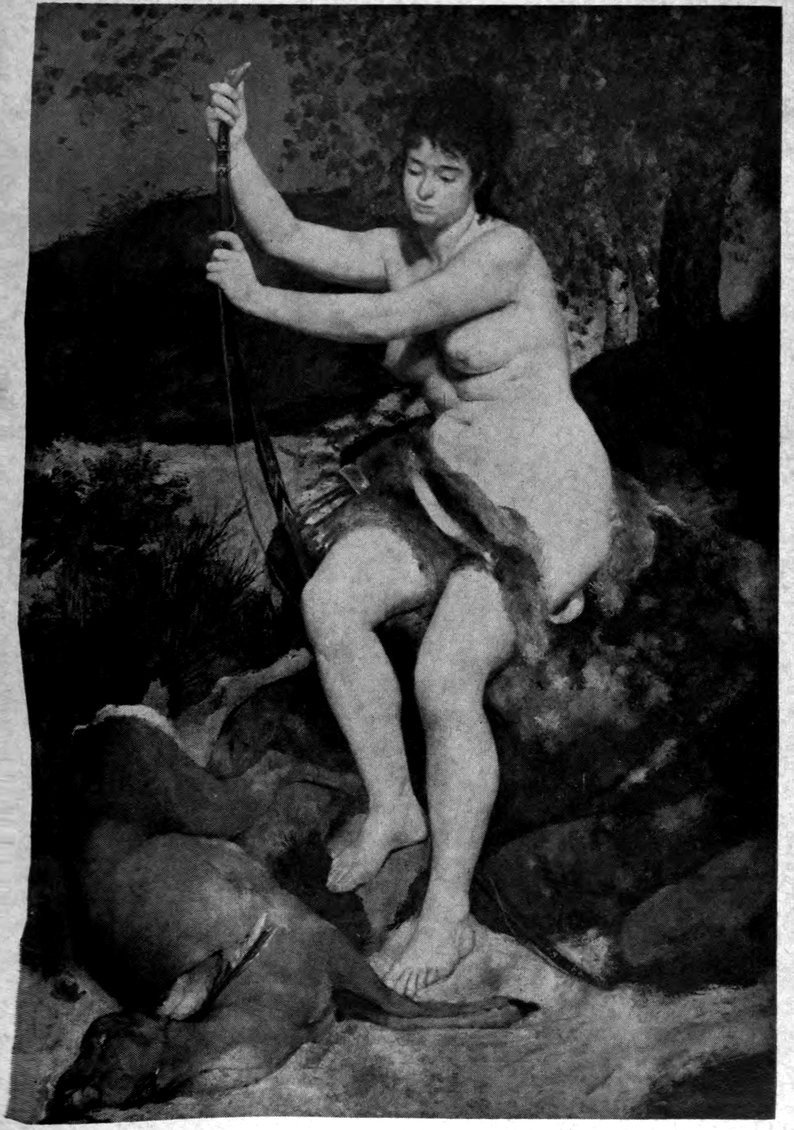
National Gallery of Art DIANA by Renoir
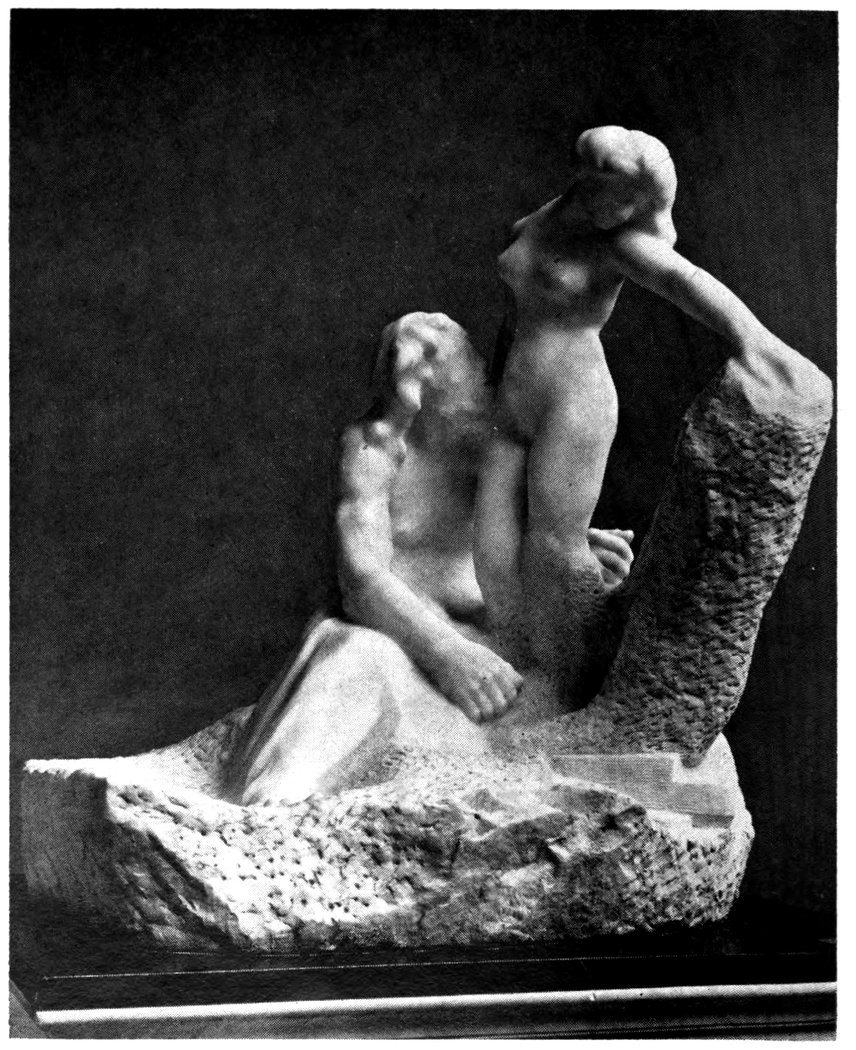
Metropolitan Museum of Art PYGMALION AND GALATEA by Rodin
309In the middle centuries prostitution as a civic institution had its distinction and its privileges. In Venice, all kinds of secondary favors were granted to these practitioners. They were favored with an indulgent and even eulogistic Latin testimonial: nostrae bene merentes meretrices.
In France, there were orgiastic ceremonies in which the participants performed in the nude. These rituals were associated in a contorted sense with primal creation and were known as Fêtes d’Adam.
In one of Boccaccio’s tales there is an instance of a script intended as an erotic provocation:
Quoth Bruno, ‘Will thy heart serve thee to touch her with a script I shall give thee?’
‘Ay, sure,’ replied Calandrino; and the other, ‘Then do thou make shift to bring me a piece of virgin parchment and a live bat, together with three grains of frankincense and a candle that hath been blessed by the priest, and leave me do.’
Accordingly, Calandrino lay in wait all the next night with his engines to catch a bat and having at last taken one, carried it to Bruno, with the other things required; whereupon the latter, withdrawing to a chamber, scribbled divers toys of his fashion upon the parchment, in characters of his own devising, and brought it to him, saying, ‘Know, Calandrino, that, if thou touch her with this script, she will incontinent follow thee and do what thou wilt.’
In Turkey, under the Sultanate, and notably in the sixteenth century, erotic relations in the seraglio were stimulated by a preparation known as pastilles de sérail.
In the sixteenth century there was a religious-erotic cult in Europe whose members were called Loïstes. Their rituals were marked by sexual orgies and erotic aberrations.
310The corpus of Shakespearean plays contains numberless allusions and comments on sexual and amatory topics. The language, however, in which these references are couched is sometimes figurative, euphemistic, and seemingly innocuous and ingenuous. Sometimes, again, they are so expressed in the contemporary Elizabethan idiom as to have an immediate and illuminating impact on the contemporary audience: but, on a cursory perusal, the context may not spontaneously reveal the underlying currency.
There is, throughout the plays, mention of the functional processes and their media, of the organs of the human body, including what are usually termed pudenda. Shakespeare touches on the normal sexual functions and also on deviations, on tribadism and coprophilia, on lust and cuckoldry, on adultery and eunuchs, on all manner of erotic encounters, embraces, and circumstances.
In Troilus and Cressida, to take an example, lust, libido, and potency are illustrated:
Cressida: They say all lovers swear more performance than they are able, and yet reserve an ability that they never perform: vowing more than the performance of ten, and discharging less than the tenth part of one. They that have the voice of lions and the act of hares, are they not monsters?
Act 3.2
Again:
Troilus: This is the monstrosity of love, lady—that the will is infinite and the execution confined; that the desire is boundless and the act a slave to limit.
Act 3.2
Troilus: What will it be
When that the watery palate tastes indeed
311Love’s thrice repured nectar?—death, I fear me,
Swooning distraction, or some joy too fine,
Too-subtle potent, tuned too sharp in sweetness,
For the capacity of my ruder powers:
Act 3.2
There are similar references in The Merry Wives of Windsor, Twelfth Night, and A Midsummer Night’s Dream.
In Pericles Priapus is mentioned as a symbol of virility:
Pericles: Fie, fie upon her!
She’s able to freeze the god Priapus.
François Villon, the fifteenth century French lyric poet, was not too happy in his loves. In his Double Ballade he makes his personal confession on amatory exercises, and gives due admonitions as to the possible effects of erotic practices:
Then love until you have your fill,
Follow the ball and midnight feast,
The end will bring you naught until
You break your head, to say the least;
For foolish loves make man a beast:
Idolatrous was Solomon,
And thereby Samson’s vision ceased.
Happier those who all this shun!
And Orpheus, sweet troubadour,
Who piped his flute among the dead,
Risked mortal peril on its spoor
From Cerberus of the triple head;
And beautiful Narcissus fled,
Because of love too lightly won,
To seek his peace in a watery bed.
Happier those who all this shun!
312Sardana, once a valiant knight,
Who conquered all the realm of Crete,
Aped woman’s form and took delight
In girlish chores and things effete;
And David, quitting wisdom’s seat,
Forgot his fear of God for one
Whose perfumed thighs aroused his heat.
Happier those who all this shun!
And Amnon, drunk with carnal power,
Feigning to gorge himself the while,
Plucked lovely Tamar’s virgin flower,
A deed incestuous and vile;
Herod—and here I use no guile—
Had John the Baptist’s head undone
For a dance, a song, a dancer’s smile.
Happier those who all this shun!
Of my poor self I wish to speak:
Beaten like washing in a stream,
Entirely nude—no tongue in cheek—
Who made me chew such sour cream
But Kate Vausselles? Noël I deem
Made up the three to share the fun.
Such wedding mittens costly seem.
Happier those who all this shun!
But is this hot, young blood to spurn
Their tender love and flee their sight?
May God forbid! Such ought to burn
As witches do who ride the night.
Sweeter than civets their delight,
But not to put your trust upon:
For be they brown or be they white,
Happier those who all this shun!
313As late as the eighteenth century, in Central Europe, there were secret cults that drew their basic tenets from ancient priapic rites. Some of these orders practiced nudism but rejected marriage. Some encouraged promiscuities in their ritualistic assemblies. The Ebionites, for instance, were of this type. Also the Basilidians, a Gnostic sect that followed the principles of the founder Basilides, a Gnostic who flourished in Alexandria in the second century A.D.; also the Nicolaitans, an early Christian sect.
In Italy, in the eleventh century and the twelfth, there was a similar sect known as the Patarini. They made obscene obeisance to a black cat, evidently a variant Satanic form, then abandoned themselves to scenes of frantic lubricity.
So too in many regions of France that still recalled ancient pagan Gaul similar orgiastic performances occurred under cover of darkness.
Even the Knights Templars, the military-religious members of the Order that was founded early in the twelfth century and was suppressed at the beginning of the fourteenth century, were reputed to have aligned themselves with foul obscenities that involved anal osculation, as in the case of the witch members of the Satanic Sabbat, and desecration of Christian ritual accompanied by erotic perversions.
Sympathetic magic and the use of wax images were common means of securing amatory ardor compulsively. The ancients were intimately familiar with the procedures. And the grimoires current in medieval times were similarly repositories of dark and occult amatory techniques, and likewise recommended a variety of rituals. Involved in the ceremonials were of course darkness, the burning of incense, the construction of special pentagrams and magic circles, the shaping of the figurine, and the Latin invocation which gave final assurance to the erotic effects.
314Amatory intimacies, especially but not exclusively in the Middle Ages, were believed possible between human beings and disembodied creatures, incubi and succubi, sylphs and undines or water spirits, salamanders, various types of Satanic emissaries and subordinates in the infernal hierarchy, such as Isheth Zemunin, who presided over prostitution.
Some of these mystic, occult unions, on the other hand, were associated with beneficent spirits, with angelic embodiments, saints, and similar personalities.
In the malefic traditions of the Black Arts and demoniac relationships, there was widespread credence in intercourse between witches and the members of the Satanic legions, between sorceresses and Satan himself, and between the practitioners of magic and all kinds of bestial and obscene creatures. The medieval demonographers are soberly voluble in recounting many such instances. They chronicle, with precise supporting confirmatory testimony, tales that brought the participants, the old and the young women so accused of diabolic intimacies, to trial, to torture, and finally to the gallows.
Ready and voluminous evidence comes from Guazzo and Johannes Anania and Jean Bodin, from Henri Boguet and Delrio, from Tartarotti, Stridtbeckh, Sinistrari and Ricardus, Molitor, de L’Ancre, Elich, and Daugis.
At the Sabbats, the assemblies of witches and Satanic forces, there were, according to the medieval chroniclers and the old European folk traditions, frantic performances of the most obscene nature, monstrous rituals, weird banquets, culminating in lewd orgies characterized, according to the grave testimonies of the demonographers, by copulation of witches and materialized demoniac spirits.
The Aphroditic force and influence are all-pervasive. Hence, in the field of astrological lore, Venus represents love, in its most extended sense, normal, illicit, and aberrational. Certain symbols, creatures, forms are regularly 315associated with her functions. The lubricities of the goat and the bull are under her sway, while, botanically, many plants, among them vervain and myrtle, are endowed with aphrodisiac qualities.
316