Front matter (continued 3)
Reading edition
Yeoland, halting on a slope above the pine woods, looked back and saw something that made her crane her neck and wax vigilant. Out of the wine-red east and the twilight gloom came the lightning of harness, the galloping gleam of armed men. Jaspar's blear eyes were unequal to the girl's. The men below were riding hard, half under the lea of the midnight pines, whose tops touched the sunset. A half-moon of steel, their crescent closed wood and moor. They had the lead in the west; they were mounting the slope behind.
Jaspar saw them at last. He was for galloping. Yeoland held him in.
"Fool, we are caught. Sit still. We shall gain nothing by bolting."
A knight was coming up the slope at a canter. Yeoland saw his shield, read it and his name. She went red under her hood, felt her heart beating, wondered at its noise.
Youth, aglitter in arms, splendid, triumphant! A face bare to the west, eyes radiant and tender, a great horse reined in on its haunches, a mailed hand that made the sign of the cross!
"Madame, your pardon."
He drew Balthasar's picture from his bosom and held it before her eyes.
"My torch," he said, "that led me to see your face again."
The girl was silent. Her head was thrown back, her slim throat showing, her face turned heavenwards like the face of a woman who is kissed upon the lips.
"You have seen your home?"
"Yes, messire."
"God pardon me your sorrow. You see I am no hypocrite. I keep my vows."
"Yes, messire."
"Madame, let me be forgiven; you have trusted one man, trust another."
She turned her horse suddenly and began to ride towards the black maw of the forest. Her lips were tightly closed, and she looked neither to the right nor the left. Flavian, a tower of steel, was at her side. Armed men ranged in a circle about them. They opened ranks at a sign from their lord, and gave the woman passage.
"Madame----"
"Messire----"
"Am I to be forgiven?"
She was mute a moment, as in thought. Then she spoke quietly enough.
"Yes, for a vow."
"Tell it me."
"If you will never see my face again."
He looked at her with a great smile, drew his sword, and held the point towards her.
"Then give me hate."
"Messire!"
"Hate, not forgiveness, hate, utter and divine, that I may fight and travail, labour and despair."
"Messire!"
"Hate me, hate me, with all the unreason of your heart. Hate me a hundred times, that I may but leap a hundred times into your life. Bar me out that I may storm your battlements again and again."
"Are you a fool?"
"A glorious, mad, inspired fool."
They were quite near the trees. Their black masses threw a great shadow over the pair. Higher still the sky burnt.
"Madame, whither do you go?"
"Where you may not venture, messire."
"God, I know no such region."
She flashed round on him with sudden bitterness.
"Go back to your wife. Go back to your wife, messire; remember her honour."
It was a home-thrust, but it did not shame or weaken him. He sheathed his sword, and looked at her sadly out of his grey eyes.
"What a world is this," he said, "when heaven comes at last, hell yawns across the path. When summer burns, winter lifts its head. Even as a man would grow strong and pure, his own cursed shackles cumber him. To-night I say no more to you. Go, madame, pray for me. You shall see my face again."
He let life vanish under the pines, and rode back with the sunset on his armour, his face staring into the rising night. His men came round him, silent statues of steel. He rode slowly, and met his wife.
Her eyes were turbulent, her lips red streaks of scorn.
"Ha, sire, I have found you."
"Madame, I trust you are well?"
They looked at each other askance like angry dogs, as they rode side by side, and the night came down. The men left them to themselves, and went on ahead. A wind grew gusty over the moor.
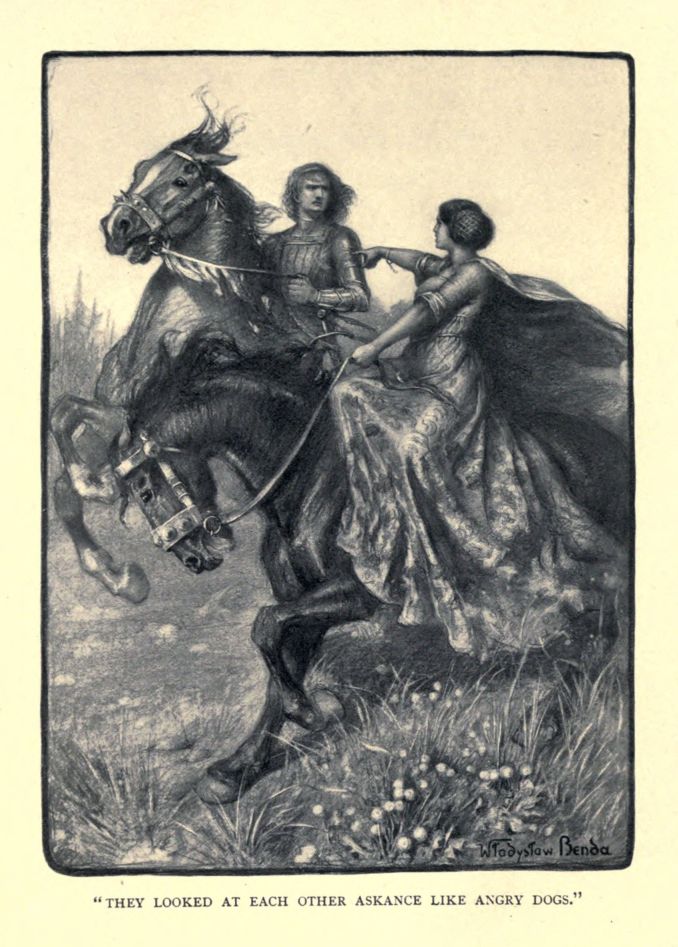
"THEY LOOKED AT EACH OTHER ASKANCE LIKE ANGRY DOGS."
"Messire, I have borne enough from you."
"Madame, is it fault of mine?"
His whole soul revolted from her with an immensity of hate. She cumbered, clogged, crushed him. Mad brutality leapt in his heart towards her. He could have smitten the woman through with his sword.
"Five years ago----" she said.
"You did the wooing. Damnation, we have been marvellously happy."
She bit her lip and was white as the moon.
"Have a care, messire, have a care."
"Threats, threats."
"Have a care----"
"Look at my shield. Have I quartered your arms with mine? God's blood, there is nothing to erase."
"Ha!"
"We have no children."
"Go on."
"I shall send gold and an embassage to the Pope."
She clenched her hands and could not speak for the moment.
"You dare do this?"
"I dare ten thousand greater things than this."
"By God, messire."
"By God, woman, am I going down to hell because you are my wife!"
She grew quiet very suddenly, a dangerous move in a woman.
"Very well," she said, "try it, dear lord. I am no fool. Try it, I am as strong as you."
And so they rode on towards Avalon together.
XVI
It is impossible for two persons of marked individuality to be much together without becoming more or less faceted one towards the other. We appeal by sympathy, and inspire by contrast. What greater glory falls to a man's lot than to be chastened by the warm May of some girl's pure heart! Yeoland had felt the force of Fulviac's manhood; the more eternal and holier instincts were being stirred in him by a woman's face.
The man's life had been a transmigration. In his younger days the world had banqueted him; new poignancies had bubbled against his lips in the cup of pleasure. Later had come that inevitable weariness, that distaste of pomp, the mood that discovers vanity in all things. Finally he had set his heart upon a woman, a broken reed indeed, and had discovered her a hypocrite, according to the measure of her passions. There had been one brief burst of blasphemy. He had used his dagger and had disappeared. There had been much stir at the time. A ruby had fallen from the King's crown. Some spoke of Palestine, others of a monastery, others of a cubit of keen steel.
Fulviac had begun life over again. He had fallen back upon elemental interests--had gone hungry, fought for his supper, slept many a storm out under a tree. The breath of the wilderness had winnowed out luxury; rain had scourged him into philosophic hardihood. He had learnt in measure that nothing pleases and endures like simplicity. Even his ambition was simple in its audacious grandeur.
Now the eyes of the daughter of Rual were like the eyes of a Madonna, and she stood in a circle of white lilies like the spirit of purity. Fulviac had begun to believe in her a little, to love her a little. She stood above all other women he had known. The ladies of the court were superb and comely, and marvellously kind, but they loved colour and contemned the robe of white. They were like a rich posy for a man to choose from, scarlet and gold, azure, damask or purple. You could love their bodies, but you could not trust their souls.
As for the girl Yeoland, she was very devout, very enthusiastic, but no Agnes. Her rosary had little rest, and with the suspicions of one not utterly sure of herself, she had striven to make religion and its results satisfy her soul. In some measure she had succeeded. Yet there is ever that psychic echo, that one mysterious being, subtle as the stars, that may come before Christ in the heart. Transcendent spirit of idolatry! And yet it is often heaven-sent, seeing that it leads many a soul to God.
It had become Yeoland's custom to walk daily in the pine wood at the foot of the stairway leading from the northern room. She had discovered a quaint nook, a mile or more from the cliff, a nook where trees stood gathered in a dense circle about a grassy mound capped by a square of mouldering stone. It was a grave, nameless and without legend. Perhaps a hermit had crumbled away there under the sods, or the bones of some old warrior slept within rusty harness. None knew, none cared greatly. Fulviac's men had hinted at treasure, yet even they were kept from desecrating the place by a crude and superstitious veneration for the dead.
She had wandered here one day and had settled herself on the grassy slope of the grave. The ribbon of her lute lay over her shoulder. A breeze sang fitfully through the branches, and a golden haze shimmered down as from the clerestory windows of a cathedral. Her lute seemed sad when it made answer to her fingers. Thought was plaintive and not devotional, if one might judge by the mood of the music, and the notes were wayward and pathetically void of discipline.
It was while the girl thrummed idly at the strings that a vague sound floated down to her with the momentary emphasis born of a fickle wind. It was foreign to the forest, or it would not have roused her as it did. As she listened the sound came again from the west. It was neither the distant bay of a hound nor a horn's solitary note. There was something metallic about it, something musical. When it disappeared, she listened for its recurrence; when she heard it again, she puzzled over its nature.
The sound grew clearer at gradual intervals, and then ceased utterly. The girl listened for a long while to no purpose, and then prepared to forget the incident. The decision was premature. She was startled anon by the sound breaking out at no great distance. There was no doubt as to its nature: it was the clanging of a bell.
Yeoland wondered who could be carrying such a thing in such a place. Possibly some of Fulviac's men were coming home with stolen cattle, and an old bell-wether from some wild moorland with them.
The sound of the bell came very near; it seemed close amid the circling ranks of pines. Twigs were cracking too, and she heard the beat of approaching footsteps. Then her glance caught something visible, a streak of white in the shadows, moving like a ghost. The thing went amid the trees with the bell mute. The girl's doubts were soon set at rest as to whether she had been seen or no. The figure in grey slipped between the pines, and came out into the grass circle about the grave, cowled, masked, bell at girdle, a leper.
The girl stared at it with a cold flutter at her heart. The thing stood under the boughs motionless as stone. The bell gave never a tinkle; a white chin poked forward from under the hood; the masked face was in shadow. Then the bell jangled, and a gruff voice came from the cowl.
"Unclean, unclean!" it said; "avoid the white death, and give alms."
Yeoland obeyed readily enough, put a portion of the grave betwixt herself and the leper, fumbled in her pouch and threw the man a piece of silver. He came forward suddenly into the light, fell on his knees, put his hood back, plucked off the mask.
It was the face of the Lord Flavian of Gambrevault.
The girl stood and stared at him with unstinted astonishment.
"You," she said, "you?"
"Madame, I said that you should see my face again."
She conceived a sudden impetuous desire to turn and leave him on his knees, but some inner potency of instinct restrained her. She looked down at the man, with no kindling kindness upon her face. She did not know what to say to him, how to tune her mood. The first thought that rushed into her mind was seized upon and pressed into service, discretion or no discretion.
"Madman, they will kill you if they find you here."
"No woman ever loved a coward."
"For Heaven's sake, go away."
He rose from his knees and lifted up his frock. The girl saw harness and a sword beneath it. This young leopard of the southern shores had fettle enough, and spirit. He was a mixture of imperturbable determination and sanguine Quixotism, as he faced her under the trees.
"This dress is privileged; my bell warns folk away; who would fall foul of a miserable leper? If this frock fails me, I have my sword."
She looked at him with the solemnity of a child, hand folded in hand.
"I cannot understand you," she said.
"Not yet."
"Are you the man whose life I saved? That breath of death on your brow, messire, should have made you thoughtful of your soul."
"Let me plead a moment."
"For what?"
"My honour."
"Why your honour?"
"Because I want you to believe that I have a soul."
He was vastly earnest, and his eyes followed her, as though she were some being out of heaven. She had never seen such a look in a man's eyes before; it troubled her. She questioned her own heart, laughed emptily, and gave in to him.
"We are both mad," she said, "but go on. I will listen for one minute. Keep watch lest any one should come upon us suddenly."
She sat down on the grass bank, while he stood before her, holding his lazar bell by the clapper.
"Look at this dress," he said.
"Yes?"
"It is how I feel in soul when I look at you."
She frowned visibly.
"If you wax personal, messire, I shall leave you."
"No, no, I will keep to my own carcase, and play the egotist. Well, I will be brief. Look at me, I am the first lord in the south, master of an army, one of the twelve knights of the Order of the Rose."
"Go on."
"When I was twenty years old, certain clever people found me a wife, a woman five years my senior in time, twenty years my superior in knowledge of the world. Well, six months had not passed before I hated her, hated her with my whole soul. My God, what a thing for a boy to begin life with a woman who made him half the bounden vassal of the devil!"
"You seem generous. The faults were all on her side."
"Madame, I say nothing against the woman, only that she had no soul. We were incompatible as day and night, fire and water. The thing crushed the youth out of me, made me desperate, and worse, made me old beyond my years. I have done my best. I have groped along like a man in the dark, knowing nothing, understanding nothing, save that I had a warm heart in me, and that life seemed one grim jest. The future had no fire for me; I drank the wine of the present, strove to please my senses, plunged into the abysses of the world. Sometimes I tried to pray. Sometimes I played the cynic. The eternal beacon of love had gone out of my life. I had no sun, no inspiration for my soul."
She sprang up suddenly, breathing fast like one who is near tears.
"Why do you speak to me of this?"
"God knows."
His voice was utterly lonely.
"What am I to you? You have hardly seen me three hours in your life. Why do you speak to me of this?"
He put a hand to his throat, and did not look at her.
"Madame, there are people who come near our hearts in one short hour, people who are winter to us to eternity. Do not ask me to explain this truth; as Christ's death, I know it to be true. I trust you. All the logicians of the world could not tell me why. I do not know that I could bring forward one single reason out of my own soul, save that you showed me great mercy once. And now--and now----"
He broke down suddenly, and could not speak. Yeoland appealed to him out of the quickness of her fear.
"Messire, messire, your promise."
"Let me speak, or I stifle."
"Go, for God's sake, go!"
He flung his hands towards her with a great outburst of passion.
"Heaven and God's throne, you shall hear me to the end. Woman, woman, my soul flows to you as the sea ebbs to the moon; deep in the sky a new sun burns; the stars are dust, dust blown from the coffins of the dead who loved. Life leaps in me like another chaos. All my heart glows like an autumn orchard, and I burn. The world is red with a myriad roses. God's in the heaven, Christ bleeds on quaking Calvary."
She ran to him suddenly and seized his wrist.
"GO----!"
"I cannot."
"Men are coming, I hear them in the woods, they will kill you!"
"I hear them too."
"Go, go, for my sake and for God's."
He kissed her sleeve, pulled his cowl down, and fled away into the woods.
XVII
The Lady Duessa stood in the chapel of water-girded Avalon, with Fra Balthasar the Dominican beside her. She had slipped in without his noticing her, and had watched him awhile in silence at his work. The jingling of her chatelaine had brought him at last to a consciousness of her presence. Now they stood together before the high altar and looked at the Madonna seated on her throne of gold, amid choirs of angel women.
The Lady Duessa's intelligence had waxed critical on the subject.
"You have altered the Virgin's face," she said.
Balthasar stared at his handiwork and nodded.
"The former has been erased, the latter throned in her stead."
The words had more significance for the lady than the friar had perhaps intended. A better woman would have snubbed him for his pains. As it was, he saw her go red, saw the tense stare of her dark eyes, the tightening of the muscles of her jaw. She had a wondrous strong jaw, had the Lady Duessa. She was no mere puppet, no bright-eyed, fineried piece of plasticity. Fra Balthasar guessed the hot, passionate power of her soul; she was the very woman for the rough handling of a cause, such as the Lord Flavian her husband had roused against her.
"I suppose," she said, "this alteration was a matter of art, Balthasar?"
"A matter of heart, madame."
"So?"
"My Lord Flavian commanded it."
"And yonder face is taken from life?"
"Madame, I leave the inference to your charity."
She laughed a deep, cynical laugh, and went wandering round the chapel, looking at the frescoes, and swinging a little poniard by the chain that linked it to her girdle. Balthasar made a pretence of mixing colours on his palette. Worldly rogue that he was, he knew women, especially women of the Lady Duessa mould. He had a most shrewd notion as to what was passing in her mind. Morally, he was her abettor, being a person who could always take a woman's part, provided she were pretty. He believed women had no business with religion. To Balthasar, like fine glass, their frailty was their most enhancing characteristic. It gave such infinite scope to a discreet confessor.
The Lady Duessa strolled back again, and stood by the altar rails.
"Am I such a plain woman?" she asked.
"Madame!"
"You have never painted me."
"There are people above the artist's brush."
"But you paint the Madonna."
"Madame, the Madonna is anybody's property."
"Am I?"
"God forbid that a poet should speak lightly of beauty."
She laughed again, and touching her hair with her fingers, scanned herself in a little mirror that she carried at her girdle.
"Tell me frankly, am I worth painting?"
"Madame, that purple hair, those splendid eyes, the superb colour of those cheeks, would blaze out of a golden background as out of heaven."
She gave a musical little titter.
"Heaven, heaven, ha--ha."
"I should be grateful for so transcendent a chance."
"And you would do me justice?"
"Where inspiration burns, there art soars."
"You would be true?"
"To the chiselling of a coral ear."
"And discreet?"
"To the curve of a lip."
"And considerate?"
"My hands are subtle."
"And your heart?"
"Is ingenuous as a little child's."
She laughed again, and held out her hands. Balthasar kissed the white fingers, crowded with their gems. His eyes were warm as water in the sun; the colours and the glimmering richness of the chapel burnt into his brain.
"You shall paint me," she said.
"Here, madame, here?"
"No, my own bower is pleasanter. You can reach it by my Lord Flavian's stair in the turret. Here is the key; he never uses it now. Avalon has not seen him these six days."
"Madame, I will paint you as man never painted woman before."
Dame Duessa's bower was a broad chamber on the western walls, joining the south-western tower. A great oriel, jewelled with heraldic glass, looked over the mere with its dreaming lilies, over the green meadows to the solemn silence of the woods.
Calypso's grotto! The bower of a luxurious lady in a luxurious age! The snuff of Ind and Araby tingled in Balthasar's nostrils. The silks of China and Bagdad, the cloths of Italy, bloomed there; flowers crowded the window, the couches, every nook. Blood-red hangings warmed the walls.
The Lady Duessa sat to Balthasar in the oriel, with her lute upon her bosom. She was in azure and violet, with neck and bosom showing under a maze of gossamer gold. Her arms were bare to the shoulder, white, gleaming arms, subtle, sinuous, voluptuous. Her hair had been powdered with gold. Her lips were wondrous red, her eyes dark as wells. Musk and lavender breathed from her samites; her girdle glowed with precious stones.
Fra Balthasar sat on a stool inlaid with mother-of-pearl and ivory. An embroidery frame served him as an easel. The man was living under the many-constellationed vault of beauty. All the scent and floweriness of the room played on his brain; all the wealth of it pandered to his art; all the woman's splendour made molten wax of his being.
As he painted she sang to him, an old lay of Arthurian love, so that he might catch the music in her eyes, and watch the deep notes gathering in her throat. He saw her bosom sway beneath her lace, saw the inimitable roundness of her arms. Often his brush lingered. He might gaze upon the woman as he would, drink her beauty like so much violet wine, open his soul to the opulent summer of her power. His heart was in a sunset mood; he lived the life of a poet.
"And the green spring grew subtle," sang the dame,
"With song of birds and laughter, and the woods
Were white for maying. So fair Guinivere
Loosed her long hair like rivulets of gold
That stream from the broad casement of the dawn.
And her sweet mouth was like one lovely rose,
And her white bosom like a bowl of flowers;
So wandered she with Launcelot, while the wind
Blew her long tresses to him, and her eyes
Were as the tender azure of the night."
Of such things sang Duessa, while the friar spread his colours.
And then she questioned him.
"Love you the old legends, Balthasar?"
"Madame, as I love life."
"Ah! they could love in those old days."
"Madame, men can love even now."
She put her lute aside, and knelt upon the couch before the window, with her elbows on the cushioned sill. Her silks swept close upon her shapely back, her shoulders gleamed under her purple hair. In the west the world grew red; the crimson kisses of the sunset poured upon the ecstasied green woods. The mere was flaked with a myriad amber scales. The meadows broidered their broad laps with cowslips, as with dust of gold.
"Balthasar."
"Madame?"
"Look yonder at the sunset. You must be tired of gazing on my face."
He rose up like one dazed--intoxicated by colours, sounds, and odours. Duessa's hand beckoned him. He went and knelt on the couch at her side, and looked out over the flaming woods.
"And the other woman?" she said.
"The other woman?"
"This Madonna of my lord's chapel."
"Yes?"
"She amuses me; I am not jealous; what is jealousy to me? Tell me about her, Balthasar; no doubt it is a pretty tale, and you know the whole."
"I, madame?"
"I, Duessa."
"But----"
"You are my Lord Flavian's friend; he was ever a man to be garrulous: he has been garrulous to you. Tell me the whole tale."
"Duessa!"
"Better, better, my friend."
She put her hands upon his shoulders, and stared straight into his eyes. Her lips overhung his like ripe red fruit. Her arms were fragrant of myrrh and violet; her bosom was white as snow under the moon.
"Can you refuse me this?"
"God, madame, I can refuse you nothing."
XVIII
The girl Yeoland saw nothing of the leper for a season. For several days she did not venture far into the pine forest, and the nameless grave heard not the sound of her lute. The third night after the incident, as she lay in her room under her canopy of purple cloth, she heard distinctly the silver clangour of a bell floating up through the midnight silence. She lay as still as a mouse, and scarcely drew breath, for fear the man in grey should venture up the stairway. The casement was open, with a soft June air blowing in like peace. The bell continued to tinkle, but less noisily, till it vanished into silence.
Other folk from the cliff had seen the leper, and Yeoland could not claim to have monopolised the gentleman. One of Fulviac's fellows had seen him one morning near the cliff, gliding like a grey ghost among the pines. Another had marked him creeping swiftly away through the twilight. It was a superstitious age and a superstitious region. The figure in grey seemed to haunt the place, with the occasional and mournful sounding of its bell. Men began to gossip, as the ignorant always will. Fulviac himself grew uneasy for more material reasons, and contemplated the test of a clothyard shaft or a bolt upon the leper's body. The man might be a spy, and if the bolt missed its mark it would at least serve as a sinister hint to this troublesome apparition.
It was then that Yeoland took alarm into her woman's heart. There was great likelihood of the man ending his days under the tree with a shaft sticking fast between his shoulders. Though he was something of a madman, she did not relish such a prospect. The day after she had heard the bell at midnight near the stair she haunted the forest like a pixie, keeping constant watch between the cliff and the forest grave. Fulviac had ridden out on a plundering venture, and she was free of him for the day.
It was not till evening that she heard the faint signal of the bell, creeping down through the gold-webbed boughs like the sound of a distant angelus. The sound flew from the north, and beckoned her towards the forest grave. Fearful of being caught, she followed it as fast as her feet could carry her, while the deepening clamour led her on. Presently she called the man by name as she ran. His grey frock and cowl came dimly through the trees.
"At last you are merciful," was his greeting.
She stood still and twisted her gown restlessly between her two hands. Anarchy showed in her face; fear, reason, and desire were calling to her heart. The intangible touch of the man's soul threw her being into chaos. She feared greatly for him, stood still, and could say nothing. Flavian put his cowl back, and stood aloof from her, looking in her face.
"Seemingly we are both embarrassed," he said.
She made a petulant little gesture. He forestalled her in speech.
"It is best to be frank when life runs deep. I will speak the truth to you, and you may treat me as you will."
Yeoland leant against a tree, and began to pull away the brittle scales of the bark.
"If you stay here longer, messire----" she began.
"Well, madame, what then?"
"You will be shot like a dog; you are suspected; they are going to try your leper's gown with a crossbow bolt."
The man smiled optimistically.
"And you came to tell me this?"
"Yes."
"I thank you."
The wind moved through the trees; a fir-cone came pattering through the branches and fell at their feet. On the cliff a horn blared; its throaty cry came echoing faintly through the trees.
Flavian looked towards the gold of the west. His mood was calm and deliberate; he had his enthusiasms in leash for the moment, for there were more mundane matters in his mind--matters that were not savoury, however crimson shone the ideal years.
"I have thrown down the glove," he said, "for good or evil, honour or dishonour. I will tell you the whole truth."
Yeoland, watching his face, felt her impatient dreads goad her to the quick.
"Will you talk for ever?" she said to him.
"Take the core then. I am going to rend my bonds as I would rend flax. I have appealed to the Church; I have poured out gold."
"To the point, messire."
"I shall divorce my wife."
He threw his head back, and challenged the world in her one person. Her good favour was more to him than the patronage of Pope or King. It was in his mind that she should believe the worst of him from the beginning, so that in some later season he might not emulate Lucifer, toppled out of the heaven of her heart. She should have the truth from the first, and build her opinion of him on no fanciful basis. Even in this justice to the more sinister side of his surroundings, he was an idealist, thorough and enthusiastic.
"So you must understand, madame, that I am not without blemishes, not without things that I myself would rather see otherwise. With me it is a question of going to hell for a woman, or getting rid of her. Being an egotist, I choose the latter alternative."
Yeoland still evaded his eyes.
"And the woman loves you?"
"Not an atom; she only cares to be called the Lady of Gambrevault, Signoress of Avalon, the first dame in the south."
"Why do you tell me this?"
"Madame, have I need of more words? It is for this: that you might not picture me as I am not, or form any false conception of me. I have bared my moral skeleton to you. Perhaps you will never know what it costs a man at times to make his mind as glass to the woman he honours above the whole world."
"Well?"
"It is because I honour you that I have goaded myself to tell you the whole truth."
Her verdict was more sudden and more human than he might have expected.
"Messire, you are a brave man," she said; "I believe I am beginning to trust you."
The sky flamed into sunset; the tracery of the trees seemed webbed with gold into shimmering domes and fans of quivering light. In the distance, the great cliff stood out darkly from the scarlet caverns of the west. The pine tops rose like the black spires of some vast city. Above, floated clouds, effulgent mounts of fire, hurled from the abysmal furnace of the sun.
Flavian came two steps nearer to the woman, leaning against the tree.
"Give me my due," he said; "I have uncovered the difficult workings of my heart, I have shown you the inner man in his meaner mould. Suffer me to speak of my manhood in godlier words. I have shown you Winter; let me utter forth Spring."
Yeoland turned and faced him at last.
"You have risked your life and my honour long enough," she said, "I am going back to the cliff."
"And I with you, as far as the stairway."
"To the threshold of death."
"What care I if I tread it at your side?"
She turned homewards with obstinate intent, and the mild hauteur of a good woman. The man followed her, went with her step for step, looking in her face.
"Hear my confession," he said; "you shall have it before you leave me. For the sake of your honour, I hold my soul by the collar. But--but, I shall win liberty, liberty. When I am free, ah, girl, girl, I shall flash golden wings in the face of the sun. I shall soar to you that I may look into your eyes, that I may touch your hands, and breathe the warm summer of your soul. I want God, I want purity, I want the Eternal peace, I want your heart. I have said the whole; think of me what you will."
Twilight had gathered; all the violet calmness of the night came down upon the world. Under the shadows of the tall trees, the girl was deeply stirred beyond her own compassion. She halted, hesitated, went suddenly near the man with her face turned heavenwards like a new-spread flower. Her eyes were very wistful, and she spoke almost in a whisper.
"You have told me the whole truth, you have shown me your whole soul?"
"As I serve you, madame, I have kept nothing back."
"Ah, messire, I will speak to you the truth in turn. God be merciful to me, but you have come strangely near my heart. These are bitter words for my soul. Ah, messire, if you have any honour for me, trust me that I aspire to heaven. I cannot suffer you to come deeper into my life."
The man held out his hands.
"Why, why?"
"Because in following me, you go innocently to your death."
He lifted up his arms, and leapt into heroics like an Apollo leaping into a blood-red sky.
"What care I; you speak in riddles; can I fear death?"
"Messire, messire, it is the woman who fears. I tell you this, because, because--God help me----"
She fled away, but that night he did not follow her.
XIX
As a wind sweeps clamorous into a wood, so Modred and his fellows, household knights, streamed into the great hall of Avalon, where the Lord Flavian sat at supper. Bearers of angry steel, fulminators of vengeance, vociferous, strong, they poured in through the screens like a mill race, bearing a tossed and impotent figure in their midst. Their swords yelped and flashed over this bruised fragment of humanity.
A gauntlet of steel was dashed often into the white face. Hands clawed his collar, clutched his body. Dragged, jerked onwards, buffeted, beaten to his knees, he sank down before the Lord Flavian's chair, blood streaming from his mouth and nostrils, specking his white habit, drabbling the floor. Then only did the flashing, growling circle recede like waves from a fallen rock.
Modred, a black man, burly, a bigot to honour, stood out a giant before his fellows. His great sword quivered to the roof; his deep voice shook the rafters.
"Blood, sire, blood."
The man in the white habit quailed, and held up his hands.
"Let me smite him as he kneels."
"Sirs, give me the courtesy of silence."
Flavian started from his chair and looked at the man, who knelt, huddled into himself, at his feet. It was a scene replete with the grim cynicism of life. Here was a man of mind and genius, cowering, quivering before the strong wrath of a dozen muscular illiterates. Here was the promulgator of bold truths, an utter dastard when the physical part of him was threatened with dissolution. Not that this event was any proof against the moral power of pagan self-reliance. Not that there was any cause for the bleating of sanctimonious platitudes, or the pointing of a proverb. A true churchman might have carved a fine moral fable out of the reality. It would have been a fallacy. Fra Balthasar was a coward. He had none of the splendid mental anatomy of a Socrates. He would have played the coward even under the eye of Christ.
Silence had fallen. Far away, choked by the long throats of gallery and stair, rose the wild, passionate screaming of a woman. It had the rebellious, blasphemous agony of one flung into eternal fire. Without modulation, abatement, or increase, malevolent, impotent, ferocious, piteous, it pealed out in long, tempestuous bursts that swept into the ears like some unutterable discord out of hell.
The kneeling man heard it, and seemed to contract, to shrink into himself. His white habit was rent to the middle; his ashy face splashed over with blood. He tottered and shook, his hands clasped over the nape of his neck, for fear of the sword. His tongue clave to his palate; his eyes were furtively fixed on the upreared yard of steel.
Torches and cressets flared. Servants stared and shouldered and gaped in the screens; all the castle underlings seemed to have smelt out the business like the rats they were. Modred's knights put them out with rough words and the flat of the sword. The doors were barred. Only Flavian, the priest, and Modred and his men took part in that tribunal in the hall of Avalon.
Flavian stood and gazed on Balthasar, the man of tones and colours. The Lord of Gambrevault was calm, unhurried, and dispassionate, yet not unpleased. The man's infinite abasement and terror seemed to arrest him like some superb precept from the lips of a philosopher. He had the air of a man who calculates, the look of a diplomat whose scheme has worked out well. From Balthasar he looked to Modred the Strong, the torchlight lurid on his armour, his great sword quivering like a falcon to leap down upon its prey. The distant screaming, somewhat fainter and less resolute, still throbbed in his ears. He thought of Dante, and the bolgias of that superhuman singer.
Going close to the Dominican, he spoke to him in strong, yet not unpitying tones. Balthasar dared not look above the Lord Flavian's knees.
"Ha, my friend, where is all your fine philosophy?"
The man cringed like a beggar.
"Where are all your sonorous phrases, your pert blasphemies, your subtleties, your fine tinsel of intellect and vanity?"
Balthasar had no word.
"Where is your godliness, my friend, where your glowing and superhuman soul? Have we found you out, O Satanas; have we shocked your pagan heroism? Be a man. Stand up and face us. You could hold forth roundly on occasions. Even that Saul of Tarsus was not afraid of a sword."
Balthasar cowered, and hid his face behind his hands. He began to whimper, to rock to and fro, to sob. The grim men round him laughed, deep-chested, iron, scoffing laughter. Modred pricked the priest's neck with the point of his sword. It was then that Balthasar fell forward upon his face, senseless from sheer terror.
Flavian abandoned philosophic irony, and addressed himself to Modred and his knights.
"Put up your swords, sirs; this man shall go free."
"Sire, sire!" came the massed cry.
"Trust my discretion. The fellow has done me the greatest service of my life."
"Sire!"
"He has given me liberty. He has gnawed the shackles from my soul. You are all my witnesses in this, and may count upon my gratitude. But this man here, he has danced to my whim like a doll plucked by a string. For my liberty has he sinned; out of Avalon shall he go scatheless."
The men still murmured. Modred shot home his sword into its scabbard with a vicious snap. Flavian read their humour.
"Do not imagine, gentlemen," he said, "that your vigilance and your loyalty to my honour can go unrewarded. Modred, your lands are heavily mortgaged, I free you at a word, with this my signet. To you, Bertrand, I give the Manor of Riesole to keep and hold for you and yours. To all you, good friends, I give a hundred golden angels, man and man. And now, sirs, as to madame, my wife."
They gathered round him in curious conclave, Balthasar lying in their midst.
"Sir Modred, you will order out my state litter, set the Lady Duessa therein, and have her borne with all courtesy to Gilderoy, to her father's house. Then you will take these gentlemen who are my true friends and witnesses, and you will ride to Lauretia, to make solemn declaration before Bishop Hilary. He has already received my earlier embassage. After this affair, we have no need of ethical subtleties and clerical conveniences. You will obtain a dispensation at his hands. Ex vinculo matrimonii. Nothing less than that."
They bowed to him and his commands, like the loyal gentlemen they were. Modred pointed to the prostrate Balthasar, who was already squirming back to consciousness, with his fingers feeling at his throat, as though to discover whether it was still sound or no.
"And this fellow, sire?"
"Pick him up."
Balthasar had found his tongue at last. He was jerked to his feet, and held up by force, with the handle of a poniard rammed into his mouth to stem his garrulity.
Flavian read him an extemporary lecture. There was something like a smile hovering about his lips.
"Go back to your missal, man, and forswear women. They are like strong wine, too much for your flimsy brain. I have more pity for you than censure. Say to yourself, when you patter your prayers, 'Flavian of Gambrevault saved me from the devil once.' And yet, my good saint, I have a shrewd notion that you will be just as great a fool two months hence."
The man gave a scream of delight, and attempted to throw himself at Flavian's feet. His superlative joy was almost ludicrous. Half a dozen hands dragged him back.
"Take him away--who cares for such gratitude!"
As they marched him off, he broke like an imbecile into hysterical laughter. Tears streamed from his eyes. He mopped his face with the corner of his habit, laughed and snivelled, and sang snatches of tavern ditties. So, with many a grim jest, they cuffed Fra Balthasar out of Avalon.
At the end of the drama, Flavian called for tapers, and marched in state to the chapel. He knelt before the altar and prayed to the Madonna, whose face was the face of the girl Yeoland.
XX
"Fulviac, I cannot fasten all these buckles."
The man waited at the door of her room, and looked at her with a half-roguish smile in his eyes.
She stood by the window in Gothic armour of a grandly simple type, no Maximilian flutings, no Damascening, the simple Gothic at its grandest, nothing more. Her breast-plate, with salient ridge, was blazoned over with golden fleur-de-lis. The pauldrons were slightly ridged; vam-brace and rere-brace were beautifully jointed with most quaint elbow-pieces. She wore a great brayette, a short skirt of mail, but no tassets. In place of cuishes, jambs, and solerets, she had a kirtle of white cloth, and laced leather shoes. It was light work and superbly wrought; Fulviac had paid many crowns for it from an armourer at Geraint.
Her beauty, mailed and cased in steel, seemed to shine upon the man with a new glory. When he had played the armourer, she stood and looked at him with a most conscious modesty, a warm colour in her cheeks, eyes full of tremulous light, her masses of dark hair rolling down over her blazoned cuirass. A hand and a half sword in a gilded scabbard, a rich baldric, and a light bassinet lay on the oak table. Fulviac took the sword, and belted it to her, and slung the baldric over her shoulder. His hands moved through her dark hair. For a moment, her eyes trembled up at him under their long lashes. He gave the helmet into her hands, but she did not wear it.
A sudden gust of youth seized the man, an old strain of chivalry woke in his heart. Grizzled and gaunt, he went on his knees in front of her and held up his hands as in prayer. There was a warm light in his eyes.
"The Mother Virgin keep you, little woman. May all peril be far from your heart, all trouble far from your soul. May my arm ever ward you, my sword guard your womanhood. All the saints watch over you; may the Spirit of God abide with you in my heart."
It was a true prayer, though Fulviac stumbled up from his knees, looking much like an awkward boy. He was blushing under his tanned skin, blushing, scarred and battered worldling that he was, for his heart still showed gold to the knife of Time. Yeoland thought more of him that moment than she had done these four months. A shadow passed over her face, and she touched her forehead with her hand.
Fulviac, a far-away look in his eyes, was furling her great scarlet banner upon its staff. Yeoland spoke to him over her shoulder.
"I am in your hands," she said.
Fulviac smoothed out a crease.
"What is your will, you have not yet enlightened me?"
He looked at her gravely for a moment.
"You are ours," he said, "a woman given to us by heaven," he hesitated, as over a lie; "you are to shine out a star, a pillar of fire before the host; every man who follows you will know your story; every man who follows you will worship you in his heart. You will inspire us as no mere man could inspire; your blood-red banner will wave on heroes, patriots. You will play the comet with an army for your tail."
Some sudden emotion seemed to sweep over her. She stood motionless with clasped hands, looking at her crucifix. There was a strange sadness upon her face, a tragic sanctity, as on the face of a woman who renounces the world, and more. For a long while she was silent, as though suffering some lustre light out of heaven to stream into her heart. Presently she answered Fulviac.
"God help me to be strong," she said, "God help me to bear the burden He has put upon my soul."
"Amen, little woman."
"And now?"
"Prosper is preaching to all our men upon the cliff. He is telling them your story. I take you now to set you before them all, that they may look upon a living Saint. I leave the rest to your soul. God will tell you how to bear yourself in the cause of the people. Come, let us pray a moment."
They knelt down side by side before the crucifix, like effigies on a tomb. Fulviac's face was in shadow; Yeoland's turned heavenward to the Cross. It was her renunciation. Then they arose; Fulviac took up the scarlet banner, and they passed out together from the room.
Traversing parlour and guard-room, finding them empty and silent as a church, they came by the winding stairway in the rock to the hollow opening upon the platform above. Two sentinels stood by the rough door. Above and around, great stones had been piled up so as to form a species of natural battlement. Fulviac, bearing the banner, climbed the rocks, and signed to Yeoland to follow. They were still within a kind of rude tower, walled in by heaped blocks of stone on every side. They were alone save for the two sentinels. Above, they saw Prosper the Preacher standing on a great square mass of rock, his tall figure outlined against the sky.
They could see that the man was borne along by the strong spirit of the preacher. His arms tossed to the sky as he bent forward and preached to those invisible to Fulviac and the girl. His oratory was of a fervid, strenuous type, like fire leaping in a wind, fierce, mobile, passionate. They could see him stride to and fro on his platform, gesticulate, point to heaven, smite his bosom, strike attitudes of ecstasy. His voice rang out the while, full of subtle modulations, the pathetic abandonments, the supreme outbursts of the orator. Much that he said fell deep into the girl's heart. The man had that strange power, that magnetic influence that exists in the individual, defying analysis, yet real as the stirring witchery of great music, or as the voice of the sea.
Anon they saw him fall upon his knees, and lift his hands to the heavens. He had cast a quick glance backward over his shoulder. Prosper had soared to his zenith; he had his men listening as for the climax of some great epic. Fulviac thrust Yeoland forward up the slope. She understood the dramatic pause in an instant. Prosper's words had been like the orisons of birds preluding the dawn. She climbed the rocks, and stepped out at the kneeling monk's side.
The scene below dazed her for the moment. Many hundred faces were turned to her from the slopes at her feet. Innumerable eyes seemed fixed upon her with a mesmeric stare. She saw the whole cliff below her packed with men, every rock crowned with humanity, even the pine trees had their living burden. She saw swords waving like innumerable streaks of light; she had a confused vision of fanaticism, exultation, power. Deep seemed calling unto deep; a noise like the noise of breakers was in her ears.
Then the whole grew clear on the instant. The sky seemed strangely luminous; every outline in the landscape took marvellous and intelligent meaning. Strange Promethean fire flashed down into her brain. She felt her heart leaping, her blood bounding through her body, yet her mind shone clear as a crystal grael.
Below her, she had humanity, plastic, inflammable, tinder to her touch. An infinite realisation of power seemed to leap in her as at the beck of some spirit wand. She felt all the dim heroism of dreams glowing in her like wine given of the gods.
Holy fire burnt on her forehead and her tongue was loosed. She stood out on the great rock, her armour flashing in the sun, her face bright as the moon in her strength. Her voice, clear and silvery, carried far over cliff and wood, for the day was temperate and without a wind.
"Look upon me well. I tell you the truth. I am she to whom the Madonna appeared from heaven."
Great silence answered her, the silence of awe, not of disbelief or disapprobation. Her voice rang solitary as the voice of a wood-fay in the wilderness. The huddled men below were silent as children whose solemn eyes watch a priest before the altar. She spoke on.
"I am she whose tale you have heard. God has given me to the cause of the poor. To your babes and to your womenfolk I lift my hands; from the Mother of Jesus I hold my command. Men of the land, will you believe and follow my banner?"
A thousand hands leapt to the sun, yet hardly a voice broke the silence, the calm as of supreme revelation. All the simple mediæval faith shone in the rough faces; all the quaint reverence, the unflinching fidelity, of the unlettered of the age shone in their hearts. They were warm earth to the seed of faith.
"Men of the land, I hear great noise of violence and wrong, of hunger and despair. Your lords crush you; your priests go in jewels and fine linen, and preach not the Cross. Your babes are slaves even before they see the light. Your children, like brute beasts, are bound to the soil. Men of the land, give me your strength, give me your strength for the cause of God."
She drew her sword from its sheath, pressed the blade to her lips, held it up to heaven. Her voice rang over rock and tree.
"Justice and liberty!"
Her shrill hail seemed to lift the silence from a thousand throats. The human sea below gave up its soul to her with thundering surges and vast sound of faith. As roar followed roar, she stood a bright, silvery pinnacle above the black fanaticism beneath, transcendent Hope holding her sword to the eternal sun.
Behind her, Fulviac unwrapped the great scarlet banner she had wrought. Its cross of gold gleamed out as he lifted the staff with both hands. Prosper, erect and exultant, stood pointing to its device. Then, in sight of all men, he bowed down before the girl and kissed her feet, as though she had been some rare messenger out of heaven.
XXI
The day had done gloriously till noon, but the sky's mood changed as evening advanced. Clouds were huddled up in grey masses by a gathering and gusty wind, and the June calm took flight like a girl in a new gown when rain threatens.
By nightfall, a storm held orgy over the cliff. Billow upon billow of wind came roaring over the myriad trees. The pines were sweeping a murky sky with their black brooms, creaking and moaning in chorus. Rain rattled heavily, and over the cliff the storm thundered and cried with the long wail of the wind over rock and tree.
In Yeoland's chamber the lamp flared and smoked, and the postern clattered. Rain splashed upon the shivering casement; the carpet breathed restlessly with the draught under the door. It was late, yet the girl was still at her devotions. Her thoughts were dishevelled and full of discords, while between her fingers the beads of her rosary moved listlessly, and her prayers were broken by the anathemas of the storm.
The dual distractions of life had come in her to grappling point again. She could boast no omnipotence in her own heart, and could but give countenance to one of the two factions that clamoured for her favour. As her mood changed like the mood of a fickle despot none too sure of his throne, so tumult and despair were let loose time after time into the echoing courts and alleys of her soul. She had neither the courage nor the force of will for the moment to compel herself either to satisfy her womanhood or sacrifice her instincts to a religious conviction. Man and God held each a half of her being. The man's face outstared God's face; God's law overshadowed the man's.
She had been carried into the palpitating azure of religious exaltation. The world had rolled at her feet. She had bathed her forehead in the infinite forethought of eternity; she had heard the stupendous sounding of the spheres. Then some mischievous sprite had plucked the wings from her shoulders, and she had fallen far into an abyss. After spiritual exaltation comes physical depression. Neither is a normal state; neither strictly sane to the intellect. Peter-like, she had trod the waves; faith had played her false; the waters had gone over her soul.
As she knelt brooding before her crucifix, under the wavering lamp, she was smitten into listening immobility, her rosary idle in her hand. A cry had come to her amid the multitudinous voices of the storm, a cry like a hail from a ship over a tumbling sea at night.
She waited and wondered. Again the cry rose above the babel of the wind. Was it from Fulviac's room; or a sentinel's shout from the cliff, seized upon and carried by the wind with distorting vehemence? Midnight covered the world, and the girl was in an impressionable mood. She took the lamp from its bracket and, opening the door, peered down the gallery that led to Fulviac's room.
A sudden sinister sound made her start back into the room, the lamp flashing tremulous beams upon the walls, and striking confusion into the shadows. A hand was beating heavily upon the postern.
She set the lamp in its bracket, crept to the door, put her ear to the lock and listened. The knocking had ceased, and in a momentary lulling of the wind she even fancied she could hear the sound of deep breathing. Her heart was hurrying, but suspense emboldened her.
"Who's there?"
A sudden gust made such a bluster that her voice died almost unheard in the night. There was a vague clangour without, as of arms, and the knocking re-echoed sullenly through the room. A lull came again.
"Who knocks?"
This time an answer came back to her.
"I--Flavian."
She caught her breath and shivered.
"What do you want at midnight, and in such a storm?"
"Let me in. Open to me."
"No--no."
"Open to me."
"Are you still mad?"
Silence held a moment. Then the voice rose again, with the hoarse moan of the wind for an underchant.
"Liberty, liberty, I am free, I am free."
She shrank aside against the wall.
"The night gave me my chance; I have men in the wood. Let me in."
"Ah, messire."
"I plead for love and my own soul. I come to give you life, sword, all. I cannot leave you; I am in outer darkness; you are in heaven. Let me in."
She stood swaying like a reed in a breeze. Her brain glowed like some rich scheme of colour, some sun-ravished garden. The massed moan of a hundred viols seemed to sweep over her soul. God, for the courage to be weak!
"Yeoland! Yeoland! have you no word for me?"
Her hand trembled to the door; her fingers closed upon the key. She hesitated and her dangling rosary caught her glance; sudden revulsions of purpose flooded back; she stumbled away from the door like one about to faint.
"I cannot, I cannot," she said.
"I will break down the door."
The threat inspired her.
"No, no, not thus can you win me."
"I will break in."
"Attempt it, and I will call the guard. You will lose hope of me for ever. I swear it."
Her voice rang true and strong as a sword. With her judgment, silence fell again, and ages seemed to crawl over the world. When the man spoke again, his voice was less masterful, more pathetic.
"Have you no hope for me?" it said.
"I have given you life."
"What is life without love?"
She sighed very bitterly.
"Messire, you do not understand," she said.
"No, you are a riddle to me."
"A riddle that you may read anon; time will show you the truth. I tell you I am given to God. Only in one way can you win me."
"Are you solemn over this?"
"Solemn as death."
"Tell me that only way."
"Only by breaking the bonds about my soul, by liberating me from myself, by battle and through perils that you cannot tell."
"War and the sword!"
"Yet not to-night. You would need ten thousand men to take me from this cliff. I advise you for your good. Only by great power and the sword can you win your desire."
"By God, then, let it be war."
An utter sense of loneliness flooded over her. She sobbed in her throat, leant against the door, listened, waited. The wind roared without, the rain beat upon the quaking casement, and she heard the multitudinous moaning of the pines. No voice companioned her, and the night was void.
A sudden access of passion prompted her. She twisted at the key, tore the bolts aside, flung the door open. The stairway was empty. Rain whirled in her face, as she stood out in the wind, and called the man many times by name. It was vain and to no purpose.
Presently she re-entered the room, very slowly, and barred the door. Her rosary rolled under her feet. She picked it up suddenly and dashed it away into a corner. The face on the crucifix seemed to leer at her from the wall.
PART III
XXII
Aurelius, physician of Gilderoy, flourished on the fatness of a fortunate reputation. He was a rubicund soul, clean and pleasant, with a neatly-trimmed beard, and a brow that seemed to dome a very various and abundant wisdom. He combined a sprightly humour and an enlivening presence with the reverent solemnity necessary to his profession.
As for the ladies of Gilderoy, they reverenced Master Aurelius with a loyalty that became perhaps less remarkable the more one considered the character of the worthy charlatan. Aurelius was an Æsculap in court clothing. He was ignorant, but as no one realised the fact, the soul of Hippocrates would have been wasted in his body. Discretion was his crowning virtue. He was so sage, so intelligent, so full of a simple understanding for the ways of women, that the frail creatures could not love him enough. The confidences granted to a priest were nothing compared to the truths that were unmasked to his tactful ken. The physician is the priest of the body, a privileged person, suffered to enter the bed-chamber before the solemn rites of the toilet have been performed. He sees many strange truths, beholds fine and wonderful transfigurations, presides over the confessional of the flesh. And Aurelius never whispered of these mysteries; never displayed astonishment; always discovered extraordinary justification for the quaintest inconsistencies, the most romantic failings. He carried a sweet and sympathetic air of propriety about with him, like a perfume that exhaled a most comfortable odour of religion. His salves were delectable to a degree, his unguents and cosmetics remarkable productions. Dames took his potions in lieu of Malmsey, his powders in place of sweetmeats. Never did a more pleasant, a more tactful old hypocrite pander to the failings of an unregenerate world.
Aurelius stood in his laboratory one June morning, balancing a money-bag in his chubby pink palm. He seemed tickled by some subtlety of thought, and wonderfully well pleased with his own good-humour. He smiled, locked the money-bag in a drawer that stood in a confidential cupboard, and, taking his cap and walking-staff, repaired to the street. Pacing the narrow pavement like a veritable potentate, pretentious as any peacock, yet mightily amiable from the superb self-satisfaction that roared in him like a furnace, he acknowledged the greetings of passers-by with the elevation of a hand, a solemn movement of the head. It was well to seem unutterably serious when under the eyes of the mob. Only educated folk can properly understand levity in a sage.
In the Erminois, a stately highway that ran northwards from the cathedral, he halted before a mansion whose windows were rich with scutcheons and proud blazonry. Aurelius prospered with the rich. The atmosphere of the mean quarters was like a miasma to him; he loved sunlight and high places where he might bask like a lizard. He passed by a great gateway into the inner court, and was admitted into the house with that ready deference that speaks of familiarity and respect.
Aurelius climbed the broad stairway, and sailed like a stately carrack into my lady's chamber. A dame in blue and silver greeted him from an oriel. The compounder of cosmetics bowed, disposed his staff and velvet cap upon a table, and appropriated the chair the lady had assigned to him.
"Superb weather, madame."
"Too sultry, though I am a warm-souled person."
"True, madame, true, Gilderoy would be fresher if there were no mean folk to stifle up the streets like weeds. The alleys send up such an unpleasant stench upon the breeze, that it makes the cultured sense revolt from poverty."
The Lady Duessa's lips curled approvingly,
"Poverty, poverty, my dear Aurelius, is like a carcase, fit only for quicklime. If I had the rule of the place, I would make poverty a crime, and cram all our human sweepings into lazar quarters."
The man of physic nodded for sympathy.
"Exactly so, madame, but one would have to deal with the inevitable religious instinct."
"That would be simple enough," she simpered. "I should confine religion to shadows and twinkling tapers, lights streaming in through enamelled casements upon solemn colours bowing before dreamy music; pardons and absolutions bought with a purse of gold. It is sad, Aurelius, but who doubts but that religion makes scavengers of us all? Away with your smug widows, your frouzy burgher saints, your yellow-skinned priest-hunters! I would rather have picturesque sin than vulgar piety."
The man of herbs sighed like an organ pipe.
"Everything can be pardoned before coarseness," he said; "give me a dirty heart before a dirty face, provided the sinner be pretty. I trust that madame was satisfied with my endeavours, that the perfumes were such as she desired, the oil of Arabia pleasant and fragrant?"
"Magical, my Æsculap. The oil makes the skin like velvet, and the drugs are paradisic and full of languors. Ah, woman, set the tray beside Master Aurelius' chair."
The man's eyes glistened over the salver and the cup. He bowed to his hostess, sniffed, and pursed his lips over the wine.
"Madame knows how to warm the heart."
"Truth to you. Who have you been renovating of late? What carcase have you been painting, you useful rogue?"
"Madame, my profession is discreet."
"I see your work everywhere. There is the little brown-faced thing who is to marry John of Brissac. Well, she needed art severely. Now the lady has a complexion like apple-blossom."
The old man's eyes twinkled.
"Madame is pleased to jest," he said, "and to think her fancies--realities. Were all ladies as fresh as Madame Duessa, what, think you, would become of my delectable art, my science of beauty? I should be a poor bankrupt old man, ruined by too much comeliness."
Aurelius always had the wit to say the pleasantest thing possible, and to press the uttermost drop of honey from the comb of flattery. A surly tongue will break a man, a glib intelligence ensure him a fortune. Aurelius earned many a fee by a pretty speech, or a tactful suggestion. Then of course he was never hindered by sincerity.
"Holy Dominic," laughed the lady, "I have proved a good patron to you in many ways."
"And I trust I shall always deserve madame's trust."
"A discreet tongue and a comfortable obedience are sweet things to a woman, Aurelius."
"Madame's voice recalls Delphi."
"Ah, the Greeks were poets; they knew how to fit their religion to their pleasures. 'Tis only we, poor fools, who measure sin by a priest's pardon. Give me a torch before an aspergill."
The man of physic sipped his wine, cogitating over it with Jovian wisdom.
"The chief aim in life, madame," he said, "should be the perfecting of one's own comfort. 'Tis my contention that a fat bishop is a finer Christian than a lean friar. The truism is obvious. Is not my soul the more mellifluous and benign if its shell is gilded and its vest of velvet?"
Duessa chuckled, and flipped her chin.
"Give me a warm bed," she laughed, "and I will pity creation. The world's saints are plump and comely; the true goddess has a supple knee. Am I the worse for being buxom!"
"Madame," said the sage with great unction, "only beggars denounce gold, and heaven is the dream of diseased souls. The cult of pleasure is the seal of health. Discontent is the seed of religion."
The door opened a few inches, and there was the sound of voices in muffled debate in the gallery. The Lady Duessa listened, rose from her chair, appeared restless. The man of physic comprehended the situation, and with that tact that characterised him, declared that he had patronage elsewhere to assuage. The lady did not detain him, but dismissed him with a smile--a smile that on such a face as hers often took the place of words. So Master Aurelius took his departure.
Five minutes later Sforza, Gonfaloniere of Gilderoy, occupied the vacant chair in the oriel.
There are many ways to fame. By the broad, embattled gate where the Cerberus of War crouches; by the glistening stair of glass where all the beauty of the world gleams as in a thousand mirrors; by the cloaca of diplomacy and cunning, that tunnels under truth and honour. Sforza of Gilderoy was a man who never took his finger off a guinea till he had seen ten dropped into the other palm. He was a narrow-faced, long-whiskered rat, ever nibbling, ever poking his keen snout into prospective prosperity. He had no real reverence for anything under the sun. To speak metaphorically, he would as soon steal the sacrificial wafer from the altar as the cheese from a burgher's larder. When he lived in earnest, he lived in moral nebulosity, that is to say, he had no light save his own lantern. Publicly, he appeared a sleek, dignified person, quick with his figures, apt at oratory, a man who could quote scripture by the ell and swear by every saint in the calendar.
Sforza, Gonfaloniere of Gilderoy, sat and faced Dame Duessa over a little table that held wine and a bowl of roses. His large hands rested on the carved arms of the chair. He had a debonair smirk on his face, a mask of complacency that suffered him to be vigilant in a polite and courteous fashion.
"Madame has considered my proposition?"
The woman leant back in her chair and worked her full lower lip against her teeth.
"I recognise your infallibility, Gonfaloniere."
"Only to the level of human foresight, madame."
"You have a longer nose than most men."
"I take the insinuation as a compliment."
He contemplated her awhile in silence.
"How am I to know that you are sincere?" he said.
"Need you disbelieve me?"
"It is my custom to disbelieve in everybody."
"Till they have satisfied you?"
"Exactly."
Duessa looked out of the window, and played with her chatelaine.
"You know women?"
"I would never lay claim to such an arrogance of cunning."
"Nevertheless you are no fool."
"I am no fool."
"And you imagine my protestations are not sincere, even after what I have suffered?"
He smiled at her most cunningly.
"You want proof?"
"I do not like unsigned documents."
She started forward in her chair with a strangely strenuous look on her face.
"Fanatic fools have often made some show of fortitude," she said, "by thrusting a hand into the fire, or the like. See now if I am a liar or a coward."
Before he could stay her she drew a small stiletto from her belt, spread her left hand on the table, and then smote the steel through the thick of the palm, and held it there without flinching as the blood flowed.
"My signature," she said, with her cheeks a shade paler.
"Madame, you have spirit."
"Do you believe in me?"
"I may say so."
"You will include me in your schemes?"
"I will."
"You remember our mutual bargain?"
"I remember it."
She withdrew the stiletto and wrapped her bleeding hand in her robe.
"You will initiate me--at once."
"To-morrow, madame, you shall go with me to the council."
XXIII
Castle Gambrevault stood out on a great cliff above the sea, like a huge white crown on the country's brow. It was as fine a mass of masonry as the south could show, perched on its great outjutting of the land, precipiced on every side, save on the north. Hoary, sullen, stupendously strong, it sentinelled the sea that rolled its blue to the black bastions of the cliffs. Landwards, green downs swept with long undulations to the valleys and the woods.
That Junetide Gambrevault rang with the clangour of arms. The Lord Flavian's riders had spurred north, east, and west to manor and hamlet, grange and lone moorland tower. There had been a great burnishing of arms, a bending of bows through all the broad demesne. Steel had trickled over the downs towards the tall towers of Gambrevault. Knights, with esquires, men-at-arms, and yeomen, had ridden in to keep feudal faith. The Lord Flavian had swept the country for a hundred miles for mercenary troops and free-lances. His coffers poured gold. He had pitched a camp in the Gambrevault meadows; some fifteen hundred horse and two thousand foot were gathered under his banner.
From the hills cattle were herded in, and heavy wains laden with flour creaked up to the castle. There was much victualling, much blaring of trumpets, much blowing of pennons, much martial stir in the meadows. It seemed as though the Lord Flavian had a strenuous campaign in view, and there was much conjecture on the wind. The strange part of it was, that none save Sir Modred had any knowledge for what or against whom they were to fight. It might be John of Brissac, Gambrevault's mortal enemy; it might develop into a demonstration against the magistracy of Gilderoy. Blood was to be spilt, so ran the current conviction. For the rest, Flavian's feudatories were loyal, and left the managing of the business to their lord.
The men had been camped a week, and yet there was no striking of tents, no plucking up of pennons. Sir Modred had ridden out to bring in a body of five hundred mercenaries from Geraint. The Lord Flavian himself, with a troop of twenty spears, was lodged for a few days in Gilderoy, in the great Benedictine monastery, where his uncle held rule as abbot. He was negotiating for arms, fifty bassinets, two hundred gisarmes, a hundred ranseurs, fifty glaives, and a number of two-handed swords. He had found the Armourer's Guild peculiarly insolent, and disinclined to serve him. He had little suspicion that Gilderoy was seething under the surface like so much lava.
Thus, while the Lord Flavian was preparing for his march into the great pine forest, Fulviac had completed his web of revolt. He had heard of the gathering at Gambrevault, and had hurried on his schemes in consequence. Five thousand men were ready at his back. He would gain ten thousand men from Gilderoy; seven thousand from Geraint. These outlaw levies, free-lances, and train-bands would give him the nucleus of the vast host that was to spring like corn from every quarter of the land. Malgo was to head the rising in the west, and to concentrate at Conan, a little town in the mountains. In the east, Godamar was to gather a great camp in Thorney Isle amid the morasses of the fens. Fulviac would himself overthrow the lords of the south. Then they were to converge and to gather strength for the march upon Lauretia, proud city of the King.
It would be a great war and a bitter, full of fanatical fierceness and revenge. Fulviac had given word to take, pillage, and burn all strong places. Destiny stood with wild hands to the heavens, a bosom of scarlet, and hair aghast. If the horde conquered, the seats of the mighty would reek amid flame; there would be death, and a great silence over proud cities.
XXIV
In an antechamber in the palace of Sforza of Gilderoy stood the Lady Duessa, watching the day die in the west over a black chaos of spires and gables. Before her, under the casement, lay the palace garden, a pool of perfume, banked with tall cypresses, red with the fire of a myriad roses. As night to the sunset, so seemed this antechamber to the garden, panelled with black oak, a dark square of gloom red-windowed to the west. The place had a sullen, iron-mouthed look, as though its walls had developed through the years a sour and world-wise silence.
The Lady Duessa was not a woman who could trail tamely in anterooms. A restless temper chafed her pride that evening, and kept her footing the polished floor like a love-lorn nun treading a cloister. The casements were open to the garden, and the multitudinous sounds of the city flooded in--the thunder of the tumbrils in the narrow streets, the distant blare of trumpets from the castle, the clangour of the cathedral bells. A solitary figure companioned the Lady Duessa in the anteroom, cloaked and masked as was the dame herself. It was Balthasar the Dominican, who followed her now in secular habit, having forsworn his black mantle and taken refuge in her service. From time to time the two spoke together in whispering undertones; more than once their lips touched.
The Lady Duessa turned and stood by a casement with her large white hands on the sill. She appeared to grow more restive as the minutes passed, as though the antique clock on the mantle clicked its tongue at her each gibing second.
"This is insolence," she said anon, "holding us idling here like ragged clients."
Balthasar joined her, soft-footed and debonair, his black eyes shining behind his mask.
"Peter kept Paul before the gate of heaven," quoth he, with a curl of the lip. "Sforza is a meddler in many matters, a god-busied Mercury. As for me, I am content."
Their hands touched, and intertwined with a quick straining of the fingers.
"Pah," said the woman with a shiver, "this room is like a funeral litter; it chills my marrow."
Balthasar sniggered.
"See, the sky burns," he said; "yon garden is packed with colour. We could play a love chase amid those dark hedges of yew."
She pressed her flank to his; her eyes glittered like amethysts; her breath hastened.
"My mouth, man."
She pouted out her full red lips to his; suffered his arms to possess her; they kissed often, and were out of breath. A door creaked. The two started asunder in the shadows with an impatient stare into each other's eyes.
Sforza the Gonfaloniere stood on the threshold, clad plainly in a suit of black velvet, with a sword buckled at his side. He bowed over Duessa's hand, kissed her finger tips, excusing himself the while for the delay. He was very suave, very facile, as was his wont. The Lady Duessa took his excuses with good grace, remembering their compact, and the common purpose of their ambitions.
"Gonfaloniere, we wait our initiation."
Sforza's eyes were fixed on Balthasar with a keen and ironical glitter.
"Very good, madame."
"Remember; Lord Flavian's head, that is to be my guerdon."
"Madame, we will remember it. And this gentleman?"
"Is the friend of whom I spoke."
"A most loyal friend, methinks?"
"True."
The Gonfaloniere coughed behind his fingers, and spoke in his half-husky tenor.
"You are ready to risk everything?"
Duessa reassured him.
"Expect no blood and thunder ceremonial," he said to them; "we are grim folk, but very simple. Your presence will incriminate you both. Be convinced of that."
He led them by a little closet into the state-room of the palace, a rich chamber lit by many tapers, its doorway held by a guard of armed men. Statues in the antique gleamed in the alcoves. The panelling shone with gem-brilliant colouring. Armoires and carved cabinets stood against the walls. The ceiling was of purple, with the signs of the Zodiac in gold thereon.
In the centre of the room, before a slightly raised dais, stood a round table inlaid with diverse-coloured stones. Scrolls, quills, and inkhorns covered it. Some twoscore men were gathered round the table, staring with masked faces at a map spread before them--a map showing all the provinces of the south, with towns and castles marked in vermilion ink thereon. A big man in a red cloak stood conning the parchment, pointing out with a long forefinger certain marches to the masked folk about him.
Sforza pointed Duessa and Balthasar to a carved bench by the wall.
"Have the patience to listen for an hour," he said, turning to join the men about the table.
A silver bell tinkled, and a priest came forward to patter a few prayers in Latin. At the end thereof, the masked Samson in the red cloak stood forward on the dais with uplifted fist. Instant silence held throughout the room. The man in red began to speak in deep, full-throated tones that seemed to vibrate from his sonorous chest.
His theme was the revolt, his arguments, the grim bleak facts that bulked large in the brain of a leader of men. He dealt with realism, with iron detail, and the strong suggestions of success. Revolt, in the flesh, bubbled like lava at a crater's brim, seething to overflow and scorch the land. It was plain that the speaker had great schemes, and a will of adamant. His ardour ran down like a cataract, smiting into foam the duller courage of the multitude.
When he had ended his heroic challenge to the world, he took by the hand a girl who stood unmasked at his side. She was clad all in white with a cross of gold over her bosom, and her face shone nigh as pallid as her mantle. The men around the table craned forward to get the better view of her. Nor was it her temporal beauty alone that set the fanatical chins straining towards her figure. There was a radiance as of other worlds upon her forehead, a glamour of sanctity as though some sacred lamp shed a divine lustre through all her flesh.
At the moment that the man in the red mask had drawn the girl forward beside him on the dais, Balthasar, with a stifled cry, had plucked the Lady Duessa by the sleeve. She had started, and stared in the friar's face as he spoke to her in a whisper, a scintillant malice gathering in her eyes. Balthasar held her close to him by the wrist. They were observed of none save by Fulviac, whose care it was to watch all men.
As Balthasar muttered to her, Duessa's frame seemed to straighten, to dilate, to stiffen. She did not glance at the friar, but sat staring at the girl in white upon the dais. The Madonna of the chapel of Avalon had risen before her as by magic; her dispossessor stood before her in the flesh. Balthasar's tongue bore witness to the truth. In the packed passion of a moment, Duessa remembered her shame, her dishonour, her hunger for revenge.
The girl upon the dais had been speaking to the men assembled round her with the simple calm of one whose soul is assured of faith. For all her fierce distraction each word had fallen into Duessa's brain like pebbles into a well. A mocking, riotous scorn chuckled and leapt in her like the laughter of some lewd faun. She heard not the zealous mutterings that eddied through the room. Her eyes were fixed on the man in the red cloak, as he bent to kiss the girl's slim hand.
She saw Fulviac turn and point to a roll of parchment on the table.
"We swim, sirs, or sink together," were his words; "there can be no traitors to the cause. In three days we hoist our banner. In three days Gilderoy shall rise. Sign, gentlemen, sign, in the name of God and of our Lady."
The leaders of Gilderoy crowded about the table where Prosper the Preacher waited with quill and testament, Sforza standing with drawn sword beside him. Fulviac had headed those who took the oath, and had drawn back from the press on to the dais. Meanwhile Duessa, with Balthasar muttering discretions in her ear, had skirted the black knot of conspirators and come close upon Fulviac. While Sforza and the rest were intent upon the scroll, she plucked the man in red by the sleeve, and spoke to him in an undertone.
"A word with you in an alcove."
Fulviac stared, but drew aside from the group none the less and followed her. She had moved to an oriel and sat down on the cushioned seat, her black robe sweeping the crimson cloth. Fulviac stood and faced her, thus closing her escape from the oriel. Midway between them and the table, Balthasar stood biting his nails in sullen vexation, ignorant of where the woman's headstrong passions might be bearing them.
Duessa soon had Fulviac at the tongue's point.
"You are the first man in this assemblage?" she had asked him.
"Madame, that is so."
"I have a truth to make known."
"Unmask to me."
She hesitated, then obeyed him.
"Possibly I am known to you," she said.
Fulviac stood back a step, and looked at her as a man might look at an old love. A knot of wrinkles showed on his forehead.
"Duessa of the Black Hair."
"Ah, in the old days."
"What would you now, madame?"
"Let me see your face."
"No."
"You hold me at a disadvantage."
"That is well. Tell me this tale of yours."
His voice was cold as a frost, and there was an inclement look about him that should have warned the woman had she been less blinded by her own malice. She had lost her cunning in her fuming passion, and denounced when she should have suggested, blurted the whole when a hint would have sufficed her.
"I was the Lord Flavian of Gambrevault's wife," she said.
"That man!"
"That devil!"
Fulviac drew a deep breath.
"Well?" he said.
"The fellow has divorced me; I will tell you why. You are the man they call Fulviac. It was you who took the Lord Flavian in an ambuscade, to kill him, for the sake of Yeoland of Cambremont, who stands yonder. The whole tale is mine. It was that girl who let the Lord Flavian escape out of your hands. A fine fool she is making of you, my friend. A saint, forsooth! Flavian of Avalon might sing you a strange song."
Duessa took breath. She had prophesied passion, a volcanic outburst. Fulviac leant against the wainscotting with folded arms, his masked face impenetrable, and calm as stone. He stirred never a muscle. Duessa had ventured forth into the deeps.
The man thrust a question at her suddenly.
"You can prove the truth of this?"
Duessa pointed him to Fra Balthasar.
"The priest can bear out my tale. I will beckon him."
"Wait."
"Ah!"
"Does Sforza know of this?"
"None know it, save I and yonder priest."
"Then I uncover to you."
He jerked his mask away, and stood half stooping towards her with a peculiar lustre in his eyes. Duessa stared at him as at one risen from the dead. Her face blanched and stiffened into a bleak, gaping terror, and she could not speak.
"Your tale dies with you."
He smote her suddenly in the bosom with his poniard, smote her so heavily that the blow dragged her to her knees. She screamed like a trapped hare, pressed her hands over her bosom, blood oozing over them. A last malevolence leapt into her eyes; she panted and strove to speak.
"Listen, sirs, hear me----"
Fulviac, standing over her like a Titan, smote her again to silence, and for ever. With arms thrust upwards, she fell forward along the floor, her white face hidden by her hood. A red ringlet curled away over the polished oak. Fulviac had sprung away with jaw clenched, his face as stone. He drew his sword, plucked Balthasar by the throat, hurled him back against the wainscotting.
"A spy, poniard him."
The great room rushed into uproar; the guards came running from the door. Fulviac had passed his sword through Balthasar's body. The friar rolled upon the floor, yelping, and clutching at the swords that stabbed him. It was soon over; not a moan, not a whimper. Sforza, white as a corpse, gripped Fulviac by the shoulder.
"Know you whom you have killed?"
"Well enough, Gonfaloniere."
"What means it?"
"That I am a brave man."
Sforza quailed from him and ran to the oriel, where several men had lifted the woman in their arms. Her lustrous hair fell down from under her hood; her hands, stained with her own blood, trailed limply on the floor. She was a pathetic figure with her pale, fair face and drooping lids. The men murmured as they held her, like some poor bird, still warm and plastic, with the life but half flown from her body.
Fulviac stood and looked down into her face. His sword still smoked with Balthasar's blood.
"Sirs," he said, and his strong voice shook, "hear me, I will tell you the truth. Once I loved that woman, but she was evil, evil to the core. To-night she came bringing discord and treachery amongst us. I have done murder before God for the sake of the cause. Cover her face; it was ever too fair to look upon. Heaven rest her soul!"
XXV
Two days had passed since the secret assembly in the house of Sforza, Gonfaloniere of Gilderoy. They had buried Duessa and Balthasar by night in the rose garden, by the light of a single lantern, with the fallen petals for a pall. It was the evening before the day when the land should rise in arms to overthrow feudal injustice and oppression. On the morrow the great cliff would be desolate, its garrison marching through the black pine woods on Avalon and Geraint.
Towards eve, when the sky was clear as a single sapphire, Fulviac came from his parlour seeking Yeoland, to find her little chamber empty. A strange smile played upon his face as he looked round the room with crucifix, embroidery frame, and prayer-desk, with rosary hung thereon. He picked up her lute, thrummed the strings, and broke broodingly into the sway of some southern song:
"Ah, woman of love,
With the stars in the night,
I see thee above
In a circlet of light.
On the west's scarlet scutcheon
I mark thy device;
And the shade of the forest
Makes gloom of thine eyes,
God's twilight
To me."
He ended the stanza, kissed the riband, and set the lute down with a certain quaint reverence. The postern stood open and admonished him. He passed out down the cliff stairway to the forest.
An indescribable peace pervaded the woods, a supreme silence such as the shepherd on the hills knows when the stars beckon to his soul. Fulviac walked slowly and thought the more. He felt the altitude of the forest stillness as of miles of luminous, windless æther; he felt the anguishing pathos of a woman's face; he felt the strangeness of the new philosophy that appealed to his heart. Nothing is more fascinating than watching a spiritual upheaval in one's own soul; watching some great power breaking up the crust of custom and habit; pondering the while on the eternal mysteries that baffle reason.
He found Yeoland amid the pines. She had been to the forest grave and was returning towards the cliff when the man met her. She seemed whiter than was her wont, her dark eyes looking solemn and shadowy under their sweeping lashes. She seemed marvellously fair, marvellously pure and fragile, as she came towards him under the trees.
Something in Fulviac's look startled her. Women are like the sea to the cloudy moods of men, in that they catch every sun-ray and shadow. An indefinite something in the man's manner made her restless and apprehensive. She went near to him with questioning eyes and laid her hand upon his arm.
"You have had bad news?"
"Nothing."
"Something has troubled you?"
"Perhaps."
She looked at him pensively, a suspicion of reproach, pity, and understanding in her eyes.
"Is it remorse, your conscience?"
"My conscience? Have I had one!"
"You have a strong conscience."
"Deo gratias. Then you have unearthed it, madame."
A vein of infinite bitterness and melancholy seemed to glimmer in his mood. It was a moment of self-speculation. The girl still looked up into his face.
"Why did you kill that woman?"
"Why?"
"Her dead face haunts me, I see it everywhere; there is some strange shadow over my soul. O that I could get her last cry from my ears!"
Fulviac, with a sudden burst of cynicism, broke into grim laughter, a sound like the rattling of dry bones in a closet. The girl shrank away with her lips twitching.
"Why cannot you trust me with the truth?"
"Truth is not always beneficent. It was a matter of policy, of diplomacy."
"Why?"
"Discords are bad at the eleventh hour. That woman could have half-wrecked our cause. It was policy to silence her and the man. I made sure of it by killing them."
Yeoland's face had a shadow of repugnance upon it; her eyes darkened. The man seemed in a callous, scoffing humour; it was mere glittering steel over the bitterness within.
"You will tell me her name?"
"What is it to you?"
"She haunts me."
"Forget her."
"I cannot."
"Have the truth if you will. She was the wife of the Lord Flavian of Gambrevault."
The girl stood motionless for a moment; then swayed away several steps from Fulviac under the trees. One hand was at her throat; her voice came in a whisper.
"What did she tell you?"
"Many things."
"Quick, do they touch me?"
Fulviac choked an oath, and played with his sword.
"Then there was some truth in her?" he said.
The girl grew imperious.
"I command you to tell me all."
"Madame, the woman declared you were a traitress, and that this lordling, this Flavian of Gambrevault, loved you."
"And you killed her----"
"For your sake and the cause. She might have cast our Saint out of heaven."
Yeoland went back from him and leant against a tree, with her hands over her eyes. Sunlight splashed down upon her dress; she shivered as in a cold wind, and could not speak. Fulviac's voice, level and passionless, questioned her as she stood and hid her face.
"You let the Lord Flavian escape?"
"I did."
"Have you seen him since?"
"I have."
"Thanks for the truth."
Her responses had come like chords smitten from the strings of a lute. She started away from the tree and began to walk up and down, wringing her hands. Her face was like the face of one in torture, and she seemed to struggle for breath.
"Fulviac, I could not kill the man."
The words came like a wail.
"He was young, and he besought me when your men were breaking down the gate. What could I do, what could I do? He was young, and I let him go by the postern and told you a lie. God help me, I told you a lie."
The man watched her with arms folded. There was a look of deep melancholy upon his face, as of one wounded by the truth. His voice was sad but resolute.
"And the rest?"
She rallied suddenly and came to him with truth in her eyes; they were wonderfully piteous and appealing.
"God knows I have been loyal to you. The man tempted me, but I withstood him; I kept my loyalty."
"And you told him----?"
"Nothing, nothing; he is as innocent as a child."
Fulviac looked down at her with a great light in his eyes. He spoke slowly and with a deeper intonation in his voice.