LOST IN THE WILDS (continued 3)
Reading edition
Yula was an experienced hand, and took the collar as a matter of course. Yankee was the first of the puppies to stand in the traces, and his severe doggie tastes were completely outraged by the amount of finery Gaspé and Louison seemed to think necessary for their proper appearance.
Wilfred was seated on a folded blanket, with a buffalo-robe tucked over his feet. Louison flourished a whip in the air to make the dogs start. Away went Yula with something of the velocity of an arrow from a bow, knocking down Gaspé, who thought of holding the back of the sled to guide it.
He scrambled to his feet and ran after it. Yula was careering over the snow at racehorse speed, ten miles an hour, and poor little Yankee, almost frightened out of his senses, was bent upon making a dash at the ribbon waving so enticingly before his eyes. He darted forward. He hung back. He lurched from side to side. He twisted, he turned. He upset the equilibrium of the sledge. It banged against a tree on one side, and all but tilted over on the other. One end went down into a badger hole, leaving Wilfred and his blanket in a heap on the snow, when Yankee, lightened of half his load, fairly leaped upon Yula's back and hopelessly entangled the traces. The boys concealed an uneasy sense of ignominious failure under an assertion calculated to put as good a face as they could on the matter: "We have not got it quite right yet, but we shall."
CHAPTER XI.
THE HUNTERS' CAMP.
A burst of merry laughter made the two boys look round, half afraid that it might be at their own expense.
Wilfred felt a bit annoyed when he perceived a little party of horsemen spurring towards the fort. But Gaspé ran after them, waving his arms with a bonjour as he recognized his own Louison's cousin, Batiste, among the foremost.
Dog training and dog driving are the never-failing topics of interest among the hunters and trappers. Batiste had reined in his horse to watch the ineffectual efforts of the boys to disentangle the two dogs, who were fighting and snarling with each other over the upturned sled.
Batiste and his comrades soon advanced from watching to helping. The sled was lifted up, the traces disentangled, and Wilfred and Gaspé were told and made to feel that they knew nothing at all about dog driving, and might find themselves in a heap all pell-mell at the bottom of the river bank some day if they set about it in such a reckless fashion. They were letting the dogs run just where they liked. Dogs wanted something to follow. Batiste jumped from his horse at last, quite unable to resist the pleasure of breaking in a young dog.
"It takes two to manage a dog team," he asserted. "It wants a man in snow-shoes to walk on in front and mark a track, and another behind to keep them steady to their work."
Dogs, horses, men, and boys all turned back together to discuss Yankee's undeveloped powers. But no, Batiste himself could do nothing with him. Yankee refused to haul.
"I'll make him," said Batiste.
But Gaspé preferred to take his dog out of the traces rather than surrender him to the tender mercies of a hunter. "I know they are very cruel," he whispered to Wilfred. So Yula was left to draw the empty sled back to the fort, and he did it in first-rate style.
"He is just cut out for hauling, as the hound is for hunting," explained Batiste. "It is not any dog can do it."
They entered the gate of the fort. The men stood patting and praising Yula, while Batiste exchanged greetings with his cousin.
Before he unlocked the door of his shop, Mr. De Brunier called Wilfred to him.
"Now is your chance, my boy," he said kindly. "Batiste tells me he passed this Bowkett on his way to the camp, so you are sure to find him there. Shall I arrange with Batiste to take you with him?"
The opportunity had come so suddenly at last. If Wilfred had any misgiving, he did not show it.
"What do you think I had better do, sir?" he asked.
"There is so much good common sense in your own plan," answered his friend, "I think you had better follow it. When we shut up, you cannot remain here; and unless we take you with us, this is the best thing to do."
Wilfred put both his hands in Mr. De Brunier's.
"I can't thank you," he said; "I can't thank you half enough."
"Never mind the thanks, my boy. Now I want you to promise me, when you get back to your home, you will make yourself missed, then you will soon find yourself wanted." Mr. De Brunier turned the key in the lock as he spoke, and went in.
Wilfred crossed the court to Gaspé. He looked up brightly, exclaiming, "Kusky is the boy for you; they all say Kusky will draw."
"I am going," whispered Wilfred.
"Going! how and why?" echoed Gaspé in consternation.
"With these men," answered Wilfred.
"Then I shall hate Batiste if he takes you from me!" exclaimed Gaspé impetuously.
They stepped back into the shed the puppies had occupied, behind some packing-cases, where nobody could see them, for the parting words.
"We shall never forget each other, never. Shall we ever meet again?" asked Wilfred despairingly. "We may when we are men."
"We may before," whispered Gaspé, trying to comfort him. "Grandfather's time is up this Christmas. Then he will take his pension and retire. He talks of buying a farm. Why shouldn't it be near your uncle's?"
"Come, Gaspard, what are you about?" shouted Mr. De Brunier from the shop door. "Take Wilfred in, and see that he has a good dinner."
Words failed over the knife and fork. Yula and Kusky had to be fed.
"Will the sled be of any use?" asked Gaspé.
Even Wilfred did not feel sure. They had fallen very low—had no heart for anything.
Louison was packing the sled—pemmican and tea for three days.
"Put plenty," said Gaspé, as he ran out to see all was right.
Louison and Batiste were talking.
"We'll teach that young dog to haul," Batiste was saying; "and if the boy gets tired of them, we'll take them off his hands altogether."
"With pleasure," added Louison, and they both laughed.
The last moment had come.
"Good-bye, good-bye!" said Wilfred, determined not to break down before the men, who were already mounting their horses.
"God bless you!" murmured Gaspé.
Batiste put Wilfred on his horse, and undertook the management of the sled. The unexpected pleasure of a ride helped to soften the pain of parting.
"I ought to be thankful," thought Wilfred—"I ought to rejoice that the chance I have longed for has come. I ought to be grateful that I have a home, and such a good home." But it was all too new. No one had learned to love him there. Whose hand would clasp his when he reached Acland's Hut as Gaspé had done?
On, on, over the wide, wild waste of sparkling snow, with his jovial companions laughing and talking around him. It was so similar to his ride with Bowkett and Diomé, save for the increase in the cold. He did not mind that.
But there was one thing Wilfred did mind, and that was the hard blows Batiste was raining down on Kusky and Yula. He sprang down to remonstrate. He wanted to drive them himself. He was laughed at for a self-conceited jackass, and pushed aside.
Dog driving was the hunter's hobby. The whole party were engrossed in watching Yula's progress, and quiet, affectionate little Kusky's infantine endeavours to keep up with him.
Batiste regarded himself as a crack trainer, and when poor Kusky brought the whole cavalcade to a standstill by sitting down in the midst of his traces, he announced his intention of curing him of such a trick with his first taste.
"Send him to Rome," shouted one of the foremost of the hunters. "He'll not forget that in a hurry."
"He is worth training well," observed another. "See what a chest he has. He will make as good a hauler as the old one by-and-by. Pay him well first start."
What "sending to Rome" might mean Wilfred did not stay to see. Enough to know it was the uttermost depth of dog disgrace. He saw Batiste double up his fist and raise his arm. The sprain in his ankle was forgotten. He flew to the ground, and dashed between Batiste and his dogs, exclaiming, "They are mine, my own, and they shan't be hurt by anybody!"
He caught the first blow, that was all. He staggered backwards on the slippery ground.
Another of the hunters had alighted. He caught Wilfred by the arm, and pulled him up, observing dryly, "Well done, young 'un. Got a settler unawares. That just comes of interfering.—Here, Mathurin, take him up behind ye."
The hunter appealed to wheeled round with a good-natured laugh.
But Wilfred could not stand; the horses, dogs, and snow seemed dancing round him.
"Yula! Kusky!" he called, like one speaking in a dream.
But Yula, dragging the sled behind him, and rolling Kusky over and over in the tangling harness, had sprung at Batiste's arm; but he was too hampered to seize him. Wilfred was only aware of a confused mêlée as he was hoisted into Mathurin's strong arms and trotted away from the scene of action.
"Come, you are the sauciest young dog of the three," said Mathurin rather admiringly. "There, lay your head on me. You'll have to sleep this off a bit," he continued, gently walking his horse, and gradually dropping behind the rest of the party.
Poor Wilfred roused up every now and then with a rather wild and incoherent inquiry for his dogs, to which Mathurin replied with a drawling, sleepy-sounding "All right."
Wilfred's eyes were so swollen over that he hardly knew it was starshine when Mathurin laid him down by a new-lit camping-fire.
"There," said the hunter, in the self-congratulatory tone of a man who knows he has got over an awkward piece of business; "let him have his dogs, and give him a cup of tea, and he'll be himself again by the morning."
"Ready for the same game?" asked Batiste, who was presiding over the tea-kettle.
The cup which Mathurin recommended was poured out; the sugar was not spared. Wilfred drank it gladly without speaking. When words were useless silence seemed golden. Yula was on guard beside him, and poor little Kusky, cowed and cringing, was shivering at his feet. They covered him up, and all he had seen and heard seemed as unreal as his dreams.
The now familiar cry of "Lève! lève!" made Yula sit upright. The hunters were astir before the dawn, but Wilfred was left undisturbed for another hour at least, until the rubeiboo was ready—that is, pemmican boiled in water until it makes a sort of soup. Pemmican, as Mr. De Brunier had said, was the hunters' favourite food.
"Now for the best of the breakfast for the lame and tame," laughed Batiste, pulling up Wilfred, and looking at his disfiguring bruises with a whistle.
Wilfred shrank from the prospect before him. Another day of bitter biting cold, and merciless cruelty to his poor dogs. "Oh, if Gaspé knew!—if Kusky could but have run back home!"
Wilfred could not eat much. He gave his breakfast to his dogs, and fondled them in silence. It was enough to make a fellow's blood boil to be called Mathurin's babby, l'enfant endormi (sleepy child), and Pierre the pretty face.
"Can we be such stoics, Yula," he whispered, "as to stand all this another twenty-four hours, and see our poor little Kusky beaten right and left? Can we bear it till to-morrow morning?"
Yula washed the nervous fingers stroking his hair out of his eyes, and looked the picture of patient endurance. There was no escape, but it could not last long. Wilfred set his teeth, and asserted no one but himself should put the harness on his dogs.
"Gently, my little turkey-cock," put in Mathurin. "The puppy may be your own, but the stray belongs to a friend of mine, who will be glad enough to see him back again."
Wilfred was fairly frightened now. "Oh, if he had to give his Yula chummie back to some horrid stranger!" He thought it would be the last straw which brings the breakdown to boy as well as camel. But he consoled himself at their journey's end. Bowkett would interfere on his behalf. Mathurin's assertion was not true, by the twinkle in his eye and the laugh to his companions. Louison must have told his cousin that Yula was a stray, or they would never have guessed it. True or false, the danger of losing his dog was a real one. They meant to take it from him. One thing Wilfred had the sense to see, getting in a passion was of no good anyway. "Frederick the Great lost his battle when he lost his temper," he thought. "Keep mine for Yula's sake I will."
But the work was harder than he expected, although the time was shorter. The hardy broncos of the hunters were as untiring as their masters. Ten, twenty, thirty miles were got over without a sign of weariness from any one but Wilfred and Kusky. If they were dead beat, what did it matter? The dog was lashed along, and Wilfred was teased, to keep him from falling asleep.
"One more push," said the hunters, "and instead of sleeping with our feet to a camp-fire, and our beards freezing to the blankets, we shall be footing it to Bowkett's fiddle."
The moon had risen clear and bright above the sleeping clouds still darkening the horizon. A silent planet burned lamp-like in the western sky. Forest and prairie, ridges and lowland, were sparkling in the sheen of the moonlight and the snow.
Wilfred roused himself. The tinkle of the dog-bells was growing fainter and fainter, as Mathurin galloped into the midst of a score or so of huts promiscuously crowded together, while many a high-piled meat-stage gave promise of a winter's plenty. Huge bones and horns, the remnants of yesterday's feast, were everywhere strewing the ground, and changing its snowy carpet to a dingy drab. There were wolf-skins spread over framework. There were buffalo-skins to be smoked, and buffalo-robes—as they are called when the hair is left on—stretched out to dry. Men and horses, dogs and boys, women drawing water or carrying wood, jostled each other. There was a glow of firelight from many a parchment window, and here and there the sound of a fiddle, scraped by some rough hunter's hand, and the quick thud of the jovial hunter's heel upon the earthen floor.
It resembled nothing in the old world so much as an Irish fair, with its shouts of laughter and snatches of song, and that sense of inextricable confusion, heightened by the all too frequent fight in a most inconvenient corner. The rule of contrary found a notable example in the name bestowed upon this charming locality. A French missionary had once resided on the spot, so it was still called La Mission.
Mathurin drew up before one of the biggest of the huts, where the sounds of mirth were loudest, and the light streamed brightest on the bank of snow beside the door.
"Here we are!" he exclaimed, swinging Wilfred from the saddle to the threshold.
CHAPTER XII.
MAXICA'S WARNING.
Mathurin knocked at the door. It was on the latch. He pushed Wilfred inside; but the boy was stubborn.
"No, no, I won't go in; I'll stand outside and wait for the others," he said. "I want my dogs."
"But the little 'un's dead beat. You would not have him hurried. I am going back to meet them," laughed Mathurin, proud of the neat way in which he had slipped out of all explanation of the blow Wilfred had received, which Bowkett might make awkward.
He was in the saddle and off again in a moment, leaving Wilfred standing at the half-open door.
"This is nothing but a dodge to get my dogs away from me," thought the boy, unwilling to go inside the hut without them.
"I am landed at last," he sighed, with a grateful sense of relief, as he heard Bowkett's voice in the pause of the dance. His words were received with bursts of laughter. But what was he saying?
"It all came about through the loss of the boy. There was lamentation and mourning and woe when I went back without him. The auntie would have given her eyes to find him. See my gain by the endeavour. As hope grew beautifully less, it dwindled down to 'Bring me some certain tidings of his fate, and there is nothing I can refuse you.' As luck would have it, I came across a Blackfoot wearing the very knife we stuck in the poor boy's belt before we started. I was not slow in bartering for an exchange; and when I ride next to Acland's Hut, it is but to change horses and prepare for a longer drive to the nearest church. So, friends, I invite you all to dance at my wedding feast. Less than three days of it won't content a hunter."
A cheer went up from the noisy dancers, already calling for the fiddles.
Bowkett paused with the bow upraised. There stood Wilfred, like the skeleton at the feast, in the open doorway before him.
"If you have not found me, I have found you, Mr. Bowkett," he was saying. "I am the lost boy. I am Wilfred Acland."
The dark brow of the handsome young hunter contracted with angry dismay.
"Begone!" he exclaimed, with a toss of his head. "You! I know nothing of you! What business have you here?"
Hugh Bowkett turned his back upon Wilfred, and fiddled away more noisily than before. Two or three of his friends who stood nearest to him—men whom it would not have been pleasant to meet alone in the darkness of the night—closed round him as the dance began.
"A coyote in your lamb's-skin," laughed one, "on the lookout for a supper."
A coyote is a little wolfish creature, a most impudent thief, for ever prowling round the winter camps, nibbling at the skins and watching the meat-stage, fought off by the dogs and trapped like a rat by the hunters.
Wilfred looked round for Diomé. He might have recognized him; but no Diomé was there.
Was there not one among the merry fellows tripping before him, not one that had ever seen him before? He knew he was sadly changed. His face was still swollen from the disfiguring blow. Could he wonder if Bowkett did not know him? Should he run back and call the men who had brought him to his assistance? He hated them, every one. He was writhing still under every lash which had fallen on poor Kusky's sides. Turn to them? no, never! His dogs would be taken as payment for any help that they might give. He would reason it out. He would convince Bowkett he was the same boy.
Three or four Indians entered behind him, and seated themselves on the floor, waiting for something to eat. He knew their silent way of begging for food when they thought that food was plentiful in the camp: the high-piled meat-stage had drawn them. It was such an ordinary thing Wilfred paid no heed to them. He was bent on making Bowkett listen; and yet he was afraid to leave the door, for fear of missing his dogs.
"A word in your ear," said the most ill-looking of the hunters standing by Bowkett's fiddle, trusting to the noise of the music to drown his words from every one but him for whom they were intended. "You and I have been over the border together, sharpened up a bit among the Yankee bowie-knives. You are counting Caleb Acland as a dead man. You are expecting, as his sister's husband, to step into his shoes. Back comes this boy and sweeps the stakes out of your very hand. He'll stand first."
"I know it," retorted Bowkett with a scowl. "But," he added hurriedly, "it is not he."
"Oh, it isn't the boy you lost? Of course not. But take my advice, turn this impudent young coyote out into the snow. One midnight's frost will save you from any more bother. There are plenty of badger holes where he can rest safe and snug till doomsday."
Bowkett would not venture a reply. The low aside was unnoticed by the dancers; not the faintest breath could reach Wilfred, vainly endeavouring to pass between the whirling groups to Bowkett's side; but every syllable was caught by the quick ear of one of the Indians on the floor.
He picked up a tiny splinter of wood from the hearth, near which he was sitting; another was secreted. There were three in the hollow of his hand. Noiselessly and unobtrusively he stole behind the dancers. A gentle pull at Wilfred's coat made him look up into the half-blind eyes of Maxica the Cree.
Not a word was said. Maxica turned from him and seated himself once more on the ground, in which he deliberately stuck his three pegs.
Wilfred could not make out what he was going to do, but his heart felt lighter at the sight of him; "for," he thought, "he will confirm my story. He will tell Bowkett how he found me by the banks of the dried-up river." He dropped on the floor beside the wandering Cree. But the Indian laid a finger on his lips, and one of his pegs was pressed on Wilfred's palm; another was pointed towards Bowkett. The third, which was a little charred, and therefore blackened, was turned to the door, which Wilfred had left open, to the darkness without, from whence, according to Indian belief, the evil spirits come.
Then Maxica took the three pegs and moved them rapidly about the floor. The black peg and Bowkett's peg were always close together, rubbing against each other until both were as black as a piece of charcoal. It was clear they were pursuing the other peg—which Wilfred took for himself—from corner to corner. At last it was knocked down under them, driven right into the earthen floor, and the two blackened pegs were left sticking upright over it.
Wilfred laid his hand softly on Maxica's knee, to show his warning was understood.
But what then?
Maxica got up and glided out of the hut as noiselessly as he had entered it. The black-browed hunter whispering at Bowkett's elbow made his way through the dancers towards Wilfred with a menacing air.
"What are you doing here?" he demanded.
"Waiting to speak to Mr. Bowkett," replied Wilfred stoutly.
"Then you may wait for him on the snow-bank," retorted the hunter, seizing Wilfred by the collar and flinging him out of the door.
"What is that for?" asked several of the dancers.
"I'll vow it is the same young imp who passed us with a party of miners coming from a summer's work in the Rocky Mountains, who stole my dinner from the spit," he went on, working himself into the semblance of a passion. "I marked him with a rare black eye before we parted then, and I'll give him another if he shows his face again where I am."
"It is false!" cried Wilfred, rising up in the heat of his indignation.
His tormentor came a step or two from the door, and gathering up a great lump of snow, hurled it at him.
Wilfred escaped from the avalanche, and the mocking laughter which accompanied it, to the sheltering darkness. He paused among the sombre shadows thrown by the wall of the opposite hut. Maxica was waiting for him under its pine-bark eaves, surveying the cloudless heavens.
"He speaks with a forked tongue," said the Cree, pointing to the man in the doorway, and dividing his fingers, to show that thoughts went one way and words another.
The scorn of the savage beside him was balm to Wilfred. The touch of sympathy which makes the whole world kin drew them together. But between him and the hunter swaggering on the snow-bank there was a moral gulf nothing could bridge over. There was a sense—a strange sense—of deliverance. What would it have been to live on with such men, touching their pitch, and feeling himself becoming blackened? That was the uttermost depth from which this fellow's mistake had saved him.
It was no mistake, as Maxica was quick to show him, but deliberate purpose. Then Wilfred gave up every hope of getting back to his home. All was lost to him—even his dogs were gone.
He tried to persuade Maxica to walk round the huts with him, to find out where they were. But the Cree was resolute to get him away as fast as he could beyond the reach of Bowkett and his companions. He expected that great lump of snow would be followed by a stone; that their steps would be dogged until they reached the open, when—he did not particularize the precise form that when was likeliest to assume. The experiences of his wild, wandering life suggested dangers that could not occur to Wilfred. There must be no boyish footprint in the snow to tell which way they were going. Maxica wrapped his blanket round Wilfred, and threw him over his shoulder as if he had been a heavy pack of skins, and took his way through the noisiest part of the camp, choosing the route a frightened boy would be the last to take. He crossed in front of an outlying hut. Yula was tied by a strip of leather to one of the posts supporting its meat-stage, and Kusky to another. Maxica recognized Yula's bark before Wilfred did. He muffled the boy's head in the blanket, and drew it under his arm in such a position that Wilfred could scarcely either speak or hear. Then Maxica turned his course, and left the dogs behind him. But Yula could not be deceived. He bounded forward to the uttermost length of his tether. One sniff at the toe of Wilfred's boot, scarcely visible beneath the blanket, made him desperate. He hung at his collar; he tore up the earth; he dragged at the post, as if, like another Samson, he would use his unusual strength to pull down this prison-house.
Maxica, with his long, ungainly Indian stride, was quickly out of sight. Then Yula forbore his wailing howl, and set himself to the tough task of biting through the leathern thong which secured him. Fortunately for him, a dog-chain was unattainable in the hunters' camp. Time and persistency were safe to set him free before the daylight.
"I thought you were going to stifle me outright," said Wilfred, when Maxica released him.
"I kept you still," returned the Cree. "There were ears behind every log."
"Where are we going?" asked Wilfred.
But Maxica had no answer to that question. He was stealing over the snow with no more definite purpose before him than to take the boy away somewhere beyond the hunters' reach. A long night walk was nothing to him. He could find his way as well in the dark as in the light.
They were miles from the hunters' camp before he set Wilfred on his feet or paused to rest.
"You have saved me, Maxica," said Wilfred, in a low, deep voice. "You have saved my life from a greater danger than the snowdrift. I can only pray the Good Spirit to reward you."
"I was hunger-bitten, and you gave me beaver-skin," returned Maxica. "Now think; whilst this bad hunter keeps the gate of your house there is no going back for you, and you have neither trap nor bow. I'll guide you where the hunter will never follow—across the river to the pathless forest; and then—" he looked inquiringly, turning his dim eyes towards the boy.
"Oh, if I were but back in Hungry Hall!" Wilfred broke forth.
Maxica was leading on to where a poplar thicket concealed the entrance to a sheltered hollow scooped on the margin of a frozen stream. The snow had fallen from its shelving sides, and lay in white masses, blocking the entrance from the river. Giving Wilfred his hand, Maxica began to descend the slippery steep. It was one of nature's hiding-places, which Maxica had frequently visited. He scooped out his circle in the frozen snow at the bottom, fetched down the dead wood from the overhanging trees, and built his fire, as on the first night of their acquaintance. But now the icy walls around them reflected the dancing flames in a thousand varied hues. Between the black rocks, from which the raging winds had swept the recent snow, a cascade turned to ice hung like a drapery of crystal lace suspended in mid-air.
It was the second night they had passed together, with no curtain but the star-lit sky. Now Maxica threw the corner of his blanket over Wilfred's shoulders, and drew him as closely to his side as if he were his son. The Cree lit his pipe, and abandoned himself to an hour or two of pure Indian enjoyment.
Wilfred nestled by his side, thinking of Jacob on his stony pillow. The rainbow flashes from the frozen fall gleamed before him like stairs of light, by which God's messengers could come and go. It is at such moments, when we lie powerless in the grasp of a crushing danger, and sudden help appears in undreamed-of ways, that we know a mightier power than man's is caring for us.
He thought of his father and mother—the love he had missed and mourned; and love was springing up for him again in stranger hearts, born of the pity for his great trouble.
There was a patter on the snow. It was not the step of a man. With a soft and stealthy movement Maxica grasped his bow, and was drawing the arrow from his quiver, when Yula bounded into Wilfred's arms. There was a piteous whine from the midst of the poplars, where Kusky stood shivering, afraid to follow. To scramble up by the light of the fire and bring him down was the work of a moment.
Yula's collar was still round his neck, with the torn thong dangling from it; but Kusky had slipped his head out of his, only leaving a little of his abundant hair behind him.
Three hours' rest sufficed for Maxica. He rose and shook himself.
"That other place," he said, "where's that?"
Now his dogs were with him, Wilfred was loath to leave their icy retreat and face the cruel world.
The fireshine and the ice, with all their mysterious beauty, held him spell-bound.
"Maxica," he whispered, not understanding the Cree's last question, "they call this the new world; but don't you think it really is the very old, old world, just as God made it? No one has touched it in all these ages."
Yes, it was a favourite nook of Maxica's, beautiful, he thought, as the happy hunting-grounds beyond the sunset—the Indian's heaven. Could he exchange the free range of his native wilds, with all their majestic beauty, for a settler's hut? the trap and the bow for the plough and the spade, and tie himself down to one small corner? The earth was free to all. Wilfred had but to take his share, and roam its plains and forests, as the red man roamed.
But Wilfred knew better than to think he could really live their savage life, with its dark alternations of hunger and cold.
"Could I get back to Hungry Hall in time to travel with Mr. De Brunier?" he asked his swarthy friend.
"Yes; that other place," repeated Maxica, "where is that?"
Wilfred could hardly tell him, he remembered so little of the road.
"Which way did the wind blow and the snow drift past as you stood at the friendly gates?" asked Maxica. "On which cheek did the wind cut keenest when you rode into the hunters' camp at nightfall?"
Wilfred tried to recollect.
"A two days' journey," reflected Maxica, "with the storm-wind in our faces."
He felt the edge of his hatchet, climbed the steep ascent, and struck a gash in the stem of the nearest poplar. His quick sense of touch told him at which edge of the cut the bark grew thickest. That was the north. He found it with the unerring precision of the mariner's compass. Although he had no names for the cardinal points, he knew them all.
There was an hour or two yet before daylight. Wilfred found himself a stick, as they passed between the poplars, to help himself along, and caught up Kusky under his other arm; for the poor little fellow was stiff in every limb, and his feet were pricked and bleeding, from the icicles which he had suffered to gather between his toes, not yet knowing any better. But he was too big a dog for Wilfred to carry long. Wilfred carefully broke out the crimsoned spikes as soon as there was light enough to show him what was the matter, and Yula came and washed Kusky's feet more than once; so they helped him on.
Before the gray of the winter's dawn La Mission was miles behind them, and breakfast a growing necessity.
Maxica had struck out a new route for himself. He would not follow the track Batiste and his companions had taken. The black pegs might yet pursue the white and trample it down in the snow if they were not wary. Sooner or later an Indian accomplishes his purpose. He attributed the same fierce determination to Bowkett. Wilfred lagged more and more. Food must be had. Maxica left him to contrive a trap in the run of the game through the bushes to their right. So Wilfred took the dogs slowly on. Sitting down in the snow, without first clearing a hole or lighting a fire, was dangerous.
Yula, sharing in the general desire for breakfast, started off on a little hunting expedition of his own. Kusky was limping painfully after him, as he darted between the tall, dark pines which began to chequer the landscape and warn the travellers they were nearing the river.
Wilfred went after his dog to recall him. The sun was glinting through the trees, and the all-pervading stillness was broken by the sound of a hatchet. Had Maxica crossed over unawares? Had Wilfred turned back without knowing it? He drew to the spot. There was Diomé chopping firewood, which Pe-na-Koam was dragging across the snow towards a roughly-built log-hut.
She dropped the boughs on the snow, and drawing her blanket round her, came to meet him.
Diomé, not perceiving Wilfred's approach, had retreated further among the trees, intent upon his occupation.
Wilfred's first sensation of joy at the sight of Pe-na-Koam turned to something like fear as he saw her companion, for he had known him only as Bowkett's man. But retreat was impossible. The old squaw had shuffled up to him and grasped his arm. The sight of Yula bounding over the snow had made her the first to perceive him. She was pouring forth her delight in her Indian tongue, and explaining her appearance in such altered surroundings. Wilfred could not understand a word, but Maxica was not far behind. Kusky and Yula were already in the hut, barking for the wa-wa (the goose) that was roasting before the fire.
When Maxica came up, walking beside Diomé, Wilfred knew escape was out of the question. He must try to make a friend—at least he must meet him as a friend, even if he proved himself to be an enemy. But the work was done already.
"Ah, it is you!" cried Diomé. "I was sure it was. You had dropped a button in the tumble-down hut, and the print of your boot, an English boot, was all over the snow when I got there. You look dazed, my little man; don't you understand what I'm talking about? That old squaw is my grandmother. You don't know, of course, who it was sent the Blackfoot Sapoo to dig her out of the snow; but I happen to know. The old man is going from Hungry Hall, and Louison is to be promoted. I'm on the look-out to take his place with the new-comer; so when I met with him, a snow-bird whispered in my ear a thing or two. But where are your guides?"
Wilfred turned for a word with Maxica before he dared reply.
Both felt the only thing before them was to win Diomé to Wilfred's side.
"Have you parted company with Bowkett?" asked Maxica cautiously.
"Bowkett," answered Diomé, "is going to marry and turn farmer, and I to try my luck as voyageur to the Company. This is the hunters' idle month, and I am waiting here until my services are wanted at the fort.—What cheer?" he shouted to his bright-eyed little wife, driving the dogs from the door of the hut.
The wa-wa shortly disappeared before Maxica's knife, for an Indian likes about ten pounds of meat for a single meal. Wilfred was asleep beside the fire long before it was over; when they tried to rouse him his senses were roaming. The excitement and exertion, following the blow on his head, had taken effect at last.
Pe-na-Koam, with all an Indian woman's skill in the use of medicinal herbs, and the experience of a long life spent among her warrior tribe, knew well how to take care of him.
"Leave him to me," she said to Maxica, "and go your ways."
Diomé too was anxious for the Cree to depart. He was looking forward to taking Wilfred back to Acland's Hut himself. Caleb Acland's gratitude would express itself in a tangible form, and he did not intend to divide it with Maxica. His evident desire to get rid of the Cree put the red man on his guard. Long did he sit beside the hunter's fire in brooding silence, trusting that Wilfred might rise up from his lengthened sleep ready to travel, as an Indian might have done. But his hope was abortive. He drew out of Pe-na-Koam all he wanted to know. Diomé had been long in Bowkett's employ. When the Cree heard this he shut his lips.
"Watch over the boy," he said to Pe-na-Koam, "for danger threatens him."
Then Maxica went out and set his traps in the fir-brake and the marsh, keeping stealthy watch round the hut for fear Bowkett should appear, and often looking in to note Wilfred's progress.
One day the casual mention of Bowkett's name threw the poor boy into such a state of agitation, Diomé suspected there had been some passage between the two he was ignorant of. A question now and then, before Wilfred was himself again, convinced him the boy had been to La Mission, and that Bowkett had refused to recognize him. When he spoke of it to Pe-na-Koam, she thought of the danger at which Maxica had hinted. She watched for the Cree. Diomé began to fear Wilfred's reappearance might involve him in a quarrel with Bowkett.
As Wilfred got better, and found Hungry Hall was shut up, he resolved to go back to Acland's Hut, if possible, whilst his Aunt Miriam and Bowkett were safe out of the way on their road to the church where they were to be married. Diomé said they would be gone two days. He proposed to take Wilfred with him, when he went to the wedding, on the return of the bride and bridegroom.
"Lend me your snow-shoes," entreated Wilfred, "and with Maxica for a guide, I can manage the journey alone. Don't go with me, Diomé, for Bowkett will never forgive the man who takes me back. You have been good and kind to me, why should I bring you into trouble?"
CHAPTER XIII.
JUST IN TIME.
The walk from Diomé's log hut to Uncle Caleb's farm was a long one, but the clear, bright sunshine of December had succeeded the pitiless sleet and blinding snow. Lake and river had hardened in the icy breath of the north wind. An iron frost held universal sway, as Wilfred and Maxica drew near to Acland's Hut.
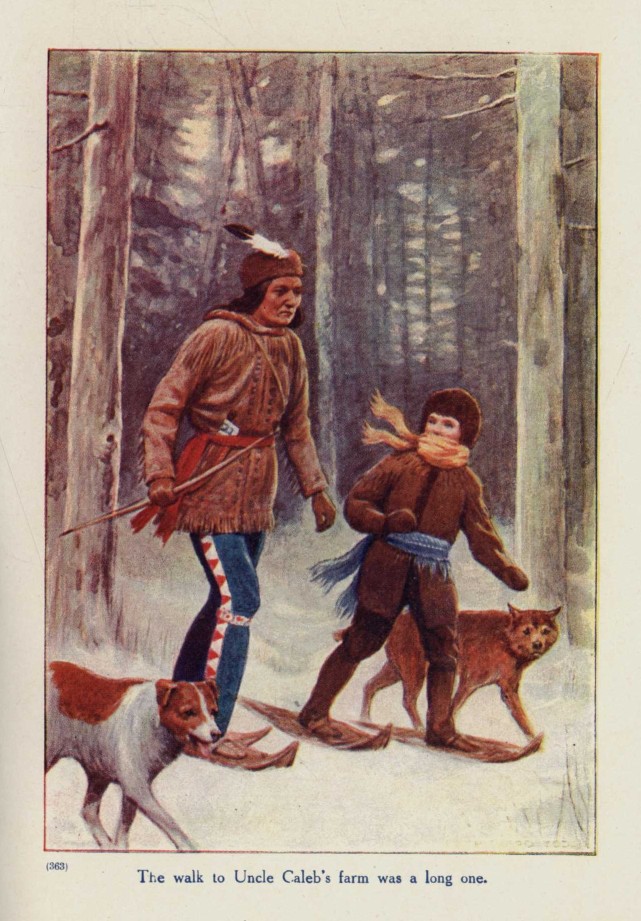
The walk to Uncle Caleb's farm was a long one.
The tinkle of a distant sledge-bell arrested Maxica. Had some miscount in the day brought them face to face with the bridal party?
They turned away from the well-known gate, crept behind the farm buildings, and crossed the reedy pool to Forgill's hut.
With the frozen snow full three feet deep beneath their feet there was roadway everywhere. Railings scarcely showed above it, and walls could be easily cleared with one long step. The door of the hut was fastened, but Wilfred waited behind it while Maxica stole round to reconnoitre.
He returned quickly. It was not the bridal party, for there was not a single squaw among them. They were travellers in a horse-sledge, stopping at the farm to rest. He urged Wilfred to seize the chance and enter with them. The presence of the strangers would be a protection. They took their way through the orchard trees, and came out boldly on the well-worn tracks before the gate. It excited no surprise in the occupants of the sledge to see two dusky figures in their long, pointed snow-shoes gliding swiftly after them; travellers like themselves, no doubt, hoping to find hospitality at the farm.
Yula and Kusky went bounding over the intervening space.
There were two travellers and a sledge-driver. The dogs considered them, and did not bark. Then Kusky, in frantic delight, endeavoured to leap into the sledge. It drew up. The driver thundered on the gate.
"What cheer?" shouted a voice from the sledge.
It was the usual traveller's inquiry, but it thrilled through Wilfred's ears, for it was—it could not be—yet it was the voice of Mr. De Brunier.
Kusky was already on Gaspé's knee devouring him with his doggie caresses.
"Is it a dream, or is it real?" asked Wilfred, as with one long slide he overtook the sledge, and grasped a hand of each.
"I didn't know you, coming after us in your seven-league boots," laughed Gaspé, pointing to the long, oval frame of Wilfred's snow-shoes, reaching a foot or more before and behind his boot.
But Wilfred did not answer, he was whispering rapidly to Mr. De Brunier.
"Wilfred, mon ami," (my friend), pursued Gaspé, bent upon interrupting the low-voiced confidence, "it was for your sake grandfather decided to make his first inquiries for a farm in this neighbourhood. Batiste was so ambiguous and so loath to speak of your journey when he came after Louison's post, we grew uneasy about you. All the more glad to find you safe at home."
"At home, but not in home," answered Wilfred, significantly laying his finger on his lips, to prevent any exclamation from his bewildered friend.
"All right," said Mr. De Brunier. "We will enter together."
Pête, who was already opening the gate, bade them heartily welcome. Hospitality in the lone North-West becomes a duty.
Wilfred dropped behind the sledge, slouched his fur cap well over his eyes, and let Maxica fold his blanket round him, Indian fashion.
Pête led the way into the kitchen, Wilfred followed behind the sledge-driver, and the Cree was the last to enter. A long row of joints were roasting before the ample fire, giving undoubted indications of an approaching feast.
"Just in time," observed Mr. De Brunier with a smile, which gained a peculiar significance as it rested on Wilfred.
"Ay, and that you are," returned old Pête; "for the missis is gone to be married, and I was on the look-out for her return when I heard the jingling of your sledge-bells. The house will be full enough by nightfall, I reckon."
Wilfred undid the strap of his snow-shoes, gave them to Maxica, and walked softly to the door of his uncle's room.
He opened it with a noiseless hand, and closed it behind him.
Mr. De Brunier's retort about the welcome which awaited uninvited guests on a bridal night kept Pête from noticing his movements.
The logs crackled and the sparks flew on the kitchen hearth. The fat from the savoury roast fell hissing in the pan, and the hungry travellers around it seemed to have eyes for nothing else.
Wilfred crept to his uncle's bed. He was asleep. The boy glanced round. He threw off his wraps. His first care was to find his uncle's comb and brush. It was a luxury unknown since his departure from Hungry Hall. He was giving a good tug at his tangled locks, hoping to make himself look a little more like the schoolboy who had once before roused the old man from his sleep, when a cough and an exclamation sounding like, "Who is there?" told him his uncle was awake.
"O uncle, you surely have not forgotten me—me, your nephew, Wilfred! Got home at last. The pony threw me, and I was utterly lost. An Indian guided me here," he answered, tumbling his words one upon another as fast as he could, for his heart was beating wildly.
Caleb Acland raised himself on one elbow and grasped Wilfred by the wrist. "It is he! It is flesh and blood!" he ejaculated. "The boy himself Pête! Pête!" He felt for the stick left leaning against his bed, and stamped it on the floor.
A great sob burst unawares from the poor boy's lips.
"Don't!" said the old man in alarm. "What are you crying for, lad? What's happened? I don't understand. Give me your hand! That's cold enough—death cold. Pête! Pête! what are ye about? Have you grown deaf that you can't hear me?"
He pulled Wilfred's cold fingers under the blankets and tried to chafe them between his swollen hands.
"I'm not crying," protested Wilfred, brushing his other hand across his eyes. "It is the ice melting out of me. I'm thawing all over. It is because I have got back uncle, and you are glad to have me. I should have been dead but for the Cree who brought me home. I was almost starving at times. I have wandered in the snow all night."
"God bless the boy!" ejaculated the old man, thundering on the floor once more.
"Here, Pête! Pête! Something quick to eat."
Pête's head appeared at the door at last.
"Whatever do you want now, master?" he demanded in an injured tone. "I thought I had put everything ready for you, as handy as could be; and you said you wouldn't call me off, with the bride expected every minute, and the supper to cook, as you know."
"Cook away then," returned his master impatiently. "It is the hour for the fatted calf. Oh, you've no eyes, none! Whom have I got here? Who is this?"
Pête backed to the door in wide-eyed wonder. "I'm struck of a heap!" he gasped, staring at Wilfred as if he thought he would melt away into vacancy.
"Where were you that you did not see him come in?" asked his master sharply.
"Where?" repeated Pête indignantly. "At your own gate, answering a party of travellers—men who've come down to buy land; and," he added, changing his tone, "there is a gentleman among them says he must speak to you, master, your own self particular, this very night."
"It is Mr. De Brunier, uncle. He took me in, and sent me to the hunters' camp, where Mr. Bowkett was to be found," interposed Wilfred.
This name was spoken with an effort. Like many a noble-minded boy, Wilfred hated to tell of another. He hesitated, then went on abruptly: "I thought he would be sure to bring me home. Well, I got there. He did not seem to know me. He was all for fiddling and dancing. They were a rough set, uncle, a very rough set. Father would not have liked to have seen me with such men. I got away again as quickly as I could. The Cree who had saved me before guided me home at last."
"What is that? Did you say Bowkett, Hugh Bowkett?" repeated the old man. "Why, your aunt was married to him this morning."
When Pête disappeared into his master's room, Maxica, who had seated himself on the kitchen floor, rose suddenly, and leaning over Mr. De Brunier, asked, "Who in this place is friend to the boy without a father?"
"I can answer your question for myself, but no further, for I am a stranger here," replied Mr. De Brunier.
"We are four," said Maxica, counting on his fingers. "I hear the voice of the man at the gate—the man who spoke against the white boy with a forked tongue; the man who drove him out into the frosty night, that it might kill him. We have brought the marten to the trap. If it closes on him, Maxica stays to break it."
"Come outside, where we can talk freely," answered Mr. De Brunier, leading the way.
Gaspé and the sledge-driver were left to the enjoyment of the roaring fire. They were considering the state of Kusky's feet. Gaspé was removing the icicles from his toes, and the man of the sledge was warmly recommending boots, and describing the way to make them, when the shouts at the gate told them the bridal party had arrived. The stupid Pête, as they began to think, had vanished, for no one answered the summons. Gaspé guessed the reason, and sent the man to open the gate. He silenced the dogs, and drew back into the corner, with instinctive good breeding, to make himself as little in the way as possible.
The great farm-house kitchen was entrance-hall as well. Every door opened into it. On one hand was the dining-room, reserved chiefly for state occasions; on the other, the storeroom. The family sleeping rooms were at the back. Like a provident housewife, Aunt Miriam had set the tables for her marriage feast, and filled the storeroom with good things, before she went to church. Pête, with a Frenchman's genius for the spit, could manage the rest.
The arrival of one or two other guests at the same moment detained the bridal party with their noisy greetings.
When Aunt Miriam entered the kitchen, leaning on her bridegroom's arm, Gaspé was almost asleep in his dim corner.
Out ran Pête, effervescing with congratulations, and crossing the heartiness of the bridal welcome with the startling exclamation, "The boy, Mrs. Bowkett!—the boy's come home!"
The bridegroom looked sharply round. "The boy," he repeated, seeing Gaspé by the fire. "There he is."
Up sprang Gaspé, bowing to the bride with all the courtly grace of the chivalrous De Bruniers of Breton days.
Aunt Miriam turned her head away. "O Pête!" she groaned, "I thought—I thought you meant—"
Bowkett did not let her finish her sentence, he hurried her into the dining-room. Behind him came his bright-eyed sister, who had played the part of bridesmaid, and was eager for the dancing and the fun, so soon to commence. At her side walked Forgill in his Sunday best, all important with the responsibility of his position, acting as proxy for his old master. He had given the bride away, and was at that moment cogitating over some half-dozen sentences destined for the after-dinner speech which he knew would be required of him. They were restive, and would not follow each other. "Happy day" and "Best wishes" wanted setting up on stilts, with a few long words to back them, for such an occasion. He knew the Indian love of speechifying would be too strong in their hunter guests to let him off. He had got as far as, "Uncommonly happy day for us all." But "uncommonly" sounded far too common in his critical ears. He was searching for a finer-sounding word, and thought he had got it in "preternaturally," when he heard the feeble voice of his master calling out, "Miriam! Here, Miriam."
"Are they all deaf?" said Caleb Acland to Wilfred. "Open the door, my lad, and show yourself to your aunt."
Slowly and reluctantly Wilfred obeyed him. He held it open just a hand-breadth, and met the scowling brow of the owner of the forked tongue.
There was mutual recognition in the glance exchanged.
Wilfred shut the door softly, and drew the bolt without attracting his uncle's attention.
"The place is full of strangers," he said; "I shall see auntie soon. I'd rather wait here with you. I shall be sure to see her before she goes to her new home."
"As you like, my boy;—that Pête's a cow. There is no going away to a new home. It is bringing in a new master here before the old one is gone, so that your aunt should not be left unprotected a single day."
As Caleb Acland spoke, Wilfred felt himself growing hard and desperate in the cold clutch of a giant despair. The star of hope dropped from his sky. He saw himself in the hand of the man who had turned him from his door into the killing frost.
It was too late to speak out; Bowkett would be sure to deny it, and hate him the more. No, not a word to Uncle Caleb until he had taken counsel with Mr. De Brunier. But in his hasty glance into the outer world Mr. De Brunier was nowhere to be seen.
Wilfred was sure he would not go away without seeing him again. There was nothing for it but to gain a little time, wait with his uncle until the wedding guests were shut in the dining-room, and then go out and find Mr. De Brunier, unless Aunt Miriam had invited him to sit down with them. Yes, she was sure to do that, and Gaspé would be with his grandfather. But Maxica was there. He had saved him twice. He knew what Maxica would say: "To the free wild forest, and learn the use of the trap and the bow with me."
Wilfred was sorely tempted to run away. The recollection of Mr. De Brunier's old-world stories restrained him. He thought of the Breton emigrants. "What did they do in their despair? What all men can do, their duty." He kept on saying these words over and over, asking himself, "What is my duty? Have I no duty to the helpless old man who has welcomed me so kindly? How will Bowkett behave to him?" Wilfred felt much stronger to battle through with the hunter on his uncle's behalf, than when he thought only of himself. "The brave and loyal die at their posts. Gaspé would, rather than run away—rather than do anything that looked like running away."
"What is the matter with you, Wilfred?" asked his uncle anxiously. "What makes you stand like that, my boy?"
"I am so tired," answered Wilfred, "I have walked all day to-day, and all day yesterday. If I take the cushion out of your chair for a pillow, I might lie down before the stove, uncle."
"That Pête is an ass not to bring something to eat, as if he could not make those fellows in the dining-room wait half-a-minute. But stop, there is some broth keeping hot on the stove. Take that, and come and lie down on the bed by me; then I can see you and feel you, and know I have got you again," answered Uncle Caleb, as if he had some presentiment of what was passing in Wilfred's mind.
Glad enough to obey, Wilfred drank the broth eagerly, and came to the bed. The old man took him by both hands and gazed in his face, murmuring, "Lord, now lettest thou thy servant depart in peace."
The peace that Uncle Caleb rejoiced in was his own alone; all around him strife was brewing. But his peace was of that kind which circumstances cannot give or take away.
"Kneel down beside me just one minute, my boy," he went on. "We must not be like the nine lepers, who forgot the thanks when the good had come. They wouldn't even with the tailors, for in the whole nine put together there was not one bit of a true man, or they could not have done it."
Wilfred fell on his knees and repeated softly the Christ-taught prayer of the ages, "Our Father who art in heaven." He remembered how he had been fed from the wild bird's cache, and saved by the wild man's pity, and his heart was swelling. But when he came to "Forgive us our trespasses, as we forgive them that trespass against us," he stopped abruptly.
"Go on," whispered the old man softly.
"I can't," muttered Wilfred. "It isn't in my heart; I daren't go on. It is speaking with a forked tongue: words one way, thoughts another; telling lies to God."
Caleb Acland looked at him as if he were slowly grasping the position.
"Is it Bowkett that you can't forgive?" he asked gently. "Did you think he need not have lost you? Did you think he would not know you, my poor boy?"
"Have I got to live with him always?" returned Wilfred.
"No, not if you don't like him. I'll send you back to school," answered his uncle in a tone of decision.
"Do you mean it, uncle? Do you really say that I shall go back to school?" exclaimed the boy, his heavy heart's lead beginning to melt, as the way of escape opened so unexpectedly before him.
"It is a promise," repeated the old man soothingly. It was obvious now there was something wrong, which the boy refused to explain.
"Patience a bit," he thought; "I can't distress him. It will leak out soon; but it is growing strange that nobody comes near us."
CHAPTER XIV
WEDDING GUESTS.
More guests were arriving—Diomé, Batiste, Mathurin, and a dozen others. Bowkett came out into the porch to receive them, and usher one after the other into the dining-room. As the last went in before him, his friend Dick Vanner of the forked tongue tapped him on the shoulder.
"Who is in there?" he whispered. "Did you see?" pointing as he spoke to the door of Uncle Caleb's room.
Gaspé was on the alert in a moment, longing to break a lance in his friend's behalf. The men dropped their voices, but the echo of one sentence reached him. It sounded like, "No, she only saw the other boy."
"So, Wilfred, mon cher, you and I have changed places, and I have become that 'other boy,'" laughed Gaspé to himself, lying perdu with an open ear.
As the two separated they muttered, "Outwit us? Like to see it done!"
"Keep that door shut, and leave the rest to me," added Vanner, sauntering up to the fire.—"Accommodation is scanty here to-night. How many are there in your party?" he asked, looking down on Gaspé. "Pête said four—three men and a boy. Was not it five—three men and two boys?"
"Yes, five," answered Gaspé.
"You boys must want something to eat," remarked Vanner, carelessly pushing open the door of the storeroom, and returning with a partridge pie. "Here, fall to. Where's your chum?"
Gaspé saw the trap into which he was expected to walk. He stepped over it.
"Have not you been taught to look out for number one?" asked Gaspé. "I'll have a turn at that pie by myself, now I have got the chance, before I call on a chum to help me. I can tell you that."
"Confound you, you greedy young beggar!" exclaimed Vanner.
"Try thirty miles in an open sled, with twenty-five degrees of frost on the ground, and see if you would be willing to divide your pie at the end of it," retorted Gaspé.
"That is a cool way of asking for one apiece," remarked Vanner, abstracting a second pie from the storeroom shelves.
"If you've another to spare I'd like two for myself," persisted Gaspé.
"Then have it," said Vanner. "I am bound to give you a satisfaction. We do not reckon on a wedding feast every night. Now, where is the other boy? You can't object to call him. Here is a sausage as long as your arm. Walk into that."
"You will not get me to move with this dish before me," returned the undaunted Gaspé, and Vanner felt it waste of time to urge him further. He went back to his friends.
Gaspé was at Caleb Acland's door in a moment, singing through the keyhole,—
"St. George he is for England, St. Denis is for France.
Honi soit qui mal y pense."
Wilfred rose to open the door as he recognized his friend's voice.
"Keep where you are. Don't come out for anybody," urged Gaspé, retreating as he heard a noise: but it was only his grandfather re-entering the porch.
He flew to his side. "What's up?" he asked breathlessly.
"A goodly crop of suspicions, if all the Cree tells me is true. Your poor friend is fitted with an uncle in this Bowkett after their old ballad type of the Babes in the Wood."
"Now listen to me, grandfather, and I can tell you a little bit more," answered Gaspé, giving his narrative with infinite delight at the success of his manoeuvring.
The moon shone clear and bright. The tree in the centre of the court, laden with hoar-frost, glittered in its crystal white like some bridal bouquet of gigantic size. The house was ablaze with light from every window. The hunters had turned their horses adrift. They were galloping at will among the orchard trees to keep themselves warm. Maxica was wandering in their midst, counting their numbers to ascertain the size of the party. Mr. De Brunier crossed over to him, to discuss Gaspé's intelligence, and sent his grandson back indoors, where the sledge-driver was ready to assist him in the demolition of the pies which had so signally failed to lure Wilfred from his retreat.
Mr. De Brunier followed his grandson quickly, and walking straight to Uncle Caleb's door, knocked for admittance.
The cowkeeper, the only individual at Acland's Hut who did not know Wilfred personally, was sent by Bowkett to keep up the kitchen fire.
The man stared. "The master has got his door fastened," he said; "I can't make it out."
"Is Mr. Acland ready to see me?" asked Mr. De Brunier, repeating his summons.
"Yes," answered Uncle Caleb; "come in."
Wilfred opened the door.
Uncle Caleb raised himself on his elbow, and catching sight of the dishes on the kitchen-table, said, "It seems to me the old man's orders are to go for little. But whilst the life is in me I am master in this place. Be so good, sir, as to tell that fellow of mine to bring that pie in here, and give this child something to eat."
"With pleasure," returned his visitor.
Wilfred's supper provided for, the two looked well at each other.
"What sort are you?" was the question in both minds. They trusted, as we all do more or less, to the expression. A good honest character writes itself on the face. They shook hands.
"I have to thank you for bringing back my boy," said Uncle Caleb.
"Not me," returned Mr. De Brunier, briefly recapitulating the circumstances which led to Wilfred's sojourn at Hungry Hall, and why he sent him to the hunters' camp. "Since then," he added, "your nephew has been wandering among the Indians. It was a Cree who guided him home—the same Cree who warned him not to trust himself with Bowkett."
"Come here, Wilfred, and tell me exactly what this Indian said," interposed Caleb Acland, a grave look gathering on his wrinkled brow.
"Not one word, uncle. Maxica did not speak," answered Wilfred. "He brought me three queer bits of wood from the hearth and stuck them in the floor before me, so, and so," continued the boy, trying to explain the way in which the warning had been given to him.
Uncle Caleb was getting so much exhausted with the excitement of Wilfred's return, and the effort of talking to a stranger, he did not quite understand all Wilfred was saying.
"We can't condemn a fellow on evidence like that," moaned the old man, "and one so near to me as Bowkett. What does it mean for Miriam?"
"Will you see this Cree and hear for yourself?" asked Mr. De Brunier. "We are neither judge nor jury. We are not here to acquit or condemn, but a warning like this is not to be despised. I came to put you on your guard."
The feeble hand grasped his, "I am about spent," groaned Caleb. "It is my breath. Let me rest a bit. I'll think this over. Come again."
The gasping words came with such painful effort, Mr. De Brunier could only lay him back amongst his pillows and promise to return in the morning, or earlier if it were wished. He was at the door, when Caleb Acland signed to him to return.
"Not a word to my sister yet. The boy is safe here. Tell him he is not to go out of this room."
Mr. De Brunier shook the feeble hand once more, and gave the required promise. There was one more word. "What was that about buying land? I might help you there; a little business between us, you understand."
"Yes, yes," answered Mr. De Brunier, feeling as if such another effort might shake the labouring breath out of the enfeebled frame in a moment.
"Keep in here. Keep quiet; and remember, whatever happens, I shall be near," was Mr. De Brunier's parting charge to Wilfred as he went back into the kitchen, intending to watch there through the night, if no one objected to his presence.
The old man started as the door closed after him. "Don't fasten it, lad!" he exclaimed. "It looks too much like being afraid of them."
Mr. De Brunier joined Gaspé and the sledge-driver at their supper. Gaspé watched him attentively as they ate on in silence.
Bowkett came out and spoke to them. "I am sorry," he said, "to seem inhospitable, but the house is so full to-night I really cannot offer you any further accommodation. But the men have a sleeping hut round the corner, under the pines, where you can pass the night. I'll send one of them with you to show you the way and light a fire."
No exception could be taken to this. The three finished their supper and were soon ready to depart.
"I must see Mr. Acland again about the land business," remarked Mr. De Brunier, recalling Uncle Caleb's hint.
Bowkett summoned his man, and Diomé came out with him. He strolled through the porch and looked about him, as if he were considering the weather.
Maxica was still prowling behind the orchard trees, like a hungry coyote watching for the remnants of the feast, as it seemed. The two met.
"There will be mischief before these fellows part," said Diomé. "Keep a sharp look-out for the boy."
Diomé went on to catch Dick Vanner's pony. Maxica stole up to the house. The travellers were just coming out. He gave Yula a call. Gaspé was the only one who perceived him, as Yula bounded between them.
It was hard for Gaspé to go away and leave his friend without another word. He had half a mind to take Kusky with him. He lingered irresolute a moment or two behind his grandfather. Bowkett had opened the door of Caleb Acland's room, and he saw Kusky creeping in between Bowkett's legs.
"How is this?" the latter was saying in a noisy voice. "Wilfred got home, and won't show his face!—won't come out amongst us to have his dinner and speak to his aunt! What is the meaning of it? What makes him afraid of being seen?"
There was not a word from Wilfred. It was the feeble voice of his Uncle Caleb that was speaking:—
"Yes, it is Wilfred come back. I've got him here beside me all safe. He has been wandering about among the redskins, half dead and nearly starved. Don't disturb us. I am getting him to sleep. Tell Miriam she must come here and look at him. You can all come and look at him; Forgill and your Diomé too. They all know my boy. How has Miriam managed to keep away?"
"As if we could spare the bride from the marriage feast," laughed Bowkett, raising his voice that every one might hear what they were saying.
"Neither can I spare my boy out of my sight a single moment," said the old man quietly.
"That's capital," laughed Gaspé to himself, as he ran after his grandfather.
They did not encounter Maxica, but they passed Diomé trying to catch the horse, and gave him a little help by the way.
"You are not going?" he asked anxiously. "I thought you would be sure to stay the night. You are a friend of Wilfred Acland's, are you not, Mr. De Brunier? He was so disappointed when he found Hungry Hall was shut up. I thought you would know him; so do I. Mrs. Bowkett says the boy is not her nephew."
"I rather think that has been said for her," remarked Mr. De Brunier quietly.
"I see through it," exclaimed Gaspé; "I see what they are driving at. Her husband told her I was the boy. She came and looked at me. Bowkett knows well enough the real Wilfred is in his uncle's room, If they could get him out into the kitchen, they would make a great clamour and declare he is an impostor trying to take the old man in."
"You've hit it," muttered Diomé. "But they shan't give him lynch law. I'll not stand by and see that."
"Come back, grandfather," cried Gaspé. "Give me one of your English sovereigns with a little silver threepenny on either side to kiss it. I'll string them on my watch-chain for a lady's locket, walk in with it for a wedding present, and undeceive the bride before them all."
"Not so fast, Gaspard. We should only bring the crisis before we have raised our safeguards," rejoined Mr. De Brunier thoughtfully. "I saw many a gun set down against the wall, as the hunters came in."
"That is nothing," put in Diomé; "we are never without them."
"That is everything," persisted Mr. De Brunier. "Men with arms habitually in their hands use them with small provocation, and things are done which would never be done by deliberate purpose."
"I am not Dick Vanner's groom," said Diomé, "but he wants me to hold his horse in the shadow of those pines or under the orchard wall; and I'll hold it as long as he likes, and walk it about half the night in readiness for him, and then I shall know where he is bound for."
"The American frontier, with Wilfred behind him, unless I am making a great mistake. If Bowkett laid a finger on him here, half his guests would turn upon him," observed Mr. De Brunier.
"That's about it," returned Diomé. "Now I am going to shut up this horse in one of the sheds, ready for Vanner at a moment's notice, and then I'll try for a word with Forgill. He is working so hard with the carving-knife there is no getting at him."
"There is one of the Aclands' men lighting a fire in his hut, ready for us," put in Gaspé.
Diomé shook his head. "He!" he repeated in accents of contempt; "he would let it all out at the wrong time."
"Is the Cree gone?"
"Maxica is on the scent already,' replied Diomé, whistling carelessly as they parted.
"Gaspard," said Mr. De Brunier, as they entered the hut, "do you remember passing a policeman on the road. He was watching for a Yankee spirit cart, contraband of course. He will have caught it by this time, and emptied the barrels, according to our new Canadian law. Go back in the sledge—you will meet him returning—and bring him here. If he rides into the farm-court before daybreak, your little friend is safe. As for me, I must keep watch here. No one can leave the house without me seeing him, the night is so clear. A dark figure against the white ground is visible at twice this distance; and Maxica is somewhere by the back of the homestead. Neither sight nor sound will escape an Indian."
Mr. De Brunier despatched the sledge-driver back to the farm with the man Bowkett had sent to light their fire, to try to procure a fresh horse. This was easily managed. Bowkett was delighted to think the travellers were about to resume their journey, and declared the better half of hospitality was to speed the parting guest.
The sledge went round to Forgill's hut. Gaspé wrapped himself in the bearskin and departed. No one saw him go; no one knew that Mr. De Brunier was left behind. He built up the fire and reconnoitred his ground. In one corner of the hut was a good stout cudgel.
"I must anticipate your owner's permission and adopt you," he said, as he gave it a flourish to try its weight. Then he looked to the revolver in his breast pocket, and began his walk, so many paces in front of the hut, with his eye on the farm-house porch, and so many paces walking backwards, with it still in sight—a self-appointed sentry, ready to challenge the enemy single-handed, for he did not count much upon Diomé. He saw how loath he was to come into collision with Bowkett, and reckoned him more as a friend in the camp than as an active ally. There was Maxica, ready like a faithful mastiff to fly at the throat of the first man who dared to lay a hand on Wilfred, regardless of consequences. He did not know Maxica, but he knew the working of the Indian mind. Revenge is the justice of the savage. It was Maxica's retaliation that he feared. Diomé had spoken of Forgill, but Mr. De Brunier knew nothing of him, so he left him out of count. It was clear he must chiefly rely on his own coolness and courage. "The moral force will tell in such an encounter as this, and that is all on my side," he said to himself. "It will tell on the outsiders and the farm-servants. I shall find some to second me." He heard the scrape of the fiddle and the merry chorus of some hunting-song, followed by the quick beat of the dancers' footsteps.
Hour succeeded hour. The fire in the hut burned low. De Brunier left his post for a moment to throw on fresh logs. He returned to his watch. The house-door opened. Out came Diomé and crossed to the cattle-sheds. Mr. De Brunier saw him come back with Vanner's horse. He changed his position, creeping in behind the orchard trees, until he was within a few yards of the house. The three feet of snow beneath his feet gave him an elevation. He was looking down into the court, where the snow had been partially cleared.
Diomé was walking the horse up and down before the door. It was not a night in which any one could stand still. His impatient stamping to warm his feet brought out Vanner and Bowkett, with half-a-dozen others. The leave-taking was noisy and prolonged. Batiste's head appeared in the doorway.
"I cannot count on his assistance," thought Mr. De Brunier, "but I can count on his neutrality; and Diomé must know that a word from me would bring about his dismissal from his new master."
Vanner mounted and rode off along the slippery ground as only a hunter could ride.
"Now for the first act," thought Mr. De Brunier. "May my Gaspard be speeding on his errand. The hour draws near."
As Bowkett and his friends turned back into the house, Diomé walked rapidly across the other end of the orchard and went towards Forgill's hut. With cautious steps De Brunier followed.
Diomé was standing moodily by the fire. He started.
"Well," demanded Mr. De Brunier, "how goes the night?"
"For God's sake keep out of the way, sir. They have made this hut the rendezvous, believing you had started hours ago," exclaimed Diomé brightening.
"Did you think I had deserted the poor boy?" asked Mr. De Brunier.
"I was thinking," answered Diomé, waiving the question, "Dick Vanner is a dangerous fellow to thwart when the bowie-knife is in his hand."
"Well, you will see it done, and then you may find him not quite so dangerous as he seems," was the quiet reply.
CHAPTER XV.
TO THE RESCUE.
Diomé had no more information to give. "For the love of life, sir," he entreated, as the brief conference ended, "move off to the other side of the house, or you will be seen by Vanner as he returns. A hunter's eye, Mr. De Brunier, notices the least change in the shadows. You mean to hide among the orchard trees, but you can't stand still. You will be frozen to death, and a moving shadow will betray you."
His cautionary counsels were wasted on a preoccupied mind. De Brunier was examining the fastenings of the door. There was a lock, but the key was with the owners of the hut. There was also a bar which secured it on the inside. Forgill's basket of tools stood by the chimney.
"How much time have we?" asked Mr. De Brunier.
"A good half-hour, sir," replied Diomé.
"Time enough for me to transfer this staple to the outside of the doorpost?"
Diomé hesitated before he answered this inquiry. "Well then?" he asked in turn.
"Well then," repeated Mr. De Brunier, "this Vanner is to meet you here. Don't go out of the hut to take his horse; beckon him to come inside. Shut the door, as if for caution, and tell him you have seen me watching him from the orchard trees. He will listen to that. Two minutes will be enough for me to bar the door on the outside, and we shall have caged the wild hawk before he has had time to pounce upon his prey. I must shut you in together; but play your part well, and leave the rest to me."
"Shut me in with Dick Vanner in a rage!" exclaimed Diomé. "He would smell treachery in a moment. Not for me."
It went hard with Diomé to turn against his old companions. It was clear to Mr. De Brunier the man was afraid of a hand-to-hand encounter. With such half-hearted help the attempt was too hazardous. He changed his tactics.
"I am not in their secrets," protested Diomé. "I am only here to hold his horse. They don't trust me."
"And I," added Mr. De Brunier, "am intent upon preventing mischief. I'll walk round once more. Should you hear the house-door open, you will probably find I have gone in."
Yes, Mr. De Brunier was beginning to regret leaving the house; and yet, if he had not done so, he could not have started Gaspé to intercept the policeman. "Now," he thought, "the boy will be carried off before they can arrive." His thoughts were turning to a probable pursuit. He crossed to the back of the house to look for the Cree. No one better than an Indian for work like that.
The light from the windows of the farm-house was reflected from the shining ground, making it bright as day before them, and deepening the gloom of the shadows beyond. A low, deep growl from Yula brought Mr. De Brunier to the opposite corner of the house, where he discovered Maxica lying on the ground, with his ear to the end of one of the largest logs with which the house was built. They recognized each other instantly, but not a word was said. They were at the angle of the building where the logs crossed each other.
Suddenly Mr. De Brunier remembered the capacity in the uncut trunk of a tree for transmitting sound, and following Maxica's example he too laid his ear to the end of another log, and found himself, as it were, in a whispering gallery. The faintest sound at the other end of the log was distinctly audible. They tried each corner of the house. The music and the dancing from dining-room to kitchen did not detain them long. At the back they could hear the regular breathing of a healthy sleeper and the laboured, painful respiration of the broken-down old man.
The log which crossed the one at which they were now listening ran at the end of the storeroom, and gave back no sound. It was evident both Wilfred and his uncle had fallen asleep, and were therefore off their guard.
To drive up the loose ponies and make them gallop round the house to waken them was a task Yula took off their hands and accomplished so well that Bowkett, listening in the midst of the whirling dancers, believed that Vanner had returned.
Maxica was back at the angle of the logs, moving his ear from one to the other. He raised a warning finger, and laid his ear a little closer to the storeroom side. Mr. De Brunier leaned over him and pressed his own to the tier above. Some one had entered the storeroom.
"Anything here?" asked a low voice.
"What's that behind the door?" whispered another in reply.
"A woman's ironing board."
"A woman's what?"
"Never mind what it is if it will slide through the window," interposed a third impatiently, and they were gone.
But the watchers without had heard enough to shape their plan. Maxica was ear, Mr. De Brunier was eye, and so they waited for the first faint echo of the horse-hoofs in the distance or the tinkle of the sledge-bell.
Within the house the merriment ran high. Bridal healths were drank with three times three. The stamp of the untiring dancers drowned the galloping of the ponies.
Aunt Miriam paused a moment, leaning on her bridegroom's arm. "I am dizzy with tiredness," she said. "I think I have danced with every one. I can surely slip away and speak to Caleb now. What made him fasten his door?"
"To keep those travellers out; and now he won't undo it: an old man's crotchet, my dear. I have spoken to him. He is all right, and his cry is, 'Don't disturb me, I must sleep,'" answered Bowkett. "You'll give Batiste his turn? just one more round."
Wilfred was wakened by his Yula's bark beneath the window. Kusky, who was sleeping by the stove, sprang up and answered it, and then crept stealthily to Wilfred's feet.
"That dog will wake the master," said some one in the kitchen.
The bedroom door was softly opened, a low whistle and a tempting bone lured Kusky away. Wilfred was afraid to attempt to detain him, not venturing to show himself to he knew not whom. There was a noise at the window. He remembered it was a double one. It seemed to him somebody was trying to force open the outer pane.
A cry of "Thieves! thieves!" was raised in the kitchen. Wilfred sprang upright. Uncle Caleb wakened with a groan.
"Look to the door. Guard every window," shouted Bowkett, rushing into the room, followed by half-a-dozen of his friends, who had seized their guns as they ran.
The outer window was broken. Through the inner, which was not so thickly frozen, Wilfred could see the shadow of a man. He knew that Bowkett was by the side of the bed, but his eyes were fixed on the pane.
At the first smash of the butt end of Vanner's gun, through shutter and frame, Mr. De Brunier laid a finger on Maxica's arm. The Cree, who was holding down Yula, suddenly let him go with a growl and a spring. Vanner half turned his head, but Yula's teeth were in his collar. The thickness of the hunter's clothing kept the grip from his throat, but he was dragged backwards. Maxica knelt upon him in a moment, with a huge stone upraised, ready to dash his brains out if he ventured to utter a cry. Mr. De Brunier stepped out from the shadow and stood before the window, waiting in Vanner's stead. For what? He hardly dared to think. The window was raised a finger's breadth, and the muzzle of a hunter's gun was pointed at his ear. He drew a little aside and flattened himself against the building. The gun was fired into the air.
"That is a feint," thought Mr. De Brunier. "They have not seen us yet. When they do, the tug comes. Two against twenty at the very least, unless we hear the sledge-bell first. It is a question of time. The clock is counting life and death for more than one of us. All hinges on my Gaspé. Thank God, I know he will do his very best. There is no mistrust of Gaspé; and if I fall before he comes, if I meet death in endeavouring to rescue this fatherless boy, the God who sees it all, in whose hand these lawless hunters are but as grasshoppers, will never forget my Gaspé."
The report of Bowkett's gun roused old Caleb's latent fire.
"What is it?" he demanded. "Are the Indians upon us? Where is Miriam?"
Wilfred threw the bearskin across his feet over the old man's back.
"I am here!" cried Bowkett, with an ostentatious air of protection. "I'll defend the place; but the attack is at this end of the house. First of all, I carry you to Miriam and safety at the other."
Bowkett, in the full pride of his strength, lifted up the feeble old man as if he were a child and carried him out of the room.
"Wilfred, my boy, keep close to me, keep close," called Uncle Caleb; but a strong man's hand seized hold of Wilfred and pulled him back.
"Who are you?" demanded Wilfred, struggling with all his might. "Let me go, I tell you; let me go!"
The door was banged up behind Uncle Caleb and Bowkett. The room was full of men.
Wilfred knew too well the cry of "Thieves" was all humbug—a sham to get him away from his uncle.
"Forgill! Forgill!" he shouted. "Pête! Pête! Help me! help me!"
A pillow was tossed in his face.
"Don't cram the little turkey-cock with his own feathers," said a voice he was almost glad to recognize, for he could not feel that Mathurin would really hurt him. He kicked against his captor, and getting one hand free, he tried to grasp at this possible friend; but the corner of the pillow, crushed into his mouth, choked his shouts. "So it's Mathurin's own old babby, is it?" continued the deep, jovial voice. "Didn't I tell ye he was uncommon handy with his little fists? But he is a regular mammy's darling for all that. It is Mathurin will put the pappoose in its cradle. Ah! but if it won't lie still, pat it on its little head; Batiste can show you how."
In all this nonsense Wilfred comprehended the threat and the caution. His frantic struggles were useless. They only provoked fresh bursts of merriment. Oh, it was hard to know they were useless, and feel the impotency of his rage! He was forced to give in. They bound him in the sheets.
Mathurin was shouting for—
"A rabbit-skin,
To wrap his baby bunting in.
They took the rug from the floor and wrapped it round Wilfred. He was laid on the ironing board.
He felt the strong, firm straps that were binding him to it growing tighter and tighter.
What were they going to do with him? and where was Mr. De Brunier?
The hunters set him up against the wall, like the pappoose in the wigwam of the Blackfoot chief, whilst they opened the window.
Mr. De Brunier stood waiting, his arms uplifted before his face, ready to receive the burden they were to let fall. It was but a little bit of face that was ever visible beneath a Canadian fur cap, such as both the men were wearing. Smoked skin was the only clothing which could resist the climate, therefore the sleeves of one man's coat were like the sleeves of another. The noisy group in the bedroom, who had been drinking healths all night, saw little but the outstretched arms, and took no notice.
"Young lambs to sell!" shouted Mathurin, heaving up the board.
"What if he takes to blaring?" said one of the others.
"Let him blare as he likes when once he is outside," retorted a third.
"Lull him off with 'Yankee-doodle,'" laughed another.
"He'll just lie quiet like a little angel, and then nothing will hurt him," continued the incorrigible Mathurin, "till we come to—
"'Hush-a-bye, baby, on the tree-top,
When the wind blows the cradle will rock;
When the bough breaks the cradle will fall,
Then down goes cradle, and baby, and all.'"
This ridiculous nursery ditty, originated by the sight of the Indian pappooses hung so often on the bough of a tree when their mothers are busy, read to Wilfred his doom.
Would these men really take him out into the darksome forest, and hang him to some giant pine, and leave him there, as Pe-na-Koam was left, to die alone of hunger and cold?
It was an awful moment. The end of the board to which he was bound was resting on the window-sill.
"Gently now," said one.
"Steady there," retorted another.
"Now it is going beautifully," cried a third.
"Ready, Vanner, ready," they exclaimed in chorus. Caution and prudence had long since gone to the winds with the greater part of them. Mathurin alone kept the control.
Mr. De Brunier nodded, and placed himself between the window and the two men on the snow in deadly silent wrestle, trusting that his own dark shadow might screen them from observation yet a little longer. He saw Wilfred's feet appear at the window. His hand was up to guide the board in a moment, acting in concert with the men above. They slid it easily to the ground.
Mr. De Brunier's foot was on a knot in the logs of the wall, and stretching upwards he shut the window from the outside. It was beyond his power to fasten it; but a moment or two were gained. His knife was soon hacking at the straps which bound Wilfred to his impromptu cradle. They looked in each other's faces; not a word was breathed. Wilfred's hands were freed. He sat up and drew out his feet from the thick folds of the rug. Mr. De Brunier seized his hand, and they ran, as men run for their lives, straight to Forgill's hut.
Diomé saw them coming. He was still leading Vanner's horse. He wheeled it round and covered their retreat, setting it off prancing and curvetting between them and the house.
Through the open door of Forgill's hut the fire was glowing like a beacon across the snow. It was the darkest hour of all that brilliant night. The moon was sinking low, the stars were fading; the dawning was at hand.
The hut was gained at last. The door was shut behind the fugitives, and instantly barred. Every atom of furniture the hut contained was piled against it, and then they listened for the return of the sledge. Whether daylight would increase their danger or diminish it, Mr. De Brunier hardly knew. But with the dreaded daylight came the faint tinkle of a distant bell and the jingling of a chain bridle.
The Canadian police in the Dominion of the far North-West are an experienced troop of cavalry. Trooper and charger are alike fitted for the difficult task of maintaining law and order among the scattered, lawless population sprinkling its vast plains and forest wilds. No bronco can outride the splendid war-horse, and the mere sight of his scarlet-coated rider produces an effect which we in England little imagine. For he is the representative of the strong and even hand of British justice, which makes itself felt wherever it touches, ruling all alike with firmness and mercy, exerting a moral force to which even the Blackfoot in his moya yields.
Mr. De Brunier pulled down his barricade almost before it was finished, for the sledge came shooting down the clearing with the policeman behind it.
Wilfred clasped his hands together at the joyful sight. "They come! they come!" he cried.
Out ran Mr. De Brunier, waving his arms in the air to attract attention, and direct the policeman to the back of the farm-house, where he had left Dick Vanner writhing under Maxica's grasp on the frozen ground.
When the window was so suddenly closed from the outside, the hunters, supposing Vanner had shut it, let it alone for a few minutes, until wonder prompted Mathurin to open it just a crack for a peep-hole.
At the sight of Vanner held down by his Indian antagonist he threw it to its widest. Gun after gun was raised and pointed at Maxica's head; but none of them dared to fire, for the ball would have struck Vanner also. Mathurin was leaping out of the window to his assistance, when Yula relaxed his hold of Vanner's collar, and sprang at Mathurin, seizing him by the leg, and keeping him half in half out of the window, so that no one else could get out over him or release him from the inside.
There was a general rush to the porch; but the house-door had been locked and barred by Bowkett's orders, and the key was in his pocket.
He did it to prevent any of the Aclands' old servants going out of the house to interfere with Vanner. It was equally successful in keeping in the friends who would have gone to his help.
"The key! the key!" roared Batiste.
Another seized on old Pête and shook him because he would not open the door. In vain Pête protested the key was missing. They were getting furious. "The key! the key!" was reiterated in an ever-increasing crescendo.
They seized on Pête and shook him again. They would have the key.
Mathurin's yell for help grew more desperate. With one hand holding on to the window-frame, he could not beat off the dog. The blows he aimed at him with the other were uncertain and feeble.
"Who let the brute out?" demanded Batiste.
He had seen Yula lying by the kitchen fire when he first arrived, and of course knew him again. Ah! and the dog had recognized him also, for he had saluted him with a low, deep growl. It had watched its chance. It was paying back old scores. Batiste knew that well.