Chapter XV · Ærial Navigation Solved.
Reading edition
Science obtains mastery over the “ethereal blue.” Ærial navigation perfected in 1925. The name of New York city changed to that of Manhattan. Washington, in the State of Mexico, becomes the centre of all airship or ærodrome lines. The fascinations of ærial navigation. From Manhattan to San Francisco in thirty-six hours, with stops at Chicago, Omaha and Denver. Terrible mid-air accidents. An air train cloud bound.
The Dreamer, thus far, has invited the attention of the reader to the political conditions extant in 1999. In the preceding chapters we have contemplated with feelings exultant, national pride, the superb growth of the United States of the Americas, from a comparatively narrow strip of territory in 1899 to a magnificent Republic in 1999, consisting of eighty-five sovereign States, extending from Alaska to Patagonia, and embracing in one Republic the continents of North, Central and South America. In order to arrive at a lucid comprehension of the political status of the great American Republic and its relationship towards the world in 1899, we have reviewed the conditions of other nations of that period. We must now pass on to the consideration of other social and economic conditions which were prevalent in the American Republic during the twentieth century.
Do not imagine for one moment that in the brief compass of a century human nature Human Nature Remains The Same. had changed in any perceptible or appreciable degree. In the year 1899 the traits of humanity were identical with those which were known to the world in the days of the Cæsars. The ebb and flow of human passions, love and hatred in the days of the Pharaohs differed in nowise from those of 1899. If forty centuries did not change our human tendencies, it will not surprise the reader to learn that in 1999 the human family was much the same in its tastes and inclinations as in the nineteenth century.
The eighteenth century was an era of oak and sails; the nineteenth century proved to be an age of iron, steel and steam, but the twentieth century witnessed far greater strides of improvement resulting from the solution of the ærial navigation problem and the conquest of electricity. The solution of these two great problems alone rendered the twentieth century the most marvelous age of all since the birth of Christ.
Ever since humanity has trodden upon this green, fruitful world of ours; ever since the gaze of man has turned upward and penetrated the skies, from the days of Adam and perhaps ages before that first settler made his appearance on earth, the problem of ærial navigation has agitated human breast and brain. To solve this difficult secret has long been the acme of human ambition. In 1899 we knew very little more about ærial navigation than did Noah and his family in the days when Mt. Arrarat was first used as a dry-dock.
Quite certain it is that ærial navigation ten thousand years hence will be limited to A Limited Field After all. a moderate elevation from the earth. Never as long as the world endures will human beings with breath in their nostrils and blood in their veins reach or travel at an altitude of over six miles above the earth’s surface. We know this because death would overtake every venturesome traveler who soared into those higher regions. A thousand years hence the laws of nature will still remain immutably the same.
But the ambition of mankind is to control the air at a reasonable distance from the earth’s surface and to navigate an element that is entirely free from all obstructions. The aim is to so control an ærial machine that it will not drift before every wind, but cleave the air and move along its course in defiance of the storm. To this must be added a guarantee of safety that the public is certain to exact before embarking upon an ærial voyage. Ærial navigation, no doubt, offers vast attractions but while sailing through the air, with the ease and grace of a bird, it might prove very inconvenient for passengers to fall out at a height of a mile or two and land through the roof of some peaceful, happy home or find themselves while unceremoniously falling securely hooked in the fork of a tree. Such little mishaps in ærial navigation had to be guarded against.
Ærial navigation was perfected about the The First Airships. year 1925. After repeated failures of the Langley system from 1896 to 1920, the learned Washington professor changed his plans. Instead of endeavoring to lift flat-irons with wings from the ground, and watching turkey buzzards at anchor in the air over the Potomac river, Langley finally created an ærial machine that was operated by electricity and moved by a large, swiftly revolving propeller, somewhat resembling those employed in steam navigation, but with blades at a more abrupt angle.
The flying machines which were constructed from 1920 to 1999 on the Langley plan, were built of Nickalum, an alloy of aluminum, crystalized, within a magnetic field. The specific gravity of Nickalum, as employed in the manufacture of ærodromes, or flying machines, was .512. It was lighter than a thin strip of pine wood, malleable as gold and impenetrable as steel. Ærodromes could not have been successfully manufactured in 1920 if Nickalum had not been employed in their construction.
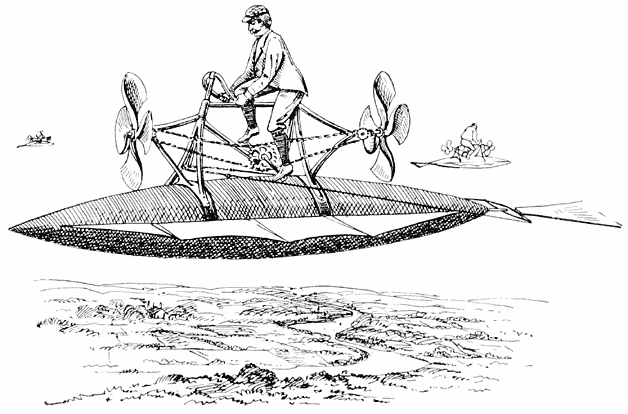
ÆRIAL NAVIGATION.
This new property was one of the marvelous products of the twentieth century. It was employed in nearly everything which required strength and elasticity. It was so malleable that waterproof garments, overcoats and shoes were manufactured of Nickalum as early as the year 1912.
With this wonderful and cheaply manufactured metal, ærial navigation became a Ærodromes of Nickalum. possibility. The old fashion days of silk balloons drifting helplessly on air currents, had long passed away. These pre-Adamite curiosities belonged to the period of the nineteenth century, when man was yet living under primitive conditions, though by no means in a state of innocence.
Ærodromes constructed of Nickalum were largely employed for traveling and commercial purposes between 1920 and 1925, while in 1999 they had reached a high stage of perfection. Ærodromes weighing four hundred pounds only, in 1925, could easily carry ten persons and cleave their way like an arrow through a high wind. Small ærodromes carrying four persons, weighed only one hundred pounds.
If the wind were favorable on their regular trips, the high grade express ærodromes Some Fast Traveling. in 1999, belonging to the popular Sky-Scraper line, could easily make the trip from Manhattan (formerly New York) to Washington, in the State of Mexico, a distance of 1,949 miles in a direct air-line, in fifteen hours, making brief stops for meals at Columbia, D. C., (formerly called Washington) and at New Orleans. From the Crescent City it was only a short run across the deep, blue gulf, to Vera Cruz, then followed a short spurt of two hundred miles west of Vera Cruz to the national capital, Washington, then built upon the site of the ancient Aztec City of Mexico. In 1999 this was regarded as a neat, breezy little trip.
The name of New York city (always a meaningless and unpopular one), had been The Great City of Manhattan. changed in 1912 to the more appropriate one of Manhattan. Its population in 1999 had increased to 25,000,000 souls. Although the largest metropolis of the world, Manhattan in 1999 had reached its zenith.
The consolidation of the republics into one vast American Union, from Alaska to Patagonia, and the removal of Washington as the seat of our national government, from the little District of Columbia to a more central and appropriate location in the State of Mexico, as well as the opening of the Nicaragua Canal, were the leading factors that contributed to the commercial detriment and undoing of Manhattan. The star of destiny shone brightly over Mexico as the conspicuous centre of the new and great American Republic and the volume of the world’s trade passed through the Nicaragua Canal, diverting millions of freightage that otherwise must have entered the port of Manhattan.
The great air-ship or ærodrome building centre in 1999 was the city of Manhattan. Upon the Palisades, opposite Grant’s tomb and about one mile east of the lofty Dewey monument, were stationed vast workshops for building these beautiful and graceful ærodromes. It was ever a fascinating sight to the men and women of 1999 to see one of these flying machines starting out of the shops on its trial trip. The body of the ærodrome was resplendent in brilliant colors and the new airships always appeared in the bravery of bunting and silk flags.
By act of Congress all ærial navigation companies were obliged to adopt a certain color and number. The big express lines running from Manhattan to Rio Janeiro and Mexico, each adopted a prismatic color along with their official number. The object of this was to enable people to distinguish at sight an approaching ærodrome and at once recognize by its color the ærial line to which it belonged.
The U. S. of the A. ærial express ships alone were permitted to use white paint on Uncle Sam’s Favorite Color. the hull of their ærodromes. Thousands of them were employed in the government service and conveyed troops to all points in the great American Republic. It was, however, strictly forbidden, under severe penalties, to carry any munitions of war or any explosives or chemicals upon any ærial ship whatever. The color of black was employed only on funeral occasions. The ærodrome, which filled the functions of an ærial hearse in 1999, was painted all black, hull and sails as well. When the eye could discern floating in the air and moving swiftly in one direction a long line of black ærodromes, it became known that one more poor mortal had entered into rest, and his remains were speeding through the air to their last resting place, namely, the nearest crematory; burials of the old style having been prohibited by act of Congress in 1947 throughout the United States of the Americas.
It was a really thrilling sight to see the large ærodromes in their brilliant colors sailing through the air with such swiftness and graceful ease, each one carrying over its stern the flag of the great Republic with its eighty-five stars. Like beautiful phantoms they flitted by, gracefully, noiselessly, swiftly cleaving the air without the least apparent effort. It was an inspiring sight.
Bridal couples in 1999 were frequently married in an ærodrome as it rested on a Airship Wedding in 1999. city square or in a modest village green. Standing around the airship, which was always decorated with multi-colored flags and floral designs, were invited guests, friends and spectators. After the ceremony was over and congratulations exchanged, the minister, as well as the nearest relatives alighted from the ærodrome, which immediately commenced to ascend amidst the hand-clappings, hurrahs and Godspeeds of the gathering. As the ærodrome gracefully arose about ten feet above terra firma, a few handsful of rice were thrown at the happy pair, who retaliated by throwing roses and other flowers at their friends below. When the ærodrome attained a height of about one hundred feet, the navigator steered the ærial ship in the direction required and the journey then commenced.
The trip across the continent in an ærial ship was always, in pleasant weather, a delightful experience. A voyage from Manhattan (formerly New York), to San Francisco, was a matter of about thirty-six hours, with stops at Chicago, Omaha and Denver. Sailing through balmy summer skies, with a continent at one’s feet, was an experience never to be forgotten. It was exhilarating to glide unchecked, without noise or friction, dust or smoke, over lakes, valleys, plains and mountains. All sense of danger or fear was banished from the mind.
At night the ærodromes were compelled by law to travel at halt speed, with two searchlights, fore and aft, in constant operation. The port lights of all ærodromes were red, and the starboard lights were green. These precautions were rendered necessary in order to avoid mid-air collisions. Some disasters in 1999 filled the Ærodrome Collisions in Mid-air. country with alarm. In 1940 a terrible mid-air collision occurred over Rio Janeiro. Two swift ærodromes, attached to the Mercury Limited express, collided about 2,000 feet over that city causing a serious loss of life. Collision in mid-air was always the nightmare and dread of ærial navigation. People in 1999 had not yet become fully reconciled to the delightful sensation of dropping out of the clouds and getting their clothes torn on church steeples and lightning rods. When they made a start for heaven they were better prepared to make it from earth as a starting point, rather than making a break for paradise starting from the clouds.
Accidents, unfortunately, were of frequent occurrence. In the columns of the Hourly Journal, published in the city of Manhattan, (old New York,) under date of Thursday, July 17, 1984, we find the following harrowing narrative: