OGILBY AND MORGAN’S MAP OF LONDON, 1677 (In Pocket at end of Volume.)
Reading edition
OGILBY AND MORGAN’S MAP OF LONDON, 1677 (In Pocket at end of Volume.)
THE FOLLOWING EXPLANATIONS ARE EXTRACTED FROM OGILBY’S KEY TO THE MAP IN THE BRITISH MUSEUM
We Proceed to the Explanation of the Map, containing 25 Wards, 122 Parishes and Liberties, and therein 189 Streets, 153 Lanes, 522 Alleys, 458 Courts, and 210 Yards bearing Name.
The Broad Black Line is the City Wall. The Line of the Freedom is a Chain. The Division of the Wards, thus oooo. The Parishes, Liberties, and Precincts by a Prick-line, ... Each Ward and Parish is known by the Letters and Figures Distributed within their Bounds, which are placed in the Tables before their Names.... The Wards by Capitals without Figures. The Parishes, &c., by Numbers without Letters. The Great Letters with Numbers refer to Halls, Great Buildings, and Inns. The Small Letters to Courts, Yards, and Alleys, every Letter being repeated 99 times, and sprinkled in the Space of 5 Inches, running through the Map, from the Left Hand to the Right, &c. Churches and Eminent Buildings are double Hatch’d, Streets, Lanes, Alleys, Courts, and Yards, are left White. Gardens, &c. faintly Prick’d. Where the Space admits the Name of the Place is in Words at length, but where there is not room, a Letter and Figure refers you to the Table in which the Streets are Alphabetically dispos’d, and in every Street the Churches and Halls, Places of Note, and Inns, with the Courts, Yards, and Alleys, are named; then the Lanes in that Street, and the Churches, &c. as aforesaid, in each Lane.
The several Marks and Names of the Wards, Parishes, and Liberties
Wards
Faringdon Without
Faringdon Within
Bainard-Castle
Bread-Street
Queen-Hith
Cordwainers
Walbrook
Vintry
Dowgate
Broad-Street
Cornhil
Cheap
Bassishaw
Coleman-Street
Bishopsgate
Cripplegate
Aldersgate
Billingsgate
Lime-Street
Langborn
Portsoken
Aldgate
Candlewick
Bridg
Tower
Parishes and Liberties
St. James Clerkenwel
St. Giles Cripple-Gate
St. Leonard Shoreditch
Norton-Folgate Liberty
St. Botolph Bishopsgate
Stepney
St. Stephen Coleman Street
Alhallows on the Wall
St. Andrew Holborn
St Giles in the Fields
St. Sepulchers
St. Mary Cole-Church
St. Botolph Aldersgate
St. Alphage
St. Alban Wood Street
St. Olave Silver Street
St. Michael Bassishaw
Christ Church
St. Anne Aldersgate
St. Mary Staining
St. Mary Aldermanbury
St. Olave Jewry
St. Martin Ironmonger Lane
St. Mildred Poultry
St. Bennet Sherehog
St. Pancras Soaper Lane
St. Laurence Jewry
St. Mary Magdalen Milk Street
Alhallows Hony Lane
St. Mary le Bow
St. Peter Cheap
St. Michael Wood Street
St. John Zachary
St. Martins Liberty
St. Leonard Foster Lane
St. Vedast, alias Foster
St. Michael Quern
St. John Evangelist
St. Mathew Friday Street
St. Margaret Lothbury
St. Bartholemew Exchange
St. Christophers
St. Mary Woolnoth
St. Mary Woolchurch
St. Michael Cornhil
St. Bennet Fink
St. Peter Poor
St. Peter Cornhil
St. Martin Outwich
St. Hellens
St. Ethelborough
St. Andrew Undershaft
Alhallows Lumbard Street
St. Edmond Lumbard Street
St. Dionis Back-Church
St. Katherine Cree-Church
St. James Dukes Place
St. Katherine Coleman
St. Olave Hart Street
St. Botolph Aldgate
St. Mary White Chapel
Trinity Minories
St. Bartholemew the Great
Alhallows Staining
Alhallows Barking
St. Mary Abchurch
St. Nicholas Accorn
St. Clement East Cheap
St. Bennet Grace-Church
St. Gabriel Fenchurch
St. Margaret Pattons
St. Andrew Hubbart
Dutchy Liberty
St. Clement Danes
Rolls Liberty
St. Dunstan in the West
White Fryers Precinct
St. Bridget
Bridewel Precinct
St. Anne Black-Fryers
St. Martin’s Ludgate
St. Gregories
St. Andrew Wardrobe
St. Bennet Paul’s Wharf
St. Peter
St. Mary Magdaline Old Fish-Street
St. Nicholas Cole-Abby
St. Austine
St. Margaret Moses
Alhallows Bread-Street
St. Mildred Bread-Street
St. Nicholas Olave
St. Mary Mounthaw
St. Mary Somerset
St. Michael Queen Hith
Trinity
St. Mary Aldermary
St. Thomas Apostles
St. Michael Royal
St. James Garlick-Hith
St. Marlin Vintry
St. Antholin’s
St. John Baptist
St. Stephen Walbrook
St. Swithin
St. Mary Bothaw
Alhallows the Great
St. Faith’s
St. Leonard East Cheap
St. Laurence Poultney
St. Martin Orgar’s
Little Alhallows
St. Michael Crooked Lane
St. Magnus at the Bridg
St. Margaret New Fish-Street
St. George Botolph Lane
St. Botolph Billingsgate
St. Mary Hill
St. Dunstans in the East
Little St. Bartholemews
Tower Liberty
St. Katherines
LIST OF PRINCIPAL BUILDINGS IN OGILBY & MORGAN’S MAP, 1677 COMPILED FROM THE MAP AND KEY
The References on the left of the names refer to the marginal numbers on the Map
7-14. African House, Throgmorton Street, B55
2-5. Ailesbury’s House, Earl of, A7
7-18. Aldgate
10-17. Alhallows Barking Church
9-10. Alhallows Bread-street Church
11-12. Alhallows Church, Great
11-12. Alhallows Church, Little
7-10. Alhallows Hony Lane Church [site absorbed into Hony Lane Market]
9-14. Alhallows Lombard Street Church
5-14. Alhallows on the Wall Church
9-17. Alhallows Staining Church, Mark Lane
9-6. Apothecary’s Hall, C1
5-12. Armorers Hall, Coleman Street, A65
11-1. Arundel House
5-10. Barber Chyrurgeons Hall, A59
6-15. Barnadiston’s House, Sir Samuel, B61
6-3. Barnard’s Inn
6-3. Bell Inn, Holborn, A83
8-6. Bell Savage Inn, Ludgate Hill, B77
3-6. Berkley’s House, Lord, A11
6-14. Bethlehem, New
6-15. Bishops Gate
6-3. Black Bull Inn, Holborn, A84
6-3. Black Swan Inn, Holborn, A81
10-9. Blacksmith’s Hall, C29
7-11. Blackwel Hall, B49
7-11. Blossom’s Inn, B48
6-9. Bludworth’s House, Sir Thomas, Maiden Lane, B3
9-4. Bolt and Tun Inn, Fleet Street, B98
6-10. Brewers Hall, Addle Street, B7
8-17. Brick-Layers Hall, Leaden Hall Street, C52
9-6. Bridewell
9-6. Bridewell Precinct Chapel, Bride Lane
3-9. Bridgwaters House, Earl of, A18
6-2. Brook House
10-11. Buckingham’s House, Duke of, C19
6-8. Bull and Mouth Inn, Bull and Mouth Street, A98
10-15. Butchers Hall, C39
9-2. Chancery Office, Chancery Lane, B73
3-6. Charter House
7-7. Christ Church, Newgate Street
7-7. Christ Hospital
7-12. Clayton’s House, Sir Robert, Old Jewry, B52
9-1. Clements Inn
6-9. Clerks Hall, Silver Street, B4
9-3. Clifford’s Inn
9-16. Cloth Workers Hall, Mincing Lane, C25
6-9. Cooks Hall, Aldersgate Street, C50
6-11. Coopers Hall, Bassishaw Street, B14
9-9. Cordwainers Hall
5-10. Cripple Gate
5-10. Curryers Hall, London Wall, A60
7-2. Cursitor’s Office
11-17. Custome house
9-12. Cutlers Hall, Cloak Lane, C21
6-5. David’s House, Sir Thomas, Snow Hill, B34
5-16. Devonshire House, A73
9-9. Doctors Commons, C10
3-7. Dorchester’s House, Marquess of, A13
7-14. Drapers Hall, B57
6-14. Dutch Church
11-13. Dyers Hall, New Key, Thames Street
8-16. East India House, Leaden Hall Street, B88
6-4. Ely House
10-1. Essex House
6-14. Excise Office, Broad Street, C60
10-15. Fiery Pillar, The [The Monument]
11-14. Fishmongers Hall, Thames Street
9-6. Fleet Bridg
8-5. Fleet [Prison]
7-12. Founders Hall, Loathbitry, B56
7-12. Frederick’s House, Sir John, Old Jewry, B51
7-14. French Church, B62
6-3. Furnival’s Inn
6-6. George Inn, Holborn Bridg, A92
9-10. Gerrard’s Hall Inn, C16
5-11. Girdlers Hall, A63
3-10. Glovers Hall, Beech Lane, A20
7-9. Goldsmiths Hall, Foster Lane, B39
5-1. Gray’s Inn
7-15. Gresham Colledge
3-7. Grey’s House, Lord, A14
8-12. Grocers Hall, B53
7-11. Guild Hall
7-10. Haberdashers Hall, B8
7-12. Hern’s House, Sir Nathiel, Loathbury, B54
4-6. Hicks’s Hall
7-5. Holborn Bridge
—— [Holy] Trinity Church, Trinity Lane [see Trinity Church]
—— [Holy] Trinity Minories Church [see Trinity Minories]
9-3. Inner Temple, Inner Temple Lane
10-12. Inn-Holders Hall, Elbow Lane, C34
8-17. Ironmongers Hall, Fenchurch Street, B91
11-11. Joyners Hall, Fryer Lane, Thames Street, C37
6-5. Kings Arms Inn, Holborn Bridg, A90
9-7. King’s Printing House, C3
5-11. Lariner’s Hall, Fore Street, A78
7-16. Lawrence’s House, Sir John, Great St. Hellens, B67
8-15. Leaden Hall Market
6-16. Leather-Sellers Hall
7-2. Lincoln’s Inn
10-1. Lions Inne
11-14. London Bridg
5-8. London House, A57
9-7. Ludgate
9-10. Lutheran Church, Trinity Lane (N.E. corner Little Trinity Lane)
8-11. Mercer’s Chapel
8-14. Merchant-Taylors Hall
10-12. Merchant-Taylors School, Suffolk Lane, C39
9-3. Middle Temple, Middle Temple Lane
8-10. Milkstreet or Hony lane Market
—— [Monument, The, see “Fiery Pillar”]
9-17. Navy Office, Mark Lane, C26
10-1. New Inn
2-4. New Prison, or Bridewel, Clerkenwel Green
2-4. Newcastle’s House, Duke of, A6
7-6. Newgate
8-7. Newgate Market
10-10. Painters Stainers Hall
8-17. Papillion’s House, Mr. Tho., Fenchurch Street, C54
6-14. Pay Office, Broad Street, B22
8-16. Pewterers Hall, Lime Street, C62
7-7. Physicians College, B37
6-14. Pinner’s Hall, B21
6-10. Plaisterers Hall, Addle Street, B6
6-15. Post Office, General, Bishopsgate Street Within, B59
8-12. Poultry Compter, B83
9-8. Prerogative Office, St. Paul’s Church Yard, C6
8-4. Red Lyon Inn, Fleet Street, B75
7-5. Rose Inn, Holborn-Bridg, A91
8-14. Royal Exchange
7-9. Sadler’s Hall, Cheapside, B41
9-13. Salter’s Hall, St. Swithins Lane, C23
6-5. Sarazens Head Inn, Snow Hill, A93
9-6. Scotch Hall, C2
6-9. Scriveners Hall
9-3. Serjeant’s Inn, Chancery Lane, B97
9-4. Serjeant’s Inn, Fleet Street
8-6. Session House, The, Old Bayly
9-8. Sheldon’s House, Sir Joseph, St. Paul’s Church Yard, C7
8-2. Simond’s Inn, Chancery Lane, B71
5-11. Sion College, A61
9-2. Six Clarks Office, Chancery Lane, B72
10-12. Skinners Hall, Dough-Gate Hill, C33
5-6. Smithfield Penns
11-1. Somerset House
6-10. St. Alban Wood-Street Church
5-11. St. Alphage Church, London Wall
6-4. St. Andrew Holborn Church
10-15. St. Andrew Hubbart Church, Little East-Cheap [formerly S. side, between Buttolph Lane and Love Lane]
8-16. St. Andrew Undershaft Church, Leaden Hall Street, B66
10-7. St. Andrew Wardrobe Church
6-9. St. Anne Aldersgate Church
9-6. St. Anne Black-Fryers Church
9-12. St. Antholine’s Church, Budg Row
8-9. St Austine’s Church
5-7. St. Bartholemew Church, Great
6-7. St. Bartholemew’s Church, Little
8-13. St. Bartholemew Exchange Church
6-7. St. Bartholemew’s Hospital
8-13. St. Bennet Fink Church
8-15. St. Bennet Grace Church
10-8. St. Bennet Pauls Wharf Church
8-11. St. Bennet Sherehog Church
9-6. St. Bridget’s Church
6-9. St. Buttolph Aldersgate Church
6-19. St. Buttolph Aldgate Church
11-15. St. Buttolph Billingsgate Church [formerly S. side of Thames Street between Buttolph Lane and Love Lane]
5-16. St. Buttolph Bishopsgate Church
8-13. St. Christophers Church
10-1. St. Clement Danes Church
9-14. St. Clement’s Eastcheap Church
9-3. St. Dunstan’s Church
10-16. St. Dunstan’s in the East Church
9-14. St. Edmond Lumbard Street Church
6-16. St. Ethelborough Church, Bishopsgate Street Within [immediately N. of Little St. Hellens]
9-8. St. Faith’s Church [under St. Paul’s]
9-16. St. Gabriel Fenchurch Church [absorbed into the roadway of Fenchurch Street, between Rood Lane and Mincing Lane]
10-15. St. George Buttolph Church, C40
4-10. St. Giles’s Cripplegate Church
9-8. St. Gregory’s Church [site absorbed by St. Paul’s]
7-16. St. Hellen’s Church
7-18. St. James Dukes Place Church. Dukes Place
10-11. St. James Garlick Hith Church
9-12. St. John Baptist Church
9-9. St. John Evangelist Church, Friday Street [formerly E. side, at the corner of Watling Street, having the latter street on the north]
6-9. St. John Zachary Church, Maiden Lane
8-17. St. Katherine Coleman Church
8-17. St. Katherine Cree Church Leaden Hall Street, B68
10-13. St. Laurence Poultney Church
7-11. St. Lawrence Jewry Church
10-15. St. Leonard East Cheap Church
7-9. St. Leonard Foster-Lane Church
11-14. St. Magnus Church, Thames Street, C59
9-13. St. Mary Abchurch Church
6-11. St. Mary Aldermanbury Church
9-11. St. Mary Aldermary Church
9-12. St. Mary Bothaw Church
6-11. St. Mary Cole Church, Cheapside [formerly S.W. corner of Old Jewry]
10-16. St. Mary Hill Church, C43
8-10. St. Mary le Bow Church
7-10. St. Mary Magdalen’s Church, Milk Street [site absorbed into Hony lane Market]
10-9. St. Mary Magdaline Old Fish Street Church
10-9. St. Mary Mounthaw Church
10-9. St. Mary Somerset Church
6-9. St. Mary Staining Church, Oat Lane
8-12. St. Mary Wool Church [site absorbed into Wool Church Market]
8-13. St. Mary Woolnoth Church, Lumbard Street [opposite Pope’s Head Alley]
7-12. St. Margaret Loathbury Church
9-9. St. Margaret Moses Church, Friday Street [formerly S.W. corner of Basing Lane]
9-15. St. Margaret Patton’s Church
10-15. St. Margaret’s New Fish Street Church [site absorbed by the Monument]
7-11. St. Martin Ironmonger Church, Ironmonger Lane [formerly adjoining the west end of St. Olave Jewry]
8-7. St. Martin Ludgate Church
10-13. St. Martin Orgar’s Church
7-15. St. Martin Outwich Church, Bishopsgate Street Within [S.E. corner of Thread Needle Street]
10-11. St. Martin Vintry Church
8-9. St. Mathew Friday Street Church
9-10. St. Mildred Bread-Street Church
8-12. St. Mildred Poultry Church, B84
6-11. St. Michael Bassishaw Church
8-14. St. Michael Cornhil
10-14. St. Michael Crooked Lane Church
10-10. St. Michael Queen Hith Church
7-9. St. Michael Quern Church, Cheapside [site absorbed into roadway of Cheapside at junction of Pater Noster Row and Blow Bladder Street]
9-11. St. Michael Royal Church
7-9. St. Michael Wood-Street Church, B45
9-13. St. Nicholas Acorn Church
9-9. St. Nicholas Cole-Abby Church, Old Fish Street (N.W. corner of Old Fish St. Hill)
9-10. St. Nicholas Olave’s Church, Bread-Street Hill [formerly near middle of W. side]
9-17. St. Olave Hart-street Church, C27
7-12. St. Olave Jewry Church
5-10. St. Olave Silver Street Church
8-11. St. Pancras Soaper Lane Church
9-8. St. Paul’s Cathedral
9-8. St. Paul’s House, Dean of, St. Paul’s Church Yard, C5
11-18. [St. Peter-ad-Vincula] Church, Tower of London
7-10. St. Peter Cheap Church
6-14. St. Peter Poor Church
10-8. St. Peter’s Church
8-14. St. Peter’s Cornhil
7-6. St. Sepulcher’s Church
6-12. St. Stephen Coleman Street Church, B56
9-12. St. Stephen Walbrook Church
10-12. St. Swithin Church, Cannon Street
9-11. St. Thomas Apostles Church, St. Thomas Apostles
7-9. St. Vedast Church, B40
6-2. Staple Inn
8-7. Stationers Hall
6-5. Swan Inn, Holborn-Bridg, A89
6-10. Swan with Two Necks Inn, Ladd Lane, B11
9-12. Tallow Chandlers Hall, Dough-Gate Hill, C22
10-3. Temple Church
5-9. Thanet House, A58
6-4. Thavy’s Inn, Holborn, A86
11-19. Tower, The
—— Trinity Church, Trinity Lane [site occupied by Lutheran Church, which see]
10-17. Trinity House, Water Lane, C45
8-19. Trinity Minories Church, B70
9-8. Turners House, Sir William, St. Paul’s Church Yard, C4
11-11. Vintonners Hall
8-13. Vyner’s House, Sir Robert, Lumbard Street, B85
10-13. Ward’s House, Sir Patient, Lawrence Poultney’s Hill, C38
6-1. Warwick House
11-13. Watermans Hall, New Key, Thames Street, C28
11-13. Waterman’s House, Sir George, Thames Street, C57
7-10. Wax Chandellors Hall, Maiden Lane, B43
6-11. Weavers Hall, Bassishaw Street, B13
8-17. Whitchurch House, Leaden Hall Street, C53
10-11. Whittington’s College, College Hill, M15
7-10. Wood Street Compter, B46
9-12. Wool Church Market
THE END
Printed by R. & R. Clark, Limited, Edinburgh.
Footnotes:
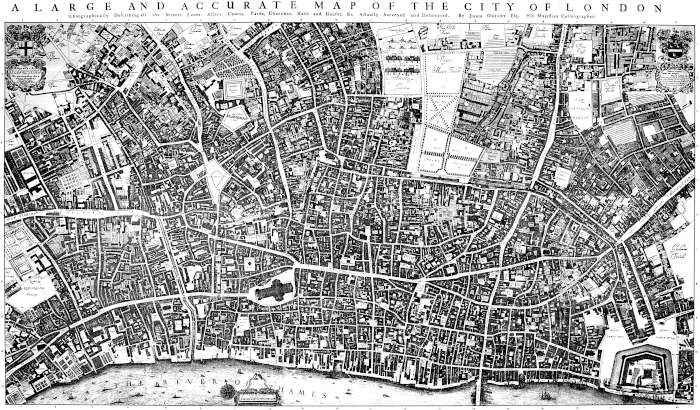
A LARGE AND ACCURATE MAP OF THE CITY OF LONDON Ichonographically Describing all the Streets, Lanes, Alleys, Courts, Yards, Churches, Halls and Houses, &c. Actually Surveyed and Delineated. By John Ogilby Esq: His Majesties Cosmographer. For explanations of references &c. on map see pp. 393–396 of the book. MAP ACCOMPANYING “LONDON IN THE TIME OF THE STUARTS”, BY SIR WALTER BESANT. PUBLISHED BY ADAM AND CHARLES BLACK, SOHO SQUARE, LONDON, 1903.
[See larger version]
Transcriptions
Transcription of image page 14
Die Veneris 5o. Maij. 1643.
It is this day Ordered by the Lords and Commons in Parliament, That the Booke concerning the enjoyning and tollerating of Sports upon the Lords day, be forthwith Burned by the hand of the Common Hangman in Cheape-side, and other usuall places: And to this purpose, the Sheriffs of London and Middlesex respectively, are hereby required to be Assistant to the effectuall Execution of this Order, and see the said Books burnt accordingly. And all persons who have any of the said Books in their hands, are hereby required forthwith to deliver them to one of the Sheriffes of London, to be burnt according to this Order.
John Browne Cler. Parl. Henry Elsynge Cler. P. D. Com.
The Sheriffes of London and Middlesex have assigned Wednesday next the 10th of this instant May, at twelve of the clock, for the putting in execution of the foresaid Ordinance, and therefore doe require all persons that have any of the Bookes therein mentioned, to bring them in by that time, that they may be burned accordingly.
John Langham. Thomas Andrewes.
LONDON: Printed for Thomas Underhill in Great Woodstreete. May 9. 1643.
Return to image
Transcription of image page 16
The 2 of May, 1643 ye Crosse in Cheapeside was pulled downe, a Troope of Horse & 2 Companies of foote wayted to garde it & at ye fall of ye tope Crosse dromes beat trumpets blew & multitudes of Capes wayre throwne in ye Ayre & a great Shoute of People with ioy, ye 2 of May the Almanake sayeth, was ye invention of the Crosse, & 6 day at night was the Leaden Popes burnt in the place where it stood with ringinge of Bells & a greate Acclamation & no hurt done in all these actions.
10 of May the Boocke of Sportes upon the Lords day was burnt by the Hangman in the place where the crosse stoode, & at Exchange
Return to image
Transcription of image page 38
Englands Miraculous Preservation Emblematically Described, Erected for a perpetuall MONUMENT to Posterity. Though Englands Ark have furios storms indurd By Plotts of foes and power of the sword Yet to this day by Gods almighty hand The Ark’s preservd and almost safe at land
Return to image
Transcription of image page 71
A LETTER Of His Excellencie The Lord General Monck, To the Speaker of the Parl. From Guild-Hall, London.
Right Honourable, In obedience to the Commands received from the Council last night, I marched with your Forces into the City this morning, and have secured all the persons except two, ordered to be secured, which two were not to be found: The Posts and Chaines I have given order to be taken away, but have hitherto forborn the taking down of the Gates and Portcullises, because it will in all likelihood exasperate the City; and I have good ground of hopes from them, that they will Levy the Assess; They desiring onely first to meet in Common-Council, which they intend to do to morrow morning. It seems probable to me, that they will yeild obedience to your Commands, and be brought to a friendly Complyance with you; for which reason I have suspended the execution of your Commands touching the Gates and Portcullises, till I know your further pleasure therein, which I desire I may by this Bearer; I shall onely desire, that (so your Commands may be answered with due obedience) such tenderness may be used towards them, as may gain their affections; They desired the Restauration of those Members of their Common-Council that are secured, which desires of theirs I shall onely commend to your grave Consideration, to do therein as you shall think most expedient, and, in attendance upon your further Commands, Remain
Guildhall Feb 9, 1659.
Your most Humble and Obedient Servant George Monck.
To the Right Honourable William Lenthal, Speaker to the Parliament of the Common-Wealth of England at Westminster.
POSTSCRIPT
I shall become an humble suiter to you, That You will be pleased to hasten your Qualifications, that the Writs may be sent out; I can assure you it will tend much to the Peace of the Country, and satisfie many honest Men.
Thursday Afternoon, January 9, 1659.
This Letter from General George Monck from Guild-Hall, London, of the 9th of February, 1659, was read.
Resolved, Upon the Question by the Parliament, That the Answer to this Letter be, to send General Monck the Resolve of the Parliament, That the Gates of the City of London, and the Portcullises thereof be forthwith destroyed, And that he be ordered to put the said Vote in Execution accordingly, and that M. Scot and M. Pury do go to General Monck and acquaint him with these Votes.
Tho. St. Nicholas, Clerk to the Parliament.
Thursday, February 9, 1659.
Resolved upon the Question by the Parliament, That the Gates of the City of London, and the Portcullises thereof be forthwith destroyed, and that the Commissioners for the Army do take Order that the same be done accordingly
Tho. St. Nicholas, Clerk to the Parliament.
LONDON, Printed by John Macock in the Year 1659.
Return to image
Transcription of image page 138
Haggai Chap:i·ve:2. Thvs speaketh the lord of hosts this people saie, the tyme is not yet come that the lords hovse shovld be bvilt. 3. Then came the word of the lord by Haggai the prophett saying, 4. is it tyme for yovrselves (o yee) to dwell in yovr seiled hovses, & this hovse lye waste:·
It is written: my hovse is the hovse of prayer: &c;·
Return to image
Transcription of image page 142
A Trimers Character. Who Can in the Twinkling of an eye Transform himselfe .vizt. to act the patriot and Saint. With two Hearts, two Tongues, and two Opinions for God or Baal like the Hedg-Hog’s Holes of refuge to fly too when a Storme Aproches, or the Barnacle both flesh and fish, Janus with two faces, or the Sea-gull that Swims as fish and flyes as fowl that hath a Double devotion Scotch and English, in one day’s duty. Half Surplice, and half Cloak both Priest and Presbeter. by way of Caution, be not led— misled I meane, but Mark these Monsters, who serve their own bellyes, and are onely fleecers, not feeders. He would be stil a Rebel if he durst, Turn-Coat in every Age for Interest.
Return to image
Transcription of image page 143
St. Alexander Carew, St. John Hotham, Captin Hotham & the Arch Bishop of Canterbury, beheaded on Towerhill for Treason against ye Parliament 1645.
[...] issue of blood in this more then miserable Kingdom; I shall desire, that I may pray for the people too, as well as for my self: O Lord, I beseech thee give grace of repentance to all people that have a thirst for blood, but if they will not repent, then scatter their devices so, and such as are or shall be contrary to the glory of thy great name, the truth and sincerity of Religion, the establishment of the King, and his posterity after him in their just rights and priviledges, the honour and conservation of Parl. in their ancient and just power, the preservation of this poor Church in her truth, peace and patrimony and the settlement of this distracted and distressed people, [un]der the ancient laws, and in their native liberties; and when thou hast [don]e all this in mercy for them, O Lord fill their hearts with thankfullness, [and] with religious dutiful obedience to thee and thy Commandments all [thei]r dayes: So Amen, Lord Jesus; and I beseech thee receive my soul to [mer]cy. Our Father, &c.
The Bishop of Canterburies last prayer on the Scaffold.
Lord I am comming as fast as I can, I know I must pass through the [sha]dow of death before I can come to see thee, but it is but umbra mortis, [a m]eere shadow of death, a little darkness upon nature, but thou by thy me- [ri]ts and passion hast broke through the jaws of death; so, Lord, receive my [So]ul, and have mercy on me, and bless this Kingdom with peace and plenty, and with brotherly love and charity, that there may be not this effusion of Christian blood amongst them, for Jesus Christ his sake, if it be thy will. And when he said, Lord receive my soul, which was his designe, the Executioner did his office.
Return to image
Transcription of image page 191
CUSTOM HOUSE
The Custom House for the Port of London, or Grand Office for the Management not only of the Affairs relating to ye Exports and Imports of the Opulent City, but of the Customs throughout England according to the Regulations of Parliament. It was built by K. Charles the 2d Anno 1668, at the Expence of above 10,000 Pounds, the former House being—consumed by the Fire of London. It is a large and gracefull Building, fronting the Water side, very Comodious as well for the Commissioners and the several Officers and Clerks above Stairs, as the Ware houses underneath, —and the Cranes for Landing and Lading the Merchnts Goods.— &c.
Return to image
Transcription of image page 211
View of the Front of Sir Paul Pindar’s’ House on the West Side of Bishopsgate Street Without This was formerly the Residence of Sir Paul Pindar, an eminent London Merchant; Consul to Aleppo; Ambassador to Constantinople and a public Benefactor during the reign of King James the first. The Vignette exhibits part of the First Floor Cieling.
Return to image
Transcription of image page 271
DURHAM HOUSE SALISBURY HOUSE WORCESTER HOUSE.
The three Houses above represented, stood on the banks of the Thames nearly adjoining each other. Durham House, the first in the Plate, occupied the spot called Durham Yard, now the Adelphi, and was built by Anty. Bec Bishp. of Durham, as a town residence for the Bishops of that See. Salisbury House was erected by Robert Cecil, Earl of Salisbury, in the reign of James I. and covered the site of the present Salisbury and Cecil Streets. Worcester House, originally belonged to the See of Carlisle. It afterwards came into the possession of the Earls of Worcester. Edwd. the last Earl of Worcester died here in 1627. His son Heny. being created Duke of Beaufort, it was called Beaufort House, and the Site is now called Beaufort Buildings. The above View was taken about the year 1630.
Return to image
Transcription of image page 322
Inside of the RED BULL Playhouse.
The Red Bull Playhouse stood on a plot of ground lately called “Red Bull Yard” near the upper end of St. John’s Street Clerkenwell; and is traditionally said to have been the Theatre at which Shakespeare first held a gentleman’s horses. In the civil wars it became highly celebrated for the representations of Drolls, to a collection of which pieces published by Frauncis Kirkman in 1672, this view of it forms a frontispiece. The figures brought together on the stage are intended as portraits of the leading actors in each Droll. The one playing Simpleton is Robert Cox, then a great favourite, of whom the publisher thus speaks in his preface. “I have seen the Red Bull Playhouse which was a large one, so full that as many went back for want of room as had entred. Robert Cox, a principal actor and contriver of these pieces, how have I heard him cryed up for his John Swabber, and Simpleton, the Smith. In which latter, he being to appear with a large piece of Bread & Butter, on the stage I have frequently known some of the female spectators to long for it”. The above print may be regarded not only as highly curious for the place it represents, but as a unique specimen of the interior economy of our antient English Theatres.
Return to image
Transcription of image page 326
VIOLA DA GAMBA
“For important regale of the Company the concerts were usually all viols to the organ or harpsichord. The violin came in late and imperfectly. When the hands were well supplied the whole chest went to work, that is, six viols, music being formed for it which would seem a strange sort of music now, being an interwoven hum-drum.”—From Autobiography of Roger North, born 1653.
CLAVICHORD
“The Clavichord hath a tunely kynde As the wyre is wrested high and lowe.” John Skelton, 1459–1529, Poet Laureate.
(The wrestler was the tuner, who wrested or strained the wire to the required tension.)
SPINET
This spinet was made in London about the end of the seventeenth century by Stephen Keene.
A contemporary advertisement runs thus:—“Mr. Stephen Keene, Maker of Harpsycons and virginals dwelleth now in Threadneedle St., at the sign of the virginal who maketh them excellently well both for sound and substance.”
THE FLAGEOLET
Pepys, in his Diary (March 1, 1666), writes:—
Being returned home I find Greeting, the flageolet-master, come and teaching my wife.” And (20th Jan. 1667)
“To Drumbleby’s the pipe maker, there to advise about the making of a flageolet to go low and soft, and he do show me a way which he do, and also a fashion of having two pipes of the same note fastened together, so I can play on one and then echo it upon the other, which is mighty pretty.”
A FINE OLD ITALIAN LUTE
A fine old Italian lute with label “1600, in Padova Venue.” A special interest attaches to it from its having been the favourite instrument of the late Carl Engel. In Evelyn’s (the Diarist) time lutes by famous Bologna makers were fetching extraordinary prices.
A VIRGINAL
Pepys, in his Diary, Sept. 2, 1666, at the time of the great fire writes:—
“Rivers full of lighters and boats taking in goods, and I observed that hardly one lighter or boat in three, that had the goods of a house in but there was a pair of virginals in it.”
Return to image
Transcription of images page 328
FEASANT HAWKING.
The Feasant Cock the woods doth most frequent, Where Spanniells spring & pearch him by the sent. And when in flight, the Hawk wth quickned speed With’s beake and savage talens makes him bleede.
ANGLING.
Angling on river banks, trowling for pike, Is noble Sport when as the fish doth strike, And when your pleasure’s over, then at night You and your freinds doe eate them with delight.
Return to image