Front matter
Reading edition
Larger Image
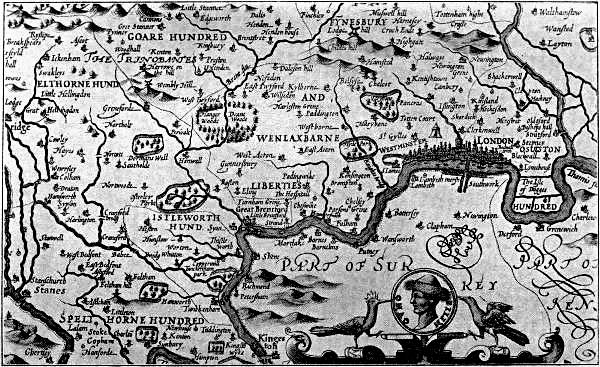
London and the Thames, from Speed’s Map, 1610
LONDON BEFORE THE CONQUEST
BY W. R. LETHABY

“Now would I fain In wordys playn, Some honoure sayen, And bring to mynde Of that auncient cytie That so goodly is to se.” —Fabyan.
LONDON MACMILLAN AND CO., Limited NEW YORK: THE MACMILLAN COMPANY MCMII
All rights reserved
“Lundres est mult riche cite, Meliur n’ad en Cristienté Pur vaillance, ni melx assisé, Melx gaurnie, de grant prisee; Al pe del mur li curt Tamise Pur li vent la marchandise Des tutes les qui sunt U marcheans Crestiens vient.” Roman de Tristan.
CONTENTS
PAGE
Introduction 1
CHAPTER I
Origins—The Legend of London—The British Church—The English come to London—Alfred’s London 6
CHAPTER II
Rivers and Fords 38
CHAPTER III
Roads and the Bridge 52
CHAPTER IV
The Walls, Gates, and Quays 74
CHAPTER V
The Citadel—Southwark—The Danes’ Quarter—The Portlands and Cnihtengild 101
CHAPTER VI
The Wards and Parishes—The Palace 126
CHAPTER VII
Streets—Craft Gilds and Schools—Churches 145
CHAPTER VIII
The Guildhall—London Stone—Town Bell and Folkmote 175
CHAPTER IX
The Government of Early London 187
CHAPTER X
Londinium 198
APPENDIX
On Materials for the Construction of Maps of Early London 212
NOTES ON FIGURES
London and the Thames, from Speed’s Map, 1610 Frontispiece
PAGE
Fig. 1.—Goddess of Hope. (Roman bronze found in London). Restored from Roach Smith’s Collectanea. About two-thirds full size 4
Fig. 2.—Stone Weapons, from the Thames at Westminster. From the Roach Smith Collection 7
Fig. 3.—Centre of Celtic Bronze Shield, from the Thames at Wandsworth. Now in the British Museum 8
Fig. 4.—Celtic Bronze Swords 9
Fig. 5.—Coin of Cunobeline. Enlarged 10
Fig. 6.—Bronze Lamp, Roman, found in London 11
Fig. 7.—Coin of Claudius and another of Constantius, the latter inscribed London (P. LON). Enlarged. The first shows an equestrian statue over a triumphal arch lettered DE BRITANN; the second an altar to Peace, inscribed BEAT TRANQLITAS 18
Fig. 8.—Christian Monogram from Cakes of Pewter found at Battersea. Now in the British Museum. One, in addition to the ΧΡ, has the words SPES IN DEO; the other Α·Ω· 21
Fig. 9.—Bronze Bracelet found in London; ornamented with a Cross. Now in the British Museum 23
Fig. 10.—Head of a Pin found in London. Now in the British Museum. A little less than full size. The subject seems to represent Constantine’s vision of the Cross 24
Fig. 11.—Enamelled Plate of Bronze, about half size of original, found in London. Now in the British Museum. From Roach Smith’s collection 25
Fig. 12.—Cross from Mosaic Pavement found in London. Now in the British Museum. It forms the centre of a geometrical pattern 27
Fig. 13.—Saxon Spear found in London, and now in the British Museum 29
Fig. 14.—Coin of Halfdan, with Monogram of London. From a unique example in the British Museum. It seems to have been coined on the taking of London by the Dane leader in 872 35
Fig. 15.—Saxon Swordhilt, of pierced bronze. Now in the British Museum. Found in London 36
Fig. 16.—Earliest printed view of London, from the Cronycle of Englonde, Pynson, 1510 39
Fig. 17.—London and the Roman Roads: The Watling Street through Greenwich and Edgware; the Erming Street through Merton and Edmonton, called also the Stone Street south of London; the Here Street through Brentford and Stratford 53
Fig. 18.—Roman Wall of London. Restored after the facts given by Roach Smith; the battlements and ditch added 75
Fig. 19.—Detail of Roman Wall of London. From a drawing of Roach Smith’s 77
Fig. 20.—From the Common Seal. Reverse, enlarged, 1224. See also Fig. 23; it shows the city wall with battlements and turrets 78
Fig. 21.—Section of Roman Wall and Ditch. Restored from excavation near Aldersgate recorded in Archæologia 80
Fig. 22.—From Matthew Paris, 1236. From MS. in the British Museum, describing the route to Jerusalem. It gives the names of six gates, the spire of St. Paul’s, etc., and refers to the legend of “Troie la Nuvela” 83
Fig. 23.—The Common Seal of London, 1224. It shows St. Paul patron of the City, such as he was figured on the City banner, rising behind one of the gates; right and left the Tower and Baynard’s Castle 85
Fig. 24.—Fragment found in the South Wall, against the river. From Roach Smith’s Collectanea. It looks late work, but is of marble 91
Fig. 25.—Fragment found in South Wall with the last 93
Fig. 26.—Danish Sword from the Thames at London. Recently shown in the New Gallery. The hilt was inlaid in precious metal. There are similar swords in the British Museum, called the Scandinavian type 112
Fig. 27.—Plan showing the relation of the Central Wards and the principal Streets; also the extent of the extra-mural liberties. Notice especially how Bridge, Langbourne, and Bishopsgate Wards lie over the two great streets, and meet at the Fourways of the great Roman Roads. See Fig. 17 127
Fig. 28.—Saxon Brooch found in Cheapside. Of lead; nearly full size. In the British Museum 153
Fig. 29.—Coin of Alfred, with Monogram of London. Enlarged. The name in the field is that of the moneyer. Compare monogram with Fig. 14, from which it seems to have been copied 155
Fig. 30.—Tomb of King Ethelred, 1017. In Old St. Paul’s. From Hollar’s drawing in Dugdale 162
Fig. 31.—Ninth or Tenth Century Tombstone from St. Paul’s Churchyard. Inscribed in runes. Now in the Guildhall Museum 164
Fig. 32.—Saxon Tomb from St. Benet Fink. Restored from fragment in the British Museum; compared with one found at Cambridge, like the entire figure 166
Fig. 33.—Head of Cross from St. John’s, Walbrook. Now in the British Museum 168
Fig. 34.—Saxon Coffin-lid from Westminster Abbey, North Cemetery, now by entrance to Chapter-House. It had been added to a Roman sarcophagus 170
Fig. 35.—Roman Pavement found in Threadneedle Street. Drawn in situ by Fairholt, 1854. From the original in the author’s collection 199
Fig. 36.—Roman Brick, inscribed London, about one-twelfth full size. From Roach Smith 203
Fig. 37.—Inscriptions from Roman Brick. P·BRI·LON 203
Fig. 38.—Roman Tomb from outside of the East Walls. Restored from fragments found together, and now in the British Museum 205
Fig. 39.—Inscription from Roman Tomb. Now in the British Museum 206
Fig. 40.—End of a Roman Tomb found in London. Now in the British Museum. From a drawing by W. Archer 207
Fig. 41.—Leaden Cist for funereal use, found in London, and now in the British Museum 207
Fig. 42.—Plate of Figured Glass for Decoration, about two-thirds full size. Now in the British Museum. Found in London. Figure restored. From Roach Smith 208
Fig. 43.—Roman Inscription, from Clement Lane, E.C.; now lost. About two feet high 209