GAP (continued 2)
Reading edition
On the FIRST FLOOR.
In the hall and stair case.
Over the chimney.
A naked boy blowing bubbles and treading on a death’s head, representing Vanity, by Elizabetha Sirani.
Near the street door.
A large picture of dogs and foxes, by Peter Sneyders.
Over the door that goes into the first parlour.
A man’s head, by Giuseppe de Ribera, commonly call’d Il Spagnoletto.
On the landing place.
A large picture of David and Abigail, by Sir Peter Paul Rubens.
85Over the door.
The adventure of Don Quixote and the barber, by a Spanish painter.
Fronting the landing place at the top.
The portrait of the Duchess of Mantua, grand daughter to the Emperor Charles the Fifth, with her son in her lap, who was the last Duke of Mantua, with some allegorical figures, armour, &c. by Giovanni Benedetto Castiglione.
Under it.
A landscape, and a musical conversation, painted by Sir Peter Lely; being the portraits of himself and his whole family, drawn by the life.
Fronting the windows.
The judgment of Paris, by Gerard Lairest.
Under it.
The judgment of Midas, by the same hand.
Over the looking glass.
A young lad blowing bubbles, said to be painted by Hannibal Caracci.
In the first parlour.
Over the chimney.
A Dutch kermis or country fair, painted by Old Pieter Bruegel.
On each side of the chimney.
Next the window, the portrait of a Turk, by Rembrandt van Rijn.
David with the head of Goliath and his sling, by Leonello Spada.
86Between the windows.
A man’s head, said to be that of Massaniello the fisherman who caused the great revolution of Naples, by Salvator Rosa.
The portrait of Francisco de Taxis, the first inventor of the posts in Europe, for which reason the direction of them has always remained in one of his family in all the dominions that belongs to the house of Austria, by a hand not certainly known.
Over the doors out of the hall,
The folly of spending our lives in the pursuit of love, wine, music and play, an emblematical picture, by Johannes Schorel.
The Virgin, our Saviour, St. Mary Magdalen, St. Peter, St. John the Baptist, and St. Jerome; by Jacobo Palma, senior, commonly called Old Palma.
Over the marble table.
The birth of our Saviour, and the adoration of the shepherds, by Giac. Bassan.
Under it, in the middle.
St. John the Baptist asleep in the desert, by Andrea del Sarto.
On both sides of it.
Two small sea pieces, a port in the Mediterranean, and a fight with the Turks, by William Vanderveld, junior.
87Under them, in the middle.
An emblematical picture, representing a guardian angel pointing out the way to heaven to a soul, under the figure of a young girl, by Carlino Dolce.
On both sides of it.
Two very highly finished landscapes on copper, by Salvator Rosa.
Between the two doors.
The portrait of the Duke of Richmond and Lenox, of the Stuart family, at whole length, with a dog, by Sir Anthony Vandyck.
Over the door to the back parlour.
Vulcan at his forge, with the Cyclops, by Jacob Jordaans of Antwerp.
Over against the windows.
In the middle.
The head of our Saviour crown’d with thorns, by Ludovico Caracci.
On both sides of that.
Two fruit pieces, by Michael Angelo Pase, called Michael Angelo del Campidoglio.
Under them, in the middle.
A Bacchanal in two colours, by Rubens.
On both sides of it.
A landscape with a robbery, and a battle, both painted by Giacomo Cortese, commonly called Il Bourgognone.
88Under them, in the middle.
A pretty large landscape and figures of Dutch boors, by Adrian Van Ostade.
On both sides of it.
A stag hunting, and another of hern hawking, by Philip Woverman.
Under them.
Two conversations of boors within doors, by Adrian Van Ostade.
In the second parlour.
Over the chimney.
Lot and his two daughters, with the city of Sodom on fire, by Lorenzo Lotti, a great imitator of Giorgione and Titian.
Over the closet doors.
Next the window.
The great amphitheatre at Rome, and other buildings, by Viviano Cadahorra.
A sea port with buildings and ruins, by Salviouch, and the figures by John Miele.
Over the door to the first parlour.
Omphale the mistress of Hercules, with the lion’s skin and his club by her, by Augustin Caracci.
Over the two other doors.
Two battles in the stile of Bourgognone, but the hands not certainly known.
In the passage room.
Over the doors.
A philosopher with a book in his hand, by Pier Francesco Mola.
89Mary Magdalen, by Giacinto Brandi.
Our Saviour meditating on the sins of the world, by Giovanni Antonio Regillio, a competitor of Titian’s, and commonly called Il Pordenone.
In the great room.
Over the door at which you go in.
The portrait of a young man on wood, by Andrea del Sarto.
Between that door and the window.
The head of St. James the apostle.
The head of St. John the evangelist.
N. B. These two last pictures are by
a hand that is not certainly known.
Under them.
A Bacchanal painted on copper, by Cornelius Polembergh.
Between the door and the wall.
In the middle.
A pretty large picture of our Saviour and the Samaritan woman, by Giovanni Francesco Barbiori da Cento, commonly called Il Guercino.
On the side towards the door.
The Virgin and Child, by Il Cavalier Giovanni Lanfranchio.
On the side towards the wall.
Venus dressing, and Cupid holding her looking-glass, by Paolo Veronese.
Under them, in the middle.
The Virgin and Child, by Raphael de Urbino.
90On the side towards the door.
The Virgin and Child in the clouds, and several angels, by Bartolomeo Murillo.
On the side towards the wall.
The Virgin and our Saviour, by Carlo Cignani.
Next to the door.
The annunciation of the Virgin Mary, by Paolo Veronese.
Next to the wall.
The birth of our Saviour, &c. by Jacapo Robusti, commonly called Tintoretto.
Over the chimney.
Tobit and the angel, by Michael Angelo Amerighi, commonly called Michael Angelo Caravaggio.
Between the wall and the chimney.
In the middle.
The portrait of a man, by Antonio Allegri, commonly called Il Correggio.
Towards the wall.
The head of some Spanish general, by Giovanni Giachinette, commonly called Il Bourgognone delle Teste.
Towards the chimney.
The portrait of the famous Hernando Cortes, conqueror of Mexico, by Titiano Vecelli, called Il Titiano.
Under them.
A large battle in an oval, painted by Luca Jordano.
91Between the chimney and farthest wall.
In the middle.
St. Sebastian, by Guido Reni.
Next the chimney.
The portrait of Sir Anthony Vandyck, painted by himself.
Next to the wall.
The portrait of a young girl, with a little dog asleep in her hands, by Rembrandt van Rijn.
Under them.
A large oval battle, painted by Luca Jordano.
Over the closet door.
The portrait of a man with a book in his hand, said to be the famous satirist Berni, by Giorgio Barbarelli, called Il Giorgione.
Between the door and the wall.
A she saint, with angels, by Pietro Berettini, called Pietro Cortona.
Under it, in the middle.
A small battle, by Bourgognone.
On both sides of it.
Two small pictures, done from the gallery of Archduke Leopold, the one from Paris Bourdon, and the other from young Palma, by David Teniers.
Between the door and the window.
A large picture, representing our Saviour at the Pharisee’s house, and Mary Magdalen 92anointing his feet, with the portrait of the person for whom it was painted, as a servant waiting at table, by Carlo Dolce.
N.B. This picture is out of the stile of Carlo Dolce’s paintings, who never before attempted so great a subject and composition; and was done by him, after the drawing of Ludovico Cigoli.
Under it, in the middle.
The portraits of three of Henry the Seventh’s children, viz. Prince Arthur, Henry the VIII. and Princess Mary, who was afterwards Queen of France, and Duchess of Brandon, by a hand not certainly known.
On both sides of it.
Two pieces of the history of Judith, the one where she is presented to Holofernes, and the other where she is entertained by him at a feast, by Paolo Veronese.
On the SECOND FLOOR.
In the dining room.
Over the door as you go into it.
A fortune teller, with several figures consulting him, by Giorgio Barbarelli, called Il Giorgione.
Over the door.
The history of Tancred and Erminia, out 93of Tasso, by Pietro Berettini, called Pietro de Cortona.
Between the doors.
A large picture, representing the baptism of our Saviour by St. John in the river Jordan, with angels, by Guido Reni.
Between the wall and middle door.
A Bacchanal, with Silenus and satyrs, by Jacob Jordaans of Antwerp.
Under it.
A large landscape, by Claude Gille, commonly called Claude de Lorraine.
Between that door and the wall.
The Virgin and our Saviour, St. John the Baptist and his lamb, St. Peter, and the three cardinal virtues, Faith, Charity, and Hope, by Titiano Vecelli, called Il Titiano.
N.B. This is an emblematical picture, by which the painter meant to represent the several virtues that are necessary to form the character of a good Christian.
Under it, in the middle.
The holy family, by Paolo Veronese; the saint which is represented in armour, being the portrait of Paolo himself.
Next to the door.
A landscape and naked figures, by Cornelius Polembergh.
94Next to the wall.
The flight into Egypt, by Filippo Lauri.
Between the wall and chimney.
Scipio and the fair captive at Carthagena, by Pietro de Cortona.
Under that.
A battle, by Giacomo Cortese, called Il Bourgognone.
Between the chimney and the window.
The dead body of our Saviour, with the Virgin Mary, and St. John, by Hannibal Caracci.
Under it.
A landscape, representing a temple of Bacchus, and the sun setting, by Claude Gille, commonly called Claude de Lorraine.
Dressing room.
Over the chimney.
The ordination of St. Dennis, patron of France, by Eustache le Sueur.
Between the chimney and the window.
Women at work by candle light, by Giacomo Bassan.
Under it, in the middle.
The annunciation of the blessed Virgin, with God the Father, and several angels in the clouds, by Francesco Albani.
N.B. This picture belonged to Pope Innocent X. as may be seen by his 95arms on the back side of it; and the frame, which is of silver, was made by the famous statuary Alessandro Algardi.
Under that.
St. Augustine in an ecstasy, contemplating the mystery of the holy Trinity, and the incarnation of our Saviour; a very high finished sketch by Vandyck, of the finest picture he ever painted, which is in the church of St. Augustine at Antwerp.
On both sides, at the top.
A man and a woman smoaking, and a man and woman drinking, by David Teniers.
Underneath, on each side.
Next the window.
Cephalus and Procris, by Adam Elsheimer.
Next to the chimney.
The will of Eudadimus the Corinthian, a sketch, by Nicholas Poussin.
Between the chimney and the wall.
The flight into Egypt, by Il Cavalier Giovanni Lanfrancho.
Under it, in the middle.
The portrait of Antonio Caracci, son of Augustino, by Annibal Caracci.
Under that.
A garland of flowers, painted on looking glass, by Old Baptiste.
96On both sides at top.
Next the chimney.
A satyr squeezing grapes, with a tyger and leopard, by Rubens.
Next the wall.
Cupid shaving his bow, and two other little Cupids, by Parmegiano.
Under them.
Dutch boors in a fury against the Spaniards, by Pieter Bruegel, and a barber surgeon’s shop, with a cat and monkies, by David Teniers.
Over against the windows.
In the middle.
St. Francis Xavier dying in an island on the coast of China, by Carlo Maratti.
On both sides of it.
Two sea pieces, by William Vanderveld, jun.
Under them, in the middle.
The Virgin and Child, St. Joseph, St. Anne, and St. Catherine, by John Abeyk, commonly called John of Bruges.
On both sides of it.
Four pieces of the history of Judith and Holofernes, by Paolo Veronese.
Under them, in the middle.
The martyrdom of the Innocents on copper, by Alessandro Turchi.
97On both sides of it.
A small battle piece, by Bourgognone.
A march of soldiers, by the same.
Over the door to the dining room.
The portrait of Cosmus the 3d. Duke of Florence, when a child, by Giustus Subtermans.
Over the two other doors.
Our Saviour breaking the bread, and blessing the cup, and St. Bruno founder of the order of Carthusians, both of them by Carlo Dolce.
Between the two doors.
The marriage of Jacob, by Ciro Ferri.
Under it.
The Virgin and our Saviour in the clouds, and the several saints, patrons of the city of Bologna, by Guido Reni.
Under that.
The nativity of our Saviour, by young Palma.
Over against the chimney.
A large landscape, with the baptism of Queen Candace’s eunuch by St. Philip, by John Both.
Under it, in the middle.
The inside of a church, by Henry Stenwix, and the figures by Velvet Brughell.
Under each corner of it.
Two little round pictures, one of them 98being the head of Mary Magdalen, and the other that of our Saviour crown’d with thorns; both of them by Francesco Albani.
Under them.
The shipwreck of St. Paul on the island of Malta, by Adam Elsheimer.
On each side of it.
Two small landscapes on copper, by John Brughell, commonly call’d the Velvet Brughell.
On both sides of them.
The martyrdom of St. Laurence, by Titiano Vecelli, commonly called Il Titiano; and St. Sebastian, and other saints, by Filippo Lauri.
Between the door and the window.
The education of Bacchus, by Simon Vouet.
Under it.
The Virgin and our Saviour, and several saints, by Ludovico Caracci.
Under that.
The judgment of Paris, by Giovanni Rottenhammer, the landscape by Paul Brill.
Between the windows over the glass.
A portrait of a Dominican friar, by Giovanni Lanfrancho.
In the passage room, over the doors.
The portrait of Don Antonio de Leyva, General to Charles the Fifth, who 99took Francis the First prisoner at the battle of Pavia. By Il Dosso di Ferrara.
The portrait of Charles Lewis, the eldest Prince Palatine, by Vandyke.
The portrait of the Lady Anne Carre, Countess of Bedford, by the same.
Over the chimney.
Our Saviour carried before Pontius Pilate, in water colours, by Lucas of Leyden.
In the bedchamber, over the door.
The portrait of a man in a ruff, by Rubens.
Over the chimney.
A large picture of a curtain, carpet, fruit, &c. by the Maltese, and Mich. Angelo del Campidoglio.
In the closet.
Over the chimney.
A copy of Raphael’s picture of the Madonna della Seggiola in the palace of Pitti, at Florence.
Under it.
A small flower piece on copper, by Velvet Brughell.
Over the little closet door.
The portrait of Sir Paul Methuen when a boy.
Over the door next the window.
The picture of a woman, &c. by Albert Durer.
100Over the bedchamber door.
A man’s head, by Tintoretto, said to be that of the famous Andrea Vesalio.
Grove street, Hackney.
Grub street, 1. Fore street, Cripplegate. 2. Market street, Westminster.
Grub’s rents, Whitechapel.†
Gubbins, or Gobions, near North Mims in Hertfordshire, had its name from its ancient Lord Sir Richard Gobion. In the reign of Henry VII. it belonged to the family of the Mores, when it was called More Hall; but on the attainder of the great Sir Thomas More, Lord High Chancellor of England, it was forfeited to the Crown, and settled on the Princess, afterwards Queen Elizabeth, who held it till her death. It afterwards came into the possession of several families, and was at length purchased by the late Sir Jeremy Sambroke. The manor house and gardens are very beautiful.
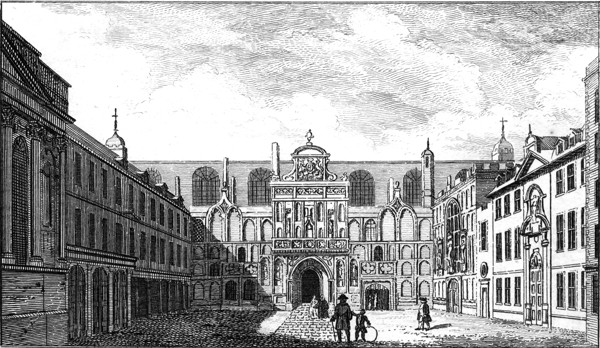
Guild Hall. S. Wale delin. B. Green sc. Oxon.
Guildhall, at the north end of King street, Cheapside, is the hall for holding the courts, and transacting the business of the city. The old hall in Aldermanbury being fallen to decay, the present structure was begun in the year 1411, upon a larger and more noble plan, and ten years were employed in compleating it. The executors of the famous Richard 101Whittington, long celebrated in song, gave a Purbeck pavement to the hall, and glazed some of the windows, on every one of which Whittington’s arms are placed; others of the Aldermen glazed different windows, and had also their arms painted on the glass.
The hall being however much damaged by the fire of London in 1666, was repaired and beautified two years after, at the expence of 2500l. in so effectual a manner, that it has stood till this time.
The entrance has a stately Gothic frontispiece, with the King’s arms under a cornice, pediment and vase; under which are niches; and in the middle of the front are the following words done in gold:
Reparata & ornate Thoma Rawlinson, Milit. Majore, An. Dom. MDCCVI.
That is,
Repaired and adorned in the year 1706, during the Mayoralty of Thomas Rawlinson.
Over the gate is a balcony, above which are placed in niches on each side, the figures of Moses and Aaron; and in niches on each side of the gate below, the four cardinal virtues; also under the balcony are depicted the arms of twenty-four companies.
On entering this Gothic arch, you 102come into the hall, which is one hundred and fifty-three feet long, forty-eight feet broad, and fifty-five feet high. The roof is flat, and divided into panels; the walls on the north and south sides are adorned with four Gothic demi-pillars, painted white with blue veins, and gilt capitals, upon which are the royal arms, and those of Edward the Confessor.
Nearly fronting the gate, are nine or ten steps, leading to the Lord Mayor’s court, over which is a balcony supported at each end by four iron pillars in the form of palm trees; by these is a small enclosure on each side on the top of the steps, used on some occasions as offices for clerks to write in, each being just sufficient to hold one person. Under these are two prisons called Little Ease, from the lowness of the ceiling, by which prisoners were obliged to sit on the floor; these prisons are intended for city apprentices, who upon complaint and a strict examination into the offence, were sometimes committed thither by the Chamberlain, whose office is at the right hand at the head of the steps. In the front of this balcony is a clock, on the frame of which is carved the four cardinal virtues, with the figure of Time, on the top, and a cock on each side of him. But the most extraordinary 103figures are yet behind; these are two monstrous giants which stand on the outside of the balcony close to the wall, one on each side: they have black and bushy beards; one holds an halbert, and the other a ball set round with spikes, hanging by a chain to a long staff. These absurd ornaments, which Mr. Strype supposes were designed to represent an ancient Briton and a Saxon, are painted, as if to give them the greater appearance of life, and render them more formidable to children.
Round the hall are hung up, the standards and colours taken from the French, at the battle of Ramilies. At the east end are the King’s arms between the pictures of his present Majesty King George II. and Queen Caroline; close by the first is Queen Anne, and by the last his late Majesty King George I. and at the same end of the hall, but on the north and south sides, are the pictures of King William III. and Queen Mary fronting each other. The hall is likewise adorned with the portraits of eighteen Judges, put up by the city as a testimony of public gratitude for their signal services, in determining the differences which arose between landlords and tenants, without the expence of law suits, on rebuilding 104the city after the fire. These Judges are all painted at full length in their scarlet gowns; and in the Lord Mayor’s court there are the portraits of five other Judges painted in the same manner.
On the east end of the hall is held the court of Hustings weekly, and occasionally that of the Exchequer; and before the Hustings is held the court of Conscience. At the west end is held alternately the Sheriff’s court for the Poultry and Wood street counters. Opposite to the Chamberlain’s office, already mentioned, as situated up the steps underneath the giants, is the office of Auditors of the city accounts, within which is the Lord Mayor’s court office, where the Lord Chief Justice occasionally sits in trials by nisi prius. On the west side of the Mayor’s court office is the court of Orphans, where the Lord Chief Justice of the Common Pleas occasionally sits. Adjoining to this court on the north, is the old council chamber, now used by the Commissioners of bankrupts. Contiguous to it is the new council chamber. Beneath the Mayor’s court is the Town Clerk’s office, where are deposited the city archives. To the east and north are the residences of the Chamberlain and Town 105Clerk; near which are two rooms wherein the business of bankrupts are dispatched. Contiguous to the north west is the kitchen; in the porch is the Comptroller’s office, and over it the Irish chamber. Over the piazzas on the west, are the common Serjeant’s, Remembrancer’s, and city Solicitor’s offices. See an account of each of these courts under the articles, Court of Common Council. Lord Mayor’s Court. Court of Hustings, &c.
Guildhall is at the end of a tolerable vista, which shews the building to some advantage, though the Gothic front has nothing very extraordinary in it. The hall within is a fine one, but the entrance would have been better at the lower end than in the middle, for by this means all the beauty of the perspective is lost. The ascent of steps across the hall not being opposite the gate, as it ought to have been, is another material defect. A noble front in the situation of Guildhall, would have had an advantage hardly to be met with elsewhere, and give an architect a fine opportunity of displaying his genius. But the present front is full of little parts which have no effect at a distance.
Guildhall alley, Basinghall street, leading to Guildhall.
Guildhall Chapel, situated between 106Blackwell hall, and Guildhall, was founded in the year 1299, dedicated to St. Mary Magdalen and All Saints, and called London College. A chantry was founded in this chapel for four chaplains, and lands and tenements left for their support. It was rebuilt in the reign of Henry VI. and received new endowments: but at the suppression of religious houses it reverted to the Crown, and was bought of King Edward VI. with other lands and tenements, for the sum of 456l. 13s. 4d. and the city holds it in soccage of the manor of Greenwich. It was defaced, but not burnt down by the fire of London in 1666, and has been since repaired.
This edifice is perfectly in the Gothic taste. In several niches are set the figures in stone of King Edward VI. of Queen Elizabeth, with a phœnix under her; and of King Charles I. treading on a globe. The windows are extremely large, and on the inside the walls are hung with tapestry. Over the Aldermen’s seats there is a wainscot covering, and a particular seat for the Lord Mayor, adorned with cartouches. There is a gallery at the west end, a handsome wainscot pulpit and desk, and a neat altar piece inclosed with rails and banisters.
On the south side of this chapel was 107formerly a library belonging to Guildhall and the College. But it is said that in the reign of King Edward VI. Edward Duke of Somerset, then Lord Protector, sent for the books with a promise of returning them shortly; upon which three carriages were loaded with them; but they being never returned, the room has been long made a storehouse for cloths.
Guildhall yard, 1. King street, Cheapside.☐ 2. King street, Westminster.
Guilford, or Guildford, a considerable borough in Surry, situated on the river Wey, thirty miles from London, and governed by a Mayor, Recorder, and Aldermen. Here the assizes are sometimes held, and always elections for members of parliament, the town itself returning two. Not far from the town are the ruinous wails of an old castle, this having been in the Saxon times a royal villa, where many of our Kings long after kept their festivals. Here were formerly two or three convents, one of which was not long ago the seat of Daniel Coswall, Esq; and had a delightful park adjoining to it. There were also three churches in the town; but one of them fell down in the year 1740. Here is a charity school founded by King Edward VI. and an almshouse 108founded by George Abbot, Archbishop of Canterbury, who endowed it with lands worth 300l. a year, 100l. of which he ordered to be employed in setting the poor at work, and the other 200l. he allotted for the maintenance of a master, twelve brethren, and eight sisters, who are to have 2s. 6d. a week: the Archbishop’s birth day is annually commemorated in it; and the Archbishop of Canterbury is its visitor. There are here likewise two charity schools for thirty boys, and twenty girls; and a fine circular course for horse races, which begin when the Newmarket races are ended. Guilford had formerly a considerable manufacture of cloth, of which there are still some remains. The great road from Chichester and Portsmouth lies through the town, which has been always famous for good inns, the cleanest of linen, and other excellent accommodations; and as the river Wey is made navigable to this town, a great quantity of timber is carried down it to London, not only from this neighbourhood, but from the Sussex and Hampshire woods, above thirty miles off, from whence it is brought to Guilford in the summer by land carriage.
The road from hence to Farnham is very remarkable, for it runs along the 109ridge of a high chalky hill, no wider than the road itself, and the declivity begins on either hand, at the edge that bounds the highway, and is very steep and high. From this hill is a surprizing prospect; to the north and north west over Bagshot Heath; to the south east into Sussex, almost to the South Downs; and to the west it is so unbounded that the view is only terminated by the horizon. On this hill, which is called St. Catharine’s, stands the gallows in such a position, that the town’s people of Guilford may, from the High street, sit at their shop doors and see the criminals executed.
Guillam’s wharf, St. Catharine’s.†
Gullyhole alley, Wheeler street.
Gulston’s square, Gulston’s street.†
Gulston’s street, Whitechapel.†
Gum alley, Barnaby street.
Gummery’s alley, Dorset street.†
Gun alley, 1. Barnaby street.* 2. Little Moorfields.* 3. St. John’s street, West Smithfield.* 4. Wapping.* 5. Well street.*
Gun dock, Wapping.
Gun-house stairs, near Vauxhall.
Gun lane, Three Colts street.*
Gunpowder alley, 1. Poor Jury lane. 2. Shoe lane.
110
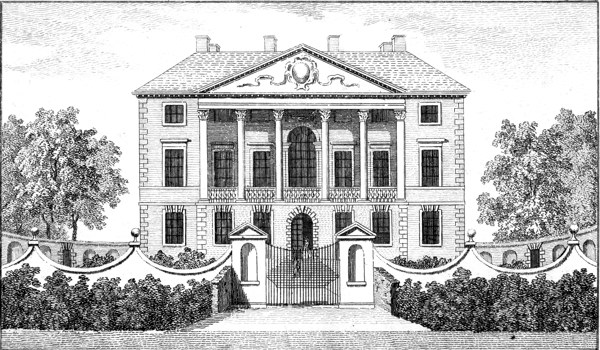
Gunnersbury. S. Wale delin. B. Green sculp.
Gunnersbury House, near Ealing, a noble and elegant structure, built by Inigo Jones, or, as some say, by Mr. Web, who was son-in-law to Inigo Jones. Indeed the architecture shews that if the plan was not drawn by that celebrated architect himself, it was designed by some of his scholars, for the building has that majestic boldness and simplicity which grace all the works of that excellent artist. It is situated on a rising ground; the approach to it from the garden is remarkably fine. The loggia has a beautiful appearance at a distance, and commands a fine prospect of the county of Surry, the river of Thames, and of all the meadows on its banks for some miles, and in clear weather of even the city of London.
The apartments are extremely convenient and well contrived. The hall, which is large and spacious, is on each side supported by rows of columns, and from thence you ascend by a noble flight of stairs to a saloon, which is a double cube of twenty-five feet high, and most elegantly furnished. This fine room has an entrance into the portico on the back front, which is supported by columns, and from the finest of the prospect over the Thames, is a delightful place to sit in, during the 111afternoon in the summer season; for it being contrived to face the south east, the sun never shines on it after two o’clock; but extending its beams over the country, enlivens the beautiful landscape that lies before this part of the edifice. On entering the garden from the house, you ascend a noble terrace, which affords a delightful view of the neighbouring country; and from this terrace, which extends the whole breadth of the garden, you descend by a beautiful flight of steps, with a grand balustrade on each side. But the gardens are laid out too plain, having the walls in view on every side. This was the house of the late Henry Furnesse, Esq; who had a fine collection of pictures in it.
Gunsmiths, a company incorporated by letters patent, granted by King Charles I. in the year 1638. This fraternity consists of a Master, two Wardens, and eighteen Assistants; but has neither livery nor hall. Maitland.
Gun street, Artillery lane, Spitalfields.*
Gun wharf, 1. Near Battle bridge.* 2. Wapping Dock.*
Gun yard, 1. Bishopsgate street without.* 2. Houndsditch.* 3. Maiden lane, Southwark.* 4. Pepper alley.* 5. Petticoat lane.* 6. Rosemary lane.* 7. Sugar Loaf alley, Moor lane.* 8. Tower ditch.*
112Gutter lane, Cheapside, originally called Guthurn lane, from Guthurn, the owner thereof. Maitland.
Guttige’s rents, Whitechapel.†
Guy of Warwick’s court, 1. Duke street.* 2. Upper Ground.*
Guy’s court, Playhouse passage, Drury lane.†
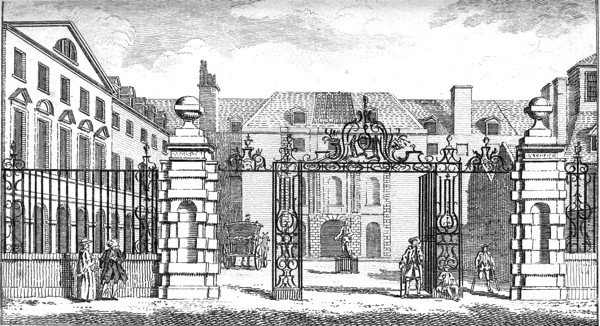
Guy’s Hospital. S. Wale delin. B. Green sc. Oxon.
Guy’s Hospital, in Southwark, for the cure of sick and lame persons, was founded by Mr. Thomas Guy, a citizen and bookseller of London, who from a small beginning amassed an immense fortune, by his industry and frugality; and more particularly by purchasing seamen’s tickets in the reign of Queen Anne; and by his success in buying and selling South Sea stock in the year 1720. He was never married, and had no near relations; and therefore towards the close of his life, considering how he should dispose of his wealth, after many ruminations, resolved to be the founder of the most extensive charity ever established by one man. He was seventy-six years of age when he took this resolution, and having no time to lose, immediately took of the President and Governors of St. Thomas’s hospital in Southwark, a lease of a piece of ground opposite to that hospital, for the term of nine hundred and ninety-nine years, for a ground rent of 30l. a year; 113and as this was covered with small houses that were old and ill tenanted, he immediately gave the inhabitants notice of his intention, and when they had removed their effects, pulled down the buildings in the year 1721, and proceeding with all the expedition of a youth of fortune erecting a house for his own residence; he caused the foundation of the intended hospital to be laid the following spring, and this vast fabric was roofed before the death of the founder, which happened on the 27th of December 1724.
The only motive that induced Mr. Guy to erect this hospital in so low and close a situation, was his design of putting it under the management and direction of the Governors of that of St. Thomas. But by the advice of his friends he altered his resolution; it was then however too late to think of chusing another situation, for the building was raised to the second story, but he rendered the place as agreeable as possible by its elevation above the neighbouring streets.
The expence of erecting and furnishing this hospital amounted to the sum of 18,793l. 16s. great part of which he expended in his life time; and the sum he left to endow it, amounted to 219,499l. both together amounting to 238,292l. 16s. 114a much larger sum than was ever before left in this kingdom by one single person to charitable uses.
The edifice is situated at a small distance from the foot of London bridge, and consists of two quadrangles, besides what the print exhibits, which is intended when the old buildings are removed to be made regular. At your approach, which is a very narrow street, you first see the side of the square, which is very elegant, and a noble iron gate, with very handsome piers, but are much disappointed when you come nearer, to find the most contemptible front you can imagine. The whole side could not be represented in the print, as there was not distance in the street to bring it into the visual angle. The iron gates open into a square, in the middle of which is a brazen statue of the founder, by Mr. Scheemakers, dress’d in his livery gown, very well executed.
In the front of the pedestal is this inscription:
Thomas Guy sole founder of this hospital in his life time. A.D. MDCCXXI.
On the west side of the pedestal is represented in basso relievo, the parable of the good Samaritan; on the south side is 115Mr. Guy’s arms; and on that side of the pedestal facing the east, is our Saviour healing the impotent man.
The superstructure of this hospital has three floors besides the garrets, and the same construction runs through the whole building, which is so extensive as to contain twelve wards, in which are four hundred and thirty-five beds; and in short the whole has a plainness that becomes the nature of the institution, and at the same time a regularity that does some honour to the builder, the whole being disposed for the mutual accommodation of the sick, and of those who attend them.
Soon after Mr. Guy’s decease, his executors, pursuant to his last will, applied to parliament to get themselves, and fifty-one other gentlemen nominated by the founder, to be incorporated Governors of the intended hospital; upon which all these gentlemen were constituted a body politic and corporate, by the name of the President and Governors of this hospital: they were to have perpetual succession and a common seal, with the power of possessing the real and personal estates of the late Thomas Guy, Esq; for the purposes of the will, and to purchase in perpetuity, or for any term of years, any other 116estate whatsoever, not exceeding 12,000l. a year.
This corporation was no sooner established by parliament, than the President and Governors set heartily about the work, by finishing and furnishing the hospital, chusing their officers and servants, and taking in patients, whose number at first amounted to 402. For the more effectual preventing inferior servants preying upon poor patients, or their friends, they resolved to give them handsome salaries, and the following were appointed and are still given.
The Treasurer 00 0 0
His Clerk 40 0 0
Steward 80 0 0
Chaplain 80 0 0
Two Physicians, 40l. each 80 0 0
Apothecary 80 0 0
Apothecary’s two servants 78 0 0
Surgeryman 30 0 0
Butler, with his horse 67 2 8
Cook and her servant 32 0 0
Porter 35 0 0
Beadle 30 0 0
Matron 50 0 0
Eleven sisters, 25l. each 275 0 0
Eight nurses, 16l. each 128 0 0
Twelve watch-women, 10l. 8s. each 124 16 0
117One brother belonging to the lunatics 35 0 0
One sister belonging to the lunatics 25 0 0
Sum total, 1349 18 8
These officers and servants are chosen by the sixty Governors, who have carried on this noble charity in such a manner as to restore ease and health to many thousands of their fellow subjects.
Besides which the out-patients who receive medicines gratis, frequently amount to about 1600 in a year.
Before we conclude this article, it may be proper to mention some other particulars relating to Mr. Guy, in order to do justice to the character of that great benefactor to the public, by which the reader will see the little foundation there is for the general opinion of his being remarkable for nothing more than his parsimony and avarice. He was a patron of liberty and of the rights of his fellow subjects, which, to his great honour, he strenuously asserted in several parliaments, whereof he was a member for the borough of Tamworth in Staffordshire, the place of his birth. To this town he was a general benefactor; and early in his life he 118not only contributed towards the relief of private families in distress, but erected an almshouse, with a library, in that borough, for the reception of fourteen poor men and women, to whom he allowed a certain pension during his life, and at his death he bequeathed the annual sum of 125l. towards their future support, and for putting out children apprentices, &c.
In the year 1701 Mr. Guy built and furnished at his own expence, three wards on the north side of the outer court of St. Thomas’s hospital, and gave to those wards 100l. a year, for eleven years immediately preceding the foundation of his hospital. Some time before his death, he removed the frontispiece of St. Thomas’s hospital, which stood over the gateway in the Borough, and erected it in the place where it now stands, fronting the street: he also enlarged the gateway; rebuilt the two large houses on its sides, and erected the fine iron gate between them, all at the expence of 3000l. To many of his relations he gave while living, a settled allowance of 10 or 20l. a year; and to others money to advance them in the world. At his death, he left to his poor aged relations the sum of 870l. a year during their life; and among his 119younger relations, who were very numerous, and his executors, he left the sum of 75,589l. He left the Governors of Christ’s hospital a perpetual annuity of 400l. for taking in four children annually, at the nomination of the Governors; and bequeathed 1000l. for discharging poor prisoners within the city of London, and the counties of Middlesex and Surry, who could be released for the sum of 5l. by which sum, and the good management of his executors, there were above 600 poor persons set at liberty, from the several prisons within the bills of mortality. Maitland.
Guy’s yard. Vinegar yard, Drury lane.†
