Chapter III · SUMMARY.
Reading edition
Queen Margaret at Linlithgow Palace—Withdraws to Perth—Writes to her brother, Henry VIII.—The mourning coronation of her son, James V.—Margaret declared Queen Regent of Scotland—Retains the State treasure—John, Duke of Albany, invited to assist her Regency—Birth of her posthumous son—Enamored of the Earl of Angus—Advances his uncle, Gavin Douglas—Her poetical portrait in his Palace of Honor—Queen marries Angus privately—Popular rage at her second marriage—Queen gives Gavin Douglas her father’s Prayer-book (fac-simile of her autograph, therein)—She is deprived of sovereign power—Message brought her from Council by the Lord-Lion—Lord Drummond strikes him in her presence—Margaret causes her husband to assault the Lord Chancellor—Her deposition—Her letters to Henry VIII.—Her reception of the Regent Albany—Her intercession for Lord Drummond—Surrender of her sons required—Shuts them up in Edinburgh Castle—Arranges their appearance in the gateway—Her husband’s retreat—Margaret retires to Stirling—Regent besieges her—She surrenders her sons—Goes to Linlithgow—Plans to steal her children—Takes her chamber for her accouchement—Escapes with her husband to Tantallan—Flies to the Border—Takes refuge at Coldstream Priory—Her illness there—Her lady-visitor maltreated—Margaret’s complaints thereof—Invited into England—Sets out for Morpeth—Taken ill on the road—Hurried into Harbottle—In danger of death—Birth of her daughter, Margaret Douglas—Letter to Albany—Languishing state—Removes to Morpeth—Death of her infant son—Deserted by her husband—Invited by Henry VIII. to Court—Katharine of Arragon’s presents to her—Progress to London—Warm welcome at Greenwich—Tournament in her honor—Her treachery to Scotland—Letters to Wolsey—Inventory of her valuables, &c. &c.
Queen Margaret had been left at her Palace of Linlithgow by her husband when he marched southward to his disastrous campaign. She had wished exceedingly to accompany him to the army, in hopes, as she said, of mediating for him with England. Therefore she remained in the north, much against her inclination, restless and unhappy, her feelings as a wife being much outraged by the scandals afloat concerning the partiality of James IV. to Lady Heron of Ford.[164]
There are traditions still current in the neighborhood of the beautiful palatial ruin of Linlithgow relative to her parting with James IV.
Near the King’s bedchamber, and a beautiful little apartment overlooking the lake, supposed to be his dressing-room, is a turnpike stair, at the corner of the east side of the quadrangle erected by James IV. This leads to a lofty turret or mirador, called by popular tradition “Queen Margaret’s Bower.” It is surrounded by a stone bench or divan, and had once a small stone table in the center. Here the Queen spent in tears the livelong summer’s day on which her husband left her to march against England. Here, too, she is said to have passed “the weary night of Flodden fight,” expecting news of the engagement, which came at last, but too soon.[165]
The fatal field of Flodden not only made Queen Margaret a widow, but rendered Scotland desolate and almost desperate. All the hope that remained to the people of averting the fury of Henry VIII., and the cruelty of his successful general, centered solely in the Queen—being founded on the near relationship of herself and their infant King to the southern sovereign.
The grief of Margaret as a widow, to whatsoever height it rose, has never been dwelt upon by any cotemporary, nor even by her own ever-active pen. No unfaithful husband, however accomplished he may be, and admired by the world in general, can reasonably expect a very profuse expenditure of tears from his widow. As Queen Regent, Margaret was much better employed than in passionate lamentations, for she exerted herself with prompt energy in securing the safety of the people committed to her care by her husband, and in hastening the coronation of her son.
For this purpose she retreated to Perth, whither there is every reason to suppose that the venerable Bishop Elphinstone had already conveyed the infant James V. When the Queen arrived there, she immediately wrote to her brother deprecating his further hostilities, and entreating him not to oppress or harm “her little King,” his nephew, “who was,” she said, “very small and tender, being only one year and five months old.”[166] To this she added the affecting fact, that she should become the mother of a posthumous babe in a few months. “Her letter,” says a most intelligent historian, “seems never to have been communicated by Henry VIII. to his Council;” but he answered it saying, “If the Scots wanted peace they should have it; if war, they should have it; as for her husband, he had fallen by his own indiscreet rashness and foolish kindness to France, but he regretted his death as a relative.”[167]
The Queen convened such of the nobility as survived the red field of Flodden to meet the clergy at Perth immediately. So prompt were all their proceedings, that the young King was crowned at Scone,[168] near that city, within twenty days of his father’s death. It was called the Mourning Coronation; for the ancient crown of Scotland being held over on the baby-brow of the royal infant, most of the witnesses and assistants of the ceremony burst into an “infectious passion” of sobs and tears. They wept not only their own recent losses on the battle-field, but their late monarch, “who was,” as Buchanan says, albeit no commender of kings, “dear to all men while living, and mightily lamented by his people at his death.”
When the first agony of grief was abated at the loss of the King and the terrible slaughter of the best of the nobility and gentry who fought in the serried phalanx of spears about his person, the discovery was made by the Scottish people that no other injury was like to accrue from Flodden fight. It was, to all intents and purposes, one of those bad expenditures of human life called a drawn battle. Had it taken place on Scottish ground, it would have been reckoned another Bannockburn: the English must have retreated (for they did so on their own ground), and the Scots would have retained possession of the field. As it was, the English had the moral advantages of being an invaded people; and, as such, their success in making a great slaughter of those who were arrayed in battle on their soil, redounded more to their true glory than is the case in most great victories. But they did not purchase it easily. Stark and stiff as James IV. lay under heaps of slain, he kept possession of that well-stricken field. The dispatch of Lord Dacre clearly proves that when the English left the field at nightfall, they were ignorant to whom the victory belonged. Then the Homes and other Border chieftains plundered the dead at their leisure; their countrymen strongly suspected that they slew their King, and turned the scale of victory against their countrymen. There is the more probability in this supposition when it is remembered how inflexibly James IV. had maintained justice on his Borders,—therefore he had honestly won the enmity of those rapacious septs.
Lord Dacre made an excursion of observation, with a party of cavalry, in the morning after the battle of Flodden, to ascertain who possessed the field; he saw the King of Scotland’s formidable train of brass cannon dominant over the scene, but mute and motionless; the artillerymen gone; the Scottish cannon and the silent dead were solely in possession of the battle-ground. The thickest heaps cumbered it on the spot where the royal James and his phalanx had fought; the breathless warriors lay just as death had left them, for the marauding Borderers had not dared to pursue their occupation of stripping and plundering in the full light of day. James IV., it was reported, had first been wounded by an English arrow, and then killed by a cannon-ball, which had so completely obliterated his features that no certainty existed as to the identity of his body.[169] The corpse that fell into the hands of the English, it is asserted, was that of Andrew Lord Elphinstone, a dear personal friend of the King, of his age and stature, and otherwise closely resembling him in person. Lord Elphinstone had married Elizabeth Barley, one of Queen Margaret’s English maids of honor.[170]
Reports prevailed that the King had been seen alive at Kelso the evening following, and that he was still in existence, performing an expiatory pilgrimage to Jerusalem.[171] It will be shown subsequently how singular was the use Queen Margaret made some years afterward of this report.
The chief fact which staggered the English in regard to the identity of the corpse they supposed to be that of the warlike King of Scotland, was the absence of the penance-chain he wore about his waist;[172] but that is, after all, no criterion, since he might have considered it his duty to take it off for that day, at least when “he meant to strike personally good blows in the field.”
The neglect which the poor corpse experienced, whether it was that of the King of Scots or Lord Elphinstone, must ever disgrace the memory of Henry VIII. It was embalmed by Surrey’s orders, and sent with James’s armor to Richmond or Shene Palace.[173] Here it was kept unburied, to be shown to Henry VIII. when he returned from winning “his French pension.” Then the body remained unburied, because James had died excommunicated by Pope Julius II., who had forbidden him to invade England. At last, when half a century had elapsed, it was buried privately by the King’s plumber in the church of St. Michael, Wood Street, in the city of London.[174]
At the end of the same century, it was generally settled that James IV. was neither buried in the church at Wood Street, nor in the far Holy Land, but had been abducted by the Elfin-queen, and carried off between life and death to fairyland; for Andrew Man, a noted witch-finder, afterward burned as a witch, deposed in his confession previous to his execution at Aberdeen, that he had seen him there, 1597.[175]
It is noticed rather emphatically in Scottish chronicle, that the Queen of France, Anne of Bretagne, survived the news of the disastrous battle of Flodden but a few hours;[176] in fact, she had been dying of decline for several months. Queen Margaret, who had indulged in transports of jealousy on account of Queen Anne’s correspondence with James IV., had a near chance of becoming her successor, as Louis XII. greatly desired to marry her.
The Parliament of Scotland was convened by Queen Margaret to meet at Stirling Castle, December 21, 1513. Here the will of James IV. was read: although his request that Margaret would take upon her the regency and personal care of the infant King was against the ancient customs of Scotland, which always placed the executive power in the hands of the next male heir; yet, the hearts of all present being full of tenderness to the memory of their loved and lost monarch, no one could bear to gainsay his last wishes.[177] Queen Margaret was therefore unanimously recognized as their Regent, and the young King was solemnly given into her care. The Lord Chancellor, James Beton, Archbishop of Glasgow, the Earls of Arran, Huntley, and Angus were deputed to assist her. Stirling Castle, the great palatial fortress of Scotland, was appointed as the residence of the infant monarch, and of the Prince or Princess the Queen was expected to produce. Queen Margaret was to have possession of Stirling Castle, until her son James V. came of age. But all her power and grandeur as reigning sovereign of Scotland were to cease if she made a second marriage: on this head the testament of James IV. was stringent.
Queen Margaret, when she began to reign in Scotland, had just completed her twenty-fourth year. Thus was the whole island under the sway of the scepters of a brother and sister; Henry VIII. ruling the south, and Queen Margaret the north, of Great Britain.
Well would it have been for Margaret Tudor if she had acted according to the homely axiom, that honesty is the best policy. On the contrary, her first action at this juncture was a dishonest one. She concealed the treasure her late husband had confided to her for the use of his successor. In that era, when all governments were personal, such trust was literally meant for the purpose of carrying on the business of the state in the name of the infant King, which it was scarcely possible to do without proper supplies of specie. Besides, it is most evident that James IV., when he placed in the hands of his Queen that remarkable proof of his confidence, did not intend it to be made the means of her gratifying her particular partialities, as he had forbidden her to sway the scepter if she gave herself to another husband.
At that very convention of parliament, the officers of the crown, on looking into the late King’s personal affairs, found an empty treasury. They manifested great surprise at his want of wisdom in attacking England pertinaciously, when he must, even if victorious, have fallen back utterly exhausted, from lack of means for continuing the contest. All historians have repeated this censure.[178] The truth has rested concealed in Queen Margaret’s letters until the present day. The fact that she retained her husband’s exchequer for her own use, throws much light on the perpetual disputes which distracted her regency.
As the treasurer had paid to her, by the King’s written order, the 18,000 golden sols with which Louis XII. had subsidized Scotland, that sum must have been positively traced into her possession. The Queen met the proposal of restitution by a plea that it was owing to her for arrears of dower. The venerable Dr. Elphinstone, Bishop of Aberdeen,[179] addressed the convened Parliament in the hall of Stirling Castle on that subject. He bewailed the utterly exhausted state of the late King’s exchequer. “Meantime, great claims,” he said, “were made thereon by the Queen for her jointure, and for the education of the young King; on which account he agreed with those who thought it desirable that the next heir, John Duke of Albany,[180] then a naturalized subject of France, should be forthwith invited to Scotland, in order to assist the Queen Regent in the government;” which, being destitute of funds, required all the nerve of a hardy soldier to wrest the needful supplies from the exhausted people. Had Margaret restored the treasure she detained to its proper destination, it is clear she would have been left without a rival in empire: thus did her avarice defeat her ambition, which, like that of every member of the Tudor race, was inordinate and dominant.
Henry VIII., in great alarm lest the French interest should be again prevalent in Scotland, wrote to his sister, urging her to use every means of preventing Albany’s arrival. She needed no importunity to do all in her power for preventing his approach. Nevertheless, the delicacy of her health, and her precarious situation, obliged her to desist from much political agitation during the winter of 1513–14. In the spring, she added a fine boy to the royal family of Scotland, who was born at Stirling Castle, April 30, 1514. He was baptized Alexander by the Bishop of Caithness, and entitled Duke of Ross. The people of Scotland fondly considered him the most beautiful infant that ever saw the light: still mourning for the father, they surveyed his posthumous babe with affectionate interest.
Some propositions were made by Louis XII. for the hand of Margaret,[181] just after the birth of her second son. The idea of this alliance alarmed the political jealousy of Henry VIII. If the mother of the King of Scotland became Queen of France, the case had been worse than the Gallic-bred Duke of Albany governing Scotland. Lord Dacre, however, whose words are always remarkably scornful when the Queen of Scotland was concerned, says without scruple, “If the French King incline to marry her, he may have her.”[182]
Such did not prove the policy of England. The young Princess, Mary Tudor, was consigned to Louis XII.; while Margaret, as soon as she recovered her health, began to bethink herself of a much more juvenile spouse.
It has been pointed out that the powerful family of Douglas was considered of the Queen’s party during the last years of her wedlock with King James. Old Angus had retired, full of indignant sorrow, to his stronghold at Tantallan, after the taunt with which his sovereign had insulted him: he had, however, left in the Scottish army his brave son George, Master of Douglas, at the head of his feudal muster. George fell in the battle, with two hundred gentlemen of the name of Douglas.[183] The old Earl of Angus never appeared in public after Flodden-field. He died during the winter that followed, leaving his vast possessions to his grandson Archibald, eldest son of George, who fell at Flodden.
The young Earl of Angus was only in his nineteenth year when he took his place at the Scottish Council-board. He was introduced there by his maternal grandfather, Lord Drummond of Stobshall, that old statesman and courtier, whose career of over-vaulting ambition had been suddenly stopped by his daughter’s mysterious death. Lord Drummond had, it will be remembered, to bewail the untimely demise at the same time, not only of Margaret, whom his King had married, but of two of her sisters, Lady Fleming and the young Sybella. His surviving daughter, the Lady Elizabeth, had married the heir of Angus, and was the mother of a large family. Lord Drummond, at the time when he took the superintendence of the career of his young grandson, Archibald, Earl of Angus, at the court of the Regent Queen, was Lord-Justiciary of Scotland, one of the greatest officers of the Crown.[184] He had marked, with the wily observation of a courtier who had profited in life by the great beauty of his family, how much Queen Margaret was struck by the lofty stature and handsome face of his grandson Angus, when that youth was first presented to her at the Privy Council-board.[185]
Although the Earl of Angus was but a youth, or adolescens, as the historian of his house terms him,[186] he was already a widower, having been married in his childhood according to the evil custom of those times. Margaret Hepburn, his wife, had died with her first-born; and the young widower, since her demise, had lost his heart irrevocably to a beautiful daughter of the noble house of Traquair.[187] Lady Jane Stuart was at least his equal, and in all matters a fitting mate for him, until his fine person drew on him the eyes of the Regent Queen of Scotland, and ambition led him to aspire to the domination of his native land as her wedded lord.
Queen Margaret’s sudden passion for the young Earl was encouraged by Lord Drummond, who prompted her with an excuse for following her inclination by representing how impossible it was for the English party in Scotland to stand against the French faction, if ever the Duke of Albany arrived as governor, without she strengthened herself by the powerful aid of the mighty Douglas clan and their allies, of which the Drummond family alone would make sufficient preponderance to outweigh all the objections the rest of the nobility could urge against her retention of the regency after wedding a second husband, contrary to the testament of the late King.
The Queen resolved to quote these good reasons to her brother, if he had aught to say against her second marriage. Meantime, with the headlong favoritism of the Tudor race, she commenced lavishing every gift at the disposal of the Crown on the family and faction of the Douglases. The day before her wedlock, she nominated, of her own despotic will, Gavin Douglas, the uncle of her inamorato, as Bishop of Dunkeld. The ambition of the Douglases pointed at the primacy of Scotland; and that very day, in a family conclave, a scheme was contrived to secure Gavin Douglas the reversion of the Archbishopric of St. Andrews. As all Scotland considered it was the proper place of their beloved Bishop Elphinstone, Margaret could not give Gavin Douglas the primacy in the lifetime of that prelate; but as she saw that the venerable man was drooping to the grave, never having looked up since the battle of Flodden, she thought his death would soon leave a vacancy for the promotion of Angus’s uncle. She therefore wrote to the Pope, in her capacity of Queen Regent of Scotland, entreating him to advance Elphinstone to the see of St. Andrews. But the old Bishop refused the preferment. “He was full of years and sorrows,” he told her, “and ready for the grave; he could not take on himself any such troublesome advancement.”[188] Margaret affected to keep the see of St. Andrews open for him, and meantime inducted the learned Gavin Douglas to the bishopric of Dunkeld.[189]
Queen Margaret had another motive for showing the utmost complaisance to the elegant churchman whose niece she meant to become. He had drawn a brilliant description of her, both as woman and sovereign. Those historical lines are introduced in Gavin Douglas’s poem of the Palace of Honor. They not only offer an accurate view of the person and costume of Margaret Tudor when in the prime of her life and the glory of her sovereignty, before disease had marred her beauty, or absurd despotism brought contempt on her authority as Regent Queen, but they give a fair specimen of the state of literature in Scotland at the era of her regency.
“Amidst them, borne within a golden chair, O’er-fret with pearls and colors most preclair, That drawen was by hackneys all milk-white, Was set a queen as lily sweetly fair, In purple robe hemmed with gold ilk-where; With gemmed clasps closed in all perfite, A diadem most pleasantly polite, Sate on the tresses of her golden hair, And in her hand a sceptre of delight. So next her rode in granate-violet, Twelve damsels, ilka ane on their estate, Which seemed of her counsel most secrete; And next them was a lusty rout, God wot! Lords, ladies, and full mony a fair prelate, Both born of low estate and high degree, Forth with their queen they all by-passed me, At easy pace—they riding forth the gate, And I abode alone within the tree.”[190]
Lord Drummond arranged all matters for the private marriage of his grandson, Angus, with the Queen Regent, by causing his brother’s son, Walter Drummond, Dean of Dunblane, and parson of Kinnoul, to attend at one of the altars of Kinnoul Church, August 4, 1514, where Margaret, widow of James IV., and Archibald, Earl of Angus, were by him made man and wife.[191]
The secret of the Queen’s marriage was not generally known until a few weeks afterward, when, at the death of Elphinstone, Bishop of Aberdeen, in the succeeding October, Queen Margaret, without paying the least regard to the rights of election inherent in the Church, nominated, by the despotism of her own will, her husband’s uncle, Gavin Douglas, as Archbishop of St. Andrews, or Primate of Scotland. The alarm throughout the country was great at finding the ambitious house of Douglas again rising into formidable power. The attention of all people was centered on the Queen, to ascertain her reasons for entering into the furious contention with the Church that ensued. Her marriage with the nephew of her nominee to the vacant see was soon discovered. No wonder, when the matter was in the keeping of twelve damsels, although her uncle Gavin has affirmed “they were of her counsel most secrete.” Nevertheless, the secret was quite public early in November, 1514.
Great was the commotion, violent the rage, and intense the indignation, of all ranks and conditions of the Scottish people.
At last it was remembered that if the Church had submitted more than was her duty to the despotism of the monarchical authority, by admitting the two preceding Archbishops of St. Andrews, Queen Margaret had no right to the same complaisance, since she had forfeited her regal station from the moment when she had given herself in second wedlock to the Earl of Angus.
It was probably at the time when all these feuds were swelling to the height of civil war, that the Queen presented to Gavin Douglas the prayer-book which had been given her by Henry VII. at their last parting in the Hall of Colleweston, wherein he had written solemn remembrances and benedictions.
At the end of the service assigned for the commemoration of St. George[192] occur these words—
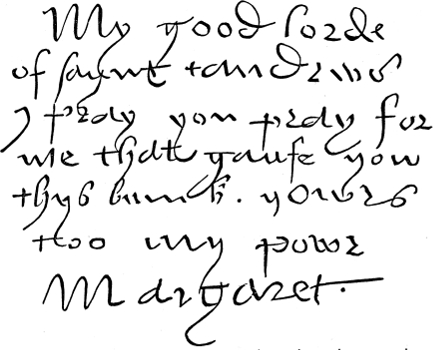
My good lorde of saynt andrews I pray you pray for me that gaufe you thys buuk. yours too my powr Margaret.
On the first leaf of the missal is likewise written, in an antique character, “This book was given by Henry 7 of England to his daughter Margaret, Queen of Scotland (mother to the Lady Margaret Douglas), who also gave the same to the Archbishop of St. Andrews.”
The Queen’s marriage with Angus determined the Council to depose her from the regency.[193] On this measure all but the immediate faction of Angus were agreed. “We have shown heretofore our willingness to honor the Queen,” observed Lord Home, “contrary to the ancient custom of this kingdom; we suffered and obeyed her authority the whiles she herself kept her right by keeping her widowhood. Now she has quit it by marrying, why should we not chuse another to succeed in the place she has voluntarily left? Our old laws do not permit that a woman should govern in the most peaceable times, far less now when such evils do threaten as can scarcely be resisted by the wisest and most sufficient men.”
The majority of the Council agreed in this opinion, one of them quaintly adding, “that the point principally annoying to them was the fact, that the Earl of Angus, as head of the house of Douglas, was already great; the Queen’s marrying him had made him greater still; but, continuing her authority as Regent, now he was her husband, would make him far too great for the peace and safety of Scotland.”[194]
The Council concluded by solemnly deposing the Queen from the sovereignty of Scotland as Regent. Moreover, the Lord Lion, king-at-arms, was formally ordered to signify to Lord Angus “that he must forthwith appear before the Lords of the Council to answer for his boldness in marrying her without their assent and recommendation.”
When the Lord Lion, vested in his most awful paraphernalia, entered the Queen’s presence-chamber to perform officially the summons, the scene that ensued was extraordinary. Queen Margaret received him in the wonted state of regnant-majesty, supported by her juvenile spouse at her side, and by his stalwart grandsire, Lord Drummond, who was all-powerful in the neighborhood of Perth. The Lord Lion demanded to be admitted, not to the presence of the reigning sovereign of Scotland, but only to “my lady Queen, the mother of his Grace our King.” This was a terrible dereliction, the fruits of her recent deposition in council! Of course it produced great irritation in the tempers of all the Queen’s partisans, to say nothing of her own, insomuch that when the Herald-King approached the Earl of Angus to announce that he was summoned before the national council, Lord Drummond bestowed on him a thundering box-on-the-ear.[195]
The sacred ear of a Lion-King had never before met with such a rebuke. He, Sir William Comyn,[196] “whom royal James himself had crowned,” he, attired in the solemn insignia of his office, which Henry VIII. himself, at the head of his victorious army in France, had respected, when he carried from his royal lord, James IV., a defiance à la outrance, and withal a most inconvenient declaration of war—he, to be cuffed and buffeted! How my Lord Lion made his retreat from the presence of the Queen and her uncivilized partisans has never been distinctly described, but a due notation was made of the outrage, as Lord Drummond afterward found to his cost.
The Privy Council forthwith deputed the Lord Lion to proceed to the Duke of Albany, in France, with the official announcement of his election as Sovereign-Regent on the Queen’s forfeiture, entreating him to come to the assistance of the kingdom, as beseemed the Prince of the blood nearest to the royal family.
The Queen gave her own version of the fray with the Lord Lion in one of her dispatches to her brother Henry VIII.; but she denies positively the box-on-the-ear—saying that all the trouble arose from my Lord Drummond having only “shaked his sleeve at a herald,[197] and gave him on the breast with his hand, because the said herald behaved himself otherwise than he ought to do, saying ‘That he came in message from the Lords to my Lady the King’s mother.’”
From the Queen’s narrative it appears that this singular scene took place at Stirling Castle, and she implies that the resistance was made on account of an attempt to take away her children rather than her new husband. However, her statement gives perfect authenticity to the historians who state that there was an assault made on the Lion King in her presence.[198]
The next outrage the Queen committed, by means of her young hot-headed husband, was on the Lord Chancellor Beton, Archbishop of Glasgow, who had expressed his disapproval of the wedlock of the Queen with Angus—which, indeed, by the will of James IV., unhinged the whole government of the kingdom. Worse confusion followed when the imperious bridegroom, at the instigation of Margaret, arrested the Lord Chancellor at Perth, and tore from him the Great Seal of Scotland.[199] The nobility, justly incensed at the insult on the law, in the person of its dispenser, flew to arms. None sided with the Queen excepting her particular dependents and her husband’s clan and faction. Margaret, rather than Angus, deserves the blame of an action stupidly despotic, because she will be found to repeat the same folly more than once in the course of her stormy career, at a time when she was by no means amenable to his influence.
Strife and trouble beset Margaret Tudor from the hour when her imprudent love-match became public. But she fancied herself sufficiently strong in the support of her brother of England to defy any opposition the Scottish Parliament might meditate against the continuation of her reign as Queen Regent. There is reason to suppose that she had lavished on her young husband a great part of the treasure which the King her husband had confined to her keeping. In reprisal, the Scottish Council stopped her dower-rents, which proceeding she set forth as an act of injustice as flagrant as if she had not appropriated the national funds.
Little more than a twelvemonth had elapsed from the death of James IV. when she dictated a dispatch to her brother, in acknowledgment of his promised support, declaring “that his loving letters had arrived at her castle of Stirling, November 22; that she showed them to the lords of her party (chiefly the kin and connections of the Douglas family), to their great consolation.”
“My party-adversary,” adds Queen Margaret, “continues in their malice, and proceeds in their Parliament, usurping the King’s authority as I and my lords were of no reputation, reputing us as rebels.”
Hitherto the Scottish Parliament had acquiesced, for love of the late King, in his testament, which superseded the national laws of Scotland by making Margaret Queen Regent. Her words, above quoted, mark the period when the Parliament, following the lead of the Privy Council, took the sovereign power from her. Some degree of anarchy ensued, the Queen exercising regnant power at Stirling and Perth, while the Parliament ruled at Edinburgh—the Queen having possession of the persons of the infant-sovereign and the babe his brother, while the Parliament had the Lord Chancellor, though not his Great Seal. The people, it may be observed, held the house of Douglas (with which the Queen identified herself) in exceeding detestation. They had suffered too much from the tyranny of those unscrupulous oligarchs, to bear them any good-will, whether they belonged to the “black” branch or the “red” branch of the same line, which last were the Angus-Douglases.
When Queen Margaret found that the people in general disobeyed her regal authority, she failed not to call in the fire and sword of the English to establish her own failing power, without much heed as to whether they would ever leave the country if they gained it.
“I beseech,”[200] she says to her brother, “that you would make haste with your army both sea and land, especial on the chamberlain (Lord Fleming). On that other side the Prior of St. Andrews (Hepburn), with the power of my counter-party (the Parliament), has laid siege to the castle of St. Andrews, which I would your navy would revenge, for it stands on the sea-side, fore-against Berwick by north.[201] I have sent my husband, Lord Angus, to break the siege, if he may, this 23d day (of November).”
Her husband displayed no remarkable prowess in his warlike expeditions. His next expedition was to relieve his uncle Gavin Douglas, besieged in the castle of St. Andrews, against John Hepburn, who had been elected to the dignity of Primate by the chapter of St. Andrews.
“I am at great expenses,” continues Queen Margaret’s dispatch,[202] “every day a thousand in wages, and my money is nigh hand wasted; if you send not soon other succors in men and money I shall be super-expended, which were to my dishonor, for I can get no answer of my rents, as I showed you before. All the hope that my party-adversaries have is in the Duke of Albany’s coming, which I beseech you to hinder in any way; for if he happens to come before your army, I doubt that some of my party will incline to him for dread. There is some of the lords of my party who dread that your army shall do them scathe, and that their lands shall be destroyed with the fury of the army, wherefore I would that you wrote to them that their lands and goods shall not be hurt, and that they shall be recompensed double and treble.
“The King, my son, and his little brother, prospers well, and are right life-like children, thanked be Almighty God.
“It is told me that the lord-adversaries are purposed to siege me in this castle of Stirling. I would, therefore, that Lord Chamberlain Fleming be held waking in the mean time with the Borderers. I trow I shall defend me well enough from the others till the coming of the (English) army.
“I pray you to give credit to Master Adam Wilkinson in other things as it is written by him, and thank him for his good service, and the peril he was in for my sake in the ship that was broken (wrecked).”
The Lord Lion of Scotland, that worthy herald-king who had received the indignity of a box-on-the-ear from Lord Drummond, had embarked to carry the news of his ill-treatment by the Queen’s party to the elected Regent of Scotland, “and other messages,” as the Queen writes, “sealed with the Great Seal of Scotland, which seal they keep masterfully from me and my lords, and use it as if they were kings!” The Lion Herald was shipwrecked, as the Queen observes with no little exultation; and she says, in the presumption of her egotism, “God was of my party, seeing that he letted (hindered) the Lord Lion’s message, and furthered mine!”[203]
In the conclusion of this remarkable epistle she requests her brother to notice, “that if her letters were only signed Margaret R., and no more, they were mere state papers, either forged or forced from her.” She ends this genuine transcript of her mind with these words—“Brother, all the welfare of me and my children rests in your hands, which I pray Jesu to help and keep eternally to his pleasure. At Stirling, the 23d day of November. Your loving sister, Margaret R.” This addition of the words, therefore, “your loving sister,” was to prove the test of the authenticity of her letters. Subsequently Margaret perpetrated a great deal of deceit and double-dealing under this preconcerted signal.
It is a little singular that the proud brother of Margaret Tudor manifested complacency at his sister’s alliance with the Earl of Angus. England had, in fact, found Scotland so formidable since the reign of the Bruce, and especially during the sway of her late great sovereign, that Henry VIII. and his Council were glad of any event which promised the distracting diversion of internal feuds to their active neighbor. Although Henry VIII. was never consulted by Queen Margaret or her second spouse on their union, he mentions it with approval in his state papers, and always acknowledged Angus as his brother-in-law.
The Queen spent the winter at Perth, from whence several of her letters extant are dated. Her meditations were how best to be revenged on the parliamentary lords who had deposed her from her reign as Regent Queen; and she resolved to take the first opportunity of escaping to England with her sons, knowing how wofully Scotland would be crippled by the detention of her sovereign in England, as in the instances of David II. and of James I.
Wolsey and her brother perpetually urged her to take this step. “It comforts my heart to hear your fraternal desire,” says Queen Margaret,[204] in one of her letters from Perth to Henry VIII.; “but it is impossible to be performed by any manner of fashion that I, or my husband (Angus), or his uncle Gavin, can devise. Considering what watch and spies there is daily where I am, I dare disclose my counsel to none but God! An’ I were such a woman that I might go with my bairn on mine arm, I trow I should not be long from you, whose presence I desire more than any man. I trust, dear brother, to defend me from mine enemies, if I had sufficient for expenses till the coming of your help; but I am so super-expended that I doubt that poverty shall (will) cause me to consent to some of their minds, which I shall never do against your counsel while I have a groat to spend. Wherefore I pray you to send me some money, for it is not for your honor that I or my children should want.”
Ever since the death of James IV. a great portion of the Scottish nobility and gentry had sedulously invited the banished Duke of Albany to return to Scotland, and take upon him the executive department of the government. But Albany, though an exile in France, was exceedingly happy and beloved there. He was one of the most renowned warriors in Louis XII.’s Italian wars, and was, moreover, both by inheritance and marriage, the lord of some of the fairest provinces in that pleasant land. When he was invited to share the government with Queen Margaret, he positively refused, saying that “the King of France could not spare him; moreover, his possessions in Scotland were confiscated, and till they were restored he should not trouble himself with the country.” Unfortunately Queen Margaret was dowered on his earldom of March, which rendered such restoration difficult.
However, that clear ideas may arise relative to a prince whose career was for some years intimately involved with that of Margaret Tudor, here follows a rapid sketch of his parentage and position in France.
The Regent Albany was the son of Alexander, Duke of Albany, that brother of James III. who had been spirited up by Edward IV. to act the same part in Scotland toward his sovereign, King James, that Edward’s own brother, Richard of Gloucester, afterward performed in England. Albany had declared the royal children, his nephews, illegitimate, and withal did his best to wrest the crown from his brother, which he would have basely held of the English King as a vassal-prince. It is one of the stern lessons with which history is replete, if politicians were not too supercilious to heed them, to view Edward IV. deliberately planning, for the destruction of his Scottish neighbor, the prototype of the same species of treason which rendered his own family desolate, and caused the deposition and the murder of both his sons.
Alexander, Duke of Albany, having failed in his attempts, and being taken prisoner, was expecting hourly to be put to death in Edinburgh Castle, when, by the aid of his faithful and devoted page, he escaped from a great height by means of a rope. In the course of the escapade, the page fell to the ground and broke his leg, but Albany ran the greatest risk of detection by carrying him off on his back.[205] A man was naturally meant for good who could be, in moments replete with peril, thus alive to the feelings of gratitude and generosity.
The fugitive Scotch prince escaped to France, where he married the heiress of a princely house, Anne de la Tour.[206] He was killed by accident, in Paris, tilting at a tournament, 1486. He left one son by Anne de la Tour, John Duke of Albany, born in exile, who became fatherless at four or five years of age. This was the Regent of Scotland. He married a lady of his mother’s family—her niece—a great heiress, Agnes de la Tour, Countess of Auvergne and Lauragais. She made him count of the latter district, and gave him a great number of lordships. They were married in 1505. The Duchess of Albany was aunt to Catharine de Medicis, afterward Queen Regent of France, who finally became heiress to the vast possessions of la Tour Auvergne.
When Louis XII. died, his successor, Francis I., became desirous of obtaining influence in Scotland; he therefore urged his friend and comrade in arms to accept the offered government of that country. Albany was exceedingly unwilling to leave his wife, whose health was not strong; but after Scotland had restored him to his rank he had no farther excuse. Accordingly he sent his friend, Antony d’Arcy, Sieur de Bastie, together with his cousin the Earl of Arran (who had never dared to return to Scotland since his unlucky naval expedition), to take possession of the citadel of Dunbar in his name. De Bastie knew Scotland well. He had been a great favorite with James IV.; he had tilted at Queen Margaret’s marriage with that King; he seems to have inspired the generous mind of Albany with the greatest enthusiasm for the character of his royal cousin, James IV.
It was on the 18th of May, 1515, that the Regent Albany landed at Dumbarton, with eight ships full of French stores and some men-at-arms. Lord Home met him at the head of ten thousand horsemen, his March-riders.[207] He expected to be caressed as a powerful partisan; but the French cavalier de Bastie, had, it is supposed, explained to Albany that this treacherous chieftain had turned the day of Flodden against Scotland, and caused the death of James IV., for which Albany vowed at some day or other to punish him. As it was, he treated him dryly, and scarcely civilly; and when Home, who was dressed gayly in Kendal-green velvet, was endeavoring to make Albany understand his value as a feudal chieftain, Albany made a quotation in Latin, to the effect that his immense train of followers was not adapted to a subject, and that a gorgeous dress ill became a mean and diminutive person.[208]
Lord Home had detested Queen Margaret and his infant sovereign, because all their friends suspected him of treachery at Flodden. He had hoped for mighty influence with the new Regent, who, being a Frenchman by birth and language, he hoped was ignorant of all reports against him, and only conscious of his power. Licensed at Albany’s contempt for his person and greatness, he withdrew in the full determination of setting up Queen Margaret’s title to the Regency, against Albany, with all convenient speed.
Meantime Queen Margaret advanced from her strong hold of Edinburgh Castle to meet the Regent, and do him all possible honor.[209] Perhaps the repulse that Albany gave to her enemy, Lord Home, had pleased her; it is certain that she at first was on very friendly terms with the rival Regent. Some flatterer had persuaded her that Albany was much disappointed because her marriage with Angus prevented him from offering her his hand; but how that matter was to be arranged it is difficult to say, as Albany had one good wife alive in France. The letters of Margaret perpetually dwell on this subject, more than could have been expected, considering the matrimonial ties by which each was bound.[210]
The Parliament at Edinburgh having, in July, 1515, solemnly invested the new Regent with the sword and scepter of state, Lord Drummond was called to account for his audacity in striking the Lord Lion of Scotland when performing the solemn behests of the Council; and, the crime being proved against him, the Regent sent him prisoner to Blackness Castle, and confiscated all his lands and goods. Gavin Douglas was committed to prison for the pretense he made to the Primacy, to the great tribulation of Queen Margaret, whose own version of the matter shall here be quoted. After mentioning the unaccountable alarm she was in lest she should have been forced by the Scotch to marry Albany, on which account she pretends that she took Angus, she proceeds to detail the dispute with the Lord Lion, saying “that the Duke of Albany had made fair and pleasant semblance to her at his first coming; but now, by the advice of his council, was meditating to take her tender children from her keeping.”[211]
But the confiscation of Lord Drummond, and his incarceration, and withal that of her uncle by marriage, Gavin Douglas, were the points which more immediately afflicted her. “So,” she continues, “I went down from Edinburgh Castle sore weeping to Holyrood, where the Regent lodged, entreating him to let them out, as they were the principal members of the Council; but grace I gat none.”[212] It is said Queen Margaret asked grace for Drummond on her knees, weeping all the time. She finishes her dispatch, which seems addressed to the Scotch ambassador resident in London for the information of her brother, Henry VIII., by exculpating herself from “ever inviting this Albany, who had done nothing but vex and trouble her and her friends.”[213] “All her party,” she complains, “had deserted her, except her husband the Earl of Angus, and Lord Home.”
Thus, in the course of six weeks, the latter, from acting as her chief opponent, had become her partisan against the Regent.
The Parliament having joined the Queen in petitioning the Regent for clemency to Lord Drummond, he was pardoned by the Regent, and his estates were restored. It was the last political agitation in which the aged statesman engaged. The threatened severity impending over him had a remarkable effect in taming the Earl of Angus and his brother George, when Queen Margaret commenced a struggle with the Regent.
A more difficult undertaking than the deprivation of her political power was to wrest her children from Queen Margaret. The Regent evidently demurred on a proceeding in which the kindest measures taken could not fail of seeming cruel in the extreme. July had nearly passed away, yet Queen Margaret still held possession of her little sons at the castle of Edinburgh. Albany made his approaches with great caution, while the Parliament was sitting at Tolbooth. There the national council chose eight peers, and out of them Albany was to appoint four by lot; and from the four Queen Margaret was to choose three to intrust with the care of her royal infants.
The four peers went in solemn procession from the Tolbooth (where the Parliament sat) up to Edinburgh Castle-gate. All the Guid Town followed them on foot, in immense concourse, to behold the exciting drama, in which their Queen and little ones played the principal parts. The gates were unfolded, and the people beheld the Queen standing within the entrance, holding the young King, with his hand clasped in hers; behind her was the nurse, with the infant Duke of Ross in her arms; near her stood her husband Angus, and her household made a half-circle in the rearward.[214]
The Queen had certainly drawn up her little force with great scenic skill, and it had its due effect on the good people of Edinburgh, who hailed the tableaux vivans before them with long and loud acclamations. When some degree of silence was restored, which was only when the populace had shouted themselves hoarse, Queen Margaret, seeing the approach of the delegates from Tolbooth, gave the words, with much majesty and command, of “Stand![215] Declare the cause of your coming before you draw nearer to your sovereigns.”
The four Scottish peers replied “that they were deputed by the Parliament, then sitting, to demand and receive their infant king and his brother.”
All the answer Margaret vouchsafed was, “Drop the portcullis!” To the consternation of the parliamentary deputies, the massive iron gate thundered down betwixt them and the royal group.
The Queen then addressed the lords commissioned to take her infants from her arms.
“This Castle of Edinburgh is part of my infeoffment! By the late King, my husband, I was made sole governess of it, nor to any mortal shall yield the command. But I require, out of respect to the Parliament and to the nation, six days to consider their mandate. For my charge is infinite in import; and, alas, my councilors be few!”
She then led away her little monarch from the gateway, followed by her train; and the peers retired in great admiration of her beauty and high spirit.
Angus was by no means remarkable for the latter quality, or at least did not exert it in this picturesque historical scene. In great alarm, lest he might have forfeited life and lands by disobeying the Regent, then sitting in full national council, he had a notarial instrument drawn, attested by proper witnesses, affirming that he had desired the Queen to surrender the royal children.[216]
Angus sent this parchment to the Regent. From that moment Angus, it may be perceived, neutralized every effort the Queen made to place him in sovereign power by her side. It is likewise evident that, from the same period, Albany treated him as a fellow of no reckoning—one who was in action, as in years, “childish young,” according to Lord Dacre’s expressive phrase. In short, much analogy may be traced between the conduct and character of Angus and of his unfortunate grandson Darnley; only, if the conduct of the latter is really viewed without prejudice, it presents more courage and power of will. Both were the husbands of reigning Queens of Scotland at the age of nineteen.
Queen Margaret, perhaps, did not know how thoroughly her lord and master had succumbed to the authority of the Regent of Scotland, as it is likely that Angus consulted not his royal lady concerning his submissive message, which was accompanied by a promise that he would manage her so that the King and his brother should be yielded peacefully, before the six days she had asked for deliberation. The Queen, on the fifth day, made an offer to the Parliament, “that if the infant James V. and his brother were left to her care, she would maintain them on her dowry; and that she would submit that they should be committed to the custody of the Earl Marshal, of Lord Home, Lord Chamberlain, of Sir Robert Lawder of Bass, and of her husband, Lord Angus.”[217]
Margaret had anticipated that her proposal would be refused; she, in consequence, fled to Stirling Castle, whither Albany followed her at the head of seven thousand men. He summoned her to surrender (August 4).
Angus was not with the Queen at this juncture; for when she fled to Stirling, he retired to his titular county, following the proverb of his family, which was often on his lips, “that he would rather hear the lark sing in the open country, than the mouse cheep”—shut up within the walls of a fortress. All the answer the Regent vouchsafed to the notarial deed of obedience which Angus had sent him, was an invitation to join his muster at Stirling; and besiege his own wife[218]—a proceeding beyond the bounds of Angus’s intended submission, which merely meant a duteous care of self, by keeping out of harm’s way. As for marching with the Scottish Regent to besiege the lady-Queen his spouse, it was more than he dared do.
Queen Margaret, finding that her husband had decamped, had no wish to stand a siege in Stirling Castle from a warrior of the Regent’s military fame. So, giving the Regent intimation that she was ready to surrender her infants into his keeping, she presented herself at the gate of Stirling Castle, with her little James V. She put in his tiny hands the massive keys of the palatial fortress, and, with a nod, directed him to give them to the Regent.
Albany knelt and received the keys and the regal boy at once in his arms, and bestowed on him many caresses.[219] He treated Margaret with great kindness and attention, giving her leave to remain with her children as long as she liked, and to see them whenever she pleased; but she was not permitted to remove them from Stirling Castle; as the sudden march of Albany was occasioned by certain intelligence which convinced him that she had intended to abduct them to England on the night of August 4.[220]
The forced surrender, by the widow of Edward IV., of the royal children of England, bore an appalling resemblance to Margaret’s delivery of the royal infants James V. and the baby Alexander, to the Regent Albany. The whole world expected that James V. would disappear as speedily from this world’s scene as his relative Edward V. Queen Margaret loudly proclaimed that such would be the case. Albany bore the angry imputations of the alarmed mother with exemplary patience. Nevertheless, her plots became incessant to further their escape into England.
A vigilant eye was kept on Lord Home by the Regent; for he knew that it was on this suspicious character that the Queen chiefly depended for the abduction of her little sons from Stirling.
The delicate situation of the Queen, her weakness at such times, when she always hovered on the brink of the grave, even when surrounded by all the care of her household, made her little calculated to undertake the perils and hardships attendant on her scheme. But she fully intended making the seclusion of her sick-chamber instrumental to her escapade.
In the course of the ensuing month, Margaret wrote the following letter to Lord Dacre:—[221]
“My Lord Dacre—
“I commend me to you as heartily as I can; and I have seen your writing, and understand at length; and I perceive that ye are not sykerly (certainly) informed in what state I stand in, for ye trow (trust) ‘that I may pass wherever I will wish.’ It is not true; but this bearer can show you the truth of all, and what my mind is, and how I am constrained to do against my will. And I pray you give him credence as ye would do to myself, for it is o’er-long to write—for I have great trust in this man.
“And send me your utter mind and answer in all thing, and God keep you.
“Written with my hand this Monday.
“Your friend,
“Margaret R.”
As a commencement to her operations, she wrote a letter to her brother, Henry VIII., which apparently was inspected by the Scottish Council; for it professes the greatest satisfaction at all the arrangements of the Regent, while all her other epistles manifest the utmost discontent. The Queen therein announced, that she meant to assume the state and dignity of “taking to her chamber,” for the birth of the child of Angus, similar to the ceremonial attending her confinements when she was Queen consort of Scotland. “Brother,” wrote Margaret, “I purpose, by the grace of God, to take my chamber, and lie in in my Palace of Linlithgow, within this twelve days, for I have not past eight weeks to my time; at the which, I pray Jesu to send me good speed, and happy deliverance, and to have you, dear brother, eternally in his keeping.” Her date is, Edinburgh, August 20.[222]
The ceremonial of “taking her chamber” withdrew Margaret from the public eye for some weeks; and that period she meant to employ in stealing her infants, by the aid of Lord Home, and escaping over the Border, which purpose she distinctly declared to Lord Dacre.
The Queen was, to all appearance, settled at Linlithgow in her chamber, lined with tapestry, where every breath of air was excluded, even the windows covered up—excepting one, from which the tapestry was occasionally withdrawn, if the royal patient had a great wish for light and the free breath of heaven. According to the written ordinances of her grandmother, Margaret, Countess of Richmond, she was to be served by female officers, lady-chamberlains, lady-ushers, lady-sewers, pantlers, and butlers. Men, let their rank or near relationship be what they might, were only admitted to converse with the Queen, when immured in her chamber, on occasions of life and death. To this strange ordinance, commenced by a religious ceremony, the royal mother[223] of Queen Margaret submitted in Westminster Palace, when she herself was born; of course, the Regent Albany could not expect the daughter of the heiress of York to abate one jot of this regal seclusion in her own Palace at Linlithgow. Well he knew that, if he, or any other prying lord of the creation, had made inquisition into such sacred retirement, the tongues of every female in the island, south as well as north, would forthwith have been in a virulent state of activity, and the two kingdoms had resounded with the “wrongs of the Queen of Scotland.”
Under shelter, therefore, of her privileged seclusion, Queen Margaret deliberately went to work, and commenced her preparations for escape. First, she affected to be very ill indeed, on which her husband, Angus, came to Linlithgow to see her. The next night, she stole out from her palace with him and four or five servants, unaccompanied by any female. Within two or three miles of Linlithgow town, the Lord Chamberlain, Home, met her, with an escort of horsemen, “hardy, well striking fellows,” as she describes them: thus guarded, they escaped to Tantallan Castle, the famous fortress of the Douglas, within a few hours’ ride of the English frontier.[224]
Before the Queen’s escape was discovered, Lord Home proposed that his rough-riders should fire one of the Duke of Albany’s towns, and some other “ruffling.” “When the Regent’s attention was drawn from Stirling garrison,” Home said “that he hoped he should be able to carry off the royal infants (to whom his state office of Lord Chamberlain gave him access), and after joining the Queen at his stronghold of Blackater Castle, they could from thence escape into her brother’s kingdom.”[225]
All succeeded, in regard to Margaret’s escape, according to her plan of action excepting the abduction of her children. Albany’s vigilance was not to be diverted from them; and the Lord Chamberlain, Home, by his scheme of arson and “other ruffling,” rendered himself an outlaw, but gained naught besides. Home escaped to Tantallan, where Margaret, Angus, and he remained till September 23, waiting the pleasure of Henry VIII.
The fatigues of her removal had a severe effect on the health of Queen Margaret; yet the failure of Lord Home’s attempt obliged her to flee from Tantallan in such haste, that she left her jewel-box and wardrobe there. She paused on the verge of England, not daring to enter unless invited formally by her brother;[226] but being worse every moment, she took sanctuary, half-dead, at Coldstream Nunnery, the lady-prioress of which was aunt to her own faithful comptroller of the household, Robert, or, as the Queen always terms him in her letters, Robin Barton.[227]
At Coldstream Priory the Queen remained long enough to receive the sympathizing visits of old Lady Home, mother to Lord Home, Chamberlain of Scotland. The Queen’s situation occasioning her great suffering, Lady Home came to give her comfort and matronly counsel concerning her health. But directly the Queen went forward to England, an agent of the Duke of Albany, a Frenchman, called M. de Barody, in order to strike terror into her friends, seized poor Lady Home in a furious and cruel manner, set her upon a high-trotting nag, to her extreme peril and pain, carried her to the Castle of Dunbar, where he put her in the strongest prison-ward, and fed her on bread and water; “from which durance, if she be not speedily released, Queen Margaret,” said she, “verily believed, considering her feebleness of body, that the Duke of Albany’s Frenchman meant to be the death of old Lady Home.”[228]
The expected invitation of Henry VIII. at last arrived, which caused Lord Dacre to send an escort to Coldstream for Queen Margaret, for the purpose of conveying her as far as Morpeth Castle, his family residence, where she would have from his lady proper attention. At his baronial seat, he had appointed Sir Christopher Gargrave, or Gervase, to await her with “stuff,”—meaning all sorts of conveniences and comforts, which her considerate sister-in-law, Queen Katharine, had sent from London, for her accommodation and her expected confinement,[229] by the said Sir Christopher, a knight of the King’s bedchamber.
The welcome message of Dacre arrived at Coldstream almost in the last minute that Queen Margaret could be moved. So desperately ill was she taken on the road, that her convoy were forced to stop by the way, and hurry her into Harbottle or Hardbattle Castle, one of the grimmest and gauntest stone-donjons that frowned on the English frontier. It was just then garrisoned by Lord Dacre in person, who had commenced the fierce war on the Borders to which the arrival of the Duke of Albany in Scotland had given rise.
The portcullis of Harbottle was raised to admit the fainting Queen of Scotland; but not one Scot, man or woman, Lord Dacre vowed, should enter with her.[230] Here was a terrible situation for Margaret.
She was received into the rugged Border-fortress, October 5, and, after remaining in mortal agony for more than forty-eight hours, gave birth to a daughter, the Lady Margaret Douglas, whose name is familiar to every one on the pages of general history, as the immediate ancestress of our present royal family.
There were the royal mother and daughter without female attendance, in a Border castle, surrounded by a wild and barren country, which was scoured on all sides by incensed Scottish moss-troopers. And the garrison of their rugged lodgment was not many degrees quieter than the enemies it kept at bay.
It has been shown that Lord Dacre had appointed all “the stuff” with Sir Christopher Gargrave to wait the Queen’s arrival at Morpeth, because small chance would there have been of its safe arrival at Harbottle Castle, with such troops of plunderers to intercept it on its way. Sir Christopher Gargrave, however, brought the letters from Henry VIII. and Queen Katharine to Queen Margaret; but she was too ill to read them for many days. In this exigence, Sir Christopher was ordered to wait her convalescence at Morpeth.[231]
The Queen exhausted her small remaining strength by dictating, on the third day after the birth of her daughter, a letter to her kinsman the Duke of Albany of an agitating nature. “She had been forced,” she says, “for fear and danger of her life, to depart from Scotland to the realm of England.” The letter was written after the baptism of the infant—this being evident by the quaint announcement of the child’s existence in these words,—“So it is that, by the grace of Almighty God, I am now delivered, and have a christian soul,[232] being a young lady.”
But Margaret could not be content with the information thus given to her cousin-Regent. She concludes her epistle with an angry exhortation, in God’s name, that he should suffer her, as his honor, and right, and good justice require, to have the whole rule and governance of Scotland, and of her tender children as their tutrix, according to the will of the late King of Scotland, her spouse. The letter is not signed by the Queen, her state being very dangerous; and, indeed, the task of signifying her intentions, and entering into such agitating subjects, must have proved nearly fatal to her. It is dated October 10, 1515.
Lord Dacre has been considered remarkably insolent and neglectful in his manner of announcing the birth of the niece of his royal master; but the situation of Lord Dacre has not been properly considered. He was, in plain reality, much in the case propounded, by way of comic argument, to Dr. Johnson,—“If you were shut up in a castle with a new-born babe, what should you do with it?” And Lord Dacre, although not exactly alone with the royal babe, had aggravations of the case, of difficulty far beyond the power of Boswell’s imagination to conceive, being occupied in hourly repelling assault and siege—for the Scottish Borderers, in a state of extreme exasperation at the flight of their Queen, were hovering round the gray pile of Harbottle, ready to demolish all goers and comers from its gates, and make spoil or prey of all supplies brought within its walls. Moreover tidings came, ever and anon, that the Regent Albany, at the head of forty thousand Scotsmen, was in full march to beleaguer the castle. He had already captured all Queen Margaret’s jewels and fine clothes, at her deserted castle of Tantallan.
“Glad would we have been,” proceeds Dacre, “to have advertised your Highness of the Queen’s safe deliverance, but our causes (state) here was intricate, with so much cumber and business, that we could not ascertain your Highness of the same till this time, unless we should have sent up a post purposely for the said Queen’s deliverance, which we thought not greatly requisite.”
Poor Lord Dacre! most undeservedly are you blamed, while your moderation in using such a temperate word as “cumber,” to express the complication of troubles which had suddenly descended in the midst of Harbottle, is so remarkable, so praise-worthy. Let us coolly enumerate all that the hardy warrior had to try his patience. Assistance of the most delicate nature was indispensable, and no such requisites were at hand. A helpless baby was wailing for nourishment—its royal mother fainting between life and death within the walls of the castle, while inimical Border-riders were ranging without, ready to pounce upon and demolish every needful relay that approached Harbottle of doctors, nurses, caudles, potions, baby-clothes, and cradles. Then there was a royal christening performed the day after the unexpected arrival of the smallest guest. The stout-hearted Lord Warden must stand excused in the eyes of all considerate readers of history, if he omitted some of the ceremonious expressions and observations suitable to the rank of his guests, mother and daughter, when the difficulties of the casualty are properly appreciated. But let him plead for himself in his own unsophisticated language.
“Forasmuch,” continues the Lord Warden,[233] “as the Queen’s lying here is so uneaseful, and costly, by reason of the far carriage of everything, we be minded to move her Grace to Morpeth, as soon as she conveniently may, after her Grace have sought the Church for her thanksgiving. It may like your Highness to signify your mind and pleasure unto her said Grace, how ye think ye will have her to be further ordered, that we may motion and move her accordingly. Sir Christopher Gargrave went to Morpeth immediately on the Queen’s deliverance, and, by our advice, hath continued there, with such stuff as your Grace hath sent to the Queen, your suster, till Sunday last past, which day he delivered your letter, and disclosed your credence, greatly to the Queen’s comfort. And forasmuch as the Queen lieth yet in childbed, and shall (will) keep her chamber these three weeks at least, we have advised the said Sir Christopher to remain at Morpeth until the Queen is coming thither; and then her Grace may order and prepare every part of the said stuff after her pleasure, and as to her Grace seemeth most convenient. And Almighty God have you our most dradde sovereign lord in his most blessed preservation. At Harebottell, the 18th day of October.”
About the same time, Lord Dacre permitted a congress of the Scottish lords, then in insurrection against the Regent, to assemble at Harbottle. They all signed a covenant, binding themselves to free the infant King of Scots and his brother Alexander from the control of the Duke of Albany; at the same time wresting the regnant power from him, and bestowing it on the Queen. The signatures of her husband, Angus the second prince of the blood, Arran, and the firebrand of mischief, Lord Home, appear to this state paper.[234]
No wonder Margaret’s life was in danger, when proceedings of such agitating tendency were transacted around her sick-bed. Before the Queen was sufficiently recovered to leave Harbottle, she received letters from the Scottish Regent and Council, in which her flight was discussed, and her return entreated. The conduct of Margaret at this juncture is discussed with no little sagacity by our great modern historian Tytler, to whose patient research and manly candor the world is indebted for justice done to that calumniated Scottish prince, the Duke of Albany. “Notwithstanding the infatuation of the mother of his sovereign, Albany was still anxious to make a last effort for a compromise: he addressed two letters to her on the same day (October 13), the first a manifesto from the Scottish Council,[235] commencing with these words,—‘Madame, we commend our humyle service to your Grace.’ The other,” continues Mr. Tytler, “was a private communication written with his own hand. The terms of both were moderate and even indulgent. The Council implored her to awake to her duty, declared their aversion to all rigorous measures, besought her to come back among them, and, as inducements, promised that she should enjoy the disposal of all benefices within her dower-lands; a benefice to her councilor, Gavin Douglas; and, lastly, the guardianship of her children, if she would solemnly promise that they should not be carried out of the kingdom. These proposals the Queen imprudently rejected, for what reason does not clearly appear. Albany’s whole conduct shows them to have been sincere; although Margaret, acting under the influence of Angus, Home, and Arran, had been taught to regard them with suspicion.”[236]
Albany, meantime, wrote to Henry VIII. that he did not in the least wish to harm or annoy the Queen; he repeated to the English monarch the advantageous terms he offered her, but without avail.[237]
The removal of Margaret and her little infant from the grim shelter of Harbottle Castle could not take place until November. When she removed to Morpeth Castle (where Lord Dacre’s family usually resided,[238] with such degree of comfort as the warlike office he held permitted), she immediately suffered a long relapse of dangerous illness, greatly aggravated by agitation of mind, arising from several causes. Lord Home was making desultory war on his own country, committing excessive outrages on the Scottish border. He had caught the same Lord Lion at Coldstream with whom Queen Margaret’s party had commenced war by giving him that remarkable box-on-the-ear, and had reft from him the Regent’s letters to King Henry VIII.[239] Albany exchanged for his captive Lord Lion the old Lady Home, whose wrongs, as she returned from waiting on Queen Margaret at Coldstream Nunnery, have been related.
In the midst of this negotiation, which greatly agitated the sick Queen, and long before she had gained strength to bear the shock, her feelings were awakened from the dullness of political treaties to all the agonies of an absent mother. One of the sons she had left in Scotland—one of those tender little ones for whose possession she was then negotiating—fell sick of some infantine disorder, and expired at Stirling Castle, December 18, 1515.[240]
Margaret’s partisans thus spoke of his death,—“Alas! it is openly spoken and repeated, that the Duke of Ross, the King’s brother, died from want of things necessary for such a prince, or else was poisoned.”[241] Another says,—“Prince Alexander, a child beautiful and promising to admiration, died at this time, or was murdered.” Margaret’s grief is best attested by the long illness which succeeded the intelligence. When she recovered, rage found utterance beyond grief; and long and loudly did she accuse Albany of poisoning her little Alexander. Yet the very circumstance of the young King, his brother, remaining lively and healthy, is a sufficient vindication of their faithful relative. Much Margaret exclaimed, both with tongue and pen, regarding Albany’s guilt; many comparisons she drew between his proceedings and those of Richard III., his father’s friend and ally. Yet the princes of York vanished together; while the death of the baby-prince of Scotland could do no good to Albany, as James V. lived and flourished.
A curious circumstance attended the sick Queen’s vehement accusations. Years afterward, when she was on remarkably loving terms with the handsome Regent, all her partisans renewed the vehement charge of murder which she raised at Morpeth against him, without perhaps having believed it herself—for it was a political outcry, like those which in subsequent centuries were used with more success as party-weapons against the Anglo-Stuarts.
A sorrow yet harder to bear likewise beset Margaret at Morpeth. Her husband, tired of waiting in attendance for her recovery, thought fit to accept the favorable terms offered him by the Regent, and, deserting her, decamped into Scotland. The time he chose for this escapade offended her as much as his mode of action, insomuch that she never forgave his conduct. It was on the very day when her life was despaired of, at Morpeth (January 17, 1515–16), that he perpetrated his desertion of her and his infant, signed the treaty with the Regent, and went back to Scotland. The poor Queen was suffering under the crisis of a typhus fever, from which she was not expected to recover.[242]
Her friend and priest, Dr. Magnus, ventured to offer his advice to Henry VIII. that he should “write comfortable letters to his sister and send for her; because she hath daily messengers coming out of Scotland, so that she is troubled in her mind, and put to study, to imagine and cast what answer to make to them.” Magnus was evidently her amanuensis in answering many of these dispatches, for he adds, “We have taken care that her letters to the Scottish Regent be so worded, that no good understanding shall ensue between them.” Yet he is evidently in dread lest Margaret should soon break through all his cunning diplomatic tricks of writing, and send to the Regent different matter; since he adds—
“Her Grace doth not make us privy to every thing, yet she as yet, as a great wise woman, resteth on this—namely, that she will do nothing without the consent of your Grace.”[243]
These representations had the desired effect, especially as they were backed by a gentle, and at that time an all-powerful pleader at the ear of Henry VIII., being his excellent Queen, Katharine of Arragon, who ever showed kind and sisterly attention to Margaret Tudor.
Under her influence, Henry VIII. sent a frank invitation for his sister to come to his court at London for her solace. He thought proper to request her husband to accompany her. Angus thanked his brother-in-law, with many professions of humble gratitude, and promised to give his attendance on his spouse the day she set forward to the south.[244]
The first fine days of April brought to Morpeth Castle a gay and noble cavalcade, sent from London, with all things suitable for the accommodation of the languishing and destitute Queen of Scotland. One of Henry VIII.’s gentlemen of the bedchamber, William Blackwell, “clerk of his spicery,” escorted a large supply of silver vessels for Margaret’s use, with all proper officers to wait upon her on her journey. “Sir Thomas Parr, Katharine of Arragon’s equerry, arrived with the present from his Queen of her favorite white pony or palfrey, with her own easy pillion, to her sister Margaret.”[245] And to the care of Sir Thomas Parr, the tender and humane Katharine especially intrusted the care of her forlorn sister-in-law’s person.
Angus, it would seem (according to the assertion of his cotemporary. Hall the chronicler), had made his appearance at Morpeth, for the purpose of escorting his consort to her brother’s court; but some distrust subsequently seized on his fluctuating mind.
“When Queen Margaret was ready to depart, she asked for her husband. But he had not kept his promise, having departed to Scotland; which made her to muse on this sudden absence. Howbeit, the English lords greatly encouraged her to keep her own promise to the King her brother. So, when she was somewhat appeased, she set forward; and in every town she was well received.”[246]
Notwithstanding the deep mortification Queen Margaret had suffered before her countrymen, by the recreant desertion of her spouse at the commencement of her journey, yet it is evident, from the tenor of the following letter, that her spirits felt the pleasant change of a southern progress, from languishing on a sick-bed in a dismal northern donjon. She thus wrote to Henry VIII. while resting at Stony-Stratford, on her London-ward journey.
“Dearest Brother—[247] As heartily as I can, I recommend me unto you, and let you wit (know) that yesternight I came hither, so being comforted of you in my journey in many and sundry wises (ways) that, loving be to our Lord God, I am in right good heal (health), and as joyous of my said journey toward you as any woman may be in coming to her brother, as I have great cause, and am most desirous now to come to your presence, and to have sight of your person, in whom, next to God, is mine only trust and confidence.
“Advertising you, dearest brother, (that) I have received this day a letter from my son’s ambassadors now in London, which letter I send you herein inclosed, and have addressed unto them mine answer severally in two sundry letters (copy whereof I also send unto you), that, upon notice had of the same, it may like you to command whether (which) of the said letters it seems best at your pleasure shall be delivered.
“And the Holy Trinity have you, my most dearest Brother, in tuition and governance. At Stony-Stratford, the 27th day of April.
“Your loving Suster,
“Margaret.
Endorsed—“Unto my dereste broder the King’s Grace.”
Her stages to London were very short and easy, for it was the sixth day after the date of this letter that the recorder of London, Edward Hall, thus notes her arrival—“The Queen of Scotland made her entry into London, May 3, 1516, riding behind Sir Thomas Parr on a white palfrey. She was richly beseen with a great company of lords and ladies.” She came first to Baynard’s Castle, and from thence she was convoyed by water to Greenwich Palace, where she was received right joyously by the King her brother, Queen Katharine, and the French Queen, her sister.[248]
One of the first questions demanded by King Henry was, “Where is my Lord of Angus?” He was perforce informed of the peculiar mode in which his brother-in-law had absented himself. Henry manifested his national antipathies, as well as his disdain for his sister’s injuries, by the exclamation—“Done like a Scot!”[249]
Many brilliant festivals were devised on account of Queen Margaret’s visit. Among others, the King proclaimed a grand tournament in her honor, which took place May 19 and 20. Henry held the lists with his favorite and brother-in-law, Suffolk, very gayly attired; their housings and tabards were embroidered with golden honeysuckles, after which “they ran volant against all comers, very pleasant to see;” and in this volant course Henry knocked over, man and steed, Sir William Kingston, a tall and burly knight, a feat which mightily gratified all the loving lieges then looking on. And when night approached, Henry and his train went to Queen Katharine’s chamber, where the King disarmed; and when his helmet was removed, the Queen of Scots, and her sister Mary, as well as his own Queen Katharine, affected great surprise and pleasure at finding that the victorious knight, who had gained such renown by the overthrow of the gigantic Kingston, proved to be the King. Such was ever the etiquette of Henry’s tournaments. The royal party then sat down to a sumptuous banquet, prepared in honor of the Queen of Scots.[250]
Every individual of Margaret’s family surrounded her at Greenwich, for the purpose of welcoming her, by keeping the merry month of May as one continued festival. The reunion of the Queens of the house of Tudor with their brother and sister-in-law, has been commemorated by the artist who illuminated one of Henry VIII.’s music-books, still preserved in the Harleian Collection. On the first page are the arms of England; and beneath, the badges of Henry VIII. and Katharine of Arragon, the rose and pomegranate, richly illuminated; and opposite is the daisy or Marguerite and the marygold—one flower being the badge of Margaret Queen of Scotland, the other, of her sister Mary, Queen Dowager of France, then recently united to Charles Brandon, Duke of Suffolk. The date is 1516.
During the whole of the summer, Margaret kept up, by means of her letters, an active series of intrigues against the Scottish Regent. Although much incensed with her husband, she instigated him, by her correspondence, to aid the King, her brother, in the unworthy task of wounding and betraying Scotland for the promotion of their private ambition. Lord Dacre refers Cardinal Wolsey to Queen Margaret for information regarding a scheme of his to subjugate the Regent.
She betrayed all the private affairs of the Scottish government to her brother’s council, while Angus privily aided the unscrupulous warfare carried on by the general of the English boundaries. Such was the true but disgraceful position of Queen Margaret and her spouse, during her sojourn in England.
The intolerable aggressions carried on by the collusion of her husband with the English warden, had caused the Scottish Regent to talk of visiting the court of Henry VIII., for the purpose of civilly remonstrating on the mutual evils caused by such wicked warfare. The heart of Margaret leaped with joy at the very idea of her rival in empire thus putting himself in the power of her unscrupulous brother. But she fairly owned that the news was too good to be true.
“My Lord Cardinal,”[251] wrote Margaret to Wolsey, “I am gladder of the tidings that the King’s Grace (Henry VIII.) telled me of the Duke of Albany, that he will come hither, which I beseech God may be true, but I dread it be not.
“My Lord, I think (it) right long till I speak with you; for next to the King’s Grace my most trust is in you, and you may do me most good of any. And I pray you, my Lord, as soon as any body comes out of Scotland, that you will send me word, for I think long till I hear tidings.
“No more, but God have you in his keeping.
“Your friend,
“Margaret R.”
The Queen was right in her surmises. The Scottish Regent repented of his Quixotic proposal of visiting the court of Henry VIII. However, he behaved with knightly courtesy regarding that species of property belonging to Queen Margaret which is usually dearest to a lady’s heart. The master of Graystock College was commissioned by Lord Dacre to pass over the Border, and, according to an agreement made with the Scottish ambassadors, to receive, in the presence of the English Herald Clarencieux,[252] her plate and jewels, which had been captured at Tantallan by the Regent’s forces. Commissioners likewise, accompanied by Rothsay, the Duke of Albany’s herald, were to journey to Queen Margaret’s Scottish dower lands and gather in her rents and dues. If incessant complaints of poverty, and even destitution, which form a species of begging chorus to all Queen Margaret’s numerous epistles, may be credited, she never received any of her Scottish immunities. But her word, either written or spoken, was not to be trusted, as the merest cursory view of her letters proves. Whether her revenues came safely over the Border can not be ascertained; but that her fine clothes and jewels certainly did, may be shown by an inventory of them which has remained for centuries in the Chapter House, Westminster. It is addressed to herself.
“Madame,—In our most humble manner we commend our service to your Grace. Your procurators, factors, and commissioners are here, and have shown to our good lord, my Lord Governor, and us, your letters under your seal and subscription manual for the receiving of your goods left by you in this realm, and also for raising and uptaking of the rents and duties of your lands, which your procurators, our said Lord Governor and we, have thankfully received, and well entreated, and shall so do to good and final end of all your matter, according to the tenor of the recess made by our Sovereign Lord’s ambassadors lately in England; and so it is that your said procurator has received the goods underwritten pertaining to your Grace—that is to say, a cheffroun[253] (cheveron), with a chain containing 57 links, weighing 1¾ oz. gross weight; one cheveron with points of gold, with 61 pearls in crammesy (crimson) velvet; a cheveron set with gold, of 21 rubies, 33 pearls; one bird of gold and two small beleis (bells), with heads and pendant of gold; one obligation of the Laird of Bass, containing 2 thousand marks, made to the Bishop of Caithnes as treasurer for the time to your Grace, or to any others his factors, subscribed and under the seals of the Lord Berwick, Sir Patrick Creichton of Cranstoun Riddale, and William Carmychell; one collar of gold, enameled with white roses and red, weighing 6 oz.; one collar of gold weighing 6 oz.; one piece of the Laird of Bass’ chain, containing x (10) links, weighing 42 oz.; one pair of sleeves of cloth of gold lined with crammesy (crimson) satin; one other pair of sleeves of cloth of gold; the King of France’s great diamond, set upon a red hat of silk; one ruby balatt upon a black hat, with three pearls; one piece of yellow satin containing 2 fr. ells; three other pieces of yellow satin; one piece of white taffeta; one piece of tawny satin ramanys; one lining of gown-sleeves of red velvet; one packet with letters closed of obligations of Kilmarnock and others; four codbers; five hats of silk; one partlet of gold-fret set upon crammesy satin, with 12 diamonds, 14 rubies, 25 pearls; one (partlet) of cloth of gold; one partlet of white taffeta with three pearls; one partlet of taffeta goldsmiths’ work; one pair of sleeves of black velvet; one busk with damask gold, with ten with gold-wire; certain ribbons and sewing silk; one pair of beads coral gaudeit (garnished), with 6 pearls; one pair of beads of jasper with four gaudes; one pair of black beads; one pair of white beads; your Grace’s testament; two beasts of silver (probably Agnus Dei) with holy wax; one hede, or hide, of sewed work; four pieces of crisp (probably crape); one pomander (or scent ball), with silver; one stone of crystal; one coffer of bone; four books; one tergatt (perhaps target or shield) of gold of our lady.
“These goods following were delivered of before to your Grace in England:—
“One cheveron with a bird of gold, with 71 pearls; one cheveron with a chain of gold white enameled; one cheveron with a point, with setts of pearl; one cheveron set with goldsmiths’ work, with 35 pearls; one cheveron with leaves of gold, with 8 rubies and 18 pearls; one new chain of gold, containing 40 links and 5 knoppis, weighing 9 oz.; one pair of sleeves of gold-wire; one ruff of taffeta; one partlet of black velvet, with goldsmiths’ work, set with 30 pearls; and one patlat of damas gold.
“Your furrings (fur trimmings) in Sterling, because of the Bishop of Galloway’s being in the north, couth (could) not be gotten at, whilst now he is coming, and shall hastily (quickly) be delivered to your said procurators.
“As to the remainder of the goods asked by them, we understand that they are the King’s (James V.), and pertain to his grace, and that you may not ask them at this time by reason of the recess. And if you would ask them by reason of executory, whenever it please your grace to come in Scotland and accept the office of executor, with the charge that follows thereto by the law—that is to say, acquitting of the King’s debts,[254] we trust my lord governor shall be well contented; and we, for our interest, that you have all our sovereign lord the King’s goods, whom God assoil! except the heirship pertaining to our sovereign lord now, your son.[255]
“Madam, in all things your Grace’s pleasure charge us, you shall find us ready servitours, as knows God, whom have your Excellency in keeping.
“Subscribed by command and deliverance of us your servitours, the Lords of Council of Scotland, and in our presence; and given under the Great Signet at Edinburgh, the 29th day of September.
The duplicate of this document exists in the public records of Scotland,[256] entitled, “Inventory of the jewels and baggis,[257] being in the coffer taken furth at Tantallan, delivered to the Commissioners of the Queen’s Grace, now being in England. September 25, 1516.”
Sir Alexander Jardin had taken charge of Queen Margaret’s jewel-coffer, and earnestly demanded her receipt to his inventory, which is the Scottish duplicate of that now published from the Chapter House. “The great diamond given by the King of France, worth 8000 crowns of gold, and worn on a red hat,” being in the same place and order as in the English list. But the Scottish inventory has, in addition, the chapel furniture of the Queen, delivered to her priest William Husband, one of her commissioners, and to John Sympson, his assistant, who give their receipt to the Scottish Lords of the Council, by the hands of the Master of St. Antony’s, “for a book belonging to Queen Margaret, a vestment of cloth of gold, a vestment of green velvet, an altar cloth of gold tissue, a dessour of gold cloth, a lyer of velvet; a cushion of velvet, a chalice, and two cruets of silver, a silver sacring bell, and two other books.” These were sent the ensuing month, being Oct. 11, 1516.
So completely did Queen Margaret withdraw her personal property from Scotland, that Robert Spittell, her tailor in Edinburgh, had to surrender to William Husband, her priest, on Sunday evening, Oct. 12, 1516, all her fur trimmings, being two pair of ermine cuffs, three wide sleeves, and half a lining of ermine for a night-gown, seven edges of ermine, and four linings of miniver.
These furrings are mentioned in the Chapter House list as not attainable until the return of the Bishop of Caithness.
A relic of her visit to England, probably the same coffer mentioned in the Scotch inventory as the receptacle of her bagues or smaller jewels, has been preserved by the descendants of Lord Forester, as a gift of Mary Queen of Scots, which it might very well be, and yet have pertained originally to her grandmother, whose emblems are more distinctively expressed by the ornaments. The fact that Queen Margaret’s personals were captured at Tantallan, as our documents assert, makes it appear that the casket with the Douglas bearings came from that stronghold, being of black oak and silver, beautifully carved all over with crowned hearts of Douglas, and flower-Marguerites surmounted with regal crowns. The initial M. frequently occurs, likewise crowned.