Volume 6 — LIVES OF FRA GIOCONDO, LIBERALE, AND OTHER CRAFTSMEN OF VERONA (continued 2)
Gaston du C. De Vere translation
On the base he painted some Saints from the breast upwards, which are all portraits from life. The first figure, wearing the habit of S. Francis, and representing a Beato, is a portrait of Fra Girolamo Rechalchi, a noble Veronese; the figure beside the first, painted to represent S. Bonaventura, is the portrait of Fra Bonaventura Rechalchi, brother of the aforesaid Fra Girolamo; and the head of S. Joseph is the portrait of a steward of the Marchesi Malespini, who had been charged at that time by the Company of the Cross to see to the execution of this work. All these heads are very beautiful.
For the same church Paolo painted the altar-piece of the Chapel of S. Francesco, in which work, the last that he executed, he surpassed himself. There are in it six figures larger than life; one being S. Elizabeth, of the Third Order of S. Francis, who is a most beautiful figure, with a smiling air and a gracious countenance, and with her lap full of roses; and she seems to be rejoicing at the sight of the bread that she, great lady as she was, had been carrying to the poor, turned by a miracle of God into roses, in token that her humble charity in thus ministering to the poor with her own hands was acceptable to God. This figure is a portrait of a widowed lady of the Sacchi family. Among the other figures are S. Bonaventura the Cardinal and S. Louis the Bishop, both Friars of S. Francis. Near these are S. Louis, King of France, S. Eleazar in a grey habit, and S. Ivo in the habit of a priest. Then there is the Madonna on a cloud above them all, with S. Francis and other figures round her; but it is said that these are not by the hand of Paolo, but by that of a friend who helped him to execute the picture; and it is evident, indeed, that these figures are not equal in excellence to those beneath. And in this picture is a portrait from life of Madonna Caterina de' Sacchi, who gave the commission for the work.
Now Paolo, having set his heart on becoming great and famous, made to this end such immoderate exertions that he fell ill and died at the early age of thirty-one, at the very moment when he was beginning to give proofs of what might be expected from him at a riper age. It is certain that Paolo, if Fortune had not crossed him at the height of his activity, would without a doubt have attained to the highest, best, and greatest honours that could be desired by a painter. His loss, therefore, grieved not only his friends, but all men of talent and everyone who knew him, and all the more because he had been a young man of excellent character, untainted by a single vice. He was buried in S. Paolo, after making himself immortal by the beautiful works that he left behind him.
Stefano Veronese, a very rare painter in his day, as has been related, had a brother-german, called Giovanni Antonio, who, although he learned to paint from that same Stefano, nevertheless did not become anything more than a mediocre painter, as may be seen from his works, of which there is no need to make mention. To this Giovanni Antonio was born a son, called Jacopo, who likewise became a painter of commonplace works; and to Jacopo were born Giovan Maria, called Falconetto, whose Life we are about to write, and Giovanni Antonio. The latter, devoting himself to painting, executed many works at Rovereto, a very famous township in the Trentino, and many pictures at Verona, which are dispersed among the houses of private citizens. He also painted many works in the valley of the Adige, above Verona, and a panel-picture of S. Nicholas, with many animals, at Sacco, opposite to Rovereto, with many others; after which he finally died at Rovereto, where he had gone to live. This master was particularly excellent in making animals and fruits, of which many very beautiful drawings, executed in miniature, were taken to France by the Veronese Mondella; and many of them were given by Agnolo, the son of Giovanni Antonio, to Messer Girolamo Lioni, a Venetian gentleman of noble spirit.
But to come at last to Giovan Maria, the brother of Giovanni Antonio. He learned the rudiments of painting from his father, whose manner he rendered no little better and grander, although even he was not a painter of much reputation, as is evident from the Chapels of the Maffei and of the Emilii in the Duomo of Verona, from the upper part of the cupola of S. Nazzaro, and from works in other places. This master, recognizing the little value of his work in painting, and delighting beyond measure in architecture, set himself with great diligence to study and draw all the antiquities in his native city of Verona. He then resolved to visit Rome, and to learn architecture from its marvellous remains, which are the true masters; and he made his way to that city, and stayed there twelve whole years. That time he spent, for the most part, in examining and drawing all those marvellous antiquities, searching out in every place all the ground-plans that he could see and all the measurements that he could find. Nor did he leave anything in Rome, either buildings or their members, such as cornices, capitals, and columns, of whatsoever Order, that he did not draw with his own hand, with all the measurements; and he also drew all the sculptures which were discovered in those times, insomuch that when he returned to his own country, after those twelve years, he was rich in all the treasures of his art. And, not content with the things in the city of Rome itself, he drew all that was good and beautiful in the whole of the Roman Campagna, going even as far as the Kingdom of Naples, the Duchy of Spoleto, and other parts. It is said that Giovan Maria, being poor, and therefore having little wherewith to live or to maintain himself in Rome, used to spend two or three days every week in assisting some painter with his work; and with his earnings, since at that time masters were well paid and living was cheap, he was able to live the other days of the week, pursuing the studies of architecture. Thus, then, he drew all those antiquities as if they were complete, reconstructing them in his drawings from the parts and members that he saw, from which he imagined all the other parts of the buildings in all their perfection and integrity, and all with such true measurements and proportions, that he could not make an error in a single detail.
Having returned to Verona, and finding no opportunity of exercising himself in architecture, since his native city was in the throes of a change of government, Giovan Maria gave his attention for the time to painting, and executed many works. On the house of the Della Torre family he painted a large escutcheon crowned by some trophies; and for two German noblemen, counsellors of the Emperor Maximilian, he executed in fresco some scenes from the Scriptures on a wall of the little Church of S. Giorgio, and painted there life-size portraits of those two Germans, one kneeling on one side and one on the other. He executed a number of works at Mantua, for Signor Luigi Gonzaga; and some others at Osimo, in the March of Ancona. And while the city of Verona was under the Emperor, he painted the imperial arms on all the public buildings, and received for this from the Emperor a good salary and a patent of privilege, from which it may be seen that many favours and exemptions were granted to him, both on account of his good service in matters of art, and because he was a man of great spirit, brave and formidable in the use of arms, with which he might likewise be expected to give valiant and faithful service: and all the more because he drew after him, on account of the great credit that he had with his neighbours, the whole mass of the people who lived in the Borgo di San Zeno, a very populous part of the city, in which he had been born and had taken a wife from the family of the Provali. For these reasons, then, he had all the inhabitants of his district as his following, and was called throughout the city by no other name but that of the "Red-head of San Zeno."
Now, when the city again changed its government and returned to the rule of its ancient masters the Venetians, Giovan Maria, being known as one who had served the party of the Emperor, was forced to seek safety in flight; and he went, therefore, to Trento, where he passed some time painting certain pictures. Finally, however, when matters had mended, he made his way to Padua, where he was first received in audience and then much favoured by the very reverend Monsignor Bembo, who presented him not long afterwards to the illustrious Messer Luigi Cornaro, a Venetian gentleman of lofty spirit and truly regal mind, as is proved by his many magnificent enterprises. This gentleman, who, in addition to his other truly noble qualities, delighted in the study of architecture, the knowledge of which is worthy of no matter how great a Prince, had therefore read the works of Vitruvius, Leon Batista Alberti, and others who have written on this subject, and he wished to put what he had learned into practice. And when he saw the designs of Falconetto, and perceived with what profound knowledge he spoke of these matters, and rendered clear all the difficulties that can arise through the variety of the Orders of architecture, he conceived such a love for him that he took him into his own house and kept him there as an honoured guest for twenty-one years, which was the whole of the rest of Giovan Maria's life.
During this time Falconetto executed many works with the help of the same Messer Luigi. The latter, desiring to see the antiquities of Rome on the spot, even as he had seen them in the drawings of Giovan Maria, went to Rome, taking him with him; and there he devoted himself to examining everything minutely, having him always in his company. After they had returned to Padua, a beginning was made with building from the design and model of Falconetto that most beautiful and ornate loggia which is in the house of the Cornari, near the Santo; and the palace was to be erected next, after the model made by Messer Luigi himself. In this loggia the name of Giovan Maria is carved on a pilaster.
The same architect built a very large and magnificent Doric portal for the Palace of the Captain of that place; and this portal is much praised by everyone as a work of great purity. He also erected two very beautiful gates for the city, one of which, called the Porta di S. Giovanni, and leading to Vicenza, is very fine, and commodious for the soldiers who guard it; and the other, which is very well designed, was called the Porta Savonarola. He made, likewise, for the Friars of S. Dominic, the design and model of the Church of S. Maria delle Grazie, and laid the foundations; and this work, as may be seen from the model, is so beautiful and well designed, that one of equal size to rival it has perhaps never been seen up to our own day in any other place. And by the same master was made the model of a most superb palace for Signor Girolamo Savorgnano, at his well fortified stronghold of Usopo in Friuli; for which all the foundations were then laid, and it had begun to rise above the ground, when, by reason of the death of that nobleman, it was left in that condition without being carried further; but if this building had been finished, it would have been a marvel.
About the same time Falconetto went to Pola, in Istria, for the sole purpose of seeing and drawing the theatre, amphitheatre, and arch that are in that most ancient city. He was the first who made drawings of theatres and amphitheatres and traced their ground-plans, and those that are to be seen, particularly in the case of Verona, came from him, and were printed at the instance of others after his designs. Giovan Maria was a man of exalted mind, and, being one who had never done anything else but draw the great works of antiquity, he desired nothing save that there should be presented to him opportunities of executing works similar to those in greatness. He would sometimes make ground-plans and designs for them, with the very same pains that he would have taken if he had been commissioned to put them into execution at once; and in this he lost himself so much, so to speak, that he would not deign to make designs for the private houses of gentlemen, either in the country or in the city, although he was much besought to do so.
Giovan Maria was in Rome on many occasions besides those described above; whence that journey was so familiar to him, that when he was young and vigorous he would undertake it on the slightest opportunity. Persons who are still alive relate that, falling one day into a discussion with a foreign architect, who happened to be in Verona, about the measurements of I know not what ancient cornice in Rome, after many words Giovan Maria said, "I will soon make myself certain in this matter," and then went straight to his house and set out on his way to Rome.
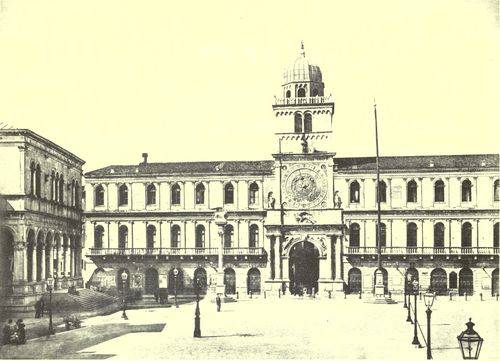
PALAZZO DEL CAPITANIO (After Falconetto. Padua) Anderson View larger image
This master made for the Cornaro family two very beautiful designs of tombs, which were to be erected in S. Salvatore, at Venice—one for the Queen of Cyprus, a lady of that family, and the other for Cardinal Marco Cornaro, who was the first of that house to be honoured with that dignity. And in order that these designs might be carried out, a great quantity of marble was quarried at Carrara and taken to Venice, where the rough blocks still are, in the house of the same Cornari.
Giovan Maria was the first who brought the true methods of building and of good architecture to Verona, Venice, and all those parts, where before him there had not been one who knew how to make even a cornice or a capital, or understood either the measurements or the proportions of a column or of any Order of architecture, as is evident from the buildings that were erected before his day. This knowledge was afterwards much increased by Fra Giocondo, who lived about the same time, and it received its final perfection from Messer Michele San Michele, insomuch that those parts are therefore under an everlasting obligation to the people of Verona, in which city were born and lived at one and the same time these three most excellent architects. To them there then succeeded Sansovino, who, not resting content with architecture, which he found already grounded and established by the three masters mentioned above, also brought thither sculpture, to the end that by its means their buildings might have all the adornments that were proper to them. And for this a debt of gratitude—if one may use such a word—is due to the ruin of Rome, by reason of which the masters were dispersed over many places and the beauties of these arts communicated throughout all Europe.
Giovan Maria caused some works in stucco to be carried out in Venice, and taught the method of executing them. Some declare that when he was a young man he had the vaulting of the Chapel of the Santo, at Padua, decorated with stucco by Tiziano da Padova and many others, and also had similar works executed in the house of the Cornari, which are very beautiful. He taught his work to two of his sons, Ottaviano, who was, like himself, also a painter, and Provolo. Alessandro, his third son, worked in his youth at making armour, and afterwards adopted the calling of a soldier; he was three times victor in the lists, and finally, when a captain of infantry, died fighting valiantly before Turin in Piedmont, having been wounded by a harquebus-ball.
Giovan Maria, on his part, after being crippled by gout, finished the course of his life at Padua, in the house of the aforesaid Messer Luigi Cornaro, who always loved him like a brother, or rather, like his own self. And to the end that there might be no separation in death between the bodies of those whose minds had been united together in the world by friendship and love of art, Messer Luigi had intended that Giovan Maria should be laid to rest beside himself in the tomb that was to be erected for his own burial, together with that most humorous poet, Ruzzante, his very familiar friend, who lived and died in his house; but I do not know whether this design of the illustrious Cornaro was ever carried into effect. Giovan Maria was a fine talker, pleasant and agreeable in conversation, and very acute in repartee, insomuch that Cornaro used to declare that a whole book could have been made with his sayings. And since, although he was crippled by gout, he lived cheerfully, he preserved his life to the age of seventy-six, dying in 1534.
He had six daughters, five of whom he gave in marriage himself, and the sixth was married by her brothers, after his death, to Bartolommeo Ridolfi of Verona, who executed many works in stucco in company with them, and was a much better master than they were. This may be seen from his works in many places, and in particular at Verona, in the house of Fiorio della Seta on the Ponte Nuovo, in which he decorated some apartments in a very beautiful manner. There are others in the house of the noble Counts Canossi, which are amazing; and such, also, are those that he executed in the house of the Murati, near S. Nazzaro; and for Signor Giovan Battista della Torre, for Cosimo Moneta, the Veronese banker, at his beautiful villa, and for many others in various places, all works of great beauty. Palladio, most excellent of architects, declares that he knows no person more marvellous in invention or better able to adorn apartments with beautiful designs in stucco, than this Bartolommeo Ridolfi. Not many years since, Spitech Giordan, a nobleman of great authority with the King of Poland, took Bartolommeo with him to that King; and there, enjoying an honourable salary, he has executed, as he still does, many works in stucco, large portraits, medallions, and many designs for palaces and other buildings, with the assistance of a son of his own, who is in no way inferior to his father.
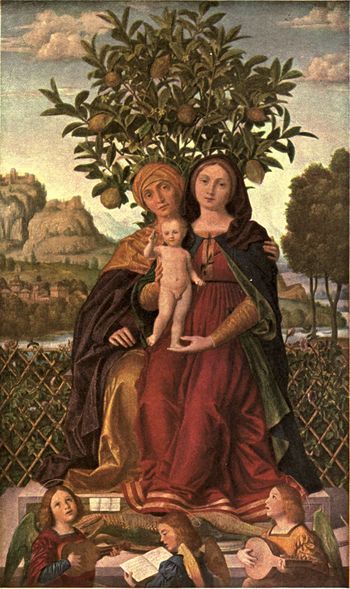
GIROLAMO DAI LIBRI: MADONNA AND CHILD, WITH S. ANNE (London: National Gallery, 748. Canvas) View larger image
The elder Francesco dai Libri of Verona lived some time before Liberale, although it is not known exactly at what date he was born; and he was called "Dai Libri"[9] because he practised the art of illuminating books, his life extending from the time when printing had not yet been invented to the very moment when it was beginning to come into use. Since, therefore, there came to him from every quarter books to illuminate—a work in which he was most excellent—he was known by no other surname than that of "Dai Libri"; and he executed great numbers of them, for the reason that whoever went to the expense of having them written, which was very great, wished also to have them adorned as much as was possible with illuminations.
This master illuminated many choral books, all beautiful, which are at Verona, in S. Giorgio, in S. Maria in Organo, and in S. Nazzaro; but the most beautiful is a little book, or rather, two little pictures that fold together after the manner of a book, on one side of which is a S. Jerome, a figure executed with much diligence and very minute workmanship, and on the other a S. John in the Isle of Patmos, depicted in the act of beginning to write his Book of the Apocalypse. This work, which was bequeathed to Count Agostino Giusti by his father, is now in S. Leonardo, a convent of Canons Regular, of which Don Timoteo Giusti, the son of that Count, is a member. Finally, after having executed innumerable works for various noblemen, Francesco died, content and happy for the reason that, in addition to the serenity of mind that his goodness brought him, he left behind him a son, called Girolamo, who was so excellent in art that before his death he saw him already a much greater master than himself.
This Girolamo, then, was born at Verona in the year 1472, and at the age of sixteen he painted for the Chapel of the Lischi, in S. Maria in Organo, an altar-piece which caused such marvel to everyone when it was uncovered and set in its place, that the whole city ran to embrace and congratulate his father Francesco. In this picture is a Deposition from the Cross, with many figures, and among the many beautiful weeping heads the best of all are a Madonna and a S. Benedict, which are much commended by all craftsmen; and he also made therein a landscape, with a part of the city of Verona, drawn passing well from the reality. Then, encouraged by the praises that he heard given to his work, Girolamo painted the altar of the Madonna in S. Paolo in a masterly manner, and also the picture of the Madonna with S. Anne, which is placed between the S. Sebastian of Il Moro and the S. Rocco of Cavazzuola in the Church of the Scala. For the family of the Zoccoli he painted the great altar-piece of the high-altar in the Church of the Vittoria, and for the family of the Cipolli the picture of S. Onofrio, which is near the other, and is held to be both in design and in colouring the best work that he ever executed.
For S. Leonardo nel Monte, also, near Verona, he painted at the commission of the Cartieri family the altar-piece of the high-altar, which is a large work with many figures, and much esteemed by everyone, above all for its very beautiful landscape. Now a thing that has happened very often in our own day has caused this work to be held to be a marvel. There is a tree painted by Girolamo in the picture, and against it seems to rest the great chair on which the Madonna is seated. This tree, which has the appearance of a laurel, projects considerably with its branches over the chair, and between the branches, which are not very thick, may be seen a sky so clear and beautiful, that the tree seems to be truly a living one, graceful and most natural. Very often, therefore, birds that have entered the church by various openings have been seen to fly to this tree in order to perch upon it, and particularly swallows, which had their nests among the beams of the roof, and likewise their little ones. Many persons well worthy of credence declare that they have seen this, among them Don Giuseppe Mangiuoli of Verona, a person of saintly life, who has twice been General of his Order and would not for anything in the world assert a thing that was not absolutely true, and also Don Girolamo Volpini, likewise a Veronese, and many others.
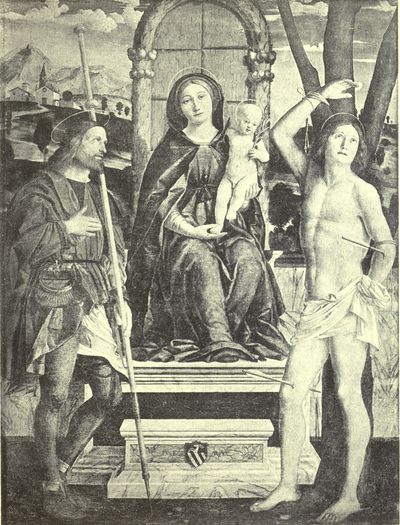
MADONNA AND CHILD WITH SAINTS (After the painting by Girolamo dai Libri. Verona: Museo Civico, 290) Brogi View larger image
In S. Maria in Organo, where was the first work executed by Girolamo, he also painted two Saints on the outer side of one of the folding doors of the organ—the other being painted by Francesco Morone, his companion—and on the inner side a Manger. And afterwards he painted the picture that is opposite to his first work, containing the Nativity of Our Lord, with shepherds, landscapes, and very beautiful trees; but most lifelike and natural of all are two rabbits, which are executed with such diligence that each separate hair may actually be seen in them. He painted another altar-piece for the Chapel of the Buonalivi, with a Madonna seated in the centre, two other figures, and some Angels below, who are singing. Then, in the ornamental work made by Fra Giovanni da Verona for the altar of the Sacrament, the same Girolamo painted three little pictures after the manner of miniatures. In the central picture is a Deposition from the Cross, with two little Angels, and in those at the sides are painted six Martyrs, kneeling towards the Sacrament, three in each picture, these being saints whose bodies are deposited in that very altar. The first three are Cantius, Cantianus, and Cantianilla, who were nephews of the Emperor Diocletian, and the others are Protus, Chrysogonus, and Anastasius, who suffered martyrdom at Aquæ Gradatæ, near Aquileia; and all these figures are in miniature, and very beautiful, for Girolamo was more able in that field of art than any other master of his time in Lombardy and in the State of Venice.
Girolamo illuminated many books for the Monks of Montescaglioso in the Kingdom of Naples, some for S. Giustina at Padua, and many others for the Abbey of Praia in the territory of Padua; and also some at Candiana, a very rich monastery of the Canons Regular of S. Salvatore, to which place he went in person to work, although he would never go to any other place. While he was living there, Don Giulio Clovio, who was a friar in that place, learned the first rudiments of illumination; and he has since become the greatest master of that art that is now alive in Italy. Girolamo illuminated at Candiana a sheet with a Kyrie, which is an exquisite work, and for the same monks the first leaf of a psalter for the choir; with many things for S. Maria in Organo and for the Friars of S. Giorgio, in Verona. He executed, likewise, some other very beautiful illuminations for the Black Friars of S. Nazzaro at Verona. But that which surpassed all the other works of this master, which were all divine, was a sheet on which was depicted in miniature the Earthly Paradise, with Adam and Eve driven forth by the Angel, who is behind them with a sword in his hand. One would not be able to express how great and how beautiful is the variety of the trees, fruits, flowers, animals, birds, and all the other things that are in this amazing work, which was executed at the commission of Don Giorgio Cacciamale of Bergamo, then Prior of S. Giorgio in Verona, who, in addition to the many other courtesies that he showed to Girolamo, gave him sixty crowns of gold. This work was afterwards presented by that Father to a Roman Cardinal, at that time Protector of his Order, who showed it to many noblemen in Rome, and they all declared it to be the best example of illumination that had ever been seen up to that day.
Girolamo painted flowers with such diligence, and made them so true, so beautiful, and so natural, that they appeared to all who beheld them to be real; and he counterfeited little cameos and other engraved stones and jewels in such a manner, that there was nothing more faithfully imitated or more diminutive to be seen. Among his little figures there are seen some, as in his imitations of cameos and other stones, that are no larger than little ants, and yet all the limbs and all the muscles can be perceived so clearly that one who has not seen them could scarcely believe it. Girolamo used to say in his old age that he knew more in his art then than he had ever known, and saw where every stroke ought to go, but that when he came to handle the brushes, they went the wrong way, because neither his eye nor his hand would serve him any longer. He died on the 2nd of July in the year 1555, at the age of eighty-three, and was laid to rest in the burial-place of the Company of S. Biagio in S. Nazzaro.
He was a good and upright man, who never had a quarrel or dispute with anyone, and his life was very pure. He had, besides other children, a son called Francesco, who learned his art from him, and executed miracles of illumination when still a mere lad, so that Girolamo declared that he had not known as much at that age as his son knew. But this young man was led away from him by a brother of his mother, who, being passing rich, and having no children, took him with him to Vicenza and placed him in charge of a glass-furnace that he was setting up. When Francesco had spent his best years in this, his uncle's wife dying, he fell from his high hopes, and found that he had wasted his time, for the uncle took another wife, and had children by her, and thus Francesco did not become his uncle's heir, as he had thought to be. Thereupon he returned to his art after an absence of six years, and, after acquiring some knowledge, set himself to work. Among other things, he made a large globe, four feet in diameter, hollow within, and covered on the outer side, which was of wood, with a glue made of bullock's sinews, which was of a very strong admixture, so that there should be no danger of cracks or other damage in any part. This sphere, which was to serve as a terrestrial globe, was then carefully measured and divided under the personal supervision of Fracastoro and Beroldi, both eminent physicians, cosmographers, and astrologers; and it was to be painted by Francesco for Messer Andrea Navagiero, a Venetian gentleman, and a most learned poet and orator, who wished to make a present of it to King Francis of France, to whom he was about to go as Ambassador from his Republic. But Navagiero had scarcely arrived in France after a hurried journey, when he died, and this work remained unfinished. A truly rare work it would have been, thus executed by Francesco with the advice and guidance of two men of such distinction; but it was left unfinished, as we have said, and, what was worse, in its incomplete condition it received some injury, I know not what, in the absence of Francesco. However, spoiled as it was, it was bought by Messer Bartolommeo Lonichi, who has never consented to give it up to anyone, although he has been much besought and offered vast prices.
Before this, Francesco had made two smaller globes, one of which is in the possession of Mazzanti, Archpriest of the Duomo of Verona, and the other belonged to Count Raimondo della Torre, and is now in the hands of his son, Count Giovan Batista, who holds it very dear, because this one, also, was made with the measurements and personal assistance of Fracastoro, who was a very familiar friend of Count Raimondo.
Finally, growing weary of the extraordinary labour that miniatures demand, Francesco devoted himself to painting and to architecture, in which he became very skilful, executing many works in Venice and in Padua. About that time the Bishop of Tournai, a very rich and noble Fleming, had come to Italy in order to study letters, to see the country, and to learn our manners and ways of living. This man, delighting much in architecture, and happening to be in Padua, became so enamoured of the Italian method of building that he resolved to take the modes of our architecture with him to his own country; and in order to facilitate this purpose, he drew Francesco, whose ability he had recognized, into his service with an honourable salary, meaning to take him to Flanders, where he intended to carry out many magnificent works. But when the time came to depart, poor Francesco, who had caused designs to be made of all the best and greatest and most famous buildings in Italy, was overtaken by death, while still young and the object of the highest expectations, leaving his patron much grieved by his loss.
Francesco left an only brother, in whom, being a priest, the Dai Libri family became extinct, after producing in succession three men most excellent in their field of art. Nor have any disciples survived them to keep this art alive, excepting the above-mentioned churchman, Don Giulio, who, as we have related, learned it from Girolamo when he was working at Candiana, where the former was a friar; and this Don Giulio has since raised it to a height of excellence which very few have reached and no one has ever surpassed.
I knew for myself some of the facts about the excellent and noble craftsmen mentioned above, but I would never have been able to learn the whole of what I have related of them if the great goodness and diligence of the reverend and most learned Fra Marco de' Medici of Verona, a man profoundly conversant with all the most noble arts and sciences, and with him Danese Cattaneo of Carrara, a sculptor of great excellence, both being very much my friends, had not given me that complete and perfect information which I have just written down, to the best of my ability, for the convenience and advantage of all who may read these our Lives, in which the courtesy of many friends, who have taken pains with the investigation of these matters in order to please me and to benefit the world, has been, as it still is, of great assistance to me. And let this be the end of the Lives of these craftsmen of Verona, the portraits of each of whom I have not been able to obtain, because this full notice did not reach my hands until I found myself almost at the close of my work.