Chapter X · CONCLUSION.
Reading edition
Something tells me that among my little readers there may be a few—perhaps the oldest or most clever—who wish to ask me certain questions. They may say to me:—
“Now what moral lesson do you draw from your story? That boy, Eusèbe, who is about the naughtiest and most disagreeable boy that ever lived, is left just as well off, and as happy as the dear good little Maurice. An author can make shadow or sunshine fall upon his paper as he pleases: then he should punish the bad, and make the good happy.”
In reply, I say to you: My dear little gentlemen and my pretty young ladies, you must know that Providence, which watches over us from above, does not institute special rewards for virtue, as men may do; nor has any system like ours for punishing the bad. Yet Providence is always just. To those who do good no other reward is sometimes accorded than that of being good: but, in truth, that is the best reward of all. If a man bestow charity in 269 the hope that God will, as a reward, render him prosperous, he is not really charitable, but only a speculator who risks a little in the hope that he may gain much. Nor can we always see how Providence punishes the bad. They may be rich and prosperous, yet they may suffer from the hatred that is in their hearts, and from the envy they feel towards those who appear happy.
But to satisfy my little readers I will leap over the fifteen years which separate the present time from that at which my story began, and see what has become of the principal characters.
To begin with Eusèbe. You may meet him everywhere; at the theatres, in the park, at races, always with his glass in his eye, generally with a cigar in his mouth, and dressed in a conspicuous and ridiculous fashion. But you may ask perhaps what he does? Nothing: that is the only thing he is capable of doing. With a cold heart and an empty head he has no friendships, nor has he intellect enough even to enjoy his amusements.
That attack of the nerves which his parents always dreaded, but which never came, was an excuse for not working at college; and when his education was supposed to be finished, it was discovered one fine day that he knew nothing and was fit for nothing. But I am forgetting: he has one occupation, which is the misery of his life. His occupation is to envy. When any of his old college companions or his schoolfellows are successful in literature, science, or art, he is miserable. It is torture to him to hear them praised. He does what he can to detract from their merit and renown; and finds a certain satisfaction—perhaps a slight consolation—in laughing at them for their application and industry.
“How a fellow can be such a fool as to work hard in that way!” he will say with an air of superiority.
In short, Eusèbe would like to sweep away all genius, talent, and wit from the face of the earth, and when there remained only fools upon it, he might be king among them. 270 And now, my little readers, what do you think of Eusèbe? Is he happy, do you suppose?
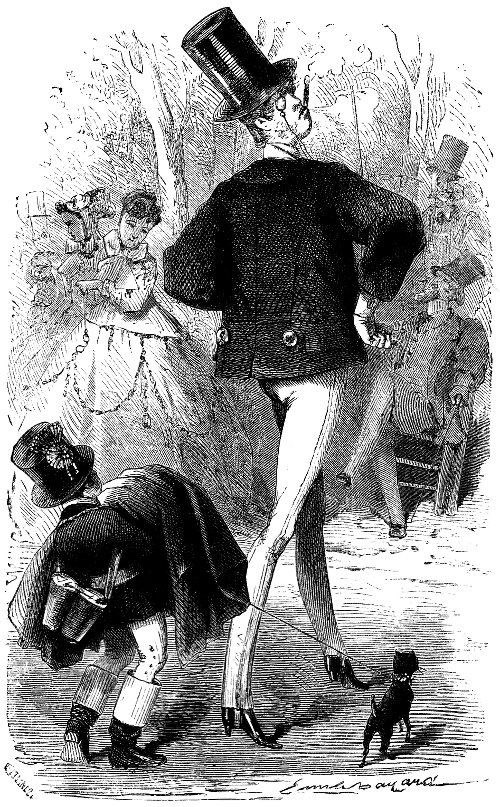
WITH HIS GLASS IN HIS EYE, AND DRESSED IN A RIDICULOUS FASHION.
You ask now if Adrienne Fallachon became a duchess after all?
271
No; far from it. She grew up wiser and less ambitious than her father. She has lately married a young lawyer, a cousin of her own, whom she loved. So she has not even changed her name, which is still Fallachon.
And Maurice?
Maurice has lately left college, where he has greatly distinguished himself. As a young man, he is still as kind, gentle, and brave, as he used to be when a boy; and is as generally loved as his cousin Eusèbe is disliked. His talent and his inclination both seem to point to a literary career, as the one he will take to; nor can any be more honourable or useful when the writer teaches what is true, and good, and noble. I am sure we all wish him success and happiness.
272