VIII UNCLE LEM’S CHRISTMAS PARTY
Reading edition

The village of Oatka Centre had no sooner swallowed the amazing fact that Lemuel Perkins was going to give the school children a Christmas party in his own house, than its bump of credulity was again strained almost to the bursting point by the information that Mrs. Em Caldwell was helping actively about the preparations, and that Mr. Lemuel Perkins himself had been seen bringing several parcels from “Nate Waterses store,” and even talking amicably with Elder Smith on the subject of missions in India and a certain small missionary from that land, though various essential differences between free will and predestination had previously cleft an impassable gulf between them.
“Will wonders never cease?” marvelled Oatka Centre, and then decided unanimously that they certainly would not, for about that time it transpired that the children’s party had enlarged into a neighbourhood celebration, and that every man, woman, and child in the village was invited.
It had been Merry Christmas’s first idea to invite the fathers and mothers to come with their children; but then so many of her particular friends—like Mr. Bennett, and Mrs. Caldwell, and Miss Marthy Watkins—were not blessed with children that it seemed impossible to narrow the gates of paradise in that manner. And when it was once decided to light the fires in the long-disused parlour and sitting-room, there really seemed to be no excuse for shutting out anybody; particularly as Uncle Lemuel developed a sudden mania for inviting every person who had a good word to speak for his “little sissy”; and who in Oatka Centre hadn’t by the time those two jolly weeks of holiday preparation were over? For, like an unconscious messenger of “peace on earth, good will to men,” she had bobbed from the schoolhouse to the stores and back again, and presently into every house in the village, on one errand or another, trading happily with her one little talent, and leaving a trail of “Merry Christmas” in the air behind her.
Talk about your Marconi stations! There is nothing like a little human heart brimming over with goodwill, and bubbling with enthusiasm, to fill the air so full of Christmas spirit that not another thought can find a wave to ride on.
And so it happened that by the time the windows of the brown Perkins homestead were set cheerily ablaze the snowy village streets were crackling and snapping merrily under the tread of many feet.
“I dunno as I’d orter ’a’ shut up the post-office and come,” confided Miss Watkins to her neighbour, Mrs. Waters, as they creaked cheerfully along together at the end of the line, “when the six o’clock is so late and the mail hain’t come in, but Merry Christmas she couldn’t have it no other way. She said she was goin’ to have Tom Bennett for Sandy Claus, anyway, and she’d just rig him up and have him fetch in the mail bags, too, and I could call the letters and passels out right there.”
“That’s a good idee,” assented Mrs. Waters. “Trust that little gal for fixin’ things around. She got Nate to shut up, too; and Job, he’s even locked up the Emporium. Both on ’em is about sold out, anyway. There hain’t been such a time for Christmas tradin’ in Oatka Centre dear knows when. It’s funny how that young one stirs things up. It’s her bein’ brought up in Injy, I expect, and a missionary’s daughter, so. Why, the Baby Jesus and the shepherds and the wise men and the angels and all is just as real to her as if they was out in Lem’s paster this minute, and she seen ’em. Makes you feel kind of green to have a young one come from heathen lands to teach us Christian folks about Christmas!”
“It’s her takin’ things so for granted,” explained Miss Watkins. “I hain’t give nobody much for Christmas in years, made an excuse of bein’ in the office and not havin’ time; and so I told her when she was in consultin’ me about some of her Christmas doin’s. Well, sir—the next afternoon in she breezed about two o’clock, and said she’d come to tend office for me till four, so I could go and do my tradin’; and land if she hadn’t wrote a list, too, of some things that she’d heard my sister’s young ones say they wanted.” She stopped to laugh deprecatingly. “Well, Priscilla, you know I come and bought ’em, don’t ye?”
“I bet that’s how she’s worked it with Lem,” answered Mrs. Waters. “Took it for granted he was so decent that he was ashamed not to be. Lem’s reely quite human these days. Do you remember his little gal, Loviny, that he lost years and years ago. Well, he’s been and hunted out a little red dress she had, and he wanted me to get some cloth just that colour and then to have Mis’ Mosher make it up on the sly for Merry. It was for a Christmas present, but Mis’ Mosher carried it up this mornin’, and I’ll bet she’ll have it on to-night.”
By this time the two women had reached the brown gate, and they stopped to admire the Christmas wreaths that shone against the lighted panes.
“Twenty on ’em there is, in all, and a little bell inside of each one,” announced Miss Watkins. “Miss Porter told me, though you can’t see but twelve from here. The young ones made ’em yesterday to the schoolhouse. Say, there she is now—red dress and all!”
There she was indeed, little Merry Christmas, in her “Kissmas-coloured” dress, with a wreath of holly crowning her brown braids—literally exploding with joy and delight into a hundred little ripples of laughter.
Unmindful of the cold air outside, she danced down the steps to meet the latest comers.
“Oh, goody!” she cried. “I was so afraid you’d be late, and I didn’t want you to miss anything. The children are going to sing their carols first, and then we’re going to have the tree and then the popcorn and candy. We made those this afternoon, for there really wouldn’t have been any room to-night, there are so many here. And uncle has put a dish of apples everywhere he could possibly make room. He thinks apples are almost as healthy as pies. You just come this way to the back entry and hang your things up. Oh, listen! They’re beginning now. Do you suppose I can ever get into the kitchen far enough to sing?”
She certainly couldn’t if she had been anybody but her active little self, for everybody else seemed to want to get into that kitchen, too. And no wonder, for it was certainly an attractive spot, with its old walls wreathed with ground pine and gay streamers, and the lighted Christmas tree sparkling at the end, with a ring of happy young faces beneath it, lustily carolling their Christmas songs.
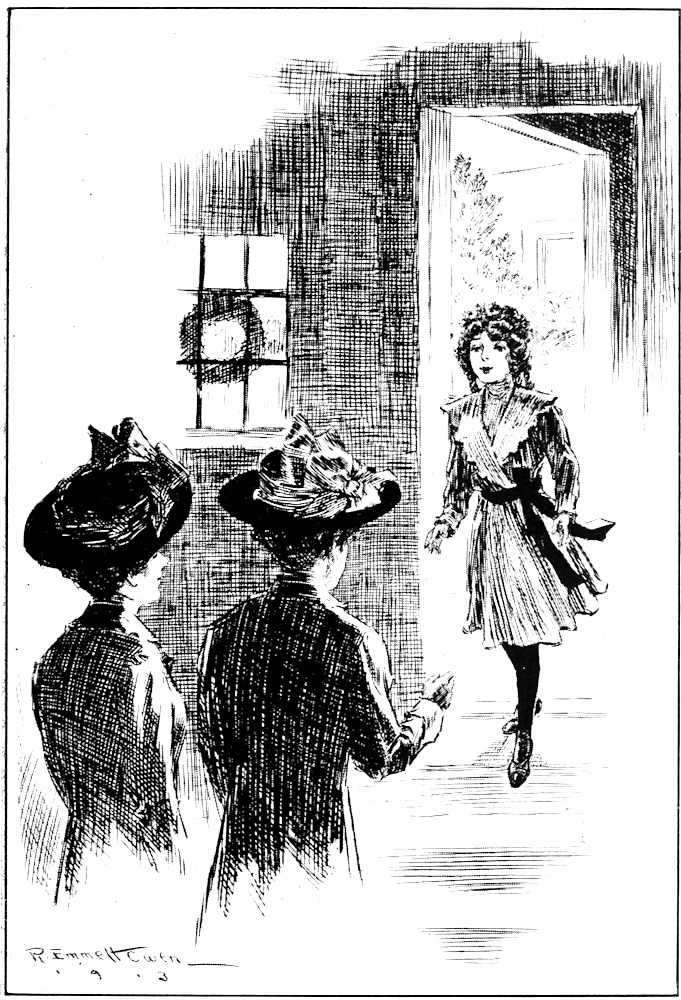
“Oh, goody!” she cried. “I was so afraid you’d be late, and I didn’t want you to miss anything”
It was a mammoth kitchen, too, built in the days when the kitchen was really the living-room and the heart of the house. But, bless you! it would have taken half a dozen such kitchens to contain all the happiness and eager anticipation and radiant good-fellowship that were rampant there; to say nothing at all of all the people who were disjointing their necks, and standing on each other’s feet, and poking holes in each other’s ribs, in their anxiety to hear the music, and see the decorations, and most of all to satisfy themselves for the hundredth time that their own little Johns and Marys were far and away the handsomest children there, and the best singers, and that it was a wonder that all the other fathers and mothers weren’t blushing with mortification at the painful obviousness of these facts.
First and foremost of all these self-complacent mortals was Mr. Lemuel Perkins, though he would have been the last person in the world to admit, or even to suspect, the fact; though nobody knows how else he could have explained the proud lift of his bristling chin whisker, or the positively vainglorious swelling of his chest, as a certain little holly-crowned figure in a red dress was lifted mysteriously on high, and smiled radiantly upon the assembled guests.
“Santa Claus is rather slow to-night,” announced the clear, childish voice, “because some of his pack came by mail, and the train is late; but my Uncle Lemuel will take his place till he comes. Oh, there he is, over by the sink. Will you let Uncle Lemuel through, if you please?”
Uncle Lemuel glanced wildly about, but there was no avenue of escape unless he leaped directly through the sink window. And in front of him a way was opening through that mass of humanity as miraculously as if Moses had been present with his famous rod. Even his growl of dissent was lost in the merry babel of voices around him, as a score of hands pushed him forward to where a little red-garbed figure welcomed him joyfully.
“I’ll help you, Uncle, if you can’t see the names very well,” she whispered. “But they’ll like to have you do the calling out.”
“Now, look here, sissy,” he protested; “I ain’t goin’ to have no foolishness. Tom Bennett can rig himself up in a mess of red flannin and cotton battin’ if he wants to, but I hain’t goin’ to make no show of myself.”
“Mercy, no!” giggled Mary. “You aren’t round enough for Santa Claus, anyway. You just call out the names. Here’s one for Elder Smith, and Sarah Haskell, and Deacon Caldwell. There are perfect heaps. Oh, hurry, do!”
Uncle Lemuel glanced at the first parcel, and a grim, “down-East” sense of humour triumphed.
“Waal, Elder Smith,” he announced in stentorian tones, “I seem predestined to hand you over this passel, that’s sure. I’ll bet you can’t prove it was my free will this time.”
The burst of laughter that acclaimed this witticism was so intoxicating that Mr. Perkins promptly proceeded to make another, which was even more successful. Whereupon he yielded himself so thoroughly to the unaccustomed delight of public appreciation and approval that when the real Santa Claus finally came he was forced to divide his honours with a determined Uncle Lemuel, who evidently regarded him as an upstart and an interloper.
But bless me! nobody minded that, and least of all the genial Mr. Bennett, for two Santa Clauses and a Merry Christmas and half a dozen understudies and assistants were none too many to tackle that mass of Christmas presents and clear them out of the way in time for the games and other jollifications to begin.
It was a mercy that the popcorn and the molasses candy were all made beforehand, for otherwise the whole school, and their presents, and their teacher, and the tree, would have been stuck together in one huge and inextricable popcorn ball; they barely escaped that fate as it was just in the eating of those toothsome dainties. But blindman’s-buff and stage-coach and puss-in-the-corner have their advantage in the line of keeping things moving and preventing you from being glued for life to your next neighbour if you chance to adhere in passing.
“Well, this is a real, right-down, old-fashioned Christmas party, ‘same as mother used to make,’ ain’t it?” queried Deacon Caldwell jovially of the man next him and then stopped suddenly, as he realized that that man was his time-honoured foe, Mr. Perkins.
But Mr. Perkins had no thought for any ancient grudges just then.
“What’s become of sissy?” he demanded sharply. “I can’t spot her nowhere in sight. She was blindman along back, but she hain’t playin’ now.”
“She must be in the parlour,” suggested Deacon Caldwell kindly. “Like as not she went in to hunt up Em. They’re great cronies, her and Em.”
“No, she ain’t,” retorted Uncle Lemuel shortly. “She ain’t there nor in the settin’-room, nor upstairs in the bedrooms. You don’t s’pose she’s been and took sick, somewheres, do ye?” he added anxiously. “Et too much stuff, or come down with that scarlet fever, mebbe?”
“Why, sho now, Lem!” cried the deacon sympathetically. “I’d hate to think so. But let’s go get Em. Em’s a master hand in sickness if need be.”
“It’ll be easy enough to find her by the red dress,” said Mrs. Caldwell encouragingly as she joined the little party of searchers. But “upstairs and downstairs and in my lady’s chamber” they looked, and no sign of the “Kissmas-coloured” dress did they see.
“There’s the cellar and the woodshed still left,” comforted Mrs. Caldwell, glancing sidewise at Uncle Lemuel’s grimly suffering face.
And just as they reached the back-entry door, a little figure in a red dress popped in from the woodshed entrance, a radiant little figure, that waved a lantern on high, and flung itself joyfully upon Uncle Lemuel.
“Where’ve you been?” demanded that gentleman with the gruffness of relief. “We’ve been huntin’ you from garret to cellar.”
“Oh, I’m so sorry if you worried!” cried Mary penitently. “I never thought you’d notice. Mr. Bennett brought me a letter, you see, from mother—my Christmas letter—and of course I was dying to read it, and I couldn’t find a single place that was quiet, so I took a lantern and went out to the woodshed.”
“I hope you hain’t took your death of cold,” cried Mrs. Caldwell anxiously.
“Oh, no; I’m warm as toast,” answered Mary happily. “And I’ve had the nicest news you ever knew. Father and mother and the children are all coming back to America! Isn’t that lovely? That’s been the only drawback to this perfectly beautiful Christmas here—missing them all so—and now—just think! They’re coming, too!”
“How do they happen to be comin’?” queried Mrs. Caldwell, returning Mary’s ecstatic embrace.
“Why, it’s on account of father’s health. Father’s not been very strong for a long time. But neither was I, and look at me now! He’ll be all right as soon as he gets to Oatka Centre, and eats enough pie and things.”
“Oh, are they comin’ here?” inquired Mrs. Caldwell, in a voice in which pleasure and surprise were mingled. Oatka Centre had not yet forgotten that when Ellen Rumball chose to marry and go to India, she had done so in face of the threat that the Perkins doors would be closed to her henceforth and forever.
But Mary returned her gaze with wide-open, astonished eyes.
“Why, she didn’t say Oatka Centre,” she cried. “But where else should they come? Why, mother loves Oatka Centre better than any other place on earth, she always says. And father has no family at all. So Uncle Lemuel is our nearest surviving relative,” she ended quaintly.
“Why, that’s so, of course,” agreed Mrs. Caldwell hastily. “How soon did you say they was comin’?”
“Right away, mother says. Isn’t that grand? Maybe I won’t even go back to school. Crescent Hill is lovely—for a school; but of course a real home, with Uncle Lemuel and the rest of my family, would be lots nicer. Oh, Uncle Lemuel, aren’t you glad as can be?”
But the old man was gazing at her with dazed eyes.
“Was you—goin’ back—to school, sissy?” he said slowly. “When?”
“Why, week after next, Uncle Lemuel. We’ve had a whole month, you see. But if mother is coming here to live maybe she won’t make me, and I can stay right along and bake pies for you all winter. Oh, goody, goody! I’m so glad that my toes are skipping round inside my shoes. Do come with me while I go and ask Miss Porter what class she would put me in.”
But Uncle Lemuel, muttering something about “the stock,” stepped to the back door, and walked slowly out under the silent stars.
“Oh, he’s going out to see if they kneel down,” explained Mary happily, after a second of surprise. “I heard that the animals all knelt in their stalls on Christmas Eve; and he promised me that he’d go and look and call me if they did. But I’m afraid that he’s too early. They don’t do it till twelve o’clock, I think. I must run and tell him to wait.”
Mrs. Caldwell laid a detaining hand upon her arm.
“I wouldn’t bother him if I was you, dearie,” she said. “Mebbe he’ll find ’em now. It’s Christmas Eve, anyhow.”
For Mrs. Caldwell, down deep in her heart, was praying eagerly that the stars of Christmas Eve would lead Uncle Lemuel, as they had led the Wise Men long ago, to learn the lessons of humbleness and love by the side of a manger.