FIGHTING PESTS WITH INSECT ALLIES
Reading edition
Top
Leland O. Howard
[Dr. Howard is Chief of the Division of Entomology in the United States Department of Agriculture at Washington. He is a lecturer at Swarthmore College and at Georgetown University. He has written “The Insect Book,” published by Doubleday, Page & Co., New York; and a work on Mosquitoes, issued by McClure, Phillips & Co., New York. Both are books of interest from the hand of a master: they are fully illustrated. The narrative which follows appeared in Everybody's Magazine, June, 1901.]
Some twenty-five years ago there appeared suddenly upon certain acacia trees at Menlo Park, California, a very destructive scale bug. It rapidly increased and spread from tree to tree, attacking apples, figs, pomegranates, quinces, and roses, and many other trees and plants, but seeming to prefer to all other food the beautiful orange and lemon trees which grow so luxuriantly on the Pacific Coast, and from which a large share of the income of so many fruit-growers is gained. This insect, which came to be known as the white scale or fluted scale or the Icerya (from its scientific name), was an insignificant creature in itself, resembling a small bit of fluted wax a little more than a quarter of an inch long. But when the scales had once taken possession of a tree, they swarmed over it until the bark was hidden; they sucked its sap through their minute beaks until the plant became so feeble that the leaves and young fruit dropped off, a hideous black smut-fungus crept over the young twigs, and the weakened tree gradually died.
In this way orchard after orchard of oranges, worth a thousand dollars or more an acre, was utterly destroyed; the best fruit-growing sections of the State were invaded, and ruin stared many a fruit-grower in the face. This spread of the pest was gradual, extending through a series of years, and not until 1886 did it become so serious a matter as to attract national attention.
In this year an investigation was begun by the late Professor C. V. Riley, the Government entomologist then connected with the Department of Agriculture at Washington. He sent two agents to California, both of whom immediately began to study the problem of remedies. In 1887 he visited California himself, and during that year published an elaborate report giving the results of the work up to that point. The complete life-history of the insect had been worked out, and a number of washes had been discovered which could be applied to the trees in the form of a spray, and which would kill a large proportion of the pests at a comparatively small expense. But it was soon found that the average fruit-grower would not take the trouble to spray his trees, largely from the fact that he had experimented for some years with inferior washes and quack nostrums, and from lack of success had become disgusted with the whole idea of using liquid compounds. Something easier, something more radical was necessary in his disheartened condition.
Meantime, after much sifting of evidence and much correspondence with naturalists in many parts of the world, Professor Riley had decided that the white scale was a native of Australia, and had been first brought over to California accidentally upon Australian plants. In the same way it was found to have reached South Africa and New Zealand, in both of which colonies it had greatly increased, and had become just such a pest as it is in California. In Australia, however, its native home, it did not seem to be abundant, and was not known as a pest—a somewhat surprising state of affairs, which put the entomologist on the track of the results which proved of such great value to California. He reasoned that, in his native home, with the same food plants upon which it flourished abroad in such great abundance, it would undoubtedly do the same damage that it does in South Africa, New Zealand, and California, if there were not in Australia some natural enemy, probable some insect parasite or predatory beetle, which killed it off. It became therefore important to send a trained man to Australia to investigate this promising line.
Vedalia, or Australian Ladybird
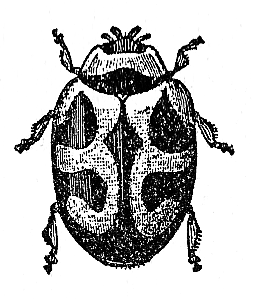
After many difficulties in arranging preliminaries relating to the payment of expenses (in which finally the Department of State kindly assisted), one of Professor Riley's assistants, a young German named Albert Koebele, who had been with him for a number of years, sailed for Australia in August, 1888. Koebele was a skilled collector and an admirable man for the purpose. He at once found that Professor Riley's supposition was correct: there existed in Australia small flies which laid their eggs in the white scales, and these eggs hatched into grubs which devoured the pests. He also found a remarkable little ladybird, a small, reddish-brown convex beetle, which breeds with marvellous rapidity and which, with voracious appetite, and at the same time with discriminating taste, devours scale after scale, but eats fluted scales only—does not attack other insects. This beneficial creature, now known as the Australian ladybird, or the Vedalia, Mr. Koebele at once began to collect in large numbers, together with several other insects found doing the same work. He packed many hundreds of living specimens of the ladybird, with plenty of food, in tin boxes, and had them placed on ice in the ice-box of the steamer at Sydney; they were carried carefully to California, where they were liberated upon orange trees at Los Angeles.
These sendings were repeated for several months, and Mr. Koebele, on his return in April, 1889, brought with him many more living specimens which he had collected on his way home in New Zealand, where the same Vedalia had been accidentally introduced a year or so before.
Larvæ of Vedalia eating White Scale
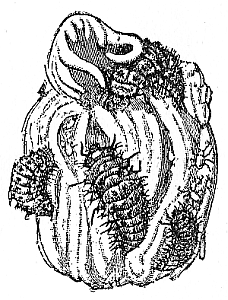
The result more than justified the most sanguine expectations. The ladybirds reached Los Angeles alive, and, with appetites sharpened by their long ocean voyage, immediately fell upon the devoted scales and devoured them one after another almost without rest. Their hunger temporarily satisfied, they began to lay eggs. These eggs hatched in a few days into active grub-like creatures—the larvæ of the beetles—and these grubs proved as voracious as their parents. They devoured the scales right and left, and in less than a month transformed once more to beetles.
And so the work of extermination went on. Each female beetle laid on an average 300 eggs, and each of these eggs hatched into a hungry larva. Supposing that one-half of these larvæ produced female beetles, a simple calculation will show that in six months a single ladybird became the ancestor of 75,000,000,000 of other ladybirds, each capable of destroying very many scale insects.
Twig of olive infected with Black Scale
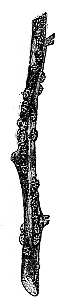
Is it any wonder, then, that the fluted scales soon began to disappear? Is it any wonder that orchard after orchard was entirely freed from the pest, until now over a large section of the State hardly an Icerya is to be found? And could a more striking illustration of the value of the study of insects possibly be instanced? In less than a year from the time when the first of these hungry Australians was liberated from his box in Los Angeles the orange trees were once more in bloom and were resuming their old-time verdure—the Icerya had become practically a thing of the past.
Rhizobius, the imported enemy of the Black Scale of the Olive.
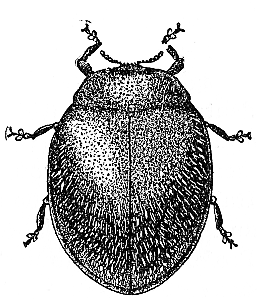
This wonderful success encouraged other efforts in the same direction. The State of California some years later sent the same entomologist, Koebele, to Australia to search for some insect enemy of the black scale, an insect which threatened the destruction of the extensive olive orchards of California. He found and successfully introduced another ladybird beetle, known as Rhizobius ventralis, a little dark-coloured creature which has thrived in the California climate, especially near the seacoast, and in the damp air of those regions has successfully held the black scale in check. It was found, however, that back from the seacoast this insect did not seem to thrive with the same vigor, and the black scale held its own. Then a spirited controversy sprung up among the olive-growers, those near the seacoast contending that the Rhizobius was a perfect remedy for the scale, while those inland insisted that it was worthless. A few years later it was discovered that this olive enemy in South Europe is killed by a little caterpillar, which burrows through scale after scale eating out their contents, and an effort was made to introduce the caterpillar into California, but these efforts failed. Within the past two years it has been found that a small parasitic fly exists in South Africa which lays its eggs in the same black scale, and its grub-like larvæ eat out the bodies of the scales and destroy them. The climate of the region in which this parasite exists is dry through a large part of the year, and therefore this little parasitic fly, known as Scutellista, was thought to be the needed insect for the dry California regions. With the help of Mr. C. P. Lounsbury, the Government entomologist of Cape Colony, living specimens of this fly were brought to this country, and were colonized in the Santa Clara Valley, near San José, California, where they have perpetuated themselves and destroyed many of the black scales, and promise to be most successful in their warfare against the injurious insect.
This same Scutellista parasite had, curiously enough, been previously introduced in an accidental manner into Italy, probably from India, and probably in scale-insects living on ornamental plants brought from India. But in Italy it lives commonly in another scale insect, and with the assistance of the learned Italian, Professor Antonio Berlese, the writer made an unsuccessful attempt to introduce and establish it a year earlier in some of our Southern States, where it was hoped it would destroy certain injurious insects known as “wax scales.”
In the meantime the United States, not content with keeping all the good things to herself, has spread the first ladybird imported—the Vedalia—to other countries. Four years ago the white scale was present in enormous numbers in orange groves on the left bank of the river Tagus, in Portugal, and threatened to wipe out the orange-growing industry in that country. The California people, in pursuance of a far-sighted policy, had with great difficulty, owing to lack of food, kept alive some colonies of the beneficial beetle, and specimens were sent to Portugal which reached there alive and flourishing. They were tended for a short time, and then liberated in the orange groves, with precisely the same result as in California. In a few months the scale insects were almost entirely destroyed, and the Portuguese orange-growers saved from enormous loss.
This good result in Portugal was not accomplished without opposition. It was tried experimentally at the advice of the writer, and in the face of great incredulity on the part of certain Portuguese newspapers and of some officials. By many prominent persons the account published of the work of the insect in the United States was considered as untrustworthy, and simply another instance of American boasting. But the opposition was overruled, and the triumphant result silenced all opposition. It is safe to say that the general opinion among Portuguese orange-growers to-day is very favourable to American enterprise and practical scientific acumen.
The Vedalia was earlier sent to the people in Alexandria and Cairo, Egypt, where a similar scale was damaging the fig trees and other valuable plants, and the result was again the same, the injurious insects were destroyed. This was achieved only after extensive correspondence and several failures. The active agent in Alexandria was Rear Admiral Blomfield, of the British Royal Navy, a man apparently of wide information, good judgment, and great energy.
The same thing occurred when the California people sent this saviour of horticulture to South Africa, where the white scale had also made its appearance.
It is not only beneficial insects, however, which are being imported, but diseases of injurious insects. In South Africa the colonists suffer severely from swarms of migratory grasshoppers, which fly from the north and destroy their crops. They have discovered out there a fungus disease, which under favorable conditions kills off the grasshoppers in enormous numbers. At the Bacteriological Institute in Grahamstown, Natal, they have cultivated this fungus in culture tubes, and have carried it successfully throughout the whole year; and they have used it practically by distributing these culture tubes wherever swarms of grasshoppers settle and lay their eggs. The disease, once started in an army of young grasshoppers, soon reduces them to harmless numbers. The United States Government last year secured culture tubes of this disease, and experiments carried on in Colorado and in Mississippi show that the vitality of the fungus had not been destroyed by its long ocean voyage, and many grasshoppers were killed by its spread. During the past winter other cultures were brought over from Cape Colony, and the fungus is being propagated in the Department of Agriculture for distribution during the coming summer in parts of the country where grasshoppers may prove to be destructively abundant.
Grasshopper dying from Fungus Disease
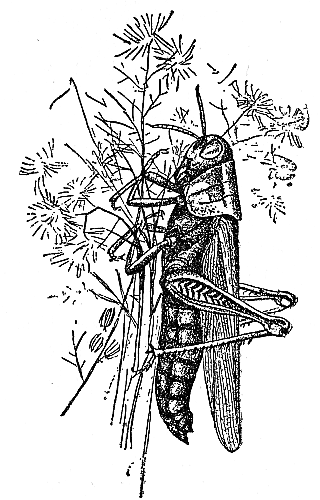
Although we practically no longer have those tremendous swarms of migratory grasshoppers which used to come down like devastating armies in certain of our Western States and in a night devour everything green, still, almost every year, and especially in the West and South, there is somewhere a multiplication of grasshoppers to a very injurious degree, and it is hoped that the introduced fungus can be used in such cases.
Persons officially engaged in searching for remedies for injurious insects all over the world have banded themselves together in a society known as the Association of Economic Entomologists. They are constantly interchanging ideas regarding the destruction of insects, and at present active movements are on foot in this direction of interchanging beneficial insects. Entomologists in Europe will try the coming summer to send to the United States living specimens of a tree-inhabiting beetle which eats the caterpillar of the gipsy moth, and which will undoubtedly also eat the caterpillar so common upon the shade-trees of our principal Eastern cities, which is known as the Tussock moth caterpillar. An entomologist from the United States, Mr. C. L. Marlatt, has started for Japan, China, and Java, for the purpose of trying to find the original home of the famous San José scale—an insect which has been doing enormous damage in the apple, pear, peach, and plum orchards of the United States—and if he finds the original home of this scale, it is hoped that some natural enemy or parasite will be discovered which can be introduced into the United States to the advantage of our fruit-growers. Professor Berlese of Italy, and Dr. Reh, of Germany, will attempt the introduction into Europe of some of the parasites of injurious insects which occur in the United States, and particularly those of the woolly root-louse of the apple, known in Europe as the “American blight”—one of the few injurious insects which probably went to Europe from this country, and which in the United States is not so injurious as it is in Europe.
It is a curious fact, by the way, that while we have had most of our very injurious insects from Europe, American insects, when accidentally introduced into Europe, do not seem to thrive. The insect just mentioned, and the famous grape-vine Phylloxera, a creature which caused France a greater economic loss than the enormous indemnity which she had to pay to Germany after the Franco-Prussian War, are practically the only American insects with which we have been able to repay Europe for the insects which she has sent us. Climatic differences, no doubt, account for this strange fact, and our longer and warmer summers are the principal factor.
It is not alone the parasitic and predaceous insects which are beneficial. A new industry has been brought into the United States during the past two years by the introduction and acclimatization of the little insect which fertilizes the Smyrna fig in Mediterranean countries. The dried-fig industry in this country has never amounted to anything. The Smyrna fig has controlled the dried-fig markets of the world, but in California the Smyrna fig has never held its fruit, the young figs dropping from the trees without ripening. It was found that in Mediterranean regions a little insect, known as the Blastophaga, fertilizes the flowers of the Smyrna fig with pollen from the wild fig which it inhabits. The United States Department of Agriculture in the spring of 1899 imported successfully some of these insects through one of its travelling agents, Mr. W. T. Swingle, and the insect was successfully established at Fresno in the San Joaquin Valley. A far-sighted fruit-grower, Mr. George C. Roeding, of Fresno, had planted some years previously an orchard of 5,000 Smyrna fig trees and wild fig trees, and his place was the one chosen for the successful experiment. The little insect multiplied with astonishing rapidity, was carried successfully through the winter of 1899-1900, and in the summer of 1900 was present in such great numbers that it fertilized thousands of figs, and fifteen tons of them ripened. When these figs were dried and packed it was discovered that they were superior to the best imported figs. They contained more sugar and were of a finer flavor than those brought from Smyrna and Algeria. The Blastophaga has come to stay, and the prospects for a new and important industry are assured.
With all these experiments the criticism is constantly made that unwittingly new and serious enemies to agriculture may be introduced. The unfortunate introduction of the English sparrow into this country is mentioned, and the equally unfortunate introduction of the East Indian mongoose into the West Indies as well. The fear is expressed that the beneficial parasitic insects, after they have destroyed the injurious insects, will either themselves attack valuable crops or do something else of an equally harmful nature. But there is no reason for such alarm. The English sparrow feeds on all sorts of things, and the East Indian mongoose, while it was introduced into Jamaica to kill snakes, was found, too late, to be also a very general feeder. As a matter of fact, after the snakes were destroyed, and even before, it attacked young pigs, kids, lambs, calves, puppies, and kittens, and also destroyed bananas, pineapples, corn, sweet potatoes, cocoanuts, peas, sugar corn, meat, and salt provisions and fish. But with the parasitic and predatory insects the food habits are definite and fixed. They can live on nothing but their natural food, and in its absence they die. The Australian ladybird originally imported, for example, will feed upon nothing but scale insects of a particular genus, and, as a matter of fact, as soon as the fluted scales became scarce the California officials had the greatest difficulty in keeping the little beetles alive, and were actually obliged to cultivate for food the very insects which they were formerly so anxious to wipe out of existence! With the Scutellista parasite the same fact holds. The fly itself does not feed, and its young feed only upon certain scale insects, and so with all the rest.
All of these experiments are being carried on by men learned in the ways of insects, and only beneficial results, or at the very least negative ones, can follow. And even where only one such experiment out of a hundred is successful, what a saving it will mean!
We do not expect the time to come when the farmer, finding Hessian fly in his wheat, will have only to telegraph the nearest experiment station, “Send at once two dozen first-class parasites;” but in many cases, and with a number of different kinds of injurious insects, especially those introduced from foreign countries, it is probable that we can gain much relief by the introduction of their natural enemies from their original home.