Front matter
Reading edition
A Little Indian Boy.
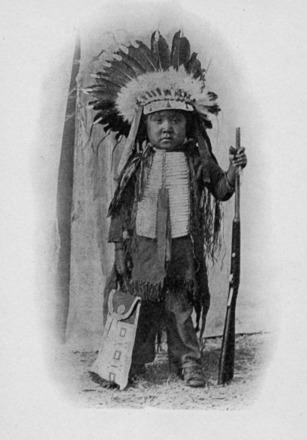
Little Folks of
North America
STORIES ABOUT CHILDREN LIVING IN
THE DIFFERENT PARTS OF
NORTH AMERICA
BY
MARY HAZLETON WADE
Illustrated by reproductions from Photographs
W. A. WILDE COMPANY
BOSTON CHICAGO
Copyright, 1909
By W. A. Wilde Company
All Rights Reserved
Little Folks of North America
CONTENTS
CHAPTERPAGE
I.Little Folks of Iceland13
II.Little Folks of Greenland26
III.Little Folks of Alaska55
IV.Little Folks of Canada80
V.Little Folks of Labrador116
VI.Little Folks of Newfoundland120
VII.Little Folks of the United States128
VIII.Little Folks of Mexico179
IX.Little Folks of Central America206
X.Little Folks of the West Indies214
LIST OF ILLUSTRATIONS
PAGE
A Little Indian BoyFrontispiece
An Eskimo Mother and Baby30
An Eskimo Village in Summer52
An Eskimo Village in Alaska60
An Alaskan Village Showing Indian Totem Poles74
Little Canadian Indian Children96
Picking Cotton on a Georgia Plantation144
How They Harvest Wheat on the Prairies152
Children Working in the Cotton Factory in a Big City174
A Mexican Village190
Foreword
You all know the story of Columbus—how, more than four hundred years ago, he sailed from Spain out into the west; and also how the people, as they watched his ships fading from sight, believed they would never look upon the fleet again, for the brave sailors who manned it were moving into an unknown world whose dangers no one could measure.
You also remember what happened before Columbus returned from that long voyage—that a new continent was discovered where strange people of a race before unheard-of were living the life of savages, and that the great sailor, believing he had entered the waters of India, named these red men, Indians.
Instead of reaching India, as he supposed, he had brought to light a new and great continent—so vast that it embraced all climates; rich, moreover, in mines and forests, lakes and rivers, high mountains, fertile plains and valleys. And there were none to enjoy all these beautiful gifts of God save tribes of red men, except in the far north the Eskimos in scattered villages. They, too, like the Indians, were savages who knew nothing of the ways of white men. They lived in small settlements along the ice-covered shores of the ocean.
After Columbus had crossed the Atlantic and discovered this New World, other ships soon followed in the course he had marked, and the people of Europe settled in one place after another. At first they made their homes near the shores of the ocean. This was partly through fear of the red men who were not pleased at the thought of these new neighbors, so different from themselves. As years went by, however, the newcomers moved farther and farther into the west, driving the Indians and the wild beasts before them, until now the homes of the white men are found throughout the land. People of unlike faiths and speaking different languages cross the ocean in shiploads, for they feel that when America is reached they will find freedom and happiness.
The Indians who are still left in the country are slowly learning the ways of the white men. They are taught in schools by white teachers. They live in houses instead of the wigwams which were their former homes. They dress in white men’s clothes. They even plant gardens and care for their farms in the way of civilized people.
There are many Negroes in North America also, but they are found mostly in the southern part of the United States. They were first brought as slaves from Africa, but are now free and independent. Although they were once savages like the Indians, they have been quick to imitate and have easily fallen into the ways of the white men. Thus the red and the black races, the white and the yellow, can all be found at home in North America, abiding together in peace and comfort as the children of One Great Father should do.