Front matter (continued 2)
Reading edition
In the adjacent Marlborough Street recently died the polished author and orator Robert C. Winthrop, and here, too, was the home of Dr. Ellis, the friend of Lowell's father.
Farther away in this newer Boston of luxury and culture is the charming and hospitable home of the poet, essayist, novelist, and critic Mrs. Louise Chandler Moulton, whose American admirers complain that in late years she remains too much in London. When at home, she inhabits a delightful dwelling which, from entrance to attic, teems with pictures, rare books, curios, and other souvenirs of her many friends in many lands. In her library, where much of "Garden of Dreams," "Swallow Flights," and other books was written, and where more of all "the work nearest her heart" was accomplished, are preserved many autograph copies of books by recent writers—several of them dedicated to Mrs. Moulton—and a priceless collection of letters from illustrious literary workers. In her drawing-rooms one may meet many of the famed authors of the day,—Higginson, Wendell, Horsford, Bynner, Nora Perry of the charming books for girls, Miss Conway, Miss Louise Imogen Guiney, Mrs. Howe, Arlo Bates, Adams, the jocosely serious Robert Grant, and others of Boston's newer lights of literature.
If we "drive on down Washington Street" with "Silas Lapham," we shall find in Chester Square the "Nankeen Square" where he dwelt in his less ambitious days, and the pretty oval green with the sturdy trees which the worthy colonel saw grow from saplings.
In a pleasant dwelling on the contiguous street lives and works the bright and busy Lucretia P. Hale, sister of the author-divine. She was the favorite scholar of Miss Elizabeth Peabody; and she has, through her writings and her classes, acquired an influence and discipleship little smaller than that which Margaret Fuller once possessed.
Farther south, in the Roxbury district, we seek the abode of the famed author of "The Man without a Country." Sauntering along the shady and delectable Highland Street, we interrogate a uniformed guardian of the law, who heartily rejoins, "Dr. Hale's is a temple on the right a block further on: and if any man's fit to live in a temple, it's him." As we walk the "block further on" we think that, however defective his grammar, the policeman's estimate of Hale is beyond criticism and agrees with that of the thousands of readers and friends of the indefatigable author, lecturer, preacher, editor, reformer, and promoter of all good. We find the house—very like a Greek temple—standing back from the street in the midst of an ample lawn, shaded by noble trees and decked with a wealth of shrubbery and bloom. The mansion is a large square edifice, with great dormer-windows in its roofs, surmounted by a cupola, and having in front a lofty portico upheld by heavy Ionic pillars, between which interlacing woodbine forms a leafy screen. Within is a wide hall, and opening out of it are generously proportioned rooms, some of them lined from floor to ceiling with thousands of books. The study is a commodious room, with a "pamphlet-annex" adjoining it on the garden side, and is crammed with book-shelves and drawers, while piles of books, magazines, portfolios, manuscripts, and memoranda are disposed on cases, tables, and stands about the apartment. Everything is obviously arranged for convenient and ready use, and well it may be so, for this is the work-room and "thinking-shop" of the hardest-working literary man in America. The books which made his first fame were written before he came to this house; of all the works produced in this study, the numerous poems, romances, histories, essays, editorials, reviews, discussions, translations,—to say nothing of the many hundreds of well-considered and carefully written sermons,—we may not here mention even the names, for no writer since Voltaire is more fruitful of finished and masterly work. It is notable that Hale regards "In His Name" as his best work from a literary point of view; of his other productions, he thinks some of the poems of the latest collection, "For Fifty Years," as good as anything,—"always excepting his sermons." Among the abundant treasures of his study, Hale has a most interesting and valuable collection of autograph letters, of which he is justly proud. His father was Nathan Hale of the Boston "Advertiser," his mother was sister to Edward Everett and herself an author and translator, his wife is niece to Mrs. Harriet Beecher Stowe, his son Robert has already acquired a reputation in the domain of letters. The doctor himself has been a writer from childhood, his earliest contributions being to his father's paper. His illustrious sister declares that in their nursery days she and her brother used to take their meals with the "Advertiser" pinned under their chins,—a practice to which their literary precocity has been attributed. We find Hale at the age of seventy-three blithe and hopeful, working as much and manifestly accomplishing more than ever before.
A little farther out on the same street is the dwelling where William Lloyd Garrison spent his last years, and in this neighborhood lived Mrs. Blake, poet of "Verses Along the Way." Here also are the early home of Miss Guiney and the school to which she was first sent,—or rather "carried neck and heels," because she refused to walk. Close by we find the pleasant home in which Jane G. Austin wrote some of her famed colonial tales and where she died not many months ago; and in the same delightful suburb, a half-mile beyond Hale's house, is the retreat where the beloved author of "Little Women" breathed out her too brief life.
OUT OF BOSTON
I
CAMBRIDGE: ELMWOOD: MOUNT AUBURN
Holmes's Church-yard—Bridge, Smithy, Chapel, and River of Longfellow's Verse—Abodes of Lettered Culture—Holmes—Higginson—Agassiz—Norton—Clough—Howells—Fuller—Longfellow—Lowell—Longfellow's City of the Dead and its Precious Graves.
CROSSING the Charles by "The Bridge" of Longfellow's popular poem, a stroll along elm-shaded streets brings us to the ancient Common of Cambridge and a vicinage which has much besides its historic traditions to allure the literary pilgrim. For centuries the site of a celebrated college and a conspicuous centre of learning, it has long been the abiding-place of representatives of the best and foremost in American culture and mental achievement.
Close by the Common, and opposite the remains of the elm beneath which Washington assumed the command of the patriot army, stood the old gambrel-roofed house in which that "gentlest of autocrats," Holmes, was born and reared, and upon whose door-post was first displayed his "shingle," on which he whimsically proposed to inscribe "The Smallest Fevers Thankfully Received;" across the college grounds is the home-like edifice where lived the erudite Professor Felton, loved by Dickens and oft mentioned in his letters; not far away, at the corner of Broadway, was the home of Agassiz, since occupied by his son; and a few rods eastward is the picturesque residence of the witty and profound Colonel Higginson,—poet, essayist, novelist, and reformer. In the adjacent Kirkland Street dwelt the delightful Dr. Estes Howe, brother-in-law to Lowell, with whom the poet sometime lived and whom he celebrated as "the Doctor" in the "Fable for Critics." Dr. C. C. Abbott formerly lived in this neighborhood, and the collections on which his best-known books are founded are preserved in the near-by Peabody Museum, beyond which we find the tasteful abode of Professor Charles Eliot Norton, the friend and literary executor of Lowell. Near the Common, too, dwelt for a year or so that rare poet Arthur Clough, author of "The Bothie" and "Qua Cursum Ventus;" and the sweet singer Charlotte Fiske Bates—the intimate friend of Longfellow—had her habitation in the same neighborhood. Opposite the southern end of the Common is the ancient village cemetery celebrated in the poetry of Holmes and Longfellow; a little way westward, Howells lived in a delightful rose-embowered cottage and pleasantly pictured many features of the old town in the "Charlesbridge" of his "Suburban Sketches." Two or three furlongs distant, within the grounds of the Botanic Garden, long lived the American Linnæus, Professor Asa Gray.
Of all the Cambridge thoroughfares, the shady and venerable Brattle Street, which curves westward from the University Press, is most interesting and attractive. Near the Press building stands the historic Brattle House,—its beautiful stairway and other antique features preserved by the Social Club, to whom the property now belongs,—where Margaret Fuller, the priestess and queen of modern Transcendentalism, passed much of her youth and young womanhood, and where her sister, wife to the poet Ellery Channing, was reared. Margaret, who is said to have stood for the Theodora of Beaconsfield's "Lothair," first saw the light in a modest little dwelling in Main Street nearer the Boston bridge, and here attended school with Holmes and Richard Henry Dana; but it was in this Brattle House that her marvellous, and in some respects unique, intellectual career commenced. Here she acquired the moral and mental equipment which fitted her for leadership in the most vital epoch of American culture and thought, and here she attracted and attached all the wisest and noblest spirits within her range. To her here came Theodore Parker, the older Channing, Harriet Martineau, James Freeman Clarke,—the earnest, brilliant, and thoughtful of all ages and conditions. One noble soul who knew her here speaks of her friendship as a "gift of the gods," and some eminent in thought and achievement testify that they have ever striven toward standards set up for them by her in that early period of her residence here.
Close by Miss Fuller's home, "under a spreading chestnut-tree" at the intersection of Story Street, stood the smithy of Pratt, who was immortalized by Longfellow as "The Village Blacksmith." To the poet, passing daily on the way between his home and the college, the "mighty man" at his anvil in the shaded smithy was long a familiar vision. The tree—a horse-chestnut—has been removed, the shop has given place to a modern dwelling, and years ago the worthy smith rejoined his wife, "singing in Paradise."
A few steps westward from the site of the smithy is the "Chapel of St. John" of another sweet poem of Longfellow; and just beyond this we find, bowered by lilacs and environed by acres of shade and sward, the colonial Cragie House, once the sojourn of Washington, but holding for us more precious associations, since Sparks, Worcester, and Everett have lived within its time-honored walls, and our popular poet of grace and sentiment for near half a century here had his home, and from here passed into the unknown. The picturesque mansion wears the aspect of an old acquaintance, and the interior, with its princely proportioned rooms, spacious fireplaces, wide halls, curious carvings and tiles, has much that Longfellow has shared with his readers. On the entrance door is the ponderous knocker; a landing of the broad stairway holds "The Old Clock on the Stairs;" the right of the hall is the study, with its priceless mementos of the tender and sympathetic bard who wrought here the most and best of his life-work, from early manhood onward into the mellow twilight of sweet and benign age. Here is his chair, vacated by him but a few days before he died; his desk; his inkstand which had been Coleridge's; his pen with its "link from the chain of Bonnivard;" the antique pitcher of his "Drinking Song;" the fireplace of "The Wind over the Chimney;" the arm-chair carved from the "spreading chestnut-tree" of the smithy, which was presented to him by the village children and celebrated in his poem "From my Arm-Chair." About us here are his cherished books, his pictures, his manuscripts, all his precious belongings, and from his window we see, beyond the Longfellow Memorial Park, the river so often sung in his verse, "stealing onward, like the stream of life." In this room Washington held his war councils. Of the many intellectual séances its walls have witnessed we contemplate with greatest pleasure the Wednesday evening meetings of the "Dante Club," when Lowell, Howells, Fields, Norton, Greene, and other friends and scholars sat here with Longfellow to revise the new translation of Dante.
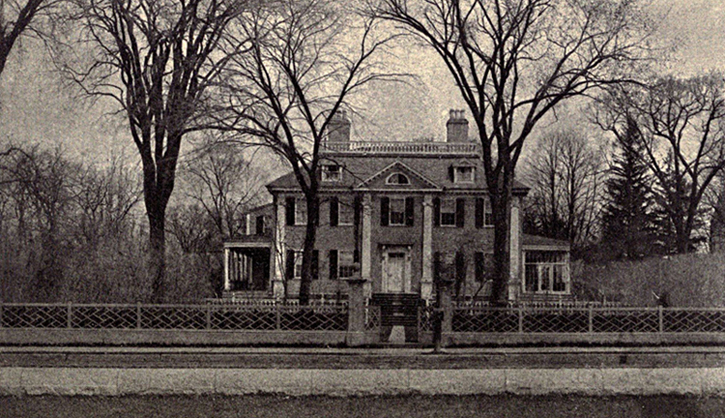
Where Longfellow Lived
The book-lined apartment over the study—once the bedchamber of Washington and later of Talleyrand—was occupied by Longfellow when he first lived as a lodger in the old house. It was here he heard "Footsteps of Angels" and "Voices of the Night," and saw by the fitful firelight the "Being Beauteous" at his side; here he wrote "Hyperion" and the earlier poems which made him known and loved in every clime. Later this room became the nursery of his children, and some of the grotesque tiles which adorn its chimney are mentioned in his poem "To a Child:"
"The lady with the gay macaw, The dancing-girl, the grave bashaw. The Chinese mandarin."
Along the western façade of the mansion stretches a wide veranda, where the poet was wont to take his daily exercise when "the goddess Neuralgia" or "the two Ws" (Work and Weather) prevented his walking abroad. In this stately old house his children were born and reared, here his wife met her tragic death, and here his daughter—the "grave Alice" of "The Children's Hour"—abides and preserves its precious relics, while "laughing Allegra" (Anna) and "Edith with golden hair"—now Mrs. Dana and Mrs. Thorp—have dwellings within the grounds of their childhood home, and their brother Ernst owns a modern cottage a few rods westward on the same street.
In Sparks Street, just out of Brattle, dwelt the author Robert Carter,—familiarly, "The Don,"—sometime secretary to Prescott and long the especial friend of Lowell, with whom he was associated in the editorship of the short-lived "Pioneer." Carter's home here was the rendezvous of a circle of choice spirits, where one might often meet "Prince" Lowell,—as his friends delighted to call him,—Bartlett of "Familiar Quotations," and that "songless poet" John Holmes, brother of the "American Montaigne."
A short walk under the arching elms of Brattle Street brings us to Elmwood, the life-long home of Lowell. The house, erected by the last British lieutenant-governor of the province, is a plain, square structure of wood, three stories in height, and is surrounded by a park of simple and natural beauty, whose abundant growth of trees gives to some portions of the grounds the sombreness and apparent seclusion of a forest. A gigantic hedge of trees encloses the place like a leafy wall, excluding the vision of the world and harboring thousands of birds who tenant its shades. Some of the aquatic fowl of the vicinage are referred to in Longfellow's "Herons of Elmwood." In the old mansion, long the home of Elbridge Gerry, Lowell was born and grew to manhood, and to it he brought the bride of his youth, the lovely Maria White, herself the writer of some exquisite poems; here, a few years later, she died in the same night that a child was born to Longfellow, whose poem "The Two Angels" commemorates both events. Here, too, Lowell lost his children one by one until a daughter, the present Mrs. Burnett,—now owner and occupant of Elmwood,—alone remained. During the poet's stay abroad, his house was tenanted by Mrs. Ole Bull and by Lowell's brother-bard Bailey Aldrich, who in this sweet retirement wrought some of his delicious work. To the beloved trees and birds of his old home Lowell returned from his embassage, and here, with his daughter, he passed his last years among his books and a chosen circle of friends. Here, where he wished to die, he died, and here his daughter preserves his former home and its contents unchanged since he was borne hence to his burial. Until the death of his father, Lowell's study was an upper front room at the left of the entrance. It is a plain, low-studded corner apartment, which the poet called "his garret," and where he slept as a boy. Its windows now look only into the neighboring trees, but when autumn has shorn the boughs of their foliage the front window commands a wide level of the sluggish Charles and its bordering lowlands, while the side window overlooks the beautiful slopes of Mount Auburn, where Lowell now lies with his poet-wife and the children who went before. His study windows suggested the title of his most interesting volume of prose essays. In this upper chamber he wrote his "Conversations on the Poets" and the early poems which made his fame,—"Irene," "Prometheus," "Rhœcus," "Sir Launfal,"—which was composed in five days,—and the first series of that collection of grotesque drolleries, "The Biglow Papers." Here also he prepared his editorial contributions to the "Atlantic." His later study was on the lower floor, at the left of the ample hall which traverses the centre of the house. It is a prim and delightful old-fashioned apartment, with low walls, a wide and cheerful fireplace, and pleasant windows which look out among the trees and lilacs upon a long reach of lawn. In this room the poet's best-loved books, copiously annotated by his hand, remain upon his shelves; here we see his table, his accustomed chair, the desk upon which he wrote the "Commemoration Ode," "Under the Willows," and many famous poems, besides the volumes of prose essays. In this study he sometimes gathered his classes in Dante, and to him here came his friends familiarly and informally,—for "receptions" were rare at Elmwood: most often came "The Don," "The Doctor," Norton, Owen, Bartlett, Felton, Stillman,—less frequently Godkin, Fields, Holmes, Child, Motley, Edmund Quincy, and the historian Parkman.
While the older trees of the place were planted by Gerry, the pines and clustering lilacs were rooted by Lowell or his father. All who remember the poet's passionate love for this home will rejoice in the assurance that the old mansion, with its precious associations and mementos, and the acres immediately adjoining it, will not be in any way disturbed during the life of his daughter and her children. At most, the memorial park which has been planned by the literary people of Boston and Cambridge will include only that portion of the grounds which belonged to the poet's brothers and sisters.
A narrow street separates the hedges of Elmwood from the peaceful shades of Mount Auburn,—the "City of the Dead" of Longfellow's sonnet. Lowell thought this the most delightful spot on earth. The late Francis Parkman told the writer that Lowell, in his youth, had confided to him that he habitually went into the cemetery at midnight and sat upon a tombstone, hoping to find there the poetic afflatus. He confessed he had not succeeded, and was warned by his friend that the custom would bring him more rheumatism than inspiration. Dr. Ellis testified that at this period his friend Dr. Lowell often expressed to him his anxiety "lest his son James would amount to nothing, because he had taken to writing poetry."
In the sanctuary of Mount Auburn we find many of the names mentioned in these chapters,—names written on the scroll of fame, blazoned on title-pages, borne in the hearts of thousands of readers in all lands,—now, alas! inscribed above their graves. From the eminence of Mount Auburn, we look upon Longfellow's river "stealing with silent pace" around the sacred enclosure; the verdant meads along the stream; the distant cities, erst the abodes of those who sleep about us here,—for whom life's fever is ended and life's work done. Near this summit, Charlotte Cushman rests at the base of a tall obelisk, her favorite myrtle growing dense and dark above her. By the elevated Ridge Path, on a site long ago selected by him, Longfellow lies in a grave decked with profuse flowers and marked by a monument of brown stone. On Fountain Avenue we find a beautiful spot, shaded by two giant trees, which was a beloved resort of Lowell, and where he now lies among his kindred, his sepulchre marked by a simple slab of slate: "Good-night, sweet Prince!" Not far away is the beautiful Jackson plot, where not long ago the beloved Holmes was tenderly laid in the same grave with his wife beneath a burden of flowers. Some of the blossoms we lately saw upon this grave were newly placed by the creator of "Micah Clarke" and "Sherlock Holmes," Dr. Conan Doyle. By a great oak near the main avenue is the sarcophagus of Sumner, and one shady slope bears the memorial of Margaret Fuller and her husband,—buried beneath the sea on the coast of Fire Island. Near by we find the grave of "Fanny Fern,"—wife of Parton and sister of N. P. Willis,—with its white cross adorned with exquisitely carved ferns; the pillar of granite and marble which designates the resting-place of Everett; the granite boulder—its unchiselled surface overgrown with the lichens he loved—which covers the ashes of Agassiz; the simple sarcophagus of Rufus Choate; the cenotaph of Kirkland; the tomb of Spurzheim; and on the lovely slopes about us, under the dreaming trees, amid myriad witcheries of bough and bloom, are the enduring memorials of affection beneath which repose the mortal parts of Sargent, Quincy, Story, Parker, Worcester, Greene, Bigelow, William Ellery Channing, Edwin Booth, Phillips Brooks, and many like them whom the world will not soon forget.
In this sweet summer day, their place of rest is so quiet and beautiful,—with the birds singing here their lowest and tenderest songs, the soft winds breathing a lullaby in the leafy boughs, the air full of a grateful peace and calm, the trees spreading their great branches in perpetual benediction above the turf-grown graves,—it seems that here, if anywhere, the restless wayfarer might learn to love restful death.
OUT OF BOSTON
II
BELMONT: THE WAYSIDE INN: HOME OF WHITTIER
Lowell's Beaver Brook—Abode of Trowbridge—Red Horse Tavern—Parsons and the Company of Longfellow's Friends—Birthplace of Whittier—Scenes of his Poems—Dwelling and Grave of the Countess—Powow Hill—Whittier's Amesbury Home—His Church and Tomb.
A FEW miles westward from the classic shades of Cambridge we found, perched upon a breezy height of Belmont, a picturesque, red-roofed villa, for some years the summer home of our "Altrurian Traveller." From its verandas he overlooked a slumberous plain, diversified with meads, fields, country-seats, and heavy-tinted copses, and bordered by a circle of verdant hills; while on the eastern horizon rises the distant city, crowned by the resplendent dome of the capitol. In his dainty white study here, with its gladsome fireplace and curious carvings and mottoes, Howells wrote—besides other good things—his "Lady of the Aroostook," in which some claim to have discerned an answer to Henry James's "Daisy Miller."
In this neighborhood is the valley of "Beaver Brook," a favorite haunt of Lowell, to which he brought the English poet Arthur Clough. The old mill is removed, but we find the water-fall and the other romantic features little changed since the poet depicted the ideal beauties of this dale, in what has been adjudged one of the most artistic poems of modern times.
In a charming retreat among the hills of Arlington, scarce a mile away from Howells's sometime Belmont home, dwells and writes that genial and gifted poet and novelist, John T. Trowbridge, whose books—notably his war-time tales—have found readers round the world.
Westward again from Belmont, a prolonged drive through a delightful country brings us to "Sudbury town" and the former hostelry of 'Squire Howe,—the "Wayside Inn"Longfellow's Wayside Inn of Longfellow's "Tales." Our companion and guide is one who well knew the old house and its neighborhood in the halcyon days when Professor Treadwell, Parsons,—the poet of the "Bust of Dante,"—and the quiet coterie of Longfellow's friends came, summer after summer, to find rest and seclusion under its ample roof and sheltering trees, among the hills of this remote region. The environment of fragrant meadow and smiling field, of deep wood glade and forest-clad height, is indeed alluring. About the ancient inn remain some of the giant elms and the "oak-trees, broad and high," shading it now as in the day when the "Tales" immortalized it with the "Tabard" of Chaucer; while through the near meadow circles the "well-remembered brook" of the poet's verse, in which his friends saw the inverted landscape and their own faces "looking up at them from below."
The house is a great, old-fashioned, bare and weather-worn edifice of wood,—"somewhat fallen to decay."—standing close upon the highway. Its two stories of spacious rooms are supplemented by smaller chambers in a vast attic; two or three chimneys, "huge and tiled and tall," rise through its gambrel roofs among the bowering foliage; a wing abuts upon one side and imparts a pleasing irregularity to the otherwise plain parallelogram. The wide, low-studded rooms are lighted by windows of many small panes. Among the apartments we find the one once occupied by Major Molineaux, "whom Hawthorne hath immortal made," and that of Dr. Parsons, the laureate of this place, who has celebrated it in the stanzas of "Old House at Sudbury" and other poems. But it is the old inn parlor which most interests the literary visitor,—a great, low, square apartment, with oaken floors, ponderous beams overhead, and a broad hearth, where in the olden time blazed a log fire whose ruddy glow filled the room and shone out through the windows. It is this room which Longfellow peoples with his friends, who sat about the old fireplace and told his "Tales of a Wayside Inn." The "rapt musician" whose transfiguring portraiture we have in the Prelude is Ole Bull; the student "of old books and days" is Henry Wales; the young Sicilian, "in sight of Etna born and bred," is Luigi Monti, who dined every Sunday with Longfellow; the "Spanish Jew from Alicant" is Edrelei, a Boston Oriental dealer; the "Theologian from the school of Cambridge on the Charles" is Professor Daniel Treadwell; the Poet is T. W. Parsons, the Dantean student and translator of "Divina Commedia;" the Landlord is 'Squire Lyman Howe, the portly bachelor who then kept this "Red Horse Tavern," as it was called. Most of this goodly circle have been here in the flesh, and our companion has seen them in this old room, as well as Longfellow himself, who came here years afterward, when the Landlord was dead and the poet's company had left the old inn forever. In this room we see the corner where stood the ancient spinet, the spot on the wall where hung the highly colored coat of arms of Howe and the sword of his knightly grandfather near Queen Mary's pictured face, the places on the prismatic-hued windows where the names of Molineaux, Treadwell, etc., had been inscribed by hands that now are dust.
Descendants of the woman who died of the "Shoc o' Num Palsy" are said to live in the neighborhood, as well as some other odd characters who are embalmed in Parsons's humorous verse. But the ancient edifice is no longer an inn; the Red Horse on the swinging sign-board years ago ceased to invite the weary wayfarer to rest and cakes and ale; the memory-haunted chambers, where starry spirits met and tarried in the golden past, were later inhabited by laborers, who displayed the rooms for a fee and plied the pilgrim with lies anent the former famed occupants. The storied structure has recently passed to the possession of appreciative owners,—Hon. Herbert Howe being one of them,—who have made the repairs needful for its preservation and have placed it in the charge of a proper custodian.
A longer way out of Boston, in another direction, our guest is among the haunts of the beloved Quaker bard. On the bank of the Merrimac—his own "lowland river"—and among darkly wooded hills of hackmatack and pine, we find the humble farm-house, guarded by giant sentinel poplars, where eighty-eight years agone Whittier came into the world.
Among the plain and bare apartments, with their low ceilings, antique cross-beams, and multipaned windows, we see the lowly chamber of his birth; the simple study where his literary work was begun; the great kitchen, with its brick oven and its heavy crane in the wide fireplace, where he laid the famous winter's evening sceneScenes of Whittier's Poems in "Snow-Bound," peopling the plain "old rude-furnished room" with the persons he here best knew and loved. We see the dwelling little changed since the time when Whittier dwelt—a dark-haired lad—under its roof; it is now carefully preserved, and through the old rooms are disposed articles of furniture from his Amesbury cottage, which are objects of interest to many visitors.
All about the place are spots of tender identification of poet and poem: here are the brook and the garden wall of his "Barefoot Boy;" the scene of his "Telling the Bees;" the spring and meadow of "Maud Muller;" not far away, with the sumachs and blackberries clustering about it still, is the site of the rude academy of his "School Days;" and beyond the low hill the grasses grow upon the grave of the dear, brown-eyed girl who "hated to go above him." We may still loiter beneath the overarching sycamores planted by poor Tallant,—"pioneer of Erin's outcasts,"—where young Whittier pondered the story of "Floyd Ireson with the hard heart."
Delightful rambles through the country-side bring us to many scenes familiar to the tender poet and by him made familiar to all the world. Thus we come to the "stranded village" of Aunt Mose,—"the muttering witch-wife of the gossip's tale,"—where Whittier found the materials out of which he wrought the touching poem "The Countess," and where we see the poor low rooms in which pretty, blue-eyed Mary Ingalls was born and lived a too brief life of love, and her sepulchre—now reclaimed from a tangle of brake and brier—in the lonely old burial-ground that "slopes against the west." Her grave is in the row nearest the dusty highway, and is marked by a mossy slab of slate, which is now protected from the avidity of relic-gatherers by a net-work of iron, bearing the inscription, "The Grave of the Countess."
Thus, too, we come to the ruined foundation of the cottage of "Mabel Martin, the Witch's Daughter," and look thence upon other haunts of the beloved bard, as well as upon his river "glassing the heavens" and the wave-like swells of foliage-clad hills which are "The Laurels" of his verse. In West Newbury, the town of his "Northman's Written Rock," we find the comfortable "Maplewood" homestead where lived and lately died the supposed sweetheart of the poet's early manhood.
Whittier's Amesbury Cottage
Whittier's beloved Amesbury, the "home of his heart," is larger and busier than he knew it, but, as we dally on its dusty avenues, we find them aglow with living memories of the sweet singer. In Friend Street stands—still occupied by Whittier's former friends—the plain little frame house which was so long his home. A bay window has been placed above the porch, but the place is otherwise little changed since he left it; the same noble elms shade the front, the fruit-trees he planted and pruned and beneath which the saddened throng sat at his funeral are in the garden; here too are the grape-vines which were the especial objects of his loving care,—one of them grown from a rootlet sent to him in a letter by Charles Sumner.
Within, we see the famous "garden room," which was his sanctum and workshop, and where this gentle man of peace waged valiant warfare with his pen for the rights of man. In this room, with its sunny outlook among his vines and pear-trees, he kept his chosen books, his treasured souvenirs; and here he welcomed his friends,—Longfellow, Fields, Sumner, Lowell, Colonel Higginson, Bayard Taylor, Mrs. Thaxter, Mrs. Phelps-Ward, Alice Cary, Lucy Larcom, Sarah Orne Jewett, and many another illustrious child of genius.
A quaint Franklin fireplace stood by one side wall,—usually surmounted in summer by a bouquet; in the nook between this and the sash-door was placed an old-fashioned writing-desk, and here he wrote many of the poems which brought him world-wide fame and voiced the convictions and the conscience of half the nation. Here are still preserved some of his cherished books. Above the study was Whittier's bedchamber, near the rooms of his mother, his "youngest and dearest" sister, and the "dear aunt" (Mercy) of "Snow-Bound," who came with him to this home and shared it until their deaths. After the others were gone, the brother and sister long dwelt here alone, later a niece was for some years his house-keeper, and at her marriage the poet gave up most of the house to some old friends, who kept his study and chamber in constant readiness for his return upon the prolonged sojourns which were continued until his last year of life,—this being always his best-loved home.
Near by are the "painted shingly town-house" of his verse, where during many years he failed not to meet with his neighbors to deposit "the freeman's vote for Freedom," and the little, wooden Friends' meeting-house, where he loved to sit in silent introspection among the people of his faith. The trees which now shade its plain old walls with abundant foliage were long ago planted by his hands. The "Powow Hill" of his "Preacher" and "The Prophecy of Samuel Sewall" rises steeply near his home, and was a favorite resort, to which he often came, alone or with his guests. One who has often stood with Whittier there pilots us to his accustomed place on the lofty rounded summit, whence we overlook the village, the long reach of the "sea-seeking" river, and the entrancing scene pictured by the poet in the beautiful lines of "Miriam."
Whittier's Tomb
From these precious haunts our pilgrim shoon trace the revered bard to the peaceful precincts of the God's-acre—just without the town—where, in a sequestered spot beneath a dark cedar which sobs and soughs in the summer wind, his mortal part is forever laid, with his beloved sister and kindred, within
"the low green tent Whose curtain never outward swings."
OUT OF BOSTON
III
SALEM: WHITTIER'S OAK-KNOLL AND BEYOND
Cemetery of Hawthorne's Ancestors—Birthplace of Hawthorne and his Wife—Where Fame was won—House of the Seven Gables—Custom-House—Where Scarlet Letter was written—Main Street and Witch Hill—Sights from a Steeple—Later Home of Whittier—Norman's Woe—Lucy Larcom—Parton, etc.—Rivermouth—Thaxter.
Hawthorne's Salem
A HALF-HOUR'S jaunt by train brings us to the shaded streets of quaint old Salem and the scenes of Hawthorne's early life, work, and triumph. Here we find on Charter Street, in the old cemetery of "Dr. Grimshaw's Secret" and "Dolliver Romance," the sunken and turf-grown graves of Hawthorne's mariner ancestors, some of whom sailed forth on the ocean of eternity nearly two centuries ago. Among the curiously carved gravestones of slate we see that of John Hathorn, the "witch-judge" of Hawthorne's "Note-Books." Close at hand repose the ancestors of the novelist's wife, and the Doctor Swinnerton who preceded "Dolliver" and who was called to consider the cause of Colonel Pyncheon's death in the opening chapter of "The House of the Seven Gables."
The sombre house which encroaches upon a corner of the cemetery enclosure—with the green billows surging about it so closely that its side windows are within our reach from the gravestones—was the home of the Peabodys, whence Hawthorne wooed the amiable Sophia, and where, in his tales, he domiciled Grandsir "Dolliver" and also "Doctor Grimshaw" with Ned and Elsie. We found it a rather depressing, hip-roofed, low-studded, and irregular edifice of wood, standing close upon the street, and obviously degenerated a little from the degree of respectability—"not sinking below the boundary of the genteel"—which the romancer ascribed to it. The little porch or hood protects the front entrance, and the back door communicates with the cemetery,—a circumstance which recalls the novelist's fancy that the dead might get out of their graves at night and steal into this house to warm themselves at the convenient fireside.
Not many rods distant, in Union Street, stands the little house where Captain Hathorn left his family when he went away to sea, and where the novelist was born. The street is small, shabby, shadeless, dispiriting,—its inhabitants not select. The house—builded by Hawthorne's grandfather and lately numbered twenty-seven—stands close to the sidewalk, upon which its door-stone encroaches, leaving no space for flower or vine; the garden where Hawthorne "rolled on a grass-plot under an apple-tree and picked abundant currants" is despoiled of turf and tree, and the wooden house walls rise bare and bleak. It is a plain, uninviting, eight-roomed structure, with a lower addition at the back, and with a square central chimney-stack rising like a tower above the gambrel roof. The rooms are low and contracted, with quaint corner fireplaces and curiously designed closets, and with protuberant beams crossing the ceilings. From the entrance between the front rooms a narrow winding stair leads to an upper landing, at the left of which we find the little, low-ceiled chamber where, ninety years ago, America's greatest romancer first saw the light. It is one of the most cheerless of rooms, with rude fireplace of bricks, a mantel of painted planks, and two small windows which look into the verdureless yard. In a modest brick house upon the opposite side of the street, and but a few rods distant from the birthplace of her future husband, Hawthorne's wife was born five years subsequent to his nativity.
The Manning House
Abutting upon the back yard of Hawthorne's birthplace is the old Manning homestead of his maternal ancestors, the home of his own youth and middle age and the theatre of his struggles and triumph. It is known as number twelve Herbert Street, and is a tall, unsightly, erratic fabric of wood, with nothing pleasing or gracious in its aspect or environment. The ugly and commonplace character of his surroundings here during half his life must have been peculiarly depressing to such a sensitive temperament as Hawthorne's, and doubtless accounts for his mental habits. That he had no joyous memories of this old house his letters and journals abundantly show. Its interior arrangement has been somewhat changed to accommodate the several families of laborers who have since inhabited it, and one front room seems to have been used as a shop; but it is not difficult to identify the haunted chamber which was Hawthorne's bed-room and study. This little, dark, dreary apartment under the eaves, with its multipaned window looking down into the room where he was born, is to us one of the most interesting of all the Hawthorne shrines. Here the magician kept his solitary vigil during the long period of his literary probation, shunning his family, declining all human sympathy and fellowship, for some time going abroad only after nightfall; here he studied, pondered, wrote, revised, destroyed, day after day as the slow months went by; and here, after ten years of working and waiting for the world to know him, he triumphantly recorded, "In this dismal chamber FAME was won." Here he wrote "Twice-Told Tales" and many others, which were published in various periodicals, and here, after his residence at the old Manse,—for it was to this Manning house that he "always came back, like the bad halfpenny," as he said,—he completed the "Mosses." This old dwelling is one of the several which have been fixed upon as being the original "House of the Seven Gables," despite the novelist's averment that the Pyncheon mansion was "of materials long in use for constructing castles in the air." The pilgrim in Salem will be persistently assured that a house which stands near the shore by the foot of Turner Street, and is known as number thirty-four, was the model of Hawthorne's structure. It is an antique edifice of some architectural pretensions, displays five fine gables, and has spacious wainscoted and frescoed apartments, with quaint mantels and other evidences of colonial stateliness. It was an object familiar to the novelist from his boyhood,—he had often visited it while it was the home of pretty "Susie" Ingersol,—and it may have suggested the style of architecture he employed for the visionary mansion of the tale. The names Maule and Pyncheon, employed in the story, were those of old residents of Salem.
Hawthorne's Custom-House
But a few rods from Herbert Street is the Custom-House where Hawthorne did irksome duty as "Locofoco Surveyor," its exterior being—except for the addition of a cupola—essentially unchanged since his description was written, and its interior being even more somnolent than of yore. The wide and worn granite steps still lead up to the entrance portico; above it hovers the same enormous specimen of the American eagle, and a recent reburnishing has rendered even more evident the truculent attitude of that "unhappy fowl." The entry-way where the venerable officials of Hawthorne's time sat at the receipt of customs has been renovated, the antique chairs in which they used to drowse, "tilted back against the wall," have given place to others of more modern and elegant fashion, and the patriarchal dozers themselves—lying now in the profounder slumber of death—are replaced by younger and sprightlier successors, who wear their dignities and pocket their emoluments. At the left we find the room, "fifteen feet square and of lofty height," which was Hawthorne's office during the period of his surveyorship: it is no longer "cobwebbed and dingy," but is tastefully refitted and refurnished, and the once sanded floor, which the romancer "paced from corner to corner" like a caged lion, is now neatly carpeted. The "exceedingly decrepit and infirm" chairs, and the three-legged stool on which he lounged with his elbow on the old pine desk, have been retired, and the desk itself is now tenderly cherished among the treasures of the Essex Institute, on Essex Street, a few blocks distant, where the custodian proudly shows us the name of Hawthorne graven within the lid, in some idle moment, by the thumb-nail of the novelist. Some yellow documents bearing his official stamp and signature are preserved at the Custom-House, and the courteous official who now occupies Hawthorne's room displays to us here a rough stencil plate marked "Salem N Hawthorne Surr 1847," by means of which knowledge of Hawthorne's existence was blazoned abroad "on pepper-bags, cigar-boxes, and bales of dutiable merchandise," instead of on title-pages. The arched window, by which stood his desk, commands a view upon which his vision often rested, and which seems to us decidedly more pleasing and attractive than he has led us to expect. The picturesque old wharf in the foreground, the white-sailed shipping, and a shimmering expanse of water extending to the farther bold headlands of the coast form, we think, a pleasant picture for the lounger here.
The apartment opposite to Hawthorne's was, in his day, occupied by the brave warrior General James Miller, who is graphically described as the "old Collector" in the introduction to "Scarlet Letter;" the room directly above it—which is the private office of the present chief executive, the genial Collector Waters—a portrait of the hero of Lundy's Lane now looks down from the wall upon the visitor; but no picture of Hawthorne is to be found in the edifice.
An ample room at the right of the hall on the second floor, now handsomely fitted and furnished, was in Hawthorne's time open and unfinished, its bare beams festooned with cobwebs and its floor lumbered with barrels and bundles of musty official documents; and it was here that he discovered, among the accumulated rubbish of the past, the "scarlet, gold-embroidered letter," and the manuscript of Surveyor Prue,—Hawthorne's ancient predecessor in office,—which recorded the "doings and sufferings" of Hester Prynne.
A short walk from the Custom-House brings us to the spot where, with "public notices posted upon its front and an iron goblet chained to its waist," stood that "eloquent monologist," the town-pump of Hawthorne's famous "Rill." Already its locality, at the corner of Essex and Washington Streets, is pointed out with pride as being among the sites memorable in the town's history, and thus the playful prophecy with which Hawthorne terminates the sketch of his official life is more than fulfilled.
The spacious and well-preserved old frame house at number fourteen Mall Street—a neighborhood superior to that of his former residences—was Hawthorne's abode for three or four years. It was here that he, on the day of his official death, announced to his wife, "Well, Sophie, my head is off, so I must write a book;" and here, in the ensuing six months, disturbed and distressed by illness of his family, by the death of his mother, and by financial needs, he wrote our most famous romance, "The Scarlet Letter." A bare little room in the front of the third story was his study here, and while he wrote in solitude his wife worked in a sitting-room just beneath, decorating lamp-shades whose sale helped to sustain the household.
Salem
As we saunter along the "Main Street" of Hawthorne's sketch and the other shady avenues he knew so well, the curious old town, which in his discontent he called tame and unattractive, seems to our eyes picturesque and beautiful, with its wide elm-bordered streets, its grassy waysides, its many gardens and square, embowered dwellings, not greatly changed since he knew them. If we follow "the long and lazy street" to the Witch Hill,Witch Hill which the novelist describes in "Alice Doane's Appeal," we may behold from that unhappy spot, where men and women suffered death for imagined misdoing, the whole of Hawthorne's Salem, with the environment he pictures in "Sights from a Steeple." We see the house-roofs of the town—half hidden by clustering foliage—extending now from the slopes of the fateful hill to the glinting waters of the harbor; the farther expanse of field and meadow, dotted with white villages and scored with shadowy water-ways; the craggy coast, with the Atlantic thundering endlessly against its headlands. Yonder is the steeple of Hawthorne's vision, beyond is the scene of the exquisite "Footprints in the Sand," and across the blue of the rippling sea we behold the place of the fierce fight in which the gallant Lawrence lost at once his ship and his life.
Not far from Salem is Oak-Knoll, where the white-souled Whittier, "wearing his silver crown," passed "life's late afternoon" with his devoted relatives. It is a delightful, sheltered old country-seat, with wide lawns, and scores of broad acres wooded with noble trees, beneath which the poet loved to stroll or sit, soothed and inspirited by the gracious and generous beauty of the scene about him.
One spot in the glimmering shade of an overarching oak is shown as his favorite resort. Close by the house is a circular, green-walled garden, where, in summer mornings, he delighted to work with rake and hoe among the flowers. The mansion is a dreamful, old-fashioned edifice, with wide and lofty piazzas, whose roofs are upheld by massive columns; and, with its grand setting of trees, it presents a pleasing picture. Whittier's study—a pleasant, cheerful room, with a delightful outlook and sunny exposure, a friendly-looking fireplace, and a glass door opening upon the veranda—was especially erected for him in a corner of the house, and here his later poems were penned. A bright and ample chamber above the parlor was his sleeping-apartment.
Whittier
The sweet poetess Miss Preston and the sprightly and versatile "Gail Hamilton" dwelt in the neighborhood and came often to this room to talk with the "transplanted prophet of Amesbury." Lucy Larcom and that "Sappho of the isles," Celia Thaxter, came less frequently. The place is still occupied by the relatives Whittier loved, who have preserved essentially unchanged the scenes he here inhabited.
A little farther up the rock-bound coast are the scene of Lucy Larcom's touching poem "Hannah's at the Window Binding Shoes;" the hearth-stone where Longfellow saw his "Fire of Drift-Wood;" and the bleak sea-side home of "Floyd Ireson" of Whittier's verse. Beyond these lie the sometime summer homes of the poet Dana, Harriet Prescott Spofford, Fields, and Whipple, with that Mecca of the tourist, the savage reef of Norman's Woe,—celebrated in Longfellow'sLongfellow, etc. pathetic poem as the scene of "The Wreck of the Hesperus,"—not far away; while across the harbor a summer resort of the gifted Elizabeth Stuart Phelps Ward stands—an "Old Maid's Paradise" no longer—among the rocks of the shore.
By the mouth of Whittier's "lowland river" we find the birthplace of Lloyd Garrison, the ancestral abode of the Longfellows, the tomb of Whitefield beneath the spot where he preached, the once sojourn of Talleyrand. Here, too, still inhabited by his family, we find the large, three-storied corner house in which Parton spent his last twenty years of busy life, and the low book-lined attic study where, in his cherished easy-chair with his manuscript resting upon a lap-board, he did much of his valuable work.
Still farther northward, we come to the ancient town of Aldrich's "Bad Boy"-hood,—immortalized as the "Rivermouth" of his prose,—the place of Longfellow's "Lady Wentworth," the home of Hawthorne's Sir William Pepperell; and to the picturesque island realm of that "Princess of Thule," Celia Thaxter, and her gifted poet-brother Laighton;—but these shrines are worthy of a separate pilgrimage.
OUT OF BOSTON
IV
WEBSTER'S MARSHFIELD: BROOK FARM, ETC
Scenes of the Old Oaken Bucket—Webster's Home and Grave—Where Emerson won his Wife—Home of Miss Peabody—Parkman—Miss Guiney—Aldrich's Ponkapog—Farm of Ripley's Community—Relics and Reminiscences.
ONE day's excursion out of Boston is southward through the birthplace and ancestral home of the brilliant essayist Quincy to the boyhood haunts of Woodworth and the scenes which inspired his sweetest lyric. In Scituate, by the village of Greenbush, we find the well of the "Old Oaken Bucket" remaining at the site of the dwelling where the poet was born and reared. Most of the "loved scenes" of his childhood—the wide-spreading pond, the venerable orchard, the flower-decked meadow, the "deep-tangled wildwood"—may still be seen, little changed since he knew them; but the rock of the cataract has been removed and the cascade itself somewhat altered by the widening of the highway; the "cot of his father" has given place to a modern farm-house; and the "moss-covered bucket that hung in the well" has been supplanted by a convenient but unpoetical pump.
Webster's Home and Grave
A few miles beyond this romantic spot we come to the Marshfield home of Daniel Webster, set in the midst of a pleasant rural region, not far from the ancient abode of Governor Winslow of the Plymouth colony. On the site of Webster's farm-house of thirty rooms—destroyed by fire some years ago—his son's widow erected a pretty and tasteful modern cottage, in which she preserved many relics of the illustrious statesman and orator, which had been rescued from the flames. Some of the relics were afterward removed to Boston, and, the family becoming extinct with the death of Mrs. Fletcher Webster, the place found an appreciatory proprietor in Mr. Walton Hall, a Boston business-man who was reared in this neighborhood, where Webster's was "a name to conjure by."
The objects connected with the memory of the statesman have been as far as possible preserved, and we find the cottage partially furnished with his former belongings. Here we see his writing-table, covered with ink-stained green baize; his phenomenally large arm-chair with seat of leather; the andirons from his study fireplace; the heavy cane he used in his walks about the farm; portraits of the great genius loci—one of them representing him in his coarse farm attire—and of members of his family; a fine cabinet of beetles and butterflies presented to him by the Emperor of Brazil; and a number of paintings, articles of furniture, and bric-à-brac which had once been Webster's.
Near the house stand the great memorial elms, each planted by Webster's hand at the death of one of his children. His favorite tree, beneath which his coffined figure lay at his funeral, was injured by the fire and has since been removed. Behind the house is a pretty lakelet, on whose surface—by his desire—lights were kept burning at night during his last illness, so that he might see them from his bed in the Pink Room where he died.
His study window looked out through a colonnade of trees upon the hill-side cemetery—a furlong distant—where he now sleeps in a spot he loved and chose for his sepulchre. His tomb, on the brow of the hill, is marked by a huge mound of earth crowned by a ponderous marble slab. The memorial stones about it were erected by him to commemorate his family, already sleeping in the vault here before he came to lie among them:—all save one, and that one died at Bull Run.
Not far away lie Governor Winslow and the Peregrine White who was born on the Mayflower. From among the neglected graves we look abroad upon the acres Webster tilled, the creeks he fished, the meadows he hunted, the haunts of his leisure during many years: on the one hand, we see a stretch of verdant pastures and lowly hills dotted by white cottages and bounded by distant forests; on the other hand, across the wave-like dunes and glistening sands we see a silver rim flecked with white sails,—the ocean, whose low-sounding monotone, eternally responding to some whisper of the infinite, mayhap lulls the dreamless sleepers beneath our feet.
Southward again, we come to historic old Plymouth, with its many Puritan shrines and associations, which did not prevent its becoming a shire-town of Transcendentalism. Here we see the house (framed in England, and erected here upside down) where Emerson, the fountain-head of that great "wave of spirituality," wooed and won Miss Jackson to be his wife; and not far away the lovely spot where, among his gardens, groves, and orchards, Marston Watson had his "Hillside" home,—to which resorted Emerson, Theodore Parker, Peabody, Thoreau, and Bronson Alcott, and which the latter celebrated in a sonnet. Here, too, we find the church where Kendall preached, and the farm of Morton, the earliest historian of the Western world.
Miss Peabody
In the Boston suburb of Jamaica Plain we find, near the station, the modest apartments where Miss Elizabeth Peabody—the "Saint Elizabeth" of her friends—passed her later years, and where, not many months ago, she died, having survived nearly all her associates in the earlier struggle for the enlargement of the bounds of spiritual freedom. She had been the intimate friend of Emerson, Channing, Theodore Parker, and the rest; and of the wider spirituality which they proclaimed she was esteemed a prophetess. Most of her literary work was done before she came to this home; and the latest literary effort of her life, her autobiography (which was undertaken here in age and weariness), was frustrated by her increasing infirmities.
Parkman
In the same delightful suburb was the ideally beautiful home of the historian Francis Parkman. His wide and tasteful dwelling surmounted an elevation overlooking a pretty lakelet, and was environed by ample grounds filled with choicest shrubbery and flowers, where there were roods of the roses and lilies he loved and studied. In this place he lived thirty-four years, and, although practically blind and rarely free from torturing pain, he here produced many volumes and accomplished the work which places him among the foremost historians of the age. In this home he died a year or so ago: his grounds having been taken for a public park, it is now proposed to erect here a bronze memorial of the great historian amid the floral beauty he created and cherished.
In the remoter region of Canton, Thomas Bailey Aldrich has a sometime summer home, erected among enchanting landscapes, where he has pondered and written much of his dainty prose and daintier poesy. The curious name of this rural retreat is preserved in the title of his entertaining volume of travel-sketches, "From Ponkapog to Pesth." The tree near his door was the home of the pair of birds he described in the delightful sketch "Our New Neighbors at Ponkapog."
A morning's drive westward through the shade and sheen of a delectable urban district conveys us to the village of Auburndale, where we find the tasteful cottage home of Louise Imogen Guiney,Miss Guiney with its French roofs, wide windows, square tower, and embosoming foliage. Here, if we come properly accredited, we may (or might before she became the village postmistress) see the gifted poetess of "White Sail" and "Roadside Harp" and essayist of "English Gallery" and "Prose Idyls"—a petite and attractive young lady—at her desk, surrounded by her treasures of books and bric-à-brac and with the portraits of many friends looking down upon her from the walls of the square upper room where she writes. She has little to say concerning her own work,—fascinating as it is to her,—but discourses pleasantly on many topics and narrates con amore the history of the precious tomes and the literary relics she has gathered here, and describes the traits and lineage of her beloved canine pets, who have been execrated by some of her neighbors.
Brook Farm
Nearer Jamaica Plain is the quiet corner of West Roxbury, where the exalted community of Brook Farmers attempted to realize in external and material fashion their high ideals and to inaugurate the precursor of an Arcadian era. In this season, "the sweet o' the year," we find the farm a delightful spot, fully warranting Hawthorne's eulogium in "Blithedale Romance." The songful stream which gives the place its name is margined by verdant and sun-kissed meads which slope away to the circling Charles; on either side, fields and picturesque pastures—broken here and there by rocky ledges and copse-covered knolls—swell upward to feathery acclivities of pine and oak, with rugged escarpments of rock. From the elevation about the farm-house we overlook most of the domain of these social reformers,—the many acres of woodlands, the orchards and fields where Ripley, George William Curtis, Hawthorne, Dwight, Bedford, Pratt, Dana, and other transcendental enthusiasts held sublimated discourse while they performed the coarsest farm drudgery, applied uncelestial fertilizers, "belabored rugged furrows," or delved for the infinite in a peat-bog. Curtis has said "there never were such witty potato-patches, such sparkling corn-fields; the weeds were scratched out of the ground to the music of Tennyson and Browning." The farm-house stands above the highway, and is shaded by giant trees planted by Ripley and his associates. It is a commodious, antiquated structure of weather-worn wood, two stories in height, with a vast attic beneath the sloping roofs and an extension which has been recently enlarged. The original edifice is a ponderous fabric of almost square form, with an entrance in the middle of the front, massive chimneys at either end, and contains four spacious lower rooms, besides an outer scullery. Here we see the sitting-room of the reformers, where at first Channing sometimes preached and the now "Nestor of American journalism" sang bass in the choir; their refectory, where Dana served as head-waiter; and their brick-paved kitchen, where the erudite Mrs. Ripley and the soulful Margaret Fuller sometimes helped to prepare the bran bread and baked beans for the exalted brotherhood. Adjoining is the old "wash-room," where some who have since become famous in literature or politics pounded the soiled linen in a hogshead with a heavy wooden pestle; and just without is the turf-carpeted yard where the dignified and handsome Hawthorne, the brilliant Charles A. Dana (who certainly was the most popular member of the community), and the genial Curtis were sometimes seen hanging the moist garments upon the lines, a truly edifying spectacle for gods and men. It was from Curtis's pockets that the clothes-pins sometimes dropped during the evening dances. Some of the trees yet to be seen near the house were rooted from the nursery established here by Dana.
This old house was the original "Hive" of the community, who added the extensive wing at the back, but increasing numbers soon forced a portion of the company to swarm, and other dormitories were erected. Of these we find vestiges of the "Eyrie"—which was also used as a school-house—upon a commanding ledge at a little distance from the house, and nearer the grove where the rural festivals of the association were held. Of the "Nest," the little house where Miss Ripley lived, the "Cottage," where Margaret Fuller lodged during her sojourns at the farm, the large barn, where social séances were held while the starry company prepared vegetables for the market, and the other steading erected by the community, only the cellars and broken foundations remain. In the wood at some distance from the house is the "Eliot's Pulpit" of Coverdale's narrative, a mass of rock crowning a knoll and having a great fissure through its core; in the forest beyond we may find "Coverdale's Walk," and the "Hermitage" where he heard by accident the colloquy of Westervelt and Zenobia.
After the day of Ripley's brilliant colony the broad acres of Brook Farm were tilled by the town poor, and—"to what base uses!"—the pretty cottage of Margaret Fuller became a loathsome small-pox pest-house; the rooms of the "Hive," after six years of familiarity with ideal refiners and reformers, became the abode of paupers, and at this day are aswarm with an odorous multitude of German orphans, wards of a Lutheran society that now owns the place.
While the pilgrim may find but few traces of the physical labors of the choice spirits who once inhabited this spot, the beneficent results of the mental and moral work here accomplished—especially among the young—are manifest and ineffaceable. These infertile fields yielded but scant returns for the manual toil of the optimistic philosophers, but their earnest strivings toward social and mental emancipation have borne abundant fruit.
IN BERKSHIRE WITH HAWTHORNE
I. The Graylock and Hoosac Region
II. Lenox and Middle Berkshire
I
THE GRAYLOCK AND HOOSAC REGION
North Adams and about—Hawthorne's Acquaintances and Excursions—Actors and Incidents of Ethan Brand—Kiln of Bertram the Lime-Burner—Natural Bridge—Graylock—Thoreau—Hoosac Mountain—Deerfield Arch—Williamstown—Bryant.
THE Hawthorne pilgrimage has drawn us to many shrines: the sunny scenes of "The Marble Faun," the peaceful landscapes of "Our Old Home," the now busy city of "The Scarlet Letter," the elm-shaded Salem of "Dr. Grimshaw" and "The House of the Seven Gables," the Manse of the "Mosses," the Wayside of "Septimius Felton" and "The Dolliver Romance,"—these and many another resort of the subtile romancer, in the Old World and the New, have held our lingering feet.
Amid the splendors of a New England September we follow him into the "headlong Berkshire" of "Ethan Brand" and "Tanglewood Tales."
Hawthorne was more than most writers influenced by environment; the situations and circumstances under which his work was produced often determined its tone and color, while the persons, localities, and occurrences observed by his alert senses in the real world about him were skilfully wrought into his romance. His residence in Berkshire affected not only the books written there, but some subsequently produced, and the scenery of this loveliest corner of New England supplied the setting for many of his tales. Some of the best passages of his "American Note-Books" are records of his observations in this region,—sundry scenes, characters, and incidents being afterward literally transcribed therefrom into his fiction,—while a few of his shorter stories seem to have been suggested by legends once current in Berkshire. It passes, therefore, that for us the greatest charm of this realm of delights is that all its beauties—the grandeur of its mountains, the enchantment of its valleys, the glamour of its autumn woods, the sheen of its lakelets, the sapphire of its skies—serve to bring us into closer sympathy with Hawthorne, to whom these beauties were once a familiar vision.
He first came to Berkshire in the summer of 1838. For thirteen years he had bravely "waited for the world to know" him. His "Twice-Told Tales" had brought him little fame or money, but they had procured him the friendship of the Peabodys, and it would appear that he and the lovely Sophia already loved each other. In a letter to her sister Elizabeth, written early in the summer, Sophia says, "Hawthorne came one morning for a take-leave call, looking radiant. He said he was not going to tell any one, not even his mother, where he should be for the next months; he thought he should change his name, so that if he died no one would be able to find his gravestone. We asked him to keep a journal while he was gone. He at first said he would not write anything, but finally concluded it would suit very well for hints for future stories." It was from his journal of these months of mysterious retirement that, forty years later, the gentle Sophia—then his widow—transcribed those pages of the "Note-Books" which contain the account of his sojourn in upper Berkshire and of his observations and meditations there. How far the journal furnished "hints for future stories" the literary world well knows.
A few days after this "take-leave call" we find Hawthorne at Pittsfield, where his Berkshire saunterings (and ours) fitly began. We follow him northward along a curving valley hemmed by mountains that slope upward to the azure; on the right rise the rugged Hoosacs in
"Wave-like walls that block the sky With tints of gold and mists of blue;"
on the left loom the darkly-wooded domes of the Taconics above the bright upland pastures, while before us grand old "Graylock" uprears his head "shaggy with primeval forest,"—his gigantic shape forming the culmination of the superb landscape. Hawthorne's superlative pleasure of beholding this grandeur and beauty from the driver's seat of a stage and being regaled at the same time by the converse of the driver is denied to us, but we enjoy quite as much as did Hawthorne the little "love-pats" and passages of a newly-wedded pair of our fellow-passengers. The stage has disappeared, the driver and the high-stepping steeds which served him "in wheel and in whoa" have given place to the engineer and the locomotive; the changes of the half-century since Hawthorne journeyed here have well-nigh overturned the world; only the eternal beauty of these hills and the bewraying demeanor of the newly-married remain evermore unchanged.
Hawthorne at North Adams
At North Adams, which the magician, "liking indifferent well, made his head-quarters," we have lodgings near the place of his on the Main Street and in the domicile of one who, as a lad of fourteen years, had known Hawthorne during his stay here. Apparently he did not attempt to carry out his plan of concealing his identity; he certainly was known to some of the villagers as the author of "Twice-Told Tales," and a descendant of one of Hawthorne's "seven doctors of the place" recalls his delight on being told that the "Whig Tavern boarder" was the creator of "The Gentle Boy;" and he remembers his subsequent and consequent worshipful espionage of the wonderful being. To this espionage we are indebted for some edifying details of Hawthorne's sojourn in upper Berkshire. The world has known few handsomer men than Hawthorne was at this period of his life,—he had been styled Oberon at college,—and our informant recollects him as "the most brilliantly handsome person he ever beheld," tall, dark, with an expressive mobile face and a lustrous eye which held something "indescribably more than keenness" in its quick glances. (Charles Reade said Hawthorne's eye was "like a violet with a soul in it.") As remembered here, his expression was often abstracted, sometimes despondent. He would sit for hours at a time on the broad porch of the old "North Adams House," or in a corner of the bar-room, silently smoking and apparently oblivious to his surroundings, yet, as we know, vigilant to note the oddities of character and opinion he encountered. It is certain that he did not drink immoderately at this time. There were a few persons—not the model men of the community—to whom he occasionally unbent and whom he admitted to a sort of comradeship, which, as his diary shows, often became confessionary upon their part. Characters of his FictionWith these he held prolonged converse upon the tavern porch,—his part in the conversations being mainly suggestions calculated to elicit the whimsical conceits or experiences of his companions,—sitting the while in the posture of the venerable custom-house officials, described in the sketch introductory to the "Scarlet Letter," with "chair tipped on its hind legs" and his feet elevated against a pillar of the porch. Among those remembered to have been thus favored was Captain C——, called Captain Gavett in the "Note-Books," who dispensed metaphysics and maple sugar from the tavern steps, and a jolly blacksmith named Wetherel, described by Hawthorne as "big in the paunch and enormous in the rear," who came regularly to the bar for his stimulant. Another was the "lath-like, round-backed, rough-bearded, thin-visaged" stage-driver, Platt, whom Hawthorne honors as "a friend of mine" in the diary, and whose acquaintance he made during the ride from Pittsfield. In later years Platt's pride in having known Hawthorne eclipsed even his sense of distinction in being "the first and only man to drive an ox-team to the top of Graylock, sir." He had once been employed to haul the materials for an observatory up that mountain's steep inclines. Of the other "hangers-on" who were wont to infest the bar-room and porch fifty years ago and whom Hawthorne depicts in his journal and his fiction, few of the present generation of loungers in the place have ever heard. Orrin ——, the sportive widower whose peccadilloes are hinted at in the "Note-Books," is remembered by older residents of the town, and the "fellow who refused to pay six dollars for the coffin in which his wife was buried" may still be named as the personification of meanness. The maimed and dissolute Daniel Haines—nicknamed "Black Hawk"—was then a familiar figure in the village streets, and his unique history and appearance could not escape the notice of the great romancer nor be soon forgotten by the towns-people. As Hawthorne says, "he had slid down by degrees from law to the soap-vat." Once a reputable lawyer, his bibulous habits and an accident—his hand being "torn away by the devilish grip of a steam-engine"—had so reduced him that at the time Hawthorne saw him he maintained himself by boiling soap and practising phrenology. It is remembered that he used to "feel of bumps" for the price of a drink, and that, Hawthorne's head being submitted to his manipulation, he gravely assured the tavern company, "This man was created to shine as a bank president," and then privately advised the landlord to "make that chap pay in advance for his board." A resident tells us that this dirty and often drunken Haines used to make biweekly visits to his father's house, with a cart drawn by disreputable-looking dogs, to receive fat in exchange for soap. The novelist touches this odd character many times in his journal, and utilizes it in the romance of "Ethan Brand," where it is the "Lawyer Giles, the elderly ragamuffin," who, with the rest of the lazy regiment from the village tavern, came in response to the summons of the "boy Joe" to see poor Brand returned from his long search after the Unpardonable Sin. This "boy Joe," son of "Bertram the lime-burner," was also a bar-room character, noted here by Hawthorne, but obviously for a different use than that made of him in "Ethan Brand,"—a reference to him in the "Note-Books" being supplemented by this memorandum: "take this boy as the germ of a tavern-haunter, a country roué, to spend a wild and brutal youth, ten years of his prime in prison and his old age in the poor-house." This sketch may have been written in the spirit of prophecy, so exactly has the life of one bar-room boy coincided with Hawthorne's outline; the career of another lad whom he here saw and possibly had in mind was happier.
Characters and Scenes
A modern hotel has replaced the "Whig Tavern" of Hawthorne's time, and a new set of habitués now frequent its bar-room; another generation of fat men has succeeded the individuals whose breadth of back was a marvel to the novelist, and in the increased population of the place the "many obese" would no longer provoke comment. The lapsing decades have expanded the pretty and busy factory-village he found into a prettier and busier factory-city without materially changing its prevailing air. The vigorous young city has not wholly out-grown the "hollow vale" walled in by towering mountains; the aspect of its grand environment is therefore essentially unaltered, and it chances that there is scarcely a spot, in or about the town, which received the notice of Hawthorne which may not still be identified. It is our crowning pleasure in the resplendent autumn days to follow his thoughtful step and dreamy vision through town and country-side to the spots he frequented and described, thus sharing, in a way, his companionship and beholding through his eyes the beauties which he has depicted of mountain and vale, forest and stream. On the summit of a hill in the village cemetery, where white gravestones gleam amid the evergreens, the grave of a child at whose burial Hawthorne assisted is pointed out by one who was present with him. The well-known author-divine Washington Gladden, sometime preached in a near-by church. The ever-varying phases of the heights which look down upon the town—the wondrous play of light and shade upon the great sweeps of foliage which clothe the mountain-sides, the shadows chasing each other along the slopes and changing from side to side as the day declines, until the vale lies in twilight while the near summits are gilded with sunset gold, the exquisite cloud-effects as the fleecy masses drift above the ridges or cling to the higher peaks—were a never-failing source of pleasure to Hawthorne, as they are to the loiterer of this day. Every shifting of the point of view as we stroll in the town reveals a new aspect of its mountain ramparts and arouses fresh delight. Hawthorne thought the village itself most beautiful when clouds deeply shaded the mountains while sunshine flooded the valley and, by contrast, made streets and houses a bright, rich gold.
Hawthorne's Rambles
The investing mountains give to the place the "snug and insular" air which Hawthorne observed; from many points it seems completely severed from the rest of the world. On some dark days sombre banks of cloud settle along the ridges and apparently so strengthen and heighten the beleaguering walls that we recall Hawthorne's fancy that egress is impossible save by "climbing above the clouds." However, the railways tunnel the base of one mountain and curve around the flanks of others, while
"Old roads winding, as old roads will,"
find easy grades about and over the ramparts, so that the bustling "Tunnel-city" is by no means isolated from the outside world.
The rambles among and beyond these investing mountains, by which Hawthorne made himself and "Eustace Bright" of "Wonder-Book" and "Tanglewood Tales" familiar with "rough, rugged, broken, headlong" Berkshire, were usually solitary. The before-mentioned admirer of the "Gentle Boy" sometimes offered to guide the novelist to places of interest in the vicinage, but he usually preferred to be alone with nature and his own reveries. Once when the lad proposed to pilot him to the peak of Graylock, Hawthorne replied he "did not care to soar so high; the Bellows-Pipe was sightly enough for him." He visited the latter point many times; it is a long walk from the village, and once he returned so late that the hotel was closed for the night and our lad pommelled the door for him until the landlord descended, in wrath and confidentially scant attire, to admit the novelist.
One starless night we were guided to the kiln of "Bertram the lime-burner" which Hawthorne visited with Mr. Leach,—one of several kilns high up on the steep slope without the town, where the marble of the mountain is converted into snow-white lime. The graphic imagery of the tale may all be realized here upon the spot where it is laid. Amid the darkness, the iron door which encloses the glowing limestone apparently opens into the mountain-side, and seems a veritable entrance to the infernal regions whose lurid flames escape by every crevice. The dark and silent figure, revealed to us by the weird light, sitting and musing before the kiln, is surely "Ethan Brand"Ethan Brand on his solitary vigil, intent on perilous thoughts as he looks into the flame, or mutely listening to the fiend he has evoked from the fire to tell him of the Unpardonable Sin; or it is the same Brand returned to the foot of Graylock after eighteen years of weary searching abroad, to find the Sin in his own heart and to burn that heart into snowy whiteness and purity in the kiln he had watched so long. As we ponder the scene we would scarce be surprised to witness the approach of the village rabble led by Joe, the old Jew exhibiting his "peep-show" at the foot of the kiln, and the self-pursuing cur violently chasing his own shortened tail, or to hear the demoniac laughter of Brand which scattered the terror-stricken rabble in the surrounding darkness. Certain it is that, thirteen years before he wrote the tale, Hawthorne saw here, at a kiln on the foot-hill of Graylock, his "Bertram," and heard the legend of a demented creature who threw himself into the midst of the circle of fire. The name "Ethan Brand" was that of an old resident of Hawthorne's Salem.
The summit of Graylock,Graylock whose rugged beauty has been sung by Holmes, Thoreau, Bryant, and Fanny Kemble, had for Hawthorne a sort of fascination. From the streets of the village, from all the ways by which he sauntered through the country-side, his eyes were continually turning to that lofty height, observant of its ever-changing aspects. His diary of the time abounds with records of its phases, presented in varying conditions of cloud and sunshine and from different places of prospect, and of the fanciful impressions suggested to his subtile thought by each fresh and unfamiliar appearance. A walk repeatedly enjoyed by him is along a primitive road on the mountain-side to the southern end of The Notch,—"where it slopes upward to the skies,"—whence he could see most of the enchanting valley of Berkshire—with its lakes, embowered villages, and billowy expanses of upland and mead—extending between mountain-borders to the great Dome which looms across it sixty miles away. In the distance he could see the crags of Bryant's Monument Mountain—the "headless sphinx" of his own "Wonder-Book"—rising above the gleaming lake whose margin was to be his later home.
Our route to the peak of Graylock is that taken by Hawthorne and Thoreau through the savage cleft of The Notch. We follow up a dashing mountain-stream past a charming cascade beneath darkening hemlocks, then along a rough road by the houses whose inhabitants Hawthorne thought "ought to be temperance people" from the quality of the water they gave him to drink. In the remoter parts of the glen a stranger-pedestrian is still a wonder, and will be regarded as curiously as was the romancer. From the extremity of The Notch, Graylock rises steeply, his sides clothed with forests, through which we climb to the summit and our reward. From the site of Thoreau's bivouac, where Fanny Kemble once declaimed Romeo and Juliet to a picnic party, we behold a scene of unrivalled vastness and beauty,—on every side peak soaring beyond peak until the shadowy outlines blend with the distant sky. The view ranges from Grand Monadnock and the misty Adirondacks to the Catskills, the Dome of Mount Washington, and the far-away hills of Connecticut, while at our feet smiles the bright valley, as beautiful as that in which Rasselas dwelt.
Natural Bridge
A mile from the town we find one of the most picturesque spectacles in New England, the Natural Bridge, to which Hawthorne came again and again during his sojourn in this region. Amid a grove of pines apparently rooted in the solid rock, a tributary of the Hoosac has, during measureless eons of time, worn in the white marble a chasm sixty feet deep and fifteen feet wide, spanned at one point by a beautifully arched mass which forms a bridge high above the stream which frets along the rock-strewn floor of the canyon. Within the ravine the brook falls in a rainbow-crowned cascade, and below this is a placid pool with margins of polished marble, where Hawthorne once meditated a bath, but, alarmed by the approach of visitors, he hastily resumed his habiliments, "not caring to be to them the most curious part of the spectacle."
From the deep bed of the brook the gazer looks heavenward between lofty walls of crystalline whiteness which seem to converge as they rise, whose surmounting crags jutting from the verge are crowned by sombre evergreens which overhang the chasm and almost shut out the sky. As we traverse the gorge whose wildness so impressed Hawthorne and listen to the re-echoing roar of the now diminished stream, we are reminded of his conceit that the scene is "like a heart that has been rent asunder by a torrent of passion which has raged and left ineffaceable traces, though now there is but a rill of feeling at the bottom."
Our way back to the town is along a riotous stream which took strong hold upon the liking of the novelist, by which he often walked and in whose cool depths he bathed. His brief descriptions of its secluded and turbulent course, through resounding hollows, amid dark woods, under pine-crowned cliffs,—"talking to itself of its own wild fantasies in the voice of solitude and the wilderness,"—although written at the time but for his own perusal, are among the gems of the language. Farther down, the boisterous stream is now subdued and harnessed by man and made to turn wheels of factories; its limpid waters are discolored by dye-stuffs; its beauty is lost with its freedom; it becomes useful and—ugly.
One day our excursion is into the romantic valley of the Deerfield by the old stage-road over the Hoosac range, the route which Hawthorne took with his friends Birch and Leach. The many turns by which the road accomplishes the ascent afford constantly varying vistas of the valley out of which we rise, and progressively widening prospects of the forest-clad mountains beyond. At the summit we are in the centre of the magnificent panorama of mountains—glowing now with autumnal crimson and gold—which extorted from Henry Clay the declaration that he had "never beheld anything so beautiful."
Incidents and Characters of Tales
On the bare and wind-swept plain which lies along the summit are a few farm-dwellings. Among these at the time of Hawthorne's visit—before the great tunnel had pierced the mountain and superseded the stage-route—was a homely wayside inn, afterward a farm-house, at whose bar passengers were wont to "wet their whistles." It may be assumed that the romancer and his companions failed not to conform to this time-honored custom, for it was in that rude bar-room—since a farm-kitchen—that Hawthorne met the itinerant Jew with a diorama of execrable scratchings which he carried upon his back and exhibited as "specimens of the fine arts;" in that room also the novelist witnessed the whimsical performance of the usually sensible and sedate old dog, who periodically broke out in an infuriated pursuit of his own tail, "as if one half of his body were at deadly enmity with the other." These incidents were carefully noted at the time for possible future use, and in such choice diction that when, many years afterward, he wove them into the fabric of a tale of "The Snow Image" volume, he transcribed them from his diary to his manuscript essentially unchanged. This instance illustrates the method of this consummate literary artist and his alertness to perceive and utilize the details of real life. His journals abundantly show that he was by no means the aphelxian dreamer he has been adjudged.
Deerfield Arch
As we descend into the deep valley we find a wild gulf where a brooklet from the top of Hoosac falls a hundred feet into a rock-bordered pool, whence it hastens to lose itself in the river; and a mile or two farther along the Deerfield we come to the Natural Arch which Hawthorne visited. It is in one of the wildest parts of the picturesque valley, where mountain-walls rise a thousand feet on either side. Through a mass of rock projecting from the margin the stream has wrought for itself a symmetrically arched passage as large as and very like the door-way of an Old-World cathedral. The summit of the arch and the water-worn pillars upon either side display "pot-holes" and other evidences of erosion, and in the bed of the current lie fragments of similarly attrite rocks which seem to indicate that at some period a series of arches spanned the entire space from mountain to mountain. Hawthorne's pleasing fancy makes this arch the entrance to an enchanted palace which has all vanished except the door-way that "now opens only into nothingness and empty space."
Williamstown
On other days our saunterings follow Hawthorne's to beautiful Williamstown and through the picturesque scenery which environs it. Within the park-like village the alma mater of Bryant, Garfield, and Hawthorne's "Eustace Bright" stands embowered in noble elms and overlooked by mighty Graylock. Viewed from here, Emerson thought Graylock "a serious mountain." Thoreau considered its proximity worth at least "one endowed professorship; it were as well to be educated in the shadow of a mount as in more classic shades. Some will remember not only that they went to the college but that they went to the mountain." Hawthorne visited both. At the college commencement we find him more attentive to the eccentric characters in the assemblage without the church than to the literary exercises within, as evidenced by his piquant description of the enterprising pedler with the "heterogeny" of wares, the gingerbread man, the negroes, and other oddities of the out-door company.
About us here lie the scenes which stirred in William Cullen Bryant that intense love of nature which inspired his best stanzas. A winsome walk brings us to a sequestered glen where a brooklet winds amid moss-covered rocks and dainty ferns, and mirrors in its clear pools the overhanging boughs and the patches of azure; this was a favorite haunt of the youthful Bryant,Bryant and here he pondered or composed his earlier poems, including some portion of the matchless "Thanatopsis." Here Emerson,Emerson lingering under the spell of the spot, was moved to recite Wordsworth's "Excursion" to a companion, who must evermore feel an enviable thrill when he recalls the exquisite lines falling from the lips of the "great evangel and seer" amid the loveliness of such a scene.
II
LENOX AND MIDDLE BERKSHIRE
Beloved of the Littérateurs—La Maison Rouge—Where The House of the Seven Gables was written—Wonder-Book and Tanglewood Scenes—The Bowl—Beecher's Laurel Lake—Kemble—Bryant's Monument Mountain—Stockbridge—Catherine Sedgwick—Melville's Piazza and Chimney—Holmes—Longfellow—Pittsfield.
WE have only to accompany Eustace Bright of "Wonder-Book" from Williams College to his home, where Catherine Sedgwick's "Stockbridge Bowl" nestles among the summer-enchanted hills of central Berkshire, to find the abode of Hawthorne during the most fertile period of his life. This region of inspiring landscapes has long been a favorite residence of littérateurs. Here Jonathan Edwards compiled his predestined treatises; here Catherine Sedgwick wrote the romances which charmed her generation; here Elihu Burritt "the Learned Blacksmith," wrought out the "Sparks" that made him famous; here Bryant composed his best stanzas and made Monument Mountain and Green River classic spots; here Henry Ward Beecher indited many "Star Papers;" here Herman Melville produced his sea-tales and brilliant essays; here Headley and Holmes, Lowell and Longfellow, Curtis and James, Audubon and Whipple, Mrs. Sigourney and Martineau, Fanny Kemble and Frederika Bremer, the gifted sisters Goodale, and many other shining spirits, have had home or haunt and have invested the scenery with the splendors of their genius. Half a score of this galaxy were in Berkshire at the time of Hawthorne's residence there.
After his sojourn in northern Berkshire he returned to Salem, where he married the lovely Sophia Peabody, endured some years of custom-house drudgery, and wrote the "Scarlet Letter," which made him famous: he then sought again the seclusion of the mountains.
Hawthorne's Return to Berkshire
Poverty, which he had long and bravely endured, has been assigned as the cause of his removal to the humble Berkshire abode in 1850; one writer refers to the slenderness of his larder here, another says the rent for his poor dwelling was paid by his friends, another that the rent was remitted by the owner, who was his friend. But the success of the "Scarlet Letter" had relieved the necessitous condition of its author; and his landlord here—Tappan of "Tanglewood"—testifies and Hawthorne's letters show that he was able to pay his rent. His motive in returning to Berkshire is stated in a letter to Bridge: "I have taken a house in Lenox—I long to get into the country, for my health is not what it has been. An hour or two of labor in a garden and a daily ramble in country air would keep me all right." Doubtless, too, he hoped to find the quiet and seclusion of the place favorable for his work.
His Home and Study
The habitation to which he brought his family he describes as "the very ugliest little bit of an old red farm-house you ever saw," "the most inconvenient and wretched hovel I ever put my head in." His wife's letters characterize it, "the reddest and smallest of houses," with such a low stud that she "fears to be crushed."
In later years we have found it scarcely changed since Hawthorne's occupancy; it was indeed of the humblest and plainest,—a low-eaved, one-and-a-half-storied structure, with a lower wing at the side, dingy red in color, with window-shutters of green. The interior was cosy and more commodious than the exterior would indicate, and one could readily conceive that the artistic taste and deft fingers of Mrs. Hawthorne might create here the idyllic home her letters portray. We have been indebted to the courtesy of Hawthorne's friend Tappan for glimpses of the rooms which Mrs. Hawthorne had already made familiar to us: the tiny reception-room, where she "sewed at her stand and read to the children about Christ;" the drawing-room, where she disposed "the embroidered furniture," and where, in the farther corner, stood "Apollo with his head tied on;" the dining-room, where the "Pembroke table stood between the windows;" the small boudoir, with its enchanting outlook; the "golden chamber" where the baby Rose was born; the room of the "little lady Una;" and the low, dingy apartment which was the study of the master-genius. Of this room she says, "it can boast of nothing but his presence in the morning and the picture out of the window in the evening." His secretary was so placed that as he sat at his work he could look out upon a landscape of forest and meadow, lake and mountain, as beautiful as a poet's dream. It was the exquisite loveliness of this scene—which Hawthorne thought surpassed all others in Berkshire—that for a time reconciled him to the deficiencies of his situation here.
Monument Mountain, looming almost across the valley, is the most prominent feature of this view, and it was from his study window that he noted most of its varying aspects which are depicted in the "Wonder-Book" and in his letters and journals. Its contour is to him that of a "huge, headless sphinx," and when—as on the days we beheld it from his window—it blazes from base to summit with the resplendent hues of autumn, his fancy suggested that "the sphinx is wrapped in a rich Persian shawl;" with the sunshine upon it, "it has the aspect of burnished copper;" now it has "a fleece of sun-brightened mist," again it seems "founded on a cloud;" on other days it is "enveloped as if in the smoke of a great battle." Upon the pane through which he had looked upon these changeful phases his hand inscribed, "Nathaniel Hawthorne, February 9, 1851."
Site of his Little Red House
He could scarcely have found a lovelier location for his home. The valley, which sometimes seemed to him "a vast basin filled with sunshine as with wine," is enclosed by groups of mountains piled and terraced to the horizon. As we behold them in the splendor of the October days, great patches of sunshine and sable cloud-shadows flit along the glowing slopes in the sport of the wind. On the one side, the ground sweeps upward from the cottage site to the "Bald Summit" of the "Wonder-Book;" on the other, a meadow—as long as the finger of the giant of "Three Golden Apples"—slopes to the lake a furlong distant. That beautiful water, sung by Sigourney, Sedgwick, and Fanny Kemble, stretches its bays three miles among the hills to the southward and mirrors its own wooded margins and the farther mountains. Beyond the lake, rising in mid-air like a great gray wall, are the sheer precipices of Monument Mountain, and in the hazy distance the loftier Taconics uprear their grand Dome in the illimitable blue.
Of "La Maison Rouge" of Hawthorne's letters, the pilgrim of to-day finds only the blackened and broken foundation walls: a devouring fire, from which Tappan saved little of his furniture, has laid it low. These walls (which remain only because relic-hunters cannot easily carry them away) measurably indicate the form and dimensions of the cottage and its general arrangement. Its site is close upon the highway, from which it is partially screened by evergreen trees. The gate of the enclosure is of course an unworthy successor to that upon which Fields found Hawthorne swinging his children, but these near-by elms have shaded the great romancer, the tallest of the evergreens is the tree his wife thought "full of a thousand memories," and all about the spot cluster reminders of the simple, healthful life Hawthorne led here. Here are the garden ground he tilled and where he buried the pet rabbit "Bunny;" the "patch," ploughed for him by Tappan, where he raised beans for himself and corn for his hens (he had learned something of agriculture at Brook Farm, albeit it was said there he could do nothing but feed the hogs); the now great fruit-trees whose leaden labels little Julian destroyed, as Tappan remembers; the place of the "scientific hennery," fitted up by the "Man of Genius and the Naval Officer,"—Hawthorne and Horatio Bridge; the long declivity where the novelist as well as his Eustace Bright used to coast "in the nectared air of winter" with the children of the "Wonder-Book;" the leafy woods—his refuge from visitors—where he walked with his children and where Bright nutted with the little Pringles; the lake-shore where Hawthorne loitered or lay extended in the shade during summer hours, "smoking cigars, reading foolish novels, and thinking of nothing at all," while the children played about him or covered his chin and breast with long grasses to make him "look like the mighty Pan."
Near by are other friends he has made known to us. Yonder copse shades a narrow glen whose braes border a brooklet winding and chattering on its way to the lake; this glen was a summer haunt of Hawthorne, where he doubtless pondered much of his work. Here he brought his children "to play with the brook" and helped them to build water-falls, or reclined in the shade and told them stories as described in the "Wonder-Book,"—for this is the "dell of Shadow-Brook," where the children picnicked with Bright and where he told them the story of "The Golden Touch" on such an afternoon as this, on which we behold the dell thickly strewn with golden leaves, as if King Midas had newly emptied his coffers there.