Chapter XII · Some of the Writers of To-Day
Reading edition
THERE is little of old-time picturesqueness in the city of New York to-day, where buildings are too towering, too massive, too thickly clustered to offer artistic and unique effects. But a stroll about the homes of the writers of the city invests their rather commonplace surroundings with more than passing interest.
In the older part of the town, the section that was all of New York a hundred years ago and is now the far down-town, there are many reminders of those friends whose books are on the most easily reached library shelf.
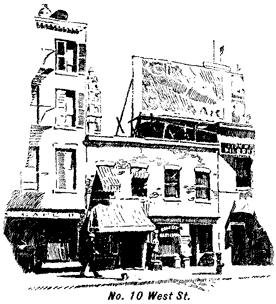
To No. 10 West Street, that stands on the river front, Robert Louis Stevenson was taken by a fellow-voyager in 1879; here he stopped the first night he spent in America, and of this house he wrote in the Amateur Emigrant. From the waterside just at dusk, catching a dim outline of the varying housetops is to glimpse some old castle of feudal times. The lowest building in all this block is No. 10—a meagre, dingy, two-story structure that has come to be very old. The doors and windows seem to have been made for some other building, and to be trying to get back to where they belong, bulging out in the struggle and making rents in the house-front.
Crossing Battery Park to State Street, at No. 17 is the tall Chesebrough building that has sprung up on the spot where William Irving, brother of Washington, lived, and where the Salmagundi wits gathered sometimes in the evening. Two or three doors farther along is a survival of old New York which delights the eye, with its porticoes and oval windows, odd appearing and many-sided; a mansion when wealth and affluence clustered around the Battery. This is the scene of the first few chapters of Bunner's Story of a New York House. Around the corner and through the wide doors of the Produce Exchange, at the back of that building and literally hidden in the middle of the block, is an old street that seems to have lost its usefulness, a quaint and curious way full half a century and more behind the times, now bearing the name of Marketfield Street, but once called Petticoat Lane. It is no longer a thoroughfare, for in its length of half a block it has neither beginning nor end. Here is all that is left of the house in which Julia Ward Howe was born.
Passing along Broad Street, where Edmund C. Stedman, the poet and financier, has an office close to Wall Street, you come in a few minutes to the Custom House. To enter that building is to get lost in a moment. Pass through the door into a veritable trackless wilderness of narrow black halls, with rooms that open in the most unexpected corners, and come after a while to the Debenture Room of old, and to the window near which Richard Henry Stoddard had his desk for close upon twenty years.
Freed from the intricacies of the old building, continue the stroll up-town, and in Park Row, at No. 29, on the third floor, is found the old home of the Commercial Advertiser, where Jesse Lynch Williams worked, and wrote A City Editor's Conscience, and other stories. A little way farther on is the Tribune building, where William Winter has his den, and under the same roof the room where Irving Bacheller conducted a newspaper syndicate before Eben Holden was thought of. Then on again a few steps to the Sun building and into the room, little changed from the time when Charles A. Dana sat there so many years, and, close by, the reporters' room where Edward W. Townsend worked, and wrote about Chimmie Fadden. There is a winding staircase, that the uninitiated could never find, leading into the rooms of the Evening Sun, where Richard Harding Davis "reported," and where he conceived some of the Van Bibber stories. Directly across the street is the World office, and looking from the windows, so high up that the city looks like a Lilliputian village, you have the view that Elizabeth Jordan looked upon during the ten years she was getting inspiration for the Tales of a City Room. Down narrow Frankfort Street is Franklin Square, the home of Harper's Magazine, where George W. Curtis established his Easy Chair in which he was enthroned so long, and which is now occupied by William Dean Howells.
Cherry Street leads out of Franklin Square direct to Corlear's Hook Park. Half a hundred feet before that green spot is reached, in a squalid neighborhood of dirty house-fronts, ragged children, begrimed men, and slovenly women, there is a house numbered 426, above the door of which are the words: "I was sick and ye visited Me." Dwellers in the neighborhood know that this is a hospital for those suffering from incurable disease, but, beyond this, seem to know very little about it. It is the home of Rose Hawthorne Lathrop, the daughter of Nathaniel Hawthorne, who has given up her entire life to brighten many another. In the same block, but nearer to Scammel Street, which is next towards the south, Brent's foundry used to be in the days when Richard Henry Stoddard was an iron-worker and the friend of Bayard Taylor, whom he visited in Murray Street.
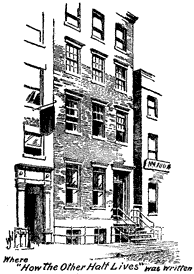
From this far East Side to Washington Square is quite a distance, but stop half-way at Police Headquarters and the nearby reporters' offices. Any one there will be glad to point out the room where Jacob A. Riis worked so many years and wrote most of How the Other Half Lives, and from which he carried out his ideas for benefiting the city poor—carried them out so well that President Roosevelt called him New York's most useful citizen.
In Washington Square the wanderer has much to think of in the literary associations recalled by this green garden that has blossomed from a pauper graveyard, and which has been written of by Howells, Brander Matthews, Bayard Taylor, Bunner, Henry James, F. Hopkinson Smith, and almost every writer who has brought New York into fiction.
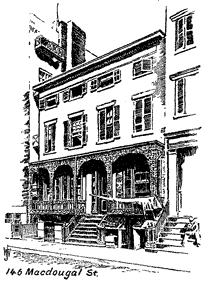
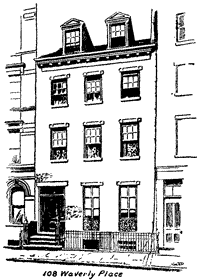
From the square, stroll in any direction for definite reminders. Towards the south and around into Macdougal Street, at No. 146, there is a dingy brick house with a trellised portico, where Brander Matthews and his friends used to dine, and which James L. Ford made the Garibaldi of his Bohemia Invaded. Walk towards the east, past the site of the University building, and stand at the Greene Street corner, at No. 21 Washington Place, where Henry James was born. Towards the west a few steps into Waverly Place, at No. 108, is a squat red brick house where Richard Harding Davis wrote his newspaper tales. Across, at the corner, lived George Parsons Lathrop when he wrote Behind Time, and there his wife, Rose Hawthorne Lathrop, wrote Along the Shore. An historic site this house stands on, for it is where Stoddard and Taylor once lived together. A block to the north is old-time Clinton Place, which now, for modern convenience, recking not of memory or of sentiment, has become Eighth Street. There, to the left of Fifth Avenue, at No. 18, is where Paul du Chaillu wrote Ivar the Viking, and to the right the house opposite, covered from basement to eaves with green clustering vines, is the home of Richard Watson Gilder.
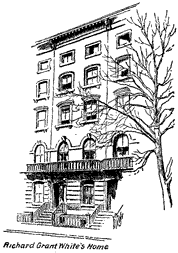
It is only a question now of crossing half a dozen city blocks towards the east to wander into what was called the Bouwerie Village. Modern streets and modern improvements have so overridden the village of old that traces of it are few and difficult to find. Here in this district many a writer of New York has lived. At Fourth Avenue and Tenth Street still stands the house, known to all who lived there as "The Deanery," in which Miss Annie Swift kept boarders, and where the family of Richard Henry Stoddard lived during the last four years that Mr. Stoddard held his post in the Custom House. Here Stedman, and Bayard Taylor, and Howells were visitors, with scores of other writers; here Mrs. Stoddard wrote The Morgensons, and here Stoddard himself wrote The King's Bell, Melodies and Madrigals, and other poems. Not more than a block away, in the house numbered 118, Richard Grant White had his home when he wrote The New Gospel of Peace, According to St. Benjamin.
Around the corner in Third Avenue, at Thirteenth Street, is a tablet telling of the pear tree that Peter Stuyvesant brought from Holland, that grew and flourished on the edge of the Stuyvesant orchard for more than two hundred years. Within a stone's throw of the tree in the sixties, and while it yet bloomed, Stoddard lived with his friend Bayard Taylor, and here the Life of Humboldt came from Stoddard's pen. Around another corner into Fourteenth Street and down a block to No. 224, Paul du Chaillu had apartments when he wrote The Land of the Midnight Sun; but the tree-filled yard and the vine-covered cottage next to it, on which the writer's window looked, are buried beneath a dwelling in the full flush of newness.
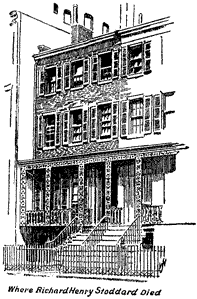
In Fifteenth Street, just past Stuyvesant Park, is a really picturesque row of tiny houses that must have been there when Stuyvesant Park was very new indeed. They have balconies enclosed by iron fretwork, and the first in the row is especially dainty and attractive, and quite overshadowed by the lofty building that has grown up beside it. In this out-of-the-way corner the Stoddards lived for something more than a quarter of a century, and here they died, the brilliant son first, then Mrs. Stoddard, and finally Richard Henry Stoddard, in 1903.
Along the parkside and around the corner to Seventeenth Street, No. 330 was another interesting landmark until, quite lately, it was swept away. Brander Matthews lived there, and could look across the square to the gray towers of St. George's while he wrote the French Dramatists of the Nineteenth Century. H.C. Bunner had quarters there when he wrote A Woman of Honor and other stories of that period, and Richard Grant White was a long dweller there.
Northward a few streets, on the south side of Gramercy Park, is the house of John Bigelow, writer of half a dozen important books, who fifty years and more ago assisted William Cullen Bryant in the editorial conduct of the Evening Post. Only a few steps away, in historic Irving Place, the ivy-covered house is where Mrs. Burton Harrison wrote Sweet Bells out of Tune, and on another block farther to the south the Lotus Club long had its home, the building now given over to commercial uses.
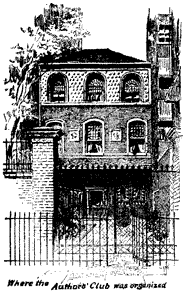
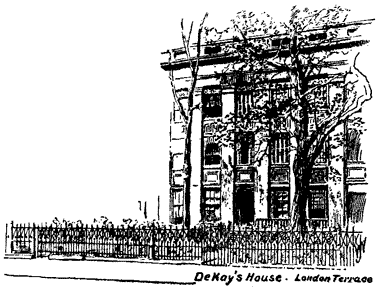
In the short stretch of Fifteenth Street that leads from Irving Place to Union Square are two points closely associated with the literature of the city. One is midway the distance, the prosaic office of a brewer now, but once the home of the Century Club when Bancroft the historian was its president. The other is nearer to the square, with a tall iron fence, and a gateway not at all in keeping with the modern appearance of the street. Behind the tall fence is a bit of greensward, and beyond that a house quaintly unusual in appearance, seeming to shrink from sight in the shadows cast about it. This is where Richard Watson Gilder at one time lived, where Charles De Kay organized the Authors' Club, and where the Society of American Artists was formed.
Beyond Union Square there is in Eighteenth Street the house numbered 121 where Brander Matthews lived for fourteen or more years, where he wrote many of his books, and where was held the first meeting to organize the American Copyright League. It was Professor Matthews who gave the dinner at which the unique society known as the Kinsmen came into being, at the Florence on the same street at number 105,—an apartment house in which Ellen Glasgow, Elizabeth Bisland, and Edgar Saltus have made their homes, and in which the widow of Herman Melville is now living.
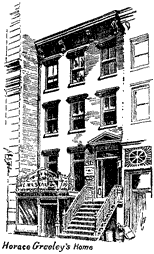
In nearby Nineteenth Street is still standing No. 35, a house where Horace Greeley lived, with William Allen Butler, the author of Nothing to Wear, for a next-door neighbor. Three blocks farther on is the big office building where Dr. Josiah Strong wrote most of Our Country, and where Hamilton W. Mabie has a study in the editorial rooms of The Outlook. A few steps farther in Twenty-second Street, at No. 33, Stephen Crane wrote part of The Red Badge of Courage and worked on the daily newspapers. Close by in Fifth Avenue is the publishing house where the critic and essayist, William Crary Brownell, author of French Traits, and other works, spends his business hours. Around the corner in Twenty-third Street, on the top floor of another publishing house is the den of the energetic author, editor, and critic, Jeannette L. Gilder. Across Madison Square, at the Twenty-fifth Street corner, Edgar Saltus had apartments for some time, and just off Broadway in Twenty-seventh Street, at No. 26, Edgar Fawcett wrote A Mild Barbarian.
On up Madison Avenue past Twenty-eighth Street is a brownstone dwelling with a luxuriantly blooming window garden, where James Lane Allen lives when he is in town and revises his writings. A few steps into the next thoroughfare the Little Church Around the Corner nestles in a populous district, and in the next block, just beyond the Woman's Hotel, Mrs. Burton Harrison has written many of her books. Two blocks away, in the Life building, John A. Mitchell, founder of the paper, spends several working hours of each day.
Going farther up-town in Park Avenue just beyond Thirty-sixth Street is a substantial building where Dr. Josiah Gilbert Holland wrote and where he died. In nearby Thirty-seventh Street hover memories of Parke Godwin, who married the daughter of William Cullen Bryant, and whose business and literary interests were closely entwined with those of his father-in-law. A few steps westward is the solemnly quiet Brick Presbyterian Church, where Dr. Henry van Dyke preached before he was called to Princeton. Turning into Forty-sixth Street, note a house distinguished from its neighbors by a doorway of wrought-iron, where John A. Mitchell did much of the writing of Amos Judd.
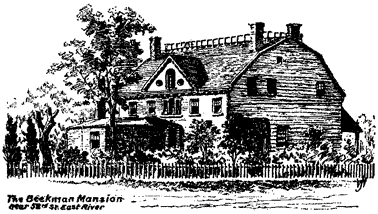
Across town, where Fifty-first Street touches the East River, is a street so short and so out-of-the-way that few New Yorkers have ever heard of it. It is called Beekman Place, and in it survives the memory of the old Beekman house which stood near by, and which in the days of the Revolution was used as a British headquarters. It was in the Beekman house that Nathan Hale rested his last night on earth. Here in this quiet spot Henry Harland lived in the eighties, when he was employed in the Register's Office and got up at two o'clock many and many a morning to write (under the name of Sidney Luska) some of his earlier books. The windows of his home looked out upon a beautiful and unusual city scene. Any one going now to where Fifty-first Street ends at an embankment high above the river may see it just as he saw it then—see the waves splashing on a rocky shore, with neither docks nor wharves nor factories to interfere; see a broad river; see a green island with stone turreted towers, and in the distance, forming a background, the irregular sky-line of the Brooklyn borough shore.
Farther up-town to Central Park, and there on the south side is the mammoth apartment house close to Sixth Avenue, where William Dean Howells did much of his work; and on beyond the avenue, at No. 150, Kate Douglas Wiggin evolved Penelope's Experiences. Still on up-town, following the easterly side of the park, in Sixty-fourth Street, at No. 16, Carl Schurz lived, and in Seventy-seventh Street is the square house of stone where Paul Leicester Ford met such a fearful death.
Crossing Central Park to the far west side, the journeyer comes to wide, tree-lined West End Avenue, and there at Ninety-third Street, almost upon the shores of the Hudson River, in a locality of beautiful homes, Brander Matthews, author of Vignettes of Manhattan and A Confident To-morrow, lives and works. Returning down-town on the westerly side of the city, stop just beyond Amsterdam Avenue and Eighty-sixth Street before a house, colonial as to its doors and windows at least, the home of that distinguished naval officer and writer, Captain A.T. Mahan. On the nearest corner is the church where funeral services were held over Paul du Chaillu when his body was brought back from Russia. Down a few streets, John Denison Champlin, author and encyclopædist, has his home, in a yellow apartment house, and half a block along Seventy-eighth Street stands the terra cotta building occupied by Stedman before he moved to Bronxville. Down to Sixty-fifth Street now, a dozen steps or more west of Central Park, Edgar Fawcett conceived A Romance of Old New York, before going to Europe for an indefinite stay.
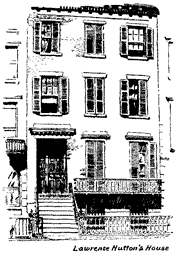
In Thirty-fourth Street, midway between Seventh and Eighth Avenues, visit the solid little brick house, with green shutters and an air of dignity that proclaims it of another time. This has stood for three quarters of a century and at one time had no neighbors. There, until 1898, when he went to Princeton, Lawrence Hutton gathered his collection of objects artistic from all parts of the world; there he kept his assortment of death masks; there he wrote and entertained his friends, authors, actors, men of different callings.
Let the last step be to that reminder of old Chelsea Village, in Twenty-third Street beyond Ninth Avenue, called London Terrace. The Terrace was built when Chelsea was really a village, and exists to-day long after the village has ceased to have an identity. One house in the row, No. 413, is particularly interesting, picturesquely and historically, carrying as its literary association the name of Charles De Kay, critic and author—a name of to-day and of the past as well, for he is the grandson of the poet, Joseph Rodman Drake.