Volume 22 — THE REAL PRISONER OF CHILLON: A GENTLEMAN GROSSLY MISREPRESENTED.
Reading edition
THE CASTLE OF CHILLON.
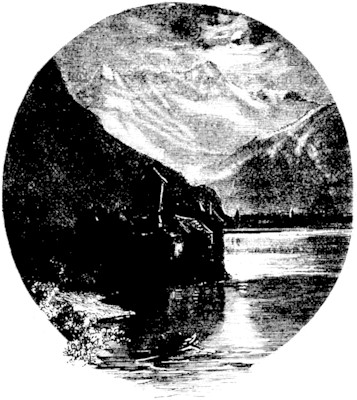
"A character more celebrated than known" is Francis Bonivard, prior of St. Victor and Prisoner of Chillon. It is not by any intentional imposture on his part that he goes stalking through modern literature disguised in the character of hero, saint and martyr, and shouting in a hoarse chest-voice his "appeal from tyranny to God." In fact, if he could be permitted to revisit his cherished little shelf of books about which has grown the ample library of the University of Geneva, and view the various delineations of himself by artist, poet, and even serious historian, it would be delightful to witness his comical astonishment. Perhaps it is not to be laid to the fault of Lord Byron, who after visiting the old castle and its dungeon beguiled the hours of a rainy day at the inn at Ouchy with writing a poem concerning which he frankly confesses that he had not the slightest knowledge of its hero. Hobhouse, his companion, ought to have been better informed, but was not. If anybody is to blame, it is the recent writers, who do know the facts, but are unwilling to hurt so fine an heroic figure or to dethrone "one of the demigods of the liberal mythology." Enough to say that the Muse of History has been guilty of one of those practical jokes to which she is too much addicted, in dressing with tragic buskins and muffling in the cloak of a hero of melodrama, and so palming off for earnest on two generations of mankind, the drollest wag of the sixteenth century.
A wild young fellow like Bonivard, with a lively appreciation of the ridiculous, could not fail to see the comic aspect of the fate which invested him with the spiritual and temporal authority and emoluments of the priory of St. Victor. This was a rich little Benedictine monastery just outside the eastern gate of Geneva, on the little knoll now crowned by the observatory, surrounded with walls and moat of its own, independent of the bishop of Geneva in spiritual matters, and in temporal affairs equally independent of the city: in fact, it was a petty sovereignty by itself, and its dozen of hearty, well-provided monks, though nominally under the rule of Cluny, were a law to themselves, and not a very rigid one either. The office of prior, by virtue of a little arrangement at Rome, descended to Bonivard from his uncle, immediately upon whose demise the young potentate of twenty-one took upon him the state and functions of his office in a way to show the monks of St. Victor that they had no King Log to deal with. The document is still extant, in the Latin of the period, in which Prior Bonivard ordains that every new brother at his initiation shall not only stand treat all round, but shall, at his own cost and charges, furnish every one of his brethren with a new cap. Another document of equal gravity makes new ordinances concerning the convent-kitchen, which seems to have been one of the good prior's most religious cares.[6] Not only his own subjects, but those of other jurisdictions, were made to feel the majesty of his sovereign authority. He would let them know that he had "just as much jurisdiction at St. Victor as the duke of Savoy had at Chambéry." He heard causes, sentenced to prison, even received ambassadors from his brother the duke, but not without looking sharply at their credentials. If these were wanting, the unfortunate wretches were threatened with the gallows as spies, and when they had been thoroughly frightened the monarch would indulge himself in the exercise of the sweetest prerogative of royalty, the pardoning power, and, when it was considered that the majesty of the state had been sufficiently asserted, would wind up with asking the whole company to dinner.
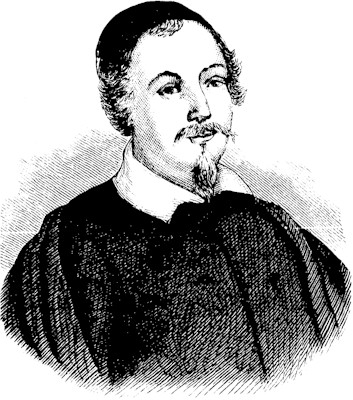
FRANÇOIS BONIVARD, "THE PRISONER OF CHILLON." [From an old print in the Public Library of Geneva, never before copied.]
It had been considered a clever stroke of policy, at a time when the dukes of Savoy and the bishops of Geneva, who agreed in nothing else, were plotting, together or separately, to capture and extinguish the immemorial liberties of the brave little free city, to get this fortified outpost before its very gate officered by a brilliant and daring young Savoyard gentleman, who would be bound to the duke by his nativity and to the Church by his office, and to both by his interests. To the dismay of bishop and duke, it appeared that the young prior, who had led a gay life of it at the University of Turin, had nevertheless read his classics to some purpose, and had come back with his head full of Plato and Plutarch and Livy and of theories of republican liberty. So that by putting him into St. Victor they had turned that little stronghold from an outpost of attack upon Geneva liberties into the favorite resort and rendezvous of all the young liberal leaders of that gay but gallant little republic, who found themselves irresistibly drawn to young Bonivard, partly as a republican and still more as a jolly good fellow.
The first manifestation of his sympathies in that direction occurred soon after his installation as prior. His uncle on his deathbed had confessed to young Francis the burden on his conscience in that he had taken Church money and applied it to the making of a battery of culverins wherewith to levy war against one of his neighbors in the country; and bequeathed to his nephew the convent and the culverins, with the charge to melt down the latter into a chime of church-bells which should atone for his evil deeds. Not long after, Bonivard was telling the story to his friend Berthelier, the daring and heroic leader of the "Sons of Geneva" in their perilous struggle against tyranny, when the latter exclaimed, "What! spoil good cannon to make bells? Never! Give us the guns, and you shall have old metal to make bells enough to split your ears. But let guns be guns. So the Church will be doubly served. There will be chimes at St. Victor and guns in Geneva, which is a Church city." The bargain was struck, as a vote in the records of the city council shows to this day. But it was the beginning of a quarrel with the duke of Savoy which was to cost Bonivard more than he had counted on. There was reckless deviltry enough among all these young liberals, but some of them—not Bonivard—were capable of seriously counting the cost of their game. On one occasion—it was at the christening of Berthelier's child, and Bonivard was godfather—Berthelier took his friend aside from the guests and said, "It is time we had done with dancing and junketing and organized for the defence of liberty."—"All right!" said the prior. "Come on, and may the Lord prosper our crazy schemes!" Berthelier took his hand, and with a serious look that sobered the rattle-headed ecclesiastic for a moment, replied, "But let me warn you that this is going to cost you your living and me my head."—"I have heard him say this a hundred times," says Bonivard in his Chronicles. The dungeon at Chillon and the mural tablet in the Tour de l'Isle at Geneva tell how truly the prophecy was fulfilled.
There was so little of the strut of the stage-hero about Bonivard that he could not be comfortable in doing a chivalrous thing without a joke to take off the gloss of it. Before the ducal party had quite given up hopes of him there was a serious affair on their hands—the need of putting out of the way by such means, treacherous and atrocious, as the Savoyards of that day loved to use, one of the noblest of the Geneva magistrates, Aimé Lévrier. An emissary of the duke, of high rank, kinsman to Bonivard, came to St. Victor and offered the prior magnificent inducements to aid in the plot. With a gravity that must have convulsed the spectators if there had been any, Bonivard pointed to his monastic gown, his prayer-book and his crucifix, and pleaded his deep sense of the sacredness of his office as a reason for having nothing to do with the affair. "Then," says his kinsman, rising in wrath, "I will do the business myself. I'll have Lévrier out of his bed and over in Savoy this very night."—"Do you really mean it, uncle? Give me your hand!"—"Then you consent, after all, to help me in the matter?"—"Oh no, uncle: that isn't it. But I know these Genevese are a hasty sort of folk, and I am just going to raise thirty florins to be spent in saying masses to-morrow for the repose of your soul." Before the evening was over, Bonivard found an opportunity of slipping in disguise over to the house of Lévrier and giving a hint of what was intended: the notes of preparation for resistance that Berthelier and his friends began at once to make wrought upon the excited nerves of the ambassador and his armed retinue to such a point that they were fain to escape from the town by a secret gate before daylight.
The affair of his rescue of Pecolat is another illustration of his character and of the strange, turbulent age in which he lived; and it went far to embitter the hatred of the duke and the bishop against him. This poor fellow was the jester, song-singer and epigrammatist of the madcap patriots who were associated under the title of "Sons of Geneva." Under a trumped-up charge of plotting the death of the bishop he was kidnapped and carried away to one of the castles in the neighborhood, and there tortured until a false confession was wrung from him implicating Berthelier and others. To secure his condemnation to death he was brought back into the city and presented before the court; but the sight of the poor cripple, racked and bruised with recent tortures, and his steadfastness in recanting his late confession, wrought more with the judges than the fear of the duke, and he was acquitted. But the feeble and ferocious bishop, moved partly by malignity and partly, no doubt, by sincere and cowardly terror, was resolved to kill him; and by some fiction declaring him to have been in the minor orders, he clapped him into the bishop's prison, claiming to try him by ecclesiastical law. The story of renewed tortures inflicted on their helpless comrade, and their knowledge of the certain death that awaited him, stirred the blood of the patriots of Geneva. It was just the moment for the prior of St. Victor to show that the studies at Freiburg and Turin that had made him doctor utriusque juris had not been in vain. He would fight the bishop with his own weapon of Church law. He despatched Pecolat's own brother with letters to the archbishop of Vienne, metropolitan to the bishop of Geneva, and, using his family influence, which was not small, he secured a summons to the bishop and chapter of Geneva to appear before the archiepiscopal court and give account of the affair, and meanwhile to cease all proceedings against the prisoner.
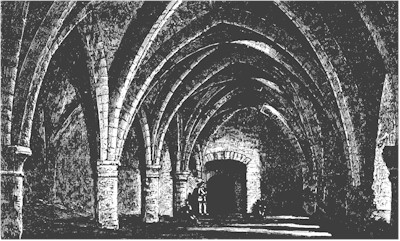
THE DUNGEON OF BONIVARD.
It was comparatively easy to procure the summons. The difficulty was to find some one competent to the functions of episcopal usher and bold enough to serve it. Bonivard bethought him of a "caitiff wretch"—an obscure priest—to whom he handed the document with two round dollars lying on it, and bade him hand the paper to the bishop at mass the next day in the cathedral. The starving clergyman hesitated long between his fears and his necessities, but finally promised to do the work on condition that the prior should stand by him in person and see him through. The hour approached, and the commissioner's courage was oozing rapidly away. His knees knocked together, and he slipped back in the crowd, hoping to escape. The vigilant prior darted after him, seized him, and laying his hand on the dagger that he wore under his robe whispered in his ear, "Do it or I'll stab you!" He adds, in his Chronicles, "I should have been as good as my word: I do not say it by way of boasting. I know I was acting like a fool, but I was quite beside myself with anxiety for my friend." Happily, there was no need of extreme measures. He gripped his terrified victim by the thumb, and as the procession moved toward the church-door he thrust the paper into his hand, saying, "Now's the time! You've got to do it." And all the time he held him fast by the thumb. The bishop came near, and Bonivard let go the wretch's thumb and pushed him to the front, pointing to the prelate and saying, "Do your work!" The bishop turned pale with terror of assassination as he heard the words. But the trembling clerk, not less terrified than the bishop, dropped on his knees and presented the archiepiscopal mandate, gasping out, "My lord, inhibitur vobis, prout in copia." Bonivard retreated into his inviolable sanctuary of St. Victor. "I was young enough and crazy enough," he says, "to fear neither bishop nor duke." He had saved poor Pecolat's life, although the work was not finished until the publication of an interdict from the metropolitan silencing every church-bell and extinguishing every altar-candle in the city had brought the bishop to terms.[7]
It is a hardship to the writer to be compelled to retrench the story of the early deeds for liberty of Bonivard and his boon companions. There is a rollicking swagger about them all, which by and by begins to be sobered when it is seen that on the side of the oppressor there is power. By violence, by fraudulent promises, by foul treachery on the part of cowardly citizens, the duke of Savoy gains admittance with his army within the walls of Geneva, and begins his delicious and bloody revenge for the indignities that have been put upon his pretensions and usurpations. Berthelier, a very copy from the antique—a hero that might have stepped forth into the sixteenth century from the page of Plutarch[8]—remained in the town serenely to await the death which he foreknew. On the day of the duke's entrance Bonivard, who had no such relish for martyrdom for its own sake, put himself between two of his most trusted friends, the lord of Voruz and the abbot of Montheron of the Pays de Vaud, and galloped away disguised as a monk. "Come first to my convent," said the abbot, "and thence we will take you to a place of safety." The convent was reached, and in the morning Bonivard was greeted by his comrade Voruz, who came into his room, and, laying paper and pen before him, required him to write a renunciation of his priory in favor of the abbot of Montheron. Resistance was vain. He was a prisoner in the hands of traitors. The alternative being "Your priory or your life!" he frankly owns that he required no time at all to make up his choice. Voruz took the precious document, with the signature still wet, and went out, double locking the door behind him. His two friends turned him over to the custody of the duke, who locked him up for two years at Grolée, one of his castles down the Rhone, and put the honest abbot of Montheron in possession of the rich living of St. Victor.
But Bonivard in his prison was less to be pitied than the citizens of Geneva who remained in their subjugated city. The two despots, the bishop and the duke, who had seized the unhappy town, combined to crush the gay and insubordinate spirit out of it. All this time, says Bonivard, "they imprisoned, they scourged, they tortured, they beheaded, they hung, so as it is pitiful to tell."
Meanwhile, the influential family friends of Bonivard, some of them high in court favor, discovering that he was yet alive and in prison, bestirred themselves to procure his liberation; and not in vain, for the possession that had made him dangerous, the priory of St. Victor, having been wrested from him, there was little harm that he could do. His immediate successor in the priory, good Abbot de Montheron, had not indeed long enjoyed the benefice. He had gone on business to Rome, where certain Churchmen who admired his new benefice invited him (so Bonivard tells the story) to a banquet more Romano, and gave him a dose of the "cardinal powder," which operated so powerfully that it purged the soul right out of the body. He left a paper behind him in which, as a sign of remorse for his crime, he resigned all his rights in the priory back to Bonivard.[9] But the pope, whose natural affection toward his cousins and nephews overflowed freely in the form of gifts of what did not belong to him, bestowed the living on a cousin, who commuted it for an annual revenue of six hundred and forty gold crowns—a splendid revenue for those days—and poor Bonivard, whose sole avocation was that of gentleman, found it difficult to carry on that line of business with neither capital nor income. He came back, some five years later, into possession of the priory. They were five years of exciting changes, of fierce terrorism and oppression at Geneva, followed by a respite, a rallying of the spirit of the people, an actual recovery of some of the old rights of the city, and, presently, by the beginning of some signs of religious light coming from the direction of Germany. And the way in which Bonivard at last got reinstalled into his convent is curiously illustrative of the strange condition of society in those times. One May morning in 1527 the little town was all agog with strange news from Rome. The Eternal City had been taken by storm, sacked, pillaged, burned! The Roman bishop was prisoner to the Roman emperor, if indeed he was alive at all. In fact, there was a rumor—dreadful, no doubt, but attended by vast consolations—that the whole court of Rome had perished. Immediately there was a rush to the bishop's palace, and a scramble for the vacant livings in the diocese that had been held by absentees at Rome. The bishop, delighted at such a windfall of patronage, dispensed his favors right and left, not forgetting, says Bonivard, to reserve something comfortable for himself in the shape of a fat convent that had been held by a cardinal. This was Bonivard's opportunity, and, times and the bishop having changed, he got back once more into his cherished quarters as prior of St. Victor. The convent was there, and the friars, but the estates that had been wont to keep them all right royally were mostly in the hands of the duke and his minions. It is in the effort to recover these that Bonivard shines out in his most magnificent character, that of military hero. The campaign of Cartigny includes the most memorable of his feats of arms.
Cartigny was an estate about six miles down the left bank of the Rhone from Geneva, appertaining to St. Victor. "It was a chastel of pleasaunce, not a forteresse," says our hero, who is the Homer of his own brave deeds. But the duke kept a garrison there, and to every demand the prior made for his place he replied that he did not dare give it up for fear of being excommunicated by the pope. Rent-time came, and the Savoyard government enjoined the tenants not to pay to the prior. Whereupon that potentate declared that, being refused civil justice, he "fell back on the law of nations."
The military resources of his realm were limited. He counted ten able-bodied subjects, but they were monks and not liable to service. The culverins of his uncle were gone, but he had six muskets—a loan from the city—and there were four pounds of powder in the magazine. But this was not of itself sufficient for a war against the duke of Savoy. He must subsidize mercenaries.
About this time there chanced to be at Geneva a swashbuckler from Berne, Bischelbach by name, by trade a butcher, who had found the new régime of the Reformers at that city too strait-laced for his tastes and habits, and had come to Geneva, with some vagabonds at his heels, in search of adventures and a livelihood. Him did the prior of St. Victor, greatly impressed with his own accounts of his powers, commission as generalissimo of the forces. Second in command he set a priest, likewise just thrown out of business by the Reformation in the North; and in a council of war the plan of campaign was determined. But before the actual clash of arms began the solemn preliminaries usual between hostile powers must be scrupulously fulfilled. A herald was commissioned to make proclamation in the name of the lord of St. Victor, through all the lands of Cartigny, that no man should venture to execute there any orders, whether of pope or duke, under penalty of being hung. This energetic procedure struck due terror, for when Bonivard's captain with several soldiers appeared before the castle it capitulated without a blow.
It was a brief though splendid victory. The very first raid in which the "Knights of the Spoon"—an association of neighboring country gentlemen—harried that region they found that the captain and entire garrison of the castle had gone to market (not without imputations of treason), leaving the post in charge of one woman, who promptly surrendered.
The sovereign of St. Victor's blood was up. He resolved to draw, if need were, on the entire resources of his realm. The army was promptly reinforced to twenty men, and Bonivard took the field in person at the head of his forces. On what wise this array debouched in two corps d'armée one Sunday morning from two of the gates of Geneva; how the junction of the forces was effected; the military history of the march; how they appeared, at last, before the castle of Cartigny,—are these not written by the pen of the hero himself in his Chronicles of Geneva? But Bonivard, though brave, was merciful. Willing to spare the effusion of blood, he sent the general-in-chief, Bischelbach, with his servant, Diebolt, as an interpreter, to summon the castle. The answer was a shot that knocked poor Diebolt over with a mortal wound; whereupon the attacking army fell back in a masterly manner into the woods and made good their way into Geneva, bringing one prisoner, whom they had caught unarmed near the castle, and leaving Diebolt to die at a roadside inn.
We may not further narrate the deeds of Bonivard as a martial hero, though they are neither few nor uninteresting.[10] But he is equally worthy of himself as a religious reformer. It was about this time that the stirrings of religious reformation at Berne and elsewhere began to be heard at Geneva, and the thought began to be seriously entertained by some of the patriotic "Sons of Geneva" that perhaps that liberty for which they had dared and suffered so much in vain might best come with that gospel which had wrought such wonders in other communities. There was one man who could advise them what to do; and they went together over to the convent and sought audience and ghostly counsel of the prior. "We are going to have done with all popish ceremonies," said they, "and drive out the whole rabble-rout of papistry, monks, priests and all: then we mean to send for gospel ministers to introduce the true Christian Reformation." It is pleasant to imagine the expression of Bonivard's countenance as he replied to his ardent friends: "It is a very praiseworthy idea. There is no doubt that all these ecclesiastics sadly need reformation. I am one of them myself. But who is to do the reforming? Whoever it is, they had better begin operations on themselves. If you are so fond of the gospel, why don't you practise it? It looks as if you did not so much love the gospel as you hate us. And what do you hate us for? It is not because we are so different from you, but because we are so like. You say we are a licentious lot; well, so are you. We drink hard; so do you. We gamble and we swear; but what do you do, I should like to know? Why should you be so hard on us? We don't interfere with your little enjoyments: for pity's sake, don't meddle with ours. You talk about driving us out and sending for the Lutheran ministers. Gentlemen, think twice before you do it. They will not have been here two years before you will wish they were gone. If you dislike us because we are too much like you, you will detest them because they are so different from you. My friends, do one thing or the other. Either let us alone, or, if you must do some reforming, try it on yourselves."
Thus did this excellent pastor, in the spirit of the gospel injunction to count the cost, give spiritual counsel to those who sought reformation of the Church. "I warrant you," he wrote concerning them, "they went off with their tails between their legs. I am as fond of reformation as anybody, but I am a little scrupulous as to who shall take it in hand."[11]
Bonivard's harum-scarum raids into the duke of Savoy's dominions after rents or reprisals at last became so embarrassing to his Geneva friends that, much as they enjoyed the fun of them, it became necessary to say to the good monk that this sort of thing really must stop; and feeling the force of his argument, that he must have something to live on, the city council allowed its neighboring potentate a subvention of four crowns and a half monthly to enable him to keep up a state worthy of the dignity of a sovereign. He grumbled at the amount, but took it; and thereafter the peace of Europe was less disturbed on his part.
But bad news came to the gay prior in his impoverished monastery. His mother was ill at his old home at Seyssel in Savoy, and he must see her before she died. It was venturing into the tiger's den, as all his friends told him, and as he did not need to be told. But he thought he would adventure it if he could get a safe-conduct from the tiger. The matter was arranged: the duke sent Bonivard his passport, limited to a single month; and the prior arrived at Seyssel, and nearly frightened the poor old lady out of her last breath with her sense of the peril to which he had exposed himself.
Our hero's incomparable genius for getting himself into difficulties never shone more brightly than at this hour. While here in the country of his mortal enemy, on the last days of his expiring safe-conduct, he got news of accusations gravely sustained at Geneva that he had gone over into Savoy to treat with the enemy. He did not dare to stay: he did not dare to go back. If he could get his safe-conduct extended for one month, to the end of May, he would try to make his way through the Pays de Vaud (then belonging to Savoy) to Fribourg in the Swiss Confederation. The extension was granted, and with many assurances of good-will from friends of the duke he pushed on. It was a fine May morning, the 26th, that he was on his last day's journey to Lausanne, and passing through a pine wood. Suddenly men sprang from ambush upon Bonivard, who grasped his sword and spurred, calling to his guide, "Put spurs!" But instead of so doing the guide turned and whipped out his knife and cut Bonivard's sword-belt; "Whereupon these worthy gentlemen," says Bonivard's Chronicle, "jumped on me and took me prisoner in the name of my lord duke." Safe-conducts were in vain. A bagful of ropes was produced, and he was carried on a mule, bound hand and foot, in secrecy, to the duke's castle of Chillon, the captain of which was one of the ambuscading party. For six years he was hidden from the world, and at first men knew not whether he was alive or dead. But his sufferings at the hand of the common foe put to shame the suspicions that had been engendered at Geneva, and it is recorded, to the honor of the Genevese, that during all that period, whenever negotiations were opened between them and the duke of Savoy, the liberation of Bonivard was always insisted on as one of the conditions.
The story of the imprisonment is soon told; for, strangely enough, this most garrulously egotistical of writers never alludes to it but twice, and then briefly. The first two years he was kept in the upper chambers of the castle and treated kindly, but at the end of this time the castle received a visit from the duke, and from that time forth the Prisoner of Chillon was remanded to the awful and sombre crypt. A single sentence in his handwriting is all that he tells us of this period, of which he might have told so much, and in this he shows a disposition to look at the affair rather in its humorous than in its Byronesque aspect. For his one recorded reminiscence of his four years of dungeon-life is, that "he had such abundant leisure for promenading that he wore in the rock pavement a little path as neatly as if it had been done with a stone-hammer."[12]
One March morning in 1536 the Prisoner of Chillon heard through the windows of his dungeon the sound of a cannonade by land and lake. It was the army of Berne, which was finishing its victorious campaign through the Pays de Vaud by the siege of the duke's last remaining stronghold, the castle of Chillon. They were joyfully aided by a flotilla fitted out by Geneva, which had never forgotten its old friend. That night the dungeon-door was burst open, and Bonivard and three fellow-prisoners were carried off in triumph to Geneva.
Not Rip Van Winkle when he awoke from his long slumber in the Catskills, not the Seven Sleepers of Ephesus when they came back from their sepulchre and found their city Christian, had a better right to be surprised than the prior of St. Victor when he got back to Geneva. Duke and bishop and all their functionaries were expelled; priests and preaching-friars were gone; the mass was abolished; in the cathedral of St. Peter's and all the lesser churches, which had been cleared of their images, there were singing of psalms and preaching of fiery sermons by Reformers from France; and the streets through which he had sometimes had to move by stealth were filled with joyous crowds to hail him as a martyr. St. Victor was no more. If he went to look for his old home, he found a heap of rubbish, for all the suburbs of the city that might give shelter to an enemy had been torn down by the unsparing patriots of Geneva, and the trees had been felled. The joyous city had ceased, and Bonivard's prophecy to his roystering companions was not long in being fulfilled for himself as well as for them: they soon found Calvin's little finger to be heavier than the bishop's loins.
And yet the heroic little town showed a noble gratitude toward the old friend of its liberties. The house which he chose out of all the city was given him for his own and furnished at the public expense. A pension of two hundred crowns a year in gold was settled on him, and he was made a senator of the republic. To all which was added a condition that he should lead a respectable life—a proviso which is practically explained in the very next appearance of his name in the records on account of a misdemeanor for which his accomplice was ordered to quit the town within three days.
The more generous was the town the more exacting became the Martyr. He could not get over his free-and-easy way of living in the gay old days when the tithes of his benefice yielded him nigh a thousand yellow crowns a year. He could not see why he was not entitled to have his rents back again; and after a vain effort on the part of the council to make him see it, he went off to Berne, where he had been admitted a citizen, to ask it to interfere for him, sending back an impudent letter renouncing his Geneva citizenship, on the ground that in his reduced circumstances he could not afford to be a citizen in two places at once. For a while the patient city lost its patience with its unruly beneficiary, but the genuine grateful and kindly feeling that every one felt for the poor fellow, and the general admiration for his learning and wit, conspired with his growing embarrassments to bring about a settlement of the affair on the basis of a reduced pension with a round lump sum to pay his debts.
They sent for him two or three years later to come to Geneva as historiographer, and he came, bringing with him a wife from Berne, who died soon after his arrival. For a man of his years, he had a remarkable alacrity at getting married, and his second venture was an unlucky one. For from the wedding-day onward, when he was not before the council with some quarrel or some affair of debt he was apt to come before it to get them to compel his wife to live with him, or, failing that, to get her money to live on himself. What time could be saved from these wranglings, which lasted almost till the poor woman's death, was devoted ardently to his literary work. The history grew apace, and other books besides. In the seditions of the Libertine party against the austerities of the new régime the old man took the side of law and order and good morals (in his book on L'ancienne et nouvelle Police de Genève) with an ardor that was the more surprising as one remembered his antecedents. In the midst of his toils he found time to get married to a third wife and to go to law with his neighbors. He is continually coming to the council, sometimes for a little loan to help him with his lawsuits, sometimes for relief in his embarrassments. It is touching to see how tender they are toward the poor foolish old man. They make him little grants from time to time, always looking to it that their money shall be applied to the object designated, and not "on his fantasies." They take up one of his notes for him, looking to see that it has not been tampered with, because "he is easily circumvented and not adroit in his business." He complains of the heat during an illness one summer, and the seigneurie give him the White Chamber in the town-hall, and when winter comes on, and he is old and infirm, they assign him the lodging lately occupied by Mathurin Cordier (famous schoolmaster Corderius, whose Dialogues were the first book in Latin of our grandfathers), because it contained a stove—a rare luxury. He thanks them for their kindness as his fathers, and makes them heirs of his library and manuscripts.
There was another and more solemn assemblage, his relations with which were less tender. This was the consistory of the Church, which found it less easy to allow for the old man's infirmities. His first appearance before this body was under accusation of playing at dice with Clement Marot, another famous character and the sweet singer of the French Reformation. He comes next time of his own accord, asking the venerable brethren to interfere because his second wife ran away from him on their wedding-day, she defending herself on the ground of a bad cold. His domestic troubles bring him thither so often as to put the clergy out of patience. He is called up for beating his wife, but shows that the discipline was needed, and she is admonished to be more obedient in future. Later on he is questioned why he does not come to church. He can't walk, is the answer. But he is told that if he can get himself carried to the hôtel de ville to see the new carvings, he could get carried to church. And why does he neglect the communion? Answer: He has been debarred from it. "Then present your request to be restored." So the poor old gentleman presents himself six weeks later, asking to be readmitted to the Church; which is granted, but with the remark, entered on the record, that he "does not show much contrition in coming with a bunch of flowers over his ear—a thing very unbecoming in a man of his years."
The dreadful consistory had a principal concern in the affair that darkened the declining days of Bonivard with the shadow of a tragedy. An escaped nun had found refuge in his lodgings after his third wife's death; and after some love-making—on which side was disputed—there was a promise of marriage given by him, which, however, he was in no hurry to fulfil. The consistory deemed it best to interfere, in the interests of propriety, and insist on the marriage; and the decrepit old invalid in vain pleaded his age and bodily infirmities. So he was married in spite of himself to his nun, and showed his disposition to make the best of it by making her a wedding-present of his new Latin treatise, just finished, on The Origin of Evil, and receiving in tender return a Greek copy of the Philippics of Demosthenes. Three years later the wretched woman was accused of adultery, and being put to the torture confessed her crime and was drowned in a sack, while her paramour was beheaded. Bonivard, being questioned, declared his belief of her innocence, and that her worst faults were that she wanted to make him too pious, and tormented him to begin preaching, and sometimes beat him when he had a few friends in to drink.[13]
For five years after this catastrophe the old man lingered, tended by hirelings, but watched with filial gratitude by the little state whose liberties he had helped to save, and whose heroic history he had recorded. He had at least the comfort of having finished that great work; and when he brought the manuscript of it to the council, they referred it to a committee with Master Calvin at the head; who reported that it was written in a rude and familiar style, quite beneath the dignity of history, and that for this and other reasons it had better not be printed. The precious manuscript was laid on the shelf until in the lapse of years it was found that the very reasons why those solemn critics rejected it were the things that gave it supreme value to a later age. It has been the pride of Geneva scholars to print in elegant archaic style every page written by the Prisoner of Chillon in prose or verse, on history, polity, philology and theology.
Somewhere about September, 1570, Francis Bonivard died, aged seventy-seven, lonely and childless, leaving the city his heir. The cherished collection of books that was the comfort of his harassed life has grown into the library of a university, and the little walled town for whose ancient liberties he ventured such perils and suffered such imprisonment is, and for the three hundred years since has been, one of the chief radiant centres of light and liberty for all the world. Leonard Woolsey Bacon.
Note.—Like every subject relating to the history of Geneva, the life of Bonivard has been thoroughly studied by local antiquarians and historians. The most important work on the subject is that of Dr. Chaponnière, before cited: this is reprinted (but without the documents attached) as a preface to the new edition of the Chronicles. M. Edmond Chevrier, in a slight pamphlet (Macon, 1868), gives a critical account both of the man and of his writings. Besides these may be named Vulliemin: Chillon, Étude historique, Lausanne, 1851; J. Gaberel: Le Château de Chillon et Bonivard, Geneva. Marc Monnier, Genève et ses Poëtes (Geneva, 1847), gives an excellent criticism on Bonivard as author. For original materials consult (besides the work of Chaponnière) Galiffe: Matériaux pour l'Histoire de Genève, and Cramer: Notes extraites des Registres du Consistoire, a rare book in lithography (Geneva, 1853). A weak little article in the Catholic World for September, 1876, bravely attacks Bonivard as "one of the Protestant models of virtue," and triumphantly proves him to have been far from perfect. The charge, however, that he was "a traitor to his ecclesiastical character," and "quitted his convent and broke his vows," is founded on a blunder. Bonivard never took monastic vows or holy orders, but held his living in commendam, as a lay-man. The main resource, however, for Bonivard's life up to his liberation from Chillon is in his own works, especially the Chronicles (Geneva, edition Fick, 1867).