BADEN AND ALLERHEILIGEN.
Reading edition
Before the change which has recently befallen the chief German watering-places, Baden—or, as it was more commonly called, Baden-Baden—was the most frequented, the most brilliant and the most profitable "hell" in Europe. Its baths and medicinal waters were a mere excuse for the coming thither of a small number of the vast concourse which annually filled its hotels. In any case, they sank into comparatively utter insignificance. It was not for water—at least not for the waters of any other stream than that of Pactolus—that the world came to Baden. Of course, the sums realized by the keepers of the hell were enormous; and they found it to be their interest to do all that contributed to make the place attractive on a liberal scale. Gardens, parks, miles of woodland walks admirably kept, excellent music in great abundance, vast salons for dancing, for concerts, for reading-rooms, for billiard-rooms, etc.—all as magnificent as carving and gilding and velvet and satin could make them—were provided gratuitously, not for those only who played at the tables, but for all those who would put themselves within reach of the temptation to do so. And this liberal policy was found to answer abundantly. Very many of the water-cure places in the smaller states of Germany had their hells also, and did as Baden did, on a more modest scale. Then came the German unification and the great uprising of a German national consciousness. And German national feeling said that this scandal should no longer exist. A certain delay was rendered necessary by the contracts which were running between the different small governments and the keepers of the gambling-tables. But it was decreed that when the two or three years which were required for these to run out should be at an end, they should not be renewed. It was a serious resolution to take, for some half dozen or so of these little pleasure-towns believed, not without good reason, that the measure would be at once fatal to their prosperity and well-nigh to their existence. And of course there were not wanting large numbers of people who argued that the step was a quixotic one, as needless and fallacious in a moral point of view as fatal on the side of economic considerations. Could it be maintained that the governments in question had any moral duty in the matter save as regarded the lives and habits of their own people? And these were not imperilled by the existence of the gambling-tables. For it was notorious that each of these ducal and grand-ducal patrons of the blind goddess strictly forbade their own subjects to enter the door of the play-saloons. And as to those who resorted to them, and supplied the abundant flow of gold that enriched the whole of each little state, could it be supposed that any one of these gamblers would be reformed or saved from the consequences of his vice by the shutting up of these tables? It was difficult to answer this question in the affirmative. No liquor law ever prevented men from getting drunk, nor could it be hoped that any closing of this, that or the other hell could save gamblers from the indulgence of their darling passion. Nevertheless, it can hardly be seriously denied that the measure was the healthy outcome of a genuinely healthy and highly laudable spirit. "Ruin yourself, if you will, but you shall not come here for the purpose, and, above all, we will not touch the profit to be made out of your vice." This was the feeling of the German government, and, considering the amount of self-denial involved in the act, Germany deserves no small degree of honor and praise for having accomplished it.
And now it is time to ask, Has Baden—for we will confine our attention to this ci-devant queen of hells—has Baden suffered that ruin which it was so confidently predicted would overtake her? Baden Revisited, by one who knew her well in the old days of her wickedness and wealth, supplies the means for replying to the question. Unquestionably, in the mere matter of the influx of gold the town has suffered very severely. How were some four-and-twenty large hotels, besides a host of smaller ones, which often barely sufficed to hold the crowds attracted by the gambling-tables, to exist when this attraction ceased? It might have been expected that a large number of these would at once have been shut up. But such has not been the case. I believe that not one has been closed. Nevertheless, a visitor's first stroll through the town, and especially in the alleys and gardens around the celebrated "Conversations-Haus," as it hypocritically called itself, is quite sufficient to show how great is the difference between Baden as it was and Baden as it is—between Baden the wealthy, gaudy, gay, privileged home of vice, and Baden moralized and turned from the error of its ways. And it cannot be denied that, speaking merely of the impression made upon the eye, the difference is all in favor of vice. "As ugly as sin" is a common phrase. But, unfortunately, the truth is that sin sometimes looks extremely pretty, especially when well dressed and of an evening by gaslight. And it did, it must be owned, look extremely pretty at Baden. The French especially came there in those days in great numbers, and they brought their Parisian toilettes with them. And somehow or other, let the fact be explained as it may—and, though perhaps easily explicable enough, I do not feel called upon to enter on the explanation here—one used in those wicked old days to see a great number of very pretty women at Baden, which can hardly be said to be the case at Baden moralized. The whole social atmosphere of the place was wholly and unmistakably different, and in outward appearance wicked Baden beat moral Baden hollow. It would not do in the old time to examine the gay scene which fluttered and glittered before the eyes much below the absolute exterior surface. The little town in those old days, as regarded a large proportion of the crowd which made it look so gay, was—not to put too fine a point upon it—a sink of more unmitigated blackguardism than could easily be found concentrated within so small a compass on any other spot of the earth. A large number of the persons who now congregate in this beautiful valley look, to tell the truth, somewhat vulgar. Vulgar? As if the flaunting crowds which seemed to insult the magnificent forests, the crystal streams and the smiling lawns with their finery were not saturated with a vulgarity of the most quintessential intensity! Yes, but that only showed itself to the moral sense of those who could look a little below the surface, whereas the vulgarity that may be noted sunning itself in the trim gardens and sprawling on the satin sofas which are the legacy of the departed wickedness is of the sort that shows itself upon the surface. In a word, moral Baden looks a little dowdy, and that wicked Baden never looked.
IN FRONT OF THE KURSAAL AT BADEN.
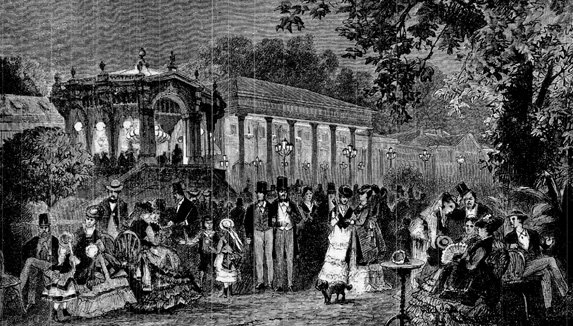
The general determination at Baden when the terrible decree which put an end to its career of wealth and wickedness came upon it like a thunder-bolt was of the kind expressed by the more forcible than elegant phrase, "Never say die!" The little town was determined to have a struggle for its existence. It still had its mineral waters, so highly valued by the Romans. The Romans, it may be remarked en passant, seem to have discovered and profited by every mineral spring in Europe. Hardly one of the more important springs can be named which cannot be shown, either by direct historic testimony or by the still existing remains of baths and the like, to have been known to the universal conquerors. Well, Baden still had its waters, good for all the ills to which flesh is heir—capiti fluit utilis, utilis alveo. It still had its magnificent forests—pine and oak and beech in most lovely juxtaposition and contrast. It had the interesting and charmingly picturesque ruins of its ancient castle on the forest-covered hill above the town, perched on one mighty mass of porphyry, and surrounded by other ranges of the same rock, thrown into such fantastic forms that they seem to assume the appearance of rival castellated ruins built on Nature's own colossal plan, and such a world of strange forms of turrets and spires and isolated towers and huge donjons that the Devil has "pulpits" and "bridges" and "chambers" there, as is well known to all tourists to be his wont in similar places. It had its other mediæval baronial residences situated in the depths of the forest at pleasant distances for either driving or walking. It had its delicious parks and gardens, beginning from the very door of the "Conversations-Haus," with brilliantly-lighted avenues, gay with shops and gas-lamps, and gradually wandering away into umbrageous solitudes and hillside paths lit by the moon alone—so gradually that she who had accepted an arm for a stroll amid the crowd in the bright foreground of the scene found herself enjoying solitude à deux before she had time to become alarmed or think what mamma would say. Then it had still the gorgeous halls, the ball-rooms, the concert-rooms, the promenading-rooms, with their gilding and velvet and satin furniture, which had been created by a wave of the wand of the great enchanter who presided at the green table. Why should not all these good things be turned to the service of virtue instead of vice? Why should not respectability and morality inherit the legacy of departed wickedness? Why should not good and virtuous German Fraüleins, with their pale blue eyes and pale blond hair, do their innocent flirting amid the bowers where the Parisian demi-monde had outraged the chaste wood-nymphs by its uncongenial presence? The loathsome patchouli savor of the denizens of the Boulevard would hardly resist the purifying breezes of one Black Forest winter. The notice to quit served on Mammon would be equally efficacious as regarded the whole of his crew. The whole valley would be swept clean of them, and sweetened and restored to the lovers of Nature in her most delicious aspect. Baden, emerging from the cold plunge-bath of its first dismay, determined that it should be so. The hotel-keepers, the lodging-house-keepers, the livery-stable-keepers, the purveyors of all kinds, screwed their courage to the sticking-place and determined to go in for virtue, early hours and moderate prices. Well, yes! moderate prices! This was the severest cut of all. But there was no help for it. Virtue does prefer moderate prices. There could be no more of that reckless scattering of gold, no more of that sublime indifference to the figure at the foot of the bill, which characterized their former customers. What mattered a napoleon or so more or less in their daily expense to him or her whose every evening around the green table left them some thousands of francs richer or poorer than the morning had found them? There can be no doubt, I fear, that Baden would have much preferred a continuance in its old ways. But the choice was not permitted to it. It is therefore making a virtue of necessity, and striving to live under the new régime as best it may. And I am disposed to think that better days may yet be in store for it. At present, the preponderating majority of the visitors are Germans. There are naturally no French, who heretofore formed the majority of the summer population. There are hardly any Americans, and very few English. Those of the class which used to find Baden delightful find it, or conceive that they would find it, so no more. And English and Americans of a different sort seem to have hardly yet become aware that they would find there a very different state of things from that which they have been accustomed to associate in idea with the name of the place. It must be supposed, however, that they will shortly do so. The natural advantages and beauties of the place are so great, the accommodation is so good, and even in some respects the inheritance of the good things the gamblers have left behind them so valuable, that it is hardly likely that the place will remain neglected. Where else are such public rooms and gardens to be found? The charge made at present for the enjoyment of all this is about six or eight cents a day. Such a payment could never have originally provided all that is placed at the disposal of the visitor. He used in the old times to enjoy it all absolutely gratuitously, unless he paid for it by his losses at the tables. Play provided it all. But it is to be feared that the very modest payment named above will be found insufficient even to keep up the establishment which Mammon has bequeathed to Virtue. The ormolu and the carved cornices, and the fresco-painted walls and the embroidered satin couches and divans, and the miles upon miles of garden-walks, have not indeed disappeared, as, according to all the orthodox legends, such Devil's gifts should do, but they will wear out; and I do not think that any eight cents a day will suffice to renew them. But in the mean time you may avail yourself of them. You may lounge on the brocade-covered divans which used to be but couches of thorns to so many of their occupants, undisturbed by any more palpitating excitement than that produced by the perusal of the daily paper. The lofty ceilings echo no more the hateful warning croak of the croupier, "Faites votre jeu, messieurs. Le jeu est fait!" which used to be ceaseless in them from midday till midnight. There are no more studies to be made on the men and women around you of all the expressions which eager avarice, torturing suspense and leaden despair can impart to the human countenance. The utmost you can hope to read on one of those placidly stolid German burgher faces is the outward and visible sign of the inward oppression caused by too copious a repast at the one-o'clock table d'hôte. It is the less disagreeable and less unhealthy subject of contemplation of the two. But the truth remains that virtuous Baden does look somewhat dowdy.
Just seventy-three years ago a change as great as that which has transformed Baden happened to an establishment which represented the old-world social system of Europe as completely and strikingly as Baden the "watering-place"—that is the modern phrase—did the Europe of the latter half of the nineteenth century. In another green valley of this region, as beautiful as, or even more beautiful than, that of Baden, there existed a gathering-place of the sort produced by the exigencies of a different stage of social progress—the convent of Allerheiligen, or, as we should say, All Saints or Allhallows. It is within the limits of an easy day's excursion from Baden, and no visitor who loves "the merry green wood" should omit to give a day to Allerheiligen, for he will scarcely find in his wanderings, let them be as extensive as they may, a more perfect specimen of the loveliest forest scenery. It is an old remark, that the ancient ecclesiastics who selected the sites of the monastic establishments that were multiplied so excessively in every country in Europe showed very excellent judgment and much practical skill in the choice of them. And almost every visit made to the spot where one of these cloister homes existed confirms the truth of the observation, more especially as regards the communities belonging to the great Benedictine family. The often-quoted line about seeking "to merit heaven by making earth a hell," however well it may be applied to the practices of some of the more ascetic orders, especially the mendicants, cannot with any reason be considered applicable to the disciples of St. Benedict. In point of fact, at the time when the great and wealthy convents of this order were founded it was rather outside the convent-wall that men were making the world a hell upon earth. And for those who could school themselves to consider celibacy no unendurable evil it would be difficult to imagine a more favorable contrast than that offered by "the world" in the Middle Ages and the retreat of the cloister. A site well selected with reference to all the requirements of climate, wood and water, and with an appreciative eye to the beauties of Nature, in some sequestered but favored spot as much shut in from war and its troubles as mountains, streams and forests could shut it in; a building often palatial in magnificence, always comfortable, with all the best appliances for study which the age could afford; with beautiful churches for the practice of a faith entirely and joyfully believed in; with noble halls for temperate but not ascetic meals, connected by stairs by no means unused with excellent and extensive cellars; with lovely cloisters for meditative pacing, and well-trimmed gardens for pleasant occupation and delight,—what can be imagined more calculated to ensure all the happiness which this earth was in those days capable of affording?
Such a retreat was the convent of Allerheiligen. It was founded for Premonstratensian monks at the close of the twelfth century by Uta, duchess of Schawenburg, who concludes the deed of foundation, which still exists, with these words: "And if anybody shall do anything in any respect contrary to these statutes, he will for ever be subject to the vengeance of God and of all saints." Poor Duchess Uta! Could her spirit walk in this valley, as lovely now as when she gave it to her monks, and look upon the ruins of the pile she raised, she would think that the vengeance of God and all saints had been incurred to a considerable extent by somebody. The waterfalls—seven of them in succession—made by the little stream that waters the valley immediately after it has passed through the isolated bit of flat meadow-land on which the convent was built, continue to sing their unceasing song as melodiously as when the duchess Uta visited the spot and marked it out for the "Gottes Haus" she was minded to plant there. Her husband, the duke Welf, who had married her when she was a well-dowered widow, had been a very bad husband, which naturally tended to lead his neglected lady wife's mind in the direction of founding religious houses. He was duke of Altorf and Spoleto, the one possession lying on the shores of the Lake of Lucerne, and the other among the ilex-woods that overlook the valley of the Tiber—a strange conjunction of titles, which is in itself illustrative of the shape European history took in that day, and of the preponderating part which Germany played in Italy and among the rulers of its soil. Being thus duke of Spoleto, Welf resided much in Italy, but does not seem to have found it necessary to take his German wife with him to those milder skies and easier social moralities. Uta stayed at home amid the dark-green valleys of her native Black Forest, and planned cloister-building. Before the chart, however, which was to give birth to Allerheiligen was signed, Duke Welf came home, and having had, it would seem, his fling to a very considerable extent, had reached by a natural process that time of life and that frame of mind which inclined him to join in his long-neglected wife's pietistic schemes. So they planned and drew up the statutes together, and the convent was founded and built, a son of Uta by her first husband being, as is recorded, the first prior.
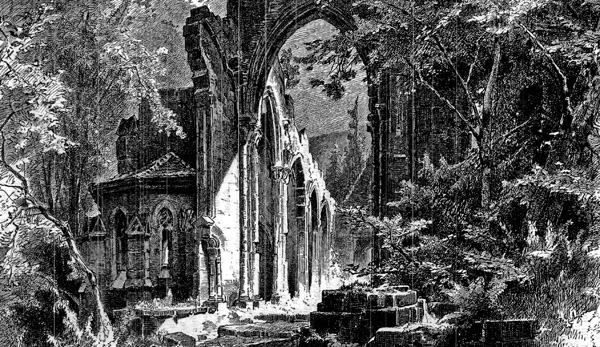
RUINS OF THE ABBEY OF ALLERHEILIGEN.
It was not long before the young community became rich. Such was the ordinary, the almost invariable, course of matters. Property was held on very unstable conditions even by the great and powerful. The most secure of all tenures was that by which the Church held what was once her own. And in a state of things when men were persuaded both that it was very doubtful whether they would be able to keep possession of their property, especially whether they would be able to secure such possessions to those who were to come after them, and that the surest way to escape that retribution in the next world which they fully believed to have been incurred by their deeds in this world was to give what they possessed to some monastic institution, it is not difficult to understand how and why monasteries grew rich. And it is equally intelligible that the result should have followed which did, as we know, follow almost invariably. As the monasteries became rich the monks became corrupt—first comfortable, then luxurious, then licentious. The Benedictines escaped this doom more frequently than the other orders. Even after their great convents had become wealthy and powerful landlords they were often very good landlords, and the condition of their lands and of their tenants and vassals contrasted favorably with that of the lands and dependants of their lay neighbors. The superiority of the Benedictines in this respect was doubtless due to their studious and literary habits and proclivities. It is constantly urged that the cause of learning and of literature owes a great debt of gratitude to the monks, but it should be said that this debt is due almost exclusively to the sons of St. Benedict.
But something more than this may be said for the community founded by Duchess Uta, the beautiful ruins of whose dwelling now complete the picturesque charm of this most exquisite valley. By a rare exception history has in truth nothing to say against them. Their record is quite clear. All remaining testimony declares that from their first establishment to the day of their dissolution the Allerheiligen monks lived studious and blameless lives. Possibly, the profound seclusion of their valley, literally shut in from the outer world by vast masses of thick roadless forests, may have contributed to this result, though similar circumstances do not in all cases seem to have ensured a similar consequence. Good fortune probably did much in the matter. A happy succession of three or four good and able abbots would give the place a good name and beget a good tradition in the community; and this in such cases is half the battle. "Such and such goings-on may do elsewhere, but they won't suit Allerheiligen"—such a sentiment, once made common, would do much for the continuance of a good and healthy tradition.
Accordingly, it was long before the sentence of dissolution went forth against the monastery of Allerheiligen—that sentence which was to produce a change in the place and all around it as momentous as that other sentence which some seventy years later went forth against Baden-Baden. It was not till 1802 that the monastery of Allerheiligen was dissolved; and its extinction was due then not to any reason or pretext drawn from the conduct of the inmates, but to the religious dissensions and political quarrels of princes and governments. But the doom was all the more irrevocably certain. In all the countries in which monasteries have been abolished and Church property confiscated tales eagerly spread, and by no means wholly disbelieved even by the spoilers themselves, are current of the "judgments" and retribution which have sooner or later fallen on those who have been enriched by the secularization of Church property or who have taken part in the acts by which the Church has been dispossessed. But rarely has what the world now calls "chance" brought about what the Church would call so startlingly striking a manifestation of the wrath of Heaven against the despoilers of "God's house." St. Norbert was the original founder of the Premonstratensian rule. And it was precisely on St. Norbert's Day next after the dissolution of the monastery of Allerheiligen that a tremendous and—the local chroniclers say—unprecedented storm of thunder, lightning and hail broke over the woodland valley and the devoted fabric in such sort that the lightning, more than once striking the buildings, set them on fire and reduced the vast pile to the few picturesque ruins which now delight the tourist and the landscape painter. Could the purpose and intent of the supernal Powers have been more strongly emphasized or more clearly marked? Truly, the scattered monks may have been excused for recalling with awe, not unmingled with a sense of triumph, the prophetic denunciation of their foundress Uta, which has been cited above, against whoso should undo the pious deed she was doing. For more than six hundred years her work had prospered and her will had been respected, and now after all those centuries the warning curse was still potent. Neither thunder nor lightning, nor the anger of St. Norbert, however, availed to rebuild the monastery or recall the monks. Their kingdom and the glory thereof has passed to another, even to Herr Mittenmeyer, Wirth und Gastgeber, who has built a commodious hostelry close by the ruins, which are mainly those of the church, and on the site of the monastic buildings, and who distributes a hospitality as universal, if not quite so disinterested, as that practised by his cowled predecessors. There, for the sum of six marks—about a dollar and a half—per diem you may find a well-furnished cell and a fairly well-supplied refectory, and may amuse yourself with pacing in the walks where St. Norbert's monks paced, looking on the scenes of beauty on which they gazed, and casting your mind for the nonce into the mould of the minds of those who so looked and mused. You may do so, indeed, thanks to Herr Mittenmeyer, with greater comfort, materially speaking, than the old inmates of the valley could have done. For the most charming and delicious walks have been made through the woods on either side of the narrow valley, and skilfully planned so as to show you all the very remarkable beauties of it. These, in truth, are of no ordinary kind. The hillsides which enclose the valley are exceedingly steep, almost precipitous indeed in some places, though not sufficiently so to prevent them from being clothed with magnificent forests. Down this narrow valley a little stream runs, and about a quarter of a mile from the spot on which the convent stood, and the ruins stand, makes a series of cascades of every variety of form and position that can be conceived. All these falls, together with the crystalline pools in huge caldrons worn by the waters out of the rocks at their feet, were no doubt well known to the vassal fishermen who brought their tribute of trout to the convent larder. But the majority of the holy men themselves, I fancy, lived and died without seeing some of the falls, for they would be by no means easily accessible without the assistance of the paths which by dint of long flights of steps, constructed of stones evidently brought from the ruins of the abbey, carry the visitor to every spot of vantage-ground most favorable for commanding a view of them. If, however, you have the advantage over the monks in this respect, your retreat will be less adapted to the purposes of retirement in another point of view. Ten or a dozen carriages a day filled with German tourists, all in high spirits and all very thirsty ("Thanks be!" says Herr Mittenmeyer), are not appropriate aids to the indulgence of contemplation. Scott advised his readers if they "would view fair Melrose aright, to visit it by the pale moonlight." And to those who would view Allerheiligen aright I would add the recommendation that the moon should be an October moon. The usual holiday-making months in Germany are by that time over. The professors have gone back to their chairs in the different universities; the privat-docents have reopened their courses; the substantial burghers have returned to their shops; and the raths of all sorts and degrees have ensconced themselves once more behind their official desks, and have ceased to "babble of green fields" any more till this time twelvemonth. The tourists will have gone, and the autumnal colors will have come into the woods. There is much beech mixed with the pine in these forests, and the beech in October is as gorgeous a master of color as Rubens or Veronese. Herr Mittenmeyer's mind, too, will have entered into a more placid and even-tempered phase. A stout, thickset man is Herr Mittenmeyer, with broad, rubicund face and short bull neck, of the type that suggests the possibility of an analogous shortness of temper under the pressure of being called in six different directions at once. Altogether, it is better in October. The song of the waterfall will not then be the only one making the woods melodious. There will be a fitful soughing of the wind in the forest. There will be a carpeting of dry, pale-brown oak-leaves on all the paths which "will make your steps vocal." Again and again, when slowly and musingly climbing the steep homeward path up the valley in the dark hour, when the sun has set and before the moon has yet risen, you will fancy that you hear the tread among the leaves of a sandalled foot behind you. But it is well that the path leads you, for there is no more any vesper-bell flinging its sweet and welcome notes far and wide over hill and vale to guide the returning wanderer through the forest.
Then the whole of this Black Forest region is full of legends and traditional stories, which live longer and are more easily preserved among a people where the sons and the daughters live and marry and die for the most part under the shadow of the same trees and the same thatch beneath which their fathers and mothers did the same. Of course, the Black Huntsman is as well known as of yore, though perhaps somewhat more rarely seen. But his habits and specialties have become too well known to all readers of folk-lore to need any further notice. Less widely known histories, each the traditional subject of inglenook talk in its own valley, may be found at every step. There is a rather remarkable grotto or cavern in the hill above Allerheiligen, the main ridge which divides that valley from Achern and the Rhine. It is, you are told, the Edelfrauengrab (the "Noble Lady's Grave"). And you will be further informed, if you inquire aright, how that unhallowed spot came to be a noble lady's grave, and something more than a grave. 'Twas at the time of the Crusades—those mischief-making Crusades, which, among all the other evil which they produced, would have absolutely overwhelmed the divorce courts of those days with press of business if there had then been any divorce courts. This noble lady's lord went to the Crusades. How could a gallant knight and good Christian do aught else? Of course he went to the Crusades! And of course his noble lady felt extremely dull and disconsolate during his absence. What was she to do? There was no circulating library; and even if there had been, she would not have been able to avail herself of its resources, for, though tradition says nothing upon the subject, it may be very safely assumed that she could not read. And needlework in the company of her maids must have become terribly wearisome after a time. She could go to mass, and to vespers also. Probably she did so at the new church of the recently-established community nestling in so charming a spot of the lovely valley beneath her. Let us hope that it was not there that she fell in with one whom in an hour of weakness she permitted to console her too tenderly for the absence of her crusading lord. Had she waited with patience but only nine months longer for his return, all would have been well. For he did return as nearly as possible about that time; and, arriving at his own castle-door, met one whom he at once recognized as his wife's confidential maid coming out of the house and carrying a large basket. The natural inquiry whither she was going, and what she had in her basket, was answered by the statement—uttered with that ingenuous fluency and masterly readiness for which ladies' maids have in all countries, and doubtless in all ages, been celebrated—that the basket contained a litter of puppies which she was taking to the river to drown. Alas! the girl had adhered but too nearly to the truth. There were seven living and breathing creatures in the basket, and the confidential maid had been sent on the very confidential errand of drowning them. Woe worth the day! They were seven little unchristened Christians, doomed to die one death as they had been born at one birth—the result of that erring noble lady's fault. The methods of injured husbands were wont to be characterized by much simplicity and directness of purpose in those days. The noble crusader invoked the aid of no court, either spiritual or lay. He happened to remember the existence of a certain dismal cavern in the sandstone rock not far from his dwelling. The entrance to it was very easily walled up. That cavern became the noble lady's prison and deathbed, as well as her grave! And a valuable possession has that lady's death and grave become to the descendants of her lord's vassals, for many a gulden is earned by guiding the curious to see the spot and by retailing the tragic history.
Well! and of the two changes, the two abolitions, which have been here recorded, which was the most needed, which the most salutary, which the least mingled in its results with elements of evil? Poor Baden piteously complains that it does not take half the money in the course of the year that it used to receive as surely as "the season" came round in the old times. And the poor, wholly unconverted by maxims of political economy, declare that there have been no good times in the land since the destruction of the monasteries. After all, Abbot Fischer (that was the name of the last of the long line) and his monks were less objectionable than M. Benazet and his croupiers. Could we perhaps keep the scales even and make things pleasant all round by re-establishing both the abolished institutions—restoring the croupiers and "makers of the game" to their green table, and requiring them out of their enormous gains to re-endow the convent? "C'est une idée, comme une autre!" as a Frenchman says.
T. Adolphus Trollope.