VINA'S "OLE MAN."
Reading edition
"DE LORD HAS DONE 'P'INTED YER TO BE A GUARDIAN ANGEL TO DAT PO' CHILE."
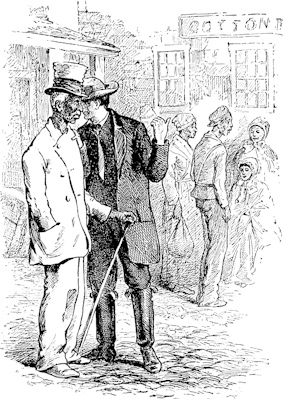
"Vina's got an idee she wants to git married." The speaker was a venerable darkey, who stood twirling his rimless hat with a sheepish air in the probate-office.
"Rather hard for you, Father Abram," said the judge kindly, "but it's a way girls have. I presume my daughter will be leaving me some day in the same ungrateful fashion. Bring around Vina's man and I will make out the license."
Father Abram's manner became at once more confused and ludicrous: he poised himself alternately on either foot, and scratched his head vigorously, while his facial expression was something too comical for description. Finally, through a series of embarrassed chuckles and gurgles, he rippled into a broad guffaw, articulating indistinctly between its paroxysms, "Bress de Lord, sah! I'se de man!"
"Shades of the mighty!" exclaimed the judge, in his astonishment dropping his pen upon a virgin page in his docket. "But the United States is a Christian country, Abram, and a man can't marry his own daughter here: it's contrary to law and gospel."
"Yes, sah?" said the negro submissively. "Den dar ain't no way for me an' Vina to git married, not even if we go over to Platte City? Vina'll be mightily disappointed."
"Good Heavens! no. 'Twould be a State's prison offence, and I don't see what ever put such a revolting idea into your head anyway, you hoary-headed old sinner!"
'"Deed, sah, 'tain't no idee ob mine. I done tole yer dat it was all 'long ob Vina, but I wouldn't see her outed for a sight" (outed being a negro expression for displeased). "An' don't yer t'ink, sah, de law might be changed, jus' for dis one time, or dat Vina an' I could be sent to de penitentium togedder? It's rather hard on both on us, 'specially on Vina—'specially as she ain't no more my darter than you be."
"Why didn't you say so before, instead of having all this talk about it? I don't know whether to believe you now: it is more than likely only a lie that you have trumped up as a last resort."
"Wish I may die, sah, ef it ain't de honest truf; an' de fus' time dat ebber I set eyes on Vina war in a slabe-pen in New Orleans eight years ago, when we war sold to de same marster. Ef Massa John Brown war libbin' he could prove it to yer; but dar ain't no udder libbin' human 'cept de slabe-driber—and he war blowed up on his nex' trip up de ribber—dat knows anyting about it."
The judge believed now that Abram had spoken the truth, for the time
When Old John Brown, Ossawattomie Brown, Shall be a name to swear by in backwoods and in town,
had come. The time was the commencement of the war, and any reference to his name on the part of a negro was equivalent to the most solemn oath.
"What did John Brown ever know about it?" asked the judge.
"Why, yer see, he war dar, sah: he come down de ribber on de same boat wid de driber an' Vina. De driber he'd done bought up a heap ob likely young gals all de way down t'roo' Missouri an' de udder towns what neighbored on to de ribber—han'somest young women he could find, what'd bring a high price in New Orleans—an' when he gits dar, what's he do but go roun' to all de slabe-pens an' buy up a heap ob worn-out, or'nary old niggers, what had been worked to def in de rice-swamps, an' nobody wouldn't gib five dollars for. Den he marries de peartest ob de gals to de mizzablest ob de ole men. When de time fur de auction come, dar was plenty ob buyers for de gals, but nobody wanted dem good-for-nuffin' ole husbands. 'Can't help it,' says de driber—'Can't help it, no way whatsumebber: it's ag'in our principles to part families. Ef yer want de woman, yer mus' take her ole man too.' An' so dey gin'rally did, an' paid a high price fur him too, fur de sake ob gittin' de gal. Wall, as I was a-sayin', Massa John Brown he come down in de same boat wid Vina: he'd took notice ob her, and he knowed she hadn't any ole man. De nex' day he come walkin' down to de slabe-pen, a-purtendin' to be a planter, and a-axin' de price ob de niggers. When dey tole him I was Vina's husband, he says, 'Why, he's too ole to be anybody's husband: I don't believe he's got a toof in his head.'—'Yes I has, massa,' says I: 'I'se got t'ree left, and can chaw hoecake powerful, but I don't crack no pecans in my mouf. Better buy me, sah: dar's a heap ob sarbice in me yet. I'se only drawed up wid de rheumatiz, dat's all.'—'Come ober heah to de light,' says he, 'an' let me look in yo' mouf, an' see whedder yer hab got any teef.' So I went wid him, an' while he was a-purtendin' to find out my p'ints he says to me, very quiet, 'Yer ain't dat gal's husband, nohow,' says he, 'an' yer knows it.':—'I knows it, massa,' says I, 'an' I'se skeered for my life ob her, fur she done said she'd kill any one dey dar'd to mate wid her: she's done got a husband ob her own up de ribber, I reckon.'—'Yes, dat am de truf,' says Massa John Brown; 'but see here, uncle: de Lord has done 'p'inted yer to be a guardian angel to dat po' chile. He calls yer to be a fader to her; an' from dis day yer is her fader—'member dat. But it may be jus' as well for yer to purtend to be her husband: 'at will keep de udder boys from pesterin' her. But 'member dis: de Lord will 'quire dat chile's happiness of yo' han's, an' will so do by yer as yer do by her.'—'Be yer de angel ob de Lord, massa?' says I. 'Clar' to goodness, sah! I was dat skeered one knee knocked ag'in de udder like a woodpecker a-hammerin' a rotten tree.—'Yes,' says he: 'I be de messenger ob de Lord, an' my name is John Brown, but I don't s'pose yer ebber heern tell ob it.'—'No, massa,' says I, 'we don't see no powerful sight ob angels down in de rice-swamps.'—'Well, keep a-watchin' an' a-waitin',' says he, 'an' yer will heer from me ag'in.' Wid dat de driber come up, and he tole him he guessed he wouldn't buy me dat day; and den he went away.
"Vina said dis mornin' she 'lowed to go up to yo' house to do some washin' for de missus; an' yer can ax her, sah, an' she'll tell yer dat all I'se been a-sayin' is de libbin' truf."
The judge hardly needed any confirmation—Abram's story was too straightforward and naïf to have been coined—but, telling him to call at his house toward evening, and that he would have the necessary papers there, and make them out if satisfied as to the eligibility of the parties for such a contract, he dismissed the aspirant for marital honors. As the judge entered the shaded coolness of his library after a distracting day spent in the discussion of a complicated will-case, the refreshing atmosphere of refinement and quiet and home exercised so powerful an influence over his tired nerves that he straightway forgot all professional and other cares, and stretching himself in his favorite lazy-chair, was soon fast asleep.
As he drifted back to a semi-conscious state he became aware of voices conversing on the back veranda, which shaded one of the library windows. The voices were those of his wife and the girl Vina, and the words which he first clearly comprehended were—
"I tell yer what, Miss' Fairdealer, dar ain't no niggerism about ole Fader Abram."
As Father Abram approached the nearest to a pure-blooded Congo African of any negro that he knew, the judge rubbed his forehead in the gentle stimulating way which he always employed when he wished to convince himself that he had heard aright and to assure some sophomorical young lawyer that he had not been asleep at all, but had caught every word of his long-winded statement of the case. The judge's ideas came back to him with their usual easy flow, and before the next sentence was enunciated he had made a mental summing-up of the case and given judgment for the plaintiff.
"I mean," continued Vina, "dat Fader Abe's got de whitest soul ebber yer see: he couldn't do a mean ting, no matter how much money de debbil 'greed to pay him for't. Fus' time I ebber see him war down in Lousianny. My ole marster had sole me away from my husband an' from John Brown: she war a little ting den, only six mo'ths, an' oughtn't to have been weaned, but I don't s'pose he cared whether she libbed or died, and de slabe-driber wouldn't take her—"
"How did you," interrupted Mrs. Judge Fairdealer with the curiosity of a true woman, "ever give your little girl such an unsuitable name as John Brown?"
("Why couldn't the woman let her go on with her story?" thought the judge. What did he care how that impish little creature, whom he had always regarded as old Abram's granddaughter, and who glared at him with such savage malignity from her piercing black eye (no figure of speech, for she had but one) when with his foot and cane he gently rolled her off the door-mat, where he found her coiled up asleep on his entrance to the house,—what did he care how that mixture of chimpanzee and evil sprite, to whom were to be attributed nine-tenths of the mischief done in the neighborhood, came by her unmaidenly cognomen?)
"John Brown didn' hab no name den: she war jus' my baby, dat war all. I use to t'ink I'd call her for her fader, an' his name war George—mos' consniptious rascal ebber yer see, de han'somest man in de whole township (John Brown takes arter him a sight), but so powerful ugly" (ugly being used here in reference to disposition) "dat de only way de oberseer could make him mind was to hab a parcel ob de boys hold him down while he kicked him in de mouf. Wall, short time befo' John Brown was born he kicked one of his eyes out dat ar way, and I nussed him an' tended him till he got well; an' when John Brown come, 'clar' to goodness ef she didn' have jus' only one eye too! Wall, I lubbed dat ar George wid all my soul, Miss' Fairdealer. Mean an' sneakin' a nigger as ebber libbed, but I didn' know it den; an', anyway, he war John Brown's fader, an' powerful han'some; an' dat do count for sumfin'. When dey sole me away from him I jus' t'ought I should die. Dey let me take my baby wid me down to de partin'-plank—dat's what dey called de gangway dey t'row out from de steamboat—but dar de gals had to bid good-bye to all dar fren's. Such a hollerin' and yellin' an' takin'-on you nebber heerd, Miss' Fairdealer. It was a little lonesome, landin' in de midst ob a right smart piece ob timber, like a many another along de Big Muddy, whar de boats stop to wood up—fearsome-enough place any day, but at night, wid dem tar-barrels a-flarin' an' dem women a-screechin'—some on 'em gone clean crazy, and all on 'em actin' zif dey had—it war more like dat place dan any 'scription I ebber heerd any minister gib ob it. I 'members one face, dat ob a man dat leaned ober de railin' and looked at us bein' dribben on board, dat looked so wild and mad-like. I allus t'ink de Lord will look dat way when on de day ob judgment he says, ''Part from me, all ye onb'lievin', backslidin' workers ob pernickety: don't want to see no more ob yer.' He spoke to me once on our way down de ribber. 'Hab patience, chile,' said he: 'de Lord ain't clean forgot yer. He'll bring yer an' yo' baby togedder ag'in ef yer kin only wait His own good time. I'm on de Lord's business: He's sent me down dis yeah ribber, same as he sent Moses into Egyp', to 'quire into dis matter an' to preach deliberance to de captive. Yer will all be free some day, but yer mus' hab patience, for de time is not yet.' I heern some one say dat dat war John Brown, and somehow de name heartened me up a little, do' I'd nebber heern it befo'."
Vina next told the incident of her so-called marriage at the slave-mart with old Abram.
"'Pears like," said Vina, "I could hab killed dat man when dey tole me he was my husband; but when he tole me 'twan't no sech ting, an' axed me if I hadn't ebber heern 'bout Fader Abram at camp-meetin', an' dat he wan't no fader till de Lord sent His angel and called him to be one—same as He called him to be a fader to me—den I listened to him, an' 'gan to b'lieve de Lord reely had sent him. Den he tole me how Abram went down into Egyp' wid his cousin Sarer, an' ole Pharaoh wanted to marry her, an' Abram he purtended dat Sarer was his wife, so Pharaoh shouldn't get her—leastways, it was sumfin' like dat—an' how de Lord bressed 'em, an' how when dey cl'ar'd out ob Egyp' dey stole 'bout ebberyting Pharaoh had; an' dat John Brown had done tole him to be anudder Fader Abram; an' I promised him I'd be anudder Sarer to him, an' we'd pull de wool ober de white folks's eyes, an' serbe de Lord till it done pleased Him to set us free."
Vina and Father Abram were bought by a planter who, with so many others in 1855, swarmed to the irrepressible conflict which was to decide whether Kansas was to be a free or slave State. By the repeal of the Missouri Compromise this question had been left for settlement to the people of the Territory. Emigration flowed in rapidly, both from the South and the North, and the terrible days of Border Ruffianism followed. Vina's master settled upon a farm in Southern Kansas, on the banks of a little stream called then by the picturesque name of the Marais des Cygnes, which has since been changed to one of a more prosaic character. Here they heard frequently of old John Brown of Ossawattomie, and began to have a clearer understanding of the man and his mission. Vina spoke of her life on the Marais des Cygnes as not a hard one, but her heart ached for her baby and for George, and the longing to see them again grew with every day and night. She felt sure that John Brown could help her, and one night Father Abram said to her, "I'se gwine to run away, honey—gwine to keep agwine till I find John Brown: den, when I'se foun' him, I'll keep agwine and agwine and agwine till I finds yo' George: den I'll come back arter yer. Reckon I'll be here in about a munf: yer kin look for me ebbery night arter dat down by de big cottonwood tree on de ribber." And when the month expired Father Abram came back, but he did not come alone: John Brown and he had found George. He only waited to see their rapturous meeting, and then bade good-bye to his "darter Vina," and heroically trudged away. Vina and George fled away to John Brown's camp near Ossawattomie. Her first question was for her baby. It had been cared for by one of the negro-women, and was now three years old. The family had removed to Platte City, Missouri, nine miles from the Kansas frontier, but the child was still with them when George left.
"An' yer done luff dat bressed baby? Didn' car' what 'come ob her, so yo' own mizzable self was safe!" exclaimed Vina in much disgust. George explained that this was the only way—that it would have been utterly impossible for him to have got away with the child—and promised that if ever a raid was made in that direction, he would join it and bring her away, at no matter what risk. In 1857 affairs began to be more settled in Kansas. John Brown, having ended his work here, had gone East: Vina and George were living in Leavenworth. Little by little, she had found out that it would have been better for her if they had never met. George was satisfied: freedom for him meant being supported by Vina, getting drunk whenever he pleased, and ill-treating her by way of showing his gratitude. Vina could have borne all this willingly enough, but at last a perfectly safe opportunity for the rescue of her baby occurred, and George refused to attempt it. They were well enough off as they were: he didn't see "what she wanted ob dat chile to support—he was sho' he wouldn't do it;" and as for adventuring his precious self among the Philistines again, he utterly declined the proposition. Then Vina's anger rose, and with her lifted mop she drove her liege lord from her cabin-door, which he ever after found barred against him. George soon consoled himself with another wife, and about a year later departed for parts unknown. The years that followed were hard and lonely ones for Vina, but she never wept for George: to use her own expression, "He wan't no cry-tear-un (criterion), he wan't, and she wasn't going to cry no tears for him."
Father Abram had found his way to Leavenworth too, but it was not till 1860 that Providence again threw them together. He stood erect now with a sense of freedom and manhood: a comparatively easy life had untied the knots that rheumatism had twisted in his muscles, and the weight of fully twenty years seemed to have been lifted from his shoulders. He heard her story. "'Pears like de Lord has got more work for Fader Abram," he said simply; and shortly after he found a way to do the Lord's work. When Vina reached this point in her story the judge became aware that his wife and himself were not the only listeners. Father Abram, true to his appointment, had come around to see if the judge's scruples had been overcome, and to ask for the marriage license.
"Fader Abram," said Vina, "tell Miss' Fairdealer how yer done foun' John Brown."
"I JUS' TOTED HER ROUN' TO DE ICE-CREAM STAN'."
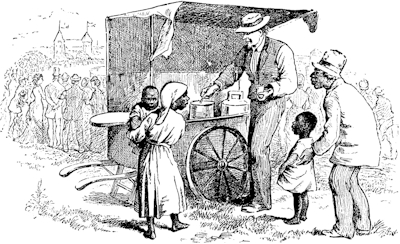
"Couldn't help findin' her," replied the old man. "Dar she was, right 'fo' my eyes. I reckon yer'd a foun' her ef de Lord had sot her down squar' in front ob yer, as he did ob me.—Ye see, madam, dat ar spring I was workin' for de Risin' Sun libbery-stable: Colonel Trott an' Cap'n Gallup run it den. De colonel was what yer call a fas' man, one ob yo' racin', bettin' characters, but right smart ob a gentleman same time; while de cap'n b'longed to de Church, and war de meanes' man out of Missouri. 'Bout dat time de firm owned Challenger, de fas'est Kansas horse goin', an' dey made a heap ob money a-racin' him at all de fairs. De colonel allus divided de winnin's wid de cap'n, but when he lost on a race de cap'n made him stan' it out ob his private puss, 'cause he said bettin' was ag'in his principles, anyhow. Dis yeah spring dar was goin' to be a famous big race at Platte City, an' de colonel he 'lowed he'd take Challenger ober. Now, de colonel nebber rode a hoss on de track—'twan't t'ought to be de correct ting for a gentleman to do—and he weighed a heap too much for anyting short ob a elephant to race. I war de leanest man in de stables, an' as de colonel war more dan usual pertik'lar 'bout Challenger carrying light weight dis time, he took me 'long wid him. When we got dar he gabe me a quarter an' tole me to loaf roun' until de races was called. Dis war jus' what I wanted, fur I knowed dat de Skylarks who used to own Vina libbed at Platte City, an' I t'ought likely some ob dem mought be at de races. Dar was a right smart sprinklin' ob niggers on de groun's, mos' ob dem hangin' roun' de 'freshment-stan's, an' I walked roun' 'mongst 'em kinder careless, zif I wasn't t'inkin' ob nuffin' pertik'lar, when I see standin' right in front ob me a little one-eyed gal dat 'minded me mightily ob Vina's George. 'Whose little gal be yer?' says I.—'She's one ob Judge Skylark's niggers,' says a woman standin' by. 'Don't see none ob de udders here: shouldn't wonder if she'd runn'd away to see de racin'.' Wall, I waited till nobody wan't lookin', an' den I axed her what her name was.—'Dey calls me Vina's little gal,' says she.—'Who's Vina?' says I.—'Dar ain't no Vina,' says she.—Who's yo' fader an' mudder?' says I.—'George was my fader,' says she, 'but de abolitioners done carried him off an' chawed him up. I'se awful skeered ob de abolitioners, I is. I ain't got no fader nor mudder: de buzzards done hatched me.' Wall, I was dat sho' it was Vina's chile dat I didn' wait no longer, but jus' toted her roun' to de ice-cream stan' an' filled her chock full of ice-cream. Den I says, 'How would yer like a ride on one ob dem fancy hosses?' an' showed her whar to hide outside de groun's until de races was ober, when I'd gib her one. I knew de colonel 'lowed to send me home wid Challenger dat night, and, do' it was mighty resky, I 'lowed to take dat chile wid me. Dat war de fus' race dat Challenger lost dat season, but I didn' put him t'roo' his best paces, for I t'ought likely dar might be need ob tall runnin' dat night, an' I didn' want him to play out den. De colonel war mightily outed, fur de stakes was heavy, an' I was sorry 'nuff to see him lose. He tole me I'd got to ride libelier dan dat ef I meant to git to de Leavenworth ferry 'fo' de boat made its last trip for de day; and I knowed dat as well as he did.
"I foun' little John Brown waitin' fur me jus' whar I tole her to hide: she was too skeered to go home, fur she knowed dey would gib her a lickin' fur runnin' away. I took her up befo' me on de hoss, an' we started fur home, 'Pears like de road from Platte City to de Leavenworth ferry's jus' 'bout de lonesomes' in dis yeah worl', an' I hadn't trabelled more'n five mile 'fore I knew I was follered. I could hear de clappetty, clappetty ob de hosses a good piece behin' me, an' one place whar de road stretched middlin' straight for nigh a half mile along de bluffs I see 'em, as many as five men, a-ridin' like mad an' a-shakin' carbines in de arr. Den I knowed dat dey was eder after John Brown or Challenger; an', hoss-thieves or kidnappers, I knew it would far' jus' about de same wid me. 'Go for true,' says I to Challenger; an' den I wraps John Brown in de hoss-blanket so dey couldn't rightly tell what it was I was a-carryin'. We'd a won de stakes easy ef I'd made Challenger lif' up his heels on de track de way he did on dat ar road. De sun went down an' de moon riz, an' I t'ink likely we trod on as many as twenty squirrels: dey didn' hab time to cl'ar de road after dey heard us a-comin'. I rode into Slab Town jus' about ten minutes ahead of my follerers, an' den I foun' dat de wus' dat could happen had happened. De Ella had made her las' trip, an' was tied up to de Kansas sho'. Dar wan't no time fur considerin' de matter. I see a flatboat hauled up on de bank, an' I shubbed her off, led Challenger onto her, an' poled her off into de ribber. Challenger didn' want to go aboard, nohow—he knowed it wan't safe—but I struck him de fus' blow I ebber gin a hoss of his blood, an' we were pretty well out in de current when de Missourians come ridin' down to de sho'. Dey was dat mad when dey see us dat dey fired all dar shot-guns at us, an' Challenger was dat s'prised dat he jumped right into de arr, an' come down on his feet ag'in like a jack-rabbit. Dat was a leetle too much for de ole raft, an' she done went to pieces like a bundle of straw. John Brown was a-holdin' on to Challenger's neck, an' she jus' held on, legs an' han's, wid her fingers clenched into de mane, so dat I had to cut some ob it off arterward to git 'em away. We'se nebber been able to prise 'em clean open sence: dey look more like birds' claws dan han's, anyway, do' 'tain't likely yer ebber took notice on't. I was a-holdin' on to Challenger's tail, an' dar we all t'ree was in de middle ob de ribber. Wall, fus' de current carried us down a good piece, an' I t'ought it was all ober for dis nigger sho'; den de saddle-girth bust, an' dat seemed to gib Challenger some 'couragement, fur he drawed a long breff an' struck out fur de Kansas sho'. Wall, it war an awful swim, an' no mistake, but bimeby we all landed, 'bout halfway down to Quindaro, blowin' and snortin' like so many steamboats. I didn' try to ride Challenger up to Leavenworth, but jis' walked by his side, a-huggin' an' a-kissin' him as I nebber kissed no women-trash in all my young days, an' John Brown a-lyin' 'crost his back as limp as a empty gunny-bag. I took her roun' to Vina's 'fore I went to de libbery-stable, an' jes' 'fore I come to de doah a t'ought come to me dat made me dat sick to de stomach I could hardly stan'. S'posin', after all, she wan't Vina's chile! But she was—leastways, Vina was sure ob it—an' ob all de goin's-on dat gal went into yer'd a t'ought 'twas sumfin' mighty consequentious, stead ob nuffin' but a little nigger young 'un. 'Yer jus' take back dat hoss, Fader Abram,' says she, 'an' den come back to yo' darter Vina; an' don't yer dar lib anywhar else after dis.'
"I tole Cap'n Gallup I'd been chased by hoss-thieves, an' had swum de ribber wid Challenger, but I didn' say nuffin' 'bout John Brown, for dat war de name Vina gabe de chile dat very day. I went dar, as she tole me, an' she got up de biggest dinnah, wid more chicken-fixin's an' pie an' cake dan ebber I see; but dat arternoon I was taken down ag'in wid de rheumatiz—couldn't do no work for more'n six munfs, an' don't reckon I'll be much use any more, nohow. Vina's tuk car' ob me more'n two year now. She's had a sight ob beaux, but she's allus tole 'em she couldn't leab her ole fader. Las' one was dat spruce yaller schoolmarster from Oberlin. Says I, 'Vina, why don't yer git married? 'Pears like yer'd feel less onsettled an' lonesome ef yer had an ole man.' Says she, 'I'se got one ole man: dat's 'nuff.' Says I, 'But don't yer nebber t'ink yer'd like to git married, Vina?' An' says she, 'Yes, Fader Abram, I do. How does you feel 'bout it?' and wid dat she—Beg yer pardon, sah, I didn' know you war dar, sah, but if yer've brought dem ar papers we was speakin' 'bout dis mornin', sah, I t'ink Vina 'll let dis day's washin' go toward payin' for 'em, sah, an' I'll come down to de office an' tote up yer winter's coal for de balance ob de damages."
Lizzie W. Champney.