SKETCHES OF EASTERN TRAVEL.
Reading edition
II. BATAVIA.
"Batavia, ho! and just ahead at that!" exclaimed the captain of our gallant East Indiaman as the entire party of passengers sprang to the quarter-deck on the first cry of "Land ahead!" It was scarcely five o'clock in the morning—not dawn between the tropics—but our impatience could brook no delay, and despite impromptu toilettes and yet unswabbed decks, with sluices of sea-water threatening us at every turn, we hastened forward to catch the earliest possible glimpse of the quaint old city of which we had heard such varied accounts. "You'll think a good part of it was built in Holland three centuries ago," said our captain, "then boxed up, sent across the waters, and dropped down, pell-mell, in the midst of the jungle." We all laughed incredulously at the time, but remembered his words afterward.
Batavia, one of the strongholds of Dutch power in the East, occupies the north-western extremity of the island of Java. It is composed of two distinct settlements, known, respectively, as the "Old City" and the "New City." The former, built directly on the seaboard, consists mainly of warehouses; stores and government offices, with a pretty extensive mingling of native dwellings and bazaars. The business-houses occupied by Europeans are all built in the old Dutch style of centuries ago, and their venerable appearance is largely augmented by the mould and discoloration of the sea-air; while the tout ensemble presents an ancient and dilapidated aspect strangely at variance with the luxuriant verdure of the tropical scenery and the brilliant tints of the picturesque Oriental costumes everywhere visible. The New City is a terrestrial Paradise, with broad avenues shaded by majestic trees, spacious parks, and palace-dwellings of indescribable elegance—a quaint commingling of city and country, of Oriental luxuriousness with the Hollander's characteristic love of solidity. In truth, the New City is not a city at all, but a continuous succession of beautiful villas embowered in orange groves, and surrounded by palms and banians, upon which climb and clamber flowering vines and creepers innumerable, while birds are singing, bees humming and butterflies fluttering their gauzy wings, utterly regardless of the proprieties of city life.
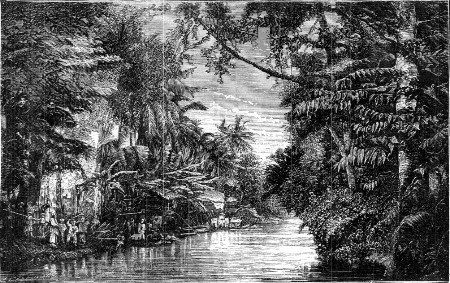
At eight o'clock we found ourselves in the custom-house, surrounded by Dutch revenue-officers, whose insignia of office seemed to consist of the huge bunches of keys with which they were armed. Their stylish uniforms and fair pale faces were singularly in contrast with the chocolate-colored skins, naked busts, scarlet girdles and green or yellow turbans of the crowds of native porters who stood ready to take charge of the baggage as fast as it was examined. Having seen our effects disposed of, we set out for our quarters in the New City, attended by the Bengalese comprador who was to serve as guide and purveyor-general during our stay in the island. We were driven in the neatest of pony palanquins, drawn by horses scarcely larger than Newfoundland dogs, over smooth, well-shaded roads, amid luxuriant fields and meadows, and for a good portion of the route by the banks of a beautiful canal, all aglow with busy life. Here and there were sampans and budgerows, some loaded with merchandise, and others with passengers, their light sails spread and pennons gayly flaunting in the breeze, while men, women and children, bathing and swimming in the smooth waters, sported like fish in their native element, and never dreamed of the possibility of danger.
A STREET IN BATAVIA (THE NEW CITY).
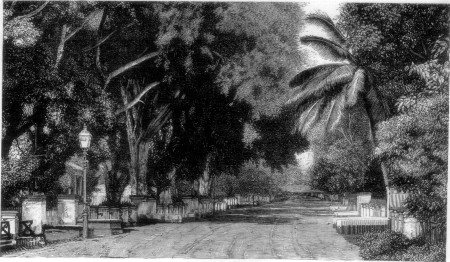
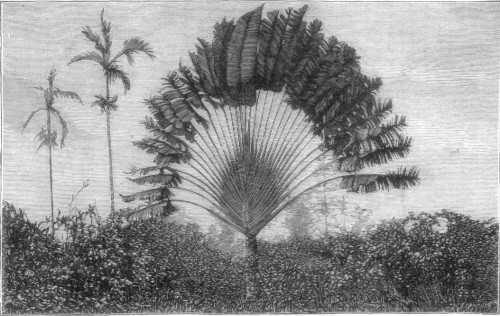
Among the majestic trees that formed natural archways above our heads, shutting out completely the sun's fervid rays, we noted especially the banians and cotton trees, the latter frequently besprinkling our heads and shoulders with what seemed at first glance a shower of bonâ fide snow, but on examination proved only the light, fleecy down of sea-island cotton. Conspicuous among the trees we encountered on that pleasant morning drive was the Palmier du voyageur, more generally known as the talipat or priestly palm, which was described in a recent number of this magazine.
A canal in Batavia
One characteristic feature of Javanese residences is their superb baths. The pools are usually of marble or granite, of such huge dimensions that one may float and flounder like fish in a pond, while the superintendent of the bath keeps in constant play a brace of jets that send their sparkling spray over the bather's head and shoulders with most refreshing results. The water is clear as crystal, and sufficiently cool for the relaxed state of the system in a tropical clime. Everybody bathes three times a day, and one would far sooner dispense with a meal than do without either of these stated baths.
THE TALAPAT PALM.
The usual routine of European life in India is to rise at "gun-fire" (five o'clock), go out for an airing in boat or palanquin for two full hours, bathe and dress at eight, take breakfast at nine, lunch at one, and siesta from two to four, when everybody retires, and, whether one wishes to sleep or not, he is secure of interruption, and has the full benefit of being en déshabillé for the two most oppressive hours of the day. At four the second bath is taken; at five all go out in full dress in open carriages, and after a rapid drive over some of the public thoroughfares, the horses are walked slowly up and down the esplanade, where all the fashionable world assemble at this hour to see and be seen, and exchange passing courtesies or comments. At half-past six "the course" is deserted, and brilliantly-lighted dining-rooms are thronged with guests eager to test the quality of the rich and varied delicacies of which an Oriental dinner consists.
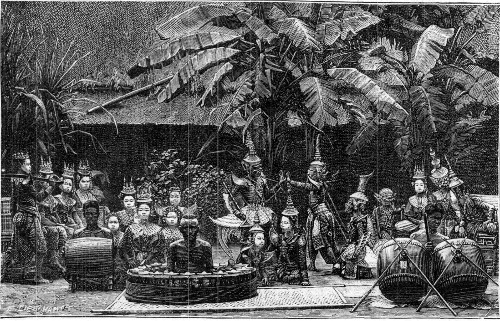
A "GAMMELANG," OR JAVANESE CONCERT.
This is the principal meal of the day, and, occupying often two or three hours, it is made not merely an epicurean feast, but also an intellectual and social banquet. Strong coffee, served in the tiniest of porcelain cups, follows the guests on their return to the drawing-rooms, and music, conversation, reading and company fill up the hours till midnight, when the third bath is taken immediately before retiring. This routine is seldom varied, except by the arrival of strangers, bent, like our party at Batavia, on sight-seeing. We soon wearied of the very voluptuousness of this stereo-typed course of indulgence, and welcomed in preference the fatigues and annoyances of exploring the thousand objects of interest that were beckoning us onward to jungle, mountain or sea-coast. Our friends, who were old residents, shook their heads knowingly, and prophesied sunstroke or jungle fever; but we went sight-seeing continually, filled our specimen baskets, and escaped both fever and sunstroke. The climate of Batavia is, however, extremely insalubrious for Europeans: a deadly miasma everywhere overshadows its luxuriant groves and lurks among the petals of its brightest flowers, rendering absolutely necessary regular habits of life. Before the occupation of the New City, when merchants and officers all resided on the seaboard, in the immediate vicinity of their business-places, the mortality was fearful, till utter depopulation seemed to threaten the colony. The inland location of the New City is more salubrious, and the extensive grounds that surround each dwelling give abundant freedom for ventilation, while the few hours passed by business or professional gentlemen at their offices—and those the best hours of the day, from breakfast to luncheon—are not deemed specially detrimental to health, even for foreigners. The Malays, Chinese and East Indians generally reside anywhere with impunity.
LIEUTENANT OF THE SULTAN'S GUARD.
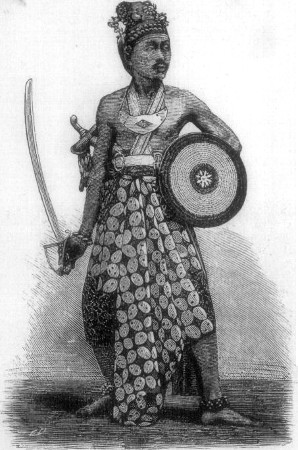
As our ship would be several weeks in port, discharging and taking in cargo, we availed ourselves of so fortunate an opportunity to explore some of the native settlements in the interior of the island. A Dutch officer, long resident in Java, kindly offered his escort, and obtained for us such passes and other facilities as were needed. Our first stopping place was at Bandong, the capital of one of the finest provinces of Java. It is under the nominal control of a native prince, who bears the title of "regent," holding his office under the government of Holland, from which he receives, an annuity of about forty thousand dollars. Among the natives he maintains the state of a grand Oriental monarch, and his subjects prostrate themselves in profoundest reverence before him; but both he and his domain are really controlled by half a dozen resident Hollanders, at the head of whom is the prefect. The palace of the regent is a massive structure, completely surrounded by beautiful gardens; and just beneath the windows where we sat I noticed a picturesque little lake, about which were sporting joyously at the evening hour a group of the young maidens of the palace. They were graceful and lovely in the careless abandon of their glee, but they no sooner perceived the white faces of the foreigners looking down at them than they fled like frightened doves, hiding themselves in a grove of bananas, in any single leaf of which one of these dainty demoiselles might have clothed herself entire.
We found the regent surrounded by crowds of native attendants, among whose prostrate forms we wended our way to his presence. He was seated on a raised dais at the upper end of the audience-hall, and received us with the courteous dignity of a well-bred gentleman. His dress was that ordinarily worn by Malayan rajahs—brocade silk saráng fastened by a rich girdle, a loose upper garment of fine muslin, and a massive turban of blue silk wrought in figures of gold. Costly but clumsy Arabic sandals, and a diamond-hilted kris or dagger of fabulous value, completed a costume that looked both graceful and comfortable for a warm climate. He greeted the ladies of our party with marked empressement, thanked them for their visit, and conducted them in person to the entrance of the seraglio to make the acquaintance of his wives and daughters.
SOLDIER OF THE SULTAN'S GUARD.
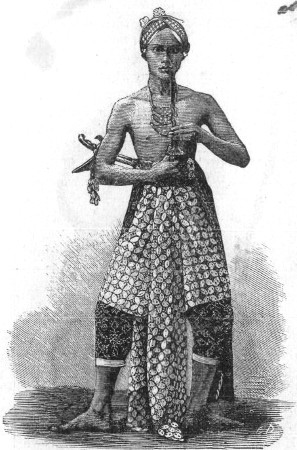
The next evening we were all invited to be present at the gammeláng, or orchestral and dramatic entertainment, in the harem of this prince. The invitation was gladly accepted, and so novel an exhibition I have seldom witnessed. Many of the musicians were masked, and wore queer-looking, conical caps that looked like exaggerated extinguishers, and a sort of light armor in which their unaccustomed limbs were evidently ill at ease. Occupying a conspicuous position in the very front, I noticed a Siamese raknát-player, robed in the native dress—or rather undress—of his country, and his hair cut à la Bangkok. He was singularly expert in the use of his instrument; and I learned afterward that, though taken to Java as a slave, his great musical talents had won for him not only liberty, but the highest favor of the regent of Bandong. He was the only rahnát-player in the gammeláng, but there were some two hundred timbrels, half a dozen drums, ten or twelve tom-toms, twenty violins, sixteen pairs of cymbals, and any imaginable number of horns, flutes and flageolets. I leave the reader to imagine the amount of noise produced by such a combination: my ears did not cease tingling for a week. But everybody praised the music, and evidently enjoyed the fun. The dancing was like all Oriental dancing, very voluptuous and enthusiastic, adapted especially to display the exquisite charms of the performers and move the passions of the audience. The play that followed possessed no merit, except in the bewildering beauty of the girlish actresses, and their superb adornments of natural flowers artistically arranged in coronets and wreaths, with costly pearls and diamonds. The play itself was simply a farce—a series of ridiculous passages between some lovesick swains and their rather tantalizing lady-loves, who eventually escaped, amid a shower of roses and bon-bons, from their pursuers, and disappeared behind a huge palm tree, which the next instant had vanished into air, roots, branches and all.
After a somewhat adventurous ascent of Mount Tan-kon-bau-pra-hou, a hurried visit to the volcanoes of Merbabou and Derapi (the former nine thousand feet high, the latter eight thousand five hundred), and a glimpse at the sacred woods of Wah-Wons, we turned our faces toward Sourakarta and Djokjokarta, the two grand principalities of Java still remaining under native rule. Each is governed by an independent sultan, whom the Dutch have never been able to subjugate; and they are allowed, only by sufferance, to keep a diplomatic agent or "resident" at the courts of these monarchs. We had been forewarned, ere setting out on our tour, of the state maintained by these proud Oriental princes, and the utter impossibility of obtaining an audience without fulfilling to the very letter all the requirements of courtly usage. So we had sent forward some costly presents to each of the sultans, with letters written in Arabic and French, praying for the honor of an interview. Our messenger to the court of Sourakarta soon returned, accompanied by a native officer and five soldiers in full uniform, with a courteous letter of welcome from the sultan to his capital. He did not say to his court, and we were left in doubt as to whether we should see him, after all. But the day of our entrée was a most propitious one, as on that very morning this renowned monarch had been made the happy father of his twenty-eighth child. To this fortunate event we doubtless owed our reception at the court of this very exclusive potentate, who, we were told, almost invariably declined the proffered civilities of foreigners. Bonfires, illuminations and processions seemed the order of the day, business was suspended, bells were ringing, gongs sounding, and everybody was taking holiday, in commemoration of an event that seemed to have lost none of its novelty even after nearly a score and a half of repetitions.
The palace is built in pagoda form, with abundant architectural adornments, and is surrounded by a semicircle of smaller buildings of much the same appearance, though somewhat less imposing. The grandest view is at night, when the whole immense pile, from base to turret, is one blaze of light that but for the abundant tropical growth might be seen for miles away. The sultan is a well-informed and courtly gentleman, with a polish of mind and manners we were quite unprepared to find hidden away in the heart of Java. He is said to be the most distinguished of all the Malayan princes of this isle. He conversed with readiness on the general aspect of political affairs in Europe and America, inquired for the latest intelligence, and before we left invited us to be present at a grand military review on the following day. The garb of the troops, both officers and men, consists of long silken sarángs confined by embroidered girdles, gold or silver bangles in lieu of boots, and costly turbans adorned with precious stones—a garb that looked; better suited to the harem than the battle-field but their man[oe]uvres certainly did credit to their royal instructor in military tactics. The distinguishing weapon of Malayan soldiers, both in Java and elsewhere, is the kris, worn at the back and passed into the girdle. This is always carried both by officers and men, and very frequently civilians: the long sword is worn only by officers.
After the review we were presented to the sultan's eldest son, a tall slender young man, somewhat over twenty, with fierce, gleaming black eyes, and a profusion of black hair falling below his shoulders. His countenance indicated both intelligence and firmness, and his appearance might have been distingué but for his strangely effeminate dress of damask silk made like a girl's, his anklets and bracelets, gold chains and jeweled girdle, and a mitre-shaped coiffure of black and gold studded with enormous diamonds, any one of which would make the fortune of a Pall-Mall pawnbroker. A score of attendants about his own age were standing at the back of the young heir, while four diminutive dwarfs and four jesters in comic garb crouched at his feet, and innumerable other subordinates—such as the fan-holder, the handkerchief-holder, the tea- and bouquet-holders, etc. etc.—made up the retinue of this youthful dignitary. At a subsequent interview the sonsouhounan presented me to his mother and several other ladies of the royal harem. The sultan was first married at the age of twelve, and had at the time of our visit forty-eight wives.
THE ELDEST SON OF THE SULTAN OF SOURAKARTA.
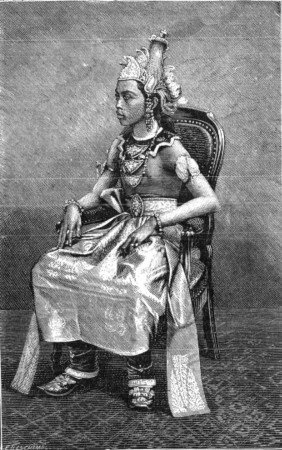
There is very much to interest the tourist in this Javanese city, so unlike the Anglo-Oriental settlements one meets elsewhere in the East, nor does he soon weary of its noble sultan and splendid Oriental court; but time forbade our tarrying longer than the third day, after which we pressed onward to the neighboring principality of Djokjokarta. This is the name most conspicuous in Javanese history, since there, from 1825 to 1830, floated victoriously the colors of the revolt, and victory was purchased at last only by the blood of fifteen thousand soldiers, of whom eight thousand were Europeans, and Djokjokarta remained as it was before, an independent sovereignty. The sultan, who belongs to an ancient family, is fine-looking, with a somewhat martial air, and a native dignity evidently the heritage of high birth. On our first interview he wore above the ordinary silk saráng a tight-fitting jacket of French broadcloth (blue), richly embroidered and trimmed with gold lace.
THE SULTAN OF DJOKJOKARTA.
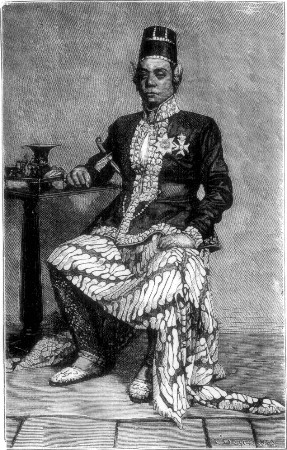
He displayed also a collection of crosses, stars, and other decorations conferred by various European powers, the French predominating. He had evidently a partiality for la belle France, and exhibited with no little pride an album containing photographs of Louis Philippe and Louis Napoleon. He conversed well in several languages, readily using either Arabic or French in lieu of his vernacular, and was evidently up to time in regard to the current political topics of the day. He introduced the ladies of our party to his young and beautiful sultana, and invited them to accompany her to the inner apartments of the harem. We found the private apartments of the seraglio, like so many others I visited all over the East, superbly magnificent in the display of gold and jewels, in costly carpets and exquisite hangings, in the most lavish exhibition of pictures, mirrors, statuettes and bijouterie generally. There were glowing tints and warm, rich colors, but all was sensuous: wealth and splendor were everywhere visible, but neither modesty nor true womanly refinement.
The sultan afterward entertained us by the exhibition of a curious collection of monkeys and apes. Some were of huge proportions, full four feet in height, and looking as fierce as if just captured from their native jungles, while the tiny marmosets were scarcely eight inches long. The orang-outangs and long-armed apes had been trained to go through a variety of military exercises; and when one of us expressed surprise at their seeming intelligence, the sultan said gravely, "They are as really men as you and I, and have the power of speech if they chose to exercise it. They do not talk, because they are unwilling to work and be made slaves of." This strange theory is generally believed by the Malays, in whose language orang-outang is simply "man of the woods."
Fannie R. Feudge.