Front matter (continued 2)
Reading edition
Thomas: If I was a girl I dare say I'd like to go to school. Of course, that's better than rocking the baby and washing the dishes—but fellows! I tell you they have better ways to pass their time, eh! Jackie? (Pokes him in the ribs. Both laugh.)
Helen: Well, it's a lucky thing for the world that all boys aren't like you, else where would our great men come from if all the boys were as willing to remain great know-nothings as you two are?
John: O, who wants to be great? Great men have to work, and to sit up nights and worry about things. I'd rather be a plough-boy than a great man any time.
Thomas: So would I! Nothing to worry about, just follow the horse and keep the plough straight.
Helen: Well, there's one thing of which both of you may be pretty sure.
Both: What's that?
Helen: You are in a fair way to get what you want. You will both be plough-boys until you are too old to hold the plough, and then you can go to the poorhouse, where the "great men" whom you despise will make laws to take care of you.
Thomas: That's just it; now you are coming around to John's statement. We will not have to worry; others will do that, you see.
Helen (impatiently): Boys, why don't you brace up and study as you ought to? What's the use of all this foolish talk? You know you don't mean a word of it! (Goes up stage.)
John: We do mean it, too, don't we, Tom?
Thomas: You're the one that talks foolishness. You said some boys would be "glad of our chance to go to school."
Helen (coming down quickly): Yes, and it's true, too. I heard my father telling last night about a boy living out in the woods beyond Gentryville who'd give almost anything for your chance. He's never been to school but a few months in his whole life, and—
Thomas: O, no wonder he thinks he'd like it, he doesn't know anything about it. I thought it was fun, too, when I was in the primer class.
John: Yes, so did I.
Helen: Well, he's beyond the primer class, I tell you. He knows the old Webster spelling book all by heart, father says.
John: How'd he learn it if he hasn't been to school? Your stories don't hitch very well, Miss Preachie.
Helen: He learned it all by himself, lying on the floor nights in front of the big fireplace. They are too poor to have even a grease light.
Thomas: Must think a lot of that old spelling book. (Both laugh.)
Helen: Of course he thinks a lot of it. He thinks a lot of any book. Father heard a man telling down at the store that this boy cut four cords of wood for some one, just to get a piece of a book.
John: O, wanted to read the Arabian Nights, probably.
Helen: But it wasn't the Arabian Nights that he bought; it was the Life of Washington.
Thomas: What's the use of his reading the Life of Washington? He's nothing but poor, white trash—too poor, you say, even to have a grease light. He'll never be anybody.
Helen: Don't you be too sure of that. I tell you that boy will be a great man. Some day you'll hear of him yet.
John: Just because he was fool enough to cut four cords of wood for a piece of a book?
Thomas: Well, I'd have had the whole book or nothing.
John: So would I (sneering). Why he was a fool. O, yes, we'll hear of him, of course. We'll read about him in the back part of the spelling book where the blank leaves are. But what's his name, do you know?
Helen: Yes, father told me. His name is Abraham Lincoln: remember it, boys, for I am quite sure you will hear it again some day.
Thomas: Of course we'll remember it; couldn't forget it if we tried. A boy that was as big a greeny as that.
John: I tell you, Helen, the next time that you have to write one of those things which you like so well—a composition—you can write it about "The Two Cuts, or The Wood That Was Cut for a Cut Book." My! but that will be fine. (Both laugh boisterously.)
Helen: Well, you may laugh, boys, but you'll find there'll be plenty of people to write about him, and it may be it will be done while you are yet alive to read the books, and more than that—
(Shouts heard from behind scenes.)
John (running off at right): Come on, Tom, I hear the boys forming for "There, old cat"; we'll be too late.
Thomas: But, how about your sum and my geography lesson? The teacher'll do something dreadful to us.
John (calling back over his shoulder): Bother on them, we'll have time to study after school calls: if we don't, who cares? Let Abraham Lincoln do the studying while we are having fun. Come on, come on. (Exit at right.)
Helen: Don't go, Tom; stay and have a perfect lesson for once.
Thomas: O, I've heard preaching enough for one morning. (Exit at right, running.)
Helen: That's the way it always ends. If I try to have them mend their ways, they just make fun of me for "preaching." (Goes to a desk and takes up book, opens it and sits at desk.) I'm only a girl, of course, but I am going to imitate poor Abe by trying to get a little knowledge into my head. But what foolish boys they are, and some day when Abraham Lincoln is a great man and everyone is talking about the wonderful things he is doing, John and Tom will be standing around whittling sticks and growling because they couldn't be as "lucky as Abraham Lincoln." Well, if I am anywhere around, I'll tell them of the things they said this morning. I know I shall never forget them. (Becomes intent on book.)
Curtain
CAPTAIN LINCOLN
Clara J. Denton
A DIALOGUE FOR FIVE BOYS
CHARACTERS
Captain Lincoln Lieutenant Dash Private Dunn Sergeant Free Gerolomo, the Indian
COSTUMES
Soldiers: For the four soldiers, suitable military outfits.
Indian: If a wig of long black hair is obtainable, part the hair and make into two heavy braids, twisting yellow or red flannel through the braids which hang down close to the face on either side. If a wig is impossible, decorate a strip of pasteboard with chicken feathers and fasten it around the head. Wear a brightly colored blanket thrown over a pair of overalls and dark cotton shirt. Wear moccasins. Carry old-fashioned gun.
The character of Lincoln must be taken by boy much taller than the others.
SCENE
Camp; tent in foreground with flap up, showing rude bed, gun, knapsack, etc.
Lieutenant Dash and Sergeant Free are discovered lying at full length not far from tent.
Lieutenant (rising): Well, I must say, I'm mighty tired lying 'round here waiting for that boat to come.
Sergeant (yawns and rolls over): Guess we'll never get where the Indians are if we wait for that boat. Wish we could all swim across the river. Captain Lincoln's getting mighty tired of waiting, too.
Lieutenant: No wonder! Such an unruly lot as he has to hold in check here.
Sergeant: Yes, think of his being blamed for that rowdy crowd breaking into the storehouse and drinking up all the whiskey. He didn't know a thing about it until it was all over.
Lieutenant (walking up and down): Yes, but you see that's the way things go; he's at the head of the company and he just has to stand the blame for all their meannesses. I should think they'd be a little careful of their doings for they all like him, or seem to, anyway.
Sergeant: You see, they just didn't think, that's the trouble with them.
Lieutenant: Perhaps they'll be more careful after this, that is if they like him as well as they pretend to.
Sergeant (jumping up): Oh, that's all real; they like him, you can depend on that. Didn't you ever hear how he came to be captain?
Lieutenant: No, I have often wondered about it, for he's young for that position. Tell me all about it if you can. (Seats himself on ground near door of tent.)
Sergeant: Well, it was this way; it's not a very long story, but I might as well sit down. (Sits on other side of door.) You see, there were two fellows put up: Kirkpatrick and Lincoln. The vote was taken in a field, by directing the fellows at the command "march," to gather around the one they wanted for captain. The other fellow was a good deal older than Lincoln and I s'pose most folks would say he was better fitted to be captain, but's sure's you live a good big majority went over to Lincoln's side. And I never saw a fellow so tickled as Lincoln was! (Slapping his knee with his right hand.)
Lieutenant: Well, now, they ought to stand by him and not cut up any more rowdy tricks, to have him disgraced by wearing a wooden sword. Better talk to them just as soon as you get a chance.
Sergeant: I will, sir, that I will. (Enter Private Dunn at left. He comes down and salutes.)
Private: You just ought to have been up the road with the boys a couple of hours ago. I tell you, we had heaps of fun. Talk about Indians!
Lieutenant (jumping up) } Indians!
Sergeant (rushing to him)
Private (crossing over): Indians! (Waving his hands for them to remain calm.) No, just one poor lonesome, hungry Indian—an old one at that.
Lieutenant } Did they kill him?
Sergeant
Private: I guess not! the Captain was there.
Lieutenant: Well, what did they do to make any fun?
Private: Well, they all ran at him with their guns, yelling "Redskin! Scalp him! Kill him! He's what we're after." Then the frightened old fellow drew from his belt a letter and whined out "Me good Injun, me no harm paleface. See—paper; from big white war chief." Someone grabbed the letter and read it aloud. It was from General Cass and said that the bearer Gerolomo was a friendly Indian and that he must be given food and shelter.
Lieutenant: Forged letter, no doubt.
Sergeant: I bet he was a spy.
Private: That's just what the others said. They all got around him and yelled "Shoot him! Kill him!" till I didn't think the poor beggar's life was worth two bits. He thought so, too, I guess, for he was so scared that he was almost white. They were all around him so that he couldn't run—tell you it looked tough. (Draws long breath.)
Lieutenant: But go on; you said they didn't kill the worthless cur?
Private: "Worthless cur!" Well, I guess not! the Captain heard the men and dashing in among them, he laid his hand on the Indian's shoulder, and he just roared: "The first man that touches him dies!" O, boys, you'd orter been there. (Goes up.)
Sergeant: Come back and tell the rest; what happened then?
Private (comes down): Someone sung out, "O, you're a coward, afraid of an old Indian. Let us have him!" Whew! You'd orter seen him then. I never see the Captain so mad. "Who says I'm a coward?" he roared, rolling up his sleeves.
Lieutenant: Well, did they fight him? (Laughs.)
Private: Guess not—didn't want to tackle that job. So the Captain after a minute or two took the old Indian by the arm and led him off to feed.
Sergeant: That was just like the Captain, but it may be the old fellow is a spy after all.
Lieutenant: Well, I guess that's the only Indian that we are likely to see and it's too bad of the Captain to spoil the boys' fun. O, here comes the noble red man now. (Gerolomo enters at right, comes down slowly and timidly.)
Lieutenant: Hullo, there, you redskin! What's your name? (Goes to him.)
Indian: Gerolomo. Me heap good Injun; heap like paleface, bring paleface heap meat. (Shows gun and continues to move on slowly across stage.)
Lieutenant: Stand still, there, and tell us where the rest of your people are; we'd like pretty well to kill a few hundred.
Indian (stands): Big paleface tell Gerolomo go bring venison, go bring duck.
Lieutenant: Well, why don't you do it, then? Better mind him, I tell you, or he'll have you shot.
Indian (shaking head decidedly): No, no, big paleface heap good, heap brave; no harm poor Injun.
Sergeant (going to Indian): You're off now, I'll bet, to tell your people just where to find us and just how many palefaces there are here.
Indian (repeats former business): No, no, Gerolomo go tell big paleface got venison, got duck, got squirrel.
Private (going to him and shaking his fist at him): None o' your lying now. If you go to the Captain with that yarn he'll make short work o' you. The Captain hates a liar, he does.
Indian (whining): Me no lie, me good Injun. Me go tell big paleface me bring venison, me bring duck, me bring squirrel.
Lieutenant (to the others): Listen to that, will you? He'll bring venison, he'll bring duck, he'll bring squirrel. My! but we'll be living high. (All laugh.)
Sergeant: We'd like to see your venison, your duck, and your squirrel.
Indian (briskly): All right, me bring 'em in, me bring heap meat. (Turns about and moves toward right exit.)
Lieutenant: Better go with him, Dunn, because if he is lying to us, which he probably is, he'll not come back.
Private: All right, come on you "heap good Injun." We'll see what you've got out there. (Exeunt.)
Sergeant (saluting): Hadn't I better go, too, Lieutenant? He may get away from Dunn.
Lieutenant: No, I think Dunn can manage him. But hasn't he learned the trick of telling a good lie?
Sergeant: I should think so. Venison, duck and squirrel, and he's only been in the woods a few hours.
Lieutenant: Well, of course he may be telling the truth, because the woods are full of game, and I daresay the old fellow is a good shot.
(Enter Private Dunn, carrying a squirrel in one hand, a duck in the other, followed by Gerolomo dragging a dead deer. They stop at center. Lieutenant Dash and Sergeant Free run to them.)
Lieutenant: Well, really, you old redskin you have told the truth for once in your life.
Indian (lifting his hands and eyes): Me shoot for big paleface. Great Spirit tell Gerolomo where venison, where duck, where squirrel for big paleface. Great Spirit always take care of big paleface. (Captain Lincoln enters at left and comes down slowly, unseen by Gerolomo. The others salute.) Big paleface take care poor old Gerolomo.
Captain Lincoln (goes to Indian and lays hand on his shoulder): You have obeyed my orders and kept your promise, the whitest soldier among us all could have done no better.
Tableau
Curtain
WITH FIFE AND DRUM
Clara J. Denton
A PLAY IN TWO ACTS FOR FOUR GIRLS AND THREE BOYS
CHARACTERS
Mrs. Mortimer, mother of the family Sally Caroline, the daughter Albert, the son Mr. Mortimer, father (this character has no lines) Auntie Temp, a negro slave George Washington Augustus, her son Clementina Diana, her daughter
SCENE
Neat home interior. Old-fashioned hair-cloth sofa at right of stage. Hair-cloth rocking-chair at left. Marble-topped table at center. Easel with large picture of Lincoln near center. Cane seat rocking-chair at left-front, also another at right-front. Crocheted tidies on sofa and all rocking-chairs, and any other minor accessories that will give to the room an old-fashioned appearance.
COSTUMES
Mrs. Mortimer and Sally Caroline: For these two characters borrow dresses made during the '60's. If this is impossible, make gowns of some cheap yet good-looking material to represent such. Let the skirt be very full and worn over hoops; the waist plain and tight-fitting with wide flowing sleeves with white muslin undersleeves. Wear a broad, flat, embroidered collar. Mrs. Mortimer wears her hair parted in the middle, two curls on either side of her face, held in place by side-combs; the remainder fastened in a knot at the back. Sally Caroline's hair hangs in curls. Let these costumes be planned and overlooked by a skillful matron who is at least sixty years of age.
Albert: In first act he wears an ordinary suit for young man; in second act butternut-color suit, ragged and soiled.
Auntie Temp: Bright-colored print gown, wide gingham apron, bright bandanna kerchief tied on head. This character should be represented by a stout person, if possible.
George Washington Augustus: Overalls and "jumper" of blue denim.
Clementina Diana: Cotton gown. The two last named must wear negro wigs or wigs of black wool. The characters making-up for negroes should cover the faces with some sort of toilet cream before applying the burnt cork or "black-face" preparation.
Mr. Mortimer: United States military uniform faded and ragged.
ACT I
Auntie Temp (before the curtain rises): Gawge Washington Augustus. O, Gawge Washington Augustus, Gawge Washington Augustus, I say. (Curtain rises. Auntie Temp is seen leaving stage at right.)
George (enters at left): I was jes' suah I yerd mammy callin' me in heah. Wondah whar she went? Mighty ha'd times dese is foh de niggahs, dat's suah. What wid ole marsa goin' off wid de Linkum sojas an' young marsa stampin' 'round an' sayin' he foh suah cehtain am agoin' wid de Fed'rates I mos' done wish I hain't nevah been bo'n. I is foh suah.
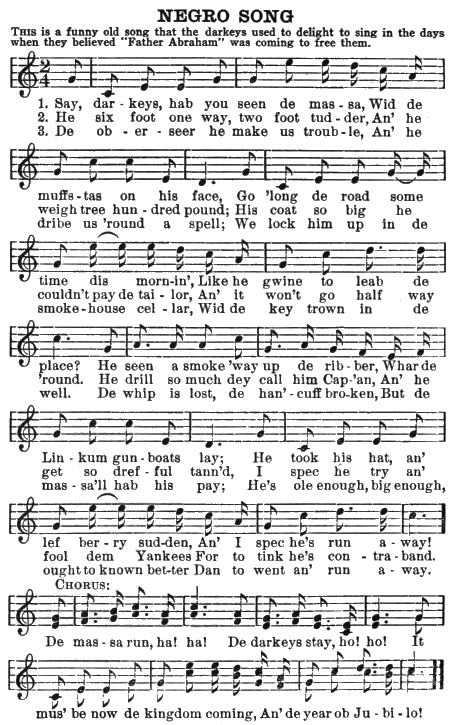
(Singing behind scenes, a strain of any darkey melody that may be convenient, though the following, is especially appropriate. George pauses to listen.)
George (continues after the singing dies out, looking toward right): Dere comes dat worfless Clementina Diana, ef she is my sistah. 'Peahs lak any niggah dat can sing now-a-days ain't got no heart, jes' all gizzahd lak a chicken. (Clementina enters at right, still singing.) Shet up dere, Clementina Diana, how kin you go a-singin' 'round right in de midst o' dis yere wah when de folkses is a-shootin' each udder down, an' a—an' a——
Clementina: O, pshaw! Gawge Washington Augustus, I didn't make de wah, 'sides I hain't seen none o' it, so I might's well be gay and happy while I kin. Mammy's been a-squawkin' foh ye dis yere long while.
George: Where's she gone ter?
Clementina: O! I dunno. (This in a slipshod way, shrugging her shoulders. Continues singing and exits at left.)
♫ Click here to play song.
George: Ef that hain't de most disrisponsible niggah gal dat eber breaved de bref o' life! If I's lak she am I'd run off tomowow and jine dem Linkum sojas, but I jes' cain't do it. I jes' keep a-wonderin' what dey all will do at home widout me. Well, I reckon I'll go hunt up mammy. (Exits at right.)
Sally (enters at left carrying open letter): Poor Cousin Bessie Helen, she has left her beautiful Alabama home with all its grand furniture and has run away with her brothers and sisters to grandpa's home here in Tennessee. What a foolish thing for her to do. (Reads from letter): "When they told me the Yankee soldiers were coming I couldn't think of anything but to get away safely with the children before the soldiers came in and butchered us all." How foolish she was! I am sure the officers would have seen that she came to no harm. (Goes to Lincoln's portrait and places her hand upon it.) It is plain that she has never looked upon your noble face. If she had she would have felt, as I do, that at least some small measure of your beautiful spirit must be scattered abroad through your army to keep the men from harming helpless widows and children. But, poor Bessie! she has only heard dreadful stories about you, and so, with her mother in her grave, and her father fighting against the Yankees she could see no safety except in flight. I must write to her and tell her something of our beloved Lincoln and the army which he controls. (Albert enters at left.) O, Albert, I am so glad you have come in just now. I have here a letter from Cousin Bessie; she is at grandfather's here in Tennessee.
Albert: In Tennessee?
Sally: Yes, read her letter; she was so afraid of the Yankee soldiers.
Albert: And well she might be, the hounds!
Sally: Hush! (placing right-hand forefinger to lips): Albert, do you forget that our father is one of them?
Albert (walking up and down excitedly): Indeed, I don't forget! I think of it every hour, and it is that which makes me so furious. How can he accept those low-down Northerners as his associates?
Sally: Brother, be still! Look at that face! (Points to Lincoln's portrait.) He is a Northerner, altho' he was born in Kentucky, and for his sake I love them all.
Albert: Then you must hate all your friends and relatives that are fighting against him.
Sally: No, no, dear brother, I do not. Don't you remember how the grand Lincoln closed his inaugural address? "We are not enemies, but friends. We must not be enemies. Though passion may have strained, it must not break our bonds of affection. The mystic chords of memory, stretching from every battlefield and patriot grave, to every living heart and hearthstone,——"
Albert (interrupting): There, stop, I will not listen to any more of his stuff.
Sally (continuing rapidly): "All over this broad land, will yet swell the chorus of the Union, when again touched, as surely they will be, by the better angels of our nature." Are those not wonderful words?
Albert: Stuff and sentimentalism, that's what they are!
Sally: O, Albert, how can you talk so? Think of it! Today is his birthday; today you should delight to honor him.
Albert: His birthday! Who cares?
Sally: Everyone should give thanks for this day.
Albert (laughing): What nonsense you talk, Sally Caroline.
Sally: Well, you will see. The time will come when the Country will celebrate his birthday just as they now do Washington's.
Albert: O, come now, that's too much. It's bad enough to know that we are to have another four years of his tyranny, without hearing you sing his praises.
Sally: But, you'll have to hear it; the war will soon be over, and he will be proclaimed as the Savior of his Country.
Albert: O, stop! The war is not anywhere near over: it is but begun. I'll not listen to this talk any longer. I resent it. I'll not hear any more of Abraham Lincoln. (Goes up stage in great excitement.)
Sally (excitedly): Why, Albert! How can you talk so? Why you sound just like a rebel.
Albert (turns and coming to center stands): And that is just what I am, a rebel! A rebel against the tyranny of Abraham Lincoln.
(Sally drops into rocking-chair at left-front; buries her face in her handkerchief and sobs violently.)
Albert (comes down): There, there, little sister! don't take on so; surely you have known my sentiments before this.
Sally (rising): O, but you never talked quite so wickedly before. How could you say things like that with his noble, benign face looking straight at you?
Albert (scornfully): Noble, benign face, indeed! I'll tear it into ribbons. I have put up with this thing long enough. (He goes toward picture. Sally runs quickly, intercepts him, and stands in front of picture, placing her arms protectingly across it.)
Albert: Stand aside!
Sally: Never!
Albert (loudly): Stand aside, I say!
Sally: Never!
Mrs. Mortimer (enters at right): Children, what in the world are you doing? Albert, was that you speaking like that to your sister? I could hardly believe my ears. (Albert goes to sofa and buries his face in his hands.) What in the world are you doing, Sally Caroline? Come and sit down.
Sally: No, mother, not until Albert promises me that he will not molest this picture.
Mrs. Mortimer: Molest that picture! Why should he? Your father paid ten good dollars of United States money for that picture and I reckon Albert doesn't want to waste money like that. Come here, Albert. (She sits in rocking-chair at right-front.) Do come away from that picture, Sally Caroline; how ridiculous you look spread out there. Come away, I say!
Sally: No, mother; not until Albert promises me that he will not harm this picture.
Mrs. Mortimer: Of course he will not harm it. I can answer for that. Harm a picture which his father loves so well? I cannot imagine my son doing a deed like that. Albert, come to me.
Albert (rising): Mother, I see that I have no place here. I will get across the line some way this very day, and join the Confederate Army. (Sally runs to him.)
Mrs. Mortimer (rises): What! My son fight against the old flag?
Sally: Albert, Albert; O, you cannot mean it!
Albert: Mother, you are a Southern woman; you ought to bid me godspeed.
Mrs. Mortimer: Yes, I am a Southern woman, but I am the descendant of men who helped to bind these States together, and no child of mine shall, with my consent, help to sever them. You shall not go, Albert.
Albert: Mother, I must! I shall—go. (Exit at right, running. Sally and Mrs. Mortimer throw their arms about each other and sink upon the sofa.)
Curtain
Here may be introduced a short drill of the Blue and the Gray if desirable. It would certainly have a pleasing effect and would tend to add variety and spice to the entertainment.
ACT II
Fife and drum heard playing YANKEE DOODLE, behind scenes. Auntie Temp discovered dusting the furniture.
Auntie Temp: Never seen nuthin' lak dem chilluns. Dat dere Clementina Diana she's jes' nuthin' but a no-'count shif'less niggah eber sence dem Linkum sojas come 'round heah. She found dat ole fife somewha's 'round an' she jes' blow on it all day long (puffing in her excitement); cain't get nuthin' else out'n her, an' Gawge Washington Augustus! (laughing) golly, he's jes' 's bad, he des poun' de old drum. O, deah, mighty queah times when niggahs jes' tinks dey's got nuthin' to do but stan' 'round and make jig music.
Mrs. Mortimer (enters at right): Aunt Temp, those children of yours can make pretty good music. I think we'll have to send them to that new Fisk University, just founded. (Sits in rocking-chair at right-front.)
Auntie Temp: Lan' sakes alive, Miss' Em'line! what de wo'ld you-all do dat foh? Suah dem chilluns ain't done nuthin' foh to shet dem up in de what ye call it, tentiarity.
Mrs. Mortimer: O, Aunt Temp, I didn't say the Penitentiary. I said the University; that's where they educate the darkies, you know, and when they are natural musicians like your children, they teach them all the branches of music.
Auntie Temp: What! eddicate de niggahs! I hain't nevah seen no good come o' dat. I'll eddicate that Gawge Washington Augustus to saw wood, and Clementina Diana has jes' nachually got to lea'n to make a hoe-cake 's good 's her mammy kin. I cain't see no use o' nuthin' else. Lan' sakes, I reckon what's good enough for dere ole niggah mammy 's good enough for dem two black niggahs. (Placing arms akimbo and holding head up proudly.)
Mrs. Mortimer: But everything's changed now, you know, Aunt Temp: there aren't any slaves any more, and so we must teach you colored people to take care of yourselves.
Auntie Temp: Yes, I know, I yerd lots o' dat kin' o' talk jes' dese yere days, but I reckon I jes' stays right heah wif you-alls twell I dies.
Clementina (running in from right): O, mammy, did you-all heah de music?
Auntie Temp: Go 'long ye good-foh-nuthin' shif'less niggah; doan ye see de mist'ess?
Clementina (turns and ducks her head and shoulders: a rude imitation of a curtsy): O, 'scuse me Miss' Em'line. I was jes' plum' crazy ovah dat fife. Golly, but dat's fine!
Mrs. Mortimer: You can play as well as a man, Clementina: come here. (Mrs. Mortimer takes Clementina's hand and leads her to Lincoln's picture.) Do you know who this is?
Clementina (looking very serious): Suah I duz, Miss' Em'line; dis heah (lays her hand on picture) is de good Massa Linkum what said to all de people eve'ywha's, up in the Norf 'n' down in de Souf, dat dere shouldn't nevah no moah be any slaves anywha's. (Joyfully and enthusiastically): Golly, but I's glad he done libed.
Mrs. Mortimer (bowing head sorrowfully and speaking slowly and softly): Yes, indeed, we are all glad of that: and now you may go, Clementine.
Clementina (comes down while Mrs. Mortimer remains looking at picture. Clementina, when near right exit, turns and runs back to Mrs. Mortimer): O, I say, Miss' Em'line, de good Marsa Linkum done gone dead now, an' won't dey take us all back foh slaves ag'in?
Mrs. Mortimer (coming down): No, you poor child, don't be afraid, slavery is done with forever and forever. No one can ever undo the work of Abraham Lincoln.
Clementina: Golly! I's glad o' dat. Bress de Lawd foh Abraham Linkum. (Dances a few steps and then exits at right, running.)
Auntie Temp: She hain't got no sense Miss' Em'line, so you-all mus' jes' nachually fohgive her foh jes' fohgettin' 'bout what all dis yere wah cost you-all. (Bowing head and speaking softly and sadly.) But I knows, I knows, Miss' Em'line, an' I's powe'ful sorry foh you-all. (Exit at right, head still bowed.)
Mrs. Mortimer (sits in rocking-chair at right-front): Yes, the cost has been great (speaking slowly and weighing each word carefully), O, how great! and our noble leader who said he now longed only to bind up the Nation's wounds has been taken from us. How will it be now, I wonder? They tell me the war is over. Lee has surrendered—but where, O where (rises and walks up and down) are my poor husband and our boy? It has been long since I have had a letter from either. Perhaps they have both died fighting for the cause in which each believed. Poor, misguided Albert! how could he ever have gone against the flag of his forefathers? (Exit at left.)
George (enters at right): Dat air Clementina Diana's jes' too much for my institution. She dinks 'case Miss' Em'line told her she done play de fife's good as a man dat she's de bigges' pickanninny on dis yere plantation. But I'll show her she cain't come none o' her friskom-fa'i'cation ovah Gawge Washington Augustus. Dis yere niggah ain't no slave no moah, an' he's gwine show dat li'l' niggah gal what's what. (Fife behind scenes.) Dah she's at it ag'in. (Enter Clementina at right, running and waving fife in air and shouting, Hurrah!) What's de matta, you crazy niggah gal? Ye des done gone out o' yore senses (runs to her and shakes her).
Clementina: Git yore dwum, Gawge Washington 'Gustus, and come on wif me: de marsa's a-comin'!
George: O, go 'long wif yore crazy talk, de massa's done gone de'd befoh dis yere. Ye s'pose he lib an' not sen' a perscripshun to de mist'ess befoh dis yere? No, dem mis'able reb bullets get him foh dis yere. I knows. (Pointing finger at her): Go 'long wid ye now! (Goes up stage.)
Clementina: Now, doan ye be so sma't, Gawge Washington 'Gustus; he's comin' foh suah—I seed 'im.
George (comes down quickly): Seed 'im? Ya mis'able good-foh-nuthin' lyin' niggah gal, how could ye seed 'im?
Clementina (slowly and solemnly): I seed a tramp comin' 'way obah de fields. I kin'a sca'd an' 'spishus. I tak Miss' Em'line's spy-glass and I looked and I seed 'twas marsa. (Dances a few steps, singing, "Marsa's come." They both run out at right. Fife and drum is heard, playing YANKEE DOODLE behind scenes.)
Mrs. Mortimer (with Sally, run in at left): I was sure I heard Clem's voice singing, "Marsa come," but there's no one here. O, why did she do it? (Drops into rocking-chair at left-front. Sally runs to her.) It was wicked of her to do a thing like that. And that dreadful tune! Sally Caroline, I think you'll have to go out and make them keep still. (Music grows fainter.)
Sally: Never mind, mother dear, they are going away now. They'll soon be out of hearing. I'll see what they are about. (Exits at right.)
Mrs. Mortimer: I never, never, want to hear that tune again. I shall always associate it with this bitter disappointment. O, I was so sure my poor husband had come. I wonder what made the child think of singing that? But, then, she is only a child; she cannot understand (buries her face in handkerchief and sobs).
Auntie Temp (enters at left and goes to side of Mrs. Mortimer): O, now, Miss' Em'line! Doan, honey, doan do dat, pore soul. Yore ole mammy knows jes' how't feels—come, now, obah heah on de sofi, an' hab a good rest. (Puts arms about her and leads her to sofa, putting pillow under her head, etc., while talking to her.) Dere, dere, honey, doan ye feel bad any moah. We-all tak de bes' caah of ye an' make ye des's happy as we kin. Des tink, Miss' Em'line, dere's Miss Sally Car'line, de lubliest angel anybuddy eber seed; she done tak des de bes' caah of ye, so des chirk up, chirk up, Miss' Em'line. Come, now, honey, tu'n obah an' go a-sleep, yore ole mammy covah ye up.
Mrs. Mortimer: And, Auntie Temp, don't ever let those children play Yankee Doodle around the house again.
Auntie Temp: Dat I won't, honey, I'll go this minnit an' see 'bout it. (Comes down stage. Sally enters at right. They meet at right-front.)
Sally (in excited undertone): Auntie Temp, what do you think? (Catches her by the arm and dances and jumps around in glee.) Father is coming across the field from the west! Your children have gone to meet him. And as I was looking around, I saw another figure coming slowly from the south. I took the glass, which was lying on the porch, and it is Albert!
Auntie Temp (excitedly): Laws honey, ye doan mean it?
Sally: Hush! I am afraid the excitement will be too much for mother. O, what shall we do? They may come rushing in any minute. (Fife and drum heard. Mrs. Mortimer groans.)
Auntie Temp: See to yore pore ma, Miss Sally Car'line, I got ter make dem niggahs shet up. (Exit at right. Music ceases in a moment.)
Mrs. Mortimer (sitting up): O, good Auntie Temp! What a comfort she is to me; she promised to make those children stop that tune and she has done it. (Sighs.)
Sally (kneeling beside her): But, mother dear, wouldn't you like to hear the fife and drum playing Yankee Doodle if it was played for joy?
Mrs. Mortimer (jumping up): For joy? What can you mean, Sally Caroline?
Sally (rising and throwing arms about Mrs. Mortimer): Don't get excited. It means, dearest mother, that you are to be happy again.
Mrs. Mortimer: O, Sally Caroline, don't deceive me! Do you mean——
Sally (interrupting): Yes, yes, it means that they (leads her slowly toward right exit) are both coming across the fields: one from the west and one from the south, and, even now, they may be in the door-yard. (Mrs. Mortimer hurries.) There, there, dear, do not overtax your strength. Remember, too, they are much changed, and you mustn't give 'way when you meet them. (Exeunt at right.)
Clementina (enters at right, waving fife, followed by George, carrying drum): Golly, wa'n't that fine? Seems lak I cu'd jes' dance mah feet off.
George: Well, ye jes' keep still, ye good-foh-nuthin' niggah gal. Nebah seed sich a crazy gal nowahs, Dere, dey's comin' now, ye better go hide.
(Clementina runs up and stands behind Lincoln's portrait so that only her face is visible. Mrs. Mortimer, Mr. Mortimer and Albert enter at right. Mrs. Mortimer is between the two and their arms are linked. Sally follows closely behind, and Auntie Temp, who is behind the others, goes to George and stands beside him.)
Mrs. Mortimer: It seems too good to be true that I have both my dear ones at home again.
Albert (breaks away from his mother and runs to Lincoln's portrait, laying his hand upon it): And, mother, I am cured of my folly. I have seen him, and I am glad the old flag was victorious.
All (excitedly): Have seen him?
Sally: O, tell us about him!
Albert (coming down): [J]It was at Richmond. I had been taken prisoner with two other young fellows. We were shut up in an old store. The President came there with some of his friends and just a few of his sailors. He passed the store and saw us staring from the window. O, the look that came over his face I can never describe, as he called out: "Break in that door and let those boys go home to their mothers." In a second we were free.
Auntie Temp: De Lawd bress him!
Albert: And, mother, when I stood face to face with him I saw that not half had been told me of his goodness and his greatness. And when I heard of his death a day or two ago, as I was begging my way across the country, to get home, I wept like a child. I knew then, as others will know later, that this was the end of life for the greatest American this country ever had.
Auntie Temp: De Lawd save us! I's mighty scar'd o' what 'comes of us pore niggahs now.
Sally (going to Auntie Temp and putting hand on her shoulder): You have nothing to fear from this time forth, Auntie Temp. Although Abraham Lincoln is dead, his spirit will live forever in the land.
Albert (comes to front-center): Yes, and he has taught the American Nation, in his own immortal words, "that government of the people, by the people, for the people, shall not perish from the earth."
Curtain
SUGGESTIVE PROGRAM
RECOMMENDED BY THE NEW YORK DEPARTMENT OF PUBLIC INSTRUCTION
1. Salute to the Flag At a signal from the principal the pupils in ordered ranks, hands to the side, face the flag. At another signal every pupil gives the flag the military salute as follows: The right hand lifted, palm downward, the forefinger touching the forehead above the eye. Standing thus all repeat slowly: "I pledge allegiance to my flag and the republic for which it stands, one nation, indivisible, with liberty and justice for all." At the words "to my flag," the right hand is extended gracefully, palm upward towards the flag, and remains in this gesture till the end of the affirmation, whereupon all hands immediately drop to the side. Where a silent salute is given, the flag is borne between the standing lines or in front of a single line, and the hands remain at salute until the flag-bearer reaches the center of the room, when, at a given signal, every hand is dropped. SCHOOL
2.. Song—red, white and blue SCHOOL
3.. Lincoln Day: Its observance a privilege for ourselves and a duty to the young people of the country READING
4.. Declamation—Selected PUPIL
5.. Song—star-spangled banner PUPIL OR SCHOOL
6.. Quotations from the sayings of Abraham Lincoln and his eulogists rising in their places and repeating. BY PUPILS
7.. Lincoln's Gettysburg Address PUPIL
8.. Essay on Lincoln PUPIL
9.. Song SCHOOL
10.. Tableaux or Grouping representing some historical event in the life of Lincoln GROUP
11.. Lincoln as a Model for the Youth of the Nation READING
12.. Song—battle hymn of the republic SCHOOL
13.. Brief Addresses by and other invited guests VISITING VETERANS
14.. Song—america. SCHOOL AND VISITORS
DRILLS, PANTOMIMES, TABLEAUX
OLD GLORY
Marie Irish
A PRIMARY FLAG DRILL FOR FIVE LITTLE GIRLS AND FIVE LITTLE BOYS
Costumes: Each child carries a flag of fairly good size and wears a soldier cap. The caps are made of red, white and blue tissue paper and should be provided with an elastic cord that passes under the chin to hold them in place. Children also wear on each shoulder an epaulet, made of strips of cambric, an inch wide, one white, one red and one blue, sewed up in a cluster.
Music: A patriotic march.
Children enter in two files, the boys coming on at the right corner of front of stage and the girls at the left corner of front. The boys march up the right side, across back and down the left side of stage, while the girls at the same time pass up the left side, across back and down the right side of stage. On reaching the corners of front the two lines pass diagonally to center of back, first boy and first girl form a couple, each two on reaching center of back do the same, and the couples march down the center of stage to the front. During the opening march the flag is held in right hand, resting against right side, but on forming couples each couple raises flags and holds them high, staffs crossed. At the front the boys turn to right, girls to left, pass to corners of front, up sides and on reaching the back they form two lines across back of stage, girls on front line with boys back of them. Mark time, then march—five abreast—down to near-front of stage, where the lines halt, and as they do so they stand far enough apart to allow a person to pass between them. During this march the flags have been held again at right side, but now each one holds flag high. The boy nearest left of stage now leads the boys along the line of girls, going in front of the first one, back of the second, in front of the third, back of the fourth, etc. Boys return to places and halt, then girl nearest the right of stage leads the line of girls along the line of boys, going behind the first boy, in front of second, back of third, etc. The girls return to places and halt, then all hold flags with staff standing upright and resting on left shoulder. All speak:
In times of peace dear Old Glory doth wave O'er homes and schools in this land of the brave; (Hold flags out in front of bodies, staffs perpendicular.) In times of trouble it stands for the Right, And says that Justice is greater than might; (Raise flags and wave them above heads.) In times of battle, its colors so bright Lead on to Victory, though fierce be the fight.
With flags held at right sides the girls now pass up the right side of stage while boys pass up the left side. At center of back form couples, raise flags and cross staffs, march in couples down center of stage to front. At front the first couple halts, second couple goes to right of first and halts in line, third couple to left of first, fourth couple to right of second, fifth to left of third. If stage is large enough let them stand in straight line across front, otherwise they can stand in curved line. The children now speak, one at a time. Each one holds the flag in position at right side until he or she speaks.
First Child (holding flag extended, arm's length at right side):
One little flag says children must be true;
Second Child (holding staff of flag horizontal along left shoulder, flag hanging down lengthwise at left side; first child now holds flag in same way):
Two flags say that we must be honest, too.
Third Child (holding staff of flag diagonally across chest, flag on left shoulder; first and second children hold flags the same):
Three flags say boys and girls must upright live;
Fourth Child (staff of flag perpendicular and resting on left shoulder; first three hold flags the same):
Four flags say, "Be unselfish when you give".
Fifth Child (holding flag in left hand, extended at left side; first four hold flags the same):
Five flags teach us, "Let Justice be your song";
Sixth Child (holding flag same as No. 2, but on right shoulder; first five children holding flags the same):
Six flags say we must grow up brave and strong.
Seventh Child (holding flag as No. 3, but on right shoulder; first six the same):
Seven flags say, "Be loyal to the Right";
Eighth Child (holding flag as No. 4, but on right shoulder, while first seven hold flags the same):
Eight flags say, "Love your home with all your might".
Ninth Child (holding flag out in front of body, staff perpendicular; first eight hold flags the same):
Nine flags say, "Do not idle time away";
Tenth Child (raising flag and holding it a little to the right side of body; first nine hold flags the same):
Ten flags say we must study hard each day,
All (in concert, waving flags above heads):
So we may grow up wise, An honor to our land; Fit subjects of Old Glory, Our starry banner grand.
The center couple now marches down to center of front, couple to its right follows, couple to left of first comes next, the couple to right of second, and fifth couple last. All march, in couples, to corner of right of stage, up right side, across to center of back, down center of stage to front, across to left corner of front and off stage.
THE STAR-SPANGLED BANNER
Marie Irish
A FLAG SALUTE, MARCH AND DRILL FOR ELEVEN INTERMEDIATE GRADE CHILDREN
One boy carries a flag considerably larger than the other ten carry. This boy we will call the Color-bearer. This march may be given by eleven boys or by six boys and five girls.
Music: A patriotic march.
The children enter in single file at left corner of the line, then, if girls take part, a girl next, then a back of stage, Color-bearer with large flag leading boy, etc. File marches across back of stage, back again to left side, diagonally to right corner of front, back to left corner of back, down left side, across front of stage, back to left corner and up left side, thus:
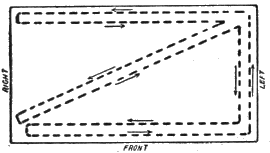
Then from left corner of back pass to center of back, down center of stage to front, where Color-bearer turns to right, first girl to left, next boy to right, next girl to left, etc. Pass to corners of front, up sides of stage, across to center of back, where the Color-bearer remains standing, while the next boy and first girl form a couple, each two do the same, couples march down stage till first couple is near front. Halt, couples face each other, standing about three feet apart. The Color-bearer now passes down between the two lines and halts at front of stage, facing audience. The couple nearest back of stage now marches down between lines, goes to right and halts, next couple comes down and goes to left, etc., thus:
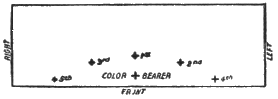
The file stands in curved line back of Color-bearer. Music changes to STAR-SPANGLED BANNER. The children in the line stand with flags held at right side, as during the march, till the music gets to "Oh! say, does the star-spangled banner still wave," when they raise flags and wave them slowly, till close of music. The piece is played through once and then music ceases, the Color-bearer raises his flag, holding it quite high. The others take flags in left hands and hold at left sides. When the large flag is raised they all say:
I pledge my head, (touch head with right hand) my heart, (lay hand over heart) and my hand, (raise right hand)
To loyally serve my native land; (drop hand at side)
I pledge my power, my honor, and my might (step forward with right foot)
To keep my country's name forever bright. (Step back in line.)
I pledge the zeal and strength of this right hand (raise right hand)
To keep Old Glory floating o'er our land. (Point to flag.)
The flags are now held in right hands, out in front of bodies:
A flag for the sailor, skimming the sea,
A flag for the soldier, guarding the lea,
A flag for the patriot, proud to be free,
A flag for YOU, (flags extended to audience) and a flag for ME! (At this flags are laid lovingly across chests and held with both hands.)
Flags are now waved above heads and the line exclaims:
"America forever! (flags held out at right) one nation (flags out at left) one country, (step forward and hold flags high, pointing toward audience) one flag!"
Step back in line and hold flags at right sides while the chorus of COLUMBIA, THE GEM OF THE OCEAN, is played softly. At the conclusion of that the music changes to a march. The Color-bearer leads and the others fall in line back of him in the same order as on entering the stage at beginning, passing in single file to right corner of front, up right side, across back, half way down left side, then across stage. The last four children halt in line, the others pass up right side, across to center of back and down center of stage. The Color-bearer halts in center, the others take places and stand thus:
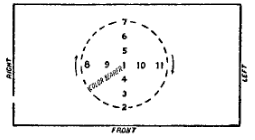
Nos. 8 and 9 face back of stage; 5, 6 and 7 face left; 10 and 11 face front; 2, 3 and 4 face right; then lines march once around, No. 1 (Color-bearer) standing as the pivot on which others turn. Keep lines perfectly straight while marching, those on outside going faster to preserve perfect movement. After rotating once, halt. Color-bearer raises flag high, others raise flags and repeat:
I pledge allegiance to my flag—the best in any land, And to the Republic for which this flag doth stand; One nation, indivisible, the pride of great and small, One flag, emblem of Liberty and Justice for us all.
Color-bearer then marches to front of line, in front of No. 2, leads to right of stage, all following in order, up to back, across to center of back, down to center, where lines form thus:
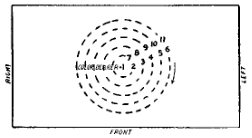
Lines march around, describing circle, those on outside a large one and others smaller, then Color-bearer takes position at back of stage, the others form two lines of five each, across stage. Color-bearer gives following orders, in sharp, quick tones:
Order, flag! Rest flag on floor at right side, holding with right hand.
Carry, flag! Raise flag and hold in right hand, staff nearly vertical, top resting against right shoulder, arm straight at side.
Present, flag! Move flag to center of body, top in front of face, grasp staff with left hand, also.
Left shoulder, flag! Flag placed on left shoulder.
Right shoulder, flag! Flag placed on right shoulder.
Carry, flag! As before.
Port, flag! Grasp staff a little below center, hold diagonally across chest, upper end resting on left shoulder.
Carry, flag! As before.
Parade, rest! Right foot six inches to rear, left knee slightly bent, rest flag staff on floor in front of center of body and grasp it at top with both hands.
Carry, flag! As before.
Surrender, flag! Lay flag on floor in front of body.
Recover, flag! Bend forward, pick up flag, hold it in front of body, staff horizontal.
Carry, flag! As before.
Fix, flag! Kneel on right knee and stand staff of flag upon left knee, staff vertical.
Triumph, flag! Stand, wave flag high above head.
Color-bearer now marches down center of stage to front, members fall in line back of him in same order as on entering at beginning. At right corner of front second boy steps up by first girl, third boy by second girl, etc. Form couples, Color-bearer marching alone at head. Pass up right side, across to center of back, down center of stage, across to left corner front, up left side and off stage.
CIVIL WAR DAUGHTERS
Marie Irish
MARCH, SONG AND DRILL FOR TWELVE GIRLS OF THE INTERMEDIATE OR GRAMMAR GRADES
Costumes: Four girls wear red dresses, four wear white and four blue. Each girl wears two streamers, about nine inches wide and a yard to a yard and a quarter long, depending on the size of the girl, pinned on left of chest, thus:
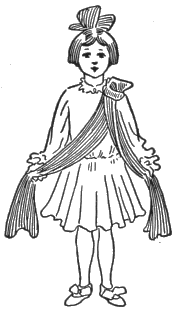
The girls in white wear one red and one blue streamer, those in red wear a blue and a white streamer, while those in blue wear a red and a white one. A bow in the hair, of the same colors as the streamers, is also pretty.
March and Song
Music: A march.
GIRLS enter at back of stage, in single file, reds first, then those in white and lastly the blues, one streamer held in each hand, arms hanging at full length at sides. March once around stage in a circle, then on reaching center of back come down center of stage to front, where first girl goes to right, second to left, etc., pass to corners of front, up sides, across to center of back, form couples and march down center of stage in couples.
At front first couple turns to right, second to left, third to right, etc., go to corners of front, up sides, across to back, form fours and march down center to front. As they reach the front in lines of four each, the three girls nearest the right of stage—a red, a white and a blue—pass to the right. As the girl in blue comes to front before turning, the next three—a red, a white and a blue—follow her. At the same time the three nearest the left of stage pass to left corner and the next three follow them. This makes two files of Red, White and Blue, one from either side, which pass to corners of front, up sides, then those passing up left side on reaching corner of back march in a diagonal line to right corner of front, while the others pass from right corner of back to left corner of front. As the lines cross at center of stage first girl from right goes in front of first girl from the left, then second girl from right in front of second girl from left, and so on. Each line crosses front of stage to opposite corner, those from the right corner keeping to the right of the other line as the files pass. March up sides of stage, then across to center of back, where the first three on the line that marched up right side form the first row, the first three on the line from the left side form the second row, second three from the right form the third row and the others the fourth row, and they march down center of stage three abreast, in the following order : B, W, R, leading; R, W, B; B, W, R; R, W, B. On reaching front of stage the three of first row pass toward left corner, second row passes toward right corner, next three follow the first row toward left and last row follows second row to right. They stand in curved line at front, thus:

Music now charges to COLUMBIA, THE GEM OF THE OCEAN and the girls sing the following verses. On opening line of each stanza girls bow low, and during chorus they all join hands, extending them to the front and swinging streamers from side to side.
Oh, we are the Civil War Daughters, With hearts that are loving and true; From Maine to Pacific's blue waters, We honor the soldiers in blue. We sing of their danger and suff'ring, We sing of their courage and might, When to save their flag from destruction, These boys stood so firm for the right.
Chorus: Three cheers for the soldier in blue, Three cheers for his loyalty true; Let us honor his name with ovation, And give to the soldier his due. Oh, we are the Civil War Daughters, We sing of the March to the Sea; And we sing of Vicksburg's close quarters, Of Shiloh where blood flowed so free. Though years have gone by since that conflict, And the soldiers are passing away, We hold them in loving remembrance: True Blue—once partly loyal Gray.
Chorus: Three cheers for the soldier, etc.
March music is resumed, those nearest left of stage face left, the other six face the right of stage, lines march to right and left corners of front, up sides of stage, from corners of back in diagonal lines to center of front, where lines cross, first girl from the right going ahead of first girl from the left, second from the right goes ahead of second from left, etc. Pass to corners of front, up sides, stop in lines six abreast along sides of stage, those on left facing right of stage and vice versa. Mark time, then march six abreast to center, halt, couples facing each other.
Raise hands holding streamers high, fingers of each couple touching. Stand thus for several measures of music, then those of the right-hand line march to front, the other line standing until the last one of the right line reaches front of stage, when the first one of the left-hand line leads that line to front and they follow the first six, making a single file which passes to right corner of stage, up to center of right, whence the line marches thus:
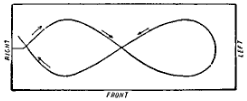
Where they cross at center of stage No. 1 goes in front of No. 7, No. 2 in front of No. 8, etc. On returning to center of right side the file passes up to right corner of back, then across back of stage, forming in two lines of six each at center-back, march six abreast down to near-front and halt in lines for the drill.
Drill and Song
Grasp streamers where hands touch them when arms hang full length, raise hands holding streamers and place on center of breast.
A. Right hand out at side, arm's length, and back, four times.
B. Left hand out at side, and back, four times.
C. Both hands at sides, and back, four times.
D. Right hand upward and outward, arm's length, and back, four times.
E. Left hand, same movement, and back, four times.
F. Both hands up, forming V, and back, four times.
G. Right hand down at side, arm's length, and back, four times.
H. Left hand down at side, and back, four times.
I. Both hands down at sides, and back, four times.
J. Right hand straight out in front of body, and back, four times.
K. Left hand in front of body, and back, four times.
L. Both hands in front of body, and back, four times.
M. Both hands on hips, down at sides and back to hips, four times.
N. Raise right hand above right shoulder and hold left hand down and out from side till streamers are stretched tight, then lower the right hand and raise the left, reversing position of streamers, four times.
O. With hands at center of breast raise right hand straight up from shoulder and left down, arm's length at side, and back, four times, then left hand up above shoulder and right hand down, and back, four times.
P. Hands meet above head, arms curved, ends of streamers hanging back of head, and back, four times.
Q. All kneel on left knee, raise both hands up, arm's length, girls on first line touching hands together, back line the same, hold position for several measures, then rise and sing, to tune of YANKEE DOODLE:
We are the Civil War Daughters, We're brave as all creation; And though we've never been to war, We stand up for our nation.
While singing the chorus those of each line join hands, holding them just a little higher than shoulders, then step out with right foot and bring it back to place, once for each measure of music.
Chorus: Honor to the soldier's name! Sing the wond'rous story Of the splendid fight he made When led on by Old Glory. Our grandsires fought in that great war, Fathers, and uncles, too, sir, And that's the very reason why We love Red, White and Blue, sir. Chorus: Honor to the soldier's name, etc.
At close of song the march music is resumed, those on front line pass to right corner, others follow, all pass up right side of stage, in single file. From right corner of back the leader takes file around stage in a large circle, then a smaller circle, etc., until smallest circle possible for girls to march around is reached, thus:

When all are in a circle at center of stage, they raise hands on inside of circle and point upward towards center, hands touching, holding streamers. March once around this way, then all turn and march in opposite direction, once around in circle, raising the outside hands, and holding streamers high. Then all turn and march in opposite direction once around circle, this time raising both hands up until fingers meet above head, lowering to side, raising again, etc. Then those in red march to left corner of front of stage, those in blue to right corner of front, while those in white come down center to front. Those in red pass across front to right corner as those in blue pass to left corner. Those in white wait at front of stage and as the reds and blues cross front two girls in white follow the reds, the other two follow the blues, the two lines pass up sides of stage and off at back.
THE BLUE AND THE GRAY ON THE RAPPAHANNOCK
Marie Irish
A DRILL AND MEDLEY FOR FROM TWENTY TO FORTY CHILDREN OF VARIOUS GRADES
Characters and Costumes: The part of Goddess of Liberty should be taken by a young lady with strong voice who recites well. She should dress in white, hair flowing, gilt crown, drapery of red-white-and-blue, and carry a flag. If desired this part may be taken by a boy dressed in patriotic costume to represent Uncle Sam. Or a good effect is obtained by having both take part, Liberty and Uncle Sam taking turns in reciting. If possible to obtain so many, have twelve little girls take part in the Call of the Flag march. These girls should be dressed in white with patriotic sashes or red-white-and-blue streamers on left shoulder, and all carry flags. The Response of the Soldier march is given by twelve boys of various sizes, wearing dark suits, one of whom carries a drum and the others carry guns. If desired some of the same boys may take part in this who take part in the Blue and Gray drill. The latter drill is given by at least sixteen boys, grammar grade, eight of whom dress in blue and eight in gray. One of the boys in blue carries a U. S. flag, and one of those in gray carries a Confederate flag; the rest carry guns.
TO THE strains of YANKEE DOODLE the Goddess of Liberty comes onto stage, marches down left side, from left corner front in a diagonal line to center of back, down to right corner front, up right side, across to center of back and halts. Music ceases and the little "flag girls" march in, half from each side of stage, half way between Liberty and front of stage. The files pass across stage and off at opposite sides, turn and march on again, meet at center of stage, form couples, first couple turns and passes off at right side, second couple at left side, etc., thus:
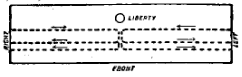
The flag is carried in right hand, arm hanging at side, flag resting against right shoulder. While this march is being given as silently as possible, Liberty recites in strong, clear voice and a great deal of feeling the following medley:
THE CALL OF THE FLAG
"Speed our Republic, O Father on high! Lead us in pathways of justice and right; Hail! three times hail to our country and flag! Girdle with virtue the armor of might." "No refuge could save the hireling and slave, From the terror of flight or the gloom of the grave: And the star-spangled banner in triumph doth wave O'er the land of the free, and the home of the brave." "'A song for our banner?' The watchword recall Which gave the Republic her station: 'United we stand—divided we fall'; It made and preserves us a nation." "Up with our banner bright, Sprinkled with starry light, Spread its fair emblems from mountain to shore, While through the sounding sky Loud rings the Nation's cry— UNION AND LIBERTY! ONE EVERMORE!"
The girls' march should be arranged to close about the time Liberty finishes speaking. One verse and chorus of MARCHING THROUGH GEORGIA is then played and as music ceases the small boys come on and march in the same way as the girls did, the drummer boy beating time softly, occasionally. While the boys march Liberty speaks:
THE RESPONSE OF THE SOLDIER
"War! war! war! Heaven aid the right! God move the hero's arm in the fearful fight! God send the women sleep in the long, long night." "Never or now! cries the blood of a nation, Poured on the turf where the red rose should bloom. Now is the day and the hour of salvation; Never or now! peals the trumpet of doom!" "Lay down the axe, fling by the spade, Leave in its track the toiling plough; The rifle and the bayonet-blade For arms like yours are fitter now: "And let the hands that ply the pen Quit the light task and learn to wield The horseman's crooked brand, and rein The charger on the battle-field." "And how can a man die better Than facing fearful odds For the ashes of his fathers And the temple of his gods?"
As Liberty concludes the lines and the boys march off, one verse and chorus of COLUMBIA, THE GEM OF THE OCEAN, is played, then music changed to a patriotic march and the boys in Blue and Gray march on in two companies. Grays come on at front corner of right and Blues at front corner of left, march up sides of stage, across to near-center of back, down to front of stage, to corners, up sides and at corners of back second boy in each line steps up by first, fourth by third, etc., and form double files. March to near-center of stage, down center to front, up sides, and at corners of back each company forms fours, march half way down stage and halt in lines of four each, thus:
Liberty
G G G G B B B B G G G G B B B B
Music stops and Liberty recites:
THE CONTEST
1. "And there was mounting in hot haste; the steed,
2. The mustering squadron, and the clattering car,
3. Went pouring forward with impetuous speed,
4. And swiftly forming in the ranks of war."
5. "By torch and trumpet fast arrayed,
6. Each horseman drew his battle-blade,
7. And furious every charger neighed,
8. To join the dreadful revelry.
9. Then shook the hills with thunder riven,
10. Then rushed the steed to battle driven,
11. And louder than the bolts of heaven
12. Far flashed the red artillery."
13. "Hark! Hark ! there go the well-known crashing volleys, the long-continued roar
14. That swells and falls but never ceases wholly, until the fight is o'er.
15. Up toward the crystal gates of heaven ascending, the mortal tempests beat,
16. As if they sought to try their cause together, before God's very feet."
17. "Like the leaves of the forest when summer is green, That host with their banners at sunset were seen; Like the leaves of the forest when autumn hath blown, That host on the morrow lay wither'd and strown."
The above lines are recited rather rapidly until number 17 is reached, the last four being given slowly and sadly. When marching in the boys hold guns in right hand, arm full length at side, gun resting against right shoulder. While Liberty recites the boys go through following movements, corresponding to the numbers of the lines of the medley: 1. Salute, by raising left hand until the forefinger touches forehead above left eye, thumb and fingers extended, palm to right. Drop arm at side. 2. Lines of Grays face left of stage, and Blues face the right. 3 and 4. All mark time as if marching rapidly. 5. Rest butt of gun on floor, arms hanging naturally at sides, right hand holding the barrel between thumb and fingers. 6. Raise gun and move to position in front of body, barrel in front of face, hold with both hands, left above the right. 7. Hold gun diagonally across chest, barrel resting on left shoulder and butt against right thigh. 8. Blues take steady aim at Grays, and vice versa. 9. Arrange for some noise at side of stage to represent firing. 10 and 11. Blues kneel and aim at Grays, and vice versa. 12. More "booming" behind scenes. 13. Rise and each company retreats backward a step, holding guns at right sides. 14. Come forward toward center, quickly, and aim. 15. Rest guns. 16. Bring guns to position and mark time as if marching rapidly. 17. Each company faces front of stage, stack guns in lots of four each and then sit on floor in lines of four, facing front of stage. Music is resumed and JOHN BROWN'S BODY is played through once, then Liberty steps forward to front of stage and recites:
"The sun had sunk into the distant west; The cannon ceased to roar, which tell of rest— Rest from the shedding of a nation's blood, Rest to lay their comrades 'neath the sod. "'Twas early spring, and calm and still the night; The moon had risen casting silvery light; On either side of stream the armies lay Waiting for morn to renew the fray. "The Rappahannock silently flowed on, Between the hills so fair to look upon; Whose dancing waters tingled with silvery light, Vied in their beauty with the starry night. "But list! from northern hills there steal along The softest strains of music and of song——"
A good effect is obtained by turning off lights during the music of JOHN BROWN'S BODY so stage is dim during the speaking and the singing. As Liberty pauses the Boys in Blue sing a stanza of THE STAR-SPANGLED BANNER. When they finish, the Boys in Gray sing a stanza of DIXIE LAND. It is a good plan to have a chorus of voices behind the scenes help with the singing of both songs, to give more force to them. As last song is finished lights are turned on, Liberty resumes her place at back of stage, boys rise, leave guns, Boy in Gray leaves his Confederate flag, all march to near-front of stage and form across in two lines of eight each, thus:
G B G B G B G B B G B G B G B G
The little girls in white who carried flags now march in and stand in a row back of the boys, Liberty stands just back of the line of girls.
Liberty recites:
"The fiercest agonies have the shortest reign, And after dreams of horror comes again The welcome morning with its rays of peace."
The little girls recite in concert:
"Peace! and no longer from its brazen portals The blast of War's great organ shakes the skies! But beautiful as songs of the immortals The holy melodies of love arise."
All the boys recite together:
"The union of lakes, the union of lands, The union of States none can sever; The union of hearts, the union of hands, And the flag of our Union forever."
Liberty waves her flag, the girls with flags wave them above the heads of the Boys in Blue and Gray, each boy in blue joins right hand with a boy in gray, and everyone sings the first stanza of MY COUNTRY, 'TIS OF THEE. Colored light may be thrown upon the scene for a tableau and then the curtain dropped, or Liberty may come to front of stage, lead the boys (who follow in single file), and then the little girls last, once around the stage and then off.
PATRIOTIC SONG PANTOMIMES
Marie Irish
The Star-Spangled Banner
HANG back of stage with dark cloth, cover a box with dark material and to back or center of it fasten a large flag. Let the box stand four feet from wall so as to leave room to pass behind it.
If possible have ten girls of good size, ten small girls and ten boys take part, though this number may be reduced if necessary. All the girls dress in white with trimmings of red, white and blue and each carries a flag. As the music of STAR-SPANGLED BANNER begins the large girls march on in two lines, half coming from right and half from left. After them come the small girls, half from each side, all march and take places thus:
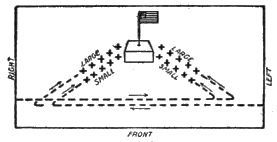
They stand motionless, with flags at right side until music reaches words, "Oh! say, does the star-spangled banner still wave," then all raise flags and wave them. As music of second stanza begins, the girls hold flags again at sides, and the boys march in, each one carrying an air-gun or rifle. They come on stage, half from right and half from left, marching slowly and carefully. As the boys get nearly to center of stage each girl quickly raises her flag, takes aim with it as though it were a gun, pointing it at line of boys. The boys stop as if in fear, then pass quickly from stage, those from the right going off at left, and those from left going off at right. Then as the music reaches the refrain, sing the words of third stanza instead of second, the boys helping behind scenes and all singing with spirit, "And the star-spangled banner in triumph shall wave, O'er the land of the free and the home of the brave," the girls waving their flags. A fine effect may be obtained by burning colored light[K] during the singing.
America
Hang back of stage with dark cloth, also cover with dark material a box that stands at center of back of stage. On this box, as curtain is drawn, stands a young lady dressed as Columbia, wearing white gown, drapery of red, white and blue bunting, and gilt crown on head. She holds in one hand a large flag and in the other six streamers made of cambric: two white, two red, and two blue, three or four inches wide and nearly two yards long. On either side of Columbia stand three girls, dressed in white and wearing sashes of red, white and blue, tied in a bow at side. Columbia holds streamers by one end and each girl holds the end of one. They stand thus:
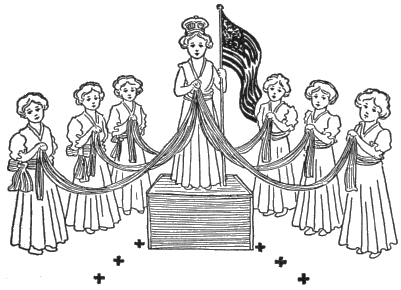
As music of second stanza is begun they kneel, taking position as marked by crosses in the diagram. As music of third stanza is begun the girls rise, raise hands holding streamers, point upward, and gaze reverently heavenward. All sing very softly the words of stanza, "Our fathers' God, to Thee, Author of liberty," etc.
Swanee Ribber
Have the words of the song sung by someone behind the scenes, the verse by one person and the chorus by a number of voices. Across the stage hang a curtain, leaving room in front for a person to walk. A young man, or tall boy, comes on stage with face blackened and wig of curled hair (made by sewing curled hair onto a circular piece of black cloth, then running a rubber cord around edge and drawing up to fit head[L]), wearing stiff hat, common dark suit and a large bright necktie. He stands in front of curtain at right of stage as the words are sung:
"'Way down upon de Swanee ribber, Far, far away, Dere's wha' my heart is turning ebber, Dere's wha' de old folks stay."
With head bent, hands in pockets and a dejected manner he walks slowly across stage to left and back to center during the words:
"All up and down de whole creation Sadly I roam, Still longing for de old plantation And for de old folks at home."
He stands at center of front during singing of chorus:
"All de world am sad and dreary (hands extended at sides, arm's length) Eb'rywhere I roam; (hands brought together in front of body) Oh! darkies, how my heart grows weary (right hand over heart) Far from de old folks at home!" (left hand in pocket, head bowed on right hand, sad, dejected attitude)
At close of chorus the impersonator goes to right corner of front of stage and stands there during the second stanza. The curtain is now drawn, revealing two little darkey boys, scantily clothed, feet bare, and old hats on heads. They chase each other across back of stage during the words:
"All round de little farm I wandered When I was young, Den many happy days I squander'd, Many de songs I sung; When I was playing with my brudder Happy was I;"
A girl with face blackened, bright cap on head, calico dress, large apron, and bright kerchief around neck comes on stage and one little darkey boy stands on either side of her as the words are sung:
"Oh! take me to my kind old mudder, Dere let me live and die."
The mother and little boys stand at back of stage during chorus, the young man comes out to near-center and acts chorus as before, except at the words, "Far from de old folks at home!" he turns and extends both arms toward the group at back of stage.
As third stanza is begun the mother and boys pass off and a young colored lady, gaily and gaudily dressed in bright colors, with a large, "much-trimmed" hat, comes on and stands at back of stage. She gazes off to side of stage and a young man, dressed about like one who does the acting, comes on carrying a banjo. She goes to meet him, they walk back to center of back, she sits on a stump of wood (or something to give an outdoor effect), and he sits at her feet and pretends to play the banjo. During the singing of this stanza the impersonator stands as before, at side of stage, but as chorus begins he comes toward center of front and acts as during second singing of chorus. The mother and two boys come back on and stand, tableau effect, beside the girl and boy with the banjo.
The Blue and the Gray
Hang back of stage with black cloth and fasten on wall, staffs crossed, two good-sized flags. A few feet from the back, with about four feet aisle between them, arrange two graves by using small boxes covered with dark cloth for the mounds and nailing at the head of each a white board for a stone. If it is not desired to have the words sung they may be recited by someone at side of stage. A girl dressed as a woman, all in black, comes on slowly, passes across back of stage from left to right, down right side, up to aisle between two mounds and kneels beside one of them as the stanza is read:
"By the flow of the inland river, Whence the fleets of iron have fled, Where the blades of the grave-grass quiver, Asleep are the ranks of the dead; Under the sod and the dew, Waiting the judgment day; Under the one, the Blue, Under the other, the Gray."
She rises and from a small basket which she carries she places a bouquet on the mound by which she knelt, then turns and places one on the other mound as the words are read:
"From the silence of sorrowful hours, The desolate mourners go, Lovingly laden with flowers, Alike for the friend and the foe; Under the sod and the dew, Waiting the judgment day; Under the roses, the Blue, Under the lilies, the Gray."
As stanza is finished she passes to back and stands by flags. Six girls in white, each carrying a small basket of flowers, march on at left back, pass to center, then down aisle between mounds to front; three turn to each side, pass around and stand in two lines of three each, one line on outside of each mound, both lines facing center, while stanza is read:
"So, with an equal splendor, The morning sun-rays fall, With a touch impartially tender, On the blossoms blooming for all; Under the sod and the dew, Waiting the judgment day; Broidered with gold, the Blue, Mellowed with gold, the Gray."
As the next stanza is begun the girls cover the mounds with flowers, then march back up the aisle between mounds and stand three on each side of girl in black by flags, finally all marching off stage when stanza is finished:
"No more shall the war cry sever, Or the winding rivers be red; They banish our anger for ever When they laurel the graves of our dead. Under the sod and the dew, Waiting the judgment day; Love and tears for the Blue, Tears and love for the Gray."
—Francis Miles Finch
Auld Lang Syne
This should be given by two as small children as can act it nicely: a little girl with hair powdered, long dark dress, white kerchief and apron, small black lace cap and spectacles, and a boy with glasses, powdered hair, long trousers, coat fixed by sewing black "swallow tails" onto a short dark coat, a white cravat and a stiff hat. As song begins they sit at a small table on which are cups and saucers and a tea-pot of tea. The girl pours out a cup of tea for each during the words:
"Should auld acquaintance be forgot, And never brought to mind? Should auld acquaintance be forgot, And days of auld lang syne?"
Then as the chorus is sung the boy rises and bows low, then sits and they raise cups, clink them and each takes a drink:
"For auld lang syne, my dear, For auld lang syne; We'll tak' a cup o' kindness yet, For auld lang syne."
They lean forward and appear to be talking during the words of second verse:
"We twa ha'e run aboot the braes, And pu'd the gowans fine; But we've wandered mony a weary foot Sin' auld lang syne."
During singing of chorus second time the girl rises, makes a courtesy to boy, then sits and they drink as before.
They stand and shake hands during the stanza:
"And here's a hand, my trusty frien', And gi'e's a hand o' thine; We'll tak' a cup o' kindness yet, For auld lang syne."
During the chorus each turns to table, takes up cup, both bow, clink cups and drink.
Columbia, the Gem of the Ocean
Words are sung by a chorus of voices off stage. At center of stage have a pedestal—box covered with dark cloth will do—on which a girl dressed as Goddess of Liberty stands, holding a large flag. A number of girls in white, each with a small flag, come in and march in circle around Liberty as the words are sung:
"Oh, Columbia, the gem of the ocean, The home of the brave and the free, The shrine of each patriot's devotion, A world offers homage to thee."
Six boys march in and stand three on each side of Liberty, the line of girls standing back of the boys and waving flags during words:
"Thy mandates make heroes assemble, When Liberty's form stands in view; Thy banners make tyranny tremble, When borne by the red, white and blue."
During the chorus the boys stand in line in front of Liberty and the girls march around them, waving flags. Liberty waves flag also.
Half of the boys and half of the girls stand in lines on either side of Liberty and give salute to flag during the words[M]:
"'Old Glory,' to greet now come hither, With eyes full of love to the brim; May the wreaths of our heroes ne'er wither, Nor a star of their banner grow dim."
Then during the rest of the third stanza and the chorus the boys stand at back of Liberty, three on either side, and the girls kneel in tableau effect in front of her.
Home, Sweet Home
At back of stage arrange a family group around a small table on which are some flowers and a lamp. The mother is sewing, father reading, a little girl playing with a dolly, and a boy working examples. All look happy and cosy. As curtain is drawn revealing the scene, the first stanza of HOME, SWEET HOME is sung, and a young man in soldier uniform, carrying a gun over shoulder, marches back and forth across front of stage as if on duty, looking sad and lonely.
(If desired, instead of a family group the scene may disclose an elderly lady with bible on her knee.)
TABLEAUX
Marie Irish
When I'm a Man
A LITTLE boy wearing a soldier cap, a blue coat much too large for him, a sword buckled at his side, a gun in one hand and a flag in the other, stands in center of stage. As colored light[N] is thrown on the stage he speaks:
"When I'm a man, a big, tall man, I'll be a soldier, brave and true, I will fight my country's battles, Led on by the Red, White and Blue."
The Soldier's Farewell
Little boy dressed as in preceding scene stands with a little girl who has on a long dress and hair done on top of head. She stands half turned away from the boy, who has a hand on her shoulder as if trying to comfort her. Her face is buried in her hands and she seems to weep as he recites:
"How can I bear to leave thee? It breaks my heart to grieve thee, But now, whate'er befalls me, I go where duty calls me."
The March of Civilization
A curtain is drawn, revealing at the back of a dimly-lighted stage an Indian tepee with several Indians standing near. A march is played and after several measures the others come onto stage. The line is led by boy dressed as Uncle Sam, who takes position at center of stage in front of tepee. On either side of him stands a soldier, and next to the soldiers stand sailors. The others arrange themselves in line, some on one side and some on other, some sitting on floor in front of line. One, with bible, dresses as minister, one as farmer with large straw hat and rake over shoulder. One as doctor, one as baker, one with tools as carpenter, etc. A girl dresses as nurse; another with gown and mortar-bored cap as a student; one has pen and scroll for writing; and another carries a typewriter, sits on floor with it in front of her and pretends to write on it. When all are in places colored light is thrown on scene and Uncle Sam recites:
"Onward, forward, with steady pace, Progress leads the American race; And 'neath her penetrating ray New wonders come to light each day."
Liberty
A colored boy, barefoot and scantily dressed in short trousers and colored shirt, with a white cloth around head for turban, stands fastened to a box with a chain. The box is covered with dark cloth and on it stands girl dressed as Liberty—long white robe, crown, a drapery of red, white and blue, and in her hand a flag. As light is turned on she looks sadly at boy, then waves her flag above him, and the chain which was lightly fastened drops to floor as boy gives it a pull. He looks at fallen chain, then sinks on knees and, raising hands, clasps them and gazes at Liberty as if asking help. Liberty waves flag above him.
Peace
On a dais at back of stage sits boy costumed as Uncle Sam, with a large flag. On one side of him stands Liberty, in white with drapery of red, white and blue, and gilt crown. On other side is Wisdom, wearing white dress with purple mantle fastened on right shoulder, bronze cap with plumes, sandals, and shield and spear by her side. To a side and a little in advance of Liberty stands Truth, all in white and carrying banner with "Truth" printed on it. By Wisdom stands Justice, in blue with scarlet mantle fastened on right shoulder and thrown back over left arm. In her right hand she holds a pair of scales and her left rests on a sword. Kneeling at right corner of dais is Ceres, the goddess of corn and harvests, dressed in yellow trimmed with grain, her left hand on sheaf of wheat, her right holding a horn of grain extended to Uncle Sam. Kneeling at left of dais is Pomona, the goddess of fruits, dressed in red trimmed with vines and clusters of grapes. She holds up to Uncle Sam a basket of fruit. As light is turned on a stanza of AMERICA is played.
Scenes from the Life of Lincoln
I. THE STUDENT
Arrange a fireplace by nailing up boards covered with dark cloth in this shape |——|, piling some wood under it, pouring on some wood alcohol, which is set on fire as curtain is drawn. Lying on the floor studying by light of fire is a tall, dark boy.
II. THE LABORER
A tall, dark boy in common work clothes, trousers rather short, stands with axe upraised ready to strike.
III. THE EMANCIPATOR
A tall, dark boy dressed in long black coat and rather ill-fitting clothes, dark hair rumpled and pushed back from forehead, sits writing as a rough-looking fellow with whip in one hand tries to pull a little boy, face blackened and poorly clothed, from his negro mother, who clings to child and weeps. A boy marches on stage, carrying large flag and recites:
"No slave beneath that starry flag, The emblem of the free! No fettered hand shall wield the brand That smites for liberty: No tramp of servile armies Shall shame Columbia's shore, For he who fights for freedom's rights Is free for evermore!"
—George L. Taylor.
IV. THE PARDONER
Boy dressed as Lincoln stands in center of stage. By his side kneels a young lady, looking imploringly at him, hands raised and clasped. Lincoln shakes head sadly for "no." Girl bows head on hands and weeps. Lincoln goes hurriedly to desk, writes, gives her the paper. She kisses his hand, waves farewell and hurries from stage.
V. THE MARTYR
On an easel at center of stage have a picture of Lincoln, two large flags draped above it and smaller ones around it. On either side of picture stand girls dressed in white trimmed with red, white and blue bunting, each holding a flag. They repeat:
"He went about his work—such work as few Ever had laid on head and heart and hand— As one who knows, where there's a task to do, Man's honest will must Heaven's good grace command. "So he went forth to battle, on the side That he felt clear was Liberty's and Right's, As in his peasant boyhood he had plied His warfare with rude Nature's thwarting mights. "So he grew up, a destined work to do, And lived to do it: four long-suffering years. Ill-fate, ill-feeling, ill-report lived through, And then he heard the hisses changed to cheers."
—Tom Taylor.
SONGS, STORIES, FACTS
WHEN LINCOLN WAS A LITTLE BOY
Clara J. Denton
Tune: YANKEE DOODLE
When Lincoln was a little boy, So fond was he of reading, His book was with him at the plough Or in the garden weeding. His home was in the woods and so He couldn't have much schooling. He had to work the live-long day, And had no time for fooling. He understood the plough and hoe And with the ax was handy. He didn't care for dressing up, And never was a dandy. For all the while his head was filled With plans for gaining knowledge. A first-class lawyer he became, Yet never went to college. He borrowed books from far and near, From every kindly neighbor, And studied them most faithfully When resting from his labor. Chorus: Keep on working, working on, Daily knowledge claiming, And you at last will reach the heights At which you are aiming.
THE DAY WE CELEBRATE
Clara J. Denton
Tune: WORK, FOR THE NIGHT IS COMING[O]
THE DAY that gave us Lincoln Is one we all love well; The day which now we honor More than we can tell. O little old log cabin, Afar in forest wild, We love your roof that sheltered This most wondrous child. And while we sing his praises We'll try like him to be: All upright, true and noble, From self-seeking free. And we will yet remember, However poor our state, There still is a chance, like Lincoln, To grow good and great. This day we will remember In loyal love and joy; For time or change can never Faith in him destroy. Yes, wreathe this day with flowers Forever in our thought; It gave the world a hero And sweet freedom brought.
LINCOLN SONG
Tune: TENTING ON THE OLD CAMP GROUND
WE ARE thinking today of a loved one lost, Lincoln, the true, the brave; Of the strong one who came, when tempest tossed, Our nation's bark to save. Chorus: Many are the hearts that are mourning today, Mourning for the brave laid low; Many are the eyes looking up to say, Oh, why must this be so! Help us to say, humbly we pray, Father, may Thy will be done! We are thinking today how he led us on, Just as the Lord led him, To the glorious victory well-nigh won; And our eyes with tears grow dim. Chorus: Many are the hearts, etc. We are weeping today, but the hour will come, Come when we all shall see Why the will of the Lord hath called him Home, No more with us to be. Chorus: Many are the hearts, etc.
THE NAME WE SING
Clara J. Denton
Tune: AMERICA
OF LINCOLN now we sing, Loud let the welkin ring, The sound prolong. He broke the bondsman's thrall And freedom brought to all, His mighty blows let fall The shackles strong. This man of pure intent, Whose every thought was bent Sweet peace to bring. O eyes so keen of view, O mighty heart so true, O soul with courage new, Of thee we sing. So long as human speech O'er this broad land shall reach From shore to shore, Here will his noble name Its high place always claim Unequaled in its fame Forever more.