Introductory material (continued 2)
Reading edition
And who was "Tootins"? you will say. A kitten?
Well, I believe she was a kind of two-footed kitten; at least, she was as full of play and frolic and merry ways as any four-footed little puss that ever called old cat mother. As fond of being cuddled and petted now and then, too.
"Tootins" was the dearest, cunningest, most fascinating little two-year-old bit of mischief that ever found out she had ten fingers, and the number of uses they could be put to.
A mischief! I should think she was! Such restless, busy little fingers! "Mademoiselle Touche-à-tout" Uncle Ruthven named her. Such an inquisitive little mind! Such never-tiring, pattering little feet! Such a sweet voice, and such a crooked, cunning tongue!
When you saw her, you wanted to catch her up, and pet and hug her, she was so fair and round and dimpled; but that did not always suit Miss "Tootins." She thought her two small feet were made to be used, and she did not choose that they should be deprived of any of their privileges, except by her own free will. So she generally struggled to be put down again; and, dear me! how sorry you were to let her go!
But sometimes, as I have said, she wanted to be cuddled and petted; and then she would nestle to you, so dear and sweet, with her sunny head upon your arm, her great starry eyes fastened upon your face, while you talked baby-talk to her, or told her simple verses and stories. Understand you, do you ask? Indeed, she understood every thing you said; more than you could have believed possible.
Pure pink and white skin; eyes blue as heaven; golden hair; yes, real golden hair, for when the sunlight fell upon her curls, they looked like threads of burning gold; shoulders and hands and arms that looked as if they were only made to be kissed; a gurgling, rippling laugh; and oh, such cunning, wheedling ways! That is our "Tootins;" otherwise, Baby Annie. Our "Tootins," did I say? Well, I suppose I must call her Mrs. Bradford's "Tootins;" but then, you see, I have drawn her picture from life, and, having before my eyes just such a pet and darling of my own, it came very natural to say "our Tootins."
But how did she come by such a funny name? you will ask again.
Well, that was a name her little brother Frankie had given her when she was a tiny baby; no one knew why he did it, but he did, and he always called her by it; and of late, if any one called her by any other name, he always pretended he did not know of whom they spoke. And so "Tootins" had come to be a sort of twin pet name with "Baby," and little Annie was called as much by one as by the other.
As I have said, she came in as if quite assured of her welcome, for Baby Annie was accustomed to have her society courted, and rather imagined she was conferring a favor when she bestowed it upon her friends. Moreover, she had been promised that she should join the others on this occasion, why or with what purpose she did not understand; but she knew that her sisters had talked of Belle and Lily coming. She was fond of Belle and Lily, and had demanded a share in their company, and here they were now. This she knew very well, and so she came in, followed by old nurse, who had her own doubts as to whether baby would be considered a serviceable member of the sewing circle.
But "Tootins'" expectations proved well-founded, for she was greeted with exclamations of pleasure; and after submitting to the necessary amount of hugging and kissing, she was accommodated with a bench at Aunt Annie's feet, and mammy told that she might leave her.
But was it really possible that any one thought baby was going to sit still on that footstool? If so, she soon undeceived them; and the busy little fingers were, as usual, searching about for what mischief they could find to do.
First, she overturned Maggie's workbox, and having contrived, during the picking up of the contents, secretly to possess herself of the eyelet-piercer, was presently discovered boring holes in her own tiny shoe. The next thing which took her fancy was a small vase of flowers, which being within her reach was dragged over, the water spilled upon the floor and the flowers scattered, before Aunt Annie could prevent it. Happily, the vase was not broken, for which Miss Baby took great credit to herself, declaring over and over again that she was "dood,"—little Pharisee that she was.
By the time that this disturbance was over, order restored, and the members of the sewing society settled once more in their places, baby had retired into privacy behind the window curtain; and, being suspiciously quiet, Aunt Annie thought proper to inquire into her occupation, when she was discovered industriously taking pins from a pin-cushion, and sticking them into the carpet.
"Oh, what a mischievous, naughty little girl!" said Aunt Annie. "Shall I call mammy to take you away?"
"No, 'deed, Nan," was the answer; "Nan" being baby's name for Aunt Annie.
"Will you be good and quiet then?"
"'Es 'deed," said baby, resigning the pin-cushion into Aunt Annie's hands, and trotting off in search of fresh pastures.
A large trunk was in the room, the lid standing open; and Miss Stanton had already called baby three or four times from its dangerous neighborhood. But the straps which kept the lid from falling back seemed to have a peculiar attraction for the little one; and once more she went over to the corner where it was placed, and, taking hold of one of these straps, would in another moment have crushed both tiny hands by pulling the whole weight of the lid upon them, had not Maggie sprung up and caught it just in time.
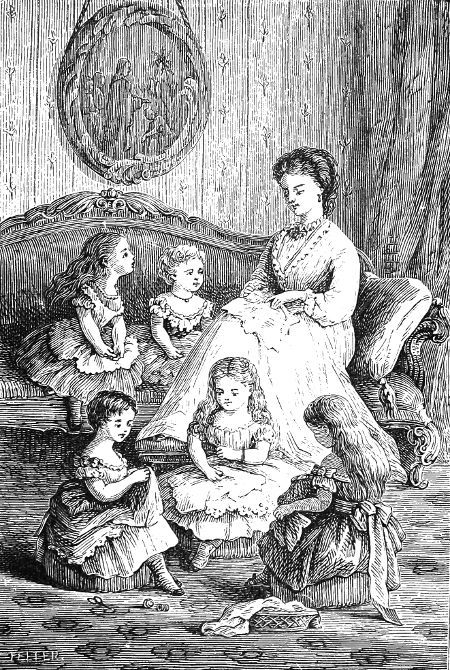
Lily Norris. p. 110.
"You had better call nurse to take her away, Maggie; she is too troublesome, and we shall accomplish nothing while she is here," said her aunt, now really vexed. But when she heard this, Baby Annie put up such a grieved lip and looked so piteous that the other children all pleaded for her; and Miss Stanton said she would try her once more.
"Shall Aunt Annie tell you a pretty story?" she asked, seating the little mischief in the corner of the sofa, where she would be out of harm's way so long as she could be persuaded to remain there.
Baby assented eagerly, for she always liked a story; and Aunt Annie began, the little one listening intently, with hands quietly folded in her lap, and her great blue eyes fixed on her aunt's face.
"Once there was a little girl, and she was a very good little girl, and always did as she was told. When her auntie said, 'You must be still,' she was as quiet as a little mouse, and made no noise. When her mamma said, 'Come here,' she always came; and when her nursey said, 'Do not touch that thing,' she never touched it. She did not take the pins, because she knew it was naughty, and that mamma would say, 'No, no;' and she did not pull at the flowers, because she knew her auntie would say, 'Let them alone;' and she did not touch Maggie's workbox, because she knew she was not to have it. And oh, dear me! why, she never would do such a naughty thing as to touch the trunk, because she knew it would hurt her little fingers, oh, so badly! and then she would have to cry. So every one loved this baby, and said, 'What a good little girl! Come here, good little girl;' and gave her pretty flowers of her own, and let her stay in the room, and did not send her away to the nursery."
Here Aunt Annie paused, to see what effect her moral tale was making on the small listener for whose benefit it was intended. Baby was intensely interested, and when Aunt Annie ceased speaking, gravely ejaculated the one syllable, "More."
The other children, who thought this extremely funny, were trying to hide their smiles that they might not spoil the lesson the story was intended to convey.
"Then there was another little girl," continued Aunt Annie, "such a naughty little girl, who would not mind what was said to her. When her mamma said, 'Don't go to the head of the stairs when the gate is open,' she would not mind, but she did go; and she fell down stairs, and bumped her poor little head. And she took the piercer, and made holes in her new shoes; and mamma said, 'Oh, the naughty baby! She must sit on the bed with no shoes on because she did such a bad thing.' And she took the scissors and cut her little fingers, and they hurt her so badly, and bled. And the pins too, and she put them in the carpet where they pricked grandmamma's feet; and grandmamma said, 'That naughty, naughty baby!' And what do you think happened to her one day? She would touch the trunk when her auntie said, 'Come away;' and the lid fell down, and cut off all the poor little fingers, and the little girl had no more fingers to play with, or to love mamma with, or to look at the pretty picture-books with. Oh, poor little girl! that was because she would not be good."
Nothing could outdo the intense gravity of the little one's face and demeanor as she listened to this thrilling tale, and drank in each word. It was certainly making a great impression, Aunt Annie thought.
"Now," she said, thinking to strengthen and give point to this, "who was the good little girl who always did as she was told?"
"Tootins," said the baby, with an air of supreme self-satisfaction, and conscious virtue, which set all the other children giggling.
"And who," asked Aunt Annie, trying to command her own face, as she put the second question, "was the naughty little girl who did all those bad things, and was so much hurt?"
"Na-a-an!" shouted baby, changing her air of delighted self-approbation to one of stern reproof and bitter indignation against her would-be teacher.
To describe the peals of gleeful laughter which followed this sudden turning of the tables would be impossible. Roguish Lily went capering and whirling about the room in an ecstasy of fun and enjoyment at this capital hit; and all thought it the most excellent joke they had heard this long time. It would have been impossible to help joining in their merry peals of laughter, even had not Aunt Annie herself been heartily amused at the little rogue's cuteness; and baby, finding she had said a good thing, joined her own rippling laugh to the general merriment, to which she further added by now saying, "Oh, dear! me so funny."
The laughter and merry voices brought mamma to see what the great joke could be; and Miss Baby now thought proper to deprive them of her society, slipping down from her nest on the sofa, and running to her mother with,—
"Me better do wis my mamma."
"Tootins" always considered she had "better" do whatever she wished to do.
And now perhaps you will say, What has all this long story about "Tootins" to do with Lily and procrastination?
Why, just this; that from the moment the baby had entered the room, Lily's attention had been entirely diverted from her sewing. In vain did that faithful little monitor, Bessie, endeavor by hints and signs, and softly whispered words, to persuade her to keep on with the work already so far behindhand. For to all her entreaties, Lily only answered, "There's time enough," or, "I'm going to do it in a minute," and so forth; while she watched the baby, and was rather disposed to encourage her in her mischief. And when Miss Stanton put little Annie up on the sofa, and began to tell her the story, Lily dropped her sewing upon the floor, and, leaving her seat, hung over the arm of the couch, listening and idling away her time. The other children were amused, too, at Annie's pranks, especially at this last one, but they kept on sewing industriously; even little Belle, who was unaccustomed to it, laboriously and with much painstaking, setting in stitch after stitch.
But even this good example had no effect on Lily; and seeing this, Aunt Annie was not sorry when "the little hindering thing" declared she had "better do wis" her mother. Mrs. Bradford thought so too; and carried away the cunning but provoking monkey.
"O Lily!" said Maggie, reproachfully, "I thought you were not going to bring Pro with you."
"Well, I didn't," said Lily. "I'm sure I've been sewing; at least, I've sewed some; and I was just looking at Annie for a moment."
"For a good many moments, Lily," said Miss Stanton; "and even when you had your work in your hand, you put in the stitches very slowly and carelessly. See there, Lily," taking up the end of the seam on which Lily was now working in great haste, in order to make up for lost time, "what long, uneven stitches, my dear child."
"Oh, they'll do, Miss Annie," said Lily. "I'll do the rest better; but I must have this seam done to-day."
Miss Stanton looked grave, and shook her head, and it was not a usual thing for gay, merry Annie Stanton to look serious; and Lily saw that she, like other people, did not think so lightly of this habit which she considered of so little consequence.
For, as you will have perceived, Lily had already forgotten the sad lesson she had received in the matter of the silver inkstand; and Maggie, Bessie, and Belle afterwards acknowledged to one another that their proverb picture had quite failed to produce the good effect they had hoped for.
"Let's keep the sewing meeting in a little longer," she said, when the hour was over, and the other children were preparing to put by their work, which had made good progress during that time.
"No," said Miss Annie, "an hour's steady work is enough for any little girl, and the others are tired. They have done enough for to-day."
"I think I'll do a little more," said Lily, who felt ashamed as she compared her own work with that of her young companions, and saw how much more they had accomplished.
"As you please," said Miss Stanton; "but I cannot attend to you longer, Lily. I am going out to dinner, and must dress now. I hope you will do better before next Thursday."
Lily went away with the others, intending to sew while they played, at least, for a while; but, as you may believe, when she saw them all engaged with their dolls, Procrastination came and put her virtuous resolution to flight, whispering that she could make up for lost time to-morrow; and, as usual, he had his way, and the petticoat was soon altogether forgotten.
VII.
WHAT CAME OF THAT.

"Lily, darling," said Mrs. Norris, on Saturday morning, "let me see how the little orphan's petticoat is coming on."
Lily went, rather sheepishly it must be confessed, and brought the skirt to her mother.
"Is this all you have done?—this little piece of a seam?" said Mrs. Norris. "And so badly too. Why, my child! what have you been thinking of? You can sew far better than this."
Lily fidgeted, and hung her head.
"Did you not all sew yesterday, when you were at Mrs. Bradford's?" asked her mamma, examining the work still more closely.
"Yes, mamma," murmured Lily.
"And did you not say Miss Annie showed you how it was to be done?"
"Yes, mamma."
"How is it, then, that you have done so very little, and that little so badly?"
"Why, you see, mamma," said Lily, hesitatingly, "I did not have much sewed, only a few stitches, and I wanted to catch up with the others; and so—and so—so the stitches wouldn't come very nice."
"And why did you not have as much accomplished as the other children? This is a very poor hour's work, dear."
"Yes, mamma; but Baby Annie was so funny, and I couldn't help looking at her, and I thought I would have time enough. It was such a horridly short hour; it was gone before I had time to do much."
"Ah, Lily," said Mrs. Norris, "it is the same old story, I fear. Procrastination, and want of attention to the duty of the time, and perhaps a little idleness and heedlessness added to them. These last two are great helpers to procrastination, Lily; or perhaps I should say, procrastination is a great helper to the sad fault of idleness. It is so very easy, when we do not feel industrious, to believe that another time will answer as well for the duty or work we should do now. So the duty is put off; and then, when shame or need calls us to the neglected task, it is hurried through heedlessly, and it may be so badly that it is quite useless, or must be done over again, as this must, my child."
"Mamma!" exclaimed Lily, in a tone in which there was displeasure as well as distress.
"Yes, indeed, my daughter. I cannot allow this to be returned to Miss Ashton with such work upon it. You are but a little girl, and no one would expect to see such neat sewing come from your hands as from those of an older person; but I should be ashamed to have it thought that my Lily cannot do better than this."
"Then I'll never have the petticoat done at all," said Lily, her eyes filling with tears. "It is 'most a week now since Miss Ashton gave them to us, and if I have to take that out it will be all to do from the beginning, and Maggie and Bessie and Belle have ever so much done on theirs, and I shan't have one stitch done on mine."
Mrs. Norris looked grieved at the rebellious tone.
"Whose fault is it, Lily?" she asked sorrowfully.
Lily hesitated for a moment; then, for the first time in her life, temper had the better of her love and reverence for her mother, and she answered passionately,—
"Yours, if you make me pull that out!"
For a moment, surprise held Mrs. Norris silent and motionless. Never before had Lily spoken so to her; never before had she been other than her loving, docile little child, not always strictly obedient it might be, but that was not so much from wilfulness as from that sad habit of putting off,—of not obeying at once.
Then the surprise died out, and left only pain and grief; and while Lily was wondering what mamma would do, could do, after such a dreadful thing as that (for the very utterance of the words had sobered her, and calmed down her temper), Mrs. Norris rose, and laying down the skirt, without one word, without one look at her naughty little child, slowly and sorrowfully left the room.
Lily stood still one moment, herself almost breathless with surprise and dismay at what she had done. Had she really said such dreadful words to mamma? and could mamma ever, ever forgive them? Her own dear, loving, indulgent mamma to hear such words from the lips of her own, only little daughter. What would papa say, what would Tom say, when they should know it? what would Maggie and Bessie say? For when mamma treated her as she deserved to be treated from this time forth, they would surely know that something was wrong, and must learn what she had done. And, oh! how angry God must be with her!
Some little boys and girls, who are in the habit of saying unkind and disrespectful things to their mothers,—and, alas! there are too many such,—may wonder at our Lily's distress and remorse; but Lily was not accustomed to behave in this way to her mother; as you have heard, it was the first time in her life that she had done so, and now she was fairly frightened when she remembered how she had let passion master her.
And what had brought this about?
Lily did not think of it just then, in all the tumult of feeling which swelled her little heart; but had it not all arisen from the sad habit of procrastination, of which she thought so lightly?
She felt as if she dared not run after her mother, and ask her forgiveness. True, mamma always was ready to forgive her when she was penitent after any naughtiness; but then—oh! she had never, never done any thing like this before—and Lily threw herself down upon the rug in a paroxysm of tears and sobs.
By and by the door was opened, and Tom came in. He stood still for a moment in surprise at the state in which he found his little sister, then came forward.
"My pet, what is it? What is the matter?" he said, stooping over her, and trying to raise her. But Lily resisted; and so Tom sat down on the floor beside her. A fresh burst of sobs came from Lily.
"What is it, dear?" asked Tom again. "Shall I call mamma?"
"Oh, no, no!" sobbed Lily. "She wouldn't c-c-come if you did. She'll never want to come near m-me a-a-gain."
"Why? What is wrong?" asked Tom, whose fears that Lily was ill or had hurt herself were now removed; for he saw that it was not bodily but mental trouble which ailed her.
"Oh! I've done the most horrid, the most dreadful thing, Tom," confessed Lily, still hardly able to speak for the fast-coming tears and sobs. "Oh! I spoke so wickedly to mamma; to my own dear, precious, darling mamma. It was 'most worse than the inkstand, oh, it was, it was! I'm so bad, oh, such a bad child!"
"Are you willing to tell me about it?" asked Tom, soothingly.
Lily raised her head, and threw it upon her brother's knee, allowing him to wipe away her tears; although, as she told her story, they flowed as fast as he dried them.
"Lily," said Tom, hoping that this might prove a good lesson to her,—ah! how often had Lily's friends vainly hoped that the trouble she brought upon herself might prove of service to her,—"Lily, how was it that your work was so very badly done?"
And Lily made a fresh confession, Tom gently leading her back to what he truly suspected to be the first cause of all this difficulty.
"Lily, dear," he said, "I am sure I do not want to seem to find fault with you, or to reproach you when you are feeling so badly; but I would like you to see how all this has come about. You think it such a small fault, such a very little thing, to put off your duties, and even your pleasures, if it happens to suit the convenience of the moment. As to pleasures, I suppose that does not matter much, so long as we do not let our want of punctuality interfere with the pleasure of others; but although it may not be what we call a great sin in itself, just see into what sin and sorrow procrastination may lead us. One little duty neglected or put off may interfere with another; or, as you have done, we may have to hurry through with it in such a manner as to leave it worse than if we had not tried to do it at all. And so we are disappointed and vexed, and perhaps we grow cross and ill-tempered, or fly into a passion, and do some very wrong or unkind thing."
"Yes; or behave worse than any child that ever lived, to our darling, lovely, precious mammas, just like me," broke forth poor, penitent Lily.
"Yes," said Tom, gravely, but kindly, "you see to what it has led you,—disrespect and impertinence to dear mamma. Is not this enough, Lil darling, to show you how much pain and trouble may come from this habit, and why you ought to try to break yourself of it? It is not only the inconvenience which must come from it, but the wrong which may grow from it, which should teach us to try and keep it from gaining a hold upon us. Do you see, Lil?"
"I should think I did," said Lily, dolefully, though she now sat upright, but with a most rueful and despairing countenance. "I should think it had made me bad enough to see what it can do. But, Tom,"—with an admiring look at her brother from the midst of her gloom and distress,—"but, Tom, what a wise boy you are! You talk as if you were grown up; quite as if you were a minister; only I understand all you say, and I don't understand all ministers say."
"No, I suppose not," said Tom, speaking more gayly; "but we will not have any more preaching just now, only—I would like to tell you a story, Lily. Shall I?"
"Yes, indeed, please do," answered Lily, brightening a little at the prospect.
"It is a very sad story, but I thought it would just fit here," said her brother.
"I'm not in a state of mind for a pleasant story," said Lily, who had lately fallen into the way of using long words, and "grown-up" phrases, after the example of her little friends, Maggie and Bessie.
"No, I suppose not," said Tom, suppressing all inclination to smile. "Well, you know Will Sturges, Lily?"
"Oh, yes, that very sorry-looking boy, whose father is dead, you told me," said Lily. "Tom, it always makes me feel sorry to see him. He hardly ever smiles, or looks happy. You know mamma told you to ask him here often, and see if you could not brighten him up; but he don't seem to brighten up at all. Bessie said he looked 'as if he had a weight on his mind' all the time."
"Ah! that is just it," said Tom. "He has a terrible weight on his mind; a grief that is there night and day. He thinks it is through his fault that his father was killed; and I suppose that it is so. At least it was brought about by a small neglect of his,—procrastination, or putting off, Lily."
"Did he ever put off?" asked the little girl, opening great eyes of wonder. "Why, he always seems so very punctual, so very ready just when he ought to be."
"Yes," said Tom, "but he was not always so, dear. Never was a more unpunctual, a more dilatory boy than Will Sturges used to be. Poor dear fellow! he has learned better by such a sad lesson. I hope my little sister may never have the like."
"I'm sure," said Lily, "I don't know who has had a sad lesson, if I have not."
"Ah! but, Lily," said her brother, "you have yet the time and chance to show you are sorry, and want to try to do better—if you really do repent—and to gain forgiveness from the one you have injured,—dear mamma; but poor Will, he never had the chance to make up for his neglect of his duty."
"Tell me," begged Lily, all curiosity and interest.
"Well," said Tom, "Will Sturges used to be, as he is now, about the brightest and quickest boy in our class."
Lily shook her head doubtfully at this; it was all Tom's modesty, she thought, and more than she could conveniently believe. Tom understood her, but continued his story without interruption.
"But, for all that, he never was at the head of his class, nor even took a very high standing in it; for never was such a boy for being behindhand as Will Sturges. Every thing that could be put off was put off, and he never seemed to like to attend to any duty or task at the proper moment. It was not laziness either, for he would leave some small task which should have been done at once, perhaps to take up one that was far harder, but which might well have waited till he had finished the first. He never could be persuaded to attend to his regular lessons first, but would let himself be led away from them, not always by play or pleasure, but often to take up some book which there was no need for him to study, always believing and saying that there was 'time enough'—'no hurry'—'by and by he would do it,' and so forth; until, as you may suppose, his lessons were left until the last moment, when they would be scrambled through, and Will just contrived to keep himself from disgrace. It was so with every thing; he never was ready in time for either work or pleasure. If he were going on a journey, or any excursion, ten to one but he was left behind by being too late for the boat or train; all his own fault too, for his father and mother used to take pains enough to have him ready in time. When Mr. Peters took the school on a picnic or frolic, it was always a part of the entertainment to see Will come tearing down the dock, or by the side of the cars just at the last moment, often after the last moment, and when it was too late. No boy in school had so many tardy marks; none lost so many books, papers, and pencils, because he always thought it was time enough to put them in their places by and by. No lesson did him any good, no disappointment or inconvenience he brought upon himself seemed to cure him; until at last the sad thing happened of which I am going to tell you.
"One afternoon his father said to him, 'Will, if you are going out, I wish these papers posted at the station. Take them with you, and attend to them at once, my son, before you go upon your own errand. They must go to grandfather by to-night's train. Can I depend upon you for once?' 'Yes, indeed, you may, sir,' promised Will, meaning what he said too; and when he left the house, he intended to go directly to the post-office station. But he had not gone far when he met a friend; and this boy begged him to go home with him, and see a fine new dog he had just bought. Will hesitated, looked at his watch, and found that there were still nearly two hours before the next mail would leave the station, that mail by which the papers must go if they were to reach the evening train. 'There'll be plenty of time, and all papa cared for was that they should reach the station before the mail left it,' he said to himself; and he went with his friend. He stayed with him more than an hour; then he said good-by, having, as he promised himself, more than time enough to reach the post, and mail his papers. But, just as he was about leaving the house, a little brother of his friend fell downstairs, hurting himself very badly; and, in the hurry and distress of the moment, he was begged to run for the doctor. He forgot his papers—indeed, how could one refuse such an errand at such a time?—and ran for the doctor, who lived far off, and in quite a different direction from the station. This last was not his fault, and if he had obeyed his father at once all would have been right; but, what with one thing and another, he was too late, and the mail had left. He tried all he could to send the papers by that evening train, but it was useless, for he could find no one to take charge of them, and he knew it would not do to trust them to chance hands. So he could do nothing but take them home again, which he did, and confessed his fault. His father looked very grave; but, as poor Will has often told me, did not scold him, only saying, 'Then I shall probably have to leave town myself to-morrow, and it will be a great inconvenience to me. I fear, my boy, that you will never learn the value of punctuality and the evil of procrastination until they are taught you by some severe lesson.' Poor, dear old Will! what a lesson that was to be! Well, his father was telegraphed the next day to come himself, since the papers had not arrived; and he left his home, Lily, never to come back. The train by which he went met with a fearful accident, and Mr. Sturges was killed in an instant. And from that day Will has been the sad, melancholy fellow you see him; for he blames himself for his father's death, and says but for him he would have remained at home, and so been safe. And, Lily, we must see that it is so, and that, if Will had not put off the duty he should have attended to, all this would probably never have taken place. If you could hear him talk about it!"
Lily drew a long sigh, partly from pity for Will Sturges, partly from dread of what sorrows might come to herself if she were not cured of this sad fault, then said,—
"But, after all, Tom, he was not so bad to his father as I was to mamma, for he did not mean to be naughty, and I'm afraid I did. Do you know, I was in a real passion, a passionate passion, with mamma. O, Tom! what shall I do?"
"What ought you to do first?" asked Tom.
"Go and ask mamma to forgive me; but how can she, Tom?" asked Lily, sobbing again.
"Mamma would forgive any thing, if she thought you were truly sorry," said her brother.
"I'm sure I am," answered the little girl. "If she could see in my heart, she would know it very well."
"You can show her what is in your heart, dear, by letting her see that you are really trying to break yourself of the troublesome fault which has led you to behave so to her."
Lily threw her arms around her brother's neck, and kissed him; the next moment she was gone in search of her mamma. When she reached her, she could find no words, none but a piteous "O mamma!" But her voice and her face spoke for her; and in another moment she was clinging fast around her mother's neck, her dear, kind arms about her, her kiss of forgiveness on the little head which buried itself in shame and contrition upon her shoulder.
But, though Lily was forgiven, she could not recover her spirits all that day, a thing very unusual with her; but then, as she said, she had "never been so wickedly naughty before," and she felt as if she could not do enough to make up to her mother for her offence.
She was rather droll, too, as she was apt to be, when by any means she fell into low spirits.
When her papa came home, she did not go to meet him with her usual light and dancing step; and he missed that, and the joyous face with which she was accustomed to greet him.
"Why," he said, "what ails my little sunbeam to-day?" for Mr. Norris had heard of Belle's idea about the sunbeams in the family, and he delighted to call his Lily so.
"I'm not a sunbeam to-day, papa," said Lily.
"You're not a little cloud, I hope," said papa.
"Oh, no!" answered Lily, mournfully, "not even so good as a cloud. I've been so very, very naughty that I believe I'm a—a"—Lily was racking her imagination for a comparison that should seem severe enough enough—"I've been quite a January thaw, papa."
Mr. Norris opened the door of the coat closet, and hastily put his head therein, taking a remarkably long time to hang up his hat, Lily thought.
Now you must know that a January thaw was Lily's idea of all that was most disagreeable in the weather. For, the last winter, she had had a severe attack of diphtheria; and just as she was well enough to go out, a long spell of damp, foggy days set in, keeping her a prisoner for some weeks longer, and depriving her of many little pleasures on which she had set her heart.
"She must not go outside of the door until this January thaw is over," the doctor said several times; and Lily had come to look upon this as the very worst specimen of weather.
"Don't you scorn me, papa?" she asked, when she had made her confession to him.
"No, I do not scorn you by any means, Lily," he answered; "and I am glad to see that you do really feel your fault, for it gives me hope that you may try to correct it with more earnestness than you have yet done."
And then he talked to her for some time longer, setting before her very plainly all the trouble and inconvenience, yes, and sin too, which might come from indulgence in this habit of procrastination.
Certainly our Lily did not want for teachers, both wise and kind; for her friends, young and old, seemed all to have set themselves to give her help in the right way, if she would but heed them.

VIII.
A LITTLE TALK.

It did really seem now that Lily was taking herself to task in earnest, and it was surprising to see how much she improved during the next few days. There was no more dilly-dallying with any little duty or task she had to perform; if her mother or any other person asked some small service from her, she ran promptly and at once; when Nora called her to make ready for school or her walk, there was no more stopping "only to do this," or "just to look at that." She was not once tardy at school; not once late at meals, a thing which her father disliked extremely, but to which Lily had until now paid but little heed. Play and nonsense were given up at school, save at the proper times, and she came to her classes with her lessons correctly prepared; for, when Lily failed here, it was not from stupidity, or want of quickness, but simply from idleness, or her habit of saying "there's time enough still."
The little petticoat, too, was progressing nicely, with a prospect of being finished in time after all; for Lily had begged her mamma to divide it off into certain portions, so much to be done on each day, that she might know her appointed task, and so be sure to have it completed. And she persevered, though the little unaccustomed fingers did grow rather tired every day before they were through with the allotted portion of seam or hem; for, having been so idle, or rather procrastinating, she found it hard to make up for lost time. Now she regretted that she had not taken the advice of her mother and teacher, and chosen one of the little aprons, instead of the petticoat.
Nora could not bear to see her plodding away over it, and more than once begged Mrs. Norris to let her help Lily, or "give her a lift," as she called it.
But Mrs. Norris refused, for she had told Lily that she would not allow this; and much as she would have liked to relieve her little girl, she did not think it best, and hoped that the burden she had brought upon herself might be of service to her.
However, when the next Thursday came, and Lily was to go to the second "sewing meeting," she was very glad that she had so much done on her petticoat.
"For I would be too ashamed to go to-day if I had not done better than I did last week, mamma," she said. "And two or three of the children in our class have finished their work already; and here is old me with mine not quite half done."
Lily was very "scornful," as she would have called it, of herself in these days, and rather delighted in heaping uncomplimentary names and reproaches upon her own head.
When she reached Mrs. Bradford's house at the appointed time, she was rather dismayed to find that, in spite of her industry of the last few days, the other children had accomplished much more than she had done. Maggie's skirt was so near completion that she had but a little piece of the hem to do; and she had only left this, in order that she might, as she said keep company with the rest in the sewing meeting. And Maggie had made a button-hole! Yes, actually made a button-hole! It was her first attempt, but still it was tolerably well done. It had cost her a good deal of trouble too, and even some few tears; but she had persevered, and now was glad that she had done so.
"Patience and Perseverance conquer all things, you know," she said to Lily, when Bessie, with some pardonable pride in her sister's success, displayed this triumph of art; "but I really thought that button-hole must conquer me, only I wouldn't let it, if I did cry a little about it."
Bessie, too, had nearly finished her bag; and though Belle was rather behind the others, she had a fair prospect of being quite through with her task in time.
They all encouraged Lily, and told her she might still finish her petticoat by the appointed day, if she would but continue to do as well as she was now doing.
The sewing meeting passed off this day without hindrance; for Baby Annie was not admitted; and there was nothing else especially to take off Lily's attention from the task in hand. Aunt Annie read an interesting story, it was true, but all the little girls sewed industriously as they listened; and at the end of the hour Maggie's petticoat and Bessie's bag were completed, while those of Belle and Lily had made fair progress.
"I have only three more days," said the latter, "for you know we have to give in the things on Tuesday, and this is Thursday."
Lily's tone was rather hopeless.
"I think you might finish your skirt in two days, Lily," said Miss Stanton. "Two hours' steady work such as you have given to it to-day would be quite time enough. If I were you I should sew one hour to-morrow, and one on Saturday, so that you may have little or nothing for your last day, Monday."
"Why wouldn't it do just as well to keep some for Monday?" asked Lily, folding up her work.
"Only that if you could finish it in the next two days it would be better," answered Miss Annie, "because something might happen to prevent you from doing so at the last moment."
"Don't have any more putting-off fits, Lily," said Maggie. "Don't you find 'distance lends enchantment to the view' of Pro? What are you laughing at, Aunt Annie? There is such a proverb, for I read it this very morning, only I didn't think I should have a good chance to use it so soon. I'll show it to you, so you need not think I made it up."
"Yes, I know," said Annie, catching the rosy, eager face between her two hands, and lovingly kissing either dimpled cheek. "It is an old, old proverb, and one very well known, dear Maggie; and let us hope that Procrastination may indeed look so much better at a distance than near at hand that Lily may keep it there, and not let it come near her."
"Aunt Annie," said Bessie, "you must be a very laughable person, for so often you laugh at things that we don't think funny at all."
"That is true," answered Aunt Annie, whose eyes were brimming with mischief, while she laughed more merrily than ever.
"Well," said Lily, "I did not quite understand what Maggie meant till Miss Annie said that, but I do know now; and, indeed, I do think Pro is better far off than close by. I'm sure I am a great deal better anyway, and I shall never let him come near me again."
Bessie stood looking gravely at her as she spoke.
"I see you don't quite trust me, Bessie," said Lily, "but you'll see. If you only knew all that I know, you'd learn what good reason I have for believing I shall never procrastinate again; but I'd rather not tell you what it is."
For Lily did really shrink from letting her little playmates know of her sad behavior to her dear mother, although she could not refrain from alluding to it in this mysterious manner.
"You know you're all coming to my house to spend the day with me on Saturday," she continued; "and before you come, I shall have the petticoat all finished, and will show it to you."
Lily kept faithfully to her resolution upon the next day, sewing industriously for a full hour, and then putting by her work with the consciousness that she had accomplished all that could be expected of her for that day. Perhaps she had been further encouraged to do so by hearing most of her young schoolmates say that morning that their little garments were quite finished, and ready to be handed in to Miss Ashton on Tuesday. Even Mabel Walton, although she had been quite ill with a bad cold, had completed her bag; and little Belle hoped and expected to put the last stitches in her's on that afternoon.
"Is your apron done, Nellie?" asked Lily of Nellie Ransom.
"Not quite," answered Nellie, "and I shall not finish it before to-morrow, for my two little cousins are in town to-day, and I must give up this afternoon to them. I am glad that I took the apron instead of the petticoat, for I am sure I should not have had time to make the last."
"You could have tried," said Gracie. "I'm sure a petticoat is not so much to make. Mine was all done on Saturday evening, and I did not have any help or showing either. Mamma is away, and I wouldn't let my nurse help me, but did it every bit myself. But then every one says I'm uncommonly handy with my needle;" and Gracie gave her head the toss which always excited the displeasure of her schoolmates.
"Well," said Nellie, coloring and hesitating a little, "I felt pretty sure that I could not make the petticoat in time, and I thought it was better to take that which I knew I could do; and now you see I should feel badly if I could not bring in my work when the rest do."
"Yes, and you were very right," said Belle. "I told Aunt Margaret about you, and she said you were a wise, prudent little girl."
"I wouldn't be such a slow poke as Nellie, would you?" whispered Gracie to Lily, when Nellie had moved away a little.
"I s'pose I'd be as I was made, and I s'pose you'd be as you were made," said Lily, loftily, for her "scorn," as she would have called it, was always excited by Gracie's attempts to exalt herself above her companions and schoolmates, and it rather delighted her to put Gracie down.
This was difficult, however. Gracie's self-sufficiency was so great that only a very hard blow could overthrow it, even for a moment; and Lily was too much afraid of being considered an anti-politer to speak her mind as plainly as she might otherwise have done.
So Gracie was not at all rebuffed by the answer she received; and, so far from taking it as the reproof Lily intended it to be, only replied,—
"Yes, of course; but I'm very glad I was made smarter than Nellie. Why, sometimes I can learn three lessons while she is learning one, she is so slow and stupid!"
"She is not stupid," retorted Lily, forgetting her determination to "be courteous" in her indignation; and, indeed, Gracie often made it difficult for those about her to keep to this resolution. "She is not stupid, and if she is a little bit slow about learning, she always knows her lessons perfectly, and never misses; no, never. You know she's been head of the spelling class for most a year; you know it, Gracie, and Miss Ashton says she is one of her very best scholars. And the whole world knows"—Lily was waxing energetic in her defence, and more earnest to be emphatic than strictly according to facts—"the whole world knows that she writes the best compositions in our class since Maggie Bradford left."
"Pooh! I never thought Maggie's compositions were so very great," said Gracie.
"That shows you're no judge, and have very little common sense," said Lily severely. "I'm sure no one could write better poetry than that poem she wrote for me, and you might be proud if you could make such lovely verses. But I don't want to quarrel with you, Gracie, so we'd better not talk any more about it, 'cause I do feel like saying something not courteous to you."
Gracie in her turn would have liked to say something that was not very pleasant, but she felt that she could not well do so when Lily declared her intention of not quarrelling, and retired in such a graceful manner from the threatened dispute. Still she did feel that somehow Lily had had the best of it, and had rather taken her down, as she was apt to do when Gracie displayed her vanity and self-conceit.
Moreover, clever and bright though she might be at her lessons, Gracie was not very quick at words; and she often felt that Lily had the advantage of her in their too frequent little disputes. And now while she was hesitating as to whether she should make a sharp answer, and what that answer should be, Miss Ashton came in and rang the bell; so that the opportunity, or I should say temptation, for further contention was at an end.
"I hope," said Miss Ashton, when the time came for dismissing school, "I hope that not one of my little girls will fail me on Tuesday. I should be very much disappointed, and mortified too, if I did not receive each garment quite finished and ready for use. Some of you I know are already through with the work which you have undertaken; and after what I have said, I believe and hope there is no one who will be willing to bring hers unfinished."
Her eye rested on Lily as she spoke. Perhaps she was hardly conscious that it was so, but she almost involuntarily turned to her as the one who was most likely to fail; and, however that might be, the little girl felt herself called upon to answer, not only for herself, but for the whole class.
"We'll be very sure to be ready, Miss Ashton," she said; "and I will too. I see you are afraid of me, but you need not be, for I b'lieve I'm quite cured now of putting off."
Miss Ashton smiled, but it was rather a doubtful smile, for she feared that Lily was too confident of herself, and the strength of her own resolutions.
So, as I have said, all this made Lily feel very industrious and prompt that day; and as soon as she was at liberty for the work, she set to her task at once, and accomplished it without delay.
But notwithstanding this, the day did not pass by without a fall into the old bad habit, as you shall learn.
IX.
SATURDAY MORNING'S WORK.

Saturday came, a bright and beautiful day, as Lily rejoiced to see when she ran to the window and peeped out as soon as she was out of her little bed.
For she was to have quite a party of children to spend the day with her, and she had been very anxious that the weather should be pleasant.
Maggie and Bessie, Belle and Mabel, and Nellie and Carrie Ransom were all coming, and they expected to have a great frolic. All Lily's playmates were fond of visiting her, not only because they loved her, and her home was a pleasant one, but also because there was such a grand play-room in Mr. Norris' house.
This was a great open attic hall or gallery. The house was a large one, and this open space ran across the whole width of it, the attic rooms being at either end, and a staircase coming up at the side. But this was shut in by a door at the foot of the flight, so that it was quite secluded, and considered rather an advantage, as it afforded a kind of retiring room. There were large bins ranged on the opposite side from the stairs, which had once been used to hold coal and wood; but they were empty now, and the top of the lids afforded capital seats for the spectators who witnessed certain performances which frequently took place in the open arena. Never was there such a famous garret, or one which had seen greater sport and fun.
Here the children could make as much noise as they pleased without fear of disturbing older people; here there was plenty of space for playing "tag," "hunt the slipper," "chairs," or any other frolicsome game; here they acted proverbs, charades, and so forth. These last were now their favorite amusements, and Mr. Norris' attic was considered the best place for their performance.
For, added to these other advantages, there was also a room devoted to the storing of all manner of odds and ends which were not in general use, and were stored there to be out of the way; and with certain of these articles the children were allowed to do as they pleased, and to make them serviceable in their games and plays. Among them were two or three old trunks full of old party dresses and ribbons; and any little girl can imagine what delightful means these afforded for "dressing up." There were flags, too, of various sizes and conditions, old-fashioned curtain fixtures, and even a tent of striped red and white canvas. All these Lily and her playmates were allowed to convert to their own uses, so long as they destroyed nothing; and many an hour did patient Nora, ever devoted to the pleasure of her nursling, spend in putting them to rights after they had been thoroughly rummaged and scattered abroad.
Chief among the treasures in the attic was an old rocking-horse which had belonged to Tom; at least he had once been a rocking-horse, but he had now not only lost his rockers, but also his hind legs. Strange to say, however, this did not at all interfere with his usefulness; perhaps it rather added to it, for when he was supposed to fill his original character, namely, that of a horse, he was accommodated with two imaginary limbs in the place of the missing members, and he never complained that they did not answer the purpose quite as well.
The number of uses to which he was put, and the characters he was supposed to represent, would be impossible to tell. Sometimes he was a prince, and sometimes a beggar or a robber; sometimes a servant, and sometimes a lover or husband; sometimes a little boy, at others a cross old man; again he was converted into an elephant by having the end of a curved iron pipe thrust into his mouth, or into a camel by a pillow upon his back; at times, a fierce wild beast, growling and raging; at others, the meekest of sheep or cows, mild and gentle in all respects. At one time he spoke in a squeaking but plaintive voice; at another in what was supposed to be a deep, roaring bass.
I forgot to say that he had lost his tail as well as his legs; and his beauty was farther increased by the fact that Maggie and Lily, finding his ears inconvenient for the proper fitting of crowns, caps, wreaths, and other decorations, had cropped them close to his head. He had also been shorn of his hair in various places, which gave him a mangy and distressed appearance; so that, save in the eyes of his most intimate and attached friends, he was not a horse of very fine personal appearance.
This gallant and accommodating steed rejoiced in the name of Sir Percy Hotspur; but this was laid aside when convenience demanded it, and he obligingly answered to the name of the moment.
Dear to the hearts of Lily and her young friends was Sir Percy Hotspur; and he was always tenderly cared for after he was through with his performances, being left to repose in the intervals in a corner of the attic, with his head upon an old sofa pillow, and carefully covered with a disused carriage robe.
What a long history of an old rocking-horse, you may say, and so it is; but, you see, Sir Percy Hotspur played a very important part in Lily's life, and she was deeply attached to him, and as this is her story, whatever concerned her deserves our attention.
With so many attractions, you may believe that an invitation to Lily's house was always considered desirable, and eagerly accepted.
Never, I think, were four little girls who found more enjoyment in their small lives and in one another, than our Maggie and Bessie, Belle and Lily. They were so much together that whatever interested one interested all the others, and any pleasure was increased if they could all share it together.
But we must go to the history of this Saturday.
"Lily," said Mrs. Norris, as the family left the breakfast table, "it is nine o'clock now; and if I were you, I would finish that little petticoat at once. I think you can do it in an hour, and then it will be off your mind and conscience; and after you have practised for half an hour, you can enjoy yourself for the rest of the day as you please."
"I don't believe the children will come before twelve o'clock, do you, mamma?" asked Lily.
"No, probably not."
"Then I have three hours," said Lily. "That is lots of time, and I shall be sure to have it done, even if I don't begin right away."
"Take care, Lily," said her mother, lifting a warning finger, and shaking her head with a smile which told the little girl what that warning meant.
"Don't be afraid, mamma," she answered "I'll be sure to do it this morning; and even if I did not quite finish it, I have Monday too."
Again Mrs. Norris shook her head, and this time without the smile; for she plainly saw that Lily was in one of her careless, putting off moods, and she feared the work would suffer.
"I am going right away, mamma," said Lily, as she saw how grave her mother looked; and away she danced, singing as she went.
But as she ran through the hall, she met her brother Tom with his puppy, which he was going to take for a walk. Lily never saw the little dog without stopping to have a romp with him, and the playful little fellow was growing fond of her already, and was always eager for the frolic with which she indulged him.
He sprang upon her now, whining and crying with pleasure at seeing her, and Lily stopped, of course, to pet him, and then began racing up and down through the hall; while Tom good-naturedly waited, and stood by, laughing at the antics of the two frolicsome young things. Gay and careless as the puppy himself, Lily had no more thought for the task awaiting her.
I do not know that she should be very much blamed for this; but few little girls who would not have done the same, and Lily knew that there was much more than time enough for the completion of the petticoat. But I want to show you how the moments, yes, and the hours too, slipped away; how little bits of idling and procrastination stole away the time before she was aware, and in the end brought her into sad trouble.
A quarter of an hour went by in Lily's frolic with the puppy, until at last Tom said he must go.
"I would take you with me, Lil," he said, "only that I know mamma wishes you to do your work."
"Yes," said Lily reluctantly; and but for very shame she would have begged to put off her work and accompany him.
Tom and his dog were gone, and Lily sauntered towards the sitting-room.
"I don't feel a bit like sewing now," she said to herself. "I could have gone with Tom, and been back time enough to finish my petticoat. Every one is so particular about my putting-off, and they never want me to do any thing I want to. But I s'pose I'll have to finish the old thing now."
Lily, you see, was allowing temptation to creep in. She did not still its first whisperings, but suffered them to make her feel discontented and fretful.
She had stopped at the foot of the staircase, and with both hands clasped about the newel-post, was swaying herself back and forth, when Nora spoke to her from the head of the stairs.
"Miss Lily," she said, by way of a gentle reminder, "do you need any help with your work?"
"No, I b'lieve not," answered the little girl. "If I do, I'll come to you. I was just thinking where I'd go to sew."
"Will you come to the nursery? It is all put in order," asked Nora, anxious to carry her point, and seeing from Lily's manner that her old enemy was busy with her.
"I'll see presently," said Lily. "I'm just going to the little parlor to look for my petticoat. I forget what I did with it yesterday when I had done sewing."
And, leaving her hold of the banisters, she crossed the hall. But as she passed the open door of the drawing-room, the piano caught her eye, and turned her thoughts into another channel.
"I think I'll go and practise first," she said. "It's all the same thing, and I can do the petticoat afterwards. I have just the same time."
This was true enough, but Lily was not wise, for she liked to practise, and she did not like to sew; and it would have been better for her to have done with the least pleasant duty first.
She placed herself at the piano, and, I must do her the justice to say, practised steadily for half an hour.
"It is ten minutes of ten," she said, looking at the clock. "Oh, there's lots of time yet; I can stay here a little longer. I'm going to practise this new piece some more."
This new piece was one Miss Ashton had given her the day before, so that she had had but one lesson on it; and it had all the charm of novelty to her, besides being, as she thought, the prettiest piece she had ever played.
"I'll astonish Miss Ashton by letting her see how well I have learned it," she said to herself; and she remained at the piano, playing over and over again the lively little waltz, until her mother's voice at the door recalled her to her neglected duty.
"Lily," it said, "you have been practising more than half an hour, dear."
"Yes, mamma," said Lily, glancing over at the clock again; "more than three quarters; but my new music is so very pretty, and I want Miss Ashton to be quite surprised with my knowing it so well."
"I am afraid Miss Ashton may have a less agreeable surprise if you do not take care, my darling," said Mrs. Norris gravely.
"Oh, you mean about the petticoat, mamma; but there's lots and lots of time. I b'lieve Pro has had hold of me this morning," said Lily, jumping down from the piano stool, "and I'll come right away; but you see I was so very sure about having time enough to-day, mamma, that it did not make so much difference. There's a good deal of time yet to-day, and I have Monday too."
"Put away your music, Lily," said her mother; and she stood waiting while Lily laid in its place the music she would have left scattered over the piano. Perhaps Mrs. Norris thought it just as well not to lose sight again of her heedless little daughter until she had her settled at her work.
"Bring your work-box to my room," said Mrs. Norris. "I have something to do there, and we will have a nice, cosey time."
Lily ran for the box, and was back with it in a moment, for as she went she said to herself,—
"I b'lieve I've let Pro steal a good many little thefts already this morning; now I'll just send him off right away. I have plenty of time yet, but now I really must make haste."
Lily's work-box was of rather formidable dimensions; indeed, some people thought it but one stage removed from a small trunk. It had been presented to her by an old lady with whom she was a great pet, and although it was extremely inconvenient in regard to size and weight, it was very handsomely fitted up with mother-of-pearl and silver, and contained every implement which could be needed by the most accomplished needle-woman. Upon the lid was a silver plate, with "For an industrious little girl" engraved upon it.
Now as we know, our Lily was by no means an industrious little girl; nevertheless she took great pride and delight in this "ark," as Tom privately called it; and, although she had two or three other work-boxes and baskets much more suitable and convenient in point of size, she made use of this one whenever she could do so.
"It held so much," she said, and indeed it did; and here the petticoat had reposed in the intervals when she was not busy with it; that is, when Lily had put it away in a proper manner.
She followed her mother with this ponderous treasure clasped in both arms; and, when she reached mamma's room, brought her little chair, and opened the box.
"Why," she said, when she had removed the upper tray which held all the dainty implements, and looked into the empty space beneath, "why, where is my petticoat? Somebody has gone and taken it out. Mamma, did you take it?"
"No, dear, I have not touched it," said Mrs. Norris. "Did you put it away yesterday?"
"Yes, mamma, you know I always put it in here. I'll ask Nora;" and away ran Lily to the nursery.
"Nora, did you take my orphan petticoat out of my work-box?" she asked.
"No, indeed, dear; and why would I touch it, unless you wanted some help with it?" answered Nora.
Back went Lily to her mamma's room, troubled and indignant.
"Mamma, some one has taken it. I never knew any thing so mean. Nora don't know any thing about it."
"Who would take it, Lily? I certainly did not, and you say Nora did not. Papa or Tom could have no reason for touching it. I will tell you what I think."
"What mamma?" asked Lily, anxiously.
"That you could not have put it away yesterday when you stopped sewing upon it. Think a moment, my daughter; can you distinctly recollect putting it away in your box?"
Lily stood considering one moment; then dismay and shame gradually overspread her face.
"No, mamma, I just believe I did not. When I was going to put away my petticoat in the box, I heard papa come in, and I wanted to know why he had come home so early; so I thought I would just wait one moment, and put it away when I had asked him, and I dropped it on the floor and ran to papa. And you know he had come to take us to see those pictures, and I never thought another thing about the petticoat. I quite forgot I had not put it away when I told you I had. I will go and look in the sitting-room where I was sewing yesterday."
But her search proved fruitless, although she certainly did look thoroughly through every part of the room. Nora was called, and took her part, but all in vain; and at last mamma came. Mrs. Norris rather felt that she should let Lily be at all the trouble of finding the petticoat for herself; but the child seemed so grieved that she could not bear to punish her in that way. But mamma was not more successful than her little daughter and the nurse had been, although in the end every servant was questioned, and every room searched.
"It is very strange. Are you quite sure you have not seen it, Hannah?" asked Mrs. Norris of her chambermaid, a rather dull girl, who had been but a short time in the house. "Have you seen nothing of the kind lying about in the sitting-room, or did you not touch Miss Lily's box?"
"Miss Lily's harnsum box, is it, ma'am? Sure, and I did see that a sittin' on the floor, where I thought you'd not be plased to see it at all at all, so I just lifted it to the table where I seen it sittin' before; but ne'er a thing I seen beside it. It wouldn't be Miss Lily's work what I found the puppy a pullin' round the ary, ma'am,—the mischavous baste that he is, my heart's most broke with him,—an' I didn't take heed what it was, but seein' it that dirty, I just put it in the basket with the siled clothes."
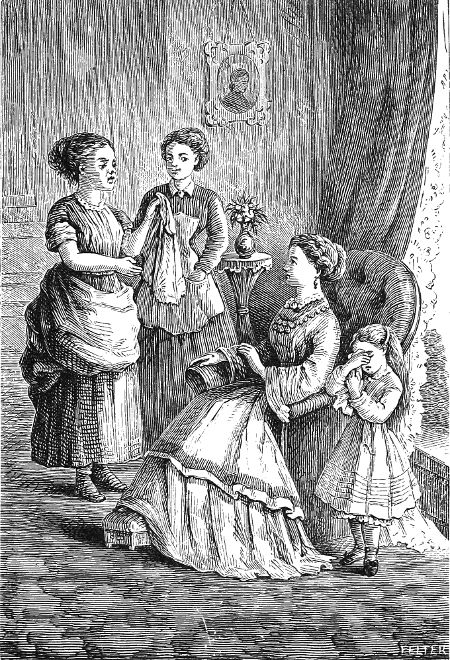
Away went Lily, Nora after her; and, sure enough, the latter soon fished out the unfortunate little petticoat from the soiled-clothes basket. Now, indeed, Lily was distressed, and cried bitterly, for the thing was in no state to be touched until it had been washed. It was easy to imagine how it had happened. The puppy, who was growing very mischievous, and who, like many another young thing, was fond of a forbidden plaything, had probably found the petticoat lying where Lily had heedlessly dropped it upon the floor; and, watching his opportunity, had dragged it from the room, down stairs, and out into the back area, where Hannah had rescued it, happily before it was torn and chewed to bits, but not before it was sadly blackened and soiled.
Lily Norris. p. 174.
"Now don't you cry, honey Miss Lily, and I'll just wash it right out for you, and have it back as clane as a new pin," said the good-natured Hannah. "If I'd known it yesterday, sure I'd a done it then; but niver a wurd did I think of its bein' your work, and it in that state. Och, what a crathur it is, that botherin' little baste!" she added, as she went off with the melancholy looking petticoat in her hand.
"Will she have it washed and dried and ironed in time for me to finish it before the children come, mamma?" asked the sobbing Lily, burying her head in her mother's lap.
"I am afraid not, dear," answered her mother, with a tender, pitying touch upon the thoughtless little head which brought so much trouble upon itself, "so much time has been lost in hunting for your work, and it is now nearly eleven o'clock."
"If I'd only gone to my sewing at first as you advised me, then I'd have found out sooner what that horrid little old hateful puppy had done, and Hannah might have washed the petticoat for me in time," moaned Lily. "I wish Tom never had the puppy."
"I do not think we must blame the puppy, my darling," said her mamma. "He only acted according to his nature; and he found the skirt, you know, where it should not have been."
"Yes," said Lily, "poor little cunning fellow; it wasn't his fault. It was all horrid old me, with my putting off that I never shall cure myself of; no, never, never. It is too mean that I cannot finish that tiresome petticoat this morning."
"Happily, dear, the consequences of your fault are not yet without remedy, and you may still make up for lost time, unless something should happen which we do not foresee; but you have only this one more chance, Lily. Take care that you do not neglect it, or be tempted to procrastinate again."
X.
SATURDAY AFTERNOON'S PLAY.

Mrs. Norris was right; for although Hannah did her best, she found it impossible to have the petticoat dry enough to iron so that Lily might have some time to sew upon it before her young friends arrived.
As soon as she had at all recovered her spirits, the little girl relieved her mind in some degree by making frequent rushes to the head of the back stairs to see if Hannah were coming with the petticoat; and once she persuaded her mother to let her go to the laundry that she might "be encouraged by seeing how much Hannah had done."
But she did not receive much encouragement from the sight of the still dripping garment, which Hannah had hung before the fire that it might dry the more quickly. Hannah took a cheerful view of the subject, saying she would have it ready very soon, and there was "lots of time afore Tuesday mornin'." But Lily was at last learning the folly of believing in "lots of time" to come; and she shook her head in a melancholy manner, and bade Hannah "take a lesson of her misfortunes, and never procrastinate."
She returned to the nursery in a very low state of mind, when Nora told her she would dress her at once if she chose, so that if she had any time to spare she might employ it on the skirt when it was dry.
Lily gratefully accepted the offer, but it proved of no use as far as the petticoat was concerned, for she had bade her little friends to "be sure and come by twelve o'clock," and her mamma having seconded the invitation, they had been allowed to do so; and soon after twelve, Maggie, Bessie, Belle, and Mabel arrived, just as Hannah brought up the petticoat, fairly smoking from her hot irons, and five minutes after, the rest of the young party made their appearance.
The clouds passed from Lily's face and mind at the sight of all these "sunbeams," and, consoling herself with the recollection that after all she still had Monday afternoon, she was presently as merry and full of spirits as usual.
Happily not one of the other children thought of asking her if the petticoat were finished, so that she was spared the mortification of confessing that it was not.
It was proposed that they should all amuse themselves downstairs until the early dinner, which had been ordered for them at one o'clock; after which they would go to the grand play-room in the attic, Maggie having provided herself with some fresh proverbs and charades, which they were to play.
"Harry and Fred are coming over this afternoon, and we want to make a ship in the lumber-room. You won't mind, will you?" asked Tom, who was taking his lunch at the little girls' dinner.
Doubtful looks were exchanged between some of them. Maggie's looks were not at all doubtful; her face was one of blank dismay at the proposal. Playing charades and proverbs was all very well when there were only those of her own age to look on; doing it before these big boys was quite another thing.
"Not if you don't like it, Maggie," said Tom, noticing her annoyance; "but we wouldn't disturb you, and anyhow I am sure you need not mind having us see you. We'll be busy at the carpenter's bench and tool-chest, and you need not heed us if we do see."
"I'm—I'm afraid you'll—you'll laugh at us," hesitated Maggie, coloring.
"If we laugh, it will be with you, not at you," said Tom. "But never mind; if you don't like it, we'll keep out of your way."
Then Maggie felt self-reproached, and, like the generous little girl she was, determined that her bashfulness should not get the upper hand of her readiness to oblige.
"I don't mind it so very much," she said; "at least I'll try not to, and you can come if the others say so. I suppose you won't take notice of us if you are building a ship, would you, Tom?" she added wistfully.
"No one shall disturb or trouble you in any way, you may believe that," said Tom; and Maggie knew that he would keep his word, and so declared her willingness that the boys should share the privileges of the lumber-room.
Away to the attic scampered the seven pairs of little feet the moment dinner was over; and Nora, following, opened the trunks for them, then left them to their own devices. That is to say, she brought her sewing, and went to sit in one of the rooms which opened out of the great gallery, where she might be within call if the children needed her, and at hand to keep them from mischief. That she provided for her own amusement by leaving the door so that she could see and hear, none of them, not even shy Maggie, noticed or cared.
Maggie of course was always chief spirit and prime manager of these entertainments; and she now divided the party, taking Belle and Nellie with herself as performers in the first charade, and assigning the part of spectators to Bessie, Lily, Carrie, and Mabel.
The audience speedily accommodated themselves and their children—that is their dolls—with seats upon the top of the bins, scrambling thereto by the help of chairs, and amusing themselves with lively conversation while waiting.
Maggie and Nellie brought forth from the store-room a small table and three chairs, which were suitably placed; Sir Percy was brought from his place of repose and laid upon the floor beside them; after which the young ladies retired again into privacy.
"The charade has begun, and Sir Percy is a great big dog this time," said Maggie, suddenly popping out her head once more, and then withdrawing it.
After some moments she reappeared, this time gorgeously arrayed in a flowing train, formed of an old red table-cloth, bordered with gold, a wreath of artificial flowers on her head, ribbons of all colors pinned and tied about her, and an enormous fan in her hand, with which she fanned herself affectedly, mincing and prinking as she walked to a chair, where she seated herself, taking good care to keep her face turned from Sir Percy, whom she pretended not to observe. The audience were spell-bound with interest and the wish to guess the word.
"Tell your mistress—er—that er—Madam Jones—er—is here—er," drawled the lady, addressing an imaginary servant, closing her eyes as if quite exhausted, and putting on all the airs and graces conceivable.
Presently entered the hostess, attired with similar magnificence, but with rather a bluff and off-hand manner, which contrasted very strikingly with that of her visitor. Meanwhile, from behind the door of the store-room came a piteous mewing, which soon attracted the attention of the second lady, who peered about her in great surprise, and exclaimed,—
"That must be a cat mewing, and I never allow a cat in my house, never!"
"Oh—er," drawled Mrs. Jones, "it is only my sweet pussy, my lovely pet, my only donly pet; such a dear pet, oh, such! Wouldn't you like to see her, Mrs. Smith?"
"No, oh, no!" cries Mrs. Smith, lifting up her hands in horror; "I hate cats, and so does my lovely pet, Bombastes Furioso. Here, Bomby, Bomby, Bomby, come and speak to Mrs. Jones, my darling pet."
Upon which Mrs. Jones affected to see for the first time the great dog Bombastes Furioso, and to be filled with alarm at the sight.
"Don't call him, pr-r-r-ay, don't!" she cried. "Is it possible that you like canine dogs, Mrs. Smith? How can you have such a pet? Here, kitty, kitty, kitty!"
Hereupon entered Belle on all fours, covered with a white flossy mat which had been brought up from the hall for the purpose, and ran mewing about her mistress.
"I'd rather like canine dogs than canine cats," wrathfully cries Mrs. Smith; "and, ma'am, I tell you I won't have cats in my house! S'cat, s'cat, s'cat!"
"Ma'am," cries Mrs. Jones, indignantly, "if you turn out my pet, you turn out me, and I'll never visit you again, ma'am, nor be acquainted with you any more. I cut you, ma'am, I cut you!"
"And I cut you, ma'am. Bringing cats in my house, indeed! Here, Bombastes Furioso, s-s-s-s!" and the indignant and inhospitable Mrs. Smith tried to urge her dog to seize Mrs. Jones' kitty. Bombastes, however, being a dog of a lazy turn of mind, contented himself with deep, hoarse growls whenever Mrs. Jones was speaking. He was silent when it was necessary for his mistress to speak; and Mrs. Smith found herself obliged to drag her lumbering pet onwards by his two remaining hoofs—I beg his pardon, I should have said paws.
This was the sole objection to the accommodating Sir Percy, that he was so unwieldy and cumbersome to move when circumstances required that he should do so. This being the case, Mrs. Jones, whose airs and graces were all put to flight by this attack upon her, had time to scuttle off with her pet before Bombastes Furioso had advanced more than a step or two.
This was greeted with shouts of laughter, in which the performers themselves joined as they disappeared; and after the applause had subsided, the four heads on the top of the bins set themselves to guess the word.
"I think it's affected lady," said Carrie.
"I don't. I think it is cat or dog," said Lily. "You know this is only the first syllable, Carrie, so it couldn't be affected lady."
"Oh, to be sure," said Carrie. "Bessie, what do you think it is?"
"I think it is pet," said Bessie. "Did you not hear how often they said 'pet'? 'Pet' dog and 'pet' cat?"
"Yes, so they did," said Lily. "Bessie, you are right. Oh, isn't it fun?"
The performers were not long in making their preparations for the next syllable; and the only change in the outward arrangements was that various bottles, a saw, some chisels, awls, and other tools were brought out, and placed upon the table.
"These are doctors' instruments," Maggie explained before retiring.
Presently she reappeared, buttoned up in an overcoat which reached to her feet, a man's hat coming down over her eyes, a cane in her hand, and bustled round among the bottles. From this occupation the doctor was roused by a knock at the door, and there entered two other overcoated figures, limping and groaning in a distressful manner.
"We've been in a railroad accident, and all our bones are broken, doctor," piped one of the sufferers.
The unfeeling surgeon hustled them each into a chair, and with great roughness proceeded to wrap and bandage, tying a great many knots with much unnecessary vigor, accompanied with shrieks and groans from his patients.
"Ow—ow—ow, doctor," cried one of them, as the doctor pulled hard upon a knot in the handkerchief he was tying on a broken arm, "you do hurt more than any doctor I ever knew. You tie so hard."
"Well," growled the doctor, "when you come to me with two broken arms, and two broken legs, and a broken back, and your eyes put out, and your head smashed up, do you expect to be mended without being hurt? Here, let me tie your head."
The patients, being well tied up, at last departed, followed by the doctor; and the audience unanimously agreed that tie was the second syllable.
"Pet—tie," said Bessie. "I just b'lieve it's petticoat."
"So it is," said Carrie; while Lily, recalled to the recollection of her unfortunate petticoat, was struck dumb by what she considered a remarkable coincidence.
The performance of the third syllable was not quite as interesting as the other two had been, the coats which had been worn by the doctor and his patients being brought out and beaten with sticks with a great bustle and fuss, but without a single spoken word. After this it scarcely needed the performance of the whole word to establish the fact that it was petticoat; but, the chairs and table being removed, it was gone through with by three young ladies, very much dressed, taking a walk on a muddy day, and greatly disturbed for the fate of their petticoats, as they splashed and waded through imaginary pools and puddles.
"Petticoat! Petticoat! Petticoat!" resounded from the top of the bins, accompanied by violent clapping and stamping, and other tokens of the pleasure which had been afforded by the representation.
And now the audience came down from their perch, and resigned it to the late performers, with whom they were to change parts; at least, Belle and Nellie were to do so, for Maggie was, as I have said, the moving spirit, and all the others played under her orders. She was the most ingenious in choosing and arranging the words, and it was believed that no charade went off well unless she took part in it.
This arrangement only left two spectators, it is true; but Maggie said she needed all the others, and no objection was made.
The chairs and table were now brought back to their old places. After the necessary dressing up had been done, Bessie appeared with a handkerchief tied over her sunny curls, a white apron coming down to her feet, and followed by Carrie as a servant, bearing dishes. These—a doll's dinner set—were arranged upon the table with much noise and rattle, the little landlady bustling about, and calling upon her maid to make haste.
"For I keep a very good inn, servant," she said; "but when some people come to inns, they make a great fuss, and give a great deal of trouble; and I heard of a gentleman who is coming to my inn, and he is very cross, and a great scolder, so I don't want to give him any reason to complain, and we must have every thing very nice in my inn."
"Yes, ma'am, we'll have the inn very fine for him," answered the maid.
The fears of the landlady were not unfounded, as it proved; for presently appeared Sir Percy in the character of a cross old gentleman, supported and dragged along with much difficulty by his wife and daughters. He was attired in a man's hat and great-coat, the sleeves of the latter coming down some distance below his—h'm—hands; but this was a convenience, as they could be flapped about in wild gesticulation, as he stormed and scolded at the inconveniences of the inn. A more ill-tempered old gentleman was never seen; and a hard time did his attendants have of it. He laid about him in the most ferocious manner, and was not to be pacified by all the attentions that were lavished upon him; until the little landlady declared that "if that old gentleman was going to stay a great while in her inn, she would not keep an inn any longer."
"Inn, inn," was called, not only from the bins, but also from the other side of the room, as the old man was at last carried away, still growling, and wildly slapping the air with his coat-cuffs.
The children turned, and Sir Percy tumbled heavily to the floor, as Maggie loosened her hold of him, struck dumb by the sight of three pairs of eyes peering above the side of the staircase.
"Now, that's too bad," cried Lily. "You boys can just go 'way. You'll laugh at us."
"Indeed, we won't," said Tom. "We came up just a few moments ago, and we thought we wouldn't interrupt you by passing through, but wait until you had finished, and that was capitally done. But I'm afraid you'll hurt yourselves with Sir Percy. He is too heavy for you to lug about, and Maggie's toes barely escaped just now."
"O Tom!" said Lily; "why, half the fun would be spoiled if we didn't have Sir Percy."
"Well, be careful then," said Tom, as he passed on with Harry into the store-room.
But Fred lingered.
"I say, Midge," he said, "let a fellow stay and see the rest of your charade, will you? It's jolly."
Maggie looked blank, but all she said was, "O Fred!"
"No, you can't," said Lily, unmindful of the duties of hospitality in her own attic; "you just can't, 'cause you'll laugh, and make fun of us."
"Now come on, Fred, and let them alone," called Tom from within the room. "I promised them they should not be teased if we came up here."
"I'm not going to tease them," said Fred. "I want to see the charade, really and truly. The little chaps do it first-rate, and I like it. Let me stay, girls."
Maggie and Bessie, especially the latter, had strong objections to being called "chaps," but Fred never could remember that. However, they passed it by; and Fred won a rather reluctant consent to his remaining as a spectator. He was put upon his good behavior, and with a run and a jump speedily landed himself beside Belle and Carrie, where he kept his word, and conducted himself as a well-behaved spectator should do.
The next syllable presented a lady writing, her maid sewing. In rushes a gardener, tree in hand, represented by a large feather dust-brush; and with much Irish brogue and great excitement, accuses the lady's son of cutting down a young peach-tree. Son denies, and is believed by his mother, who sternly tells the gardener that her son has never told a lie, and whatever he says is "true, true, true."
Gardener declares that "indade, an' he is thrue; an' if the missis will but make Master George Washington hould up the hand that's behint him, she'll see the hatchet he did it with."
Mother demands the hatchet, son rebels, still keeping his hand behind him, but mother, chasing round and round, presently discovers it; whereupon she clasps her hands frantically, cries she thought he was true, falls fainting to the ground, and is carried off by son, gardener, and maid.
This new version of an old and familiar story was received with tremendous applause, to which Fred's boots added not a little.
Next appeared Sir Percy once more, this time without any outward adornments. He was laid upon the floor, and in his mouth was thrust a pointed stick, bearing a paper, on which was written in Maggie's largest, roundest hand, these words:—
"This is a disagreeable smelling dead cat."
About and around the dead cat walked five young ladies, uttering exclamations of disgust, wondering where the smell could come from, but strangely blind to the offensive animal which lay before them.
"Ow! how horrid!" cried one.
"Ugh! disgusting!" exclaimed another.
"What an awful smell!" said the third.
"Ugh! it's that dead cat!" said the fourth. "Let's shun it, let's shun it!"
And with loud cries of "Shun it, shun it," the five young ladies scamper into the store-room, from which the sound of smothered laughter had now and then mingled with the public applause without.
It was not difficult now to guess the word; nevertheless the whole charade must be played out before it was even hinted at to the performers.
"In-tru-sion," was carried out by two of the aforesaid young ladies, who rang violently at a front-door bell, and were denied admittance by a dainty, little sunny-haired maid, who declared that her mistress was very much engaged.
The visitors persisted in their desire to see her, and forced their way in, to be fiercely attacked by the indignant lady of the mansion, who was engaged with her lover, Sir Percy, and who sternly demanded, "Whence this intrusion?"
"No intrusion at all, ma'am," says one of the visitors.
"Yes, intrusion, ma'am," replies the hostess; and contradiction followed free and fast, until stopped by the shouts of "Intrusion! Intrusion!" from the reserved seats.

XI.
A SAD ACCIDENT.

"That's capital!" exclaimed Fred. "Give us another, Midge, will you?"
Fred had conducted himself with such becoming propriety, and his applause had been so hearty, that Maggie felt not only quite reconciled to his presence, but also ready to indulge him; and she answered,—
"Yes, I have one more, and it is to be instructive as well as amusing, Fred, because it is an historical charade."
"Go ahead!" said Fred, scrambling back into his seat, which he had left to help carry Sir Percy into retirement.
The preparations for the first syllable of the historical charade were very imposing. Two chairs were placed face to face; upon these was mounted the table, turned upside down, with its legs in the air; to one of the legs was tied a large feather dust-brush,—the whole arrangement supposed to represent an oak-tree, as Maggie explained.
Maggie, Nellie, Lily, and Belle were the performers on this occasion; and in due time they all entered, escorting Sir Percy, now in the character of King Charles, in full kingly costume, the red table-cloth doing duty for his robes, and a crown, a "real crown" of tinsel paper adorning his majesty's brows. He was held with some difficulty upon his horse,—another chair turned down for the purpose,—and again Tom's warning voice came from the store-room.
"You'd better look out with that old hobby. You'll hurt yourselves some time, lugging him about that fashion."
But the suggestion was treated with disdain.
An old hobby indeed! King Charles an "old hobby"!
The horse—that is, the chair horse—paused beneath the tree, and then, relieved of his burden, galloped off, led by Belle; while the other three prepared to hoist his cumbersome majesty into the tree, he not being agile enough to perform that office for himself.
Maggie had proposed that two of the children should be his enemies in pursuit; but no one was willing to take that character. Staunch little royalists they were, every one, and not to be reckoned among the persecutors of the unfortunate king. So this little diversion from the true historical facts had been permitted to suit the occasion, all the more readily as it was feared that it would take the united strength of the whole four to raise him to the necessary height. Still Maggie had not been quite satisfied with such a very great departure from reality; and, hearing the difficulty as they worked at the carpenter's bench, Tom and Harry had good-naturedly offered to take upon themselves the obnoxious part of the king's enemies, and as soon as he was safely hidden in the tree to rush forth in search of him, and feign total unconsciousness as they passed beneath his place of shelter.