Chapter XIV · ACCIDENTS AND FATALITIES FROM LIGHTNING.
Reading edition
The accidents that occur annually from the effects of lightning are far greater in number and extent than is generally supposed. Although the art of protecting buildings by means of lightning conductors was discovered some hundred and twenty-seven years ago, and it is now one hundred and eleven years since, in 1768, Benjamin Franklin’s ‘lightning rods’ were first set up over the dome of Saint Paul’s Cathedral, yet the application of this great discovery is by no means general. At least one-half, and perhaps two-thirds, of all the public buildings, including the churches and chapels, of Great Britain and Ireland, are without any protection against lightning. As to private houses, it may safely be affirmed that not five out of every thousand are fitted with lightning conductors. It is well known that the amount of property annually destroyed by lightning in this country is very great, though it is, very naturally, impossible to form any accurate, or even approximate estimate of it. With regard, however, to the number of deaths from the same cause, certain statistics do exist, although many of them are notoriously imperfect. According to the ‘Fortieth Report of the Registrar-General,’ issued in July 1878, and former reports, the number of deaths from lightning in England and Wales was as follows in each of the nine years from 1869 to 1877:—
Years Males Females Total
1869 5 2 7
1870 13 6 19
1871 23 5 28
1872 35 11 46
1873 17 4 21
1874 25 — 25
1875 14 3 17
1876 15 4 19
1877 — — 12
Total 147 35 194
The official returns of the number of deaths from lightning, as given by the English Registrar-General, are admittedly incomplete. In Prussia, where the registration of the causes of death is most rigidly enforced by law, and, in consequence, is far more accurate than in England, there were one thousand and four persons reported as killed by lightning in the nine years from 1869 to 1877. According to the official report issued by Dr. Ernst Engel, Director of the Statistical Bureau of Berlin, the number of lives lost each year was as follows:—
Years Males Females Total
1869 47 32 79
1870 59 43 102
1871 56 47 103
1872 50 35 85
1873 61 50 111
1874 58 49 107
1875 92 48 140
1876 59 47 106
1877 105 66 171
Total 587 417 1,004
The population of Prussia is somewhat larger than that of England and Wales—25¾ millions against 24½ millions—but on the other hand, thunderstorms are less frequent there than with us. Altogether it will be rather under than over the mark to say that as many persons are killed by lightning in England as in Prussia, the loss amounting, on the average, to over one hundred every year.
Of the deaths by lightning in France, Mons. Boudin some years ago collected statistics which showed that during the thirty years beginning in 1834 and ending in 1863, two thousand and thirty-eight people were struck dead by lightning in that country. During the last ten years of this period, the deaths amounted to eight hundred and eighty, and of these only two hundred and forty-three were females. In connection with this it is a noticeable fact that when a lightning stroke falls upon a crowd, it almost invariably causes more fatalities among the men than the women.
In the following tables are given statistics of deaths and accidents from lightning in the various countries referred to.
In the case of the United States, the Chief of the Bureau of Statistics writes that no record of deaths or fires caused by lightning is kept—a somewhat curious admission on the part of such a practical and methodical country. A similar reply has been received from the authorities in Spain.
Cas de Mort, occasionnés par la Foudre, dans les 49 Gouvernements de la Russie Européenne, sans compter la Finlande et les Gouvernements du ci-devant royaume de Pologne.
Années Hommes Femmes
1870 261 139
1871 260 167
1872 404 216
1873 300 179
1874 227 117
Total (en cinq années) 1,452 818
De ce nombre dans les villes 75 34
De ce nombre dans les villages 1,377 784
Incendies, occasionnés par la Foudre, dans les 49 Gouvernements de la Russie Européenne, sans compter la Finlande et les Gouvernements du ci-devant royaume de Pologne.
Années Dans les Villes Dans les Villages
1870 11 571
1871 23 767
1872 28 1,217
1873 19 908
1874 12 636
Total 93 4,099
Dans le gouvernement de Cherson les villes Odessa et Nicolaev ne sont pas comprises, à cause du manque de renseignements.
The returns from Russia, which include the years 1870, 1871, 1872, 1873, and 1874, are here printed as they were received from the President of the Commission for Statistics at St. Petersburg.
The returns from Sweden, extending as they do over a period of more than sixty years, are highly interesting. In this case the difference in the number of men and women killed is not so noticeable as in other countries:—
Deaths by Lightning in Sweden.
Year Total Of which
Under 10 years old Over 10 years old Males Females In the country In the towns
1877 8 — 8 4 4 7 1
1876 14 2 12 6 8 14 —
1875 16 — 16 10 6 16 —
1874 9 — 9 6 3 9 —
1873 14 1 13 7 7 13 1
1872 26 2 24 10 16 25 1
1871 6 — 6 2 4 5 1
1870 9 1 8 5 4 9 —
1869 7 1 6 3 4 7 —
1868 14 — 14 11 3 14 —
1867 5 — 5 3 2 5 —
1866 26 2 24 8 18 25 1
1865 13 2 11 7 6 13 —
1864 5 1 4 2 3 4 1
1863 4 — 4 3 1 4 —
1862 12 2 10 10 2 11 1
1861 15 — — — — 15 —
1860 7 — — 4 3 7 —
1859 22 4 18 12 10 20 2
1858 18 — 18 11 7 17 1
1857 6 1 5 3 3 6 —
1856 6 1 5 3 3 6 —
1855 25 2 23 16 9 25 —
1854 5 — 5 4 1 5 —
1853 8 1 7 4 4 8 —
1852 15 4 11 7 8 14 1
1851 9 — 9 7 2 9 —
1850 9 3 6 6 3 9 —
1849 11 1 10 4 7 10 1
1848 5 — 5 1 4 5 —
1847 10 — 10 3 7 10 —
1846 21 1 20 14 7 21 —
1845 16 4 12 10 6 14 2
1844 11 — 11 9 2 10 1
1843 2 — 2 — 2 2 —
1842 7 1 6 5 2 7 —
1841 7 1 6 5 2 7 —
1840 2 — 2 1 1 2 —
1839 22 4 18 17 5 22 —
1838 11 1 10 9 2 11 —
1837 5 2 3 3 2 5 —
1836 4 — 4 2 2 4 —
1835 5 1 4 3 2 5 —
1834 36 4 32 21 15 36 —
1833 7 1 6 6 1 7 —
1832 5 — 5 1 4 5 —
1831 7 1 6 3 4 7 —
1830 5 — — 5 — — —
1829 10 — — 6 4 — —
1828 9 — — 6 3 — —
1827 5 — — 4 1 — —
1826 11 — — 6 5 — —
1825 6 — — 3 3 — —
1824 6 — — 4 2 — —
1823 5 — — 3 2 — —
1822 8 — — 4 4 — —
1821 4 — — 3 1 — —
1820 15 — — 8 7 — —
1819 32 — — 17 15 — —
1818 10 — — 4 6 — —
1817 4 — — 2 2 — —
1816 7 — — 3 4 — —
Deaths by Lightning in Baden.
Year Males Females Total
1874 3 — 3
1875 3 5 8
1876 2 7 9
Total 8 12 20
Fires through Lightning in Bavaria.
Right side of Rhine.
Year Total
1843–44 24
1844–45 39
1845–46 54
1846–47 25
1847–48 27
1848–49 26
1849–50 30
1850–51 32
1851–52 44
1852–53 60
1853–54 38
1854–55 47
1855–56 70
1856–57 66
1857–58 56
1858–59 60
1859–60 50
1860–61 64
1861–62 63
1862–63 80
1863–64 59
1864–65 90
1865–66 48
1866–67 100
1867–68 140
1868–69 86
1869–70 79
1870–71 115
1871–72 107
1872–73 170
Left side of Rhine.
Year Total
1870 6
1873 36
Austria. List of Damages by Fire through Lightning.
Key: AWE - Austria, Western Europe AEE - Austria, Eastern Europe Sa. - Salzburg St. - Styria K. - Kärnten Il. - Illyria Co. - Coastland Ty. - Tyrol Bo. - Bohemia Mä. - Mähren Si. - Silesia Ga. - Galicia Bu. - Buckovina D. - Dalmatia
YearTotal Fires Of which those through lightning are:—
AWEAEESa.St.K.Il.Co.Ty.Bo.Mä.Si.Ga.Bu.D.Total
1870 4,171 20 16 1 14 3 4 2 2 58 15 — 26 — — 161
1871 4,293 9 26 1 9 5 2 3 1 53 8 1 34 4 — 156
1872 5,265 11 26 4 32 5 12 3 2 45 14 7 56 5 1 223
1873 5,500 11 16 3 30 4 12 1 11 88 18 7 42 3 3 249
1874 5,244 15 24 — 32 5 9 — 8 79 15 5 53 5 — 250
1875 4,529 17 34 — 19 4 10 2 7 68 19 8 62 — — 250
1876 5,001 18 13 1 22 5 5 1 1 59 15 — 48 — — 188
1877 6,125 21 23 3 23 8 8 — 7 63 19 6 43 1 — 225
Total 40,128 122 178 13 181 39 62 12 39 513 123 34 364 18 4 1702
Deaths by Lightning in Wurtemberg.
Year Total
1841–42 26
1851–60 117
Deaths by Lightning in Switzerland.
Males Females Total
1876 2 1 3
1877 21 9 30
Total 23 10 33
The data given here is necessarily incomplete, although much trouble has been taken in obtaining it. Many countries keep no separate records of deaths and accidents from lightning, and those kept by others are often meagre and untrustworthy. Still the statistics given are sufficient to prove that lightning constitutes no unimportant factor among the dangers that threaten the safety of human life. The apathy with which the danger is regarded by most people is simply astounding: very few make any effort to protect themselves or their houses against it, although during certain months of the year it is almost impossible to take up a newspaper that does not contain an account of some fatality or casualty from the effects of a thunderstorm. The long roll of accidents appended to this chapter shows only too clearly the enormous amount of damage that has arisen—and is continually arising—from this source. Public buildings fare little better than private houses. Even some of the first cathedrals of England have no lightning conductors whatever, while others, supplied with them, are insufficiently protected, as is apparent to any competent observer. A glaring instance of the absence of protection against lightning is to be found at Windsor Castle. It is a fact that several portions of this splendid palace, among them St. George’s chapel, and the adjoining Belfry Tower, are entirely unprovided with lightning conductors. On other parts of the castle a few conductors are placed, but clearly not enough. It is needless to say that, speaking only of St. George’s chapel and the Belfry Tower, these beautiful buildings, constantly touched by the storm-clouds that sweep up the valley of the Thames, are liable at any moment to destruction or great damage.
Thomas Fuller, in his ‘Church History of Britain,’ states that—
‘There was scarce a great abbey in England which (once, at the least) was not burnt down with lightning from Heaven. 1. The Monastery of Canterbury, burnt anno 1145, and afterwards again burnt anno 1174. 2. The abbey of Croyland, twice burnt. 3. The Abbey of Peterboro, twice set on fire. 4. The Abbey of Mary’s in York, burnt. 5. The Abbey of Norwich, burnt. 6. The Abbey of St. Edmondsbury, burnt and destroyed. 7. The Abbey of Worcester, burnt. 8. The Abbey of Gloucester. 9. The Abbey of Chichester, burnt. 10. The Abbey of Glastonbury, burnt. 11. The Abbey of St. Mary in Southwark, burnt. 12. The Church of the Abbey of Beverley, burnt. 13. The steeple of the Abbey of Evesham, burnt.’
Even in those cases where in modern times lightning conductors have been applied to buildings, they are very often improperly fixed in the first instance, or, having once been put up, are never examined or tested with the view of ascertaining their constant efficiency. Several accidents owing their origin to one or the other of these causes have occurred quite recently. In May 1879, the church at Laughton-en-le-Morthen was struck by lightning and damaged in the manner described in Chapter XIII. The spire was fitted with a corrugated copper tube conductor the joints of which were made by screws and coupling-pieces, but there was no metallic contact between the lengths; the conductor was insulated from the building; and the earth-contact was obtained by bending the end of the tubing, and inserting it about twelve inches deep in dry loose rubbish! Such a conductor is worse than useless. If it had been examined by a competent person, it must at once have been utterly condemned. In June 1879, a disastrous result followed the use of a similar conductor erected upon a private house near Sheffield. In this case the corrugated tube forming the conductor contained too little metal, and it was insulated from the building. The examples show the necessity of leaving the design and erection of lightning conductors to those persons who have made a thorough study of the subject, since the work is by no means so free from complexity as is commonly supposed.
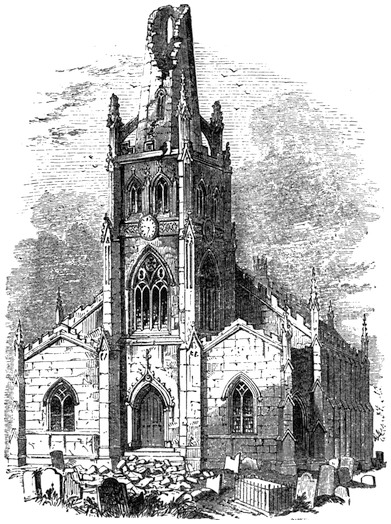
Fig. 40. ST. GEORGE’S CHURCH, LEICESTER.
Figs. 40 and 41 show the tower and spire of St. George’s Church, Leicester, after being severely damaged by lightning on August 1st, 1846. The storm, during the course of which it was struck, was very violent, of prolonged duration, and accompanied by torrents of rain and hail. Mr. Charles Tomlinson, F.R.S., in his work on ‘The Thunderstorm,’ thus describes the catastrophe:—
‘It was at five minutes past eight, after one or two peals of unusual distinctness, that the church of St. George was struck with a report resembling the discharge of cannon, and with a concussion of the air which shook the neighbouring houses, and extinguished a lamp burning at the entrance of the News-room, many hundred feet distant. The Sexton had gone into the church, as usual, to toll the eight o’clock bell; but was so terrified by the “fire-balls” that he saw in the sky, and by the fact that once or twice the clapper struck the side of the bell without his agency, that he made his work as short as possible, and had just gone out and locked the churchyard gate when the stroke fell. Two of the spectators of this awful event were Captain Jackson and the Rev. R. Burnaby, the rector of the parish, who both described the flash as a vivid stream of light, followed by a red and globular mass of fire, and darting obliquely from the north-west, with immense velocity, against the upper part of the spire. For the distance of forty feet on the eastern side, and nearly seventy on the west, the massive stone-work of the spire was instantly rent asunder and laid in ruins. Large blocks of stone were hurled in all directions, broken into small fragments, and in some cases, as there is every reason to believe, reduced to powder. One fragment of considerable size was hurled against the window of a house three hundred feet distant, shattering to pieces the woodwork, as well as fourteen out of the sixteen panes of glass, and strewing the room within with fine dust and fragments of glass. It has been computed that a hundred tons of stone were on this occasion blown to a distance of thirty feet in three seconds. In addition to the shivering of the spire, the pinnacles at the angles of the tower were all more or less damaged, the flying buttresses cracked through and violently shaken, many of the open battlements at the base of the spire knocked away, the roof of the church completely riddled, the roofs of the side-entrances destroyed, and the stone staircases of the gallery shattered. The top of the spire, when left without support beneath, fell perpendicularly downwards, inside the steeple, causing much devastation in its descent. Falling through the uppermost storey, and carrying along with it the bell and its solid supports, the ruined spire entered the room containing the clock, dashed the works to pieces, and penetrating the strong and well-supported floor, descended with additional momentum through the third and fourth floors (the latter being that just deserted by the prudent sexton), and reached the paved vestibule with so furious a shock as to drive in a portion of the strong foundation-arch, by which the weight of the whole tower was supported. On looking upward from the scene of ruin in this vestibule, the tower appeared like a well, so small were the vestiges of its various storeys.’
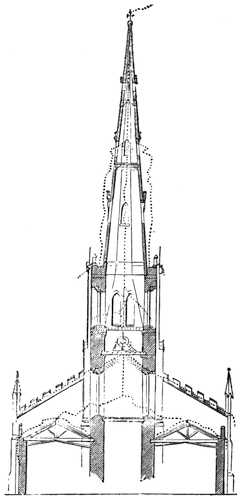
Fig. 41. ST. GEORGE’S CHURCH, LEICESTER.
After minute examination, it was evident that the course of the lightning had been nearly as follows:—‘The flash first struck the gilded vane, marks of lightning being perceptible between its bevelled edges. After traversing the vane and spindle, and the terminating iron supports, the only path left for the fluid was through a series of iron cramps, separated by masses of sandstone; and here it was that the explosion commenced—the stone being torn and hurled aside as it came in the path of the lightning to the lowest lead lights of the spire. Most of these iron cramps were found to be powerfully magnetic; and one of them, eight weeks afterwards, sustained a very considerable brush of steel filings at its edges. The lattices of the lights on three sides of the spire were little injured; but on the fourth side the stone-work was shattered, and the lattice singularly twisted and partially fused. Here, it appears, another violent explosion took place, and the lightning diverging struck the north-west pinnacle, attracted apparently by the copper bolt by which the stones were held together. It also struck the large cast-iron pipe on the other side of the spire, reaching from the tower-battlements to the roof of the church; and during its passage down the pipe, and at an inequality in the surface of the metal, it displayed the most extraordinary expansive force, bursting open and scattering to a distance portions of metal of great solidity and weight. From the leadwork of the roof the lightning was conducted to the leaden gutters, and so finally to the earth.
‘The course of the remaining current in the interior of the tower was first to be traced on the lattices of the belfry, then in the clock-room, where the works of the clock were strongly magnetised, thence in at least three different directions to the outside of the tower. The external faces of the clock were not much altered, the hands were, however, slightly discoloured, and the blackened surfaces of the dials covered with streaks, as if smeared with a painter’s brush. On quitting the dial faces on the northern and southern sides of the tower, the lightning evidently fell upon the leads of the side lobbies, and was finally carried off by the two iron pipes connecting their roofs with the earth. Both these pipes were chipped and injured, and one of them was perforated, as if by a musket-shot, a few inches from the ground. The edges of this fracture were found to possess magnetic power. Thus, besides the division of the current at the upper part of the spire, there was a second division in at least three directions from the clock-room and dial faces. The roof of the church throughout its whole extent showed signs of an extraordinary diffusion of the electric current; and in almost every place where one piece of metal overlapped another, a powerful explosion had evidently taken place.’
As far as is known the church was unprovided with any lightning conductor. The same storm produced most disastrous effects in other parts of the Kingdom. Seven thousand panes of glass were broken by the hail in the Houses of Parliament; three hundred at the Police Office, Scotland Yard; other buildings in the metropolis suffered to a similar extent, the glass in the picture gallery at Buckingham Palace being totally destroyed and the apartment flooded with water.
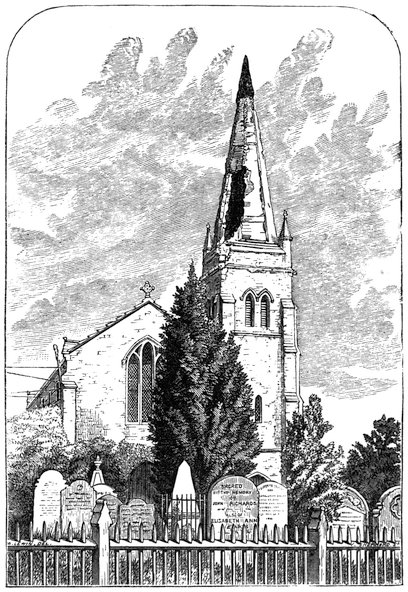
Fig. 42. WEST-END CHURCH, SOUTHAMPTON.
Fig. 42 shows the spire of the church at West End, Southampton, which was struck by lightning on June 10, 1875. A large quantity of the stone-work was broken by the passage of the electric discharge, and some of the pieces were thrown to a great distance.
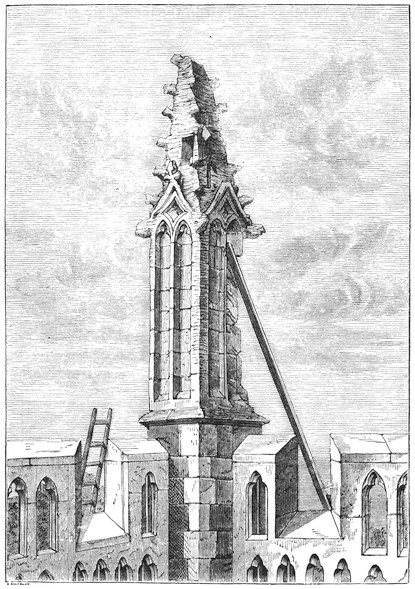
Fig. 43. MERTON COLLEGE CHAPEL, OXFORD.
On September 27, 1875, the tower of the chapel of Merton College, Oxford, was struck by lightning. The damage done was confined to the mutilation of one of the corner pinnacles and the displacement of fragments of some of the stone-work which were thrown on to the leads and the pathway beneath. Some workmen were on the leads at the time, but fortunately were not hurt. The tower had lately been restored, and the scaffolding had only been removed a few days previous to the accident. A gentleman who had taken shelter from the storm in one of the workmen’s sheds beneath the tower was startled by seeing fragments of stone falling from above; looking up, he discovered that the tower had been struck, and immediately informed the college authorities. On ascending the tower it was found that one of the eight crocketted pinnacles had been struck. This pinnacle occupied the south-western corner, and had been completely and cleanly severed from summit to base. Fortunately, the stone-work displaced—which weighed about three hundredweight—was thrown on to the roof of the tower, a distance of twenty-five feet. The vane, slightly fused by the electric discharge, was found embedded in an upright position in the leads. The mouldings on the edges of the pinnacle were divided to the extent of four feet, and many of the stones were turned entirely round.
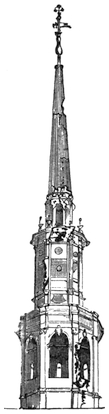
Fig. 44.
The tower, which was erected in 1424, and is one of the landmarks of Oxford, had not up to the time of the accident been provided with lightning conductors, but they have since been affixed to the building.
Fig. 44 shows the steeple of St. Bride’s Church, Fleet Street, London, which was severely damaged by lightning on June 18, 1764. The spire of this steeple is built in four storeys, surmounted by an obelisk. These four storeys are braced together by means of horizontal iron bars; another iron bar, about twenty feet long and two inches square, passes through the upper part of the obelisk and supports the weathercock and other ornamental work on the top; there is also a great deal of iron-work used generally in the construction of this part of the building, thus forming a complete series of discontinuous metallic masses. When the lightning struck the building it was received by the long iron bar which supported the vane; at the lower end of the bar the electric discharge, meeting with no metallic conductor, burst with great violence, shattering the stone on which the bar rested; the lightning then pursued its course to earth, leaping from one piece of metal to another and breaking the stone-work in its way. The last trace of it was found at the west window of the belfry, from whence it seems to have found a road to the earth. The damage sustained by the structure was so great that eighty-five feet of the spire had to be entirely rebuilt.
The edifice was afterwards attentively examined (as explained in a previous chapter) by Dr. Watson, a well-known electrician in those days, who reported to the Royal Society that the accident ‘completely indicated the great danger of insulated masses of metal to buildings from lightning; and, on the contrary, evinced the utility and importance of masses of metal continued and properly conducted, in defending them from its direful effects. The iron and lead employed in this steeple, in order to strengthen and preserve it, did almost occasion its destruction; though, after it was struck by the lightning, had it not been for these materials keeping the remaining parts together, a great part of the steeple must have fallen.
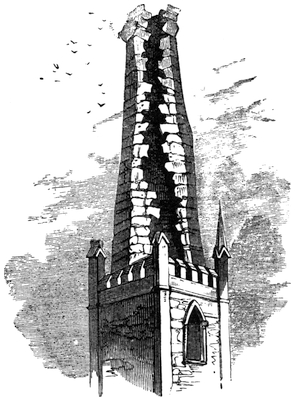
Fig. 45.
Fig. 45 shows the condition of St. Michael’s Church, at Black Rock, near Cork, after being struck by lightning on January 29, 1836. The damage done was entirely on the windward side of the steeple, caused, as is suggested in Mr. Tomlinson’s work, by this side receiving the greatest quantity of rain, and so being rendered the ‘line of least resistance,’ but not a sufficiently good conductor to carry off the discharge to earth.
On Trinity Sunday, June 8th, 1879, a violent thunder-storm broke over the town of Wrexham about half-past three in the afternoon, during which the spire of St. Mark’s Church was struck by lightning. A Sunday-school class was being held in the room at the base of the spire, and the teacher and five of his scholars were burnt, three of them severely, and one had his leg broken. Some of the stone-work of the spire was also displaced and thrown down. The spire was fitted with a copper conductor, but it was of too small a calibre, and it is very doubtful whether the earth connection was all it should have been.
Many other cases might be enlarged upon, but enough have been given to prove the imperative need for a more general use of lightning conductors on all public and private buildings. Another equally important necessity is that lightning conductors should be erected on sound principles, and also be periodically examined and tested by some competent person.
PUBLIC BUILDINGS STRUCK BY LIGHTNING.
Date Building Damage Authority
1589. July 16 Nicholas Tower, Hamburg The tower burnt down From original notices in Reimarus, Bl. 315
1670. June 29 Nicholas Church, Straland Damaged Phil. Trans. v. 2084
1673. June 29 Pharr Church, Epperies, Hungary Damaged Breslauer Samml. 1717, p. 64
1693 Oundle Church Set on fire Phil. Trans. xvii. 710
1700. Oct. 9 Principal church, Troies Set on fire and shattered Mém. de l’Acad. de Sc. Paris, 1760, p. 65
1708. July All Hallows’ Church, Colchester Damaged Phil. Trans. 432
1711. May 20 Principal town tower in Bern; houses adjoining Damaged Scheuchzer, Meteorol. Helv. p. 35
1711. May 23 The belfry of the church at Solingen Set on fire Scheuchzer, Meteorol. Helv. p. 28
1714. June 21 Elizabeth Tower, Breslau Damaged Breslauer Samml. 1717, p. 68
1717. July 2 Church at Seidenberg, near Zittau Seven persons killed Breslauer Samml. 1718, p. 1534
1718. April 14, 15 Twenty-four churches between Landerneau and St. P. de Léon, Brittany Set on fire and shattered Hist. de l’Acad. de Sc. Paris, 1719, p. 21
1718. Dec. 14 Church tower at Eutin Set on fire Breslauer Samml. 1718, p. 1968
1725. Dec. 18 Church tower, Winterthur Lightning followed an accidental conductor, and resulted in melting it Breslauer Samml. 1725, p. 166
1728. Aug. 25 Church tower, Mellingen, in Baden Shattered Reimarus, Bl. 145
1731. July Three villages near Geneva Destroyed Gent.’s Mag. p. 309
1732. Oct. The Escurial at Madrid Set on fire Gent.’s Mag. p. 1034
1743. Aug. Liberton Church, Scotland Steeple destroyed Gent.’s Mag. xiv. 450
1745. July 21 Tower of monastery, Bologna Shattered. Lightning followed an accidental conductor, and melted it Reimarus, Bl. 93
1746. May 21 Tower of the School Church, Halle The ball on the tower bent, and other mechanical effects Reimarus, 198
1747. Aug. 20 Tower of the College Church, Pluviers Physio. and mechanical effects Mém. de l’Acad. de Sc. Paris, 1748, p. 572
1748. May 31 Top of a church tower, Witzendorf Shattered and tore off the roof; melted and shattered accidental conductor Hamburg Magazine, ix. 301
1750. Feb. 5 Church tower, Danbury, Essex Set on fire Phil. Trans. xlvi. 611
1750. Spring Tower of Dutch Church, New York Lightning followed an accidental conductor, which was shattered, and caused other mechanical effects Franklin, Experiments and Observations xv. 180
1751. June 6 Tower of church, South Moulton, Devonshire Lightning followed an accidental conductor, which was shattered, and caused other mechanical effects Phil. Trans. xlvii. 330
1752. June 19 Church tower, Alfwa, Sweden Tower damaged; several persons injured Schwed. Abh. xv. 80
1753. Mar. Darlington Church Much damaged Gent.’s Mag. xxiii. 145
1753. Oct. Church of Les Filles de St. Sacrament, Naples Reduced to ashes Gent.’s Mag. xxiii. 487
1754. June 16 Belfry of Newbury Church Point of spire shattered, accidental conductor melted, and other damage Phil. Trans. xlix. 307
1755 Danish Church, Wellclose Square Clock damaged Phil. Trans. xlix. 298
1755. Dec. St. Aubin Church, Lorraine Much damaged Gent.’s Mag. xxv. 42
1757. Jan. Lostwithiel Church, Cornwall Much damaged Gent.’s Mag. xxviii. 427
1757. Nov. Christ Church, Dublin Much damaged Gent.’s Mag. xxvii. 527
1759. April Great Billing Church, Northamptonshire Steeple destroyed Ann. Reg. ii. 84
1759. May Portsmouth Church, New Hampshire Much damaged Gent.’s Mag. xxix. 355
1759. June 10 Jacob Church, Aumale Several persons injured Reimarus, Bl. 158
1760. July 16 Church, Altona Lightning struck the copper covering on the top of spire, followed accidental conductors, and melted them Reimarus, 59
1761. June Shifnal Church, Norfolk Greatly damaged Ann. Reg. iv. 136
1761. July Ludgvan Church, near Penzance Greatly damaged Ann. Reg. iv. 142
1763. Mar. Harrow Church Set on fire Gent.’s Mag. xxiii. 142
1763. Mar. Salisbury Cathedral Damaged Gent.’s Mag. xxiii. 143
1763. Mar. Southam Church, Warwickshire Damaged Gent.’s Mag. xxxiii. 142
1764. June 18 St. Bride’s Church, London Spire struck and much damaged Phil. Trans. liv. 227
1765. Aug. Bicester Church Much damaged Gent.’s Mag. xxxv. 391
1766. July Skipton-in-Craven Church Much damaged Ann. Reg. ix. 118
1766. Aug. St. Mary’s Church, Bury St. Edmunds Much damaged Ann. Reg. ix. 122
1767. April Provence, France Three churches set on fire Ann. Reg. x. 81
1767. May Mentz Cathedral Set on fire Ann. Reg. x. 92
1767. Aug. 6 Nicholas Tower, Hamburg Lightning followed accidental conductors, and partly melted them Reimarus, Bl. 291
1767. Sept. Genoa Several churches damaged Ann. Reg. x. 126
1768. Aug. 21 Church tower in Alem Damaged. Several persons injured Haarlem Verh. xiv. 34
1770. Feb. 18 St. Keverns Church, Cornwall Damaged. Several persons injured Hemmer, Act. Acd. Palat. iv. 37
1771. Feb. 2 Nicholas Church, Kiel Lightning followed accidental conductor, and left traces Ackermann’s notice, Kiel, 1772
1772. Mar. St. Paul’s Cathedral, London Lightning followed accidental conductor, and left traces Arago, iv. 88
1773. April Lighthouse at Villafranca, Nice Destroyed Gent.’s Mag. xliii. 246
1773. June Rhichenback, Saxony Town reduced to ashes Ann. Reg. xvi. 115
1773 St. Peter’s Church, London Shattered the tower roof Phil. Trans. lxv. 336
1774. Aug. Buckland Church, near Dover Damaged Ann. Reg. xvii. 140
1775. Feb. St. Colomb Church, Cornwall Much damaged Ann. Reg. xviii. 91
1775. June 27 A church in Munich Tower injured Epp. 90
1776. Aug. Cuckfield Church, Suffolk Much damaged Ann. Reg. xix. 170
1778. April 15 Church in Altona Metal melted Reimarus, Bl. 64
1780. Sept. Church of the Holy Spirit, Hamburg Injured Reimarus, N.B. 47
1780. Oct. Hammersmith Church Much damaged Ann. Reg. xxiii. 230
1783. July Ashbourne Church, Derbyshire Steeple demolished Gent.’s Mag. liii. 707
1783 St. Mary’s, Leicester Steeple demolished
1786. June 26 Church in Wachenheim Shattered. People injured Act. Acad. Theod. Palat. vi. 332
1787. June St. Mary’s Church, Grenoble Much damaged Gent.’s Mag. lvii. 820
1787. June Vendamir Church, Vercovia Several persons killed Gent.’s Mag. lvii. 820
1787. June St. Gregorius Church, Prague Set on fire Gent.’s Mag. lvii. 820
1787. June Cranbrook Church Much damaged Gent.’s Mag. lvii. 824
1789. May Pforzheim Church Entirely consumed, with thirty adjoining buildings Gent.’s Mag. lix. 754
1789. June Barnewell Church, near Oundle Damaged Gent.’s Mag. lix. 665
1790. Dec. Beckenham Church Set on fire Ann. Reg. xxxii. 229
1790. Dec. Horsham Church Set on fire Ann. Reg. xxxii. 229
1791. Jan. Ashton-under-Lyne Church Much damaged Ann. Reg. xxxiii. 3
1791. Oct. Rainham Church Much damaged Gent.’s Mag. lxi. 1050
1795. June Castor Church Much damaged Gent.’s Mag. lxv. 517
1795. Dec. 25 Church in Bergen, Norway Set on fire Gilb. Ann. xxix. 176
1797. July Grantham Church Damaged Gent.’s Mag. lxviii. 104
1797. Aug. Caldecot Church, Rutland Spire much damaged Gent.’s Mag. lxvii. 817
1801. July Corby Church Damaged Gent.’s Mag. lxxi. 659
1804. Mar. St. Gertrude Church at Nevelles Burnt by lightning Gent.’s Mag. lxxiv. 368
1804. Mar. St. Maria at Oudenard in Flanders Burnt by lightning
1804. June Edenham Church, Lincoln Damaged Ann. Reg. xlvi. 394
1804. June Hanslope Church, Bucks Spire destroyed Ann. Reg. xlvi. 395
1806. July Sunbury Church, Middlesex Damaged Ann. Reg. xlviii. 426
1807 Montvilliers Church, France Damaged Howard’s Climate of London, ii. 29
1810. July Attercliffe Chapel Much damaged Gent.’s Mag.
1811. June Ashford Church Much damaged Gent.’s Mag. lxxxi. 584
1811. Dec. Ledbury Parish Church Damaged Gent.’s Mag. lxxxi. 650
1812 St. Pelverin Church, Department of the Loire Set on fire and burnt to the ground Howard’s Climate of London, ii. 165
1813 Bridgwater Church Spire destroyed Howard’s Climate of London, ii. 222
1813 Weston Zoyland Church Tower much damaged Howard’s Climate of London, ii. 222
1814. Nov. Thackstead Church, Essex Much damaged Gent.’s Mag. lxxxiv. 491
1815 The steeples of many churches in Belgium, in places far distant from one another Struck and set on fire nearly at the same hour Howard’s Climate of London, ii. 259
1816. July Worschetz, county of Temeswar Church and the town greatly damaged Ann. Reg. lviii. 102
1816. Oct. Moselle Church Damaged Ann. Reg. lviii. 161
1817. Mar. St. Paulinas Church, Germany Set on fire Ann. Reg. lix. 15
1819. Jan. St. Martin’s Church, Guernsey Much damaged Ann. Reg. lxi. 5
1819. July Sedgeford Church, Lynn Much damaged Ann. Reg. lxi. 50
1821. May 7 Tower of Katherine’s Church, Gross-Selten Church burned Gilb. Ann. lxviii. 224
1821. May 7 Wooden Tower of Katherine Church, Tischendorf Tower burned Gilb. Ann. lxviii. 224
1821. May 8 Church at Carlsruhe Damaged Gilb. Ann. lxviii. 224
1821. April Redcliffe Church, Bristol Much damaged Gent.’s Mag. xci. 367
1822. Jan. 15 Church at Gerstetten Damaged Wurtemberger Jahreshafte, xi. 463
1822. June North Luffenham Church, Rutland Much damaged Gent.’s Mag. xcii. 636
1822. Aug. Church at Chatham Spire ripped open Tomlinson’s Thunderstorm, p. 165
1822. Sept. Rouen Cathedral Set on fire Tomlinson’s Thunderstorm, p. 165
1822. Oct. St. Peter’s Church, Venice Reduced to ruins Gent.’s Mag. xcii. 553
1823 Kemble Church, Wilts Spire destroyed Howard’s Climate of London, iii. 135
1823. Feb. Shaugh Church, near Plymouth Tower struck and much shattered. An iron conductor had been erected about two years before, but this had rusted and gone to decay Tomlinson’s Thunderstorm, p. 165
1824. July 10 Church at Simmerfeld Damaged Würtemberger Jahreshafte, xi. 463
1824. Nov. Charles Church, Plymouth Steeple struck, and the small brass rod erected as a lightning conductor knocked to pieces Tomlinson’s Thunderstorm, p. 165
1825—about Torrington Church, North Devon Tower and steeple ruined. They had to be rebuilt Tomlinson’s Thunderstorm, p. 165
1826. June Alphington Church, near Exeter Much damaged Ann. Reg. 1826, p. 97
1827 Pailant Church, Chichester Considerably damaged Howard’s Climate of London, iii. 259
1827. Jan. 11 Church Tower, Bussen Set on fire, although covered with snow Würtemberger Jahreshafte, xi. 463
1828. April Edlesborough Church Set on fire Gent.’s Mag. xcviii. 358
1828. June Kingsbridge Church, Devon Steeple rent, and other damage Tomlinson’s Thunderstorm, p. 165
1828. Oct. Kilcoleman Church, co. Mayo Spire destroyed Ann. Reg. p. 131
1830. July Independent Chapel, Edgworth Moor, near Bolton Damaged Ann. Reg. p. 101
1830. Aug. Marlborough Church, near Kingsbridge, Devon Tower and church severely damaged Tomlinson’s Thunderstorm, p. 166
1831. Feb. Kilmichael Church, Glassire Much damaged Ann. Reg. p. 39
1833. Aug. Strasburg Cathedral Much damaged Builder, ii. 39
1835. May 16 Church Tower, Endersbach Much shattered Würtemb. Jahreshafte, xi. 465
1835. June Durham Cathedral Western tower damaged Ann. Reg. p. 94
1836. Jan. Black Rock, near Cork Spire demolished Tomlinson’s Thunderstorm, p. 166
1836. Nov. Christ Church, Doncaster The spire shattered and the church greatly injured. The roof was smashed in, and the churchyard presented a scene of ruin and devastation. The spire was surmounted by a ball of glass to keep off the lightning! Tomlinson’s Thunderstorm, p. 166
1837. June Hoo Church, Kent Set on fire Gent.’s Mag. N.S. viii. p. 80
1839. Jan 8 Church tower in Hasselt Damaged Arago, Notiz, 125
1841. Jan. Spitalfields, London Spire rent, and other damages Tomlinson’s Thunderstorm, p. 166
1841 Streatham Spire nearly destroyed, and church set on fire Tomlinson’s Thunderstorm, p. 166
1841. May 10 Walton Church, Stafford Spire destroyed Tomlinson’s Thunderstorm, p. 166
1841. Aug. 24 St. Michael’s, Liverpool Beautiful spire shattered, and clock injured Tomlinson’s Thunderstorm, p. 166
1841. Aug. 24 St. Martin’s, Liverpool Spire shattered, and other damage Tomlinson’s Thunderstorm, p. 166
1841 Wolverhampton Parish Church Set on fire Annals of Electricity, vi. 504
1841 Spitalfields Church Steeple damaged Annals of Electricity, vi. 504
1842. April 24 Brixton Church, London Dome and building much rent Tomlinson’s Thunderstorm, p. 166
1842. July 28 St. Martin’s, London Spire shattered; cost of repair, 1,500l. Tomlinson’s Thunderstorm, p. 166
1843. April 25 Exton Church, Rutland Spire destroyed; church set on fire and nearly destroyed Tomlinson’s Thunderstorm, p. 166
1843. May 25 St. Mark’s, Hull Slightly damaged Tomlinson’s Thunderstorm, p. 166
1843. Oct. North Huish, near Modbury, Devon Steeple shattered Tomlinson’s Thunderstorm, p. 166
1844. Mar. Oving Church, near Chichester Spire damaged Tomlinson’s Thunderstorm, p. 166
1844 St. Clement’s, London Clock injured Tomlinson’s Thunderstorm, p. 166
1844. July Magdalen Tower, Oxford One of the pinnacles damaged; staircase injured Tomlinson’s Thunderstorm, p. 166
1844. July 20 Stannington Church, near Sheffield Seriously damaged Tomlinson’s Thunderstorm, p. 166
1846. June 14 Church near Chambrey Damaged Compt. Rend. xxiii. 153
1846. Aug. St. George’s Church, Leicester Spire destroyed Builder, iv. 395
1846. Aug. Dedham Church, Essex Much damaged Builder, iv. 395
1846. Oct. Village of Schledorf, near Munich Completely destroyed Journal des Debats, Oct. 20, 1846
1847. June Her Majesty’s palace, Osborne One tower much damaged Builder, vii. 291
1847. June Church in Thann Much damaged Compt. Rend. xxix. 485
1847. Aug. Walton Church, Lincolnshire Lightning entered at the belfry; one man killed, several injured Tomlinson’s Thunderstorm, p. 158
1849. July St. Saviour’s, Southwark Damaged Ann. Reg. xci. 80
1850. May Norton-by-Gaulby Church Spire much damaged Builder, viii. 248
1850. May Little Stretton Church Much damaged Builder, viii.
1850. Aug. Roman Catholic Church, York Bell-turret shattered Builder, viii. 405
1850. Oct. Keysoe Church Considerably damaged Builder, viii. 509
1850. Nov. Cobridge Church, Potteries Considerably damaged Builder, viii. 533
1851. May St. Sepulchre’s Church, Northampton Much damaged Builder, ix. 329
1851. May Edinburgh Assembly Hall Much damaged Builder, ix. 305
1851. June Boulogne Cathedral Dome damaged Builder, ix. 415
1852. July 6 Ross Church, Hereford Severely damaged Tomlinson’s Thunderstorm, p. 166
1852. July Woolpit Church, Suffolk Tower and spire destroyed Builder, x. 492
1852. July Leighton Buzzard Church Much damaged Builder, x. 492
1852 Exton Parish Church Church nearly destroyed Builder, xii. 575
1853. Jan. Derby Church Much damaged Builder, xi. 28
1853. Jan. Parish Church, Eskdalemuir, Dumfries Entirely destroyed Builder, xi. 43
1853. Feb. Lincoln Cathedral Struck north-west pinnacle of the broad tower; set on fire; narrowly escaped destruction Tomlinson’s Thunderstorm, p. 166
1853. July Skipton Church Much damaged Builder, xi. 423
1853. July Hereford Old Parish Church Slightly damaged Builder, xi. 487
1853. Nov. Chaddesley Corbett Church Considerably damaged Builder, xi. 704
1854. May Hanwell Church Spire much damaged Builder, xii. 283
1854. May Helpringham Church Spire much damaged Builder, xii. 269
1854. June Ealing Church Had a common conductor, which was fused; the church slightly damaged Tomlinson’s Thunderstorm, p. 167
1854. July Ashbury Church Had a common conductor, which was fused; church damaged, but not considerably Tomlinson’s Thunderstorm, p. 167
1854. July 19 Tower of Magdalen College, Oxford Much damaged Tomlinson’s Thunderstorm, p. 167
1854. Aug. National School Chapel, St. Mary, Ipswich Three children killed, several injured Ann. Reg. xcvi. 140
1855. May Trinity Church, Southwark Slightly damaged Builder, xiii. 239
1855. May St. Mark’s, Myddelton Square Considerably damaged Builder, xiii. 239
1855. July Holy Trinity Church, Brompton Slightly damaged Builder, xiii. 348
1855. July St. Ebbe’s Parish Church Slightly damaged Builder, xiii. 348
1856. Feb. Chimney at Liverpool, 310 ft. high Much damaged; struck at 20 yds. below the top Tomlinson’s Thunderstorm, p. 167
1856. June Hemingbrough Ch. Much damaged Builder, xiv. 348
1856. July Clapton Church Much damaged Builder, xiv. 391
1856 July Addlethorpe Church, Lincolnshire Much damaged Builder, xiv. 391
1856. July 14 Church of St. Ebbe, Oxford Much damaged Tomlinson’s Thunderstorm, p. 167
1856. Aug. Holy Trinity Church, Manchester Much damaged Builder, xiv. 451
1857. May Parish Church, Wisborough, Sussex Steeple set on fire Tomlinson’s Thunderstorm, p. 167
1857 Walgrave Church Damaged Tomlinson’s Thunderstorm, p. 167
1857. May Wargrave Church, Twyford Pinnacle destroyed Tomlinson’s Thunderstorm, p. 167
1857. Aug. Tower of Windsor Castle Four tons of parapet demolished Tomlinson’s Thunderstorm, p. 167
1857 Independent Chapel, Portsmouth Set on fire Tomlinson’s Thunderstorm, p. 167
1857. Aug. St. Michael’s Church, Stamford Pinnacle demolished Tomlinson’s Thunderstorm, p. 167
1857 Trinity Church, Southwark Struck during service Tomlinson’s Thunderstorm, p. 167
1857. Aug. A gasometer at the Chartered Gas Co.’s works, St. Luke’s Struck, and gas ignited Builder, xv. 488
1858. July The monument to Dugald Stuart at Edinburgh Slightly injured
1858. July Peak Hall, near Stoke-on-Trent Church struck; roof damaged, walls seriously fractured, and organ injured Tomlinson’s Thunderstorm, p. 167
1862. May Mashbury Church, Essex Set on fire Builder, xx. 391
1862. May Bampton Parish Church Much damaged Builder, xx. 391
1862. May Rainham Parish Church, Kent Damaged Builder, xx. 391
1862. July Tackley (near Woodstock) Parish Church Much damaged Building News, 1862, p. 77
1863. Feb. Dunoon Church, Scotland Nearly destroyed Builder, xxi. 140
1863. June St. Paul’s Church, Manchester Considerably damaged Building News, 1863, p. 457
1864. Sept. St. Mary, York Slightly damaged Builder, xxii. 691
1865 Jan. St. Lawrence, Nuremberg, Bavaria Much damaged Builder, xxiii. 53
1865. July St. Mary’s Church, Stamford Much damaged Builder, xxiii. 526
1865. July St. Botolph Church, Boston Much damaged Builder, xxiii. 526
1865. July Roman Catholic Chapel, Colchester Much damaged Builder, xxiii. 526
1867. Sept. Sutton-in-Ashfield Church, Nottinghamshire Spire destroyed Builder, xxv. 695
1867. Sept. St. Pé-Saint-Simon Church, France Much damaged Builder, xxv. 684
1867. Sept. Sanzet Church Set on fire Builder, xxv. 684
1868. May St. Paul’s Church, Little Chester, Derby Much damaged Builder, xxvi. 340
1868. June St. Stephen’s, Southwark Slightly damaged Builder, xxvi. 433
1868. June Temporary Congregational Church, Buckhurst Hill Set on fire Builder, xxvi. 433
1868. June Victoria Tower, Houses of Parliament Slightly damaged Builder, xxvi. 416
1868. June Morville Church, Shropshire Much damaged Builder, xxvi. 416
1868. June School, Furze Hill, Brighton Much damaged Builder, xxvi. 416
1868. June Church, Shanghai Destroyed Builder, xxvi. 416
1870 St. Saviour’s, Southwark One pinnacle destroyed and church damaged Builder, xxviii. 604
1870 Rotherfield Church Considerably damaged Builder, xxviii. 604
1871. June Hethersett Church Much damaged Builder, xxix. 450
1871. June St. John’s Church, Bury St. Edmunds Slightly damaged Builder, xxix. 450
1871. July St. Margaret’s Church, King’s Lynn Much damaged Ann. Reg. p. 72
1871. July Cromer Church Damaged Ann. Reg. p. 72
1871. Sept. Congregational Church, Terre Haute, Ind., U.S. Considerably damaged Scientific American, xxv. 161
1872. Jan. St. Mary’s Church, Crumpsall, Manchester Set on fire and destroyed Builder, xxx. 51
1872. June Baptist Chapel, Wem Slightly damaged Builder, xxx. 511
1872. June St. Mary’s Church, Beeston, Norfolk Set on fire and destroyed Builder, xxx. 423
1872. June St. Martin’s Church, Birmingham Slightly damaged Builder, xxx. 423
1872. May Rainham Church, Kent Damaged Builder, xxx. 391
1872. May Mashbury Church, Essex Set on fire Builder, xxx. 391
1872. May Bampton Parish Church Much damaged Builder, xxx. 391
1872. June Chiddingley Church Slightly damaged Builder, xxx. 484
1872. June All Saints’ School, Little Horton Slightly damaged Builder, xxx. 484
1872. June Kibblesworth Wesleyan Chapel Slightly damaged Builder, xxx. 484
1872. July Brixton Church Considerably damaged Builder, xxx. 603
1872. July Leigh Church Severely injured Builder, xxx. 591
1872. Aug. St. Giles, Cripplegate Slightly damaged Builder, xxx. 629
1872. Aug. Holy Trinity Church, Windsor Severely injured Builder, xxx. 610
1872. Sept. Dundonald Parish Church Spire and roof damaged
1873. April Parish Church, Cromer Slightly damaged Builder, xxxi. 331
1873. April Martham Church Much damaged Builder, xxxi. 331
1873. Nov. Ripponden Church Much damaged Builder, xxxi. 875
1873. Nov. Industrial School, Mosbank, Glasgow Set on fire Builder, xxxi. 875
1874. July Chesterfield Church Slightly damaged Builder, xxxii. 613
1874. July Christ Church, Salford Slightly damaged Builder, xxxii. 613
1874. July St. Luke’s, Homerton Set on fire, much damaged Builder, xxxii. 613
1874. July General Post Office, St. Martin’s le Grand Slightly damaged Builder, xxxii. 613
1874. July Military Prison, R.A. Barracks, Woolwich Slightly damaged Builder, xxxii. 613
1874. July Free Church of Braco, Perthshire Completely destroyed Builder, xxxii. 613
1874. July Ayot St. Peter Parish Church, Herts Completely destroyed Ann. Reg. p. 70
1875. June Chester le Street, Durham Spire considerably damaged Newcastle Chronicle, June 16th
1875. June West End Church, near Southampton Spire destroyed Builder, xxxiii. 586
1875. June London and South Western Railway Co.’s tall chimney shaft at Southampton Destroyed Builder, xxxiii. 586
1875. July Barthomley Church, near Crewe Damaged Daily paper
1875. July St. Mary’s Church, Birkenhead Much damaged Builder, xxxiii. 632
1875. Aug. St. Nicholas Church, Blundellsands Much damaged Builder, xxxiii. 783
1876. Mar. Cottingham Church, near Hull Set on fire Daily paper
1876. April Snettisham Church Considerably damaged Daily paper
1876. April Shotts Parish Church Steeple destroyed Daily paper
1876. July Union Workhouse, Retford Roof set on fire Daily Chronicle, July 25
1876. July Bishopstone Church Considerably damaged Lloyd’s Weekly News, July 23
1876. July Wilmcote Church Considerably damaged Lloyd’s Weekly News, July 23
1876. July St. Peter’s Church, Stratford-on-Avon Considerably damaged Sunday Times, July 23
1876. July Market Hall, Doncaster Damaged Daily Telegraph, July 24
1876. Sept. Grey Friars Tower, King’s Lynn Considerably damaged Daily paper
1877. May Catholic Church, Wieschen, Poland Six persons killed and seventy seriously injured Globe, May 31, 1877
1877. May All Saints Church, Stand Whiteland, Lancashire Much damaged Builder’s Weekly Reporter, May 25, 1877
1878. May Sir David Baird’s monument, Perthshire Almost entirely destroyed Daily Telegraph, May 30
1878. June St. Luke’s Church, Hackney Damaged Daily paper
1878. July Wesleyan Chapel, Southampton Damaged Daily paper
1878. July Free Methodist Church, Tamworth Damaged Daily paper
1878. July St. Jude’s Church, Bethnal Green Much damaged Daily paper
1878. July Church of the Holy Nativity, Knowle Considerably damaged The Times, July 27
1879. April Henlow Church, Bedfordshire Considerably damaged The Times, April 18
1879. May Laughten-en-le-Morthen Church Considerably damaged The Times, May
1879. June St. Marie’s Church, Rugby Set fire to the woodwork Weekly Dispatch, June 8
1879. June Clevedon Market House, nr. Bristol Very much damaged Daily Chronicle, June 10
1879. Aug. Parish Church, Wells, Norfolk Burnt to the ground Norwich paper
1879. Aug. Cromer Church Pinnacle damaged Daily paper
1879. Aug. St. Bride’s Church, Stepney Slightly damaged Daily paper
1879. Sept. Sanctuary of Madonna de Valmala, Valmala Damaged. Several persons killed Electrician, Sept. 6
POWDER MAGAZINES STRUCK BY LIGHTNING.
Date Building Damage
1732. Oct. Gunpowder Magazine at Compost Major, Portugal Exploded. City laid in ruins; above 1,000 people injured
1739. Sept. Bremen 1,000 houses destroyed
1763. Nov. Fort Augusta, Jamaica, powder magazine, containing 2,850 barrels of powder Great number killed; much damage to property
1769. Aug. Brescia Magazine, containing 207,600 lbs. of powder Exploded; 3,000 persons killed
1769 Venice 400 persons killed
1772. Nov. Chester Great damage to property; many lives lost
1773 Cambray 18 people killed; several houses greatly damaged
1773 Abbeville 150 persons killed; 100 houses destroyed
1780. Aug. Malaga Gunpowder Magazine
1782. Mar. Sumatra Gunpowder Magazine
1785. May Tangiers Gunpowder Magazine
1807. June Luxembourg Gunpowder Magazine About 12 tons of powder exploded
1808. Sept. Venice Gunpowder Magazine
1829. Nov. Navarino Gunpowder Magazine 17 killed; 78 wounded
1840. June Bombay Gunpowder Works Dum Dum Gunpowder Magazine
1843. April Sicily, Puzzaloni Gunpowder Magazine
1843. April Spain, Gaucin Gunpowder Magazine A number of persons killed; church and 200 houses destroyed
1853 Hounslow Gunpowder Magazine
1855. Oct. Firework manufactory, Liverpool Exploded
1856. Nov. Rhodes Gunpowder Magazine A considerable number of persons killed, and a large portion of the town laid in ruins
1857. Aug. Bombay, Joudpore About 1,000 persons killed; 500 houses destroyed
1878. Aug. Bruntcliffe Colliery, near Leeds; powder magazine, containing about one ton of powder Exploded
1878. Aug. Pottsville, Pa., U.S.; a powder magazine containing 25,000 lbs. of powder Exploded; 3 persons killed, several injured; many houses wrecked