Chapter VI · Qualitative Colour Nomenclature.
Reading edition
SIMPLE COLOURS.
The vision can separate six monochromatic colours from a beam of white light, therefore in practical work six must be dealt with, no matter how they may be theoretically accounted for. They naturally take the accepted spectrum names and symbols already in use. To these are added two other terms, Bk. to signify black, and L. for light; these terms deal with the brightness, or dinginess, of a colour.
Simple Terms. Symbols.
RedR
OrangeO
YellowY
GreenG
BlueB
VioletV
BlackBk
WhiteL
COMPLEX COLOURS.
The order of the association of simple colours to form complex, is governed by two factors. The first is a physiological limitation of the vision, which is unable to simultaneously distinguish more than two colours, in the same beam of light, this limits the most complex colour to two colour names. The second limitation is one of association, based on the experimental fact, that the particular two must be adjacent in their spectrum order, spectrum red and violet being considered adjacent for this purpose. Under these conditions, any given colour must be either a monochrome, or a bichrome, and all complex colours must be bichromes. Therefore the only possible combinations are as follows:—
Red and Orange Orange and Yellow Yellow and Blue Blue and Green Green and Violet Violet and Red
The classified order of associating symbols for describing the components of the whole range of distinguishable colours is set out in the following tables:—
Monochromes of a Standard Brightness. Monochromes Brighter than Standards. Monochromes Duller than Standards.
R.R. L.R. Bk.
O.O. L.O. Bk.
Y.Y. L.Y. Bk.
G.G. L.G. Bk.
B.B. L.B. Bk.
V.V. L.V. Bk.
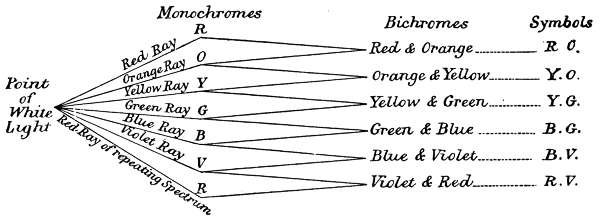
The separation of the six monochromatic sensations from a point of white light, and the formation of binary sensations by the combination of adjacent colours, is graphically illustrated in the above diagram.
In order to make the qualitative symbols quantitative it is only necessary to add the numerical unit value to each factor as found by direct experiment.